Difficulty: 2/5 – Beginner
An Asian carpenter ant of the subgenus Tanaemyrmex, described in 1989 and almost unknown in the European hobby. Polymorphic, with amber workers with a striped gaster, and large-headed major workers that appear early. Sold as an established colony: a queen with 10–20 workers and brood, monogynous. A nest at 24–28 °C with heat on one side, humidity in the tubes and the rest of the nest dry, and a QBIK ONE from the Alpha range with medium galleries to start. Nectar in a feeder and plenty of varied protein. No compulsory diapause: if you like, a mild rest of 4–8 weeks at 15–20 °C. Moving by tipping and a mineral oil barrier. Calm, but it bites hard: always use tools.
Camponotus pseudoirritans Wu & Wang, 1989 is a carpenter ant from southern China whose name records its resemblance to another species: it is the “false irritans”. Two Chinese myrmecologists described it from workers and major workers, and it has hardly been studied since. Its description and the keys to identify it are published in Chinese and cannot be consulted online. In the European hobby it is a rarity.
Because so little is known about it, in this care sheet we carefully separate what is documented about the species, what is known about its relatives and the genus Camponotus, what the shops that sell it say and what we recommend at Antomas. And there are things to tell: a cousin that travelled in Alfred Russel Wallace’s boxes, a 2026 study that pitted it against the fire ant and a curious habit: playing dead.
Biology
“False irritans”: what its name tells us
The name makes sense once you take it apart. Pseudo- comes from Greek and means “false”, and irritans is a Latin participle: “the one that irritates” or “the one that provokes”. Pseudoirritans is therefore “the false irritans”. A name like this shows that its authors saw it as very similar to Camponotus irritans, a species described more than a century earlier, but distinct from it.
Wu and Wang described it in 1989, within a study of the Camponotus of China published in Chinese in the journal Forest Research. The reference specimen, the holotype, is a worker collected in 1983 in Guangdong Province, and the series was completed with 34 workers from Hunan, Yunnan, Sichuan and Fujian. The specimens are kept in Beijing, in the collection of the Chinese Academy of Forestry. The description covers the worker and the “soldier”, as the major worker is called in that literature. The queen and the male have never been described.
A cousin that travelled with Wallace
The “real” irritans has an explorer’s story. The British entomologist Frederick Smith described it in 1857 as Formica irritans, from workers from Malacca, on the Malay Peninsula, and from Sarawak, in Borneo. They had been collected by Alfred Russel Wallace, the naturalist who arrived at the idea of natural selection at the same time as Darwin, and Smith published them in his catalogue of the Hymenoptera that Wallace had gathered on those travels.
C. irritans is far more widespread than its “false” relative: it ranges from India and Sri Lanka to southern China and Taiwan, and south as far as Sumatra, Java and New Guinea. For a long time it was treated as a subspecies of Camponotus maculatus, and today it includes a dozen subspecies, one of them, hongkongensis, from southern China. With so many similar forms in the same region, it is no surprise that they get confused: at least one European shop currently sells C. pseudoirritans under the name C. irritans.
How do you tell it apart? A species described in Chinese
This is where it gets difficult. The features that separate C. pseudoirritans from C. irritans are in the original description and in the identification keys to the ants of China, all of them in Chinese: those by Wang and Wu from 1994, Wu and Wang from 1995, Zhou from 2001, on the ants of Guangxi, and Zhang and Zheng from 2002. None can be consulted online, and we have not found any genetic study that includes the species. Nor is there an accessible key that separates it from Camponotus nicobarensis, another carpenter ant from southern China that appears alongside it in studies.
The name, on the other hand, is well established: the world catalogue of ants and the checklist of the ants of China (Guénard & Dunn, 2012) list it as a valid species, with no synonyms or subspecies. What we keep at Antomas is the ant that circulates in the hobby under that name, and we tell you what we know about it without embellishment.
A Tanaemyrmex, like barbaricus and ocreatus
In 1997, the myrmecologist Alexander Radchenko placed it in the subgenus Tanaemyrmex, the same one in which Carlo Emery had placed C. irritans in 1925. Other carpenter ants in our shop have also been placed in that subgenus, such as the Iberian Camponotus barbaricus and the North American Camponotus ocreatus.
That said, the subgenera of Camponotus are a provisional classification. The major 2016 revision of the formicines acknowledges that many are artificial groupings, awaiting someone to revise a genus of more than a thousand species. Sharing a subgenus does not guarantee a close relationship.
A carpenter ant from southern China
Everything known about its distribution comes from China. In addition to the provinces of the type series, Guangdong, Hunan, Yunnan, Sichuan and Fujian, it has been recorded in Guangxi and Jiangxi, and it appears in the updated checklist of the ants of Yunnan published in 2020. In recent years, photographs by naturalists in southern China identified as this species have been added, and GBIF, the global biodiversity database, collects them. What does not exist is a scientific description of its habitat or its nests.
Its climate. It is a region with a monsoonal subtropical climate. In the lowlands of the south of its range, summer is long, hot and very humid, with means of about 29 °C in July and nights that do not drop below 26–27 °C. Winter is cool and dry: the January mean is around 13–14 °C inland and 16–17 °C on the coast, with mean minimums of about 10 °C and the occasional rare frost inland. Further north and in the inland provinces, winter is colder. That cool winter, without real cold in the lowlands, explains why it does not need a diapause and why it copes well with a mild rest (see “Winter rest: optional and mild”).
The ant that plays dead
In 2026, a team from the Guangdong Academy of Sciences and South China Agricultural University pitted the red imported fire ant, Solenopsis invicta, one of the most damaging invasive species in the world, against eight ants from southern China. Among them were C. pseudoirritans, C. nicobarensis, the weaver ant Oecophylla smaragdina and the golden weaver Polyrhachis dives. It is a preprint, a paper released before peer review, so it should be taken with caution. But it is the most complete thing published on the species’ behaviour:
- Calm until touched. In one-on-one fights it was among those that attacked least: about 3.7 attacks per fight, compared with 6.4 for C. nicobarensis. It stayed still and did not react until the fire ant touched it, and the authors note that it has the habit of playing dead.
- But it bites hard. In its encounters, fire ants turned up with broken legs or gasters, which the authors attribute to its powerful mandibles.
- Effective on equal terms. In group fights with the same number of workers of each species, C. pseudoirritans and C. nicobarensis caused the highest mortality among the fire ants.
- Defensive chemistry. Among the compounds of its venom gland they detected nonadecane, a hydrocarbon that, tested in pure form, proved highly toxic to the fire ant on contact. And when they sealed its acidopore, the outlet of that gland, with nail varnish, more C. pseudoirritans workers died in the fights.
The authors did not test the habit of playing dead: they suggest it as a way of avoiding the fire ant’s large workers. At home you will see it as a calm ant that does not go looking for trouble, but should not be underestimated (see “Handling and safety”).
Formic acid: weapon, antidote and disinfectant
Like all formicines, it has no sting. Its weapon is formic acid, which it produces in the venom gland and expels through the acidopore, a small nozzle at the tip of the gaster. Two studies on other species show that it uses it for much more than defence:
- An antidote to the fire ant. In 2015, a team from the University of Texas found that when a fire ant applies its venom to them, formicines smear themselves with their own acid, which neutralises the venom’s alkaloids and improves their survival. They saw it in species from all the major groups of the subfamily.
- A pantry disinfectant. In 2020, Simon Tragust and his colleagues saw that formicines swallow their own acid: they bend over, bring the mouth to the acidopore and take a few drops. In this way they keep the crop, the “social stomach” where they store the food they later share, very acidic, and they hold back the microbes that come in with the food.
Neither study was done with C. pseudoirritans, but these are traits of the whole subfamily. When you see a worker bent over itself, with its mouth at the tip of the gaster, you will know what it is doing.
Blochmannia, the partner that lets it live on sugar
All Camponotus carry a bacterium inside them, Blochmannia, which lives in special cells of the gut and passes from the queen to her eggs. In 2007, Heike Feldhaar and her colleagues showed with Camponotus floridanus that the bacterium improves the ant’s diet: it supplies essential amino acids, and colonies whose bacteria were reduced with antibiotics reared less brood when the food was poor in them. It is one of the reasons why these ants thrive on diets so rich in sugary liquids.
Where did the partner come from? A 2009 study proposes that the ancestors of these ants acquired it while tending sap-sucking insects such as aphids and scale insects. Even so, the bacterium is no substitute for protein: the larvae need insects to grow (see “Feeding”).
Workers of different sizes
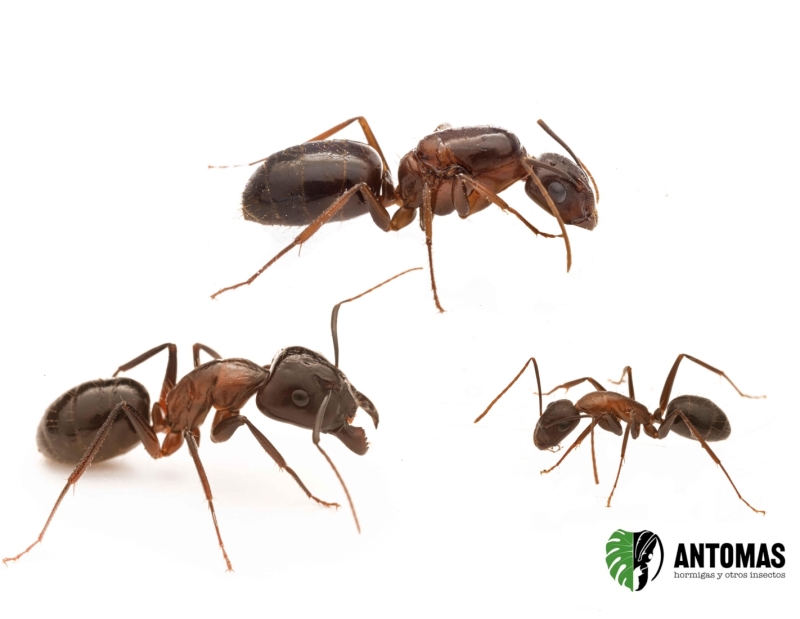
Like almost all Camponotus, it is polymorphic: the original description already distinguishes the worker from the “soldier”. In 1953, Edward O. Wilson explained that this polymorphism is above all a matter of growth: as worker size increases, the head grows faster than the rest of the body, which is why major workers have such outsized heads.
And size is decided, in part, mouth to mouth. In 2016, Adria LeBoeuf and her colleagues analysed the liquid that C. floridanus workers pass to each other mouth to mouth, trophallaxis, and found proteins, small RNAs and juvenile hormone. When they added juvenile hormone to the food of the nurse workers, their larvae were twice as likely to complete metamorphosis and became larger workers. When you see two workers with their mouths together, they are not just sharing food.
Size and morphology
A polymorphic Camponotus without a sting, with workers of several sizes. As the original description is not accessible, here we combine the little that has been published about it with the traits of the whole genus.
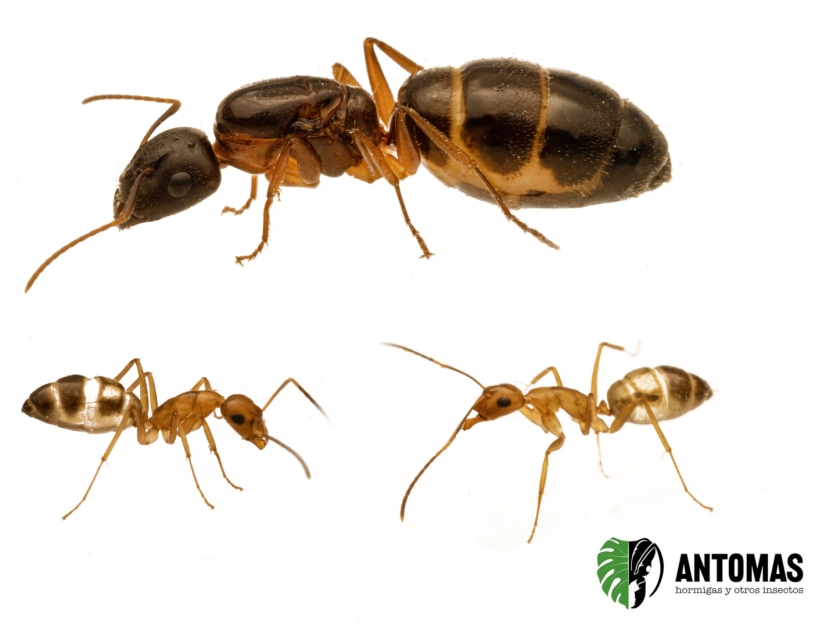
- Castes described. The worker and the major worker, the “soldier” of the Chinese description. The queen and the male have not been described.
- Major workers. A head proportionally larger than that of the minors, and strong mandibles: in the 2026 study, their bites broke the legs and gasters of fire ants.
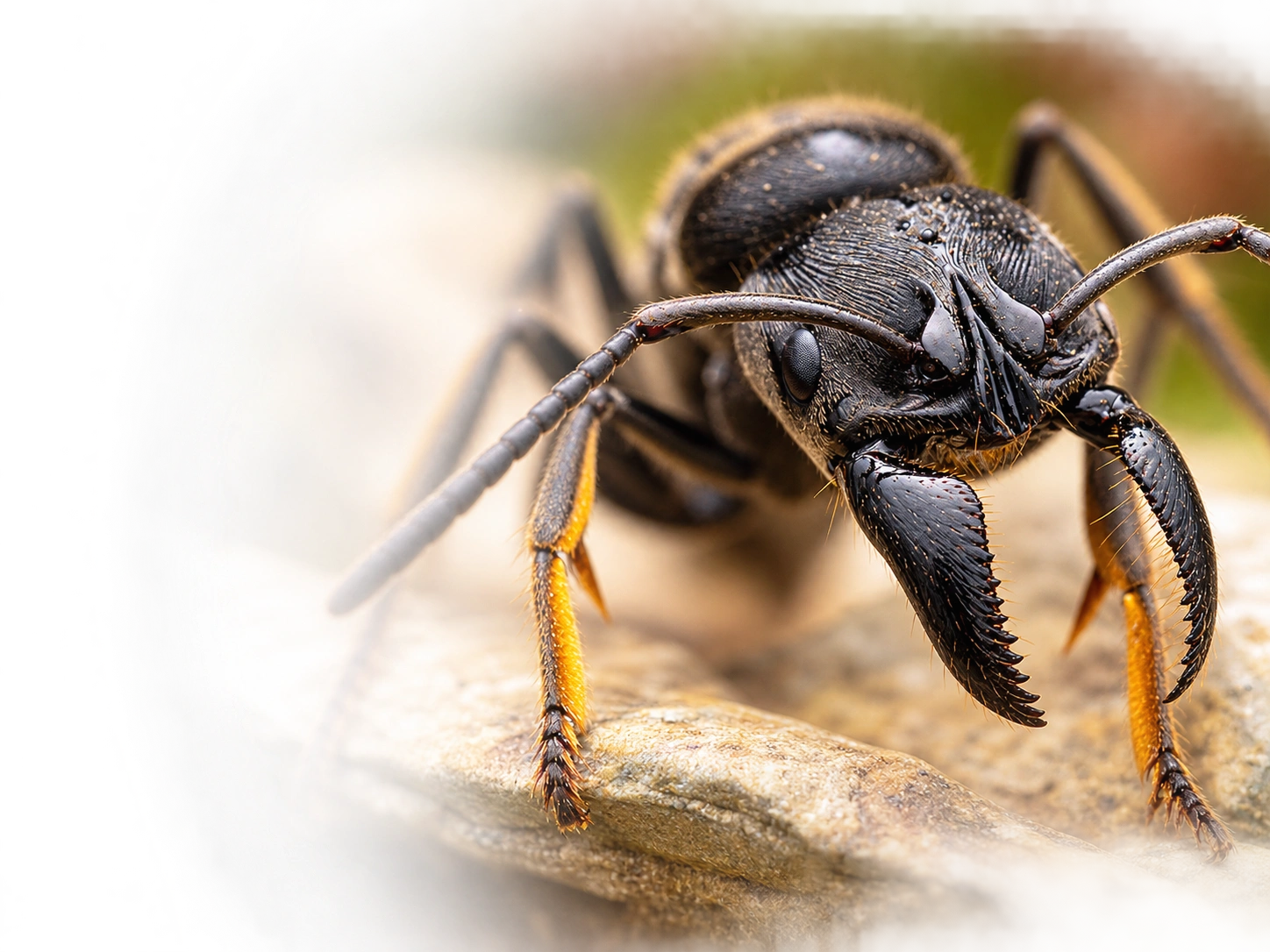
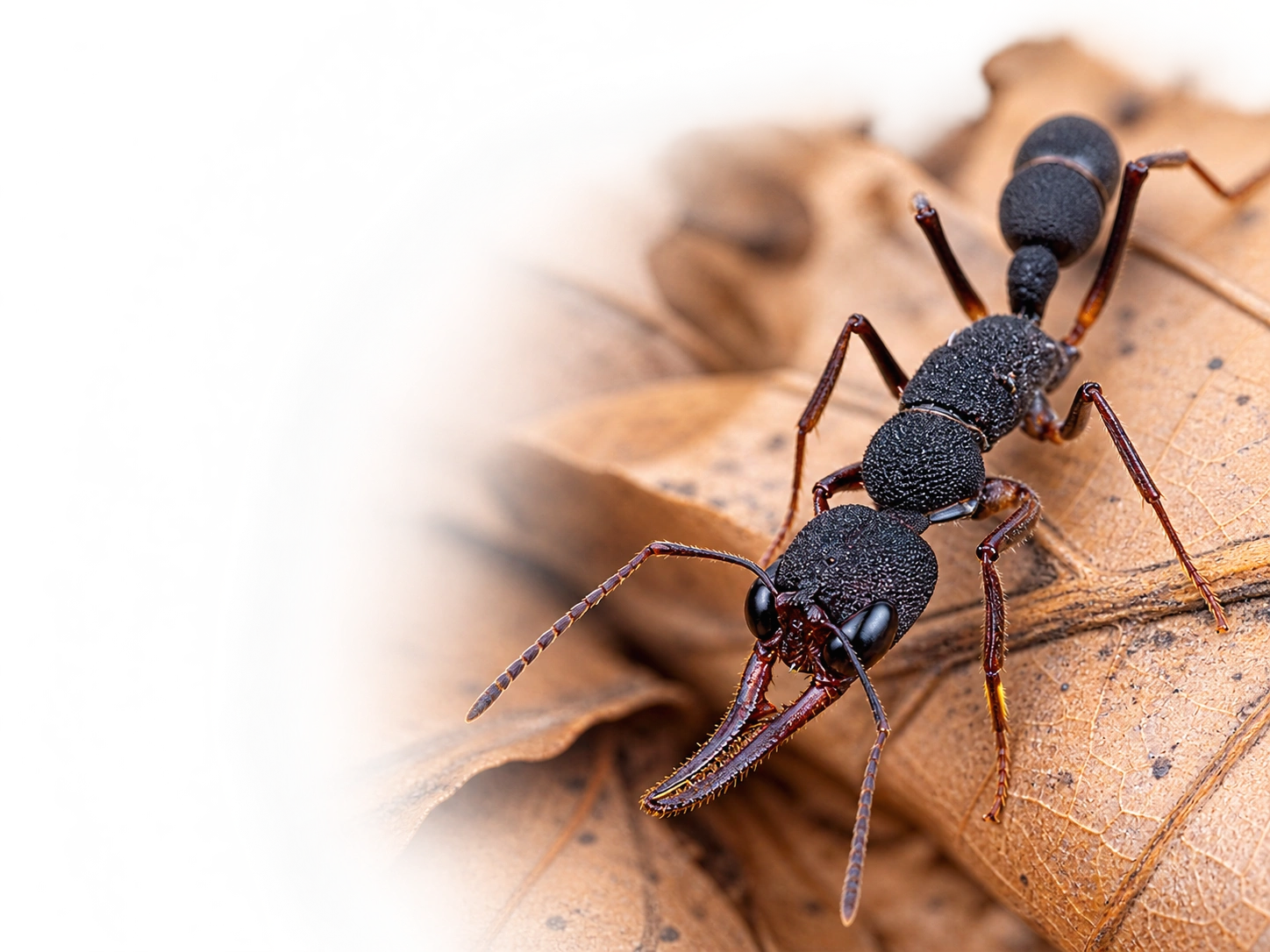
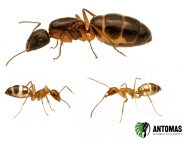
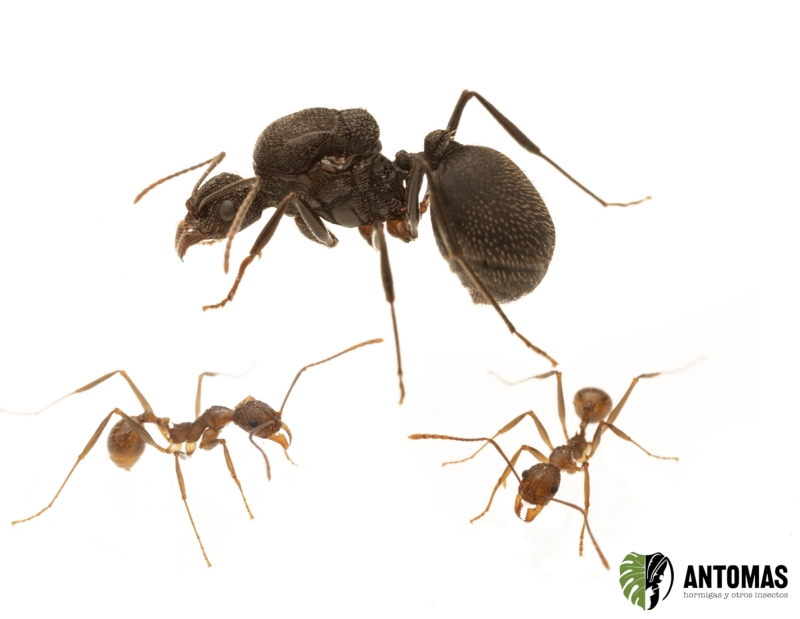
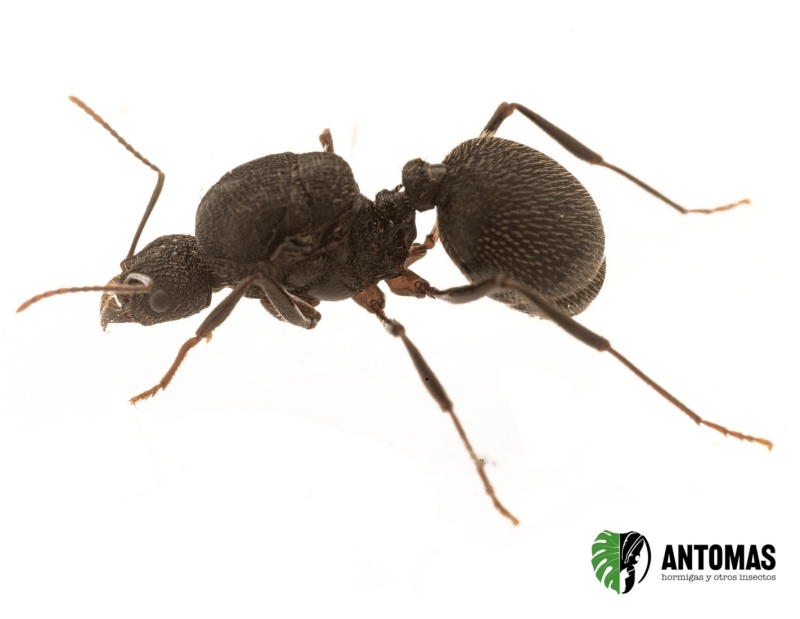
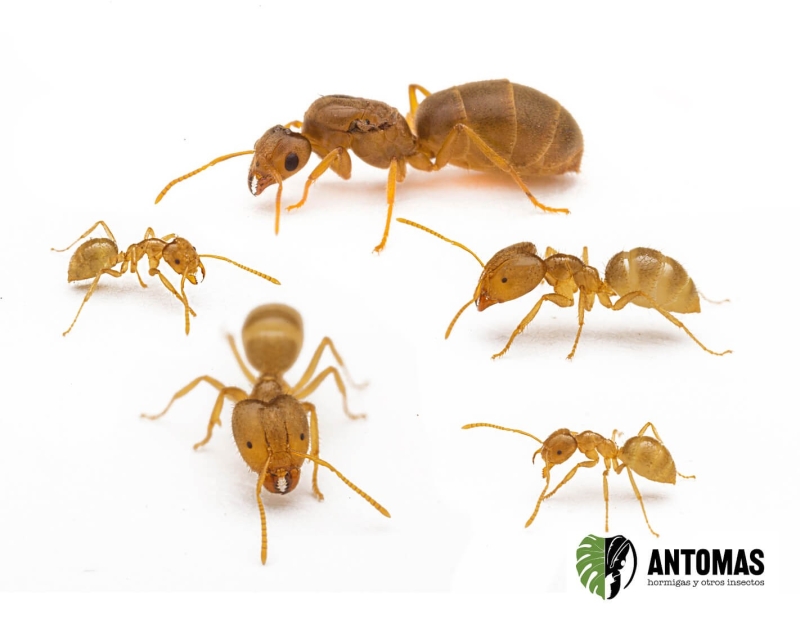
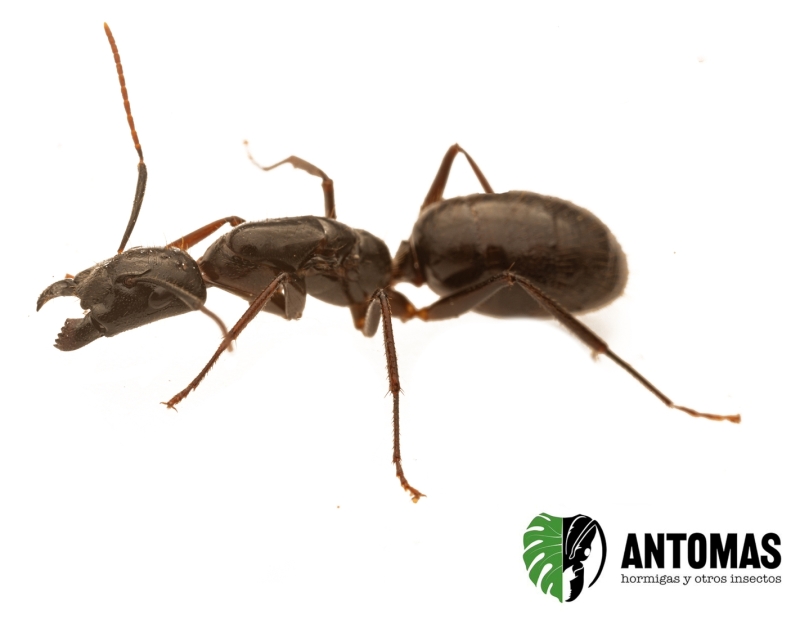
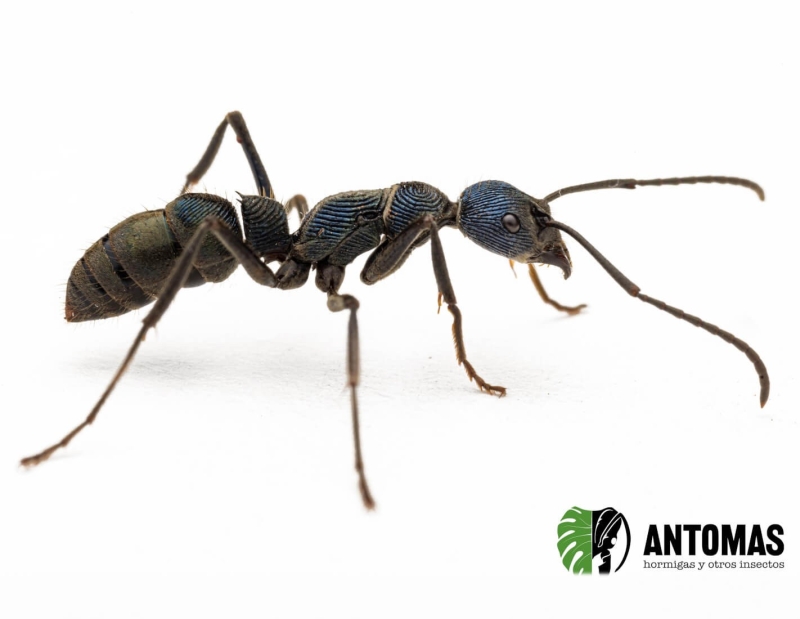
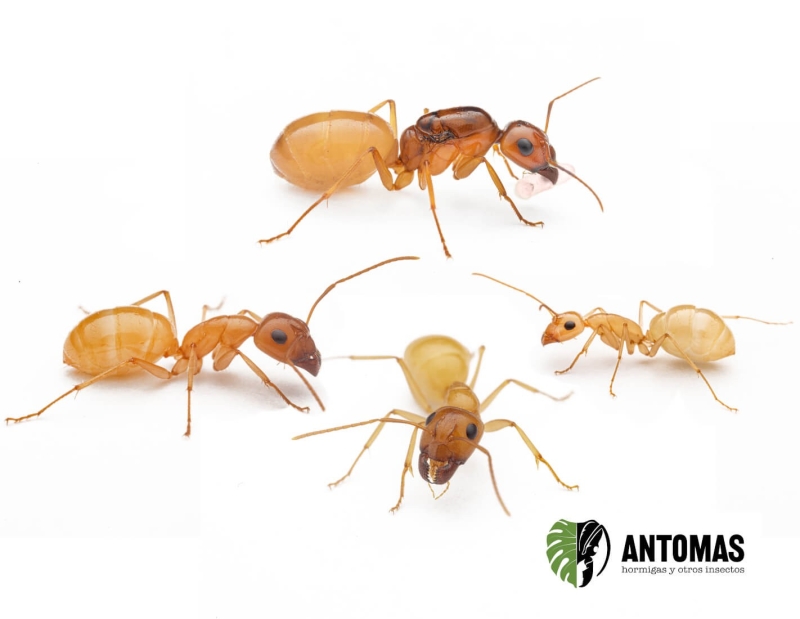
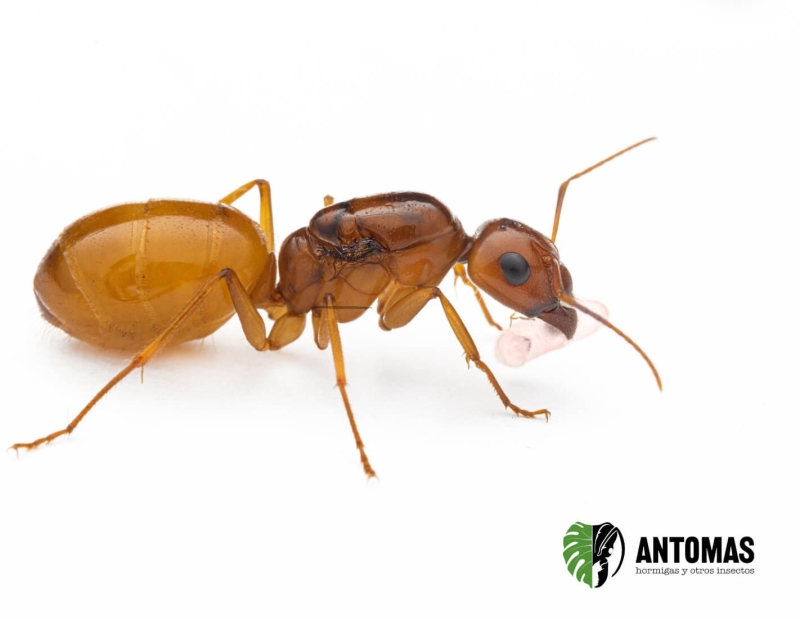
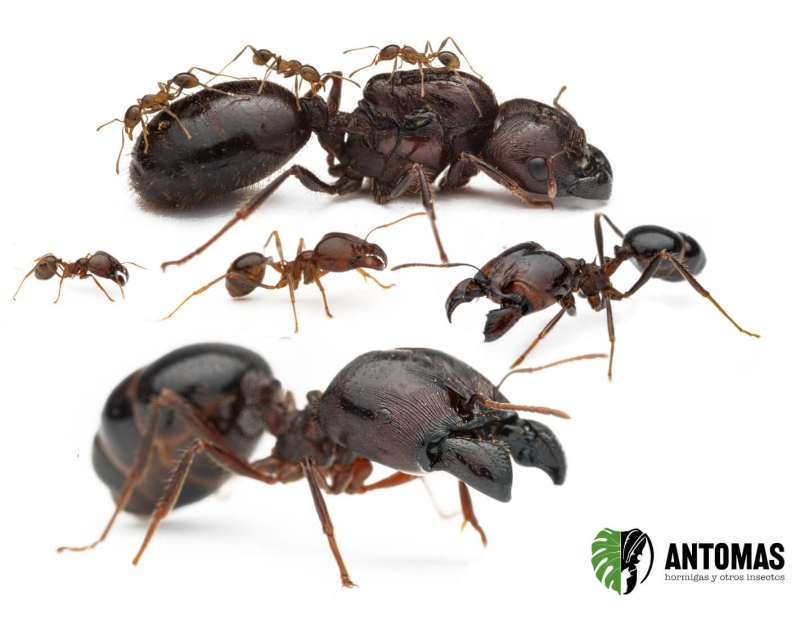
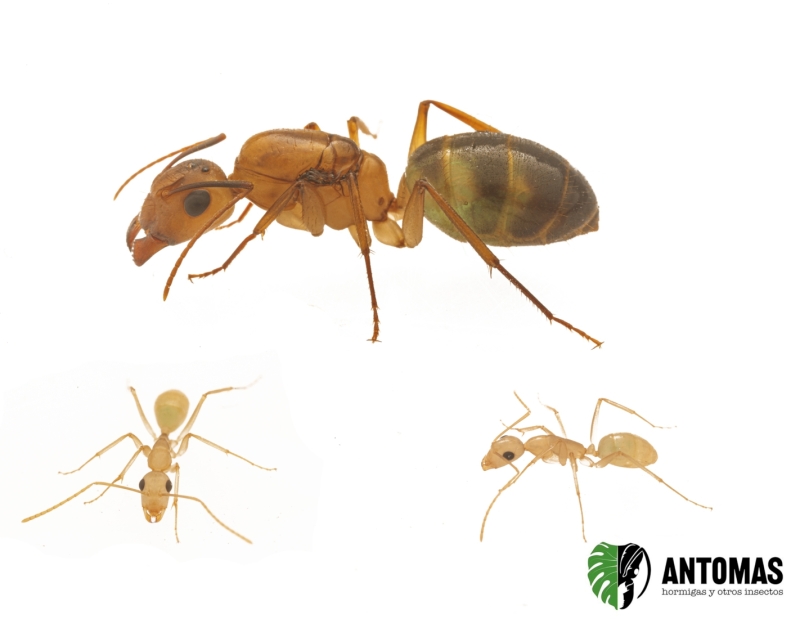
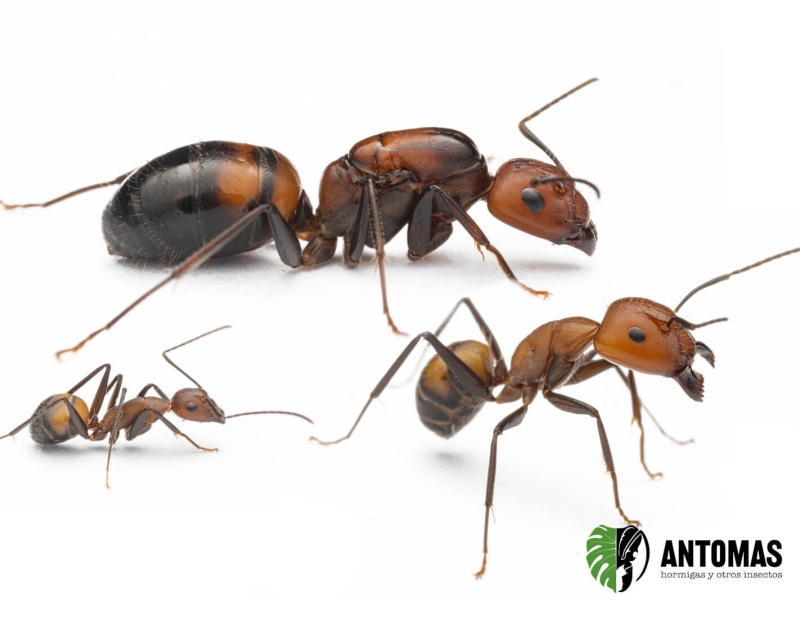
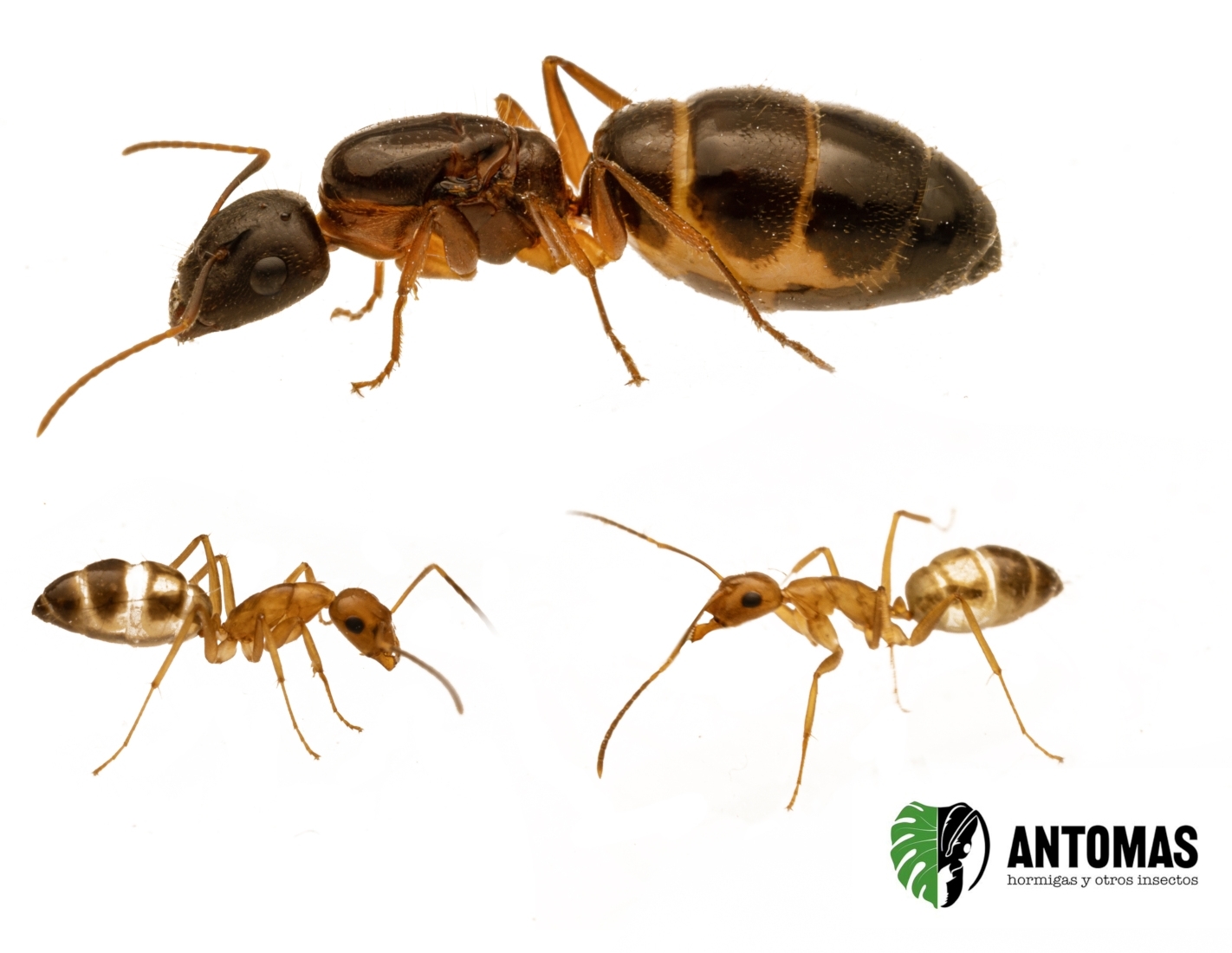
- Colouration. There is no accessible scientific description of its colour. In the photos of our colonies, the queen has a blackish, shiny head, a dark brown thorax with reddish tones on the sides, amber legs and antennae, and a dark brown gaster with pale bands between the segments. The workers are orange-amber, long-legged, with a striped gaster: brown bands alternating with pale ones, from cream to whitish.
- Profile. As in all Camponotus, the back of the thorax forms an arch when seen from the side: hence the name of the genus, from the Greek kampé, “curve”, and nôton, “back”.
- Gaster. It ends in the acidopore, through which it expels formic acid. It has no sting.
- Development. The larvae spin a silk cocoon to pupate, as in all Camponotus.
Approximate sizes
- Queen: about 14–16 mm (according to shops)
- Minor workers: about 5–8 mm (according to shops)
- Major workers: about 9–14 mm (according to shops)
- Male: not described
There are no accessible scientific measurements: the 1989 description cannot be consulted and the queen has never been described. The figures we give are those published by the shops that sell it, which do not always agree with each other, so take them as a guide.
Care in captivity
Difficulty: 2/5 – Beginner
At Antomas we consider it a species to start with. It arrives as an established colony, with a queen, 10–20 workers and brood, so you skip the most delicate stage: founding. It eats everything, is happy with a rather dry nest, does not need a diapause and, day to day, it is calm.
Why not 1/5? For three details:
- It needs warmth. The shops that sell it agree on a nest at 24–28 °C, and in a European home, outside summer, that calls for a heat source with a thermostat.
- It grows and needs room. The major workers appear early, within a few months, and from then on the colony needs more protein and timely expansions (see “Recommended formicaria”).
- It bites hard. It is calm, but when it bites it means it: always use tools (see “Handling and safety”).
And it is well worth it. It is an Asian carpenter ant almost unknown in Europe, with workers of several sizes and a serene temperament that is a pleasure to watch. What is more, there is very little published experience with it: if you take it on, you will be among the first to keep it. And if you are looking for another Asian Camponotus to start with, C. nicobarensis, its neighbour in southern China, is one of the most rewarding.
Recommended parameters
- Nest temperature: 24–28 °C during the active season, with gentle heat on one side and always with a thermostat, so that the colony can choose where to settle.
- Why: it is the range on which the shops that sell it agree, and it fits the long, hot summer of its range.
- Foraging area: at room temperature, or a little warmer at one end.
- Humidity: in the tubes; the rest of the nest dry (see “Humidity: in the tubes, the rest dry”).
- Water: always available, in a test tube with water and cotton wool in the foraging area.
- Light: a dark nest and a lit foraging area, with a normal day and night cycle.
- Winter: no compulsory diapause; if you like, a mild rest of 4–8 weeks at 15–20 °C (see “Winter rest: optional and mild”).
Humidity: in the tubes, the rest dry
In its climate, summer is very humid and winter is dry. At home, like almost all Camponotus, it needs humidity while the colony is small, and a colony of 10–20 workers still is:
- In a Qbik Alpha, the nest is on the dry side and the humidity is in the tubes. Always keep them filled with water.
- The colony chooses: it usually keeps the small brood near the humidity and spreads out in the dry part with the rest.
- Never wet: too much water brings condensation, mould and mites. If you see droplets on the walls, ventilate and wait a few days.
- Dry does not mean without water: the water tube in the foraging area must never be missing.
Recommended formicaria
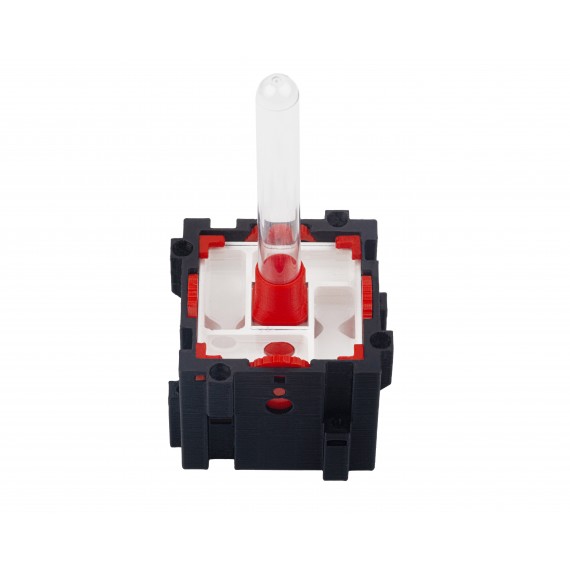
At Antomas we recommend Anthouse’s Qbik Alpha range: modular formicaria with a nest on the dry side and the humidity in the tubes, which expand as the colony grows. The colony you receive can go straight into a QBIK ONE with medium galleries:
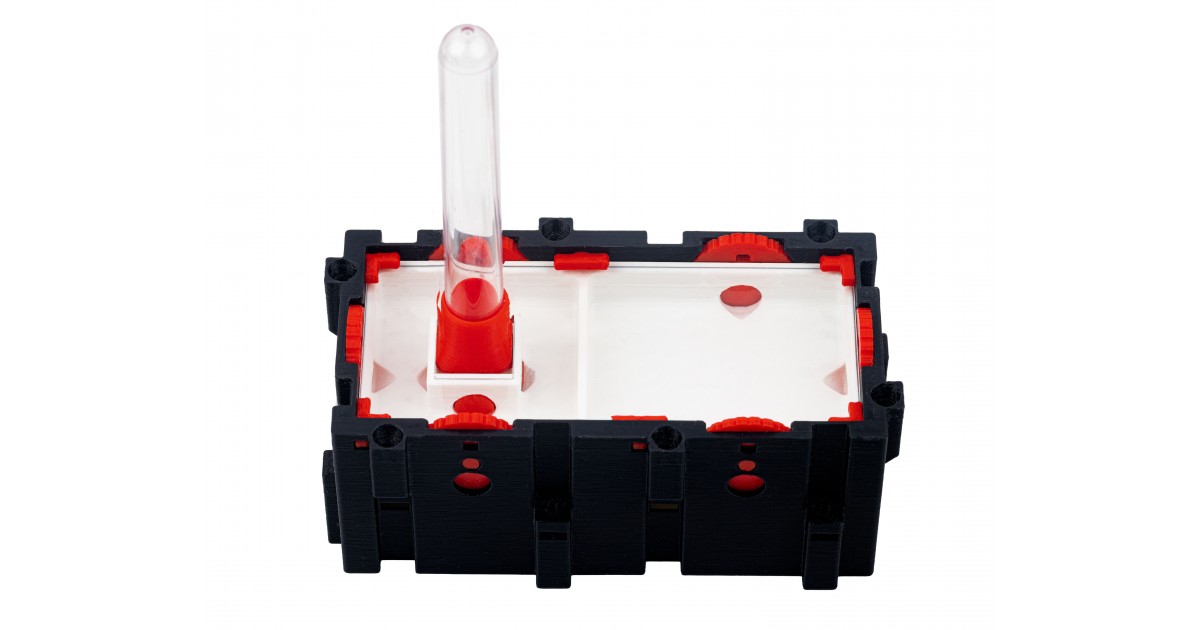
To expand, the QBIK DUO and, when the colony grows and the major workers need them, larger galleries and the bigger formats of the same range:
Expand when you see workers standing idle in the foraging area because they do not fit inside, which comes early with this species. But do not jump ahead: in a huge nest for a small colony, the spare chambers end up as rubbish dumps. Complete the set-up like this:
- A foraging area with a little sand, a flat stone and a twig, with nothing reaching the barrier.
- Water in a test tube with cotton wool, and a feeder for sugary liquids, never on cotton wool.
- Gentle heat on one side of the nest, with a thermostat and away from the feeder.
- A mineral oil barrier and a well-fitting lid (see “Escapes and barriers”).
Arrival and moving by tipping
Your colony arrives in a test tube, with its water reserve behind the cotton wool. Let it rest for a day or two in a quiet, dark place at 24–26 °C, and check that the tube still has water. With 10–20 workers it is already big enough to move into the formicarium. At Antomas we do it by tipping:
- Set up the formicarium first, with the humidity tubes full, the water in place and the oil barrier already applied.
- Work over a tray, with a soft brush or soft forceps, never with your hands.
- Open the tube in the foraging area, next to the nest entrance, and gently tip out the queen, the workers and the brood, helping the stragglers along with the brush.
- Close the lid and leave the nest dark. Within a few hours they will have carried the brood inside.
To move it to a larger module later on, the same method.
One queen and a growing colony
In the wild, as in almost all Camponotus, the queen founds the colony alone and claustrally: she seals herself in and rears her first workers on her own body reserves, without going out to feed. Your colony has already passed that stage.
- A single queen. It is monogynous: in Antomas’s experience, and according to the shops that sell it, each colony has one queen. At Antomas we do not combine queens or colonies.
- Growth. There are no published counts. The shops agree that, with warmth and plenty of food, it grows well once it gets going, and they speak of colonies of several thousand workers, but these are estimates, not counts.
- The major workers. In Antomas’s experience, they appear fairly early, within a few months of having the colony. From then on, the colony needs larger galleries and more protein.
- Warmth and patience. With the nest at 24–28 °C, the brood develops much faster than at room temperature.
Feeding
Sugar in a feeder, always available. Like all Camponotus, it lives largely on sugary liquids: in the wild, nectar and honeydew from sap-sucking insects. At Antomas we recommend variety: Anthouse Blue Sugar Nectar 4–5 times a week and another nectar or sugary liquid 1–2 times a week. You can also add some protein to the nectar. Always offer it in a feeder, where the drop sits “spread out” and accessible, and never on cotton wool, which goes mouldy and spoils the liquid within a few days.
Protein: the more, the better. It is what makes the colony grow: the queen needs it to lay and the larvae need it to become workers. If you do maintenance often and remove leftovers, it is better to give too much than too little: in Antomas’s experience, the colony understands that it has resources and grows faster and in greater numbers. If you will not be able to clean often, it is better not to overfeed, because leftover food rots and brings mould and mites. Change the type of insect from one week to the next, so that they do not always eat the same thing:
Remove leftovers within a day at most and buy insects from a reliable supplier: those treated with insecticides can wipe out the colony. There is no need to give it seeds.
Water: always available, in the test tube with cotton wool in the foraging area, separate from the sugar.
Winter rest: optional and mild
It does not need a diapause. There are no studies of its annual cycle, the shops that sell it do not call for one and, in Antomas’s experience, it is kept just like its neighbour C. nicobarensis: active all year round at 24–28 °C. Its climate does have a cool, dry winter, with means of 13–17 °C in the lowlands of the south of its range, so it copes well with a mild rest if you want to give it one:
- How long: 4–8 weeks, in midwinter.
- Temperature: 15–20 °C. There is no need to go lower.
- Gradual start and end: remove the heat and let the temperature drop little by little over a week; when you finish, raise it the same way back to 24–28 °C.
- During the rest: water always, a little nectar and less protein. Disturb the colony as little as possible.
- Where: an unheated room is usually enough. Check the temperature with a thermometer next to the nest.
During the rest it is normal for the queen to lay less and for the colony to move little. If you would rather not do it, keep it at 24–28 °C all year round: it will keep growing.
Behaviour and observation
Serene. Everything points to a calm ant that does not go looking for trouble: in the 2026 study it was among those that attacked least. Do not be surprised if, when disturbed, a worker freezes: that is what they did in that study before reacting. But do not be overconfident: when it decides to defend itself, it bites hard and can spray formic acid.
Rhythm. There are no published data on whether it forages more by day or by night. Many Camponotus become active at dusk: notice the times when your colony comes out most and use them to watch it and to feed it.
Trophallaxis. Watch how they pass food mouth to mouth: foragers return with their crop full of nectar or prey juice and share it among their nestmates and the larvae.
Observe without fear. At Antomas we believe that ants are there to be enjoyed, observed and learned from, not kept hidden away. All it takes is a dark nest and a lit foraging area, and observing them gently, intervening as little as possible. They get used to your presence.
Warning signs:
- A colony that does not grow in the middle of the season: it is almost always short of warmth or protein.
- Larvae that do not grow outside the winter rest: not enough protein.
- Condensation on the walls, mould or mites: too much humidity or forgotten leftovers.
- Lots of workers idle in the foraging area: time to expand.
Escapes and barriers
Like almost all Camponotus, it climbs glass and plastic well. At Antomas we use mineral oil:
- A thin, continuous band of mineral oil along the top of the walls of the foraging area. Renew it when it collects dust or debris.
- A well-fitting lid, as a second line of defence.
- No gaps in connections, stoppers or tubes.
- Nothing that can act as a bridge to the barrier: no twigs or stones leaning nearby.
Handling and safety
It does not sting: it has no sting. But it bites, and hard, and it can spray formic acid, which stings on sensitive skin or in a small cut. Nothing serious if you work calmly:
- Always use tools: a soft brush, soft forceps and, for transfers, tubes and adapters. Never your hands.
- Open the formicarium only as much as necessary, work slowly over a tray and close it when you finish.
- Do not combine different queens or colonies, and do not keep it with other species.
- With small children at home, let them enjoy watching it, with the formicarium closed.
It is an exotic species: it must never be released.
What not to do
- Keep it at room temperature all year round, with no heat in the nest.
- Heat the whole nest from below without leaving it a cooler area.
- Soak the whole nest or let the humidity tubes dry out while the colony is small.
- Give it a cold diapause, as for a European species, or change the temperature suddenly when starting or ending the rest.
- Put a small colony into a huge formicarium.
- Put sugary liquids on cotton wool or let them run out.
- Always give it the same insect or leave leftovers for more than a day.
- Combine different queens or colonies.
- Handle it with your hands or neglect the barrier.
Scientific sources
Very little has been published on Camponotus pseudoirritans, and its description and the keys to identify it are in Chinese. This care sheet is based on that description and on the ant catalogues (AntCat, AntWiki and GBIF), on the 2026 study on the fire ant, on the scientific literature on the genus Camponotus and the formicines, on climate data for its range, on what the shops that sell it publish and on the experience of Antomas. Main references:
- Smith, F. (1857). Catalogue of the hymenopterous insects collected at Sarawak, Borneo; Mount Ophir, Malacca; and at Singapore, by A. R. Wallace. Journal of the Proceedings of the Linnean Society of London, Zoology 2: 42–88. doi:10.1111/j.1096-3642.1857.tb01759.x
- Wilson, E. O. (1953). The origin and evolution of polymorphism in ants. The Quarterly Review of Biology 28: 136–156. doi:10.1086/399512
- Wang, C., Xiao, G. & Wu, J. (1989). Taxonomic studies on the genus Camponotus Mayr in China (Hymenoptera, Formicidae) [concl.]. Forest Research 2: 321–328. In Chinese; original description of C. pseudoirritans (no DOI).
- Feldhaar, H., Straka, J., Krischke, M., Berthold, K., Stoll, S., Mueller, M. J. & Gross, R. (2007). Nutritional upgrading for omnivorous carpenter ants by the endosymbiont Blochmannia. BMC Biology 5: 48. doi:10.1186/1741-7007-5-48
- Wernegreen, J. J., Kauppinen, S. N., Brady, S. G. & Ward, P. S. (2009). One nutritional symbiosis begat another: phylogenetic evidence that the ant tribe Camponotini acquired Blochmannia by tending sap-feeding insects. BMC Evolutionary Biology 9: 292. doi:10.1186/1471-2148-9-292
- Guénard, B. & Dunn, R. R. (2012). A checklist of the ants of China. Zootaxa 3558: 1–77. doi:10.11646/zootaxa.3558.1.1
- LeBrun, E. G., Diebold, P. J., Orr, M. R. & Gilbert, L. E. (2015). Widespread chemical detoxification of alkaloid venom by formicine ants. Journal of Chemical Ecology 41: 884–895. doi:10.1007/s10886-015-0625-3
- LeBoeuf, A. C. et al. (2016). Oral transfer of chemical cues, growth proteins and hormones in social insects. eLife 5: e20375. doi:10.7554/eLife.20375
- Ward, P. S., Blaimer, B. B. & Fisher, B. L. (2016). A revised phylogenetic classification of the ant subfamily Formicinae (Hymenoptera: Formicidae), with resurrection of the genera Colobopsis and Dinomyrmex. Zootaxa 4072: 343–357. doi:10.11646/zootaxa.4072.3.4
- Liu, C., Fischer, G., Hita Garcia, F., Yamane, S., Liu, Q., Peng, Y. Q., Economo, E. P., Guénard, B. & Pierce, N. E. (2020). Ants of the Hengduan Mountains: a new altitudinal survey and updated checklist for Yunnan Province highlight an understudied insect biodiversity hotspot. ZooKeys 978: 1–171. doi:10.3897/zookeys.978.55767
- Tragust, S. et al. (2020). Formicine ants swallow their highly acidic poison for gut microbial selection and control. eLife 9: e60287. doi:10.7554/eLife.60287
- Zhang, W., Jiang, L., Cheng, M., Xu, Y. & Li, J. (2026). Interspecific competition between Solenopsis invicta Buren and eight other ant species. Preprint, Research Square (not peer-reviewed). doi:10.21203/rs.3.rs-9183057/v1