This website uses its own and third-party cookies to improve our services and show you advertising related to your preferences by analyzing your browsing habits. To give your consent to its use, press the Accept button.
Functional cookies are strictly necessary to provide the services of the shop, as well as for its proper functioning, so it is not possible to refuse their use. They allow the user to browse through our website and use the different options or services that exist on it.
These are cookies that collect information about the advertisements shown to users of the website. They can be anonymous, if they only collect information about the advertising spaces shown without identifying the user, or personalised, if they collect personal information about the user of the shop by a third party, for the personalisation of these advertising spaces.
Collect information about the user's browsing experience in the shop, usually anonymously, although sometimes they also allow the user to be uniquely and unequivocally identified in order to obtain reports on the user's interests in the products or services offered by the shop.
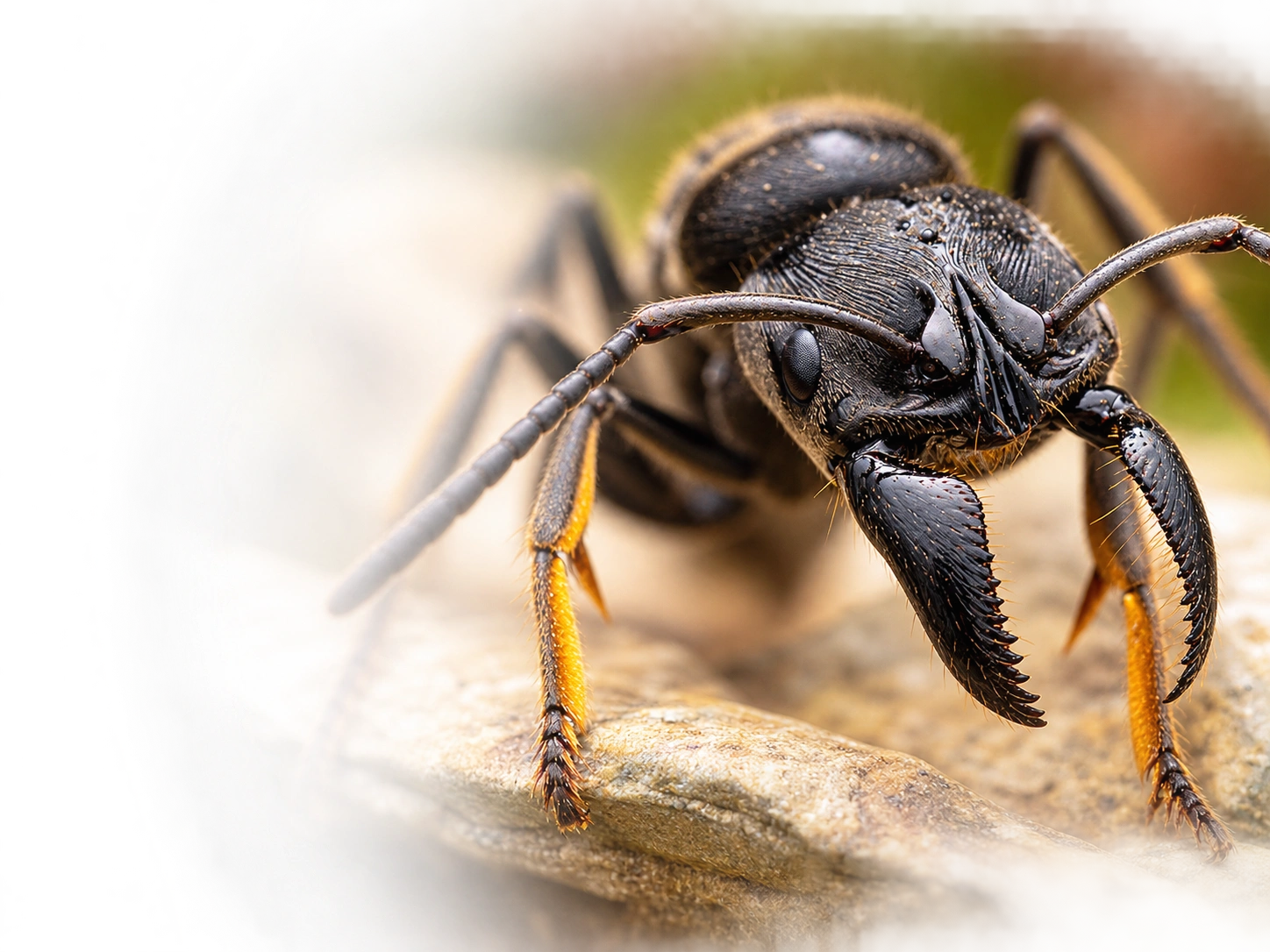
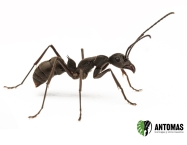
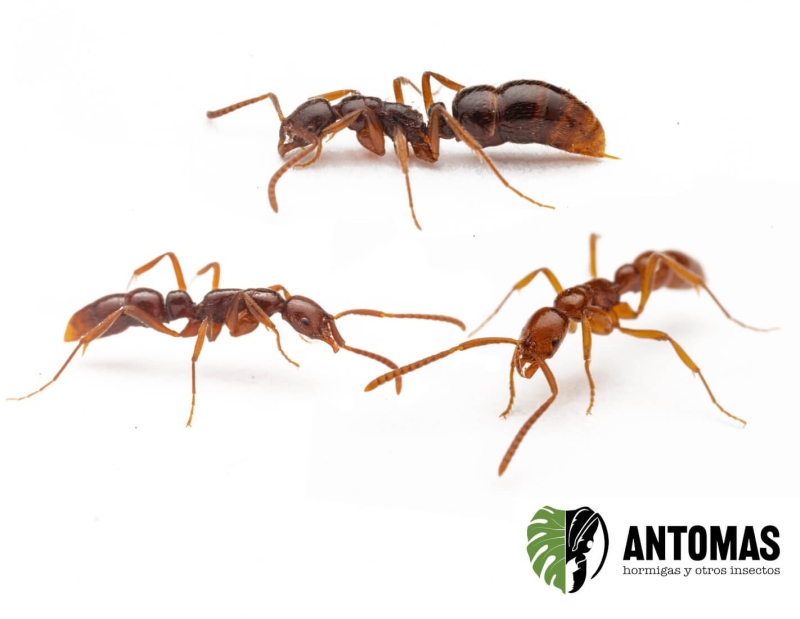
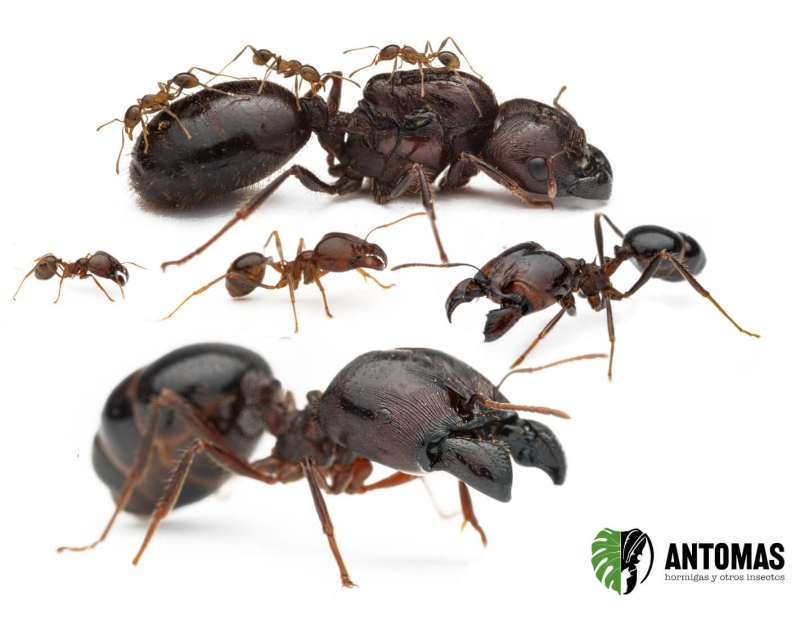
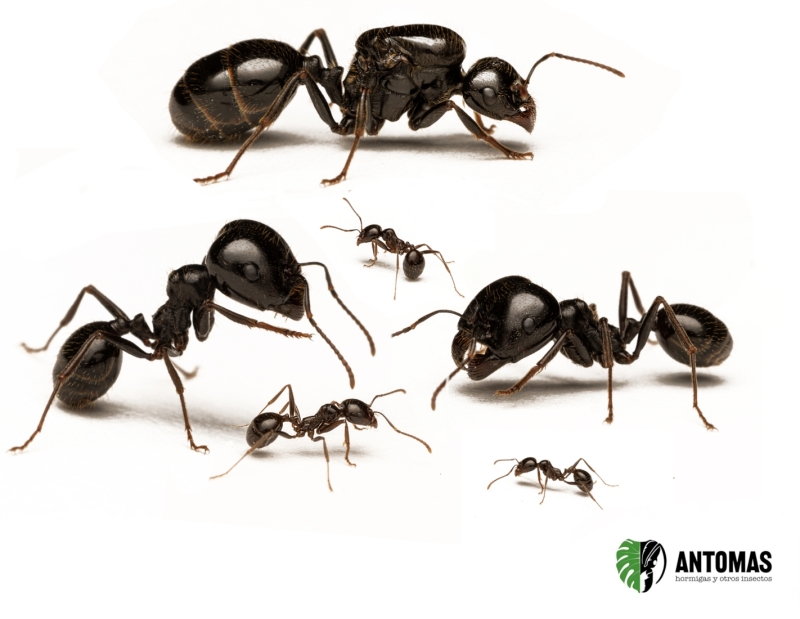
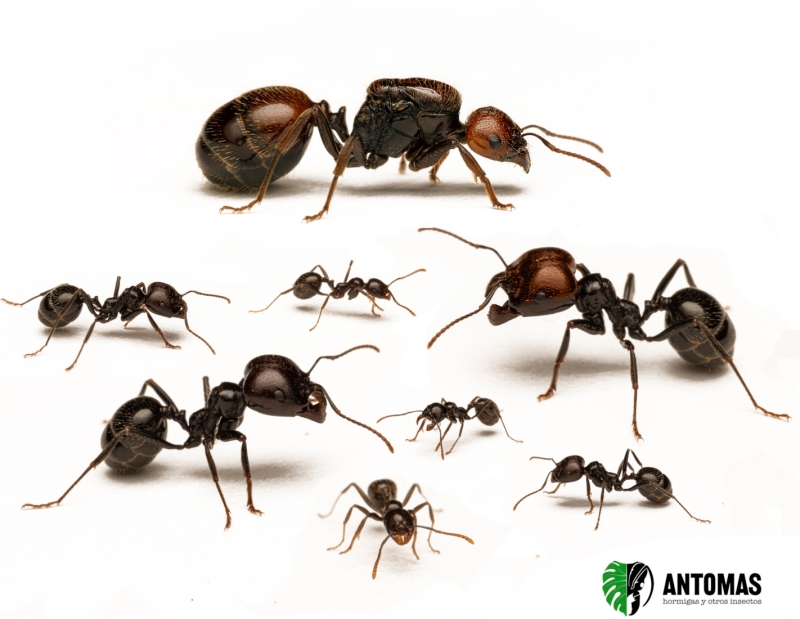
The big sister of the gladiator ants. A long-legged colossus in ridged armour, with a blade-sharp sting, that heads out almost always alone and backs down from nothing that moves. It forages less than its relatives, but every worker hunts for herself and its aggression is ferocious. There is no throne and there are no wings in its nest: it is ruled by a gamergate, a mated worker who lays the eggs and stops her sisters from mating from the moment they emerge. It needs a very humid nest, 24–28 °C and plenty of live prey. Difficulty 3/5, advanced, with a sting that commands respect. Colonies with a gamergate. Shipping throughout Europe, live arrival guaranteed.
The big sister of the Diacamma: far larger and more powerful than its relatives, a formidable solitary hunter and tremendously aggressive. It has no queen: the colony depends on a gamergate, a mated worker who lays the eggs. Very humid nest (60–80 %), 24–28 °C, active all year round.
Anyone who has kept other Diacamma notices it the moment they open the box: this is another scale altogether. Diacamma scalpratum, the giant of the gladiator ants, is to us the big sister of all the others. It has some of the largest workers in the genus, far more strength and a temperament to match. At Antomas we sum it up in three ideas: it hunts superbly on its own, it goes out to forage somewhat less than its relatives and it is tremendously aggressive. Few workers outside, but each one is worth several.
It is worth separating what is known from what we have seen right from the start. On colonies published under this name there is a single field study, short and full of fascinating detail, which we cite often. Almost everything else comes from other, better-studied Diacamma (D. australe, D. ceylonense, D. indicum and the Okinawa species), and we flag it as such. Its temperament and the comparison with its relatives are Antomas experience, not data measured in a laboratory.
Biology
What is a gamergate?
A gamergate is a mated worker that lays fertilised eggs and single-handedly sustains the colony's reproduction. The word is built from two Greek roots, gamos ("wedding") and ergátēs ("worker"), and was proposed by Christian Peeters and Ross Crozier in 1988, to make it clear that not every female that mates and lays is a queen.
The difference from a queen is a fundamental one:
No wings, before or after. A typical queen is born winged, flies, mates and sheds her wings. In Diacamma that female does not exist: Wheeler and Chapman did not find her in 1922, and nobody has found her since.
No queen's body. Her thorax is that of any worker, without the flight muscles that give a queen's its bulk, and she cannot be told apart from her nestmates by size.
She is not born one. Every female leaves the cocoon as a worker. What decides the matter happens later, in adult life, inside the nest. After that, her ovaries, her chemical signature and the activity of a handful of genes all change.
In this species we have direct evidence. When four complete colonies published as D. scalpratum were excavated, the researchers checked the workers one by one: in each colony only one still had her gemmae, and dissection confirmed that she was the mated, egg-laying one. That is why our colonies are always sold with a gamergate, never "with a queen": there is no queen here to sell.
Why it cannot found a colony like a species with queens
In many ants, a newly mated queen seals herself in alone and raises her first daughters on her reserves: she reabsorbs her huge flight muscles and pulls through with barely any exposure. A gamergate has neither those muscles nor those reserves, because her body is a worker's. She cannot make that journey alone.
Peeters and Ito explained this in their 2001 review of colony dispersal: when reproductives do not fly, as in many ponerines, the winged queen is lost or disappears and the colony multiplies by dividing into self-sufficient parts, in which the reproductive is accompanied by her workers. This is called fission. It comes at a cost: without flight, the species disperses less and colonises less well.
The consequence for the keeper is simple. A lone gamergate is not a founding colony, and there is no point looking for "queens" of this species. How many workers leave at each split has not been published. What is known is that cohesion counts for a lot: in D. indicum, in 25 of 30 trials with deliberately split colonies, the parts came back together in a single nest, and none of the 12 intact colonies divided just because a good site was available nearby.
The big sister: just how much bigger?
The field study puts it plainly: this species has some of the largest workers in the genus. The taxonomic revision by Laciny, Pal and Zettel gives a total length of 16.4–18.5 mm, and at Antomas we have stated up to 18–20 mm (details under "Approximate measurements").
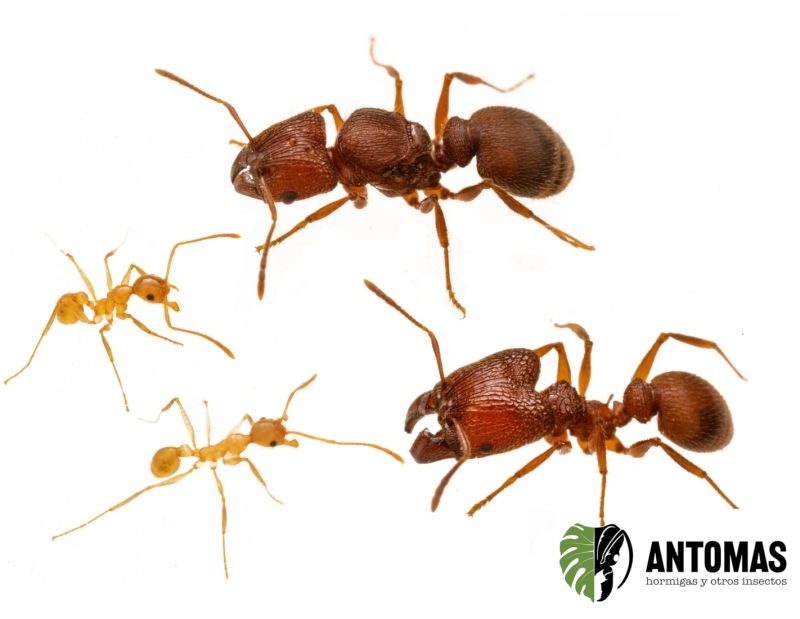
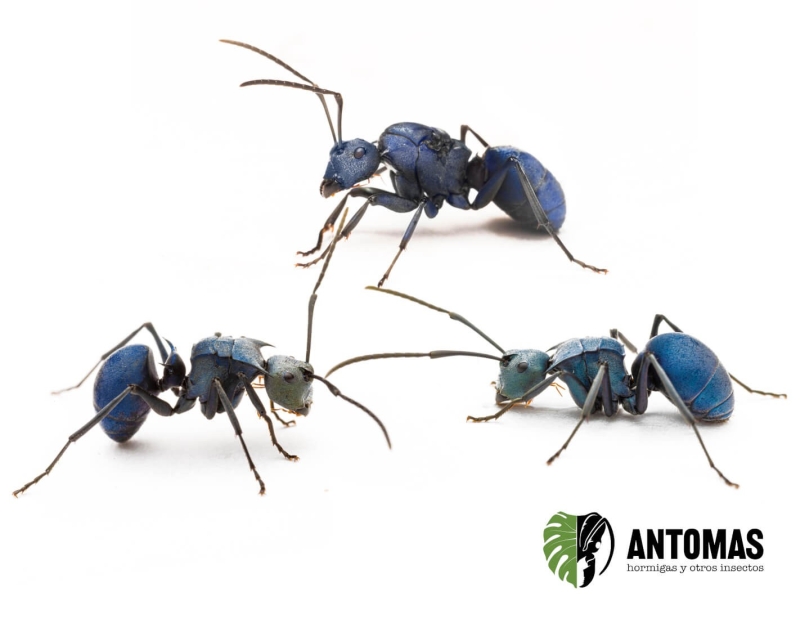
On paper, the difference from the rest of our Diacamma is striking: D. rugosum stops at 6–10 mm in our colonies, PURPLE at 11–13 mm, BLUE reaches 13–15 mm and GREEN has a published reference of 12.8–13.8 mm. It lacks the metallic colours of those three; what it offers instead is presence: very long legs, a wide stride and a strength you appreciate as soon as a worker drags off prey bigger than herself.
A sharp blade in the name
Frederick Smith described it in 1858 as Ponera scalprata, from a worker from Sikkim, in the eastern Himalayas, which is kept at the Natural History Museum in London. It was later moved to Diacamma, and a D. compressum described by Mayr in 1879 turned out to be the same ant. The epithet points to the Latin scalprum, a blade or scalpel; we have not been able to find out why Smith chose it, but watch it hunt and the name suits it well. The "gladiator" nickname comes from a similar image: at Antomas we have always seen its long, sharp sting as a sword, with which it runs through its opponents, especially smaller ants.
Sources place it in the hills of northern India, Sikkim and Assam, in Bangladesh, Pakistan and Myanmar, and it has been published under this name as far as Southeast Asia. It also gives its name to a small group of very similar species, the scalpratum group, which also includes D. violaceum and D. longitudinale. D. violaceum was described in 1900 as a mere variety of it and is now a separate species.
Telling them apart is specialist work: they look at the pattern on the petiole and the length of the antennal scapes, and the authors of the field study point out that ideally the male genitalia should be examined. Taxonomists acknowledge that the genus needs a thorough revision, with species still to be described, so the exact limits of each one may change. That is why we treat the field data below with some caution: they describe colonies published under this name.
Digging down almost a metre
In September 2006, Christian Peeters, John Heraty and Decha Wiwatwitaya excavated four complete colonies in a small pine wood in Southeast Asia, where nests were plentiful and easy to find. They deliberately chose those not right up against the base of the trees. In one of them, the dig went on to a depth of 90 cm.
The count: 151 ± 109 workers per colony on average, with a very wide spread, and 69 ± 38 cocoons, between 47 and 101. That fits what we have always stated at Antomas, colonies of some 100–200 workers, and explains why every one of them counts. With four nests you cannot generalise much, but it is the best that has been published under this name. Among the cocoons there were also developing males.
Up to twenty ovarioles: big on the inside too
In the same excavation half a dozen workers were dissected, and all had 16–20 ovarioles, the small ovarian tubes in which eggs form. The authors consider this a diagnostic figure among closely related species: another large ant from the same area has only 8. For comparison, the Philippine Diacamma dissected by Wheeler and Chapman in 1922 had five per ovary, ten in total. Even on the inside it seems built to a different scale.
A few hours to lose everything: the bite on the gemmae
Gemmae are two tiny appendages on the sides of the thorax, with sensory hairs and a gland of their own. In the Japanese species they have been shown to derive from the wing buds, which in the larva are almost entirely destroyed by programmed cell death. All workers leave the cocoon with them, but soon lose them: according to Peeters and colleagues, mutilation comes within a matter of hours.
That is where everything is decided. Without gemmae, a worker no longer performs the sexual call or mates, and the nerve connections of those hairs degenerate, which would explain why it is irreversible. The victim is a newly emerged adult, pale and soft (a callow), not a pupa, as you will sometimes read. She does not fight an established gamergate, although she does show aggression towards other intact callows.
This is how the whole colony stays stable: a single female decides, as soon as each sister emerges, that she will never be her rival. In our colonies, the gamergate's gemmae look like two small yellow, orange or reddish structures. The easiest way to find them is with a magnifying glass, although with practice and a good angle they can be seen with the naked eye.
The signal that triggers the attack is carried by the newly emerged worker herself. This was discovered in an experiment with D. ceylonense and "nilgiri", an Indian form whose gamergate never mutilates: when cocoons were swapped, "nilgiri" workers were spared among the mutilators, and D. ceylonense workers lost their gemmae even in a nest where the behaviour does not exist.
When the gamergate is gone
While the reproductive is alive, nobody gets to challenge her, because none keeps her gemmae long enough. When she dies, the chain breaks: mutilation stops and the role usually passes to the first worker to emerge intact. In "nilgiri", where everything is settled by dominance, a divided colony produces an alpha female within one or two days through bites and antennal blows, and two weeks later she is already laying. If a callow, very aggressive, emerges during those first days, she will normally be the future gamergate.
To reproduce, the candidate performs the sexual call at the nest entrance, with pheromones from the metatibial gland on the hind legs. Winged males from other colonies come to her. Mating can last up to two days and ends badly for him: the new gamergate and her nestmates kill him and carry him out of the nest. That single male is all she needs.
Workers that want offspring of their own
Mutilated does not mean entirely sterile. A worker without gemmae keeps her ovaries and can lay unfertilised eggs, which only ever produce males. She rarely tries when there is a gamergate and often when there is not, and in the Japanese species both the gamergate and the other workers go after those that try. That discipline relaxes with size: in a 2018 study, males came from colonies of a hundred workers or more, and in the laboratory 58 % of them were workers' sons. These data come from another Diacamma, but they explain why, in a large colony, males can appear when nobody expects them.
A wasp inside the cocoon
The most unexpected finding of that excavation came when the cocoons were opened: inside several of them there were wasp larvae eating the ant pupae. It was a new species, Schizaspidia diacammae, of the family Eucharitidae, and the first known case of brood parasitism in the whole genus. Of more than 50 cocoons opened, 9 were parasitised, in 3 of the 4 colonies. Peeters, who had examined thousands of cocoons from more than ten Diacamma species, had never seen anything like it.
The wasp's life cycle is the stuff of films. Females of this family lay on plants, not in the ant nest, and their tiny travelling larva reaches the nest riding on the foragers themselves; there it waits for the ant larva to spin its cocoon. On emerging, the wasp cuts the cocoon at one end, whereas ants open it in the middle, and that is how it can be recognised. In the laboratory, workers carried such a cocoon out of the nest, as they routinely do with empty ones, and shortly afterwards a female walked out with thousands of mature eggs in her abdomen. The ants themselves may be helping to spread their enemy.
And as if that were not enough, several workers, including a gamergate, carried a large mite on the thorax. A true gladiator with a passenger on her back. In captivity you need not worry about the wasp, but it is a good reason to check your ants often.
Solitary hunter: few, but formidable
This is the key to understanding this species. Diacamma are solitary hunters of small invertebrates, and in the wild termites are the main prey of the best-studied species. In D. ceylonense about a quarter of the workers are outside the nest at any given moment, and each one hunts only during a phase of 9 to 23 days, almost always in the same direction.
At Antomas, with D. scalpratum we see a somewhat different split: it is a little less active at foraging than its smaller relatives, but the worker that does go out hunts really well on her own. We have not measured how many go out, so take this as a keeper's observation. What we do see is that its power lets it bring down prey larger than itself and move surprising weights unaided.
Its daily rhythm in the wild is unclear: the genus is described as diurnal, but for this species the sources disagree. At home, the most practical approach is to look at them at different times and find out when your colony comes out.
Less teamwork than its little sisters
To recruit, Diacamma do not lay pheromone trails: one worker leads another, which follows her, touching her with its antennae. This is tandem running, one at a time, and in D. indicum relocations even the gamergate travels this way. Often the follower also carries a larva or pupa, and guides choose the shortest route far more often than chance would predict.
Here another difference in temperament appears. In our experience, the large Diacamma cooperate less than the small D. rugosum, which readily recruits to carry prey. The big sister has strength to spare and tends to go it alone: she handles the hunt by herself, and that is exactly what makes her such a sight.
Carnivorous, but with a sweet tooth
Ponerines are considered strict carnivores, although the same field study notes that Diacamma foragers can be attracted to sweet plant secretions. In captivity, they readily accept sugary liquids. And they have a trick: as well as drinking, they can carry a drop held between their mandibles. A 2023 study of colonies from Okinawa found that they choose between the two methods according to how thick the liquid is. We do not know whether this has been described in this species, but with a thick nectar it is worth watching for.
Size and morphology
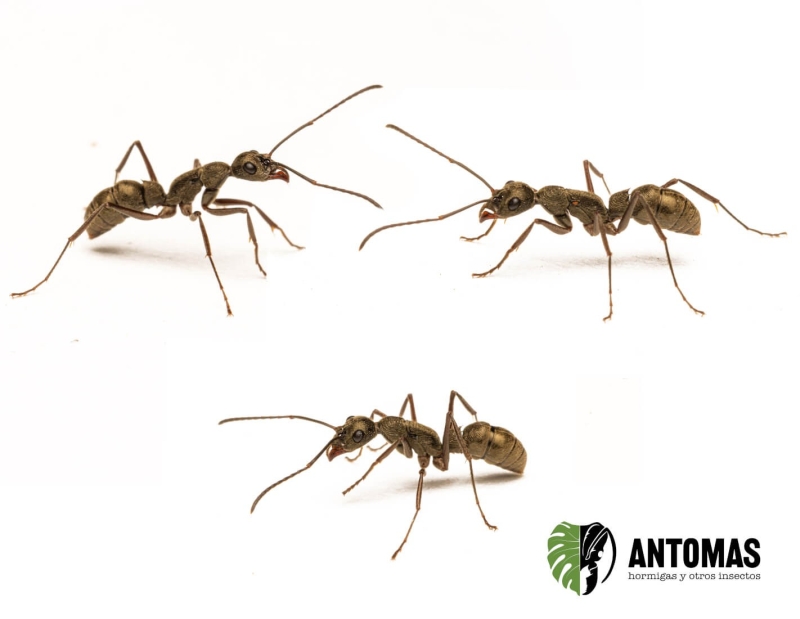
As in the rest of the genus, the workers are monomorphic: a single form and a very uniform size, with no soldiers or size castes, and the gamergate does not stand out by her measurements. What gives her away is her gemmae.
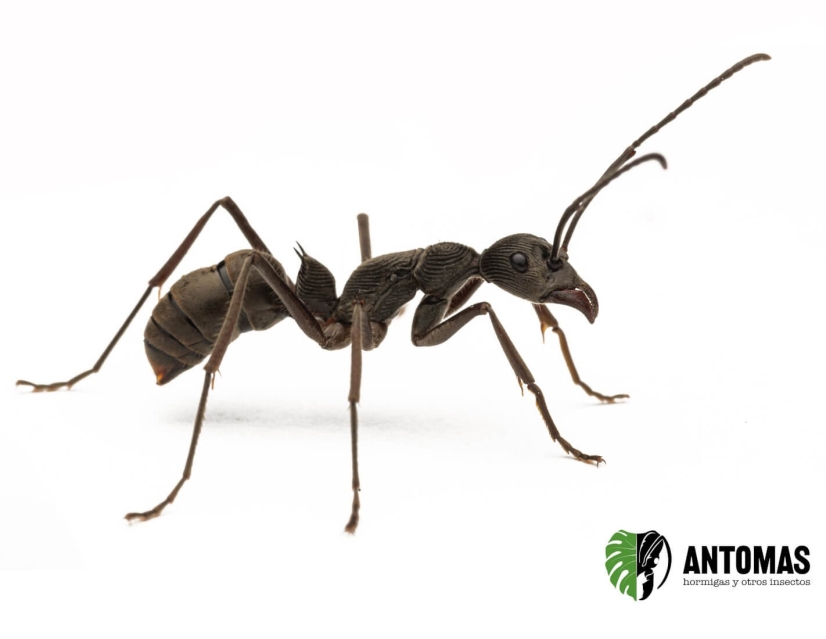
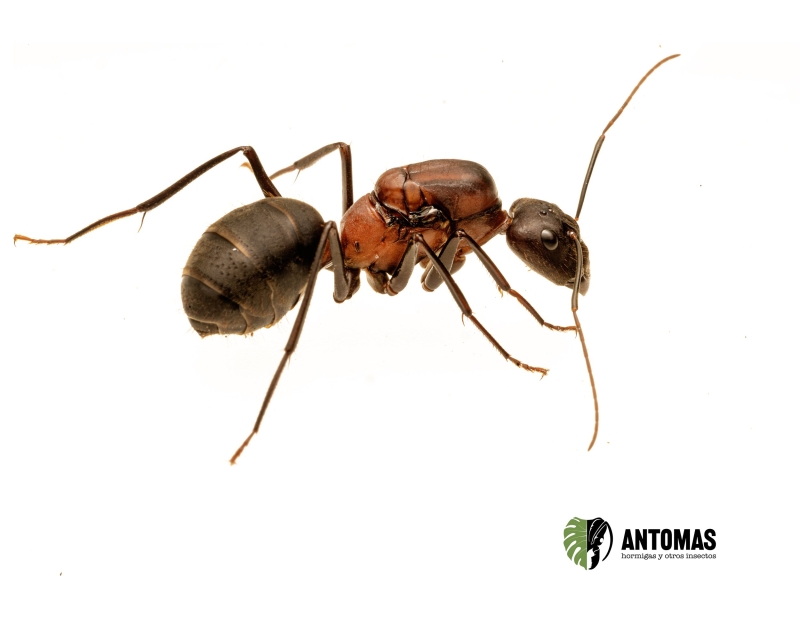
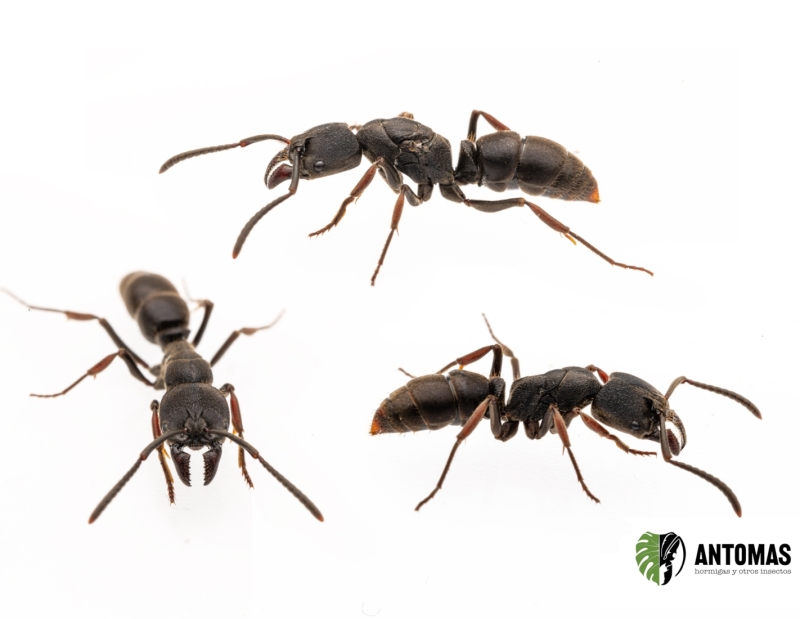
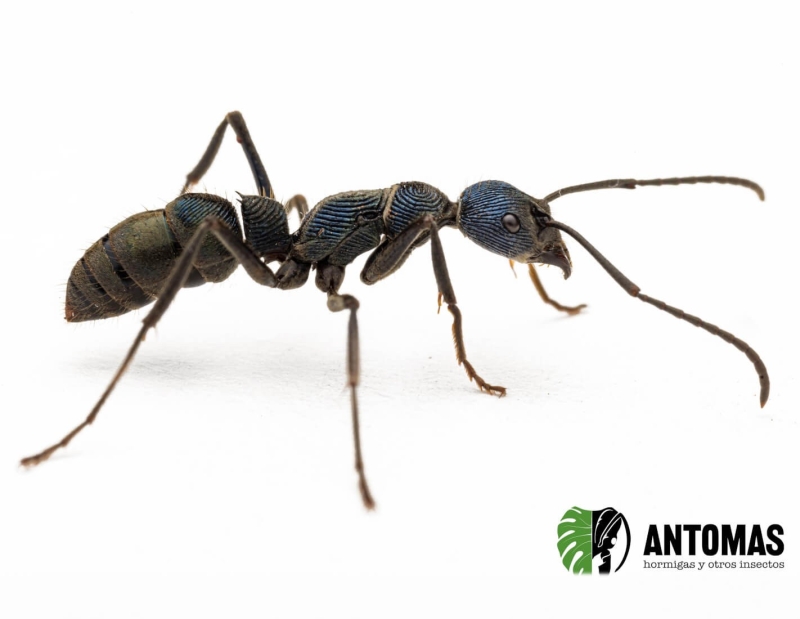
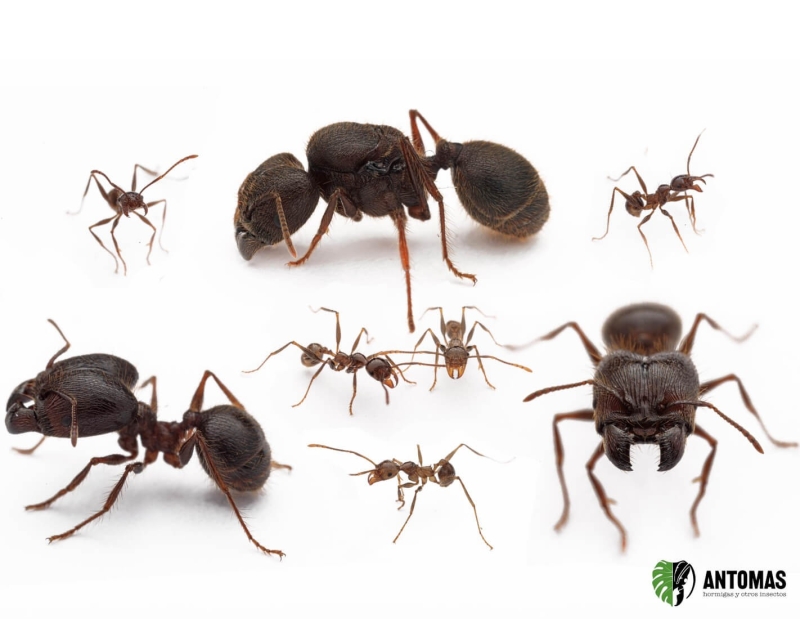
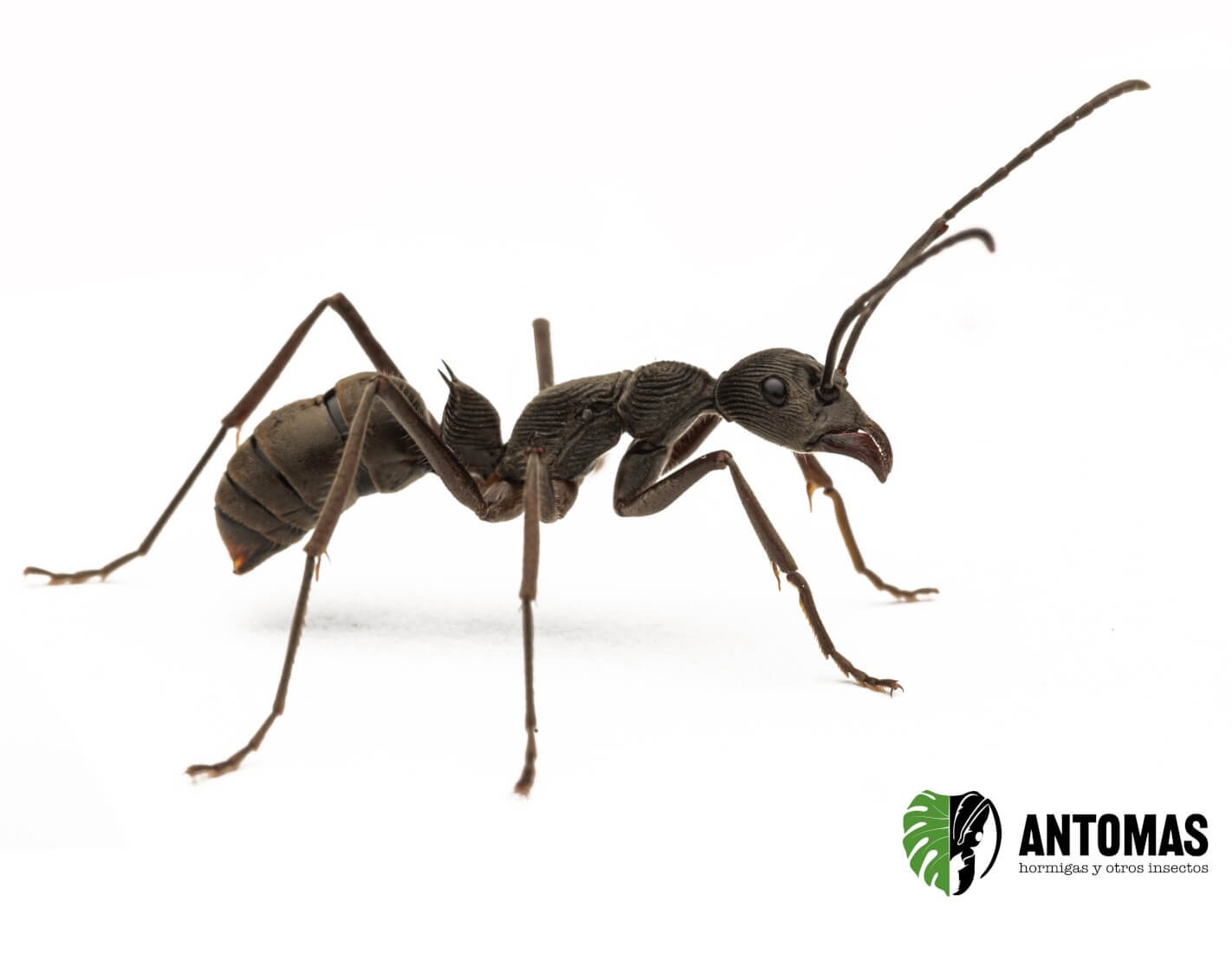
Silhouette. Large, slender and very long-legged, with an elegant gait quite unlike the nervous hurry of small species. At Antomas we have also always highlighted its exoskeleton, hard as armour.
Colour. Black, with a silvery sheen depending on the light, as keepers describe it. It lacks the metallic colours of the Philippine Diacamma.
Sculpture. Furrowed with marked striae, longitudinal on the head. Their pattern is a key character in the taxonomy of the group.
Petiole. A thick scale topped with two spines, as in other Diacamma. In this species, the upper part bears a crest with faded striation, which helps to separate it from D. violaceum.
Antennae. Long scapes, with an index of 164–174, compared with 181–192 in D. violaceum.
Sting. Long and functional. It is its main weapon: it immobilises prey with venom before carrying it to the nest.
Gemmae. Present in all of them at emergence; only the gamergate keeps them.
Males. Winged and different from the workers, as throughout the genus. We know of no accessible description of those of this species.
Approximate measurements
Workers, revision by Laciny, Pal and Zettel (2015, consulted indirectly): 16.4–18.5 mm
Workers, Peeters and colleagues (2015): up to 16–17 mm
Workers, Antomas guideline: up to 18–20 mm, not systematically measured
Gamergate: same as the workers
Genus Diacamma, for comparison: normally 8–16 mm
An ant's total length varies depending on how it is measured, so it is normal for some figures not to quite match others. What does not change is the impression: next to any of its relatives, it looks as if it belongs in another class.
Care in captivity
Difficulty: 3/5 – Advanced
It is kept just like other Diacamma, and it is not a fragile ant. What takes it to an advanced level is the sum of three things: keeping the nest very humid without waterlogging it, sustaining a diet rich in live prey, and working with a large, powerful and very aggressive species, with a sting, whose colony depends on a single gamergate. That is why, unlike with its smaller relatives, handling matters here as much as rearing.
Is it worth it? If you like hunters, it is hard to find anything better. Every sortie by a worker has something of a duel about it: she locates the prey, closes in, subdues it with her sting and carries it back unaided. And inside the nest, one of the rarest social systems in existence carries on working.
Recommended parameters
Temperature: 24–28 °C, with one end of the setup slightly warmer and the other cooler, so that the colony can choose. This is the Antomas guideline for the genus and it matches keepers' practice; no laboratory study has established it for this species.
Nest humidity: very high, 60–80 %, usually around 70 %.
Foraging area: slightly less humid, with a water tube always available.
Diapause: not needed. We keep it active all year round, like the rest of the genus, and the care guides agree.
Light: a dark area inside the nest and a lit foraging area, so you can enjoy the hunting.
Letting them dry out is a serious mistake. It lives in warm, humid environments, and a dry colony soon suffers, especially the brood. Spread the humidity by keeping one part of the nest wetter and another less so, and add water little and often: all at once and you will only waterlog it and encourage mould and mites.
Recommended formicaria
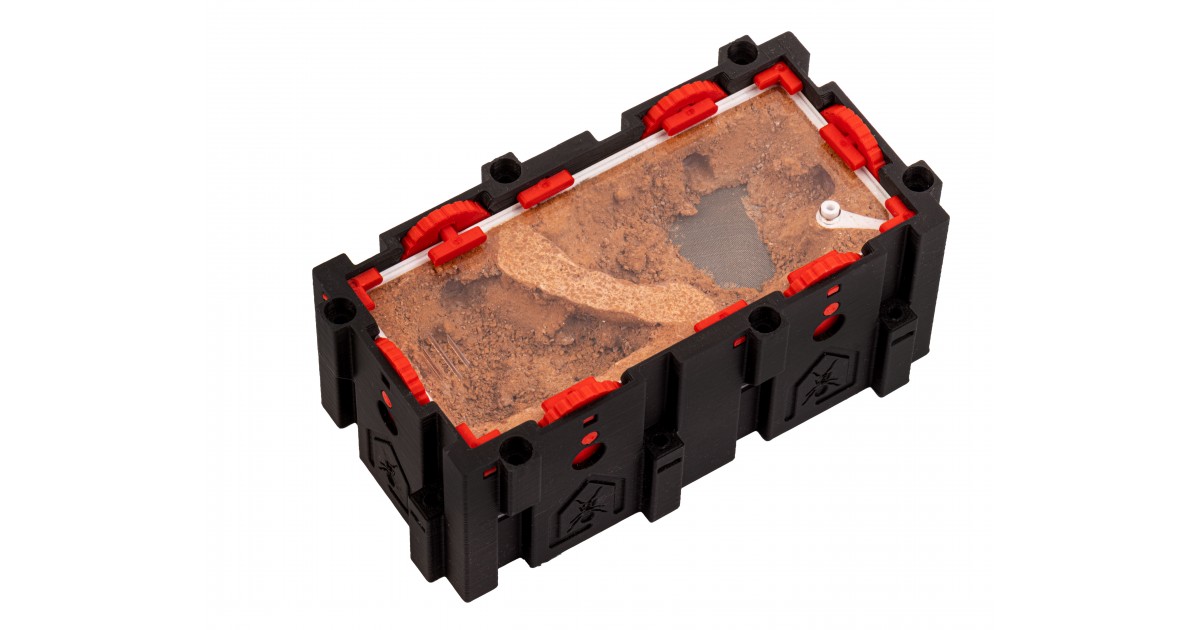
We use the Qbik Wild range by Anthouse in the Duo format. All three humidity systems give good results, and our pick is the Qbik Wild Duo P 2C Hybrid, which combines evaporation from a lower reservoir with a side water tube. In the evaporation version, water never reaches the chambers and a natural gradient forms; the standard one is refilled with a water tube.
Give it a large foraging area: a hunter this size needs room to patrol and stalk. A base of sand with a little clay and a few stones looks natural and holds some moisture. Expand the nest when the colony already fills almost all of it, because empty spaces are harder to keep in good condition.
The colony at home: gamergate, arrival and moving in
Our colonies are always sold with a gamergate, in the formats you will see in the product options. As we have explained, the workers are not an extra: they are what makes the colony viable.
As soon as it arrives, place it at a stable temperature, offer it water and remove any workers that died on the way. To install it, at Antomas we move it by tipping it in: we empty the colony into its new formicarium and, often, force them to go inside. With such an aggressive species, do this with the lid to hand, unhurriedly and with the barriers already prepared.
After that, check on it often. Ants are there to be enjoyed and learned from, and inspecting them gently is the best way to catch any problem with humidity, mould or lack of food in time. That said, do not expect to see the gamergate strolling about: in our Diacamma she is very shy and elusive and never goes out to forage.
If the gamergate dies
The colony is not lost. Without a gamergate, newly emerged workers are no longer mutilated, and one of them can take her place. What is needed is for her to mate with a male from another colony: a male from the same one will not do. We have seen this work in Diacamma, with customers who ordered males from us and obtained a new gamergate from an unmutilated worker. If it happens to you, write to us as soon as possible and keep caring for the colony as usual.
Colonies, on the other hand, cannot be merged: they are too aggressive towards each other.
Feeding
The rule is a varied diet, with plenty of protein. And in an ant this size, protein shows.
Protein. They eat live and dead insects, but at Antomas we recommend mostly live prey, because that is where the great spectacle lies: this species is tremendously aggressive towards other arthropods and invertebrates, and a single worker can tackle items that other Diacamma would struggle with. Crickets, feeder cockroaches, mealworms, flies and other safe feeder insects all work well. Change the insect every week, so that they do not always eat the same thing.
Offer protein 3–5 times a week, depending on the number of larvae. The more protein, the better and faster they grow: if you clean daily, it is better to overdo it, because the colony understands that it has resources to spare and raises more brood. If you are not going to remove leftovers, it is better not to overfeed, because at this humidity they quickly go mouldy. As they go out hunting somewhat less than other species, leave prey where they can find it without crossing the whole setup.
Sugars. They are quite fond of them. You can offer them every 3–4 days or leave a feeder ad libitum. As a rule, use Anthouse Blue Sugar nectar4–5 times a week and another sugary liquid 1–2 times a week. A mix of lactose-free milk with honey works for us, adding a little liquid protein. Protein can also be added to the nectar.
How to offer it. Sugary liquids go in a feeder, never on cotton wool: it goes mouldy and the liquid soon spoils. Traditional or homemade feeders both work, as long as the drop stays within reach. Water is another matter: a test tube with water and cotton wool in the foraging area keeps it always available.
Hunting gladiators, part 3: D. scalpratum hunting and taking on Harpegnathos venator (Anthouse).
Behaviour in captivity
Do not expect a constant bustle of workers as in other species. There is usually less foraging activity, and on its own that is no sign of trouble. The difference lies in what happens when prey comes in: the worker that detects it launches herself without hesitation, and that is when you understand why she is the big sister.
Its aggression extends to other ants and to colonies of its own species, so no shared setups. What should concern you is a colony without brood huddled in a corner, or larvae that are not growing: check humidity, temperature and the amount of protein first. If at some point they move of their own accord, watch for the tandem running pairs.
Escapes and barriers
Like other Diacamma, they are not great escape artists, and a lid and a large foraging area are enough. Even so, given its power and temperament, it is best to leave nothing to chance with this species: close plugs and connections properly. As reinforcement, you can use oil, petroleum jelly or "talcol", a mixture of talcum powder and alcohol applied in a strip.
Fluon (PTFE) fails in the high humidity this ant needs, sometimes without you noticing, so do not rely on it as your only barrier.
Handling and safety
It is a large, very aggressive ant with a functional sting: treat it with respect and without fear. Among keepers, the sting is described in very different ways, from almost imperceptible to painful without being intense, and in smaller Diacamma we have seen them struggle to get through the skin. As this one plays in another league, do not assume the same.
Always work with tweezers and gloves, with no direct contact with your hands, and without rushing, not least so that you do not lose the gamergate. This is not a species for people allergic to hymenopteran stings. And, like any exotic species, it must never be released.
What not to do
Let the nest dry out: with this species that is a serious mistake.
Go to the other extreme and waterlog it.
Leave prey remains in place.
Always offer the same insect or skimp on protein.
Put sugars on cotton wool.
Look for a "queen" or try to found a colony with a lone gamergate.
Merge colonies or mix it with other species.
Handle it with bare hands or without the lid and barriers ready.
Rely entirely on Fluon in a humid environment.
Forget to check on them: with a small colony, a problem shows quickly.
Scientific sources
This care sheet combines the only field study of colonies published under this name, the taxonomic revision of the genus, work on other Diacamma and the experience of Antomas, which we flag as such. Main references:
Peeters, C., Heraty, J. & Wiwatwitaya, D. (2015). Eucharitid wasp parasitoids in cocoons of the ponerine ant Diacamma scalpratum […]. Halteres 6: 90–94. biodiversitylibrary.org
Heraty, J.M., Mottern, J. & Peeters, C. (2015). A new species of Schizaspidia, with discussion of the phylogenetic utility of immature stages for assessing relationships among eucharitid parasitoids of ants. Annals of the Entomological Society of America 108: 865–874. doi:10.1093/aesa/sav062
Laciny, A., Pal, A. & Zettel, H. (2015). Taxonomic notes on the ant genus Diacamma (Hymenoptera: Formicidae), part 1. Zeitschrift der Arbeitsgemeinschaft Österreichischer Entomologen 67: 83–136. zobodat.at
Peeters, C. & Crozier, R.H. (1988). Caste and reproduction in ants: not all mated egg-layers are "queens". Psyche 95: 283–288. doi:10.1155/1988/52368
Peeters, C. & Ito, F. (2001). Colony dispersal and the evolution of queen morphology in social Hymenoptera. Annual Review of Entomology 46: 601–630. doi:10.1146/annurev.ento.46.1.601
Wheeler, W.M. & Chapman, J.W. (1922). The mating of Diacamma. Psyche 29: 203–211. doi:10.1155/1922/80849
Peeters, C. & Higashi, S. (1989). Reproductive dominance controlled by mutilation in the queenless ant Diacamma australe. Naturwissenschaften 76: 177–180. doi:10.1007/BF00366404
Gotoh, A., Sameshima, S., Tsuji, K., Matsumoto, T. & Miura, T. (2005). Apoptotic wing degeneration and formation of an altruism-regulating glandular appendage (gemma) in the ponerine ant Diacamma sp. from Japan. Development Genes and Evolution 215: 69–77. doi:10.1007/s00427-004-0456-7
Ramaswamy, K. et al. (2004). Social mutilation in the ponerine ant Diacamma: cues originate in the victims. Insectes Sociaux 51: 410–413. doi:10.1007/s00040-004-0765-x
Baratte, S., Cobb, M. & Peeters, C. (2006). Reproductive conflicts and mutilation in queenless Diacamma ants. Animal Behaviour 72: 305–311. doi:10.1016/j.anbehav.2005.10.025
Cournault, L. & Peeters, C. (2012). Aggression regulates monogyny in non-mutilating Diacamma ants. Insectes Sociaux 59: 533–539. doi:10.1007/s00040-012-0251-9
Shimoji, H. et al. (2018). Social enforcement depending on the stage of colony growth in an ant. Proceedings of the Royal Society B 285: 20172548. doi:10.1098/rspb.2017.2548
Sahu, P.K., Kolay, S. & Annagiri, S. (2019). To reunite or not: a study of artificially fragmented Diacamma indicum ant colonies. Behavioural Processes 158: 4–10. doi:10.1016/j.beproc.2018.10.017
Karpakakunjaram, V. et al. (2003). Contributions to the biology of the queenless ponerine ant Diacamma ceylonense Emery (Formicidae). Journal of the Bombay Natural History Society 100: 533–543. repository.ias.ac.in
Mukhopadhyay, S., Pathak, M.K. & Annagiri, S. (2019). Path minimization in a tandem running Indian ant in the context of colony relocation. Journal of Experimental Biology. doi:10.1242/jeb.206490
Kaur, R. & Sumana, A. (2014). Coupled adult-brood transport augments relocation in the Indian queenless ant Diacamma indicum. Insectes Sociaux 61: 141–143. doi:10.1007/s00040-014-0338-6
Fujioka, H., Marchand, M. & LeBoeuf, A.C. (2023). Diacamma ants adjust liquid foraging strategies in response to biophysical constraints. Proceedings of the Royal Society B 290: 20230549. doi:10.1098/rspb.2023.0549
Baidwan, P.S. et al. (2024). Description of Diacamma rugosum jerdoni (Insecta: Hymenoptera) male along with two new additions to the myrmecofaunal diversity of Kerala, India. Halteres 14: 20–30. doi:10.5281/zenodo.14439664
Dificultad
Intermediate
2 Reviews
Very good!
The colony arrived quickly and with no deaths.
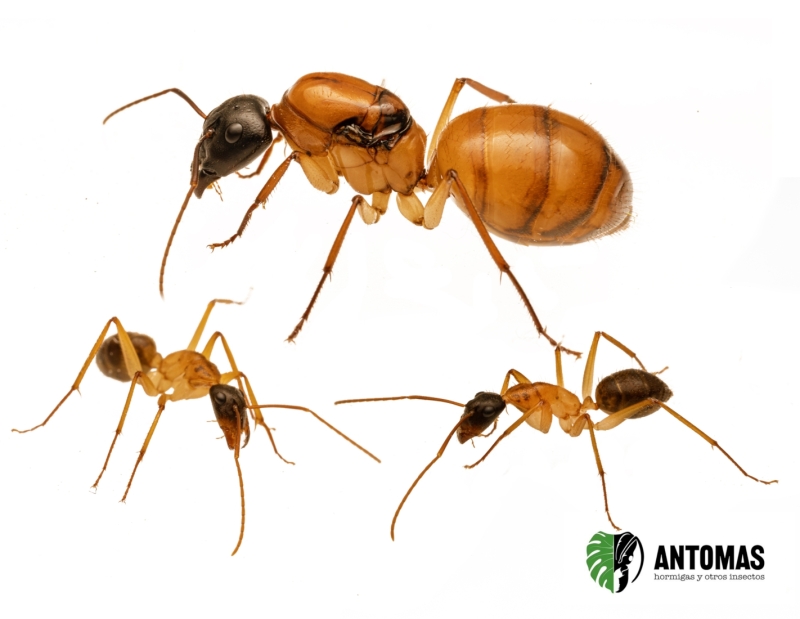
Since the gamergate had been marked, it was easy to locate her.
By Niels
on 2026-11-18
De lo mejor que puedes encontrar
Brutal la calidad de la colonia que me llego, sana sana. Envío rápido y bien protegido y además, VIENE LA GAMERGATE marcada, para la gente que le cuesta como yo encontrarla. En pocos sitios encontrarás una calidad tan suprema.
By Bernat Bonet
on 2026-11-11
Comments (0)
No customer reviews for the moment.
Your review appreciation cannot be sent
Report comment
Are you sure that you want to report this comment?
Report sent
Your report has been submitted and will be considered by a moderator.
Your report cannot be sent
Write your review
Review sent
Your comment has been submitted and will be available once approved by a moderator.



Since the gamergate had been marked, it was easy to locate her.