Difficulty: 4/5 – Advanced
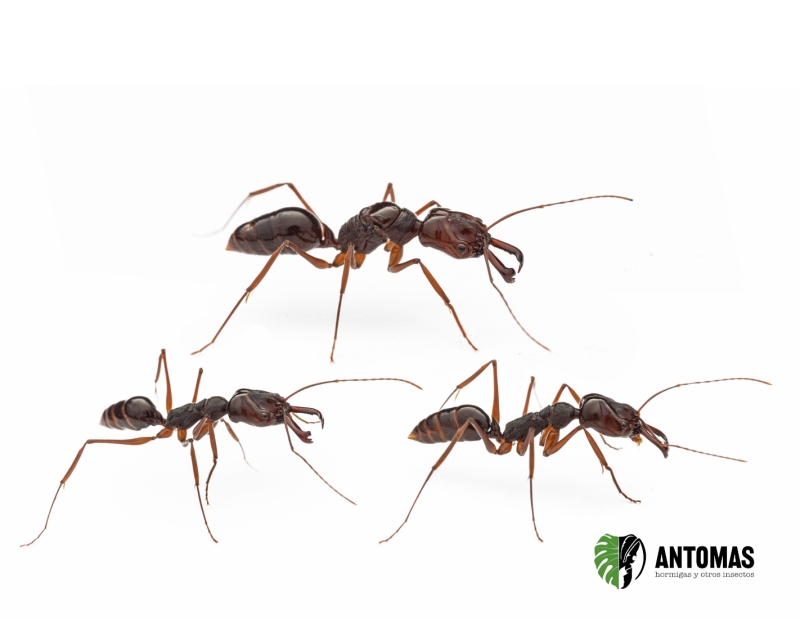
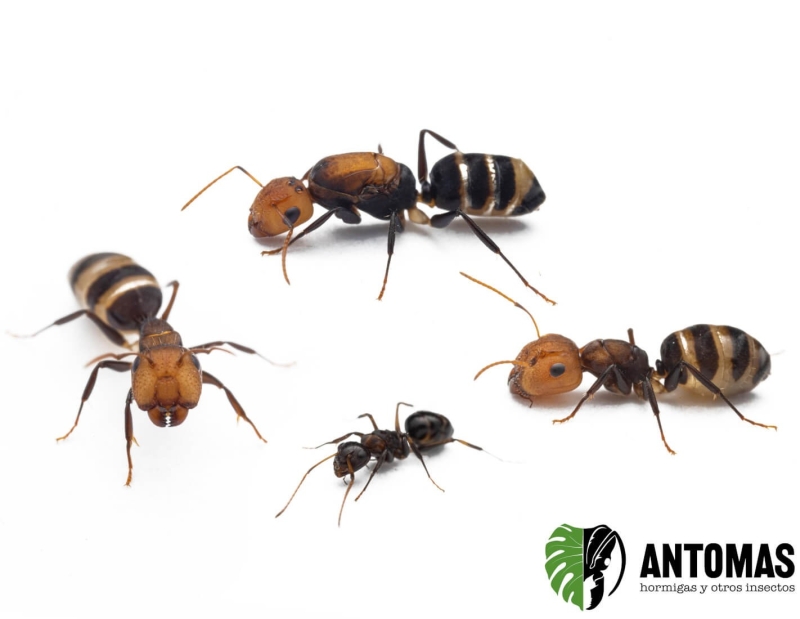
One of the largest Camponotus in Asia: queens of almost 2 cm, red head and black body, and true soldiers with heart-shaped heads that are almost as long as the queen. Colonies with queen and workers with brood, single-queen. Qbik Wild plaster nest with roomy galleries, 24–27 °C, moderate humidity with a gradient, sugar always available and plenty of protein. No diapause. Slow start: it calls for patience and consistency. It climbs: use a paraffin oil barrier.
Camponotus singularis (Smith, 1858) is a carpenter ant from the tropical forests of Asia, from Nepal to Java. It is big even for a Camponotus: queens approach 2 cm and even the smallest workers measure almost a centimetre. But what makes it truly singular is not its size, but the way it divides up the work. Its colonies have two very different types of worker, with nothing in between: ordinary workers and soldiers with enormous, heart-shaped heads, which science has taken as a model for understanding how castes evolve in carpenter ants.
It is not a well-studied species. Almost everything science knows about it comes from a 2016 study by the Natural History Museum Vienna, which measured a hundred museum specimens in detail; little is known about its life in the wild. In this care sheet we always separate what is documented, what is known about the genus, what other keepers report and what we have learnt at Antomas. It is an ant for keepers who already have some experience and want a spectacular colony, even if it grows unhurriedly.
Biology
A worker from Java in the British Museum
It was described in 1858 by the British entomologist Frederick Smith as Formica singularis, in the catalogue of Hymenoptera of the British Museum, from a single worker collected on Java. That worker, the holotype, the reference specimen for the name, is still kept in London, and it is a small worker, a minor. Five years later, in 1863, Julius Roger moved it to the genus Camponotus, where it remains today.
Since then it has changed "drawers" within the genus several times: William M. Wheeler placed it in 1919 in the subgenus Myrmosphincta, and Carlo Emery, in 1925, in Myrmosaulus. Today the subgenera of Camponotus are little used, because many do not reflect real relationships. Along the way, an ant from Burma described separately, C. birmana, turned out to be the same species and became a synonym. And in 1941 the British entomologist Horace Donisthorpe described a form from Borneo with reddish patches, the variety rufomaculatus, which we will come back to shortly, because it could be another species.
True soldiers: dimorphism with nothing in between
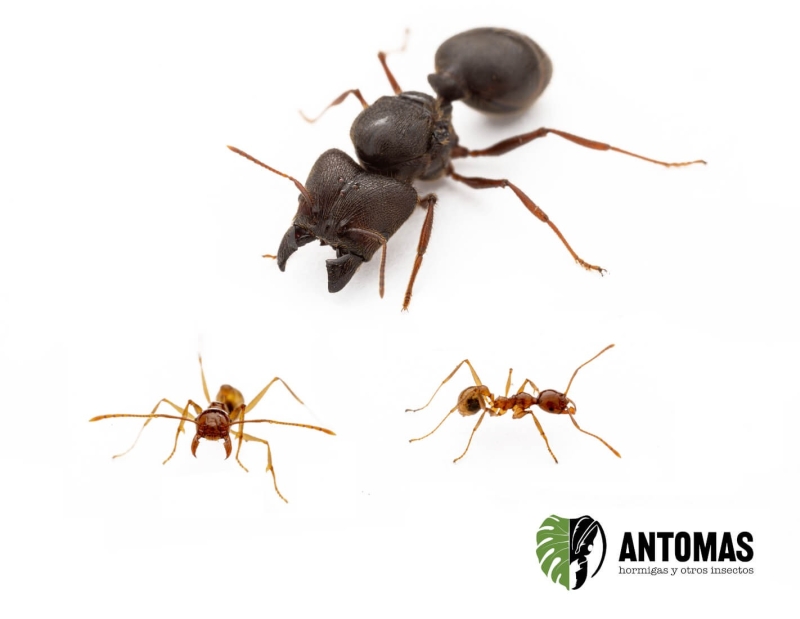
In most Camponotus with workers of several sizes there is a continuous gradation, from the smallest to the largest, with every intermediate size. This is called polymorphism. C. singularis is different. In 2016, Alice Laciny, Herbert Zettel and Irina Druzhinina measured 85 small workers, 10 large ones and 5 queens from almost its entire range, from Myanmar to Java, and showed that it has true dimorphism: two clearly separate worker castes, the minors and the majors, and no intermediate individuals between them.
- Minors: highly variable. The largest exceed the smallest by up to 50% in head width and thorax length.
- Majors: much more uniform, all almost identical, and with a head that is enormous in proportion to the body.
That is why the authors chose C. singularis as the model species for dimorphism in the tribe Camponotini, the carpenter ants. And they proposed calling its majors, quite properly, "soldiers": they are not simply ordinary workers writ large, but a distinct caste, built according to different growth rules.
A detail of interest to keepers: in museum collections, majors are much rarer than minors, 10 against 85 in that study. There are no counts of complete nests, but in other Camponotini with soldiers these have been measured at around 20% of the colony. Soldiers are expensive to produce, and the colony makes them sparingly.
A heart-shaped head
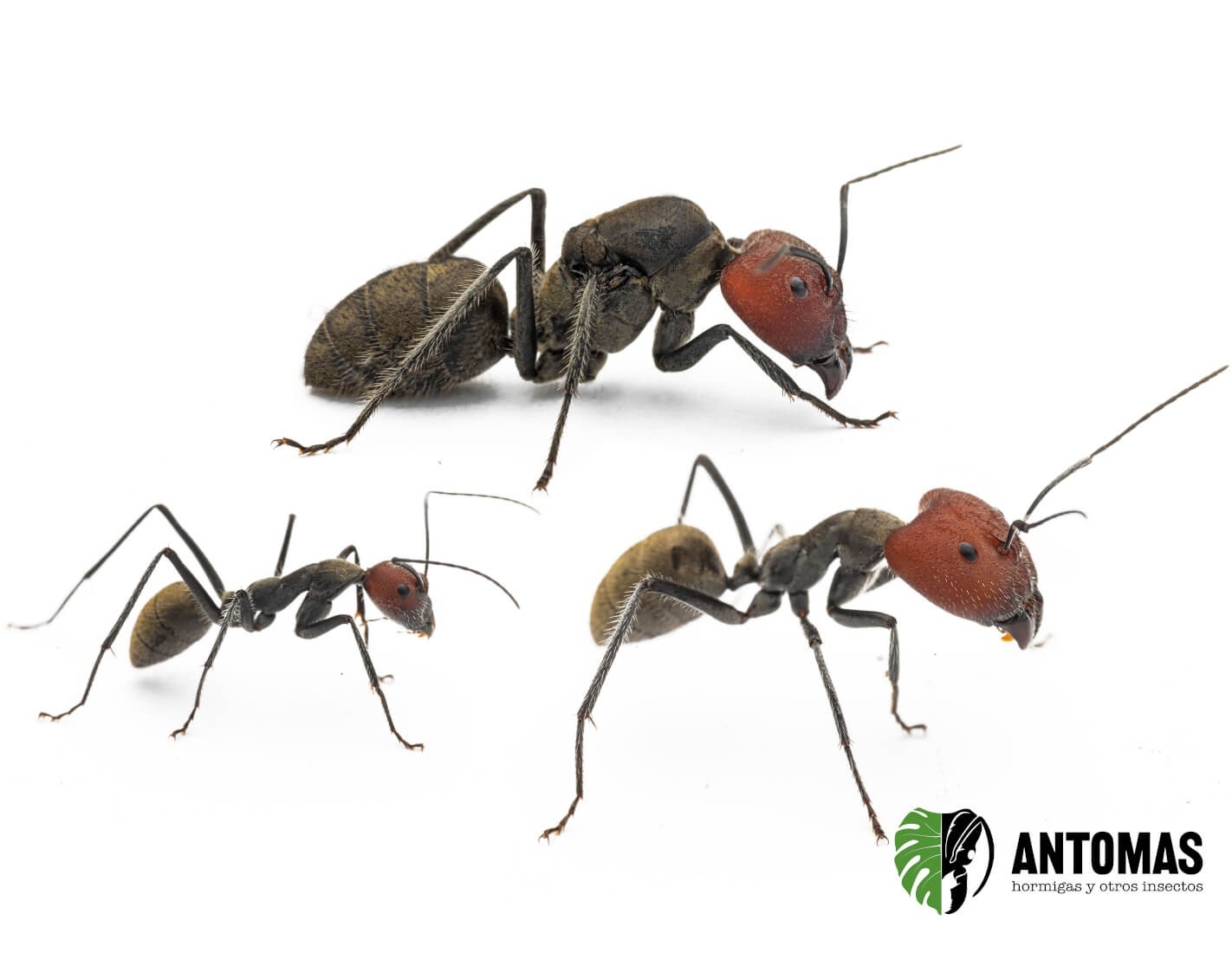
The difference between the two castes is obvious in the head:
- Minor: oval head, longer than wide, rounded behind the eyes and with a small protruding "neck". Long antennae and palps, long slender legs.
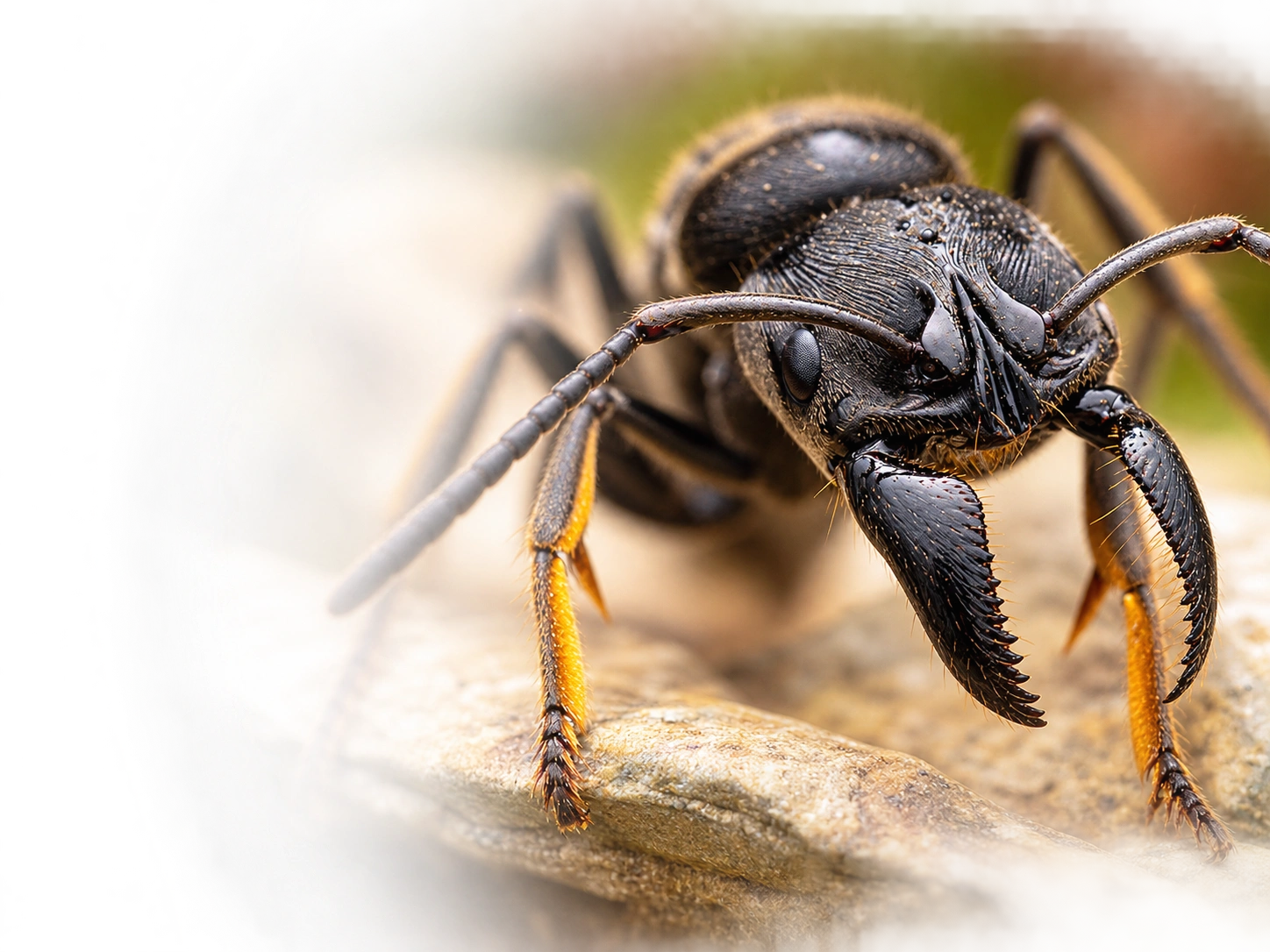
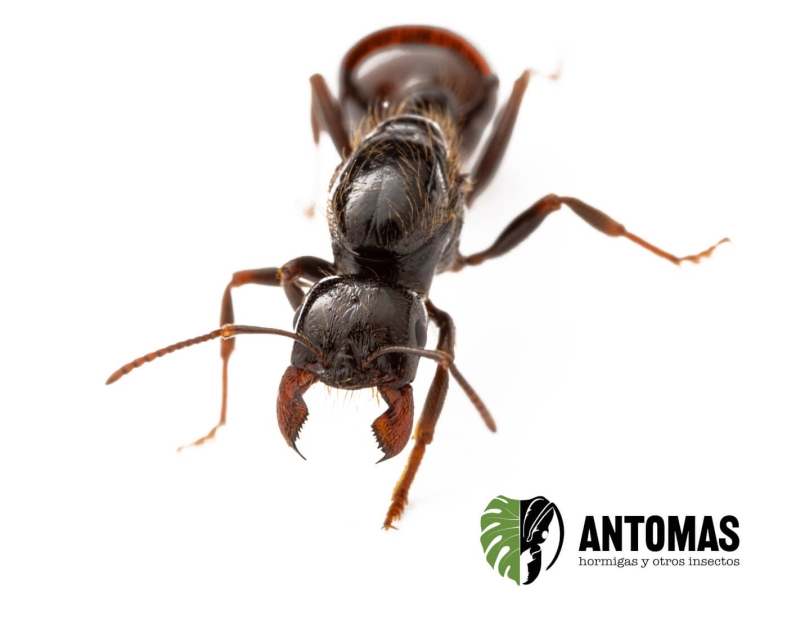
- Major: enormous, heart-shaped head, deeply notched at the back and without a neck. Much thicker mandibles, especially at the base, powered by highly developed adductor muscles, which are what fill that head. Relatively short antennae, palps and legs.
The figures make it clear. The head of a major is 4.4–5.3 mm wide, against 1.7–2.8 mm in minors: almost double. And it is wider than that of the queen herself, which measures 4.2–4.4 mm. The authors link that head to nest defence: a head full of muscle for biting hard, and short antennae and palps that are less likely to break in a fight. In another Asian Camponotus, C. compressus, it has been found that majors also have fewer olfactory receptors on their antennae than minors, as if their job depended less on smell. In C. singularis this is, for now, only a hypothesis.
Half soldier, half queen
Here comes the most curious part. The soldiers of C. singularis resemble the queen in features a worker should not have:
- The eyes are shifted towards the top of the head, as in the queen, rather than on the sides, as in minors.
- The ocelli, the three small simple eyes that queens have on the forehead to orient themselves during the nuptial flight, do not exist in minors. But one major from Myanmar had three reduced ocelli, and many others show small scars in exactly that spot.
- The antennae and legs, shorter than in minors, are also shortened in the queen.
- The petiole, the "knot" of the waist, is higher than long in majors and queens, and rounded and elongated in minors.
To explain this, the authors turn to an idea proposed in 2012 by Mathieu Molet, Diana Wheeler and Christian Peeters: new castes in ants would be mosaics that "recycle" parts of the developmental programme of other castes. The soldier of C. singularis would be just that: a worker body, with a worker thorax, to which part of the queen's growth programme has been added. A piece of evolution you can see with your own eyes in your formicarium, by comparing the head of a soldier with that of its mother.
The thorax tells the other half of the story. Workers, and soldiers even more so, have a highly developed first thoracic segment, the one that moves the head and the front legs. The queen, on the other hand, has an enormous second segment, the one that moves the wings. It is a trade-off repeated in many ants: a thorax for walking and fighting, or a thorax for flying.
One species or two? The Borneo enigma
When measuring the specimens, the Vienna team got a surprise: those from Borneo did not fit. They had clearly longer palps, antennae and legs than those from the rest of the range, a thorax reddish on top in some specimens and darker hairs on the head. They were, moreover, the form that Donisthorpe had described in 1941 as the variety rufomaculatus, "red-spotted".
Their conclusion: the Borneo population is probably a distinct species, endemic to the island. They announced a separate revision which, as far as we have been able to check, has not yet been published, so catalogues still treat it as a subspecies of C. singularis. It is a good example of how little is still known about many Asian ants, even the largest and most striking ones.
From Nepal to Java, from rainforest to mountain
Its range is huge: it stretches from Nepal and India, through Myanmar, Thailand, Laos, Vietnam and southern China, to the Malay Peninsula, Singapore, Sumatra and Java, with the form rufomaculatus on Borneo and records from the Philippines. It is an ant of tropical evergreen forest, the ever-green forest of South-East Asia, and it even turns up in wooded gardens, such as the Bogor Botanical Gardens on Java. According to some sources, it is sometimes found in the middle and upper layers of the forest canopy.
One fact stands out in the material of the 2016 study: many specimens come from mid-elevation mountains, between 600 and 1,900 m above sea level, in Laos, Myanmar and the Malaysian highlands, although there are also lowland ones. There are no scientific descriptions of its nests in the wild. Hobby sources speak of decaying wood in large trunks or of nests in the ground, without agreeing.
Its climate. In the equatorial lowlands, as on Java, it is hot all year round, with averages of about 25–27 °C and high humidity. In the mid-elevation mountains it is cooler and very stable, with averages of about 18–22 °C. In northern Indochina the climate is monsoonal: heavy rain from May to October and a dry, somewhat cooler season from November to April, without frost in the lowlands. In other words, it never experiences a cold winter: that is why it has no diapause, and at home it is comfortable at 24–27 °C, with moderate humidity and never waterlogged.
A giant that comes out at night
There are no studies of its daily rhythm in the wild, but keepers and shops agree that it is a mainly nocturnal ant that goes out foraging at dusk. At home, where the light is dimmer than in the forest, it also shows itself during the day. In the wild, according to hobby sources, it looks for food on trees and shrubs, with a preference for the honeydew of aphids and other sap-sucking insects and for flower nectar, like so many Camponotus.
Acid in the pantry and a bacterium in the gut
Like all Camponotus, it has no sting: it defends itself by biting and spraying formic acid from the acidopore, a small nozzle at the tip of the gaster. That acid is not just a weapon. In 2020, a German team showed that the ants of its subfamily, the formicines, swallow their own venom: while grooming they bring the tip of the gaster to their mouth and take a few drops of acid, which keep the crop very acidic, the "social stomach" where they store the food they share mouth to mouth. In this way they filter out the microbes that come in with the food. And in 2026 it was discovered that the venom of several Camponotus also contains peptides that inhibit fungi and help protect the brood. C. singularis was not among the species studied, but these are traits of the genus.
It also carries an invisible partner. All ants of the tribe Camponotini harbour a bacterium, Blochmannia, which lives in special cells of the gut and passes from the queen to her daughters through the eggs. It produces essential amino acids that the ant cannot make, and allows it to live largely on sugary, protein-poor liquids. According to the most widely accepted hypothesis, the tribe acquired the bacterium by tending sap-sucking insects, and 2025 phylogenomics places the origin of the tribe about 38 million years ago, probably in Australasia or the Indo-Malayan region. That said: it is no excuse to skimp on protein; the larvae need insects to grow, all the more so in a species of this size.
A single queen, for many years
There are no scientific studies of its colony structure, but keepers agree that it is monogynous: each colony has a single queen. Its founding is claustral: after the nuptial flight, the queen seals herself in and raises her first workers without going out to eat, using the reserves of her own body. The first workers are small minors, and the soldiers arrive considerably later.
Nor is it known how long a queen of this species lives, but Camponotus queens are among the longest-lived insects. There is a famous record in the genus: the Haskinses kept in their laboratory a queen of an Australian Camponotus that lived 23.2 years. It is another species, but it gives an idea: a C. singularis colony is a project for many years.
How large does it grow? There is no scientific data on this either. Figures from shops and keepers range from one to several thousand workers in mature colonies, without agreement. What they do agree on is the pace: a slow start, up to a few dozen workers, and then steadier growth. With ants of this size, every worker counts, and a colony of a few hundred is already a spectacle.
Size and morphology
A large, robust carpenter ant, with two clearly distinct worker castes, minors and soldiers, and no sting. The scientific reference is the morphometric redescription by Laciny, Zettel and Druzhinina (2016).
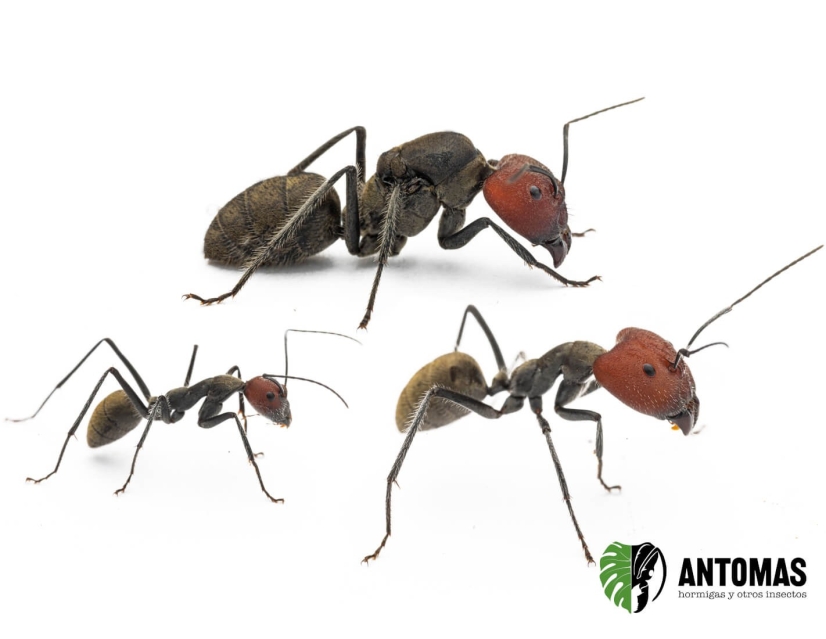
- Colour. Red head and black body, with a pubescence that gives it a greyish, matt tone, without shine. In the Borneo form, some specimens have a thorax that is reddish on top.
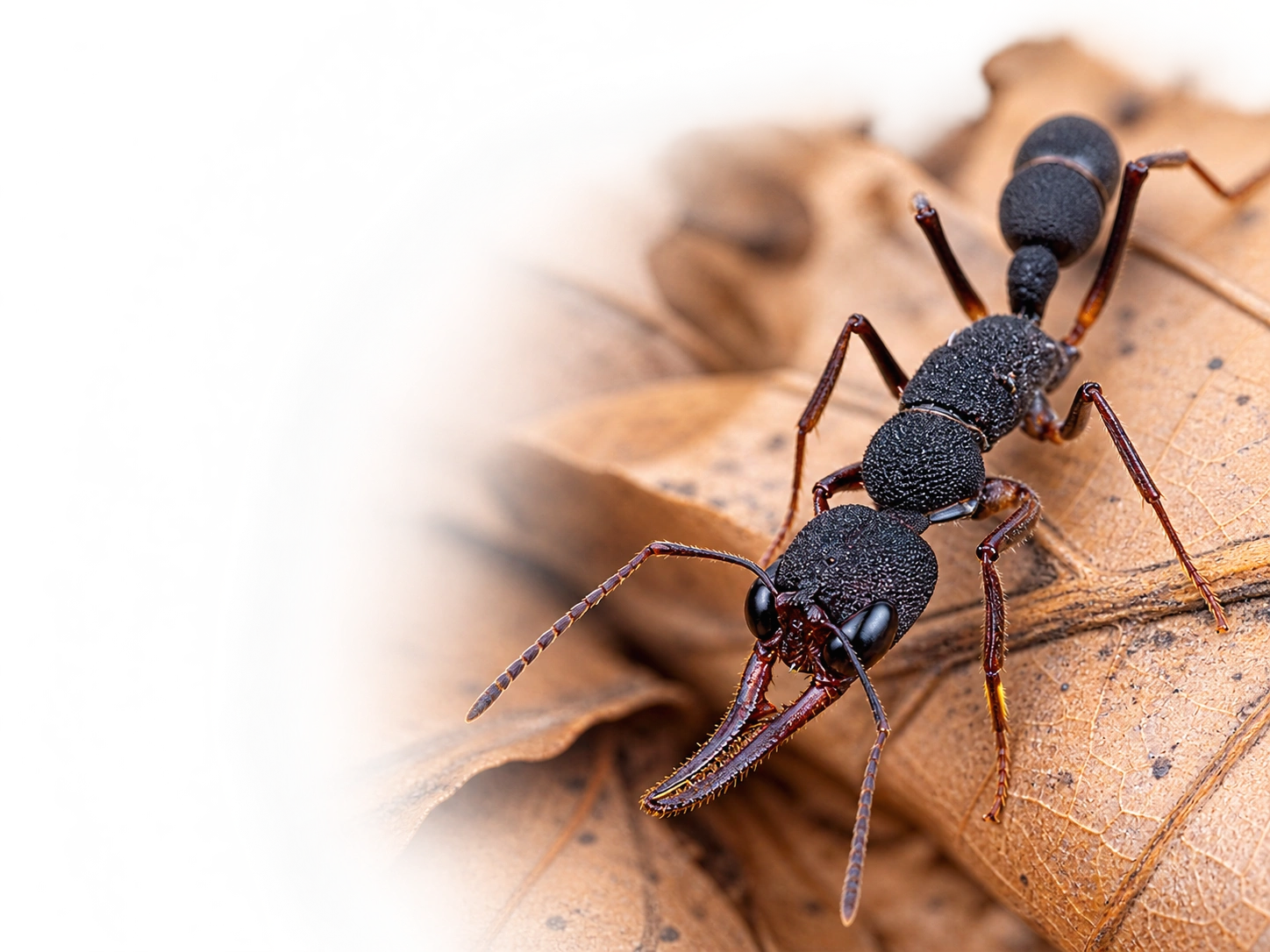
- Minors. Oval head with a small neck, eyes on the sides, very long antennae and long, slender legs. They are the ones most often seen outside the nest.
- Soldiers (majors). Enormous, heart-shaped head notched at the back, wider than the queen's; thick mandibles; eyes high on the head; relatively short antennae and legs. Sometimes, remnants of ocelli.
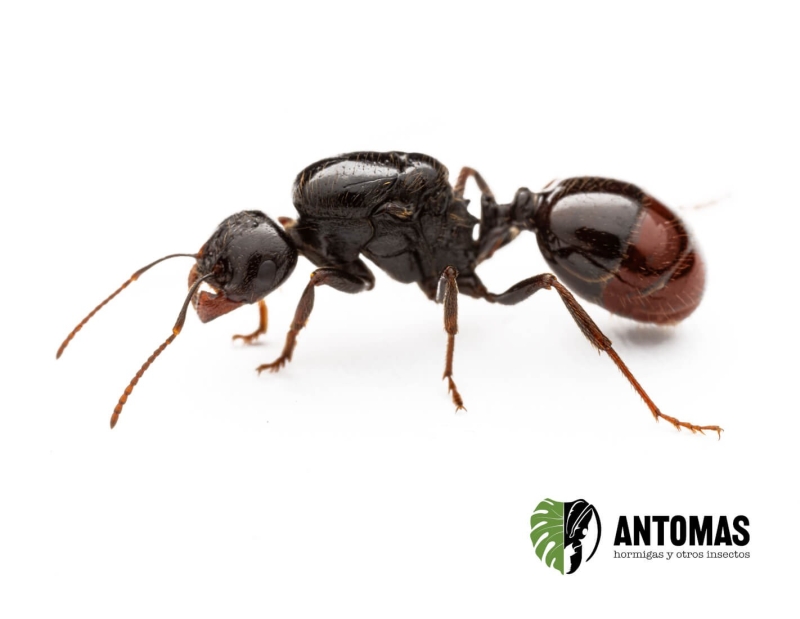
- Queen. Large, with a head somewhat narrower than the soldiers' and almost straight at the back, large eyes, a thorax highly developed for flight and a broad gaster.
- Petiole. Higher than long, with a well-marked node, in soldiers and queens; rounded and elongated in minors.
Approximate measurements
- Queen: 18.4–20.5 mm (alate queens; Laciny et al. 2016)
- Workers (minors): 9.3–15.4 mm (Laciny et al. 2016)
- Soldiers (majors): 16.8–19.6 mm (Laciny et al. 2016)
- Male: no published measurements
These are total lengths of museum specimens, from the tip of the mandibles to the end of the gaster, and they depend somewhat on the condition of the specimen, because the gaster shrinks or swells. What matters is the proportion: a soldier is almost as long as the queen, and its head is wider. In a young colony the first workers are small minors, and the average size increases with each generation. There are no published data on when the first soldiers appear; in young colonies they arrive considerably later than the first minors, once the colony has reached a certain size and is well fed.
Care in captivity
Difficulty: 4/5 – Advanced
At Antomas we consider it a species for keepers with some experience. It is not delicate day to day, but it asks for more than a beginner's Camponotus:
- Stable warmth. It is tropical and has no diapause: it needs 24–27 °C all year round, and cold brings it to a standstill.
- Well-managed humidity. Neither dry nor waterlogged, with a gradient.
- Slow start. A single queen and large workers that are costly to raise: the first few dozen workers come slowly.
- Space. Ants of almost 2 cm need roomy galleries and a generous foraging area.
- Good barriers. It climbs and it is strong.
And it is well worth it: few ants that can be kept at home are so large, and few let you see so clearly how a colony with true soldiers works.
Recommended parameters
- Nest temperature: 24–27 °C all year round, with a slightly warmer area if you wish. This matches the climate of its range and what keepers recommend. Below about 22 °C it slows down a lot.
- Foraging area: at warm room temperature, 22–28 °C.
- Humidity: moderate, with a gradient: one part of the nest moist and another drier (see "Humidity: moderate, never waterlogged").
- Water: always available, in a test tube with water and cotton wool in the foraging area.
- Light: a dark area in the nest and a lit foraging area, with a normal day-night cycle.
- Diapause: none.
For warmth, a heating cable or mat on one side of the nest, with a thermostat, is better than a source that heats the whole formicarium evenly. That way the colony chooses its temperature. Avoid direct sunlight and radiators.
Humidity: moderate, never waterlogged
It lives in humid forests, but that does not mean a soaking nest. At Antomas we recommend moderate humidity and always with a gradient: one moist area of the nest, where the colony can take the brood when it needs to, and the rest drier, with a dry foraging area. That way it is the colony that chooses.
- Signs of too much humidity: condensation on the walls, mould or mites.
- Signs of too little: brood piled up next to the water or workers crowding into the water tube.
Never let it run out of drinking water: it is a large ant, and a dehydrated colony suffers quickly.
Recommended formicarium
At Antomas we recommend the plaster formicaria by Anthouse from the Qbik Wild range, because plaster holds the moderate humidity it likes. Our first choice is the Qbik Wild Duo P 2C Hybrid: a lower reservoir, separate from the galleries, transmits humidity through a mesh, and it is complemented by a side drinking tube. This way you control exactly how much humidity you provide and keep the gradient:
A good alternative is the Qbik Wild Duo P 2C, the classic plaster model, in which you moisten one of the chambers:
With an ant of this size, make sure the galleries are roomy: the soldiers and the queen must be able to move around freely. Expand when the nest becomes too small for them, but do not jump ahead: in a huge nest for a colony of few workers, the spare chambers end up as rubbish dumps and the humidity gets out of control. Complete the set-up with these details:
- Escape barrier: a band of paraffin oil or liquid petroleum jelly on the upper part of the foraging area walls, and a tight-fitting lid (see "Escapes and barriers").
- A generous foraging area, dry, with some sand, flat stones and a twig or piece of bark to climb on, with nothing that could act as a bridge to the barrier.
- Water always available, in a test tube with water and cotton wool.
- A feeder for sugary liquids, never on cotton wool (see "Feeding").
- Gentle heat on one side of the nest, away from the feeder, with a thermostat.
Arrival, first weeks and moving house
At Antomas we sell C. singularis as an established colony: queen with 10–20 or 20–30 workers and brood, in a test tube. The most delicate phase of claustral founding, when the queen is alone, is already over.
- On arrival, let it rest in a quiet, dark place at 24–27 °C, and check that the tube has water. Do not move it into the nest straight away.
- Food from day one: a drop of sugary liquid in a feeder or on a small piece of aluminium foil, never on the cotton wool, and a small piece of insect a couple of times a week. Remove the leftovers the next day.
- Patience: during the first weeks the colony settles in. It is normal to see the brood grow slowly; in a species of this size, development from egg to worker takes a long time.
Moving house. When it is time to move it into the formicarium, at Antomas we do it by tipping: we open the tube inside the foraging area, next to the nest entrance, and gently tip out the queen, the workers and the brood, helping any stragglers with a soft brush. Three tips:
- Prepare everything beforehand: the formicarium set up, with the barrier in place and the water connected.
- Work over a tray, in case a worker climbs up the tube or the tools. They are big and fast.
- Keep the nest area dark so that they occupy it straight away. The workers will collect the brood and carry it inside.
If you ever need to move the colony to another formicarium, use the same method.
Feeding
Sugary liquids, always available. In the wild it lives largely on honeydew and nectar, and at home it should never run short of sugar. Vary the sugars: at Antomas we recommend Blue Sugar nectar by Anthouse 4–5 times a week and another sugary liquid or nectar 1–2 times a week. You can also add some protein to the nectar. Always offer them in a feeder and never on cotton wool, because cotton wool goes mouldy and spoils the liquid very quickly. Use a traditional or home-made feeder, where the drop stays "spread out" and accessible, and replace it before it ferments.
Protein: the more, the better. Raising workers of this size, and above all soldiers, takes a lot of protein. This is the Antomas philosophy: if you do daily maintenance and remove leftovers, it is better to overfeed, because the colony understands that it has more resources and grows faster and in greater numbers. If you will not be able to clean often, better not to overfeed: leftover food rots and brings mould and mites.
- Change the type of insect from one week to the next, so they do not always eat the same thing: crickets, red runner roaches or dubia roaches, flies or chopped mealworms.
- For small colonies, Thermobia domestica is a perfect prey: small, soft and easy to breed at home.
- Chopped or freshly killed prey is the most practical; large colonies will also dismember medium-sized prey, and that is where the soldiers shine.
- Fresh and from a trusted source. Freeze-dried protein works as a supplement, but fresh is better. Buy insects from a reliable supplier: those treated with insecticides can kill the colony.
A tip for a nocturnal species: put the protein in late in the afternoon, when they start to move, and remove the leftovers the next morning.
No diapause
C. singularis has no diapause: there is no cold winter in its range, and it should be active all year round. If your home gets cold in winter, keep the nest warm with the cable or mat and the thermostat. A slight drop in temperature during the colder months does it no harm, since many populations live in mid-elevation mountains with averages of 18–22 °C, but at Antomas we recommend not going below about 20 °C for long periods: in colder conditions the colony stops, the brood stalls and a small colony can be lost.
Behaviour in captivity
Nocturnal. It is most active at dusk and at night, although at home it also comes out during the day, especially if there is food in sight. If you want to see the colony in full swing, watch it in the evening.
A division of labour you can see. Nobody has yet studied the division of labour in this species, but its anatomy offers clues, and in other Camponotus with soldiers the same pattern recurs: the minors, with long antennae and legs, are the ones that go out to forage, tend the brood and explore; the soldiers, built for biting, are kept back to defend the nest and dismember large prey. Seeing a soldier standing guard at the entrance, with its heart-shaped head, is one of the great moments of this species.
Calm, but determined. According to keepers, day to day it is a calm and somewhat shy ant that withdraws from anything unfamiliar. If the nest is disturbed, however, it comes out to defend it with bites and formic acid.
Observe without fear. At Antomas we believe ants are there to be enjoyed, observed and learnt from, not kept hidden away. Simply leave them their dark area in the nest and a lit foraging area, and observe them gently, intervening and stressing them as little as possible. With ants of this size, a simple magnifying glass reveals details that in other species would need a microscope: compare the head of a soldier with that of the queen and look for the remnants of ocelli on its forehead.
Warning signs:
- Brood that stalls or disappears: almost always a lack of protein or warmth.
- Colony motionless and not coming out for days: check the temperature.
- Condensation on the walls or mould: too much humidity or forgotten leftovers.
- Many workers sitting idle in the foraging area, with no room inside: time to expand.
Escapes and barriers
Like almost all Camponotus, it climbs smooth surfaces, and with its size and strength it takes advantage of any gap or ill-fitting lid. The barrier we use at Antomas is oil:
- A band of paraffin oil or liquid petroleum jelly on the upper part of the foraging area walls, thin and continuous. Renew it when it collects dust or debris.
- A tight-fitting lid, with fine-mesh ventilation, as a second line of defence.
- No gaps: check connections, stoppers and tubes, especially as the colony grows.
- Nothing that can act as a bridge: no twigs or stones leaning near the barrier.
- Take care when opening: open only as much as needed, work calmly and close up when you finish.
Handling and safety
They do not sting: they have no stinger. But they are large ants, and a soldier or a queen can give a noticeable bite, and spray formic acid, which stings on sensitive skin or a small wound. Nothing dangerous if you work calmly. Handle them with entomological tools, such as a soft brush or soft forceps, never with your hands, and take special care with the queen: she is the only one in the colony, and if she is lost, the colony has no replacement. Do not merge different colonies or keep it with other species. It is an exotic species: under no circumstances should it be released.
What not to do
- Let it get cold or put it through a diapause: it is tropical.
- Waterlog the nest or, conversely, let it dry out completely.
- Move a small colony into a nest too big for its size, or into one with narrow galleries.
- Put sugary liquids on cotton wool, or let them run out.
- Always give them the same insect, or leave leftovers uncleaned.
- Neglect the barriers: gaps, loose connections or oil that has not been renewed.
- Try to add another queen or merge different colonies.
- Handle them with your hands.
- Expect rapid growth: the key is consistency.
Scientific sources
This care sheet has been compiled from the scientific literature on Camponotus singularis and its genus, from distribution records and climate data for its range, and from the experience of Antomas and other keepers. Main references:
- Laciny, A., Zettel, H. & Druzhinina, I. (2016). Workers, soldiers, and gynes – morphometric characterization and description of the female castes of Camponotus singularis (Smith, 1858) (Hymenoptera, Formicidae). Deutsche Entomologische Zeitschrift 63: 183–193. doi:10.3897/dez.63.9435
- Donisthorpe, H. (1941). Descriptions of new ants (Hym., Formicidae) from various localities. Annals and Magazine of Natural History (11) 8: 199–210. doi:10.1080/03745481.1941.9727964
- Bharti, H., Guénard, B., Bharti, M. & Economo, E. P. (2016). An updated checklist of the ants of India with their specific distributions in Indian states (Hymenoptera, Formicidae). ZooKeys 551: 1–83. doi:10.3897/zookeys.551.6767
- Guénard, B. & Dunn, R. R. (2012). A checklist of the ants of China. Zootaxa 3558: 1–77. doi:10.11646/zootaxa.3558.1.1
- Wilson, E. O. (1953). The origin and evolution of polymorphism in ants. The Quarterly Review of Biology 28: 136–156. doi:10.1086/399512
- Molet, M., Wheeler, D. E. & Peeters, C. (2012). Evolution of novel mosaic castes in ants: modularity, phenotypic plasticity, and colonial buffering. The American Naturalist 180: 328–341. doi:10.1086/667368
- Keller, R. A., Peeters, C. & Beldade, P. (2014). Evolution of thorax architecture in ant castes highlights trade-off between flight and ground behaviors. eLife 3: e01539. doi:10.7554/eLife.01539
- Mysore, K., Shyamala, B. V. & Rodrigues, V. (2010). Morphological and developmental analysis of peripheral antennal chemosensory sensilla and central olfactory glomeruli in worker castes of Camponotus compressus (Fabricius, 1787). Arthropod Structure & Development 39: 310–321. doi:10.1016/j.asd.2010.04.003
- Tragust, S. et al. (2020). Formicine ants swallow their highly acidic poison for gut microbial selection and control. eLife 9: e60287. doi:10.7554/eLife.60287
- Koch, L., Andreotti, S., Schubert, M. et al. (2026). Beyond formic acid: Peptides in carpenter ant venoms aid in disease protection. Science Advances 12: eaed4078. doi:10.1126/sciadv.aed4078
- Feldhaar, H. et al. (2007). Nutritional upgrading for omnivorous carpenter ants by the endosymbiont Blochmannia. BMC Biology 5: 48. doi:10.1186/1741-7007-5-48
- Wernegreen, J. J., Kauppinen, S. N., Brady, S. G. & Ward, P. S. (2009). One nutritional symbiosis begat another: phylogenetic evidence that the ant tribe Camponotini acquired Blochmannia by tending sap-feeding insects. BMC Evolutionary Biology 9: 292. doi:10.1186/1471-2148-9-292
- Ward, P. S., Fisher, B. L., Wernegreen, J. J. & Blaimer, B. B. (2025). Evolutionary history, novel lineages and symbiont coevolution in the ant tribe Camponotini (Hymenoptera: Formicidae). Systematic Entomology 50: 646–676. doi:10.1111/syen.12678
- Haskins, C. P. & Haskins, E. F. (1992). Note on extraordinary longevity in a queen of the formicine ant genus Camponotus. Psyche 99: 31–33. doi:10.1155/1992/53614