This website uses its own and third-party cookies to improve our services and show you advertising related to your preferences by analyzing your browsing habits. To give your consent to its use, press the Accept button.
Functional cookies are strictly necessary to provide the services of the shop, as well as for its proper functioning, so it is not possible to refuse their use. They allow the user to browse through our website and use the different options or services that exist on it.
Cookie
Provider
Purpose
Expiry
PHP_SESSID
antomas.es
The PHPSESSID cookie is native to PHP and allows websites to store serialised status data. On the website it is used to establish a user session and to pass state data through a temporary cookie, which is commonly known as a session cookie. These Cookies will only remain on your computer until you close your browser.
Session
PrestaShop-#
antomas.es
This is a cookie used by Prestashop to store information and keep the user's session open. It stores information such as currency, language, customer ID, among other data necessary for the proper functioning of the shop.
These are cookies that collect information about the advertisements shown to users of the website. They can be anonymous, if they only collect information about the advertising spaces shown without identifying the user, or personalised, if they collect personal information about the user of the shop by a third party, for the personalisation of these advertising spaces.
Collect information about the user's browsing experience in the shop, usually anonymously, although sometimes they also allow the user to be uniquely and unequivocally identified in order to obtain reports on the user's interests in the products or services offered by the shop.
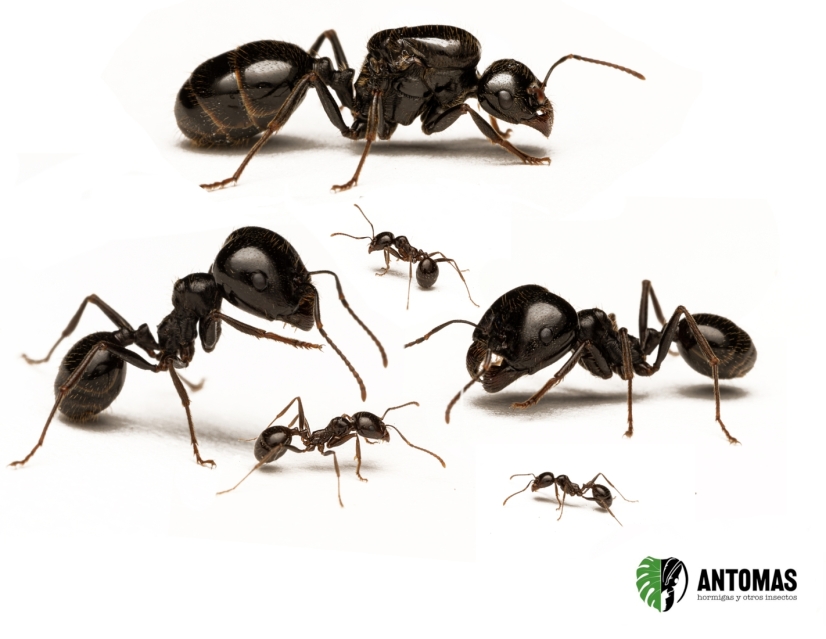
Jet-black and armed with colossal-headed majors, Messor capitatus digests its grain before eating it: its saliva turns the starch in seeds into sugar, a pre-digested mash that feeds the whole empire. Lone scouts that comb the ground one by one, colonies that sign their territory with faeces and plug their neighbours’ doors, and workers able to have fatherless daughters when they lose their queen. A Mediterranean harvester with two centuries of scientific history, perfect for beginners and for watching an empire of black heads grow, year after year. 2026 queens and colonies with a queen. Shipping across Europe, live arrival guaranteed.
The jet-black, glossy harvester of the Mediterranean, with colossal-headed majors and a saliva that turns the starch in seeds into sugar. 2026 queens and colonies with a queen. A Qbik with medium galleries, a small humid area and a very dry granary, varied seeds, plenty of protein, water always available in a tube and a winter diapause from November to March, below about 20 °C.
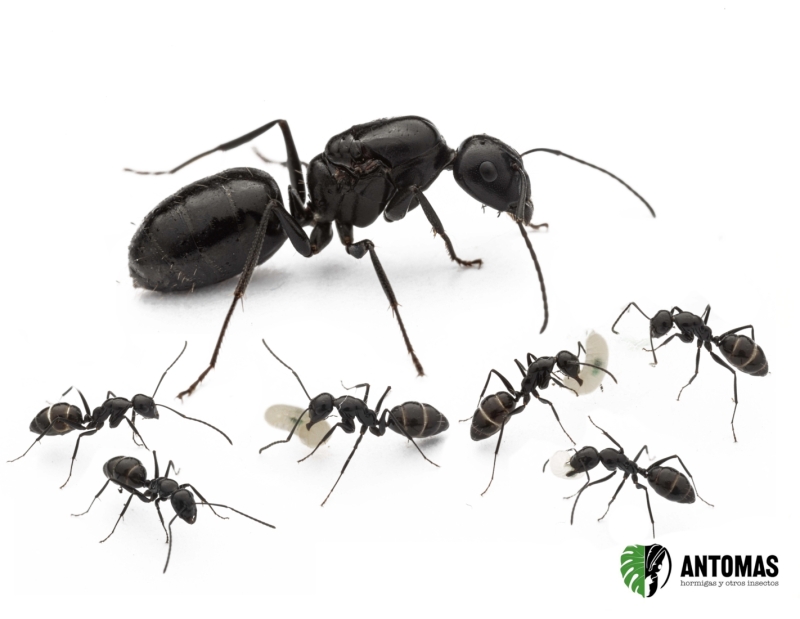
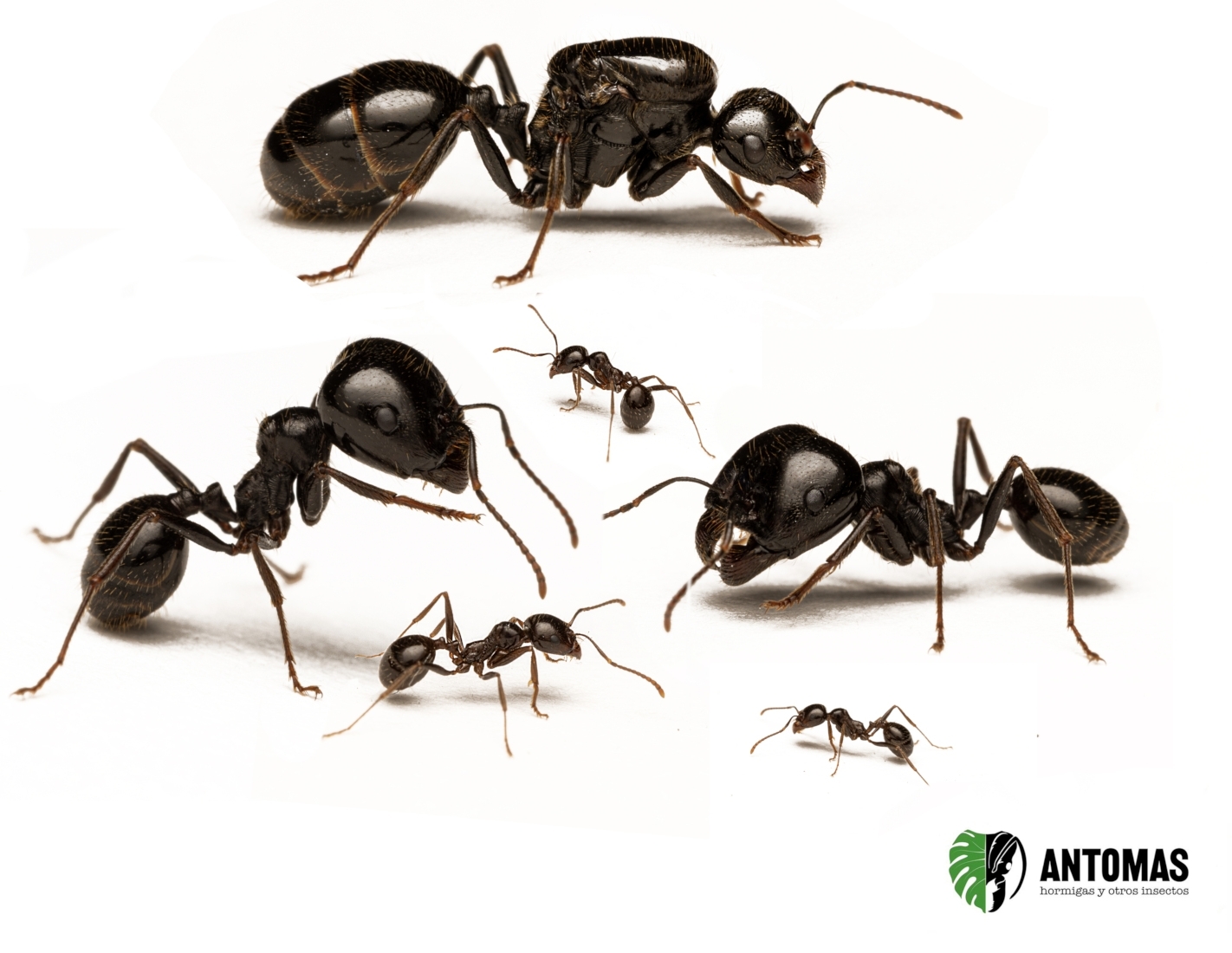
Messor capitatus (Latreille, 1798) is the other great seed harvester of the western Mediterranean: an ant as black as jet, glossy from head to gaster, whose largest workers carry a head so out of proportion that it gave the species its name. Capitatus is Latin for “provided with a head”, in other words “big-headed”, and you only need to watch one of its majors cracking open a grain of wheat to understand why. It is precisely these colossal majors that make it so striking.
It lives on dry, open ground, such as grassland, open scrub and stony slopes, from the Iberian Atlantic coast and the Balearic Islands to the Balkans, and it has also been recorded from north-west Africa: a range of hot, dry summers and winters that go from mild to cool. There it shares the landscape with Messor barbarus, with which it was long confused, but it lives differently: it does not lay down the long columns of its cousin, but searches for seeds alone, and its saliva holds one of the best-studied secrets of the seed-eating ants.
It is also a laboratory ant. A group of Italian myrmecologists has made it their model species, and thanks to them we know that these ants sign their territory with faeces, block their neighbours’ doors and, when left without a queen, can have daughters without mating. All of that fits into a formicarium at home.
Harvester ants of the genus Messor in captivity, from brood to war: “Guerras de Hormigas y cría: ¡Dentro del Poderoso Imperio Messor!” (in Spanish), by Anthouse.
Biology
Big-headed by name: majors with huge, always-black heads
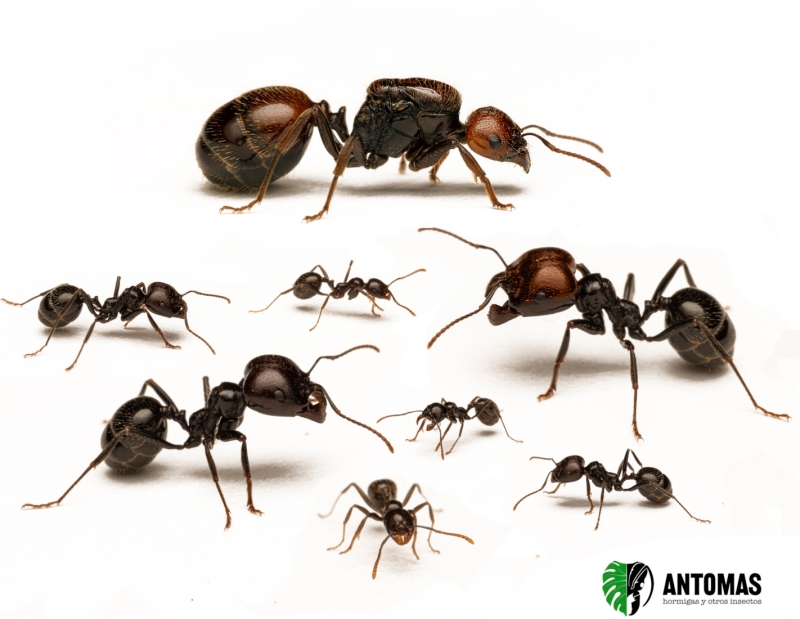
In a mature colony of M. capitatus, no two workers are alike. The smallest measure about 5 mm; the largest exceed 12, and every intermediate size lies in between. This is continuous polymorphism, with no separate castes. Size does not only change the length, but also the proportions: the bigger the worker, the more the head grows relative to the rest of the body, until you reach the majors, which seem to be made of nothing but head and mandibles.
That head is the engine of the colony. It is packed with the muscles that close the mandibles, which is why the large workers are the ones that carry the heaviest seeds and open the hard grains that the small ones cannot even bite. And it has a feature that sets it apart from its more famous neighbour: in M. barbarus, the majors usually sport a reddish head; in M. capitatus, the majors’ head is always black, as dark and glossy as the rest of the body (see “capitatus or barbarus?”).
Digestion outside the body: the saliva that turns grain into sugar
Seeds are a strange food for an ant. An adult cannot swallow solid pieces: only liquids pass through its narrow “waist”. So how does a colony that lives on dry, hard grain feed itself? That was the question the researcher B. Delage asked in 1962, and he answered it by studying M. capitatus.
First he ruled out the two ideas of his day: that the ants waited for the seed to germinate, or that they grew a fungus on it, the black mould Aspergillus niger. His ants ate healthy seeds with no fungus, and threw the germinated ones away (see the next section).
What they actually do is far more elegant. Several workers crush the seed together and lick it for a long time, until it becomes a plastic paste, shiny and soaked in saliva, which stayed moist even in nests that Delage had deliberately dried out. Then came the key experiment:
In the grains crushed by the ants, of barley and wheat, reducing sugars, the chemical trace of digested starch, appeared in 8 out of 10 tests.
In the intact grains, the 11 controls, none appeared.
The source lay in the labial glands, the salivary glands of the thorax, which produce a highly active amylase and maltase: two enzymes that break down starch and turn it into sugar.
The conclusion is astonishing: M. capitatusstarts digesting the seed outside its body. The saliva turns the starch into sugar on the grain itself, which is why, in some fifty dissections, Delage did not find a single starch grain in its gut. The famous “ant bread” of Messor is, in this species, a mash pre-digested with salivary enzymes. And there is a practical lesson: if saliva is the main ingredient of their food, a colony of harvester ants must never run out of water.
Sprouting seeds go to the rubbish heap
Along the way, Delage solved another mystery. Next to the nest entrance, a small cone of husks and debris builds up, the colony’s rubbish heap, and in it he found cut seedlings and germinated seeds. When a grain in the granary began to sprout, the workers carried it out of the nest and threw it away. It makes sense: a germinating seed spends its reserves on growing and stops being good food, and a root inside a gallery is a nuisance.
At home you will see it with your own eyes: a seed that gets damp and sprouts soon ends up on the rubbish heap in the foraging area. If many do, it is a warning that the granary is too humid (see “Recommended parameters”).
Fatherless daughters: orphaned workers that become mothers
In many ants, workers left without a queen can lay eggs, but, since they do not mate, they only produce males. That is the rule in Hymenoptera: unfertilised eggs give rise to males, and fertilised ones to females. M. capitatus is one of the few known exceptions. In 2000, an Italian and Belgian team studied queenless colonies in the laboratory and saw that the workers developed their ovaries and produced females by thelytokous parthenogenesis, that is, fatherless daughters, born from unfertilised eggs. Later on, the same colonies also produced males.
The researchers first suspected Wolbachia, a bacterium famous for manipulating reproduction in many insects and causing this kind of parthenogenesis in other groups. But the workers were not infected: the ability to have daughters without mating belongs to the ant itself.
So can a queenless colony survive without a queen? Better not to count on it: this has been studied in the laboratory, and nobody knows how often it happens in the wild or for how long it can sustain a colony. But if yours loses its queen and brood keeps appearing, you will know it is not magic.
A signature made of faeces
Around the entrance of an M. capitatus nest there is a signal that we cannot see, but that the ants read instantly: the colony’s chemical signature. In 2005, the team of the Italian myrmecologist Donato A. Grasso showed that the workers mark the nest area with faeces, “anal spots” that come from the rectal sac, the last stretch of the gut.
These spots are not mere waste. They are loaded with hydrocarbons very similar to those of the cuticle of the ants themselves, the chemical coat that every colony wears and that works as its family scent. Thanks to them, workers recognise their own territory and tell nestmates from strangers. It is as if each colony painted its family name on its front door.
In the formicarium there is no need to keep the foraging area spotless: remove food leftovers and the rubbish heap when it is time, and let them keep their scent of home.
Dirty tricks: they plug their neighbours’ doors
M. capitatus is not a quarrelsome ant in the classic sense, but it knows how to get rid of the competition. In 2004, the same team described an unusual behaviour: a group of workers stations itself in front of another species’ nest and plugs its entrances, leaving the neighbours shut in. And they do not stop there: they also interfere with their trails and steal their food right at the nest entrance, just as the rivals return laden.
It is an effective tactic: a colony that is shut in cannot forage, and the ground and its seeds are left to whoever put in the plug. According to the literature, M. capitatus also practises cleptobiosis, a technical word for something very simple: stealing seeds from other colonies, even of its own species.
Lone scouts: the harvester that does not form columns
Anyone who knows the highways of M. barbarus is in for a surprise with M. capitatus. A study comparing three Iberian Messor found that M. capitatushardly ever formed well-defined columns: while M. barbarus keeps permanent trails and M. bouvieri opens them seasonally, our species forages mostly alone. The vast majority of its workers look for seeds on their own, and the few trails it uses soon branch into short, unstable paths.
That does not mean it cannot work as a team. When a scout finds a good patch of seeds, it marks the way back with a pheromone from the Dufour’s gland, a chemical trail that fades in about 30 minutes if nobody reinforces it. To recruit nestmates, it combines that trail with runs through the nest, body vibrations, antennal contacts and small food samples. It is a flexible system: each ant on its own when seeds are scattered, and recruitment when a gold mine turns up.
It consumes far fewer seeds than the harvesters that forage in groups, and physiologists have used it as a model to measure how much energy a laden worker spends. At home you will see lone workers all over the foraging area, and an improvised caravan when they find the pile of seeds.
Gardener of the clearings
Every harvester drops the odd seed along the way, and in M. capitatus that slip has ecological consequences. The same study found that the seeds it loses end up mostly on bare soil and low, sparse vegetation, hardly ever in dense grass, so the ant works as a small sower of clearings: it leaves seeds exactly where a plant has the most room to get established.
Its appetite has also been studied from the plants’ side. In a study of Erodium paularense, a threatened endemic of the mountains of central Iberia, seed-harvesting ants took a significant share of its seeds, and M. capitatus appears among them in the literature. Another study compared how M. capitatus and M. bouvieri exploit food when they share ground in Spain. And, with artificial seeds, it showed no preference for size: it is a generalist.
Two centuries in the shadow of M. barbarus
The French naturalist Pierre André Latreille described it in 1798 as Formica capitata, from workers collected in France. For much of the nineteenth century it was treated as a synonym and then as a subspecies of M. barbarus, until, towards the end of that century, most authors recognised it as a valid species. The current Iberian key groups it with M. barbarus, M. ibericus and M. erwini.
The story is not over. In 2023, M. erwini was described, a new species from Catalonia separated from M. capitatus using genetics and morphometrics, and so similar that measurements and formulae are needed to tell them apart. And some specialists suspect that the western and eastern Mediterranean populations might in fact be a species complex. This black harvester may still hold a taxonomic surprise or two.
Storm flights and a single queen
M. capitatus colonies are monogynous: a single queen per nest, which, according to keepers, can gather several thousand workers; there are no scientific counts of its colonies. Nests are dug in the soil, often under stones, with chambers for the brood and granaries where seeds pile up.
Like M. barbarus, it flies in autumn. In Antomas’ experience, the nuptial flights of M. capitatus usually take place from September to November, on mild, humid afternoons, often after the first rains or a storm. The classic literature on the ants of western Europe mentions flights from June, but in Iberia autumn is the norm. After the flight, the mated queen sheds her wings, digs a chamber and starts her colony alone: she is a claustral foundress, who raises her first workers on her own body reserves, without going out to feed.
Size and morphology
A robust myrmicine with a compact body and a polished look, with a range of sizes running from the tiny worker to the big-headed major.
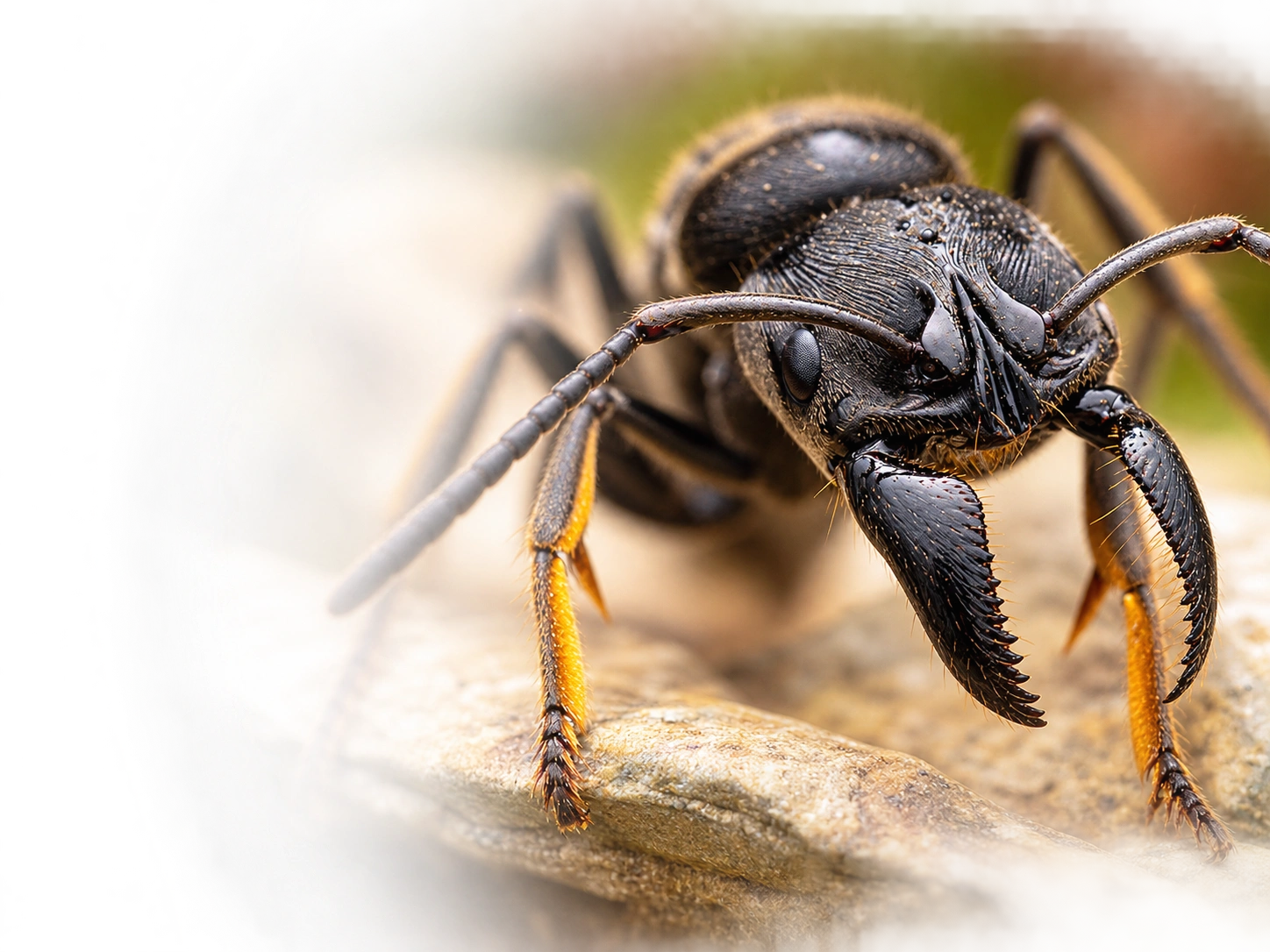
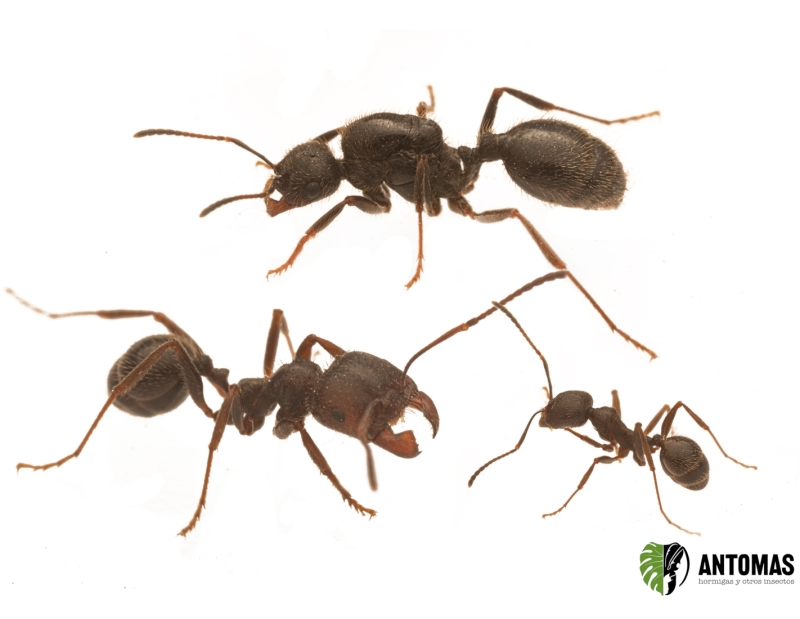
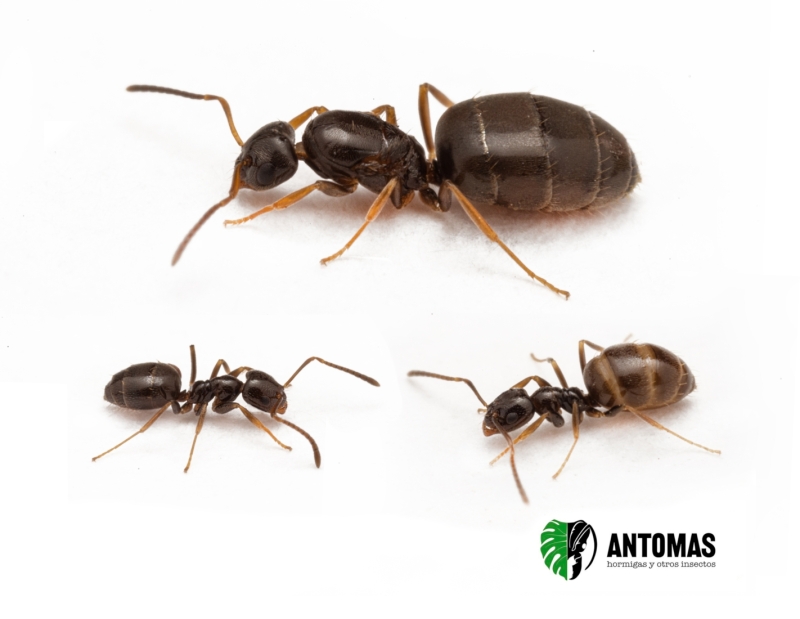
Colour. Uniform, very glossy black in every size, like polished jet. The mandibles and the tip of the antennae lean towards reddish brown. Unlike M. barbarus, the majors do not turn reddish: their head is always black.
Majors’ head. Huge and lustrous, much broader in proportion than that of the small workers, with broad mandibles built for grinding.
Propodeum. In profile, the rear part of the thorax forms a distinct angle in the majors; in the minors it is rounded or barely angular.
Sculpture. Sparse, with smooth, shiny areas. The minors have fine transverse striae on the top of the propodeum, and the majors a more rugose pronotum.
Pilosity. Short hairs all over the body, more abundant on the gaster. It lacks a psammophore, the “basket” of long hairs that other Messor carry under the head to transport sand.
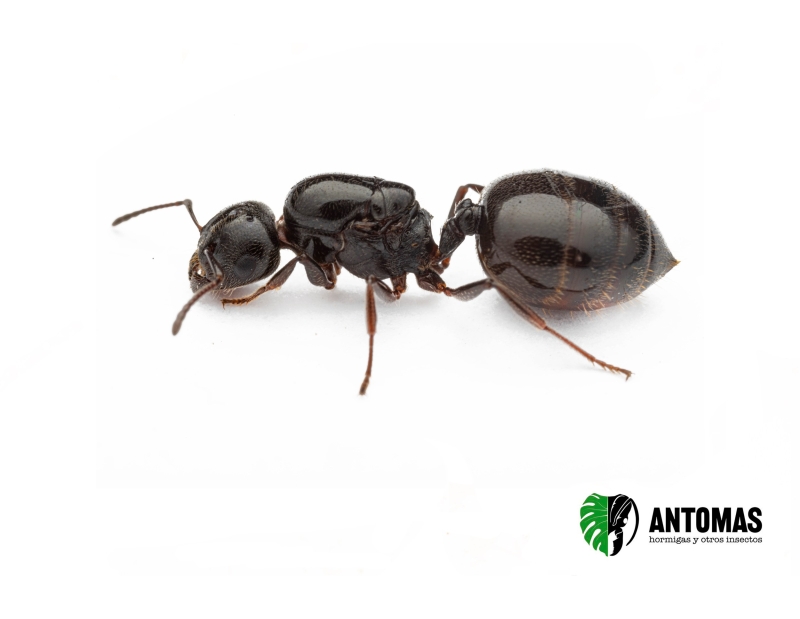
Queen. Larger than any worker and the same glossy black. After the flight she loses her wings, and the scars remain on her thorax, which is much bulkier than that of the workers.
Male. Winged, slighter and more slender than the queen, and short-lived: it lives only for the autumn flight.
Development. Naked pupae, without a cocoon, as in all myrmicines. Keepers reckon on about 7–8 weeks from egg to worker at a good temperature.
capitatus or barbarus? The head-and-corner test
In the field, and sometimes at home, the two large black harvesters of Iberia get confused. The worker key to the Iberian Messor by Arcos and Fede (2023) gives a clear rule, as long as you look at workers of all sizes, especially majors, because the minors of M. barbarus also often have a black head.
M. capitatus: uniform, glossy black; majors with an always-black head and an angular propodeum; forages with lone workers.
M. barbarus: black body and majors with a reddish or dark garnet head; rounded propodeum in all sizes; forms columns and permanent trails.
M. ibericus: light brown to dark chestnut, matt and heavily sculptured, with plenty of erect hairs on the rear margin of the head. In Iberia it represents the M. structor group, which was split into five species in 2018.
M. erwini: known only from Catalonia. Its majors sometimes have a reddish head and more sculpture on the front of the head, but separating it from M. capitatus requires measuring several parts of the body.
In a nutshell: if the major has a red head, it is M. barbarus; if it is coal-black and the propodeum has a corner, it is M. capitatus. For queens there are no published characters that separate them reliably, so final confirmation comes with the colony’s first majors.
Approximate measurements
Workers: from about 5 mm to just over 12 mm, from minors to majors
Queen: no published scientific measurements
Male: no published scientific measurements
The worker measurement comes from the taxonomic literature. For the queen and the male, only shop figures are in circulation, and we do not include them.
Care in captivity
Difficulty: 1/5 – Beginner
For Antomas, M. capitatus is an excellent starter species: hardy, not much of an escape artist, harmless to people and with a diet anyone can keep in the larder. Some keepers find it slightly more demanding than M. barbarus; in our experience, all it asks for is consistency: varied seeds always available and a granary that stays dry.
In return, it puts on quite a show: big-headed majors cracking grains, scouts all over the foraging area and a granary that fills up before your eyes. And if harvester ants win you over, at Antomas you will also find the Iberian M. ibericus and M. dentatus, from the eastern Mediterranean.
Recommended parameters
Temperature in the active season: 22–28 °C in the nest, the range keepers agree on, and the foraging area a little warmer, up to about 30 °C. If you add heat, make it gentle and put it at one end of the foraging area, never under the nest.
Humidity, in two separate worlds: a small humid area for the brood and a very dry granary taking up a good part of the nest; some keepers recommend that at least half of it be completely dry. The foraging area, dry.
Water: always available, in a test tube with cotton wool placed in the foraging area; in the hot months, preferably two.
Light: foraging area lit with the normal household cycle and nest in semi-darkness, with no direct sun.
Diapause: essential, from November to March, with the colony below about 20 °C; details further down.
The classic mistake with this species is to dampen the whole nest: the seeds germinate, go mouldy and end up clogging the galleries. If you see white fluff in the granary, let that area dry out.
Recommended formicaria
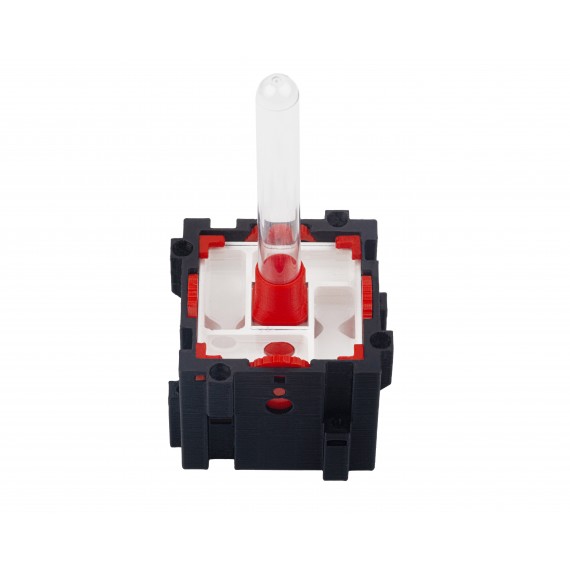
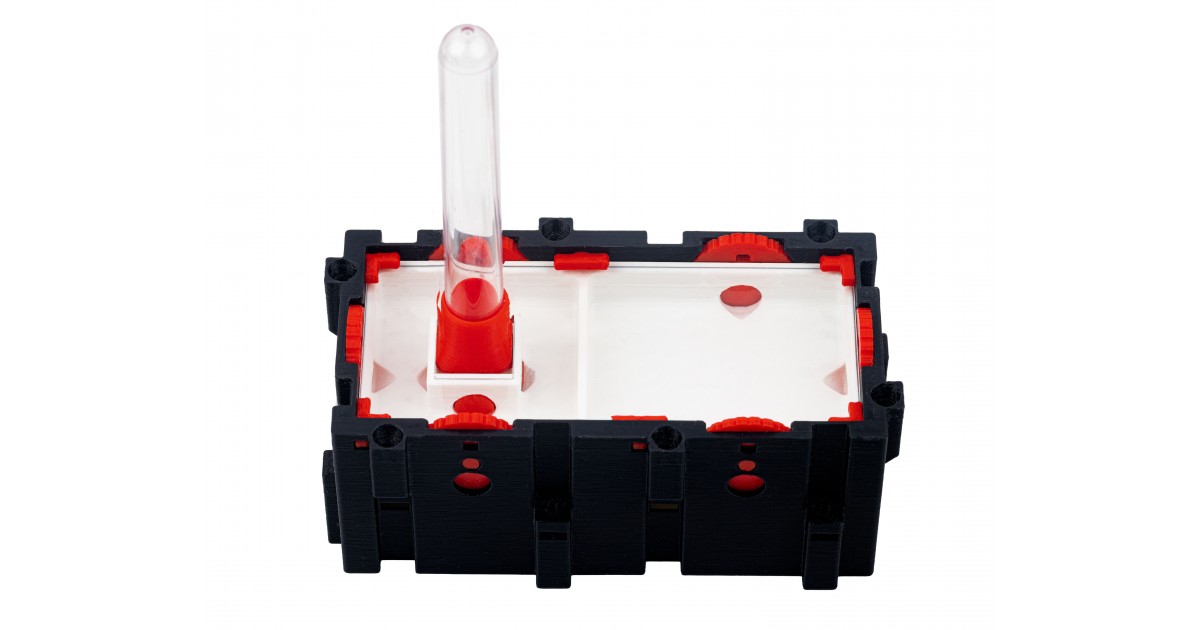
At Antomas we go for the Alpha range of Anthouse Qbiks, modular and rather dry, perfect for a seed-eater that needs a granary free of humidity. As a first nest, a QBIK ONE with medium galleries: the queen and her first workers settle in comfortably and the granary is easy to see.
When the first majors appear, their heads will need wide corridors. That is the time to expand with the QBIK DUO, and from then on keep growing always with larger galleries:
No plaster, no Ytong, nothing that gives way. Like M. barbarus, these harvesters gnaw: their mandibles, built to open seeds, crumble plaster, aerated concrete and any soft material. In a keeping journal posted on a forum, a colony began digging into its nest substrate two days after moving in. Choose a professional formicarium made of a material they cannot get through.
To complete the set-up:
The granary, away from the water. Position the formicarium so that the dry area is on the side opposite the moisture; the ants will carry the seeds there themselves.
A feeder for nectar, if you offer it: never on cotton wool, which turns mouldy and ruins the liquid, but in a feeder that keeps the drop within reach.
A corner for the rubbish heap: a clear corner of the foraging area, with a little dry sand if you like, for husks and germinated seeds.
Founding with a 2026 queen
The 2026 queens we sell are from this season, mated during the autumn flights. Since they found claustrally, they do not need to eat: just a test tube with its water reservoir behind the cotton wool, darkness and peace.
Her first diapause, without heating. Your queen arrives on the threshold of winter: at Antomas we recommend letting her go through diapause naturally, in a cool place, below about 20 °C, until March. Whether or not she already has eggs, do not warm her up to bring the brood forward.
A glance now and then to check that the tube still has water; if it runs out or the cotton gets dirty, move her to a new tube with a gentle tip-out.
The first seeds. When the first workers hatch, offer small, soft seeds, such as poppy, chia or cracked canary seed, at the dry end of the tube, and a pinch of protein. Remove whatever they do not eat.
Patience with the nanitics. The first workers are small; the real majors arrive in the second year (see “Growth and the mature colony”).
Into the nest, with a few dozen workers, by tipping out (see “Arrival and moving”).
One queen per tube. It is a monogynous species: do not put queens together to found.
Arrival and moving
When your colony arrives, leave it for a few hours somewhere quiet, at room temperature, and check that it has water. To set it up, at Antomas we do it by tipping out: the tube is opened next to the nest entrance and the whole colony is tipped in, with its queen, brood and seeds, helped along with a few gentle taps and a fine brush for the stragglers. Do it decisively: within a few hours they will have chosen their brood corner. Every expansion is done the same way.
Feeding
Seeds, always varied. We see it every day at Antomas: they like practically everything. Offer mixes with canary seed, millet, linseed, wheat, barley, oats, poppy, chia, quinoa or dandelion, and now and then a little crushed walnut or almond, unsalted and unroasted. Until there are majors, small or cracked seeds are best.
Always dry. Put the seeds in the foraging area, away from the water tube, and leave the ants to haul them into the granary.
Variety before quantity. Giving a single type of seed is one of the typical mistakes: mix and rotate.
Germinated seeds, out. The ants throw them onto the rubbish heap themselves; you remove the heap from time to time, along with any mouldy seed.
Protein, lots of it. Grain keeps the colony going, but what makes it grow is protein. Without it there is no egg-laying and no larvae turning into workers, let alone majors. At Antomas we recommend insects such as Thermobia domestica, perfect for founding queens and small colonies, crickets, dubia roaches or red runner roaches, as well as chicken, tuna or pinkies. Meat and fish are best cooked, and any animal protein they have not touched within 24–48 hours should come out. Switch the type of insect every week, so that their diet never becomes monotonous.
Feed a lot, clean a lot. With daily maintenance and removal of leftovers, a well-fed colony understands that it has resources to spare and grows faster and with more workers. If cleaning cannot be frequent, cut back the amount: forgotten protein attracts mould and mites.
Sugar, only once in a while. It is not their thing: they already get much of the sugar they need from the starch in the seeds. As a supplement, you can offer them, always in a feeder rather than on cotton wool, Anthouse Blue Sugar Nectar; at Antomas we give it only once or twice a month. Thick honey is best avoided: they get stuck in it.
Water, without exception. In its tube, all year round, during diapause too.
Diapause
Throughout its range, winter forces M. capitatus to stop: it ceases rearing brood and lives on what it stored in the granary. At home that rest, the diapause, must be respected. At Antomas we recommend it from November to March, with the colony below about 20 °C. Many keepers do it colder, at 10–15 °C, and that works too. You do not need a fridge: an unheated room, a storeroom or a cool garage usually does the job.
Gentle drop and rise, over the course of November and March.
Water always; food, hardly any, since they will live off their granary. Leave a few seeds in case they come out.
No artificial heat during the rest.
2026 queens and young colonies too: this season’s queens go through their first diapause without heating.
You will know the colony is in diapause because activity drops, protein stops interesting them and brood rearing stops. In spring, as the temperature rises, the queen resumes laying and the granary starts working again.
Growth and the mature colony
In the first year, be patient: an M. capitatus colony grows slowly, with small and medium workers. According to keepers, the turning point comes in the second year, when the first large majors hatch: from then on the colony can open any seed, the granary fills up and growth takes off. With plenty of protein, space and well-managed diapauses, within a few years you will have a colossal empire of black heads.
An empire of M. capitatus in captivity: “Las hormigas recolectoras colosales” (in Spanish), by Anthouse.
Combat queens. In the flight season, a mature Messor colony may raise winged princesses that, unable to fly, shed their wings and join the nest as workers and warriors. These are the famous combat queens, boundlessly aggressive, and the workers themselves end up eliminating them if they serve no purpose. We explain it in detail in the Messor barbarus care sheet; if they turn up in your colony, you do not need to do anything.
One colony, one formicarium. Never connect two colonies: in the wild they block their neighbours’ doors and defend their ground (see “Dirty tricks”).
Made to be watched. A harvester colony is there to be watched at work, not hidden in a cupboard: with the brood in semi-darkness and the foraging area lit, they soon get used to your presence.
Signs to watch for: if the queen leaves the nest, check the water; if there is mould in the granary, there is too much humidity; if the rubbish heap fills with germinated seeds, dry the nest; and if you see workers crowded in the foraging area, it is time to expand.
Escapes and handling
From what we see at Antomas, they do not escape as long as they have food, water and space; when any of these is lacking, they do try to get out. According to keepers, they also struggle to climb smooth surfaces such as glass, so a PTFE or mineral oil barrier on the rim of the foraging area is more than enough. What you do need to watch is their fondness for gnawing: stoppers, joints and soft parts.
They are harmless to people: they do not spray formic acid or sting noticeably, and a major’s pinch can be felt but does not hurt. Handle them with a soft brush, more for the queen’s sake than yours, and never release them into the wild, even though the species is native to much of southern Europe.
What not to do
Housing them in a plaster, Ytong or any soft-material nest.
Dampening the whole nest: the granary must be dry.
Always giving them the same seed.
Forgetting to remove uneaten animal protein after 24–48 hours, or leaving mouldy seeds.
Skimping on protein: without it, the colony does not grow.
Giving them nectar every day: for a seed-eater it is an occasional extra.
Putting nectar on cotton wool or leaving water uncovered.
Leaving them without water, not even during diapause.
Warming a 2026 queen in winter so that she breeds sooner.
Skipping diapause or going from warm to cold overnight.
Putting queens together or connecting colonies.
Hiding the formicarium: it is there to be watched.
Scientific sources
This care sheet combines the scientific literature on Messor capitatus and its genus with what we have learnt at Antomas and what other keepers report. Main references:
Delage, B. (1962). Recherches sur l'alimentation des fourmis granivores Messor capitatus Latr. Insectes Sociaux 9: 137–143. doi:10.1007/BF02224260
Baroni-Urbani, C. & Nielsen, M. G. (1990). Energetics and foraging behaviour of the European seed harvesting ant Messor capitatus. II. Do ants optimize their harvesting? Physiological Entomology 15: 449–461. doi:10.1111/j.1365-3032.1990.tb00534.x
Cerdá, X. & Retana, J. (1994). Food exploitation patterns of two sympatric seed-harvesting ants Messor bouvieri (Bond.) and Messor capitatus (Latr.) from Spain. Journal of Applied Entomology 117: 268–277. doi:10.1111/j.1439-0418.1994.tb00735.x
Grasso, D. A., Mori, A. & Le Moli, F. (1998). Chemical communication during foraging in the harvesting ant Messor capitatus. Insectes Sociaux 45: 85–96. doi:10.1007/s000400050071
Grasso, D. A., Wenseleers, T., Mori, A., Le Moli, F. & Billen, J. (2000). Thelytokous worker reproduction and lack of Wolbachia infection in the harvesting ant Messor capitatus. Ethology Ecology & Evolution 12: 309–314. doi:10.1080/08927014.2000.9522803
Grasso, D. A., Mori, A., Giovannotti, M. & Le Moli, F. (2004). Interspecific interference behaviours by workers of the harvesting ant Messor capitatus. Ethology Ecology & Evolution 16: 197–207. doi:10.1080/08927014.2004.9522631
Grasso, D. A., Sledge, M. F., Le Moli, F., Mori, A. & Turillazzi, S. (2005). Nest-area marking with faeces: a chemical signature that allows colony-level recognition in seed harvesting ants. Insectes Sociaux 52: 36–44. doi:10.1007/s00040-004-0762-0
Albert, M. J., Escudero, A. & Iriondo, J. M. (2005). Assessing ant seed predation in threatened plants: a case study. Acta Oecologica 28: 213–220. doi:10.1016/j.actao.2005.04.005
Arnan, X., Retana, J., Rodrigo, A. & Cerdá, X. (2010). Foraging behaviour of harvesting ants determines seed removal and dispersal. Insectes Sociaux 57: 421–430. doi:10.1007/s00040-010-0100-7
Plowes, N. J. R., Johnson, R. A. & Hölldobler, B. (2013). Foraging behavior in the ant genus Messor (Hymenoptera: Formicidae: Myrmicinae). Myrmecological News 18: 33–49. Full text in Myrmecological News
Steiner, F. M., Csősz, S., Markó, B., Gamisch, A. et al. (2018). Turning one into five: integrative taxonomy uncovers complex evolution of cryptic species in the harvester ant Messor “structor”. Molecular Phylogenetics and Evolution 127: 387–404. doi:10.1016/j.ympev.2018.04.005
Arcos, J. & Fede, G. (2023). Hormigas de la Península Ibérica y Baleares: worker key to the genus Messor, illustrated by P. Alarcón.