This website uses its own and third-party cookies to improve our services and show you advertising related to your preferences by analyzing your browsing habits. To give your consent to its use, press the Accept button.
Functional cookies are strictly necessary to provide the services of the shop, as well as for its proper functioning, so it is not possible to refuse their use. They allow the user to browse through our website and use the different options or services that exist on it.
Cookie
Provider
Purpose
Expiry
PHP_SESSID
antomas.es
The PHPSESSID cookie is native to PHP and allows websites to store serialised status data. On the website it is used to establish a user session and to pass state data through a temporary cookie, which is commonly known as a session cookie. These Cookies will only remain on your computer until you close your browser.
Session
PrestaShop-#
antomas.es
This is a cookie used by Prestashop to store information and keep the user's session open. It stores information such as currency, language, customer ID, among other data necessary for the proper functioning of the shop.
These are cookies that collect information about the advertisements shown to users of the website. They can be anonymous, if they only collect information about the advertising spaces shown without identifying the user, or personalised, if they collect personal information about the user of the shop by a third party, for the personalisation of these advertising spaces.
Collect information about the user's browsing experience in the shop, usually anonymously, although sometimes they also allow the user to be uniquely and unequivocally identified in order to obtain reports on the user's interests in the products or services offered by the shop.
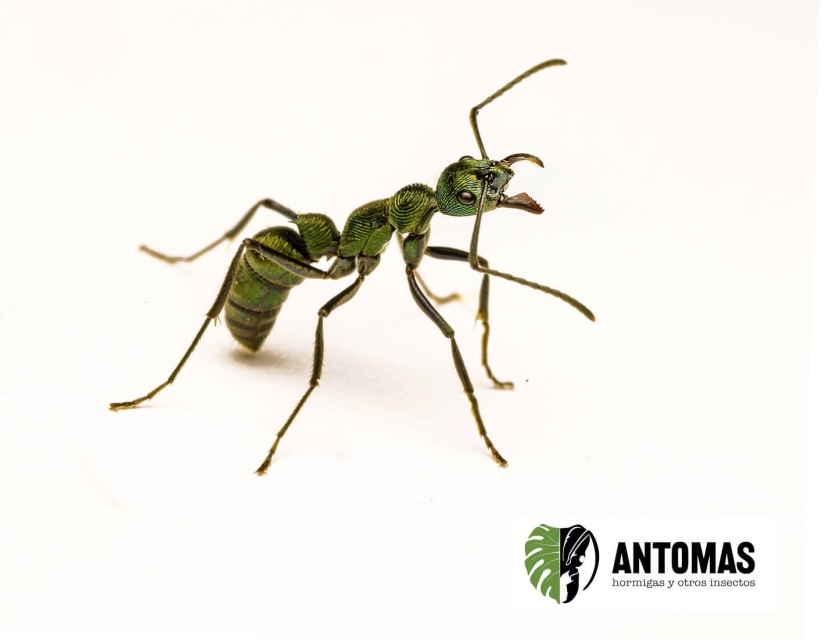
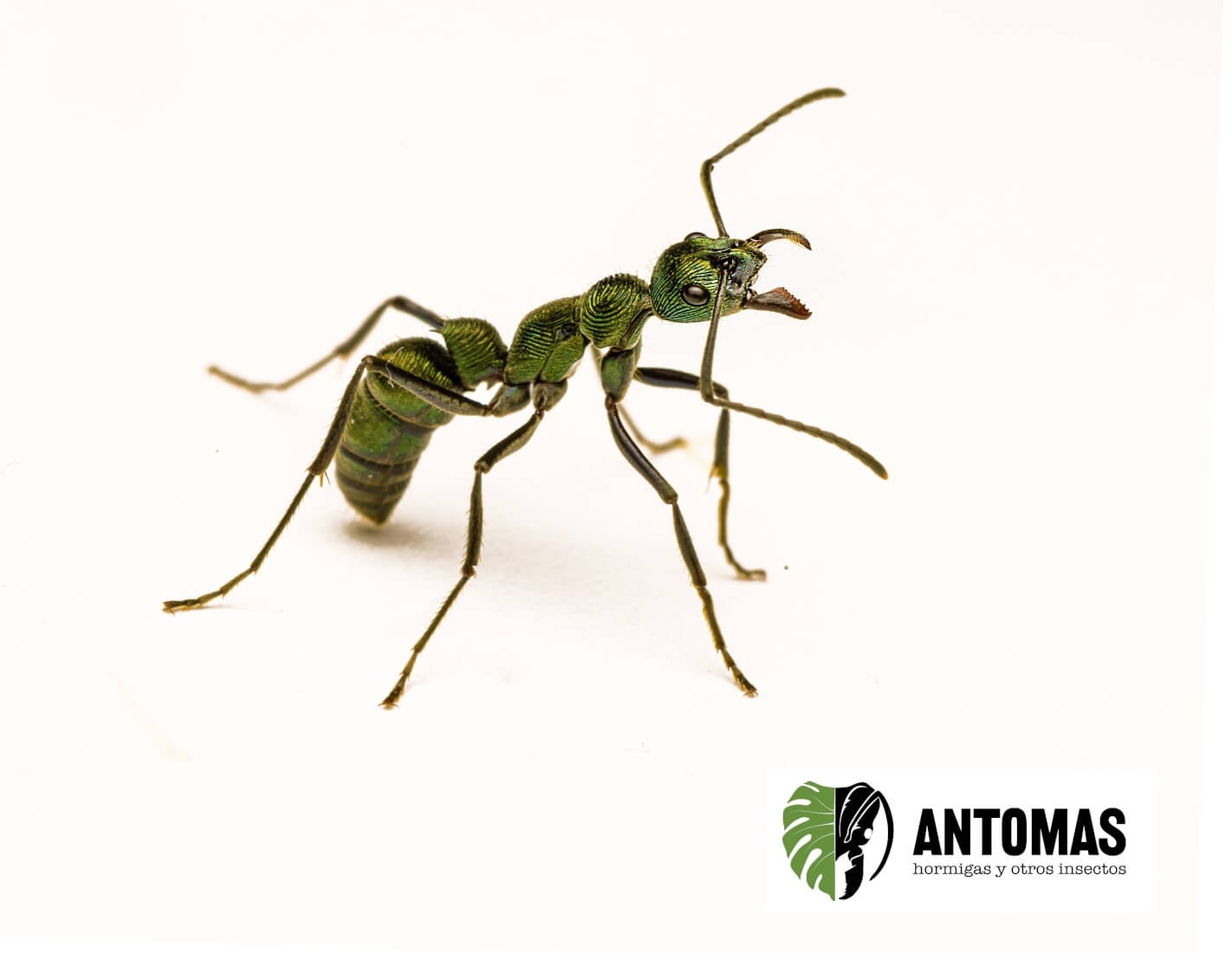
Diacamma viridipurpureum viridipurpureum - Green Morph
Last items in stock
€249.99
VAT included
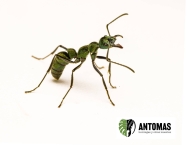
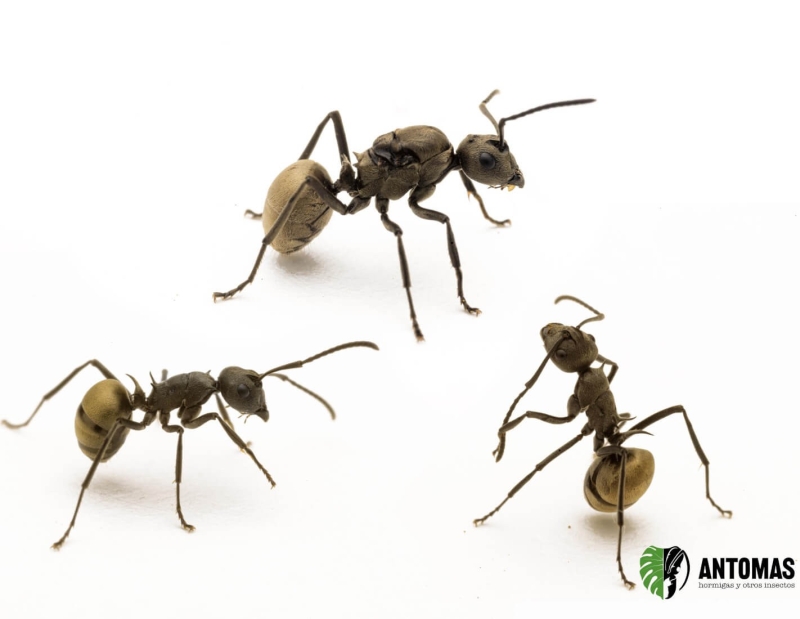
Green and purple like a jewel, as deadly as a born hunter. The original form of Diacamma viridipurpureum, described in 1893 on the outskirts of Manila, patrols alone and pounces on any arthropod with boundless ferocity. No queen here: power belongs to a gamergate, a fertile worker who bites off her sisters' gemmae so that she alone can reign. Every colony shows its own blend of green and purple, and the workers carry nectar home as a shining drop between their mandibles. For experienced keepers looking for something truly unique. Colonies with a gamergate. Shipping throughout Europe, live arrival guaranteed.
A Philippine Diacamma with green and purple highlights: a fierce hunter of other arthropods, yet calm with people. They have no queen: the eggs are laid by a mated worker, the gamergate. Its colours vary from colony to colony: some show a purple head and a green thorax, others the exact opposite. Very humid nest (60–80 %), 24–28 °C, active all year round.
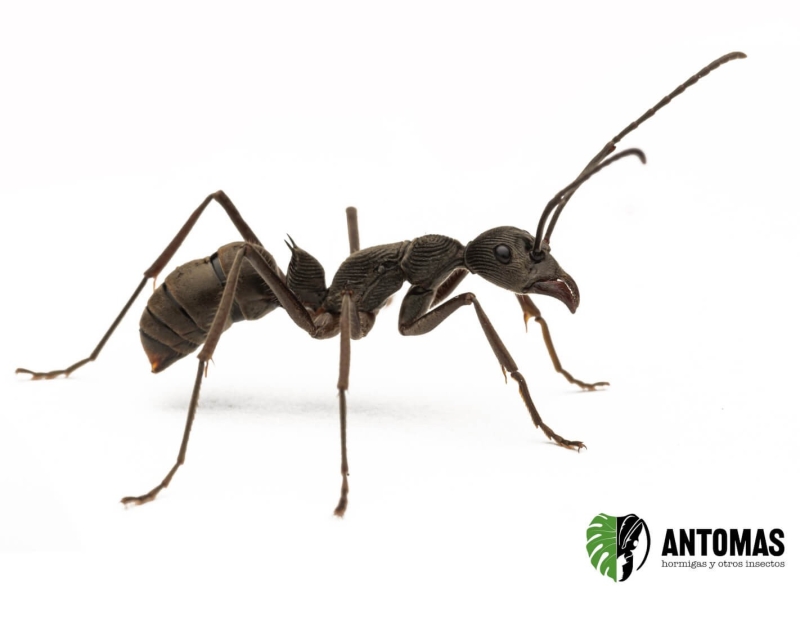
Picture an ant more than a centimetre long walking the ground on its own, head held high and eyes alert, and throwing itself without hesitation at a cricket its own size. Now add a body that, depending on the light, shifts from black to bottle green and purple. That is Diacamma viridipurpureum, the Green Morph from the Philippines: a ponerine with a boundless ferocity towards any other arthropod and the look of a jewel. Behind that façade lies a society without a queen, in which a single mated worker, the gamergate, keeps egg-laying to herself and prevents all the others from reproducing.
It is worth making one thing clear from the outset: this species is known from its description and its diagnostic characters, but nobody has yet studied its life inside the nest. What we know about its biology comes from other Diacamma that have been researched in depth (the Australian D. australe, the Indian D. ceylonense and D. indicum, and the Diacamma from Okinawa), which share the same social model. We say so whenever we extrapolate.
Biology
What is a gamergate?
It is the name given to workers that mate and lay fertilised eggs, taking on within their colony the role that a queen plays in almost every other ant. The term comes from Greek: gamos means "wedding" and ergátēs "worker". A gamergate is, quite literally, a "married worker".
No queen is known anywhere in the genus Diacamma: since the first excavations more than a century ago, nobody has found a winged female. Every female leaves the cocoon as a worker and, in each colony, only one of them, almost always mated to a single male, takes charge of reproduction. The differences from a true queen are huge:
She has never flown. She has no wings and no remnants of flight muscles, so there is no nuptial flight: mating takes place next to the nest.
She is the size of any other worker. When 26 colonies of D. ceylonense were examined, the gamergate turned out to be the only one with active ovaries and sperm, yet her size did not set her apart from the rest.
Her role is earned as an adult. No larva is reared to become a gamergate: the position is settled among adults, through the relationships inside the nest. Once she holds it, her chemical profile changes, that is, the blend of hydrocarbons coating her cuticle that her nestmates "read" with their antennae. The activity of a handful of genes changes too, mostly genes linked to nutrition, and it does so almost as soon as she takes the dominant position, as shown in the Diacamma from Japan.
How can you spot her with a magnifying glass? By her thorax: she is the only female in the nest that still has her gemmae, two tiny appendages that all the others lost when they emerged (more on this below). She rules modest colonies: between 30 and 300 workers in the Okinawa species, around 230 females on average in D. ceylonense and roughly 273 in the "nilgiri" form, the record for the genus.
Who is the Green Morph? The original form of the species
"GREEN" is the trade name. Its full scientific name is Diacamma viridipurpureum viridipurpureum (Emery, 1893): it is the nominate form, in other words the population from which the species was first described. The Italian myrmecologist Carlo Emery published it in 1893 as a variety of D. geometricum, based on workers that the French arachnologist Eugène Simon had collected in 1890 at Antipolo, on the outskirts of Manila, on the island of Luzon. The Antomas line comes from the Philippines.
For more than a century it was barely mentioned again. In 2015, Alice Laciny, Anna Pal and Herbert Zettel revised the Philippine Diacamma, treated it as a valid species and designated one of Simon's workers, kept at the Natural History Museum in Genoa, as its reference specimen (lectotype). In the same work they described its blue subspecies, D. viridipurpureum quezonicum, from eastern Luzon. A curious detail from its AntWiki page: obtaining more specimens from the type locality is now difficult, because Antipolo has been swallowed up by the urban sprawl of Manila.
The name says it all: viridis is Latin for "green" and purpureus for "purple". Of the three colourful Diacamma we keep at Antomas, two belong to this species: the Green Morph is the nominate form, and its "cousin", the Blue Morph, D. viridipurpureum quezonicum, is the blue-sheened subspecies. The third, the Purple Morph, Diacamma excellens, is a different species, also from the Philippines. And if you are looking for a Diacamma without a metallic sheen, the classic choice is Diacamma rugosum.
Diacamma Mayr, 1862 now includes about 44 valid species and more than 20 subspecies (Bolton, 2024), spread across India, southern China, Japan, Southeast Asia and northern Australia, and the Philippines is one of the regions with the most metallic forms. In the wild they nest in the soil, in simple nests: in D. indicum, almost every nest studied had a single entrance leading to a single chamber.
Green, purple… and different in every colony
The scientific description of the nominate form speaks of a moderate, polychrome sheen on the trunk, dominated by dark greens and purples, and notes that areas of both colours are always present. The mandibles, antennae and legs, on the other hand, are dark brown to black, with no metallic reflections.
That matches what we see at Antomas, with one important nuance: the colouring varies considerably from one colony to another. In some, the head is purple while the thorax shines green and the gaster mixes green and black; others reverse it: the head, or at least its edges, green and the rest of the body purple. Sometimes the Green and Purple Morphs even share shades, so colour alone is not enough to tell which species you are looking at. What never changes is that the legs and antennae stay dark, with no sheen.
Nor should it be confused with another Philippine species described in 2015, D. generali, from the Mount Makiling area (Luzon): its sheen is greenish or bluish green and weaker, with no trace of purple, and its clypeus is densely punctured. The subspecies quezonicum differs from the Green Morph in its intense blue and in a small depression on the clypeus that the nominate form lacks; and D. caeruleum, from Mindoro, is blue as well.
Where do these colours come from? Nobody has studied it in Diacamma, but in insects metallic sheens are usually structural colours: microscopic layers in the cuticle that reinforce some wavelengths and cancel others, with no pigment involved. That is why the Green Morph looks almost black in the dimness of the nest and "lights up" in green and purple when it goes out hunting under a lamp, and why its shade changes as the viewing angle changes.
The first gamergate was discovered in the Philippines
The story of reproductive workers begins on the same islands as the Green Morph. The entomologist James W. Chapman spent six years in Dumaguete, on the island of Negros, where Diacamma were common from the coast up to about 900 metres. There he found a worker in the act of mating with a male, and in 1922 he and William M. Wheeler published what he had seen.
They dissected more than twenty workers from three colonies: almost none had developed ovaries, but the mating one had five ovarioles in each ovary and a spermatheca full of sperm. Their conclusion was that, in these ants, only one worker is fertilised and takes on the role of the queen. They also noticed that some males had their wings gnawed off at the base, perhaps to keep them from leaving the nest. The word "gamergate" would not exist for another sixty years, but the idea was already there. And the form they studied was then called D. rugosum geometricum: the same group in which Emery had described our Green Morph as a variety.
Wings turned into a fertility switch
Every Diacamma worker emerges with two gemmae, small bulges on the sides of the thorax, covered in sensory hairs and equipped with a gland. Their origin is surprising: in the larva, wing buds form and then almost entirely die off through programmed cell death, and the small part that survives becomes the gemma. What in other ants would be a queen's wings has here been turned into the organ that decides who may reproduce.
The gamergate keeps watch over every emergence. As soon as a newly emerged worker, still pale and soft (a callow), is within reach, she bites off its gemmae. From that moment on, the worker will never perform the sexual call or accept a male. The effect is permanent: without the gemma, the nerve fibres linking its sensory hairs to the nerve centres wither away, which would explain why there is no going back.
Beware of an error repeated all over the internet: mutilation does not happen at the pupal stage, but to adults that have just left the cocoon. These offer no resistance to an established gamergate, although they do behave aggressively towards other intact callows, their potential competitors.
The newborn carries the signal
An experiment with two Diacamma from southern India revealed what triggers mutilation. In one of them, the form known as "nilgiri", the gamergate never mutilates and keeps her monopoly through dominance alone. When cocoons were moved from one species into a colony of the other, "nilgiri" workers emerging among D. ceylonense were spared the bite, whereas D. ceylonense workers were mutilated even in a "nilgiri" colony, where this behaviour does not exist. The signal, therefore, comes from the emerging worker herself, most likely through her gemmae, and not from her surroundings.
Succession, the sexual call and a two-day mating
While the gamergate is alive, no worker keeps her gemmae long enough to challenge her. When she dies, mutilation stops, and her place is almost always taken by the first worker to emerge with her gemmae intact, as soon as she manages to mate. Thanks to this succession, a colony can last far longer than the life of any of its members.
To mate, the candidate positions herself at the nest entrance a few days after emerging and performs the sexual call: she releases a pheromone produced by the metatibial gland (on the tibia of each hind leg) that attracts winged males from other colonies. Mating can last up to two days, and once it is over, the new gamergate and her nestmates kill the male and remove the body. That single mating gives her enough stored sperm for the rest of her life. In captivity, that male must come from another colony (see "If the gamergate dies").
Workers that lay in secret
A mutilated worker cannot mate, but her ovaries still work: she can lay unfertilised eggs, which only ever produce males. When there is a gamergate, she hardly ever tries; in orphaned colonies, on the other hand, it is common. In the Diacamma from Japan a double control has been demonstrated: both the gamergate and the other workers attack any worker that tries to lay.
That control is not equally strict at every stage. A 2018 study showed that only colonies with a hundred workers or more produced males (of 56 males analysed, 47 came from colonies of more than a hundred workers and not a single one from colonies with fewer than fifty), and that in the laboratory around 58 % of the males had been laid by virgin workers rather than by the gamergate. As the colony grows, policing loosens and workers succeed in sneaking in sons of their own.
New colonies by splitting
With no winged queens, there are no nuptial flights or solitary founders. To multiply, the colony splits in two (fission): a group of workers leaves with a new gamergate for another nest. Nobody has published what proportion of the colony leaves at each split. In the laboratory both divisions and fusions have been observed, and in D. indicum researchers have studied how the two halves of a divided colony react when they meet again.
Moving house in pairs, with guides that find shortcuts
To recruit, Diacamma do not lay pheromone trails: they use tandem running. A worker that knows the destination walks slowly ahead while another follows closely, touching her abdomen with its antennae. When a colony of D. indicum moves, most females travel this way, the gamergate included, while males and brood are carried in the mandibles; and the follower often carries a larva or pupa at the same time, so that each trip moves one adult and one item of brood.
The guides also learn and correct themselves. When researchers moved the target nest in the middle of a relocation, most guides adjusted their course with an error of just 1.65 % (262 guides studied); when the main guide was removed, others took over without the pace dropping; and, faced with several possible routes, they chose the shortest far more often than chance would predict.
A drop of nectar between the mandibles
Diacamma have a very particular way of bringing liquids home. Besides drinking and storing liquid in the crop, like any ant, they can hold a drop between their mandibles, kept intact by surface tension, and then share it among their nestmates without swallowing or regurgitating it. This is called pseudotrophallaxis.
A 2023 study on colonies from Okinawa showed that they choose the method according to the viscosity of the liquid, not its sweetness: with thick liquids that are hard to drink, they switch to the mandible drop and collect more liquid in less time. The drops measured about 1 µl, and loaded workers walked almost as fast as the others. With a thick nectar or with the milk-and-honey mix we recommend below, you may well see your workers return to the nest carrying a shiny droplet between their mandibles.
Each worker, her own heading
They are daytime hunters that work alone. In D. ceylonense, about a quarter of the workers (24 %) are outside the nest at any given moment, a percentage so stable that researchers use it to estimate colony size without digging up the nest. Each worker hunts only during a specific period of her life, lasting between 9 and 23 days, and usually keeps to the same direction or a narrow sector; together they share out the territory. With eyes that large, everything suggests they navigate by sight, although no study has proven it.
In the wild they hunt mainly termites, the staple food of D. ceylonense. The worker locates the prey, approaches, immobilises it with her sting and carries it off; if she finds something too large, she goes back for help and recruits in tandem.
And one last oddity: in 1985 the naturalist Mark Moffett observed that some Diacamma decorate the area around their entrance with feathers and dead ants, perhaps so that morning dew condenses on them and water is close at hand. It is an unconfirmed hypothesis and we do not know whether the Green Morph does it; if you see it in your colony, let us know.
Size and morphology
The Green Morph shares the monomorphic workers of the rest of the genus: they all have the same shape and almost the same size, and the gamergate cannot be told apart by size. These are its defining features:
Colouring. A dark base with a green and purple metallic sheen that, in the Antomas line, covers the entire body (head, thorax and gaster) and changes with light and angle. The distribution of colours varies from colony to colony: purple head with green thorax and green-and-black gaster, or green head (or head edges) with a purple body. Legs and antennae are dark, without sheen.
Sculpture. The cuticle is furrowed with striae and wrinkles whose pattern differs between species; in the Green Morph, the rugae on the sides of the propodeum curve clearly upwards, one of the characters Laciny and colleagues used to separate it.
Head. Large, bulging eyes, triangular mandibles armed with 7 teeth and 12-segmented antennae (genus characters); in the nominate form, the clypeus is almost smooth towards the tip and has a rounded margin.
Petiole. A thick scale topped by two sharp spines, typical of the genus.
Gemmae. All workers are born with them, but only the gamergate keeps them: the surest way to recognise her.
Sting. Functional, long and with an upturned tip.
Male. Winged and yellowish brown; huge eyes, three ocelli, small mandibles and 13 antennal segments (data from another Diacamma).
Approximate measurements
Workers: 12.8–13.8 mm total length, according to the published reference for the nominate form (Laciny, Pal & Zettel, 2015)
Gamergate: the same size as her nestmates
Workers across the genus: 8 to 16 mm, depending on the species
Male, for reference (D. rugosum jerdoni, from India): about 10 mm
It is one of the large Diacamma. The measurement comes from the 2015 scientific revision, consulted via AntWiki; at Antomas we have not systematically measured our own line.
Care in captivity
Difficulty: 3/5 – Advanced
The Green Morph is not fragile, but it does not forgive carelessness either. Three things put it at the advanced level: a nest with high, stable humidity that never becomes waterlogged; a diet based above all on live prey; and a colony that depends on a single gamergate, which is very easy to lose if you handle the nest in a hurry. Keepers of the genus disagree about its difficulty, and most consider it intermediate.
Is it worth it? Absolutely. It is one of the most spectacular hunters you can keep at home: large workers that detect movement, chase their prey and overpower it with boundless aggression. And, inside the nest, an almost unique organisation: a gamergate you can tell apart by her gemmae, pairs travelling in tandem and, if you are patient, the emergence of new workers. All with green and purple highlights that no two colonies display in quite the same way.
Recommended parameters
Temperature: 24–28 °C. Create a gradient: the warmest part of the setup close to 28 °C and the coolest towards 24 °C. This is the usual range among Diacamma keepers.
Nest humidity: very high, 60–80 %; we usually keep it at around 70 % at Antomas.
Foraging area: less humid than the nest, with water always available.
Diapause: not needed. It comes from a tropical climate without winter and stays active all year round; what it does not tolerate well are sudden jumps in temperature.
Light: nest dark or covered; hunting area lit. They are diurnal hunters that rely on sight, and their colours show best in good light.
Let the colony choose: one part of the nest more humid, where they will place eggs and larvae, and another slightly drier. Add water in small amounts and often; too much at once encourages mould and mites.
Recommended formicaria
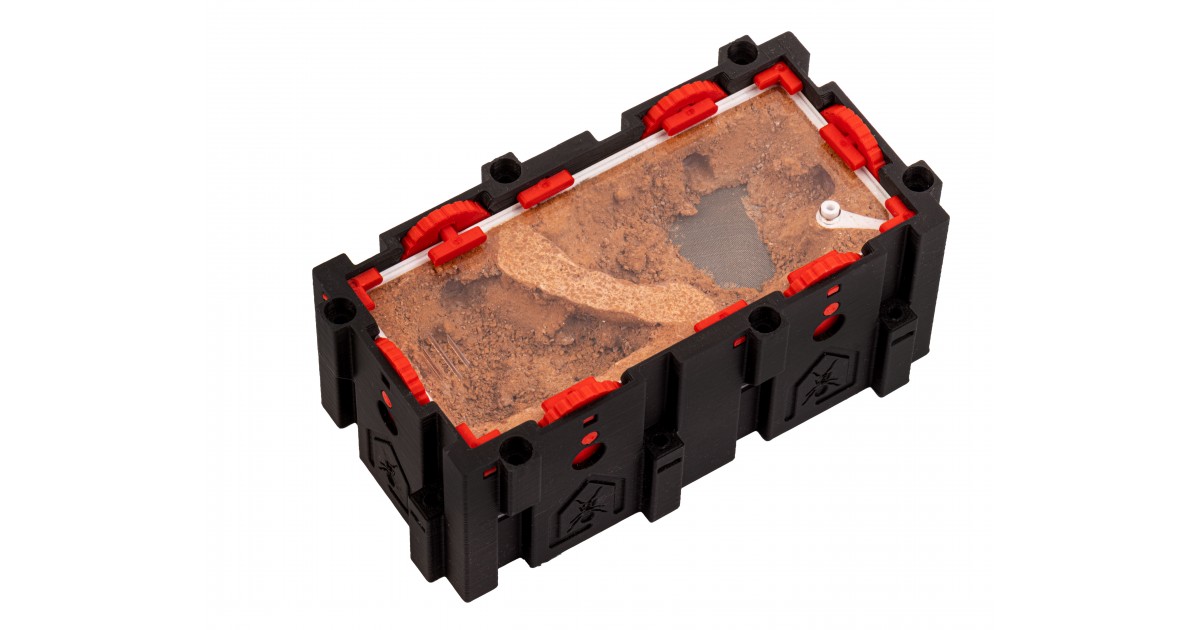
For the Green Morph, at Antomas we recommend the Qbik Wild formicaria by Anthouse in the Duo format, the best fit for the size of our colonies. There are three humidity systems and all three work: the hybrid, with a reservoir that evaporates water through a technical mesh plus a drinking tube on one side; the evaporation version, in which the chambers never get wet and humidity spreads by itself in a gradient; and the standard one, with a refillable water tube. If we had to pick just one, we would choose the Qbik Wild Duo P 2C Hybrid.
In the foraging area, a base of sand mixed with a little clay, plus a few stones, gives a natural look and holds some moisture; if it is dark, the green and purple stand out even more. Do not expand until the colony fills almost the whole nest: empty chambers dry out or grow mould, and the colony does worse.
When your colony arrives
At Antomas we always ship colonies with a gamergate, in whatever size we have in stock. A lone gamergate cannot make it: in Diacamma colonies form by fission, never from a single female, so she needs her workers.
When it arrives, place it somewhere quiet, dark and at a constant temperature, and remove any workers that did not survive the journey. For the first few weeks, avoid knocks and vibrations, direct light on the nest and opening it out of curiosity: these are the most common reasons a colony stops raising brood. When it is time to move it into its permanent formicarium, at Antomas we almost always tip the colony in: we empty it into the new nest and, if necessary, force them to go inside. With this species it is what gives us the best results.
To find the gamergate, look at the thorax with a magnifying glass: she keeps her gemmae, while the others only have scars. But do not expect to see her often: at Antomas we have found that she hides at the slightest disturbance, that she is very shy and elusive and that she never leaves the nest to forage, so the hunting is always done by the workers.
If the gamergate dies
It is not the end of the colony. Without a gamergate nobody mutilates, so new workers emerge with intact gemmae and all of them are candidates to become the reproductive: they only need to mate. What is needed is a male from another colony, just as in the wild, where males fly in from neighbouring nests.
At Antomas we know it works: some customers left without a gamergate ordered males from us, and an unmutilated worker mated and became the new gamergate. If it happens to you, write to us and we will look at it together. In the meantime, keep caring for the colony as usual. And the best prevention is to handle the nest slowly, so that the gamergate does not escape or get lost.
Feeding
The key is a varied diet, with plenty of protein (mostly live) and sugars.
Protein. They will eat dead prey, but at Antomas we recommend that it be mostly live: towards other arthropods and invertebrates their aggression is extreme, and watching a green-and-purple worker chase down and overpower its prey is the great spectacle of this species. Crickets, feeder cockroaches, flies or mealworms, always of a size they can handle; and change the type of insect every week so that the diet is not monotonous. We offer protein 3 to 5 days a week, depending on how many larvae there are.
Do not let them run short: according to keepers, a protein-starved colony may end up eating its own brood. And remove leftovers within 24 h, because at this humidity mould appears very quickly.
Sugars. Sugary liquids are a favourite. Offer them every 3–4 days or leave a feeder ad libitum, no problem. And do not always give the same one: Anthouse Blue Sugar nectar can be their main sugar (4–5 times a week when using a feeder), while on the other 1–2 days of the week, any other sugary liquid. Our favourite for those days is lactose-free milk mixed with honey, which adds a little liquid protein (the milk must always be lactose-free). It is a thick mix: a good moment to watch the "drop between the mandibles".
Water: clean and always available.
Hunting, aggression and the gamergate of a Diacamma colony (video by Anthouse).
Behaviour in captivity
Outside the nest they never stop, even less so with warmth and light: each worker patrols the foraging area on her own and pounces on anything that moves. They are merciless towards other arthropods and towards ants from other colonies, so they should not share a setup with anyone. People, however, are not treated as a threat. If at some point they move of their own accord, watch for the tandem running pairs and the workers travelling with a larva in their mandibles.
Warning signs: a colony huddled in the warmest spot with little brood usually means it lacks heat or humidity; if egg-laying stops after you have disturbed the nest, give it a few days of peace.
Escapes and barriers
They are not particularly prone to escaping. At Antomas a well-fitting, ventilated lid and a spacious foraging area, where they can patrol and hunt freely, are enough. To reinforce the edges, apply oil, petroleum jelly or "talcol", a mixture of talc and alcohol: you paint a strip and, once the alcohol evaporates, a film of talc remains that they cannot climb.
Be careful with Fluon (PTFE): in high humidity it loses effectiveness and may stop working without you noticing. With this species humidity is always high, so use it only as a complement to the lid. Also check plugs and connections: even an ant this large can escape through a tiny gap.
Handling and safety
The sting is real and it works, although what we see at Antomas is that they struggle to get through the skin and take their time before stinging; nor are they aggressive towards us, because all their ferocity is aimed at their prey. Even so, anyone allergic to bee or wasp stings could react, so it is wise to move them with a brush or soft tweezers. Do it calmly: rushing is when the gamergate gets lost. And remember: it is an exotic species and should never be set free.
What not to do
Go outside 24–28 °C or 60–80 % humidity, or change them suddenly.
Leave the nest soaking wet, which opens the door to mould and mites.
Forget prey remains for more than a day.
Skimp on protein or always offer the same insect.
Give them a huge nest too early.
Open the nest, light it or move it often.
Forget to remove workers that arrive dead.
Handle in a hurry and lose track of the gamergate.
Try to merge colonies: it is not possible, because they attack each other. Nor mix them with other species.
Rely on Fluon as the only barrier in a humid setup without a lid.
Scientific sources
This care sheet is based on the taxonomic revision of the Philippine Diacamma, on scientific studies of the biology of the genus and on the experience of Antomas and other keepers. Main references:
Laciny, A., Pal, A. & Zettel, H. (2015). Taxonomic notes on the ant genus Diacamma (Hymenoptera: Formicidae), part 1. Zeitschrift der Arbeitsgemeinschaft Österreichischer Entomologen 67: 83–136. zobodat.at
Wheeler, W.M. & Chapman, J.W. (1922). The mating of Diacamma. Psyche 29: 203–211. doi:10.1155/1922/80849
Peeters, C. & Higashi, S. (1989). Reproductive dominance controlled by mutilation in the queenless ant Diacamma australe. Naturwissenschaften 76: 177–180. doi:10.1007/BF00366404
Gotoh, A., Billen, J., Hashim, R. & Ito, F. (2005). Apoptotic wing degeneration and formation of an altruism-regulating glandular appendage (gemma) in the ponerine ant Diacamma sp. from Japan. Development Genes and Evolution. doi:10.1007/s00427-004-0456-7
Ramaswamy, K. et al. (2004). Social mutilation in the ponerine ant Diacamma: cues originate in the victims. Insectes Sociaux 51: 410–413. doi:10.1007/s00040-004-0765-x
Baratte, S., Cobb, M. & Peeters, C. (2006). Reproductive conflicts and mutilation in queenless Diacamma ants. Animal Behaviour 72: 305–311. doi:10.1016/j.anbehav.2005.10.025
Cuvillier-Hot, V., Cobb, M., Malosse, C. & Peeters, C. (2001). Sex, age and ovarian activity affect cuticular hydrocarbons in Diacamma ceylonense, a queenless ant. Journal of Insect Physiology 47: 485–493. doi:10.1016/S0022-1910(00)00137-2
Peeters, C. & Tsuji, K. (1993). Reproductive conflict among ant workers in Diacamma sp. from Japan: dominance and oviposition in the absence of the gamergate. Insectes Sociaux 40: 119–136. doi:10.1007/BF01240701
Shimoji, H. et al. (2018). Social enforcement depending on the stage of colony growth in an ant. Proceedings of the Royal Society B 285: 20172548. doi:10.1098/rspb.2017.2548
Kaur, R. et al. (2014). Coupled adult-brood transport augments relocation in the Indian queenless ant Diacamma indicum. Insectes Sociaux. doi:10.1007/s00040-014-0338-6
Mukhopadhyay et al. (2019). Path minimization in a tandem running Indian ant in the context of colony relocation. Journal of Experimental Biology. doi:10.1242/jeb.206490
Fujioka, H., Marchand, M. & LeBoeuf, A.C. (2023). Diacamma ants adjust liquid foraging strategies in response to biophysical constraints. Proceedings of the Royal Society B 290: 20230549. doi:10.1098/rspb.2023.0549
Karpakakunjaram, V. et al. (2003). Contributions to the biology of the queenless ponerine ant Diacamma ceylonense Emery (Formicidae). Journal of the Bombay Natural History Society 100: 533–543. repository.ias.ac.in