Difficulty: 3/5 – Intermediate
A jumping, sight-hunting ant from southern India. It has no queen: the eggs are laid by a gamergate, a mated worker that acts as the colony’s reproductive. 24–26 °C, 60–80 % humidity, live prey only and no diapause.
Harpegnathos saltator Jerdon, 1851 is a large ponerine ant from southern India that combines three talents almost no other ant has at once: it jumps, it hunts by sight, lying in wait, and its workers can become reproductives in the middle of their adult lives. That is why it is one of the most studied ants in the world: its genome was sequenced in 2010, and today several laboratories use it as a model to research ageing, the brain and social behaviour.
The colony we sell at Antomas has no queen: it is ruled by a gamergate. Since many people arrive at this care sheet looking for exactly that word, that is where we begin.
Biology
What is a gamergate?
A gamergate is a mated worker that lays eggs and acts as the colony’s reproductive. She has no wings and never had any, she does not have a queen’s body and she is the same size as her nestmates: from the outside, she is just another worker. The difference is inside: she has mated, her ovaries are active and she lays fertilised eggs, which hatch into females.
The word comes from the Greek gámos, “marriage”, and ergátēs, “worker”: literally, “married worker”. It was proposed by the myrmecologist William L. Brown and first published by Peeters and Crewe in 1984; later, Peeters and Crozier (1988) defended it with a simple argument: not every mated female that lays eggs is a “queen”, and it is better to call things by their name. Gamergates are known in one or two hundred species, mostly ponerines (an approximate figure).
In H. saltator, moreover, gamergates coexist with a queen system: every colony is founded by a winged queen, and the gamergates take over when she is gone. Each gamergate lays roughly half as many eggs as a queen (about two a day in the laboratory), and it is normal to have several at once. They can be recognised by their behaviour: they stay in the chamber, next to the cocoons, walk slowly and upright, with the gaster held higher than the thorax, do not let other workers walk over them and do not go out to hunt.
Gamergate or ergatoid queen?
It is a common question, and one we have asked ourselves at Antomas too: is the reproductive of Harpegnathos a gamergate or an “ergatoid queen”? After reviewing the literature, the answer is gamergate, although the two are very similar.
A gamergate is a mated worker: she is born and develops as a worker, has the same body and, like all the workers of her species, a functional spermatheca, the organ that stores sperm; what is more, she cannot found a colony on her own. An ergatoid queen, on the other hand, is a permanently wingless queen: a queen caste with its own larval development, often more ovarioles than the workers and an appearance halfway between worker and queen (“ergatoid” means “worker-like”), which in many species replaces the winged queens. And neither of them is an intercaste: an anomalous intermediate form that appears sporadically and hardly ever reproduces.
Harpegnathos saltator is the classic example of a species with both winged queens and gamergates: the queens found the colony and the gamergates take over. In Diacamma, by contrast, there is no queen caste and only gamergates reproduce; that is why the word is so closely associated with that genus, but it is not exclusive to it.
Why are they confused? At first glance, both look like workers and both reproduce, and the terminology has changed over the years: names such as “intermorphic queens” (Heinze and Buschinger, 1987) or “ergatoid reproductives” have been used without much rigour. Peeters and Crozier already warned that calling mated workers “queens” hides their origin. That is why the colony we sell has a gamergate, not a queen: a mated worker acting as the reproductive.
“Theoretically immortal” colonies
A winged queen mates outside the nest with males from other colonies and founds alone. Every year, the colony rears winged queens and males. When the queen grows old or dies, several workers mate and take her place as gamergates, and when a gamergate dies, another replaces her. Jürgen Liebig’s laboratory at Arizona State University sums it up like this: in theory, the colony can go on indefinitely.
The succession is needed, because the queen is short-lived for an ant: an average of 1.79 years in the laboratory, although some live beyond 5. In southern India, 7 of 15 colonies studied in depth between 1991 and 1994 were running without a queen, on gamergates alone. Colonies are small (an average of 65 ± 40 workers in the Western Ghats; 200–300 in the laboratory) and they do not split: the nest is such a valuable investment that it pays to keep it for generations. There is small print to this “immortality”, though: in the field, colonies with gamergates die sooner than those that keep their queen.
Sibling weddings inside the nest
In H. saltator, newly emerged males do not leave straight away to look for foreign queens: first they mate with some of their worker sisters inside their own nest. So even with a queen present, there are mated workers that do not lay: a reserve of future gamergates. And when the colony is left without reproductives, the winners of the competition for the post mate with the first available males, which are their brothers.
This has a practical consequence: a colony usually already contains mated workers, ready to take over. Only if there are none and no males are born either would a worker that starts laying produce nothing but unfertilised eggs, which in ants always hatch into males (this is a deduction, not something verified in captivity).
Antennal duels: the tournament for the throne
When the reproductives disappear, the workers launch into a tournament. Two workers face each other and strike each other with their antennae at full speed, in a ritualised fight that hardly ever causes injuries. In a stable colony only the gamergates duel; without reproductives, many more join in.
A 2021 study followed the tournament day by day in groups of 30 young and 10 old workers: most give up duelling within about 5 days, the future gamergates keep fighting for at least another 45 days, and the first ones start laying around day 10. The most surprising part: by day three it is already possible to predict who will become a gamergate with 86 % accuracy. In the end, 30 workers produce 3 to 6 gamergates, in a transition that takes about 3 months. Recent research (2026, not yet peer-reviewed) describes the competition as a layered system.
Chemistry goes hand in hand with it: dopamine rises in the most aggressive workers when the tournament starts, peaks in the gamergates and drops in the losers. And the hierarchy is also marked with the “dominance bite”: the dominant ant bites the subordinate’s head and pushes it down.
Worker policing: pinned down for up to 24 hours
The tournament has referees. When a worker starts laying without having earned the post, her nestmates jump on her and hold her down, in extreme cases for up to 24 hours, while the policed worker stays still in a “pupal posture”. This limits the number of reproductives. How do they know who is laying? By smell: the cuticular hydrocarbons, the “chemical signature” ants read with their antennae, change with ovarian activity, and one of them appears only in egg-layers.
Policing also works the other way round: a gamergate isolated for 4 weeks and returned to a colony that already has reproductives is policed, stops laying and, about 2 months later, goes back to hunting like any other worker.
Five times longer life: the worker who grows younger by rising in rank
In almost every animal, reproduction comes at a cost. H. saltator breaks the rule: a worker lives a median of about 7 months (217 days), but if she becomes a gamergate she lives about 3 years (some 1,100 days): around five times longer, with the same genome. If she reverts to being a worker, she loses the advantage: “reverted” gamergates live a median of 188 days, like their nestmates.
The explanation proposed in 2022, in the journal Science, involves insulin: the gamergate’s brain produces more of it, which activates reproduction, while the ovary makes an “anti-insulin” protein, Imp-L2, which blocks, in the fat body, the branch of that signal that shortens life. It is a proposed model, not something fully proven. Add to this a heat shock factor unique to this ant, telomerase and sirtuins, which are more active in reproductives, and a peptide exclusive to its lineage which, according to recent research not yet peer-reviewed, even extends the lifespan of fruit flies. What is more, the median lifespan of a reproductive worker is multiplied by at least 2.6 when she has helpers to look after her.
A brain that shrinks by 19 % and grows back
A gamergate’s brain is 19 % smaller than that of a hunting worker, and its visual centres shrink even more: it makes sense, because she lives in the darkness of the chamber and no longer hunts. The extraordinary part came in 2021: if the gamergate reverts to being a worker, her brain regains its size within 6–8 weeks, something thought impossible in insects such as the honeybee or the fruit fly.
The glia, the cells that accompany neurons, change too: in gamergates a type of protective glia multiplies that declines with age in workers, and their brains respond better to injury. That is why this ant also interests people who study brain ageing and neurodegenerative diseases.
Corazonin: the molecule that decides between hunting and laying
What decides whether a worker becomes a hunter or a reproductive? One of the answers is corazonin, a brain hormone related to the one that controls reproduction in vertebrates (GnRH). In future gamergates its level drops, and if they are injected with it, they go back to hunting and stop duelling and laying eggs.
More hormones are involved: ecdysone promotes ovary activation and juvenile hormone holds it back, and one gene, Kr-h1, translates those signals into different programmes in each caste: without it, gamergates behave like workers, and workers like gamergates. One and the same ant, two “professions” and a chemical switch between them.
From India to the laboratory: genome, CRISPR and ageing
All this makes it a model organism: the switch from worker to gamergate happens in adults, can be triggered by removing the reproductives and is reversible. Its genome was published in 2010, together with that of Camponotus floridanus, to study the epigenetics of ageing and behaviour. Laboratory colonies descend from colonies collected in southern India between 1992 and 1999.
In 2017 it became one of the first ants modified with CRISPR: by knocking out the orco gene, essential for smell, researchers obtained ants with abnormal social behaviour and defective brain development. It was possible thanks to gamergates: a modified worker that becomes a gamergate can found her own line, without queens or nuptial flights.
10 cm jumps without a catapult
Its name says it all: saltator, “jumper”. It can jump about 2 cm high and 10 cm long, more than five times its body length, to escape, to move around and to hunt, even insects in mid-air: it is probably the only insect that uses jumping for all three. There are even “group jumps”: one worker jumps erratically for minutes and her neighbours copy her, for reasons nobody knows. At Antomas we see it every day: their jumps are mainly forwards, they find it hard to jump upwards, and to hunt they prefer to climb a wall or a branch and launch themselves onto their prey from above.
The surprising thing is how it does it: it jumps with its middle and hind legs, without any spring storing energy like a catapult: it is pure muscle power. A 2023 study measured take-offs at 0.7 m/s in just 0.02 s, and found that the muscle that moves the trochanter is about 8 times larger in the middle legs, and about 14 times larger in the hind legs, than in a ponerine that does not jump. Forward jumping has evolved separately in at least four ant genera: Gigantiops, Harpegnathos, Myrmecia and Odontomachus. A word of caution on the figures: some sources mention escape jumps of 3 to 21 cm, but we have not been able to verify this in the original paper.
Huge eyes and a venom that keeps prey fresh
Its eyes take up almost half the length of its head. It is a solitary, visual hunter that leaves no scent trails to recruit nestmates: it spots its prey by sight, stalks it motionless and pounces on it. You will often read that it has more ommatidia (the units of the compound eye) than any other ant studied; it is possible, but we have not found the original count.
At Antomas we see it every day with its relative H. venator: before attacking, the worker sways its gaster with an “excited” movement of unknown meaning, like a sniper adjusting their aim. Keepers of H. saltator describe the same thing.
The prey does not die: the venom paralyses it quickly and permanently, and the colony can store it “fresh”. Workers emerge from the cocoon with an empty venom sac, fill it at around 57 days of age and start hunting from about day 50. In the wild they hunt crickets, cockroaches, cicadas, flies and spiders, and they do not jump on slow prey such as termites.
A “wallpapered” nest built for floods
In the wild it builds very elaborate soil nests: shallow chambers; the top one under a thick vaulted roof surrounded by a hollow space that insulates it from the soil; and, in large colonies, a kind of almost spherical “shell” enclosing several chambers. The walls are “wallpapered” with strips of empty cocoons and other debris, perhaps to keep them dry (this is a hypothesis), and the rubbish goes to a separate, deeper chamber.
Everything points to a nest built to withstand the floods of the plains of southern India, which the colony keeps for generations (also a hypothesis). The entrance, a small mound of twigs and leaves, is closed at dusk and reopened by day. In captivity they do not need to dig: in laboratories they live in plaster nests, without soil.
A home without winter and with a monsoon: southern India
It was described in 1851 by the British naturalist T. C. Jerdon from workers collected in Tellicherry (today Thalassery, Kerala) and Mysore (Karnataka); since he created the genus and the species at the same time, the author is written without brackets: Jerdon, 1851. It lives in southern India, including the Western Ghats, and in Sri Lanka (subspecies H. s. taprobanae Forel, 1909), in the shade of plants or near roots, on plains that flood. The Antomas line comes from India.
Its climate knows no winter. The climate normals of the India Meteorological Department (IMD, 1991–2020) paint this picture, season by season:
- Cool, dry season (December–February). On the Malabar Coast (Kannur, about 20 km from Thalassery), averages of about 28 °C and almost no rain; on the Karnataka plateau (Mysore, at 770 m), averages of 22–24 °C and nights of about 16–17 °C in January, the coolest of the year.
- Pre-monsoon (March–May). The hottest period: on the coast, 30–30.5 °C on average and maximums of about 35 °C; on the plateau, 26.5–28 °C. The first storms arrive in May.
- South-west monsoon (June–September). On the coast, more than 2,600 mm of rain falls in four months (78 % of the year’s rainfall), with 81–87 % humidity and averages of 26–27 °C; on the plateau it rains much less and averages drop to 24–25 °C.
- Post-monsoon (October–November). The rains continue (October is the wettest month in Mysore), with averages of about 24–28 °C.
In short: on the coast, averages of 26–30.5 °C all year round; on the plateau, from 22 to 28 °C; and no month below an average of about 22 °C. Day length hardly changes: from 11 h 25 min to 12 h 50 min over the year. And that monsoon, which floods the plains where it lives, would explain its flood-proof nest, with the top chamber insulated from the soil and “wallpapered” walls.
It is diurnal, with a split schedule: it hunts in the morning and late afternoon, with a midday break, depending on soil temperature and light. The genus contains nine species, from India to the Philippines, southern China and Java; at Antomas we also keep its black relative, H. venator, and the Philippine H. honestoi.
Size and morphology
A large, slender ponerine ant with long mandibles and huge eyes. Harpegnathos comes from the Greek hárpē, “sickle”, and gnáthos, “jaw”; saltator is Latin for “jumper”.
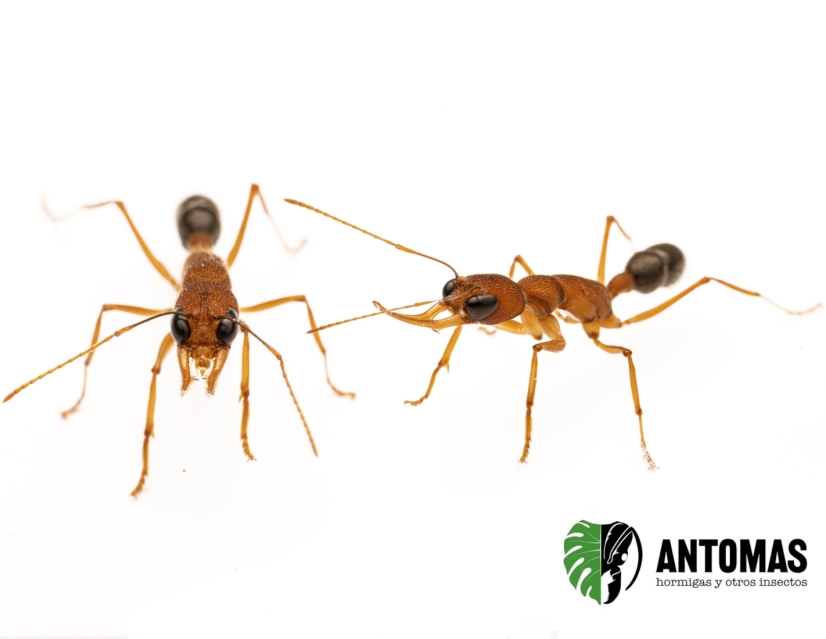
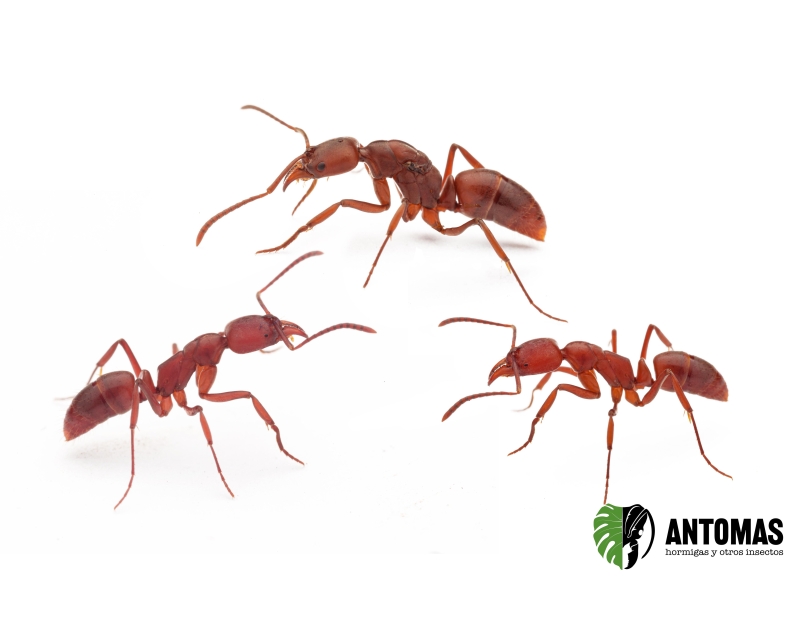
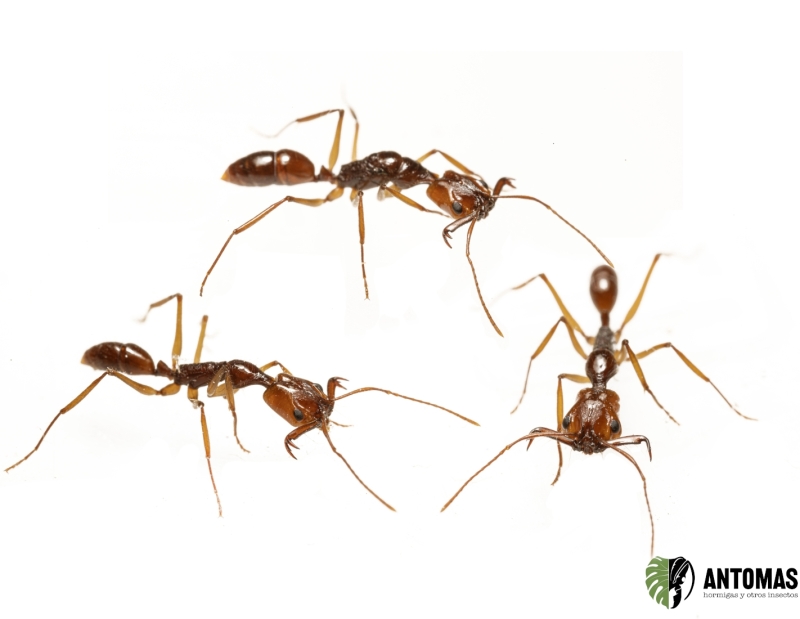
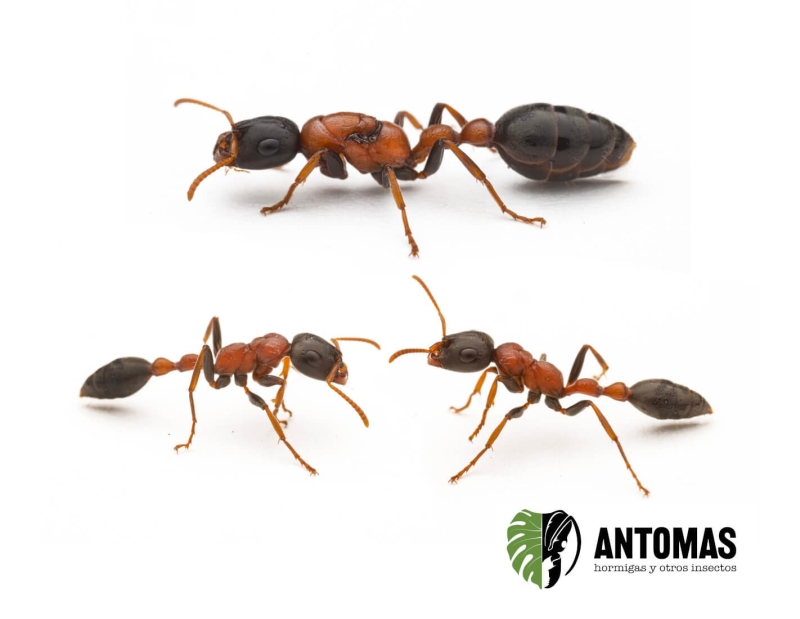
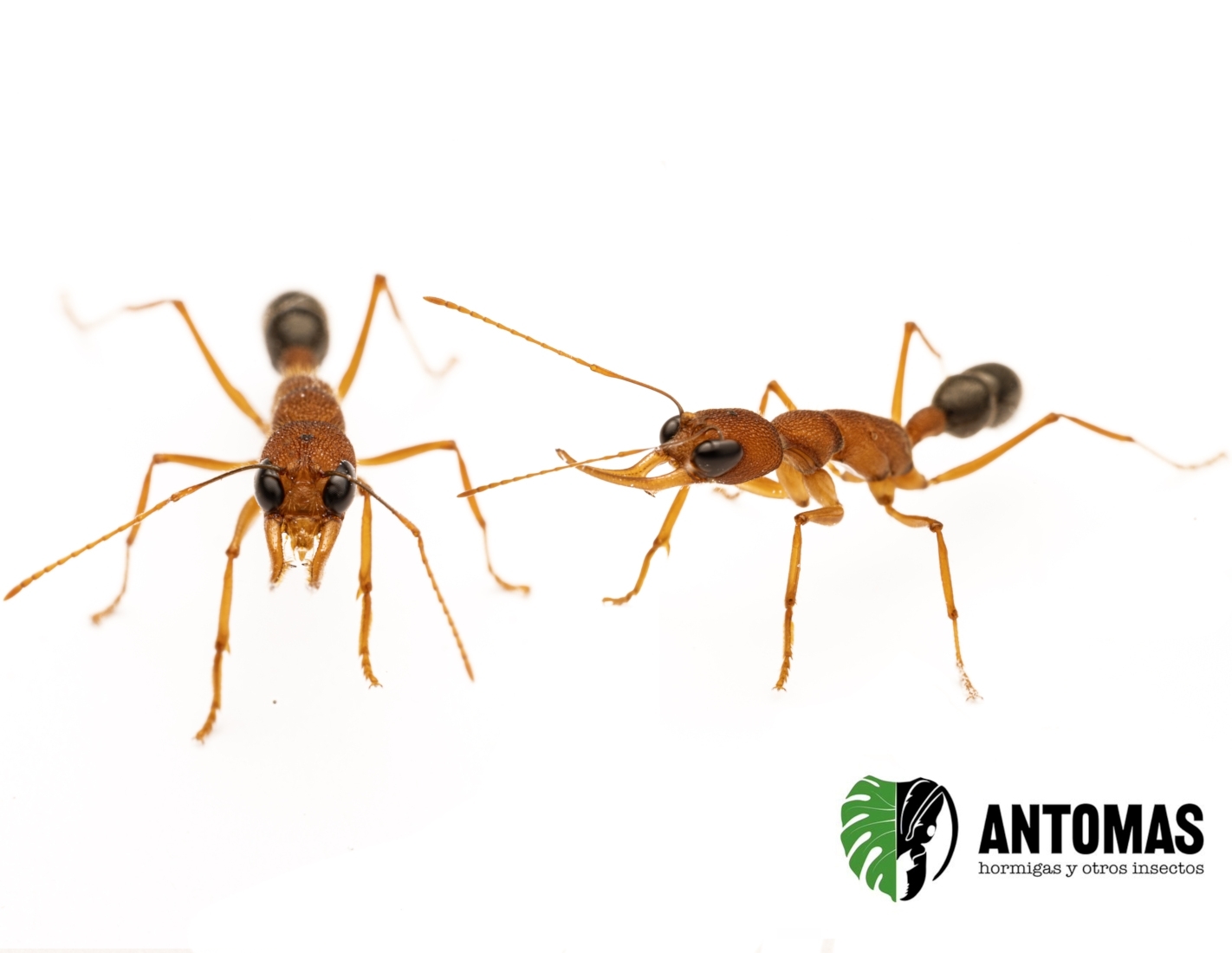
- Colouration. According to Bingham (1903), the head, thorax and petiole are rusty red; the gaster is glossy black; and the mandibles, antennae and legs are yellow. Jerdon (1851) described the head as darker, so there may be some variation. The Antomas line, from India, has a reddish head, as in Bingham’s description.
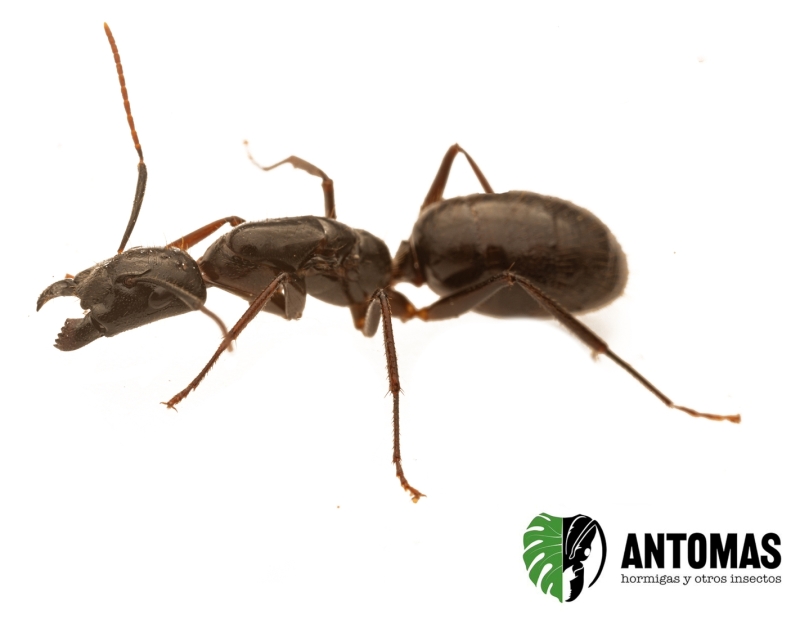
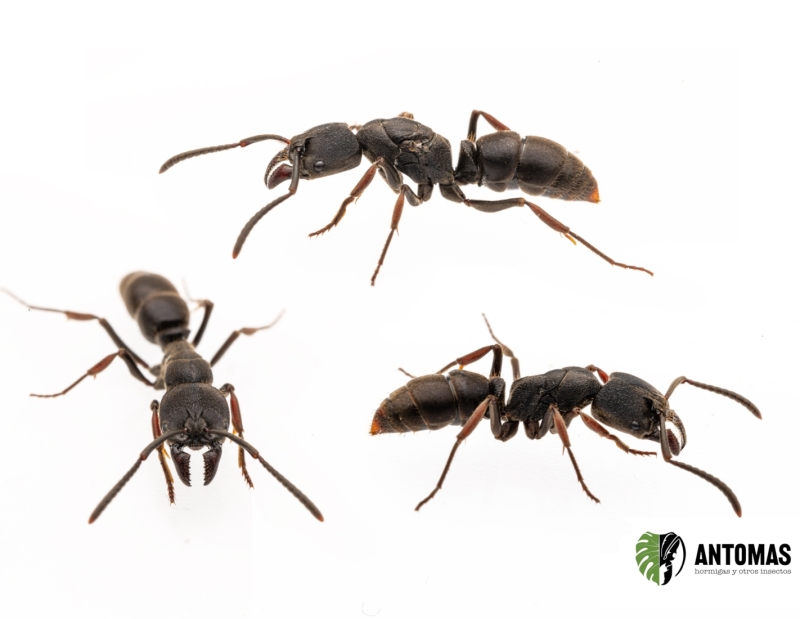
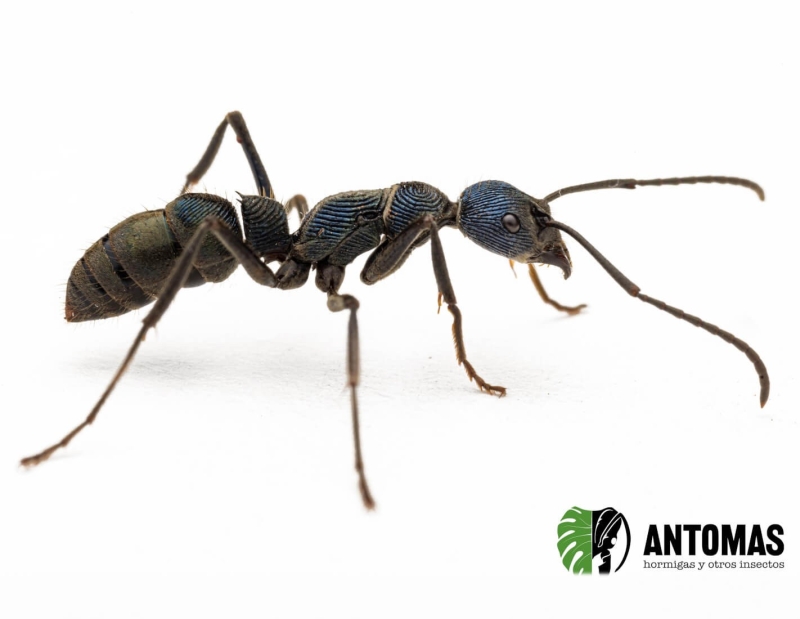
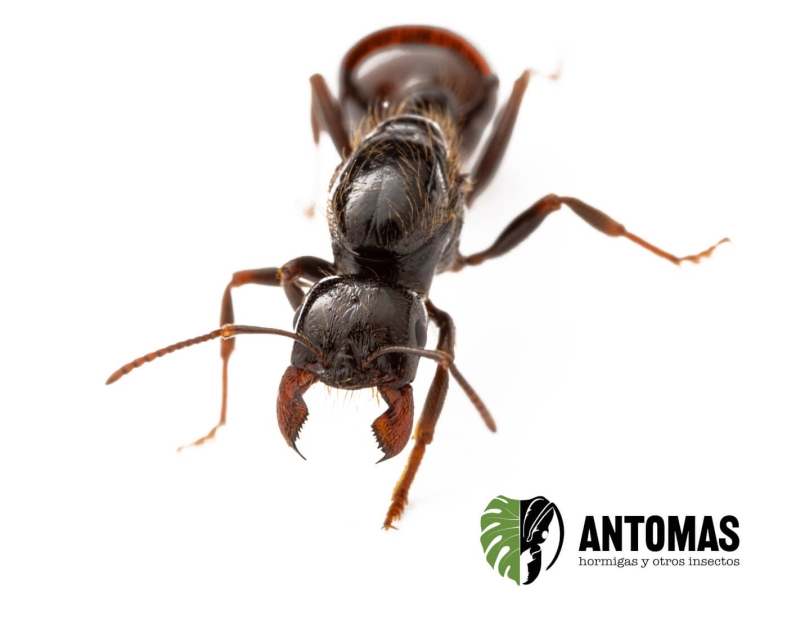
- Compared with H. venator. H. saltator is two-coloured, with a smooth, glossy gaster; H. venator is almost entirely black, with a matt gaster. They are kept in exactly the same way: only the colours change.
- Mandibles. Long, upcurved and sickle-shaped, with two rows of denticles and a hollow at the base which, according to a 2020 study, is used to hold eggs.
- Eyes and ocelli. Huge eyes, almost half the length of the head, and, unusually for a worker, also ocelli, the small simple eyes on the forehead.
- Jumper’s legs. The hind legs measure 92 % of the body length; a worker weighs about 32 mg.
- Sting. Large and functional.
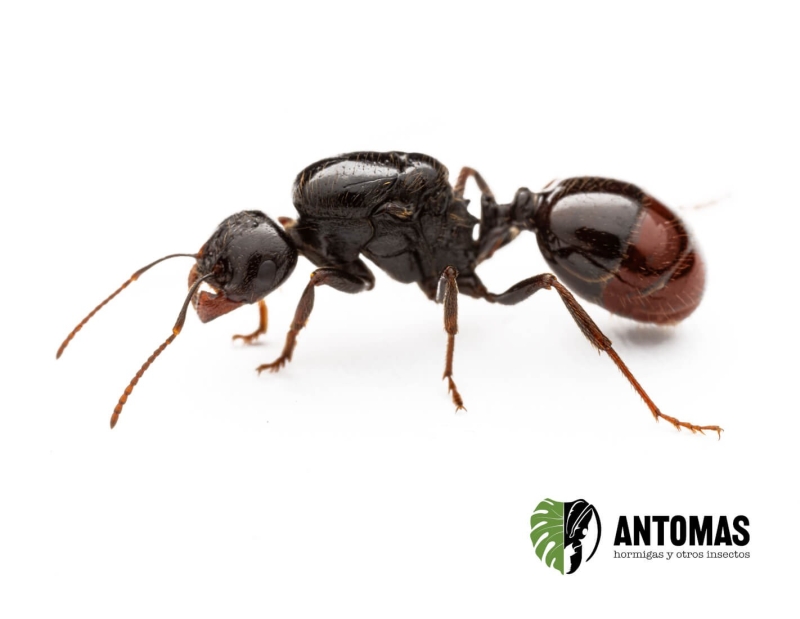
- Queen. Born winged and very similar to the worker, slightly larger; the difference in shape between the two is minimal. She removes her own wings, and once wingless she starts behaving like a worker (2021 research, not yet peer-reviewed). She can be told apart from a gamergate by her wing scars and thorax; ocelli are no help, because workers have them too.
- Gamergate. From the outside, a worker: she is recognised by her behaviour (see “What is a gamergate?”).
- Male. Reddish brown, winged and with short, broad, triangular mandibles, without the sickle.
- Development. The larva goes through 4 instars, and its caste is decided late, by juvenile hormone. It takes about 80 days from egg to adult in the laboratory. Before pupating, the larvae spin a cocoon, and to do so they need fine material: in laboratories they are given sawdust.
Approximate measurements
- Workers: 14–17 mm
- Gamergates: 14–17 mm, the same as workers (no separate measurements have been published)
- Queen: 17–19 mm, roughly the size of a large worker
- Male: about 9.5 mm
These are historical measurements (Bingham, 1903; Forel, 1900, for the male). Jerdon (1851) gives about 19 mm for the worker, and the review by Schmidt and Shattuck (2014) gives 14–20 mm for workers of the genus. There are no modern morphometric data for the species.
Care in captivity
Difficulty: 3/5 – Intermediate
The parameters are simple: a stable temperature of around 25 °C and a damp plaster nest, as in the laboratories that have kept it for decades, where it is considered easy to maintain. The real difficulty lies in a constant, plentiful supply of live prey, because it eats only protein and eats a lot, and in keeping humidity high at all times, stable and without waterlogging. Shops often rate it as “advanced” or “for experts”; at Antomas we place it at an intermediate level, like H. venator, which is kept in exactly the same way.
And it is well worth it. Large, two-coloured workers that follow you with their eyes, climb to the top of a branch, lie in wait motionless, sway their gaster and pounce on their prey. And, inside the nest, the society studied by the world’s leading laboratories: the gamergate standing tall over the cocoons, antennal duels and worker policing. All of this in a species that is very rare in the European trade.
Recommended parameters
- Temperature: 24–26 °C, stable. Laboratories keep it at a constant temperature of around 25 °C, and in its native range no month falls below an average of about 22 °C.
- Nest humidity: 60–80 %, high at all times and stable.
- Foraging area: slightly drier than the nest, with light and water always available (a test tube with water and a cotton plug).
- Nest type: natural materials that hold and spread moisture, ideally plaster. This is not a species for dry nests or for acrylic nests without a good hydration system.
- Light: simply leave them their dark area in the nest and a lit foraging area; laboratories use a cycle of 12 h light and 12 h darkness.
- Diapause: none; there is no winter in its native range (see below).
These species need high humidity at all times, and stable humidity, because they are sensitive to sudden changes: letting them dehydrate is quite a serious mistake. A nest that dries out while the larvae are growing fast leads to failed moults; a waterlogged one soaks the cocoons, which then fail to open, and brings mould and mites. The laboratories’ rule of thumb: damp plaster, “not looking dusty to the touch”, but able to absorb all the water you add, watered on average once a week with deionised water (at home, distilled water), because salts reduce how well the plaster absorbs water. Good ventilation helps to prevent mites.
Recommended formicaria
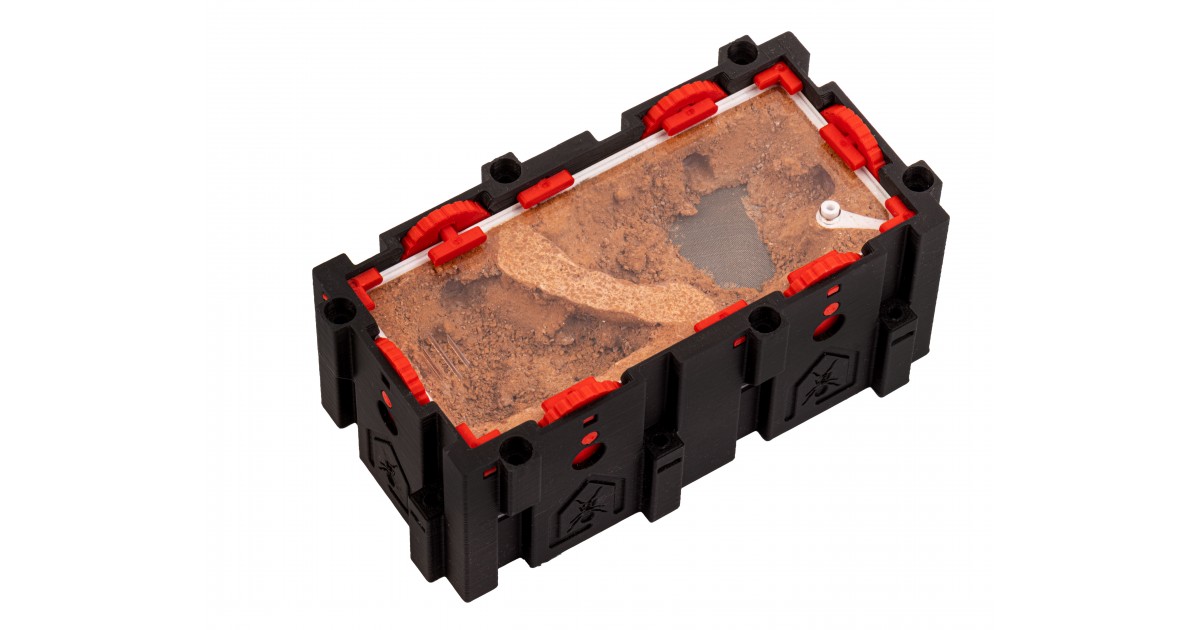
At Antomas we recommend the Qbik Wild range by Anthouse, made of plaster, and especially its hybrid version: a lower evaporation reservoir, separate from the galleries, passes humidity through a mesh (with activated carbon so the water does not stagnate), and it is completed by a side drinking tube. The right format is the Duo: the Qbik Wild Duo P 2C Hybrid, designed for large ants.
As alternatives, the same range with the evaporation system (the water never touches the chambers) or with the standard system (refillable water tube):
Complete the set-up with these five details:
- A large foraging area, ideally with a ventilated lid: with this species, a good hunting area matters more than the size of the nest.
- Branches or decoration in the foraging area: they love climbing them, or the walls, to jump on their prey from above. It is their favourite way of hunting and a wonderful behaviour to watch.
- Fine substrate in the foraging area and in the nest (coconut fibre, sawdust or fine soil, ideally sterilised for a few days in the freezer): the larvae need it to spin their cocoons, and the workers help them by covering them with particles.
- Water always available: for long-jawed species like this one, at Antomas we recommend a test tube with water and a cotton plug in the foraging area; they drink from the cotton without any problem.
- Roomy chambers: one H. saltator keeper recommends a wide nest, ideally with a single chamber, so that the workers have space.
Colonies with gamergates
At Antomas we sell this species as a colony with a gamergate, without a queen. It works just like a colony with a queen and is just as stable: the gamergate lays fertilised eggs, which hatch into workers, and the colony grows. Bear in mind, though, that she lays roughly half as many eggs as a queen and that development is slow (about 80 days from egg to adult): the first new workers will take a few months to appear.
What is more, new gamergates can appear in your care, and males are not always needed: sometimes the workers arrive already mated. It is normal for a colony to have several, and when the colony rears males, they mate with their sisters inside the nest, so there are mated workers ready to take over. If you see antennal duels or workers holding others down, enjoy it: it is not a fight to worry about.
To recognise the gamergate, watch her behaviour: she stays in the chamber, next to the cocoons, standing tall, walks slowly and never goes out to hunt.
If the queen or the gamergate dies, do not rush: wait to see whether a worker is already mated and takes over, or whether males are even born and mate with a worker. In Harpegnathos this happens quite often, especially in H. saltator. Only if there are no mated workers and no males are born would the new egg-layers produce nothing but males (this is a deduction). And if you have any doubts, get in touch: we will be happy to help.
Colonies cannot be merged: do not try.
Arrival. Set the colony up in a quiet place at a stable temperature, with its dark area in the nest, and offer water straight away: they usually arrive thirsty after the journey. For the first few days they may be skittish and huddled together, but with their good eyesight they soon adapt. Remove any workers that died in transit. To move the colony into its formicarium, at Antomas we do it by tipping it in: we tip the colony into the new formicarium.
Feeding
This species eats only protein: no sugar or nectar. Laboratories do not use it, and most keepers of H. venator agree that it is not accepted.
At Antomas we recommend feeding it at least 3–4 times a week, mainly with live prey: crickets, cockroaches and flies of a size they can overpower (in the laboratory, crickets of about 6–10 mm). Our favourite is the red runner cockroach (Shelfordella lateralis), which carries less risk of mites, to which the genus is sensitive. Change the type of insect from one week to the next, so that they do not always eat the same thing.
Why live? Their venom paralyses without killing, and the prey stays “fresh” for longer. Feeding only dead prey is usually ineffective and even harmful for the colony, and you would also miss the best part: the hunt.
They eat a lot. As a reference, the only published hobbyist diary of H. saltator reports that 40 workers ate more than 20 crickets a week, that with less they did not rear brood, and that it was best to always have a cricket in the nest. When hungry, the colony eats its own brood: this is one of the most common causes of failure. Adjust the amount to the brood: the more larvae, the more prey.
The more they eat, the better and faster they grow. This is the Antomas philosophy: if you do daily maintenance and remove leftovers, it is better to overfeed, because the ants understand that they have more resources and grow faster and in greater numbers. If you will not be able to clean often, it is better not to overfeed: leftover food rots and brings mould and mites.
Leave the prey within reach of the larvae. As in many ponerines, workers do not feed the larvae mouth to mouth: the larvae feed directly on the prey. Small larvae can share a cricket; give the large ones a head or a leg each.
Watch out for treated crickets: crickets treated with insecticides or acaricides can kill the colony. Buy from a trusted supplier; a keeper’s tip: if there are live spiders in the cricket box, the crickets are probably untreated. Remove leftovers at every feed, before they grow mould and mites, and make sure there is always water in the tube with cotton.
Diapause
It does not enter diapause and needs no wintering: there is no winter in its native range, and no month falls below an average of about 22 °C. At Antomas we keep it active all year round at 24–26 °C, and in laboratories it grows and produces queens and males at a constant 25 °C, without any winter rest. Do avoid sudden temperature changes, though.
Behaviour in captivity
It is a very visual ant: keepers report that their workers follow them with their eyes across the room. And the way it hunts is a spectacle: in Antomas’ experience, they usually climb the walls of the foraging area or a branch and jump on their prey from above, after standing still and swaying their gaster. They are excellent climbers: that is why it is a good idea to give them branches or decoration in the foraging area. They also jump to get out of the way when something startles them and, at times, out of sheer agitation (the “group jumps”).
Its temperament is twofold: a little skittish with the keeper at first and quarrelsome within the colony, with antennal duels, dominance bites and workers holding others down for hours; this is how it organises itself. It hunts mainly in the morning and late afternoon, and it likes to decorate: one keeper noticed that his workers adorned the nest entrance with a variety of materials.
How to watch them without disturbing them. At Antomas we believe ants are there to be enjoyed, watched and learnt from, not to be kept hidden away. With species that see this well it is even easier, because they get used to your presence. Simply leave them their dark area in the nest and a lit foraging area, and watch them gently, intervening and stressing them as little as possible.
Warning signs: if the brood disappears, food is almost always lacking; if the colony huddles in a corner and stops rearing brood, check the temperature and humidity.
Escapes and barriers
Good news for an ant called a “jumper”: in Antomas’ experience, they are excellent climbers, but not escape artists. And, despite their name, they find it hard to jump upwards: their jumps are mainly forwards, about 10 cm long compared with about 2 cm high. They climb almost anything, glass included, but they do not look for a way out.
That is why, at Antomas, we recommend a ventilated lid, if possible, and no other barrier is needed. Do check plugs, joints and connections, though: any gap is an exit for such a good climber.
Handling and safety
It has a large, functional sting, and Jerdon (1851) already described it as a very belligerent ant that “bites and stings most severely”. In practice, there is no need to worry: there are no modern measurements of the pain, and in Antomas’ experience a Harpegnathos has never hurt us; in some people, the sting has caused a little redness and swelling, and nothing more. Even so, at Antomas we recommend always handling it with entomological tools (soft forceps or a brush), never with your hands, and taking care if you are allergic to hymenopteran stings. Be careful with newly emerged workers, whose cuticle is still soft, and work slowly so as not to lose the gamergate. This is an exotic species: under no circumstances should it be released.
What not to do
- Offer it sugar, nectar or honey: it eats only protein.
- Feed it only dead prey.
- Skimp on food: hunger leads to brood cannibalism.
- Always give it the same insect, or crickets that may have been treated with insecticides or acaricides.
- Leave prey remains in the nest or in the foraging area.
- Let them dehydrate: they need high humidity at all times and water always available.
- Waterlog the plaster, or change the temperature or humidity suddenly.
- Set it up without fine substrate: the larvae need it for their cocoons.
- Leave the foraging area empty, without branches or decoration to jump from when hunting.
- Handle it with your hands.
- Try to merge colonies: it cannot be done.
- Put it into diapause.
- Keep it hidden away: it is there to be watched and enjoyed; do so gently, intervening as little as possible.
Scientific sources
This care sheet is based on the scientific literature on Harpegnathos saltator, the rearing protocols of the laboratories that study it and the experience of Antomas and other keepers. Main references:
- Peeters, C. & Crewe, R. M. (1984). Insemination controls the reproductive division of labour in a ponerine ant. Naturwissenschaften 71: 50–51. doi:10.1007/BF00365989
- Peeters, C. & Crozier, R. H. (1988). Caste and reproduction in ants: not all mated egg-layers are “queens”. Psyche 95: 283–288. doi:10.1155/1988/52368
- Peeters, C. (1991). Ergatoid queens and intercastes in ants: two distinct adult forms which look morphologically intermediate between workers and winged queens. Insectes Sociaux 38: 1–15. doi:10.1007/BF01242708
- Peeters, C. & Hölldobler, B. (1995). Reproductive cooperation between queens and their mated workers: the complex life history of an ant with a valuable nest. PNAS 92: 10977–10979. doi:10.1073/pnas.92.24.10977
- Liebig, J., Peeters, C. & Hölldobler, B. (1999). Worker policing limits the number of reproductives in a ponerine ant. Proceedings of the Royal Society B 266: 1865–1870. doi:10.1098/rspb.1999.0858
- Opachaloemphan, C. et al. (2021). Early behavioral and molecular events leading to caste switching in the ant Harpegnathos. Genes & Development 35: 410–424. doi:10.1101/gad.343699.120
- Opachaloemphan, C., Carmona-Aldana, F. & Yan, H. (2023). Caste transition and reversion in Harpegnathos saltator ant colonies. Bio-protocol 13: e4770. doi:10.21769/BioProtoc.4770
- Yan, H. et al. (2022). Insulin signaling in the long-lived reproductive caste of ants. Science 377: 1092–1099. doi:10.1126/science.abm8767
- Penick, C. A. et al. (2021). Reversible plasticity in brain size, behaviour and physiology characterizes caste transitions in a socially flexible ant (Harpegnathos saltator). Proceedings of the Royal Society B 288: 20210141. doi:10.1098/rspb.2021.0141
- Gospocic, J. et al. (2017). The neuropeptide corazonin controls social behavior and caste identity in ants. Cell 170: 748–759. doi:10.1016/j.cell.2017.07.014
- Yan, H. et al. (2017). An engineered orco mutation produces aberrant social behavior and defective neural development in ants. Cell 170: 736–747. doi:10.1016/j.cell.2017.06.051
- Baroni Urbani, C. et al. (1994). A novel mechanism for jumping in the Indian ant Harpegnathos saltator (Jerdon) (Formicidae, Ponerinae). Experientia 50: 63–71. doi:10.1007/BF01992052
- Aibekova, L. et al. (2023). Parallel and divergent morphological adaptations underlying the evolution of jumping ability in ants. Integrative Organismal Biology 5: obad026. doi:10.1093/iob/obad026
- Peeters, C., Hölldobler, B., Moffett, M. & Musthak Ali, T. M. (1994). “Wall-papering” and elaborate nest architecture in the ponerine ant Harpegnathos saltator. Insectes Sociaux 41: 211–218. doi:10.1007/BF01240479



I had been looking for this species for ages, so I jumped straight on it when I saw Antomas selling them. Zero regrets