This website uses its own and third-party cookies to improve our services and show you advertising related to your preferences by analyzing your browsing habits. To give your consent to its use, press the Accept button.
Functional cookies are strictly necessary to provide the services of the shop, as well as for its proper functioning, so it is not possible to refuse their use. They allow the user to browse through our website and use the different options or services that exist on it.
Cookie
Provider
Purpose
Expiry
PHP_SESSID
antomas.es
The PHPSESSID cookie is native to PHP and allows websites to store serialised status data. On the website it is used to establish a user session and to pass state data through a temporary cookie, which is commonly known as a session cookie. These Cookies will only remain on your computer until you close your browser.
Session
PrestaShop-#
antomas.es
This is a cookie used by Prestashop to store information and keep the user's session open. It stores information such as currency, language, customer ID, among other data necessary for the proper functioning of the shop.
These are cookies that collect information about the advertisements shown to users of the website. They can be anonymous, if they only collect information about the advertising spaces shown without identifying the user, or personalised, if they collect personal information about the user of the shop by a third party, for the personalisation of these advertising spaces.
Collect information about the user's browsing experience in the shop, usually anonymously, although sometimes they also allow the user to be uniquely and unequivocally identified in order to obtain reports on the user's interests in the products or services offered by the shop.
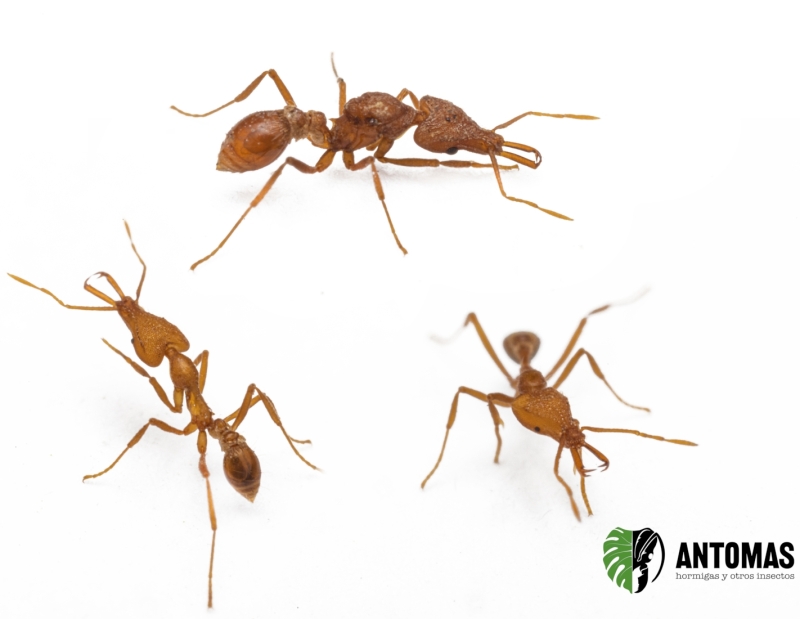
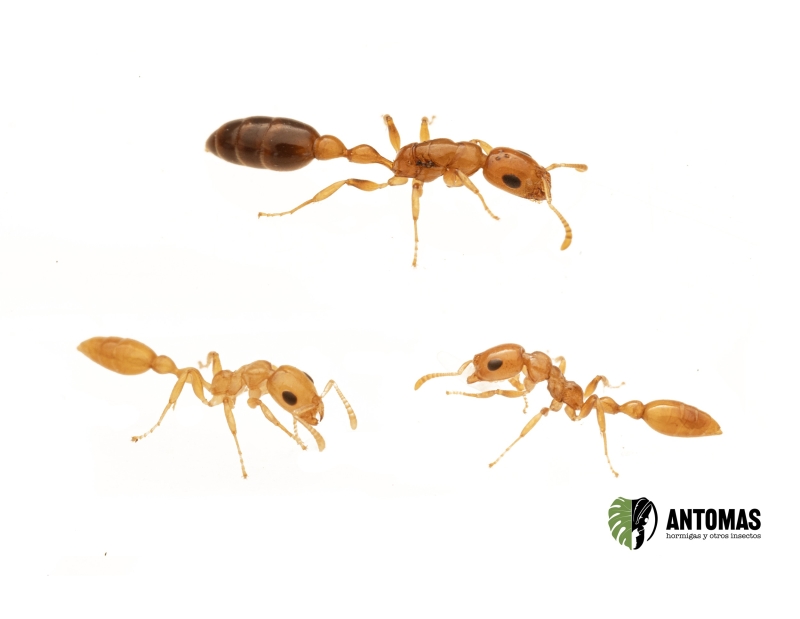
An army in miniature. The Mini Tank Ant is a Carebara from South-East Asia, the little sister of the famous tank ant: intense orange-red workers barely more than a millimetre long, and dark, huge-headed soldiers as big as their single queen. It forms columns, launches raids and stores reserves in larder soldiers. It belongs to a record-breaking genus, with giant queens, termite-mound squatters and soldiers with plug-shaped heads. It eats everything, buries its treasures and climbs like few others. Very hardy, but it demands high humidity and a set-up without a single gap. Colonies with queen. Shipping across Europe, live arrival guaranteed.
The little sister of the tank ant: a dimorphic Carebara from South-East Asia, with tiny orange-red workers and dark, big-headed soldiers, sold in the hobby as “bengalensis” (here we explain why it isn’t one). Colonies with queen, with a single queen and very hardy. 24–27 °C all year round, no diapause, high humidity (never let them dry out), a soil nest, a terrarium or a plaster nest, and they eat everything. Key point: a perfectly sealed set-up, because the workers slip through any gap, and a talc powder barrier.
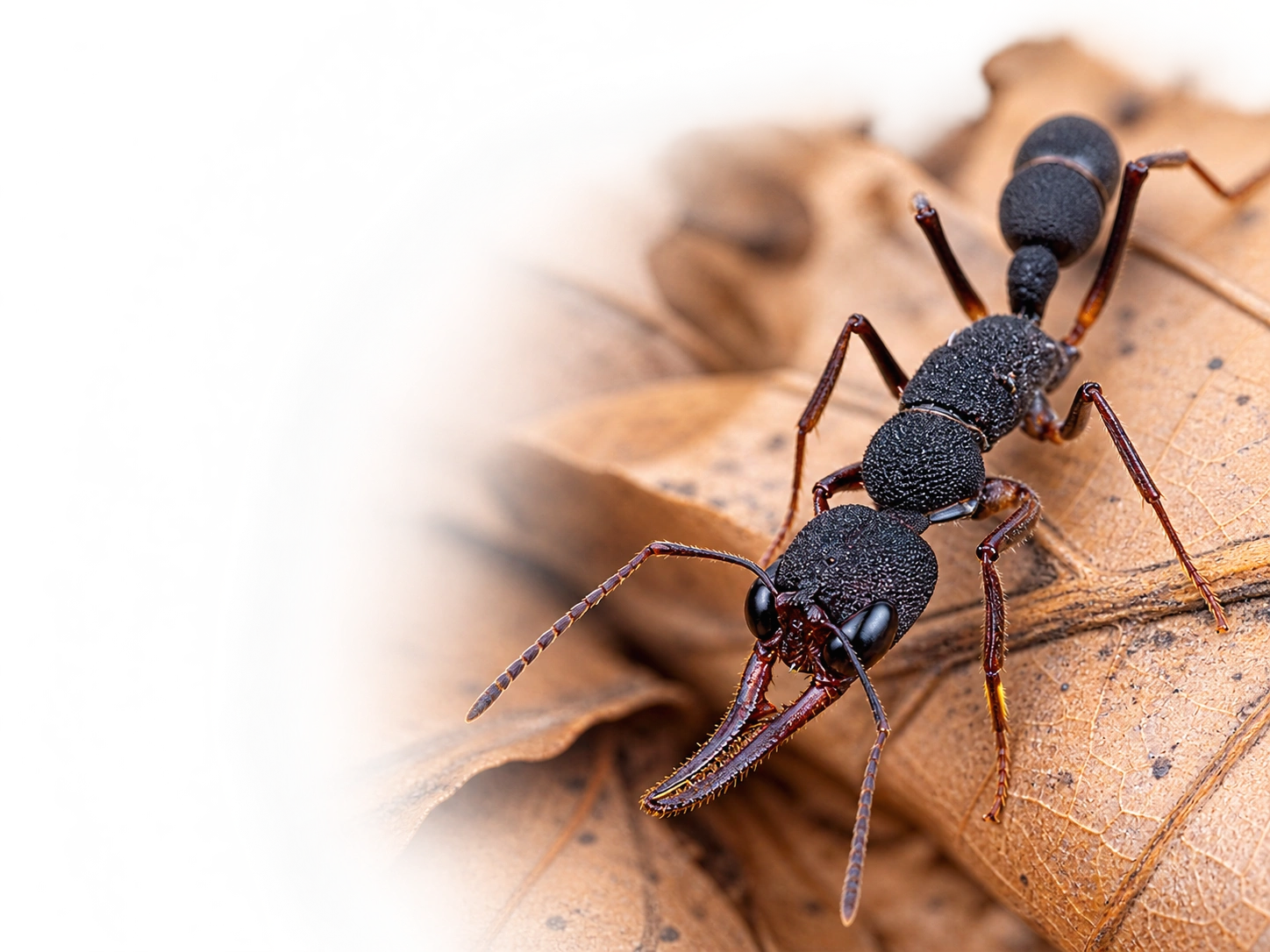
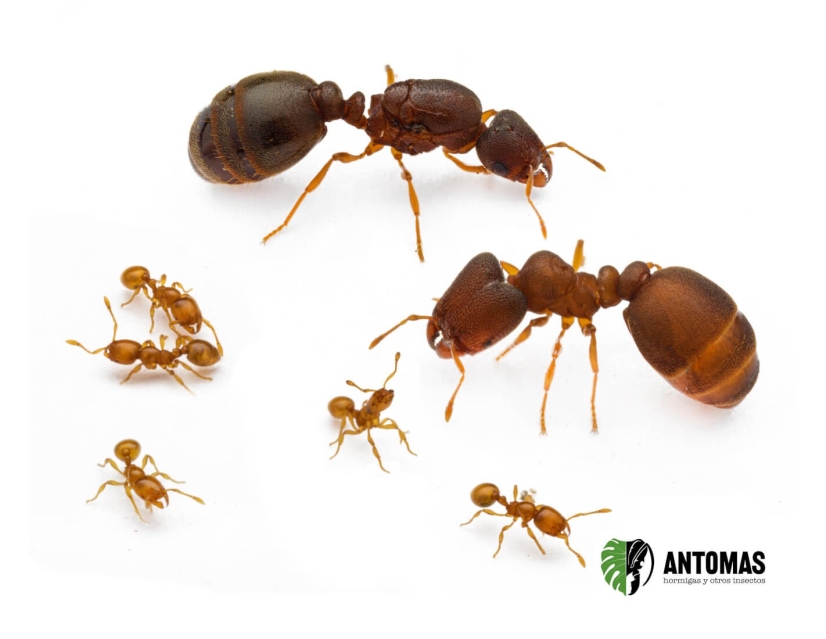
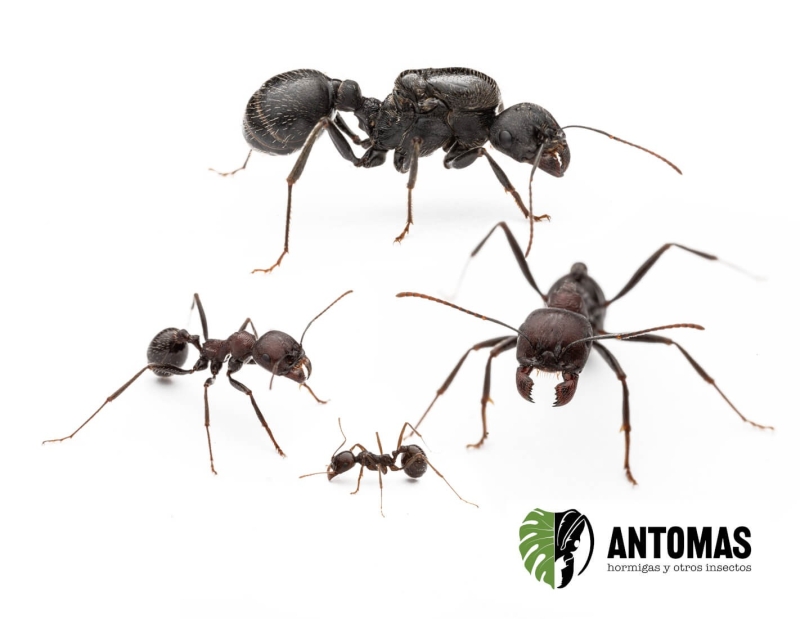
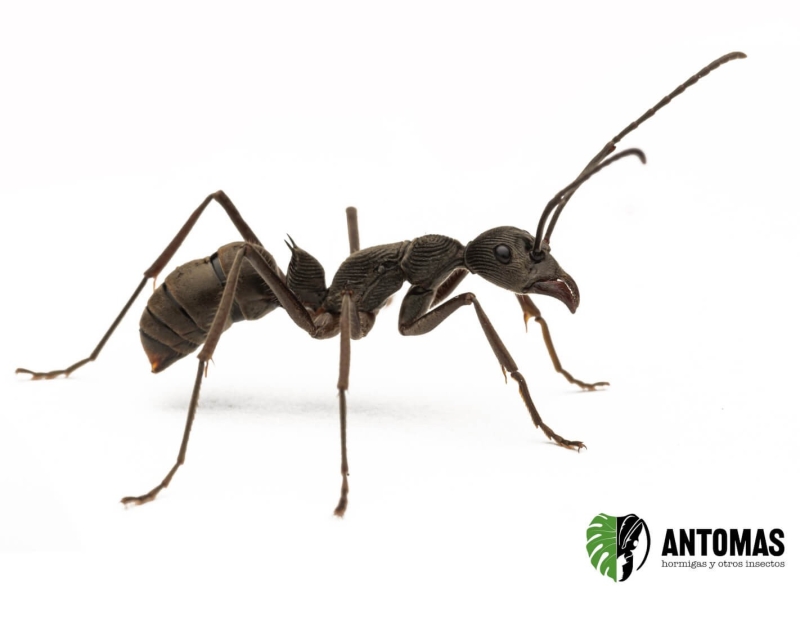
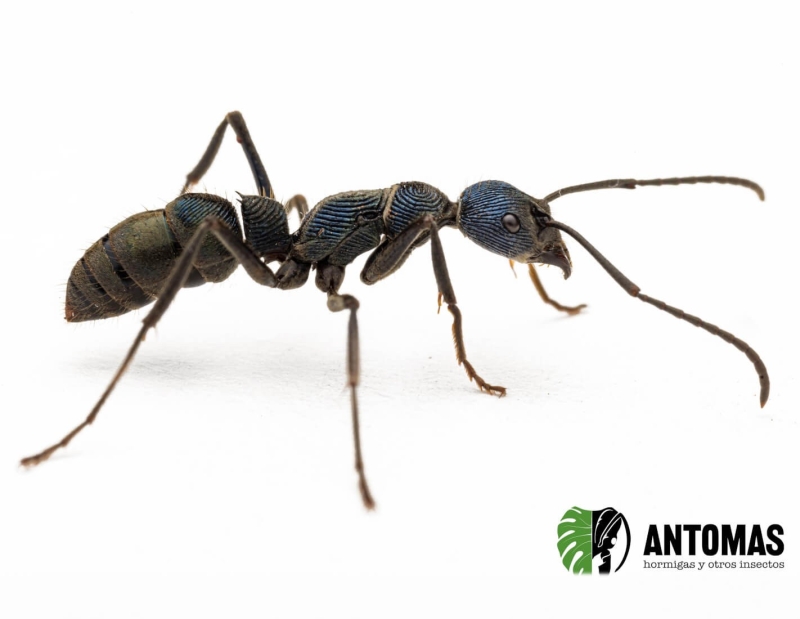
The Mini Tank Ant is the little sister of the tank ant, Carebara diversa, also known as the marauder ant. It is a Carebara from South-East Asia with two very different kinds of worker: tiny workers, an intense orange-red and among the smallest you will ever see in a formicarium, and big-headed soldiers, darker in colour, which are practically the same size as their single queen. In a way, it is a tank ant on a reduced scale: where its big sister has soldiers over a centimetre long, the Mini Tank Ant has soldiers just a few millimetres long. And it shares its sister’s appetite: it eats everything and buries its food.
In the hobby it is sold as Carebara bengalensis and, sometimes, as “qianliyan”. At Antomas we keep the trade name because it is how everyone knows it, but we want to be clear from the outset: it is not a true bengalensis, and we explain why in the first section. As with almost all small Carebara, very little is known about it, so in this care sheet we always separate three things: what is documented for the genus and its Asian species, what is known from relatives such as the tank ant, and what we have learnt from keeping it at Antomas.
Biology
Bengalensis? Qianliyan? The truth about its name
Let’s start with the name, because we would rather tell you ourselves.
The real bengalensis. The name goes back to 1902, when the Swiss myrmecologist Auguste Forel described Oligomyrmex bengalensis from just two specimens: a queen and a male, collected at Barrackpore, in West Bengal, near the Ganges delta. In 2004, when the genus was reorganised, it became Carebara bengalensis. More than a century later, its worker and its soldier have still not been described: in the identification key to the Carebara of India it is listed among the species known only from queens, or from queens and males, and its known distribution is limited to the Indian subcontinent: India, Bangladesh and Nepal.
The consequence is simple: there is no way to compare a colony with Forel’s bengalensis. To identify a Carebara, taxonomists look above all at the workers and the soldiers (the number of antennal segments, the teeth on the mandibles, the spines on the thorax, the sculpture of the gaster…), and for bengalensis neither is known. And there is more: in 2024, Zhi-yu Liu’s team revised the Carebara of China and explicitly rejected the presence of C. bengalensis in that country, after consulting another specialist.
And “qianliyan”? The other name it goes by does belong to a real species: Carebara qianliyan Terayama, 2009, described from soldiers and workers from Taiwan. Its original description separates it from the other Asian Carebara by its large size for the genus (the soldier of the type specimen measures about 3.8 mm) and by the fine longitudinal striations on the first segment of the soldier’s gaster. In 2025, Kohei Matsuura, Shingo Hosoishi and Hong Thai Pham re-examined that specimen and found that its antennae have 11 segments, not 9 as the original description said, so it probably belongs to the C. pygmaea species group, a group of dimorphic Carebara from South-East Asia. With soldiers of about 3.8 mm, it fits ours quite well. But it is known only from Taiwan, and nobody has compared the colonies in the hobby with the type specimen, so we cannot say it is that species either.
The name, by the way, has a story behind it. Terayama named several ants from Taiwan after deities and figures from Chinese folklore, including Mazu herself, the goddess of the sea. Most probably, qianliyan is the transcription of 千里眼, “the eye that sees a thousand li” (the li is an old Chinese unit of distance, of about 500 m). Qianliyan is one of the two generals who guard Mazu in her temples; the other is Shunfeng’er, “the ear that hears with the wind”. We have not been able to read the etymology in the original description, so we give it as probable. But there is something charming about an ant just a few millimetres long being named after a guardian with prodigious sight.
So what is it? With what is known today, the Mini Tank Ant is a dimorphic Carebara from South-East Asia whose exact identity remains unresolved. The candidates are several species with dimorphic workers described in the region in recent years, above all from the pygmaea group and its neighbour, the oni group, and it may well be a species that has not yet been named. This is not unusual at all: the taxonomy of the Asian Carebara is under full revision, with new species almost every year and redefined groups. And the hobby, out of habit, carries old names along with it: the tank ant itself is still sometimes sold as Pheidologeton, a genus that disappeared in 2014.
Strictly speaking, we should call it Carebara sp., that is, an unidentified species. It does not even qualify for a “cf.” (from confer, “compare with”), the abbreviation used when a specimen closely resembles a described species but cannot be confirmed as it: there are no workers of Forel’s bengalensis to compare it with. We keep “bengalensis” in the product name because that is how it is known and searched for in the hobby, but now you know what lies behind it. If a specialist ever gives it a name, we will update this care sheet.
Two castes and nothing in between: tiny workers and big-headed soldiers
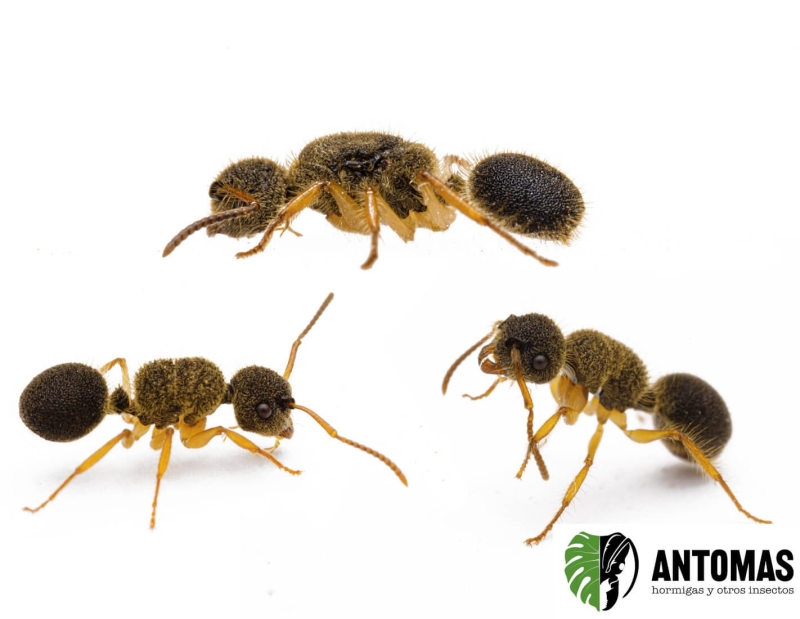
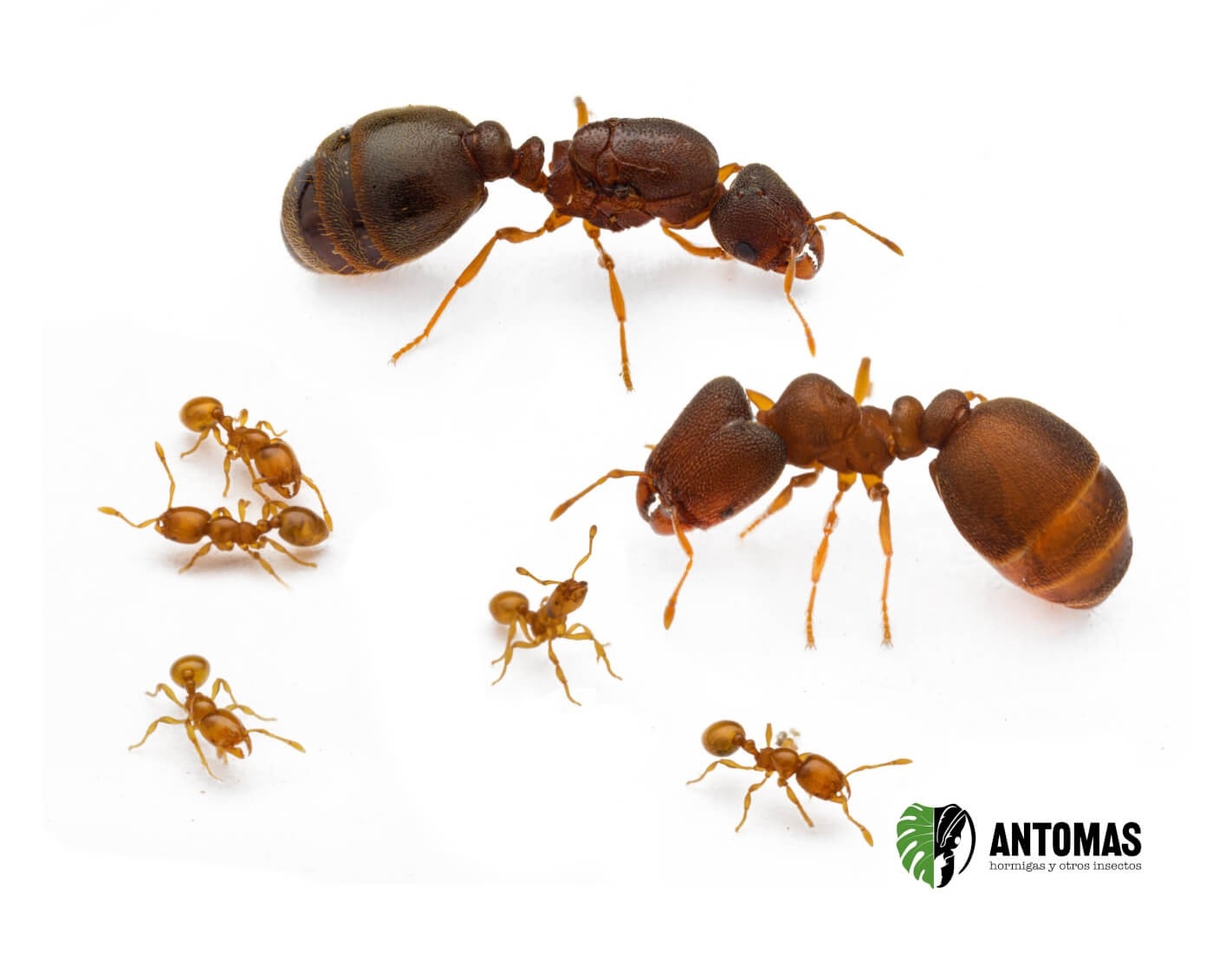
The first thing that strikes you when you look at a colony is that its workers are not all the same, yet they do not form a gradient of sizes either: there are two types, and almost nothing in between. On the one hand, the minor workers, tiny, which make up the vast majority and do almost all the work; on the other, the soldiers or major workers, much larger, with a huge head in proportion to the body. This is what biologists call worker dimorphism, and it is the hallmark of many Carebara: the former Oligomyrmex, now part of the genus, were precisely the dimorphic species.
What are two such different castes for? In the genus, the general division of labour is clear: the small workers look after the brood and the large ones defend the nest. In some species, the soldier’s head has become a highly specialised tool, as you will see below. What has not been studied in any dimorphic Asian species is the proportion of soldiers in a colony or how they share the work day to day. For reference, in one group of African species soldiers make up almost 10 % of the workers in some nests.
Its big sister, the tank ant, plays in another league: it has continuous polymorphism, with workers of every size, from the smallest to the “super-soldier”, and belongs to another lineage within the genus. The Mini Tank Ant is simpler and, in its own way, more elegant: two designs, each perfect for its job.
The Mini Tank empire: a Mini Tank Ant colony, in a video by Anthouse (in Spanish).
Giant queens and pocket-sized workers: a record-breaking difference
If one trait defines the genus Carebara, it is this: queens are, in general, far, far larger than the workers. In Carebara in the strict sense, the original group of the genus, the workers measure about 2 mm and the queens, “enormously enlarged”, usually exceed 15 mm: more than seven times the length of their daughters. It is one of the greatest size differences between queen and worker known in ants, a record-breaking difference, although nobody has turned it into an official figure.
That size has an obvious advantage: a huge queen carries a great deal of reserves inside her to raise her first daughters. In the African C. vidua, newly mated queens reared broods of about 1,000 workers in 39 days in the laboratory.
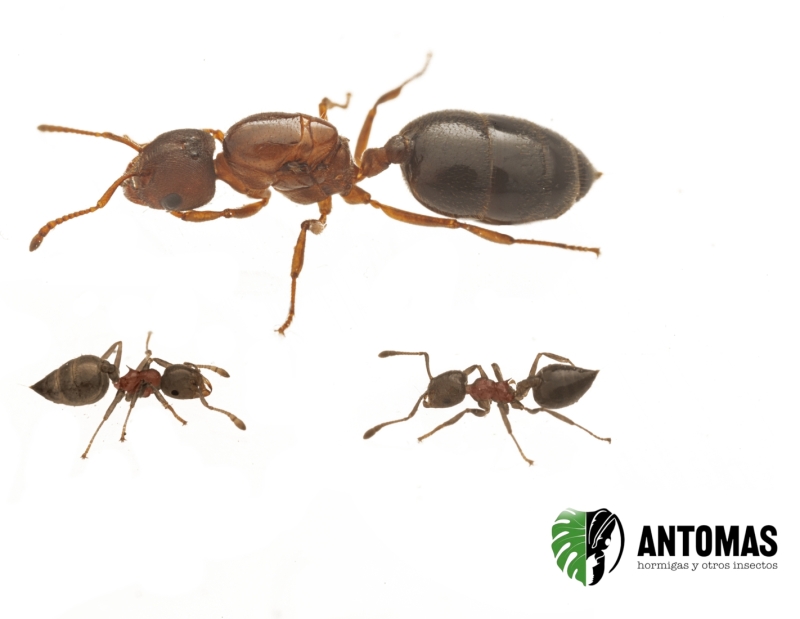
Not all Carebara are like this. In dimorphic species of the former Oligomyrmex type, which is what our Mini Tank Ant resembles, the difference is much smaller: soldiers measure about 2–2.5 mm and the queen, at most, twice that, about 5–6 mm or less. In our experience, in the Mini Tank Ant the queen and the soldiers are practically the same size, about 3.5–5 mm, while the workers, at 1–1.5 mm, are tiny. The queen is still several times longer than a minor worker, but she is not the giantess of her African cousins.
The myth of the queens with stowaways
For much of the 20th century, books told a lovely story about Carebara. Because their workers are minuscule and their queens gigantic, it was said that queens of the African C. vidua set off on their nuptial flight with several tiny workers clinging to their legs, like stowaways, to help them found the new nest. The entomologist George Arnold recorded it in 1915, the great myrmecologist William Morton Wheeler repeated it in 1923, and the story passed from book to book.
It was too good to be true. As early as 1948, Lowe had seen that the founding queens of another species, C. lignata, carried no help at all, and in 1989 the South Africans Hamish Robertson and Martin Villet studied colony foundation in C. vidua and found no trace of accompanying workers: the queens found their colonies alone. They published their work under a title that leaves no room for doubt: “Colony founding in the ant Carebara vidua: the dispelling of a myth”.
Today we know that queens travelling with “luggage” do exist, but in other genera: those of Acropyga, for example, set off on their nuptial flight with a mealybug in their mandibles, the seed of their future herd. Carebara do not need it: their trick is the size of the queen, who carries everything she needs to get started.
Where might the myth have come from? It is only a guess on our part, but perhaps from a scene seen in other Carebara: in some Asian species, keepers describe minor workers riding on the queen or on the soldiers, and in the tank ant the minors travel on the soldiers’ backs. In the Mini Tank Ant, by contrast, the workers do not climb onto either the soldiers or the queen.
Squatters in termite mounds
Carebara nest in the soil, in rotten wood and, many of them, inside termite mounds. Once again, the best studied is the African C. vidua. The ecologists Lepage and Darlington, both termite specialists, found its nests in 2–10 % of the large mounds of Macrotermes termites, though also well away from them, and discovered something astonishing: its tiny workers were able to overpower, kill and eat termite workers much larger than themselves. The queens, by contrast, could sit among the termites without provoking any attack.
The entomologist Joseph Bequaert saw the winged females of C. junodi emerging from inside termite mounds in the middle of their nuptial flight, with the walls of the mound covered in tiny workers of the same species. The classic interpretation is that, because of their size, they go unnoticed and hunt termites with impunity inside their neighbours’ fortress. Some Carebara are also considered lestobiotic, a word that comes from Greek and means “living by robbery”: they nest right next to the nests of other ants or termites and steal their food or brood.
Whether the Mini Tank Ant lives with termites is not known, but once you see its almost invisible workers you will understand why the genus thrives as a gentleman thief: these are ants the size of a comma.
Soldiers with plug-shaped heads
Some ants close the entrance to their nest with their heads. This is called phragmosis: a soldier with a flattened or truncated head sits in the hole and blocks it like a cork; when a nestmate arrives, it moves aside, and when an enemy arrives, it stays put. The most famous example is Colobopsis, the “doorkeeper” ants that nest in branches.
In 2022, Hosoishi and colleagues described a Carebara from South-East Asia with a soldier that seems made in the image of Colobopsis: the front of the head is truncated and forms a shield that includes the clypeus and even the mandibles, and each rear corner of the head bears a sharp, horn-like tooth. They named it Carebara colobopsis, and it is the first known case of a truncated phragmotic head in the genus. It was collected in the leaf litter of a dry lowland forest, and its soldier is tiny: the head is just over 0.8 mm long, little more than twice that of its minor workers.
One caveat: its use of the head as a plug is inferred from its shape, because nobody has yet found its nest. But it illustrates very well how far a Carebara soldier’s head can go: from a tool for biting and crushing to an armoured door.
Larder soldiers
The other great speciality of Carebara soldiers is storing food. In 2024, when describing a new species, C. laeviceps, Liu’s team observed that some soldiers had a swollen gaster, and that this gaster works as a storage organ for reserves: a larder on legs.
In the tank ant, this specialisation is even more developed. The myrmecologist Mark Moffett described its “repletes”: medium and large workers with a crop full of an oily reserve, which live permanently in the nest and regurgitate food to their nestmates. And keepers of C. diversa and C. affinis report that their largest soldiers stay grouped in the chambers and act as food containers.
And the Mini Tank Ant has them too: in our colonies there are repletes, soldiers with a swollen, shiny gaster that serve as the colony’s larder. If you see them, now you know what they are.
The little sister of the tank ant
The name Mini Tank Ant is no accident. Its famous relative, the tank ant (Carebara diversa), was called Pheidologeton diversus for more than 150 years, until in 2014 Georg Fischer, Frank Azorsa and Brian Fisher showed that Pheidologeton had no characters of its own that justified keeping it separate from Carebara. Since then, the tank ant and the Mini Tank Ant have been in the same genus, although in different lineages: the former is polymorphic, with workers of every size, and the latter dimorphic.
The tank ant is famous for its raids: it goes hunting en masse, in columns and fan-shaped swarms of tens of thousands of workers, which allow it to gather booty very quickly, steal food from other species and capture large prey. Its relative from the Malayan rainforests, C. silenus, is even faster: its swarms advance at up to 4.5 m per hour, and its medium and large soldiers devote themselves to clearing the way and finishing off prey.
Does the Mini Tank Ant do the same? On its own scale, yes. Nobody has studied how dimorphic Asian Carebara forage in the wild, but in our colonies the Mini Tank Ant forms columns and carries out raids: the workers set out in groups, find the food, cut it up and carry it off, or bury it on the spot. A pocket-sized army.
Most Carebara are tiny and subterranean and feed mainly on dead insects and other invertebrates. Prey recorded for the genus includes mites, springtails and arthropod eggs, and stable isotope analysis of six African species, a technique that reveals at which level of the food chain an animal feeds, places them as predators, some of them highly specialised.
Its big sister is the opposite extreme: a total omnivore that hunts anything it can, takes advantage of carrion and fruit, and harvests seeds straight from the plants.
At Antomas, our experience with the Mini Tank Ant is clear: it eats everything, from insects to sugary liquids. And, like its big sister, it buries its food, something that keepers of C. affinis also describe. In the wild, hiding the booty underground probably protects it from other ants; in a formicarium, buried leftovers rot and attract mites (see “Feeding”).
Tiny, subterranean and almost unknown
The genus Carebara is huge: it has 234 valid species, nine of them fossils, spread across the tropical and subtropical regions of the whole world. And yet it is one of the great unknowns of myrmecology, because of its size and its way of life: workers one or two millimetres long that live underground, in rotten wood or inside termite mounds, and are almost never seen. Many species are known from a single caste, and some, like Forel’s bengalensis, only from the queen and the male.
In South-East Asia, the pace of discovery is frantic. Since 2021 new species have been described almost every year: one that lives in the twilight zone of a cave; another, from the pygmaea group, with a wingless queen, so similar to a worker that it is called ergatoid, which nests in rotten wood; several from the oni group, which live in decaying wood or under stones, from 370 to 2,200 m above sea level; and the one with plug-headed soldiers. And in the 2024 revision of the pygmaea group, the queen of C. pygmaea, a species known since 1887, was described for the first time. One hundred and thirty-seven years to meet the queen of an ant: that is how elusive they are.
Taxonomists themselves acknowledge that very little is known about their behaviour and life cycle, so every observation made at home counts.
A climate without winter
Its region ranges from an equatorial to a monsoon climate, with a subtropical climate only at the northern edge. This is shown by the 1991–2020 climate normals of three weather stations covering that gradient:
Equatorial. No thermal seasons: monthly means of 27–28.5 °C all year round, nights of about 24 °C, rain every month, air humidity of 79–84 % and days of about 12 hours.
Monsoon. A cool, dry season (November–February), with means of 22–25 °C and nights of 16–20 °C; a hot season (March–April), with maximums of 35–37 °C; and a rainy season (May–October), with means of 26–29 °C and air humidity of 71–82 %.
Subtropical, at the northern edge. Only here is there a real winter, with means of 14–15.5 °C from December to February.
What does this mean for keeping them? That in most of its region there is no winter, and there is no need to imitate one. And since they live underground or in rotten wood, what reaches them is the buffered temperature and constant humidity of the soil of a tropical forest. That is why at Antomas we keep them at 24–27 °C all year round, with no diapause and in a highly humid environment.
Size and morphology
A tiny, dimorphic myrmicine: minuscule orange-red minor workers, darker big-headed soldiers, and a queen that is practically the same size as the soldiers. As we do not know for certain which species it is, we describe what we see in our colonies and what is known about dimorphic Asian Carebara.
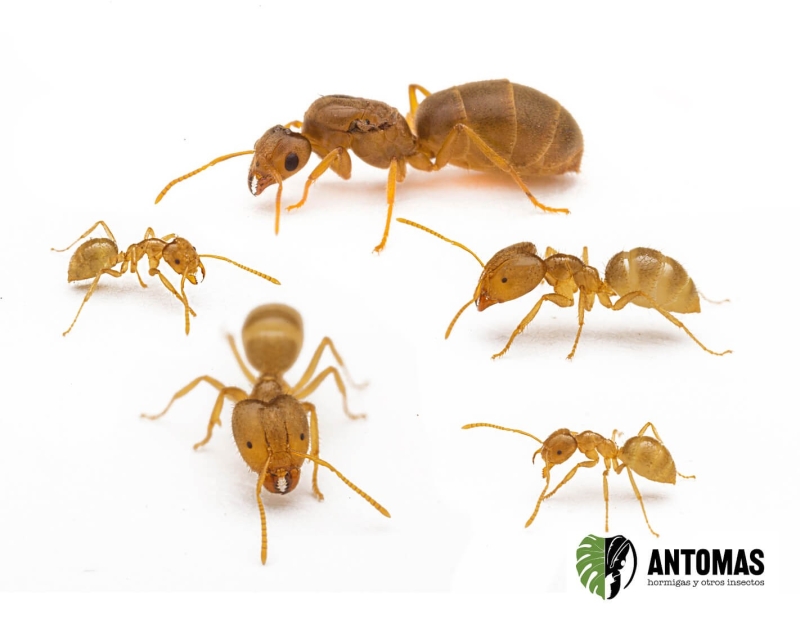
Minor workers. Especially small: they measure 1–1.5 mm, and some do not even reach a millimetre. They are a very red, very orange colour. They are the ones that escape: they get through gaps that look closed to the naked eye.
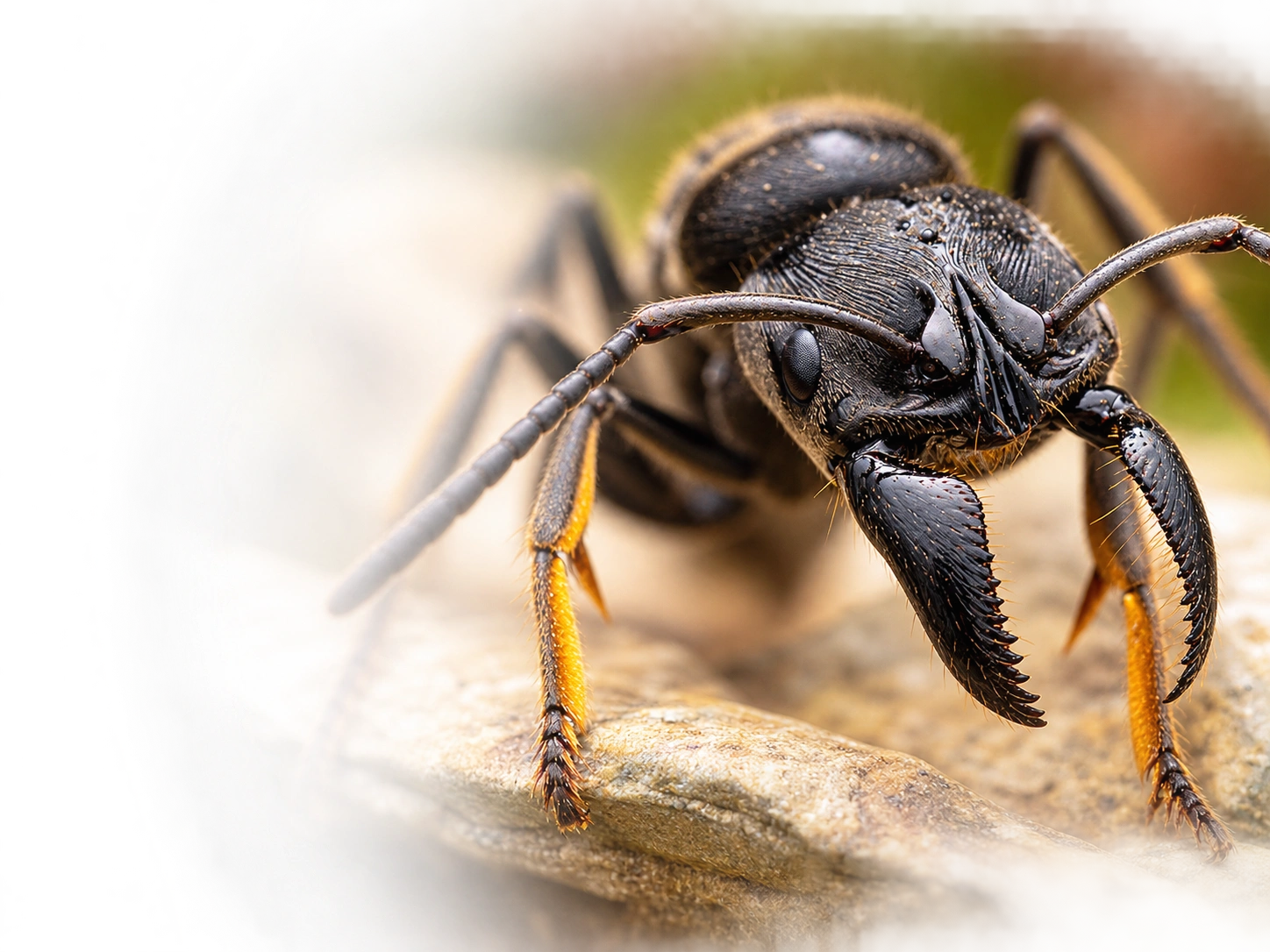
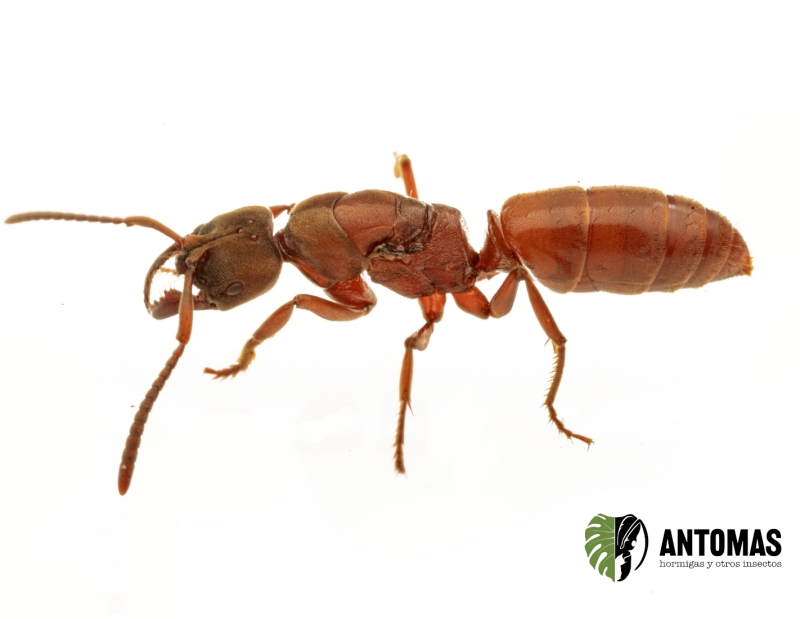
Soldiers. Much larger, with a big, massive head, out of proportion to the body, and browner and darker in colour than the workers. In our experience they measure 3.5–5 mm, and they do not escape. In similar Asian species, the soldier’s head may bear horns, ocelli or a shield.
Queen. Practically the same size as the soldiers, about 3.5–5 mm, and also brown and dark. She does not escape either. One per colony.
Antennae. In dimorphic Asian Carebara they have 9 or 11 segments, depending on the species group: 9 in the oni group and 11 in the pygmaea group.
Mandibles. With 5 or 6 teeth, also depending on the group.
Male. No published data and no measurements of our own.
If you have a good microscope, your colony can contribute something to science: with high-magnification photos of a soldier and a minor worker (antennae, mandibles, propodeum and first gastral segment of the soldier) or, better still, with dead specimens preserved in alcohol, a specialist could tell whether it is a known species or a new one. If you try, let us know.
Approximate measurements
Minor workers: 1–1.5 mm, and some do not even reach a millimetre (Antomas’s experience). In the dimorphic Asian Carebara that have been measured, the minor worker is 1.0–1.9 mm in total length, with a head 0.3–0.5 mm wide
Soldiers: 3.5–5 mm (Antomas’s experience). The soldier of the type specimen of C. qianliyan measures about 3.8 mm, and those of the oni group 2.8–3.4 mm
Queen: 3.5–5 mm, practically the same as the soldiers (Antomas’s experience; there are no scientific measurements of the queen of any dimorphic Asian Carebara)
Male: no data
The measurements of workers, soldiers and queens are our own; those of similar species are for comparison. They fit the pattern of dimorphic Carebara: soldiers a few millimetres long and queens no longer than about 5–6 mm.
Care in captivity
Difficulty: 3/5 – Advanced
The Mini Tank Ant is not a fragile ant. In our experience it is very hardy. That is what we see in our colonies, although keepers of its larger relatives, C. diversa and C. affinis, describe them as sensitive to dryness, cold and mites. The difference may lie in the species; in any case, being hardy is no excuse for neglecting the basics. What keeps it out of reach of beginners is three things:
Escapes. Its workers are so small that they slip through any gap, and they are good climbers too. The set-up must be perfectly sealed, which is why, for now, we do not recommend any brand of nest for this species.
Humidity. It needs a highly humid environment, constant and without lapses. Letting it dry out is a serious mistake.
Hygiene. It buries its food, and buried leftovers attract mites. You need to clean consistently and keep the foraging area somewhat drier than the nest.
And it is well worth it. It is a dimorphic Carebara in a formicarium, a rarity on the European market: two castes that look nothing alike, almost invisible workers that never stop, and the life of the tiny ants of the tropical soil, which hardly anyone has observed up close. And, as a bonus, a small taxonomic mystery on your shelf.
Recommended parameters
Temperature: 24–27 °C all year round. A moderate drop at night does them no harm: with similar species, keepers lower it to about 22 °C without problems. If you need heat, apply it from outside, on one side of the nest and with a thermostat, never with cables that enter the set-up.
Nest humidity: high, with one area that is always moist; in much of its region, air humidity is around 75–85 % for many months of the year.
Foraging area humidity: somewhat drier than the nest, to avoid mites and mould.
Water: always available, in a test tube with water and cotton wool in the foraging area.
Ventilation: just enough to avoid condensation and stale air, and always through a very fine mesh.
Light: it is enough to give them a dark area in the nest and a lit foraging area, with a day–night cycle of about 12 hours, as in their region.
Diapause: none (see “Diapause”).
High humidity, always: the mistake that is never forgiven
This is half the key. The Mini Tank Ant needs a highly humid environment in the nest, every day of the year. And it has an advantage that makes this easy for you: they immediately seek out humidity. As soon as part of the nest dries out, the colony moves towards the moist area, with the queen and the brood: if they crowd into the dampest corner, the rest of the nest has dried out.
Letting them dehydrate is a serious mistake. With workers this small, the margin is minimal: the smaller a body, the more surface it has in proportion to its volume and the faster it loses water (that is physics, not a figure measured in this species). With the tank ant, one keeper lost an entire colony in a single day through dehydration. Check the nest humidity every time you feed them and top up the reservoir before it runs dry.
High humidity does not mean waterlogged: standing water, soaked substrate and dripping condensation are paradise for mould and mites. That is why at Antomas we prefer a somewhat drier foraging area: the nest moist; the area where they eat drier and ventilated, with the food leftovers in plain sight. Keepers of the tank ant reach the same conclusion.
The formicarium: what any set-up must have
For now, at Antomas we do not recommend any brand of formicarium for this species. This is not a criticism of any manufacturer: its workers are so small that they find gaps where other species see nothing, and we prefer not to recommend a model until we are sure it is escape-proof for them. What we can tell you is what any set-up must have, whether bought or home-made:
A perfect seal. Lids must fit without any play. If a lid wobbles, that is where they will get out.
Gaps and lids checked. Seals, stoppers, tube connections and joints between modules: everything. A simple trick: before putting the colony in, hold the set-up up to the light; if you can see light through a joint, a worker will get through it.
Very fine mesh on the vents. In similar species, a minor worker’s head is 0.3–0.5 mm wide, so the mesh openings must be clearly smaller (our own deduction from those measurements). Keepers of C. affinis report that their minor workers get through the mesh of an ordinary formicarium.
No cable entry points. No heating cables and no thermometer or hygrometer probes coming in through a hole: every cable entry is a doorway. Heat and measurements, always from outside.
As for the type of nest, in our experience soil nests, terrariums and plaster nests all work quite well: all three let you keep a stable moist area that you can keep an eye on. The sealing requirements are the same for all of them; in a terrarium, a tight-fitting lid and ventilation only through very fine mesh. If you use soil, never use unsterilised garden soil: it brings mites and mould. Whatever you choose: the seal first, everything else after.
Escapes and barriers
There is good news and bad news. The good news: the queen and the soldiers do not escape; they are too big for the gaps their sisters slip through, so the heart of the colony is safe. The bad news: the workers do. They are tiny and good climbers, including on smooth surfaces, as keepers of C. affinis report, and if escapes are constant, the colony slowly bleeds away.
The barrier. In our experience, with this species almost any barrier works. Mineral oil works well, but some workers can get stuck in it, and with ants this small that means losing them. That is why at Antomas we prefer talc powder. A common way to apply it is to mix it with a little alcohol and paint a wide band near the top of the foraging area walls with a brush; once the alcohol evaporates, it leaves a layer of fine powder they cannot grip. Keep it dry and renew it when you see it caked, dirty or patchy.
The barrier is the second line of defence, never the first. What really stops this species is a well-sealed set-up; the barrier is there for any that find a route you have missed. And be careful when opening: open only as much as necessary, work calmly, preferably over a tray, and close up when you have finished.
Arrival and moving
At Antomas we sell colonies with queen, workers and brood, already up and running. When you receive yours, let it rest in a quiet place at 24–27 °C and check that the tube is still moist.
To move it into its formicarium, we do it by tipping the colony in, and with this species it is especially easy, because they immediately seek out humidity: as soon as they find it, they settle in.
Prepare everything beforehand: the set-up sealed and checked, and the moist area of the nest already hydrated, so that they have somewhere to go from the very first minute.
Work over a tray or inside a large container, so that no worker ends up on the table.
Tip the colony into the foraging area, next to the nest entrance: open the tube and, with gentle taps, let the workers, soldiers, queen and brood drop out. Help the stragglers with a very fine brush.
Close up immediately and leave them in peace. Before long they will head for the moisture of the nest and carry the brood inside.
If you ever need to move the colony to a new formicarium, use the same method.
One colony, one queen
Mini Tank Ant colonies have a single queen. The genus has all sorts: species with a single queen, such as C. lignata, and others with several, such as the tank ant or C. affinis, with up to 16 queens according to a German shop.
In the genus, colony foundation is claustral: the queen shuts herself away and raises her first workers alone on her reserves. We sell colonies with queen, so you skip that stage and start with the fun part: watching it grow. How big? There are no published data on colony size in dimorphic Asian Carebara. The genus has all sorts, from species groups with colonies of up to about a thousand individuals to the huge colonies of its big sister.
A colony lives on its brood. In the tank ant, keepers report that minor workers live one or two months and that a colony that stops raising brood runs out of workers within a few weeks. We do not know whether the same holds for the Mini Tank Ant, but the advice still applies: plenty of protein, stable humidity and a constant temperature, so that there is always brood on the way.
Feeding
In our experience, the Mini Tank Ant eats everything, but what suits it best is insects and sugary liquids. You need to bear in mind its size and its habit of burying food.
Protein: plentiful and varied. It is the engine of the colony, and it is the Antomas philosophy: if you do daily maintenance and remove leftovers, it is better to overfeed, because the colony understands that it has more resources and grows faster and in greater numbers. If you will not be able to clean often, it is better not to overfeed: leftover food rots and brings mould and mites. Change the type of insect from one week to the next, so that they do not always eat the same thing: fruit flies, small crickets, cockroach nymphs, chopped mealworms or waxworms… With workers this small, cut up or open large prey; freshly killed insects suit them perfectly, as in the wild. And buy your insects from a reliable supplier: insects treated with insecticides can kill the colony.
Watch out for buried food. This is its weak point: they bury whatever they do not eat straight away, and those leftovers, out of your sight, rot and attract mites. Offer protein in the dry part of the foraging area, on a smooth surface (a small piece of aluminium foil or a small lid), remove leftovers within 24 hours at most, as keepers of its relatives recommend, and check the nest regularly: a spot of mould or tiny white or brown dots moving next to a buried leftover are the sign that it is time to clean.
Sugars: varied and in a feeder. At Antomas we recommend varying the sugars: Anthouse’s Blue Sugar nectar 4–5 times a week and another sugary liquid or nectar 1–2 times a week. You can also add a little protein to the nectar. Always offer them in a feeder and never on cotton wool, because cotton wool goes mouldy and spoils the liquid very quickly. Use a traditional or home-made feeder in which the drop stays “spread out” and accessible; with workers this small, small drops are better than puddles, and renew it before it ferments.
Seeds and nuts: only crushed, and as a secondary option. Its big sister harvests seeds, and keepers of other Asian Carebara offer them, but the Mini Tank Ant is so small that it can hardly break them open. If you want to give it any, always make them crushed (sesame, millet or unsalted peanut), in small amounts and only now and then, and remove whatever they do not take, because they may bury it too. The basis of the diet, always: insects and sugary liquids.
Water: always available, in the test tube with cotton wool.
Diapause
It does not undergo diapause: in most of its region there is no winter (see “A climate without winter”). Shops and keepers agree that Asian Carebara do not need it. At Antomas we keep it active all year round, at 24–27 °C, with no winter drops. Do watch out for cold rooms in winter, though: in a keeping diary of the tank ant, the cold of a poorly insulated house killed almost all the male brood and part of the worker brood.
Behaviour in captivity
Humidity seekers. They always head for moisture, which helps you guide them during a move and serves as an indicator of the nest’s humidity.
Climbers. The workers walk up the walls of the foraging area effortlessly: the seal and the barrier are non-negotiable.
In columns and on the attack. They form columns and carry out raids: when they find food, they set out in groups to get it, like a miniature tank ant.
Buriers. Food disappears underground or into the nest sooner than you expect. They have not finished it: it is stored away.
With their own larder. They have repletes, soldiers with a swollen gaster that store reserves (see “Larder soldiers”).
Observe without fear. At Antomas we believe that ants are there to be enjoyed, observed and learnt from, not kept hidden away. It is enough to give them their dark area in the nest and a lit foraging area, and to observe them gently, intervening and stressing them as little as possible. With this species, a hand lens is your best ally.
A Mini Tank Ant colony in captivity, in a video by Anthouse (in Spanish).
Warning signs:
Workers wandering around outside the set-up: there is a gap, or the barrier needs renewing.
Spots of mould, dripping condensation or tiny white or brown dots moving next to the food: there is too much standing water or there are buried leftovers.
Brood that stalls or disappears: almost always a lack of protein, or it is too cold.
Handling and safety
They are harmless to people: they cannot bother you or do you any harm, and their bite is negligible. With workers this small, the challenge is a different one: not losing them. As with any species, handle them with entomological tools: a very fine brush or an aspirator (pooter), never with your hands. Work slowly and over a tray, so as not to lose or injure any worker, let alone the queen. This is an exotic species: under no circumstances should it be released.
What not to do
Leave gaps: lids with play, loose seals, badly fitted connections, coarse mesh or cable entry points. Their workers find any opening.
Rely entirely on the barrier: first and foremost, a well-sealed set-up. And if you use oil and see workers stuck in it, switch to talc powder.
Let the nest dry out, even for a day: letting them dehydrate is a serious mistake.
Waterlog the foraging area or tolerate standing water and condensation: moist nest, somewhat drier foraging area.
Let buried leftovers build up: remove uneaten food within 24 hours and check the nest.
Put sugary liquids on cotton wool: always in a feeder.
Always give them the same insect, skimp on protein or offer them whole seeds: if you give them any, crushed.
Put them into diapause or leave them in a cold room in winter.
Handle them with your hands.
Scientific sources
This care sheet is based on the scientific literature on the genus Carebara, on the climate of its region and on the experience of Antomas and other keepers. Main references:
Liu, Z.-y., Zhong, Y., Huang, Y.-y., Ran, H. & Song, F. (2024). A new ant species of the genus Carebara Westwood, 1840 (Hymenoptera, Formicidae, Myrmicinae) with a key to Chinese species. ZooKeys 1190: 1–37. doi:10.3897/zookeys.1190.110552
Fischer, G., Azorsa, F. & Fisher, B. L. (2014). The ant genus Carebara Westwood (Hymenoptera, Formicidae): synonymisation of Pheidologeton Mayr under Carebara, establishment and revision of the C. polita species group. ZooKeys 438: 57–112. doi:10.3897/zookeys.438.7922
Sharaf, M. R., Aldawood, A. S. & Taylor, B. (2011). First record of the myrmicine ant genus Carebara Westwood, 1840 (Hymenoptera: Formicidae) from Saudi Arabia with description of a new species, C. abuhurayri sp. n. ZooKeys 92: 61–69. doi:10.3897/zookeys.92.770
Matsuura, K., Hosoishi, S. & Sokh, H. (2024). A remarkable new species from the pygmaea species group of the genus Carebara Westwood, 1840 (Hymenoptera: Formicidae: Myrmicinae) from Cambodia. Far Eastern Entomologist 496: 1–9. doi:10.25221/fee.496.1
Hosoishi, S., Yamane, S. & Sokh, H. (2022). Discovery of a new phragmotic species of the ant genus Carebara Westwood, 1840 (Hymenoptera, Formicidae) from Cambodia. Journal of Hymenoptera Research 91: 357–374. doi:10.3897/jhr.91.82490
Lepage, M. G. & Darlington, J. P. E. C. (1984). Observations on the ant Carebara vidua F. Smith preying on termites in Kenya. Journal of Natural History 18: 293–302. doi:10.1080/00222938400770221
Moffett, M. W. (1984). Swarm raiding in a myrmicine ant. Naturwissenschaften 71: 588–590. doi:10.1007/BF01189188
Moffett, M. W. (1988). Foraging dynamics in the group-hunting myrmicine ant, Pheidologeton diversus. Journal of Insect Behavior 1: 309–331. doi:10.1007/BF01054528
Moffett, M. W. (1988). Foraging behavior in the Malayan swarm-raiding ant Pheidologeton silenus (Hymenoptera: Formicidae: Myrmicinae). Annals of the Entomological Society of America 81: 356–361. doi:10.1093/aesa/81.2.356
Moffett, M. W. (2019). Marauder ants (Carebara in part). In: Starr, C. (ed.), Encyclopedia of Social Insects. Springer. doi:10.1007/978-3-319-90306-4_75-1