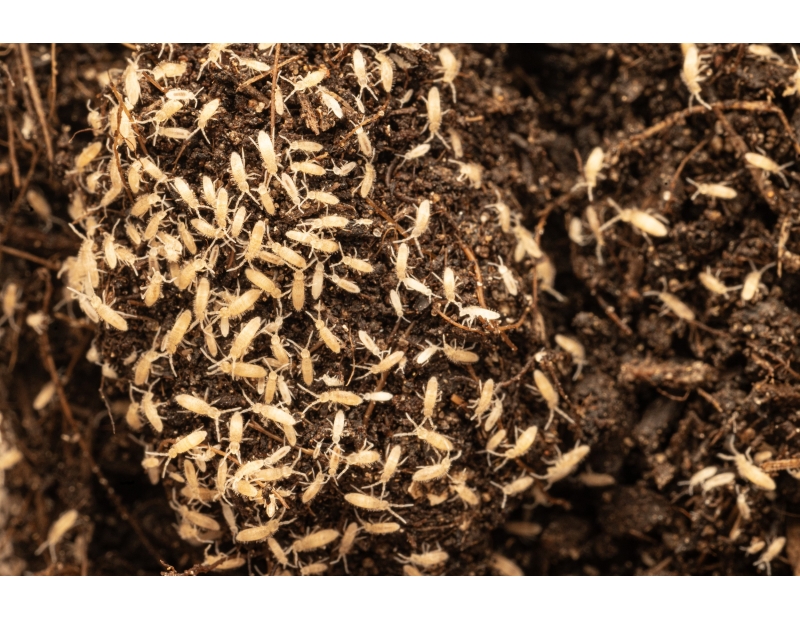
Live food · Breeding: easy with heat (2/5)
What it is for: a small, soft-bodied prey, ideal for founding queens and small colonies. It does not sting, does not bite and cannot climb glass or smooth plastic, so it stays in the foraging area, and its remains dry out instead of rotting: no mould in your test tubes. A favourite of our Pheidole and Myrmecocystus, and a great termite substitute for termite-eating species. How to keep them: a smooth tub with a fine-mesh lid, egg carton, oat flakes and a water point; at room temperature they last for weeks, although they do not breed. Can they be bred? Yes, and it is easy with heat: at 35–37 °C, they breed all year round.
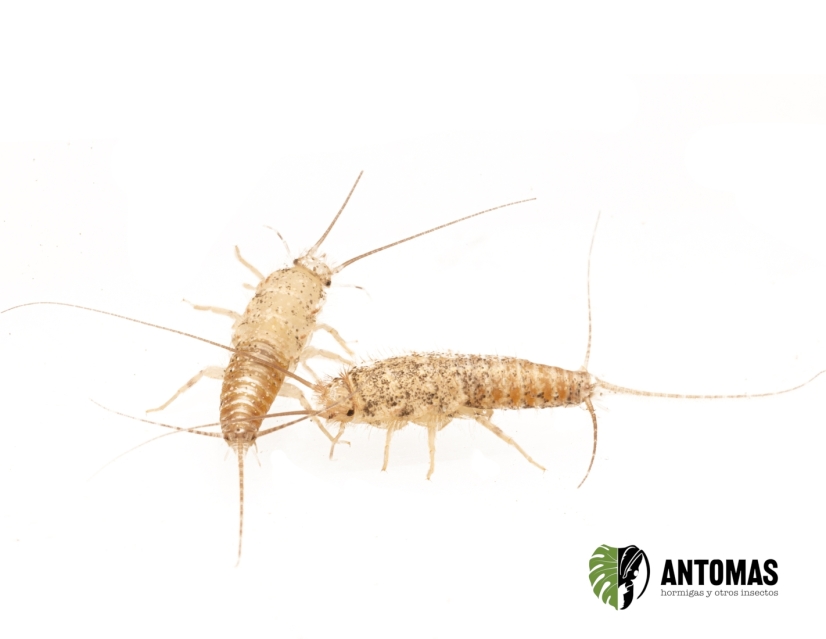
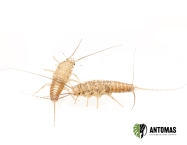
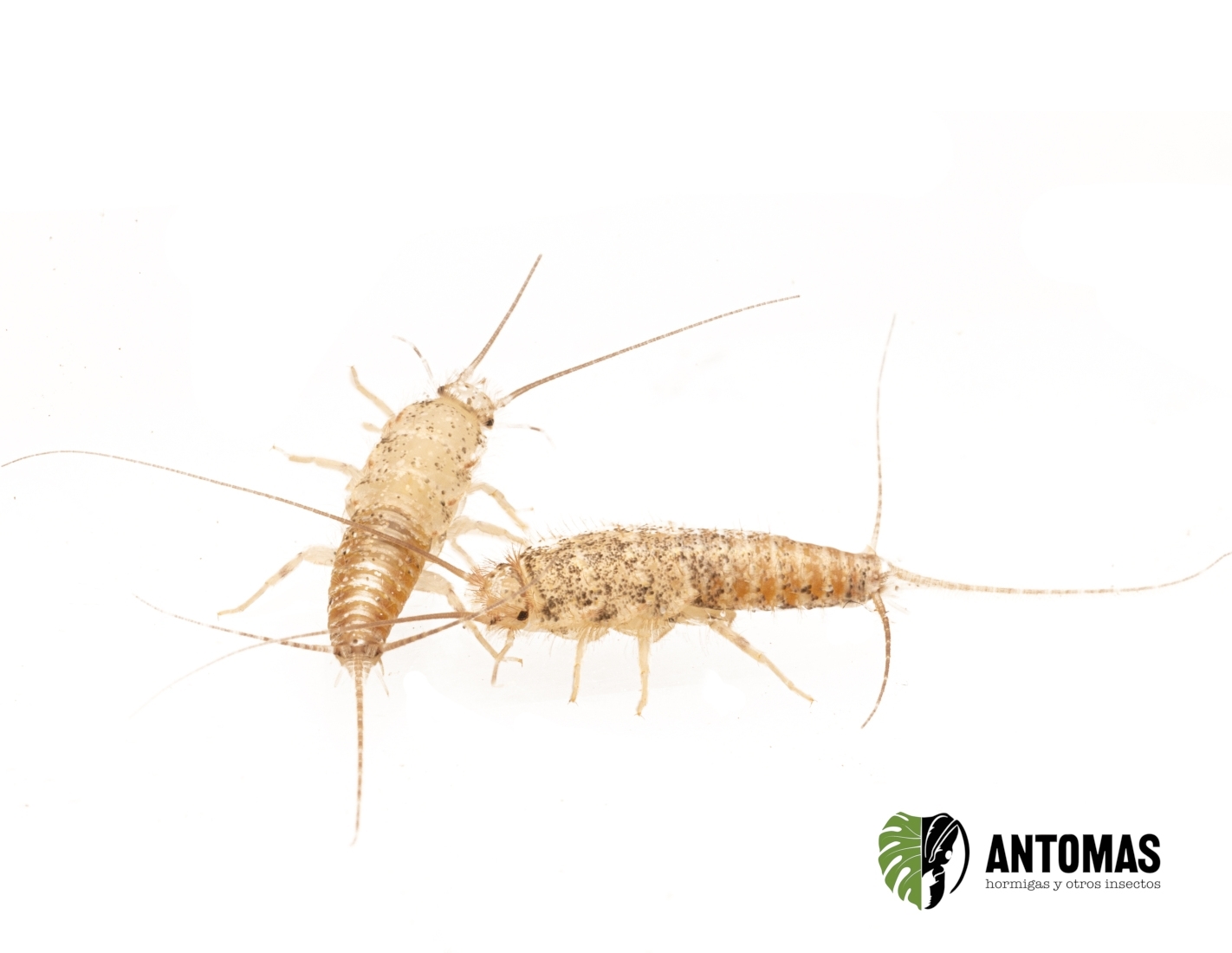
Thermobia domestica (Packard, 1873) is a small wingless insect of the order Zygentoma and one of the most rewarding live foods for your ants. In English it has a name of its own, the firebrat, although it is often mistaken for the common silverfish, Lepisma saccharinum, the one found in bathrooms and cupboards. Thermobia is its heat-loving relative, and its scientific name gives it away: it comes from the Greek thermós, “hot”, and bíos, “life”.
It is much more than food: the Zygentoma are the sister group of all winged insects, and T. domestica, very easy to rear, is the laboratories’ favourite: it is used, for example, to study the origin of metamorphosis. At Antomas we sell it for a simpler reason: ants love it. It is sold by weight: 1 g is about 80 individuals, and 3 g about 240.
Why it is one of the best live foods for ants
What follows is the experience of Antomas, which uses it every day: no study or forum has compared it with other prey. Its biology, however, helps to explain it.
Mould-free test tubes: remains that dry out instead of rotting
The great enemy of the test tube is the forgotten food scrap: a piece of cricket rots within days in the moisture of the cotton wool, goes mouldy and forces you to move the queen to a new tube at the worst possible moment. With Thermobia the opposite happens: at Antomas we see time and again that its remains neither rot nor go mouldy. They stay dry and can be removed whenever it suits you. That is why it is an especially good live food for colonies that still live in test tubes.
Nobody has studied why, but its biology offers several reasonable explanations:
- It drinks from the air, but only while alive. A live firebrat absorbs water vapour from the air when humidity is above 63%, using a mechanism that consumes energy (see “An insect that drinks water from the air”). Once dead, it can no longer take up water: it can only lose it.
- It dries out in low humidity. Below 43% relative humidity it loses water even when alive, so a scrap left away from the wet cotton wool dries out before mould has time to grow.
- Small body. About 12.5 mg on average, many times lighter than a cricket: the smaller a body, the more surface it has relative to its volume, and the faster it dries.
- Dry diet. It is reared on flakes, bran and flour, not on fruit or vegetables, so its gut holds little water and little sugar to ferment.
These are hypotheses, but they fit what we see. Mind you, with condensation or soaking-wet cotton wool, any scrap will go bad.
The perfect bite for founding colonies
A queen with her first workers needs protein but cannot cope with large prey. In our experience, Thermobia is brilliant for founding colonies for four reasons:
- Its size. An adult is about 1 cm long without antennae or tails, and every batch includes smaller individuals: just the right size for a handful of workers.
- Easy to carry. It is long, flat and soft, with no spines or hard armour, and even the smallest workers carry it back to the nest.
- It neither stings nor bites. It has no sting or venom, and its mandibles are so weak that they scrape rather than bite: no risk to the queen or the brood.
- It cannot climb glass or smooth plastic. That is why it cannot get out of a bath, and for the same reason it stays in the foraging area, within reach of the workers.
Pheidole and Myrmecocystus: the ones that enjoy it most
With two genera, in our experience, it is especially satisfying, both for the colony and for whoever is watching.
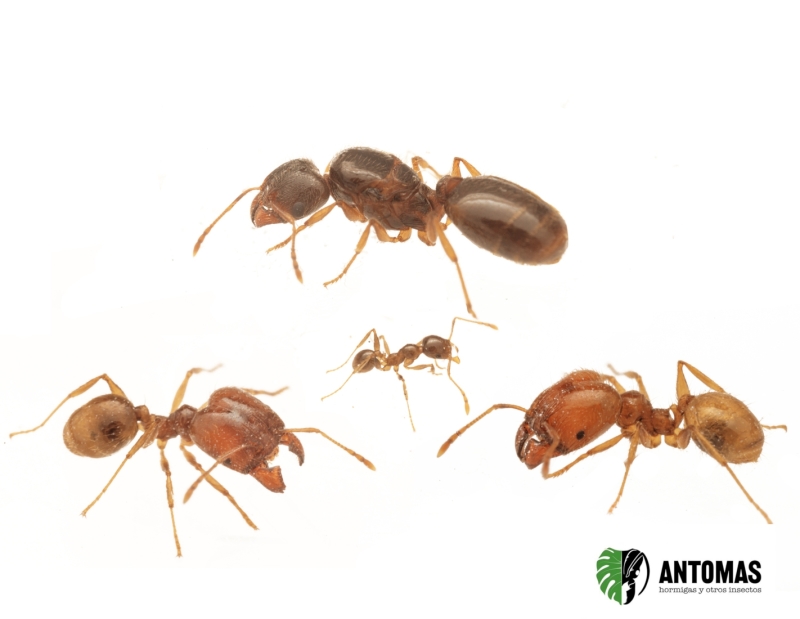
Pheidole. The minor workers find the prey straight away and recruit their nestmates, and the majors, with their huge heads, help to cut it up: a firebrat is just the right size for teamwork. We see it with our Pheidole pallidula, the Mediterranean Pheidole, and with the American Pheidole rhea and Pheidole titanis.
Myrmecocystus. Honeypot ants get off to a slow start and at first need very small, frequent protein. At Antomas, our Myrmecocystus mexicanus, M. placodops, M. mimicus, M. mendax and M. navajo get Thermobia as their daily starter protein.
The best termite substitute in captivity
Some ants are termite specialists: in the wild they live by hunting them, and in captivity getting hold of termites and keeping them alive is tricky. At Antomas we have found that Thermobia is a great substitute for termites: soft, the right size and easy to carry, these hunters love it. We see it with some Leptogenys, a genus in which several species are specialist termite hunters, and with Pheidole titanis, which raids termite nests in groups in the wild. It also suits Myrmecocystus mimicus, which counts termites among its main prey in its natural habitat.
How to offer them: live or freshly killed, and how many
- Live, for colonies with plenty of workers and to enjoy watching them hunt: release them in the foraging area, where they stay until they are found.
- Freshly killed, for lone queens, founding colonies and species that are poor hunters, because the adults are very fast (see “A sprinter with sensors in its tail”). At Antomas we never freeze them: we kill them just before offering them by lightly crushing the head, so they arrive fresh and whole. In a founding tube, keep them away from the cotton wool.
How many? As a guide, as many as the colony will eat in a day:
- Lone queen or queen with 1–5 workers: 1 every one or two days.
- Small colony, 10–50 workers: 2–5 a day.
- Medium colony, 50–200 workers: 5–15 per feed.
- Large colony: several dozen, alternating with larger prey.
And do not hold back: the more protein, the better and faster they grow. If you do daily maintenance and remove the leftovers, it is better to overfeed, because the colony senses that it has more resources and grows faster; if you cannot clean often, better not to overdo it. With Thermobia, what is left over does not rot anyway.
Nutritional value: what is known and what nobody has measured
Let us start with what does not exist: nobody has published a nutritional analysis of Thermobia, or of any other Zygentoma. There are no figures for protein, fat, calcium or amino acids, and any percentage you see out there has been copied from another insect.
The only measured figure is water: in well-fed adults, dry matter is 33.9% of live weight, that is, about 66% water. The same study found that fasting raises the proportion of water and uses up dry matter (Okasha, 1971): a hungry firebrat is a poorer meal. For context, here are the published figures for other feeder insects:
| Prey | Dry matter (% of live weight) | Crude protein* | Crude fat* | Ca:P ratio |
|---|
| Thermobia domestica, adult | 33.9% | no data | no data | no data |
| Drosophila melanogaster, adult | 30.9% | 68.0% | 19.0% | 0.13 |
| Shelfordella lateralis, small nymph | 20.8% | 76.1% | 14.5% | 0.20 |
| Tenebrio molitor, adult beetle | 38.8% | 67.7% | 17.7% | 0.07 |
| Acheta domesticus, adult cricket | 28.4% | 63.3% | 17.3% | highly variable |
* On a dry-matter basis. Sources: Oonincx & Dierenfeld (2012); Okasha (1971) for Thermobia; Barker et al. (1998) and Finke (2002) for the cricket, whose calcium content varies widely between samples.
With 34% dry matter, Thermobia is somewhat more concentrated than the fruit fly or the cricket. And all the analyses agree on one thing: feeder insects are poor in calcium, and methionine and cystine are the first amino acids to fall short (Finke, 2002).
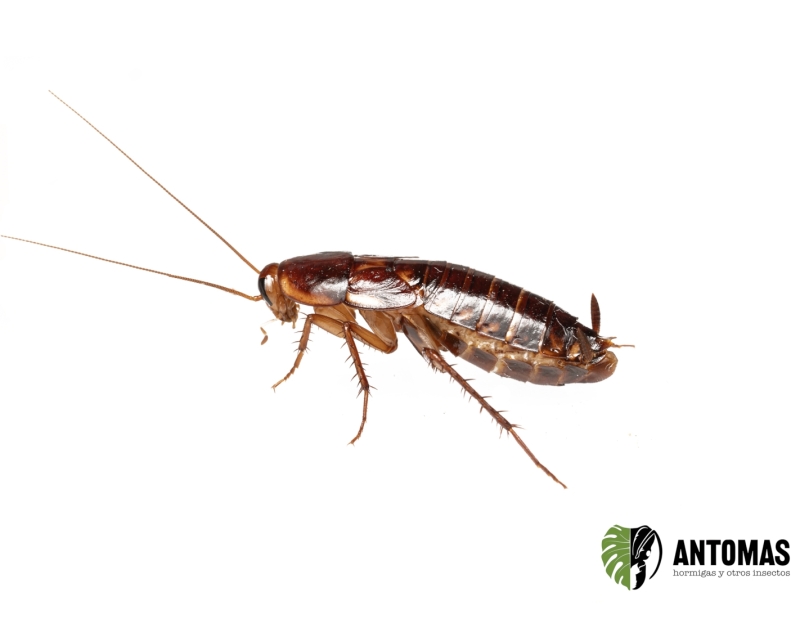
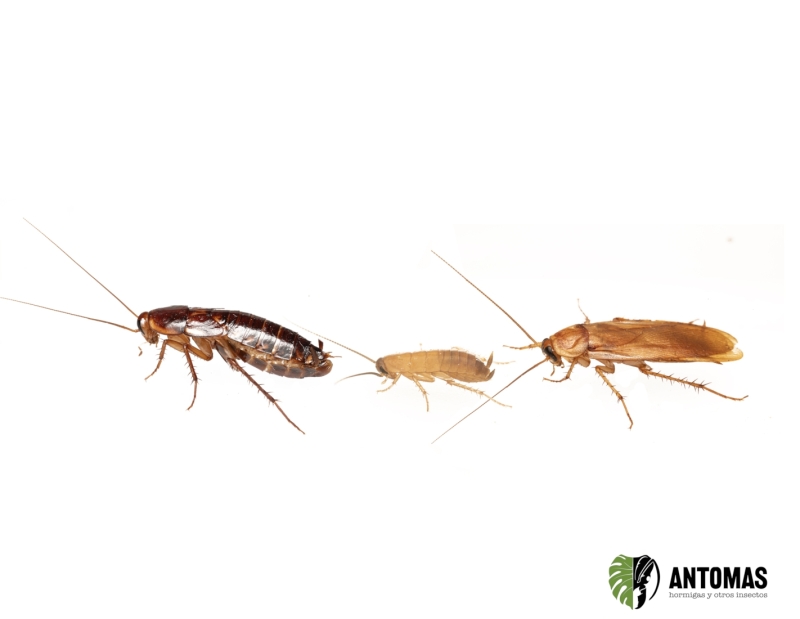
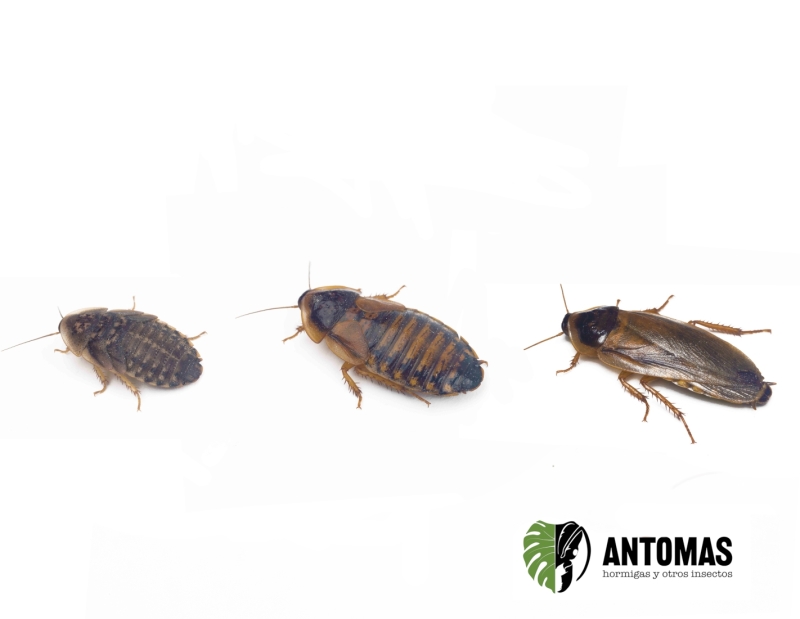
The Antomas rule: a varied diet. No insect is complete on its own, so do not feed Thermobia all the time. Use it as the staple for founding and small colonies and, from one week to the next, alternate it with other live foods from our shop, depending on colony size: crickets (Acheta domesticus), dubia roaches (Blaptica dubia), red runner roaches (Shelfordella lateralis), mealworms (Tenebrio molitor) and springtails (Sinella curviseta). The same goes for sugar: at Antomas we recommend Anthouse’s Blue Sugar nectar 4–5 times a week and another sugary liquid or nectar 1–2 times, always in a feeder and never on cotton wool.
Biology of the firebrat
It loves 37 °C
Few insects seek out heat like Thermobia. Its probable origin is the deserts of North Africa and Western Asia, and today it lives all over the world, but almost always indoors where it is hot: bakeries, ovens and boiler rooms. In choice tests it preferred shelters at 35 °C to those at 20 °C, and females kept at 35 °C laid many eggs, whereas at 20 or 25 °C they laid none (Tremblay & Gries, 2006). In the cold it does not die: it saves energy. Based on the data of DeVries & Appel (2013), at 20 °C it uses 4 to 6 times less oxygen than at 37 °C. It has no winter rest: given heat, it breeds all year round.
An insect that drinks water from the air
This is its great superpower. At a relative humidity of 63% or more, it actively absorbs water vapour from the air through its rectum; below 43%, it loses water (Noble-Nesbitt, 1969). The engine is a set of rectal sacs packed with mitochondria, and its cuticle carries an almost waterproof greasy layer. It is the perfect adaptation for a desert insect and probably part of the secret behind its dry remains.
Moulting for life
Almost all insects stop moulting once they are adult. Thermobia keeps moulting throughout its life, which lasts from two to several years, and goes through 45 to 60 instars. It also uses its moults to repair itself: if it loses a leg or a cercus, the next moult comes sooner, and in it the legs regain at least 80% of their length, but the cerci only 20% (Buck & Edwards, 1990).
Courtship without copulation: the spermatophore
Silverfish and their relatives do not mate like most insects. After a courtship of antennal contact, the male leaves a spermatophore, a small sperm packet, on the ground, and the female picks it up: a system that predates the copulation of winged insects. A Japanese study from 2023 also showed that females mate several times (Inada et al., 2023). There is no parthenogenesis: to breed them you need both males and females.
Drawn together by the smell of their microbes
They are not social, but they gather in shared shelters. In 2008 this was put down to a pheromone in their amber-coloured droppings; in 2013 the same researchers found the key: what attracts them is a bacterium, Enterobacter cloacae, and a fungus, Mycotypha microspora, which live in those droppings and which, what is more, provide nutrients to the nymphs that eat them (Woodbury & Gries, 2013). Cellulose, on the other hand, it digests by itself, with an enzyme of its own.
A sprinter with sensors in its tail
If you have ever tried to catch a silverfish, you know how fast it is. Its two cerci and its central filament are covered with sensory hairs connected to giant interneurons, which trigger escape at the slightest touch or air current. The system has all the elements of the one found in crickets and cockroaches, and has been described as a prototype of defence against terrestrial predators (Edwards & Reddy, 1986). For an ant, a live adult is a real hunting challenge; the nymphs, which are slower, are easier prey.
A newcomer to Spain: a Madrid bakery, 2022
Until recently it was not on the list of household lepismatids of Spain. The first published record dates from October 2022: 36 specimens on a sticky trap inside an electrical cabinet in the oven room of an industrial bakery in Madrid. On the Iberian Peninsula it had previously been known only from a bakery near Lisbon.
Morphology and size
Long, flattened, wingless body, with two long antennae, small compound eyes and three “tails”: two cerci and a central filament. Its scales form a grey and brown mottled pattern, without the silvery sheen of Lepisma; ours are cream mottled with grey and black, with orange bands on the abdomen. The young hatch white and without scales, which appear in the fourth instar. The mouthparts are of the chewing type but very weak, and males and females can only be told apart by the tip of the abdomen.
Approximate sizes
- Adult: 10–13 mm, excluding antennae and cerci (up to 15 mm according to some authors)
- Adult weight: over 7 mg; physiologists use a 30 mg individual as a reference
- Our batches: about 12.5 mg on average (80 per gram), probably subadults and small adults
- Body water: about 66%
- Egg: about 1 mm, orange according to breeders
- Lifespan: from 2 to several years
How to keep them at home for a few days or weeks
At room temperature they survive without problems, although they do not breed: below about 30 °C they stop reproducing and their metabolism slows down (see “It loves 37 °C”).
- Container: a smooth plastic tub with a lid ventilated with fine mesh.
- Shelter: a piece of egg carton or crumpled unprinted paper.
- Food: a pinch of oat flakes or fish flakes, renewed every week. Well fed, they make better food for your ants.
- Water: a water point they cannot drown in, such as damp cotton wool in a bottle cap or a small tube of water plugged with cotton wool, and no condensation. In the dry air of a home they slowly dehydrate: water is what extends their life the most.
- Location: in the dark, between 20 and 28 °C, and never below about 15 °C.
How to breed them
If you use a lot of them, breeding them pays off and is not difficult: the only essential is heat. These guidelines come from laboratories and from European breeders.
Heat and humidity: 35–37 °C with water to hand
- Temperature: 35–37 °C in the warm zone, the laboratory standard, and a cooler zone of about 26–30 °C. Below about 30 °C they do not breed.
- Controlled heat: with a thermostat and the probe inside the container. A heating cable on a side wall, not on the bottom, works well; a heat mat without control can overheat.
- Humidity: laboratories work above 70%, although a classic study reared them at 25%. What is essential is water they can reach without risk of drowning, and no condensation, which drowns the young and makes the food go mouldy.
Container and shelters
- Box: smooth plastic, 5–10 litres, with ventilation covered by very fine mesh that also stops newly hatched young.
- Just enough ventilation: an airtight lid causes condensation, and a mesh-only lid dries the air too much. Ideally, use a lid with holes covered by mesh.
- Shelters: dry egg cartons, corrugated cardboard or folded filter paper.
- Starting out: breeders recommend starting with 100–150 individuals. The culture takes a few months to get going.
The culture diet
Dry, starchy food. Laboratories use infant rice cereal with dry cat food, or fish flakes with oat flakes; breeders add wheat bran or wheat germ, and brewer’s yeast works as a supplement. Little and often is best. Water goes in a vial plugged with cotton wool, never in a puddle. Remove anything that goes mouldy and do not use printed paper or anything that might carry insecticides.
Egg-laying and incubation: orange eggs in 9–12 days
Given heat, females start laying at 1.5–4.5 months of age, about 50 eggs per clutch on average. Give them balls of clean cotton wool between the cartons: it is their favourite spot. According to breeders, the eggs are orange: over time the cotton wool turns greyish orange, and the orange is the eggs. At 37 °C, they hatch in 9–12 days (Makkinje et al., 2025; Truman et al., 2024), and it takes about 3 months from egg to adult.
Young that do not eat until the third instar
Newly hatched young moult the day after hatching and do not start eating until the third instar (Truman et al., 2024). Do not worry if you do not see them eat, but have food and water available from the first week. From the third to the fifth instar, already feeding and with few scales, they are the ideal size for the smallest founding colonies.
Harvesting in batches
- By age: every 1–2 weeks, move the cotton wool with eggs to a separate box at 35–37 °C. In 9–12 days you will have a batch of young of the same size.
- To collect them: shake a piece of egg carton over a smooth cup: they fall in and cannot get out.
- Do not overharvest: wait until the box is well populated and always leave breeding adults. Cultures collapse if too many are taken or if water runs short.
Escapes: what they can and cannot climb
They cannot climb glass or smooth plastic, but they can climb cardboard, adhesive tape and rough surfaces. In the culture, fit fine mesh on every opening and make sure nothing rough reaches the lid. In the formicarium they stay in a glass or acrylic foraging area, but they hide on rough surfaces, under decorations and in the cotton wool of test tubes: offer only as many as will be eaten and check the hiding places when you clean.
Hygiene and safety
It is a harmless insect; a few simple precautions are enough:
- Allergies: the only registered allergen from a silverfish is a tropomyosin from Lepisma, which acts through the airways and resembles those of dust mites and shellfish (Barletta et al., 2005). None has been registered for Thermobia. Even so, if you are allergic to dust mites or shellfish, wear gloves, do not stir up dust from the culture and wash your hands afterwards.
- Your pantry is safe: in a home they survive but do not breed, because they need more than about 30 °C. Even so, keep the culture tightly closed and away from the pantry and from books.
- Never release them or throw live eggs in the bin: freeze any leftovers first.
- Bred stock only: do not feed your ants silverfish caught at home, as they may carry insecticides.
Scientific sources
This care sheet is based on the scientific literature on Thermobia domestica and on the composition of feeder insects, on the first record of the species in Spain (Bernal, Molero-Baltanás & Viejo, 2022, Boletín de la SEA 71: 153–154), on the University of California guide to silverfish and firebrats, and on the experience of Antomas and other keepers. Main references:
- Tremblay, M. N. & Gries, G. (2006). Abiotic and biotic factors affect microhabitat selection by the firebrat, Thermobia domestica (Packard) (Thysanura: Lepismatidae). Journal of Insect Behavior 19: 321–335. doi:10.1007/s10905-006-9028-1
- DeVries, Z. C. & Appel, A. G. (2013). Standard metabolic rates of Lepisma saccharina and Thermobia domestica: effects of temperature and mass. Journal of Insect Physiology 59: 638–645. doi:10.1016/j.jinsphys.2013.04.002
- Noble-Nesbitt, J. (1969). Water balance in the firebrat, Thermobia domestica (Packard). Exchanges of water with the atmosphere. Journal of Experimental Biology 50: 745–769. doi:10.1242/jeb.50.3.745
- Okasha, A. Y. K. (1971). Water relations in an insect, Thermobia domestica. Journal of Experimental Biology 55: 435–448. doi:10.1242/jeb.55.2.435
- Buck, C. & Edwards, J. S. (1990). The effect of appendage and scale loss on instar duration in adult firebrats, Thermobia domestica (Thysanura). Journal of Experimental Biology 151: 341–347. doi:10.1242/jeb.151.1.341
- Inada, K., Minemura, T., Ohde, T. & Daimon, T. (2023). Mating behaviors and multiple mating in the firebrat, Thermobia domestica (Zygentoma: Lepismatidae). Applied Entomology and Zoology 58: 297–302. doi:10.1007/s13355-023-00826-9
- Woodbury, N. & Gries, G. (2013). Firebrats, Thermobia domestica, aggregate in response to the microbes Enterobacter cloacae and Mycotypha microspora. Entomologia Experimentalis et Applicata 147: 154–159. doi:10.1111/eea.12054
- Woodbury, N. & Gries, G. (2013). How firebrats (Thysanura: Lepismatidae) detect and nutritionally benefit from their microbial symbionts Enterobacter cloacae and Mycotypha microspora. Environmental Entomology 42: 860–867. doi:10.1603/EN13104
- Edwards, J. S. & Reddy, G. R. (1986). Mechanosensory appendages and giant interneurons in the firebrat (Thermobia domestica, Thysanura): a prototype system for terrestrial predator evasion. Journal of Comparative Neurology 243: 535–546. doi:10.1002/cne.902430408
- Truman, J. W., Riddiford, L. M., Konopová, B., Nouzova, M., Noriega, F. G. & Herko, M. (2024). The embryonic role of juvenile hormone in the firebrat, Thermobia domestica, reveals its function before its involvement in metamorphosis. eLife 12: RP92643. doi:10.7554/eLife.92643
- Makkinje, W. P. D., te Lindert-Blommert, E., van Velzen, R. & Schranz, E. (2025). Developmental transcriptomics of the Firebrat: exploring developmental expression patterns and morphology during the embryogenesis of Thermobia domestica. PLoS ONE 20: e0324844. doi:10.1371/journal.pone.0324844
- Oonincx, D. G. A. B. & Dierenfeld, E. S. (2012). An investigation into the chemical composition of alternative invertebrate prey. Zoo Biology 31: 40–54. doi:10.1002/zoo.20382
- Finke, M. D. (2002). Complete nutrient composition of commercially raised invertebrates used as food for insectivores. Zoo Biology 21: 269–285. doi:10.1002/zoo.10031
- Barletta, B. et al. (2005). Immunological characterization of a recombinant tropomyosin from a new indoor source, Lepisma saccharina. Clinical and Experimental Allergy 35: 483–489. doi:10.1111/j.1365-2222.2005.02214.x