Difficulty: 4/5 – Advanced
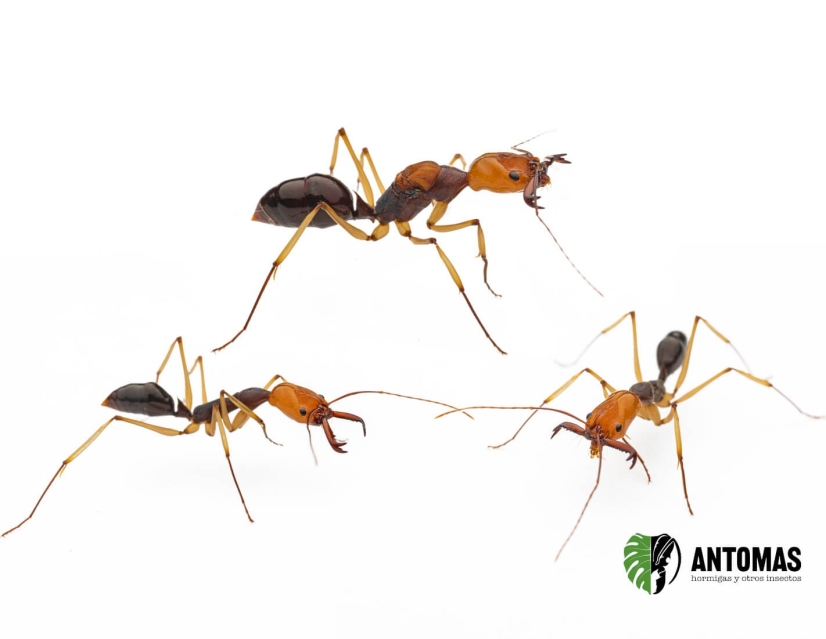
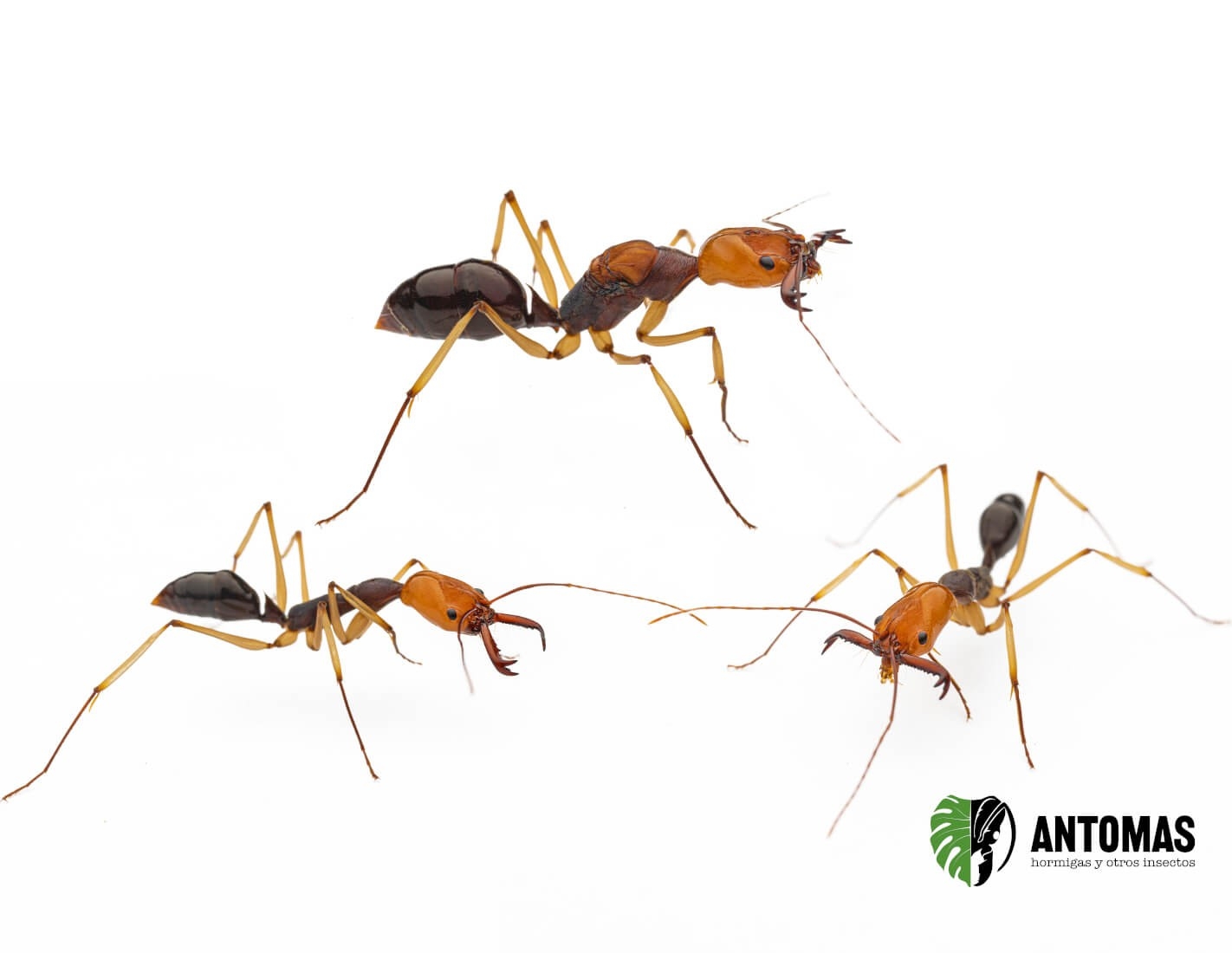
One of the great trap-jaw ants of South-East Asia: bicoloured workers up to 16 mm long, with a yellowish-orange head on a reddish-brown body, a real sting and jaws that snap shut in a fraction of a millisecond. Colonies with queen. A constant 24–27 °C all year round, no diapause, a humid nest (70–80%) with coconut fibre and a little fine sand, sugar in trap-jaw feeders and a great deal of protein. The key: never let the nest dry out, and always use an oil barrier and keep the lid closed, because, although they climb poorly, they can get up acrylic, and they jump.
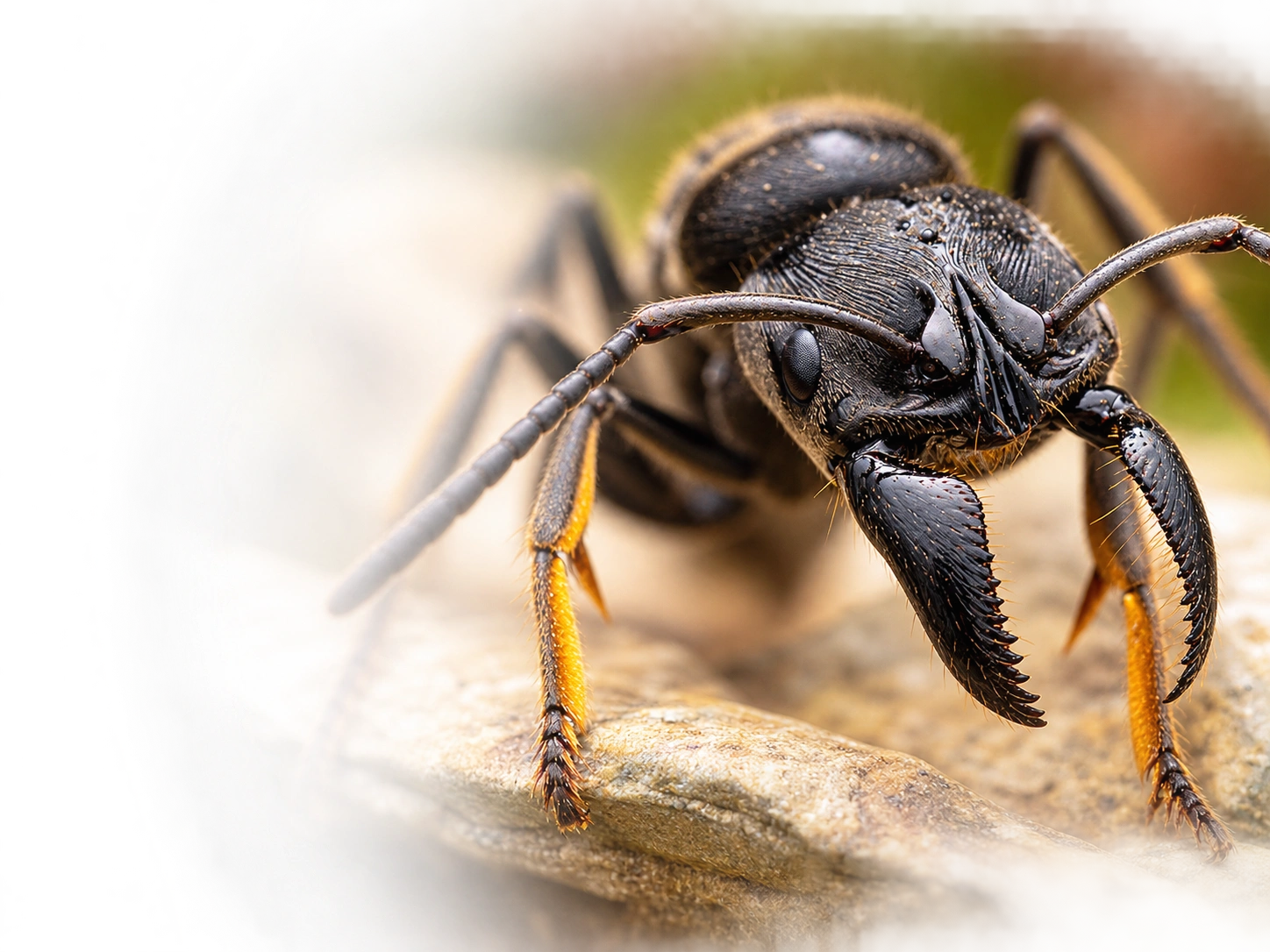
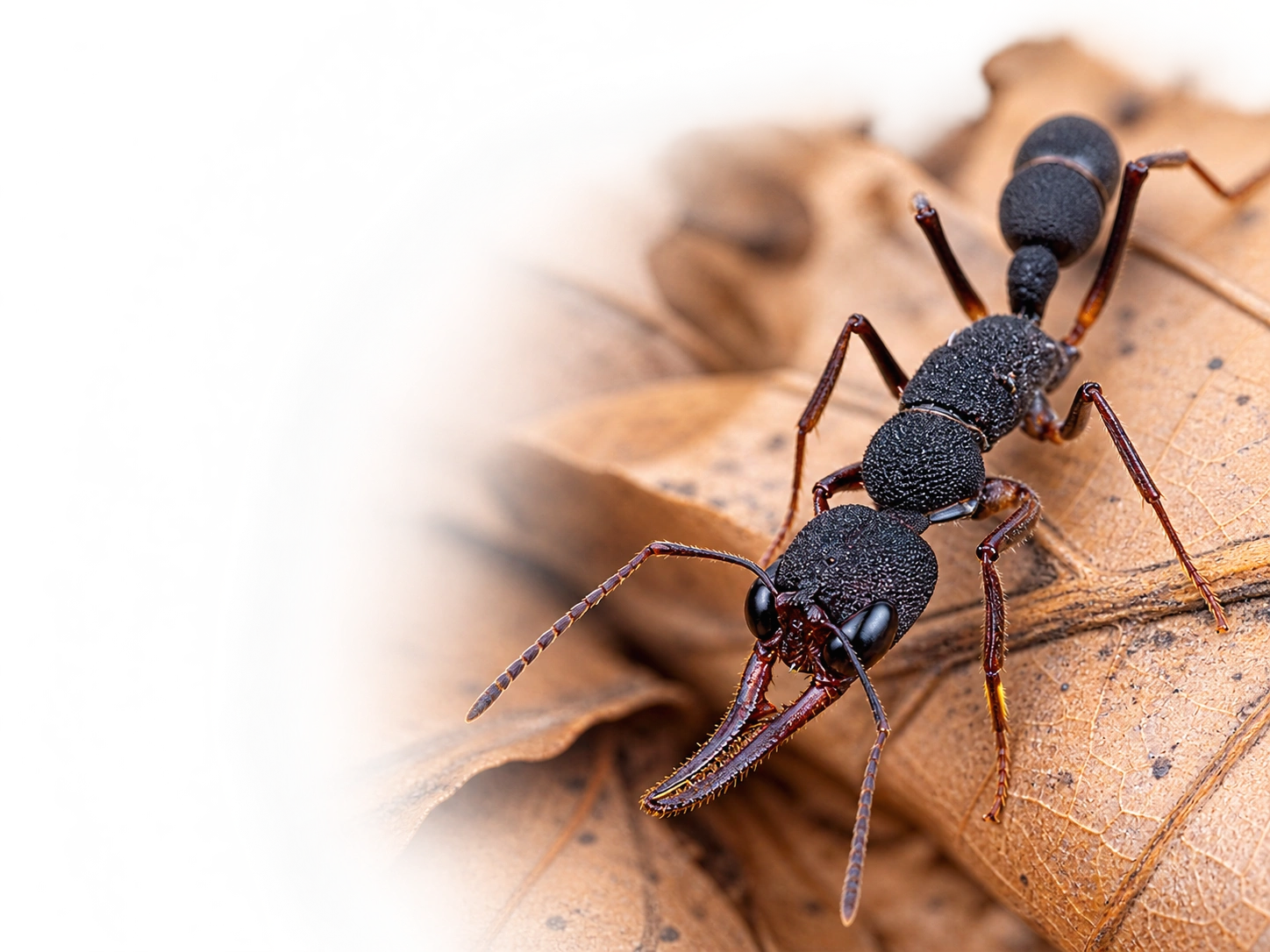
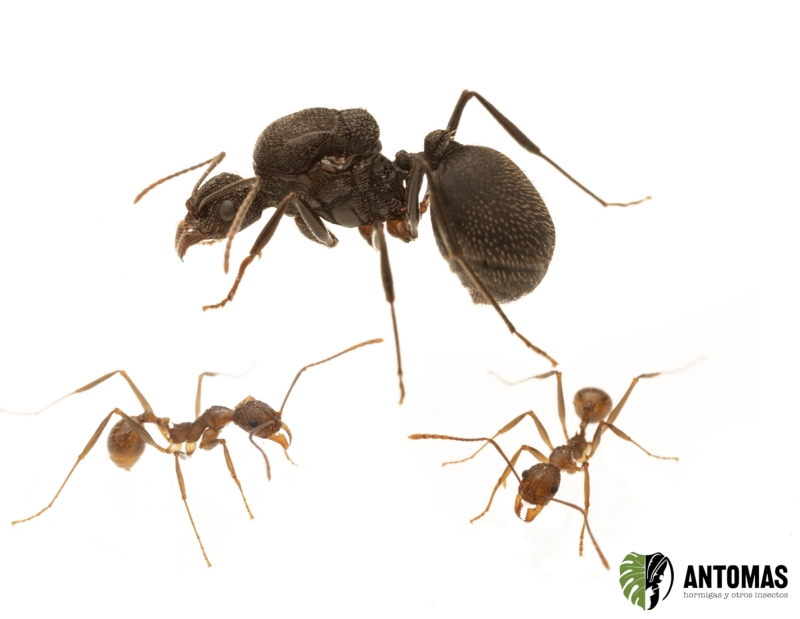
Odontomachus banksi Forel, 1910 is a trap-jaw ant from South-East Asia: a large, slender ponerine that moves slowly through the leaf litter of the rainforest with its jaws held open to the sides, like a set trap, and snaps them shut the moment prey brushes its trigger hairs. It lives in humid tropical forests of giant trees, on mountain slopes, and belongs to a species group centred on the islands of that region.
At Antomas we think of it as a giant among trap-jaw ants, and it lives up to the description: its workers reach 16 mm, and the queen about 16.5 mm. It is also an ant with a story: some of its original specimens were lost in a war, its first description contained a misprint and specialists consider it the most distinct member of its group. It is very rare in the hobby and, given some very specific care, a true spectacle. Let us start with its history.
Biology
Type specimens lost in the war
The Swiss myrmecologist Auguste Forel described the species in 1910, in a paper on the ants of the Philippines, from workers from Luzon. They had been collected by Charles Sumner Banks (1875–1939), an American entomologist working in the archipelago. Forel does not explain the name, but everything points to a tribute to its collector: in the same paper he dedicated two other ants to him, Monomorium banksi and Vollenhovia banksi.
The specimens on which a species is described, the types, are its ultimate point of reference. Some of those of O. banksi were kept at the Bureau of Science, the scientific institution of the colonial administration, and that collection was destroyed during the Second World War. Fortunately, Forel had kept a few in his personal collection, which is now in the Natural History Museum of Geneva: three workers mounted on a single pin. In 2011, Daniela Sorger and Herbert Zettel, while revising the Philippine Odontomachus, chose the top one as the lectotype, the single specimen that has since fixed what O. banksi is.
The 1910 misprint: a “queen” that was a worker
Forel’s description holds a curiosity. In the texts of the time, each caste was marked with a symbol, and next to the species Forel put the female sign, “♀”, which was used for the queen. Yet everything he describes belongs to a worker. Sorger and Zettel put it down to a typesetting error: the characters Forel gives can only be those of workers.
The real queen had to wait six years. In 1916, the German entomologist H. Viehmeyer published, from a single specimen, the first description of the queen, and he made it clear in writing: “noch nicht beschrieben”, that is, “not yet described”. She measured 16.5 mm and looked very much like the worker, with the head “perhaps somewhat broader”. More than a century later, that is still the only published description of the queen of O. banksi. And the male has not even been described.
The most distinct of its group
Within Odontomachus, taxonomists gather related species into groups. O. banksi belongs to the O. infandus group: large, slender ants with long antennae and legs, an elongated head, long mandibles with sharp teeth, a thorax with a pattern of striations peculiar to each species and a tall petiole topped by a long spine. Two other species you can find at Antomas belong to the same group: O. infandus, the most common, and O. schoedli, the mountain species.
And among all of them, O. banksi stands out. Sorger and Zettel call it, in their own words, “the most distinct Philippine member of the O. infandus group”. These are its features:
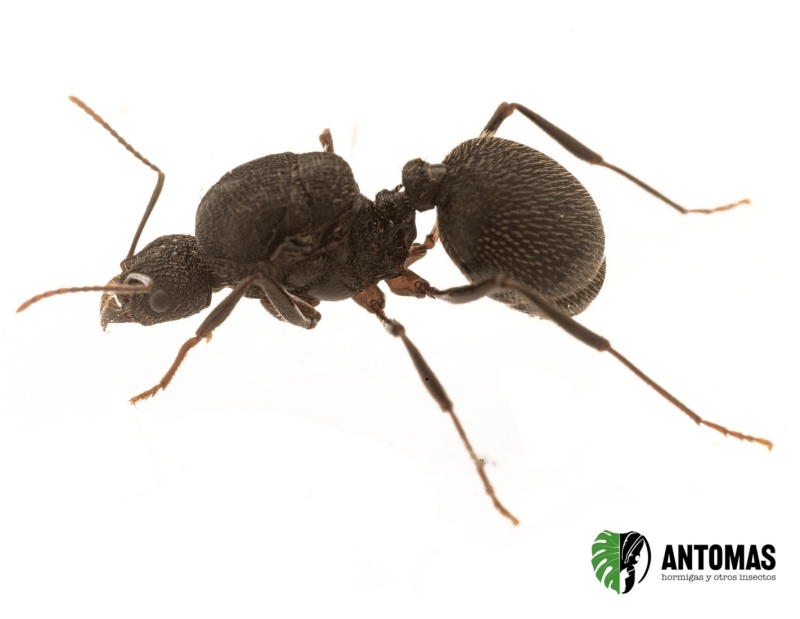
- Bicoloured. A light brown or yellowish-orange head, contrasting with the reddish-brown thorax and petiole, and a dark brown gaster. O. infandus is dark, and O. schoedli has the head and thorax in the same chocolate brown.
- Hairy. The thorax bears long, dense hairs, whereas in its relatives they are sparse.
- Striated. The side of the thorax, the mesopleuron, is striated all over (in O. infandus the centre is almost smooth), and the pronotum shows circular striations, with closed loops.
- A straight spine. The petiolar spine is long, sharp and straight; in O. infandus it curves backwards.
Size does not tell them apart: all three measure almost the same (see “Approximate sizes”). The most revealing thing is where it lives. Its range lies within that of O. infandus, which is more common and widespread, and even so it keeps all its differences. For the authors, this is a clear sign that it is a species in its own right and not a mere variant.
To each mountain its own Odontomachus
The O. infandus group is centred on the Philippines, and it is a forest group. Its Philippine species are endemic, that is, they live nowhere else, and almost all of them are parapatric: each occupies its own territory, bordering on that of its neighbour, but they barely overlap. The result is a mosaic in which almost every island, or every mountain range, has its own trap-jaw ant:
- O. banksi, in central and southern Luzon;
- O. schoedli, in the mountains of the north of the same island, with the type specimen collected at 1,600 m;
- O. infandus, the most widespread, throughout Luzon and on part of a neighbouring island;
- and other species, such as O. alius, O. scifictus or O. pangantihoni, each on its own island.
In 2011, Sorger and Zettel counted 11 species of Odontomachus in the Philippines, two of them still unnamed, and eight belonged to the O. infandus group. The remaining three are not endemic, and among them is a real oddity: O. malignus, which hunts among the corals when the tide goes out. At least two more species have been described since then, so the archipelago now has more than a dozen.
How does a mosaic like this come about? In 2018, a phylogeny of Indo-Pacific Odontomachus, including O. banksi, supported the taxon cycle theory: lineages that move out of the forest interior into open habitats disperse more widely, colonise new islands and, over time, give rise to endemic species that retreat once more into the forest interior. O. banksi, endemic and tied to the rainforest, fits that picture, although this last point is our own reading.
Forests of giant trees, with no winter
Sorger and Zettel found it “only in dipterocarp forests, sometimes degraded, on mountain slopes”. Dipterocarps are the family of giant trees that dominates the rainforests of South-East Asia. This is how the same authors describe these ants in the field: a large worker moving slowly across the leaf litter, with its jaws held open to the sides, ready to snap them shut as soon as prey touches its long trigger hairs. The altitude at which it lives has not been published.
Nothing is known about its nests either. In the genus, most species nest in the ground, in leaf litter or in rotten wood. For its relative O. infandus, Sorger and Zettel believe that the main requirements of the nest site are humidity and shade. It is a very valuable clue for keeping it.
The climate of its range is that of a tropical rainforest with no winter. In the lowlands, the mean monthly temperature is around 26–29 °C, with less than 3 °C of difference between the coolest and the warmest month; mean minimums do not fall below about 23 °C, and over much of its range the air humidity is around 85–90% all year round. It rains every month, and in many areas there is no dry season. On the slopes, under the canopy, it will be somewhat less hot. The known workers were collected in months as different as February, March, May and September: everything suggests that it is an ant that is active all year round.
230 km/h jaws: a record for the genus
It is the most famous fact about Odontomachus, and it is worth telling properly. In 2006, Sheila Patek’s team used a camera running at 50,000 frames per second to film workers of O. bauri, an American species, collected in Costa Rica. The complete closing of the jaws took an average of 0.13 milliseconds, and the fastest, 0.06. The tip of the mandible reached a mean speed of 38 m/s, about 137 km/h, and a peak of 64.3 m/s: more than 230 km/h. And each mandible struck with a force of more than 300 times the ant’s body weight.
So the famous 230 km/h is the maximum measured in the genus, in O. bauri, and not in O. banksi. In fact, nobody has yet measured the strike of O. banksi, nor that of any Asian Odontomachus. What is known is how it changes with size. In 2008, Spagna and colleagues filmed four American species: mean speeds were 36–49 m/s, and the large species accelerated less, but struck harder. The largest, O. chelifer, did so with about four times the force of the smallest. If the rule also holds in Asia, a species the size of O. banksi would be on the brute-force side (this is an inference, not a measurement).
Mind you, it is no longer the absolute record: in 2018, a snap of up to 90 m/s was measured in the Dracula ant, Mystrium camillae, with a different mechanism in which one mandible slides over the other, as when we snap our fingers. The Odontomachus strike remains, in any case, one of the fastest movements in the animal kingdom.
Giant neurons for a millisecond trigger
How is a strike like that achieved? With a catapult mechanism, like that of a crossbow:
- The latch. When the jaws open, the base of each mandible catches in a notch in the joint and is locked open.
- The spring. The large closer muscle, slow and powerful, contracts for several seconds and loads a “spring” with energy, probably the cuticle of the mandible and of the head itself.
- The trigger. A tiny, fast muscle pulls the mandible out of the notch, and the energy is released all at once in less than a millisecond.
The trigger is pulled by long trigger hairs on the inner edge of the mandibles. Each one is served by a giant sensory neuron, with an axon 15–20 micrometres thick, among the thickest known. This was discovered by Wulfila Gronenberg, Jürgen Tautz and Bert Hölldobler in 1993, and two years later Gronenberg described the circuit: two giant sensory neurons and two giant motor neurons on each side, probably connected by a single synapse. From the moment something brushes the hairs to the moment the jaws close, less than 10 milliseconds go by.
Curiously, the hairs do not decide everything: workers touch their nestmates without firing, and removing the hairs does not stop them from striking. Moreover, these jaws are not just a weapon, because they are also used to care for the brood and to build the nest. And the invention is not unique: the trap jaw has appeared at least four times in the evolution of ants, and the closest relative of Odontomachus is its sister genus, Anochetus, to which our copper-coloured trap-jaw ant, Anochetus princeps, belongs.
The ballistic jump
A strike this powerful has a curious side effect: if the mandible hits something hard, the recoil sends the ant flying. Patek’s team distinguished two jumps in O. bauri:
- The escape jump. The ant strikes the ground with its jaws and shoots upwards, as high as 8.3 cm, spinning at about 63 turns per second.
- The defensive bounce. It strikes an intruder or a large object and is thrown horizontally, backwards, nearly 40 cm (39.6 cm).
At the nest entrance, the bounce is used to drive intruders out with blows: this is what workers of O. ruginodis do, standing guard with the trap set. And does the escape jump actually work? In 2015, Fredrick Larabee and Andrew Suarez pitted workers of O. brunneus against antlion larvae. In 117 encounters, about a third of the ants ended up caught, half escaped by running and 15% saved themselves with a jaw-powered jump. Those whose jaws had been glued shut fared considerably worse. The authors sum it up like this: jaws that evolved for hunting have been repurposed for escape.
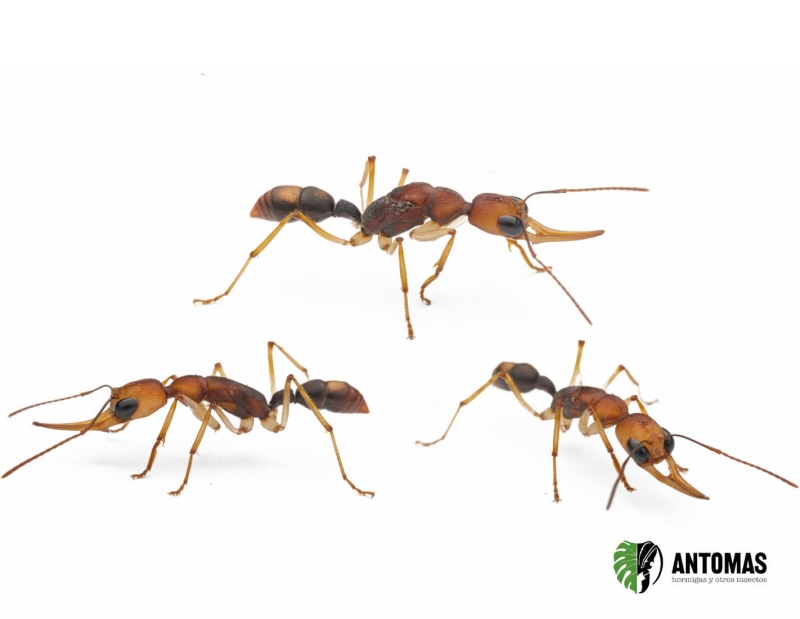
Jumping with the legs is another story: other ponerines do it, such as the Harpegnathos, including our Harpegnathos venator. And in Borneo lives O. rixosus, the only ant known to jump both ways, with its legs or with its jaws. This was discovered in 2015 by Daniela Sorger, the same author behind the revision of the Philippine Odontomachus. There are no jump measurements for O. banksi, but at home it is enough to know that they can be flung through the air: hence the lid, always closed (see “Escapes and barriers”).
A patient hunter that drinks with its jaws
Odontomachus are generalist predators of arthropods, and many species are partly specialised in termites. The hunting sequence is always similar: they feel the prey with their antennae, strike it with their jaws, often several times, and, if necessary, sting it. In Panama, Birgit Ehmer and Bert Hölldobler followed the workers of O. bauri: they hunted alone, under the leaf litter, and came back with prey on at least 28% of their trips; most prey items measured 3–4 mm, above all termites, and large prey was usually found already dead. According to the authors, in these species the speed of the strike serves more to give power to the blow than to catch elusive prey: less a lasso than a hammer blow.
They are not reckless hunters: they approach dangerous prey cautiously, and O. troglodytes has been seen to learn to avoid prey that hurts it. And it is not all meat: some species in the genus tend honeydew-producing insects, visit nectaries or eat fruit.
Now for a lovely detail. With jaws like these, how do you carry a liquid back to the nest? Many ants swallow nectar and later regurgitate it to their nestmates. Odontomachus, by contrast, carry the drop held between their jaws and pass it from one to another, like a bucket. This was described as early as 1971, in an African Odontomachus that collected honeydew in cocoa plantations, and it is covered in a 2021 review of how ants share liquids. It is the reason why, at home, sugar has to be offered as a free, accessible drop (see “Feeding”).
A sting that is not just for show
As well as the trap, the workers have a powerful sting at the tip of the abdomen. In the genus, stinging is part of hunting, above all with large prey, although O. bauri did not even sting termites: the strike was enough.
The venom of O. banksi has not been studied, but that of an Asian species of the genus, O. monticola, has. In 2017, a Japanese team analysed its venom glands and found that 98.5% of the toxin transcripts corresponded to pilosulin-like peptides, named after the Australian ant in which they were discovered, Myrmecia pilosula. They are accompanied by enzymes such as hyaluronidase, which helps the venom spread through the tissues. The authors add that O. monticola is not aggressive towards people, although its sting hurts and leaves an itch for a while.
In Antomas’s experience, the sting of O. banksi is usually painful; with calm handling and the right tools, it rarely comes to that (see “Handling and safety”).
Cocoons that need sand
Like almost all ponerines, Odontomachus pupate inside a silk cocoon, light to dark brown in colour. And here is a key detail for any keeper: according to the revision of the genus published by William L. Brown in 1976, the larvae need sand or loose soil to complete the cocoon. Without particles to anchor the threads to, they cannot close it.
Keepers confirm it. A hobbyist community’s care guide for O. haematodus insists that very fine sand or soil is needed and that, without a suitable substrate, rearing fails again and again. One Odontomachus keeper reported that, in test tubes, the larvae of his second generation often failed to pupate, and that his colonies only thrived in a set-up with soil.
That is why, at Antomas, we set up their nests with damp coconut fibre and a little fine sand in the chambers: this gives them the particles they need to spin and, at the same time, holds moisture (see “Recommended formicarium”).
Queens and colonies: what is still unknown
Nothing has been published on the social life of O. banksi in the wild: neither what its nests are like, nor how many queens each colony has, nor how many workers it can gather.
The genus does, however, offer some clues. Most species have winged queens and semi-claustral founding: the queen goes out to hunt while rearing her first workers, as has been seen in the Asian O. rixosus. As for the number of queens, there is a bit of everything: many species are polygynous, such as O. chelifer, whose queens form hierarchies, whereas in O. bauri only single-queen colonies have been found. Colonies usually have several hundred workers (about 300 in O. bauri), although, depending on the species, they range from about 18 to about 10,000.
And there is politics inside the colony too: in O. brunneus, workers face each other in ritualised duels that decide who stays inside with the brood and who goes out to forage.
Size and morphology
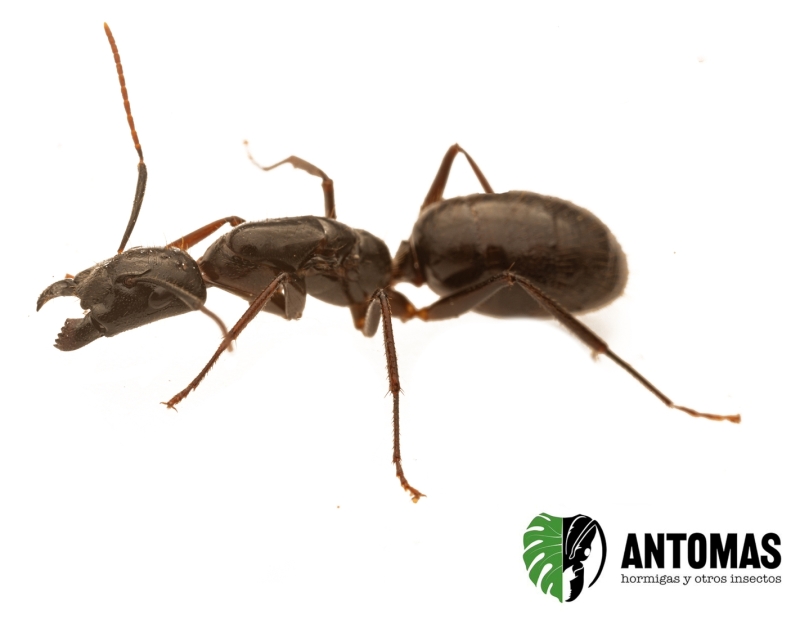
A large, slender ponerine with long legs and antennae, an elongated head and long, straight mandibles, wearing the bicoloured livery that sets it apart from its relatives.
- Colouring. Bicoloured: a light brown or yellowish-orange head, contrasting with the reddish-brown mesosoma (the “thorax”) and petiole, and a dark brown, almost blackish gaster. The colour of the legs and antennae has not been described.
- Head. Long, with marked temporal prominences; striated from the frontal lobes to the ocular ridge, and smooth and shiny elsewhere.
- Mandibles. Long and straight, a little over half the length of the head, with long, sharp apical teeth and the trigger hairs on the inner edge.
- Mesosoma and petiole. A flattened mesosoma with long, dense hairs, a pronotum with looped striations and a mesopleuron striated all over (see “The most distinct of its group”). A tall petiole, without a false peduncle, with a long, sharp, straight spine.
- Sting. Powerful and functional.
- Queen. Very similar to the worker, with the head perhaps somewhat broader, much of the top of the thorax a reddish yellow and light brown wings with dark veins and pterostigma.
- Male. Undescribed.
Approximate sizes
- Workers: 12.4–16 mm total length
- Worker head, without mandibles: 2.90–3.70 mm long and 1.95–2.80 mm wide
- Worker mandibles: 1.63–2.05 mm
- Queen: 16.5 mm
- Male: no measurements, as it has not been described
The worker measurements come from the redescription by Sorger and Zettel (2011): the lectotype measures 16 mm, and the workers with the narrowest and the broadest heads that they measured, 12.38 and 15.75 mm. The queen’s measurement is from Viehmeyer (1916), based on a single specimen. For comparison, in the same revision O. infandus measures 12.00–16.31 mm, and O. schoedli 12.75–16.25 mm: the three species are practically the same size.
Care in captivity
Difficulty: 4/5 – Advanced
It is not a difficult species because of its climate: its 24–27 °C are easier to maintain at home than the coolness required by its mountain relative, O. schoedli. Its difficulty lies in four other things:
- Humidity. The nest must always be humid, without becoming waterlogged.
- Appetite. It needs a great deal of protein, and regularly.
- Safety. Its sting is usually painful, they jump with their jaws and, although they climb poorly, they can get up acrylic: the set-up must be well sealed, and handling always done with tools.
- Lack of information. There are hardly any published keeping data for this species.
And it is well worth it. Few ants are as impressive: workers up to 16 mm long that patrol with their jaws open, hunt with a single strike and carry drops of nectar between their mandibles.
Recommended parameters
- Nest temperature: 24–27 °C, constant all year round. As with the whole genus, it is best not to exceed about 28 °C for long periods.
- Nest humidity: high and stable, 70–80%, without waterlogging.
- Substrate: damp coconut fibre with a little fine sand in the chambers.
- Foraging area: clean and somewhat drier than the nest, with the lid always closed, an oil barrier, water in a test tube with cotton wool and a trap-jaw feeder.
- Light: a normal day–night cycle, with the nest kept dim.
- Diapause: none (see “No diapause”).
If your home drops below 24 °C in winter, use a gentle heat source with a thermostat on one side of the nest, never underneath the whole of it, so that the colony can choose. In summer, find the coolest room, away from direct sunlight, and put a thermometer next to the nest.
Humidity: the one thing you cannot neglect
It lives in rainforests where the air humidity is around 85–90% all year round, and its relative O. infandus seeks out damp, shady places to nest. At home, the nest must be kept at 70–80%, consistently: letting it dry out is a serious mistake. A dry nest stresses the colony, slows down brood rearing and leaves the larvae without a damp substrate in which to spin.
How to tell that humidity is lacking: the coconut fibre looks pale and loose; the workers crowd around the water tube, and large larvae appear that cannot manage to spin their cocoon.
How to maintain it: check the nest reservoir often and refill it before it runs dry, and moisten the coconut fibre when it starts to turn pale. High humidity does not mean waterlogging: standing water and still air bring mould and mites. Gentle ventilation and removing food leftovers are the best prevention. Some keepers add springtails as a clean-up crew, to eat incipient mould and small scraps.
Recommended formicarium
At Antomas we recommend the Anthouse Qbik Wild range, made of plaster, in its Hybrid version, the one that best keeps a nest very humid and stable: beneath the galleries it has an evaporation reservoir, separate from them, which passes the humidity through a mesh with activated carbon so that the water does not stagnate, and it is completed by a side drinking tube. The right format for our colonies is the Qbik Wild Duo P 2C Hybrid.
Inside the nest there is one essential substrate: coconut fibre with a little fine sand, in a thin layer in the chambers and always damp. It does two jobs:
- For spinning. The larvae need loose particles to anchor the thread of the cocoon to (see “Cocoons that need sand”).
- For humidity. It holds water and spreads it through the chamber, like the leaf litter of the rainforest.
Check that there is still fibre in the brood chambers, because the workers sometimes carry it out of the nest; if that happens, add a little more. Use coconut fibre without fertilisers or additives, and washed fine sand.
Founding and growth
At Antomas we sell colonies with queen, workers and brood, already up and running, so you skip the most delicate stage. In the genus, the queen founds her colony in a semi-claustral way: she goes out to hunt to feed her first larvae.
There are no published data on the development of O. banksi. For reference, keepers of other Odontomachus speak of about 8 weeks from egg to worker, which can stretch to 12–16 weeks or more if protein is lacking. In other words, protein sets the pace: a well-fed colony grows steadily, and a hungry colony stalls and loses larvae.
Do not expect a formicarium with thousands of workers. Nobody has counted an O. banksi colony, but in the genus several hundred is the norm, and its charm lies in quality: each worker is a predator more than a centimetre long. When the nest becomes too small, connect another one. And do not combine queens or colonies: in other Odontomachus, queens that already have brood attack one another.
Arrival and moving by tipping
When you receive your colony, let it rest in a quiet place at 24–27 °C, and check that it has water. To move it into its formicarium, at Antomas we do it by tipping: we open the tube inside the foraging area, next to the nest entrance, and tip out the colony (workers, queen and brood) with gentle taps, helping the stragglers along with a brush. Three tips for this species:
- Keep the lid at hand: a worker may be flung out by a jaw strike.
- Use tools, never your fingers: a brush and soft forceps.
- Have the nest ready: with the coconut fibre and sand damp, the reservoir full and the nest kept dim, so that they occupy it straight away.
Do it calmly and without fear: within a few hours they will have moved into the nest.
Feeding
O. banksi is, above all, a hunter: it needs a great deal of protein, as well as sugary liquids and water.
Protein, plentiful and varied. At Antomas we recommend live or dead prey and, at first, while the colony settles in, freshly killed. Later on, live prey lets you see the trap in action. Good options:
Change prey often (keepers observe that they do not like having the same one two days running) and feed them daily or every other day when there are larvae. If a large prey item is left lying in the foraging area, offer it chopped up. Buy insects from a reliable supplier: insects treated with insecticides can kill the colony.
The more they eat, the better and faster they grow. It is the Antomas philosophy: if you do daily maintenance and remove the leftovers, it is better to overfeed, because the colony understands that it has more resources and grows faster and in greater numbers. If you will not be able to clean often, it is better not to overfeed: leftover food rots and brings mould and mites. Remove leftovers within 24 hours; one keeper of O. simillimus lost his entire colony to mites.
Sugar, in trap-jaw feeders. There is no need to give them sugary liquids every day: at Antomas we offer sugar 2–3 times a week, mostly Anthouse’s Blue Sugar nectar and, now and then, another nectar for variety. With its relative O. schoedli, we have seen at Antomas that at first they pay it little attention: keep at it, because they end up taking it. What matters is how you offer it. Because they carry the drop between their jaws (see “A patient hunter that drinks with its jaws”), they need a free, liquid and accessible drop:
- use special feeders for trap-jaw ants, or put the drop on a bottle cap, a shell or a small piece of aluminium foil;
- never on cotton wool: it goes mouldy, spoils the liquid and does not let them pick up the drop;
- replace it as soon as it dries out, thickens or starts to ferment.
Water: always, in a test tube with water and cotton wool. It is the one thing they must never be without.
No diapause
O. banksi does not have a diapause. Its climate has no winter: the mean temperature shifts by only a few degrees over the year, it rains every month and, under the rainforest canopy, the ground buffers the changes even further (see “Forests of giant trees, with no winter”). At Antomas we keep it active all year round, at a constant 24–27 °C, with no winter drop. Avoid sudden changes and do not cool it down on purpose: it gains nothing from it and it can slow down brood rearing.
Behaviour and observation
Hunters in plain sight. You will see the workers slowly patrolling the foraging area with their jaws open and then, all of a sudden, the strike. Watch how they drink, too: they load the drop of nectar between their jaws and carry it into the nest.
At any hour. There are no data on its daily rhythm, but O. bauri forages by day and by night, with no clear pattern, so do not be surprised to see them active at any time.
Watch without fear. At Antomas we believe ants are there to be enjoyed, watched and learnt from, not kept hidden away. It is enough to leave them their dark area in the nest and a lit foraging area, and to watch them gently, intervening and stressing them as little as possible. They get used to your presence.
Warning signs:
- Large larvae that do not spin their cocoon: check the humidity and the coconut fibre.
- Brood that disappears: almost always a lack of protein.
- Workers crowding next to the water or the queen outside the nest: the nest is drying out.
- Mould, mites or workers that refuse food: forgotten leftovers or standing water.
Escapes and barriers
Here, Antomas’s experience outweighs what you read on many forums. Several keepers’ sources say that Odontomachus do not climb glass or acrylic, but at Antomas we have seen that they do climb acrylic, albeit poorly: O. schoedli, a member of the same group, manages it, and this species climbs slightly worse still. It only takes one to make it, so, with O. banksi:
- An oil barrier, essential: a thin, continuous band around the rim of the foraging area. Renew it when it collects dust.
- The lid always closed, because of the jumps: in O. bauri, the bounce throws them nearly 40 cm horizontally. Open it calmly to feed or clean, and close it when you have finished.
- A clean foraging area, with no leftovers, substrate or decoration touching the barrier and serving as a bridge.
- Joints, plugs and connections, carefully checked and with no gaps.
Dust, condensation or stuck-on substrate give them grip even on walls that look smooth: do not trust a foraging area that seems “too smooth to climb”.
Handling and safety
They have a functional sting, and being stung by O. banksi is usually painful; with calm handling and the right tools, it rarely comes to that. They can also deliver a jaw strike, the same blow they hunt with. At Antomas we recommend always handling them with entomological tools (a soft brush or soft forceps), never with your hands; working slowly, so as not to alarm them or harm the queen, and taking care if you are allergic to hymenopteran stings. Keep the set-up out of reach of small children and pets. It is an exotic species: it must never be released.
What not to do
- Let the nest dry out: it needs 70–80% humidity, always.
- Waterlog the nest or leave the air stagnant: it brings mould and mites.
- Set them up without coconut fibre or fine sand, or let the workers clear the brood chambers of substrate.
- Skimp on protein, always give them the same insect or leave leftovers for more than 24 hours.
- Put sugar on cotton wool or in a feeder where they cannot pick up the drop with their jaws.
- Exceed about 28 °C for long periods, or heat the whole nest from below.
- Give them a diapause or lower their temperature in winter.
- Trust that they cannot climb, or leave the lid open.
- Combine queens or colonies.
- Handle them with your hands.
- Keep them hidden away: they are there to be watched and enjoyed; do it gently, intervening as little as possible.
Scientific sources
This care sheet is based on the scientific literature on Odontomachus banksi and trap-jaw ants, on climate data from its range and on the experience of Antomas and other keepers. Main references:
- Sorger, D. M. & Zettel, H. (2011). On the ants (Hymenoptera: Formicidae) of the Philippine Islands: V. The genus Odontomachus Latreille, 1804. Myrmecological News 14: 141–163. PDF on Myrmecological News (open access)
- Viehmeyer, H. (1916). Ameisen von den Philippinen und anderer Herkunft (Hym.). Entomologische Mitteilungen 5: 283–291. PDF on Internet Archive (open access)
- Zettel, H. & Sorger, D. M. (2023). Another new trap-jaw ant (Hymenoptera, Formicidae, Odontomachus Latreille, 1804) from the Philippines. Linzer Biologische Beiträge 55: 381–385. PDF on ZOBODAT (open access)
- Matos-Maraví, P. et al. (2018). Taxon cycle predictions supported by model-based inference in Indo-Pacific trap-jaw ants (Hymenoptera: Formicidae: Odontomachus). Molecular Ecology 27: 4090–4107. doi:10.1111/mec.14835
- Gronenberg, W., Tautz, J. & Hölldobler, B. (1993). Fast trap jaws and giant neurons in the ant Odontomachus. Science 262: 561–563. doi:10.1126/science.262.5133.561
- Gronenberg, W. (1995). The fast mandible strike in the trap-jaw ant Odontomachus. II. Motor control. Journal of Comparative Physiology A 176: 399–408. doi:10.1007/BF00219065
- Patek, S. N., Baio, J. E., Fisher, B. L. & Suarez, A. V. (2006). Multifunctionality and mechanical origins: ballistic jaw propulsion in trap-jaw ants. PNAS 103: 12787–12792. doi:10.1073/pnas.0604290103
- Spagna, J. C. et al. (2008). Phylogeny, scaling, and the generation of extreme forces in trap-jaw ants. Journal of Experimental Biology 211: 2358–2368. doi:10.1242/jeb.015263
- Larabee, F. J. & Suarez, A. V. (2014). The evolution and functional morphology of trap-jaw ants (Hymenoptera: Formicidae). Myrmecological News 20: 25–36. PDF on Myrmecological News (open access)
- Larabee, F. J. & Suarez, A. V. (2015). Mandible-powered escape jumps in trap-jaw ants increase survival rates during predator-prey encounters. PLOS ONE 10: e0124871. doi:10.1371/journal.pone.0124871
- Larabee, F. J., Smith, A. A. & Suarez, A. V. (2018). Snap-jaw morphology is specialized for high-speed power amplification in the Dracula ant, Mystrium camillae. Royal Society Open Science 5: 181447. doi:10.1098/rsos.181447
- Ehmer, B. & Hölldobler, B. (1995). Foraging behavior of Odontomachus bauri on Barro Colorado Island, Panama. Psyche 102: 215–224. doi:10.1155/1995/27197
- Kazuma, K., Masuko, K., Konno, K. & Inagaki, H. (2017). Combined venom gland transcriptomic and venom peptidomic analysis of the predatory ant Odontomachus monticola. Toxins 9: 323. doi:10.3390/toxins9100323
- Meurville, M.-P. & LeBoeuf, A. C. (2021). Trophallaxis: the functions and evolution of social fluid exchange in ant colonies (Hymenoptera: Formicidae). Myrmecological News 31: 1–30. doi:10.25849/myrmecol.news_031:001