Use: live food for tiny ants and clean-up crew for humid nests and terrariums
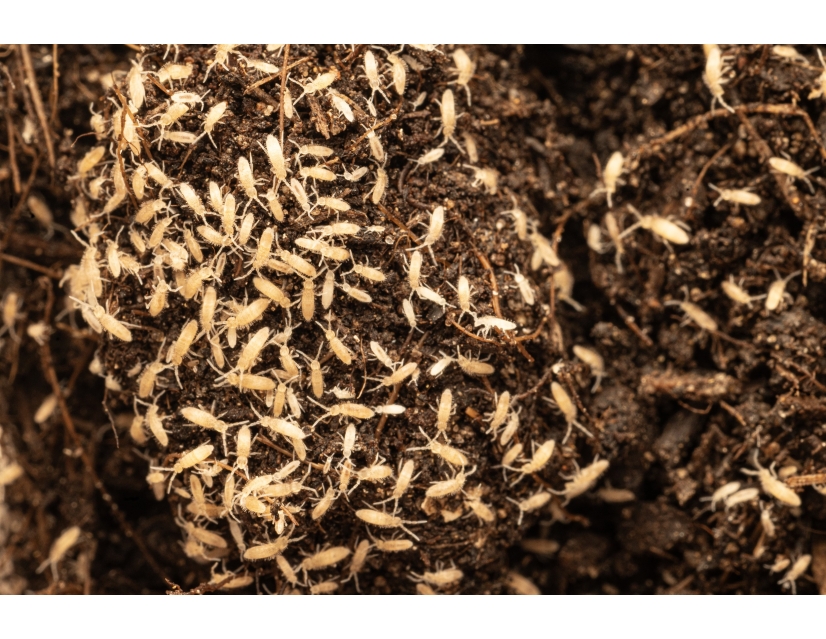
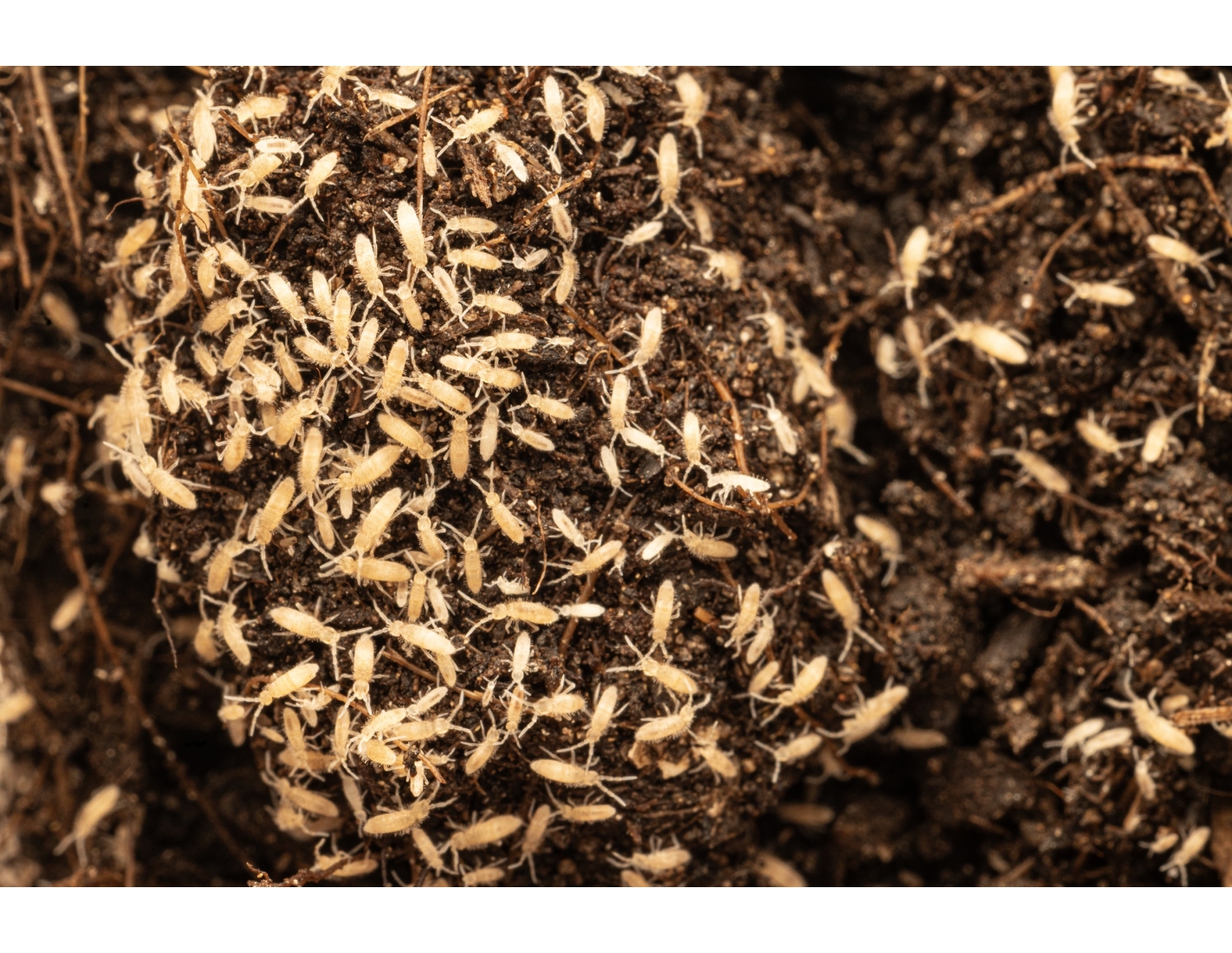
Size: up to about 2 mm, pale, soft body. What they are for: live prey for hunters of tiny prey such as Strumigenys, and a clean-up crew in plaster nests and humid terrariums, where they eat mould and debris. How to keep them: closed tub, damp substrate but no standing water, at 18–26 °C and never in the fridge; a few granules of baker’s yeast every week. How to feed them: alive, by shaking a piece of substrate or using a damp paintbrush in the foraging area. Can you breed them? Yes, and it is easy: plaster with charcoal, high humidity and yeast.
Sinella curviseta Brook, 1882 is a springtail of the family Entomobryidae, one of the most widespread in the Northern Hemisphere and a laboratory species: it is used in soil ecology and toxicity testing, and its genome has been sequenced (Zhang and colleagues, 2019). Springtails (class Collembola) are wingless hexapods, related to insects but outside them, and almost all of them carry a furcula under the abdomen: a folded appendage that, when released, launches them into a jump.
We sell it as Sinella cf. curviseta. The “cf.” (from the Latin confer, “compare”) means the animal matches S. curviseta, but the identification has not been confirmed by a specialist under the microscope: Sinella species are told apart by the arrangement of their setae. For use with ants, it makes no difference.
At Antomas we sell it for two reasons: it is the natural prey of springtail-hunting ants, and it is a good clean-up crew for humid nests, where it eats the mould and the leftovers the ants leave behind. Sold by the tub.
Why it is good food for ants
The prey that the Strumigenys trap evolved for
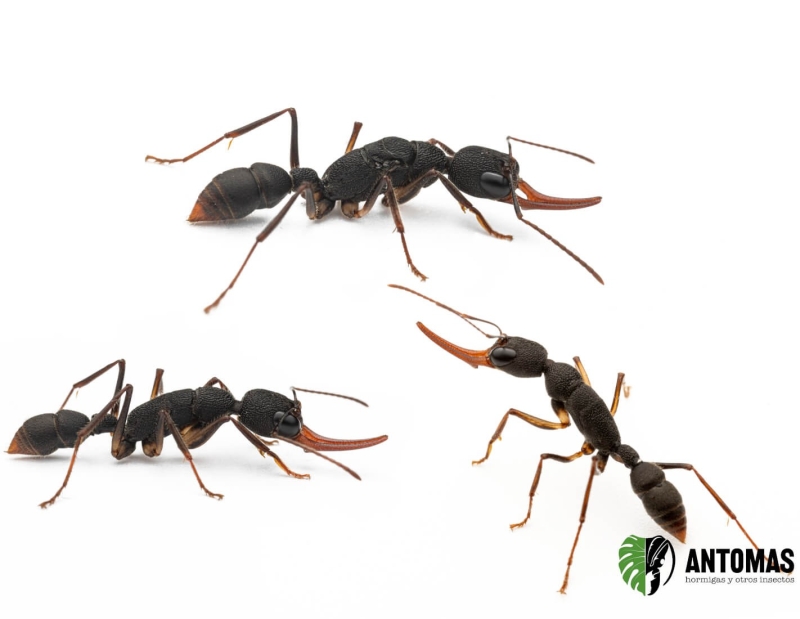
Strumigenys are leaf-litter predators that feed mainly on springtails (Booher and colleagues, 2021), and Dejean (1986) studied their hunting sequence using a cultured springtail. The furcula is the reason a trap jaw is needed: a springtail that is touched jumps away before an ordinary ant can close its mandibles. For our Strumigenys sp., live springtails are not a supplement: they are the staple of the diet, and ideally you should have the culture up and running before the colony arrives.
Prey size for 1–3 mm ants
At about 2 mm at most, with juveniles much smaller, S. curviseta covers the prey size that no other live food in the shop provides. It is suitable for:
- Specialists: Strumigenys and other dacetines.
- Small hunters: in the laboratory, Anochetus accept springtails alongside termites and fruit flies (Gronenberg and Ehmer, 1996), and keepers of small species use them during colony founding. A good match for our Anochetus graeffei.
- Species with tiny workers: the prey recorded for the genus Carebara includes entomobryoid springtails, the family of Sinella (Fischer and colleagues, 2014). A good match for the minor workers of our Carebara bengalensis.
- Founding colonies of small species whose first workers cannot handle a piece of cricket.
For medium-sized or large ant colonies, a springtail is too small to be useful prey: small nymphs of Thermobia domestica, the next size of soft-bodied prey in the shop, are a better choice there.
Prey that does not rot: the ones not eaten stay alive
A forgotten piece of cricket in a humid nest goes mouldy within a few days. Springtails that are not caught stay alive in the substrate, eating mould and debris, until the workers come out to hunt them.
Clean-up crew in plaster nests and terrariums
S. curviseta is fungivorous and detritivorous. Its grazing on soil fungi such as Fusarium oxysporum has been studied (Nakamura and colleagues, 1992), and fungi such as Neurospora crassa switch on chemical defences when it attacks them (Sun and colleagues, 2023). In culture they eat yeast, moulds, eggs and corpses of their own species and the remains of other arthropods (Draney, 2000).
In a plaster nest such as the Qbik Wild One P 1C by Anthouse, in a terrarium with ants or in a large test tube, a springtail population eats the first patches of mould and the prey remains before they spread. Two clear limits:
- They are no substitute for cleaning. Some moulds are not eaten and end up crowding the springtails out (Draney, 2000). Remove large leftovers anyway.
- Only in a humid setting. In a dry formicarium, a sand one or an acrylic one with no moisture, they die in a short time.
Biology
A leaf-litter springtail, between the surface and the soil
Springtails are distributed in layers: epigeic species live on the surface and are pigmented, with eyes and a long furcula; euedaphic species live deep in the soil and are white and blind. S. curviseta sits in between: it is hemiedaphic, living in leaf litter and topsoil; it is pale, keeps a few simple eyes and has a complete furcula (Barezzi and colleagues, 2024).
In a drought test with seven species, S. curviseta withstood a considerably drier environment than Folsomia candida, the laboratory springtail par excellence (Barezzi and colleagues, 2024). This gives it some leeway if you slip up, but in culture it is bred at near-saturated humidity.
Reproduction without copulation: spermatophores and pheromones
Springtails do not copulate. In S. curviseta, the male deposits spermatophores on the substrate, small droplets of sperm on a stalk, and the female picks them up. Females release a volatile pheromone that makes males deposit more spermatophores (Waldorf, 1974). In addition, males produce large amounts of an exclusive molecule, curvisetone, which appears in mature animals and peaks about ten days before the first egg-laying; its function, probably reproductive, has not yet been confirmed (Möllerke and Schulz, 2025).
It is a sexual species, with males and females, unlike F. candida, which reproduces by parthenogenesis (Zhang and colleagues, 2019). To breed it, transfer a group of animals of various sizes to each new container, not just a few loose individuals, to make sure both sexes are present.
Lifelong moulting and reproduction at laboratory pace
Like all springtails, it keeps moulting after reaching adulthood, alternating reproductive and non-reproductive instars. It reaches maturity in about 34 days at 20 °C and in about 31 days at 24–25 °C (data compiled by Möllerke and Schulz, 2025). Under optimal laboratory conditions, at 30 °C and saturated humidity, each female left a net offspring of 515 females, and 74% of the eggs reached reproductive adulthood (Gist and colleagues, 1974). These are maximum figures, but they explain why a well-run culture recovers so quickly from harvesting.
They eat their own eggs and slow egg-laying when crowded
In 1971 Waldorf documented two behaviours with practical consequences. On the one hand, selective egg cannibalism: freshly laid eggs are smooth and those already developing are wrinkled, and the adults do not treat them the same way. On the other, oviposition inhibition in dense cultures, attributed to a substance that builds up in the container. That is why laboratories keep many small containers instead of one large one, and renew old cultures (Draney, 2000).
Size and morphology
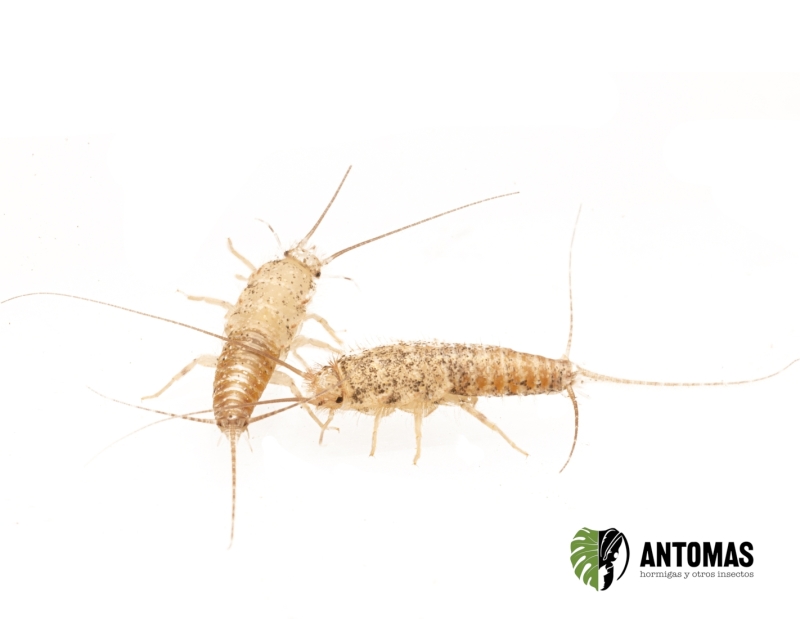
Elongated, soft, scaleless body, whitish to pale orange, without the patterning of epigeic springtails. Four-segmented antennae, slightly over half the body length. Very reduced eyes: two ommatidia on each side, visible as two dark spots (Zhang and colleagues, 2019; Barezzi and colleagues, 2024). Complete furcula, folded under the abdomen.
Measurements
- Adult: up to about 2 mm long (Barezzi and colleagues, 2024)
- Antennae: around 0.6 times the body length
- Eyes: 2 ommatidia per side
- Weight: females weigh roughly twice as much as males (Möllerke and Schulz, 2025)
- Maturity: about 31–34 days at 20–25 °C
There are no published measurements of the egg or the juveniles.
How to keep them at home for a few days or weeks
A tub of springtails is not a ration that runs out: it is a small culture that, if well looked after, keeps going and grows. What kills them is almost always dryness, cold or overfeeding.
- Humidity: the substrate must be damp and glistening, with no puddles. If it dries out, add a few drops of chlorine-free water (left to stand, filtered or bottled) at one side.
- Temperature: 18–26 °C, in the dark. Never in the fridge: intense cold can kill them (Draney, 2000).
- Food: a few granules of dry baker’s yeast once a week, or a grain of rice. If the previous food is still there, do not add more.
- Air: open the tub for a few seconds every few days to refresh the air.
How to breed them
S. curviseta has been bred in laboratories since the 1950s, originally as food for other tiny predators (Draney, 2000). The guidelines below come from laboratories; those marked as such come from keepers’ experience.
Container: several small ones are better than one large one
- Plastic pots of 100–500 ml with a lid, without holes or with a tiny one covered with very fine mesh. Laboratories use containers about 5 cm in diameter (Pan and colleagues, 2016).
- Several at once: keep at least three or four pots. Dense cultures slow their own egg-laying, and if one fails, the others act as a backup.
- Renewal: when the substrate gets dirty with mould and droppings, move springtails to a new pot instead of trying to rescue the old one.
Substrate: plaster with activated charcoal
This is the laboratory standard. The charcoal makes the plaster more permeable and keeps humidity close to 100% (Draney, 2000).
- Mix: between 8:1 and 8:4 plaster to powdered activated charcoal, by weight; Draney uses 8 parts plaster, 4 parts charcoal and about 5.5 parts water. Pour a layer of around 1 cm and let it set and dry for a week.
- Before use: soak it with chlorine-free water until it stops absorbing and pour off the excess.
- Keepers’ alternative: sterilised, damp coconut fibre or unfertilised soil, with pieces of charcoal. It works, but the springtails are harder to see and collect than on dark plaster.
Temperature and humidity
- Temperature: they breed well at room temperature; laboratories work at 20–23 °C (Barezzi and colleagues, 2024; Pan and colleagues, 2016), and the optimum for reproduction is around 30 °C (Gist and colleagues, 1974). A range of 20–26 °C is comfortable and safe.
- Humidity: surface always damp and glistening, with no standing water: they live in the water film, but puddles drown them. In dry soil their reproduction drops (Bandow and colleagues, 2013).
- Light: they do not need it. Keep them in the dark or in dim light.
Feeding the culture: baker’s yeast, and not much
- Dry baker’s yeast: the laboratory food. A few granules for sparsely populated cultures and a few dozen for very crowded ones. Brewer’s yeast on its own does not sustain reproduction (Draney, 2000).
- Do not overdo it: excess yeast ferments, goes mouldy and can kill the culture. Only add more once the previous portion has been eaten.
- Other options: in the laboratory they have also been reared on potato (Pan and colleagues, 2016); keepers use grains of raw or cooked rice, which go mouldy slowly and the springtails graze on them.
- Water: only what is in the substrate; no water dish is needed.
Harvesting
- With bait: leave a grain of rice or a pinch of yeast on a piece of damp cardboard or bark; the next day it will be covered in springtails and you can shake it out wherever you like.
- With a paintbrush: a fine, damp paintbrush picks them up one by one without harming them.
- Without emptying the culture: harvest no more than part of it each time and always leave adults and eggs. A mature culture recovers in a few weeks.
How to feed them to your ants
Springtails are offered alive. Dead ones do not interest the specialists, they dry out or go mouldy, and their size means a dead springtail is barely any food at all.
- How: shake a piece of substrate or the springtail-covered bait into the foraging area, or drop them off with a damp paintbrush near the entrance of the nest or the test tube.
- Where they survive best: in a foraging area with a thin layer of damp substrate (coconut fibre, unfertilised soil or a little clean leaf litter), where they survive until the workers hunt them.
- How many, with specialists such as Strumigenys: several times a week and in quantity; a stable population is better than rations. If the brood is not progressing, there are not enough springtails.
- How many, with small hunters or founding colonies: a few dozen per feed, 2–3 times a week, alternating with other small prey.
- As cleaners: in a plaster nest or a terrarium, it is enough to seed a handful of springtails with some substrate once and top up if the population disappears.
- Varied diet: except for the specialists, springtails are a supplement. Alternate them with Thermobia domestica nymphs and, as the colony grows, with larger prey.
Escapes, hygiene and safety
- Escapes: because of their size they get through the tiniest gaps, and they jump. In formicaria and cultures, use tight-fitting lids and very fine mesh on any ventilation. Outside a humid environment they dehydrate and die in a short time.
- At home: springtails are common fauna in soil and plant pots; they do not sting, do not bite and do not damage food or furniture. An escaped springtail has nowhere to thrive in a dry house.
- Mites and mould: an overfed or waterlogged culture attracts mites and mould. The fix is the usual one: little food, no standing water, and renew the pot.
- Hygiene: wash your hands after handling the substrate, as with any invertebrate culture.
- Cultured only: do not use springtails from plant pots or the garden for your ants: they may carry mites, pesticides or fertilisers.
What not to do
- Put them in the fridge or leave them in the cold.
- Let the substrate dry out, or waterlog it.
- Overfeed: leftover yeast goes mouldy and kills the culture.
- Use brewer’s yeast as the only food.
- Keep a single large culture instead of several small ones.
- Put them in a dry formicarium expecting them to clean: they die.
- Rely on them as the only cleaning: remove large leftovers anyway.
- Buy a Strumigenys colony without having the culture up and running first.
Scientific sources
This care sheet is based on the scientific literature on Sinella curviseta and on springtail hunting by ants, on Draney’s culture manual for S. curviseta (2000, published on collembola.org: Springtail culture methods), on Gronenberg and Ehmer (1996) for the prey of Anochetus, on keepers’ experience and on Antomas’s own experience. Main references:
- Zhang, F., Ding, Y., Zhou, Q.-S., Wu, J., Luo, A. & Zhu, C.-D. (2019). A high-quality draft genome assembly of Sinella curviseta: a soil model organism (Collembola). Genome Biology and Evolution 11: 521–530. doi:10.1093/gbe/evz013
- Chen, J.-X. & Christiansen, K. A. (1993). The genus Sinella with special reference to Sinella s. s. (Collembola: Entomobryidae) of China. Oriental Insects 27: 1–54. doi:10.1080/00305316.1993.10432236
- Barezzi, E., Slotsbo, S. & Holmstrup, M. (2024). Does pre-exposure to mild drought enhance desiccation resistance in Collembola? European Journal of Entomology 121: 303–309. doi:10.14411/eje.2024.032
- Gist, C. S., Crossley, D. A. & Merchant, V. A. (1974). An analysis of life tables for Sinella curviseta (Collembola). Environmental Entomology 3: 840–844. doi:10.1093/ee/3.5.840
- Niijima, K. (1973). Experimental studies on the life history, fecundity and growth of Sinella curviseta (Apterygota, Collembola). Pedobiologia 13: 186–204. doi:10.1016/s0031-4056(23)02100-5
- Waldorf, E. S. (1971). Selective egg cannibalism in Sinella curviseta (Collembola: Entomobryidae). Ecology 52: 673–675. doi:10.2307/1934158
- Waldorf, E. S. (1971). Oviposition inhibition in Sinella curviseta (Collembola: Entomobryidae). Transactions of the American Microscopical Society 90: 314. doi:10.2307/3225191
- Waldorf, E. S. (1974). Sex pheromone in the springtail, Sinella curviseta. Environmental Entomology 3: 916–918. doi:10.1093/ee/3.6.916
- Möllerke, A. & Schulz, S. (2025). Curvisetone, a male-specific tricyclic nor-diterpenoid from the springtail Sinella curviseta. Journal of Natural Products 88: 857–861. doi:10.1021/acs.jnatprod.4c01432
- Nakamura, Y., Matsuzaki, I. & Itakura, J. (1992). Effect of grazing by Sinella curviseta (Collembola) on Fusarium oxysporum f. sp. cucumerinum causing cucumber disease. Pedobiologia 36: 168–171. doi:10.1016/s0031-4056(24)00773-x
- Sun, X. et al. (2023). The sensor histidine kinase (SLN1) and acetyl-CoA carboxylase (ACC1) coordinately regulate the response of Neurospora crassa to the springtail Sinella curviseta attack. Applied and Environmental Microbiology 89. doi:10.1128/aem.01018-23
- Pan, H., Xu, L., Noland, J. E., Li, H., Siegfried, B. D. & Zhou, X. (2016). Assessment of potential risks of dietary RNAi to a soil micro-arthropod, Sinella curviseta Brook (Collembola: Entomobryidae). Frontiers in Plant Science 7: 1028. doi:10.3389/fpls.2016.01028
- Bandow, C., Coors, A., Karau, N. & Römbke, J. (2013). Interactive effects of lambda-cyhalothrin, soil moisture, and temperature on Folsomia candida and Sinella curviseta (Collembola). Environmental Toxicology and Chemistry 33: 654–661. doi:10.1002/etc.2479
- Booher, D. B. et al. (2021). Functional innovation promotes diversification of form in the evolution of an ultrafast trap-jaw mechanism in ants. PLOS Biology 19: e3001031. doi:10.1371/journal.pbio.3001031
- Dejean, A. (1986). Étude du comportement de prédation dans le genre Strumigenys (Formicidae-Myrmicinae). Insectes Sociaux 33: 388–405. doi:10.1007/BF02223947
- Fischer, G., Azorsa, F. & Fisher, B. L. (2014). The ant genus Carebara Westwood (Hymenoptera, Formicidae): synonymisation of Pheidologeton Mayr under Carebara, establishment and revision of the C. polita species group. ZooKeys 438: 57–112. doi:10.3897/zookeys.438.7922