Difficulty: 2/5 – Beginner
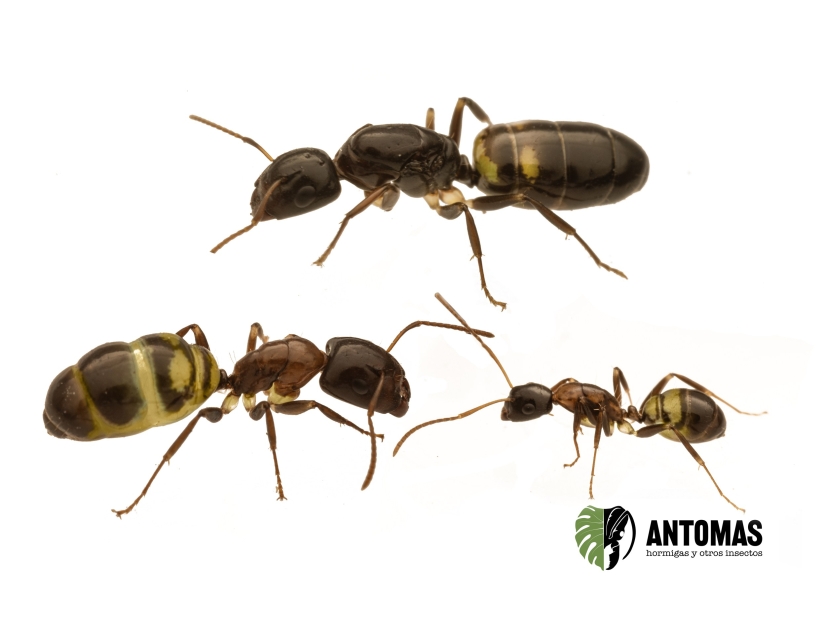
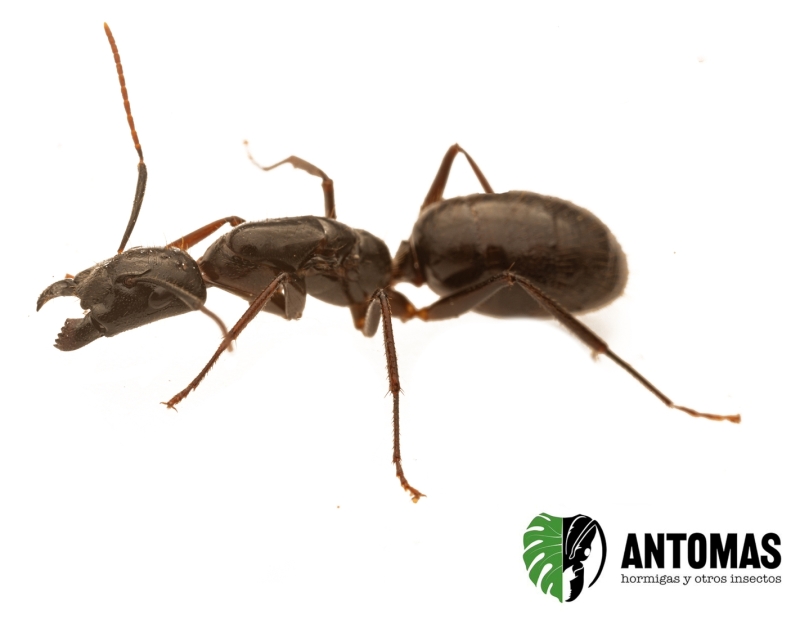
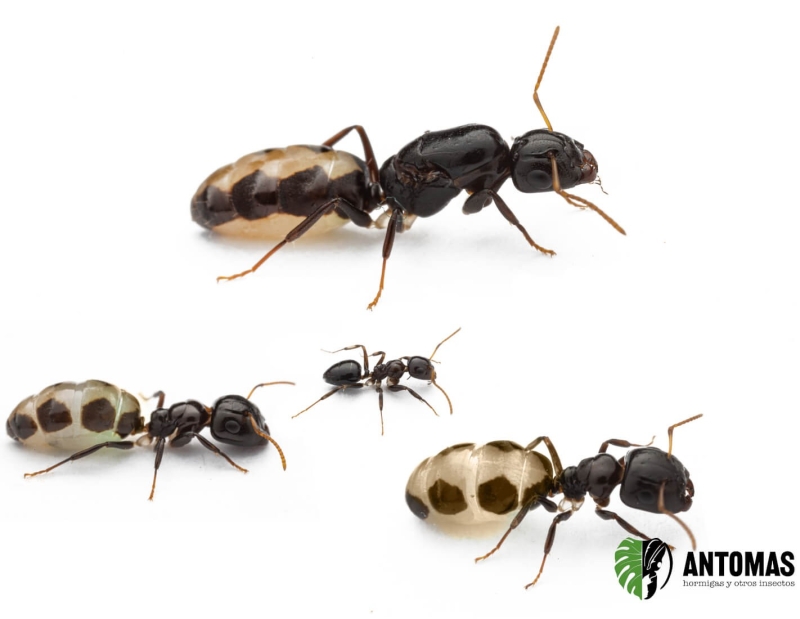
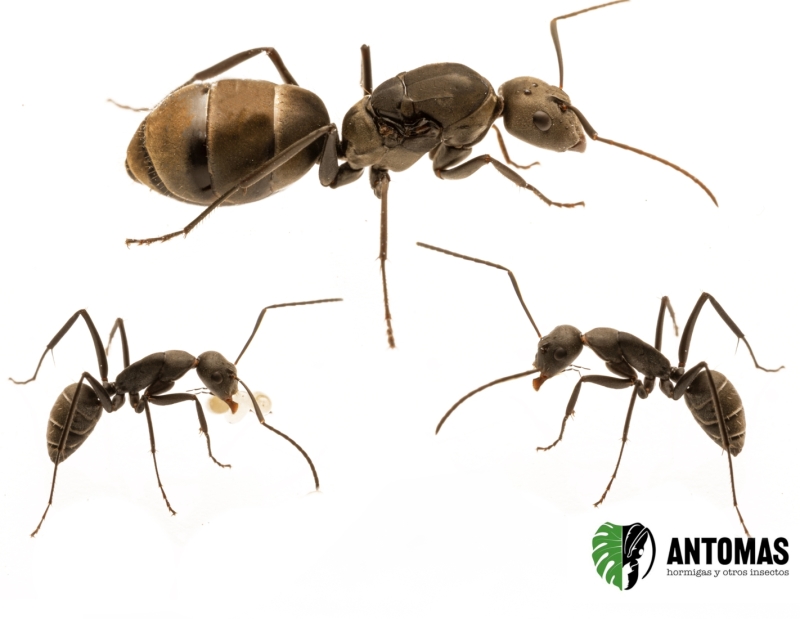
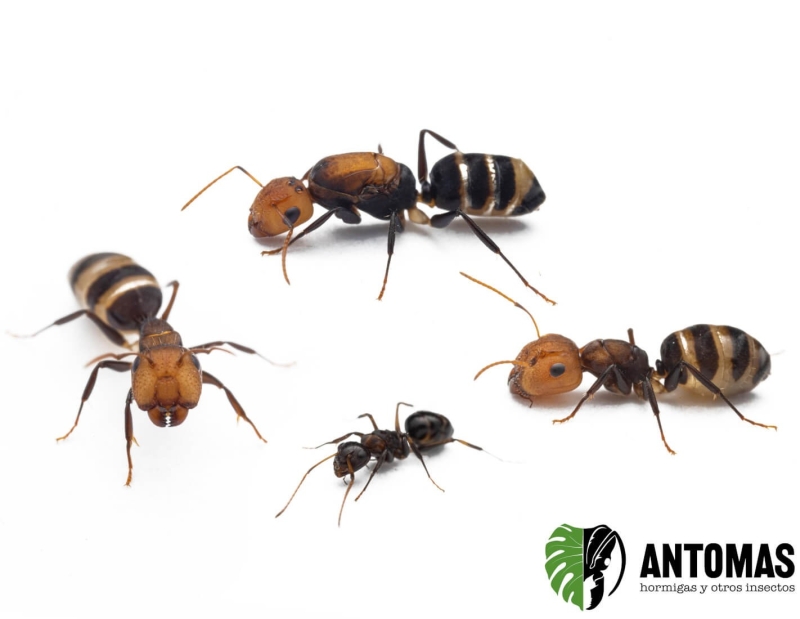
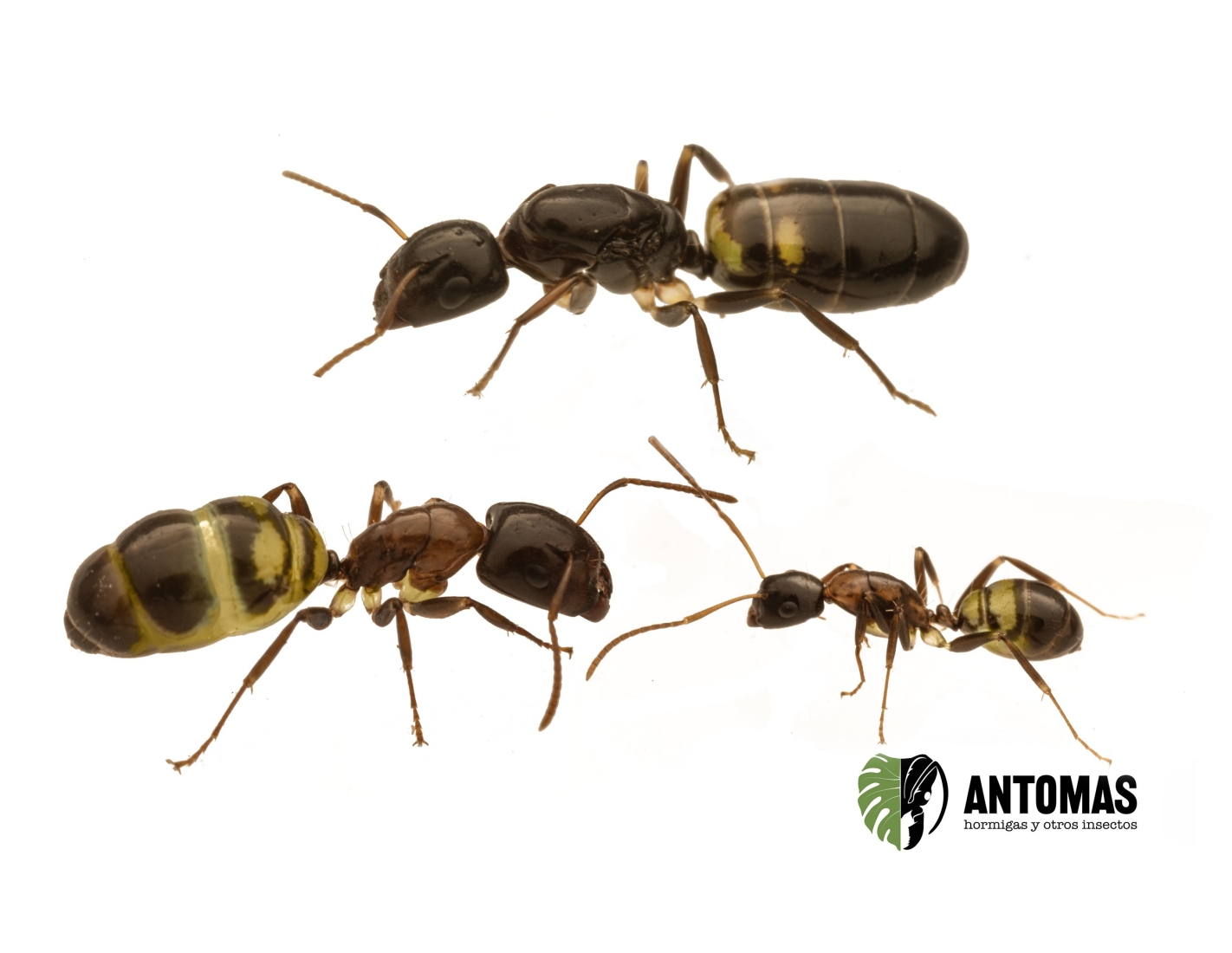
A tree-dwelling carpenter ant from South-East Asia, of the tribe Camponotini, that still has no species name: a glossy black queen, large-headed majors with a blunt front, agile minors and a gaster that, when full, opens out into pale bands. Queen with workers and brood. Nest at 24–28 °C with one side slightly warmer, moderate humidity in a gradient, a QBIK ONE with medium galleries to start with, nectar in a feeder, plenty of varied protein, moving by tipping and a mineral-oil barrier. A clue to find out what it is: check whether its pupae have cocoons.
This ant is a small adventure. It is a carpenter ant that lives in the trees of South-East Asia, with a glossy body and workers of two clearly different sizes, but we do not yet know which species it belongs to. That is why we sell it as Camponotus sp.: “sp.” is the abbreviation of species and is used in taxonomy when the genus is known but the species is not.
In this care sheet we tell you honestly what can and cannot be said about it from a photo, what links it to the tree-dwelling carpenter ants of Asia and how to keep it. Everything that does not come from scientific studies is marked as the experience of Antomas or of other keepers.
Biology
What does “sp.” mean and why does it have no name?
Camponotus is one of the largest ant genera in the world, with more than a thousand described species, and in the forests of South-East Asia many remain to be studied, while many others can only be told apart with the specimen under the microscope and the specialist literature to hand. To put a name to an Asian carpenter ant you need measurements, the full-face view of the head, the pilosity and, often, a comparison with the type specimens kept in museums.
A profile photo, however good, is not enough, and we prefer not to make things up. What we can say for certain is that it belongs to the tribe Camponotini, that of the carpenter ants: an acidopore at the tip of the gaster, no sting, antennae inserted well away from the edge of the head, workers of several sizes and a thorax without spines, which separates it from its spiny cousins of the genus Polyrhachis.
Camponotus or Colobopsis? A case of convergent evolution
Within the Camponotini there are two genera that look extremely alike: Camponotus and Colobopsis. For almost a century, Colobopsis was a mere subgenus of Camponotus, that of the carpenter ants whose major workers have a truncated head, like a plug. Genetic analyses changed everything: Blaimer and her colleagues (2015) showed that Colobopsis is a very ancient lineage, far removed from Camponotus, and in 2016 Ward, Blaimer and Fisher restored it to the rank of genus, with 94 species moving from one genus to the other.
The problem is that not even the truncated head separates them. In 2021, Ward and Boudinot showed that plug-shaped heads have appeared several times, independently, in both Camponotus and Colobopsis, and that trying to tell the two genera apart by their workers is “difficult” because of that tangle of convergences. In minors, the most reliable approach is to measure, under the microscope, the distance between the antennal insertions and the shape of the clypeus.
Our ant sits right in that no man’s land. The major has a large head, longer than it is high, with a blunt front, and the queen also has an elongated head with a barely protruding front. That is the look of a Colobopsis, but also of some tree-dwelling Camponotus, such as those of the subgenus Myrmamblys, whose major workers usually have a head longer than broad and often obliquely truncated (Ward and Boudinot, 2021). The resemblance can be extreme: in 2018, Zettel and his colleagues described from South-East Asia a group of Camponotus (Myrmamblys) so similar to the Colobopsis of the cylindrica group that they interpret it as mimicry.
The cocoon test
There is a clue you can check at home, without a magnifying glass: the pupae. According to Ward and Boudinot (2021), Colobopsis have naked pupae, whereas those of Camponotus are wrapped in a silk cocoon, like those of almost all carpenter ants. In addition, Colobopsis larvae have a kind of ventral pocket, the praesaepium, which Camponotus larvae lack.
So, when your colony has well-developed brood, take a close look: if you see cream-coloured cocoons, it points to Camponotus; if you see naked, whitish pupae with their legs and antennae folded in plain view, it points to Colobopsis. It is one of those observations that turn ant keeping into science.
Doorkeepers with their heads
Large, blunt-fronted heads have a known function in many tree-dwelling carpenter ants: plugging the nest entrance. Ward and Boudinot (2021) explain that these “phragmotic” heads, from the Greek phragma, “barrier”, serve to block the entrances of nests in twigs, and that they have evolved several times, to different degrees, in both genera. In classic Colobopsis, the major stays at the entrance and acts as a living door: it only moves aside to let its nestmates through.
We do not yet know whether the majors of this ant act as doorkeepers. At home it is easy to check: watch whether one of them stays still at the mouth of a gallery or a tube, with its head facing outwards. If it does, let us know.
Life in the trees
Many South-East Asian Camponotini live in the canopy or on the trunks and branches of trees, in dead wood, in hollow twigs, in stems or under bark. Colobopsis, in particular, nest mainly in dead twigs (Ward and colleagues, 2016). High up in a tree, a good small, well-defended entrance is worth its weight in gold, and that explains why plug-shaped heads appear again and again.
Life in the trees also shows in the way it moves: it climbs easily on any surface, so at home it is a good idea to give it branches or bark in the foraging area to explore, and to keep the escape barrier in very good condition (see “Escapes and barriers”).
A gaster that fills with bands
One of its most striking features is the gaster: black and glossy, but when the workers have drunk a lot, the plates move apart and reveal the pale, yellowish membranes between them, which form bands. It is the “social stomach” filled to the brim: ants store liquid in the crop and later share it mouth to mouth with the queen, the larvae and their nestmates. In practice it is a very useful indicator: a gaster with pale bands tells you that the colony is well supplied with sugar.
Honeydew and a bacterium millions of years old
Like all Camponotini, it carries a bacterium, Blochmannia, which lives in special cells of its gut and makes essential amino acids that the ant cannot produce itself. According to Wernegreen and colleagues (2009), the ancestors of the tribe acquired it by tending sap-sucking insects such as aphids and scale insects, whose honeydew is still one of the main sources of energy for tree-dwelling carpenter ants today. That alliance is what you will see at work every time you give it a feeder.
Record-breaking relatives: exploding ants and zombie ants
The tree-dwelling carpenter ants of South-East Asia show some of the most astonishing behaviours in the ant world. In Borneo, the Colobopsis of the cylindrica group are the famous “exploding ants”: when a minor worker is in danger, it contracts its gaster until it ruptures and releases a sticky yellow secretion that immobilises the enemy, sacrificing itself for the colony. In 2018, Laciny and colleagues described Colobopsis explodens as a model species for studying them. Note: there is no sign that our ant does anything of the kind, and this behaviour is specific to one particular group.
In the forests of South-East Asia, another canopy carpenter ant, Camponotus leonardi, is the host of the celebrated “zombie” fungus Ophiocordyceps: infected workers come down from the trees, bite the vein of a leaf, all of them around midday, and die there, hanging (Hughes and colleagues, 2011). These are two examples of how far life in the trees has shaped these ants.
Size and morphology
A small to medium-sized carpenter ant, glossy and with very little pilosity, with workers of two sizes that can be told apart at a glance. What follows comes from our own photos of the colony:
- Queen. Black and very glossy, wingless (she sheds her wings after the nuptial flight), with an elongated head and a barely protruding front, a bulging thorax where the flight muscles were and a large gaster.
- Major worker (major). A large black head, longer than high in profile, with a blunt front, on a brown thorax and brown legs. With a full gaster, it is the one that shows off the pale bands best.
- Minor worker (minor). Much smaller, with a small, rounded head, a reddish-brown thorax and long legs for its size: it is the colony’s explorer.
- Gaster. Black and glossy, with pale, yellowish intersegmental membranes that form bands when it is full. It ends in the acidopore, the nozzle through which formicine ants spray formic acid. There is no sting.
- Brood. Eggs, larvae and pupae, without cocoons if it is a Colobopsis and with cocoons if it is a Camponotus (see “The cocoon test”).
Approximate sizes
As the species has not been identified, there are no published measurements to refer to, and we prefer not to give figures from other species as if they were its own. As a visual guide, the major is almost as long as the queen when its gaster is full, and the minor considerably smaller. We will keep adding to this section with our own measurements from the colony.
Captive care
Difficulty: 2/5 – Beginner
At Antomas we rate it at beginner level. It eats everything, has no sting, the colony arrives already up and running, with workers and brood, and its needs are those of a tropical carpenter ant: moderate warmth, a humidity gradient, sugar always available and varied protein. Three things to bear in mind:
- Tropical warmth. It needs 24–28 °C in the nest all year round; in a European home, that usually means a heating cable or heat mat with a thermostat.
- A climber. Like any good tree ant, it climbs everything: the escape barrier must always be in good condition.
- Species yet to be identified. There is little specific information: you will need to observe and adjust. That is also what makes it interesting.
And it is well worth it. It is a tree-dwelling Asian carpenter ant rarely seen in Europe, striking, with two very different worker castes and a small taxonomic mystery that you can help to solve. If you are interested in carpenter ants with plug-shaped heads, compare it with the European Colobopsis truncata, and if you are looking for another easy Asian carpenter ant, with Camponotus nicobarensis.
Recommended parameters
- Nest temperature: 24–28 °C, with one side slightly warmer and always with a thermostat, so that the colony can choose. A little cooler, it stays active but grows more slowly.
- At night it can drop a few degrees without any problem, as in the wild.
- Foraging area: at room temperature, dry and ventilated.
- Humidity: moderate, with a gradient: one zone of the nest slightly humid that never dries out and the rest drier (see “Humidity: moderate and in a gradient”).
- Water: always available, in a test tube with water and cotton wool in the foraging area.
- Light: a dark nest and a lit foraging area, with a normal day–night cycle and no direct sunlight.
- Winter: see “Winter: watch its rhythm”.
For heat, a heating cable or heat mat on one side of the nest, with a thermostat, is better than a source that heats the whole formicarium evenly or from below, which dries it out and causes condensation. Avoid direct sunlight and radiators.
Humidity: moderate and in a gradient
Ants that nest in wood inside a tree live in a drier environment than those in the soil, but in a humid tropical climate. At home, at Antomas we recommend the happy medium:
- At first, the formicarium’s humidity systems with water: the queen and the small brood need it.
- Once the colony is up and running, a gradient: one part of the nest slightly humid, where they usually keep the eggs and small larvae, and the rest drier, where they gather the pupae. The colony chooses.
- Never soaked: condensation on the walls, mould or mites mean there is too much water or that leftovers have been forgotten.
- Never completely dry: letting a tropical colony dehydrate is a serious mistake. If you see the workers crowded into the humid zone and the rest empty, raise the humidity a little.
Recommended formicaria
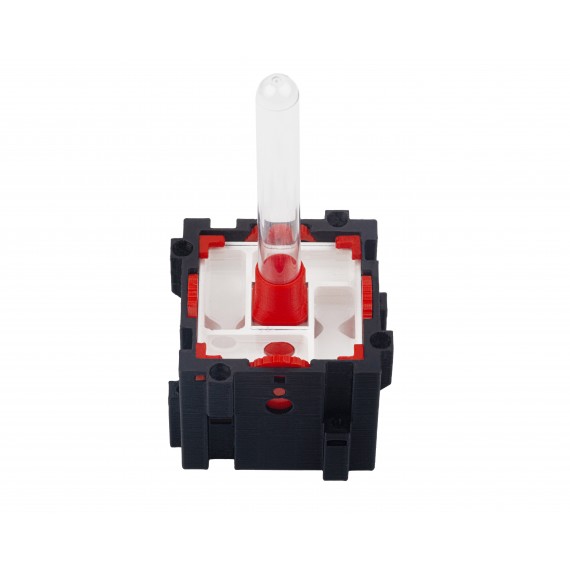
In the wild it nests in wood, but at home we do not recommend wood, cork or bamboo nests: carpenter ants gnaw and soil them, they hold humidity poorly, go mouldy and barely let you see the colony. To start with, at Antomas we recommend the Anthouse Qbik Alpha range: modular, with a fairly dry nest and the humidity in the tubes, just what a tree ant needs. For a colony like the ones we sell, a QBIK ONE with medium galleries:
To keep expanding, the QBIK DUO. The nest should always be in proportion to the colony: in one that is too big, the spare chambers become rubbish tips, with mould and mites. Expand when you see many workers standing idle in the foraging area because there is no room inside. Complete the set-up like this:
- A foraging area with a branch, some bark or a piece of cork to climb and explore, with nothing reaching up to the barrier.
- Water in a test tube with cotton wool and a feeder for sugar, never on cotton wool.
- Heat on one side of the nest, with a thermostat, away from the feeder.
- A mineral-oil barrier and a well-fitting lid (see “Escapes and barriers”).
Arrival and moving by tipping
At Antomas we sell it as a queen with workers and brood: a small colony, with a single queen, that has already passed the founding stage. When you receive it:
- First days. Keep it for a few days as it arrives, in a dark place free of vibrations, at 24–26 °C.
- Gentle feeding. Offer a drop of nectar on a small piece of aluminium foil and a small, opened prey item. Remove anything left over the next day.
- Watch it often, carefully. Check every day how the queen, the brood and the water are doing, without opening the container or moving it more than necessary.
With the workers it arrives with, it can already go into its first formicarium. At Antomas we do it by tipping:
- Set up the formicarium beforehand, with the humidity loaded, the barrier in place and the water ready.
- Work over a tray, with a soft brush or soft tweezers, never with your hands.
- Open the tube or container it arrives in, in the foraging area, next to the nest entrance, and gently tip out the queen, the workers and the brood, helping the stragglers along with the brush.
- Close the lid and leave the nest dark. Within a few hours they will have carried the brood inside.
To move it later into a larger module, use the same method.
Growth and majors
There are no scientific data on this ant’s development, so we are not going to give you egg-to-worker figures that we cannot back up. What we do know from experience with tropical carpenter ants is that temperature and protein are what count: at 24–28 °C and well fed, the colony makes good progress; in the cold or with little protein, it stalls.
The majors, with their large heads, appear in greater numbers once the colony has gained strength, and the sooner the more protein it receives. One colony, one queen: at Antomas we do not combine queens or colonies.
Feeding
Sugar in a feeder, always available. In the wild, much of its energy comes from the honeydew of aphids and scale insects and from nectar. At Antomas we recommend variety: the Blue Sugar nectar by Anthouse 4–5 times a week and another nectar or sugary liquid 1–2 times a week. You can also add a little protein to the nectar. Always offer it in a feeder, where the drop stays spread out and within reach, and never on cotton wool, which goes mouldy and spoils the liquid straight away. The pale bands on the gaster will tell you whether they are well supplied.
Protein: the more, the better. It is the engine of growth. In Antomas’s experience, if you do frequent maintenance and remove leftovers, it is better to give too much than too little: the colony understands that it has resources and grows faster and in greater numbers. If you will not be able to clean often, it is better not to overfeed. Change the type of insect from one week to the next, so that they do not always eat the same thing:
Buy the insects from a reliable supplier: insects treated with insecticides can kill the colony. Remove the leftovers the next day.
Water: always, in the test tube with cotton wool in the foraging area, separate from the sugar.
Winter: watch its rhythm
South-East Asia ranges from equatorial forests with no cold season to monsoon areas with a cool, dry winter, and without knowing the species we cannot give you a fixed routine. At Antomas we recommend keeping it at 24–28 °C all year round and watching its rhythm:
- If in autumn and winter the queen slows down her laying and the colony becomes less active even though it has warmth and food, go along with it with a gentle rest: a few degrees less, never below 18–20 °C, nectar and water always available and less protein, for a few weeks.
- At the end of winter, return gradually to 24–28 °C and plentiful protein.
- Never severe cold: it is a tropical ant.
We will keep refining this section with what we see in our colonies.
Behaviour and observation
Two castes, two roles. The minors explore, forage and climb the branches in the foraging area; the majors tend to stay close to the nest and the brood, and are the ones that fill up most with nectar. Watch whether a major stands still at the mouth of a gallery with its head facing outwards, acting as a doorkeeper.
Observe without fear. At Antomas we believe ants are there to be enjoyed, watched and learnt from, not kept hidden away. It is enough to keep the nest dark and the foraging area lit, and to watch them gently, intervening and stressing them as little as possible. They get used to your presence.
Warning signs:
- The colony does not grow in the middle of the season: almost always a lack of protein or warmth.
- Larvae that do not develop or a queen that stops laying: check that the nest is at 24–28 °C.
- Workers crowded into the humid zone and the rest of the nest empty: it may be too dry.
- Gasters always thin, with no pale bands: not enough sugar.
- Condensation, mould or mites: too much humidity or forgotten leftovers.
- Many workers standing idle in the foraging area: time to expand.
Escapes and barriers
It is a tree ant and climbs any surface, and its minors are small and can squeeze through the tiniest gaps. At Antomas we use mineral oil with them:
- A thin, continuous band of mineral oil along the top of the walls of the foraging area. Renew it when it collects dust or debris.
- A well-fitting lid, with fine-mesh ventilation, as a second line of defence.
- No gaps in connections, stoppers or tubes.
- Nothing that can act as a bridge to the barrier: keep branches and bark well away from the walls.
Handling and safety
It does not sting: it has no sting. It can bite and spray formic acid, which stings a little on sensitive skin or in a small cut, but it is nothing serious if you work calmly:
- Always use tools: a soft brush, soft tweezers and, for transfers, tubes and adaptors. Never your hands.
- Open the formicarium only as much as needed, work slowly over a tray and close it when you finish.
- Do not combine different queens or colonies, or keep it with other species.
- With young children at home, let them enjoy it by watching, with the formicarium closed, but never handling it.
It is an exotic species: it must never be released into the wild.
What not to do
- Keep it below 22 °C for long periods or expose it to severe cold.
- Heat the whole formicarium from below or without a thermostat.
- Let the nest dry out completely, or soak it all.
- Put it in a wood, cork or bamboo nest, or in a formicarium that is huge for its size.
- Put the sugar on cotton wool or let it run out.
- Always give it the same insect or leave leftovers for more than a day.
- Combine queens or colonies.
- Handle it with your hands or neglect the barrier.
Scientific sources
As the species has not been identified, this care sheet is based on the literature on the tribe Camponotini and the genera Camponotus and Colobopsis, on our photos of the colony and on the experience of Antomas and other keepers with tropical carpenter ants. Main references:
- Wernegreen, J. J., Kauppinen, S. N., Brady, S. G. & Ward, P. S. (2009). One nutritional symbiosis begat another: phylogenetic evidence that the ant tribe Camponotini acquired Blochmannia by tending sap-feeding insects. BMC Evolutionary Biology 9: 292. doi:10.1186/1471-2148-9-292
- Hughes, D. P., Andersen, S. B., Hywel-Jones, N. L., Himaman, W., Billen, J. & Boomsma, J. J. (2011). Behavioral mechanisms and morphological symptoms of zombie ants dying from fungal infection. BMC Ecology 11: 13. doi:10.1186/1472-6785-11-13
- Blaimer, B. B., Brady, S. G., Schultz, T. R., Lloyd, M. W., Fisher, B. L. & Ward, P. S. (2015). Phylogenomic methods outperform traditional multi-locus approaches in resolving deep evolutionary history: a case study of formicine ants. BMC Evolutionary Biology 15: 271. doi:10.1186/s12862-015-0552-5
- Ward, P. S., Blaimer, B. B. & Fisher, B. L. (2016). A revised phylogenetic classification of the ant subfamily Formicinae (Hymenoptera: Formicidae), with resurrection of the genera Colobopsis and Dinomyrmex. Zootaxa 4072: 343–357. doi:10.11646/zootaxa.4072.3.4
- Laciny, A., Zettel, H., Kopchinskiy, A., Pretzer, C., Pal, A., Abu Salim, K., Rahimi, M. J., Hoenigsberger, M., Lim, L., Jaitrong, W. & Druzhinina, I. S. (2018). Colobopsis explodens sp. n., model species for studies on “exploding ants” (Hymenoptera, Formicidae), with biological notes and first illustrations of males of the Colobopsis cylindrica group. ZooKeys 751: 1–40. doi:10.3897/zookeys.751.22661
- Zettel, H., Balàka, P., Yamane, S., Laciny, A., Lim, L. & Druzhinina, I. S. (2018). New mimetic ants from Southeast Asia – the Camponotus (Myrmamblys) inquilinus group (Hymenoptera: Formicidae: Camponotini). Zeitschrift der Arbeitsgemeinschaft Österreichischer Entomologen 70: 125–174. PDF on ZOBODAT (open access)
- Ward, P. S. & Boudinot, B. E. (2021). Grappling with homoplasy: taxonomic refinements and reassignments in the ant genera Camponotus and Colobopsis (Hymenoptera: Formicidae). Arthropod Systematics & Phylogeny 79: 37–56. doi:10.3897/asp.79.e66978
- Bolton, B. AntCat: An online catalog of the ants of the world. antcat.org (accessed in 2026)