This website uses its own and third-party cookies to improve our services and show you advertising related to your preferences by analyzing your browsing habits. To give your consent to its use, press the Accept button.
Functional cookies are strictly necessary to provide the services of the shop, as well as for its proper functioning, so it is not possible to refuse their use. They allow the user to browse through our website and use the different options or services that exist on it.
Cookie
Provider
Purpose
Expiry
PHP_SESSID
antomas.es
The PHPSESSID cookie is native to PHP and allows websites to store serialised status data. On the website it is used to establish a user session and to pass state data through a temporary cookie, which is commonly known as a session cookie. These Cookies will only remain on your computer until you close your browser.
Session
PrestaShop-#
antomas.es
This is a cookie used by Prestashop to store information and keep the user's session open. It stores information such as currency, language, customer ID, among other data necessary for the proper functioning of the shop.
These are cookies that collect information about the advertisements shown to users of the website. They can be anonymous, if they only collect information about the advertising spaces shown without identifying the user, or personalised, if they collect personal information about the user of the shop by a third party, for the personalisation of these advertising spaces.
Collect information about the user's browsing experience in the shop, usually anonymously, although sometimes they also allow the user to be uniquely and unequivocally identified in order to obtain reports on the user's interests in the products or services offered by the shop.
The world record for polymorphism: tiny minors and berserkers more than 500 times heavier, hunting in swarms, building earthen roads and raising empires of hundreds of thousands of workers. The marauder ant, a non-stop spectacle for experienced keepers. Queenright colonies with tubes loaded with brood. Shipping across Europe, live arrival guaranteed.
The ant with the most extreme polymorphism on the planet: tiny minors and soldiers weighing more than 500 times as much, hunting in swarms and building roads. It needs warmth, high humidity, lots of space and constant care of the brood.
Carebara diversa (Jerdon, 1851), the marauder ant, is one of the most spectacular ants you can keep at home. Known for more than a century as Pheidologeton diversus, it is one of the two "marauder ants" of Asia: colonies of hundreds of thousands of workers that hunt in swarms, build real earthen roads and bring together tiny workers and giant soldiers in the same nest. In Japan it is called Yokozuna-ari, after the yokozuna, the grand champions of sumo. Almost everything we know about it comes from the myrmecologist and photographer Mark W. Moffett, who studied it for years in Singapore, Malaysia, Thailand and India.
Biology
Distribution and habitat
It ranges from India and Sri Lanka across South-East Asia to southern China, Taiwan, the Philippines and Indonesia. It is the commonest marauder ant in human-altered habitats: as well as primary and secondary forest, it lives in rice paddies, rubber and coconut plantations, other crops and urban parks and gardens. Where it is abundant, Pheidole ants are scarce, as it drives them away from food; and in the forests of Peninsular Malaysia it gives way to its relative Carebara silenus.
The nest is underground, often at the base of a tree, in a rotting log or in old burrows, termite mounds, dead roots and even buried bottles and cans. Almost all chambers lie less than 80 cm deep: a central zone with the queen and brood, and satellite chambers up to a metre and a half away, occupied by the "repletes", workers that act as a larder.
The world record for polymorphism
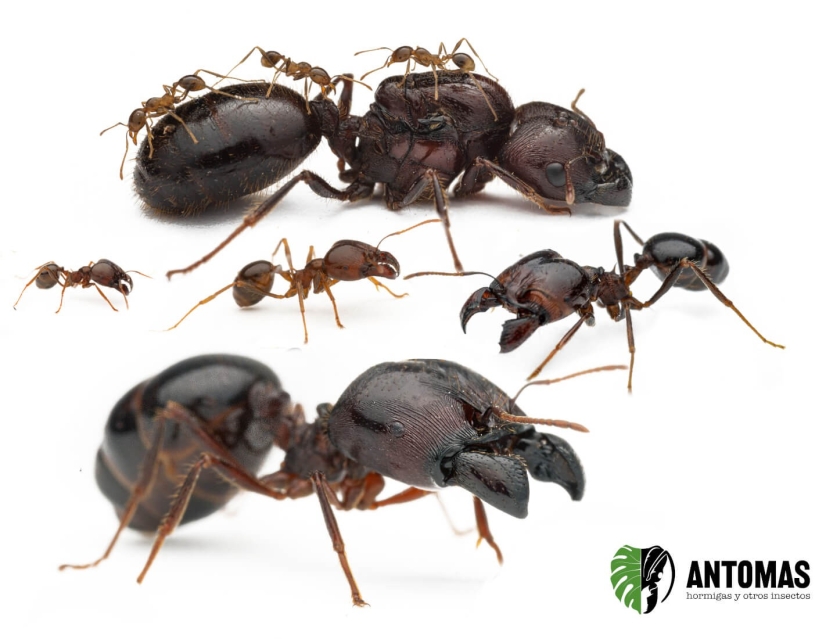
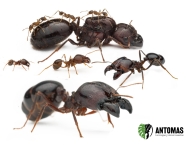
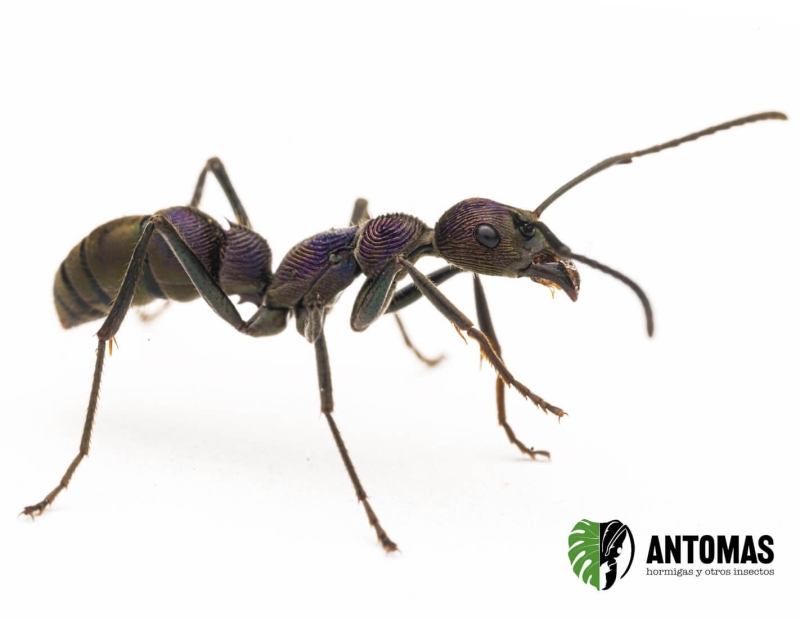
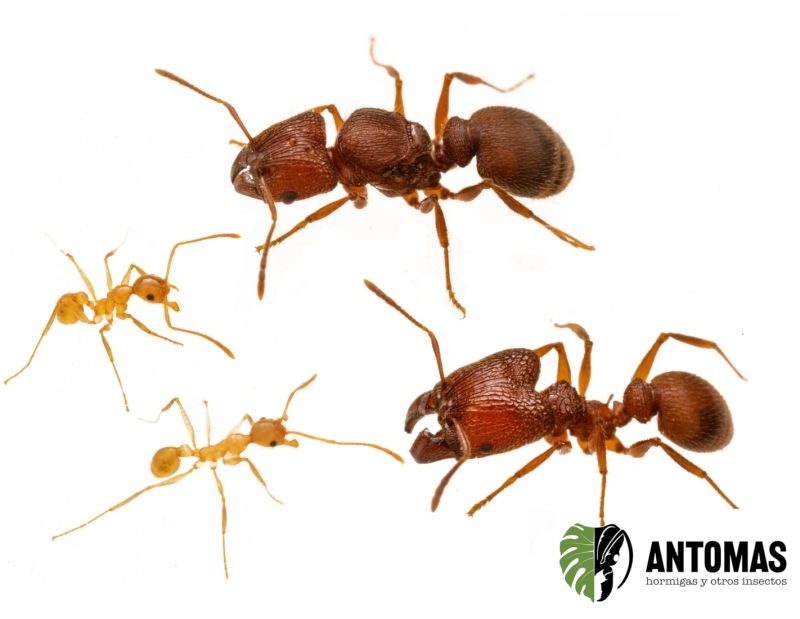
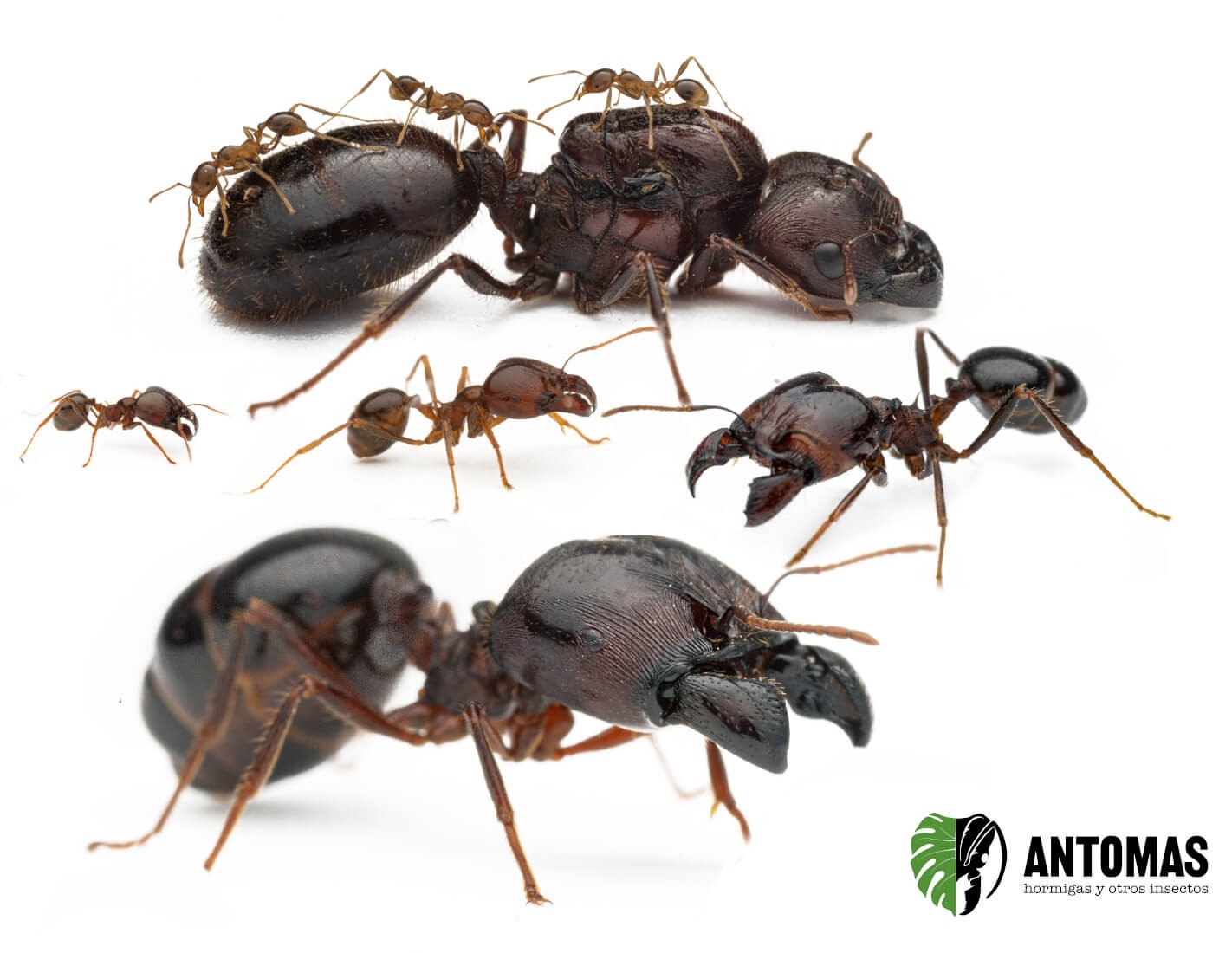
No known ant has workers so different from one another. In C. diversa head width varies tenfold from the smallest to the largest worker, and the largest soldiers weigh more than 500 times as much as a minor. By comparison, in Atta leafcutters, famous for their polymorphism, the difference in weight is around 100-fold. The tiny minors make up at least 99 % of the colony; above them there are workers of every size, from medias to majors and the huge "supermajors" known in the hobby as berserkers.
Moffett distinguished four physical castes: minors, medias, majors and repletes. The latter are medias and majors with a crop full of an oily reserve, which stay in the nest and regurgitate food to their nestmates: a living larder. In one of the colonies studied they were almost half of all non-minor workers. Minors also divide work by age: the youngest care for the brood and the oldest go out to fight.
The castes of the marauder ant (Anthouse, in Spanish).
Berserkers in action (Anthouse).
Marauders: swarm hunting
The marauder ant has no solitary scouts. It hunts en masse: tens of thousands of workers form narrow columns or fan-shaped swarms 2 to 4 metres wide that advance at about 2–3 metres an hour, with a front where workers relieve one another centimetre by centimetre, and which can travel more than 20 metres. When they find prey, minors pile on by the hundreds until it is immobilised, many dying in the attempt, and then the medias and majors arrive and cut off legs and appendages with their mandibles. They have no functional sting: everything is done by biting.
They are active at any hour, day and night, and their activity depends enormously on humidity. On humid days they launch many more raids and are far more aggressive: in one of Moffett's experiments, 39.5 % of workers attacked a finger on humid days compared with only 3.9 % on dry days. It is the first clue to what this species is: an ant that lives and dies by humidity.
The marauder ant's public works
Each colony maintains one or two roads: trunk trails 5 to 100 metres long that can last more than two months. They are smooth, with side walls of soil, sometimes fully roofed over as arcades or even sunk below ground. Minors smooth the surface; medias and majors clear obstacles by pushing them with their heads or chewing them away, and the largest majors tamp down the roofs. As early as 1903 the naturalist Charles Bingham wrote that the soldiers seemed to be "the trowels and rammers of the Ants' Public Works Department". In heavy traffic, ants returning with loads use the centre and outgoing ones the sides. Arcades are only built with moist soil: when dry they crumble.
School buses: minors riding on soldiers
One of the most curious sights of the species: more than twenty minors can ride on top of a large major for up to twenty minutes. Moffett compared them to school buses carrying the little ones to the front. Riding saves energy and doubles as an escort: minors perched on food carried by majors chase off thieving flies trying to steal it.
Extreme omnivores
They eat practically everything. Roughly half their diet is animal: insects, earthworms, snails, woodlice, centipedes, spiders, eggs and even small frogs and geckos. The other half is plant matter: seeds of dozens of species, which medias pluck from grasses and minors carry away on a real conveyor belt while majors crack the hardest ones; plus fruit, coconuts, bananas, figs or cocoa pods. A colony can remove 300 grams of seeds in eight hours, and in one case more than 6,000 workers a minute went in and out of a cocoa pod that they emptied in a day. For large prey they work as a team: a hundred workers can drag a 10 cm earthworm weighing 5,000 times as much as each of them, and over carrion or large fruit they build earthen covers to exploit it for days.
Army ants? Almost, but not quite
With its mass raids, covered trails and guards, the marauder ant looks very much like the African army ants, but it is not nomadic: it has a fixed nest and only moves occasionally, using its road as an emigration route over several nights. Nor does it form the gigantic colonies sometimes attributed to it: the colonies excavated by Moffett had between 85,000 and 250,000 workers, which is already saying something.
The queen: just one, and well protected
In nature almost every colony has a single queen, and Moffett observed something extraordinary: old, worn-out queens dragged out of the nest by minors and covered with soil at the edge of the trail, a sign that the colony replaces its queen. Nuptial flights take place at night in the rainy season; in Singapore, in May, with almost daily downpours. Founding is claustral: the queen sheds her wings, digs a chamber and lays 50 to 250 eggs that she carries stuck to a smooth area under her gaster, raising her first workers without eating, thanks to her fat reserves and a crop full of oily fluid.
Why it is so delicate in captivity
Moffett himself tried to rear them in aquaria with soil and in tubes, and failed: the workers barely ate, minors and larvae died quickly, and of 16 queens none managed to raise larvae. He concluded that they need far more space for nest and foraging than ants are usually given. The experience of European keepers points the same way: most colonies that are lost do not die because of the queen, but because the worker population collapses and there is no brood to replace it. In the care section we explain how to avoid it.
A new name for an old ant
For more than 150 years it was Pheidologeton diversus. In 2014 a revision of the genus Carebara showed that Pheidologeton had no characters of its own to justify keeping it separate, and the species became Carebara diversa. The genus Carebara now contains some 230 species, many of them tiny and subterranean; the marauder ant is its most spectacular member. Two forms (subspecies) of the species mainly circulate in the hobby.
Size and morphology
Minors are chestnut brown, smooth and shiny, with yellowish-brown antennae and legs. Majors are dark brown, with almost black mandibles and a huge rectangular, striated head, pure muscle for biting, cracking seeds and pushing obstacles. They have a surprising feature: an ocellus, a small "third eye", on the forehead, which gave the species one of its old names, Pheidole ocellifera; intermediate workers may have one to three. The queen looks like a darker major, with a short, tall, massive thorax and a bulky gaster. Males are dark brown, with a small head and very large eyes and ocelli.
The antennae have 11 segments with a 2-segmented club, compared with the 12 segments and 3–4-segmented club of Pheidole, with which they are often confused. Majors have a pair of propodeal spines. And although it belongs to the Myrmicinae, most of which sting, the marauder ant does not sting: it bites.
Approximate measurements
Minor workers: 1.5–3.5 mm
Media and major workers: 4.5–13 mm (largest measured about 15.6 mm)
Queen: 18–20 mm (15–16 mm in the Philippine form)
Male: about 13 mm
Measurements from the classic descriptions (Bingham 1903; Forel 1912; Wheeler 1929) and collections. They are indicative values: soldier size depends greatly on the size and feeding of the colony.
Care in captivity
Difficulty: 4/5 – Advanced
It is not a difficult species from day to day: it eats everything, grows very fast once established and is a constant spectacle. The difficulty is that it does not forgive lapses with humidity: its workers are short-lived, the colony must produce brood non-stop, and if the brood is interrupted the colony can collapse within a few weeks. It also needs warmth, lots of space, lots of food and well-maintained escape barriers. For those who can provide all that, it is one of the most impressive species in the hobby.
The key to everything: humidity, brood and hatching
In Antomas' experience, the hatching of C. diversa eggs depends on a very precise level of humidity. In a healthy colony, the brood mass itself (larvae and pupae) helps the workers self-regulate this microclimate: the workers pile up the brood and move it around the nest in search of just the right humidity. But if the colony collapses and is left without larvae or pupae, it loses that ability to regulate and the eggs stop hatching. And since workers are not particularly long-lived (some live a month and the average is 3–4 months; soldiers live longer the bigger they are), a colony without brood fades fast.
Other keepers' experience confirms it: the most common collapse pattern is a colony in which laying or brood stops for a few weeks (because of cold, dryness, stress or mites) and the minor population crashes without replacement. And a dry nest can kill workers in less than a day. That is why the whole set-up revolves around one idea: always keep humidity high and stable and the colony full of brood.
Recommended parameters
Temperature: 26–30 °C, with a gradient (heat from the side, not under the nest). Above 30 °C, if humidity is right, the colony grows very fast; never exceed 34 °C.
Humidity: high and stable in the substrate and brood area; never let it dry out.
Watering: misting is not enough; the substrate must be watered according to the size of the terrarium. As a guide, in a GAIA Oasis, about 1 litre of water a week.
Water: always available, in addition to watering.
Ventilation: enough to prevent mould and excessive condensation, without drying the terrarium.
Diapause: none. A tropical species active all year round.
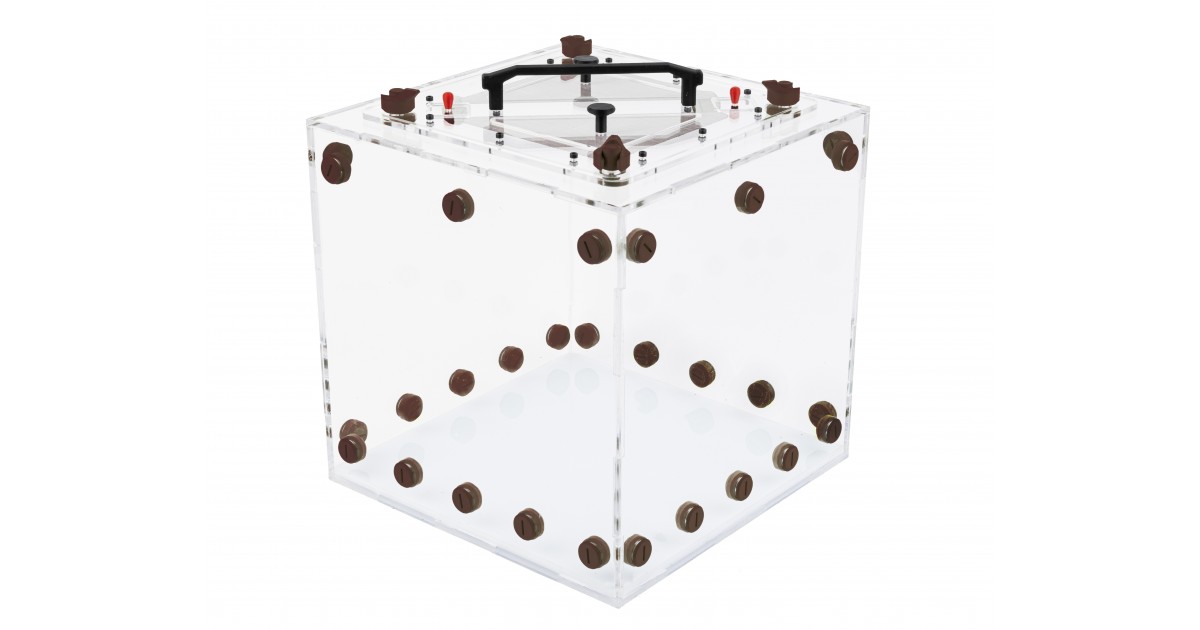
At Antomas we recommend keeping the marauder ant in naturalistic terrariums, specifically the Anthouse GAIA range. The GAIA Oasis (29 × 29 × 29 cm) is a good starting point. A terrarium with a good layer of moist substrate lets the colony dig its own nest as in nature, move the brood to the humidity it needs at each moment and buffer changes: it is the safest way to keep the brood from being interrupted.
Substrate: a mix of coconut fibre, ordinary potting soil and some clay so they can build galleries and their famous arcades. Do not use live plants: they usually kill them. Branches, bark or flat stones give them spots to build the nest.
The alternative: very humid plaster nests. They can also be kept in formicaria, but then always plaster ones; Anthouse's evaporation and hybrid models work quite well. However, they demand very intensive care to keep humidity right every day, and most likely, at some point of neglect, the colony will collapse, be left without brood and the eggs will never hatch again. That is why we prefer the terrarium.
Hygiene and mites: the marauder ant buries food to retrieve it later, and rotting leftovers attract mites, the other big cause of colony loss according to keepers. Remove any leftovers you see within 24 h and do not add unsterilised garden soil.
Queens, merging colonies and what to do if the colony collapses
At Antomas we sell single-queen colonies, always with plenty of brood, and never lone queens: keepers agree that raising a colony from a single queen, or from a few dozen workers, is almost impossible.
The marauder ant accepts polygyny quite well, and colonies can be merged as long as they are of the same form (subspecies). Two mainly circulate in the hobby, and at Antomas we record which one we sell in each batch. If you want to merge colonies, tell us when you bought yours and we will tell you whether the one we have available is compatible.
If your colony collapses and is left without larvae or pupae, it is not necessarily lost: you can add another compatible colony, which brings young workers and, above all, brood, to restart the cycle. As we always ship colonies heavily loaded with brood, this is the best way to rescue it. Ask us first about subspecies compatibility.
Feeding
Protein: the staple, in large amounts and daily: crickets, cockroaches, mealworms, flies, earthworms and any safe feeder insect. They accept live and dead prey, and large colonies tear apart huge prey. As a guide, a colony of about a thousand workers can eat several large crickets a day.
Seeds: they accept almost any, and in large colonies they can make up half the diet. They love crushed peanuts (unsalted). It does not matter if a seed germinates in the nest: they remove it when it bothers them.
Sugars: not the basis of their diet. A little honey water or nectar once or twice a month is enough.
Water: always available.
An Antomas colony growing at full speed (Antomas channel).
A marauder ant feast (Anthouse).
Behaviour in captivity
Once the colony is established, growth is explosive: in a few weeks it can multiply its number of workers, and medias, majors and, in time, the great berserkers appear. You will see columns, raids on food, galleries and earthen covers, and almost constant activity, day and night. They are sensitive to stress: they flee direct light and dislike frequent disturbance. There is no need to force a move: simply leave the test tube in the foraging area and they will move in quickly.
Escapes and barriers
Minors are tiny and slip through almost invisible gaps: the lid must fit tightly and every joint must be checked. Any escape barrier works, but beware: they can get over oil, Fluon and vaseline by piling substrate on top. Keep an eye on them, clean them and restore them regularly.
Handling and safety
They do not sting, but they bite hard: minors annoyingly, and large majors can even cut the skin. It is not dangerous, but it is painful. Do not handle with bare hands. It is an exotic species: under no circumstances should it be released.
What not to do
Let the substrate or nest dry out, even for a day.
Rely on misting alone: you need to water.
Drop below 26 °C for weeks or exceed 34 °C.
Put live plants in the terrarium.
Use formicaria that are not plaster, or humid nests you cannot check daily.
Leave food leftovers rotting: they attract mites.
Start with a lone queen or a tiny colony.
Merge colonies of different subspecies.
Neglect the barriers: they cover them with substrate and cross them.
What you receive
Colonies with a queen and hundreds of workers, shipped in large tubes heavily loaded with brood, sometimes with more brood than workers, so the colony gets off to a strong start. We ship to Spain and all of Europe almost every week, with thermal packaging when needed; live arrival guaranteed.
Scientific sources
This care sheet was compiled from the scientific literature on the species and from the experience of Antomas and European keepers. Main references:
Moffett, M.W. (2019). Marauder Ants (Carebara in part). In C. Starr (ed.), Encyclopedia of Social Insects. Springer. doi:10.1007/978-3-319-90306-4_75-1
Moffett, M.W. (1987). Division of labor and diet in the extremely polymorphic ant Pheidologeton diversus. National Geographic Research 3(3): 282–304.
Moffett, M.W. (1988). Foraging dynamics in the group-hunting myrmicine ant, Pheidologeton diversus. Journal of Insect Behavior 1(3): 309–331. doi:10.1007/bf01054528
Moffett, M.W. (1988). Nesting, emigrations, and colony foundation in two group-hunting myrmicine ants. In J.C. Trager (ed.), Advances in Myrmecology: 355–370. Brill. doi:10.1163/9789004630765_026
Moffett, M.W. (1984). Swarm raiding in a myrmicine ant. Naturwissenschaften 71: 588–590. doi:10.1007/bf01189188
Moffett, M.W. (2010). Adventures among Ants: A Global Safari with a Cast of Trillions. University of California Press.
Fischer, G., Azorsa, F. & Fisher, B.L. (2014). The ant genus Carebara Westwood: synonymisation of Pheidologeton Mayr under Carebara. ZooKeys 438: 57–112. doi:10.3897/zookeys.438.7922
Bingham, C.T. (1903). The Fauna of British India, including Ceylon and Burma. Hymenoptera, vol. 2. Taylor & Francis.
Foo (2022). Biodiversity Record: Carebara diversa ants attacking an Oriental whip snake. Nature in Singapore 15: e2022049. doi:10.26107/NIS-2022-0049
Cassill, D.L. & Tschinkel, W.R. (2000). Behavioral and developmental homeostasis in the fire ant, Solenopsis invicta. Journal of Insect Physiology 46: 933–939. doi:10.1016/s0022-1910(99)00200-0
Dificultad
Experienced
1 Reviews
What an absolutely awesome colony very good quality and easy people to work with nothing but the best from me thanks again