This website uses its own and third-party cookies to improve our services and show you advertising related to your preferences by analyzing your browsing habits. To give your consent to its use, press the Accept button.
Functional cookies are strictly necessary to provide the services of the shop, as well as for its proper functioning, so it is not possible to refuse their use. They allow the user to browse through our website and use the different options or services that exist on it.
Cookie
Provider
Purpose
Expiry
PHP_SESSID
antomas.es
The PHPSESSID cookie is native to PHP and allows websites to store serialised status data. On the website it is used to establish a user session and to pass state data through a temporary cookie, which is commonly known as a session cookie. These Cookies will only remain on your computer until you close your browser.
Session
PrestaShop-#
antomas.es
This is a cookie used by Prestashop to store information and keep the user's session open. It stores information such as currency, language, customer ID, among other data necessary for the proper functioning of the shop.
These are cookies that collect information about the advertisements shown to users of the website. They can be anonymous, if they only collect information about the advertising spaces shown without identifying the user, or personalised, if they collect personal information about the user of the shop by a third party, for the personalisation of these advertising spaces.
Collect information about the user's browsing experience in the shop, usually anonymously, although sometimes they also allow the user to be uniquely and unequivocally identified in order to obtain reports on the user's interests in the products or services offered by the shop.
Architects of the canopy: the only ant that sews nests out of living leaves with the silk of its own larvae, links its bodies into chains to bend whole leaves and defends empires of half a million workers. Our colonies and queens are of Asian origin, with yellow or orange workers. Expert level (5/5): it demands heat, ventilation and a good escape barrier, and in return offers the most incredible spectacle in the hobby. Shipping across Europe, live arrival guaranteed.
The ant that sews leaf nests with the silk of its own larvae. Demanding in heat, ventilation and escape barriers, but probably the most spectacular and entertaining species you can keep at home.
Oecophylla smaragdina (Fabricius, 1775) is the weaver ant of Asia and Australia, one of only two living species of the genus Oecophylla (the other, O. longinoda, lives in tropical Africa). Few ants have fascinated naturalists as much: it builds nests out of living leaves sewn together with the silk of its own larvae, forms chains with its bodies to bend leaves and bridge gaps, defends territories spanning several trees with hundreds of thousands of workers, and has been working for humans as a biological control agent for more than 1,700 years. It is, with good reason, one of the most sought-after species in the hobby, and also one of those with the most failed set-ups behind it.
Biology
Distribution and habitat
It occupies a huge belt of the Old World tropics: from India, Sri Lanka, Nepal and Bangladesh, through southern China and the whole of South-East Asia (Thailand, Laos, Vietnam, Malaysia, Indonesia, the Philippines), to New Guinea, the Solomon Islands and northern Australia. A review of more than 2,700 records from 21 countries places it roughly between 32.7° N and 23.9° S; almost all records come from humid tropical climates, with hardly any from semi-arid areas.
In Australia its southern limit has been studied in detail: the presence of the species is explained by the combination of annual rainfall and mean minimum temperature, and it only occurs where there is forest or woodland. The southernmost confirmed populations are at Tannum Sands and Rundle Range (Queensland, around 23°40'–23°57' S). This matters in captivity: it is a humid-tropics ant whose larval development stops in the cold.
It lives in the canopy of open tropical forests, forest edges, mangroves, isolated trees and, above all, plantations: mango, cashew, citrus, cocoa, coconut and oil palm. In Laos, larva collectors say it avoids dense evergreen forest and prefers tracks, field margins and trees next to rice paddies. In India it has been found on mango, guava, Syzygium cumini, Terminalia, hibiscus and a dozen other trees, with nests at an average height of about 3 m and between 1 and 300 leaves per nest.
A superorganism spread across the trees
A mature Oecophylla colony is one of the largest insect societies on the planet: up to half a million workers have been estimated, spread across hundreds of nests, occupying anything from a single tree to more than twenty large trees and territories of around 1,500 m² in ground projection. It is a polydomous colony: a central nest houses the queen, and around it multiply satellite nests, brood nests and "barrack nests" on the borders of the territory, occupied only by major workers on guard.
Leaf nests are living, ephemeral structures: they last as long as the leaves do, around 85–130 days on average, so the colony is constantly building and moving. In a two-year study in India, each colony used between 2 and 8 nest trees at the same time, and the central tree, probably the queen's, remained continuously occupied for more than two years. Anyone who keeps them at home will recognise this behaviour: they move, open secondary nests and move again without anything being wrong.
How they bend a leaf: pulling chains
Construction begins before the silk. Oecophylla is the only genus of weaver ants that manipulates the leaf before gluing it: a worker bites the edge of the leaf, preferably the tip, and pulls backwards; her nestmates join beside her or grip the gaster of the ant in front, forming chains of several ants that walk backwards and roll the leaf towards the centre. The bites cluster in space and time through positive feedback: the more some pull, the more others join in.
In 2025 a team measured the force of these chains with dynamometers and found something surprising: each ant pulls almost twice as hard when the team grows, because the ants at the front pull and those behind act as anchors, like a ratchet. It is exactly the opposite of what happens in human teams, where each person contributes less the larger the group (the so-called Ringelmann effect).
Larvae as shuttles: living glue
Once the edges touch, they have to be sewn together. To do this the workers go into the nest, pick up last-instar larvae in their mandibles and carry them to the seam; there they move them back and forth like the shuttle of a loom, tapping their heads with their antennae so that they extrude a thread of silk from their labial glands. The result is a sheet of silk that joins the leaves and which the colony keeps reinforcing over time.
The evolutionary price of this trick is remarkable: Oecophylla larvae donate all their silk to the communal nest and pupate naked, without a cocoon, something unusual among formicine ants. Hölldobler and Wilson called them the colony's "auxiliary caste". Female larvae have larger silk glands and contribute far more silk than male larvae (measured in O. longinoda). The founding queen also has silk of her own: in the laboratory, newly mated queens sealed two leaves together in about three days.
There is an immediate practical consequence for keeping them: no larvae, no building. A colony going through a pause in egg-laying stops weaving, and a lone queen can barely close a shelter. That is why colonies with workers and brood get going far better than lone queens.
Video: weaver ants, how they build their nest (Anthouse, in Spanish).
Hanging chains and bridges
Do they build bridges? Yes, although not like army ants. When they need to get down to the ground or reach a neighbouring branch or plant they form hanging chains: one or a few workers let themselves hang from a support and the others link on to them until they touch the other side. A 2023 study with sub-colonies of 200 workers shows that they complete chains across vertical gaps of 2.5–5 cm but not across 11 cm gaps, and that the limit is around 9 cm; each ant decides how long to stay in the chain (about 23 s on average) according to her distance from the ground, a simple mechanism that stops the colony wasting workers on an impossible gap. When they can choose, they build the bridge towards the nearest structure.
In a terrarium this means that any object less than 10 cm from the glass, the lid or another plant is a potential bridge, and that the workers explore the edges of their enclosure tirelessly: in exploration trials they spend 80 % of their time within 3 cm of an edge, walking at about 6 cm/s.
An extraordinary grip
The weaver ant is the model animal used to study insect adhesion. Between the claws of each foot it has an arolium, a soft pad that unfolds like a cushion when the leg pulls towards the body and folds away when the leg is lifted. The unfolding is hydraulic and passive: a haemolymph pressure of just 15 kPa is enough to inflate it fully, and it works even without a nerve signal, which lets them grip a moving leaf instantly or withstand the impact of raindrops far bigger than themselves. Adhesion works through an ultra-thin two-phase liquid film that gives them both stickiness and friction. In addition, the tarsi carry combs of friction hairs which, on smooth glass, generate a force of up to 3.1 times the worker's body weight (around 8 mg).
Walter Federle's group, pioneers of these studies, has reported that insects like the weaver ant achieve adhesion of more than a hundred times their own weight on smooth surfaces; Thomas Endlein's famous photograph shows a worker holding a 500 mg weight upside down, about 60 times what she weighs. For the keeper the lesson is clear: no escape barrier is foolproof with this species, and several experienced keepers report that they cross PTFE (Fluon) and oil without difficulty.
Vision: fast eyes and a sun compass
O. smaragdina is a diurnal hunter that relies on sight. Its compound eyes are large and convex: around 800 ommatidia per eye in major workers and around 500 in minors. Its spatial resolution is moderate (0.52 cycles/degree), but its critical flicker fusion frequency is 132 Hz, very high for a walking insect, which points to a fast visual system built to detect movement in full daylight. They use the sun as a compass, orient towards artificial lights and respond to changes in the polarity of the magnetic field. In the field they catch most of their prey by day, and in winter they do not forage on cloudy, cold days.
The long legs, the extremely long antennae and the large eyes work as a set: they let them step from leaf to leaf, feel out empty space and judge distances between leaves. In captivity you will notice it in the way they react to your movement 20–30 cm from the glass and gather where something is moving.
Territory, castes and chemical defence
Colonies defend absolute, three-dimensional territories: any worker from another colony is attacked, bitten and torn apart by a group, while members of the same colony only receive antennal contact. And they are more aggressive towards neighbouring colonies than towards distant ones (the "nasty neighbour" effect), a behaviour that persists even after ten days together in the laboratory.
Work is divided by caste: the major workers (around 90 % of the colony) forage, build and defend; the minors care for the brood and the scale insects inside the nest. This difference in aggressiveness has a chemical basis: majors have more octopamine in the brain, and manipulating it in the laboratory reverses the aggressiveness of each caste.
They have no sting. Their defence is the bite plus the spraying of secretions from the acidopore of the gaster, which they bend forward to aim at the wound. In the venom gland of O. smaragdina the dominant compound is undecane (more than 50 %), a hydrocarbon that acts as an alarm pheromone and spreads the irritant; formic acid as a venom component is well documented in its African sister species O. longinoda. Communication is just as sophisticated: rectal-gland trails for long-distance recruitment (food, new territory, emigration), short-range sternal-gland trails against intruders, and tactile signals such as body jerking.
Scale-insect farming, bodyguard butterflies and spies
Like many formicines, the weaver ant "milks" sap-sucking insects: soft scales, treehoppers, aphids and mealybugs, which give it honeydew in exchange for protection. In the Queensland rainforest two thirds of the tended homopteran aggregations were on lianas, and an aggregation of soft scales can last more than four months. They also tend the caterpillars of lycaenid butterflies (Hypolycaena phorbas, several Arhopala, Anthene), which pay them with sugary secretions. And they have parasites worthy of them: the armoured caterpillar of Liphyra brassolis lives inside the nest eating the brood without being touched, and the jumping spider Cosmophasis bitaeniata smells exactly like the colony because it acquires its cuticular hydrocarbons by eating larvae, so the workers do not attack it.
Seventeen hundred years of biological control
It is the protagonist of the oldest known case of biological control. Around 304 AD, Ji Han described in the Nanfang Caomu Zhuang how nests of the "citrus ant" were sold in the markets of southern China to be placed in orange trees; for centuries farmers strung bamboo canes between trees so that the workers could cross from one to another. Today it is used in Vietnamese citrus (growers with weaver ants spend half as much on agrochemicals), in cashew in northern Australia (it significantly reduces the four main pests and improves nut quality) and in mango, where fruit from trees with ants shows less weevil damage and more sugar.
A delicacy: "red ant eggs"
In Thailand and Laos the large larvae and pupae of the weaver ant, the khai mot daeng ("red ant eggs"), are a highly prized traditional food collected with 4–6 m bamboo poles and baskets; their price is double that of chicken or beef. In a mango plantation between 32 and 105 kg of brood per hectare and year were harvested without harming the colonies, and in a single province of north-eastern Thailand the annual trade was estimated at some 105 tonnes, worth more than 600,000 dollars. In Java the brood, called kroto, is sold as bird food.
Social organisation, nuptial flights and founding
Across most of its range the colony has a single queen (monogyny), but in Australia's Northern Territory polygyny is common: 10 of 12 mature colonies in Darwin had 2 to 6 queens living together in the same nest. The explanation lies in founding: newly mated queens frequently team up (pleometrosis), and of 73 new nests studied in mango, 71 % had more than one queen, with groups of up to 15 foundresses. In Queensland and Java monogyny is the rule, with occasional polygyny. Queens often mate with several males. The queen is the only one that lays fertile eggs; workers can lay male eggs.
Nuptial flights coincide with the rains. In Darwin they took place on rain-free days before 3 pm, with wind below 18 km/h and high atmospheric pressure: queens mate in the air, finish copulating in the canopy and, after midday, fly off alone to find a nest site. Sexuals are present in the nests from November to March. In Laos and Thailand virgin queens appear from February to April and males in May, just before the monsoon.
Founding is claustral: the queen (or group of queens) shuts herself inside a leaf, or between two leaves that she seals with her own silk in about three days, and the nest stays closed for about three weeks until the first workers emerge: small minors that act as nurses. Colonies founded by several queens produce 3.2 times more workers in the first two months and their first worker emerges 4.3 days (8 %) earlier; from that figure, the time from nuptial flight to first worker is around 7–8 weeks in single-queen colonies. Young colonies produce small, slender workers (nanitics) during their first year and a half, reach maturity at 2–3 years and start producing sexuals at 18–24 months.
The thermal thresholds measured in Australia are the most useful figures for anyone keeping them: larval development stops below about 17 °C, egg development at about 10 °C and pupal development at about 7 °C, and it is larval survival that suffers most from the cold.
An ancient lineage
The genus Oecophylla has an exceptional fossil record: some fifteen extinct species from the Eocene to the Miocene, among them O. leakeyi from Kenya, known from a fossil nest containing workers, larvae and pupae. The two living species separated 11–13 million years ago, and the O. smaragdina populations of Asia, Sulawesi and Australia–New Guinea are ancient, well-differentiated genetic lineages, to the point that some authors suspect that more than one species hides under the name smaragdina.
Size and morphology
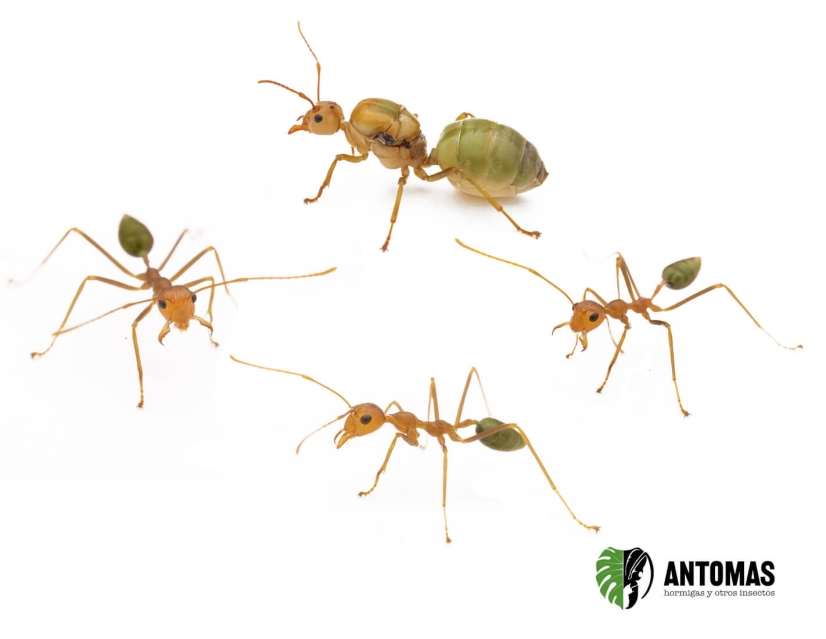
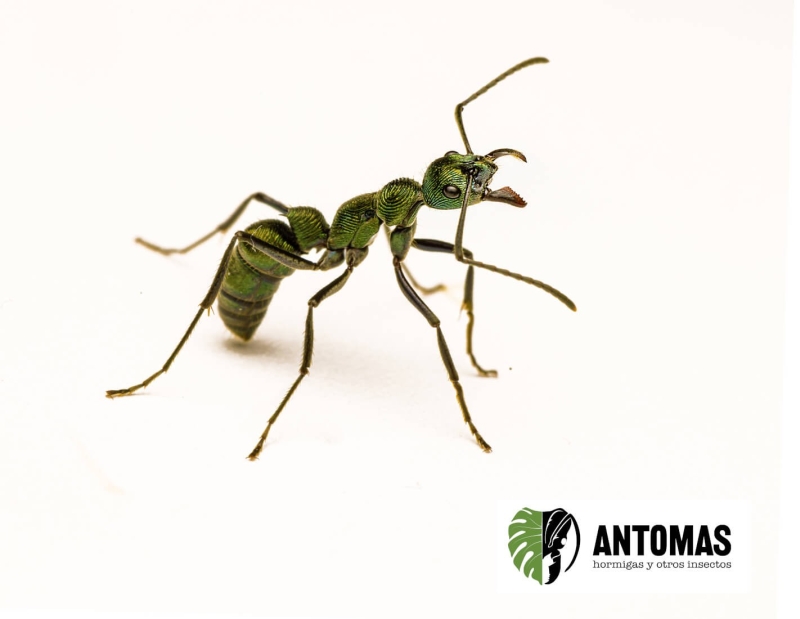
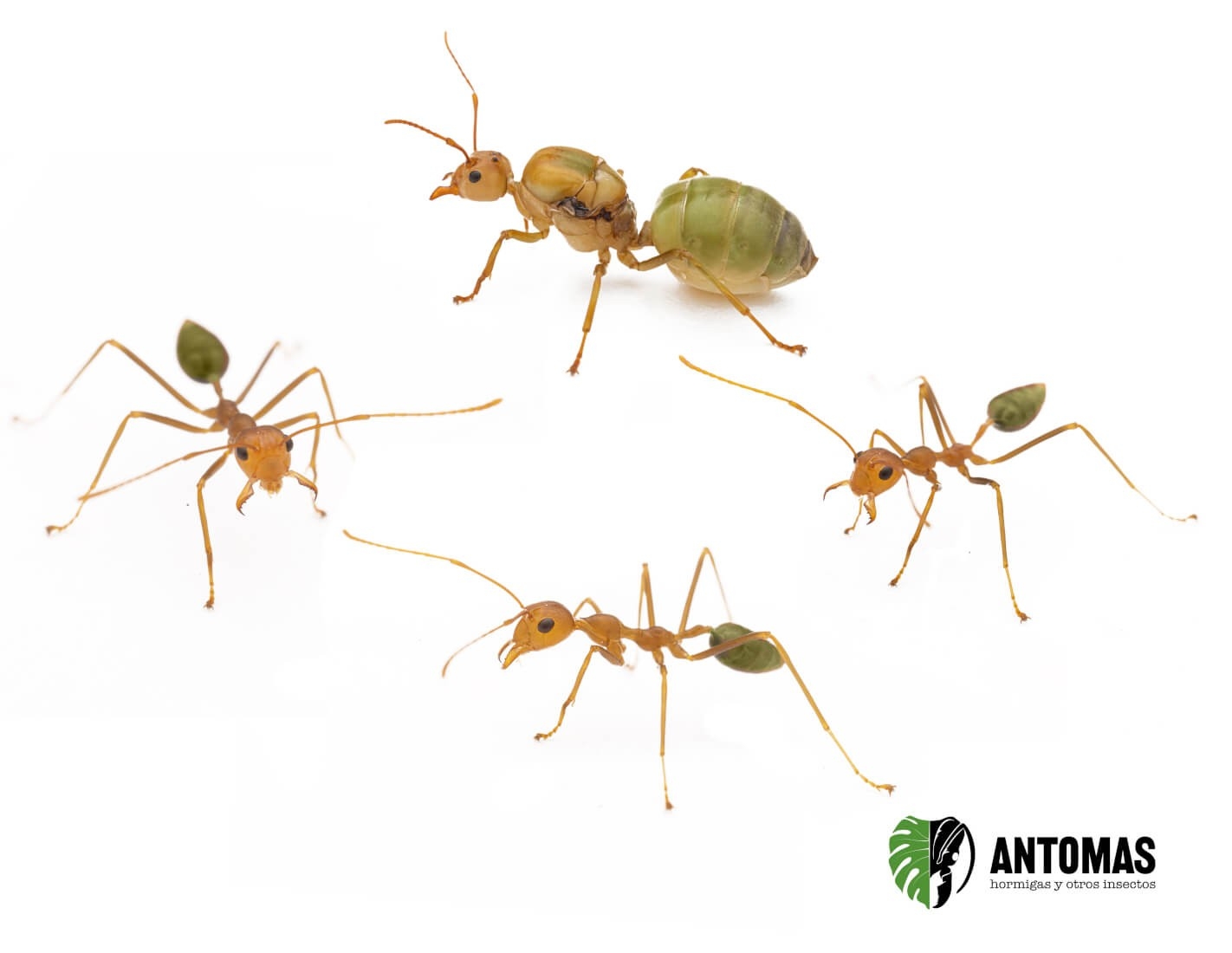
The weaver ant is unmistakable: slender body, extraordinarily long legs and antennae (12-segmented antennae with a very long scape), large, convex eyes, a low, elongated petiole without a scale, and a gaster that can be bent upwards over the thorax to spray. The mandibles are triangular, with ten or more teeth and a long, sharp apical tooth that lets them grip and drag the edge of leaves. It lacks a functional sting (acidopore). The workers are strongly polymorphic, with two sizes that hardly overlap: majors and minors.
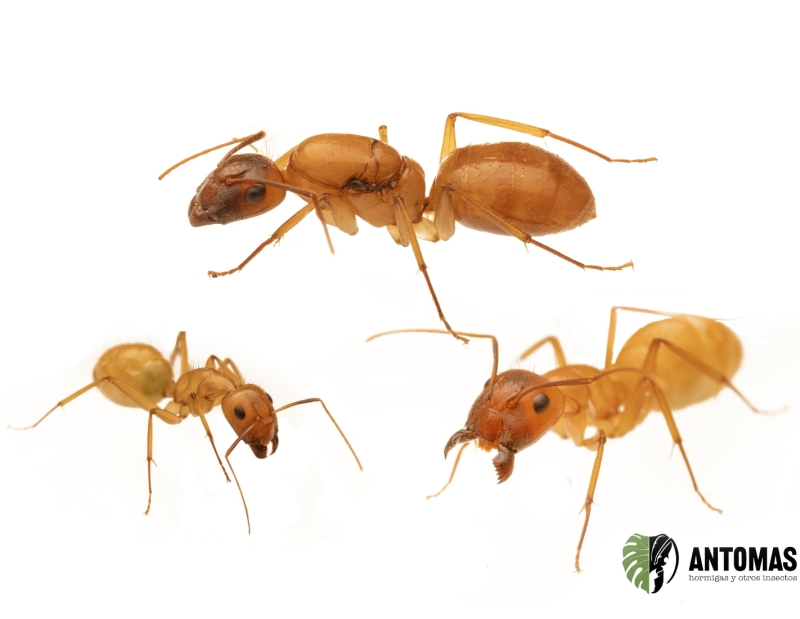
Colouration. It varies with the region of origin. Populations from South-East Asia and India are orange to reddish brown (in Thailand it is called mot daeng, "red ant"); those from northern Australia and New Guinea often have a bright green gaster, hence the English name green tree ant and the epithet smaragdina, "emerald". Fabricius himself described the Australian form separately as virescens ("greenish"), now a synonym. Queens range from green to greenish brown depending on the source; males are black. Antomas' lines are Asian: yellow or orange workers and queens ranging from red through yellow, with the occasional green one. To date there is no study that explains the green pigment or formally links it to a particular lineage.
Vision. Major workers have around 804 ommatidia per eye and minors around 508, with facets of about 17 µm in diameter in both castes; they have no ocelli.
Naked pupae. Unlike most formicines, Oecophylla pupae have no cocoon: all the larval silk goes into the nest. The larvae pass through three instars and a prepupa.
Approximate measurements
Minor workers: ≈5 mm (head width 1.0 mm)
Major workers: 8–10 mm (head width 1.4–1.6 mm)
Queen: 13–16 mm
Males: 6–6.5 mm, black, winged
Egg: ≈1 mm; mature larva ≈2.3 mm; pupa 3–4 mm
Weight of a medium worker: ≈8 mg
Published measurements: worker data come from populations in India, Borneo and Queensland; queen and male data from the AntWeb database. They are indicative values, with variation according to the population of origin.
Care in captivity
Video: birth of the weaver empire, Oecophylla smaragdina colonies (Anthouse, in Spanish).
Difficulty: 5/5 – Expert
It is an expert-level species, but not because of daily care: it eats everything, grows fast with heat and is the most visible and entertaining ant you can have at home. The difficulty lies in five points: it needs constant heat all year round (brood development stops below 22–24 °C); its lone-queen or tiny-colony phase is very delicate; it is aggressive and bites while spraying acid; its grip makes escapes the number-one problem, because the usual barriers are not reliable; and its lack of hygiene inside the nest demands constant ventilation and cleaning. On top of that, it is a tropical colony with potentially enormous growth: with good management, a colony of 20 workers can pass 300 in three months and approach 2,000 in a year.
And yet we recommend it wholeheartedly. Few species are as enjoyable in captivity: watching a chain of workers bend a leaf, seeing them sew the nest with larvae in their mandibles, hunt by sight or form a hanging chain to reach a branch is an experience no other ant in the hobby offers. At Antomas we recommend it to keepers with experience of tropical species who can guarantee temperature, ventilation and space; in return, it is probably the most fun species in our catalogue.
Recommended parameters
Temperature: 26–29 °C in the brood area during the day; at night it can drop to 24–25 °C.
Hot spot: 30–32 °C, localised (lamp or heat mat at one end), so that the colony chooses where to place the brood.
Minimum: never below 22 °C for sustained periods. Larval development threshold ≈17 °C.
Ambient humidity: 60–75 %, always with plenty of ventilation and no condensation on the glass.
Nest: dry. Neither the tube nor the leaf nest should get wet; the humidity belongs in the air and in the drinking water.
Ventilation: essential (mesh lid, side vents; in large terrariums, a small fan on a timer).
Light: 10–12 h of light a day; it is a diurnal ant that is not afraid of light.
Diapause: none. The heat must be maintained in winter too.
Caution is needed here. Commercial care sheets give nest humidities of 50–70 % in some cases and 70–90 % in others; in Antomas' experience what matters is that the environment is humid and ventilated and that the nest itself is dry. The ants themselves regulate the humidity inside the leaf nest, and colonies thrive in dry test tubes without any problem.
The set-up: ventilated terrarium or dry tubes
What we recommend at Antomas. The weaver ant does especially well in dry test tubes inside a large, very well-ventilated foraging area. It is the most hygienic set-up and the one that brings the most colonies through, even if you lose the spectacle of the leaf nests. Several European keepers with long-lived colonies have reached the same conclusion: their colonies chose the dry tube over the water tube or the leaf, and pupae survived better in the tube than in the leaf nest. Weaver ants weave with whatever they have: in the tube they glue soil, sand, fibres or aluminium foil to the walls and close the entrance with silk.
The naturalistic terrarium is the spectacular version: a tall terrarium (at least 40–60 cm; the taller the better) with live plants with large, flexible leaves, where they will bend leaves and weave nests in full view. The plants keepers find best accepted are Pachira aquatica, Ficus benjamina, citrus (calamondin), coffee plant, hibiscus and Schefflera. Two non-negotiable rules: the plant must be free of pesticides and fertiliser (from an organic nursery, or kept untreated at home for a year; several colonies have died because of a treated plant or because coffee grounds were used as fertiliser), and the terrarium must be very well ventilated (mesh in the lid, side vents), because plants consume oxygen at night and in a closed enclosure condensation, mould and the ants' own formic acid build up. Artificial plants are sometimes accepted, but most colonies ignore them and end up in a tube.
For this species we do not recommend any conventional plaster, Ytong or acrylic formicarium: they usually will not use it. What they need is height, structures to climb and a dry, dark place to retreat to (a tube or a jar with ventilation holes).
Hygiene: they are very messy. Weaver ants carry prey into the nest and often abandon it there; in a leaf nest or a closed tube a dead insect goes mouldy in two days, and the mould, bacteria and mites that grow on those remains can wipe out the brood and the queen. That is why at Antomas we insist on dry nests and generous ventilation, and recommend removing food remains from the foraging area every 24–48 h. A substrate with springtails or dwarf woodlice in the terrarium helps keep it clean.
Founding
Natural founding is claustral: the queen shuts herself inside a leaf and raises her first workers from her reserves. In captivity, the lone-queen phase is the most delicate of the whole process: the stress of transport makes many queens eat their eggs, closed tubes without air kill them, and queens without workers have very low survival. That is why at Antomas we sell colonies that are already started, with a mated queen, workers and brood: with workers, the colony gets going by itself.
If you nevertheless start from a lone queen or a tiny colony: a large test tube (25 × 150 mm) with a water reservoir, a cotton plug that is not too dense so that she can drink, some ventilation, 27–29 °C, darkness and complete rest for the first few days. Offer a drop of honey from the first week and small, freshly killed prey (Drosophila, micro-crickets) once larvae appear. The first workers are small minor nurses; the majors arrive with the following generations. In nature queens found in groups and colonies with several queens produce three times as many workers; in captivity queens that arrived together can be kept together, but queens from different colonies must never be put together.
Rough timings: from the nuptial flight to the first worker takes about 7–8 weeks; at 28–30 °C development from egg to adult takes approximately 4–5 weeks (keepers' data; there is no scientific measurement for the species). The queen lays irregularly, with long pauses; while there are no larvae, the colony cannot weave.
Orphaned colonies: adopting a queen
If the queen dies, the colony is not lost. In Antomas' experience, orphaned O. smaragdina colonies accept a new queen quite readily, and can even merge into another established colony. This fits what is known about the species: in nature queens found in groups, and in northern Australia several queens live together in the same mature colony, so tolerance of more than one queen is part of its repertoire. That is why, after losing the queen, we recommend acquiring another colony (or a queen with workers) and attempting an adoption, which usually works. It is the opposite of what happens between two healthy colonies with queens, which fight to the death: the key is that the receiving colony is orphaned. The adoption is done by observation: the new queen (or the new colony) is left in her own tube next to the orphaned colony's set-up and the behaviour is watched. There may be some hostility between workers, which usually subsides on its own; but a colony that has been queenless for a while almost never kills the new queen. There is no exact percentage, but in our experience the success rate is high.
Feeding
Carbohydrates. Honey water or ant nectar always available, renewed every 2–3 days; ripe fruit (grape, mango) occasionally. Important: offer it up high, on a platform, a branch or a leaf. Many colonies ignore a feeder on the floor of the outworld and rush instantly to a drop placed on a leaf.
Protein. It is a voracious predator that needs protein almost daily while it has larvae: Drosophila, micro-crickets, flies, small cockroaches (Blatta lateralis), chopped mealworms and other safe feeder insects. They accept live or freshly killed prey far better than blanched prey: they need movement. The major workers dismember large prey as a team. A colony of 20–50 workers eats one small prey item a day; one of 2,000, several crickets a day. Remove the remains within 24–48 h and, if you use live prey, breed it yourself to avoid mites and parasites.
Clean water always available (tube with cotton or a drinker), in addition to the honey water.
Behaviour in captivity
It is one of the most active and visible species in the hobby: they patrol the outworld and the plant all day, hunt by sight, open satellite nests and move nest frequently, carrying the queen from one place to another. They react to movement 20–30 cm from the glass, adopt a threat posture with open mandibles and gather at the entrance when they feel vibrations. Growth is fast but irregular, with egg-laying pauses of weeks. A well-kept colony often stays at a few hundred workers; those that exceed 2,000 need space and a supply of prey that are hard to sustain at home, and regulating growth through food is an accepted practice among keepers.
Escapes and barriers
Here biology rules: the arolium and friction hairs that let them hold tens of times their own weight make the classic barriers fail. Several experienced keepers report that their ants crossed PTFE (Fluon) "quickly" and walked over paraffin oil, and a shop specialising in weaver ants advises against PTFE and oil outright.
At Antomas we recommend talc: a wide band of talcum powder on the upper part of the walls and on the rim of the lid, renewed frequently, because they eventually cross a film of caked powder or dirt. For open set-ups (a plant on a tray, with no lid), the barrier is a water moat at least 5 cm wide around the set-up, to which a film of paraffin oil can be added; keep an eye on it, because some workers fall in and drown. In closed terrariums, add a well-fitting mesh lid, and remember that a gap of less than 9 cm between the plant and the glass or the lid is a potential bridge.
Handling and safety
They have no sting, but they bite hard, cling to the skin and bend the gaster to spray the wound with their secretions (undecane and formic acid): the result is an unpleasant, long-lasting burning sensation that can irritate sensitive skin. In large colonies, putting your hand in means dozens of bites at once. Do not handle with bare hands; use long tweezers and work slowly, because they detect movement at a distance. Never keep them with other species or near them: colony losses through intrusion by other ants have been documented. It is an exotic species: under no circumstances should it be released.
What not to do
Keep it below 22–24 °C or without heat in winter.
A closed, unventilated set-up (plugged tube, aquarium without mesh): condensation, mould and a build-up of formic acid.
Wet the nest or the tube; the humidity belongs in the air.
Plants with pesticides or fertiliser; coffee grounds as fertiliser.
Leave prey remains for more than 48 h.
Rely on PTFE or oil alone as a barrier.
Look at or move the queen often during founding; transport in bags.
Put queens from different colonies together, or keep them with other species.
Small critter-keeper-type enclosures: they escape instantly and there is no height for weaving.
What you receive
Started colonies with a mated queen, workers and brood, according to the option available at the time. We ship to Spain and all of Europe, with thermal packaging when needed; live arrival guaranteed.
Scientific sources
This care sheet was compiled from the scientific literature on the species and from the experience of Antomas and European keepers. Main references:
Hölldobler, B. & Wilson, E.O. (1983). The evolution of communal nest-weaving in ants. American Scientist 71: 490–499.
Hölldobler, B. (1983). Territorial behavior in the green tree ant (Oecophylla smaragdina). Biotropica 15: 241–250. doi:10.2307/2387648
Bochynek, T. & Robson, S.K.A. (2014). Pulling chain formation in the nest-weaving ant Oecophylla smaragdina. PLoS ONE 9(4): e95112. doi:10.1371/journal.pone.0095112
Stewardson, M., Carlesso, D., Labonte, D. & Reid, C.R. (2025). Superefficient teamwork in weaver ants. Current Biology 35: 4270–4275. doi:10.1016/j.cub.2025.07.038
Carlesso, D., McNab, J.M., Lustri, C.J., Garnier, S. & Reid, C.R. (2023). A simple mechanism for collective decision-making in the absence of payoff information. PNAS 120(29): e2216217120. doi:10.1073/pnas.2216217120
Federle, W., Brainerd, E.L., McMahon, T.A. & Hölldobler, B. (2001). Biomechanics of the movable pretarsal adhesive organ in ants and bees. PNAS 98(11): 6215–6220. doi:10.1073/pnas.111139298
Ogawa, Y., Jones, L., Ryan, L.A., Robson, S.K.A., Hart, N.S. & Narendra, A. (2023). Physiological properties of the visual system in the Green Weaver ant, Oecophylla smaragdina. Journal of Comparative Physiology A 209: 489–498. doi:10.1007/s00359-023-01629-7
Peng, R.K., Christian, K. & Gibb, K. (1998). How many queens are there in mature colonies of the green ant, Oecophylla smaragdina? Australian Journal of Entomology 37: 249–253. doi:10.1111/j.1440-6055.1998.tb01579.x
Offenberg, J., Peng, R. & Nielsen, M.G. (2012). Development rate and brood production in haplo- and pleometrotic colonies of Oecophylla smaragdina. Insectes Sociaux 59: 307–311. doi:10.1007/s00040-012-0221-2
Lokkers, C. (1990). Colony dynamics of the green tree ant (Oecophylla smaragdina) in a seasonal tropical climate. PhD thesis, James Cook University. researchonline.jcu.edu.au/24114
Van Mele, P. (2008). A historical review of research on the weaver ant Oecophylla in biological control. Agricultural and Forest Entomology 10: 13–22. doi:10.1111/j.1461-9563.2007.00350.x