This website uses its own and third-party cookies to improve our services and show you advertising related to your preferences by analyzing your browsing habits. To give your consent to its use, press the Accept button.
Functional cookies are strictly necessary to provide the services of the shop, as well as for its proper functioning, so it is not possible to refuse their use. They allow the user to browse through our website and use the different options or services that exist on it.
Cookie
Provider
Purpose
Expiry
PHP_SESSID
antomas.es
The PHPSESSID cookie is native to PHP and allows websites to store serialised status data. On the website it is used to establish a user session and to pass state data through a temporary cookie, which is commonly known as a session cookie. These Cookies will only remain on your computer until you close your browser.
Session
PrestaShop-#
antomas.es
This is a cookie used by Prestashop to store information and keep the user's session open. It stores information such as currency, language, customer ID, among other data necessary for the proper functioning of the shop.
These are cookies that collect information about the advertisements shown to users of the website. They can be anonymous, if they only collect information about the advertising spaces shown without identifying the user, or personalised, if they collect personal information about the user of the shop by a third party, for the personalisation of these advertising spaces.
Collect information about the user's browsing experience in the shop, usually anonymously, although sometimes they also allow the user to be uniquely and unequivocally identified in order to obtain reports on the user's interests in the products or services offered by the shop.
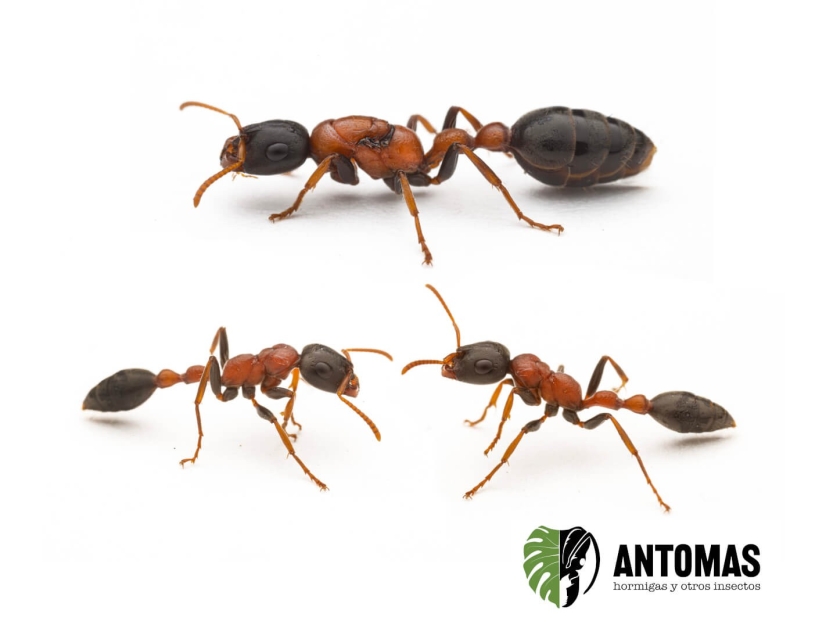
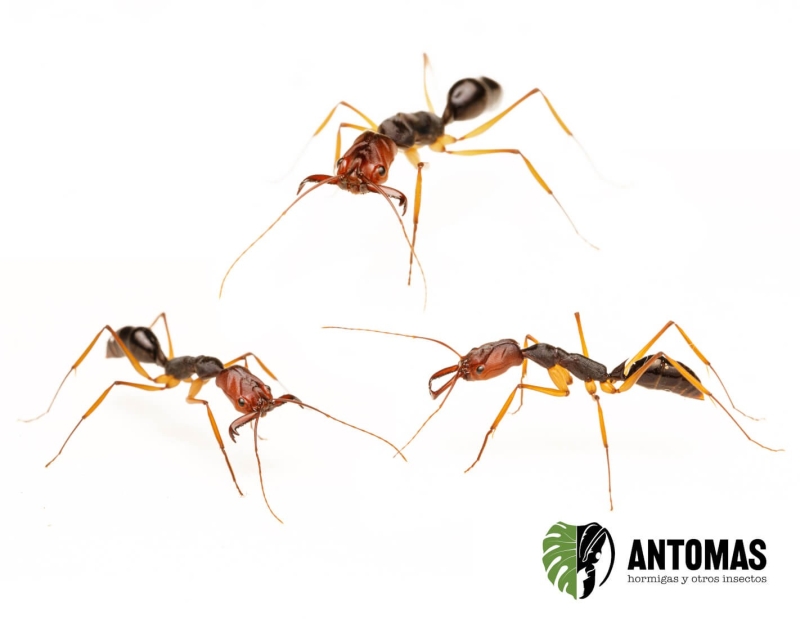
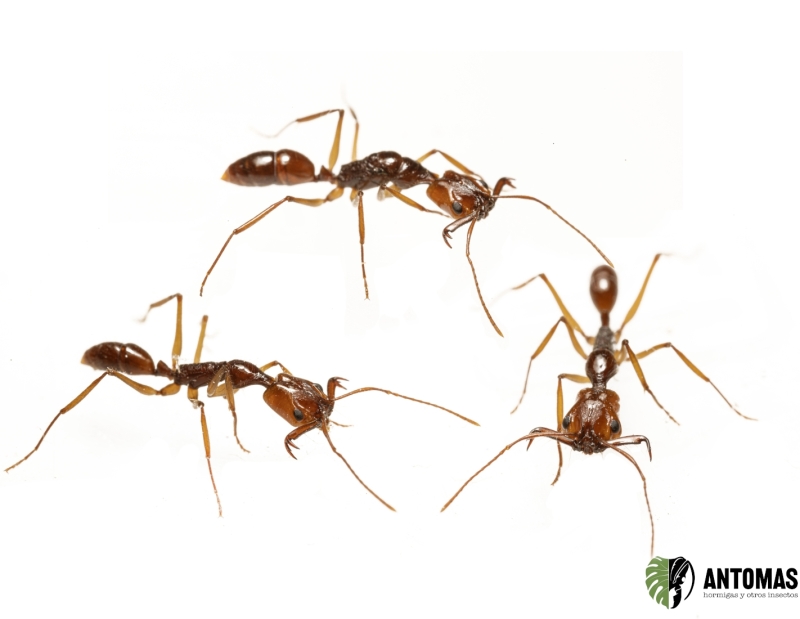
Red and black, slender as a needle. The Bi-coloured Arboreal Ant rules the treetops of Asia: it nests inside branches and beetle tunnels, builds walls of soil, patrols territories of thousands of square metres and hunts with huge eyes that miss nothing. Fast, sweet-toothed and fearless, it defends its nest with a real sting, drums its gaster to throw giants off balance and even has spiders that disguise themselves as it. A distant cousin of the bulldog ants, it grows very fast and is easy to rear if you respect its temperament. Colonies with queen, for experienced keepers. Shipping across Europe, live arrival guaranteed.
Difficulty: 4/5 – Advanced (because of its temperament and handling, not its rearing)
Asia’s bi-coloured arboreal ant: tree-dwelling, fast, large-eyed and with a unique red-and-black contrast. It grows very quickly and is easy to rear, but it is a determined escape artist and very aggressive towards mammals: a Qbik nest it cannot chew through, a closed lid, a generous layer of mineral oil, 24–28 °C all year round, no diapause, and sugar always available. As a precaution, we do not recommend it for homes with young children or pets, or for anyone allergic to hymenopteran stings.
Biology
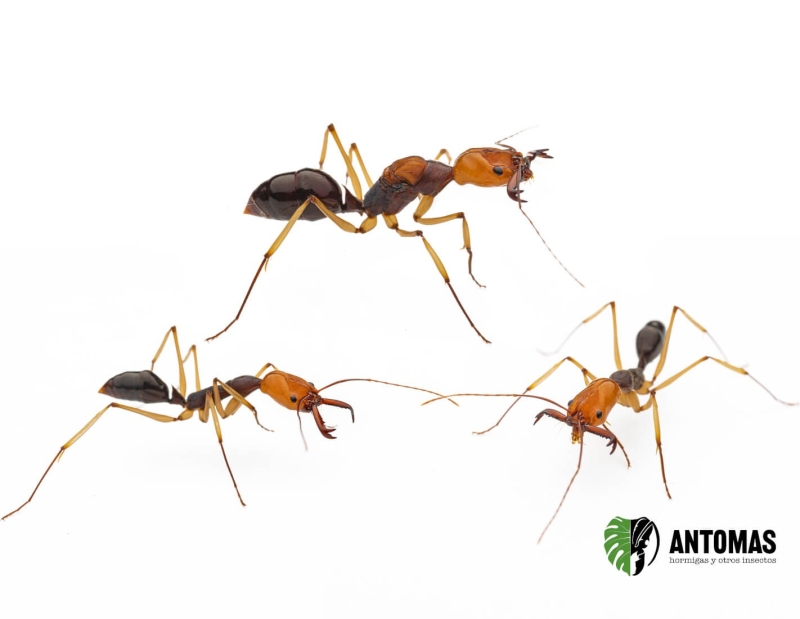
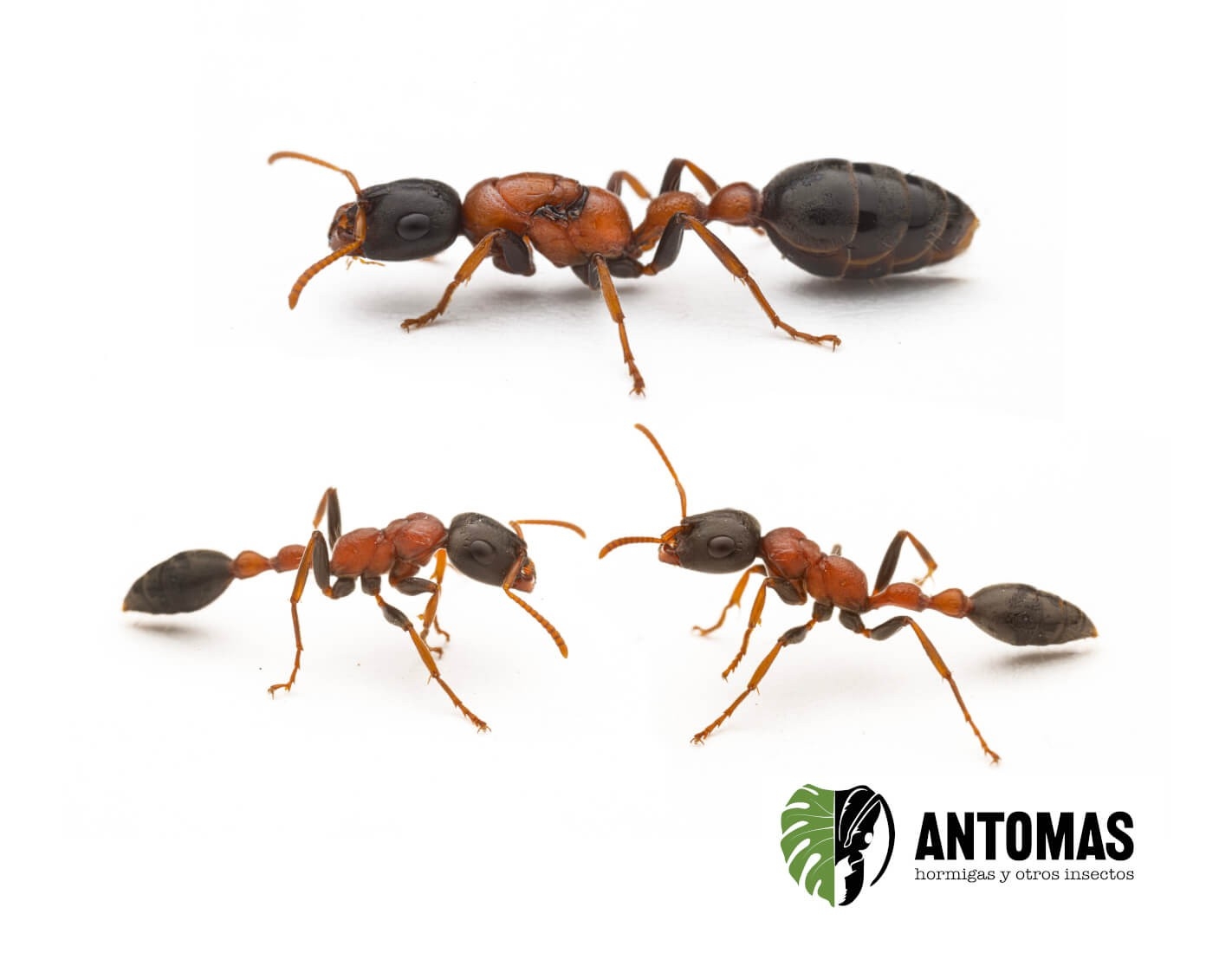
Tetraponera rufonigra (Jerdon, 1851) is one of Asia’s most striking ants: long, slender as a needle, with a black head and gaster and an intense orange-red thorax. It lives in trees, from Pakistan, India, Nepal and Sri Lanka to Indochina, southern China, Malaysia, Singapore, Sumatra and Java. It occupies semi-deciduous forests, mangroves, hill forests and, above all, trees in parks, gardens and avenues: it is an ant that has adapted remarkably well to cities.
It is fast, clever and highly visual, hunts alone along trunks and branches, adores sugar and defends its nest resolutely. In the field it is easy to recognise: no other Asian ant combines its size, its needle-like silhouette and that red-and-black contrast.
The Asian bi-coloured arboreal ant in action, in a video by Anthouse.
An ant that lives in the canopy
T. rufonigra is arboreal. It nests inside wood: in dead branches still attached to the tree, especially high in the canopy, and in the galleries left by the larvae of wood-boring beetles in living wood. In Sri Lanka, 11 nests have been dissected and three types described: long tunnels in rotten wood, a few tunnels in semi-hard wood, and a network of tiny holes in a dead Plumeria branch, probably excavated by the workers themselves. In India, a colony was found inside a beetle gallery in a sandalwood sapling, with soil partitions built by the workers to divide the tunnel.
It is not fussy about its tree: at least 14 host species have been recorded, including teak, casuarina, acacia, Plumeria, the golden shower tree (Cassia fistula) and sandalwood. Beware of a common mix-up online: the classic study of a Tetraponera living inside bamboo concerns another species, T. binghami, not this one.
A city ant
Few tropical ants get along so well with people. On the island of Penang (Malaysia), one study found active colonies at 34 of 58 sites sampled in urban areas, almost always in trees surrounded by leaf litter and household rubbish. In Sri Lankan cities it is so common that, when a tree with a nest is felled or falls, the workers pour out en masse and give the neighbours quite a lot of trouble.
This urban life has a genetic curiosity: in Penang, populations only a few kilometres apart are almost isolated from one another, with very little gene flow. This suggests that queens found new colonies very close to their colony of origin.
Big eyes: a hunter’s vision
It belongs to the subfamily Pseudomyrmecinae, which specialists call “the big-eyed arboreal ants”. Its eyes take up much of the sides of the head, and it also has three ocelli. These ants live in a world of branches, leaves and light, and rely heavily on sight: keepers report that they react to shadows and movement as soon as anything moves near the formicarium.
Long-distance explorers
It is diurnal: in Malaysia it forages mainly between 8 in the morning and 6 in the evening, and its activity rises with heat and falls with humidity. Workers go out alone and travel far for their size: some 46 metres from the nest, across a territory of about 2,000 m². A mature colony can have more than 2,000 foragers.
Confirmed sweet tooths
It is a predator and scavenger: it hunts small insects and makes use of any remains it finds. But when offered sugar, protein and fat baits, sugar wins: it accepts solutions of between 20% and 60%, and among fats it prefers egg yolk. In the wild it probably also visits nectar and honeydew, like other Tetraponera, although this has not been studied in this species. In captivity it shows: a well-fed colony drinks a great deal of sugary liquid (see “Feeding”).
A real sting
Like its relatives, it has a functional sting. In workers it is retractable, long and thin, with three pairs of small barbs; the queen’s is short and blunt, and males have no sting. Its venom has been analysed in the laboratory in Thailand, where the enzymes it contains have been identified. In practice, they do sting: in Antomas’ experience, the sting is unpleasant but much less painful than that of a bee or a wasp. Even so, at Antomas we recommend carrying out maintenance calmly and with a few simple precautions (see “Handling and safety”).
A drum in the gaster: how they disorient a giant
In Antomas’ experience, T. rufonigra has a surprising trick when facing a much larger ant: it drums with its gaster, tapping rapidly, and manages to disorient its rival. The video shows them doing this against a “berserker” of the marauder ant, Carebara diversa, whose soldiers are vastly larger than it is.
As far as we know, this behaviour has not been studied in the species, but it makes sense: ants can barely hear airborne sound and communicate mainly through vibrations transmitted through the ground or the branch. Moreover, all Pseudomyrmecinae have a stridulatory organ on the gaster, a kind of file with which they produce vibrations by moving the abdomen up and down. And a 2016 study found that this organ is more common in genera that live in trees, where vibrations travel well through branches and leaves.
T. rufonigra drums with its gaster to disorient a “berserker” of Carebara diversa, in a video by Anthouse.
Distant cousins of the bulldog ants
The Pseudomyrmecinae are the sister group of the Myrmeciinae, the subfamily of the Australian Myrmecia, and their origin goes back to the Cretaceous. Within the subfamily there are two genera that look remarkably alike: Tetraponera, in Africa, Asia and Australia, and Pseudomyrmex, in the Americas. Slender, large-eyed and arboreal, they are an example of parallel evolution on either side of the ocean.
And there is more: DNA analyses place the species group of T. rufonigra, the rufonigra group, closer to the American Pseudomyrmex than to the rest of Tetraponera. It has been proposed to revive the old genus name Pachysima for it, but this has not been formalised: today it remains Tetraponera. In Asia, this group has only two species, T. rufonigra and the Indian T. periyarensis, described in 2014 and entirely black.
“Fertiliser” bacteria in the gut
Tetraponera have a small pouch in the gut full of bacteria related to Rhizobium, the bacteria that fix nitrogen in the roots of legumes. They probably help them recycle nitrogen from their own waste, a huge advantage for ants living on sugary, protein-poor diets. This has been demonstrated in the genus, not specifically in T. rufonigra.
Larvae that eat “pellets”
In the Pseudomyrmecinae, workers compact solid food remains in a pouch in their mouth and place the pellet in a kind of ventral “pocket” on the larva, the trophothylax. The larva gradually grinds it down with a special mouthpart. In other ants, these pellets are thrown away with the rubbish. This is described in Pseudomyrmex and is considered typical of the whole subfamily, although it has not been studied in this species. Their pupae are also naked, without a cocoon.
Spiders disguised as Tetraponera
An ant so feared by predators has its imitators. The jumping spider Myrmarachne melanocephala copies its silhouette and red-and-black colouring across much of southern Asia. To complete the disguise, ant-mimicking spiders raise and wave their front legs as if they were antennae. Bingham, in 1903, also mentioned a wasp that mimicked it.
“Lohari”, the blacksmith: 175 years of names
Thomas Jerdon described it in 1851 in India as Eciton rufonigrum, and since then it has passed through the genera Pseudomyrma, Sima and Tetraponera. The former subspecies yeensis, testaceonigra and ceylonensis are now considered synonyms. Curiously, no type specimens have been preserved, but the species is so unmistakable that its identity has never been in dispute. Bingham recorded its popular name in India, “lohari”, the blacksmith; in Sri Lanka it is called “hath polayaa”. In Spanish, at Antomas we call it “hormiga aguja” for its long, slender body; in English it is known as the bi-coloured arboreal ant.
Colonies and nuptial flights
There are no scientific studies on the organisation of its colonies. In Antomas’ experience, they can be polygynous: a single colony can have several queens. Shops place the nuptial flights between January and March, a figure not scientifically confirmed. The type of colony foundation is not clear either: some sources describe it as claustral and others as semi-claustral (the queen goes out to hunt). At Antomas we sell it as a colony with a queen and workers, so that stage has already been taken care of.
Size and morphology
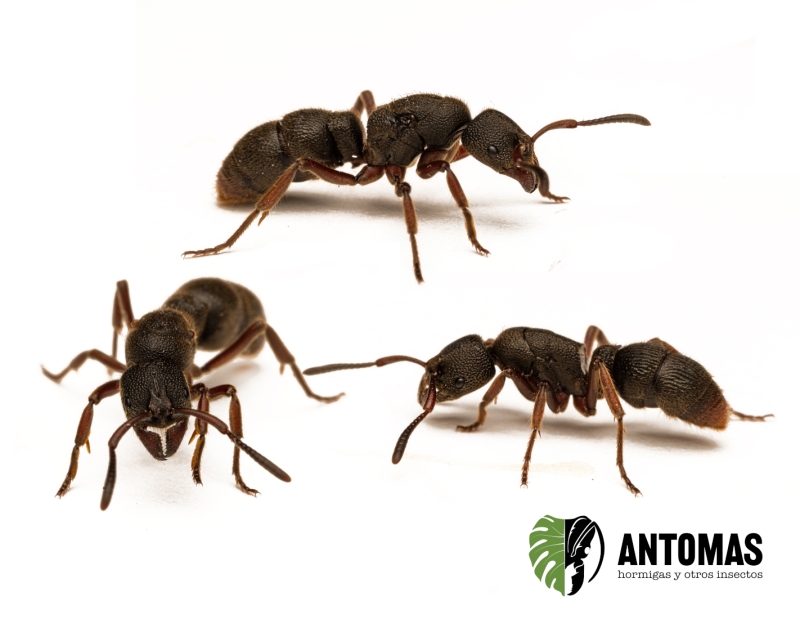
It is a large ant with a long, narrow body. The head, gaster and postpetiole are black; the mesosoma (thorax), petiole, mandibles and antennae are orange-red, ranging from brownish orange to dark reddish depending on the individual. The legs are dark.
Large eyes and three ocelli on the forehead, typical of an ant that relies on sight.
Two-segmented waist (petiole and postpetiole), as in the myrmicines, with a small tooth beneath the petiole, typical of its species group.
Mandibles with 5–6 sharp teeth and short, sturdy antennae.
Monomorphic workers: all of one type, with no soldiers or majors, and little variation in size.
Queen similar to the workers, but stockier and slightly larger, with a bulkier thorax.
Sting functional in workers and queen (see “A real sting”).
Naked pupae, without a cocoon.
In Asia, nothing else resembles it: T. nigra and T. attenuata are black and smaller, T. allaborans is much smaller and T. periyarensis is entirely black.
Approximate measurements
Workers: 10.5–13 mm
Queen: 13–14 mm
Males: no reliable published measurements.
These are the measurements from Bingham’s description (1903). The modern revision of the genus gives the worker a head width of 1.62–2.07 mm and a head length of 1.76–2.37 mm, consistent with those body lengths. The figures of 12–14 mm for workers that circulate online have no scientific backing.
Keeping in captivity
Difficulty: 4/5 – Advanced
Rearing itself is easy: in Antomas’ experience, T. rufonigragrows very quickly, takes food readily and needs no diapause. Keepers confirm this: one colony went from a handful of workers to around 500 in a year, and another reached “several hundred” in seven months. If we rate it 4/5, it is mainly because of how aggressive and difficult to handle they are:
they are determined escape artists: slender, fast and good climbers;
they are very aggressive towards mammals, including us: when you open the formicarium, they come out to defend it;
and they sting.
None of this is a problem if you work methodically. You need to take extra precautions when carrying out maintenance, as we explain below. In return, it is one of the most beautiful and spectacular ants to watch: fast, visual, a hunter and with unique colouring. As a precaution, we do not recommend it if you have young children or pets, or if you are allergic to hymenopteran stings.
Recommended parameters
Temperature: 24–28 °C, all year round.
Hot spot: 28–30 °C, localised in one part of the nest, so the colony can choose where to place the brood.
Nest humidity: low; they do not need much. With a small colony, keep the nest’s humidity system topped up with water; with a large colony, the nest can be almost dry, with no water reservoir required.
Foraging area: dry, well ventilated and securely closed.
Nest type: a formicarium made of materials they cannot chew through (see “Recommended formicaria”).
Diapause: no.
Our colonies come from South-East Asia, and these values match the region’s climate. For reference, in Bangkok the average temperature ranges from 27 to 31 °C depending on the month; in Chiang Mai, in northern Thailand, the average drops to around 22 °C in December and January, with daytime temperatures of 29–30 °C. As it lives in branches, it copes well with fluctuations between day and night: a night-time drop of a few degrees suits it well.
Recommended formicaria
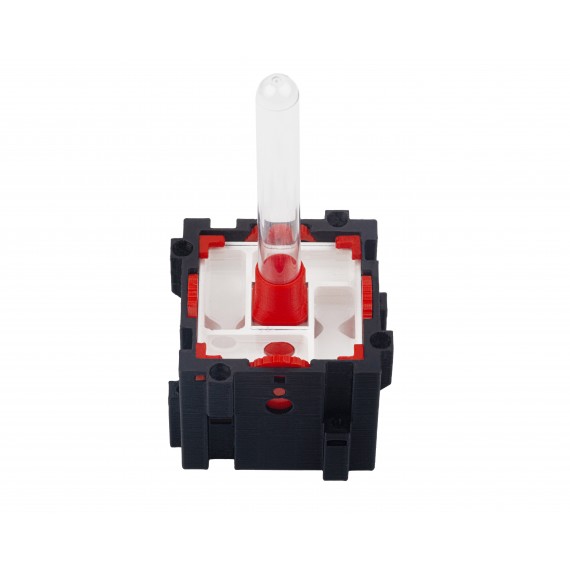
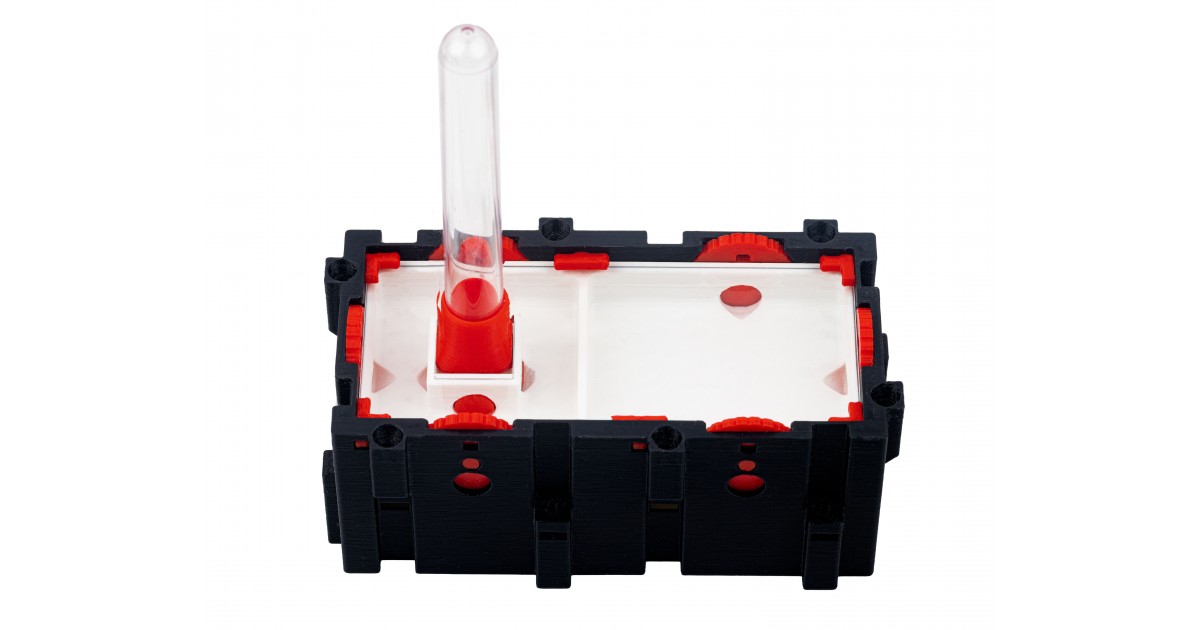
At Antomas we recommend the Anthouse Qbik range, the standard Qbiks from the Alpha range: modular formicaria that grow with the colony. To start with a small colony, a QBIK ONE with medium galleries:
No wooden nests or soft materials. In the wild they live in hollow branches, and some shops recommend nests made of wood, cork, bamboo or branches. At Antomas we do not recommend them: they can chew through them and escape. Keepers report the same with soft wood, soft plastic and cotton wool. Nor do we recommend keeping them in natural branches or canes: besides the risk of escape, you cannot see anything that goes on inside.
Complete the set-up with these details:
A closed foraging area, with a tight-fitting lid and fine-mesh ventilation, and an anti-escape barrier around the rim (see “Escapes and barriers”).
Nest humidity according to colony size. At first, with a small colony, keep the nest’s humidity system topped up with water. Once the colony is large, it can live with the nest almost dry: they do not need much humidity.
A clear foraging area, without branches. Although they are arboreal, at Antomas we recommend not adding branches: they make cleaning harder, and with this species it pays to keep maintenance quick.
Water in a test tube. A tube with water and cotton wool in the foraging area is the best water source, always available.
A feeder for sugary liquids, never on cotton wool (see “Feeding”).
No devices inside the foraging area. They get inside them: one keeper had to take apart a digital thermometer to remove workers and brood. Thermometers, probes and cables should always stay outside.
Arrival and moving in
When you receive your colony, let it rest in a quiet place at room temperature, and make sure it has water. To move it into its formicarium, at Antomas we do it by tipping: we open the tube and tip the colony (workers, queen and brood) into the new formicarium with a few gentle taps. With this species, do it inside the foraging area, already set up and with the barrier in place, or over a large tray with a barrier, so that workers that run off do not reach the table. You can help stragglers along with a soft brush, and close the lid as soon as you have finished. Within a few hours they will have settled into the nest.
Feeding
Sugary liquids, always available. They have a real sweet tooth, and a growing colony consumes an enormous amount of sugar: at Antomas we give it to them ad libitum, so they never run short.
Varied diet:Anthouse Blue Sugar Nectar 4–5 times a week, and another sugary liquid or nectar 1–2 times a week. Protein can also be added to the nectar.
Always in a feeder, never on cotton wool: cotton wool goes mouldy and the liquid spoils quickly. Use a traditional or home-made feeder, where the drop stays “spread out” and accessible.
At first, a newly arrived colony may ignore sugar and want only protein; over time, they drink a lot.
Protein, in abundance. They are hunters: they love insects the size of a fly or a small cricket, alive or dead. Crickets, flies, small cockroaches and chopped mealworms work very well, and they dispatch live prey within minutes. Change the type of insect from one week to the next, so they are not always eating the same thing. A keepers’ trick against mites: scald the prey for a few seconds in boiling water, because freezing does not kill mite eggs.
The more they eat, the better and faster they grow. This is Antomas’ philosophy: if you do daily maintenance and remove leftovers, it is better to overfeed, because the ants sense they have more resources and grow faster and in greater numbers. With this species it is very noticeable. If you will not be able to clean often, it is better not to overfeed: leftover protein rots and brings mould and mites.
Water: always, in the test tube with cotton wool.
Diapause
T. rufonigradoes not undergo diapause. It is tropical: in its native range the temperature barely drops in winter, and keepers maintain it active all year round. Keep it at 24–28 °C in winter too; if the temperature at home drops a little, the colony will slow down somewhat, but there is no need to cool it.
Behaviour in captivity
Fast and highly visual. They patrol the formicarium and the foraging area at full speed and react instantly to shadows and movement: when you approach, they come out to see what is going on. It is part of their charm: these are ants to enjoy, observe and learn from. Keep the nest dark and the foraging area lit, and observe them gently, without knocks or sudden movements.
Hunters. Watching a worker hunt is one of the highlights of the species: it locates its prey by sight, grips it and stings it. Keepers observe that they hunt better on branches than on the ground.
Cleaning. They defecate on the walls of the foraging area: clean them from time to time.
Escapes and barriers
They are determined escape artists. They are slender, squeeze through gaps that would stop almost any other ant, climb any surface and make the most of every second the formicarium is open.
Lid closed, always. The foraging area must have a tight-fitting lid and fine-mesh ventilation. This is the main barrier.
Mineral oil on the rim, in a generous layer. In Antomas’ experience, mineral oil works well with this species, but you need to apply a generous layer and renew it as soon as it gets dirty or wears off. With a thin layer, they cross it.
Check the joints and corners. One keeper saw them climbing the silicone in the corners of a glass terrarium.
Talc and PTFE: better not to rely on them. In the only documented case they got past both barriers, although these may have been poorly applied.
Handling and safety
They are very aggressive towards mammals: as soon as they detect a hand nearby, they come out to defend. That is why, when carrying out maintenance, at Antomas we recommend taking extra precautions:
Open the formicarium only as much as necessary: have everything ready beforehand (food, feeder, tweezers) and close it as soon as you have finished.
Use long tweezers to place and remove food, never your fingers.
Work calmly and without sudden movements. The more you disturb them, the more workers come out.
Check the lid and the barrier before leaving the formicarium.
Do not handle them with your hands.
The sting. They sting, but it is nothing dramatic: in Antomas’ experience, the sting is unpleasant but much less painful than that of a bee or a wasp. If you are stung, wash the area and apply something cold. With methodical maintenance, you will normally not get stung at all.
Who is this species not for? As a precaution, at Antomas we do not recommend T. rufonigra for anyone with young children or pets at home, or for anyone allergic to hymenopteran stings (bees, wasps and ants).
What not to do
Do not use nests made of wood, cork, bamboo, hollow branches or soft materials: they can chew through them and escape.
Do not leave the formicarium open, not even for a moment while you do something else.
Do not trust a thin barrier: mineral oil, in a thick layer and renewed.
Do not put devices or cables in the foraging area.
Do not cool them in winter: they do not undergo diapause.
Do not put sugar on cotton wool: always in a feeder.
Do not skimp on food: sugar always available and protein in abundance, with leftovers cleaned away.
Scientific sources
Ward, P. S. (2001). Taxonomy, phylogeny and biogeography of the ant genus Tetraponera in the Oriental and Australian regions. Invertebrate Taxonomy 15: 589–665. doi:10.1071/IT01001
Ward, P. S. and Downie, D. A. (2005). The ant subfamily Pseudomyrmecinae: phylogeny and evolution of big-eyed arboreal ants. Systematic Entomology 30: 310–335. doi:10.1111/j.1365-3113.2004.00281.x
Ward, P. S. (1990). The ant subfamily Pseudomyrmecinae: generic revision and relationship to other formicids. Systematic Entomology 15: 449–489. doi:10.1111/j.1365-3113.1990.tb00077.x
Bingham, C. T. (1903). The Fauna of British India. Hymenoptera, vol. II: Ants and Cuckoo-wasps. archive.org
Dias, R. K. S. and Fernando, K. S. S. D. (2017). Host tree species, nest information and the management of an outbreak of Tetraponera rufonigra. Caucasian Entomological Bulletin 13(1): 93–98. doi:10.23885/1814-3326-2017-13-1-93-98
Naephrai, S. et al. (2021). Composition and acute inflammatory response from Tetraponera rufonigra venom on RAW 264.7 macrophage cells. Toxins 13(4): 257. doi:10.3390/toxins13040257
van Borm, S. et al. (2002). Tetraponera ants have gut symbionts related to nitrogen-fixing root-nodule bacteria. Proc. R. Soc. B 269: 2023–2027. doi:10.1098/rspb.2002.2101
Klein, R. W. et al. (1994). Colony structure of a bamboo-dwelling Tetraponera sp. from Malaysia. Insectes Sociaux 41: 29–41. doi:10.1007/BF01240571
Subedi, I. P., Budha, P. B. and Thapa, V. K. (2022). Ant genus Tetraponera in Nepal, with two new records and keys to workers. J. Inst. Sci. Technol. 27(1): 93–99. doi:10.3126/jist.v27i1.46661
Golden, T. M. J. and Hill, P. S. M. (2016). The evolution of stridulatory communication in ants, revisited. Insectes Sociaux 63: 309–319. doi:10.1007/s00040-016-0470-6
Bharti, H. and Akbar, S. A. (2014). Tetraponera periyarensis, a new species from India. Asian Myrmecology 6: 43–48.
Wheeler, W. M. (1915). On the presence and absence of cocoons among ants. Annals of the Entomological Society of America 8: 323–342. archive.org
Myrmarachne melanocephala, a mimic of T. rufonigra. Journal of Threatened Taxa 13(12): 19753–19761 (2021). threatenedtaxa.org