Difficulty: 4/5 – Advanced
One of the biggest-headed Pheidole known and one of the few species in the world with supersoldiers: as well as minor workers and soldiers, the colony produces a third, giant-headed caste, with heads almost 4 mm wide. A very fast-growing seed harvester and hunter from south-western North America. Colonies with a queen. A plaster Qbik Wild with large galleries, a very humid brood area (70–80%) and a dry granary, nest at 28–32 °C, huge amounts of food (all kinds of seeds, even cooked pasta, and protein at least every 3–4 days), sugar only 1–2 times a month and a diapause of 3–4 months at 15–18 °C. Supersoldiers arrive once colonies are large, usually after the first diapause. Small, highly escape-prone minor workers: PTFE or mineral oil barrier.
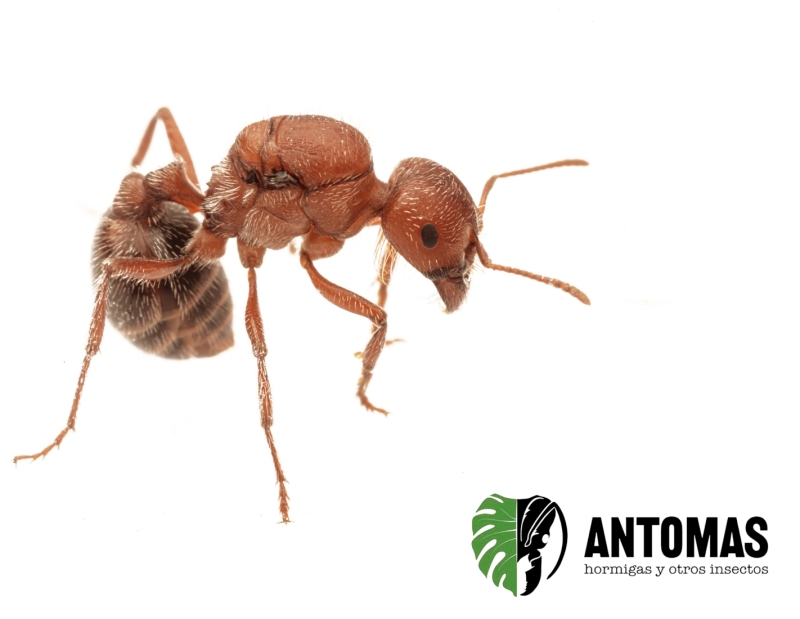
Pheidole rhea Wheeler, 1908 is a harvester ant from the mountain grasslands of southern Arizona, New Mexico and north-western Mexico. It belongs to Pheidole, one of the most species-rich ant genera on the planet, famous for its big-headed soldiers. But P. rhea goes one step further: its colonies are home to slender, fast minor workers, soldiers with enormous heads and even larger supersoldiers, whose heads are almost 4 mm wide, more than four times that of a minor worker. In English it is known as the big-headed harvesting ant, and few ants deserve the name more.
In science it is something of a celebrity. It has been used to study how a soldier comes into being, why a handful of species in the genus produce supersoldiers and how work is organised in such an unequal society. At home it is a spectacle of a different kind: trails of workers carrying seeds, soldiers waiting at the entrance to dismember prey and, once the colony matures, the appearance of the first supersoldiers. Getting there takes heat, plenty of food and patience. Throughout this care sheet we always distinguish between what is documented in P. rhea, what is known from other Pheidole and what we have learned from rearing it at Antomas.
Biology
What is a supersoldier?
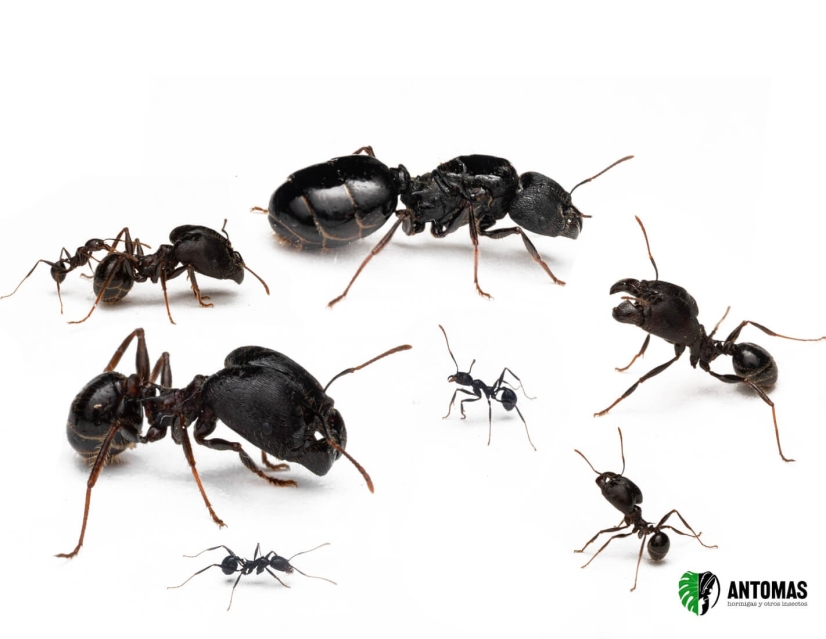
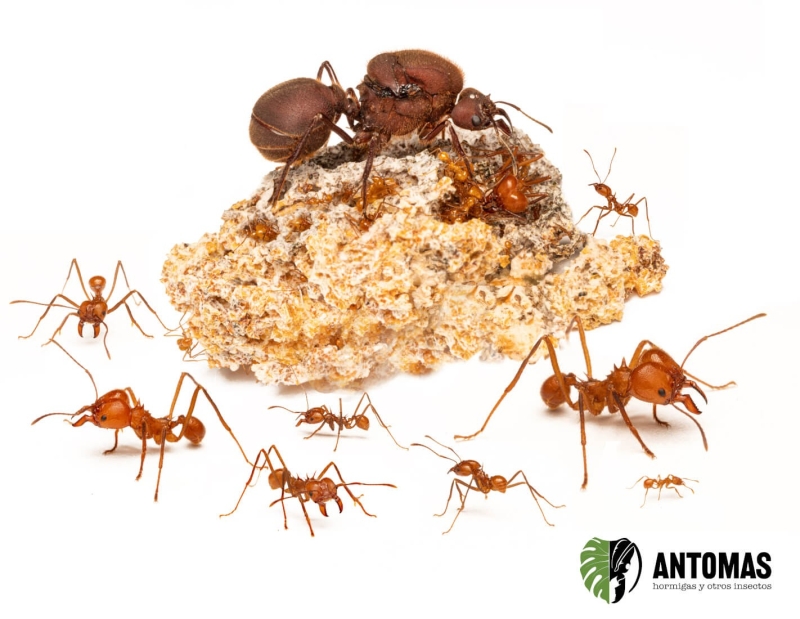
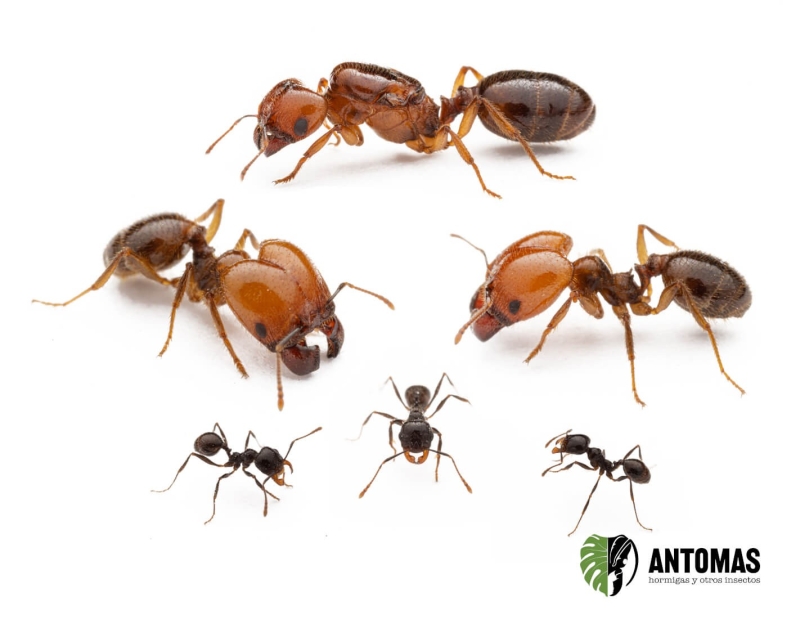
In almost all Pheidole there are two types of worker: the minor worker, a small ant that does almost all the work, and the soldier or major worker, with an enormous head packed with muscle for biting, cutting up prey and cracking seeds. A supersoldier (the literature uses both supersoldier and supermajor) is a third class of worker, larger still than the soldier: it is neither a queen nor a male, but simply another sterile worker, which develops this way because of how its larva is fed and regulated.
The figures for P. rhea, measured by the myrmecologist Edward O. Wilson in his monograph on the genus, say it all. The head of a minor worker is about 0.86 mm wide; that of a soldier, 2.52 mm; and that of a supersoldier, 3.86 mm. The supersoldier therefore has a head about 4.5 times wider than the minor’s and one and a half times wider than the soldier’s, and its body reaches about 10 mm.
Titaness or rhea? A mysterious name and a lone queen
William Morton Wheeler described the species in 1908, in his major work on the ants of Texas, New Mexico and Arizona, from a single specimen: a very large dealate queen collected in southern Arizona. That specimen, the holotype, measures 14.3 mm. Wheeler never saw a single soldier or worker.
The story then took a wrong turn. In 1915 Wheeler himself treated it as a mere synonym of Pheidole fimbriata, and so it remained until, in 1943, Marion R. Smith reinstated it as a species and described its soldiers and workers for the first time, within a subgenus that is no longer used, Macropheidole. In 1949 Robert Gregg studied a complete nest and measured hundreds of specimens. Wilson redescribed it in 2003 and placed it, with reservations, in the P. pilifera species group.
And the name? Wheeler never explained it. Wilson points out that Rhea is the genus of the rheas, the South American running birds, and admits that nobody knows what the name alludes to. Rhea is also the Titaness of Greek mythology, mother of the Olympian gods, and a few years earlier Wheeler had named Pheidole titanis. That he had the Titaness in mind is our interpretation, not a fact. What is certain is that, with those supersoldiers, the name we use in our Spanish shop, hormiga titánica, suits it well.
Mountain grasslands with summer rains
Its range extends from southern Arizona and New Mexico to north-western Mexico, through Sonora, Chihuahua, Sinaloa and Nayarit, between about 34 and 22.5° north. It is uncommon in United States collections and, according to specialists, much more common in Mexico. In Arizona it occurs on the lower slopes of several mountain ranges, the so-called “sky islands” that rise above the desert.
It lives in the foothills and plateaus at the base of the mountain ranges, between about 1,100 and 2,200 m above sea level, favouring the lower part of that range. Its typical landscape is open, stony, grassy slopes. Gregg found the nest he studied near the top of a dry slope, in very stony soil with desert grasses, and the myrmecologist Stefan Cover described huge colonies nesting in the soil, under stones or with the entrance crowned by untidy craters of earth.
The climate of this habitat is semi-arid and mid-altitude, with four very distinct periods:
- Winter (December–February): mild days, with highs of about 16–18 °C, and cold nights, with frequent ground frosts.
- Spring: very dry and increasingly warm; May is usually the driest month of the year.
- June: the hottest month, with average highs of about 34 °C before the rains arrive.
- Monsoon (July–September): storms almost every day in July and August, bringing just over 60% of the year’s rainfall. This is when the ants are at their most active.
Underground, where the colony lives, the extremes are greatly softened. At a soil-monitoring station in these grasslands, the ground at a depth of 10–50 cm stays at about 28–32 °C from June to August and drops to about 10–14 °C from December to February, without ever freezing. These are the two figures we use to set its parameters at home.
Seven or eight species worldwide
Supersoldiers are a rarity within a gigantic genus. The work of Ming Huang and Diana Wheeler refers to seven described species with polymorphic soldiers, and that of Ehab Abouheif’s team to eight, all from the south-western United States and northern Mexico. The best known are P. rhea, P. obtusospinosa and P. tepicana, joined by P. polymorpha, from central Mexico, whose name refers precisely to this coexistence of soldiers and supersoldiers.
P. rhea is the giant of the group. Its supersoldier’s head is 3.86 mm wide, compared with about 2.5 mm in P. obtusospinosa and 1.6 mm in P. tepicana. It also outstrips other Pheidole famous for their size: P. titanis, which lives in the same region, has large soldiers but no supersoldiers, and its soldier’s head is about 1.9 mm wide; that of the soldier of the Asian P. ocellata, about 3 mm. We know of no published measurement of a Pheidole head wider than this supersoldier’s, although no study has formally compared the whole genus.
A potential that lay dormant for tens of millions of years
How do supersoldiers appear in so few species, and in species so far apart on the genus’s family tree? In 2012, Rajendhran Rajakumar, Ehab Abouheif and their team published a surprising answer in Science. Studying eleven species, they found that P. rhea belongs to a lineage that split off very early from the rest of Pheidole, whereas P. obtusospinosa sits on a much more recent branch: the supersoldier has arisen at least twice independently.
The clue lay in a wild colony of P. morrisi, a species without supersoldiers, in which they found a few anomalous, supersoldier-like individuals. In the laboratory they treated the larvae of P. morrisi and other species without supersoldiers with methoprene, a substance that mimics juvenile hormone, and obtained supersoldier-like workers. The conclusion: the programme for producing them is stored in the development of many Pheidole, switched off for tens of millions of years, and a hormonal or environmental nudge is enough to reawaken it. Species such as P. rhea are the ones that use it routinely.
The organ that builds giant heads
In Pheidole, whether a larva ends up as a minor worker or a soldier is not written in its genes: it depends on how much juvenile hormone it has at a sensitive moment in the final larval instar, and that in turn depends on how the colony feeds it. Diana Wheeler and Frederik Nijhout demonstrated this in 1981. In species with supersoldiers there is a second, higher threshold that decides whether a future soldier becomes a supersoldier.
In 2018, Abouheif’s team revealed the missing piece in Nature. Larvae destined to become soldiers develop, for a time, rudimentary wing discs, the beginnings of a queen’s wings that will never actually form. Their growth is needed for the head to grow much more than the body: if it is held back, soldier proportions are not reached. And the colony is in control: adult soldiers release a pheromone that inhibits the growth of these discs when there are already plenty of soldiers. Supersoldiers induced with methoprene also retained small wing rudiments.
It is one of the most beautiful stories in ant biology: a “useless” organ, a wing that will never fly, is the tool the colony uses to build its warriors. The experimental work was carried out mainly on another species, P. hyatti, but it explains something you will see at home: how many soldiers and supersoldiers your colony has depends on how it is fed and on how many soldiers it already has.
A ladder of sizes, not three rungs
Talking about “three castes” oversimplifies things. In 1949, Gregg measured the population of a single nest: 201 soldiers, 262 medium-sized workers and 274 minor workers. He found a continuous gradation, with no clear breaks, from small soldiers of about 5.5 mm to the largest ones, of 9.8–10.2 mm. More than sixty years later, Huang and Wheeler studied the demography of colonies of P. rhea, P. obtusospinosa and P. tepicana and found that P. rhea soldiers show two size modes, two peaks in the distribution: the soldier and the supersoldier, linked by intermediate individuals.
Their results include other curious details:
- In all these species, the soldier’s head grows much faster than its body: the larger the soldier, the more disproportionate its head.
- Most soldiers belong to the small class, but P. rhea invests roughly the same biomass in soldiers as in supersoldiers: few of them, but very costly.
- In P. rhea, both soldier classes appear throughout the colony’s development; in P. obtusospinosa, the second one arrives much later.
For a keeper, the consequence is simple: supersoldiers do not appear all at once. First you will see small soldiers, then increasingly large ones and, once the colony has a good number of workers, the first giants; in Antomas’s experience, never during the first year (see “Supersoldiers at home: protein, space and patience”).
All head… and much the same job
You might expect each class of worker to have its own trade. In 2017, Darcy Gordon, Iulian Ilieş and James Traniello put this to the test with a laboratory colony of about 30,000 workers. They compared behaviour, brain and body shape across the three classes and found a large difference between minor workers and soldiers, but very little between soldiers and supersoldiers, which overlap a great deal in what they do, in the structure of their brains and in their shape. All three classes have similar repertoires, although minors perform the key tasks more often. The authors suggest that soldiers and supersoldiers might specialise in seeds of different sizes, but did not go on to test it.
A year later, the same group found an unexpected difference: supersoldiers detect pheromone trails at lower concentrations than minors and soldiers. On the other hand, when searching for a new nest or meeting a worker from another colony, size made no difference to their response. Because P. rhea belongs to an ancient lineage within the genus, the researchers believe its organisation may resemble that of the earliest Pheidole.
Heads that double as doors
What, then, is a supersoldier for? The best clue comes from its relative P. obtusospinosa. One July afternoon in 2006, in a canyon of oaks, sycamores and junipers in southern Arizona, Ming Huang witnessed a raid on one of its colonies by an army ant, Neivamyrmex texanus, and published the account in 2010:
- Groups of 4–6 army ants attacked the soldiers outside the nest, while the minor workers immobilised them by stretching out their legs.
- The supersoldiers went inside and plugged the entrances with their heads, standing motionless even as the army ants bit them and tried to sting them.
- They then came out to counter-attack from the rear, alternating between blocking and counter-attacking at least three times over 30–45 minutes, until the raid was repelled.
It was the first time an ant had been seen blocking an entrance with a head that is not modified to act as a plug. Huang proposed that pressure from army ants partly explains why supersoldiers have arisen several times in that region. This has not been observed directly in P. rhea, but it lives in the same landscapes and faces the same enemies.
Harvester and hunter
P. rhea eats whatever it finds in the grassland. According to Cover, cited by Wilson, it harvests seeds in large quantities and is at the same time an active predator. In April, Gregg saw workers and soldiers gathering seeds from several desert plants near the entrance to the nest. Mature colonies organise trunk trails, permanent, heavily used paths that leave the nest and branch out towards the foraging grounds, like those of our Messor barbarus.
Who goes out foraging is also documented: the minor and medium-sized workers. Large soldiers and supersoldiers are rarely seen outside the nest; keepers report that they wait at the entrance to dismember incoming prey. It is often said that supersoldiers are there to crack the largest seeds, and it makes sense given those muscle-packed heads, but no study has confirmed it. Colonies are aggressive and every caste turns out to defend the nest.
With the harvester ants of the genus Pogonomyrmex, the red ants of North American deserts and grasslands, the rivalry is a special one. In Antomas’s experience, they are direct competitors: they go after the same seeds on the same ground, and in the wild they often fight and kill one another. We have not yet found a study that measures this in P. rhea, but it is one of the traits that best define it: a harvester ant that does not step aside for other large harvester ants.
A hanging nursery
One of the best-studied curiosities of the species concerns its brood. In 2012, Clint Penick and his team reported that P. rhea workers hang their larvae from the walls and ceiling of the deep chambers of the nest. They do this with final-instar (fourth-instar) larvae, which bear hairs with anchor-shaped tips, like the hooks of Velcro. In flat chambers, the brood piles up on the floor; in deep chambers with sand walls, the larvae are found stuck everywhere, while the eggs, small larvae and pupae stay at the bottom.
They showed that these hairs are the key: when the hairs were trimmed, the larvae came away from surfaces inclined at 90° and 120°, while intact larvae stayed in place. And there is a detail nobody has explained: soldier and male larvae were never found hanging, even though soldier larvae also have anchor-tipped hairs. For the authors, it is a way of organising the nursery: it makes use of the walls and separates the large larvae from the rest of the brood. If you ever see larvae stuck to the ceiling of a chamber, it is not a problem: it is exactly what they do.
An ancient lineage in a hyperdiverse genus
Pheidole is one of the most species-rich genera of animals: in 2015 there were about 1,124 described species, around 8% of all known ants, and today the figure is already close to 1,200. The phylogenetic study by Evan Economo and his team placed the origin of the genus in the New World, about 37 million years ago, followed by a single colonisation of the Old World about 22 million years ago, after which it diversified across every continent.
On that tree, P. rhea and its relative P. fimbriata occupy a basal position: they belong to a lineage that split off very early from the rest. That is why researchers use it as a window onto what the earliest Pheidole may have been like, and why it is so striking that supersoldiers appear in it as well as in some species on much more recent branches. At Antomas you will also find the Mediterranean Pheidole, Pheidole pallidula, and another giant from the same region, Pheidole titanis, a termite hunter.
Gigantic colonies: 35,000 workers in a year
Cover described wild P. rhea colonies as enormous, and the laboratory colony studied by Gordon and his colleagues had about 30,000 workers. In Antomas’s experience, its growth is extraordinary: under optimal conditions, with heat, humidity and huge amounts of food, a colony can reach about 35,000 workers in a single year.
How large can an old wild colony get? Nobody has yet counted an entire nest, but given that rate of growth, at Antomas we think it very likely that the largest ones reach hundreds of thousands of workers, perhaps close to a million. That said, they should not be confused with a supercolony in the strict sense, which is a network of nests that do not attack one another and share a huge territory, like that of the Argentine ant: P. rhea forms gigantic colonies, but they are territorial and aggressive towards their neighbours.
When they fly and how they found: what is known
Here science has more gaps than data. No dated nuptial flight of P. rhea has been published. The evidence is indirect: in July 2005 incipient colonies, each a founding queen with her brood, were collected in southern Arizona for Penick’s studies, and Gregg found a dealate queen under a stone on 2 March, perhaps a foundress that had overwintered. North American keepers place the flights between June and September, peaking in July after the first monsoon rains, as in its relative P. obtusospinosa, in which alates have been seen from April to September.
According to those same keepers, colony founding is claustral: the queen seals herself in alone and raises her first workers on her own reserves, without going out to feed. And colonies have a single queen. This fits what is usual in the genus, but no study has confirmed it. There are no data on the queen’s lifespan. The closest evidence comes from Penick’s laboratory, which reared foundations collected in 2005: one of its colonies produced males in the summer of 2011, which points to queens that live several years.
Size and morphology
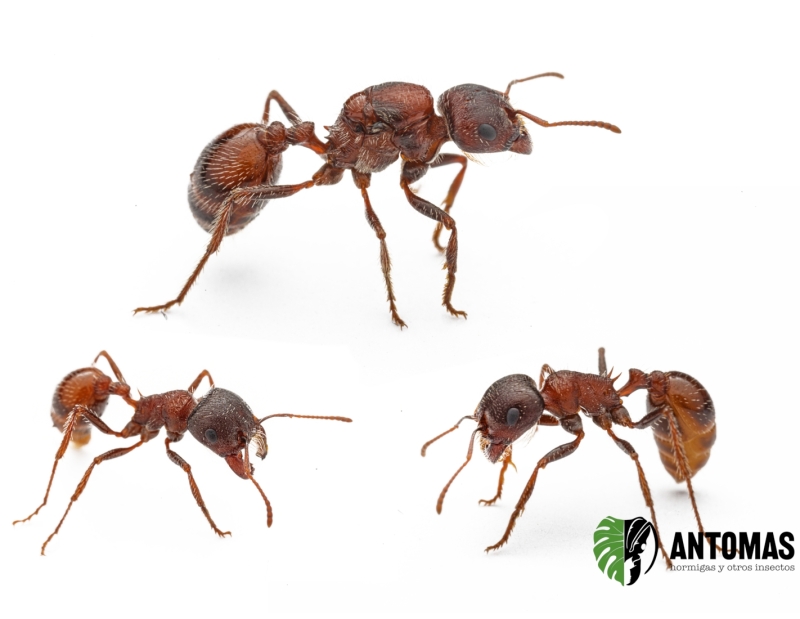
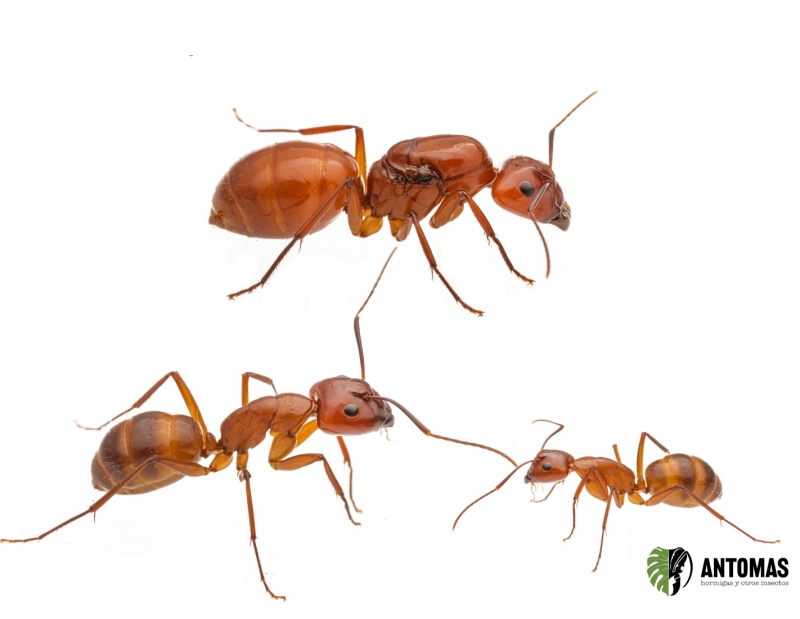
A robust and highly polymorphic myrmicine, with workers of very different sizes ranging from the minor to the supersoldier, and no clear cut-off between soldiers and supersoldiers.
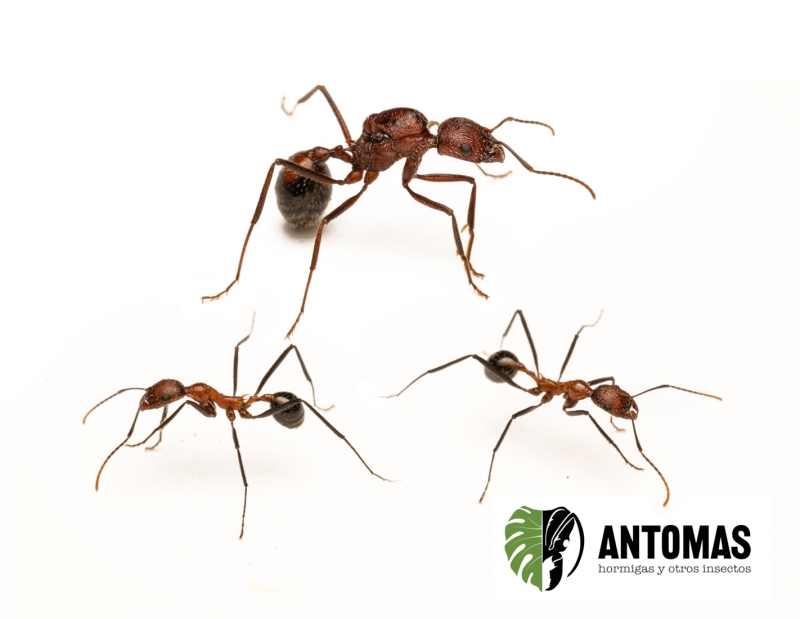
- Minor worker. Small, fast and long-legged, with a proportionate head. Like every caste of the species, it has very long spines on the propodeum, the rear part of the thorax.
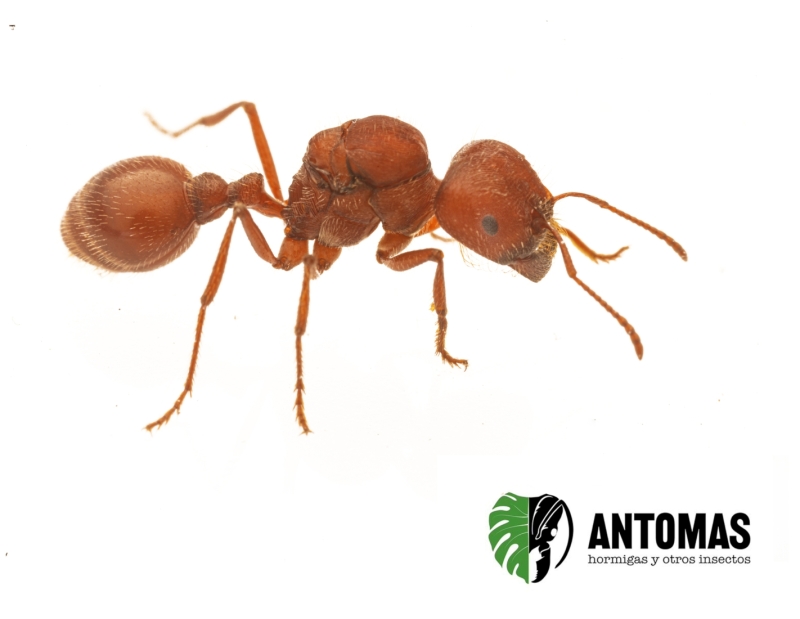
- Soldier. Large head, covered in fine longitudinal ridges (carinulae) except on the frontal triangle, with powerful mandibles. The rear face of the propodeum drops almost vertically, and the postpetiole, the second node of the “waist”, is diamond-shaped when seen from above.
- Supersoldier. Like the soldier, but much larger and with a disproportionate head. In the largest individuals, the sculpture on the rear lobes of the head forms concentric whorls, like a fingerprint.
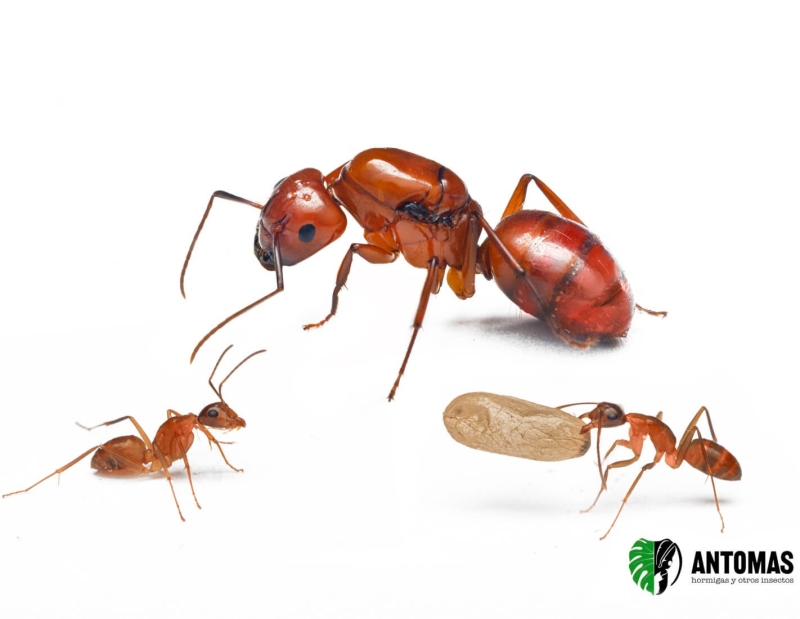
- Queen. Large and robust, with the head wider than long.
- Male. Winged; there is no published description with measurements.
- Colouration. According to Wilson, light reddish brown, with the gaster somewhat darker. Gregg describes the largest soldiers as having the rear half of the head distinctly reddish and the thorax and gaster brown to black.
- Sting. Like all myrmicines, it has a small one, but keepers agree that it does not sting people to any noticeable degree (see “Handling and safety”).
- Development. Naked pupae, without a cocoon, as in all myrmicines.
What could it be confused with? With its relative P. fimbriata, with which it was lumped together for almost thirty years. According to Gregg, P. fimbriata has dense tufts of hairs beneath the petiole and postpetiole, which are absent in P. rhea, and slightly fewer facets in the eye. The other supersoldier species of the region, P. obtusospinosa and P. tepicana, are considerably smaller.
Approximate sizes
- Queen: about 14 mm (14.3 mm the type specimen)
- Supersoldier: up to about 10 mm; head 3.86 mm wide and 4.04 mm long
- Soldier: from about 5.5 mm, with every intermediate size up to the supersoldier; head 2.52 mm wide and 2.76 mm long
- Minor worker: about 3–4 mm; head 0.86 mm wide and 0.96 mm long
- Male: no published measurements
The head measurements are Wilson’s (2003); the body lengths are those of Smith (1943) and Gregg (1949); and the queen’s are those of Wheeler’s type specimen and of Gregg. Queens of 16 to 22 mm and workers of 2 mm are quoted in shops and forums: these figures do not stand up against these measurements. The supersoldier’s head width of almost 4 mm, on the other hand, is well measured.
Care in captivity
Difficulty: 4/5 – Advanced
This is not a delicate species: it eats almost anything, is hardy and, given heat and food, grows quickly. Some shops rate it as intermediate. At Antomas we give it 4/5 because it is a very demanding species in its day-to-day care:
- High temperature. It survives at room temperature, but hardly grows. It needs the nest at 28–32 °C throughout the active season, summer included.
- Very demanding when it comes to humidity. The brood area must always be very humid, at 70–80%, while at the same time the granary is kept dry. Letting the nest dry out is a serious mistake.
- Huge amounts of food. Plenty of seeds of every kind, and protein at least every 3–4 days: a colony of this species eats an enormous amount.
- Escape-prone. Its minor workers are small, fast and very persistent in looking for a way out: the barrier and seals must always be in good condition.
- It grows very large. In Antomas’s experience, a colony under optimal conditions can reach about 35,000 workers in a year. You need to expand in good time and clean a lot.
- A delicate diapause. It lasts 3–4 months at 15–18 °C, with gradual temperature changes and without letting the brood area dry out.
- Supersoldiers do not come straight away. They never appear in the first year: you need a colony with a good number of workers, and they usually emerge after the first diapause.
And it is well worth it. Few ants offer so much in a single formicarium: trails of workers carrying seeds, soldiers dismembering prey at the entrance, larvae hanging from the chamber ceilings and, finally, giant-headed supersoldiers that hardly anyone has seen in the flesh. It is one of the species that best shows what an ant society is capable of.
Recommended parameters
- Nest temperature: high, 28–32 °C in the active season; 28–30 °C is a comfortable range. Above 26 °C there is no problem, but below that it grows very slowly. This is the soil temperature of its habitat in summer, and Arizona keepers agree that without heat it barely grows. Do not let the whole nest go above 32 °C.
- Foraging area: at room temperature or slightly warmer, with a warm corner if you like; that way the colony can choose.
- Humidity: high. The brood area should be very humid, at 70–80%, without waterlogging, with a dry granary for the seeds. The foraging area should be dry. This species is very demanding when it comes to humidity: if the nest dries out, the brood soon suffers.
- Water: always available, in a test tube with water and cotton wool in the foraging area. Never let it run out.
- Light: simply give them a dark area in the nest and a lit foraging area, with a normal day–night cycle.
- Diapause: 3–4 months at 15–18 °C, roughly from November or December to February or March (see “Diapause”).
If you use heating, place it on one side of the nest, with a thermostat and away from the water reservoir: heat next to water causes condensation, and in the galleries of a small ant a droplet is a trap.
Recommended formicaria
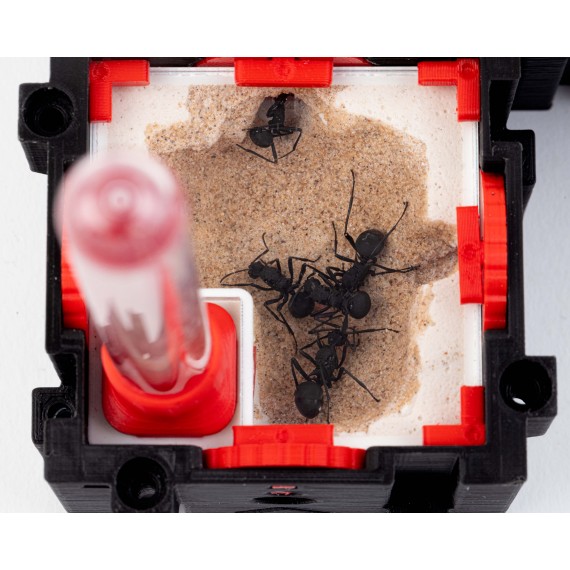
At Antomas we recommend above all the Anthouse Qbik Wild range: modular plaster formicaria that hold the humidity this species needs very well, especially in the early stages. To start with, a Qbik Wild One:
From there, the colony grows quickly and you can keep adding Wild modules of all kinds. The Qbik Wild Duo P 2C Hybrid works very well for us, combining humidity by evaporation from a lower reservoir with a side water tube, and you can also use the Qbik Wild Duo P 2C, with evaporation only:
Over time, you can also intersperse modules from the Qbik Alpha range, which are drier, such as the QBIK DUO: they make a good place for the granary. And when large soldiers start to appear, always choose large galleries: a supersoldier has a head almost 4 mm wide, and in narrow galleries the heaviest soldiers can actually get stuck.
Expand when you see lots of workers idling in the foraging area with no room inside, but without getting too far ahead: in a huge nest for a small colony, the spare chambers end up as rubbish dumps, with mould and mites. Complete the set-up as follows:
- Humid brood area and dry granary. Always keep the reservoir of the Wild modules topped up with water, so that the brood area stays at 70–80%, and let the colony store the grain in the driest chambers or in an Alpha module.
- A thin layer of dry sand in the foraging area, where they will set up their rubbish dump.
- Water in a test tube with cotton wool, never left open: a minor worker can drown in a single droplet.
- Feeder for sugary liquids, never cotton wool (see “Feeding”).
- Escape barrier of PTFE or mineral oil and a tight-fitting lid (see “Escapes and barriers”).
Founding and growth
At Antomas we sell colonies with a queen, with workers and brood. Founding is the most delicate phase for this species, and starting with an established colony spares you the most fragile months. On arrival, leave it undisturbed in the dark for a few days, at 28–30 °C and with the brood area humid, with water, a few seeds and a small prey item, and do not open the tube or nest more than necessary.
From then on, the pace depends above all on heat and protein. Diaries kept by North American keepers give an idea of what it can do:
- The first soldiers, small ones, appear early, within a few weeks.
- A colony fed crickets daily went from a newly founding queen to about 780 workers and about 20 soldiers in three months, although it had been given a boost of pupae of its own species.
- An Arizona shop speaks of more than 5,000 workers in the first year with heat and good food.
- In Antomas’s experience, under optimal conditions a colony can reach about 35,000 workers in a year.
These are not fixed rules: without heat, without humidity or with little food, growth is much slower. What never changes is the golden rule: never combine queens or different colonies. This is a territorial species, very aggressive towards other ants; one keeper found that a colony mutilated the brood of another Pheidole that had been added to it.
Arrival and moving
To move the colony into the formicarium, at Antomas we do it by tipping: with the formicarium already set up, the humid area ready and the barrier in place, we open the tube or container in the foraging area, next to the nest entrance, and gently tip out the queen, workers, brood and seeds, helping any stragglers along with a paintbrush. Work over a tray, because the minor workers are fast, and keep the nest dark: within a few hours they will have carried the brood to the humid area and started to organise the granary. As early as 1949, Gregg reported that the colony moved when he disturbed the nest he was studying: this is a species that relocates readily. To move it into a larger Wild module, use the same method.
Feeding
This species eats an enormous amount, and food is what does most to determine its growth.
Seeds: lots of them, of every kind. It is a harvester ant and eats a huge quantity of seeds: keepers agree that it grows faster with plenty of seeds in the granary. At Antomas we give them all kinds of seeds, clean, untreated, unsalted and unroasted: grass seed (Poa), chia, dandelion, canary seed, millet and evening primrose, which are those most often mentioned for this species, and, for large colonies, shelled and chopped sunflower seeds.
- Leave them in the foraging area so that the ants carry them to the dry granary; never in the humid area or in contact with the cotton wool.
- Two or three times a week, remove any sprouted or mouldy seeds, and empty the rubbish dump from time to time.
Cooked pasta: an extra they love. At Antomas we also give them cooked pasta, the same pasta we eat ourselves: a piece of macaroni, a few noodles, whatever there is, with no sauce. They bite into it and eat it readily, and it is highly recommended as a supplement to seeds. Give them small pieces and remove any leftovers the next day, because damp pasta goes mouldy.
Protein: the more, the better. It is the engine of growth and the key to large soldiers. Offer it at least every 3–4 days, and more often if you can. This is the Antomas philosophy: if you carry out daily maintenance and remove leftovers, it is better to overfeed, because the colony perceives that it has more resources and grows faster and in greater numbers. If you will not be able to clean often, it is better not to overfeed: surplus protein rots and brings mould and mites. Change the type of insect from one week to the next, so that they do not always eat the same thing:
In the early stages, small, freshly killed insects are best; as the colony grows, you can give them larger prey, and live prey too, and you will see the minor workers recruit their nestmates while the soldiers come to cut it up. Buy insects from a reliable supplier, because insects treated with insecticides can kill the colony, and remove leftovers within 24 hours.
Animal protein of every kind. As well as insects, at Antomas we give them a bit of everything: chicken, pinkies (frozen newborn mice, sold as reptile food) and other meats, in small pieces suited to the size of the colony. Meat is best cooked; pinkies can be given as they are. If they have not eaten the animal protein within 24–48 hours, remove it.
Sugars, only as a supplement. They are not the basis of its diet, and at Antomas we do not recommend giving them often: once or twice a month, as we do with harvester ants, and varied: mostly Anthouse Blue Sugar Nectar and, occasionally, another nectar or sugary liquid; you can also add a little protein to the nectar. Always in a feeder, where the drop stays “spread out” and accessible, and never on cotton wool, which goes mouldy and spoils the liquid very quickly.
Water: always, in the test tube with cotton wool. Even though they eat dry seeds, they must never go without water.

“Cabeza de pollo vs hormigas titánicas” (Chicken head vs giant ants), part 2, by Anthouse: protein on a grand scale for a P. rhea colony.

“Una batalla para engendrar un monstruo” (A battle to breed a monster), part 2, by Anthouse: in search of the supersoldiers.
Supersoldiers at home: protein, space and patience
It is the question everyone who buys this species asks: when will the first supersoldier appear? In Antomas’s experience, never during the first year: the colony needs to have a good number of workers, and they usually emerge after the first diapause. According to the biology of the genus, a larva becomes a soldier, and then a supersoldier, when it receives plenty of food at just the right moment and the colony “decides” that it needs more soldiers. In practice, that means:
- A large colony. Small colonies produce small soldiers. North American keepers confirm this: one of them, with a huge colony at nine months, had still not seen any supersoldiers.
- Plenty of food, consistently. Producing supersoldiers in captivity requires abundant feeding, especially protein. Spells of hunger are paid for in the size of the soldiers.
- Heat and humidity in the active season. Mimic its monsoon summer: 28–32 °C, plenty of food and a well-humidified brood area.
- Space. Large galleries and timely expansions: a cramped colony will not commit to producing its most costly workers.
And do not worry if, at first, almost all the soldiers are small: the same is true in the wild. What is rare, and valuable, is the supersoldier.
Diapause
There are no studies on its diapause, and opinions are divided: some Arizona sellers say it does not need one and keep it active all year round, while other shops recommend a mild rest of 2–3 months at 15–18 °C. In Penick’s laboratory, colonies kept at a constant 24 °C lived for years and reproduced. But in its habitat winter is real: from December to February there are ground frosts, and the soil where the colony lives stays at about 10–14 °C for around three months.
At Antomas we give it a diapause of 3–4 months, roughly from November or December to February or March, at 15–18 °C: it respects its natural cycle without cooling it down like a European species. It can be a delicate time, so it is worth doing it carefully:
- Lower the temperature gradually, over one or two weeks, and raise it the same way at the end.
- Do not go below 15 °C.
- Do not let the brood area dry out: keep the nest’s reservoir topped up with water throughout the diapause.
- Water always available and seeds in the granary; little or no protein.
- At the end, return to heat and protein as soon as you see activity and brood. This is when the first supersoldiers usually appear.
Behaviour in captivity
Tidy and hard-working. Within a few days you will see the household in order: brood in the humid area, grain in the granary and the rubbish dump outside. In the foraging area, the minor and medium-sized workers form trails to the food, and the large soldiers stay in the nest or at the entrance, waiting for prey.
Active in heat and humidity. In the wild, at the height of summer, they come out mainly at dusk, and they become much livelier after rain, according to keepers. At home, with a warm nest, you will see them on the move at any time of day.
Very aggressive towards other ants. They defend the nest with all their castes and attack any foreign ant: no shared set-ups and no formicaria connected to other colonies.
Observe without fear. At Antomas we believe ants are there to be enjoyed, observed and learned from, not kept hidden away. Simply give them a dark area in the nest and a lit foraging area, and observe them gently, intervening and stressing them as little as possible. With a magnifying glass, look for larvae hanging from the chamber ceilings and compare the workers’ heads.
Warning signs:
- Brood that stalls or disappears: almost always a lack of protein, heat or humidity.
- Sprouted seeds or mould in the granary: too much humidity in the dry area.
- Condensation in the galleries: heat too close to the water.
- Lots of workers idling in the foraging area, with no room inside: time to expand.
Escapes and barriers
This is its weak point. Minor workers measure 3–4 mm, are fast and explore every crack, and keepers agree that a large colony searches for a way out with great persistence. The more it grows, the more workers try their luck:
- PTFE (Fluon) in a thin layer on the upper part of the foraging-area walls, the barrier most recommended by Pheidole keepers. It lasts longer if applied to the underside of a lip.
- As an alternative, a band of mineral oil, which is much easier to find. Renew it when it collects dust or debris.
- A tight-fitting lid and no gaps in connections, stoppers and tubes: to a minor worker, any slit is a door.
- Nothing that could act as a bridge to the barrier, and no food remains stuck to it.
Handling and safety
This is not a dangerous species. Like all myrmicines it has a small sting, but keepers agree that it does not sting people to any noticeable degree. What they do is bite: the nip of a large soldier or a supersoldier can be felt, but it goes no further than that. Always handle them with tools, soft forceps and a paintbrush, never with your hands, and work slowly so as not to lose or harm any worker, let alone the queen. This is an exotic species: it must never be released under any circumstances.
What not to do
- Keeping it below 26 °C in the active season and expecting it to grow.
- Letting the brood area dry out: this species is very demanding when it comes to humidity.
- Putting seeds in the humid area or in contact with the cotton wool.
- Letting the water run out or placing the heating next to the water reservoir.
- Skimping on food, always giving the same insect or leaving protein or pasta remains for more than 24 hours.
- Putting sugary liquids on cotton wool or leaving water uncovered.
- Relying on an old barrier or leaving gaps in lids and connections.
- Using narrow galleries once large soldiers appear, or waiting until the colony is cramped before expanding.
- Combining queens or colonies, or keeping it alongside other species.
- Going below 15 °C during diapause, cutting it short to a few weeks or changing the temperature abruptly.
- Expecting supersoldiers in the first year: they arrive with a large colony, usually after the first diapause.
- Handling them with your hands.
Scientific sources
This care sheet is based on the scientific literature on Pheidole rhea and its genus, on distribution and climate data for its habitat, and on the experience of Antomas and other keepers. Main references:
- Wheeler, W. M. (1908). The ants of Texas, New Mexico and Arizona. (Part I.). Bulletin of the American Museum of Natural History 24: 399–485. doi:10.5281/zenodo.25136
- Gregg, R. E. (1949). A note on Pheidole (Macropheidole) rhea Wheeler (Hymenoptera: Formicidae). Psyche 56: 70–73. doi:10.1155/1949/62806
- Wilson, E. O. (2003). Pheidole in the New World: A Dominant, Hyperdiverse Ant Genus. Harvard University Press, p. 594. Species account:doi:10.5281/zenodo.6274328
- Wheeler, D. E. & Nijhout, H. F. (1981). Soldier determination in ants: new role for juvenile hormone. Science 213: 361–363. doi:10.1126/science.213.4505.361
- Moreau, C. S. (2008). Unraveling the evolutionary history of the hyperdiverse ant genus Pheidole (Hymenoptera: Formicidae). Molecular Phylogenetics and Evolution 48: 224–239. doi:10.1016/j.ympev.2008.02.020
- Huang, M. H. (2010). Multi-phase defense by the big-headed ant, Pheidole obtusospinosa, against raiding army ants. Journal of Insect Science 10: 1. doi:10.1673/031.010.0101
- Huang, M. H. & Wheeler, D. E. (2011). Colony demographics of rare soldier-polymorphic worker caste systems in Pheidole ants (Hymenoptera, Formicidae). Insectes Sociaux 58: 539–549. doi:10.1007/s00040-011-0176-8
- Rajakumar, R., San Mauro, D., Dijkstra, M. B., Huang, M. H., Wheeler, D. E., Hiou-Tim, F., Khila, A., Cournoyea, M. & Abouheif, E. (2012). Ancestral developmental potential facilitates parallel evolution in ants. Science 335: 79–82. doi:10.1126/science.1211451
- Penick, C. A., Copple, R. N., Mendez, R. A. & Smith, A. A. (2012). The role of anchor-tipped larval hairs in the organization of ant colonies. PLoS ONE 7: e41595. doi:10.1371/journal.pone.0041595
- Economo, E. P., Klimov, P., Sarnat, E. M., Guénard, B., Weiser, M. D., Lecroq, B. & Knowles, L. L. (2015). Global phylogenetic structure of the hyperdiverse ant genus Pheidole reveals the repeated evolution of macroecological patterns. Proceedings of the Royal Society B 282: 20141416. doi:10.1098/rspb.2014.1416
- Lillico-Ouachour, A. & Abouheif, E. (2017). Regulation, development, and evolution of caste ratios in the hyperdiverse ant genus Pheidole. Current Opinion in Insect Science 19: 43–51. doi:10.1016/j.cois.2016.11.003
- Gordon, D. G., Ilieş, I. & Traniello, J. F. A. (2017). Behavior, brain, and morphology in a complex insect society: trait integration and social evolution in the exceptionally polymorphic ant Pheidole rhea. Behavioral Ecology and Sociobiology 71: 166. doi:10.1007/s00265-017-2396-z
- Gordon, D. G., Moreau, M., Fourcassié, V. & Traniello, J. F. A. (2018). Limited size-related variation in behavioral performance among workers of the exceptionally polymorphic ant Pheidole rhea. Insectes Sociaux 65: 431–438. doi:10.1007/s00040-018-0629-4
- Rajakumar, R., Koch, S., Couture, M., Favé, M.-J., Lillico-Ouachour, A., Chen, T., De Blasis, G., Rajakumar, A., Ouellette, D. & Abouheif, E. (2018). Social regulation of a rudimentary organ generates complex worker-caste systems in ants. Nature 562: 574–577. doi:10.1038/s41586-018-0613-1