This website uses its own and third-party cookies to improve our services and show you advertising related to your preferences by analyzing your browsing habits. To give your consent to its use, press the Accept button.
Functional cookies are strictly necessary to provide the services of the shop, as well as for its proper functioning, so it is not possible to refuse their use. They allow the user to browse through our website and use the different options or services that exist on it.
These are cookies that collect information about the advertisements shown to users of the website. They can be anonymous, if they only collect information about the advertising spaces shown without identifying the user, or personalised, if they collect personal information about the user of the shop by a third party, for the personalisation of these advertising spaces.
Collect information about the user's browsing experience in the shop, usually anonymously, although sometimes they also allow the user to be uniquely and unequivocally identified in order to obtain reports on the user's interests in the products or services offered by the shop.
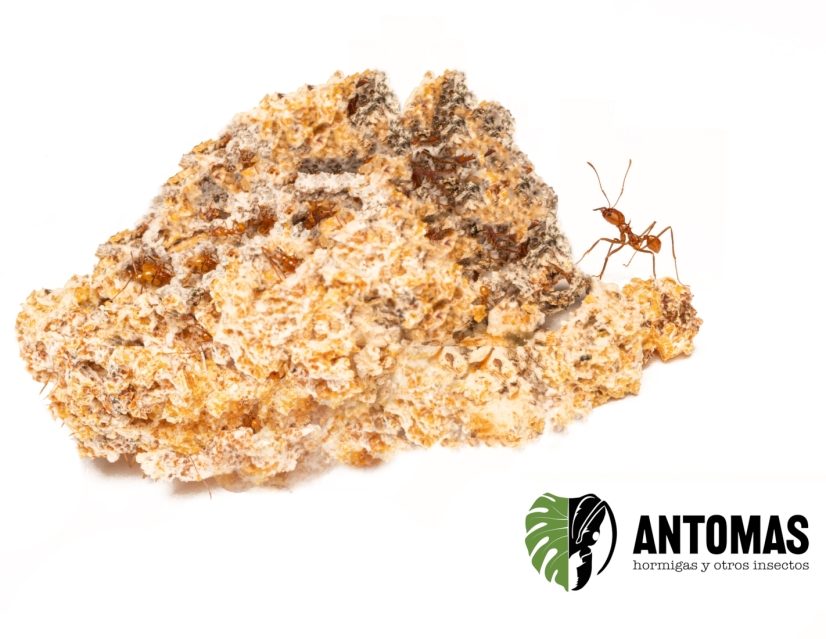
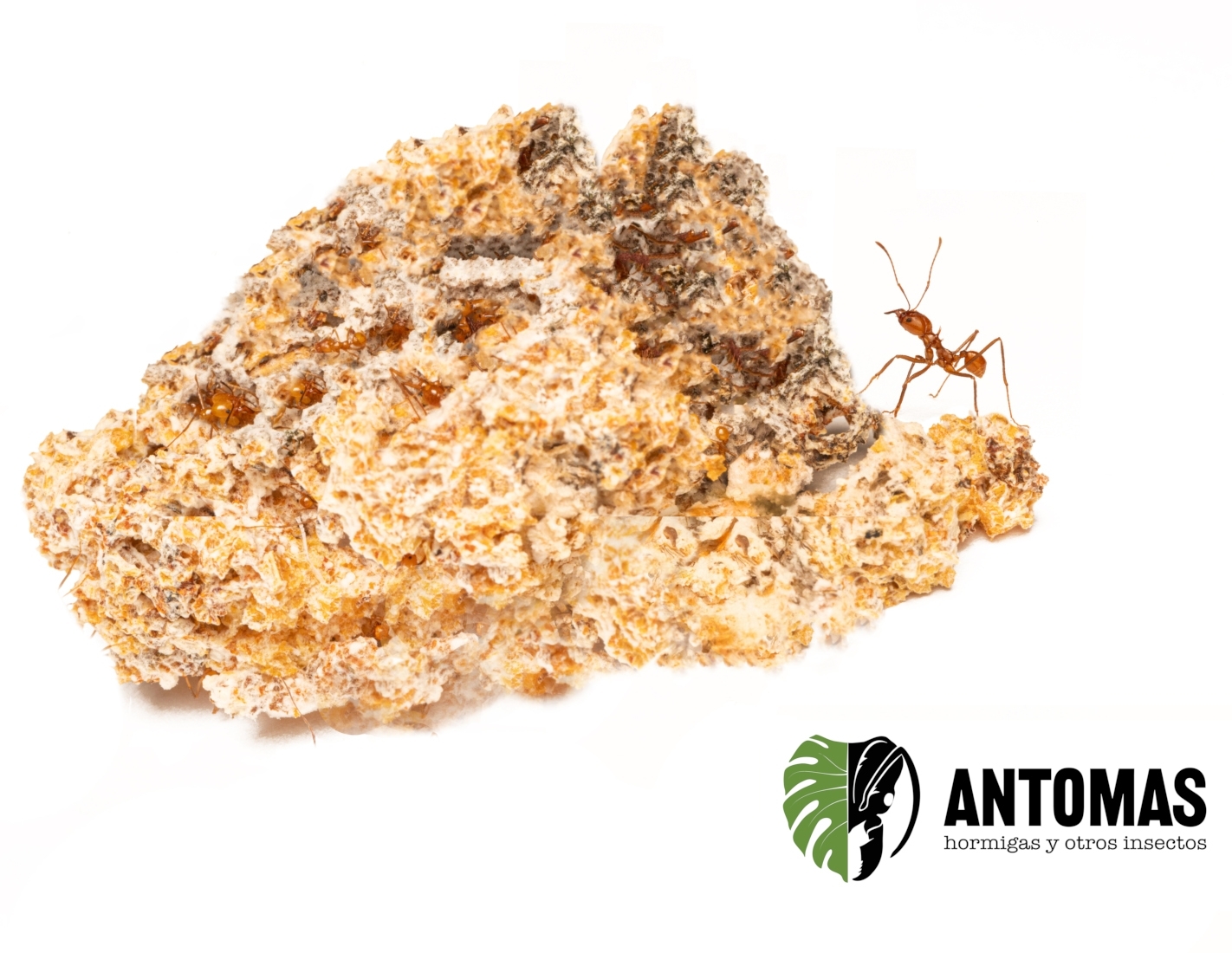
Leucocoprinus gongylophorus - Fungus for leafcutter ants
€14.99
VAT included
The garden that feeds an empire. Leucocoprinus gongylophorus is the fungus farmed by leafcutter ants, Atta and Acromyrmex: its gongylidia feed the larvae and, without it, the colony has no future. This live fungus booster is for colonies that have lost or damaged their garden, for founding colonies with very little fungus and for rebuilding the crop after shipping. Use it straight away and always without any ants it may contain: the fungus cannot survive without a colony to tend it, and acceptance cannot be guaranteed. Format: 20 ml of fungus. Shipping across Europe.
Use: garden booster for leafcutter ants (Atta and Acromyrmex). You receive 20 ml of live fungus for colonies that have lost or damaged their garden, for founding colonies with very little fungus and for rebuilding the crop after shipping. Storage: closed, at 22–26 °C, in the dark and never in the fridge; use it as soon as possible, ideally the same day. How to add it: without any of the ants from the tube, next to the colony’s garden or, if no garden is left, in the fungus chamber with the workers. Important: the fungus cannot be grown without ants and no colony is obliged to accept it: acceptance cannot be guaranteed.
Leucocoprinus gongylophorus (Möller) R. Heim is the fungus farmed by leafcutter ants. In the ant literature it almost always appears as Leucoagaricus gongylophorus, and in older mycological papers as Attamyces bromatificus: it is the same organism. Alfred Möller described it in 1893, in Brazil, as Rozites gongylophora, and today the accepted name in Index Fungorum is Leucocoprinus gongylophorus, although the nomenclature of the group is still under revision.
For a leafcutter colony, the fungus is not an extra: it is the food and the heart of the nest. The workers do not eat the leaves they cut; they use them as a substrate to grow this fungus, and the larvae feed on it. A colony without a garden has no future. That is why we sell this booster: 20 ml of live fungus, to give a second chance to a garden that has collapsed or a push to a colony that is just starting out.
It is a delicate product: a living organism that depends on the ants, and the decision to adopt it is made by them and by the fungus itself.
What a fungus booster is for
Colonies that have lost their garden
A garden can collapse for many reasons: it dries out, becomes waterlogged, overheats, receives a leaf treated with fungicide or is overrun by mould. If the colony still has its queen and workers but has been left without fungus, or with only a tiny remnant, a booster gives it material to rebuild the crop. This is the most urgent situation and the one where you must act fastest: without fungus, the larvae have nothing to eat.
Founding colonies with very little fungus
A founding queen starts with a tiny pellet of fungus, and in captivity that first crop is the weak point. Here science brings the best news: in an experiment with founding queens of Acromyrmex octospinosus and A. echinatior, every queen accepted a fragment of new fungus. The authors speak of a brief “window of opportunity”: during founding, the colony accepts foreign fungus far more readily than once it is established (Poulsen and colleagues, 2009).
After shipping or a move
Shipping and moving shake up the garden: the fungus crumbles, gets squashed or loses moisture. That is why at Antomas we often send a tube of booster fungus with our Atta mexicana and Acromyrmex octospinosus colonies: if the main garden arrives in poor shape, the booster helps the colony recover.
A sick or shrinking garden
If the fungus shrinks, darkens over large areas or the colony abandons it, first look for the cause: temperature, humidity, ventilation or the last plants you offered. A booster can help it bounce back, but it does not fix the cause: if the problem is still there, the new fungus will end up the same way. And if the garden shows visible mould, first remove the affected parts or let the workers do it.
Will they accept it? The honest answer
Not always. Each colony grows its own strain, and fungi from different colonies can reject one another. In Acromyrmex it has been shown that the fungus itself rejects fungus fragments from neighbouring colonies, more strongly the more genetically different they are; the substances behind this incompatibility pass intact through the workers’ gut and end up in the faecal droplets they use to manure the garden (Poulsen and Boomsma, 2005). Partial incompatibility between workers and fungi from other colonies has also been observed (Bot, Rehner and Boomsma, 2001). Keepers’ forums report cases of colonies that completely ignored a piece of foreign fungus.
What we know helps to set expectations:
More likely: in founding and small colonies, and in colonies that have been left without fungus of their own.
Less likely: in large colonies with a healthy garden, which defend their strain.
No guarantee: neither that they will accept it nor that the fungus will thrive afterwards. It is a rescue resource, not a miracle product.
Biology: a domesticated fungus
Some 50 million years of agriculture
Ants of the tribe Attini have been farming fungi for tens of millions of years: around 50 million according to the first estimates based on molecular data (Mueller, Rehner and Schultz, 1998). The most primitive ones grow a variety of fungi that still live freely in nature; the leafcutters, Atta and Acromyrmex, have taken it to the extreme, with a crop so domesticated that it is no longer known in the wild without its ants (Mueller and colleagues, 2005). Both grow the same species, L. gongylophorus, but each colony keeps its own strain.
Gongylidia: the “kohlrabi” that feeds the larvae
Möller, the mycologist who described it, compared the little clusters of white swellings in the garden to kohlrabi (Kohlrabi, in German). Today they are called gongylidia: swollen, nutrient-packed hyphal tips that cluster in bunches (staphylae), visible as tiny white dots on the surface of the fungus. They are the main food of the larvae. Adult workers eat them too, but they get much of their energy from the sap of the leaves they cut (Quinlan and Cherrett, 1979).
Outside the nest, the fungus loses this ability: in liquid laboratory culture it grows in an atypical form and without gongylidia (Powell and Stradling, 1986).
Manured with faeces: enzyme recycling
The workers do not just cut and chew the leaf: they also manure the garden with faecal droplets. The surprising part is what those droplets carry: enzymes from the fungus itself, such as pectinases, which break down plant cell walls, and a laccase that neutralises the plants’ defensive phenols. The ants ingest them with the gongylidia, the enzymes pass intact through their gut and return to the garden exactly where they are needed, on the freshly added leaf (Schiøtt and colleagues, 2010; De Fine Licht and colleagues, 2013). Ant and fungus work as a single digestive system.
A crop with many nuclei
Domestication has also changed its genetics. In leafcutters, the fungus is polyploid: each cell carries many nuclei and several copies of the chromosomes, far more than in the fungi grown by primitive Attini. The authors link this to higher production of food and enzymes for large-scale farming (Kooij and colleagues, 2015).
Why it cannot be grown without ants
This is the question we are asked most. In the laboratory, mycologists keep strains on agar plates, but they grow slowly and do not form a garden like the one in the nest (Powell and Stradling, 1986). At home, the fungus cannot be kept without ants:
Nobody feeds it. Without workers to cut, chew and manure the leaf, the fungus exhausts its substrate and dies off.
Nobody defends it. Gardens have a specialised parasite, the fungus Escovopsis, which feeds on the crop and can wipe it out (Currie, Mueller and Malloch, 1999). The workers fight it by grooming the fungus and pulling out infected pieces to carry them to the refuse pile (Currie and Stuart, 2001). Without them, moulds and parasites spread unchecked.
It depends on its community. The garden is a guarded monoculture; left alone, it stops being one.
That is why the booster is a product to use straight away and with a colony, not to store or to “grow the fungus” separately.
Each colony, its own strain
The founding queen carries a small pellet of fungus from her mother’s nest on her nuptial flight, stored in the infrabuccal pocket, and uses it to sow her first garden. In this way the strain passes from mother to daughter over generations (Mueller and colleagues, 2005). This system avoids mixing strains that would compete with each other, and explains why an established colony may reject a foreign fungus (see “Will they accept it? The honest answer”).
A mushroom hardly anyone has seen
It is a mushroom-forming fungus of the family Agaricaceae, but inside the nest it almost never fruits: the workers make sure it grows as mycelium. The mushrooms, small and with a pale cap, have been found on rare occasions, for example on a live nest of Atta cephalotes (Fisher, Stradling and Pegler, 1994). If one day you see something like that in your setup, congratulations: it is a rarity.
The fungus must survive, in a video by Anthouse.
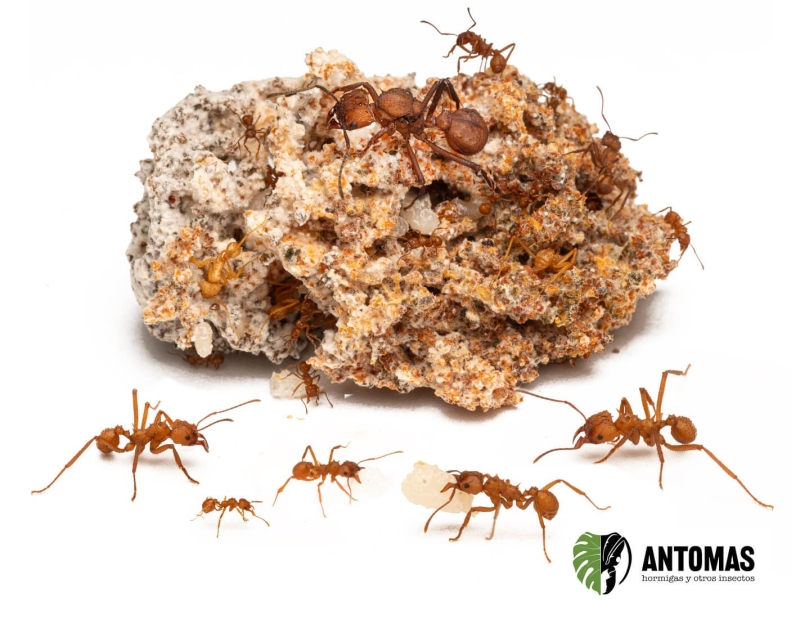
A colony of Atta leafcutters with its fungus garden, at Antomas.
Appearance: how to recognise healthy fungus
The garden looks like a sponge or a crumbly honeycomb, light and full of cavities, made of leaf fragments wrapped in mycelium. Look out for the following when you receive it and after adding it:
Healthy: greyish white or cream, moist and spongy, with tiny white dots (the staphylae of gongylidia) on the surface and a mild earthy or mushroomy smell.
Old: grey or brown, more compact. This is the exhausted part that the workers carry to the refuse pile; a little dark colour at the base is normal.
Bad: green, black or yellow mould fuzz, wet and sticky patches, a sour or rotten smell, or dry, matted fungus.
The 20 ml is an approximate volume of fungus, not counting the container.
How to store it on arrival
There are no studies on how long a piece of garden lasts without ants, so caution is the rule here: at Antomas we recommend using it the same day it arrives or, at the latest, the following day. The longer it waits, the more it runs down and the more ground moulds gain. In the meantime:
Temperature: 22–26 °C. Isolated fungus grows best at 20–25 °C (Powell and Stradling, 1986), and workers of Acromyrmex heyeri choose very similar temperatures to grow it (Bollazzi and Roces, 2002).
No fridge and no heat: do not put it in the refrigerator or leave it next to a radiator or in the sun. Above 30 °C the fungus suffers, and in Atta the queen can become infertile if kept like that for long.
Closed, in the dark and not squashed: leave the container as it arrives, without opening it to look or pressing the fungus.
Add nothing: no misted water, no leaves, no sugar. The fungus on its own cannot use them and you would only be feeding the mould.
Check it from the outside: if you see coloured mould, keep it away from your colony; do not add it.
How to introduce it to the colony
First of all: no ants from the tube
If the fungus comes with any workers, remove them before giving it to your colony. The ants that come with the booster belong to another colony and must never be mixed with yours. Remove them with a soft brush or soft tweezers and check the fungus carefully, because the smallest workers hide inside. It is the same rule we give for the booster tube that comes with our colonies.
Colony that still has some garden
Next to the garden, not on top of it. Place the booster against the colony’s fungus, in the same chamber, using tweezers or a clean teaspoon, without breaking it up.
Let them decide. If they accept it, within hours or a few days you will see workers handling it, carrying it into the garden and adding leaf to it.
Tender leaves at hand. Leave fresh, untreated leaves in the foraging area so they can feed the fungus straight away.
Colony left without a garden
All the fungus in the fungus chamber, in a single block, with the queen and the workers alongside it. In a small chamber, contact is immediate.
High, stable humidity, with no puddles or drips falling on the fungus.
No rush with the leaves: a few tender ones at first, and more once you see the fungus growing.
Founding colonies
Place a small piece of booster next to the queen’s fungus, in her chamber, and keep the rest aside in the same conditions in case it is needed over the following days. During founding the queen accepts new fungus more readily (Poulsen and colleagues, 2009), but a piece that is too large in a tiny chamber is more fungus than she can tend, and the neglected part goes mouldy.
Signs of acceptance and rejection
Acceptance: the workers climb onto the booster, lick it, break it into pieces and incorporate it into the garden, and start placing leaf on it. After a few days it can no longer be told apart from the rest.
Rejection: they ignore it, push it aside or carry it whole to the refuse pile within one or two days. If this happens, remove it before it goes mouldy.
Unclear: they leave it where it is without working it. Give them a few days; if it goes mouldy or loses its colour, remove it.
The setup: humidity yes, water no
The booster only thrives in a setup that works. Keep the fungus chamber humid, with constant ventilation and no waterlogging, at 22–26 °C, with a refuse area separate from the fungus. At Antomas we recommend the Anthouse Fungarium Kit, designed for leafcutters: the fungus rests on a grid above a water tray, and the reducer caps adjust the chamber volume to a small garden, which is exactly the case of a recovering colony. You will find the details on setup, feeding and humidity in the pages for our leafcutters: Acromyrmex octospinosus, Atta mexicana and the Leafcutter Empire, a large colony of A. mexicana.
Feeding the garden: fresh leaves and flowers completely free of any treatment, in variety (rose, bramble, young citrus leaves, hibiscus), removing any they do not cut before they spoil. Leafcutters do not need insects: their protein is the fungus. If you are looking for live food for your other ants, we have the firebrat, Thermobia domestica.
What not to do
Put the ants that come with the fungus in with your colony.
Store it for days or weeks “just in case”, or in the fridge.
Try to grow it without ants, in a jar with leaves or on home-made agar.
Mist water onto the fungus or leave it waterlogged.
Keep it above 30 °C or in direct sun.
Break it up or squash it when adding it.
Place it on top of the garden of a large, healthy colony that does not need it.
Leave a rejected or mouldy booster inside.
Use it without correcting what made the garden collapse: temperature, humidity, ventilation or a treated plant.
Offer leaves from florists, garden centres or any treated plant.
Expect miracles: acceptance is not guaranteed.
Throw remains of fungus or exotic ants outdoors: freeze them before disposing of them.
Scientific sources
This page is based on the scientific literature on the leafcutter ant fungus, on its Index Fungorum record, on the nomenclatural review by Heisecke and colleagues (2021, Phytotaxa 494, doi:10.11646/phytotaxa.494.1.2) and on the experience of Antomas and other keepers. Main references:
Mueller, U. G., Rehner, S. A. & Schultz, T. R. (1998). The evolution of agriculture in ants. Science 281: 2034–2038. doi:10.1126/science.281.5385.2034
Mueller, U. G., Gerardo, N. M., Aanen, D. K., Six, D. L. & Schultz, T. R. (2005). The evolution of agriculture in insects. Annual Review of Ecology, Evolution, and Systematics 36: 563–595. doi:10.1146/annurev.ecolsys.36.102003.152626
Quinlan, R. J. & Cherrett, J. M. (1979). The role of fungus in the diet of the leaf-cutting ant Atta cephalotes (L.). Ecological Entomology 4: 151–160. doi:10.1111/j.1365-2311.1979.tb00570.x
Currie, C. R., Mueller, U. G. & Malloch, D. (1999). The agricultural pathology of ant fungus gardens. PNAS 96: 7998–8002. doi:10.1073/pnas.96.14.7998
Currie, C. R. & Stuart, A. E. (2001). Weeding and grooming of pathogens in agriculture by ants. Proceedings of the Royal Society B 268: 1033–1039. doi:10.1098/rspb.2001.1605
Poulsen, M. & Boomsma, J. J. (2005). Mutualistic fungi control crop diversity in fungus-growing ants. Science 307: 741–744. doi:10.1126/science.1106688
Bot, A. N. M., Rehner, S. A. & Boomsma, J. J. (2001). Partial incompatibility between ants and symbiotic fungi in two sympatric species of Acromyrmex leaf-cutting ants. Evolution 55: 1980–1991. doi:10.1111/j.0014-3820.2001.tb01315.x
Poulsen, M., Fernández-Marín, H., Currie, C. R. & Boomsma, J. J. (2009). Ephemeral windows of opportunity for horizontal transmission of fungal symbionts in leaf-cutting ants. Evolution 63: 2235–2247. doi:10.1111/j.1558-5646.2009.00704.x
Schiøtt, M., Rogowska-Wrzesinska, A., Roepstorff, P. & Boomsma, J. J. (2010). Leaf-cutting ant fungi produce cell wall degrading pectinase complexes reminiscent of phytopathogenic fungi. BMC Biology 8: 156. doi:10.1186/1741-7007-8-156
De Fine Licht, H. H., Schiøtt, M., Rogowska-Wrzesinska, A., Nygaard, S., Roepstorff, P. & Boomsma, J. J. (2013). Laccase detoxification mediates the nutritional alliance between leaf-cutting ants and fungus-garden symbionts. PNAS 110: 583–587. doi:10.1073/pnas.1212709110
Kooij, P. W., Aanen, D. K., Schiøtt, M. & Boomsma, J. J. (2015). Evolutionarily advanced ant farmers rear polyploid fungal crops. Journal of Evolutionary Biology 28: 1911–1924. doi:10.1111/jeb.12718
Powell, R. J. & Stradling, D. J. (1986). Factors influencing the growth of Attamyces bromatificus, a symbiont of attine ants. Transactions of the British Mycological Society 87: 205–213. doi:10.1016/S0007-1536(86)80022-5
Bollazzi, M. & Roces, F. (2002). Thermal preference for fungus culturing and brood location by workers of the thatching grass-cutting ant Acromyrmex heyeri. Insectes Sociaux 49: 153–157. doi:10.1007/s00040-002-8295-x
Fisher, P. J., Stradling, D. J. & Pegler, D. N. (1994). Leucoagaricus basidiomata from a live nest of the leaf-cutting ant Atta cephalotes. Mycological Research 98: 884–888. doi:10.1016/S0953-7562(09)80259-1
Dificultad
Intermediate
No reviews yet
Comments (0)
No customer reviews for the moment.
Your review appreciation cannot be sent
Report comment
Are you sure that you want to report this comment?
Report sent
Your report has been submitted and will be considered by a moderator.
Your report cannot be sent
Write your review
Review sent
Your comment has been submitted and will be available once approved by a moderator.