This website uses its own and third-party cookies to improve our services and show you advertising related to your preferences by analyzing your browsing habits. To give your consent to its use, press the Accept button.
Functional cookies are strictly necessary to provide the services of the shop, as well as for its proper functioning, so it is not possible to refuse their use. They allow the user to browse through our website and use the different options or services that exist on it.
Cookie
Provider
Purpose
Expiry
PHP_SESSID
antomas.es
The PHPSESSID cookie is native to PHP and allows websites to store serialised status data. On the website it is used to establish a user session and to pass state data through a temporary cookie, which is commonly known as a session cookie. These Cookies will only remain on your computer until you close your browser.
Session
PrestaShop-#
antomas.es
This is a cookie used by Prestashop to store information and keep the user's session open. It stores information such as currency, language, customer ID, among other data necessary for the proper functioning of the shop.
These are cookies that collect information about the advertisements shown to users of the website. They can be anonymous, if they only collect information about the advertising spaces shown without identifying the user, or personalised, if they collect personal information about the user of the shop by a third party, for the personalisation of these advertising spaces.
Collect information about the user's browsing experience in the shop, usually anonymously, although sometimes they also allow the user to be uniquely and unequivocally identified in order to obtain reports on the user's interests in the products or services offered by the shop.
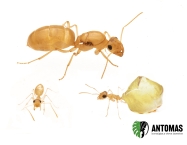
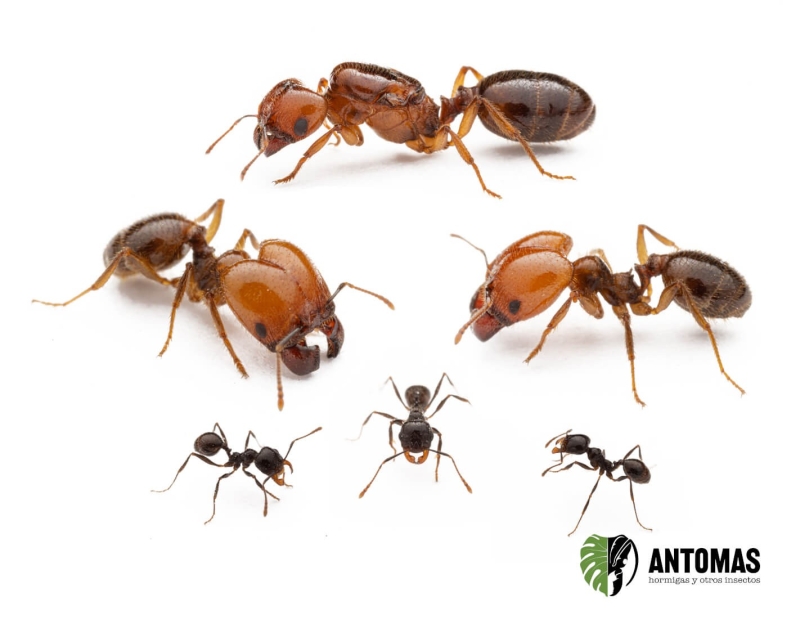
A pale ghost of the Mojave mountains. Myrmecocystus christineae is one of the rarest honeypot ants on the planet: barely eleven scientific records, a handful of mountains in California and Nevada and a life that science hardly knows. Straw yellow, almost white, with large eyes made for the night, it keeps its treasure in pale golden repletes. And it hides a secret: its queens do not fight, but reign together for life. A jewel for collectors and pioneers. Colonies with 2 queens. Shipping across Europe, live arrival guaranteed.
One of the rarest honeypot ants in the world and in the hobby: an endemic of a few mountain ranges in the Mojave Desert, with only 11 records in GBIF and a biology almost unknown to science. Pale, a straw yellow that is almost whitish, with large eyes and probably nocturnal. Colonies with 2 queens: in our experience, its queens tolerate each other and live together for life. A Qbik Wild nest with rough ceilings, household temperature without strong heat, nectar by the drop until there are repletes and always within reach afterwards, and tiny prey every day. Diapause of about 4 months (November–February) at 8–14 °C. Mineral oil barrier.
Myrmecocystus christineae Snelling, 1982 is probably the most mysterious honeypot ant ever to pass through Antomas. It was described a little over forty years ago from specimens collected in the Ivanpah Mountains, in the Mojave Desert (California), and since then hardly anyone has studied it again. In GBIF, the great global biodiversity database, it has only 11 records. Almost nothing is known about its life in the wild: not what its nests are like, nor when its queens fly, nor how many live together in each colony.
That is why this care sheet is different. We tell you honestly the little that science says about it, which fits into a couple of pages of its original description; what can be cautiously inferred from its pale relatives, such as M. mexicanus and M. navajo; and what we have learnt from keeping it. A word of warning from the start: our Spanish shop calls it “Hormiga Mielera Blanca”, that is, white, but it is not entirely white. It is, however, one of the palest honeypot ants ever measured.
Biology
Eleven records in the whole world
To measure its rarity, a comparison is enough. GBIF, the platform that brings together records from museums, collections and citizen science across the planet, has almost 1,500 records of M. mexicanus and about 280 of M. navajo. For M. christineae it has eleven, all from the United States, and those that give a state are from California.
Its known range is tiny: the Ivanpah and Granite Mountains, in San Bernardino County (California), and the south of Clark County (Nevada), all in the eastern Mojave Desert. When he described it in 1982, Snelling knew it only from the Ivanpah Mountains, and he already suspected that it would also live in the neighbouring ranges of California and Nevada. Later records have proved him right.
Why is it so rare? Nobody has studied this, so we can only suggest explanations, which are ours and not data:
It lives in a handful of remote desert mountains, far from the most thoroughly sampled areas.
It is small, pale and, in all likelihood, nocturnal: it comes out when hardly anyone is looking for it.
Like other honeypot ants, it keeps the most valuable part of the colony underground.
It may be commoner than the records suggest, or it may truly be a very restricted endemic. What is certain is that in the hobby it is one of the rarest species there is.
An ant named after a woman
It was described in 1982 by Roy R. Snelling, the great honeypot ant specialist at the Natural History Museum of Los Angeles County, in the first supplement to his 1976 revision of the genus. The reference specimen, the holotype, is a worker collected on 14 April 1977 beside Morningstar Mine Road, about 15 km north-north-east of Cima (San Bernardino County, California), at 1,280–1,300 m above sea level. It was collected by Christine D. George and Snelling himself.
And the name is dedicated to her. Snelling dedicated the species to Christine D. George, who helped him to collect and study it and who at the time was investigating the ecology of Myrmecocystus in the Mojave Desert. Together they also wrote, in 1979, a major report on the taxonomy, distribution and ecology of the ants of the California deserts.
A note on spelling: the correct name is christineae, with “-ineae”, as it appears in the original description and in taxonomic catalogues. The form “christinae”, seen on some websites, is an incorrect variant.
The type series was generous. As well as the holotype, Snelling had 724 workers, 16 queens and 68 males from the same place and date, so he was able to describe all three castes. The queens were described with wings, so in mid-April the colonies were already keeping winged queens and males in the nest, probably waiting for their nuptial flight.
A neighbour of the Joshua trees
What is its home like? The type locality lies in a high desert, at about 1,300 m, with very hot summers and cold winters with frequent night frosts. On the same day and along the same road, Snelling and George collected two other honeypot ants: M. romainei, whose nests were common in a Joshua tree woodland (Yucca brevifolia), many of them with winged males and queens, and M. mendax, with a nest on a rocky slope. The next day, a little lower down, they found M. testaceus, another pale honeypot ant, also among Joshua trees. It is quite a honeypot ant neighbourhood: four species within a few kilometres of road.
For M. christineae specifically, the records compiled by Arizona State University indicate that it is often found in sandy washes, the dry stream beds that only carry water after storms. There are no further published data on its soil, vegetation or altitude. But the picture fits what we see at home: an ant of dry ground that does well in a fairly dry nest with a moist spot (see “Parameters for a high-desert honeypot ant”).
White… or almost
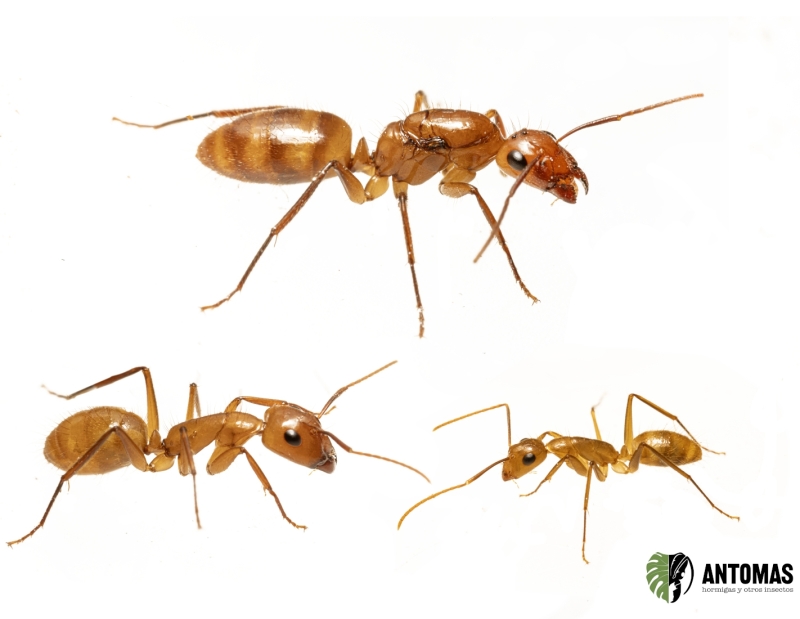
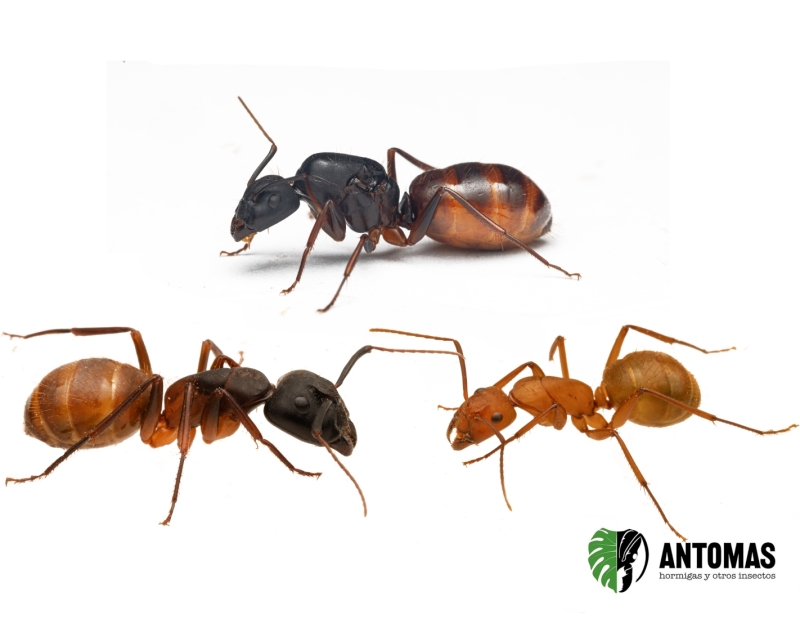
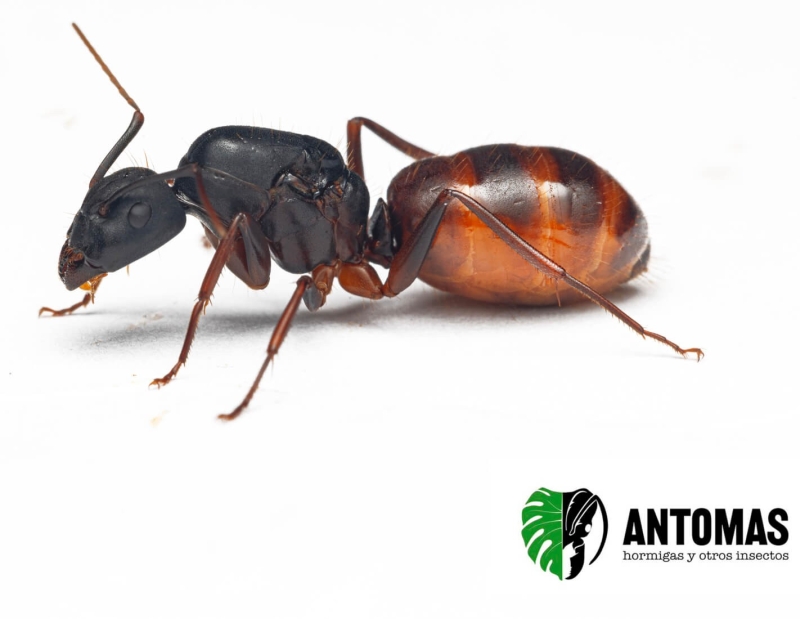
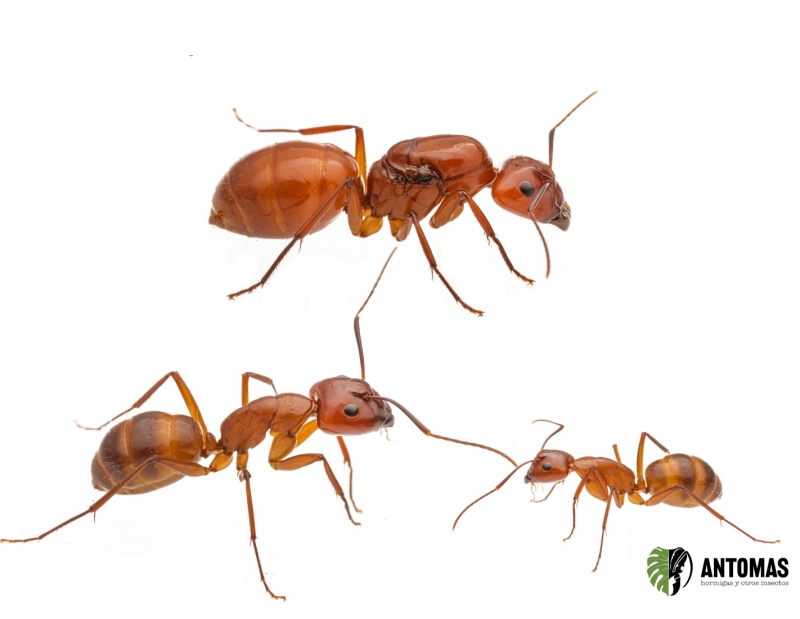
Snelling described its colour like this: workers light brownish yellow, with the back of the head sometimes somewhat brownish and the legs and antennae paler still; queens yellow, with a light brown area on the front of the head and clear wings; and males uniformly brownish, with yellowish appendages. Strictly speaking, no white at all.
But its paleness is real, and it has been measured. In 2022, a study used photographs to compare the body brightness of several honeypot ants: species with a mean value above 65 were considered pale, and those below 60 dark. M. christineae scored 75.2. Of the nine Myrmecocystus populations measured, only one of M. mexicanus gave a higher value, 78.4; M. navajo reached 74.1, and the dark ones, such as M. mendax, stayed below 60.
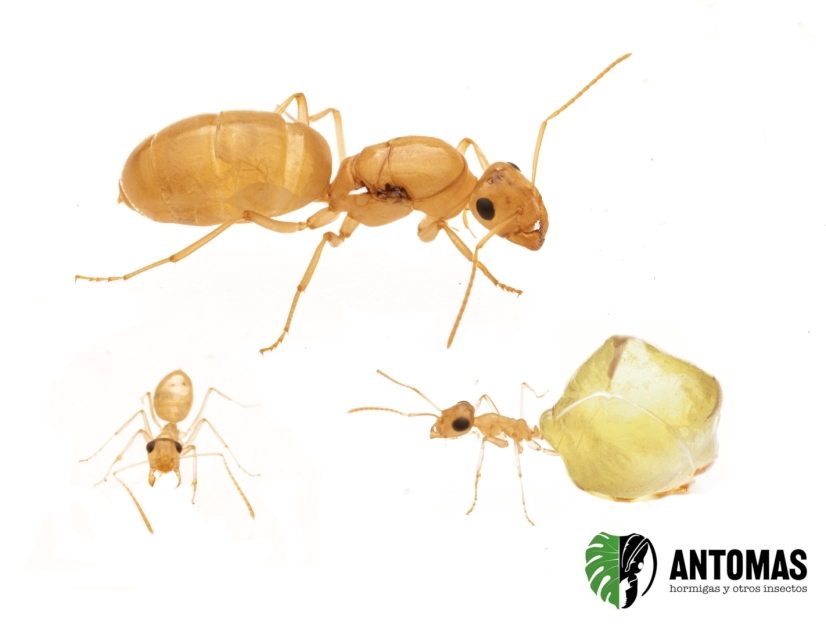
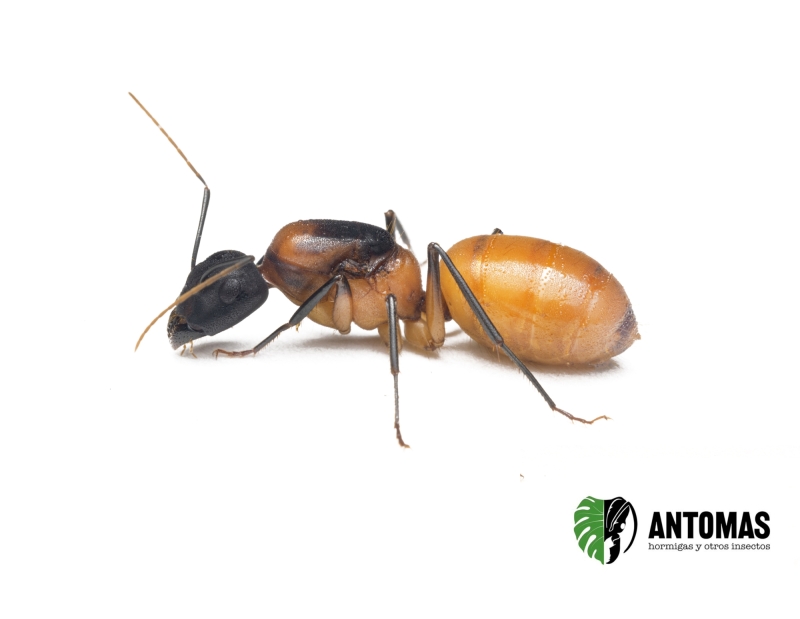
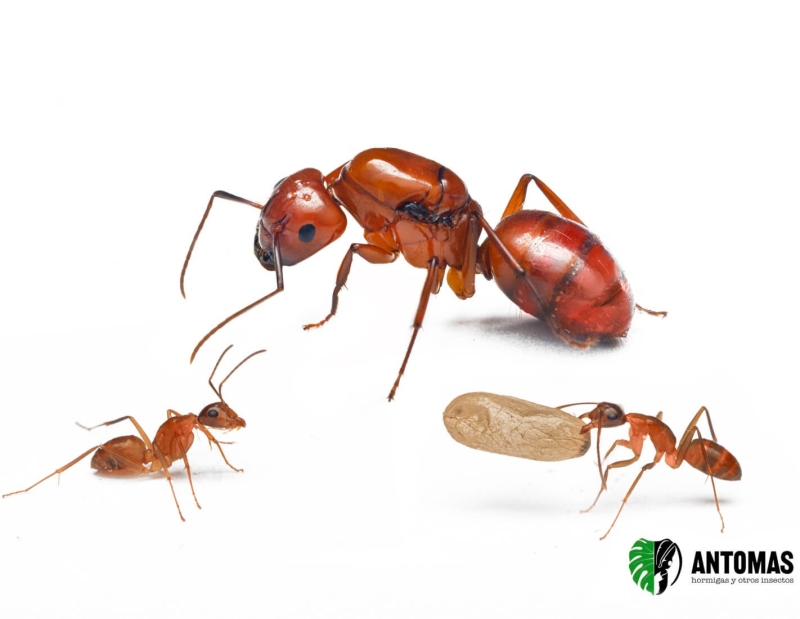
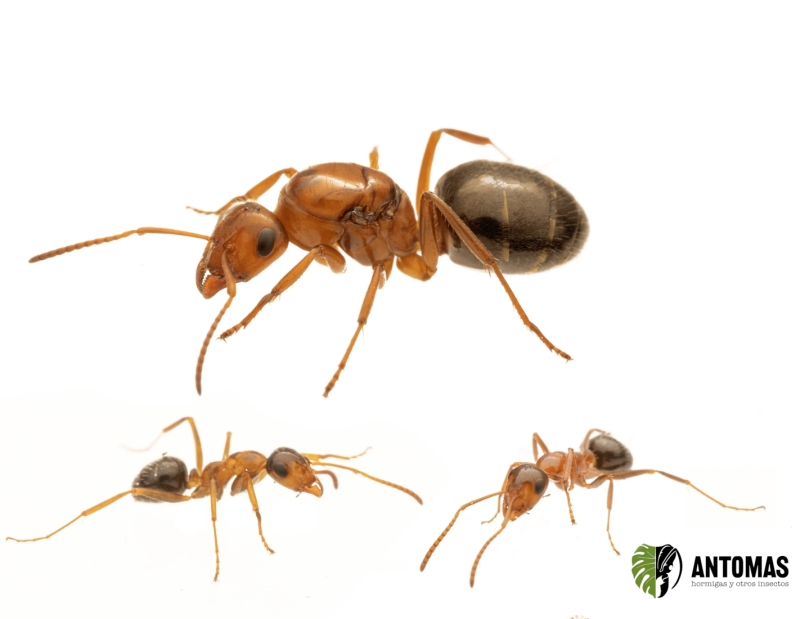
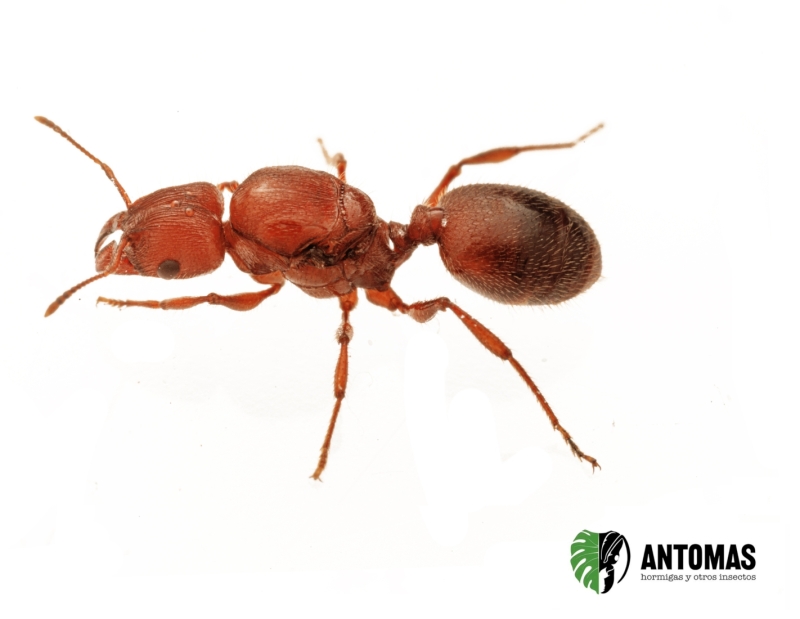
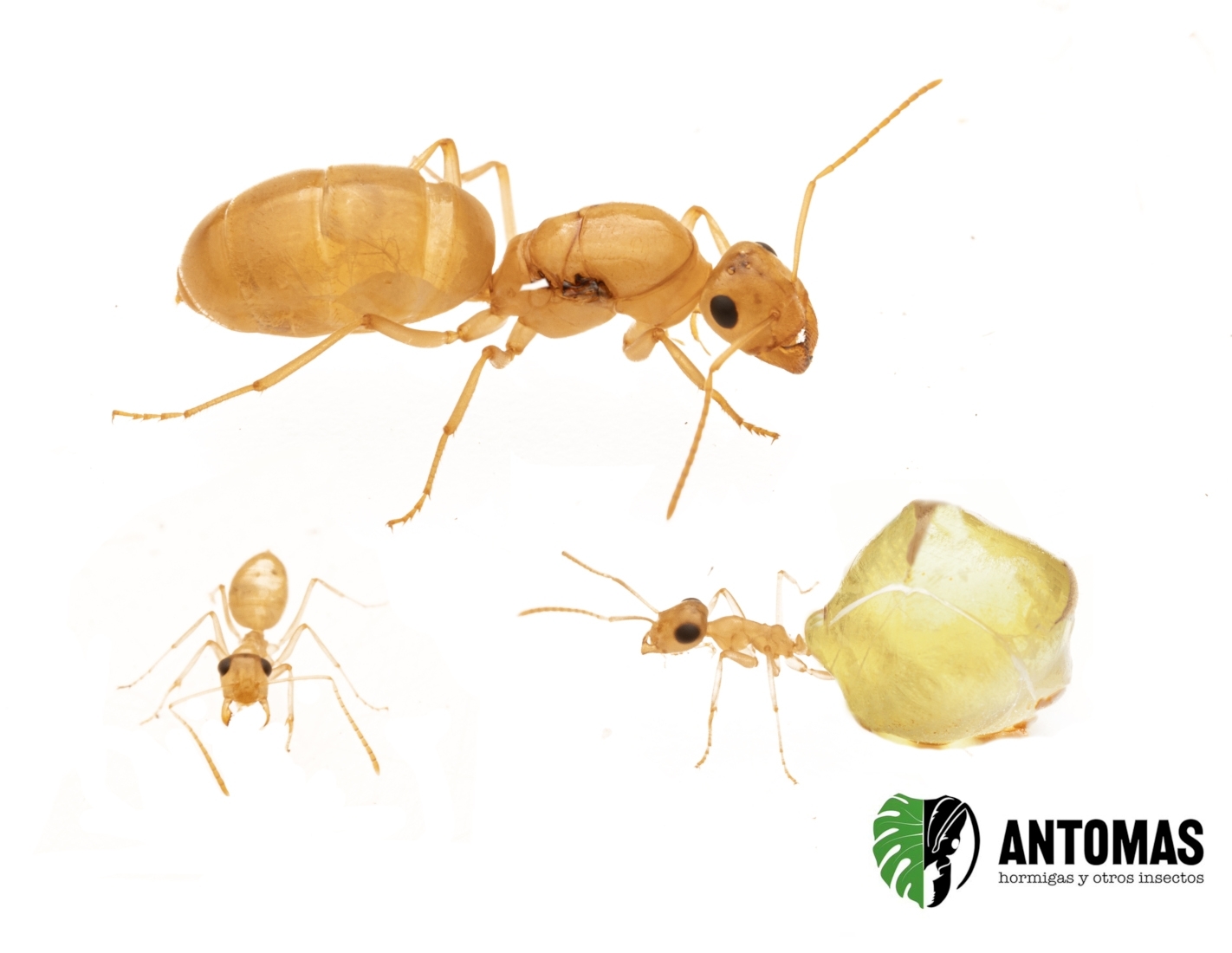
In our colonies, queens and workers are a very light straw yellow, almost whitish, and their repletes fill with a light yellow, translucent liquid. Hence the shop name: “Blanca” exaggerates a little, but it points to exactly what makes it special. Next to a dark honeypot ant such as M. placodops, with its red head and black body, it looks like something from another world.
Big eyes for the night
The same 2022 study measured its eyes, and the result is typical of a nocturnal ant. M. christineae workers have facets, the tiny lenses of the compound eye, about 19.7 microns across on average (20.8 once corrected for body size), compared with about 13–14 microns in M. yuma, a small dark honeypot ant. Wider facets gather more light, which is exactly what an animal moving in dim light needs.
Snelling had already pointed out that its eyes are large and set far back: their upper edge almost reaches the rear corner of the head. It is a trait it shares with the honeypot ants of the M. pyramicus group and with M. navajo. In the 2022 study’s table, M. christineae is listed as a nocturnal species, based on the literature and the authors’ observations. Nobody has yet published a study of its activity, but everything points the same way: pale colour, large eyes and nocturnal relatives.
Small, hairless and halfway between
It is a small honeypot ant. According to Snelling’s measurements, the workers’ head is 0.77 to 1.13 mm long and 0.63 to 1.03 mm wide, and the mesosoma 1.03 to 1.63 mm. For comparison: the majors of M. placodops have heads more than twice as wide as the largest workers of M. christineae. The workers vary in size, but without great extremes: in the small ones the sides of the head are almost parallel, and in the larger ones slightly convex.
And it is almost hairless. It has no erect hairs on the thorax, the cheeks, the antennal scapes or the tibiae, and the first two segments of the gaster lack them in the centre too. Its pubescence, the short hair lying flat against the body, is fine and sparse, and the workers look smooth and moderately shiny.
Snelling placed it in the group of pale, nocturnal honeypot ants, the subgenus Myrmecocystus in the strict sense, alongside M. mexicanus, M. navajo, M. testaceus and M. pyramicus. And he saw it as a link between two species groups: in the profile of the thorax and the number of mandibular teeth, seven or eight in the workers, it resembles the M. mexicanus group; in its set-back eyes and scarcity of hairs, the M. pyramicus group. The molecular phylogenies of the genus, from 2004 and 2021, have shown that these classic groups do not always reflect true relationships. We have not been able to check whether M. christineae was included in them, so its exact place in the honeypot ant family tree remains open.
Pale ants do not fear the cold
Being nocturnal in the desert has a direct consequence: you have to move in the cold. In a classic study of honeypot ants from New Mexico, Kay and Whitford compared diurnal and nocturnal species. The nocturnal species kept moving down to −0.4 °C and went out foraging with air and ground temperatures between 2 and 30 °C. The diurnal ones, by contrast, came to a halt below about 11–12 °C, but went out with the ground at up to 60 °C.
The strategy of the pale species is to avoid the midday furnace and work in the cool hours. M. christineae was not part of that study, but it shares the colour, the eyes and, in all likelihood, the timetable of the nocturnal species. For keeping, this has two practical consequences:
It does not need strong heat. A temperate household temperature is enough, without intense hot spots.
It tolerates a cooler diapause than the dark honeypot ants, such as M. placodops, which become almost motionless at 12 °C (see “A cool diapause for a pale honeypot ant”).
Straw-coloured repletes
Like almost all Myrmecocystus, M. christineae stores the colony’s food in repletes: workers whose crop, the “social stomach” where ants keep the food they share, swells until it fills the whole gaster. They hang motionless from the ceilings of the chambers; the other workers fill them with nectar when there is plenty, and they give it back, mouth to mouth, when it is scarce. An emptied replete does not die: it becomes shrivelled and can be filled again.
Repletes are known in 20 of the 29 species of the genus, but we have not found any publication describing them in M. christineae. In our colonies, they do form them: the one in the shop photo is filled with a light yellow, translucent liquid, matching the colour of its sisters. The colour of a replete depends on what the colony drinks, so yours may vary with the nectar you give them.
In the honeypot ants that have been studied, the larder also holds a few surprises that make a lot of sense in a desert. A small proportion of repletes are clear, much more watery than the rest: genuine water tanks for the dry months. And some also store fats, which form a second layer inside the crop. Nobody has checked this in M. christineae, but for an ant of sandy washes, where water is a luxury, a living water bottle would be a great advantage.
This is how repletes hang in a nest of M. mimicus, a dark honeypot ant; those of M. christineae are straw-coloured (video by Anthouse).
Two queens under one roof
Here science says nothing: nothing has been published on how M. christineae queens found their colonies or how many live in each colony. The 16 queens of the type series do not settle the question, because they were described with wings: they were, in all likelihood, young queens that did not yet have a colony of their own.
What we can tell you is what we see at Antomas: M. christineae is not monogynous. Its queens tolerate each other and live together for life in the same colony, without fighting. That is why we sell it as a colony with two queens, something unusual among the honeypot ants we keep, most of which have just one.
It is not an isolated case in the genus. In M. mimicus, several queens, from 2 to 9 but mostly 2 to 4, often team up to found a colony, but afterwards the workers eliminate the surplus queens until only one is left. In some populations of M. mendax, on the other hand, all the mature colonies studied had several queens, which in the laboratory were not eliminated after the first workers emerged, and those colonies produced more workers and more repletes than single-queen colonies. From what we see at home, M. christineae plays on the tolerant team. It is a keeping observation, not a published study.
Be careful: the fact that queens from the same colony live together does not mean that queens from different colonies can be put together. Never do that.
What science still does not know
This is what has not yet been published about M. christineae:
What its nests are like and how deep it keeps its repletes.
When its nuptial flight takes place. We only know that in mid-April there were already winged sexuals in the nests.
How it founds colonies: alone, in groups or both.
How many workers a mature colony has.
What it eats in the wild and exactly when it comes out.
For now, almost everything known about its daily life comes from those who keep it. If you have a colony, your observations are worth their weight in gold, and we would love you to share them with us.
Size and morphology
A small, pale honeypot ant with almost no erect hairs, large set-back eyes, workers of variable size and no sting. The measurements come from Snelling’s original description (1982).
Colour according to Snelling. Workers light brownish yellow, with the back of the head sometimes brownish and paler appendages. Queen yellow, with the front of the head light brown and pale yellow appendages. Male uniformly brownish.
Colour of our colonies. Queens and workers a very light straw yellow, almost whitish; repletes with a light yellow, translucent liquid.
Head. In workers, longer than wide, with almost parallel sides in the small ones and slightly convex sides in the larger ones. In the queen, as wide as it is long.
Eyes. Large, with the upper edge almost at the rear corner of the head.
Mandibles. With seven or eight teeth in the workers.
Hairs. No erect hairs on the thorax, cheeks, scapes or tibiae; fine, sparse pubescence lying flat against the body.
Integument. Moderately shiny.
Defence. As a formicine, it has no sting; it can bite and release formic acid.
Approximate measurements
Workers: head 0.77–1.13 mm long and 0.63–1.03 mm wide; scape 0.97–1.33 mm; mesosoma 1.03–1.63 mm
Queen: head 1.67–1.73 mm long and 1.67–1.77 mm wide; mesosoma 3.5–3.7 mm
Male: head 0.62–0.70 mm long; mesosoma 1.23–1.40 mm
Total length: not published
Snelling did not give the total length of any caste, and we prefer not to make it up. What his measurements do tell us is that this is a small honeypot ant, with a queen clearly larger than any worker: her head is wider than that of the largest worker, and her mesosoma more than twice as long.
Care in captivity
Difficulty: 4/5 – Advanced
It is not a species for beginners. The reasons are those of all honeypot ants, plus one of its own:
Nobody has much experience with it. There is hardly any published keeping experience, and almost everything we know we have learnt at home. If you take the plunge, you will be one of the few keepers in the world who have it.
Nectar must be rationed. Little and by the drop while there are no repletes; plentiful and constant as soon as they appear (see “Sweet death, twice over”).
Small workers, tiny prey. It is a small honeypot ant, and its prey must be smaller still.
Fragile repletes, which can fall or burst if handled badly.
On the other hand, the colony arrives with a head start: two queens and between 20 and 30 workers, with the founding stage behind them. And it is worth it: it is a living rarity, with a colour unlike that of any other honeypot ant in our shop, two queens that share the nest for life and a biology waiting to be discovered. Few species let you learn something that science does not yet know.
Parameters for a high-desert honeypot ant
Temperature: at Antomas we keep them practically at household room temperature. As keepers’ data, those who succeed with the genus keep them at 24–31 °C, ideally around 29 °C; for a pale, nocturnal honeypot ant like this one, the temperate part of that range is enough.
Extra heat: not needed. If you use it, keep it gentle, at one end of the nest and always away from the repletes.
Cooler nights: no problem; that is what they find in their desert.
Humidity: a fairly dry nest, with a moist spot near the brood.
Replete area: stable, without condensation; neither wet nor parched.
Foraging area: dry and ventilated, with a little sand if you want to recall its washes.
Water: a test tube with water and cotton wool in the foraging area, always.
Light: nest area dark and foraging area lit, with the normal day-night cycle.
Diapause: about 4 months, from November to February, at 8–14 °C (see “A cool diapause for a pale honeypot ant”).
Recommended formicaria
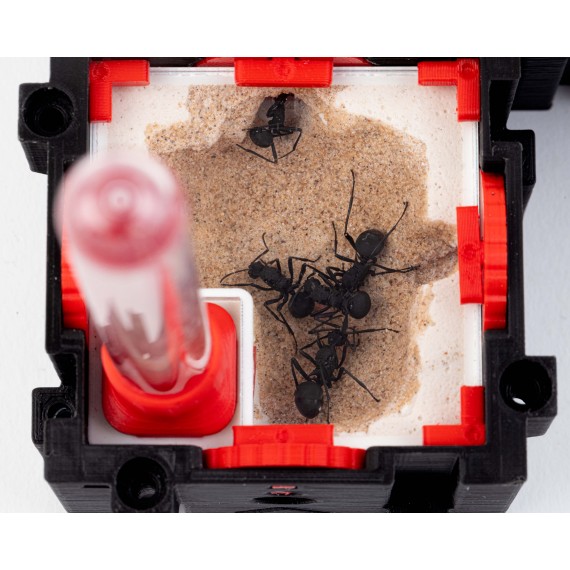
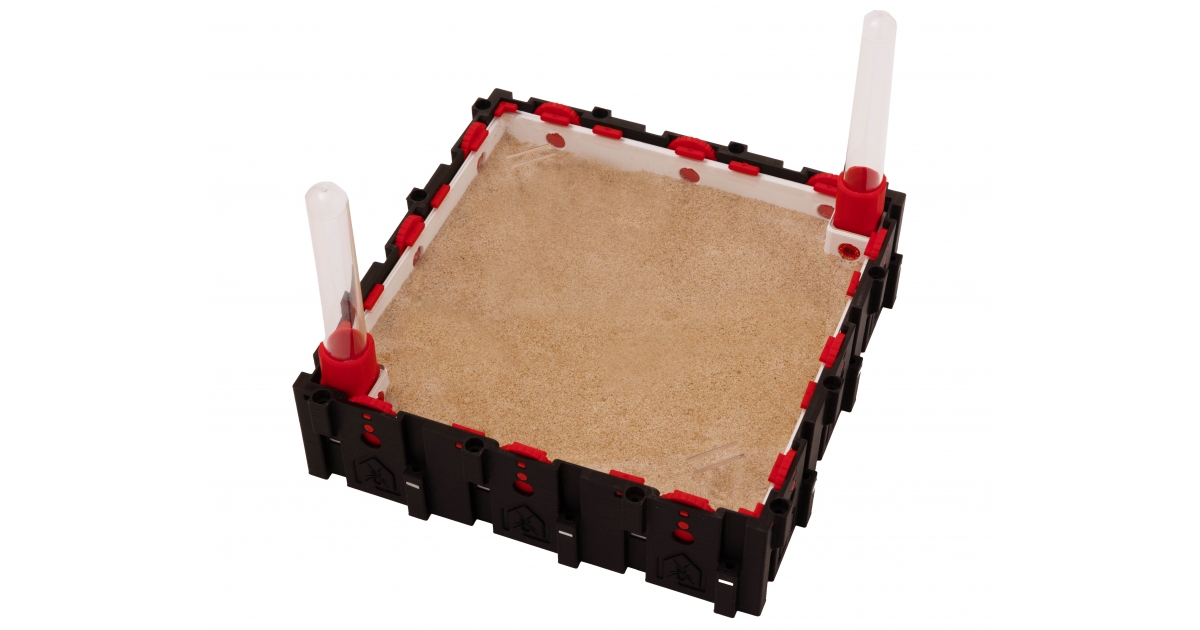
For a colony with two queens and a few dozen workers, at Antomas we recommend starting with the Qbik Wild One P 1C by Anthouse. It has horizontal chambers high enough for the repletes to hang without touching the floor, and it lets you watch both queens and the brood without disturbing them:
Once the colony has grown, the Qbik Wild NoNa Diáfano lets it dig its own galleries in a block of substrate. It is the option closest to its sandy washes: use a mixture of sand and soil compact enough for the ceilings not to collapse, and moisten it only in places, away from where the repletes hang. Keep it for large colonies, because in a small one you would lose sight of the queens and the brood.
Three details for any honeypot ant nest: rough ceilings the repletes can grip; chambers at least 2–3 cm high; and no vertical nests while the colony is small. And do not expand too early: a new module is connected when the previous one is really occupied.
Arrival and moving by tipping
When available, we send M. christineae as “2 Queens and 20/30 workers with brood”: two queens that already live together, between 20 and 30 workers and brood. The founding stage, the riskiest phase for any honeypot ant, is over.
When it arrives, leave it in peace for a few hours in a cool, dim place and check that it has water. To move it into the formicarium, at Antomas we always do it by tipping:
Set up the complete nest beforehand, with the mineral oil barrier and the water tube.
Open the tube inside the foraging area, next to the nest entrance, working over a tray.
Gently tip out the queens, the workers and the brood from a very low height. Help the stragglers with a soft brush.
Keep the nest area dark: the workers will carry the brood and the queens inside within a short time.
The two queens move together: there is no need to separate them or watch them individually. If the colony already has repletes, tip even more carefully and without shaking, because a replete that drops sharply can burst. Ideally, make the main move before they appear, and settle the colony in a permanent nest as soon as it has its first larders.
Sweet death, twice over
There is one mistake that can ruin a honeypot ant colony, and at Antomas we know it well. If a small colony, still without repletes, has sugar to spare, the queen herself may be the one who fills up: her gaster swells like a replete’s, egg-laying slows down or stops and the colony stops growing. There are no published studies on this; it is keeping experience. With M. christineae the risk is double, because there are two queens that could end up turned into larders.
The danger of giving too much sugar at the start, explained by Anthouse: queens that end up as repletes.
The solution is simple:
No repletes in the colony: sugary liquid is given by the drop, a few drops that the workers finish quickly. No full feeders yet.
With the first repletes: sugar becomes available ad libitum, and from that day on it must never run out. Repletes need plenty of nectar to fill up and stay full.
From dropper to feeder: feeding
Varied nectar, well served. While respecting the two phases above, alternate the sugars: at Antomas we recommend Anthouse’s Blue Sugar nectar 4–5 times a week and another nectar or sugary liquid 1–2 times a week, and you can enrich the nectar with a little protein. When the feeder phase arrives, make it a proper feeder, never cotton wool: cotton wool goes mouldy and spoils the liquid within a few days. A traditional or home-made feeder in which the drop stays “spread out” and within the workers’ reach will do. Change it before it ferments.
Tiny prey, almost daily.M. christineae workers are small, so the protein must be exaggeratedly small, especially at first: Drosophila, firebrats (Thermobia), termites and micro-crickets, freshly killed or cut up and, if possible, every day. As the colony grows it accepts somewhat larger pieces and larger amounts, but then it is better to space out the feeds rather than give them daily. Alternate the type of insect from one week to the next, so that the diet is not always the same.
At Antomas we are not afraid of protein: with daily removal of leftovers, we would rather overdo it than fall short, because a well-fed colony understands that there are resources and grows faster and with more workers. If you cannot check the nest often, it is better not to overfeed: forgotten leftovers rot and attract mould and mites. And remember that repletes store liquids, but larvae only grow with protein.
We do not yet have a video of M. christineae larvae, but these, from its dark cousin, raised at Antomas, show very well how honeypot ant larvae feed:
Honeypot ant larvae feeding; in this case, M. placodops (Antomas channel).
For a species with nocturnal habits: offer the protein at dusk, when the colony comes to life, and remove what is left the next morning.
Water: always within reach in the tube with cotton wool in the foraging area, even when the nectar feeder is full.
A cool diapause for a pale honeypot ant
At the type locality of M. christineae, at about 1,300 m in the Mojave, winters are cold, and its nocturnal relatives keep moving close to 0 °C. At Antomas we give it a diapause somewhat shorter than that of native ants: about 4 months, from November to February.
The guide temperature is 8–14 °C, cooler than what we recommend for dark, diurnal honeypot ants. The reason is physiological: diurnal species such as M. placodops become almost paralysed below about 12 °C and need a mild winter of 14–18 °C, while the pale, nocturnal ones cope with the cold without any problem (see “Pale ants do not fear the cold”). For M. christineae, a winter at 8–14 °C is a natural rest, not a punishment.
Gradual changes: lower the temperature over one or two weeks, and raise it the same way at the end.
Water, always.
Some nectar if the workers keep moving, without topping up the repletes again and again.
Minimal or no protein while there are no growing larvae.
Small colonies or colonies without repletes: better at the top of the range, around 12–14 °C.
In March, when movement returns and new brood appears, gradually bring back the protein.
Behaviour in captivity
A colony of the dusk. Most likely you will see it more active in the late afternoon and at night, as befits a pale honeypot ant. During the day, it is normal for many of the workers to stay inside the nest.
Two queens at peace. The queens share chamber and brood without conflict. Do not worry whether you see them together or apart: both are normal.
Watch without fear. At Antomas we believe that ants are there to be enjoyed, observed and learnt from, not hidden away. Leave them their dark area in the nest and a lit foraging area, and watch them calmly, intervening only as much as necessary. With such a little-known species, every observation counts.
Warning signs:
A queen with a very swollen gaster and egg-laying halted before there are repletes: too much sugar.
Larvae that do not grow outside diapause: not enough protein, or prey too large.
Fallen repletes: the ceiling is too smooth or has condensation.
Mould in the chambers: too much humidity or leftovers not removed.
Escapes and barriers
They are not particularly prone to escaping, and in our experience mineral oil is enough. Apply a thin, continuous band at the top of the foraging area walls and renew it when it gets dirty. Make sure the lid fits well, check tubes and connections and do not leave anything leaning that could serve as a bridge. As the workers are small, pay special attention to gaps.
Handling and safety
They cannot sting, as they have no sting. They can bite and release formic acid if they feel trapped, but they are so small that you will barely notice. The care is for them: always handle them with a soft brush or another entomological tool, never with your fingers. Do not put together queens or colonies from different origins, or keep them with other species. It is an exotic species: it must never be released.
What not to do
Give a full feeder to a colony without repletes: either of the two queens could end up as a replete.
Let the nectar run out once there are repletes.
Serve sugary liquids on cotton wool.
Give large prey to such small workers or let days go by without protein at the start.
Expose it to strong heat or place the heat source next to the repletes.
Skip the winter diapause: it is a honeypot ant of cold winters.
Wet the whole nest or leave condensation where the repletes hang.
Separate the two queens from their colony.
Put together queens or colonies from different origins.
Handle them with your fingers.
Scientific sources
This care sheet is based on the original description of the species (Snelling, R. R., 1982, Bulletin of the Southern California Academy of Sciences 81: 69–86, no DOI), on distribution records from GBIF and Arizona State University, on the scientific literature on the genus and on the experience of Antomas. Main references:
Johnson, R. A. & Rutowski, R. L. (2022). Color, activity period, and eye structure in four lineages of ants: Pale, nocturnal species have evolved larger eyes and larger facets than their dark, diurnal congeners. PLOS ONE 17: e0257779. doi:10.1371/journal.pone.0257779
Kay, C. A. R. & Whitford, W. G. (1978). Critical thermal limits of desert honey ants: possible ecological implications. Physiological Zoology 51: 206–213. doi:10.1086/physzool.51.2.30157867
van Elst, T., Eriksson, T. H., Gadau, J., Johnson, R. A., Rabeling, C., Taylor, J. E. & Borowiec, M. L. (2021). Comprehensive phylogeny of Myrmecocystus honey ants highlights cryptic diversity and infers evolution during aridification of the American Southwest. Molecular Phylogenetics and Evolution 155: 107036. doi:10.1016/j.ympev.2020.107036
Kronauer, D. J. C., Hölldobler, B. & Gadau, J. (2004). Phylogenetics of the New World honey ants (genus Myrmecocystus) estimated from mitochondrial DNA sequences. Molecular Phylogenetics and Evolution 32: 416–421. doi:10.1016/j.ympev.2004.03.011
Bartz, S. H. & Hölldobler, B. (1982). Colony founding in Myrmecocystus mimicus Wheeler (Hymenoptera: Formicidae) and the evolution of foundress associations. Behavioral Ecology and Sociobiology 10: 137–147. doi:10.1007/BF00300174
Eriksson, T. H., Hölldobler, B., Taylor, J. E. & Gadau, J. (2019). Intraspecific variation in colony founding behavior and social organization in the honey ant Myrmecocystus mendax. Insectes Sociaux 66: 283–297. doi:10.1007/s00040-019-00687-y
Conway, J. R. (1977). Analysis of clear and dark amber repletes of the honey ant, Myrmecocystus mexicanus hortideorum. Annals of the Entomological Society of America 70: 367–369. doi:10.1093/aesa/70.3.367
Burgett, D. M. & Young, R. G. (1974). Lipid storage by honey ant repletes. Annals of the Entomological Society of America 67: 743–744. doi:10.1093/aesa/67.5.743
Conway, J. R. (1986). The biology of honey ants. The American Biology Teacher 48: 335–343. doi:10.2307/4448321
Conway, J. R. (1994). Honey ants. American Entomologist 40: 229–234. doi:10.1093/ae/40.4.229