This website uses its own and third-party cookies to improve our services and show you advertising related to your preferences by analyzing your browsing habits. To give your consent to its use, press the Accept button.
Functional cookies are strictly necessary to provide the services of the shop, as well as for its proper functioning, so it is not possible to refuse their use. They allow the user to browse through our website and use the different options or services that exist on it.
Cookie
Provider
Purpose
Expiry
PHP_SESSID
antomas.es
The PHPSESSID cookie is native to PHP and allows websites to store serialised status data. On the website it is used to establish a user session and to pass state data through a temporary cookie, which is commonly known as a session cookie. These Cookies will only remain on your computer until you close your browser.
Session
PrestaShop-#
antomas.es
This is a cookie used by Prestashop to store information and keep the user's session open. It stores information such as currency, language, customer ID, among other data necessary for the proper functioning of the shop.
These are cookies that collect information about the advertisements shown to users of the website. They can be anonymous, if they only collect information about the advertising spaces shown without identifying the user, or personalised, if they collect personal information about the user of the shop by a third party, for the personalisation of these advertising spaces.
Collect information about the user's browsing experience in the shop, usually anonymously, although sometimes they also allow the user to be uniquely and unequivocally identified in order to obtain reports on the user's interests in the products or services offered by the shop.
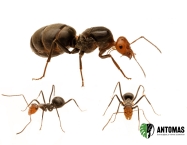
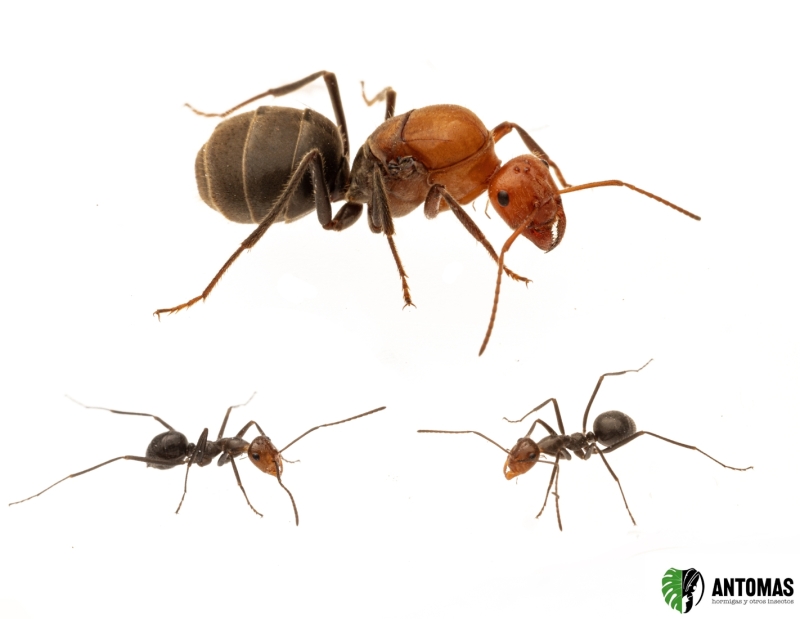
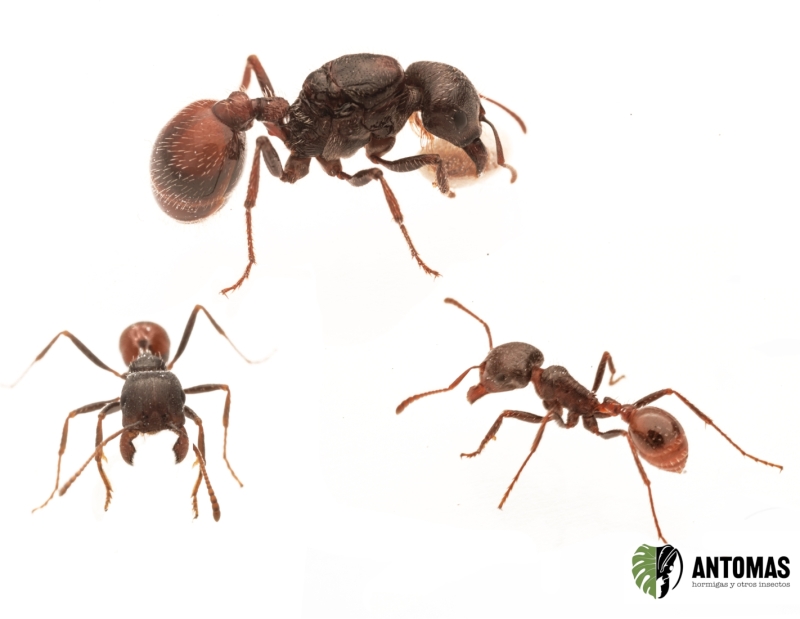
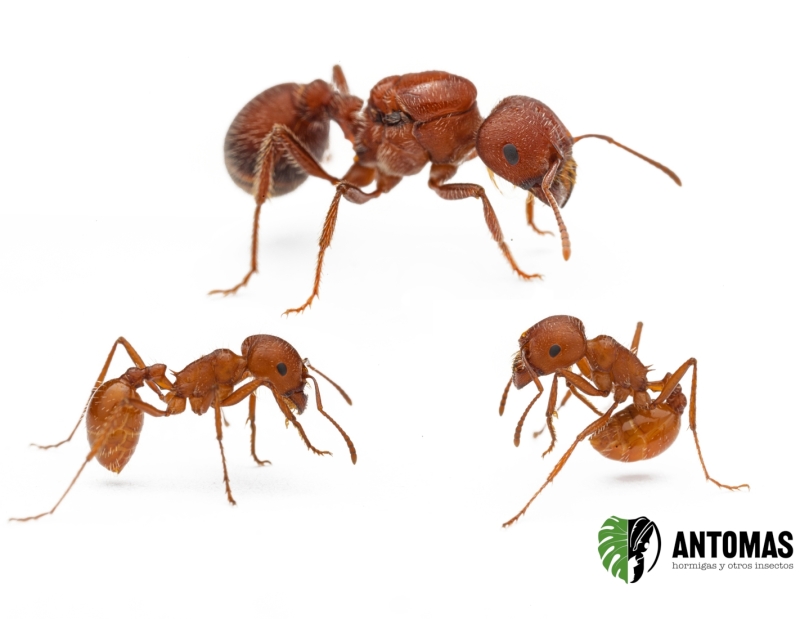
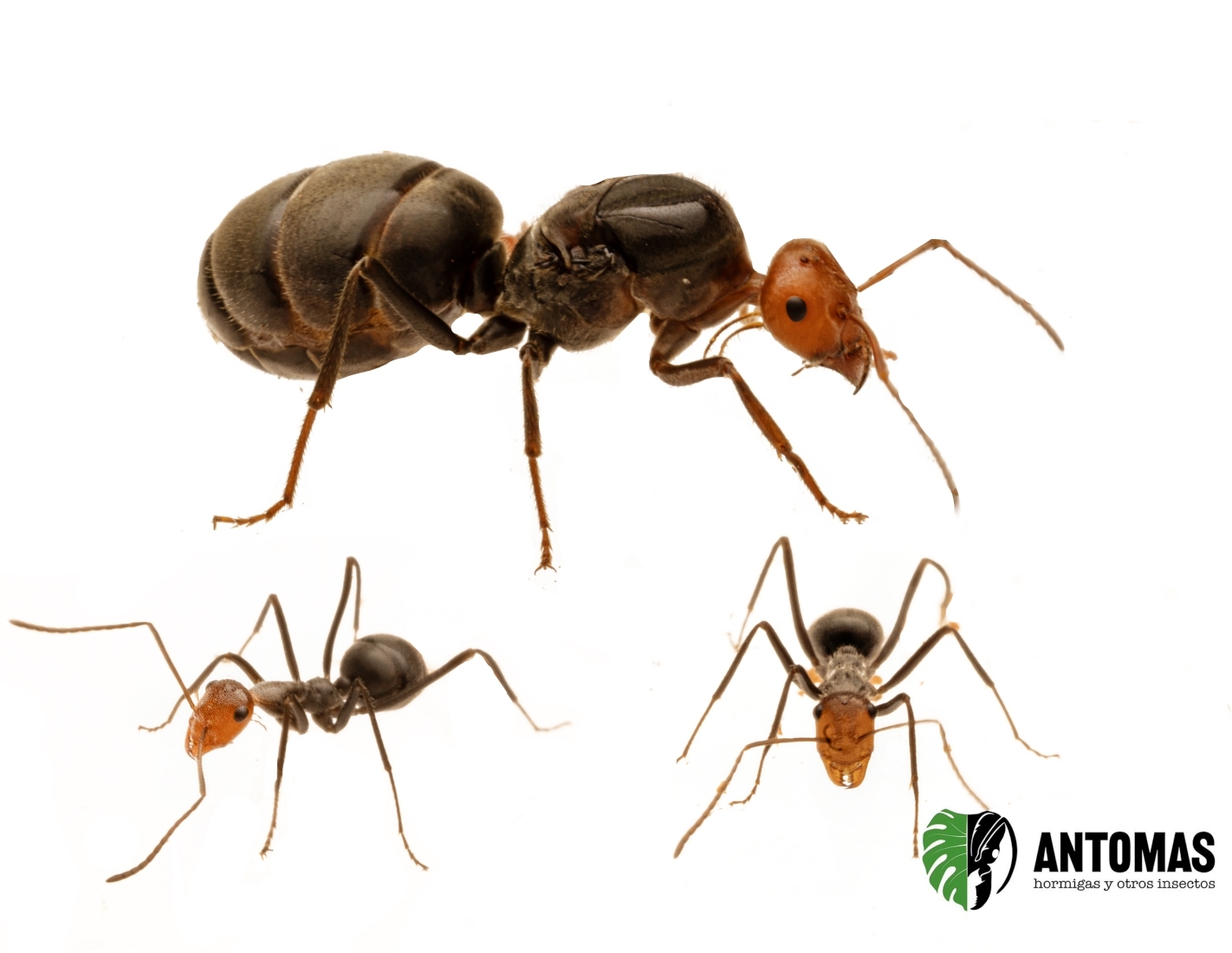
The midday hunter wears a red crown. Myrmecocystus placodops goes out hunting when the sun scorches the deserts of Texas, Arizona and northern Mexico, and stores nectar in repletes, workers turned into living jars that hang from the ceilings of nests more than 3.7 metres deep. Its queen sports a reddish-orange head on a black body, and its majors an almost round head that puzzled scientists for decades. A diurnal honeypot ant to watch in action in broad daylight, and a jewel for patient keepers. Colonies with queen. Shipping across Europe, live arrival guaranteed.
A dark, diurnal honeypot ant from the south-western United States and northern Mexico: a queen with a reddish-orange head and a black body, majors with an almost round head and nests more than 3.7 m deep. A very active hunter in full sun. Colonies with queen, with a single queen. A Qbik Wild nest with rough ceilings, household room temperature, sugar by the drop at first and ad libitum from the first repletes, and tiny protein almost every day. Diapause of about 4 months (November–February) at 14–18 °C. Not great escape artists: mineral oil is enough.
Myrmecocystus placodops Forel, 1908 is one of the large honeypot ants of North America and, for us, the most striking of the dark ones. The queen wears an intense reddish-orange head on a black body, and the workers repeat the contrast with an orange-red head: hence its name in our Spanish shop, “Hormiga Mielera de Cabeza Roja”, which refers to that red head. Like all Myrmecocystus, it stores the colony’s food in repletes, workers turned into living larders that hang from the ceilings of the chambers with their gaster swollen like a grape.
But it is no ordinary honeypot ant. It goes out hunting with the sun high in the sky, while the pale honeypot ants wait underground for nightfall; its largest workers have an almost circular head, a trait that baffled taxonomists for decades; and it digs nests deeper than two people standing on each other’s shoulders. In this care sheet we separate what has been published about it, which is little, what is known about its genus, which is a lot, and what we have learnt from keeping it. And the larvae in our video, in the feeding section, are M. placodops larvae.
Biology
From the Rio Grande to the Sonoran Desert
M. placodops lives in the south-western United States and northern Mexico. According to the revision of the genus published by Roy R. Snelling in 1976, its range runs from the Rio Grande valley and the neighbouring lowlands of Texas and Mexico westwards to Sonora and Arizona, and it is especially abundant in the Rio Grande valley itself and on the plains of western Texas. Records in biodiversity databases place it mainly in Arizona, Texas and New Mexico, with a few in California, and in Mexico in Chihuahua, Sonora, Coahuila, Nuevo León and Tamaulipas. There are also records from Utah, outside the range given by Snelling, which are probably misidentifications.
Its landscape is open, dry and sunny, and it changes from one state to another:
Texas: from the Spartina prairies of the south to mesquite savanna; most records come from grassland with cenizo scrub (Leucophyllum) and from mesquite and acacia savanna. In the Panhandle, the north of the state, it lives in grama and buffalo grass grassland.
New Mexico: creosote bush and tarbush (Flourensia) scrub.
Arizona: creosote bush and Ambrosia scrub.
It nests in open areas, in mineral soils, often stony or covered with gravel. And it has a small peculiarity within its species group, the M. melliger group: its relatives usually live at low and middle elevations in desert mountain ranges, but in Texas M. placodops is the exception and lives on flat ground, far from the mountains.
Endiodioctes: the midday hunter
In his 1976 revision, Snelling divided the honeypot ants into three groups, or subgenera. He placed the large, dark or bicoloured, diurnal species under the name Endiodioctes, Greek for “midday hunter”, and there he put M. placodops, alongside relatives such as M. melliger, M. mendax and M. mimicus. The name fits it like a glove. While the pale honeypot ants, such as M. mexicanus, forage at night, the Endiodioctes forage in light and heat, and Snelling described them as great predators of small arthropods.
In M. placodops in particular, observers have highlighted the huge quantity of insects and insect fragments that foragers haul back to the nest. It is a very active hunter and scavenger: it catches small arthropods, collects dead insects and makes use of any source of protein it finds around the nest, and that protein goes mainly to the larvae. But it does not live on meat alone: the workers look for nectar in flowers, honeydew from sap-sucking insects and sweet juices from desert plants, and use them to fill the repletes.
A word of caution: Snelling’s subgenera are no longer used as formal categories, because the 2021 molecular phylogeny showed that they do not match the real family tree of the honeypot ants. Diurnal life has evolved more than once, and Snelling’s groups remain a practical way of grouping species by their appearance and their timetable.
An engine that shuts down at 12 °C
Why do some honeypot ants come out by day and others by night? Part of the answer lies in temperature. In a classic study of desert honeypot ants from New Mexico, Kay and Whitford measured the thermal limits of diurnal and nocturnal species, and the difference was huge:
Cold: the diurnal species lost the ability to move below 11.2–12 °C; the nocturnal species kept moving down to −0.4 °C.
Heat: here they were all similar, with a limit of 43–48 °C.
In the field: the diurnal species were active with air temperatures between 13 and 46 °C and a soil surface of up to 60 °C, hot enough to fry an egg; the nocturnal species only between 2 and 30 °C.
Nothing similar has been measured in M. placodops, but it shares its group, colour and timetable with the diurnal species in the study. For keeping, this is gold dust: it explains why its diapause must be mild, since below about 12 °C a diurnal honeypot ant becomes almost motionless (see “Diapause: four mild months”), and why it appreciates a warm spot in the nest. It is an ant built for heat.
Red head, black body: dressed for the sun
Broadly speaking, honeypot ants fall into pale and dark species, and colour is no whim. A 2022 study measured the brightness of the body and the eyes of several Myrmecocystus species and of three other genera of desert ants, and the conclusion fits in one sentence: pale, nocturnal species have larger eyes and wider facets than their dark, diurnal relatives of similar size. In the dark honeypot ants studied, such as M. mendax and M. kennedyi, the facets measured about 14–16 microns on average, compared with about 20–22 in the pale ones. With light to spare, a diurnal ant does not need such sensitive eyes.
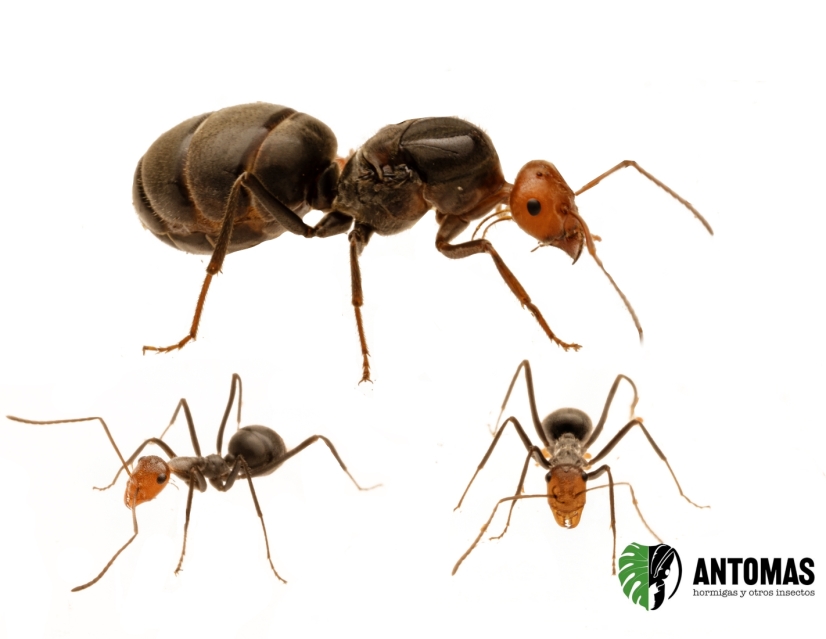
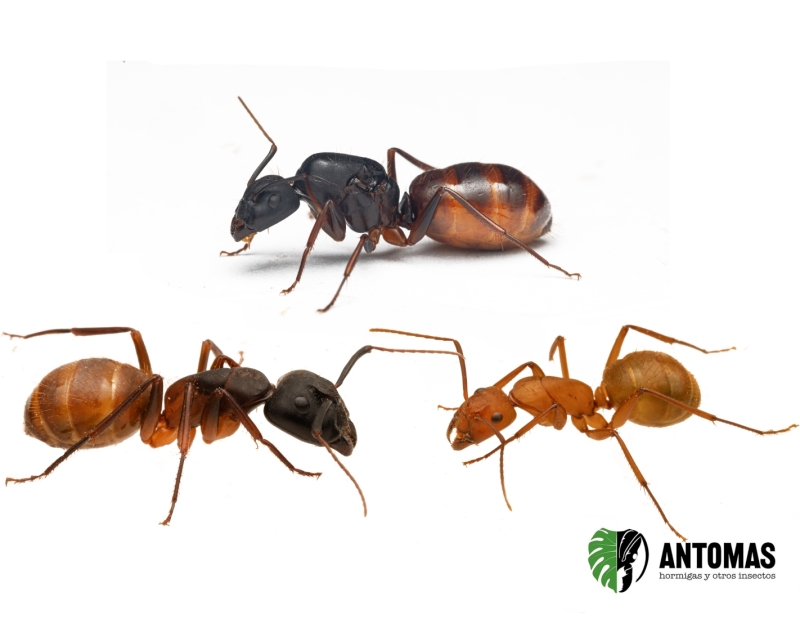
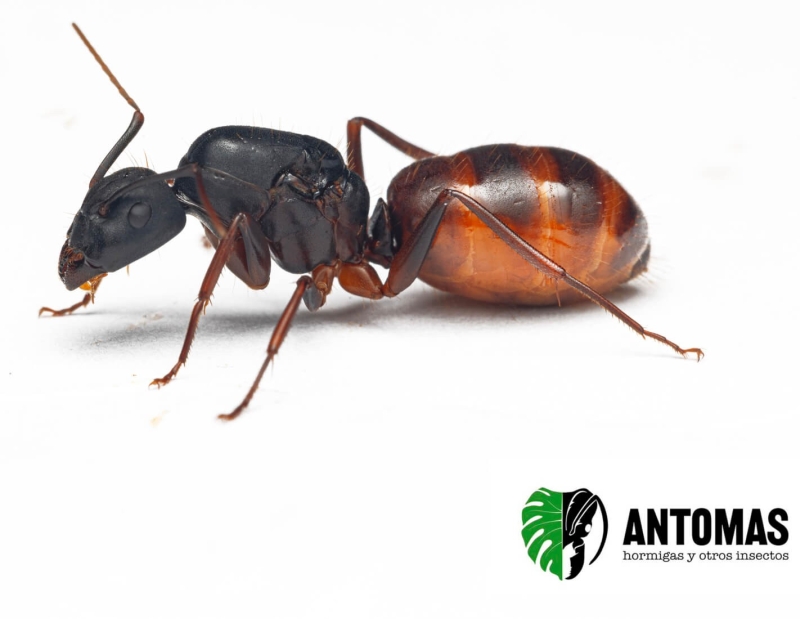
M. placodops was not included in that study, but it wears the dark species’ outfit. In our colonies, the queen has an intense reddish-orange head and the rest of the body, the mesosoma (the thorax) and the gaster, black or very dark brown; the workers have an orange-red head and a black body. Snelling described the Endiodioctes as bicoloured, with a reddish front part and a blackish gaster, and we have not been able to consult his detailed description of the species. Why the head is red and the rest black, nobody has studied; but in a well-lit formicarium, that contrast is quite a sight.
Round-headed majors
The most characteristic trait of M. placodops is found in its largest workers. The species is polymorphic, with a continuous series of sizes, from small to large, but without a separate soldier caste. And in the largest workers the head widens until it becomes distinctly orbicular, almost circular when seen from the front. It is one of the characters used in Snelling’s key to recognise it, and it allows its majors to be told apart from those of other closely related honeypot ants. The head width of the workers ranges from 0.8 to 2.3 mm: the largest worker’s head is almost three times as wide as the smallest’s.
These round-headed majors look like soldiers, but they are not: they belong to the same gradual series and do a bit of everything. They take part in defence, in catching prey and in carrying food, and they also play a special role in the larder. In honeypot ants, repletes come mainly from the largest workers, and if the repletes are removed from a colony, the next workers in size take their place (see “Living larders hanging from the ceiling”). In an M. placodops colony, therefore, the round-headed majors are the best candidates to become repletes.
At home you will need patience to see them: the first generations are small workers, and the large ones arrive as the colony grows.
Orbiceps: the head that baffled taxonomists
The scientific history of M. placodops reads almost like a novel. The Swiss myrmecologist Auguste Forel described it in 1908 from a single worker whose label simply said “Mexico”. That same year, the American William M. Wheeler described a form called orbiceps, from Bull Creek, near Austin (Texas), on the basis of its workers with orbicular heads and because he found no repletes. And so the name game began:
In 1954, orbiceps came to be regarded as a synonym of M. melliger.
In 1969, Snelling moved it to M. placodops.
And in his 1976 revision he moved it to M. mendax, where it remains today.
There is a reason for the muddle. The workers of these species look very much alike, and according to Snelling the queens and males of M. mendax, M. melliger and M. placodops apparently cannot be told apart. It is also confused with M. intonsus, another honeypot ant whose majors have very orbicular heads, and with M. koso. There are even records from California published as M. placodops that are now attributed to another species, M. semirufus.
And the story is not over. In 2026, a genetic study of the M. mendax complex, with 140 specimens and more than 2,500 regions of the genome, detected a cryptic lineage with the morphology of M. placodops: there may be more species hiding under that name than we think. It is a preprint, not yet peer-reviewed, but it teaches a clear lesson: old data on “orbiceps” or on “round-headed melliger” cannot simply be attributed to M. placodops. You will see why with the Tucson nest.
Living larders hanging from the ceiling
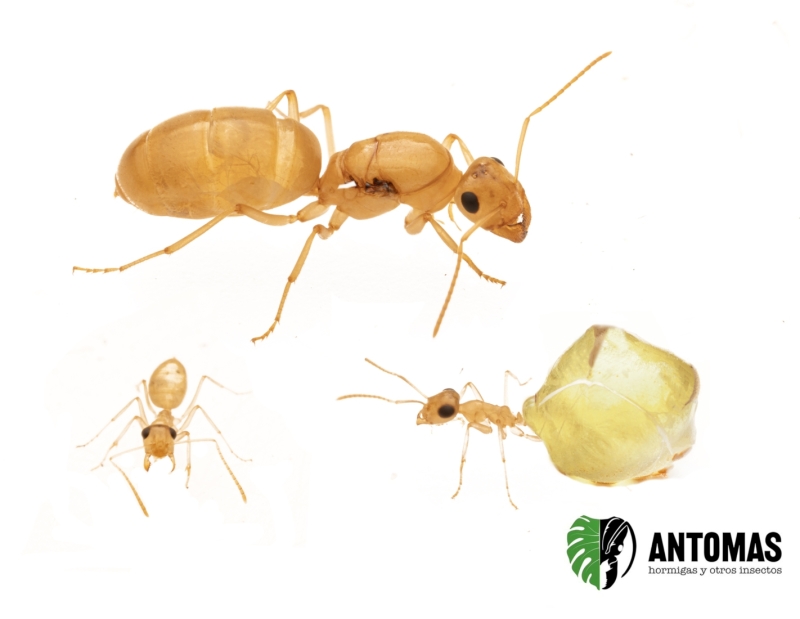
Like all honeypot ants, M. placodops produces repletes: workers that store large quantities of liquid in their social stomach (the crop), the widened part of the gut where ants keep the food they share, until their gaster turns into a translucent sphere.
Repletes spend their lives hanging from the ceilings and walls of the deep chambers. When nectar and other nourishing liquids are plentiful, the foragers fill them by trophallaxis, the mouth-to-mouth exchange of food. In times of scarcity, the process is reversed and the repletes gradually return their reserves to the rest of the colony. They are a communal larder made up of living individuals: they not only store food, but hand it out exactly when another worker, a larva or the queen needs it. And they do not die when emptied: an empty replete becomes limp, with its crop still distended, and can be filled again.
Repletes are not born destined for this role. Certain workers, usually large and often young, though they need not be, begin to receive food from their nestmates until their gaster becomes distended. Once completely full, they can barely move and no longer go outside to work.
And what do they store? Mainly nectar and honeydew, which is why the liquid can be clear, yellow, orange, reddish or brown depending on the food source, and repletes of very different colours can live side by side in the same colony. But the honeypot ants that have been studied hold some surprises: a few clear repletes, rich in water, that work like water bottles, and milky ones, with proteins and fats from prey. In a hunter like M. placodops this would make sense, although nobody has analysed it.
Repletes of M. mimicus, a diurnal relative of M. placodops, hanging from the ceiling of their nest (video by Anthouse).
A cousin of Lasius, a neighbour of the desert
Myrmecocystus are exclusively North American ants: they live in the deserts and semi-deserts of the south-western United States and northern Mexico. They belong to the formicine subfamily and their closest relative is Lasius, the genus of the black garden ant, so common in Europe. The 2021 molecular phylogeny dated the split between the two lineages to the early Miocene and the diversification of today’s honeypot ants to about 14 million years ago, at the same time as the North American deserts were forming. Of the 29 described species, repletes are known in 20, and M. placodops is one of them.
The curious thing is that the living larder has been invented several times. In Australia, Camponotus inflatus and Melophorus bagoti also have repletes without being close relatives of Myrmecocystus: it is convergent evolution, the same solution for storing a few weeks of plenty to survive months of drought. The honey of C. inflatus, which Aboriginal Australians collect as a treat, even has its own antimicrobial activity, different from that of bees’ honey. Nobody has analysed that of M. placodops.
A nest deeper than two people
To protect its repletes, M. placodops digs downwards, and a long way. The most solid record is an old one: in 1929, the naturalist Parks found a nest in a gravel pit near San Antonio (Texas) that went down more than 12 feet, about 3.7 m, with the repletes kept in a layer of soft sand. That is the height of two adults standing on each other’s shoulders.
As in other honeypot ants that have been excavated, the first galleries pass through the gravel or compact soil at the surface; further down, where the earth is softer and more stable, the workers build low, wide chambers with rough ceilings, from which the repletes hang. It is a city built downwards: the workers labour near the surface, while the most valuable reserves are kept in deep storerooms, with a temperature and humidity far more stable than outside. In a desert where the soil surface can exceed 60 °C in summer and cool down sharply on winter nights, those metres of earth are the best possible insulation. Snelling, in fact, never found repletes above the level at which the soil keeps permanent moisture.
This depth cannot be reproduced in a formicarium, but its logic can: wide, low chambers, rough ceilings to cling to and a stable area, without direct heat or condensation, for the repletes (see “Set-up: rough ceilings and a gradient”).
The Tucson nest: placodops or melliger?
There is an even more famous nest. In 1954, Creighton and Crandall published the excavation of a honeypot ant nest near Tucson (Arizona) that went down more than 16 feet, about 4.9 m, with more than 1,500 repletes and several hundred workers. It was such a hard dig that, according to the myrmecologist John Conway, professional gravediggers had to be hired. Our old care sheet attributed it to M. placodops, as do some current sources.
But there is a problem. The original paper is titled “New data on the habits of Myrmecocystus melliger”, and Conway, in his 1986 review, cites it as a nest of M. melliger. The attribution to M. placodops is a later reinterpretation, based on the fact that the colony had orbicular-headed workers, the trait of the old orbiceps, and many repletes. With what you already know about the taxonomic muddle, you will understand why we prefer to say it with caution: it is the nest of a honeypot ant of the M. melliger group that may have been M. placodops. What is well documented for the species is the Texas nest of more than 3.7 m.
A single queen, and much still to discover
There is no published study on the founding or on the number of queens of M. placodops. What we do know is what we see at Antomas: its colonies have a single queen, and that is how we treat them. In the genus there are species that found colonies in groups and others with several queens per colony in some populations, but M. placodops is, in our experience, monogynous. That is why queens from different flights, places or colonies must never be put together.
Nor are there any studies on how its colonies interact with each other. Its relative M. mimicus is famous for its ritualised tournaments, but nothing similar has been published for M. placodops: neither brood raiding nor data on its aggressiveness, so we are not going to attribute them to it. We know where it lives, what it looks like and that it digs extremely deep nests; almost everything else is still to be studied, which is why observations by those who keep it are so valuable.
Size and morphology
M. placodops is one of the large honeypot ants of North America: robust and polymorphic, with workers of all sizes in a continuous series, no soldier caste, and majors with orbicular heads. As a formicine, it has no sting.
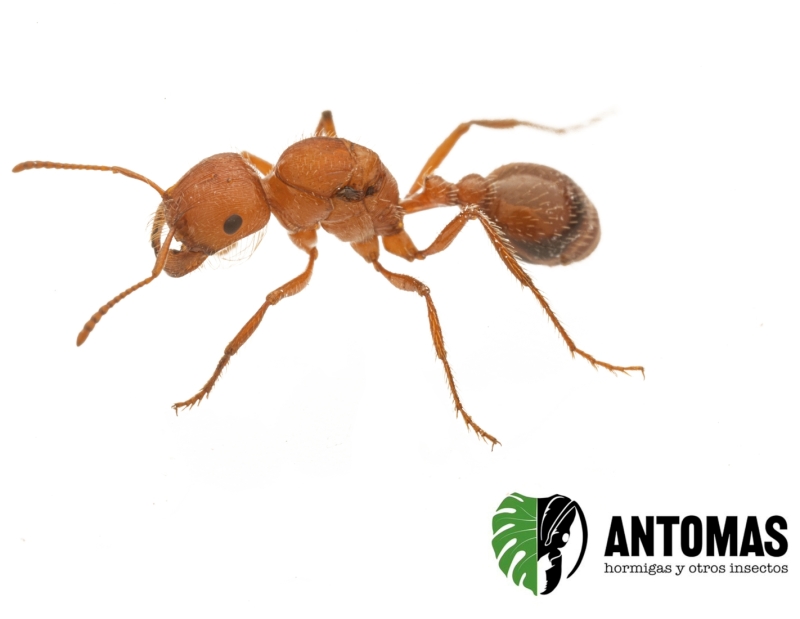
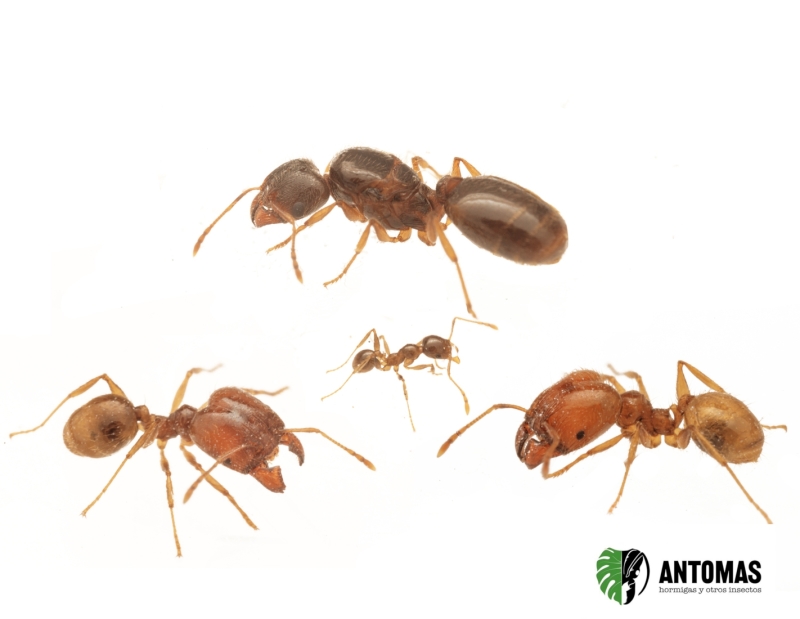
Colour of our colonies. Queen with a reddish-orange head and a black or very dark brown mesosoma and gaster. Workers with an orange-red head and a black body. Legs and antennae can range from brown to dark red and almost black.
Colour according to the literature. Snelling describes the Endiodioctes as bicoloured, with a reddish front part and a blackish gaster. We have not been able to consult his detailed description of the species.
Head. In majors, very wide and rounded, almost circular seen from the front. Worker head width: 0.8–2.3 mm.
Hairs. Short: the long hairs on the pronotum, the front part of the thorax, are about half the diameter of the eye.
Eyes. Dark, diurnal honeypot ants have smaller eyes and facets than pale, nocturnal ones; they have not been measured in M. placodops.
Repletes. The body keeps the size of a large worker, but the full gaster is far wider than the rest of the body.
Queen and male. According to Snelling, practically impossible to distinguish from those of M. mendax and M. melliger.
Defence. No sting: it bites and releases formic acid from the tip of the gaster.
Approximate measurements
Workers: head width, 0.8–2.3 mm (Snelling’s key)
Total length of workers and queen: no accessible scientific measurements
As a rough guide, without a scientific source: about 6–11 mm for the workers and 14–16 mm for the queen
Repletes: the body of a large worker, with a much wider gaster when full
The complete measurements of the species are in Snelling’s 1976 revision, which we have not been able to access. The lengths in circulation, which our old care sheet also gave, have no scientific backing and contradict each other, so we give them only as a rough guide.
Care in captivity
Difficulty: 4/5 – Advanced
At Antomas we consider it a species for experienced keepers. Not because it is fussy about temperature or humidity, but for four reasons:
A slow, fragile start. In our experience, an M. placodops colony cannot be considered stable until it has more than a hundred workers, and that usually takes about two years.
Sugar must be rationed. At first, by the drop, so that the queen does not turn into a replete; later, always available (see “Sweet death”).
Tiny protein, almost daily. Small colonies need exaggeratedly small prey, every day if possible.
Repletes are delicate. A fall or a rough move can cause them irreversible injuries.
Is it worth it? Absolutely. It is a diurnal honeypot ant: you will see it hunting in broad daylight. Its red-headed queen is beautiful, its round-headed majors catch the eye, and the day the first replete appears hanging from the ceiling is unforgettable.
Recommended parameters
Temperature: at Antomas we keep them practically at household room temperature. For reference, keepers who succeed with Myrmecocystus keep them at 24–31 °C, ideally around 29 °C.
Warm spot: as a true “midday hunter”, it appreciates a warmer area of about 28–30 °C at one end of the nest during the active season. Never under the repletes.
Night: the temperature can drop a few degrees, as in its desert.
Humidity: moderate and localised in the brood area; the rest of the nest drier.
Replete chambers: stable, ventilated and free of condensation; neither soaked nor parched.
Foraging area: dry, well ventilated and lit.
Water: always available, in a test tube with water and cotton wool in the foraging area.
Diapause: about 4 months, from November to February, at 14–18 °C (see “Diapause: four mild months”).
Set-up: rough ceilings and a gradient
The colony needs a clear gradient inside the nest. Eggs and larvae need a moist area, while the repletes need stable surfaces free of condensation. Do not heat the whole formicarium evenly: the colony must be able to move the brood away from the warm spot when it needs to, and the repletes, which tolerate heat poorly, should be in the stable, temperate part.
Horizontal or almost horizontal chambers, low and wide, at least 2–3 cm high so that a replete can hang with space beneath it.
Rough ceilings and walls. Repletes spend their lives hanging by their legs: on a smooth, wet or condensation-covered surface they can lose their grip and fall.
Loose, earthy substrate in the soil areas, which also helps the larvae spin their cocoons properly.
A laboratory trick: the myrmecologist Bert Hölldobler glued small wooden sticks to the ceiling of his honeypot ants’ tubes so that the first repletes had something to hang from.
Check the gripping surfaces from time to time: if you see condensation on the ceiling of a chamber with repletes, ventilate or reduce the humidity in that area.
Recommended formicaria
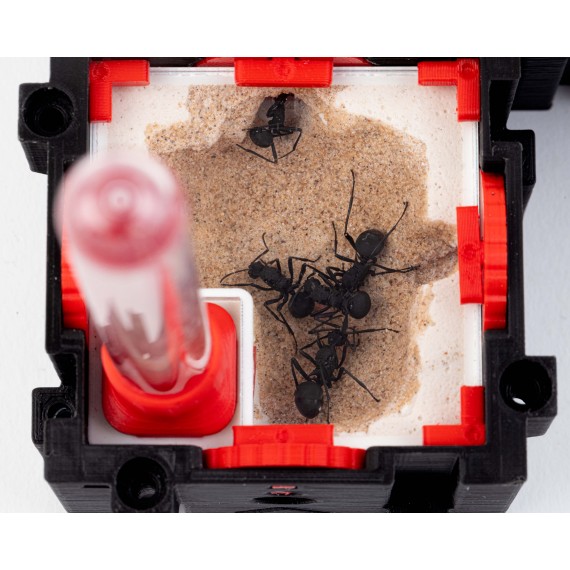
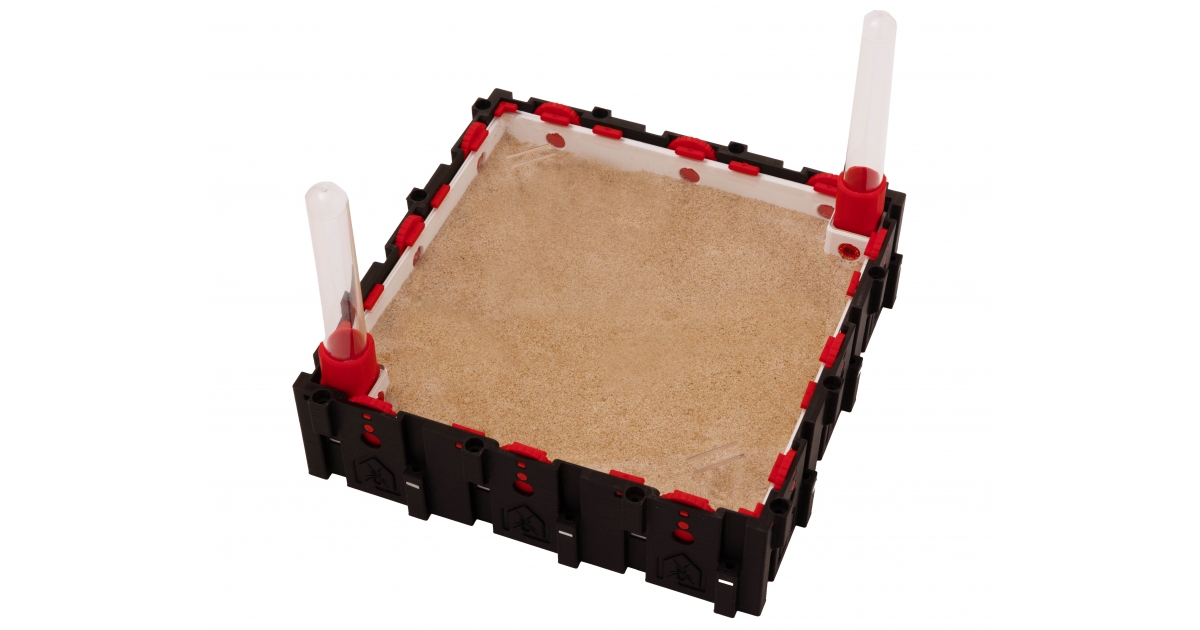
Vertical formicaria are not recommended for small colonies: they are more suitable once the colony has plenty of repletes and enough workers to occupy them properly. To start with, at Antomas we recommend the Qbik Wild One P 1C by Anthouse. Its chambers are high enough for the first repletes to hang from the ceiling and walls without having to move the colony too early, and its horizontal surface is comfortable for the queen, the brood and the workers, as well as letting you watch the first repletes appear:
For large colonies, the Qbik Wild NoNa Diáfano. With no pre-formed chambers, it lets the colony dig and organise its own network of galleries. Allowing for the enormous difference in depth, it reproduces quite well the principle of the natural nests of M. placodops: a mass of earth in which the ants choose where to build their low, wide chambers. Use a compact substrate that keeps the ceilings stable, and moisten it locally, without soaking the areas where the repletes hang. It is a set-up for mature colonies: in a small colony it would make it hard to keep track of the queen, the food and the formation of the first repletes.
Expand gradually: do not connect a much larger formicarium until the colony has really filled the first module.
Your colony: queen and workers with brood
At Antomas we sell M. placodops as “Queen and 5/15 workers with brood”: a queen that has already come through the founding stage, with between 5 and 15 workers and brood. It is the safest way to start with a honeypot ant, because the most delicate phase is already over.
How does a colony get there in the wild? Nothing has been published on M. placodops, but in the honeypot ants that have been studied, founding is claustral: after the nuptial flight, the queen sheds her wings, shuts herself in a small chamber and raises her first workers without going out to feed, living on her body reserves. The first workers take about two months to emerge, they are few and small, and none of that first batch becomes a replete. Your colony therefore arrives with that first step already taken.
What comes next calls for patience:
In the first months, the colony grows slowly and in spurts. It is normal to see weeks of plentiful brood followed by pauses.
The first repletes usually appear with the second or third generation of workers, when there are a few dozen and large workers are starting to emerge. That is the moment to change the sugar routine (see “Sweet death”).
Stability comes, in our experience, once the colony passes a hundred workers, usually at around two years.
When it arrives, let the colony rest for a few hours in a quiet place with the brood area in darkness, check that it has water and do not move it to a new container straight away.
Sweet death
This is the most typical mistake with honeypot ants, and at Antomas we have seen it with our own eyes. If a small colony, still without repletes, receives plenty of sugar, the queen herself can fill her crop until her gaster swells and she becomes a kind of replete. A queen like that reduces or stops laying, the colony stops growing and, in the worst case, the founding fails. We have not found any study of this phenomenon: it is keeping experience, ours and that of other keepers. Our interpretation is simple: in a tiny colony there are still no repletes to store the surplus, so the queen ends up acting as the larder.
When there is too much sugar: honeypot ant queens that end up swollen like repletes during founding (video by Anthouse).
That is why, with M. placodops, sugar comes in two phases:
Until the first repletes: sugary liquids by the drop. Just a few drops that the workers finish quickly, without leaving reserves within the queen’s reach.
From the moment the first repletes emerge: sugar ad libitum, always available. From then on it must never run out: without plenty of sugar there are no repletes to fill, and the colony loses its larder.
Feeding
Sugar: in a feeder, and varied. As well as following the two phases we have just described, vary the sugars. At Antomas we recommend Anthouse’s Blue Sugar nectar 4–5 times a week and another sugary liquid or nectar 1–2 times a week; you can also add some protein to the nectar. Always offer them in a feeder and never on cotton wool, which goes mouldy and spoils the liquid very quickly. A traditional or home-made feeder works well, one where the drop stays “spread out” and accessible, and replace it before it ferments. During the dropper phase, place the drop on a clean surface and remove whatever is left over.
Protein: tiny at first, and almost every day.M. placodops is a great hunter, but a young colony has small workers and larvae to feed, and the prey must be exaggeratedly small: fruit flies (Drosophila), firebrats (Thermobia), termites and micro-crickets, every day if possible, killed or cut up. As the colony grows, it accepts larger prey and can be given more food, but less often, not every day. An established colony can also be given live prey of a suitable size: watching it hunt in broad daylight is one of the joys of keeping a diurnal honeypot ant.
Change the type of insect from one week to the next, so that they do not always eat the same thing. And do not be afraid of giving protein: at Antomas we believe that, with daily maintenance and removal of leftovers, it is better to overfeed, because the colony understands that it has more resources and grows faster and in greater numbers. If you will not be able to clean often, it is better not to overdo it: leftover food rots and brings mould and mites. Bear in mind, too, that repletes store liquids, but they do not replace the protein the larvae need to grow.
The larvae in this video from our channel are M. placodops, raised at Antomas:
M. placodops larvae feeding in one of our colonies (Antomas channel).
A tip for a diurnal species: put the protein in in the morning, when the colony is at its most active, and remove the leftovers at the end of the day.
Water: always, in the test tube with water and cotton wool in the foraging area, even if they have nectar available.
Moving by tipping
At Antomas, moves are done by tipping: we open the tube or container inside the foraging area, next to the entrance of the new nest, and gently tip out the queen, the workers and the brood, helping the stragglers with a soft brush. The workers gather up the brood and go into the nest within a short time, especially if the nest area is kept dark.
With M. placodops it is best to make the main move before there are repletes, because the appearance of the first repletes marks the moment when the colony needs a permanent home. If you have to move a colony with repletes, do it even more gently:
Prepare everything beforehand: the nest set up, the oil barrier in place and the water tube connected.
Work over a tray, in case a worker climbs up the tube or the tools.
Tip from a very low height onto a soft surface, without shaking: a replete that drops sharply can burst. Nudge any that do not move towards the entrance with a soft brush.
Diapause: four mild months
M. placodops lives in regions with relatively mild winters, and its deep nests buffer the changes at the surface. At Antomas we give it a diapause somewhat shorter than that of our native species: about 4 months, from November to February.
At what temperature? We recommend 14–18 °C, and this is where its physiology comes in. Diurnal honeypot ants become practically motionless below about 12 °C, while pale, nocturnal ones such as M. mexicanus or M. christineae keep moving close to 0 °C and tolerate a colder winter (see “An engine that shuts down at 12 °C”). For a dark honeypot ant, a cold diapause is not a rest, it is paralysis.
Lower and raise the temperature gradually, over one or two weeks.
Water always available.
A little sugar if the workers stay active, but without constantly topping up the repletes.
Little or no protein while there are no developing larvae.
Very young colonies without repletes: better at the top of the range, around 18 °C.
During diapause, egg-laying, brood development and activity outside the nest will slow down. At the end, go back to protein as soon as you see movement and new brood.
Behaviour in captivity
Shy when young, very active when grown. Young colonies can spend long periods almost hidden, but M. placodops becomes very active as the population grows.
By day, in plain sight. Unlike many nocturnal honeypot ants, you will see it foraging during the day. The workers cross the foraging area quickly and respond instantly to a small insect. It is a rewarding species to watch: there is no need to wait for nightfall.
Watch without fear. At Antomas we believe that ants are there to be enjoyed, observed and learnt from, not kept hidden away. It is enough to leave them a dark area in the nest and a lit foraging area, and to watch them gently, intervening and stressing them as little as possible. They get used to your presence.
Warning signs:
A queen with a swollen gaster and no eggs in a colony without repletes: too much sugar.
Brood that stalls outside diapause: not enough protein, or prey too large for the workers.
Repletes on the floor of the chambers: the ceiling is too smooth or has condensation.
Mould or piled-up leftovers: clean more and feed smaller amounts at a time.
Escapes and barriers
They are not great escape artists, and in our experience mineral oil is enough:
A thin, continuous band of mineral oil at the top of the walls of the foraging area. Renew it when it collects dust or debris.
A well-fitting lid and connections without gaps.
Nothing that can act as a bridge to the barrier, such as branches or stones leaning against the walls.
Handling and safety
M. placodops has no sting. Workers can bite and release formic acid when they are trapped or the nest is disturbed directly, but this is no problem if you work calmly. Plan any intervention and carry it out with tubes, spare containers and entomological tools, never with your hands. Do not put different queens or colonies together, or keep them with other species. It is an exotic species: it must never be released.
What not to do
Flood a small colony without repletes with sugar: the queen may turn into a replete.
Let the sugar run out once there are repletes.
Put sugary liquids on cotton wool.
Give large prey to a young colony or skip protein days at the start.
Heat the whole nest evenly or place the heat source next to the repletes.
Give it a cold diapause, below about 12 °C.
Leave smooth, wet or condensation-covered walls where the repletes hang.
Move a small colony into a vertical nest or one that is too large.
Shake the tube when tipping out a colony with repletes.
Put different queens or colonies together.
Scientific sources
This care sheet is based on the scientific literature on Myrmecocystus placodops and its genus (including Snelling 1976, Parks 1929 and Creighton and Crandall 1954, which have no DOI), on distribution records and on the experience of Antomas and other keepers. Main references:
Kronauer, D. J. C., Hölldobler, B. & Gadau, J. (2004). Phylogenetics of the New World honey ants (genus Myrmecocystus) estimated from mitochondrial DNA sequences. Molecular Phylogenetics and Evolution 32: 416–421. doi:10.1016/j.ympev.2004.03.011
van Elst, T., Eriksson, T. H., Gadau, J., Johnson, R. A., Rabeling, C., Taylor, J. E. & Borowiec, M. L. (2021). Comprehensive phylogeny of Myrmecocystus honey ants highlights cryptic diversity and infers evolution during aridification of the American Southwest. Molecular Phylogenetics and Evolution 155: 107036. doi:10.1016/j.ympev.2020.107036
Wolf, M. et al. (2026). Understanding cryptic diversity within the honeypot ant species complex of Myrmecocystus mendax. bioRxiv (preprint). doi:10.64898/2026.04.20.719579
Kay, C. A. R. & Whitford, W. G. (1978). Critical thermal limits of desert honey ants: possible ecological implications. Physiological Zoology 51: 206–213. doi:10.1086/physzool.51.2.30157867
Johnson, R. A. & Rutowski, R. L. (2022). Color, activity period, and eye structure in four lineages of ants: Pale, nocturnal species have evolved larger eyes and larger facets than their dark, diurnal congeners. PLOS ONE 17: e0257779. doi:10.1371/journal.pone.0257779
Conway, J. R. (1986). The biology of honey ants. The American Biology Teacher 48: 335–343. doi:10.2307/4448321
Conway, J. R. (1994). Honey ants. American Entomologist 40: 229–234. doi:10.1093/ae/40.4.229
Conway, J. R. (1977). Analysis of clear and dark amber repletes of the honey ant, Myrmecocystus mexicanus hortideorum. Annals of the Entomological Society of America 70: 367–369. doi:10.1093/aesa/70.3.367
Burgett, D. M. & Young, R. G. (1974). Lipid storage by honey ant repletes. Annals of the Entomological Society of America 67: 743–744. doi:10.1093/aesa/67.5.743
Dong, A. Z., Cokcetin, N., Carter, D. A. & Fernandes, K. E. (2023). Unique antimicrobial activity in honey from the Australian honeypot ant (Camponotus inflatus). PeerJ 11: e15645. doi:10.7717/peerj.15645
Dificultad
Experienced
2 Reviews
mrowki przyjechaly do mnie w 24 godziny od zlozenia zamowienia. Gdy dotarly mialy bardzo duzo larw, troche kokonow i 9 robotnic. teraz jest 15 robotnic, nowe kokony, troche larw i jaja. bardzo fajne mrowki, ladne ubarwienie. polecam.
By Raf
on 2026-10-19
Ich habe diese Kolonie bestellt und sie kam noch besser an, als angegeben. Reichlich Brut, viele Arbeiterinnen und ein bomben Wachstum der Kolonie! Bei Fragen ist der Geschäftsführer auch immer sehr hilfsbereit gewesen. 10/10 Empfehlung !