Difficulty: 3/5 – Advanced
A North American Formica from the western deserts that, instead of avoiding water, seeks it out: it nests along riverbanks, in floodplains and on irrigated land. Fast, very active and quick-growing for its genus. Founding queens with brood, with claustral founding. A plaster Qbik Wild nest with localised humidity and a dry foraging area, 24–28 °C with a gradient, plenty of sugar and lots of protein. A diapause of about 3 months (December–February) at 7–11 °C. Good climbers: use a well-maintained mineral-oil barrier.
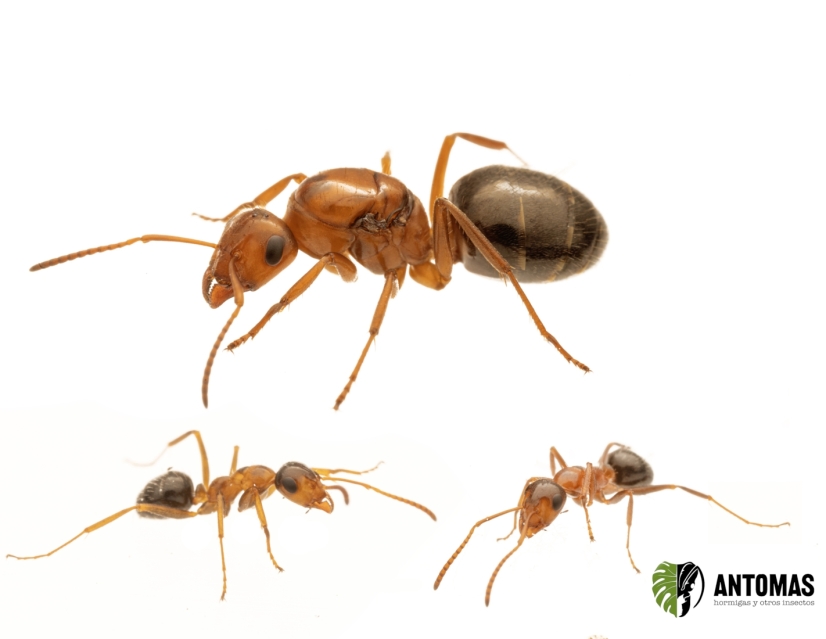
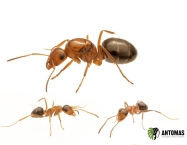
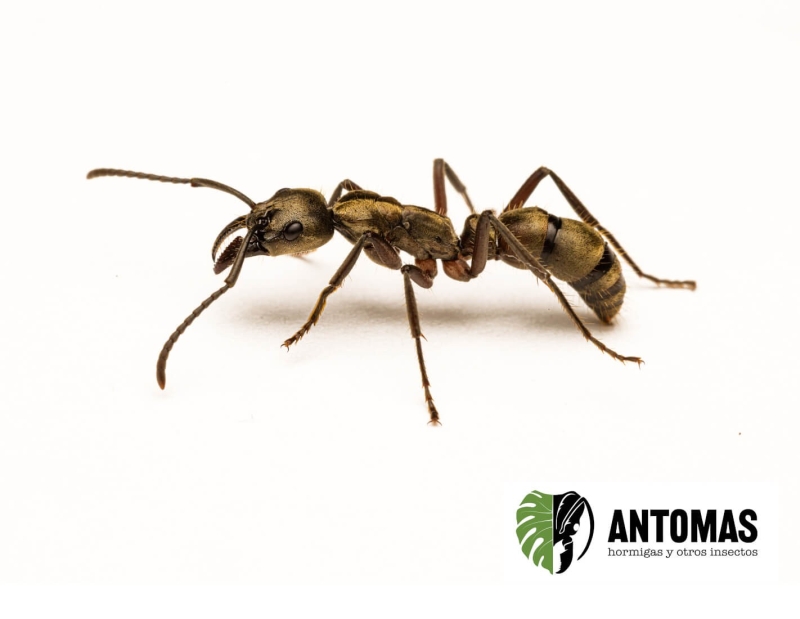
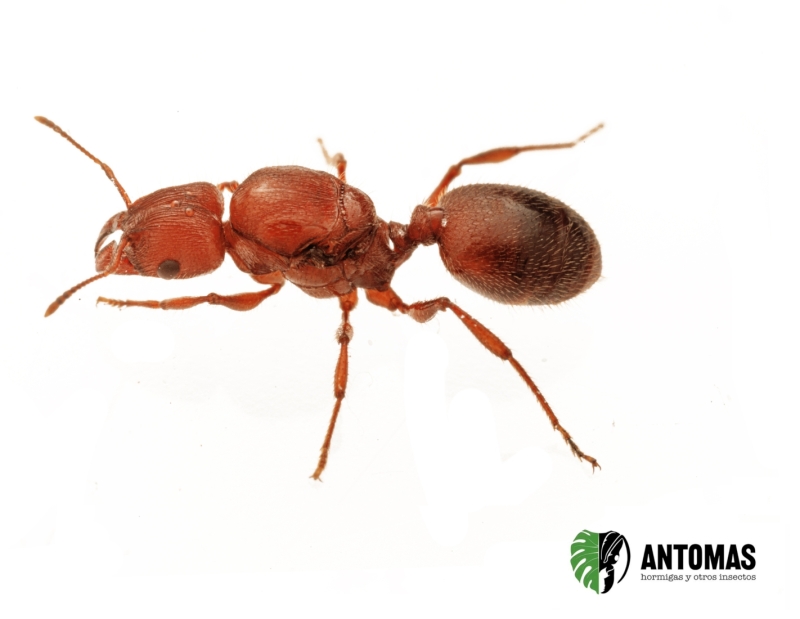
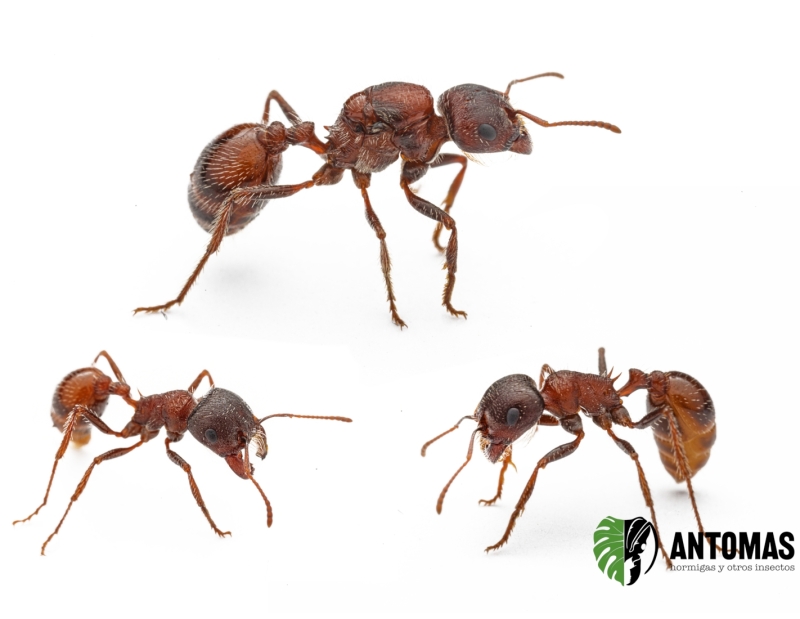
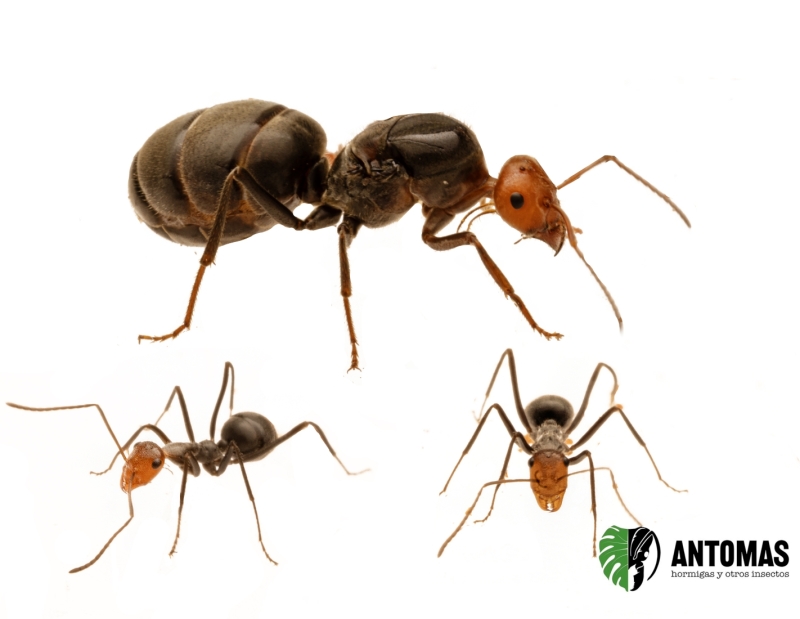
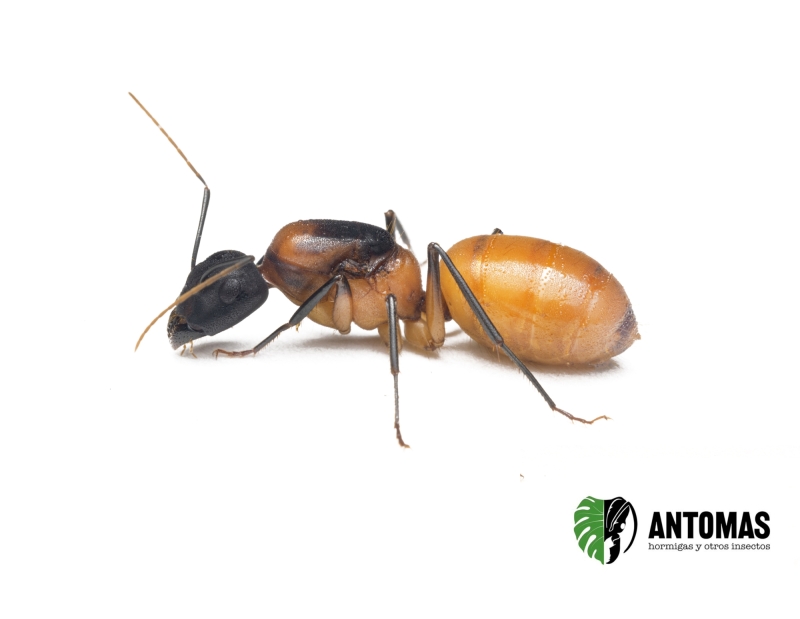
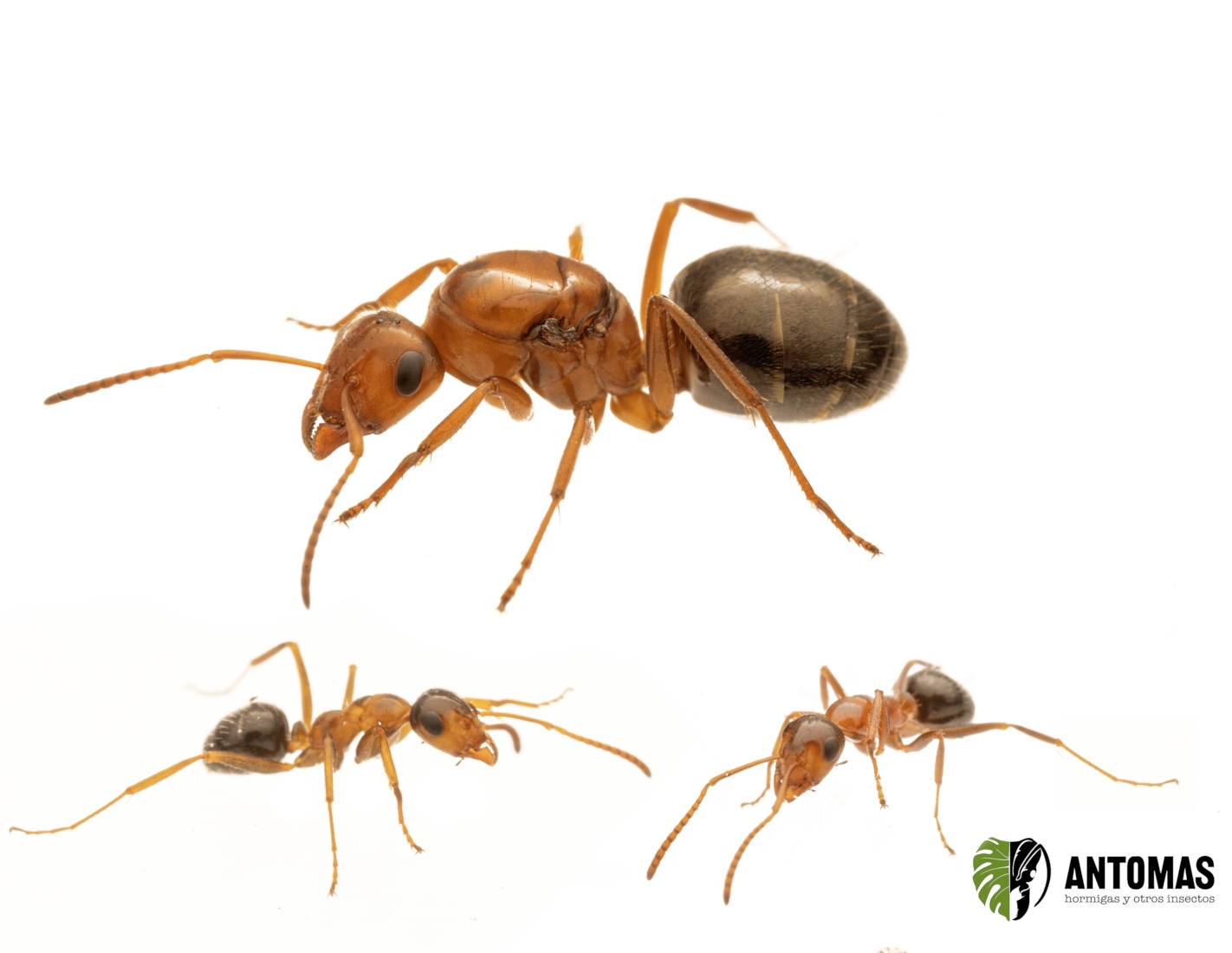
Formica perpilosa Wheeler, 1913 is a Formica from western North America with a habit that is unusual in its genus: it lives in the desert, but next to water. It nests along the banks of streams, in floodplains and on irrigated land, from the plateaus of Utah and Colorado to northern Mexico, almost always at the foot of a shrub or a tree. It is bicoloured, with an orange head and thorax and a black gaster, and it is covered in long silvery-white hairs that give it its name: perpilosa, “the very hairy one”.
It is also one of the best-studied Formica of the North American deserts. Its temperature limits have been measured, every action of its workers has been recorded, and researchers have discovered that a butterfly enters its nest to pupate, that acacias with one of its nests at their base produce almost twice as many seeds and that, in some vineyards, it has become a pest. In this care sheet we keep apart what science has documented, what keepers do and what we recommend at Antomas.
Biology
“The very hairy one”: name and history
Perpilosa combines the Latin intensifying prefix per- with pilosa, “hairy”: “very hairy”. The American myrmecologist William Morton Wheeler, who described it, noted long, erect, silvery-white hairs on the head, thorax, petiole, gaster and front coxae. With a hand lens and good light, a worker seems wrapped in a white halo over the orange and black.
Wheeler first introduced it in 1902 as a mere variety of another Formica, in a Mexican scientific journal, and in his great revision of the genus, in 1913, he already treated it as a species in its own right: hence the formula Formica perpilosa Wheeler, 1913. At the time it was the only Formica he knew from Mexico, and only from the high plateau. And its type locality, the place the material for the description came from, is not in a hot desert, but in Colorado.
It looks like a slave-maker, but founds alone
Because of the notch in the queen’s clypeus (the plate covering the front of the head), it was placed for years in the F. sanguinea group, that of the slave-making Formica. Today it is included in the neogagates group, although it does not seem closely related to the other species in it. Wheeler found no sign of social parasitism or brood raiding, and in the vineyards of California it was shown that new colonies are founded by a single queen, with no help from another species. In this it resembles the European Formica in our shop, Formica rufibarbis and Formica gerardi, and not those of the F. rufa group, whose queens need to sneak into another species’ nest to get started.
A desert Formica that lives by the water
It occupies a huge swathe of western North America: from Idaho and Wyoming to Texas and California, with most records from Arizona, Utah and New Mexico, and in Mexico it reaches Chihuahua, Coahuila, Sonora and Baja California. It lives in the low, hot valleys of the Sonoran Desert as well as in the Chihuahuan Desert and on the cold plateaus of the interior.
The surprising thing is how it lives. Wheeler already wrote that it inhabits mainly the irrigated lands and floodplains of the south-western deserts, that it forms fairly populous colonies around the roots of shrubs and trees and that he never found it under stones. The entrances are small craters or low mounds at the foot of the plant. In south-eastern Arizona it is closely associated with Acacia constricta (now also called Vachellia constricta), an acacia with extrafloral nectaries, glands that produce nectar outside the flower; in the Chihuahuan Desert, with mesquite thickets and loose sand. It always looks for the dampest spot in the landscape: shade, the edge of a dry riverbed and even a roadside embankment.
For keeping, this is the key idea: a desert climate, but a nest with moisture (see “Localised humidity: an oasis in the nest”).
45 °C up, 5 °C down: eating in the branches
A 1974 study in the Chihuahuan Desert compared it with a neighbour, the fungus-growing ant Trachymyrmex smithi neomexicanus. The latter stopped going out when the air was very dry or the soil was above 50 °C; F. perpilosa, by contrast, foraged almost regardless of either. Its trick lies in the plants: it looks for food both on the ground and on shrubs, where it laps up nectar and honeydew, hunts small insects and collects dead ones, in the shade of the branches. Its resistance to desiccation is not exceptional; its advantage is that it tolerates water loss and replaces it with the sugary liquids it gathers.
The same study measured its critical temperatures, those at which it loses coordination: 45.2 °C maximum and 5.2 °C minimum, compared with 36.7 °C and 9.7 °C in Trachymyrmex. The 45.2 °C is a laboratory limit, not a keeping temperature. The 5.2 °C, on the other hand, is a guide for diapause: at 7–11 °C the colony stays close to its activity limit without falling below it (see “Diapause: three months of gentle cold”).
Big distributor workers: the 6.6% that never go out
In May 1975, the myrmecologist Bert Hölldobler collected founding queens in south-eastern Arizona. One of them gave rise to a laboratory colony of about 450 workers, which the Brazilian myrmecologist C. R. F. Brandão observed for 18 hours, spread over four weeks, recording 2,809 acts one by one. He divided the workers into three groups by head width, and the large ones, just 30, or 6.6% of the colony, turned out to be very special:
- Almost half of their acts, 48.6%, consisted of regurgitating food to their nestmates.
- They were never seen foraging, digging or carrying anything.
- They did not defend the nest even when a Novomessor cockerelli, a large desert ant, got in and the rest of the colony rushed out to attack it.
- Their repertoire was minimal: about 11 behaviours, compared with 29 in the minors and 36 in the medium workers.
Brandão suggested that they form a trophic subcaste and that they might represent a first evolutionary step towards the repletes of honeypot ants, such as the Myrmecocystus mexicanus in our shop. But they are not repletes: they do not hang from the ceiling or swell up like grapes. They are the colony’s larder-keepers.
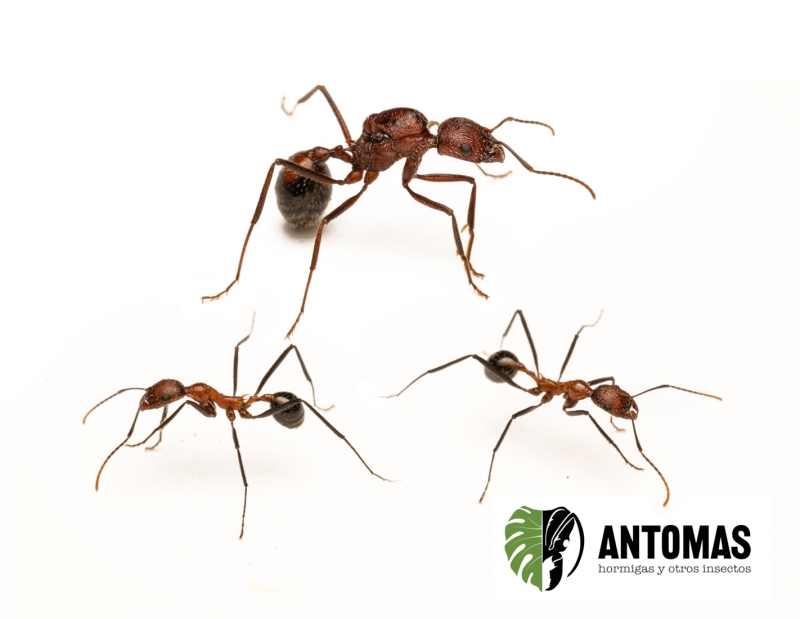
The rest of the division of labour is just as clear. The minors do almost all the work of foraging, digging and carrying, 35.5% of their acts. The medium workers, the most numerous, are the nursemaids: brood care makes up 24.8% of their activity, almost twice as much as in the other two groups. And all this in a worker caste that is barely polymorphic: few differences in body and many in trade.
From 35 to 262 in an hour: the power of the trail
Brandão left the colony without food for a week and placed honey at the end of a bridge of sticks. For one hour he removed every worker that reached the honey, so that none could return to raise the alarm: 35 arrived. In another hour, letting the discoverers go back, 262 arrived. The returning ants rubbed the tip of the gaster along the bridge, probably laying a chemical trail. In the vineyards of California, most foraging and recruitment took place within 6.39 m of the nest. At home you will see it straight away: one drop of nectar in the foraging area and, before long, a line of workers.
The butterfly that pupates inside the ant nest
Its most astonishing relationship is with a small blue butterfly of the family Lycaenidae, Hemiargus isola (now Echinargus isola), whose caterpillars attract ants with secretions and signals and receive their protection in return. In south-eastern Arizona, the ecologist Diane Wagner discovered that caterpillars tended by F. perpilosa came down from the acacia and entered the ant’s galleries to pupate. The others did so in cracks in the ground, under bark or among leaves. And it paid off:
- They spent 67% less time searching for shelter.
- Pupae in chambers connected to a nest disappeared overnight 4 to 5 times less often than those in unconnected chambers.
- They lost no more weight than the others: attracting ants comes “cheap”.
The ending has a touch of suspense: in the field, newly emerged butterflies left the nest without a scratch, but in the laboratory, shut in with the ants for a few minutes, they were attacked. The colony’s hospitality has its limits.
Acacias with twice the seeds
The acacia benefits too. Wagner compared A. constricta plants with an F. perpilosa nest at the base with others without a nest: the former produced, on average, 1.9 times as many seeds, almost twice as many, and the soil of the nests was richer in nutrients. Years later, with E. F. Nicklen, she studied acacias associated with ants: the species that visit their nectar nested closer to the plants than expected by chance, more new nests appeared when nectar was added and the acacias took up nitrogen from the nests. That work does not focus on F. perpilosa, but it sketches a neat deal: nectar in exchange for fertiliser.
The vine mealybug that turned it into a pest
In vineyards, the story changes: in recent decades it has become a costly pest of table grapes in the Coachella Valley, in California, and in Sonora, in Mexico. The nuance matters: it is a native ant that does not damage the vine by itself. The problem is its partner.
Like so many ants, it tends sap-sucking insects in exchange for their honeydew: in the wild, treehoppers of the genus Pubilia and other hemipterans; in vineyards, the vine mealybug, Planococcus ficus, which is alien to California, of Mediterranean origin and also a pest in Spanish vineyards. Its honeydew soils the bunches and, in heavy infestations, weakens the vine. The ant nests at the base of the vines and defends the mealybugs from their predators and parasitoids, above and below ground. Where the ant was eliminated with baits, the mealybugs on the trunk and roots did not survive.
And it spreads fast: it colonised a vineyard that was free of it and infested 9% of the vines within a year and a half, and in September it occupied 16 to 22% of the vines in vineyards 5, 20 and 30 years old. An irrigated vineyard in the middle of the desert is exactly the habitat Wheeler described, “irrigated lands”. The pest arises from a very specific combination: a native ant, an introduced mealybug and an irrigated monoculture.
Against the cotton boll weevil
Its agricultural history has not always been a bad one. Wheeler recounted in 1913 that the Mexican naturalist Herrera, in all likelihood the biologist Alfonso L. Herrera, had shown its value as a destroyer of the cotton boll weevil, Anthonomus grandis, a weevil that became one of the worst pests in American agriculture. At the beginning of the 20th century it was studied as an ally of farmers; a century later, as a pest of vineyards.
One queen, several nests and summer flights
Colonies have a single queen, but not always a single nest: in vineyards it was shown to be seasonally polydomous, with satellite nests during the active season. This is not polygyny: there is one mother and several seasonal homes. The colonies are populous: in the Chihuahuan Desert, between 2,000 and 3,500 foraging workers per colony were estimated, not counting those that stay inside.
In the Coachella Valley it flies in early August and in the first half of September; in Arizona founding queens have been collected in May, and across its range records soar from June to August and almost disappear in December and January. After the flight, the queen sheds her wings and founds alone, in a claustral way: she does not go out to eat and rears her first workers on her own reserves. In a keeping journal posted on a North American forum, the queen did not touch honey until the day her first two workers emerged.
Formic acid: weapon, disinfectant and dressing
Like all formicines, it has no sting: its weapon is formic acid, which it sprays from the acidopore, a small nozzle at the tip of the gaster. Wheeler already described it as a “very active and aggressive” ant. In 2020 it was shown, in Camponotus floridanus and other formicines, that they also swallow their own venom while grooming: this keeps the crop acidic, the “social stomach” where they store the food they share, and filters out microbes. In a species with larder-keepers it makes perfect sense. And a practical detail: keepers report that it sprays acid onto protein, even onto dead prey, and that this dirties the set-up. A thin layer of sand in the foraging area absorbs it.
Size and morphology
A medium-sized Formica, bicoloured, shiny and very hairy, with workers of somewhat different sizes within the colony and no sting.
- Colouration according to Wheeler. Yellowish red, with a black gaster. Small workers have the back of the head and the upper thorax darker, from reddish brown to brown. It varies between populations.
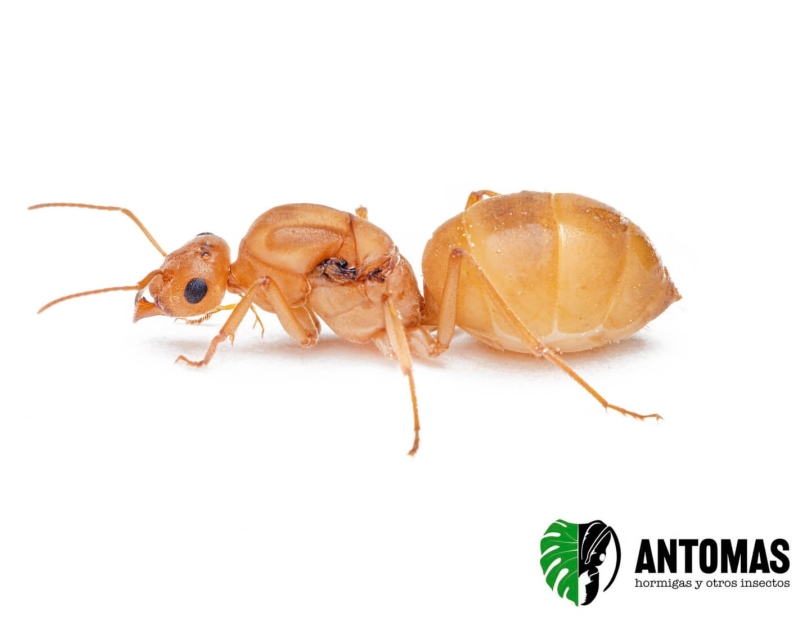
- Colouration of our colonies. The queen has an orange-amber head and mesosoma (the thorax) and a shiny black gaster. The workers are orange, with a slightly darker head and a black gaster.
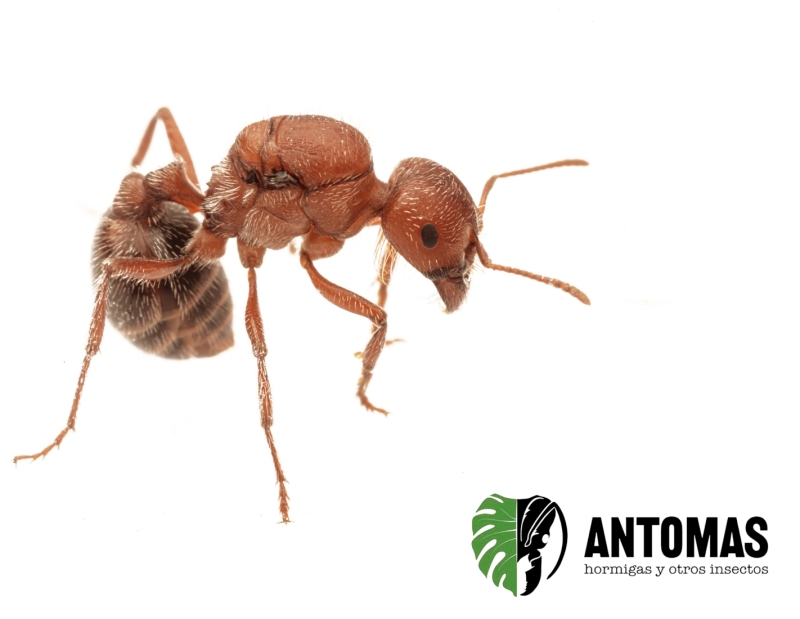
- Pilosity. Long, erect, silvery-white hairs on the head, thorax, petiole, gaster and front coxae: its most characteristic feature.
- Head and surface. Body and legs shiny. Clypeus with a keel, robust antennae and small eyes.
- Clypeus. In the worker, the margin is almost always rounded; in the queen, it has a broad, shallow notch.
- Petiole. Narrow and wedge-shaped.
- Queen. Like the worker, with dark patches on the head and thorax. Colourless wings with brown veins.
- Male. Black and matt, with grey pilosity, yellow legs and smoky wings.
Colour is not enough to identify it: there are other similar bicoloured Formica in its region, and they are often confused on forums. What gives it away is the abundant white pilosity together with the notch in the clypeus, which is easier to see in queens. As in all Formica, the larvae spin a cocoon before pupating, and newly emerged workers are pale and darken gradually.
Approximate measurements
- Workers: 3–5.5 mm
- Queen: 7.5–9 mm
- Male: 7–8 mm
- Worker head width: minors, up to 1.0 mm; medium workers, 1.0–1.4 mm; large workers, over 1.4 mm
The lengths are those in Wheeler’s description (1913). The head-width groups are those used by Brandão (1978), who defined them as arbitrary: they are useful for comparing behaviour, not three separate castes.
Care in captivity
Difficulty: 3/5 – Advanced
Some North American keepers consider it suitable for beginners, and it is easy to see why: it eats everything, recruits quickly and grows fast for a Formica. At Antomas we rate it 3/5 for four reasons:
- Humidity just right: neither a dry nest nor a soaked one, but localised humidity (see “Localised humidity: an oasis in the nest”).
- Heat and a gradient: at room temperature it barely develops.
- Fast, climbing, acid-spraying workers: skittish at first and aggressive once the colony grows (see “Escapes and barriers”).
- A genuinely cold diapause: about 3 months at 7–11 °C.
And it is well worth it. It is a Formica very rarely seen in Europe, beautiful for its contrast of orange and black and for its halo of white hairs, with spectacular recruitment and larder-keepers you can watch in the nest itself. Well fed, it can go from a handful of workers to several hundred in its first year.
Recommended parameters
- Nest temperature: 24–28 °C during the active season, with a gradient: one end at 29–30 °C and a cooler one at 22–24 °C. This is the range on which keepers agree; without heat, it barely grows.
- Heating: a heat cable or mat with a thermostat, on one side or under part of the nest, never under the water reservoir.
- Humidity: localised: one damp, stable area of the nest, and the rest drier and well ventilated. The foraging area, dry.
- Water: always available, in a test tube with water and cotton wool in the foraging area.
- Light: it is enough to leave them a dark area in the nest and light in the foraging area, with a normal day–night cycle.
- Diapause: about 3 months, from December to February, at 7–11 °C (see “Diapause: three months of gentle cold”).
Localised humidity: an oasis in the nest
In the wild it picks the damp spots in a dry landscape: the bank of a stream, an irrigated field, the roots of an acacia. In the formicarium you need to give it the same: a damp, stable corner where the colony can take the brood, and drier, ventilated chambers elsewhere.
- Neither dry nor soaked: if the nest dries out completely, the brood suffers; if it is wet throughout, condensation, mould and mites follow.
- Let them choose: where they place the brood is the best guide for adjusting humidity and heat.
- A pinch of fine, clean sand in one corner helps the larvae spin their cocoons. There is no need to fill the nest with substrate.
Recommended formicaria
At Antomas we recommend the Anthouse Qbik Wild range: plaster nests, which hold moisture well, and modular, so they grow with the colony as you add modules.
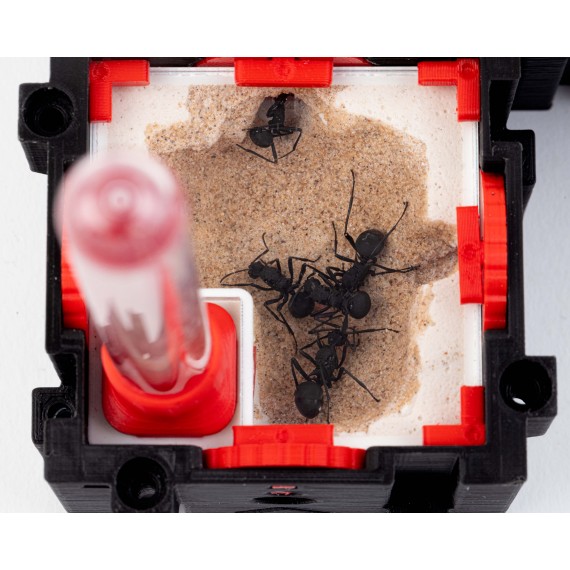
1. To start with: Qbik Wild One P 1C. A small plaster module, about 6.8 × 6.8 cm and 5 cm high, with a central moisture point that is refilled with water. It is just the right size for the queen and her first few dozen workers: the colony fills it completely and defends it well.
2. To grow: Qbik Wild Duo P 2C Hybrid. Twice the size, it combines a lower reservoir that provides humidity by evaporation, without the water touching the chambers, with a side drinking tube. It is the easiest way to maintain the localised, stable humidity this species needs. If you add heat, do it from one side and never under the reservoir.
Expand when the brood and workers start to pile up in the foraging area; until then, a snug nest is better, because unused chambers end up full of waste. The polydomy seen in vineyards does not mean you need several nests: simply add modules as you go. Complete the set-up with a dry, spacious foraging area (a thin layer of sand, a flat stone or two and a twig, away from the barrier), the mineral-oil barrier and a well-fitting lid, the water tube and a feeder for sugary liquids, never on cotton wool.
Founding: queen with brood, step by step
At Antomas we sell founding queens with brood: queens that have already started their colony in a test tube, with their brood and, depending on the option, with their first worker.
- Tube, darkness and gentle warmth. Keep the tube as it arrives, with its water reservoir behind the cotton wool, in a dark, quiet place at 25–27 °C. If you add heat, put it under the dry half of the tube and never next to the reservoir: it causes condensation and can flood the tube.
- Water. Check that the cotton wool is still damp and that there is water left. If it runs out or the tube gets very dirty, move her to a new one by tipping.
- Little disturbance. A stressed or protein-starved Formica queen may eat part of her brood.
- Food from the start. Once the first worker is in the tube, offer a small piece of insect two or three times a week and a tiny drop of sugary liquid on a small piece of aluminium foil, never on the cotton wool, which goes mouldy and spoils the reservoir. Remove the leftovers the next day. The larvae grow in just a few days: with protein, it is better to overdo it than to fall short.
- Patience, but not too much. With warmth and good food, keepers report about 4–7 weeks from egg to worker. The first workers are small, and later ones gradually get bigger.
When to move her into the nest? There is no need to wait long: with just a few workers she can already go into the Qbik Wild One P 1C, which is small and suited to her size. And sooner if the tube becomes too small, dirty or runs out of water.
Arrival and moving
When your queen arrives, let her rest in a quiet, dark place at 24–27 °C and check that the tube has water. To move her, at Antomas we do it by tipping: the tube is opened inside the foraging area, next to the nest entrance, and the queen, the workers and the brood are gently tipped out, helping any stragglers with a soft brush. Have the nest ready beforehand, with its moisture and the oil barrier in place; work over a tray, because they are very fast, and keep the brood area dark so that they occupy it straight away. With a large colony the method is the same, but with a freshly renewed barrier: with hundreds of nervous workers, this is the moment with the greatest risk of escapes.
Feeding
Plenty of sugar. In the wild it lives largely on nectar and on the honeydew of the hemipterans it tends, and it keeps workers devoted almost solely to sharing out liquids. Vary the sugars: at Antomas we recommend Anthouse’s Blue Sugar nectar 4–5 times a week and another sugary liquid or nectar 1–2 times a week. You can also add some protein to the nectar. Always offer them in a feeder and never on cotton wool, which goes mouldy and spoils the liquid very quickly: a traditional or home-made feeder, where the drop stays “spread out” and accessible, is best. Avoid pure honey, which is too thick; if you use honey, dilute it.
Protein: the more, the better. If you do daily maintenance and remove the leftovers, at Antomas we recommend overfeeding: the colony understands that it has resources to spare and rears brood faster and in greater numbers. If you will not be able to clean often, it is better not to overdo it, because whatever is left rots and brings mould and mites. Change the type of insect from one week to the next, so that they do not always eat the same thing:
- Thermobia domestica, a small prey item, perfect for the queen with her first workers and for young colonies.
- Drosophila and small flies, which keepers list among their favourites.
- Blaptica dubia cockroaches, small or chopped, another of their favourites.
- Crickets and mealworms, chopped for small colonies.
For young colonies, preferably chopped or freshly killed; large colonies hunt small live prey well. Buy your insects from a reliable supplier, never wild-caught ones, and do not give them mealybugs or infested plants to imitate their natural diet. Remove the leftovers within about 16–24 hours: because they spray acid on the protein, it spoils sooner. As a reference, Brandão’s colony grew on an artificial diet, honey water three times a week and a weekly ration of cockroaches. That is a minimum; with protein more often, it will grow faster. And water, always, in the tube with cotton wool in the foraging area, even if the nest has its own moisture.
Growth: what to expect
For a Formica, it grows fast, although the rates keepers report vary. A North American shop speaks of more than 300 workers in under 6 months and more than 1,000 in the second year. A keeping journal on a forum, with cable heating, is more modest: 13 workers about five weeks after the first ones emerged, 23 at two and a half months and around 150–200 after a year. Brandão’s colony had about 450 workers when it was studied. The difference comes down to warmth and, above all, protein: the first months are slow, and once there are a few dozen workers, foraging multiplies and growth speeds up.
Diapause: three months of gentle cold
In the wild there is a clear winter pause. Even in the warm valleys of California, nests were active only from early February to mid-October, and across its range records almost vanish in December and January. Its climate ranges from desert valleys with no real winter, with January averages of about 15 °C, to the foothills and the high plateau, with January averages of about 5 °C and night frosts, and to the plateaus of Utah, Colorado, Wyoming and Idaho, with cold winters.
At Antomas we recommend a diapause of about 3 months, from December to February, at 7–11 °C. This is what the keepers who maintain it do: some cool it to 7–11 °C for 6–10 weeks and others to about 9 °C for about 3 months. The 14–17 °C figures that circulate would only suit populations from the warmest valleys.
- Prepare it in autumn: feed it well and, when egg-laying and foraging slow down, reduce the heat gradually over one or two weeks.
- Between 7 and 11 °C: a cool room or a wine cooler will do. Do not keep it below 7 °C for long: its critical minimum is 5.2 °C.
- Water and a little sugar: its metabolism slows down but does not stop. Little or no protein.
- Movement is normal: a keeper who kept it at about 9 °C noticed that the workers remained fairly active. It is no cause for alarm.
- A gradual awakening: in March, raise the temperature little by little and go back to protein as soon as there is activity and brood.
Behaviour in captivity
Skittish at first, aggressive as they grow. Young colonies rush to hide the brood when the nest is opened; large ones pour out to defend it with bites and acid. Over time, they all get used to your presence.
A division of labour you can see. The small workers forage and the large ones stay inside sharing out food: with a hand lens you will see a larder-keeper feeding several nestmates mouth to mouth. And when a scout finds food, the line of recruits is not long in coming.
Watch without fear. At Antomas we believe that ants are there to be enjoyed, watched and learnt from, not kept hidden away. It is enough to leave them a dark area in the nest and light in the foraging area, and to watch them gently, intervening and stressing them as little as possible.
Warning signs:
- Brood that stalls outside diapause: almost always a lack of protein or warmth.
- All the brood piled up next to the water and the rest of the nest bone-dry: not enough humidity.
- Condensation or mould: too much humidity or forgotten leftovers.
- A founding queen eating her brood: too much disturbance or too little protein.
- Workers and brood piling up in the foraging area: time to expand.
Escapes and barriers
Formica are good climbers, on glass and plastic too, and F. perpilosa adds very fast, nervous workers to the mix. At Antomas we recommend a well-maintained mineral-oil barrier:
- A thin, continuous band of mineral oil on the upper part of the foraging-area walls. Check it every week and renew it when it collects dust, sand or debris.
- Sand away from the walls: grains stuck to the barrier form bridges.
- A well-fitting lid as a second line, and no gaps in connections, stoppers or tubes.
- Nothing that could act as a bridge: no twigs or stones leaning near the barrier.
- Care when opening: open only as much as needed, work calmly and close as soon as you finish.
Handling and safety
They do not sting, because they have no sting, but they bite and spray formic acid, which smarts on sensitive skin or in a small cut. Nothing to worry about if you work calmly. Handle them with entomological tools, such as a soft brush or long tweezers, never with your hands, and keep your face away when opening. Do not put queens together: according to keepers, founding queens that share a tube usually fight once the workers emerge. Do not mix colonies either. It is an exotic species in Europe and must never be released; what is more, the vine mealybug it allies with in California is also present in Spanish vineyards.
What not to do
- Keep it in a completely dry nest: it needs a damp area.
- Wet the whole nest: humidity in one part only.
- Keep it without heat or without a gradient.
- Heat under or next to the water reservoir.
- Skip diapause, make it too mild or go below 7 °C for long.
- Skimp on protein when there are larvae, or always give the same insect.
- Put sugary liquids on cotton wool, use pure honey or let them run out.
- Leave food remains for more than a day.
- Neglect the barrier or leave sand against the walls.
- Put different queens or colonies together.
- Give them wild insects, mealybugs or infested plants.
- Handle them with your hands or release them.
Scientific sources
This care sheet is based on the scientific literature on Formica perpilosa and its subfamily, on distribution records and climate data from its range, and on the experience of Antomas and other keepers. Main references:
- Wheeler, W. M. (1913). A revision of the ants of the genus Formica (Linné) Mayr. Bulletin of the Museum of Comparative Zoology 53: 379–565. archive.org/details/biostor-21207
- Schumacher, A. & Whitford, W. G. (1974). The foraging ecology of two species of Chihuahuan desert ants: Formica perpilosa and Trachyrmyrmex smithi neomexicanus (Hymenoptera: Formicidae). Insectes Sociaux 21: 317–330. doi:10.1007/BF02226923
- Whitford, W. G., Kay, C. A. & Schumacher, A. M. (1975). Water loss in Chihuahuan desert ants. Physiological Zoology 48: 390–397. doi:10.1086/physzool.48.4.30155664
- Brandão, C. R. F. (1978). Division of labor within the worker caste of Formica perpilosa Wheeler (Hymenoptera: Formicidae). Psyche 85: 229–237. doi:10.1155/1978/10958
- Wagner, D. (1995). Pupation site choice of a North American lycaenid butterfly: the benefits of entering ant nests. Ecological Entomology 20: 384–392. doi:10.1111/j.1365-2311.1995.tb00472.x
- Wagner, D. (1997). The influence of ant nests on Acacia seed production, herbivory and soil nutrients. Journal of Ecology 85: 83–93. doi:10.2307/2960629
- Wagner, D. & Nicklen, E. F. (2010). Ant nest location, soil nutrients and nutrient uptake by ant-associated plants: does extrafloral nectar attract ant nests and thereby enhance plant nutrition? Journal of Ecology 98: 614–624. doi:10.1111/j.1365-2745.2010.01640.x
- Tollerup, K., Rust, M. K. & Klotz, J. H. (2007). Formica perpilosa, an emerging pest in vineyards. Journal of Agricultural and Urban Entomology 24: 147–158. doi:10.3954/1523-5475-24.3.147
- Tragust, S. et al. (2020). Formicine ants swallow their highly acidic poison for gut microbial selection and control. eLife 9: e60287. doi:10.7554/eLife.60287