This website uses its own and third-party cookies to improve our services and show you advertising related to your preferences by analyzing your browsing habits. To give your consent to its use, press the Accept button.
Functional cookies are strictly necessary to provide the services of the shop, as well as for its proper functioning, so it is not possible to refuse their use. They allow the user to browse through our website and use the different options or services that exist on it.
Cookie
Provider
Purpose
Expiry
PHP_SESSID
antomas.es
The PHPSESSID cookie is native to PHP and allows websites to store serialised status data. On the website it is used to establish a user session and to pass state data through a temporary cookie, which is commonly known as a session cookie. These Cookies will only remain on your computer until you close your browser.
Session
PrestaShop-#
antomas.es
This is a cookie used by Prestashop to store information and keep the user's session open. It stores information such as currency, language, customer ID, among other data necessary for the proper functioning of the shop.
These are cookies that collect information about the advertisements shown to users of the website. They can be anonymous, if they only collect information about the advertising spaces shown without identifying the user, or personalised, if they collect personal information about the user of the shop by a third party, for the personalisation of these advertising spaces.
Collect information about the user's browsing experience in the shop, usually anonymously, although sometimes they also allow the user to be uniquely and unequivocally identified in order to obtain reports on the user's interests in the products or services offered by the shop.
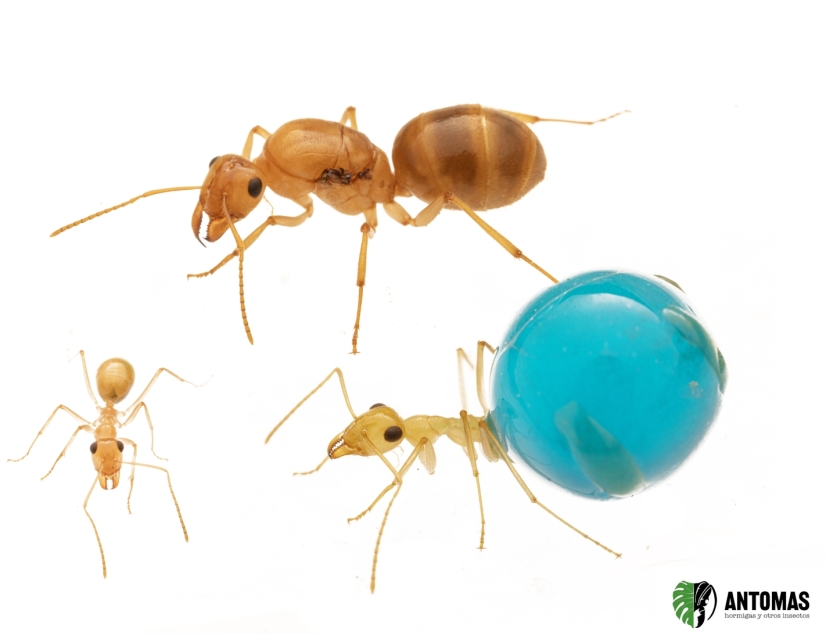
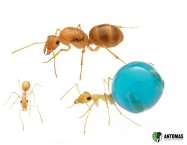
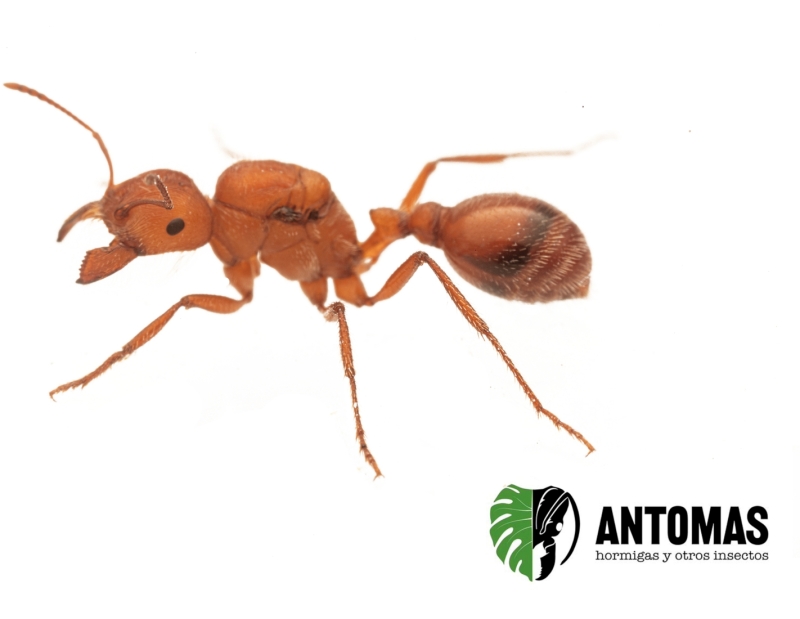
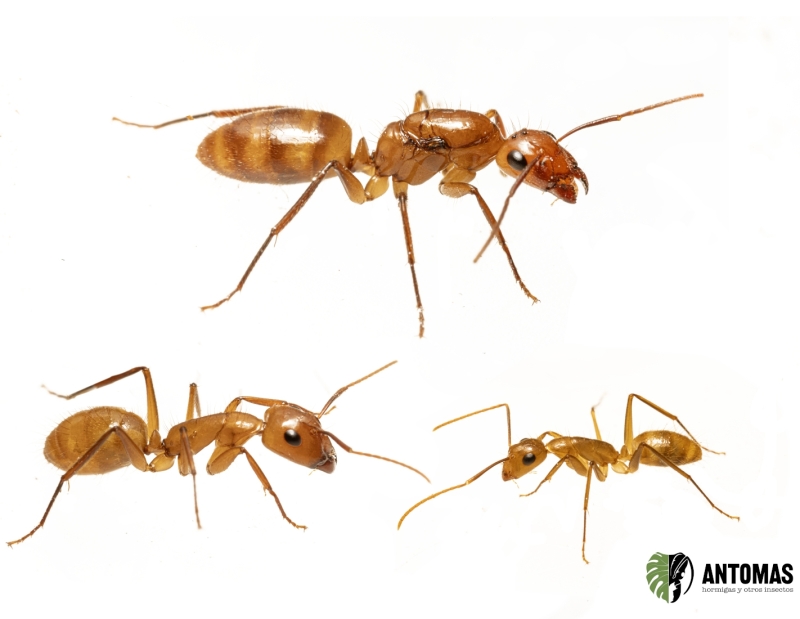
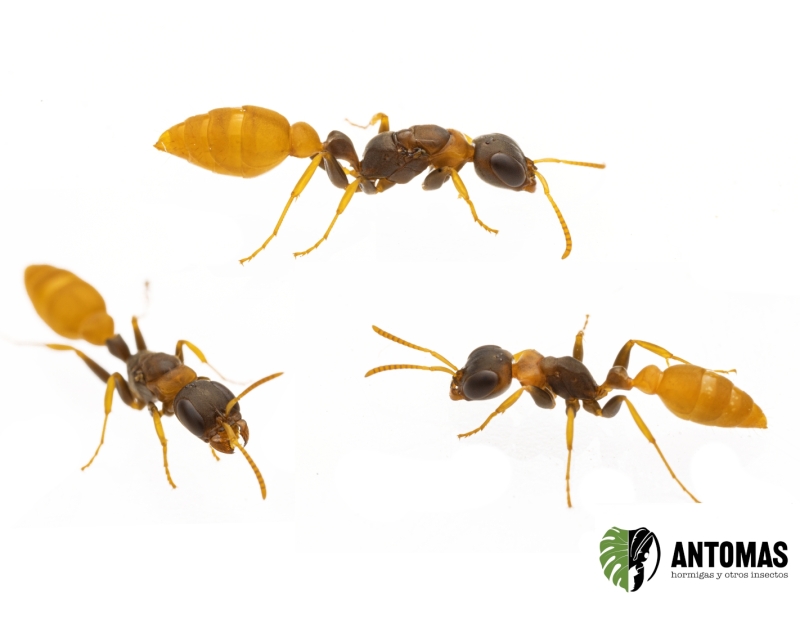
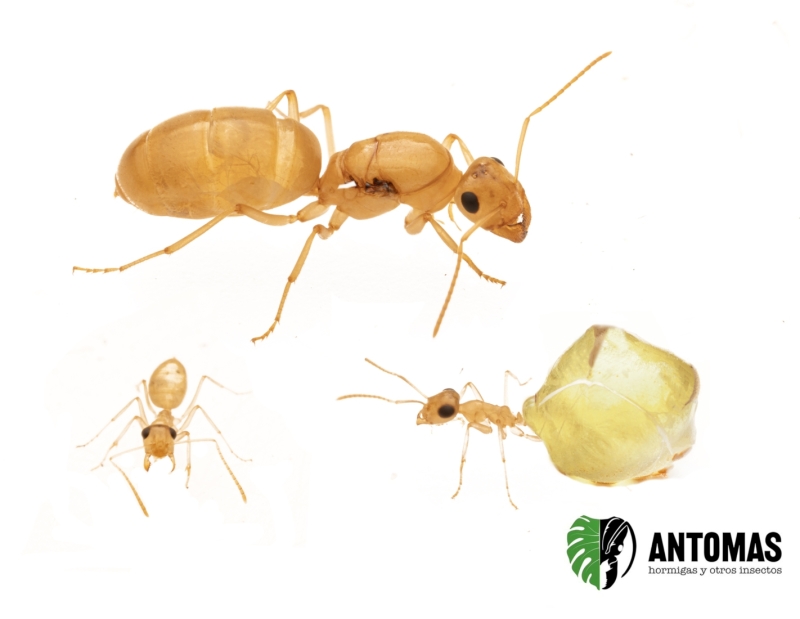
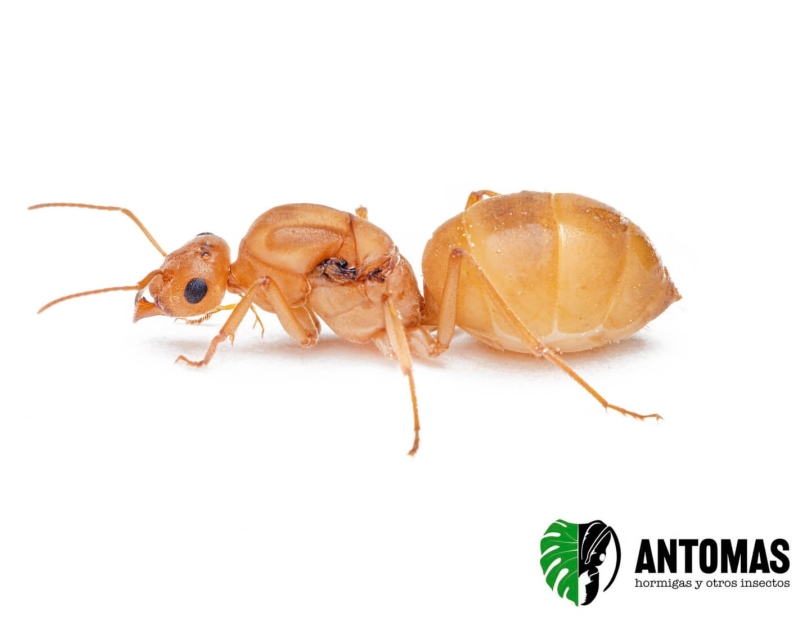
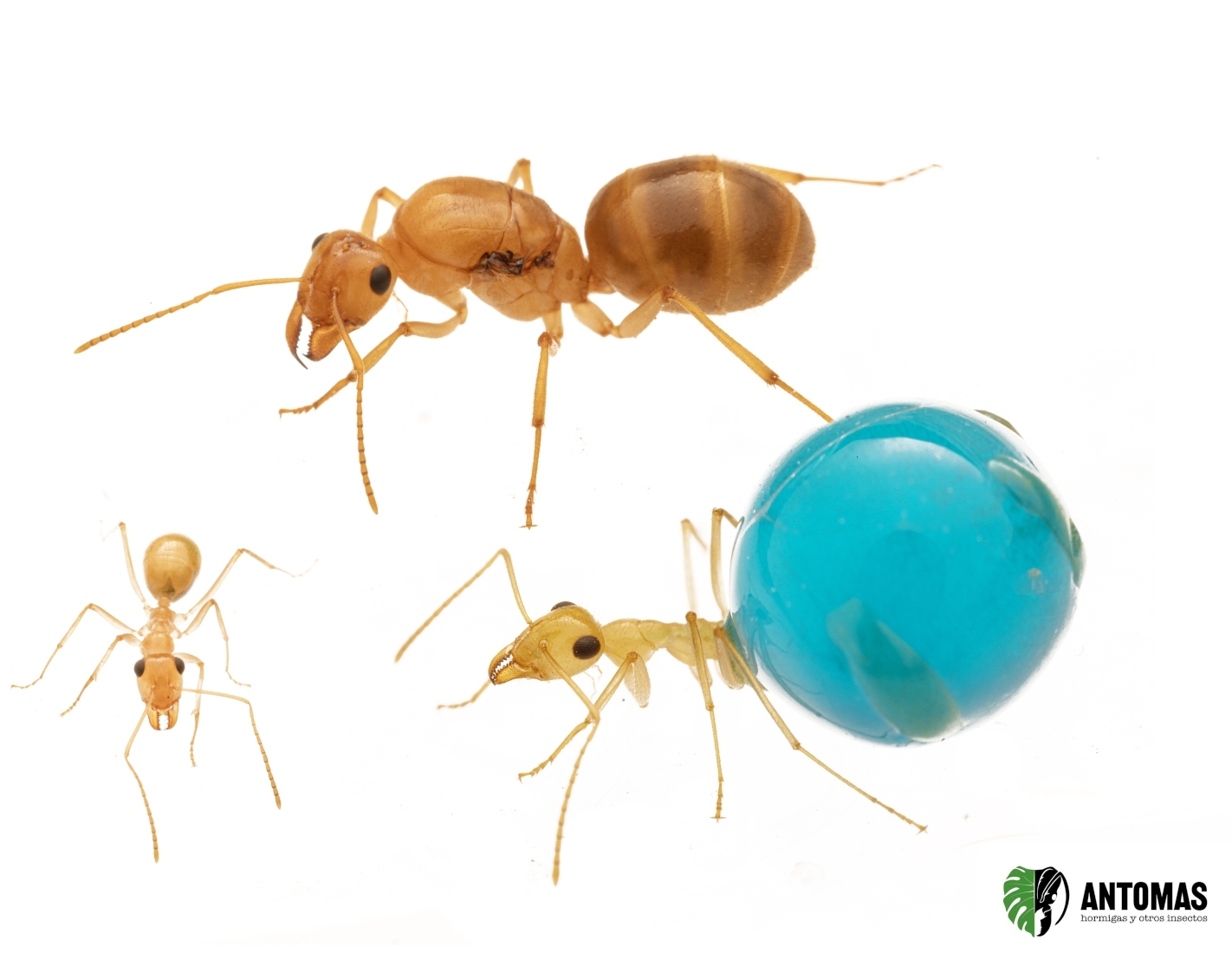
Living gold in the desert night. Myrmecocystus navajo is the “miniature mexicanus” of the piñon–juniper woodlands: a yellow honeypot ant the colour of pale gold, with huge, rear-set eyes, that wakes at sunset and roams the cold ground by starlight. Its repletes, living larders hanging from the ceiling, fill up with whatever they drink and take on its colour: at Antomas, one glows blue with Blue Sugar nectar. A species rarely seen in the hobby, for patient keepers looking for something different. Founding queens with brood. Shipping across Europe, live arrival guaranteed.
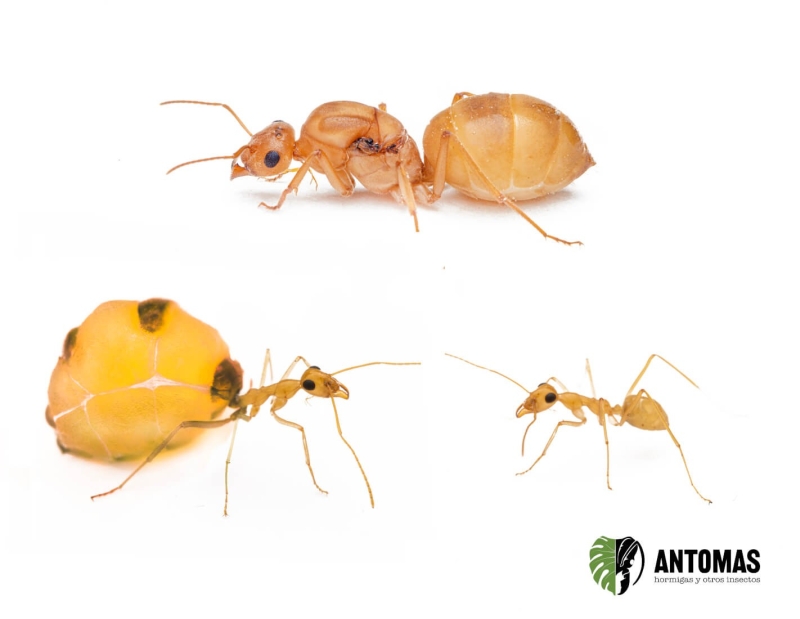
A “miniature mexicanus” from the piñon–juniper woodlands: smaller, golden or light amber all over, nocturnal and with huge eyes set far back on the head. Its repletes take on the colour of whatever they drink: the one in our photo is blue from Anthouse’s Blue Sugar nectar. Queens with brood, with claustral founding, and a single queen per colony. Nectar by the drop until repletes appear and, from then on, always available; tiny prey almost every day. Set-up: Qbik Wild One P 1C, hybrids and, for large colonies, NoNa Diáfano. Household room temperature. Diapause from November to February, about 4 months, at 10–14 °C. Against escapes, mineral oil is enough.
Myrmecocystus navajo Wheeler, 1908 is the little one among the nocturnal honeypot ants. Myrmecologists describe it as a “miniature mexicanus”: it shares with the great classic honeypot ant its pale colour, its nocturnal life and its repletes, those workers turned into living larders, but in a smaller format and with even more striking eyes. It lives in the south-western United States and northern Mexico, and its most typical landscape is the open piñon–juniper woodland of the plateaus.
In our shop it is the yellow honeypot ant, named after the pale honey colour of its workers. It is a little-studied species: not a single scientific paper is devoted to it alone. That is why, in this care sheet, we carefully separate what is known about M. navajo, what can be inferred from its relative M. mexicanus and the rest of the genus, and what we have seen at Antomas, such as the blue replete in the product photo, which we explain below.
Biology
A miniature mexicanus
It was described by the American myrmecologist William Morton Wheeler in 1908, in his major work on the American honeypot ants, as a subspecies of the classic honeypot ant: M. mexicanus navajo. Wheeler still treated it that way in 1912, together with other pale forms of the group. It was Roy Snelling who, in his 1976 revision of the genus, regarded it as a species in its own right and chose a worker as the reference specimen for the name, a lectotype. The name recalls the Navajo people; we have not been able to consult the original description to find out whether Wheeler explained his choice.
Snelling defined it with a phrase that has stuck: a “miniature mexicanus”. The differences from its larger cousin are subtle but consistent:
Size: it is smaller and less polymorphic, meaning there is less difference in size between its small and large workers.
Eyes: large and set far back, towards the rear margin of the head. This is the most striking difference (see “Owl eyes: large, set back and without an anterior ocellus”).
Pilosity: the pubescence on the head is sparse, and there are no erect hairs on the outer face of the femora or tibiae.
Petiole: the node joining the thorax to the gaster is usually thinner and has fewer erect hairs.
In the field it is confused with M. mexicanus, with M. testaceus and with other pale honeypot ants, and telling them apart takes a hand lens and Snelling’s key. The males are tiny: their head is less than 0.8 mm wide.
Golden to the eye, pale to science
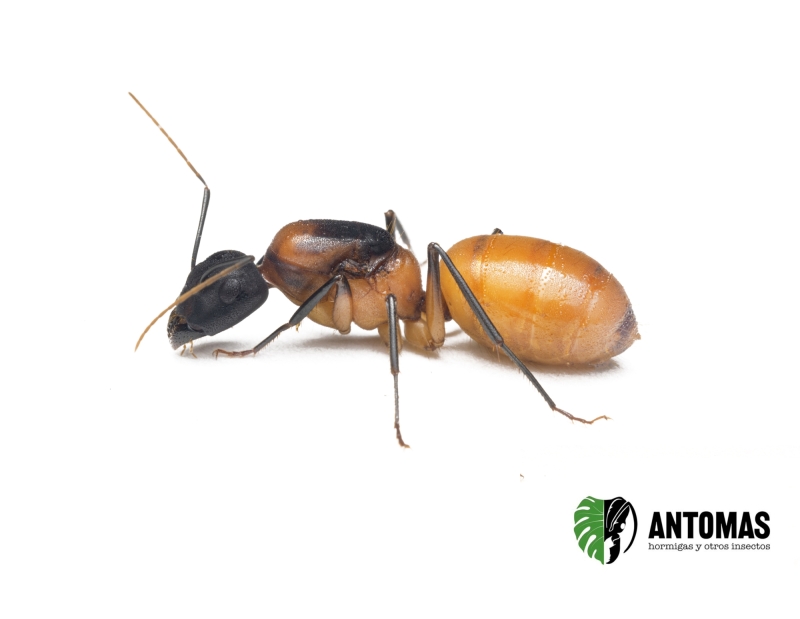
“Golden” is how it looks at Antomas: our queens and workers are golden or light amber from head to gaster, and the queen has a slightly darker, banded gaster. To science, however, M. navajo is simply a pale species. Snelling placed it in the group of honeypot ants with a light yellow integument, large eyes and a nocturnal life, and a 2022 study that measured colour brightness in many species placed it among the pale ones, with a mean brightness above 65 on its scale.
Why is it pale? That same study compared four ant lineages in which pale and dark species have arisen independently, and found the same pattern in all of them: the pale species are nocturnal and the dark ones diurnal. A common explanation is that the dark pigment, melanin, protects against sunlight and desiccation, a defence an ant that works at night needs far less.
There is a curious nuance: a naturalist guide to the region separates M. mexicanus from M. navajo because the former is a lighter yellow, which suggests that the navajo may have a slightly warmer tone. It is a field observation, not a measured fact, but it matches the golden look of our colonies.
Owl eyes: large, set back and without an anterior ocellus
If you look closely at the head of an M. navajo worker, the first thing you notice is the eyes: large, bulging and placed far back. The 2022 study measured the eyes of pale and dark ants from four lineages, including Myrmecocystus, and these are the figures for M. navajo:
Large facets: about 20.4 µm in diameter, compared with about 14.3 µm in M. kennedyi, a dark, diurnal honeypot ant. Each facet is a tiny lens, and the wider it is, the more light it gathers.
Eyes for the half-light: its “eye parameter”, a measure combining facet size and the angle between facets, is around 2. High values are typical of eyes that work in dim light.
A wide field of view, reaching 128°.
No anterior ocellus: 11 of the 12 workers examined lacked the anterior ocellus, the first of the three simple eyes many ants carry on top of the head.
Ocelli help many diurnal insects to orient themselves by the light of the sky. An ant that works at night invests in large, sensitive compound eyes and does without what is of little use to it. And why so far back? Nobody has studied it, but it is reasonable to think that they widen its view to the sides and to the rear, which is useful when searching for food in the dark. That is our own inference, not a fact.
A daughter of the piñon–juniper woodlands
According to Snelling, M. navajo lives from eastern Colorado to western Texas, and west to southern Utah, Nevada, California and northern Sonora. West of central Arizona it occurs patchily, probably only at suitable elevations in the mountain ranges. Records in biodiversity databases are concentrated in Arizona and New Mexico, followed by Utah, California and Texas, and in Mexico mainly in Chihuahua.
Its altitude is poorly documented, but Snelling’s data paint a picture of a mid-mountain ant: 1,220–1,860 m in New Mexico, 670–1,980 m in Nevada and 210–1,370 m in California. It lives from the creosote bush scrub of the low deserts up to chaparral, and it is common in open oak–juniper and piñon–juniper woodland: that landscape of low piñon pines and scattered junipers on stony ground, with cold winters and warm summers, that covers much of the plateaus of the American South-West.
Its nest can be recognised by a small crater-shaped mound of coarse sand or fine gravel around the entrance. Underneath, the nests are deep, with the repletes in the lower part, as in M. mexicanus, although nobody has yet published a complete excavation of an M. navajo nest.
The night shift: four honeypot ants, two timetables
At Portal, in south-eastern Arizona, and Rodeo, in south-western New Mexico, Bert Hölldobler studied an area where at least four species of honeypot ant live side by side. Two are nocturnal, M. navajo and M. mexicanus, and two are strictly diurnal, M. mimicus and M. depilis. The diurnal ones are the famous honeypot ants of tournaments and raids between colonies; the nocturnal ones work the same ground once the others have withdrawn.
This division has a physiological basis. In 1978 the thermal limits of five honeypot ants from New Mexico were measured in the laboratory: the diurnal species lost the ability to move at around 11–12 °C, while the nocturnal one remained active down to −0.4 °C and worked with air and soil temperatures between 2 and 30 °C. Extreme heat, on the other hand, was tolerated similarly by all of them. Pale honeypot ants do not flee the heat: they have taken over the cold hours that the dark ones cannot use.
There are no temperature measurements for M. navajo itself, but everything suggests it works the same way: it is nocturnal, it is pale and it has the eyes of a nocturnal species. At home you will notice that internal clock: activity picks up at dusk (see “How it behaves at home”).
A night-time scavenger
Its diet, according to the observations compiled by Snelling, combines three sources: honeydew from aphids and mealybugs, flower nectar and a significant share of dead arthropods. Like its larger cousin, it is a nocturnal scavenger that roams the ground looking for fallen insects rather than a hunter of live prey. In captivity this translates into a rule: protein in small, soft, freshly killed pieces.
Its mature colonies are estimated at more than 1,000 workers, far fewer than the 5,000 counted in colonies of M. mexicanus. That fits its size: a smaller honeypot ant with smaller colonies, which takes up less space at home than its giant cousin.
Repletes that do not always appear
Like the other honeypot ants in its group, M. navajo forms repletes: workers that fill up with liquid until the gaster becomes a translucent sphere and that spend their lives hanging from the chamber ceilings. But a naturalist guide to the region points out something interesting: in its colonies, repletes are not always present.
Why? There are no studies on this species, but what is known about the genus offers clues. In M. mexicanus, Steven Rissing showed in 1984 that repletes are the largest workers in the colony, and Conway confirmed that the first generation of workers never becomes repletes. A less polymorphic species, with less difference between small and large workers, may have fewer obvious candidates. And repletes form when more nectar comes in than the colony uses. It is an inference, but it fits what we see in captivity well: M. navajo repletes arrive when the colony already has workers of several sizes and sugar to spare.
The mechanism, though, is that of the whole genus. The replete stores liquid in its social crop, the “stomach” in which ants carry the food they share, which stretches until it pushes the other organs aside. The membrane between the plates of the gaster becomes taut and transparent, and the plates are left like dark islands on it. When the colony needs it, other workers stroke its antennae and the replete regurgitates a droplet. An empty replete does not die: it becomes limp and can be filled again. This Anthouse video shows repletes of a diurnal cousin, M. mimicus:
This is how a honeypot ant’s larders hang: repletes of M. mimicus, a diurnal cousin of the yellow honeypot ant (Anthouse).
The blue replete: they drink what you give them
The photo of this product has a detail that does not go unnoticed: among the golden workers, a replete full of a blue liquid. It is not a quirk of the species: it is Anthouse’s Blue Sugar nectar, which we feed our colonies at Antomas. Repletes store what they drink, and through their translucent gaster you can see the colour of what they carry inside.
Science demonstrated this decades ago. John Conway, who studied the honeypot ants of Colorado, fed colonies of M. mexicanus sugar water dyed blue or red and obtained blue and red repletes. He gave one colony nothing but red-dyed water, and one of its workers became a semi-replete full of water. In the wild, colours also tell a story: dark amber repletes hold sugars with a molasses flavour; clear ones mainly hold water with sucrose and act as water tanks for the desert; and milky ones hold proteins and fats from prey.
For a keeper, this turns repletes into a window: the colour of your repletes tells you what they have been drinking. If you alternate nectars over the week, as we recommend (see “Nectar, tiny prey and water”), you may in time see repletes of different shades in the same chamber. And it is a reminder of something important: a replete is a larder, and what it stores should be good and varied.
Summer founders
No nuptial flight of M. navajo has ever been published. The flight of M. mexicanus is documented, though, a species with which it shares its group, its timetable and part of its range: it flies in late July or early August, after heavy summer rain, at dusk. It is reasonable to assume that M. navajo follows a similar calendar, linked to the summer storms of the South-West, but it is an assumption.
Honeypot ants found their colonies claustrally: after the flight, the queen sheds her wings, digs a chamber, seals it and raises her first workers alone, using her body fat and her wing muscles, which she no longer needs. In M. mexicanus, the first workers emerge two or three months after the flight, and the queen spends her first winter sealed in with them. There are no data on group founding or on colonies with several queens in M. navajo: at Antomas we treat it as monogynous, with a single queen per colony.
A family that science is still sorting out
Snelling divided the honeypot ants into three groups, then subgenera: the pale, nocturnal, large-eyed ones, where he placed M. navajo alongside M. mexicanus; the large diurnal species, often bicoloured, such as M. mimicus; and the small dark ones. It was a logical classification, based on appearance and timetable.
Genetics has called it into question. In 2004 the first phylogeny of the honeypot ants based on mitochondrial DNA was published, and in 2021 a far more complete one, covering 28 of the 29 described species with genome-wide markers, concluded that Snelling’s groups do not match the genetic tree and that cryptic lineages are hidden within seven species. If those groups are not natural, pale colour and nocturnal life would have arisen more than once in the history of the genus: a solution that evolution would have found several times for living in the desert.
That phylogeny also dated the origin of the group: Myrmecocystus split from Lasius, the genus of our black garden ants, in the early Miocene, and diversified around 14 million years ago, while the American South-West was drying out.
Honeypot ants of the world: the same idea, many times over
M. navajo belongs to a curious club. Repletes are not an invention exclusive to Myrmecocystus: they have arisen independently in several ant lineages that live where food comes in bursts. In Australia, Camponotus inflatus has repletes of up to 1.4 g, colonies in which almost half the ants are repletes, and a honey with its own antimicrobial activity, according to a 2023 study. Also in Australia, Melophorus bagoti has smaller, more mobile repletes; there are tiny repletes in Plagiolepis, others in Prenolepis, in North America, and in Leptomyrmex, of which even a fossil replete worker from the Eocene has been described.
Among the American honeypot ants, repletes have been recorded in 20 of the 29 species of Myrmecocystus. M. navajo is one of them, although, as we have seen, its repletes are not always there. It is the miniature in a club of giants.
Size and morphology
A small honeypot ant for the genus, slender and pale, with workers that differ little in size.
Colouration according to science: pale, from the group of honeypot ants with a light yellow integument.
Colouration of our colonies:golden or light amber all over, queen and workers alike; the queen has a darker, banded gaster. The translucent repletes take on the colour of what they drink (see “The blue replete: they drink what you give them”).
Eyes: large, with wide facets and set back towards the rear margin of the head; almost always without an anterior ocellus.
Pilosity: sparse pubescence on the head and no erect hairs on the outer face of the femora and tibiae.
Petiole: a thin node with few erect hairs.
Polymorphism: less than in M. mexicanus, and no soldiers.
Defence: no sting; like all formicines, it bites and uses formic acid.
Approximate measurements
Workers: no accessible published measurements; smaller than those of M. mexicanus
Queen: no accessible published measurements
Male: head width under 0.8 mm (Snelling)
Worker eye facets: about 20.4 µm in diameter (Johnson and Rutowski, 2022)
Full measurements for each caste are given in Snelling’s 1976 revision, which was not accessible for this care sheet, and we prefer not to give figures without a source. As a relative reference: it is a “miniature mexicanus”, so its workers are smaller than those of M. mexicanus, which measure 3–7 mm according to Cole’s classic 1936 description.
Care in captivity
Difficulty: 4/5 – Advanced
Being small does not make it easy. At Antomas we class it as advanced for four reasons:
Little published experience. It is one of the least kept honeypot ants: there are few breeding journals and almost no scientific data of its own, so much of what we know comes from its cousin M. mexicanus and from our own experience.
A slow start. As throughout the genus, the queen takes months to produce her first workers, and the colony is fragile until it gets past the first generation.
Sugar that has to be measured out. At first, nectar is given by the drop (see “Beware of the sweet death”).
Repletes that keep you waiting. They arrive with the second or third generation, and in this species they sometimes take longer.
The good news is that everything else is simple: it lives at household temperature, it is not an escape artist, it eats food that is easy to find and it takes up little space. And there is a reward: a golden, big-eyed colony that wakes at dusk and, with patience, repletes that literally reflect what you give them.
Queen with brood: the first months
At Antomas we sell it as a queen with brood: a queen that has already started her colony in a test tube and has eggs, larvae or pupae. Founding is claustral, so the queen goes on raising her brood on her own reserves. Your job at this stage is mainly not to get in the way:
Darkness and calm. Leave the tube as it arrives, in a box or drawer with no direct light or vibrations, at room temperature.
Water. Once a week, check that the cotton wool is still moist and that the reservoir still has water. If it runs out or the tube gets dirty, move the colony to a new tube by tipping.
A droplet, no more. Now and then, use a dropper to offer a small drop of nectar on a small piece of plastic or aluminium foil inside the tube, never on the cotton wool, and remove whatever is left the next day.
Protein in miniature. When the first workers emerge, start with tiny pieces of Drosophila or micro-cricket, daily if possible, and remove the leftovers.
Timetable. There are no data for M. navajo, but in M. mexicanus the first workers take two or three months from the flight. They are small nanitics, and none of them will become a replete.
Once the first workers are out, move her into a Qbik Wild One P 1C (see “From tube to nest: moving by tipping”). From then on the colony grows slowly: patience, routine and tiny food.
Beware of the sweet death
With honeypot ants, overfeeding is as dangerous as underfeeding. We know this from our own breeding experience, not from books: when a founding queen or a very small colony has more nectar than it can use, and there are not yet any repletes to store it, the queen ends up filling herself. Her gaster swells like a replete’s, egg-laying slows down or stops and the colony stalls; if this goes on, it can be lost. We call it the sweet death, and this Anthouse video shows it in queens in the middle of founding:
The sweet death: queens that turned into repletes during founding, in a video by Anthouse.
Hence the dropper rule: small drops, and no top-up until they are gone. If the queen is already swollen, stop the nectar until she shrinks and starts laying again, while keeping up the water and the tiny prey. And the day you see the first replete hanging from the ceiling, switch mindset: the colony now has somewhere to store food, and nectar becomes always available.
The formicarium: from the Wild One to the NoNa
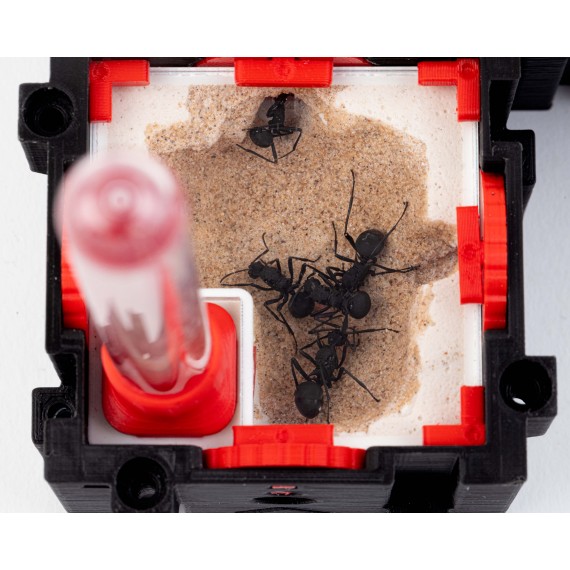
At Antomas we recommend starting with the Qbik Wild One P 1C by Anthouse, the small module of the range, measuring 6.78 × 6.78 × 5 cm and designed for queens and small colonies. For a honeypot ant with modest colonies like this one, it is a first home that lasts quite a while:
Its chambers are just tall enough for the first repletes to hang from the ceiling, without forcing a small colony to move along vertical walls. To begin with, avoid narrow vertical nests: they look impressive, but they bear no resemblance to the low, wide chambers in which honeypot ants keep their repletes.
We also recommend the hybrids, such as the Qbik Wild Duo P 2C Híbrido, for when the colony needs more space. It moistens from a lower reservoir separate from the galleries and also has a side drinking tube: stable humidity with no water in the chambers, exactly what repletes need.
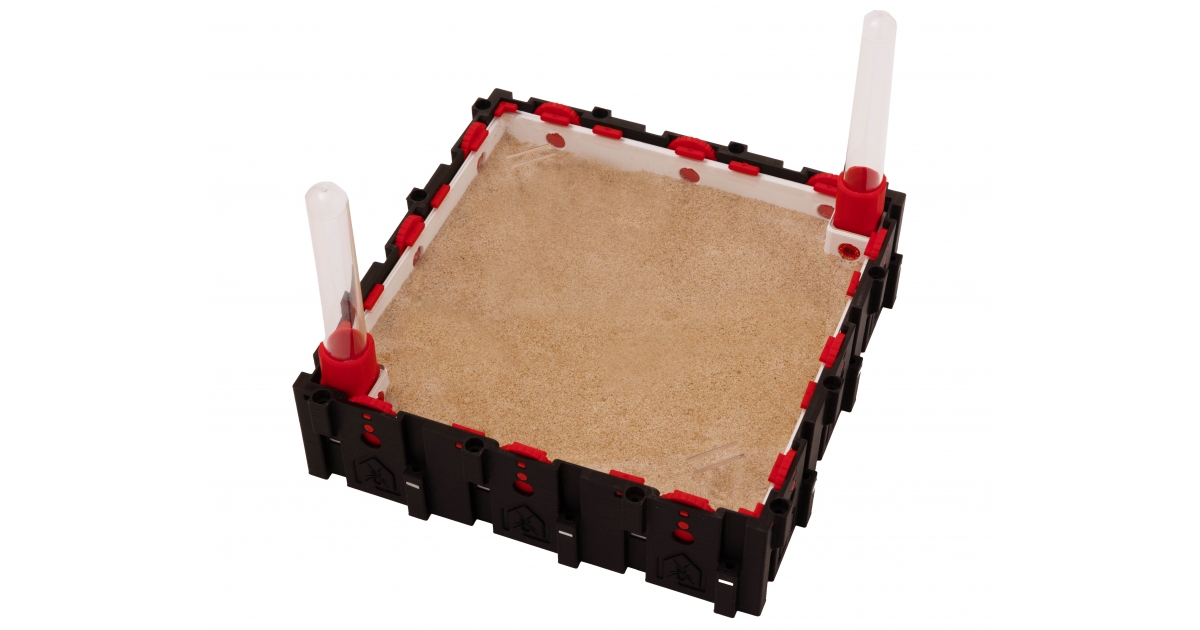
And for a large colony, the Qbik Wild NoNa Diáfano by Anthouse, one of the large formats in the range. With no interior chambers, it lets the ants dig and organise their own nest in the substrate, as they would under a juniper, always with a compact substrate that will not collapse, moistened only at specific points. It is a nest for colonies that are already large: used too early, you would lose sight of the queen and control of the food.
Whatever the model, check two things: that the chamber ceilings have a rough surface to grip and that there is enough height for a replete to hang without touching the floor. Add a dry foraging area, a water tube with cotton wool, a feeder and the band of mineral oil.
Temperature and humidity
Temperature: at Antomas, simply household temperature. Keepers who succeed with the genus work at 24–31 °C and point to about 29 °C as ideal; some M. navajo keepers keep it exactly like that, and one documented a colony of more than 70 workers at 26–28 °C. If you want to give it that extra, use a heating cable with a thermostat on one side of the nest, never under the repletes.
Humidity: one M. navajo keeper summed it up as slightly moist, with no condensation. A moist spot near the brood and the rest dry, with stable replete chambers: no droplets on the walls, which would make them fall, and no extreme dryness.
Foraging area: dry and ventilated.
Water: always within reach, in a test tube with water and cotton wool.
Light: a dark nest and the foraging area under room light.
Diapause: from November to February, at 10–14 °C (see “Diapause from November to February”).
From tube to nest: moving by tipping
When your queen arrives, leave the tube to rest in the dark and check that it has water; do not move her into the nest on the first day. When it is time to move her, at Antomas we do it by tipping:
Set up the formicarium beforehand, with the water and the oil barrier in place, and darken the nest area.
Open the tube inside the foraging area, next to the entrance, working over a tray.
Gently tip out the queen, workers and brood, and help any stragglers with a soft brush.
Leave them in peace: before long they will have carried the brood into the nest.
Once there are repletes, move the colony only if it is essential, and also by tipping, but carry the repletes separately, one at a time, with a soft brush and without pressing on the gaster.
Nectar, tiny prey and water
Nectar, in two phases. Until the first repletes, by the drop (see “Beware of the sweet death”). From then on, ad libitum and without interruption: it must never run out. Vary the sugars: at Antomas we recommend Anthouse’s Blue Sugar nectar 4–5 times a week and another sugary liquid or nectar 1–2 times a week, and you can add a little protein to it. Yes, it is what fills the blue replete in our photo: with M. navajo you will see, through the gaster of the repletes, what you have put in the feeder. Always offer it in a feeder, never on cotton wool, which goes mouldy and spoils it; ideally one in which the drop stays spread out and accessible, renewed before it ferments.
Protein: small, frequent and varied. At first, extremely small prey: Drosophila, newly hatched firebrats (Thermobia), termites and micro-crickets, daily if possible. As the colony grows, it accepts larger prey, such as flies or small crickets, in greater quantity but with more days between feeds. Change the insect every week and buy them from a reliable supplier.
If you can check the colony daily and remove leftovers, do not be afraid to feed generously: at Antomas we see that, with plenty of food, the colony understands that it has resources and grows faster. If you cannot clean often, adjust the amount, because leftovers ferment and bring mould. This is how the larvae of a honeypot ant feed:
Feeding time in the nest: M. placodops larvae eating at Antomas (Antomas channel).
Water separately, always: a test tube with water and cotton wool in the foraging area. And, as it is nocturnal, put food in as evening falls and remove leftovers in the morning.
Diapause from November to February
At Antomas we give it a diapause of about 4 months, from November to February, slightly shorter than that of our native species, and we suggest 10–14 °C. Why that figure? Because of its group: pale, nocturnal honeypot ants remain active close to 0 °C and tolerate a cooler rest than dark, diurnal ones, which become immobile at around 11–12 °C and need a milder diapause. But we do not push it as far as with M. mexicanus: its colonies are smaller, its repletes are sometimes scarce and some of its populations live at low altitude. In the first winter of a queen with brood, still without repletes, it is better to stay at the top of the range: 12–14 °C.
Lower the temperature over one or two weeks, and raise it the same way in March.
Water always, and a little nectar if workers are moving about.
No protein, or hardly any, while there are no larvae; resume it as soon as the colony becomes active.
How it behaves at home
It is an ant with a nocturnal timetable: during the day you will see few workers outside, and at dusk the foraging area comes to life. Scouts go out one by one and, when they find the feeder or a prey item, repeat the route. Young colonies are discreet; do not worry if you hardly see them.
Enjoy them without fear. At Antomas we believe ants are there to be observed and learned from, not hidden away: all you need is a dark area in the nest and light in the foraging area, and to observe them gently, without intervening more than necessary. They get used to you. An evening, at the time they wake up, with a hand lens, is the best moment to see those huge eyes.
Signs to watch for: a swollen queen that is not laying (too much nectar), brood that does not progress (lack of protein), repletes on the floor (condensation or knocks) and mould (humidity or leftovers).
Escape barrier
It is not an escape artist. In our experience, a band of mineral oil on the upper part of the foraging area, a lid that closes well and connections without gaps are enough. Check that no branch or stone touches the barrier.
Handling
It cannot sting, as it has no sting. If it feels trapped, it bites and releases formic acid, with no further consequences. What is fragile here is the repletes: for any intervention, use tubes, brushes and soft forceps, never your hands, and work calmly. Do not combine queens or colonies. And, as an exotic species, it must never be released.
Costly mistakes
Filling a feeder for a lone queen or a colony without repletes.
Continuing to give nectar to a swollen queen.
Leaving a colony that already has repletes without sugar.
Starting with large prey instead of tiny ones.
Putting nectar on cotton wool or leaving leftovers for days on end.
Wetting the nest until condensation appears.
Choosing a narrow vertical nest, or one that is too large, for a colony that is just starting.
Moving a colony with repletes unnecessarily.
Combining queens or colonies.
Scientific sources
This care sheet is based on the scientific literature on Myrmecocystus navajo, its species group and its genus, and on the experience of Antomas and other keepers. Main references:
Wheeler, W. M. (1912). Additions to our knowledge of the ants of the genus Myrmecocystus Wesmael. Psyche 19: 172–181. doi:10.1155/1912/59057
Johnson, R. A. & Rutowski, R. L. (2022). Color, activity period, and eye structure in four lineages of ants: pale, nocturnal species have evolved larger eyes and larger facets than their dark, diurnal congeners. PLoS ONE 17: e0257779. doi:10.1371/journal.pone.0257779
Hölldobler, B. (1981). Foraging and spatiotemporal territories in the honey ant Myrmecocystus mimicus Wheeler (Hymenoptera: Formicidae). Behavioral Ecology and Sociobiology 9: 301–314. doi:10.1007/BF00299887
Kay, C. A. R. & Whitford, W. G. (1978). Critical thermal limits of desert honey ants: possible ecological implications. Physiological Zoology 51: 206–213. doi:10.1086/physzool.51.2.30157867
Conway, J. R. (1977). Analysis of clear and dark amber repletes of the honey ant, Myrmecocystus mexicanus hortideorum. Annals of the Entomological Society of America 70: 367–369. doi:10.1093/aesa/70.3.367
Conway, J. R. (1986). The biology of honey ants. The American Biology Teacher 48: 335–343. doi:10.2307/4448321
Conway, J. R. (1994). Honey ants. American Entomologist 40: 229–234. doi:10.1093/ae/40.4.229
Kronauer, D. J. C., Hölldobler, B. & Gadau, J. (2004). Phylogenetics of the New World honey ants (genus Myrmecocystus) estimated from mitochondrial DNA sequences. Molecular Phylogenetics and Evolution 32: 416–421. doi:10.1016/j.ympev.2004.03.011
van Elst, T., Eriksson, T. H., Gadau, J., Johnson, R. A., Rabeling, C., Taylor, J. E. & Borowiec, M. L. (2021). Comprehensive phylogeny of Myrmecocystus honey ants highlights cryptic diversity and infers evolution during aridification of the American Southwest. Molecular Phylogenetics and Evolution 155: 107036. doi:10.1016/j.ympev.2020.107036
Dong, A. Z., Cokcetin, N., Carter, D. A. & Fernandes, K. E. (2023). Unique antimicrobial activity in honey from the Australian honeypot ant (Camponotus inflatus). PeerJ 11: e15645. doi:10.7717/peerj.15645