Difficulty: 1/5 – Beginner
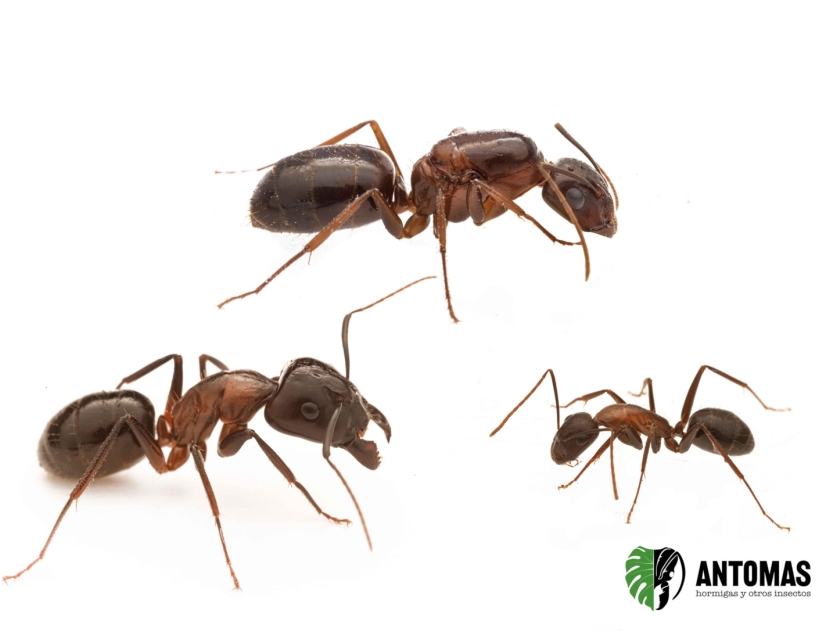
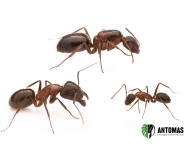
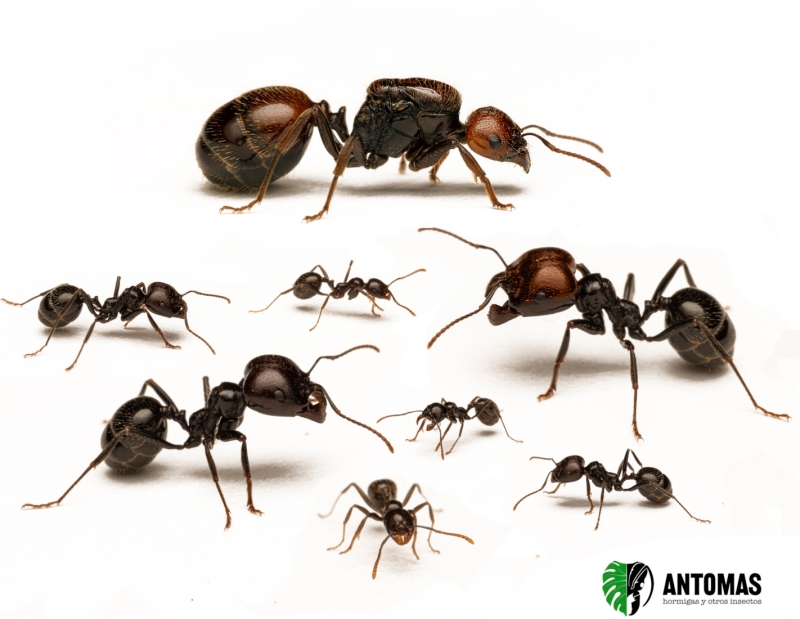
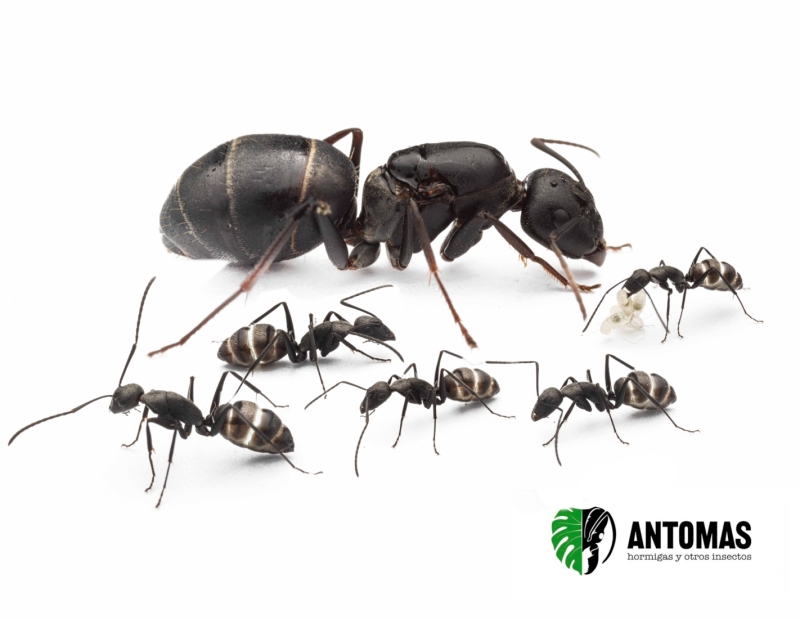
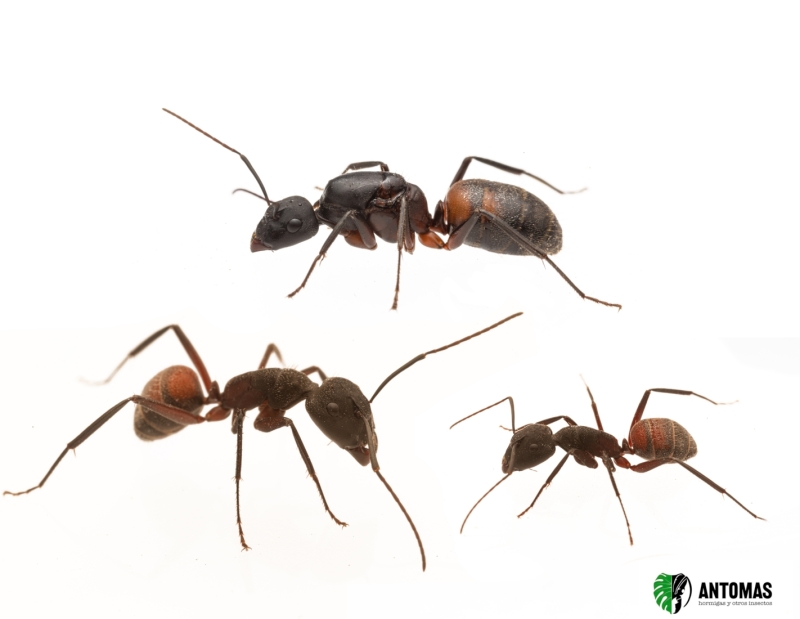
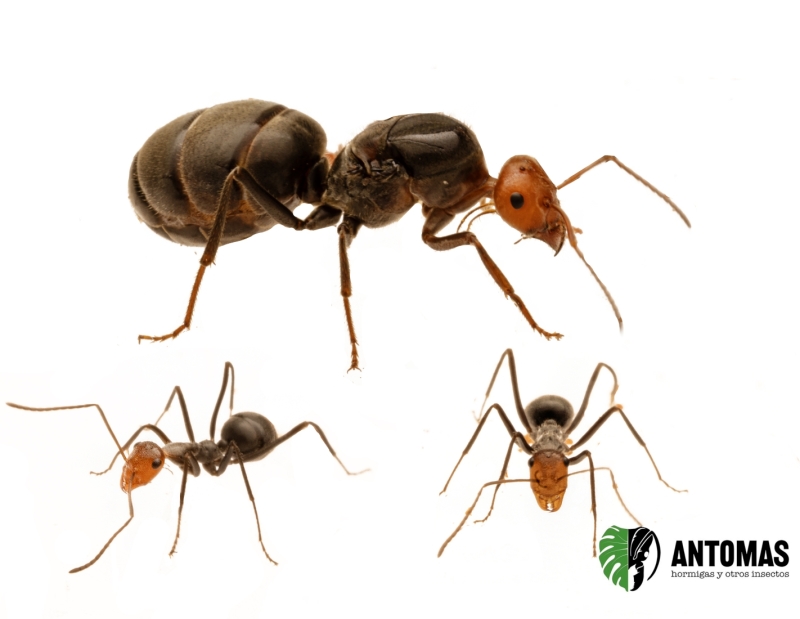
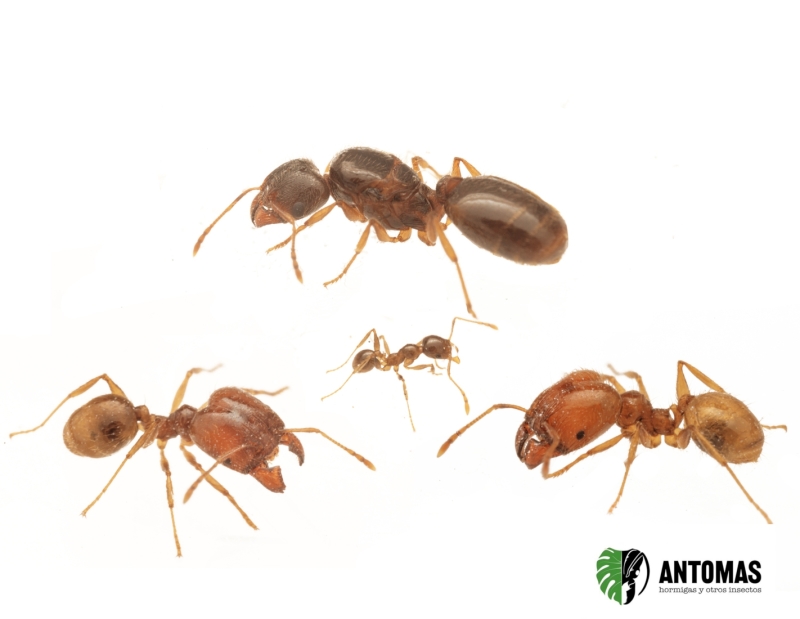
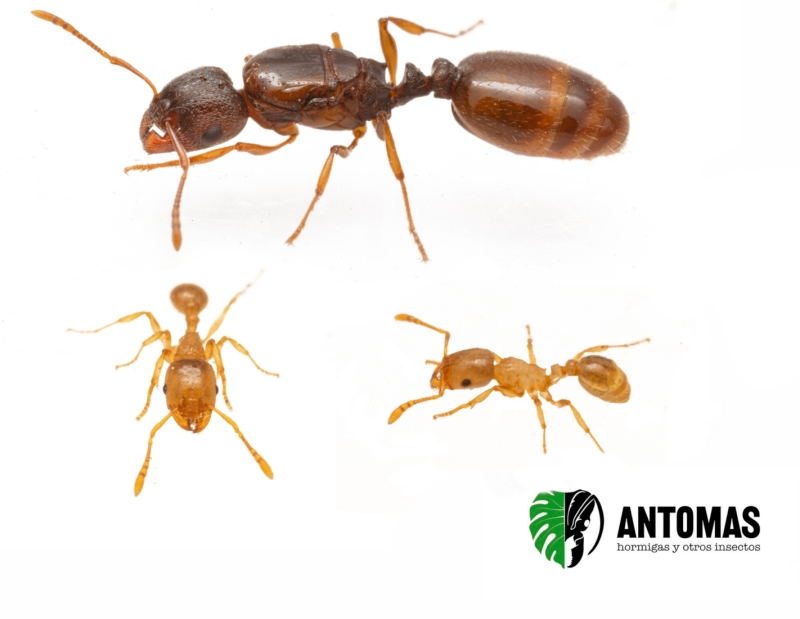
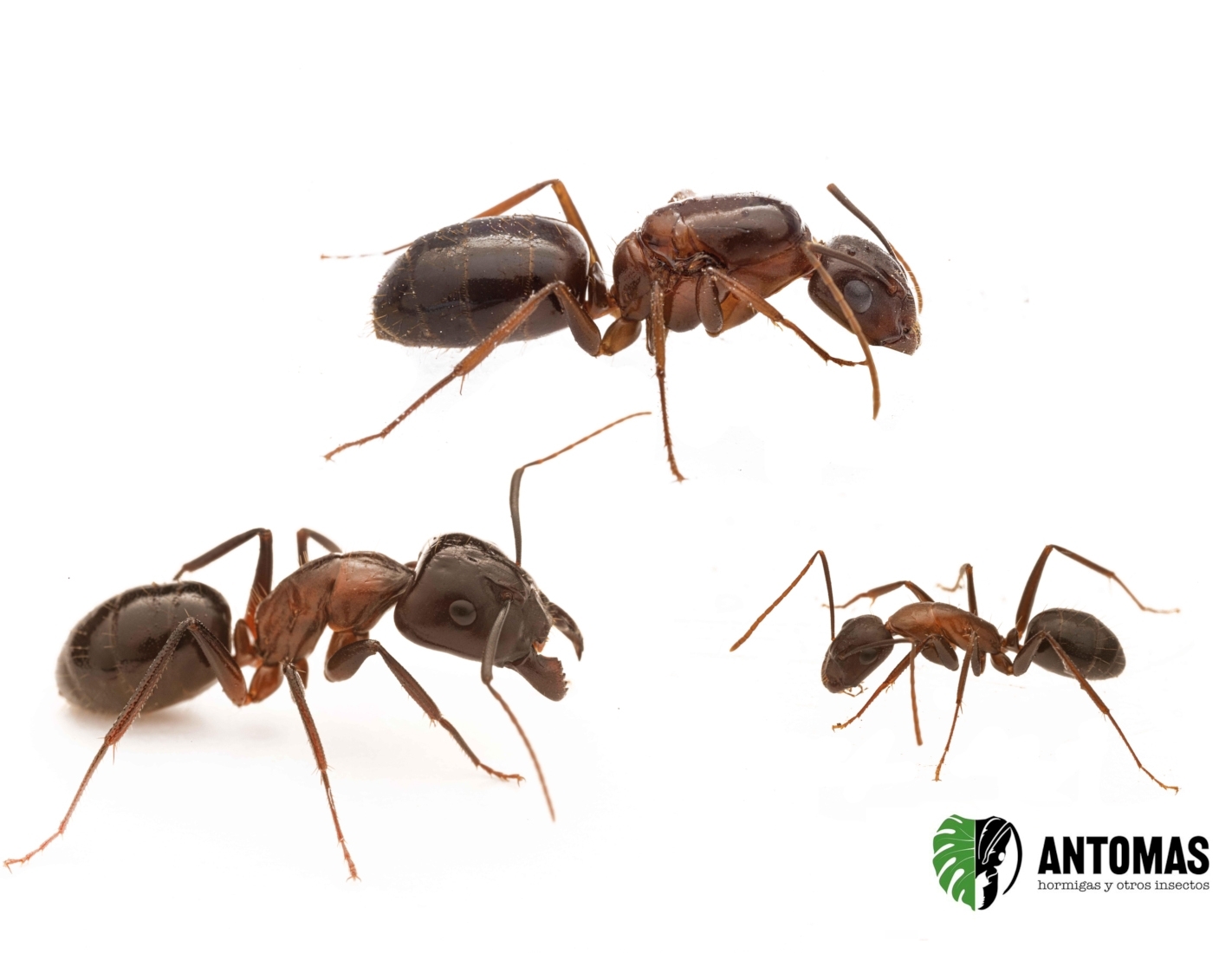
The great Iberian Camponotus of the night shift: dark, glossy head and gaster, reddish-brown thorax and workers of several sizes, which go out to tend their aphids when the light fades. Founding queens with brood; one queen per colony and claustral founding. Found the colony in a Qbik Wild and move it to the Alpha range later; 24–28 °C, a rather dry nest, water in a tube, sugar always in a feeder and plenty of protein. Diapause of 3–4 months at 8–13 °C, never below freezing. It runs and climbs: a band of mineral oil or talc keeps it in check. No sting, so it cannot sting.
Camponotus sylvaticus (Olivier, 1792) is a large, polymorphic carpenter ant from the western Mediterranean, with workers of several sizes and a life that is almost entirely nocturnal. While the sun beats down on the stones of meadows and scrubland, the colony waits underground; when the light goes, the workers climb into the vegetation in search of aphids, nectar and insects. It is one of the commonest Camponotus in the Iberian Peninsula and yet few people have ever seen it at work: it does its job while we sleep.
At Antomas we consider it an excellent species to start with: hardy, calm, easy to feed and with a yearly cycle that suits a home in a Mediterranean climate. In this care sheet we keep apart what science says, what other keepers report and what we recommend at Antomas.
Biology
Described in the middle of the French Revolution, from a single queen
Its scientific history begins in 1792, the year France proclaimed the Republic. The naturalist Guillaume-Antoine Olivier described it as Formica sylvatica in the Encyclopédie méthodique, and with very little material: according to the world ant catalogue, AntCat, the description was based on a single queen, collected in the forests of southern France. That type specimen is kept at the National Museum of Natural History in Paris.
It was later moved to Camponotus, the genus of carpenter ants, and in 1925 the Italian myrmecologist Carlo Emery placed it in the subgenus Tanaemyrmex, where it remains today: Camponotus (Tanaemyrmex) sylvaticus.
The “woodland” ant that prefers meadows
Sylvaticus is Latin for “of the woods” or “wild”, after the forests where Olivier’s queen turned up. But the ant is less of a forest dweller than its name suggests. In the Iberian Peninsula it lives mainly in meadows, scrubland, clearings and woodland edges, in sunny and rather dry places, and nearly always nests under stones, in the soil or in dead wood. It has been recorded up to about 1,250 m above sea level. Anyone who lifts a flat stone on a sunny bank may find a chamber of large, shiny workers with a reddish thorax underneath; what they will hardly ever see is those workers strolling about in full sun.
The ant of the night shift
The key study of its life in the wild was published in 1988 by the ecologists Javier Retana, Xim Cerdá and their colleagues, who followed it in a meadow on the Catalan coast. Their conclusion was clear: C. sylvaticus is crepuscular and nocturnal. The workers come out late in the afternoon, work all night and withdraw early in the morning; by day it is very rare to see them foraging on the ground.
What starts the shift is not heat but light: according to the study, light intensity is the main factor that sets the beginning and end of activity. Temperature merely provides the frame, as the workers were seen foraging between 14 and 29 °C.
And not all of them keep the same hours. Those tending aphids may spend the whole day in the vegetation, next to their “herds”, while most foragers return to the nest in the morning. For the aphids, it is a round-the-clock guard service.
When heat shares out the shifts
Why would such a large ant choose the night? In July, average maximum air temperatures reach around 32–36 °C over much of its range, and sun-baked ground gets far hotter. The same team of ecologists has shown that, in Mediterranean ant communities, temperature shares out time and space: some species make the most of the midday heat, others of the cool hours, and heat can even scramble the dominance hierarchies between species. These are studies of whole communities, not of C. sylvaticus in particular, but our reading is that, instead of competing in full sun with heat-loving species such as the desert ant Cataglyphis velox, it takes the shift they leave free. Its Iberian relative C. pilicornis, from the same subgenus, is also crepuscular and nocturnal.
An aphid rancher
Retana and his colleagues also described its diet, and it has a sweet tooth: it is based mainly on aphid honeydew, the sugary liquid aphids excrete while sucking sap, topped up with nectar. This is trophobiosis: the aphids hand over sugar and the ants protect them from predators and parasitoids. The deal is so ancient that many ant-tended aphids no longer flick the droplet away but hold it at the tip of the abdomen for the worker to collect (Stadler and Dixon 2005).
It defends that larder with its jaws. In the same meadow, the team also studied C. cruentatus (Alsina et al. 1988) and portrayed C. sylvaticus as a very aggressive ant where its honeydew sources are concerned: two nearby stone pines were occupied all year round by workers from two sylvaticus colonies, and no other species was ever seen there. Working at night and starting its season late spares it some friction with its neighbour, but in July and August every encounter ended in a fight, and it was common to see cruentatus workers with sylvaticus heads still clamped to their legs and antennae. By mid-August, the pine cruentatus had been exploiting was almost entirely in sylvaticus hands, although the authors could not say for certain that it had been conquered.
Honeydew, however, is very poor in nitrogen. Camponotus make up for it with an inside ally, the bacterium Blochmannia, which lives in special cells of the gut and passes from the queen to her daughters through the eggs. In the North American C. floridanus it was shown to improve the ant’s nutrition, above all when its diet lacks essential amino acids (Feldhaar et al. 2007). But it does not replace insects: the larvae still need them to grow.
The “mother” of C. barbaricus
C. sylvaticus belongs to the subgenus Tanaemyrmex, the “maculatus group” of Gómez and Espadaler in Hormigas ibéricas: a glossy cuticle, as if freshly varnished, a gaster with very little fine hair and a clypeus, the front plate of the head, with a rectangular lobe. In the Iberian Peninsula the subgenus also includes C. pilicornis, C. aethiops and its closest relative, C. barbaricus.
In 1905, Emery described barbaricus as a subspecies of another ant, C. maculatus, from specimens from the south of the Iberian Peninsula. A few years later, Emery himself (1920) and the Swiss entomologist Felix Santschi (1921) treated it as a subspecies of C. sylvaticus: for a while it was just a southern form of our species. Today it is a valid species, with subspecies of its own in North Africa, although Gómez and Espadaler point out that the boundary between the two is not fully settled. You can meet the “daughter” on our Camponotus barbaricus page.
This kinship should not be confused with another one. Camponotus cruentatus and Camponotus micans, the other two large Iberian Camponotus in our catalogue, belong to the subgenus Myrmosericus, matt and with a velvety gaster. A sylvaticus gleams like polished furniture; they look as if they were dressed in velvet.
When sylvaticus reached the Red Sea
In the 19th century the name covered far more than it does today. In 1877, Emery listed as sylvaticus ants from Aden, Eritrea, the Isthmus of Suez and North Africa, and gave the species a range across “southern Europe, North Africa and part of Asia”: one broad name for a set of large, shiny, red-thoraxed ants that looked very much alike. Over time, those populations were split off into other species, and the story of barbaricus fits the same process of breaking up a name that had grown too big. The internal classification of Camponotus, a genus with more than a thousand species, has been thoroughly revised over the last decade with genetic data, and this group may still hold surprises.
An ant of the western Mediterranean
Today it is an ant of the western Mediterranean, with its core in the Iberian Peninsula and southern France. In GBIF, the large global biodiversity database, it has more than 1,400 records, most of them from Spain, followed by France and Portugal. In the Iberian Peninsula it is commonest in the eastern half and the south, from the Mediterranean coast and the Ebro valley to the centre and Andalusia, as well as southern Portugal, and there are old records from the Galician coast. In France it occupies the Mediterranean belt. Its presence in North Africa is unclear, as the scattered records could belong to C. barbaricus, and it has not been confirmed in the Balearic Islands either.
A Mediterranean winter, in the shelter of a stone
Its climate is Mediterranean: hot, dry summers, and winters that are mild on the coast and in the south and colder inland. Between December and February, the mean air temperature stays below 14 °C even in the warmest lowlands, where it is around 11–12 °C, and drops to 6–8 °C inland, with frosts. Compare that with its activity range, 14–29 °C, and the sums are easy: in the wild it spends about three months a year, or four inland, with almost no activity, sheltering under its stone, where the soil buffers the frost. That is the winter we imitate in captivity with diapause.
Nuptial flights on summer evenings
True to its habits, it also flies at night. According to keepers’ records, nuptial flights take place between June and August, depending on the area and altitude. They start at dusk and are repeated over several days in a row: in inland Spain, one keeper watched queens and males leave between 20:30 and 21:30 for three or four evenings. In the hottest areas, flights have also been seen at dawn. The next morning the queens, already wingless, turn up under small stones, freshly settled in the chamber where they will found their colony.
One queen per colony
All keepers’ sources agree that it is monogynous, with a single queen per colony, and we have not found a single case of colonies with several. This fits what is known about Palaearctic ants: in an analysis of 149 species, Boulay and colleagues (2014) concluded that having a single queen is the ancestral state, and that colonies with several queens are linked to very large colonies and to dependent founding.
Founding is claustral: the queen seals herself in and raises her first workers alone, without going out to feed, using up her fat reserves and the flight muscles she no longer needs. That is why queens of claustral species are large and set off on their flight loaded with fat (Keller and Passera 1989). The first workers, the nanitics, are small. A practical rule follows from this: never put queens together. Stressed queens release a lot of formic acid, and on the forums there are reports of several queens shut in one tube ending up suffocated.
No sting, but plenty of chemistry
Like all formicines, the subfamily that includes Camponotus, it has no sting. Instead it has the acidopore, a tiny nozzle at the tip of the gaster through which it sprays formic acid: if it feels threatened, it bites, curls its gaster forwards and fires. A spider really feels the burn; a person, hardly anything. And the acid is not just a weapon. In 2020 it was shown in C. floridanus and other formicines that these ants swallow their own acid while grooming, to keep the crop, the store where they keep the food they share mouth to mouth, highly acidic and so hold microbes in check (Tragust et al. 2020). If you see a worker curled up with her mouth on the tip of her gaster, she is taking her dose of disinfectant.
Size and morphology
It is a large and clearly polymorphic Camponotus: in a mature colony, minor, media and major workers live side by side, the majors with much broader heads. The features of its subgenus are summarised by García (2025), following Cagniant (1996), and by Gómez and Espadaler.
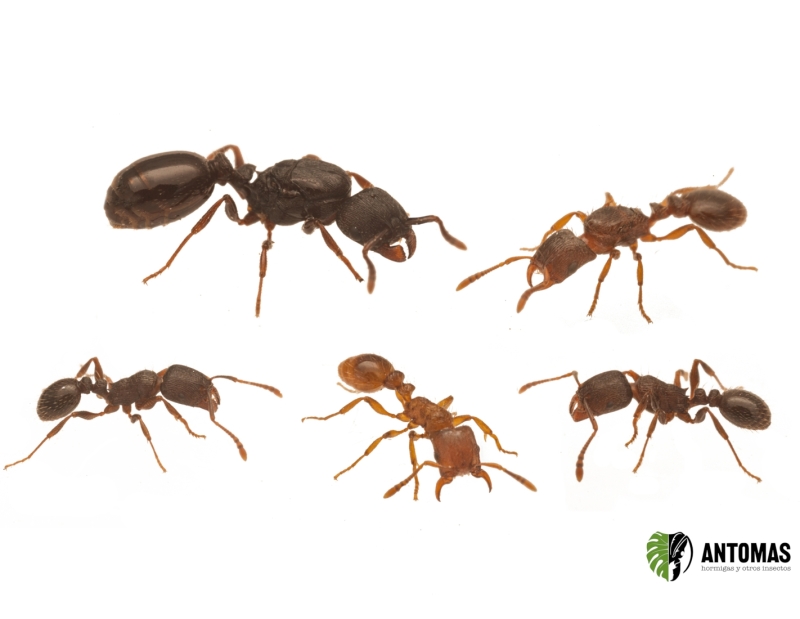
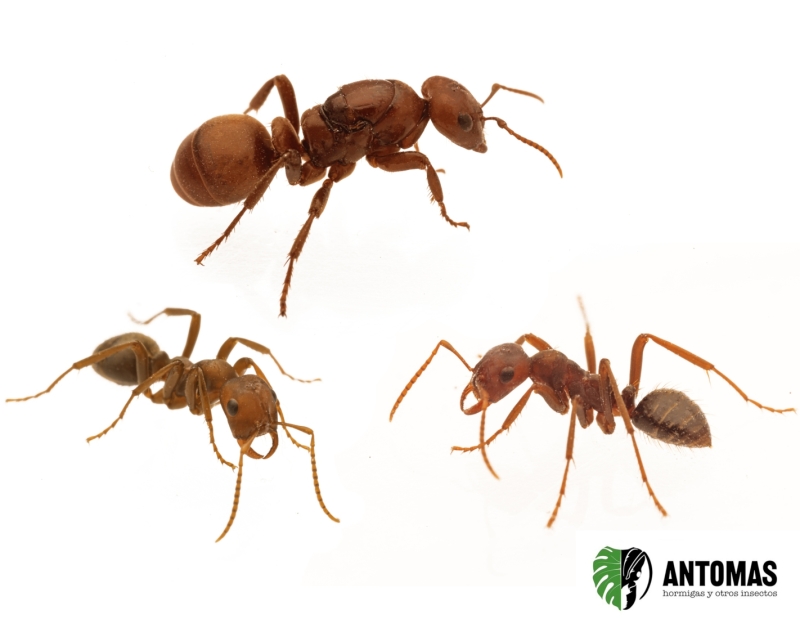
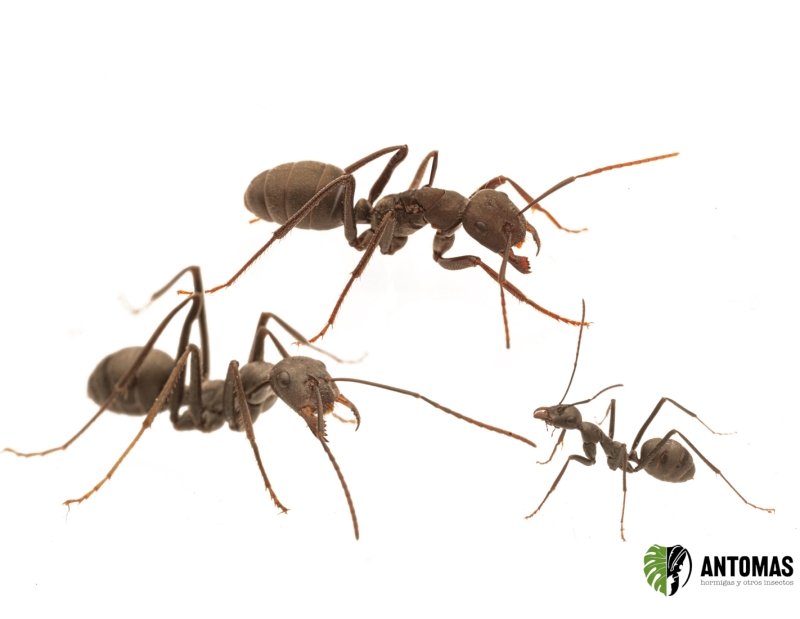
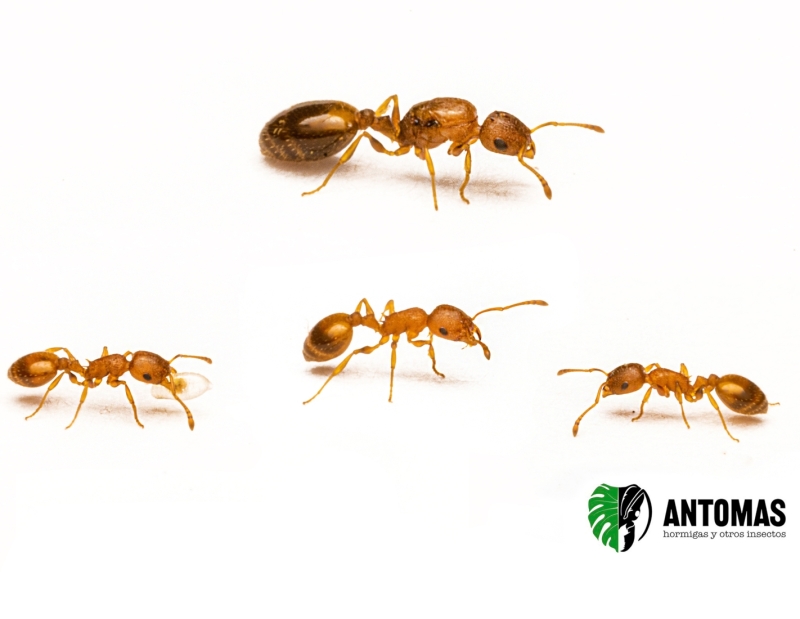
- Colour. Dark, almost black head and gaster; mesosoma, the ant’s thorax, red to dark reddish brown, and reddish legs. This is the pattern we see in our colonies.
- Shine. A smooth, glossy cuticle, without the matt look of the Myrmosericus, and a gaster almost free of pubescence, the lying hair that covers it like felt in other species.
- Head. Clypeus with a rectangular lobe and mandibles with 7–8 teeth. Majors have a large, broad head with sturdy mandibles.
- Facial hairs. Few or no erect hairs on the margins of the genae, the “cheeks”, and of the pronotum.
- Queen and male. The queen is considerably larger than the workers, with the bulky thorax of founding queens. The male, winged and smaller, only appears in mature colonies.
Measurements
Time to be honest: no accessible source publishes measurements by caste for C. sylvaticus, and the figures from shops and forums vary so much that we would rather not repeat them. What we can say is that, in its subgenus, Tanaemyrmex, major workers can exceed one centimetre (García 2025). The first workers of a colony are the smallest, and the average size increases with each generation.
How to tell it from its look-alikes
The Iberian Peninsula has several large Camponotus with a reddish thorax, and they are often confused, on forums too. According to the key by Gómez and Espadaler:
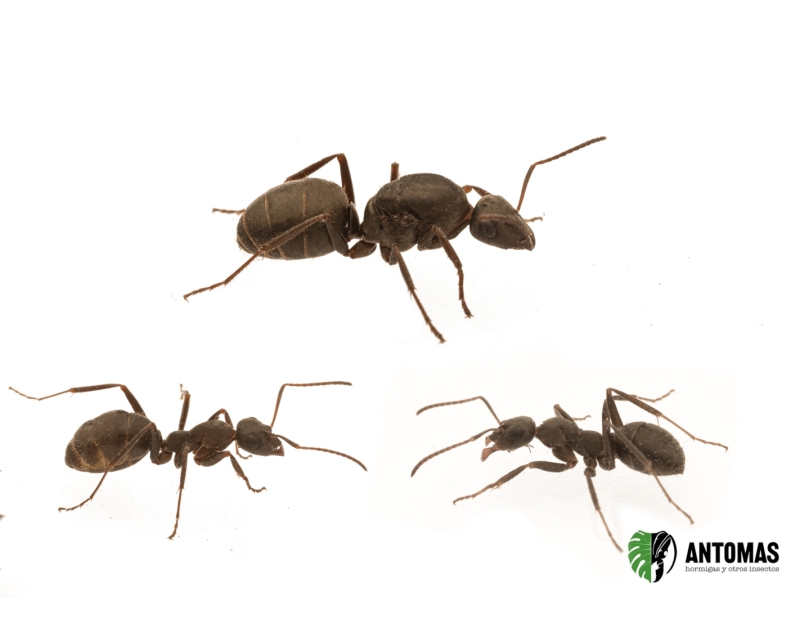
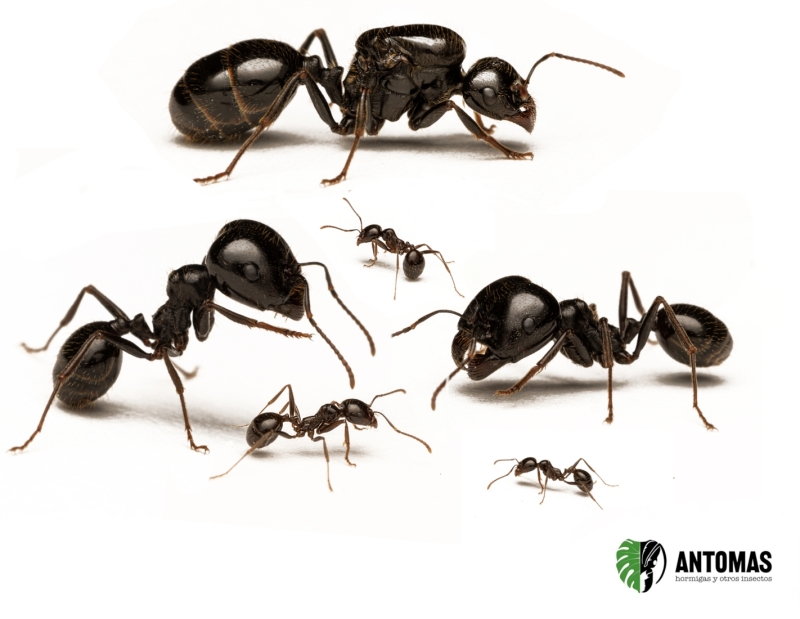
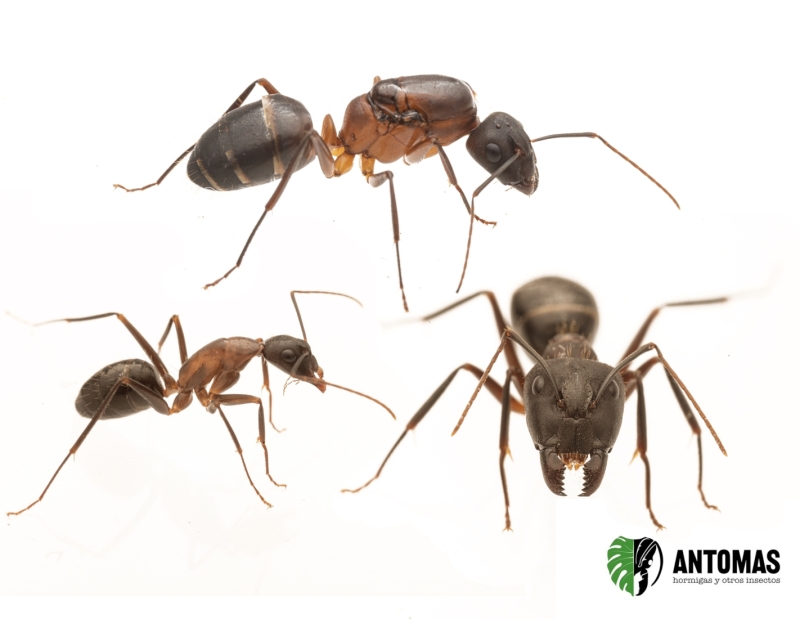
- C. barbaricus. Mesosoma reddish to orange and a very marked longitudinal groove on the tibia of the hind leg. As they were the same taxon for years, telling them apart needs a magnifier.
- C. pilicornis. Erect hairs on the genae, and head, mesosoma and sometimes the base of the gaster orange. The key advises checking this on small workers.
- C. cruentatus and C. micans. Matt, with the gaster covered in fine hair: cruentatus with a reddish gaster base; micans black with silvery or golden glints.
Care in captivity
Difficulty: 1/5 – Beginner
At Antomas we rate it 1/5 – Beginner. It forgives small mistakes and teaches a lot:
- It is happy at room temperature and in a dry nest, with no special equipment.
- It eats everything: sugary liquids and a wide range of insects.
- It is calm in the nest, has no sting and its bite is weak.
- It follows a simple yearly cycle: active from spring to autumn and in diapause in winter.
All it asks for is patience during the first two years, which are slow, and a good escape barrier, because its workers are fast. In return, you get one of the most striking Camponotus in Europe and a night-time show that few people have ever seen in the wild.
The queen arrives: the first months in the tube
At Antomas we sell it as a founding queen with brood: a mated queen in her test tube, with water behind the cotton wool and her first brood, which may be eggs, larvae or pupae depending on the time of year.
- Darkness and calm. Keep the tube in a dark, quiet place free of vibrations, at 24–28 °C. According to keepers, the queen of this species needs a lot of calm during founding: if stressed, she may eat her eggs. If you see her nibbling the cotton wool, shade the tube from the light and leave her in peace for a few days.
- Water. Check now and then that the reservoir still has water. If it runs out or the tube gets very dirty, move the queen to a new tube by tipping her in.
- Food. A lone queen does not need to eat, although you can offer her the occasional tiny drop of very dilute honey water on a scrap of aluminium foil, never on the cotton wool. Once the first workers appear, start with sugary liquids and small pieces of insect once or twice a week, removing leftovers the next day.
- Patience. From egg to worker takes 6–12 weeks, depending on temperature. Some care sheets say a month, but in Camponotus it usually takes longer.
You can watch her gently; what is best avoided during these weeks is moving her often or leaving her next to a loudspeaker or a washing machine.
Temperature: summer warmth, cooler nights
From spring to autumn, we recommend 24–28 °C in the nest. Keepers rear it at 25–30 °C and agree that warmth speeds up development, although it copes well at summer room temperature; with less warmth it simply grows more slowly.
- Heat on one side: if needed, a heat cable or mat with a thermostat on one side of the nest, so the colony can choose where to put the brood.
- No direct sun and no radiators: a nest in the sun overheats within minutes.
- Cooler nights are no problem: in the wild it works between 14 and 29 °C.
Humidity: a rather dry nest
According to keepers, it tolerates dryness very well and is harmed by excess humidity. At Antomas we recommend a rather dry nest, with a single slightly damp spot where the colony can take the brood, and a dry foraging area.
- Drinking water, always: a test tube with water and cotton wool in the foraging area.
- If there is condensation, mould or mites, there is too much humidity.
- If the brood piles up next to the damp spot, it needs a little more.
Light: a dark nest area and a lit foraging area, with a normal day–night cycle, are all it takes. For a species whose timetable is set by light, that is exactly what it needs.
From the tube to a Qbik Wild, then on to the Alpha range
With this species we follow a two-stage path.
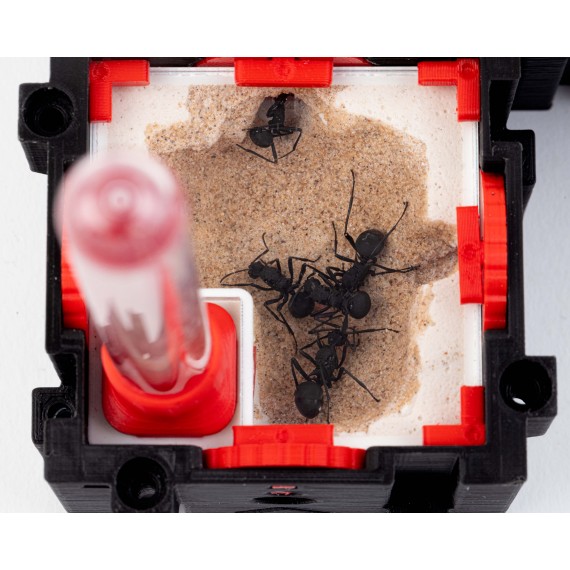
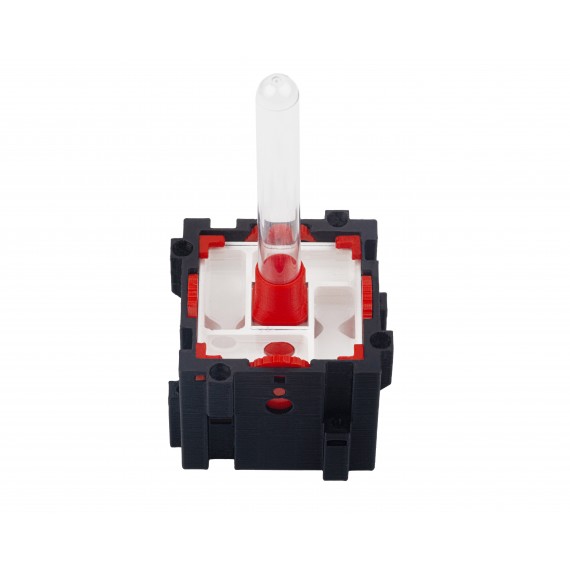
First, found in plaster. When the queen has her first 5–10 workers, move her to an Anthouse Qbik Wild One P 1C with medium galleries. Plaster holds some moisture and buffers changes, ideal for a small colony; as C. sylvaticus prefers it dry, moisten it sparingly.
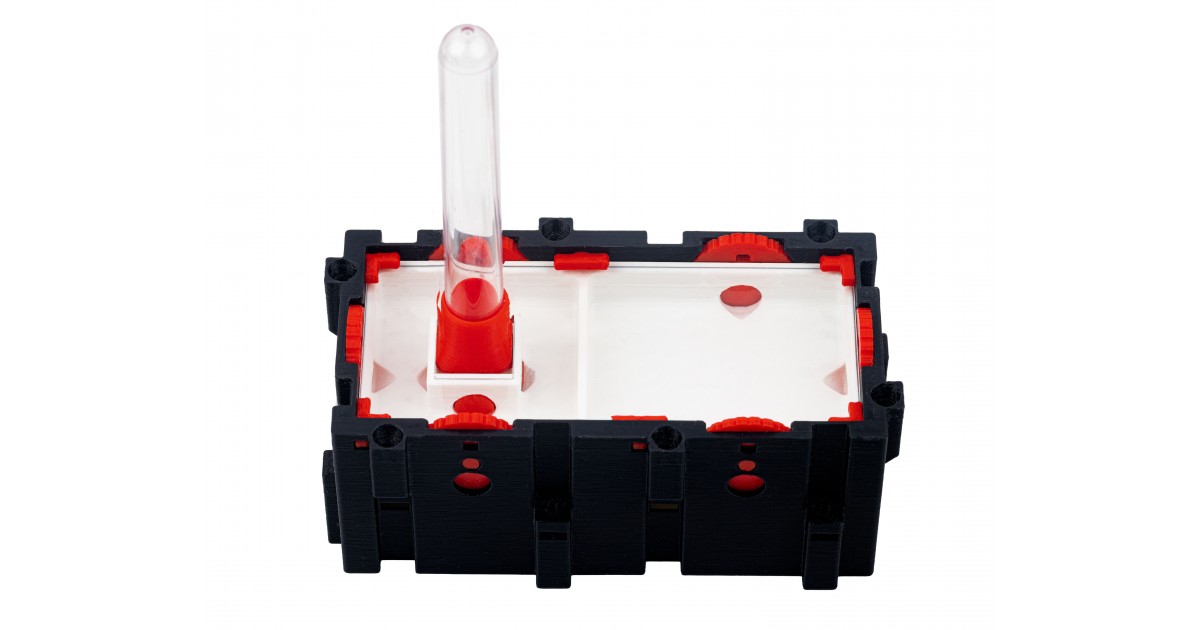
If it outgrows the One before the big move, the Qbik Wild Duo P 2C gives it a second chamber of the same material:
Then, on to the Alpha range. With several dozen workers or more, move the colony to a QBIK ONE and, later, a QBIK DUO. They are modular and rather dry, with the humidity in the tubes, which suits this species very well. And since a well-kept colony can grow quite large, the modules work out cheaper and weigh less than a big block of plaster.
Expand when the colony runs out of room, and not before: in a huge nest for a small colony, the empty chambers end up as rubbish dumps. Complete the set-up with:
- A dry foraging area, with sand, a flat stone or two and a twig to climb, well away from the barrier.
- An escape barrier of mineral oil or talc at the top of the walls.
- A water tube with cotton wool, always topped up.
- A feeder for sugary liquids, never cotton wool.
Moving by tipping
At Antomas we move colonies by tipping them into the new nest, without waiting for them to decide to move on their own:
- Prepare the new nest beforehand, with the barrier in place and the water tube fitted.
- Work over a light-coloured tray: given how fast they run, better safe than sorry.
- Open the tube or old nest inside the foraging area, next to the entrance of the new one, and gently tip in the queen, workers and brood, helping stragglers along with a soft brush.
- Keep the nest area dark: within a few hours they will have carried all the brood inside.
If you can, do it during the day, when the colony is less active and more huddled together.
Feeding: a menu for an aphid rancher
Sugar always available. In the wild it lives mainly on honeydew from aphids and other sap-sucking insects and on nectar, so at home it should never run out of sugar. Always offer it in a feeder, traditional or home-made, where the drop stays “spread out” and accessible, and never on cotton wool, which goes mouldy and spoils the liquid very quickly. Vary the sugars: what we do at Antomas is give Anthouse’s Blue Sugar nectar 4–5 days a week and another nectar or sugary liquid on 1–2 days. If you like, add a little protein to the nectar.
Protein: the more, the better. This is what makes the colony grow: according to the most thorough keepers’ care sheet for the species, after the first two years it gets through “vast quantities of insects”. Offer protein at least 2–3 times a week, and more as it grows. If you check daily and remove leftovers, it is better to err on the generous side: with food to spare, the colony senses there are resources and responds by raising more workers, faster. If you cannot clean often, do not overdo it, because leftovers rot and bring mould and mites.
- Change the prey every week, so they do not always eat the same thing. For small colonies, the firebrat, Thermobia domestica, is perfectly sized prey. For large ones, the cricket, Acheta domesticus, the Dubia roach, Blaptica dubia, the red runner roach or flies.
- Dead and opened at first: the workers of a young colony are cautious. Large colonies have no trouble hunting small live prey.
- At dusk: put the protein in when they start coming out and remove leftovers the next morning. It is also the best way to watch them hunt.
- Insects from a trusted source, never collected where insecticides are used.
Water: always available, in the test tube with cotton wool in the foraging area.
Growth: two years of patience, then a growth spurt
Like many European Camponotus, it starts slowly. Keepers agree that the first two years are slow, with few workers and modest egg-laying. Then, once the colony is established, the queen lays far more and growth shows from one month to the next. There are no scientific data on colony size, and figures circulating in shops and forums range from a few hundred to several thousand workers. In our experience, a well-fed colony that gets its diapause every winter can become very populous. Majors do not appear from the start: there are no published data on when they appear in this species, but in other Camponotus keepers usually see them once the colony numbers many dozens of workers.
Diapause: a long, cool winter
It is an ant of a Mediterranean climate, with real winters, and at Antomas we recommend respecting its diapause, the winter rest of ants. During those months the queen stops laying, the larvae stop growing and the colony hardly comes out. This is completely normal.
- When: from November or December to February, for 3–4 months.
- At what temperature: 8–13 °C, and never below freezing. This is Antomas’s guideline, consistent with keepers, who advise going below about 13 °C without frost, and with the winter in its range.
- Gradually: lower the temperature over 2–3 weeks in late autumn and raise it the same way at the end of winter. No jumping straight from 26 °C into the fridge.
- Where: a cool room, a frost-free garage or a wine cooler set to that temperature.
- While it lasts: water always available and some sugar in the feeder; little or no protein.
- Do not bring spring forward: warming them in mid-winter, or cutting diapause short because “they don’t seem to be doing anything”, is one of the mistakes most often repeated on forums.
When it ends, offer protein again as soon as you see activity: the queen resumes laying and the larvae that spent the winter carry on developing.
Fast and agile climbers: escapes
If one thing surprises people about C. sylvaticus, it is the speed of its workers. Keepers warn that it is very fast and that you need to be careful when feeding, and like all Camponotus it climbs glass and plastic with ease. With a good barrier, it is no trouble:
- A narrow, unbroken band of mineral oil or talc high up on the foraging area walls, renewed as soon as it collects dust or debris.
- A well-fitting lid as a second line, and connections and stoppers checked.
- Nothing that acts as a bridge to the barrier, neither twigs nor stones.
- Everything at the right time: clean during the day, when the colony is tucked away; when leaving food at dusk, open only as much as needed and close straight away.
Does it bite? Handling without fear
C. sylvaticus poses no danger to people. It has no sting, so it cannot sting. If disturbed it may bite, but its bite is weak, and the formic acid causes at most a slight tingle if it gets into a tiny cut. If someone were to pick up lots of them by hand, the acid might leave a callus, but that would be stretching it: it very rarely happens. Even so, handle them with entomological tools, such as a soft brush or soft forceps, and not with your fingers: not for your sake, but for theirs. Do not mix different colonies, because they fight, and never release a captive-reared colony into the wild.
Watching them at night
At Antomas we believe ants are there to be enjoyed, watched and learnt from, not kept hidden away. With this species, the best time is at dusk: that is when the workers come out to forage, patrol the edges and pass drops of sugar mouth to mouth. Dim light in the room is enough to see them, and they soon get used to your presence. If the brood stops developing in mid-season, protein or warmth is usually lacking; during diapause, on the other hand, a still colony is normal.
What not to do
- Put several queens together, in a tube or in a nest.
- Wet the whole nest or the foraging substrate: it likes things dry.
- Put the sugar on cotton wool, or let the feeder run dry.
- Always give the same insect, or leave leftovers uncleaned.
- Skip diapause, bring it forward with heat or start it abruptly; and never go below 0 °C.
- Rehouse a small colony in a huge formicarium.
- Neglect the barrier: as fast as they are, a single gap is enough.
- Put the nest in the sun, handle them with bare hands or mix different colonies.
Scientific sources
This care sheet is based on the scientific literature on Camponotus sylvaticus, its subgenus and Mediterranean ants, on distribution records and climate data from its range, and on the experience of Antomas and other keepers. The activity and diet data come from the field study by Retana, Cerdá, Alsina and Bosch (1988), in Acta Oecologica, and those on its rivalry with C. cruentatus from the paper by Alsina, Cerdá, Retana and Bosch (1988), in Miscel·lània Zoològica; the features of the subgenus, from García (2025), in Arquivos Entomolóxicos, and from Hormigas ibéricas, by Gómez and Espadaler. Main references:
- Cagniant, H. (1996). Les Camponotus du Maroc (Hymenoptera: Formicidae): clé et catalogue des espèces. Annales de la Société entomologique de France (N.S.) 32: 87–100. doi:10.1080/21686351.1996.12278857
- Ward, P. S. & Boudinot, B. E. (2021). Grappling with homoplasy: taxonomic refinements and reassignments in the ant genera Camponotus and Colobopsis (Hymenoptera: Formicidae). Arthropod Systematics & Phylogeny 79: 37–56. doi:10.3897/asp.79.e66978
- Ward, P. S., Blaimer, B. B. & Fisher, B. L. (2016). A revised phylogenetic classification of the ant subfamily Formicinae (Hymenoptera: Formicidae), with resurrection of the genera Colobopsis and Dinomyrmex. Zootaxa 4072: 343–357. doi:10.11646/zootaxa.4072.3.4
- Janicki, J., Narula, N., Ziegler, M., Guénard, B. & Economo, E. P. (2016). Visualizing and interacting with large-volume biodiversity data using client–server web-mapping applications: the design and implementation of antmaps.org. Ecological Informatics 32: 185–193. doi:10.1016/j.ecoinf.2016.02.006
- Cerdá, X., Retana, J. & Cros, S. (1997). Thermal disruption of transitive hierarchies in Mediterranean ant communities. Journal of Animal Ecology 66: 363–374. doi:10.2307/5982
- Cerdá, X., Retana, J. & Manzaneda, A. (1998). The role of competition by dominants and temperature in the foraging of subordinate species in Mediterranean ant communities. Oecologia 117: 404–412. doi:10.1007/s004420050674
- Retana, J. & Cerdá, X. (2000). Patterns of diversity and composition of Mediterranean ground ant communities tracking spatial and temporal variability in the thermal environment. Oecologia 123: 436–444. doi:10.1007/s004420051031
- Stadler, B. & Dixon, A. F. G. (2005). Ecology and evolution of aphid-ant interactions. Annual Review of Ecology, Evolution, and Systematics 36: 345–372. doi:10.1146/annurev.ecolsys.36.091704.175531
- Feldhaar, H., Straka, J., Krischke, M., Berthold, K., Stoll, S., Mueller, M. J. & Gross, R. (2007). Nutritional upgrading for omnivorous carpenter ants by the endosymbiont Blochmannia. BMC Biology 5: 48. doi:10.1186/1741-7007-5-48
- Boulay, R., Arnan, X., Cerdá, X. & Retana, J. (2014). The ecological benefits of larger colony size may promote polygyny in ants. Journal of Evolutionary Biology 27: 2856–2863. doi:10.1111/jeb.12515
- Keller, L. & Passera, L. (1989). Size and fat content of gynes in relation to the mode of colony founding in ants (Hymenoptera; Formicidae). Oecologia 80: 236–240. doi:10.1007/BF00380157
- Tragust, S., Herrmann, C., Häfner, J., Braasch, R., Tilgen, C., Hoock, M., Milidakis, M. A., Gross, R. & Feldhaar, H. (2020). Formicine ants swallow their highly acidic poison for gut microbial selection and control. eLife 9: e60287. doi:10.7554/eLife.60287