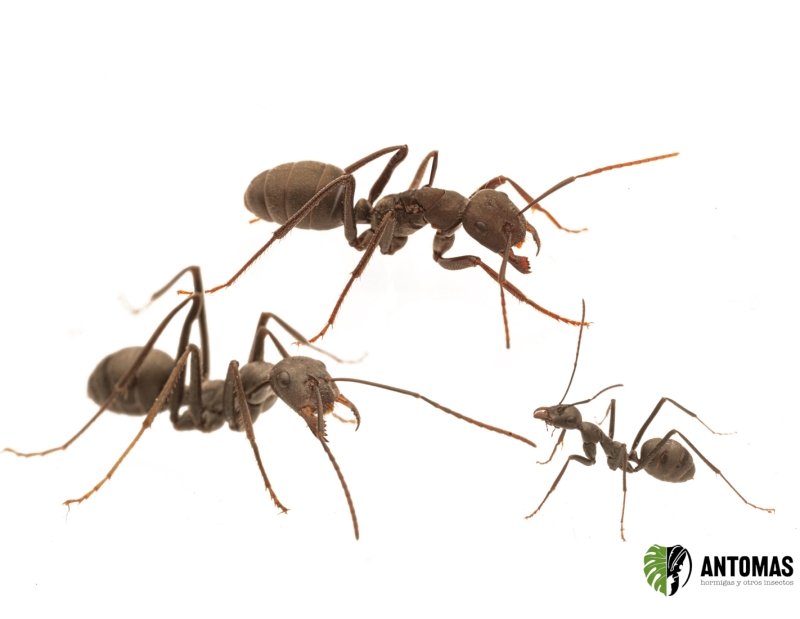
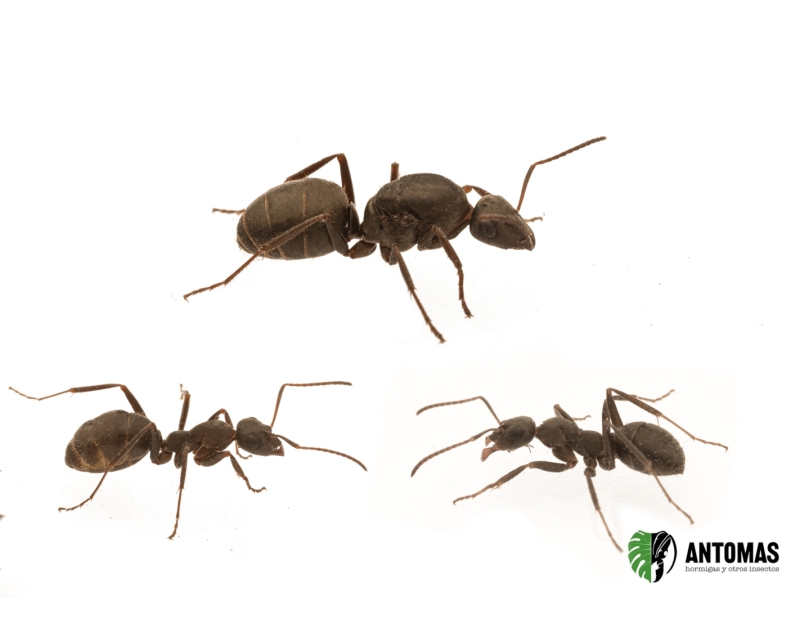
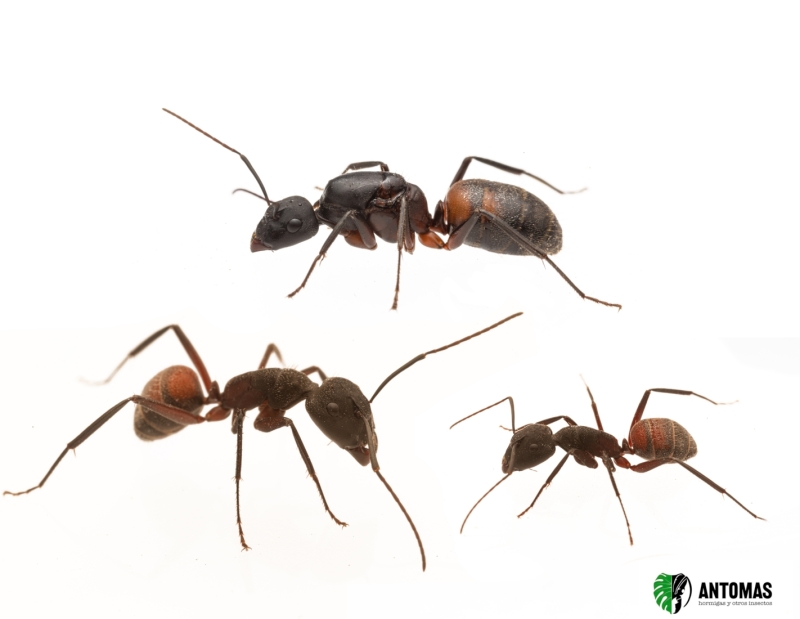
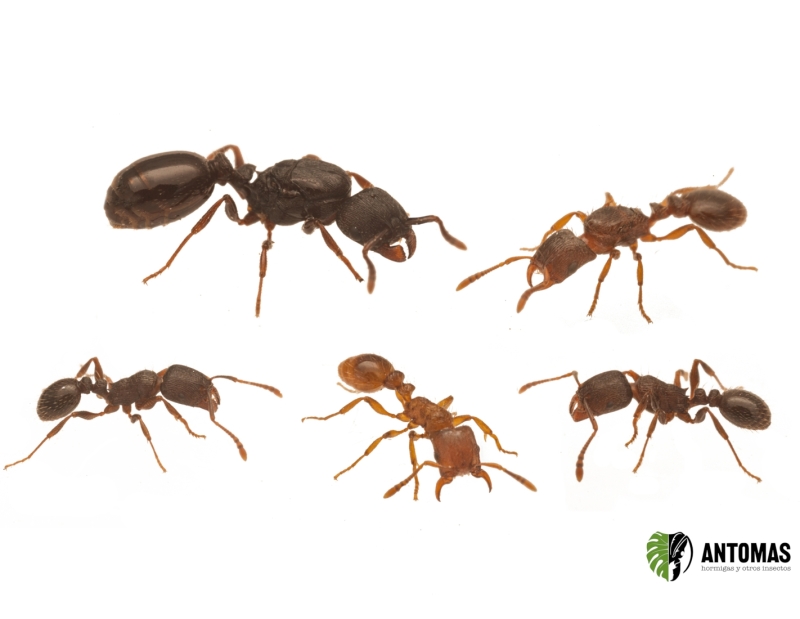
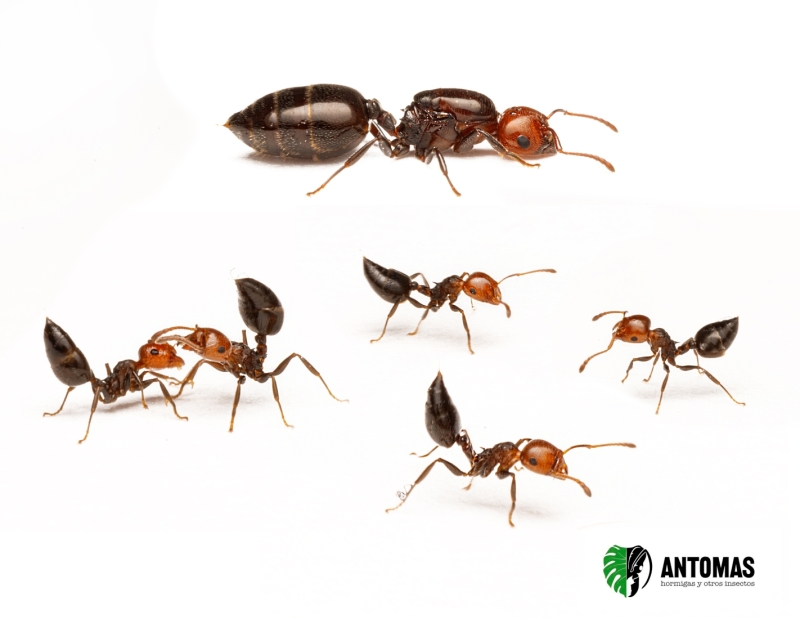
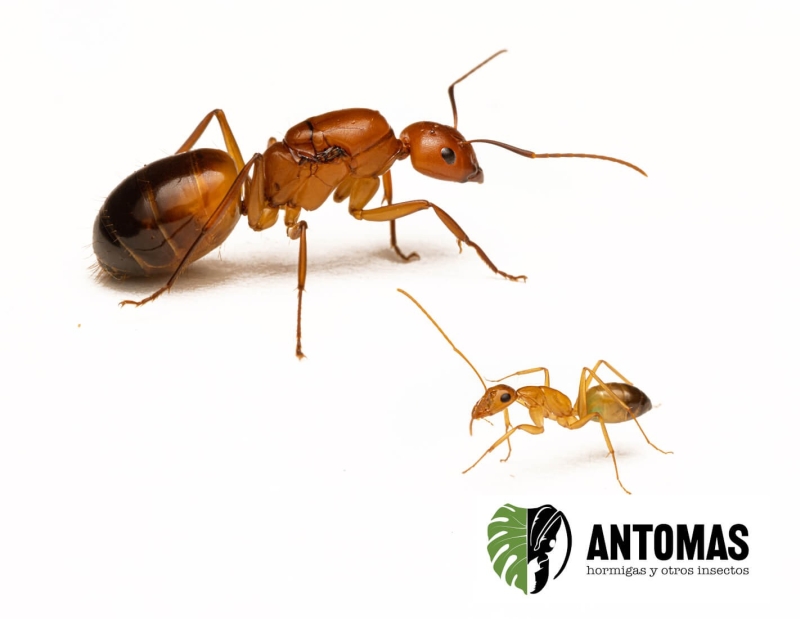
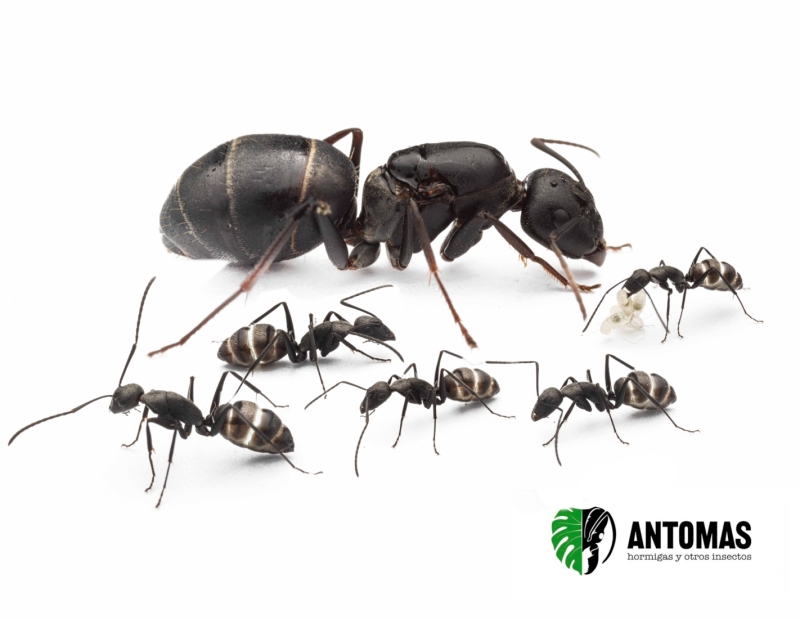
Difficulty: 3/5 – Advanced
The largest myrmicine in Europe: a red mountain ant, with a sting, that lives from almost sea level to over 3,000 m in the Alps and other mountain ranges of central and southern Europe. Founding queens with brood, with semi-claustral founding: the queen needs to eat, so she starts in a tube with a mini-arena and plenty of small protein, such as Thermobia. Afterwards, a Qbik Wild plaster nest with a humid area. Moderate temperature (20–25 °C) and a marked diapause of 4–5 months at 5–10 °C. It stings: handle it with forceps; we do not recommend it for people who are allergic to insect stings. Mineral oil barrier.
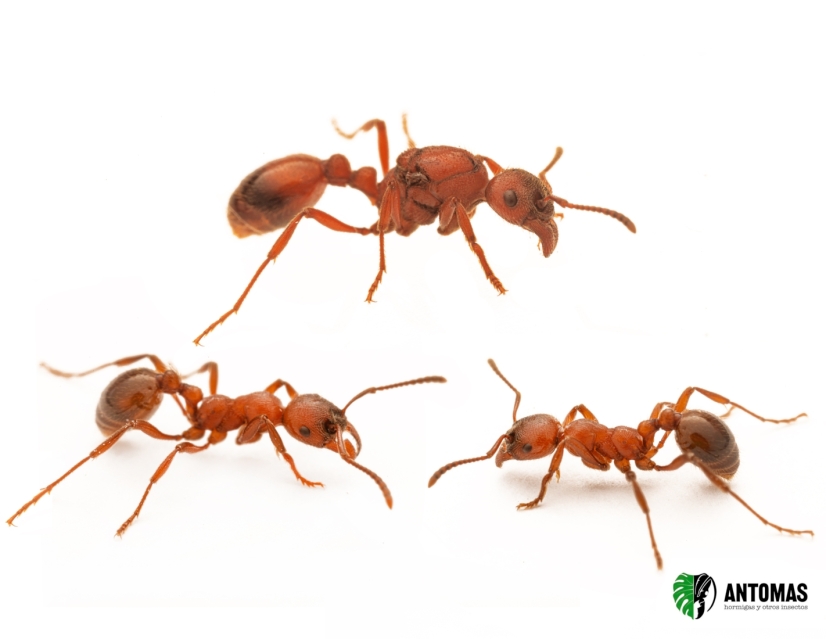
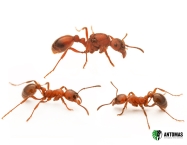
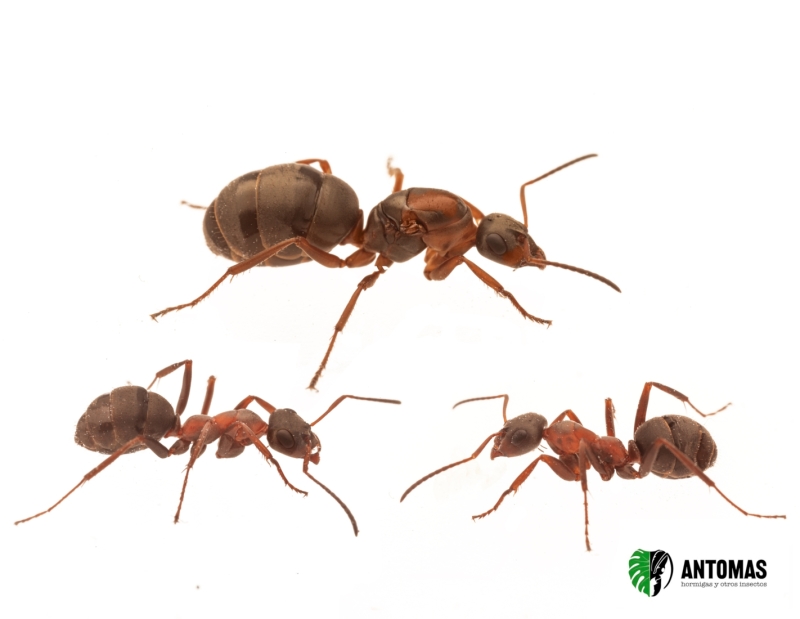
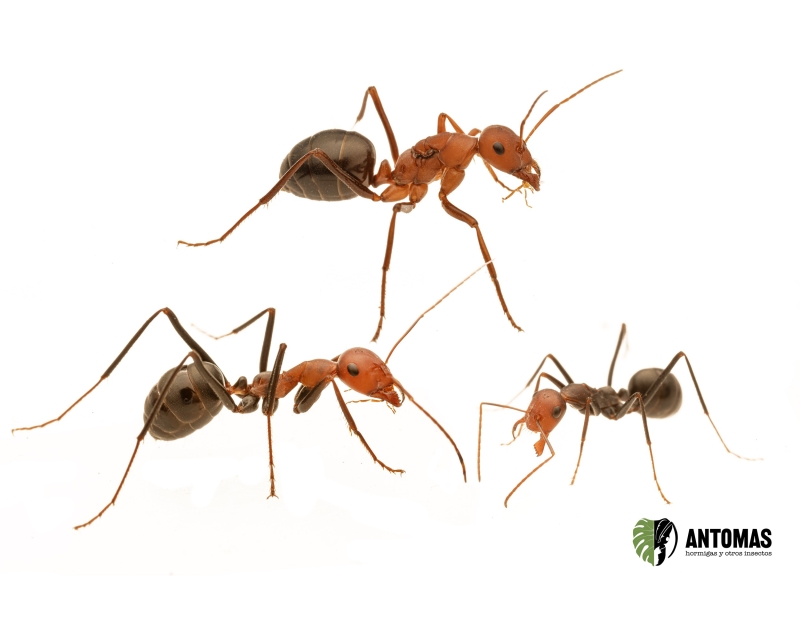
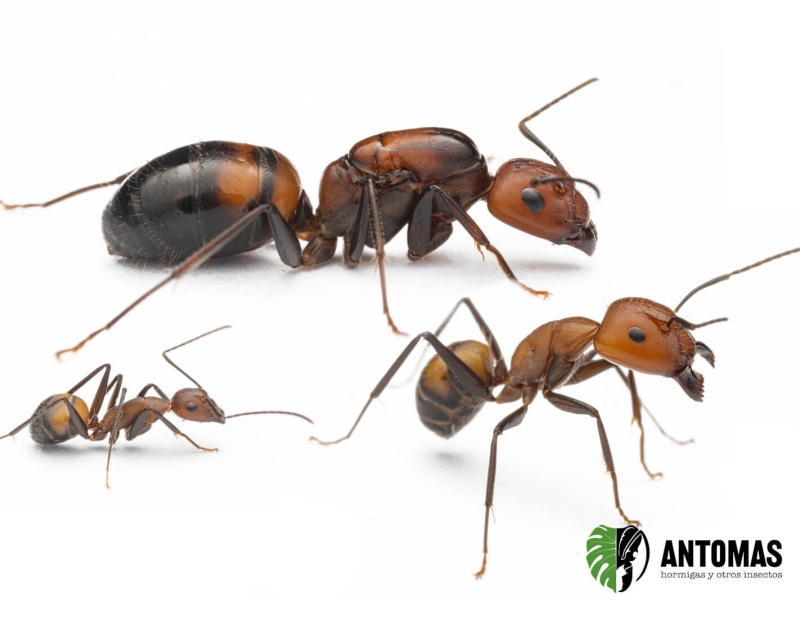
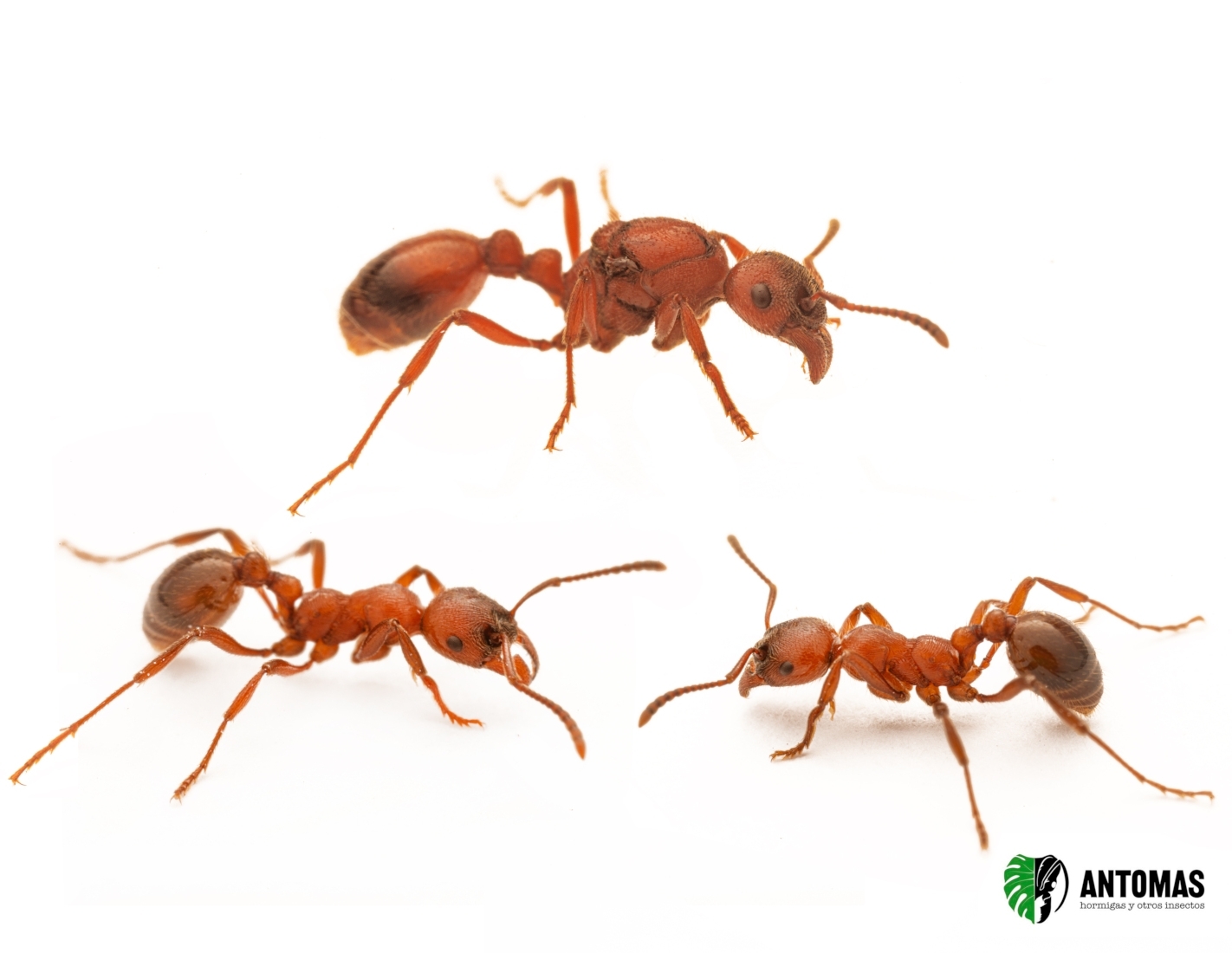
Manica rubida (Latreille, 1802) is a red mountain ant in the most literal sense: large, a shiny rust red, long-legged and with a sting it knows how to use. It lives in the Alps and other mountain ranges of central and southern Europe, withstands long, cold winters and nests on riverbanks, in gravel pits and in damp meadows. And it holds a record: it is the largest myrmicine in Europe.
It is also one of the most interesting European ants for science. Its venom combines peptides that paralyse insects with a toxin that switches on the pain channels of vertebrates; its queen founds “the old way”, going out to hunt; and in some Alpine valleys its colonies have small queens that work like workers. In this care sheet we keep apart what is documented, what keepers report and what we recommend at Antomas to bring on a founding colony that, well fed, grows much faster than the books say.
Biology
The largest myrmicine in Europe
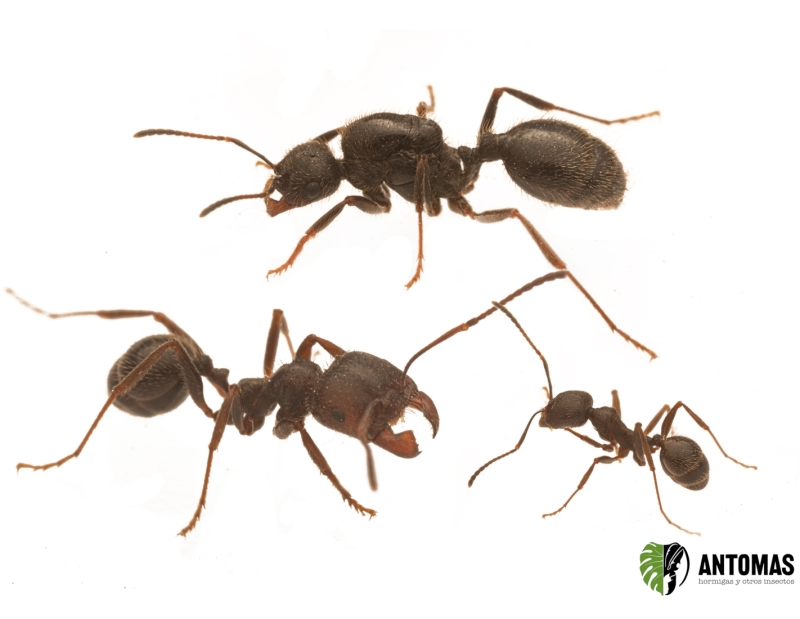
The myrmicines are the most diverse ant subfamily in the world, and the largest of all the European ones is M. rubida: so says Bernhard Seifert in his reference work on the ants of central and northern Europe, and so does the distribution study that Patrick Krapf published in 2023. Its workers measure about 6–8 mm, and the large queens 10–13 mm.
It looks like a giant Myrmica, and in fact it was placed in that genus for a time. But one detail gives it away: the propodeum, the rear part of the thorax, has no spines, whereas Myrmica carry two clearly visible ones there. With its size and its uniform reddish colour, it is one of the easiest ants to recognise in the European mountains. The males, by contrast, are completely black.
From almost sea level to over 3,000 metres
Seifert describes it as frequent in European mountains between 500 and 2,000 m above sea level. But in 2023 Krapf gathered 611 reliable records from 19 countries and found something striking: the extremes range from 6 m, almost at sea level, in northern Germany, to 3,098 m, in the French Alps. That is more than 3,000 m of altitude for a single species. The band with the most records is 1,000–1,500 m, and there are 74 above 2,000 m.
It lives mainly in the Alps (France, Switzerland, Austria and Italy), the Massif Central and the Carpathians, and reaches the Balkans, the Pindus, the Caucasus, the Pontic Mountains of Turkey, Georgia and Russia. And its map has a very modern twist: 81% of the records Krapf used came from citizen science platforms such as iNaturalist and GBIF. Much of what we know about where it lives we owe to amateurs with a camera.
And in the Iberian Peninsula?
The answer is clear: there are no records at all. The GBIF database, with more than 3,500 records of the species, has none from Spain, Portugal or Andorra, and the checklist of the ants of Andorra published in 2013, with 75 species, does not include it either. Krapf’s model does flag the Pyrenees as a range with a potentially suitable climate for it, but a suitable climate is not a population: as things stand, M. rubida is not part of the Iberian fauna. If it ever turned up in the Pyrenees, it would be quite a piece of news.
Riverbanks, gravel pits and damp meadows
Seifert defines it as a “moderately thermophilous and slightly hygrophilous” species: it likes the sun, but also soil that does not dry out completely. It nests in damp meadows and peat bogs, on riverbanks, in open sandy areas, floodplains and gravel pits, and even in old open-cast mines, under stones or directly in the soil. Around the entrance it builds conspicuous earth craters.
In the Giffre valley, in the French Alps, where Alain Lenoir and his team studied it for years, it occupied the flat banks of the river, with sparse vegetation and a few alders, on sand and gravel. Its nests were large but shallow, and it shared the ground with Formica selysi and F. lemani. It is the climate of the temperate mountains: cold winters, with snow for months at higher altitudes, and mild summers. Under a stone in the sun, however, the chambers warm up far more than the air.
That dependence on cool soils makes it vulnerable. In Germany it is considered near threatened, and Krapf points to two risks: the droughts brought by climate change and the spread of Formica fuscocinerea, which displaces it from riverbanks at low altitude.
A two-faced venom
Few European ants have such a well-studied venom, and what researchers have found is an arsenal with two functions: peptides for hunting insects and toxins for defence against vertebrates.
In 2019, Heep and colleagues isolated a peptide of just ten amino acids, U-MYRTX-MANr1, and tested it on the pea aphid. The whole venom, at 1 mg/ml, killed all the aphids within 24 hours. The isolated peptide paralysed them reversibly, reduced their survival and their offspring, which fell by 26%, and made them lose fluid through the wound. The authors put it forward as a starting point for new bioinsecticides.
In 2020, Touchard and colleagues described the complete repertoire: 13 “myrmicitoxins”. Tested on the blowfly Lucilia caesar, several proved to be effective insecticides: U20-MYRTX-Mri1a and three toxins of the U10 family paralysed the flies irreversibly, and U13-MYRTX-Mri1a was the fastest, although its effect wore off within 24 hours.
Δ-MYRTX-Mri1a: the toxin that switches on pain channels
Among Touchard’s myrmicitoxins was a 20-amino-acid peptide, then called U3-MYRTX-Mri1a, which did nothing to flies. In 2023, a study published in Nature Communications found out why: it is a vertebrate-selective toxin.
- It activates the NaV1.6 sodium channels of sensory neurons and, to a lesser extent, NaV1.7, key components in the transmission of pain.
- In cultures of mouse sensory neurons it activated 52% of the cells; with the sodium channels blocked by tetrodotoxin, only 2.9%.
- Injected into the paws of mice, it caused pain behaviours in proportion to the dose.
It is now called Δ-MYRTX-Mri1a, delta-myrmicitoxin-Mri1a. According to the study, many ants have toxins designed to cause pain to vertebrates and so protect the nest. In M. rubida both strategies coexist in the same sting: peptides for hunting and a toxin to make anyone who pokes their snout into the nest think twice.
How much does its sting hurt?
It hurts, and the scientists who have studied it agree: Lenoir describes it as “very painful”, and Heep and colleagues speak of a “painful sting”. It does not appear in the Schmidt sting pain index, and the pain toxin identified produces moderate pain in mice, less intense than that of the toxins of other ants in the same study.
In 2025, moreover, the first two known cases of anaphylaxis from its sting were published: a mother and daughter living in Switzerland suffered hives, malaise and chest tightness after being stung. An entomologist identified the ant, and both had antibodies against an allergen from wasp venom. Both recovered. These are exceptional cases, but they leave two clear messages: this ant is always handled with forceps, and we do not recommend it for people who are allergic to insect stings.
An “archaic” founding in a modern subfamily
Most myrmicine and formicine queens found claustrally: they shut themselves in and rear their first workers without eating, on their own reserves. The M. rubida queen does not. Her founding is semi-claustral: while she rears her first brood, she goes out to look for food.
In 1969, Le Masne and Bonavita described it with a telling title: the founding of societies “according to an archaic type” by an ant belonging to an evolved subfamily. Archaic, because this is what many ponerines and other ancient ant lineages do. For keeping, it is the key: an M. rubida queen needs to eat protein to bring on her first workers (see “Founding: first, a tube with a mini-arena”).
Half a million sperm and a slow-growing colony
Just how slow is that founding? Lenoir and colleagues collected about a hundred queens during a nuptial flight in the French Alps in May 1996 and followed their colonies for two seasons, at 24–25 °C and with five months of rest at 10 °C in between. These were the results:
- In the first 15 days, each queen laid an average of 28.2 eggs; by the end of August, laying had almost stopped.
- At the end of the third month, each colony had an average of 1.06 workers.
- At the end of the second summer, 5.14 workers.
- 82% of the founding colonies survived the first three months, and 33% survived to the end of the second period.
Were the queens short of sperm? No: they stored an average of 524,000 sperm, between 20% and 50% of what a male carries, and that reserve did not fall during founding. The authors put the slowness down to semi-claustral founding or to an adaptation to the mountain climate, although they acknowledged that part of the mortality might be due to the rearing conditions. And there was a surprise: in four cases, a mated female that still had her wings founded a colony. Keepers who feed it heavily tell a different, much faster story (see “Growth: from the laboratory to the keepers”).
Microgynes: small queens that work like workers
In 1998, in a colony in the Giffre valley, Lenoir and his team found, alongside the large queens or macrogynes, many winged females that were clearly smaller than them: the microgynes. Years later there were colonies with microgynes along some 6 km of the valley and in other Alpine localities. The study, published in 2010, is one of the most curious ever written on the species:
- Two clearly separate sizes. Head width averages 2.02 mm in macrogynes and 1.61 mm in microgynes.
- They do not fly. They spend the winter in the nest, with their wings on.
- They work like workers. They retrieve brood as fast as the workers do and go out foraging: in one nest, 53 different microgynes were counted foraging in a single hour.
- They almost never reproduce. They have a spermatheca but undeveloped ovaries, and of 38 microgynes dissected only one had mated.
Are they dispersal morphs or social parasites? The title of the paper poses both hypotheses, and the question remains open. What is clear is that a small winged female tending larvae is not necessarily a second queen.
Pyrazine trails and “manicone”
In 1986, Attygalle and colleagues found four alkylpyrazines in its venom gland and showed that one of them, 3-ethyl-2,5-dimethylpyrazine, triggers very marked trail following: the venom gland does not just load the sting, it also marks the paths. Curiously, its workers also follow the trails of other myrmicines, such as Myrmica rubra and Tetramorium caespitum.
Another chemical star comes from the mandibular gland. In 1988, Bestmann and colleagues identified its volatile components and worked out the structure of a molecule named after the genus: manicone. That same year, Cammaerts and colleagues studied the effect of that secretion on the workers’ behaviour. And in 1996, Hefetz and colleagues showed that the secretion of the postpharyngeal gland, the one that stores the “colony odour”, modulates their aggressiveness.
Raised alongside Formica selysi: the laboratory mixed colonies
In the Giffre valley, M. rubida and Formica selysi share the riverbanks. In the laboratory, the French researcher Christine Errard went further: she raised the two species together, from different subfamilies, to study how an ant learns to recognise its nestmates. In 1994 she followed the development of that recognition between species, and in 1991, with Corbara, she asked how these artificial colonies are organised: do they form a true mixed colony or two parallel colonies sharing a nest?
These are tightly controlled experiments that reveal something fascinating: recognising nestmates is learned. But they are not a recipe: at home, M. rubida is kept on its own (see “What not to do”).
Few queens, thousands of workers and quarrelsome neighbours
Colonies usually have a single queen, and sometimes a few large reproductive queens: they are almost always monogynous and rarely oligogynous, as Lenoir sums it up. A mature colony can have several thousand workers, monomorphic and without a soldier caste.
There is no aggression among nestmates, but neighbours are another matter: Lenoir describes colonies that are closed and aggressive towards each other, with real battles between nearby nests, and according to Cammaerts and Cammaerts aggressiveness increases with the distance between nests. Towards the outside world, however, it is a calm ant: Heep and colleagues describe it as not very aggressive, but with workers that respond immediately to any disturbance and defend the colony with powerful stings.
Spring flights and sexuals that spend the winter at home
According to Seifert, nuptial flights run from late April to mid-June, in the morning and in sunshine; in the Giffre valley they are concentrated in late May and early June. The curious thing is the timetable of the sexuals: they emerge in late June, spend the winter inside the nest and do not fly until the following spring. It makes sense in the mountains: the young queens set off at the start of the season and have the whole summer ahead of them to found.
The only Manica in Europe
The genus Manica is small: its other species live in North America and Japan, and M. rubida is both its type species and its only European representative. Among its North American relatives there is even a workerless social parasite, M. parasitica.
Latreille described it in 1802 as Formica rubida, from a queen collected near Lyon; it then passed through Myrmica and ended up in Manica, the genus Jurine created in 1807. Rubida comes from the Latin rubidus, “reddish”, and it could not be more fitting. Manica means “sleeve” or “gauntlet” in Latin, and also “handcuffs”; why Jurine chose that name we have not been able to find out.
Size and morphology
A large, slender myrmicine with long legs, a functional sting and a two-node waist.
- Colouring according to the literature. Workers amber yellow to reddish brown, with the rear part of the first gastral segment dark.
- Colouring of our colonies. Shiny rust red over the whole body and the legs, which are long. The queen has a slightly darker gaster.
- Propodeum. Without spines, unlike Myrmica.
- Waist. Two nodes, the petiole and the postpetiole.
- Workers. Monomorphic, without a soldier caste.
- Queens. Macrogynes of 10–13 mm and, in some Alpine populations, microgynes that are clearly smaller.
- Males. Shiny black.
- Pupae. Naked, without a cocoon.
Approximate sizes
- Workers: 6–8 mm (Bernard, 1968, cited by Lenoir et al., 2010); other scientific sources give 5–8 mm and about 6–9 mm.
- Macrogynes: 10–13 mm; head width, 2.02 mm on average; thorax width, 1.45 mm.
- Microgynes: head width, 1.61 mm on average; thorax width, 1.08 mm.
- Males: head width including the eyes, 1.04–1.06 mm on average; no published total length.
These are measurements from scientific papers. We do not give the queen and male lengths that circulate on shop and popular websites, because they do not come from studies.
Care in captivity
Difficulty: 3/5 – Advanced
Once established, it is not a difficult species: it eats everything, does not need heat, adapts well to a plaster nest and follows the seasonal rhythm of a European ant. So why a 3/5?
- Semi-claustral founding. The queen needs to eat, and a lot: she has to be fed often, with small prey and without letting leftovers build up.
- Sensitive small colonies. They suffer if the nest dries out or if they lack protein.
- A real diapause. 4–5 months of cold rest every winter.
- The sting. It stings, and it is always handled with forceps.
And it is well worth it. It is the largest myrmicine in Europe, a beautiful red, easy to watch in the foraging area and with a biology full of stories. Watching a queen leave her chamber to fetch her prey is a spectacle that claustral species do not offer.
Recommended parameters
- Nest temperature: 20–25 °C in the active season; during founding, 24–25 °C, the temperature at which the founding colonies in Lenoir’s study were reared.
- No strong heat: if you use heating, keep it gentle, on one side of the nest and with a thermostat. Some keepers heat the queen’s chamber to 25–28 °C for the first two weeks; at Antomas we prefer not to go above 24–25 °C.
- Foraging area: at room temperature.
- Humidity: one part of the nest moist and another drier, never waterlogged (see “Humidity: cool soil, never waterlogged”).
- Water: always available, in a test tube with water and cotton wool in the foraging area.
- Light: it is enough to leave them a dark area in the nest and a lit foraging area, with a normal day–night cycle.
- Diapause: 4–5 months, from November to March, at about 5–10 °C (see “Diapause”).
Founding: first, a tube with a mini-arena
At Antomas we sell founding queens with brood: queens that have already started their colony in a test tube, with eggs, larvae or pupae. As her founding is semi-claustral, the queen cannot stay shut away in the tube living off her reserves. That is why the first set-up we recommend is this one:
- Tube with a mini-arena. Connect the tube to a mini-arena, a small foraging area with a lid, where you will put her food. That way she goes out to hunt without exposing herself, and you can feed her without opening the tube.
- Water in the tube. Check from time to time that the cotton wool is still damp and that the reservoir still has water: small colonies suffer if they dry out.
- Gentle, steady warmth. At 24–25 °C, with the brood area kept dark. Some keepers report that their queens would not lay at 21–22 °C until they raised the temperature.
- Small, frequent meals. Prey the queen can carry and take to the brood: Thermobia, small pieces of cockroach or mealworm and cricket legs (see “Feeding”).
- Cleaning. Remove leftovers from the mini-arena before they spoil.
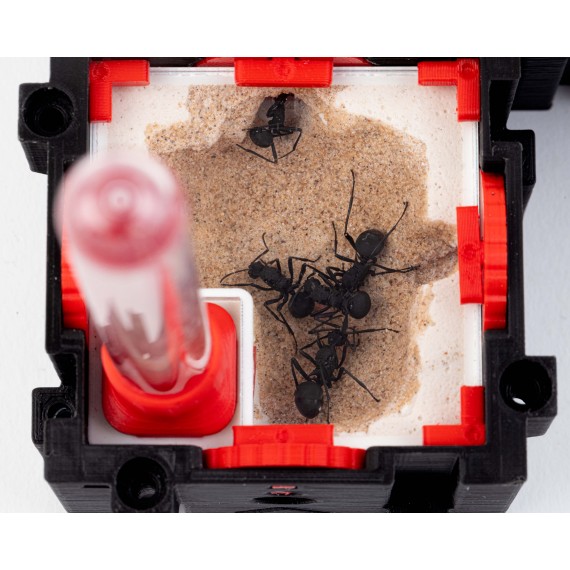
If the queen frays the cotton wool, keepers read it as a sign of hunger: give her more protein. When to move her into the nest? When the tube becomes too small, dirty or runs out of water. We move her by tipping (see “Arrival and moving”) into a small plaster nest, the Qbik Wild One P 1C.
Recommended formicaria
At Antomas we recommend Anthouse’s Qbik Wild formicaria, which are made of plaster: they hold the moisture that a species of cool soils needs and allow one part to be moister and another drier. To start with, after the tube with a mini-arena, the Qbik Wild One P 1C:
To grow, once the colony fills the first one, the Qbik Wild Duo P 2C:
Expand when you see the brood piled up or lots of workers sitting still in the foraging area, with no room inside. But do not jump ahead: in a nest that is too big for the colony, humidity is harder to control and the spare chambers end up as rubbish dumps. Complete the set-up with these details:
- A mineral oil barrier and a well-fitting lid (see “Escapes and barriers”).
- A foraging area with some sand, or sand mixed with clay, and a flat stone or two: they like moving particles around.
- Water always available, in a test tube with cotton wool, and a feeder for sugary liquids, never on cotton wool.
Humidity: cool soil, never waterlogged
It is a “slightly hygrophilous” species: it nests in soils that retain moisture, and small colonies are sensitive to drying out. But it does not live in mud: its nests are in well-drained ground, of sand and gravel. The rule is simple: one part of the nest moist and another drier, so that the colony can choose where to keep the brood.
- Moisten the plaster little by little, following the formicarium’s instructions, without flooding the chambers.
- Do not wet the queen’s chamber directly.
- If you see condensation on the walls or mould, there is too much moisture or there are forgotten leftovers.
Feeding
Protein: the more, the better. It is the key to this species, especially during founding, and it is the Antomas philosophy: if you do daily maintenance and remove the leftovers, it is better to overfeed, because the colony understands that it has more resources and grows faster and in greater numbers. If you will not be able to clean often, it is better not to overfeed: leftover food rots and brings mould and mites.
For the queen and small colonies, the ideal prey is small and soft, of a size the queen can carry. Our favourite is Thermobia domestica: it is just the right size, and the queen can carry it to the brood on her own. Pieces of cockroach nymph, half-centimetre bits of mealworm and cricket legs also work, but never whole crickets or large prey next to a lone queen.
As the colony grows, change the type of insect from one week to the next, so that they do not always eat the same thing:
- Crickets, Acheta domesticus, chopped at first and whole once the colony is large.
- Red runner roaches, Shelfordella lateralis, especially small nymphs.
- Dubia roaches, Blaptica dubia, in pieces or as nymphs, for medium-sized and large colonies.
- Mealworms, Tenebrio molitor, chopped.
- Flies and Drosophila, which they also take readily.
According to keepers, they kill insects larger than themselves with their sting, so an established colony will also take small live prey. And buy your insects from a reliable supplier: insects treated with insecticides can kill the colony.
Sugary liquids. In the wild they take honeydew from aphids. Vary the sugars: at Antomas we recommend Anthouse’s Blue Sugar nectar 4–5 times a week and another sugary liquid or nectar 1–2 times a week. You can also add some protein to the nectar. Always offer them in a feeder and never on cotton wool, because cotton wool goes mouldy and spoils the liquid very quickly. Use a traditional or home-made feeder, where the drop stays “spread out” and accessible, and replace it before it ferments. For the queen in her mini-arena, a tiny drop on a small piece of aluminium foil is enough.
Water: always, in the test tube with cotton wool in the foraging area.
Growth: from the laboratory to the keepers
Going by Lenoir’s experiment, M. rubida looks hopelessly slow: one worker per colony after three months and five after two seasons. But the authors themselves suspected the rearing conditions, and keepers have since shown that it can go much faster.
The best-documented case is in a guide by Polish keepers translated on the Formiculture forum in 2026. One of them set up five freshly caught queens in early May and recorded their timeline:
- First larvae: about 24 days after capture.
- First pupae: at five weeks.
- First workers: at 58 days.
- All five queens produced workers, and his colony reached about 100 workers before its first diapause.
The secret? Steady warmth and lots of protein: every few days before there were larvae and, as soon as they appeared, twice a day, in pieces the queen could carry to the brood. It is keepers’ experience, not a controlled experiment, but it fits the rule we apply at Antomas to every species: the more protein, the better and faster they grow. The first workers are small, and size increases with each generation.
Arrival and moving
When you receive your queen, let her rest in a quiet, dark place, check that the tube has water and connect it to her mini-arena. When the time comes to move her into the formicarium, at Antomas we do it by tipping: we open the tube inside the foraging area, next to the nest entrance, and gently tip out the queen, the workers and the brood, helping the stragglers with a soft brush.
- Prepare everything beforehand: the formicarium moistened, the oil barrier in place and the water tube in the foraging area.
- Work over a tray and keep the forceps to hand: remember that they sting.
- Keep the nest area dark, so that the workers carry the brood in straight away.
Use the same method when you move the colony into the Qbik Wild Duo P 2C.
Diapause
It is a mountain ant, with a marked diapause: in the wild it rests roughly from October to March. In Lenoir’s study, the founding colonies spent five months at 10 °C between one season and the next, and then carried on developing. At Antomas we recommend a diapause of 4–5 months, from November to March, at about 5–10 °C:
- Lower the temperature gradually, over two or three weeks, and raise it the same way at the end.
- A few days before starting, stop giving them protein.
- During diapause, water always available and, at most, a little sugary liquid. Never let it freeze.
- When it ends, go back to protein as soon as you see activity.
Is it compulsory? Some keepers maintain that a well-kept colony can skip its first winter, and others say the queen needs the cold. We are clear about it: it is a mountain species, and diapause is part of its life. Besides, forcing it does not work: keepers report that, when they warmed their colonies in November, the large larvae would not pupate. Those larvae get through the winter without any problem and pupate in spring.
Behaviour in captivity
Calm, but with a sting. Day to day it is a calm ant, even somewhat shy, but if the nest is opened or knocked, the workers rush out to defend it. Not very aggressive and very defensive, just as scientists describe it.
Trails and hunting. When a forager finds food, she marks the way and more soon follow. And watching a worker subdue a cricket larger than herself with her sting is one of the most striking moments with this species.
Watch without fear. At Antomas we believe ants are there to be enjoyed, watched and learned from, not kept hidden away. It is enough to leave them their dark area in the nest and a lit foraging area, and to watch them gently, intervening and stressing them as little as possible.
Warning signs:
- A queen that does not lay or brood that does not develop in the middle of the season: almost always a lack of warmth or protein.
- A queen fraying the cotton wool: she is hungry.
- Condensation on the walls or mould: too much moisture or forgotten leftovers.
- Lots of workers sitting still in the foraging area, with no room inside: time to expand.
Escapes and barriers
According to keepers, they are good climbers, and with an ant that stings it is best that not a single one escapes. At Antomas we recommend a mineral oil barrier:
- A band of mineral oil on the upper part of the walls of the foraging area, thin and continuous. Renew it when it gathers dust or debris.
- A well-fitting lid, on the founding mini-arena too.
- No gaps in connections, stoppers and tubes, and nothing that could act as a bridge to the barrier.
Handling and safety
Workers and queens sting, and the sting hurts. Nothing to worry about if you work calmly and follow three rules:
- Always use forceps, soft entomological ones, or a soft brush; never your hands.
- Open only what is necessary and work slowly.
- We do not recommend it for people who are allergic to insect stings (see “How much does its sting hurt?”).
And never release it into the wild: it does not live in the Iberian Peninsula, and ants kept at home should never be released anywhere.
What not to do
- Leave the queen shut in a tube with no way out: she needs her mini-arena to eat.
- Skimp on protein during founding or leave leftovers uncleaned.
- Put large whole prey next to a lone queen.
- Give them strong heat or heat the whole nest.
- Let the nest dry out or waterlog the queen’s chamber.
- Skip diapause or warm the colony in autumn to “speed it up”.
- Put sugary liquids on cotton wool or let them run out.
- Always give them the same insect.
- Handle them with your hands.
- Merge queens or colonies, or mix it with other species, even though it has been raised with Formica selysi in the laboratory.
- Leave gaps, badly fitting lids or the barrier unrenewed.
- Release it into the wild.
Scientific sources
This care sheet is based on the scientific literature on Manica rubida, on the species’ distribution records and on the experience of Antomas and other keepers. Main references:
- Lenoir, A., Devers, S., Marchand, P., Bressac, C. & Savolainen, R. (2010). Microgynous queens in the Paleartic ant, Manica rubida: dispersal morphs or social parasites? Journal of Insect Science 10: 17. doi:10.1673/031.010.1701
- Lenoir, A., Bressac, C., Le Guisquet, A.-M. & Chevrier, C. (1999). Étude sur les fondations des colonies chez Manica rubida: production d’ouvrières et stock de spermatozoïdes des reines. Actes des Colloques Insectes Sociaux 12: 131–134. PDF (no DOI)
- Krapf, P. (2023). Contribution of the public to the modelling of the distributions of species: occurrence and current and potential distribution of the ant Manica rubida. European Journal of Entomology 120: 137–148. doi:10.14411/eje.2023.017
- Heep, J. et al. (2019). Identification and functional characterization of a novel insecticidal decapeptide from the myrmicine ant Manica rubida. Toxins 11: 562. doi:10.3390/toxins11100562
- Touchard, A. et al. (2020). Venom peptide repertoire of the European myrmicine ant Manica rubida: identification of insecticidal toxins. Journal of Proteome Research 19: 1800–1811. doi:10.1021/acs.jproteome.0c00048
- Robinson, S. D. et al. (2023). Ant venoms contain vertebrate-selective pain-causing sodium channel toxins. Nature Communications 14: 2977. doi:10.1038/s41467-023-38839-1
- Mencarelli, L., Sabine, A., Lantin, J. P., Forini Giacalone, I. & Ribi, C. (2025). Allergie au venin de la fourmi Manica rubida: une histoire de famille. Revue Française d’Allergologie 65: 104334. doi:10.1016/j.reval.2025.104334
- Attygalle, A. B., Cammaerts, M.-C., Cammaerts, R., Morgan, E. D. & Ollett, D. G. (1986). Chemical and ethological studies of the trail pheromone of the ant Manica rubida. Physiological Entomology 11: 125–132. doi:10.1111/j.1365-3032.1986.tb00399.x
- Bestmann, H. J. et al. (1988). Pheromones, 65. Identification of the volatile components of the mandibular gland secretion of the ant Manica rubida: structure elucidation, synthesis, and absolute configuration of manicone. Liebigs Annalen der Chemie 1988: 55–60. doi:10.1002/jlac.198819880111
- Cammaerts, M.-C., Attygalle, A. B., Vostrowsky, O. & Bestmann, H. J. (1988). Ethological studies of the mandibular gland secretion of the ant Manica rubida. Journal of Insect Physiology 34: 347–350. doi:10.1016/0022-1910(88)90146-1
- Hefetz, A., Errard, C., Chambris, A. & Le Negrate, A. (1996). Postpharyngeal gland secretion as a modifier of aggressive behavior in the myrmicine ant Manica rubida. Journal of Insect Behavior 9: 709–717. doi:10.1007/BF02213551
- Corbara, B. & Errard, C. (1991). The organization of artificial heterospecific ant colonies. The case of the Manica rubida/Formica selysi association: mixed colony or parallel colonies? Behavioural Processes 23: 75–87. doi:10.1016/0376-6357(91)90107-B
- Errard, C. (1994). Development of interspecific recognition behavior in the ants Manica rubida and Formica selysi reared in mixed-species groups. Journal of Insect Behavior 7: 83–99. doi:10.1007/BF01989829
- Bernadou, A., Fourcassié, V. & Espadaler, X. (2013). A preliminary checklist of the ants (Hymenoptera, Formicidae) of Andorra. ZooKeys 277: 13–23. doi:10.3897/zookeys.277.4684