Difficulty: 1/5 – Beginner
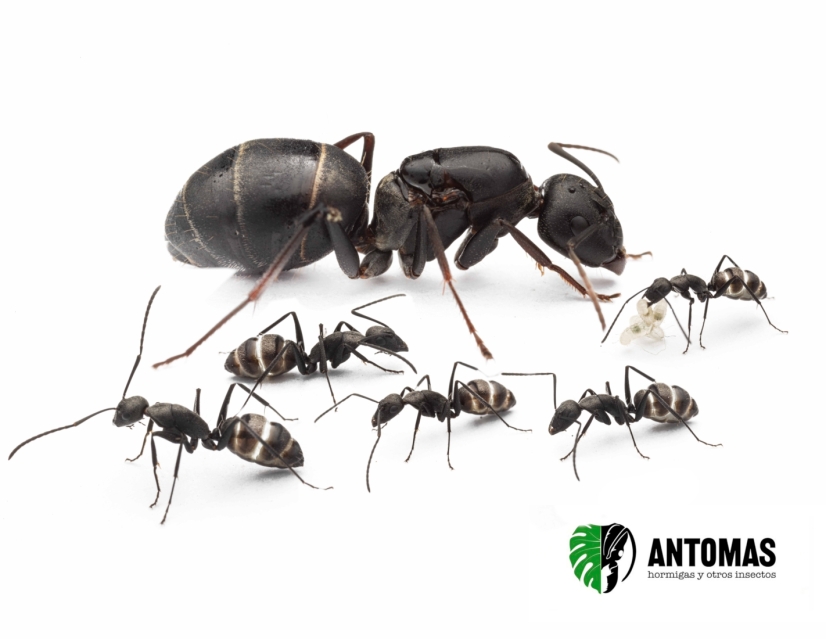
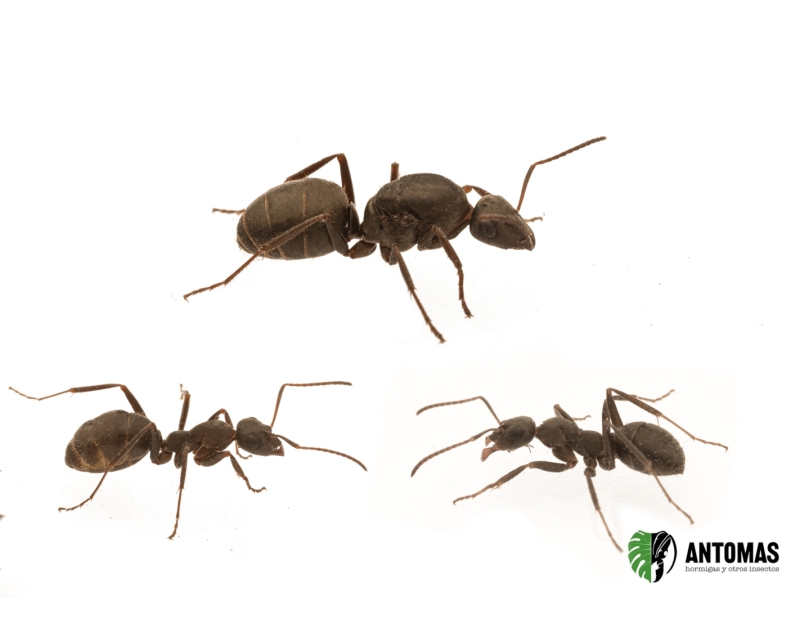
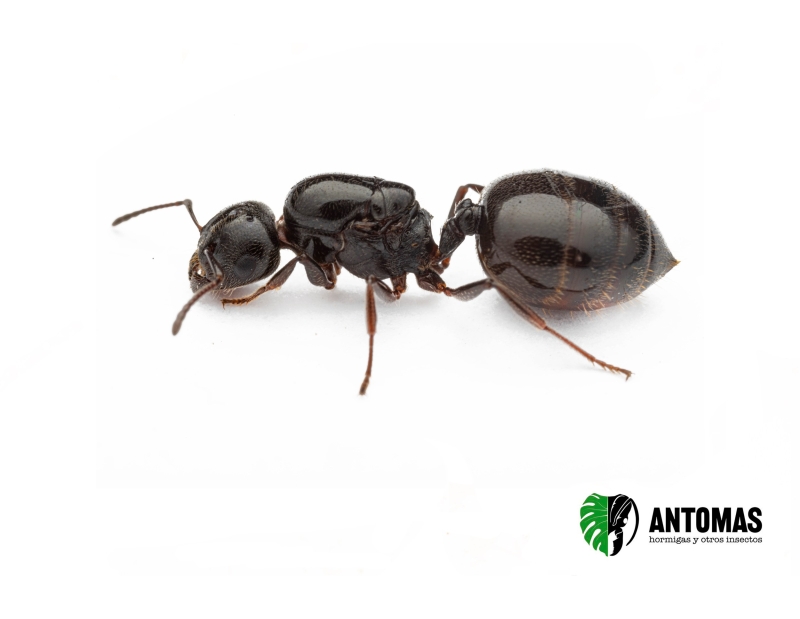
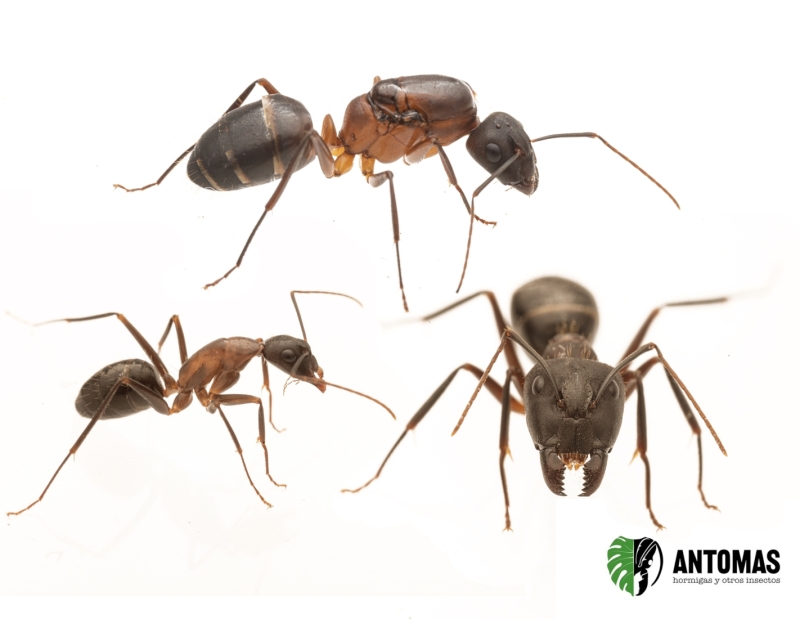
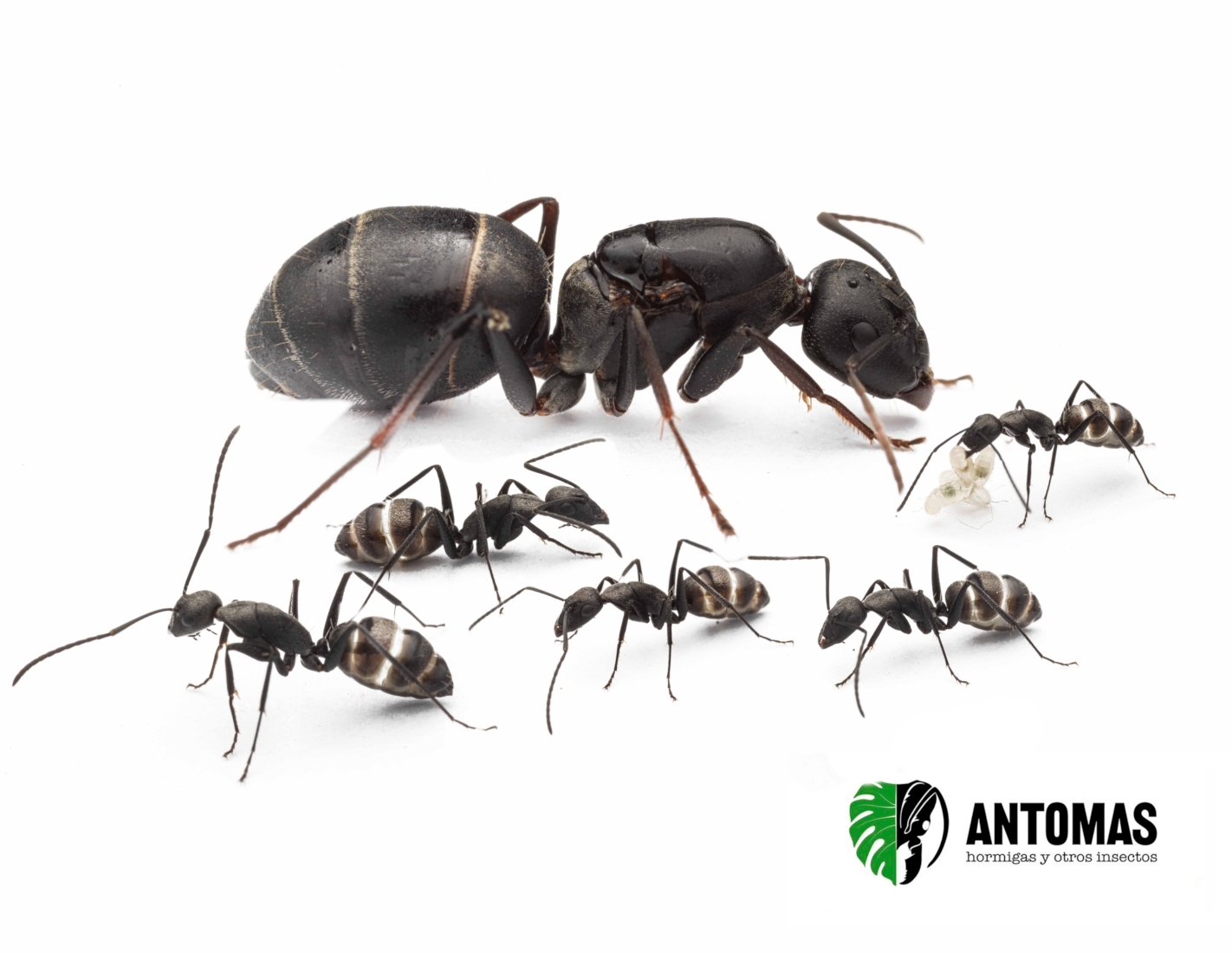
A carpenter ant from Iberia, black and matt, its gaster crossed by fine hairs that sparkle silver and gold. It shares the subgenus Myrmosericus with C. cruentatus, and the peninsula has no other species in it. It arrives as a mated founding queen already with brood: one queen per nest, raising her first daughters unaided. Start it in a Qbik Wild, then move it to the Alpha range. It likes 24–28 °C with a warmer corner, a dry nest, a nectar feeder that never runs empty and insects in abundance. Winter rest (diapause): about three months at 12–15 °C. It walks up walls: stop it with mineral oil or talc.
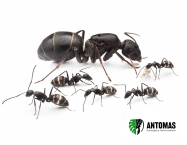
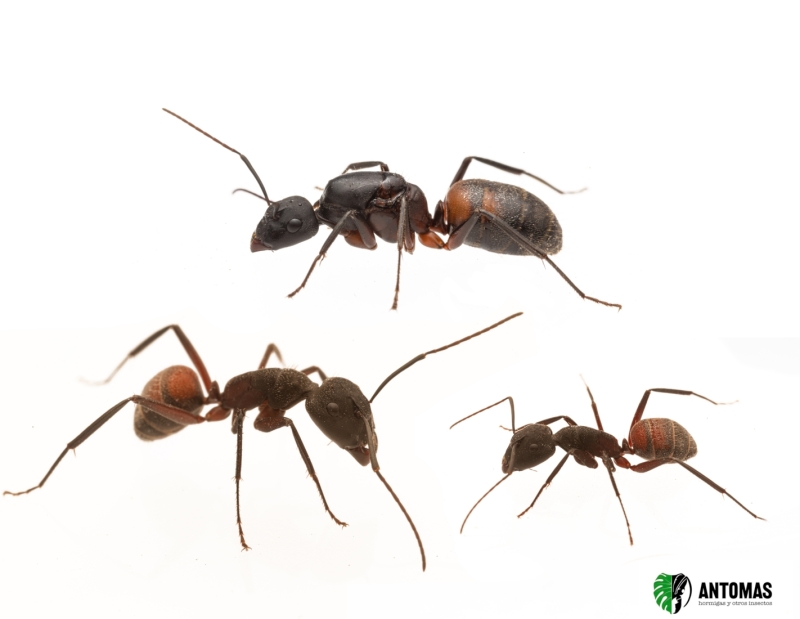
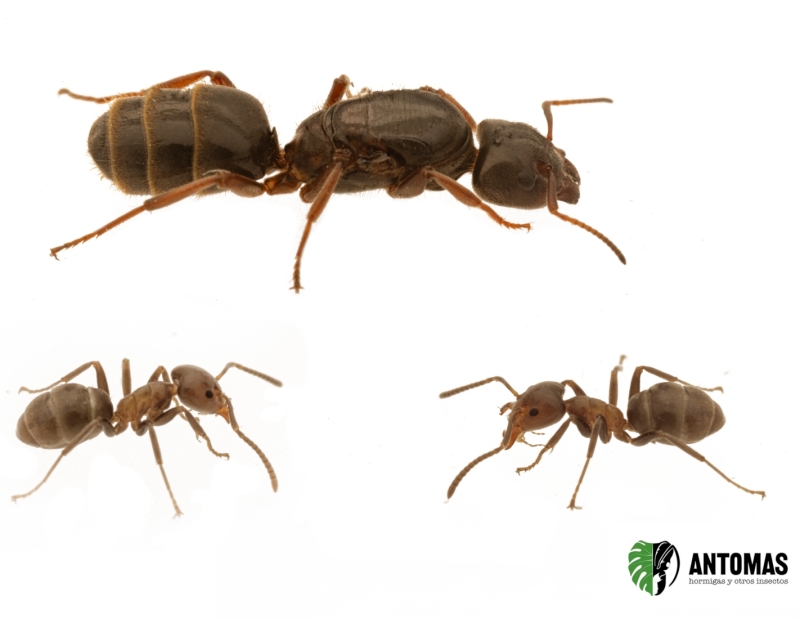
Camponotus micans (Nylander, 1856) is a large carpenter ant, with workers of several sizes, native to the south of the Iberian Peninsula and North Africa. At first glance it looks like just another black ant, but a single ray of sunshine is enough to light up its gaster with bands of silver and golden hairs. Hence its name: in Latin, micans means “the one that sparkles”.
It is a native Iberian ant, heat-loving and at home in dry meadows and on sunny, stony ground. For anyone starting out with Camponotus it is a great choice: serene, not at all fussy about food and with a yearly calendar shaped by the Mediterranean climate. Because its biology has hardly been studied, in each section we state whether a fact comes from the scientific literature, from the experience of other hobbyists or from our own colonies.
Biology
“The one that sparkles”: a name given to a glint
It was described in 1856 by the Finnish naturalist William Nylander, as Formica micans, from workers collected in Algeria. Nylander is better remembered today as one of the great lichen specialists of the 19th century, but before that he devoted a good part of his work to ants.
Micans is the present participle of the Latin verb micō, “to sparkle” or “to twinkle”, the word Latin authors used for the flickering of the stars. We do not know whether Nylander explained his choice, but you only need to see a worker walking in full sun to understand it.
Today its full name is Camponotus (Myrmosericus) micans, and that is where Ward and Boudinot’s 2021 revision of the subgenera of Camponotus keeps it. In 1939 a subspecies was also described, C. micans asniensis Santschi, from specimens collected in the mountains of the Moroccan Atlas.
Shining without being shiny
Here lies its great curiosity. Under a magnifying glass, its skin, the cuticle, does not shine at all: it is matt, because it is covered by a reticulate microsculpture, an extremely fine network of ridges that scatters light instead of reflecting it. The glint comes from the pubescence: a dense layer of short, flattened, yellowish hairs that together look silvery.
On the gaster, at the joints between the segments, these hairs are longer and lie crosswise, so the abdomen appears striped with bands that light up and fade depending on the angle of the light. In our colonies, the glint ranges from silver to gold depending on the individual and the lighting.
Its neighbours in the subgenus Tanaemyrmex, such as C. barbaricus or C. sylvaticus, do exactly the opposite: they have a smooth, glossy cuticle, as if lacquered, and almost no hair on the gaster. C. micans has a dull skin and a “borrowed” shine.
What is the hair for? It is tempting to compare it with that of the Saharan Cataglyphis bombycina: in 2015, a study published in Science showed that its hairs, triangular in cross-section, reflect sunlight and help to radiate heat. Nobody has studied this in C. micans, and its fine, flattened hairs do not have the same structure, so their function remains a lovely mystery.
The Iberian cousin of C. cruentatus
There are only two Camponotus of the subgenus Myrmosericus in the Iberian Peninsula: C. micans and C. cruentatus, as García (2025) notes in his work on the Camponotus of north-western Iberia. The myrmecologists Gómez and Espadaler call it the “cruentatus group” and recognise it by a set of features shared by both species:
- Clypeus, the plate above the mandibles, with a central keel and the front edge shaped into a rectangular lobe.
- Mandibles armed with 7 or 8 teeth.
- Matt body and a very pubescent gaster, velvety in appearance.
They are cousins, but easy to tell apart. C. cruentatus has the rear of the thorax and the forward half of its gaster orange or blood red. C. micans is black from head to gaster, and what gives it away is the glint, not the colour.
In a genus of more than a thousand species like this one, trusting resemblance is risky. The very title of Ward and Boudinot’s paper speaks of “grappling with homoplasy”, that is, with features that look alike because they evolved several times independently, not because of kinship. That is why the subgenus is decided under the lens.
Between the two shores of the Mediterranean
C. micans lives on both sides of the Strait of Gibraltar. In Europe it occupies mainly the southern half of the Iberian Peninsula: Andalusia, southern Portugal, Extremadura, La Mancha, Madrid and the Spanish east coast. On GBIF, the international portal of biodiversity records, many of the Portuguese data cluster in the Algarve. Outside the peninsula it lives in Sicily and Calabria and in the Maghreb: Morocco, Algeria and Tunisia. García (2025) describes it as far more southern than C. cruentatus, and there are no records from Galicia or the Balearic Islands.
You will sometimes read that it is “native to Africa”. Nothing supports this: it is native to both shores, and the fact that it was described from Algerian workers is an accident of the history of science, not a clue to its origin.
Its climate. Its home is the warm Mediterranean climate, with long, dry summers, when average July maxima exceed 32–36 °C in the lowlands of the south, and mild winters, with averages of about 10–13 °C between December and February. That short, temperate winter explains the rest we recommend: about three months at 12–15 °C, with no extreme cold (see “Diapause: a southern winter”).
An ant that asks for sunshine
Nobody has yet studied its daily rhythm in the wild, but everything points to a thermophilic species, one that needs warmth to be active. Popular sources place its optimal activity above about 25 °C, and when it turns cold it vanishes underground. Those who keep it find it more diurnal than many other carpenter ants. Its cousin C. cruentatus has, by contrast, been studied: in Catalonia it was seen active by day in spring and autumn.
Being a sun-lover pays off. Xim Cerdá and Javier Retana found that, among the ants that populate Mediterranean soils, the thermometer decides who eats: in moderate heat a few dominant species rule, but in the most scorching hours they retreat and the heat-tolerant ones seize the opening. They called it the “thermal disruption” of hierarchies. C. micans does not appear in those studies, but they help us understand how a sun-loving ant makes its way in a meadow full of competitors.
A home under a stone
It lives in dry, warm, open places: meadows, grasslands, scrub clearings and stony ground. According to naturalist sources, it usually settles beneath a stone; it rarely uses wood, and some keepers mention nests dug straight into the soil.
The stone is no accident. A flat slab in the sun warms up quickly and holds the heat for hours, and the soil beneath stays moister than in the open air. Many Mediterranean ants use this natural “radiator” for their brood. You will see it in the formicarium: the colony carries its larvae to the warmest corner.
Honeydew, aphids and a trusted bacterium
Its diet in the wild has never been studied, but Camponotus obtain much of their energy from honeydew, the sugary liquid excreted by aphids, scale insects and other sap-sucking insects, and its cousin C. cruentatus is a well-documented aphid tender. The name for this exchange is trophobiosis: the ant “milks” those insects and, in return, protects them from predators and parasites. A classic 2005 review points out that the deal is not fixed, but depends on how much honeydew there is and what other food the ants can find.
Such a sugary diet has a trick to it. The secret lies in a bacterium, Blochmannia, which every Camponotus houses in certain gut cells and which the queen hands down to her offspring through the egg. In 2007, work on C. floridanus showed that it makes essential amino acids, those the ant cannot produce, and recycles nitrogen: with the bacterium reduced by antibiotics, colonies raised far less brood on a poor diet. Even so, it is no excuse to skimp on insects: the larvae need protein to grow (see “Feeding”).
An acid weapon instead of a sting
It belongs to the formicines, a subfamily that lost its sting. The gaster ends in the acidopore, a small nozzle through which the venom is released, mostly formic acid. If it feels attacked, it bites and bends its gaster forward to spray it.
The acid has another use. In 2020, a team reported in eLife that these ants ingest some of their own acid: while grooming, they bring the acidopore to the mouth and keep the crop highly acidic, that shared reservoir holding the food to be passed on, and in this way they filter out microbes. The tests were run on C. floridanus and other species of the subfamily. If you see a worker hunched over, nibbling at the tip of its abdomen, it is not ill: it is disinfecting itself.
One queen for each colony
No nest of C. micans with more than one queen has ever been described, either in the wild or in captivity: all keepers treat it as monogynous. That is to be expected. In 2014 Boulay and colleagues reviewed almost 150 Palaearctic species and concluded that monogyny is the original condition, and that having several queens tends to go hand in hand with huge societies.
Founding is claustral. After the nuptial flight, the queen loses her wings and seals herself into a chamber under a stone. There she feeds her first larvae by using up her own reserves: fat and her now useless flight muscles. In 1989 Keller and Passera measured queens of many species and found that claustral founders weigh more and store more lipids than those that depend on workers.
How large does a colony grow? There are no scientific data. Keepers speak of a few hundred workers, and one shop of around a thousand. At Antomas we see that, well cared for and with plenty of protein, they can grow quite large.
Nuptial flights: a calendar still to be deciphered
The published observations contradict each other: some place the flights in late spring or early summer, on warm, humid nights; others in late summer, often after a storm. No study has pinned down the months. If you ever find a winged queen of C. micans, note the date, the time and the weather: it is a piece of data that is still missing.
A queen that lives two or three years? A myth
Someone once wrote on a forum that the queen of C. micans lives only two or three years. There is no source behind it, and it does not fit the genus. Ant queens are among the longest-lived insects, and they live far longer than their workers: in Camponotus, an Australian queen kept by Caryl and Edna Haskins lived for 23.2 years. Nobody has measured the lifespan of C. micans, but a well-kept queen is a companion for many years, not for two winters.
Size and morphology
A large, polymorphic carpenter ant with no sting. We have not found an accessible modern description, so here we bring together the characters from the Iberian and North African identification keys and what we see in our colonies.
- Colour. Black all over: head, thorax, gaster and legs. In our colonies, entirely black except for the silver or golden bands of hair on the abdomen.
- Surface. Matt, owing to the reticulate microsculpture.
- Pubescence. Dense on the gaster, made of yellowish hairs that look silvery, longer and crosswise at the joints between segments.
- Head. Clypeus with a keel and a rectangular lobe, and seven or eight teeth on each mandible. In majors, the head is far bulkier and broader than in minors.
- Castes. Marked polymorphism, with minors, medias and majors. Majors are robust and approach the size of the queen.
- Queen. Black and matt, with abundant yellowish hairs on the head and gaster.
- Male. No accessible description found.
How to recognise it
- Compared with C. barbaricus, C. sylvaticus and other Tanaemyrmex: those gleam, have hardly any hair on the abdomen and often wear a reddish thorax.
- Compared with C. vagus: the other large black carpenter ant belongs to a different subgenus, is covered in long erect hairs and nests in wood.
- Compared with the C. lateralis group: these are medium-sized species whose largest workers do not exceed about 7 mm, and they are not closely related.
- Compared with C. haroi: in the Iberian key, the minors of C. micans lack a marked depression between the thorax and the propodeum, and their gaster is much more pubescent.
Measurements
We have not found the sizes of each caste of C. micans in any accessible scientific source. The figures circulating in shops and care sheets vary so widely, with queens from 11 to almost 20 mm depending on who quotes them, that we prefer not to reproduce them. The closest scientific reference is that of its cousin: workers of C. cruentatus reach 13 mm, according to García (2025). What you will see at home: the queen’s first daughters emerge tiny, and each new batch is a little bigger than the one before.
Care in captivity
Difficulty: 1/5 – Beginner
Few Camponotus are as straightforward; it is the ideal gateway to the native species:
- It is tough: it comes from scorching summers and mild winters.
- Its diapause is no trouble: a cool corner of the house or a wine cooler is enough, no fridge needed.
- It is not demanding about food: nectar and any insect of a suitable size.
- It is calm and not dangerous to people.
What it asks for is warmth during the active season, patience in the first year, because Camponotus start slowly, and a good barrier. In return, it offers something few ants have: a colony that sparkles in the light of the foraging area.
Temperature, humidity and light
- Nest: from spring to autumn, 24–28 °C, with a warmer end of 26–30 °C. Keepers recommend 21–28 °C for the nest, and one reports that their queen did not start laying until it reached about 30 °C: that warm corner helps a great deal during founding.
- Foraging area: at room temperature or slightly warmer, and always dry.
- Humidity: low in the nest. One slightly moist corner is enough, to which the colony can move the brood if needed.
- Water: a full test tube, plugged with cotton wool, always within reach in the hunting area.
- Light: darkness in the chambers, brightness in the hunting area and the natural rhythm of days and nights.
- Diapause: about 3 months at 12–15 °C; it starts in November or December and ends in February.
For heat, fit a thermostat-controlled heating mat or cable along one flank of the nest. That creates a gradient, the colony chooses, and you imitate the warm stone of its natural nest. Avoid direct sunlight and radiators. If you see condensation or mould, there is too much humidity; if the brood crowds into the moist area, there is too little.
Recommended formicaria
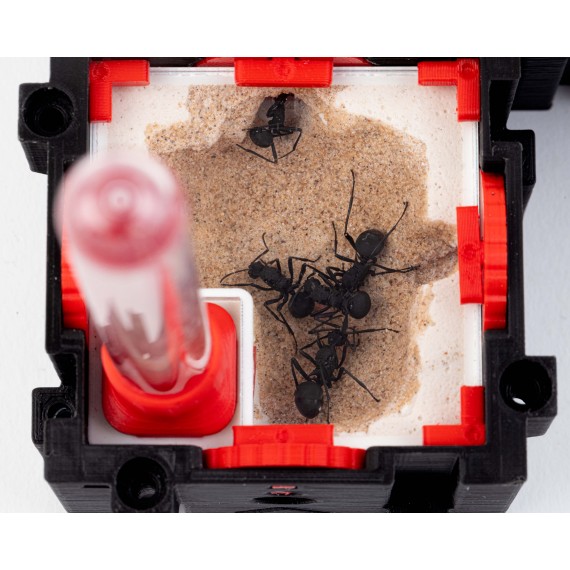
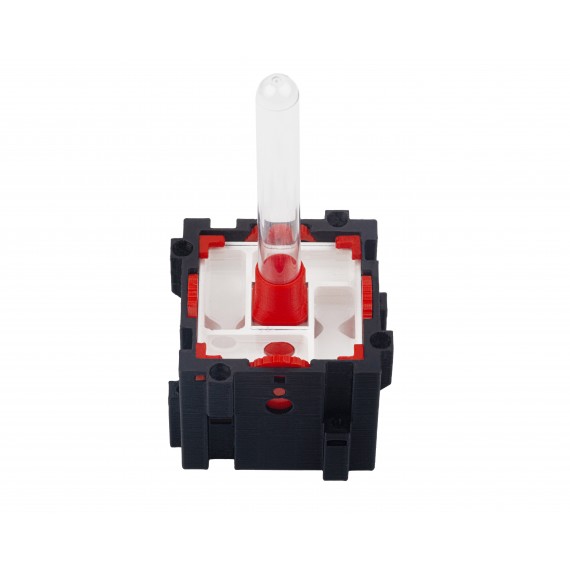
At Antomas we recommend founding in a Qbik Wild from Anthouse. They are made of plaster, a material that holds moisture, and their size is ideal for a queen with her first workers. The Qbik Wild One P 1C, with mid-sized galleries, is the one to begin with:
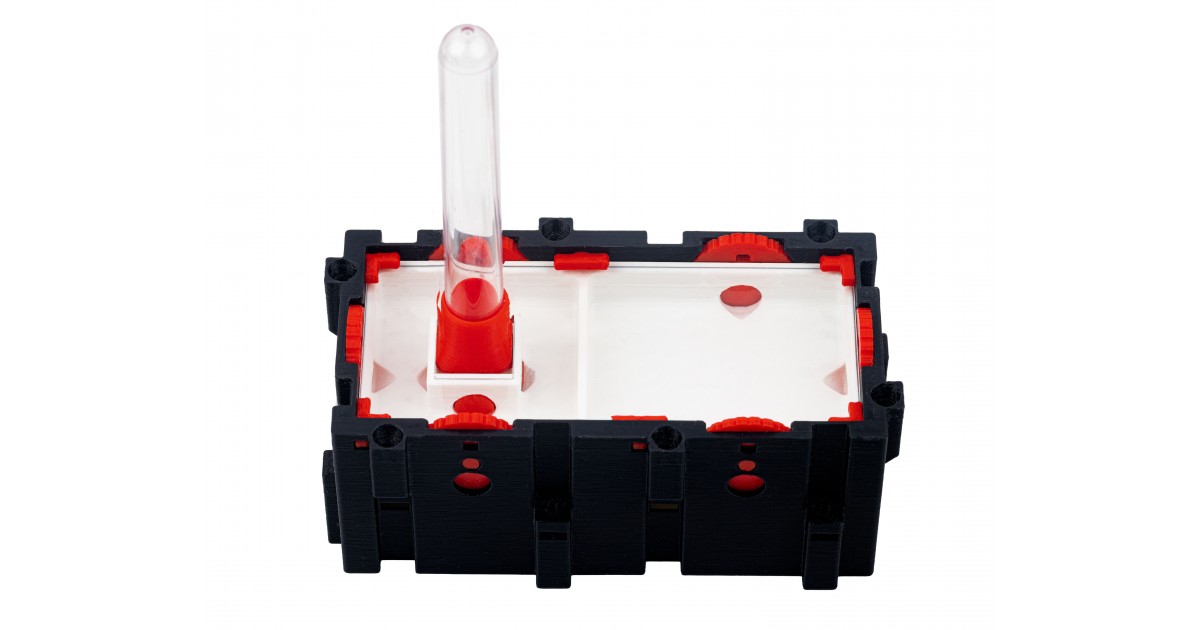
Need more space before switching range? Then its big brother with a double chamber:
Once the colony is settled, transfer it to the Alpha range: the QBIK ONE and, later on, the QBIK DUO, also with medium galleries. They are modular; moisture comes in through the tubes and the chambers stay dry, just what this species prefers. They also cost less and are lighter, a real advantage because, well cared for, these colonies can grow quite large:
Expand as the colony asks for it, never in advance: the empty chambers of an oversized nest end up full of waste. The rest of the set-up:
- An anti-escape band at the top of the foraging area, made of mineral oil or talc.
- A dry foraging floor, with a little sand and one or two flat stones reminiscent of its habitat, away from the barrier.
- Water in a tube, with its cotton wool plug, and a separate feeder for the nectar.
- Heat along one flank of the nest, with a thermostat and away from the feeder.
The first weeks with your queen
We send you a founding queen with brood, already mated and with eggs, larvae or pupae, inside a tube with her water reserve behind the cotton wool. Because she founds claustrally, she does not have to go out looking for food to raise her first daughters. For now, your role is simple:
- Gentle, steady warmth. Leave the tube as it arrives, in a quiet, dark place, at 24–28 °C, with one end near the warm area and never above 30 °C.
- Few disturbances. This is the only stage when it is best to handle her little: a harassed queen may eat some of her eggs. Glancing at her now and then does no harm; moving her all the time does.
- Water reserve. When the reserve is empty or the tube very dirty, tip the colony into a clean one.
- A sweet droplet. Now and then, a micro-drop of diluted nectar on a bit of foil, and never on the cotton wool: it would grow mould and ruin the water.
How long until the first worker? It depends on the temperature: in European Camponotus, full development from egg to worker normally takes 6 to 12 weeks. And if the queen arrives in autumn, the brood may well stop until spring: this is normal in a species with diapause.
The first workers are small, shy and more fragile than the ones that follow. As soon as they emerge, put out a small feeder with nectar and a piece of prey a couple of times a week; whatever they do not eat comes out the next day.
Moving house by tipping out
At Antomas we move the colony into the formicarium when it has at least 5 workers, ideally 5–10, into the Wild One P 1C. We move them by tipping them out: we do not wait for them to decide to leave.
- Have the formicarium ready: barrier applied, water connected and chambers in half-light.
- Do it over a tray: if a worker escapes up the tube or the tools, it will not get far.
- Unplug the tube inside the foraging area, next to the nest entrance, and carefully let its whole contents drop out: queen, workers and brood.
- Any that stay inside, nudge them out with a brush.
- Close up and leave them alone: within a short while all the brood will be inside the nest.
The later jump to the Alpha range is done the same way.
Feeding
Nectar around the clock. An ant that in the wild lives on the honeydew secreted by aphids and scale insects must never be left without sugar. Serve it in a feeder, not on cotton wool: cotton wool soaked in nectar ferments and grows mould within days. A shop-bought or home-made feeder will do, as long as the drop stays spread out, soaking nothing, and the workers can reach it easily. Alternate flavours: Blue Sugar, Anthouse’s nectar, on most days (4–5 a week), and another nectar or sugar water on the remaining 1–2. A little protein can be added to the nectar.
Insects, generously. Larvae grow on protein, and our rule is a generous one: if you clean up the leftovers every day, you can, and should, give more than they need, because a colony that senses plenty lays more eggs and grows sooner. If you cannot check the foraging area often, scale back the portions, because rotting leftovers attract mites and fungi. Some ideas:
With few workers, protein two or three times a week is enough; with many, daily or every other day. Buy insects from a trusted supplier, because any that have touched insecticides can wipe out the colony. And keep the water tube in the foraging area topped up.
Growth: a calm start
Like almost all Camponotus, it starts slowly. The first year is the year of patience: few workers, plenty of brood and a queen who gradually picks up the pace. From the second year on, with warmth during the active season, a properly done winter rest and protein every day, growth really shows. Nobody has published when the majors of this species appear; in Camponotus they usually take a while, because the colony first needs a good number of workers. Expand when you see many ants standing idle in the foraging area because there is no room left inside.
Diapause: a southern winter
C. micans needs a winter rest, the diapause. Even in the warmest south, from December to February the average air temperature stays below about 13 °C, and the colony takes refuge under its stone. On top of that, those who keep it speak of an internal clock in the queen that demands this break, even if you keep her at 25 °C all year round.
There is no consensus on the details: some propose a gentle rest at 15–18 °C, from late November to early February, while others stretch the cold to five months at 12–15 °C. We settle on the middle ground: about 3 months at 12–15 °C, starting in November or December and ending in February.
- A gentle way in. In November, switch off the nest heating and let the temperature drop little by little over 2–3 weeks.
- Three quiet months between 12 and 15 °C: an unheated room, a pantry or a wine cooler. Never the fridge.
- The water tube stays in place all winter.
- Minimal food: a little nectar in the feeder in case a worker wants it, and no insects. It is to be expected that the brood stops developing.
- An equally gentle way out. From mid- or late February, raise the temperature again over 2–3 weeks.
Veteran keepers insist on one thing: no warmth before its time. Rousing the queen from her torpor in the middle of January does not bring the season forward and may shorten her life. When activity and eggs reappear, go back to offering insects.
Behaviour and observation
Cautious at first, confident later. In a young colony the small workers are skittish and hide at any sudden movement. As the colony grows and larger workers appear, it gains confidence and occupies the foraging area with ease.
Things worth watching. The brood travels around the nest according to the temperature, in search of its “warm stone”. Look out too for trophallaxis, when two workers pass food mouth to mouth, and for the grooming of the acidopore. And watch the foraging area with the light coming from the side: that is when the bands on the gaster sparkle.
Watch as much as you want. An ant colony is for enjoying and learning from, not for hiding in a cupboard: that is how we see it at Antomas. With the chambers dark and the hunting area lit, you can watch it every day; just try not to shake the nest or step in more than necessary.
Warning signs:
- The brood does not progress in the middle of the active season: almost always a lack of warmth or protein.
- Droplets on the walls, mould or mites: too much water or forgotten food.
- Larvae and pupae piled up by the moist corner: the nest has become too dry.
Keeping them in
Like all carpenter ants, it climbs with ease on plastic and glass, and C. micans is no exception. Well protected, it does not get out:
- Mineral oil or talc along the top edge of the foraging area, with no gaps. Replace the oil when it picks up dust and the talc when it cakes with humidity.
- A lid that closes properly, in case one gets past the barrier.
- Check connections and stoppers, especially when moving to the Alpha range and adding modules.
- Nothing that could serve as a bridge near the barrier, and take your time when opening.
Does it bite? Safety and handling
No risk whatsoever. It has no sting. A worker that feels attacked may bite, but the bite of C. micans is weak, even weaker than that of the large workers of C. cruentatus, and at most amounts to a pinch. It can also release a little formic acid: only by handling a great many with your fingers might you get a small callus, and that would be exaggerating, because it almost never happens.
For their sake, move them with a brush or soft-tipped forceps, not by hand. Do not mix colonies or put new queens into a colony. And although it is a native species, a colony raised at home must never be set free outdoors.
What not to do
- Put two queens together or add a queen to a colony that is already working.
- Serve the nectar on cotton wool or allow the feeder to run dry.
- Give only one kind of prey or let leftovers pile up.
- Skip the winter rest, cool it below freezing or wake the colony in January.
- Go suddenly from warm to cold, or from cold to warm.
- Flood the nest or put a tiny colony into a huge formicarium.
- Forget to renew the oil or talc, or leave loose connections.
- Release the colony into the wild.
Scientific sources
For this care sheet we started from the scientific literature on Camponotus micans, its subgenus and its genus, from distribution records and the climate of its range, and from what we have learnt at Antomas and other keepers have reported. For Iberian taxonomy we have also relied on the keys by Gómez and Espadaler (Hormigas ibéricas) and on García (2025), Arquivos Entomolóxicos 32: 73–79. Main references:
- Cagniant, H. (1996). Les Camponotus du Maroc (Hymenoptera: Formicidae): clé et catalogue des espèces. Annales de la Société entomologique de France (N.S.) 32: 87–100. doi:10.1080/21686351.1996.12278857
- Ward, P. S. & Boudinot, B. E. (2021). Grappling with homoplasy: taxonomic refinements and reassignments in the ant genera Camponotus and Colobopsis (Hymenoptera: Formicidae). Arthropod Systematics & Phylogeny 79: 37–56. doi:10.3897/asp.79.e66978
- Ward, P. S., Blaimer, B. B. & Fisher, B. L. (2016). A revised phylogenetic classification of the ant subfamily Formicinae (Hymenoptera: Formicidae), with resurrection of the genera Colobopsis and Dinomyrmex. Zootaxa 4072: 343–357. doi:10.11646/zootaxa.4072.3.4
- Janicki, J., Narula, N., Ziegler, M., Guénard, B. & Economo, E. P. (2016). Visualizing and interacting with large-volume biodiversity data using client–server web-mapping applications: the design and implementation of antmaps.org. Ecological Informatics 32: 185–193. doi:10.1016/j.ecoinf.2016.02.006
- Shi, N. N., Tsai, C.-C., Camino, F., Bernard, G. D., Yu, N. & Wehner, R. (2015). Keeping cool: enhanced optical reflection and radiative heat dissipation in Saharan silver ants. Science 349: 298–301. doi:10.1126/science.aab3564
- Cerdá, X., Retana, J. & Cros, S. (1997). Thermal disruption of transitive hierarchies in Mediterranean ant communities. Journal of Animal Ecology 66: 363–374. doi:10.2307/5982
- Retana, J. & Cerdá, X. (2000). Patterns of diversity and composition of Mediterranean ground ant communities tracking spatial and temporal variability in the thermal environment. Oecologia 123: 436–444. doi:10.1007/s004420051031
- Stadler, B. & Dixon, A. F. G. (2005). Ecology and evolution of aphid-ant interactions. Annual Review of Ecology, Evolution, and Systematics 36: 345–372. doi:10.1146/annurev.ecolsys.36.091704.175531
- Feldhaar, H., Straka, J., Krischke, M., Berthold, K., Stoll, S., Mueller, M. J. & Gross, R. (2007). Nutritional upgrading for omnivorous carpenter ants by the endosymbiont Blochmannia. BMC Biology 5: 48. doi:10.1186/1741-7007-5-48
- Tragust, S. et al. (2020). Formicine ants swallow their highly acidic poison for gut microbial selection and control. eLife 9: e60287. doi:10.7554/eLife.60287
- Boulay, R., Arnan, X., Cerdá, X. & Retana, J. (2014). The ecological benefits of larger colony size may promote polygyny in ants. Journal of Evolutionary Biology 27: 2856–2863. doi:10.1111/jeb.12515
- Keller, L. & Passera, L. (1989). Size and fat content of gynes in relation to the mode of colony founding in ants (Hymenoptera; Formicidae). Oecologia 80: 236–240. doi:10.1007/BF00380157
- Haskins, C. P. & Haskins, E. F. (1992). Note on extraordinary longevity in a queen of the formicine ant genus Camponotus. Psyche 99: 31–33. doi:10.1155/1992/53614
- Keller, L. & Genoud, M. (1997). Extraordinary lifespans in ants: a test of evolutionary theories of ageing. Nature 389: 958–960. doi:10.1038/40130