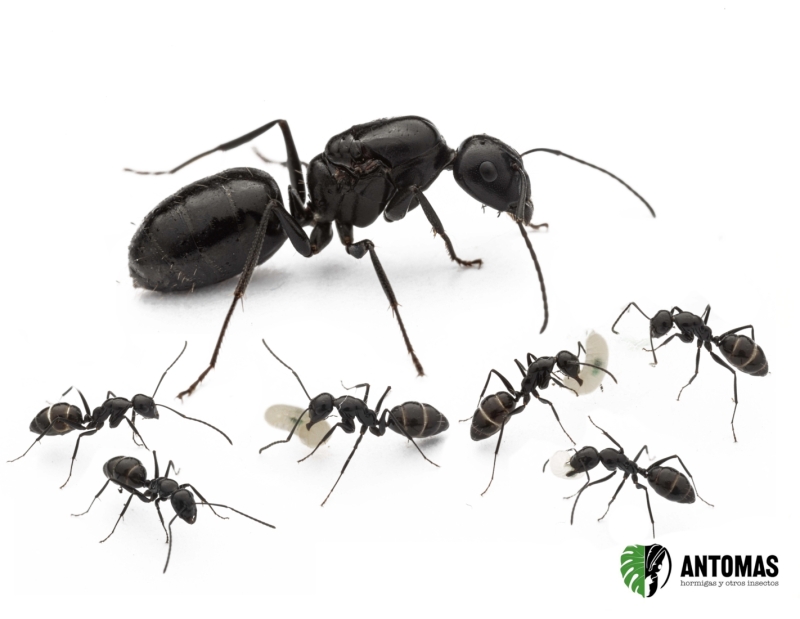
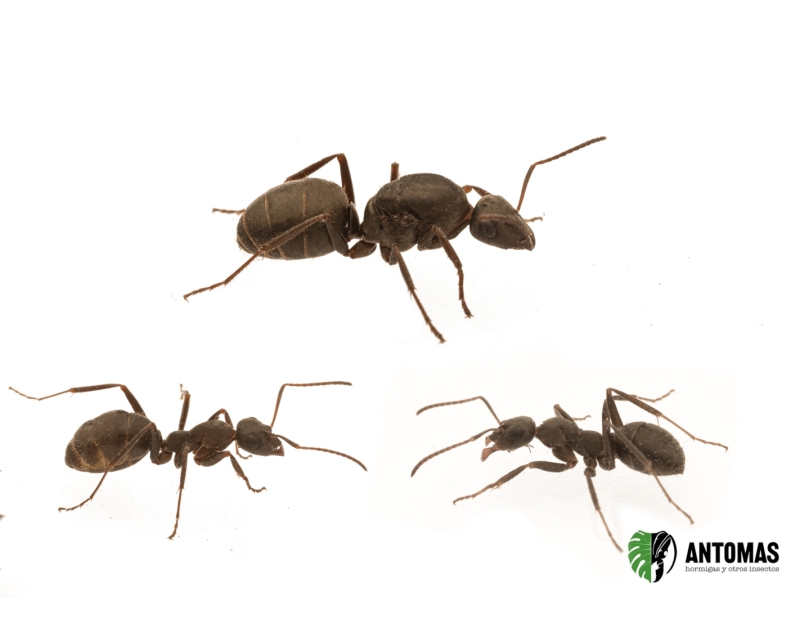
Difficulty: 1/5 – Beginner
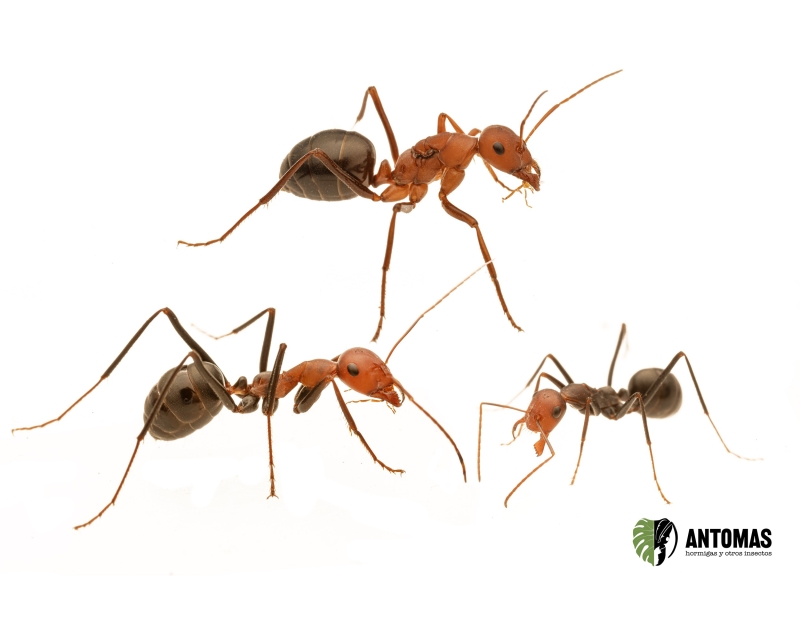
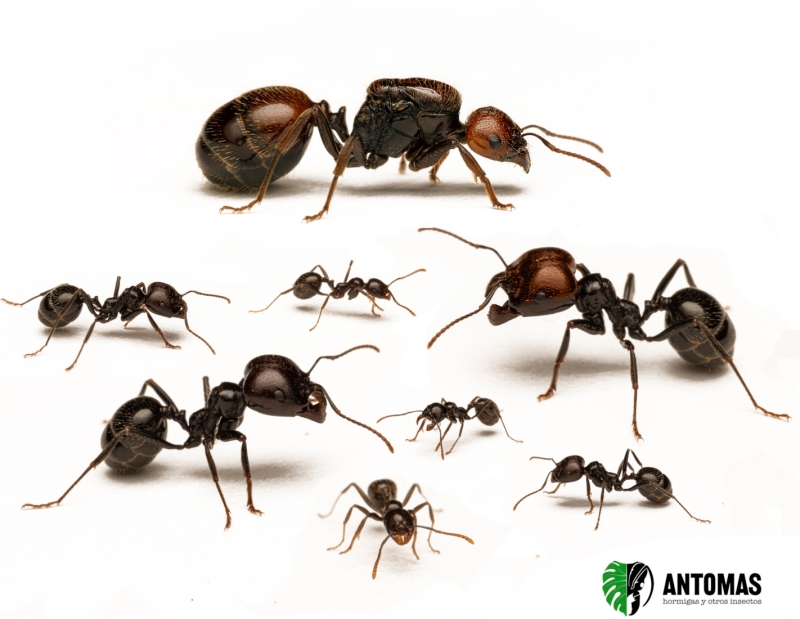
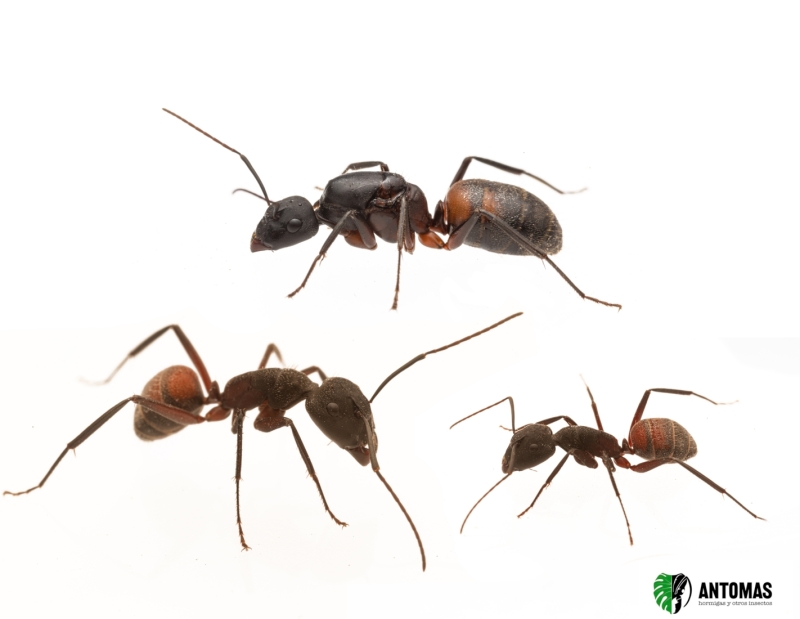
An Iberian Camponotus of the subgenus Tanaemyrmex: a glossy red thorax between a black head and gaster, a shiny cuticle and majors with enormous heads. A ground-nesting ant, crepuscular and nocturnal in summer, that lives on honeydew and hunts insects. Sold as a colony with a queen, workers and brood: one queen per nest and claustral founding. To start, Qbik Wild; as it grows, the Alpha range. Nest at 24–28 °C with a gradient, sugary liquids daily in a feeder and insects in abundance, and a mild diapause of 8–12 weeks at 14–16 °C. It walks up glass, so it needs a mineral-oil or talc barrier. Harmless to whoever keeps it.
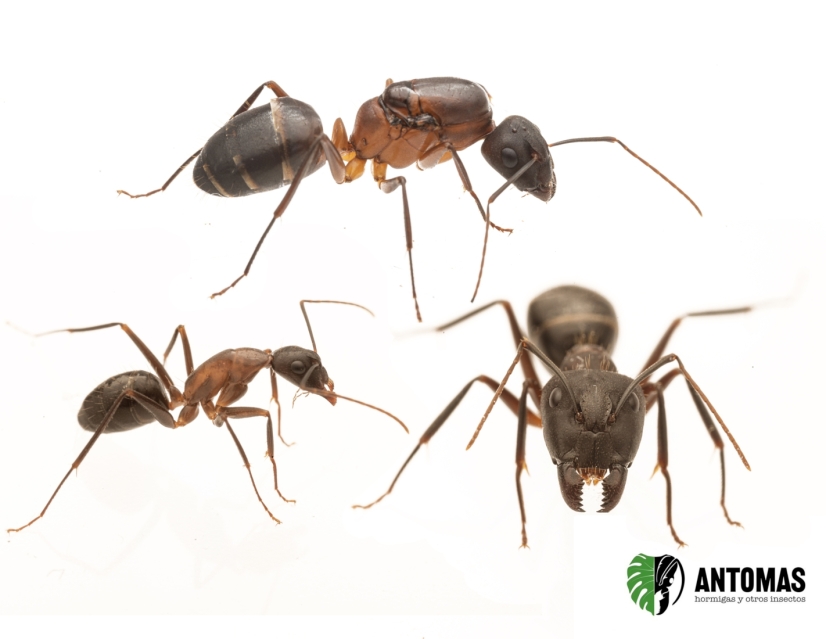
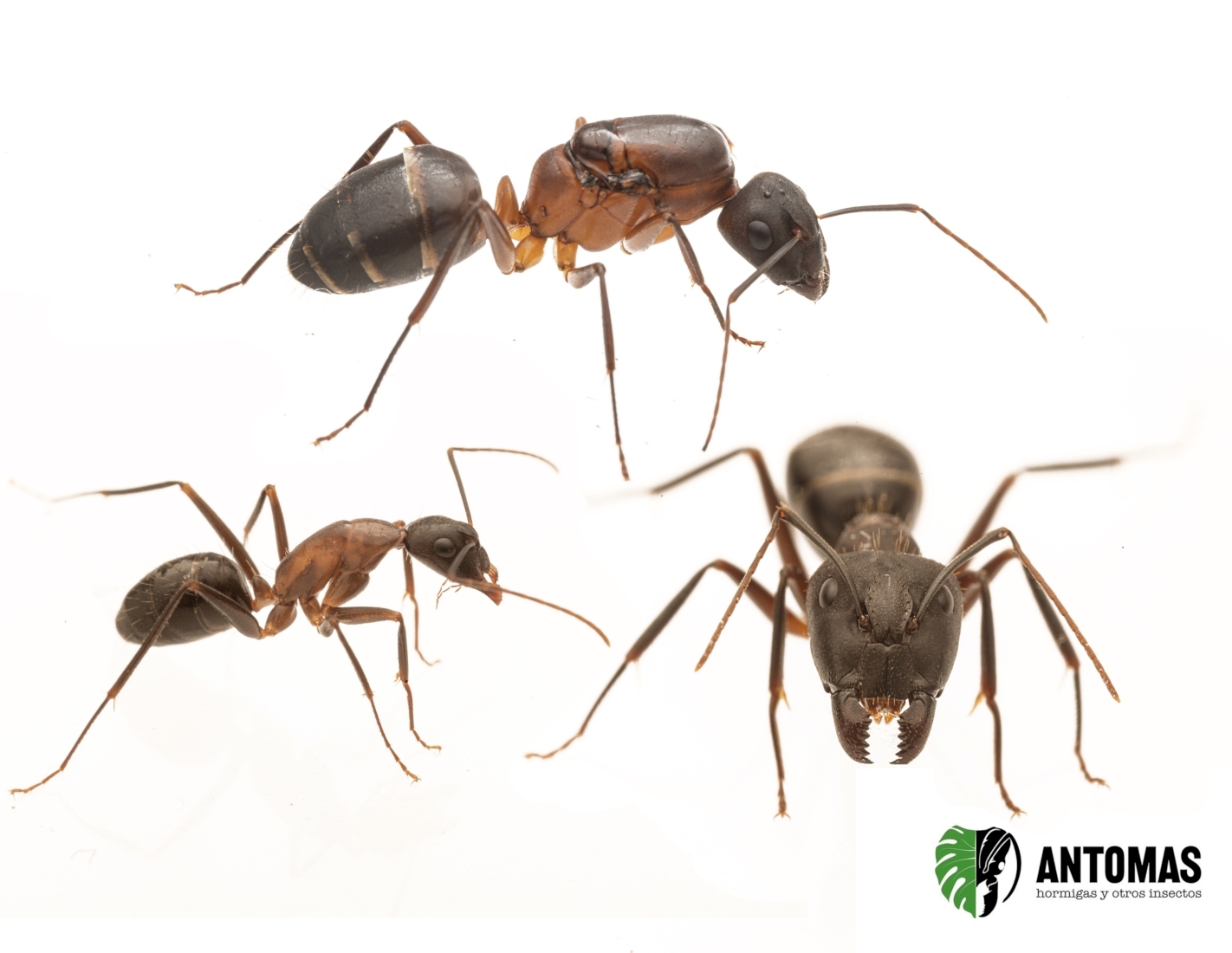
Camponotus barbaricus Emery, 1905 is one of the large carpenter ants of the western Mediterranean and, for many keepers, one of the most beautiful ants of the Iberian Peninsula. Its workers look hand-painted: a black head and gaster and, between them, an orange-red thorax that gleams as if it had been varnished. As the colony matures, majors with colossal heads appear, the great spectacle of the species.
It also has a history: it was described from specimens collected in Seville and Gibraltar, spent decades as a subspecies of C. sylvaticus, and its exact position is still an open question. In the lines that follow we keep published data, the experience of other hobbyists and the Antomas guidelines apart. We will give away the conclusion now: it is one of the most rewarding Camponotus to start with.
Biology
“The Barbary ant”, described from Seville
The name is misleading. In Latin, barbaricus means “foreign, barbarian”, and in zoology it usually refers to Barbary, the old European name for the coast of the Maghreb. Yet when the Italian myrmecologist Carlo Emery described it in 1905, the specimens in front of him, the syntypes or reference specimens of the description, came from Gibraltar and Seville, “Siviglia” in Emery’s Italian. Today they are kept in the Civic Museum of Natural History in Genoa. The “Barbary” ant was therefore born, as far as science is concerned, on this side of the Strait.
Emery did not describe it as a species but as Camponotus maculatus subsp. barbaricus: a form of C. maculatus, an African ant whose name was then used for many similar Camponotus. That same year he also described the form xanthomelas, from Algeria and Tunisia, today one of its subspecies alongside eubarbaricus, which the French myrmecologist Henri Cagniant described from Algeria in 1970.
It even has a famous misprint: in 1921 the Swiss Felix Santschi wrote it as “barbarus”, like the seed-harvesting ant Messor barbarus, which belongs to another subfamily and looks nothing like it.
Daughter of C. sylvaticus: a taxonomic knot still to be untied
In 1920 Emery moved it, as a subspecies, to C. sylvaticus, and Santschi did the same the following year. For much of the twentieth century it was therefore a form of Camponotus sylvaticus, the glossy, reddish-thoraxed carpenter ant found across much of the Peninsula and southern France. Later it regained species rank and, in Barry Bolton’s 1995 world catalogue, it was placed in the subgenus Tanaemyrmex Ashmead, 1905, where it remains.
The story is not over. K. Gómez and X. Espadaler, authors of Hormigas Ibéricas, flag C. barbaricus as a taxonomic problem that is still unresolved. That is not unusual: Camponotus has more than a thousand species and its classification is being rebuilt with DNA. Since 2016 the formicine subfamily has been reorganised, and a 2021 revision showed that many traits used to define the subgenera of Camponotus have arisen several times independently during evolution, which is known as homoplasy.
For a keeper, the consequence is simple: C. barbaricus is easy to recognise in practice, but its boundary with C. sylvaticus is still debated, and telling them apart takes a hand lens and a key.
Lacquered, not velvety
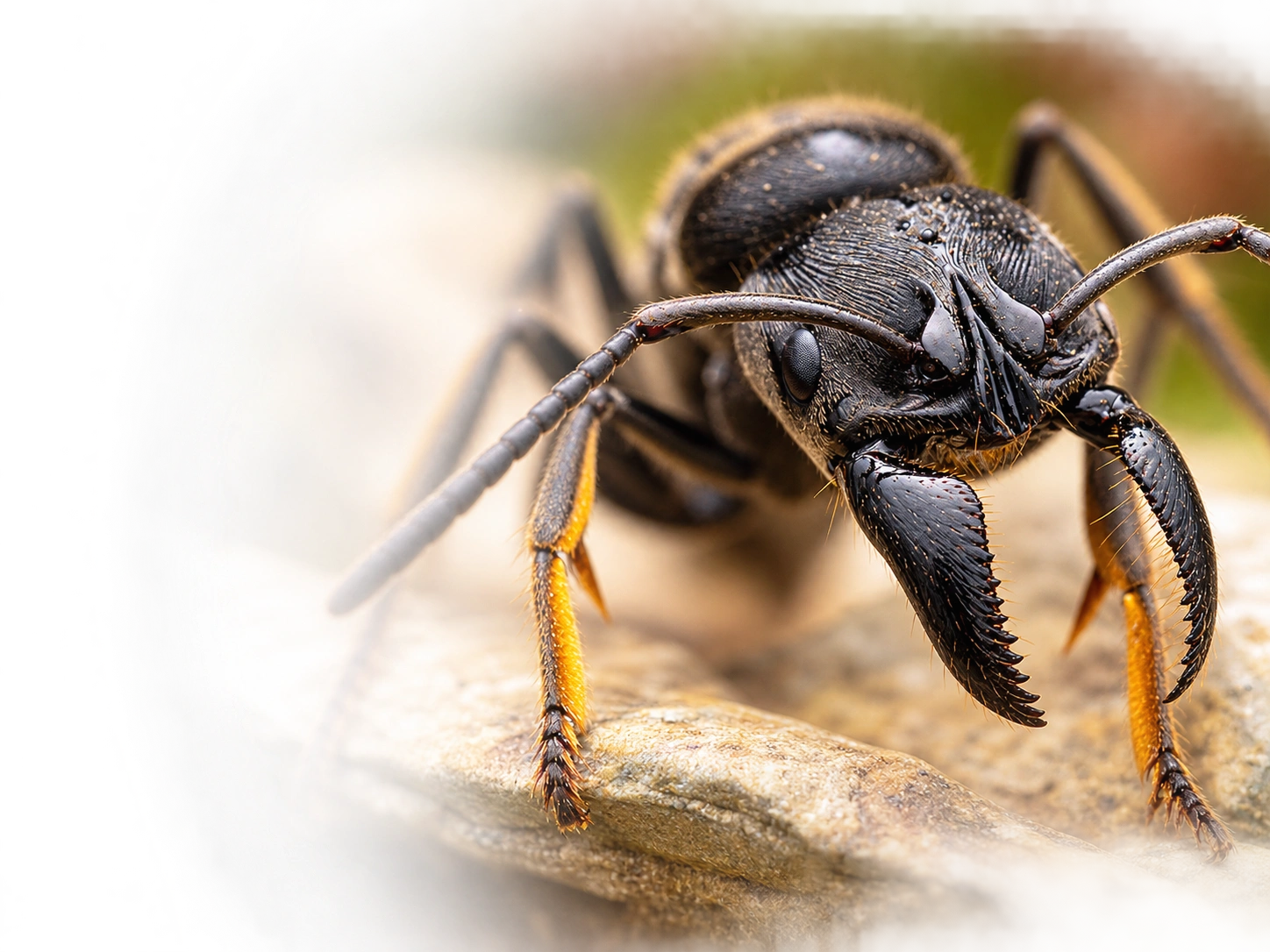
Next to a C. cruentatus, large and black and red like itself, anyone would say they are cousins. They are not: they belong to different lineages, and in good light it shows. C. cruentatus and C. micans belong to the subgenus Myrmosericus: matt, with a gaster made velvety by fine hairs. C. barbaricus belongs instead to Tanaemyrmex: a shiny cuticle and a gaster with almost no pubescence, smooth as lacquer.
Both subgenera share mandibles with 7–8 teeth and a clypeus, the plate that covers the mouth from the front, with a central keel and a rectangular lobe, so keys look mainly at shine and hair. For the four large Iberian species at Antomas, the quick rule is this:
- Matt gaster, with fine hairs and a reddish base: C. cruentatus.
- Entirely black, with the gaster banded in silvery or golden hairs: C. micans.
- Glossy black head and gaster, red thorax: a Tanaemyrmex, which may be C. barbaricus, C. sylvaticus or C. pilicornis.
Within the subgenus you already need a lens. Gómez and Espadaler, in their key, separate it by its reddish-to-orange mesosoma and by a deep channel running along the hind tibia; C. pilicornis has setae on its cheeks, and to separate barbaricus from sylvaticus specialists compare the erect hairs on the cheeks and on the antennal scape.
Majors with enormous heads
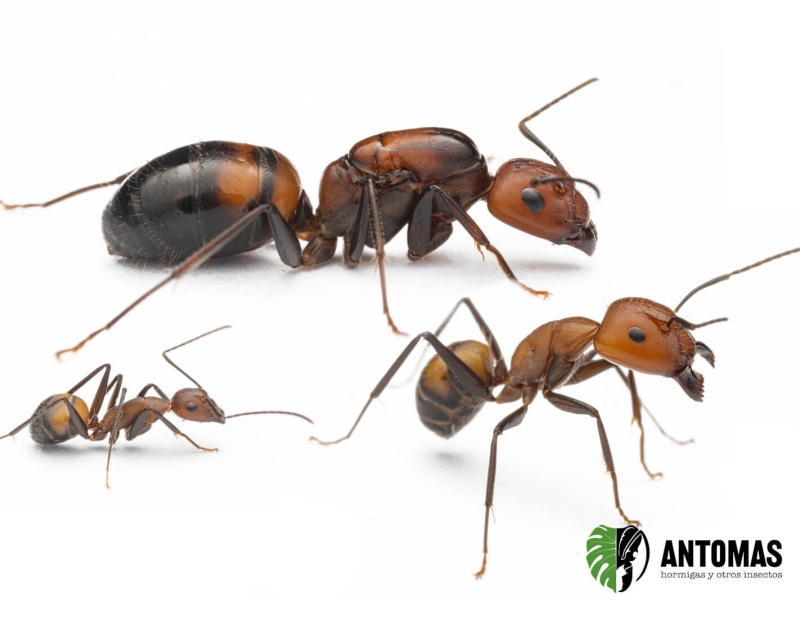
The great attraction of C. barbaricus is its castes. It is strongly polymorphic: the same queen produces slender minors, medium workers and majors with enormous black heads and broad, powerful mandibles. They are not separate castes but the two ends of a continuous scale, and the secret lies in allometry: the larger the worker, the more its head grows in proportion to its body. That is why a minor has a narrow head and a major seems to be all head.
In the subgenus Tanaemyrmex, majors can exceed one centimetre, according to García’s 2025 paper on the Camponotus of Galicia, which reviews the Iberian subgenera. In a very well cared-for colony documented by one keeper, the first ones appeared roughly a year after founding, when there were about 80–100 workers.
Minors handle almost all the foraging and brood care; majors defend the nest and cut up large prey. When a bulky insect lands in the outworld, they are usually the ones that open it up.
Southern Iberia, Malta and the Maghreb
This is an ant of the warmest part of the western Mediterranean. Distribution maps record it in Spain, Portugal, Gibraltar, Italy, Malta and Algeria, and the subspecies xanthomelas in Algeria and Tunisia. In the Peninsula it is mainly southern: its types are Andalusian, the flights logged by hobbyists cluster in the south, and it has not been recorded in Galicia. In Malta its presence was also confirmed by a keeper who caught a queen there in 2019. There are no Canary Island records, and Morocco and the Balearics remain to be confirmed.
It lives in open, sunny ground with dry soil, nesting under stones and, less often, in dead wood. It forages on the ground and in low vegetation, and has been photographed by day on wild artichoke flowers (Cynara).
Its climate is that of the southern Mediterranean: long, hot, dry summers and short, mild winters with few frosts in the lowlands. The colony spends a few cool months without raising brood, but without freezing, which is why its diapause at home is short and mild (see “A mild diapause”).
Weddings on June nights
C. barbaricus reproduces through a nuptial flight: winged queens and males leave many nests at once, mate, and the males die soon afterwards. Hobbyist records on the antflights website place its flights between the second half of June and the second half of July, nearly always from nine in the evening to midnight, on warm, clear nights. Some nights the flight is massive, and the logs include plenty of alates that end up drowned in swimming pools.
After the flight, the young queen sheds her wings and shuts herself into a small chamber, nearly always under a stone. Claustral founding begins: she brings up her first batch of workers while fasting, drawing on her fat reserves and on flight muscles she will never need again. A classic 1989 paper confirmed this by measuring queens of different species: claustral founders are bigger and store more fat than those that have to forage while founding. Even so, of the vast number of queens that fly each summer, very few live to see their colony grow.
Night shift in summer
There are no studies of its daily rhythm, but keepers agree that in high summer C. barbaricus is crepuscular and nocturnal: it comes out as the sun goes down and retreats from the heat. One keeper with years of experience called it “definitely nocturnal”. In spring and autumn it is also seen by day, as on those wild artichoke flowers.
This fits with its Iberian relatives: C. pilicornis is crepuscular and nocturnal, and in C. sylvaticus it has been measured that light sets its working day. Among Mediterranean ants, moreover, the thermometer sets the timetable: the team of Xavier Cerdá and Javier Retana showed that midday heat can upset the hierarchies between dominant and subordinate species. Going out at night makes it possible to avoid both the heat and the competitors, a reasonable explanation that nobody has measured in this species.
It does not form large foraging trails: its workers go out alone or in small groups. According to keepers, at 25–30 °C it becomes quite bold towards any intruder.
An aphid herder with a bacterium on board
Like the rest of its genus, C. barbaricus lives largely on the honeydew excreted by aphids and scale insects, and on nectar. This alliance is called trophobiosis: the ant guards these sap-suckers against their enemies and, in return, “milks” them, stroking them with their antennae so that they release their sweet droplet. A 2005 review showed that, depending on the species and the situation, the relationship ranges from mutual benefit to something resembling a farm. There are no studies specific to C. barbaricus, but in captivity its passion for sugar leaves no doubt.
How does such a large ant get by on such a sweet diet? With a partner. Carpenter ants carry Blochmannia in their gut, a bacterium that lives inside specialised cells, the bacteriocytes, and that every queen passes on to her offspring inside the egg. It was described as a genus in 2000, and a 2007 experiment with C. floridanus proved that it improves its host’s nutrition with nitrogen compounds. According to a 2009 study, the tribe adopted this partner when it began tending sap-sucking insects. Even so, the bacterium is no substitute for insects (see “Feeding”).
Chemistry without a sting
C. barbaricus has no sting. Like all formicines, its weapon is the formic acid of its venom gland, whose production was studied in a 1978 paper. It sprays it through the acidopore, a nozzle ringed with tiny hairs at the tip of the gaster, and usually combines it with a bite: first it bites, then it curls its gaster forward to spray the spot.
The acid has a second, more surprising use. In 2020 a German team showed that formicines swallow their own venom: after eating, the worker curls round, takes up a droplet or two at the acidopore and swallows them. The crop, the pouch holding food destined for nestmates, thus stays highly acidic, and a good share of its microbes are filtered out. It was studied in C. floridanus, but it is typical of the whole subfamily. That contortionist’s pose you will see in the outworld, with the head pressed against the tip of the gaster, is internal hygiene.
For people it poses no problem at all (see “Does it bite? Handling and safety”).
One queen per colony
C. barbaricus is monogynous: each colony has a single queen, the mother of all the workers. We know of no study or captive case with several queens. That is to be expected: a 2014 analysis of 149 Palaearctic ants concluded that having one queen is the ancestral condition, and that polygyny appears mainly in species with huge colonies and dependent founding, far removed from the solitary, claustral founding of this species.
In practice, do not combine queens, neither to found a colony nor to “reinforce” one. Everything depends on its single queen, so treat her calmly during the first months.
Size and morphology
A large, robust, polymorphic ant with a glossy look. We have not been able to consult a modern description of all its castes; what follows combines the diagnosis of the subgenus, the Iberian keys and what can be seen in our colonies.
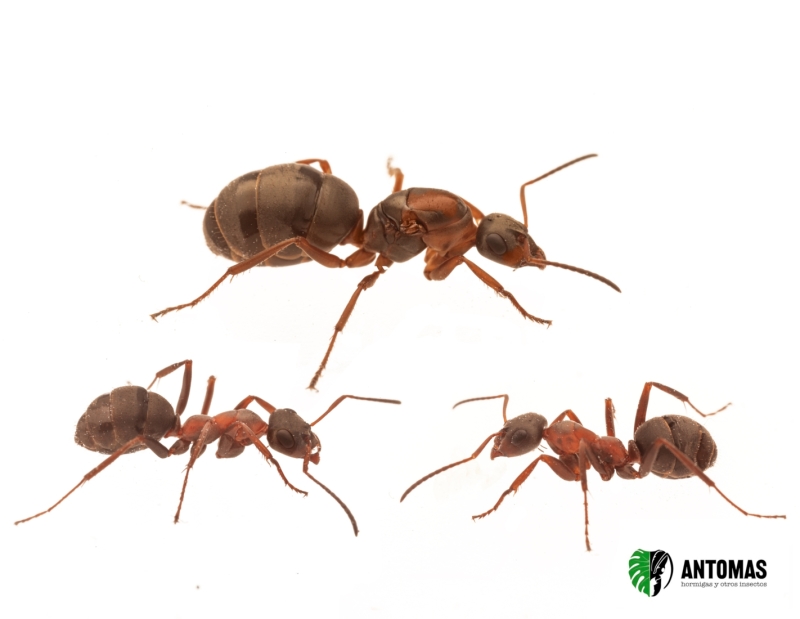
- Worker colour. Black or dark head and gaster; the mesosoma, the middle section of the body from which the legs arise, ranges from dark red to orange-brown, and the legs lean towards red too. In our colonies, the orange-brown mesosoma contrasts strongly with the rest.
- Surface. Smooth, glossy cuticle, with almost no pubescence on the gaster: the hallmark of Tanaemyrmex.
- Majors. Enormous black head, out of proportion to the body, with broad mandibles bearing 7–8 teeth.
- Minors. Smaller and slimmer, with a narrow head. They are the ones you will see foraging most.
- Clypeus. With a central keel and a rectangular lobe on the front margin.
- Hind legs. The tibia carries a clearly visible channel along its length, a good feature for recognising it under a lens.
- Queen. Larger than the workers, with a black head and gaster and a black mesosoma with more or less red, according to keepers.
- Male. Black, according to keepers.
Measurements
- Majors: can exceed 1 cm, according to the diagnosis of the subgenus Tanaemyrmex (García, 2025).
- Minors and medium workers: we have found no published measurements.
- Queen: no published figures within our reach either.
- Male: no published data that we have been able to consult.
We will be clear: there are no accessible published measurements by caste for C. barbaricus, and the sizes quoted by shops and forums contradict each other so much that we do not reproduce them. Nanitics, the first batch, are tiny, and each generation comes out a little larger.
Care in captivity
Difficulty: 1/5 – Beginner
We class it as a starter ant: European, robust and not at all fussy. Its strengths:
- It eats eagerly: sugar every day and fresh prey, which it pounces on without a second thought.
- A short, mild diapause: a cool room is enough, no fridge-cold needed.
- A single queen: the colony is stable and there are no conflicts between queens.
- Harmless: no sting, and only a feeble bite.
- It grows a good deal if well fed, and majors arrive in the first or second year.
What it really asks for is patience at the start, because small colonies are shy and slow, and a good barrier, because it climbs. In return, you will have one of the most photogenic ants in Europe.
Arrival and the first few days
At Antomas, C. barbaricus is sold as a colony with a queen, workers and brood, already up and running in its test tube: the most delicate phase, that of the lone queen, is over. When it arrives:
- Give it 48 hours of calm: a dark corner free of vibrations, at 24–27 °C.
- Check the water: the cotton wool should still be damp. If the reservoir runs out, move the colony to a new tube by tipping it out.
- First meal: a drop of sugar in a tiny feeder or a small bottle cap, and a morsel of fresh insect; whatever they leave untouched goes the next day.
- No rush: do not move it into the formicarium on the first day. It is normal for the workers to barely show themselves.
Temperature and humidity
This is an ant from the south: in the warmth it breeds, in the cold it stops. A German keeper reported that at 17–19 °C his colony hardly moved and the brood did not develop, until he raised the temperature and gave it fresh prey. The keeper whose colony grew spectacularly kept it at 25–30 °C, with the pupae in the warmest area.
- Nest: 24–28 °C from March to October, the months of activity, with a slightly warmer corner, up to 28–30 °C, where the colony can take its pupae.
- Outworld: at room temperature, between 20 and 28 °C.
- Nest humidity: moderate, around 50–60 %, with one damper part and one drier part.
- Outworld humidity: low, 30–50 %, with dry ground.
- Water: always available; a full test tube stoppered with cotton wool, in the outworld.
- Light: chambers in semi-darkness and the outworld lit by the room’s own light.
If heating is needed, attach the heat cable, always with a thermostat, to a single flank of the nest; never beneath the entire set-up or where the sun hits it. The gradient is what matters: let the colony choose where to put everything.
Formicarium: plaster to found, Alpha to grow
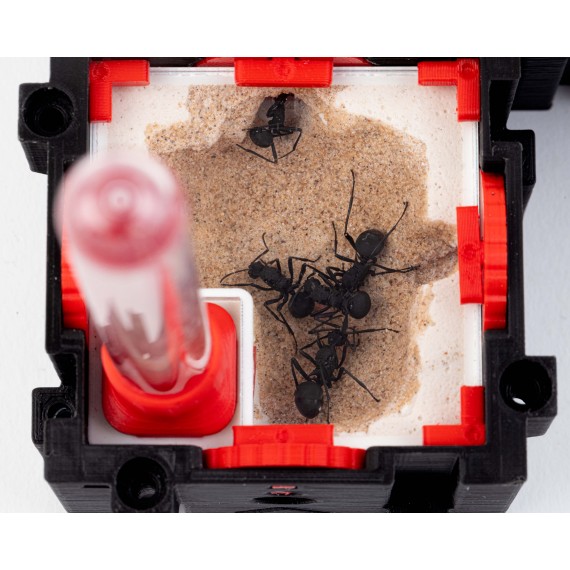
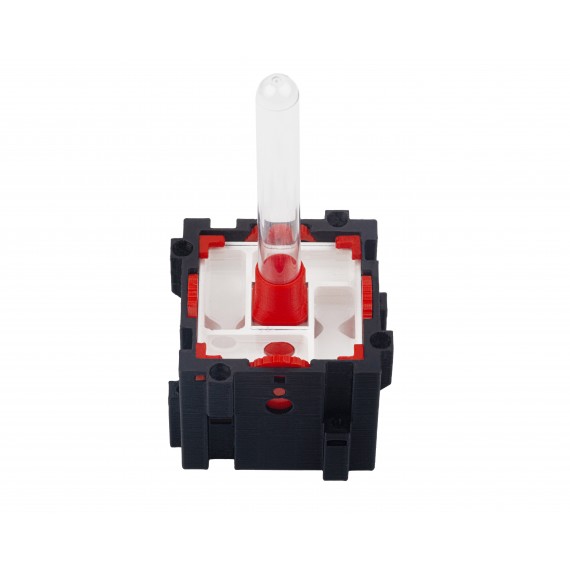
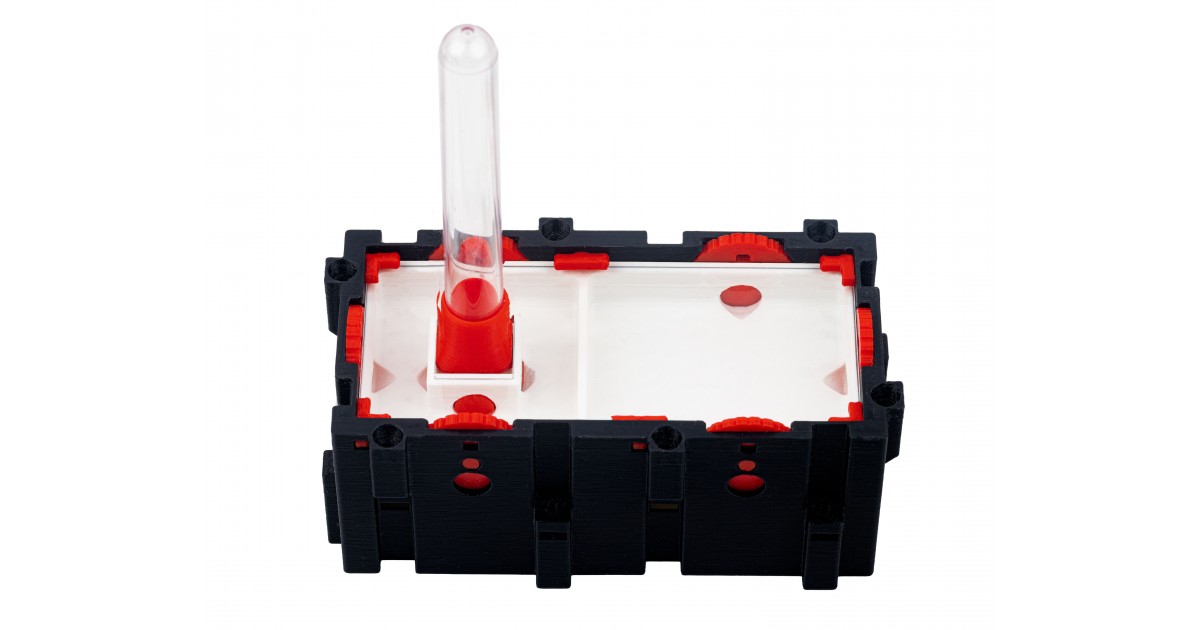
Our recipe for this ant comes in two stages. Stage one, plaster. Anthouse’s Qbik Wild nests are built from plaster, hold humidity well and give a small colony a stable nest, sized just right. As a first step, a Qbik Wild One P 1C:
If the colony fills it sooner than expected, the next step is the Qbik Wild Duo P 2C, with two chambers:
Stage two, the Alpha range. When the colony has dozens of workers and runs out of space, we move it to the QBIK ONE and QBIK DUO: modular units with a dry interior that take their humidity from their water tubes. This saves money and keeps the nest lighter, because a colony that is looked after well ends up fairly big: Alpha nests are extended module by module, with no need to lug around an ever heavier slab of plaster.
Which galleries? Medium to begin with, and large for new modules once the first majors appear, since their big heads need wide passages. Complete the set-up with:
- an outworld with dry ground, a little sand, a flat stone and a small stick to climb, never touching the barrier;
- a water tube with cotton wool;
- a feeder for sugar;
- the escape barrier along the upper rim of the outworld (see “Escapes: oil or talc”).
Do not jump ahead on size: in a huge nest, a small colony scatters and uses the empty chambers as rubbish tips. One keeper recounted that moving her C. barbaricus into a large nest too early only unsettled it.
Moving by tipping out
At Antomas, moves are done by tipping the colony out, without waiting for it to decide to leave on its own. It works for going from the tube to the Qbik Wild and, later on, from plaster into the Alpha modules.
- Have the destination ready: formicarium assembled, barrier applied and water connected.
- Work over a large tray that will catch any stray worker.
- Tip the colony out into the outworld of the new nest, next to the entrance: uncork the tube or open up the old nest and shake it gently until the whole colony drops out, queen and brood included; nudge the most reluctant ones with a brush.
- Darkness at the destination: cover the nest area so they occupy it straight away. Within a few hours the workers will have hauled the whole brood indoors.
It is a stressful moment, but it does not last: as soon as the queen enters the new nest, the rest of the colony follows her.
Feeding
Sugar, always within reach. Its natural fuel is honeydew, so liquid sugar has to be on offer seven days a week. Serve it in a feeder and never on cotton wool: soaked cotton turns mouldy fast and ruins the liquid, so use a classic or home-made feeder instead, with the drop lying “spread out” and easy to reach. To keep the diet from becoming monotonous, combine Anthouse Blue Sugar nectar, which can cover 4–5 days of the week, with a different nectar or another sweet liquid on the remaining 1–2 days. The nectar can also be enriched with a little protein.
Protein, and plenty of it. Sugar fuels the workers, but it is insects that make the larvae grow. The Antomas rule: with daily removal of leftovers, overfeeding pays off, because the colony reads abundance as a signal to raise more brood, sooner. Without that cleaning, keep portions tight: anything left to rot is an open invitation to mould and mites.
Food at dusk. Serve protein late in the day and collect the leftovers in the morning: you will see it hunting at its best.
Water separately. Even though they drink nectar, the water tube with cotton wool must always be full.
Growth: from nanitics to majors
Camponotus are in no hurry at first, and C. barbaricus is no exception. From egg to worker takes, depending on temperature, from about 5 weeks to about 3 months:
- In real heat, around 30 °C, keepers’ guides speak of 4–6 weeks. In a breeding journal from Malta, in high summer, the first worker emerged about 36 days after the eggs appeared.
- At about 25 °C, 8 to 12 weeks.
- By stage, according to a German care sheet: egg to larva, 3–5 weeks; larva to pupa, 2–3; and pupa to adult, 3–5.
How big does it get? A cautious benchmark from keepers is 10–20 workers at the end of the first year and around a hundred at the end of the second. With warmth and plenty of food it goes faster: the keeper mentioned above went from 4–5 workers in November to 80–100 by the following summer, and says she reached about 4,000 in two years. It is an exceptional case, but it shows what the species can do. No study has ever counted its wild colonies; breeding sources speak of several thousand workers.
The start is the slowest part. Once the colony passes a few dozen workers and gets abundant protein, each batch of brood outdoes the last: time to start thinking about the Alpha range.
A mild diapause
Within its range, winter is short and mild. At home we imitate it with a mild diapause, shorter and less cold than that of central European ants. This is the Antomas guideline, based on what keepers of this species do:
- Dates: from November or December to February.
- Duration: 8–12 weeks.
- Temperature: 14–16 °C. An unheated room, a mild storeroom or a wine cooler will do.
- Slow transitions: 2–3 weeks to cool down at the beginning and as many again to bring the warmth back at the end.
- During diapause: water always, a little sugar and protein all but withdrawn. You will see larvae on hold all winter and a queen that barely lays, and that is to be expected.
- At the end: as soon as activity returns, so does protein. In Malta, one colony came out of diapause in mid-March and its workers were foraging again a couple of weeks later.
There is no need for more cold: a fridge-cold diapause does nothing for a southern ant. Some keepers have left their colony at about 18 °C for a winter and the queen kept laying; even so, we recommend doing it, because it reproduces the natural rhythm of the species.
Behaviour and observation
Shy when small, confident when grown. In young colonies, the few workers stay with the queen and come out only when they must. Once majors appear, the colony changes character: it takes over the outworld, patrols and pounces on food.
Its best hour is dusk. Sit down to watch it after dinner: minors searching for food, medium workers at the feeder and, if there is a large prey item, majors cutting it up.
Watch it as much as you like. Ants are there to be enjoyed and learnt from, and this one copes well with an audience: a dark nest, a lit outworld and a calm hand when you clean or feed are all it takes.
Signs worth reading:
- Larvae that do not grow in the middle of the season: not enough heat or protein.
- Workers crowded around the water tube: the nest is too dry.
- Condensation or mould on the walls: too much humidity or forgotten leftovers.
- Workers idling in the outworld and chambers full of brood: time to expand.
Escapes: oil or talc
C. barbaricus walks up glass and acrylic effortlessly, even across the ceiling, and one keeper watched a worker cross a strip of PTFE, the slippery coating many hobbyists use, without any trouble. Better not to rely on a single line of defence:
- Mineral oil or talc in a continuous band around the upper part of the outworld. Renew the oil when it collects dust, and the talc when it wears off.
- A lid that genuinely closes, as a backup.
- Fine mesh over the ventilation grilles: nanitics fit through surprisingly small holes.
- Nothing that can act as a bridge: no twigs, stones or tubes leaning near the barrier.
- Secure connections: check stoppers and tubes every time you expand.
Does it bite? Handling and safety
Danger to people: none. C. barbaricus lacks a sting, and its bite amounts to a pinch: not even a major, big head and all, can really hurt you. Anyone handling a great many by hand might, at most, end up with a small callus from the formic acid, and even that would be overstating it: it is extremely rare.
What does matter is looking after them: to move them, use a fine-haired brush or soft entomological forceps, and take extra care with the queen. Never put two colonies together: they will fight. And, even though it is an Iberian species, never release a captive colony into the wild.
What not to do
- Combining queens or adding a queen to an established colony.
- Leaving it below about 20 °C in spring or summer: the brood stalls.
- Giving a colony of only a few workers an enormous nest.
- Soaking cotton wool with sugar or forgetting to refill the water.
- Always giving the same insect, or only dried prey.
- Leaving food remains in the nest or the outworld.
- Giving it a fridge-cold diapause, too cold or too long.
- Relying on a single barrier, or leaving grilles without mesh.
- Picking them up by hand or with hard forceps.
Scientific sources
To write this care sheet we drew on the scientific literature on Camponotus barbaricus, its subgenus and its tribe; on Hormigas Ibéricas by K. Gómez and X. Espadaler and F. García’s paper on the Camponotus of Galicia (Arquivos Entomolóxicos 32, 2025), which have no DOI; on distribution and nuptial-flight records; and on what Antomas and other hobbyists have learnt. Key literature:
- Cagniant, H. (1996). Les Camponotus du Maroc (Hymenoptera: Formicidae): clé et catalogue des espèces. Annales de la Société entomologique de France (N.S.) 32: 87–100. doi:10.1080/21686351.1996.12278857
- Ward, P. S. & Boudinot, B. E. (2021). Grappling with homoplasy: taxonomic refinements and reassignments in the ant genera Camponotus and Colobopsis (Hymenoptera: Formicidae). Arthropod Systematics & Phylogeny 79: 37–56. doi:10.3897/asp.79.e66978
- Ward, P. S., Blaimer, B. B. & Fisher, B. L. (2016). A revised phylogenetic classification of the ant subfamily Formicinae (Hymenoptera: Formicidae), with resurrection of the genera Colobopsis and Dinomyrmex. Zootaxa 4072: 343–357. doi:10.11646/zootaxa.4072.3.4
- Janicki, J., Narula, N., Ziegler, M., Guénard, B. & Economo, E. P. (2016). Visualizing and interacting with large-volume biodiversity data using client–server web-mapping applications: the design and implementation of antmaps.org. Ecological Informatics 32: 185–193. doi:10.1016/j.ecoinf.2016.02.006
- Keller, L. & Passera, L. (1989). Size and fat content of gynes in relation to the mode of colony founding in ants (Hymenoptera; Formicidae). Oecologia 80: 236–240. doi:10.1007/BF00380157
- Boulay, R., Arnan, X., Cerdá, X. & Retana, J. (2014). The ecological benefits of larger colony size may promote polygyny in ants. Journal of Evolutionary Biology 27: 2856–2863. doi:10.1111/jeb.12515
- Cerdá, X., Retana, J. & Cros, S. (1997). Thermal disruption of transitive hierarchies in Mediterranean ant communities. Journal of Animal Ecology 66: 363–374. doi:10.2307/5982
- Stadler, B. & Dixon, A. F. G. (2005). Ecology and evolution of aphid-ant interactions. Annual Review of Ecology, Evolution, and Systematics 36: 345–372. doi:10.1146/annurev.ecolsys.36.091704.175531
- Sauer, C., Stackebrandt, E., Gadau, J., Hölldobler, B. & Gross, R. (2000). Systematic relationships and cospeciation of bacterial endosymbionts and their carpenter ant host species: proposal of the new taxon Candidatus Blochmannia gen. nov. International Journal of Systematic and Evolutionary Microbiology 50: 1877–1886. doi:10.1099/00207713-50-5-1877
- Feldhaar, H., Straka, J., Krischke, M., Berthold, K., Stoll, S., Mueller, M. J. & Gross, R. (2007). Nutritional upgrading for omnivorous carpenter ants by the endosymbiont Blochmannia. BMC Biology 5: 48. doi:10.1186/1741-7007-5-48
- Wernegreen, J. J., Kauppinen, S. N., Brady, S. G. & Ward, P. S. (2009). One nutritional symbiosis begat another: phylogenetic evidence that the ant tribe Camponotini acquired Blochmannia by tending sap-feeding insects. BMC Evolutionary Biology 9: 292. doi:10.1186/1471-2148-9-292
- Hefetz, A. & Blum, M. S. (1978). Biosynthesis of formic acid by the poison glands of formicine ants. Biochimica et Biophysica Acta – General Subjects 543: 484–496. doi:10.1016/0304-4165(78)90303-3
- Tragust, S., Herrmann, C., Häfner, J., Braasch, R., Tilgen, C., Hoock, M., Milidakis, M. A., Gross, R. & Feldhaar, H. (2020). Formicine ants swallow their highly acidic poison for gut microbial selection and control. eLife 9: e60287. doi:10.7554/eLife.60287