This website uses its own and third-party cookies to improve our services and show you advertising related to your preferences by analyzing your browsing habits. To give your consent to its use, press the Accept button.
Functional cookies are strictly necessary to provide the services of the shop, as well as for its proper functioning, so it is not possible to refuse their use. They allow the user to browse through our website and use the different options or services that exist on it.
Cookie
Provider
Purpose
Expiry
PHP_SESSID
antomas.es
The PHPSESSID cookie is native to PHP and allows websites to store serialised status data. On the website it is used to establish a user session and to pass state data through a temporary cookie, which is commonly known as a session cookie. These Cookies will only remain on your computer until you close your browser.
Session
PrestaShop-#
antomas.es
This is a cookie used by Prestashop to store information and keep the user's session open. It stores information such as currency, language, customer ID, among other data necessary for the proper functioning of the shop.
These are cookies that collect information about the advertisements shown to users of the website. They can be anonymous, if they only collect information about the advertising spaces shown without identifying the user, or personalised, if they collect personal information about the user of the shop by a third party, for the personalisation of these advertising spaces.
Collect information about the user's browsing experience in the shop, usually anonymously, although sometimes they also allow the user to be uniquely and unequivocally identified in order to obtain reports on the user's interests in the products or services offered by the shop.
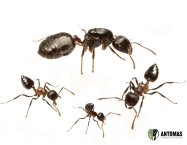
A chemical arsenal in its thorax. Crematogaster aurita is an acrobat ant from the dry forests of Indochina: two-toned, dark with a reddish waist, with workers of every size and a heart-shaped gaster that it raises over its head at the slightest threat. It belongs to the group of Crematogaster with giant metapleural glands, and it shows: disturb it and it answers with a foul smell. It smears its venom with a spatula-shaped sting, climbs like few others and grows at an outrageous speed. An extremely rare gem in Europe for keepers with some experience. Colonies with queen. Shipping across Europe, live arrival guaranteed.
An acrobat ant from Indochina, two-toned and with workers of every size, from the group of Crematogaster with giant metapleural glands: when disturbed, it gives off a foul smell. Colonies with queen, monogynous and with explosive growth. 24–28 °C all year round, no diapause, a well-ventilated Qbik Alpha nest, slightly humid at first and dry once the colony grows, sugar always available and plenty of protein. Key point: keep everything tightly closed, with Vaseline as back-up, because they are excellent climbers and get past escape barriers.
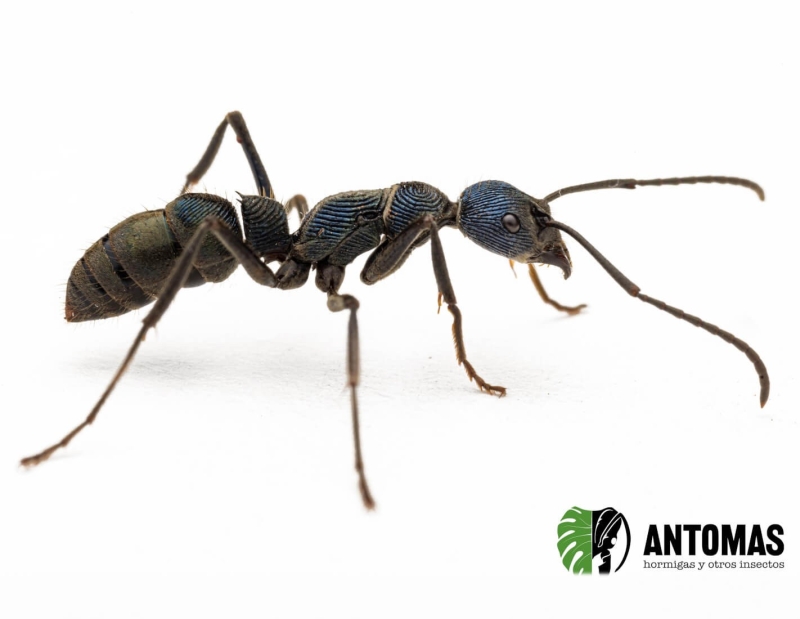
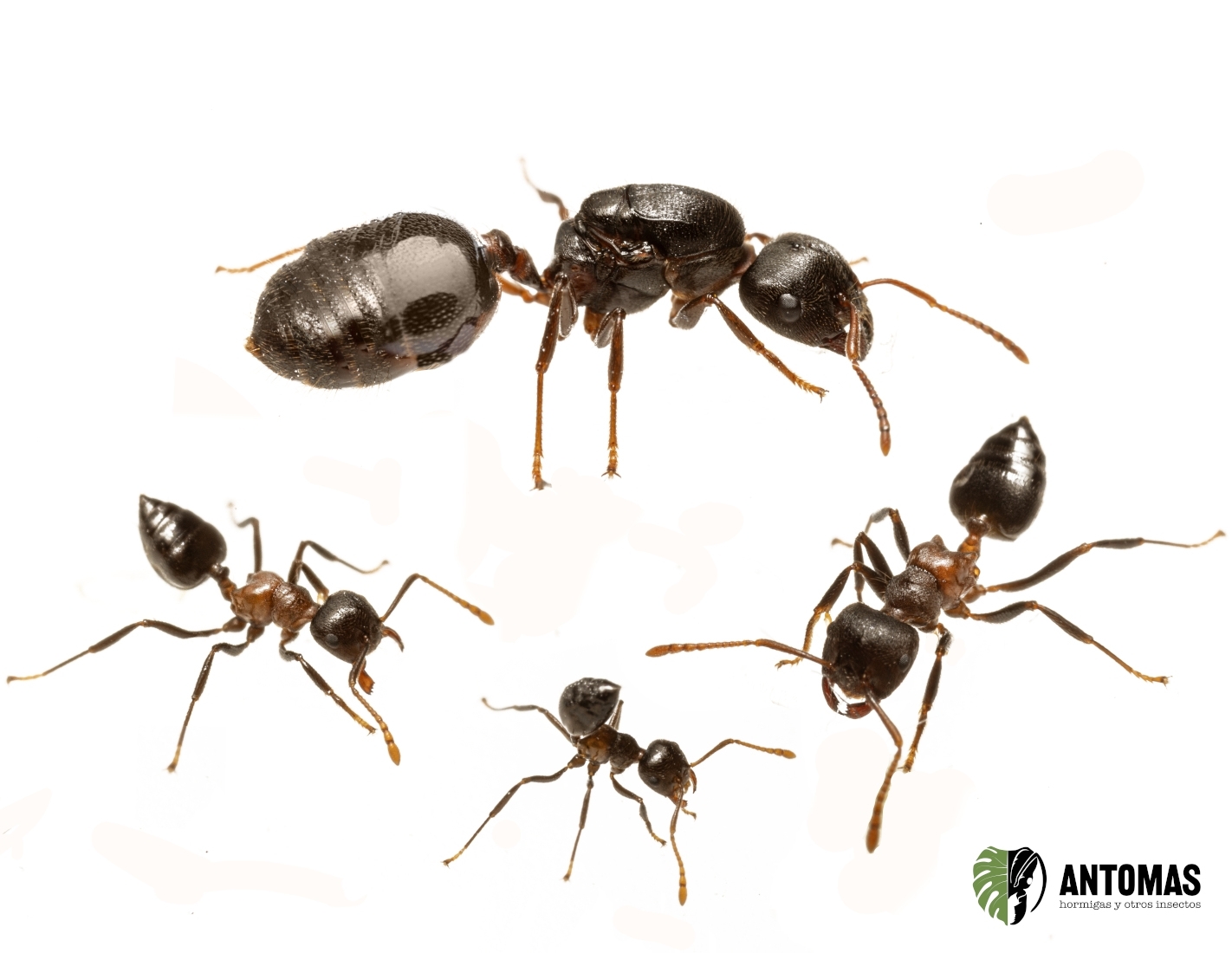
Crematogaster aurita Karavaiev, 1935 is an acrobat ant from Indochina: a two-toned myrmicine, with a dark brown body and a reddish “waist”, which lives in the open, dry forests of the South-East Asian lowlands and which, when it feels threatened, raises its heart-shaped gaster above its body. It belongs to a very special group of Asian species, the Crematogaster with a swollen thorax, which hide in their thorax one of the most striking chemical weapons in the ant world: enormous metapleural glands, loaded with a defensive secretion.
It has no common name, in English or in any other language, and it has barely been studied outside museums: its workers, its distribution and its place in the family tree of the genus are known, and little more. That is why, in this care sheet, we always keep three things apart: what is documented for C. aurita, what is known about its closest relatives, such as C. inflata and C. difformis, and what we have learned rearing it at Antomas. And what we have learned boils down to three ideas: it grows at an outrageous speed, it is very smelly and it is a first-class escape artist. Let us take it step by step.
Biology
An ant with an old name and a new family
The myrmecologist Vladimir Karavaiev described it in 1935 in the journal Treubia, from workers collected in 1930 in the lowlands of Indochina. He placed it in the subgenus Physocrema, which Auguste Forel had created for the Asian Crematogaster with a swollen propodeum and whose type species is C. inflata. In 2008, the Japanese researchers Shingo Hosoishi and Kazuo Ogata designated one of those workers as the lectotype, the reference specimen for the name, and the following year they revised the whole subgenus, endemic to Asia, with 12 species.
In 2012, the entomologist Bonnie Blaimer reorganised the entire genus, a genus found all over the world and with hundreds of species, and left only two subgenera: Crematogaster and Orthocrema. Physocrema ceased to be a subgenus and became a synonym of the subgenus Crematogaster, so today its full name is Crematogaster (Crematogaster) aurita. The former Physocrema did not disappear, though: today they form the inflata group, one of the species groups of the genus.
The missing piece arrived in 2023. Hosoishi’s team analysed some 4,000 bases of DNA from six nuclear genes and two mitochondrial genes and confirmed that the inflata group is a natural group, with three subgroups: difformis, vacca and inflata. C. aurita belongs to the inflata subgroup, and its sister species, its closest relative, is C. onusta. According to that study, the group arose in Sundaland, the large continental shelf of the Malay Peninsula, Sumatra, Java and Borneo, some 12 million years ago, in the middle Miocene, and it did so from an ancestor that already had a swollen propodeum and a round metapleural gland opening. The “swollen thorax” and its chemistry are not the whim of a single species, but the hallmark of the whole family.
And the name? Aurita means “eared” or “with ears” in Latin, but we have not been able to consult the original description, so we do not know which feature Karavaiev had in mind. It has no common name, and we are not going to invent one.
Acrobat ants: the heart-shaped gaster, always at the ready
Crematogaster are known in English as acrobat ants, and also as cocktail ants. The reason is obvious as soon as they are disturbed: they lift the gaster, the rear part of the abdomen, and bring it forwards, over the thorax and even over the head, pointing the tip in almost any direction. Seen from above, the gaster is heart-shaped, which is why they are also known in English as “Saint Valentine ants”.
It is not just for show. In C. scutellaris, the Mediterranean acrobat ant, a team from the Université Libre de Bruxelles found that, in encounters with other species, the workers frequently flex their gaster and try to smear their abdominal secretion onto the rival. The raised gaster is both a warning and a loaded weapon.
You will see it at home as soon as you open the foraging area or bring prey close: dozens of workers with their gasters held high, turning towards the threat.
A poisoned paintbrush: the sting that smears instead of stabbing
Crematogaster are myrmicines and have a sting, but they do not use it like a wasp. Its tip is shaped like a spatula and is not designed to pierce, but to apply venom by contact, smearing it onto the enemy. A brush like that does not prick anyone: with people, what you will notice about this ant is not a sting, but its bites and its smell (see “Handling and safety”).
The chemistry of that venom is well known in C. scutellaris, and it is worthy of a laboratory. The droplet forms when two secretions mix at the tip of the sting: the Dufour’s gland supplies esters, long-chain acetates, and the venom gland supplies the enzymes that transform them. The result is reactive aldehydes, contact poisons more toxic than the starting secretion. It is a two-component chemistry, like that of an epoxy glue, which is only “activated” as it comes out. And the reaction also releases acetic acid, the acid in vinegar, which works as an alarm pheromone for their nestmates.
What is it for? In the Brussels experiments, every ant species tested fled immediately on touching the venom with their antennae or mouthparts. Its toxicity varied enormously: some species were killed by three tiny droplets, while others withstood ninety. The workers never used it against their nestmates, they were resistant to their own venom and, curiously, they were never seen using it to hunt: its main function is to repel other ants. In the field, thanks to it, they drove Pheidole pallidula away from baits and kept almost all the prey for themselves.
All of this has been studied in C. scutellaris, not in C. aurita. But the spatulate sting is common to the whole genus, and in our species it is joined by another chemical weapon, even more striking, which is located in the thorax.
The stinking ant: a giant gland in the thorax
Almost all worker ants have a pair of metapleural glands: two small reservoirs on the sides of the rear part of the thorax. They are unique to ants, and their original function was probably that of an antiseptic: their secretion holds back fungi and bacteria, something vital for animals that live crowded together in warm, humid nests. Over time, in many species it has also come to serve as a chemical defence. They have a curious design: the secretion is stored in a rigid chamber and seeps out little by little through an opening that cannot be closed, or the ants themselves collect it with their legs.
In the inflata group, this gland has gone into overdrive. The former Physocrema have the propodeum, the rear part of the thorax, swollen like a balloon and a large, round metapleural opening, and in them the gland has stopped being merely an antiseptic and has become a weapon:
C. inflata has the largest metapleural glands known in ants relative to body size, with more than 1,400 secretory cells between the two. When attacked, the workers release a white, very sticky secretion that immobilises enemy arthropods, and that same secretion raises the alarm among their nestmates: the antiseptic gland has become a defence and alarm gland. As the gland has no muscles of its own, the secretion comes out through the pressure of the thoracic muscles or when something squeezes the ant.
C. difformis, from the same group, continuously releases small amounts of an antiseptic secretion, which is not sticky, and increases the discharge when it fights other animals. In the words of Ulrich Maschwitz, who studied it in 1974, enemies are repelled by its “irritating tar-like smell”. Its chemistry is phenolic: 3-propylphenol, 3-pentylphenol, mellein and two resorcinols, which the ant releases as a repellent when other ants attack its waist, the most vulnerable part of its body, and which also have some insecticidal activity.
In two other species of the group, studied in Borneo, long-chain salicylic and resorcylic acids have also been found, some of them also present in lichens. The authors sum it up like this: when disturbed, these ants release a white secretion from their hypertrophied metapleural glands.
And C. aurita? No analysis of its secretion has been published. What we can tell you is our own experience: it is a very smelly ant. When disturbed, it releases its secretion through the metapleural gland. The liquid cannot actually be seen and, in our experience, it neither stains nor irritates: what you notice, and very much so, is the smell, as soon as you open the formicarium or handle the colony. It fits perfectly with what is known about its group: a hypertrophied gland, a defensive secretion and, in its relative C. difformis, an irritating “tar-like” smell. But we do not know which compounds the secretion of C. aurita contains, and so we will not tell you that it is phenolic or sticky: that is the most likely scenario, but nobody has measured it.
In nature, this chemistry makes perfect sense: a secretion that stinks, repels and alerts nestmates all at once is a very effective defence for a medium-sized ant that crosses paths every day with other ants and predators. In C. inflata, it is aimed above all at large arthropods and vertebrates. At home, it translates into a practical tip: handle the colony calmly and do not be surprised if, when moving it, the smell lingers in the air for a while.
The stinking tree ant, in a video by Anthouse (in Spanish).
So feared that it has imitators
Just how well does this chemistry work? A study published in 2004 demonstrated it in the most curious way. In Malaysia, on the foraging trails of C. inflata, an international team of myrmecologists found a Camponotus that imitated it: the same bright yellow and black pattern, the same way of walking, and always on the trails of its model. They offered both ants to chicks. The chicks found C. inflata distasteful; the Camponotus, on the other hand, was palatable. And, after tasting C. inflata, the chicks also stopped attacking the imitator.
It is a case of Batesian mimicry: a harmless species that benefits from its resemblance to another that predators avoid. Among social insects imitating each other it is very rare, and the Camponotus takes the trick all the way: it also takes advantage of its model’s prey, even though C. inflata attacks it. All of this has been studied in C. inflata, not in C. aurita, but it illustrates very well what it means to belong to this group: carrying a defence in your thorax so effective that other ants find it worthwhile to look like you.
No, it is not formic acid
Many people, including experienced keepers, associate any ant smell with formic acid. It is understandable: formic acid owes its name to ants (formica, in Latin), and the sour smell of a disturbed Formica nest is unmistakable. But that is not what is going on with C. aurita.
Formic acid as a venom is the speciality of a single subfamily, the formicines: Formica, Camponotus, Lasius, Polyrhachis, Oecophylla and company. They produce it in the venom gland and expel it through the acidopore, a nozzle at the tip of the gaster that only they possess. They even swallow this highly acidic venom to disinfect the food they carry in their crop. Crematogaster, on the other hand, are myrmicines: they have no acidopore, they have a spatulate sting and their venom is a different chemistry. In C. scutellaris, the acid involved is acetic acid, as an alarm pheromone. We know of no scientific study that attributes formic acid to Crematogaster.
The smell in a colony of C. aurita almost certainly comes from two sources: the secretion of its enormous metapleural glands, which in its relatives is phenolic and smells of tar, and the venom droplets from its sting. Two chemical weapons, and neither of them “formic”.
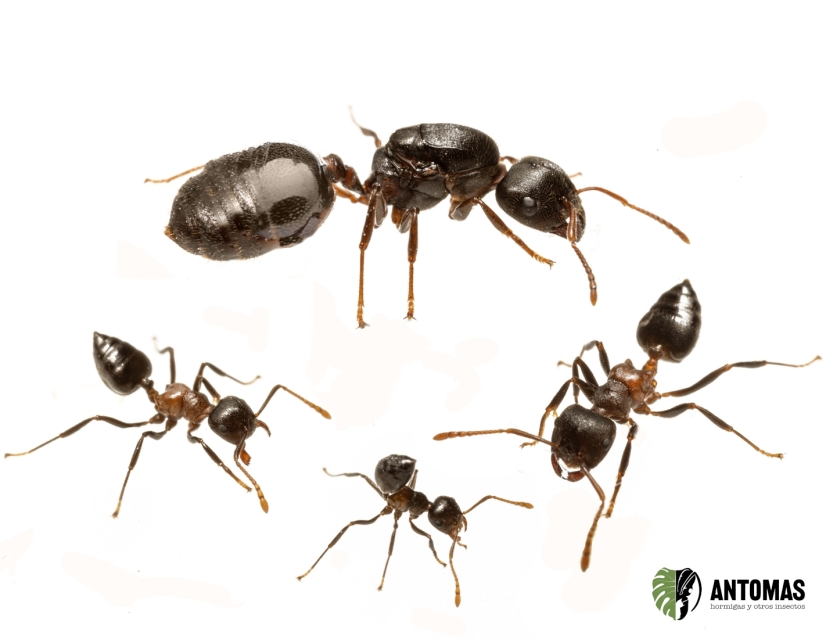
Workers of every size
If you take a close look at a colony of C. aurita, you will soon see that not all the workers are the same. There are small, medium and large workers, with every size in between: a continuous polymorphism. Hosoishi and Ogata’s revision describes it as “strongly polymorphic in size”: head width ranges from 0.95 to 1.84 mm, almost double from the smallest worker to the largest, and the length of the thorax from 1.07 to 2.13 mm.
And it is not only size that changes. Large workers have the propodeum and the sides of the thorax clearly rugose and punctate, and a more marked mesonotum; small workers have those areas almost smooth and shiny. The antennal scape is also proportionally shorter in the large ones. All of them share, however, fine longitudinal striations on the top of the head and on the clypeus, the plate just above the mandibles. What has not been studied is whether large and small workers divide up the work.
In Antomas’s experience, it is a slight, continuous polymorphism: there are no huge-headed soldiers, as in Pheidole or Carebara, but a smooth gradation of sizes that is very easy to appreciate in a large colony. And, above all, they are quite large for Crematogaster: next to the acrobat ants native to the Iberian Peninsula, their large workers really stand out.
Two-toned and spineless: how to recognise it
Its colouration is well described: the head, the promesonotum (the front part of the thorax), the petiole, the postpetiole, the gaster and the legs are dark brown, almost black to the naked eye, and the rear part of the thorax, the metanotum and the propodeum, is reddish brown. This is the “two-toned” of our catalogue: a dark ant with a glowing thoracic “waist”.
Other features to recognise it, all from Hosoishi and Ogata’s revision:
No spines. Most Crematogaster bear two spines on the propodeum; C. aurita has none. In its subgroup, the spines never develop.
Propodeum slightly raised above the promesonotum, with a round metapleural gland opening and the spiracle, the breathing pore, very close to it.
Sturdy waist: the postpetiole is broader than long.
Abundant erect hairs on the head and thorax.
Which species can it be confused with? With its relative C. inflata, of similar colouration, which lives further south, in the Malay Peninsula and Sundaland, and which is black and bright yellow. They can be told apart by the longitudinal striations on the clypeus and the more sculptured body of C. aurita; C. inflata is smooth and shiny, and has a much more swollen propodeum.
Chemical footprints with the hind legs
Most ants mark their trails with pheromones that come from the gaster, dragging it along the ground. Crematogaster do it differently: they mark with their hind legs. In 1968, the entomologist R. H. Leuthold described in C. ashmeadi a gland in the tibia of the hind leg: a spindle-shaped reservoir, filled with an oily substance, which a very fine duct carries to the tarsus, the ant’s “foot”. The workers drum with their hind tarsi and leave a trail of scented “footprints”; the gaster does not touch the ground even when they lay down a new trail. That same year, D. J. C. Fletcher and J. M. Brand reached the same conclusion in a South African species, C. peringueyi.
It has not been studied in C. aurita, but it is a trait of the genus, and it shows in captivity: keepers of other Crematogaster agree that they recruit very quickly, and as soon as food appears, the path to it fills with workers.
Herders of aphids and scale insects
Many Crematogaster live largely on honeydew, the sugary liquid excreted by aphids, scale insects and other hemipterans. The ants protect them and “milk” them, in a relationship that biologists call trophobiosis. Within its species group, C. inflata has been found with nests associated with scale insects in the cracks of the bark or under the loose bark of trees. Besides honeydew, Crematogaster hunt small insects and make use of nectar and other plant resources.
The genus has taken its relationship with plants a very long way. In the forests of South-East Asia, some Crematogaster live inside trees of the genus Macaranga, which give them a home and food in exchange for protection, and they even prune the neighbouring plants that touch their tree, so that enemy ants cannot get in across those “bridges”. Those living on Macaranga with stems covered in slippery wax, a natural barrier that holds back competing ants, prune less than the others. As you can see, this genus knows a lot about barriers… and about how to get past them.
There are no data on the diet of C. aurita in the wild. In captivity it does not need trophobionts: we replace them with sugary liquids that are always available and plenty of protein (see “Feeding”).
From dry forest to teak plantations
C. aurita is endemic to the Indochinese Peninsula and lives in the lowlands: the records with altitude data are around 150–200 m, and there is no sign that it is a mountain species. It does not reach south of the Isthmus of Kra, the narrow neck of land that separates Indochina from the Malay Peninsula. Hosoishi and his team believe it is held back by its limited dispersal ability and its preference for open, dry habitats, and they propose that its lineage reached Indochina by taking advantage of the “savanna corridors” that opened up in Sundaland during glacial periods, when the sea level dropped.
The places where it has been collected confirm this: mixed deciduous forest, teak plantations, a botanical garden and forestry stations. These are forests that lose much of their foliage in the dry season and let the sun through to the ground: nothing like the ever-wet, dark rainforest. In naturalists’ observations it also turns up in parks and university campuses, and occasionally on a tree trunk, which suggests that it forages in the trees, like so many species of its genus.
And the nest? It is one of the big gaps: no description of the nest of C. aurita has been published. In the genus there are all kinds: in dead wood, in hollow branches and stems, in the ground or built of carton, a paste of chewed plant fibres, and its relative C. inflata builds nests of soil or carton on high branches. In the case of C. aurita, we do not know, and we would rather say so than make it up. Nor do we know whether it builds carton or partitions in captivity, so we are not going to promise it.
Monsoon, dry season and no winter
The climate of its range is tropical monsoon, with three well-defined seasons:
Cool, dry season (November–February). Almost no rain and plenty of sunshine. In the southern lowlands of its range, means of 26–28 °C; at the northern edge, means of 22–25 °C, with mean minimums of around 15–17 °C and the occasional cold night.
Hot, dry season (March–April). The hottest time of the year, with mean maximums of 35–38 °C and air humidity at its lowest.
Rainy season (May–October). The south-west monsoon brings 80–90 % of the year’s rain, with means of 27–30 °C, stable minimums of 23–25 °C and air humidity of 77–84 %.
Day length changes little: from about 11 hours in December to just over 13 in June. Monthly means range from about 22 to 30 °C, and the mean minimums do not drop below about 15 °C even in the coolest month. There is no real winter.
What does this mean for rearing? That what marks its year is not the cold, but water: months of drought followed by months of rain. That is why we keep it at 24–28 °C all year round, in well-ventilated nests that are kept dry as soon as the colony grows. The cool season of its region is just context: there is no need to imitate it.
A single queen and explosive growth
Among Crematogaster there are species with a single queen and species with many. Nothing has been published about the colonies of C. aurita: neither how many queens they have, nor what the queen looks like, nor how they found their colonies.
What we can tell you is our own experience: its colonies are monogynous, with a single queen measuring around 9–12 mm, and they grow outrageously fast. With good food and the right temperature, a colony of a few dozen workers soon becomes a large population that needs more space, more food and closer attention to escapes.
For another Asian Crematogaster, C. rogenhoferi, shops and keepers speak of colonies of thousands and even tens of thousands of workers in the wild. How large C. aurita can get has never been measured, neither in the wild nor in captivity. Given the exponential rate at which our colonies grow, at Antomas we estimate that they very probably exceed 100,000 workers with ease; this is our own estimate, not a measured figure. At Antomas we sell colonies with queen, already up and running, so you skip the most delicate stage, colony foundation, and go straight to the fun part: watching it grow.
Size and morphology
A myrmicine of medium size for its genus, two-toned, with workers of very varied sizes, a heart-shaped gaster and a spineless thorax.
Colouration. Dark brown, almost black, with the metanotum and propodeum reddish brown.
Polymorphism. Continuous: from small, almost smooth and shiny workers to large workers with a more rugose thorax.
Head. Slightly broader than long, with longitudinal striations on the top and on the clypeus and abundant erect hairs.
Thorax. No propodeal spines; propodeum slightly raised, with a round metapleural gland opening.
Waist and gaster. Petiole and postpetiole, the latter broader than long; heart-shaped gaster, which they can raise above the thorax.
Sting. Spatulate: it smears the venom instead of stabbing.
Queen. No published description. In Antomas’s experience, she measures around 9–12 mm, and each colony has just one.
Male. No published description.
Approximate sizes
Workers: head width, 0.95–1.84 mm; head length, 0.89–1.80 mm; thorax length, 1.07–2.13 mm
Total length of the worker: not published; the head and thorax alone add up to about 2.0–3.9 mm, without the gaster (our own calculation from those measurements)
Queen: 9–12 mm (Antomas’s experience; no published measurements)
Male: no published measurements
The worker measurements come from three specimens, from the smallest to the largest, published in Hosoishi and Ogata’s revision (2009). The queen’s measurement is ours: there is no published morphometry of the queen or the male.
Care in captivity
Difficulty: 3/5 – Advanced
C. aurita is not difficult to keep: it eats everything, needs no diapause and is happy with a well-ventilated nest, dry once the colony grows, at the temperature of a warm home. What sets it apart from beginner species is its handling, for four reasons:
It grows very fast. The colony multiplies in no time and calls for expansions, more food and more cleaning sooner than a beginner expects.
There are lots of them. A mature colony is a tide of fast workers of very different sizes, and opening the formicarium requires order and calm.
Its chemical defence is foul-smelling. When disturbed, they release their secretion through the metapleural gland. It neither stains nor irritates, but the smell is noticeable, and they need to be handled calmly so as not to fill the room with it.
They climb like few others. They get past escape barriers, so the set-up must be tightly closed from day one.
And it is well worth it. Few ants offer so much in a single formicarium: workers of every size, heart-shaped gasters raised as soon as anything moves, a textbook chemical defence and a colony that, well fed, grows before your eyes. It is also a very rare species in the European trade and almost undocumented in the hobby.
Recommended parameters
Temperature: 24–28 °C all year round. It does not need excessive heat: in a warm home this is usually enough and, if needed, a gentle heat source on one side of the nest, with a thermostat. This is the range of the mean temperatures in its distribution area (see “Monsoon, dry season and no winter”).
Humidity: slightly humid at first and dry afterwards. While the colony is small, moisten one part of the nest a little; once the colony is large, stop moistening it, as is done with Camponotus. The foraging area should always be dry, and drinking water always available in a test tube with water and cotton wool.
Ventilation: good, always. It is as important as low humidity.
Light: it is enough to leave them their dark area in the nest and the foraging area in the light, with a normal day–night cycle; in its range, days last between about 11 and 13 hours.
Diapause: none (see “Diapause”).
Some humidity at first; dry and ventilated afterwards
This is the key to the set-up. At Antomas we do it as with Camponotus: at first, a little humidity in one part of the nest, so that the young colony and its brood are comfortable; once the colony is large, it is removed, and from then on they must be kept dry. And always with good ventilation. That is why we recommend nests from the Alpha range. It fits with everything that is known about the species: it lives in open, dry deciduous forests and in teak plantations, in a region with whole months without rain, and its lineage is associated with open, dry habitats.
The rearing journals of another Asian Crematogaster, C. rogenhoferi, confirm this the hard way. In one, the humidity was too high at first and the workers tried to escape en masse; once the lid was closed properly and the set-up was allowed to dry out, they stopped trying. In another, with damp humus, the hygrometer always read 90 %, and the problem was solved by switching to sand. On top of that, condensation ruins PTFE barriers, which already work poorly with this genus.
Dry does not mean without water: the drinking-water tube must never run out. And the initial humidity is slight and in just one part of the nest: what you must always avoid is a wet nest, a soaked substrate and still, stuffy air. Good ventilation prevents condensation and mould and, incidentally, stops the colony’s smell from building up.
Recommended formicaria
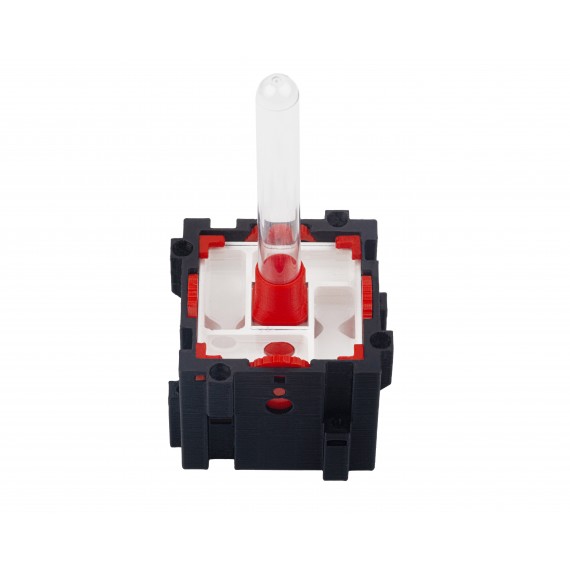
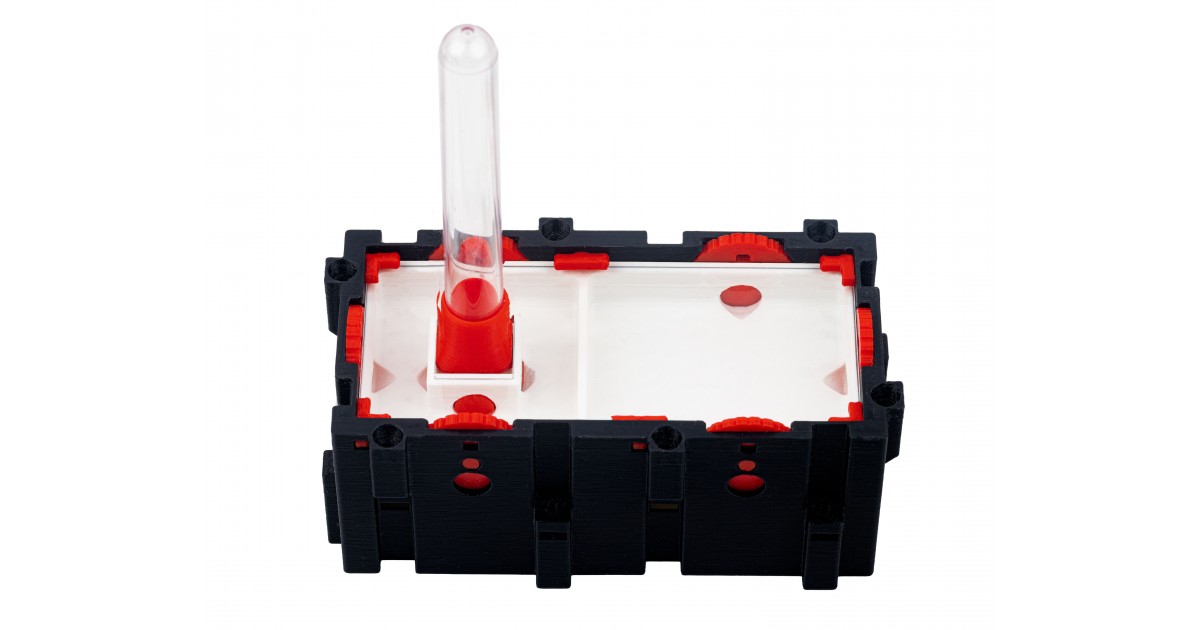
At Antomas we recommend Anthouse’s Qbik Alpha range: modular formicaria, suitable for dry-nesting species, that grow with the colony. To start with, a QBIK ONE with small galleries: in a young colony, narrow galleries make them feel secure and let you keep a close eye on the queen and the brood.
This species grows outrageously fast, so it will not be long before you need to expand. To continue, move on to medium galleries, with more room for the large workers and for an ever larger population: the QBIK DUO and, after that, the larger formats of the same range.
Expand when the nest becomes too small for them: a clear sign is seeing lots of workers sitting still in the corners of the foraging area, with no room inside. But do not jump the gun: in a huge nest for a small colony, the spare corners end up as rubbish dumps. Complete the set-up with these details:
Everything tightly closed: a well-fitting lid or one with fine mesh, checked connections and Vaseline as back-up (see “Escapes and barriers”).
A dry, clean foraging area, with no food remains left to rot and nothing that could act as a bridge to the lid.
Water always available, in a test tube with water and cotton wool.
A feeder for the sugary liquids, which must always be within their reach; never cotton wool (see “Feeding”).
Arrival and moving
At Antomas we sell colonies with queen, workers and brood. When you receive yours, let it rest in a quiet place at 24–28 °C and check that it has water. To move it into its formicarium, we do it by tipping: we open the tube inside the foraging area, next to the nest entrance, and tip the colony out (workers, queen and brood) with a few gentle taps, helping the stragglers along with a brush. With this species, three tips:
Get everything ready beforehand: the set-up, closed and checked, so that the lid is open for as short a time as possible.
Work over a tray or inside a large container: if a worker climbs up your tools, it will not end up on the table.
Expect the smell: when tipped out, they become alarmed and release their secretion. This is normal, and with good ventilation it soon goes away.
Do it calmly and without fear: they will soon have taken over the nest. If you ever need to move the colony to another formicarium, use the same method.
Feeding
Sugary liquids, ad libitum. They must always be available: in the wild, their genus lives largely on hemipteran honeydew. Vary the sugars: at Antomas we recommend Anthouse’s Blue Sugar nectar 4–5 times a week and another sugary liquid or nectar 1–2 times a week. You can also add some protein to the nectar. Always offer them in a feeder and never on cotton wool, because cotton wool goes mouldy and spoils the liquid in no time. Use a traditional or home-made feeder, where the drop stays “spread out” and accessible, and replace it before it ferments.
Protein: the more, the better. It is the engine of their growth, and it is the Antomas philosophy: if you do daily maintenance and remove the leftovers, it is better to overfeed, because the colony understands that it has more resources and grows faster and in greater numbers. If you will not be able to clean often, better not to overfeed: leftover food rots and brings mould and mites. Change the type of insect from one week to the next, so that they do not always eat the same thing: flies, Drosophila, small or chopped crickets and cockroaches, chopped mealworms… Keepers of C. rogenhoferi report that their colonies “prefer protein”. And buy your insects from a reliable supplier: those treated with insecticides can kill the colony.
Do they hunt? In our experience, for now they are not good at hunting large prey; small arthropods, yes. For a young colony, offer small, chopped or freshly killed prey. Once the colony is large, everything changes: you can give them almost anything. There are lots of them, they bite hard and they use their chemical defence to annihilate their prey and anyone who enters their territory. Watching a mature colony surround a cricket, with dozens of raised gasters, is quite a spectacle.
Water: always, in the test tube with cotton wool. Even though their nest is dry, they must never be without drinking water.
Diapause
It does not undergo diapause: there is no real winter in its range (see “Monsoon, dry season and no winter”). Keepers agree that South-East Asian Crematogaster do not need it. At Antomas we keep it active all year round, at 24–28 °C, with no winter drop. Watch out for cold rooms in winter, though: in a C. rogenhoferi journal, the colony grew more slowly in the cold months, even with a heating cable.
Behaviour in captivity
Fast and numerous. They recruit en masse: as soon as a scout finds food, the path fills with workers.
Acrobats on guard. When you open the lid or bring prey close, you will see their gasters held high.
Smelly. If you disturb them, you will notice it by the smell. The bigger the colony, the more noticeable it is.
Watch without fear. At Antomas we believe that ants are there to be enjoyed, observed and learned from, not kept hidden away. It is enough to leave them their dark area in the nest and the foraging area in the light, and to observe them gently, intervening and stressing them as little as possible. They get used to your presence.
Warning signs:
Workers crowding at the lid or constantly looking for a way out: check the humidity and ventilation, because excess humidity triggers mass escape attempts.
Condensation on the walls or mould: too much humidity or forgotten leftovers.
Brood that stalls or disappears: almost always a lack of protein.
Lots of workers sitting still in the foraging area, with no room inside: time to expand.
Escapes and barriers
This is the most important point in this care sheet. C. auritais an excellent climber and gets past escape barriers. At Antomas we are clear about it: the best thing is to keep everything tightly closed.
A well-fitting lid or fine mesh. The foraging area must be closed with a lid that fits well or with a very fine mesh. The small workers have heads less than 1 mm wide, so any gap of that size can be a doorway (this last point is our own deduction from their measurements).
Check for gaps. Joints, lids, connections, stoppers and tubes: everything tightly fitted. Keepers of other Crematogaster insist on sealing every gap and leaving no slack in the connectors.
Vaseline, as back-up. At Antomas, as well as keeping everything tightly closed, we apply a strip of Vaseline as a back-up barrier. PTFE, on the other hand, only half works with similar species: on the forums, keepers report that Crematogaster cross it “as if it were not there”, especially on vertical walls, and that dust and condensation ruin it. Whatever the barrier, it is a second line of defence: it never replaces the lid.
Take care when opening. This is when they escape most. Open only as much as you need, work calmly and close up when you have finished.
Dry and ventilated. Excess humidity triggers escape attempts.
With everything tightly closed, a colony of C. aurita causes no problems.
Handling and safety
Their weapon is not the sting, which is spatulate and smears the venom instead of stabbing, but their bites and their chemistry. In our experience, they bite hard for their size and, when disturbed, release their secretion through the metapleural gland. Do not worry: the liquid cannot actually be seen, it neither stains nor irritates, and all you will notice is the smell, which clears with ventilation. As with any species, handle them with entomological tools (a soft brush or soft forceps), not with your hands, and work slowly so as not to lose or harm any worker, let alone the queen. It is an exotic species: it must never be released into the wild.
What not to do
Leave gaps, loose joints or ill-fitting lids: they are excellent climbers and slip through tiny gaps.
Rely entirely on an escape barrier, even Vaseline: the first thing is to keep everything tightly closed.
Soak the nest, or keep moistening it once the colony is large: from then on, they must be kept dry.
Forget to ventilate: stuffy air brings condensation, mould and escape attempts.
Skimp on food for a colony that grows so fast, always give them the same insect or leave leftovers uncleaned.
Put the sugary liquids on cotton wool or let them run out: always in a feeder and always available.
Give them a diapause or lower their temperature in winter.
Open the lid without having prepared what you are going to do.
Handle them with your hands.
Wait until the nest is bursting before expanding: with this species, you need to stay one step ahead.
Scientific sources
This care sheet is based on the scientific literature on Crematogaster aurita, its species group and its genus, on climate data from its distribution area and on the experience of Antomas and other keepers. Main references:
Hosoishi, S. & Ogata, K. (2009). A taxonomic revision of the Asian endemic subgenus Physocrema of the genus Crematogaster (Hymenoptera: Formicidae). Zootaxa 2062: 15–36. doi:10.11646/zootaxa.2062.1.2
Hosoishi, S. et al. (2023). Multilocus phylogeny and historical biogeography of the Crematogaster inflata-group (Hymenoptera: Formicidae) in South-East Asia. Zoological Journal of the Linnean Society 198: 901–922. doi:10.1093/zoolinnean/zlad005
Blaimer, B. B. (2012). A subgeneric revision of Crematogaster and discussion of regional species-groups (Hymenoptera: Formicidae). Zootaxa 3482: 47–67. doi:10.11646/zootaxa.3482.1.3
Maschwitz, U. (1974). Vergleichende Untersuchungen zur Funktion der Ameisenmetathorakaldrüse. Oecologia 16: 303–310. doi:10.1007/BF00344739
Hölldobler, B. & Engel-Siegel, H. (1984). On the metapleural gland of ants. Psyche 91: 201–224. doi:10.1155/1984/70141
Attygalle, A. B., Siegel, B., Vostrowsky, O., Bestmann, H. J. & Maschwitz, U. (1989). Chemical composition and function of metapleural gland secretion of the ant, Crematogaster deformis Smith (Hymenoptera: Myrmicinae). Journal of Chemical Ecology 15: 317–328. doi:10.1007/BF02027793
Billen, J., Hashim, R. & Ito, F. (2011). Functional morphology of the metapleural gland in workers of the ant Crematogaster inflata (Hymenoptera, Formicidae). Invertebrate Biology 130: 277–281. doi:10.1111/j.1744-7410.2011.00230.x
Jones, T. H., Brunner, S. R., Edwards, A. A., Davidson, D. W. & Snelling, R. R. (2005). 6-Alkylsalicylic acids and 6-alkylresorcylic acids from ants in the genus Crematogaster from Brunei. Journal of Chemical Ecology 31: 407–417. doi:10.1007/s10886-005-1349-6
Ito, F., Hashim, R., Huei, Y. S., Kaufmann, E., Akino, T. & Billen, J. (2004). Spectacular Batesian mimicry in ants. Naturwissenschaften 91: 481–484. doi:10.1007/s00114-004-0559-z
Pasteels, J. M., Daloze, D. & Boevé, J.-L. (1989). Aldehydic contact poisons and alarm pheromone of the ant Crematogaster scutellaris (Hymenoptera: Myrmicinae): enzyme-mediated production from acetate precursors. Journal of Chemical Ecology 15: 1501–1511. doi:10.1007/BF01012379
Marlier, J.-F., Quinet, Y. & de Biseau, J.-C. (2004). Defensive behaviour and biological activities of the abdominal secretion in the ant Crematogaster scutellaris (Hymenoptera: Myrmicinae). Behavioural Processes 67: 427–440. doi:10.1016/j.beproc.2004.07.003
Tragust, S. et al. (2020). Formicine ants swallow their highly acidic poison for gut microbial selection and control. eLife 9: e60287. doi:10.7554/eLife.60287
Leuthold, R. H. (1968). A tibial gland scent-trail and trail-laying behavior in the ant Crematogaster ashmeadi Mayr. Psyche 75: 233–248. doi:10.1155/1968/73761