Difficulty: 2/5 – Beginner
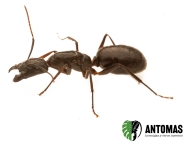
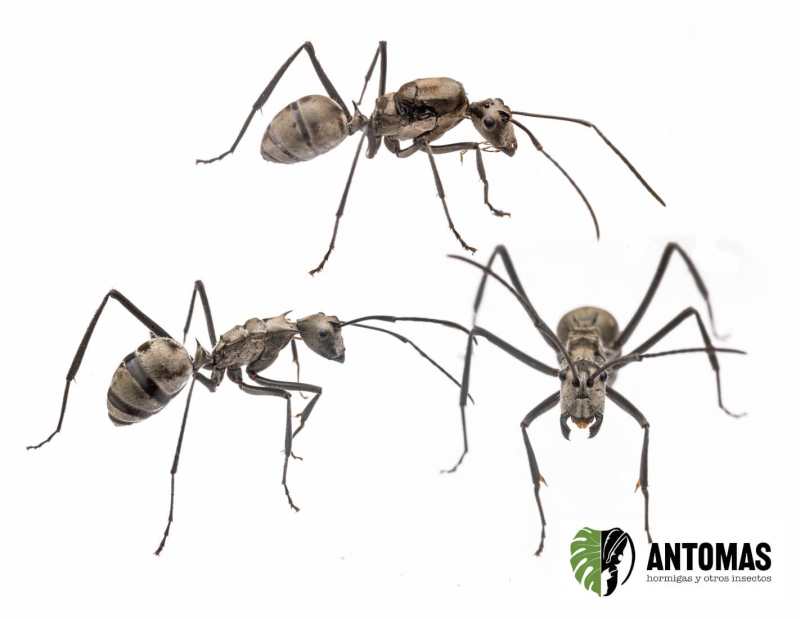
A matt black, robust Camponotus from Southeast Asia, with a 13–15 mm queen whose head is elongated, the “horse face”; the workers do not have it. An unidentified species: “guangxi” is a trade name. Colonies with queen. Qbik Alpha with medium galleries to start with and large ones later, 24–28 °C without overheating, no diapause, sugary liquids always available and insects, mostly dead ones at first. They climb well: use a mineral-oil barrier.
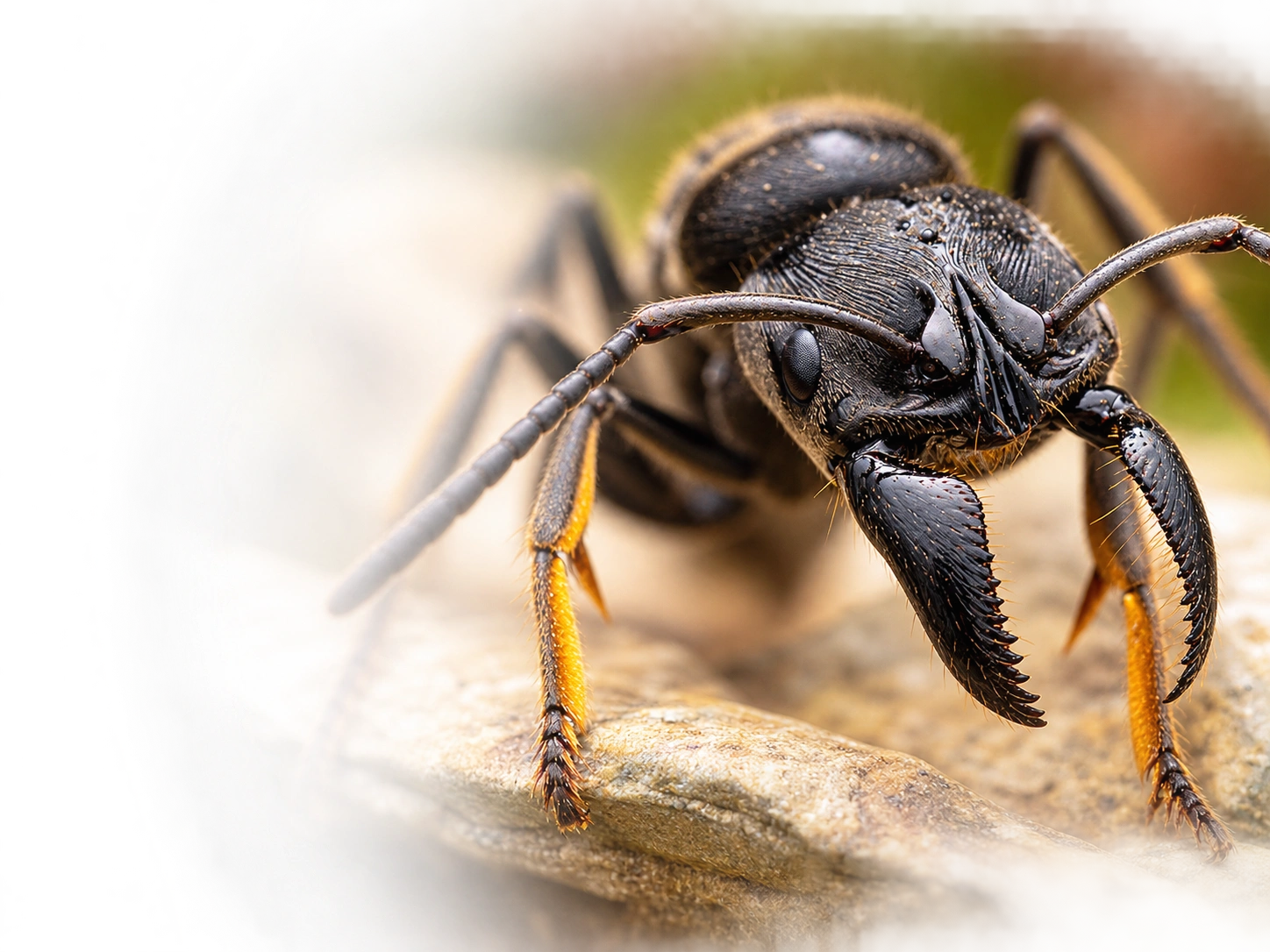
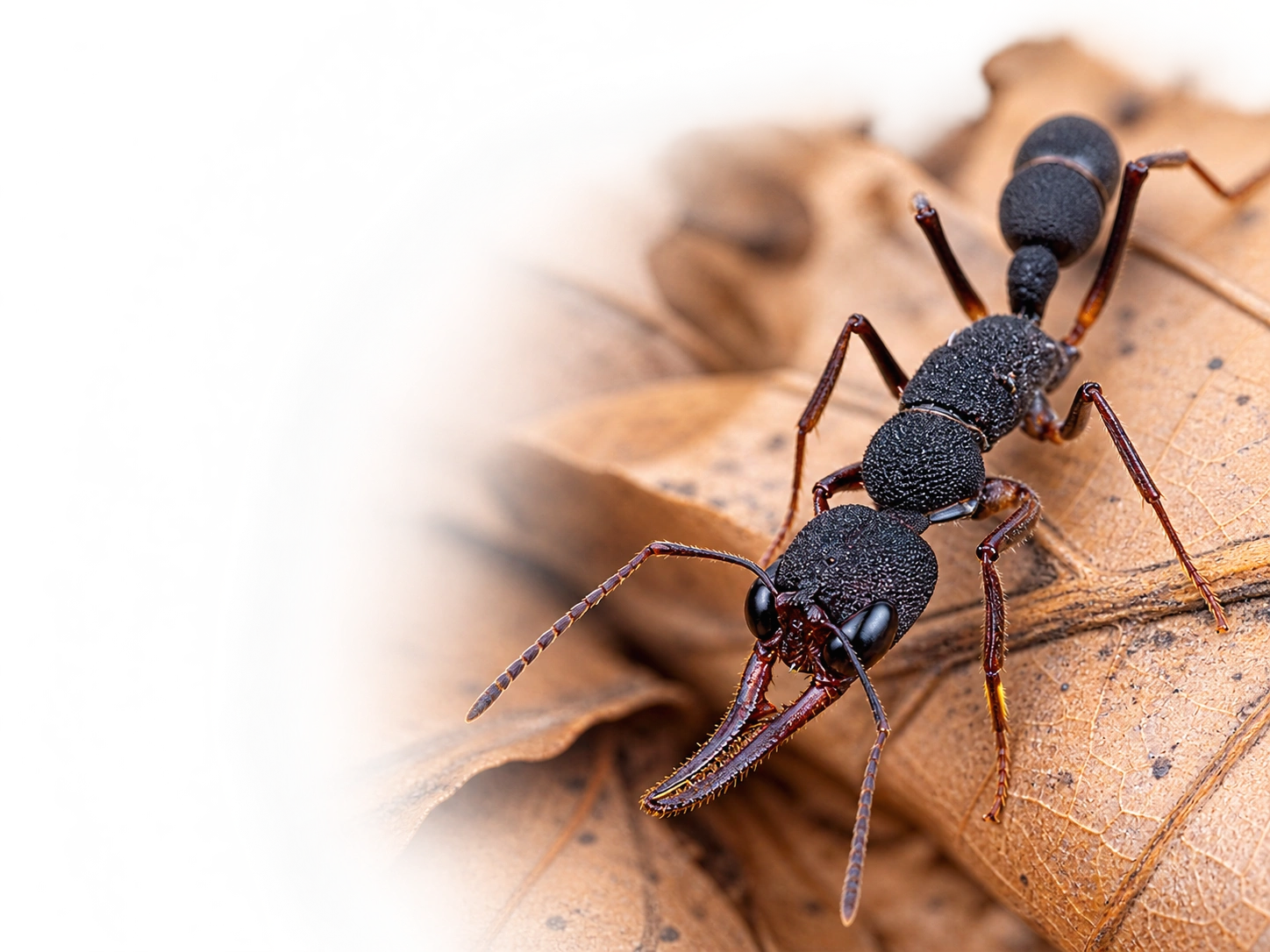
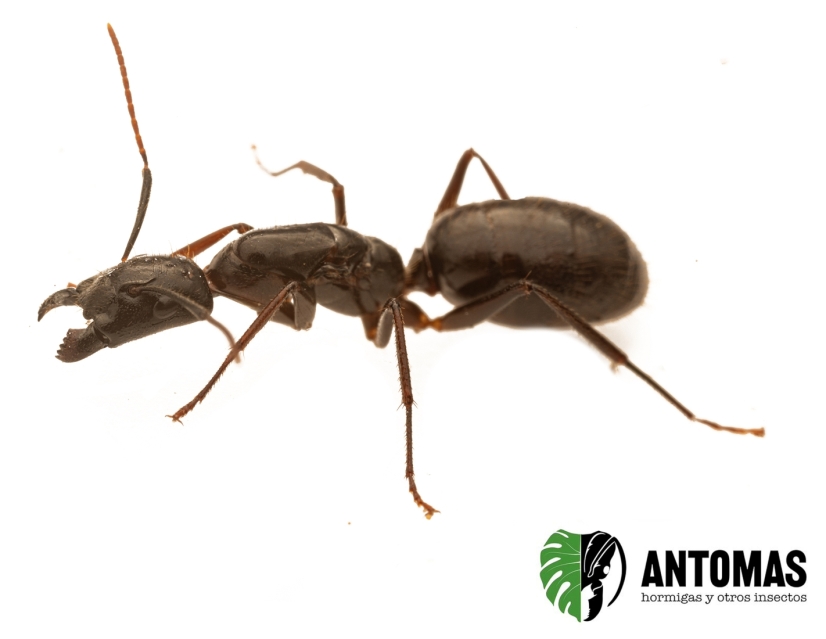
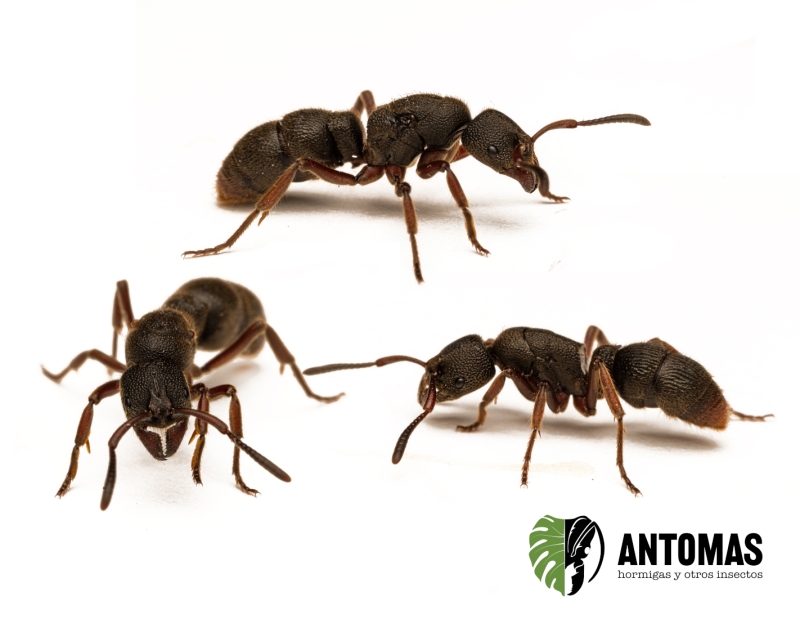
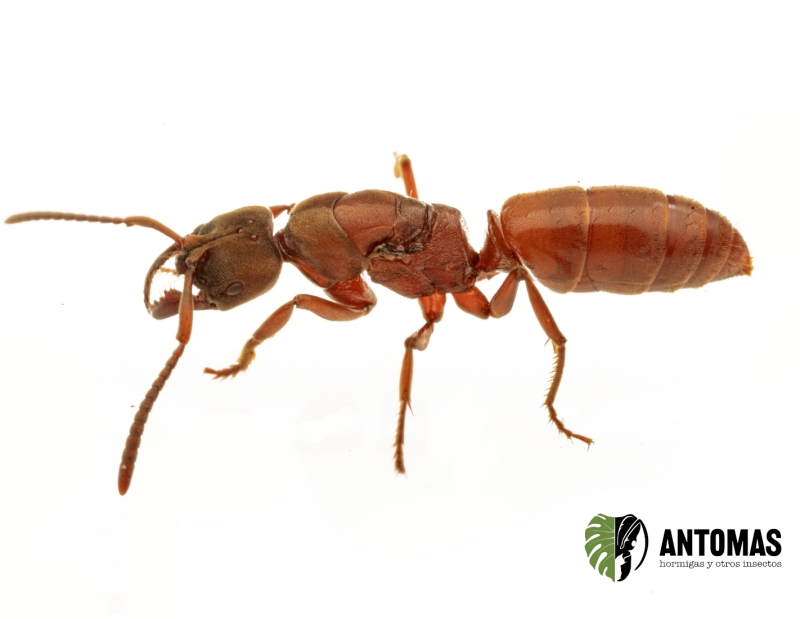
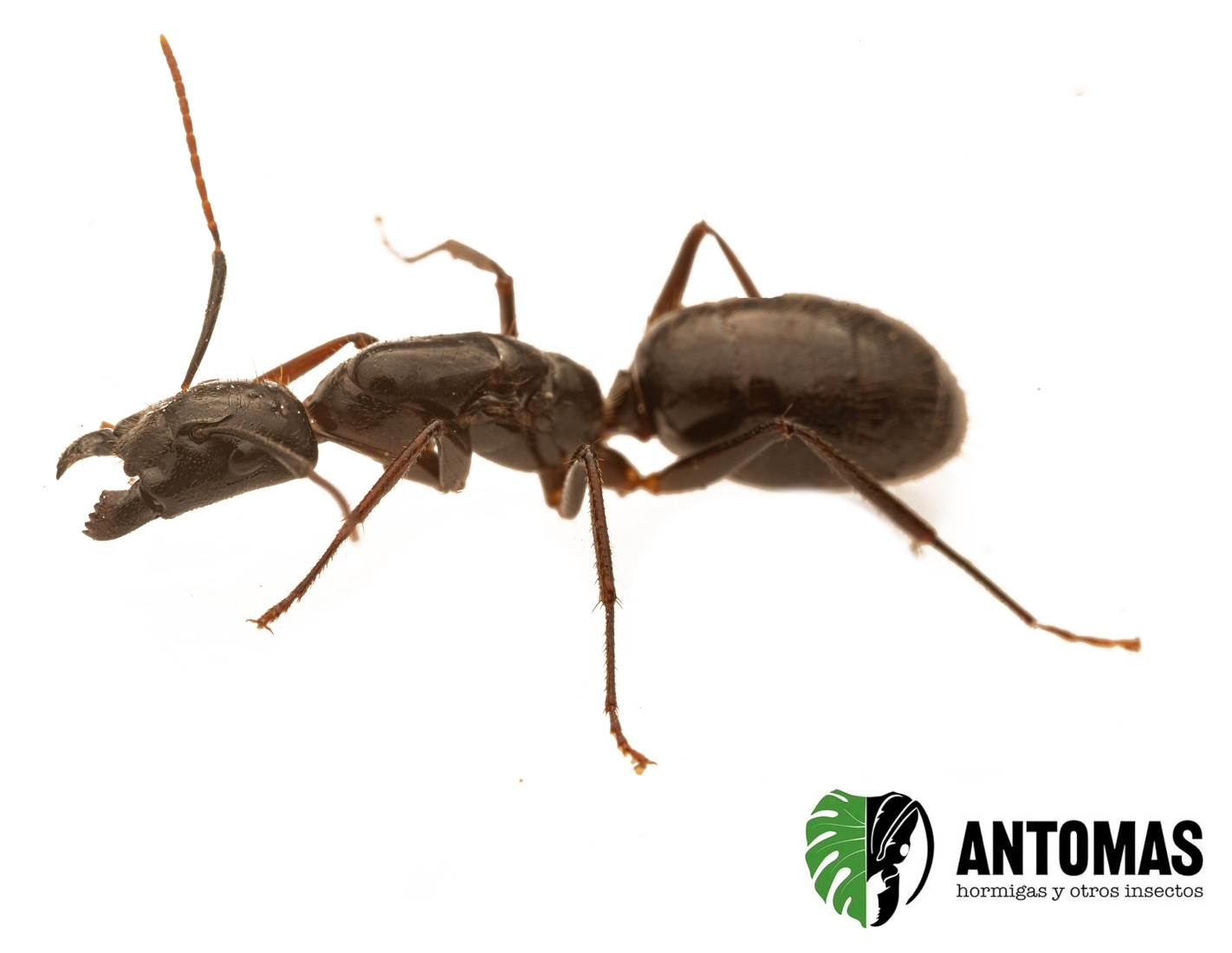
Camponotus sp. “guangxi” is a Camponotus from Southeast Asia, matt black and robust, with reddish-brown legs and antennae and a feature that has earned it its nickname: an elongated head, longer than it is wide, known in the hobby as a “horse face”. And you do not have to wait for the soldiers to see it: in our colonies, the queen already has the horse face, a large queen of 13–15 mm.
It is also one of the most mysterious ants in our catalogue. It has no scientific name, because nobody has identified it yet, and we have not found a single care sheet, forum or video devoted to it. That is why, in this care sheet, we always keep three things apart: the little that can be said about its identity, what is documented for the genus Camponotus and its possible relatives, and what we have learnt by keeping it at Antomas. The last part is quickly summed up: it is an easy-going Camponotus that thrives on sugar, protein and a simple formicarium, and it still keeps a secret or two.
Biology
Camponotus sp. “guangxi”: what its name says (and does not say)
Let us start with the name, because we would rather tell you ourselves. In taxonomy, “sp.” is the abbreviation of species, and it is written after the genus when we know which genus a specimen belongs to, but not which species: either because it could not be identified or because, quite simply, the species does not have a name yet. Camponotus sp. therefore means “a Camponotus of unknown species”. It should not be confused with two other abbreviations you will also come across in the hobby: “cf.” (from confer, “compare with”), used when a specimen closely resembles a particular species but this cannot be confirmed, and “sp. n.” or “sp. nov.”, which marks a new species in the paper that describes it.
The part in quotation marks, “guangxi”, is not a scientific name but a trade label: that is why it is written in lower case, in quotation marks and not in italics. It is a common habit in the hobby, where many unidentified ants circulate under a nickname, often a place name, to tell them apart from others in the same genus. Guangxi is a region in southern China, and that is where the label comes from. But it should not be given more weight than it deserves: it is a trade name and does not indicate where our colonies come from, which is Southeast Asia. Nor does it say anything about the species.
So why has nobody named it? Because identifying an Asian Camponotus is not easy. It is one of the largest ant genera in the world, with more than a thousand described species, and new species are still being described in Southeast Asia, as you will see in the next section. We have searched for “Camponotus sp. guangxi” and “horse face” in forums, videos and publications, in several languages and in Chinese as well, and neither name is linked to any particular species: no scientific name has been proposed for this ant. The honest thing to do is to call it what we call it and tell you which candidates fit. If a specialist ever gives it a name, we will update this care sheet.
Two suspects with elongated heads
From what has been published, there are two leads worth following. Neither is an identification: they are the described species that most resemble our ant in the shape of the head.
The Camponotus selene complex. This is new in 2026. The myrmecologists Marco Chan, Matthew T. Hamer and Benoit Guénard proposed this species group, native to Southeast Asia, which brings together C. selene, C. obtusatus (restored to species rank), C. siamensis and a species new to science, C. orthogonius, and they published keys to tell them apart using both minor and major workers. What is interesting is how they describe the head of the majors of C. orthogonius: rectangular and longer than wide, with parallel sides and a straight rear margin, and partly phragmotic, that is, adapted to plug the nest entrance (see “Heads that act as doors”). The body is black, and the mandibles and antennae are reddish brown. So far, the resemblance is striking.
But there are differences. In C. orthogonius, the front two fifths of the majors’ head are orange, and the species is medium-sized: the head of its majors is about 2 mm long. It is also arboreal. The type series was collected from several neighbouring dead twigs on the same fallen tree, which suggests a colony spread over several nests, and its workers forage by day on vegetation. Our ants, on the other hand, are a uniform matt black, at least in the product photo, and the queen is large. It fits, but only in part. We have not been able to consult the full descriptions of the rest of the complex.
Camponotus albivillosus. It was described by the myrmecologist Zhou Shanyi in 2001. In his description, the major has a “head elongate, with subparallel sides and convex occipital border”: a long head, with almost parallel sides and a rounded back. That is exactly the kind of head the hobby calls a “horse face”. The problem is that it is known only from that original description, which we have not been able to read in full. And its name, albivillosus, “with white down”, suggests abundant white hairs that would need to be looked for in our colonies.
And what if it is neither? That is perfectly possible. Some Asian Camponotus are known only from their original description, and others have yet to be described. To settle the question, the majors and minors of our colonies would have to be compared with the keys of Chan and his colleagues and with the type specimens, and that is a job for a specialist. In the meantime, if you are curious, in “How to measure a horse face” we explain how to compare the heads of your ants with those of the candidates.
Horse face: where the nickname comes from
In the hobby, “horse face” is used for ants with an elongated head: longer than wide, narrow and with almost parallel sides, which, seen from the front, is reminiscent of a horse’s face. It is not a scientific term, and it is not always applied to the same caste. On a blog by naturalists in Southeast Asia, for example, the term horse faced is used for the long-faced minor workers of some Camponotus, not for the majors. The same blog points out that the Camponotus of the region can have workers in two, three or even four distinct sizes, and that in the four-size species, the most common ones, it is usually the minors that have the long face.
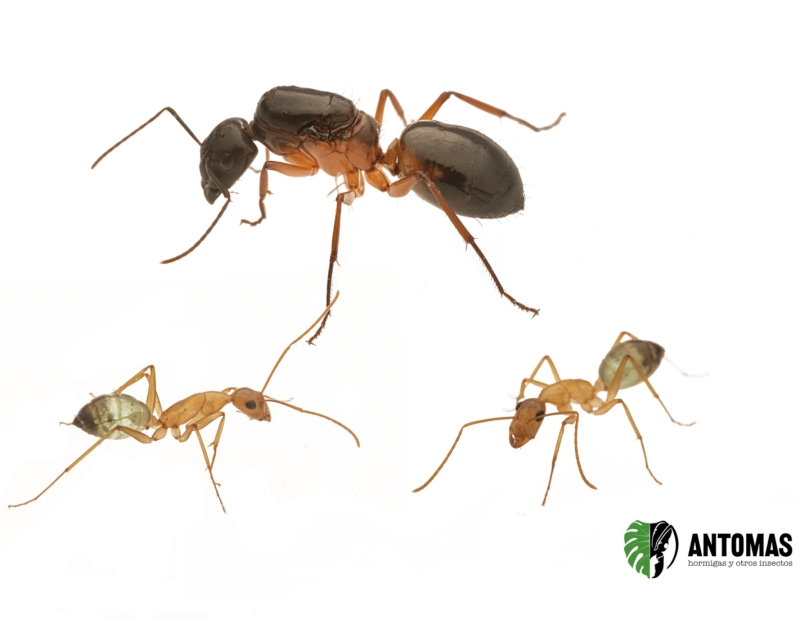
What is striking about our ant is where that face appears. In many Camponotus, the most special heads belong to the majors, the soldiers, which have larger heads and often a different shape from the small workers. Here, by contrast, the queen already has the horse face: it is the first thing you notice when you look at her, a clearly elongated head on a large, robust body. And, curiously, her workers do not have it: they are black like her, but with a normally shaped head. Exactly the opposite of the species on the blog. As far as we know, in this ant the horse face belongs to the queen.
And the majors? Here we have to be honest: we do not yet know when they appear in this species, at what colony size, or exactly what their head will look like. No data have been published, and we have not yet documented it in our colonies. In Camponotus the first workers are usually small, and the larger sizes arrive as the colony grows, but with an unidentified species we prefer not to promise any timescales. If you keep a colony of Camponotus sp. “guangxi”, you may be among the first to see its majors emerge. And if you do, we would love to hear about it.
Heads that act as doors
An oddly shaped head is hardly ever a whim. In several ants that nest in hollow twigs and trunks, the majors have a head modified to act as a living door: they fit it into the nest entrance, which is exactly as wide as that head, and block the way to intruders. This is phragmosis, a word that comes from the Greek phragma, “fence” or “barrier”. The most famous case is Colobopsis, whose majors and queens have the front of the head truncated, like a cork. When a nestmate wants to pass, the doorkeeper backs into a wider chamber and makes room for it.
The curious thing is that phragmosis has appeared several times, along independent paths. For more than a century, Colobopsis was considered a subgenus of Camponotus, but genetic studies showed that they are not even sister groups. Some of their lineages look so alike through convergence, that is, by arriving at the same solution separately, that they confused taxonomists, and in 2021 species had to be moved from one genus to the other in both directions. Within Camponotus there are also majors with plug-shaped heads, such as those of the inquilinus group of the subgenus Myrmamblys. And the majors of C. orthogonius, one of our suspects, have a partly phragmotic head. Its describers believe it might serve the same purpose, although nobody has yet seen them blocking an entrance in the wild.
Does our ant do the same? We do not know, and it is worth pointing out that its head is not a plug: it is elongated, not truncated. What we can rule out is that it is a Colobopsis, and there is a very simple way to check this at home: the pupae. In Camponotus, the larvae spin a silk cocoon before they transform, and the pupae look like small elongated cases; in Colobopsis, by contrast, the pupae are naked. Those of our colonies are in cocoons: it is a Camponotus.
And while we are on the subject of Colobopsis, a curiosity. Some of its species in Southeast Asia, those of the C. cylindrica group, are the famous exploding ants: in territorial fights, their workers sacrifice themselves by rupturing the wall of the gaster and releasing the sticky, irritant contents of enormous mandibular glands, which kill or drive off their rivals. One of them, Colobopsis explodens, was described in 2018 as a model species for studying them. Our Camponotus sp. “guangxi”, rest assured, does not explode.
A family tree under construction: the genera that came out of Camponotus
Camponotus is one of the largest ant genera in the world, with more than a thousand described species on almost every continent. In English they are called carpenter ants because some excavate their nests in wood, although many others nest in the soil or in hollow twigs. Such a huge genus is also a catch-all, and genetics has spent a decade putting it in order.
In 2016, a reclassification of the whole formicine subfamily restored genus rank to Colobopsis and to Dinomyrmex, the giant ant of the forests of Southeast Asia, which until then had been called Camponotus gigas. It drew, among others, on a 2015 study which showed that phylogenomic methods, based on a large number of regions of the genome, resolved the deep relationships of the formicines far better than traditional methods.
And in 2025 came the most complete tree to date. Philip S. Ward and his colleagues studied more than 200 species of the Camponotus tribe, the Camponotini, using so-called ultraconserved elements: regions of the genome that change very little from one species to another and are useful for reconstructing ancient relationships. They found eight major lineages and three new genera for species that had mistakenly been described as Camponotus: Lathidris, from the mountains of Mesoamerica; Retalimyrma, from the Indian Himalaya; and Uwari, from eastern Asia. They also put dates on it: the modern Camponotus group would be about 18.6 million years old, and the whole tribe about 38.4, with a probable origin in Australasia or in the Indomalayan region, which includes Southeast Asia.
What does all this mean for our ant? That its “surname”, the genus, is more provisional than it seems. Camponotus sp. “guangxi” is an unidentified Camponotus from Southeast Asia, right in the probable region of origin of the tribe, and the genus is still under revision. Another reason to call it, for now, Camponotus sp.
Blochmannia, the bacterium that cannot stand the heat
Every Camponotus carries an essential partner inside it: Blochmannia, a bacterium that lives in specialised cells, the bacteriocytes, lining the ant’s midgut, and is passed on from the queen to her offspring. The relationship is so old that the bacterium’s family tree largely mirrors that of its ants: they have evolved together. And so intimate that, according to a study published in Nature in 2020, the ant embryo integrates the bacterium into its own development, as just another part of its body.
What do they need it for? Blochmannia makes essential amino acids, which the ant cannot produce for itself, and helps it recycle nitrogen. In an experiment with C. floridanus, workers without the bacteria and fed a diet lacking essential amino acids raised far less brood. Its role is felt above all during development: in the same species, the bacterium’s genes involved in nitrogen recycling reach their peak activity during the pupal stage, and groups of workers treated with antibiotics reared far fewer pupae from newly hatched larvae. It is one of the reasons why Camponotus thrive on such sugary diets. That said, it is no excuse to skimp on protein: the larvae need insects to grow (see “Feeding”).
And now for the fact that matters most to keepers. In 2013, Yongliang Fan and Jennifer Wernegreen exposed workers and queens of two Camponotus species in the laboratory to days with highs of 37.7 °C. After four weeks, the amount of active Blochmannia had fallen by more than 99% in the minor workers and in the unmated winged queens, although it almost never disappeared completely, not even after sixteen weeks. The authors compare it to coral bleaching, in which corals lose their symbiotic algae when the water warms up.
Nobody has measured this in our Camponotus sp. “guangxi”, and 37.7 °C is far more than a well set-up formicarium should ever reach. But the lesson is clear: with Camponotus, more heat is not better. That is why we recommend a nest at 24–28 °C, with the heat, if needed, at one side and on a thermostat (see “Recommended parameters”).
They swallow their own venom
Like all formicines, Camponotus sp. “guangxi” has no sting. Its chemical weapon is formic acid, which it produces in the venom gland and sprays through the acidopore, a small nozzle fringed with tiny hairs at the tip of the gaster that only ants of this subfamily have. But in 2020, a team of German researchers discovered that this acid is also a disinfectant. While grooming, the ant bends its gaster, brings the tip to its mouth and swallows a few drops of its own venom.
In this way it keeps its crop very acidic: the “social stomach” where workers store the liquid food they later share mouth to mouth. The acid works like a filter: it stops many of the microbes that come in with the food and helps to prevent contaminated food from spreading an infection through the whole colony. It was studied mainly in C. floridanus, and the authors confirmed it in other formicines too.
And the story does not end there. In 2026, another study showed that the venom of Camponotus is not just acid: in eight species from places far apart, the researchers found 35 peptides, which they called formicitoxins. Several of them are active against fungi and, applied to pupae, slow down fungal growth, which suggests that they help to keep the colony hygienic. The old “acid spray” turns out to be a small first-aid kit as well. At home you will hardly notice it: the acid only comes out when they feel attacked (see “Handling and safety”).
Queens for many years
Ant queens are among the longest-lived insects known. A classic 1997 study linked social life to lifespans about a hundred times longer than those of solitary insects, which fits the evolutionary theories of ageing: the queen lives protected at the heart of a well-defended nest. A later review also linked the longevity of queens to the characteristics of their colonies.
Camponotus holds one of the best-documented records. The entomologists Caryl and Edna Haskins kept in their laboratory a queen of C. perthiana, an Australian form now included in C. nigriceps. That queen lived 23.2 years, counted from before her first eggs. Over her lifetime she raised between 5,000 and 7,000 workers, and when the record was published, in 1992, it was the second-longest lifespan known for an ant, second only to a queen of Lasius niger.
How long does a queen of Camponotus sp. “guangxi” live? Nobody knows: it is an unidentified species, and its history in captivity is very short. But it belongs to a genus of long-lived queens, so it is reasonable to think of a companion for many years, not for a few months.
Size and morphology
A large, robust Camponotus with an elongated-headed queen. As the species has not been identified, there is no scientific description to compare it with: what follows is what we see in our colonies and in the product photo, with the measurements of one of the candidates as a reference.
- Colour. The queen and the workers are black. According to the product photo, a matt black, with reddish-brown legs and antennae.
- Build. Robust, with a broad, strong body.
- Head. In the queen, elongated and longer than wide: this is the “horse face” that gives it its nickname. The workers do not have an elongated head.
- Queen. On the large side: 13–15 mm in our colonies.
- Workers. Black and with a normally shaped head. There is no published description, and their sizes have yet to be documented.
- Majors. Not yet documented (see “Horse face: where the nickname comes from”).
- Gaster. Ends in the acidopore, through which it sprays formic acid; it has no sting.
- Pupae. Enclosed in a cocoon, as in all Camponotus.
- Male. Not documented.
How to measure a horse face
Taxonomists do not say “horse face”: they measure it. To do so, they use the cephalic index (CI), which is the width of the head divided by its length and multiplied by 100, with the head seen from the front. A head as wide as it is long has a CI of 100, and the lower the figure, the more elongated the head.
As a reference, the majors of C. orthogonius, one of our suspects, have a CI of 84–86: the head is 14–16% narrower than it is long. In its minors, the index ranges from 84 to 100. If you have a good front-on photo of the queen and another of a worker, you can work it out yourself by measuring the head on the screen, and you will see the difference between the two in figures. And if a major ever appears, that number will be one of the first clues as to what it is.
Approximate sizes
- Queen: 13–15 mm (Antomas queens; no published measurements)
- Workers: no published measurements
- Majors: not yet documented
- Male: no published measurements
- Reference from a candidate, C. orthogonius: head length of the majors, 1.83–2.02 mm; CI of the majors, 84–86
All the measurements for the species are our own. Those of C. orthogonius only serve as a reference for one of the candidates, not for our ant.
Care in captivity
Difficulty: 2/5 – Beginner
At Antomas we consider it a species to start with. It is an uncomplicated Camponotus: it eats sugary liquids and insects, does not go into diapause, does well at 24–28 °C in a simple modular formicarium, and a mineral-oil barrier is all it takes to keep it under control.
Why a 2 and not a 1? For three reasons:
- Temperature. It needs 24–28 °C all year round, with no diapause. In much of Europe, that means giving it heat in winter, on a thermostat and without overdoing it.
- It is exotic. It is not a local ant, and its climate and rhythm are not those of our native species.
- It is fairly new on the market. We still do not know very well how its colonies will develop: when the majors will appear, what size an adult colony will reach or how its temperament will change as it grows. Keeping it calls for careful observation and taking nothing for granted.
And it is well worth it. It is a black, large and elegant Camponotus, with a horse-faced queen that catches the eye at first sight and a mystery still to be solved: nobody has yet documented its majors. Few easy ants offer the chance to discover something new in your own formicarium.
Recommended parameters
- Nest temperature: 24–28 °C, all year round. Do not overdo it: with Camponotus, more heat is not better (see “Blochmannia, the bacterium that cannot stand the heat”).
- Foraging area: at room temperature or slightly warmer. If heat is needed, keep it gentle, at one side of the nest and on a thermostat, so that the colony can choose.
- Humidity: moderate. The Qbik Alpha is a rather dry nest, and the moisture they need comes from the water tube and from the sugary liquids, which are mostly water. Avoid wetting the nest: too much moisture brings condensation, mould and mites.
- Water: always available, in a test tube with water and cotton wool in the foraging area.
- Light: it is enough to leave them a dark area in the nest and a lit foraging area, with a normal day–night cycle.
- Diapause: none (see “No diapause”).
Recommended formicaria
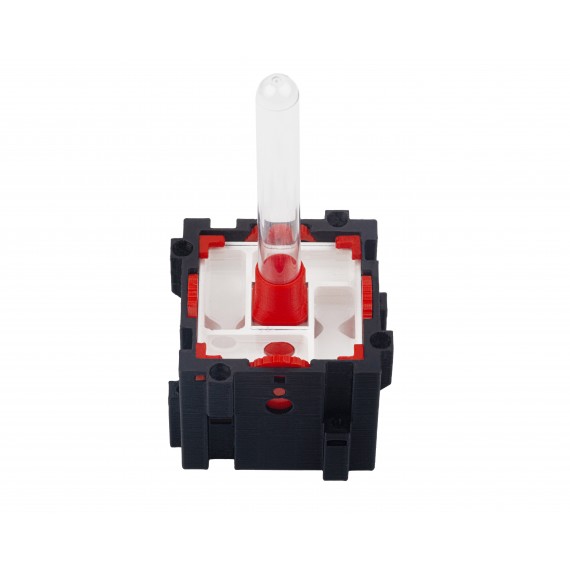
At Antomas we recommend the Anthouse Qbik Alpha range: modular formicaria that grow with the colony. To start with, a QBIK ONE with medium galleries: it is just the right size for a small colony, leaves room for a large, long-headed queen and makes it easy to keep an eye on the brood.
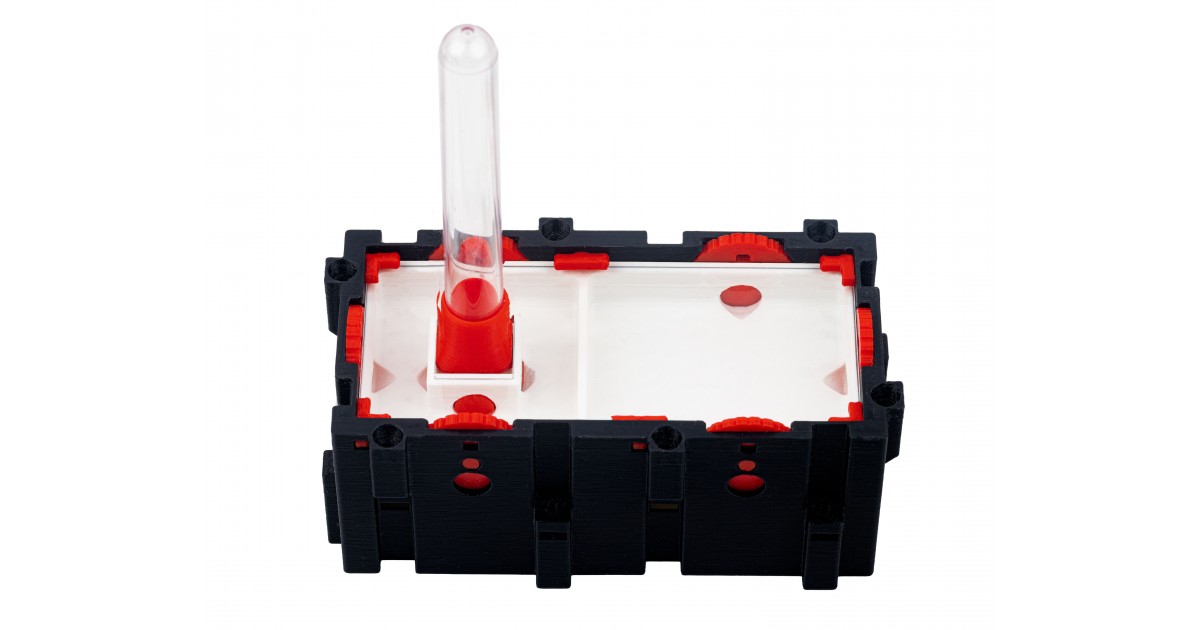
When the colony grows, and especially when large workers start to appear, move on to large galleries: the QBIK DUO with large galleries and, later, the bigger formats in the same range.
Expand when the nest becomes too small for them: a clear sign is seeing lots of workers standing still in the corners of the foraging area, with no room inside. But do not jump the gun: in a huge nest for a small colony, the spare chambers end up as rubbish dumps. Complete the set-up with these details:
- Escape barrier: a band of mineral oil on the upper part of the walls of the foraging area and a well-fitting lid (see “Escapes and barriers”).
- Foraging area with some sand, flat stones and a twig or piece of bark to climb on, with nothing that could act as a bridge to the barrier.
- Water always available, in a test tube with water and cotton wool.
- A feeder for the sugary liquids, never on cotton wool (see “Feeding”).
- Gentle heat, only if needed, at one side of the nest and away from the feeder, on a thermostat.
Arrival and moving
Our colonies travel in their test tube, with the queen, her workers and the brood. When you receive yours, let it rest in a quiet, dark place at 24–28 °C, and check that the tube has water. Do not move it into the formicarium as soon as it arrives. When the time comes, at Antomas we do it by tipping: we open the tube inside the foraging area, next to the nest entrance, and gently tip out the queen, the workers and the brood, helping the stragglers with a soft brush. Three tips:
- Prepare everything beforehand: the formicarium set up, with the oil barrier in place and the water tube in position.
- Work over a tray, in case a worker climbs up the tube or your tools.
- Take it calmly: after tipping, the workers gather the brood and carry it into the nest. Keep the nest area dark so that they occupy it straight away.
If you ever need to move the colony to another formicarium, for example when switching from medium to large galleries, use the same method.
Feeding
Sugary liquids, ad libitum. In other words, always available: they should never run out. Camponotus live largely on sugar, on the honeydew of aphids and scale insects and on nectar, and this one is no exception. Vary the sugars: at Antomas we recommend Anthouse’s Blue Sugar nectar 4–5 times a week and another sugary liquid or nectar 1–2 times a week. You can also add some protein to the nectar. Always offer them in a feeder and never on cotton wool, because cotton wool goes mouldy and spoils the liquid very quickly. Use a traditional or home-made feeder, where the drop stays “spread out” and accessible, and replace it before it ferments.
Insects: mostly dead ones at first. With a small colony, offer chopped or freshly killed insects: the workers can make use of them without any risk, and there is no live prey running around near the queen. There is no magic number of workers for switching to live prey: give it to them when you see that the colony is strong, with plenty of workers and more determined when it attacks, so that a live prey item cannot harm them.
Protein: the more, the better. It is the engine of their growth, and it is the Antomas philosophy: if you do daily maintenance and remove the leftovers, it is better to overfeed, because the colony understands that it has more resources and grows faster and in greater numbers. If you will not be able to clean often, it is better not to overfeed: leftover food rots and brings mould and mites. Change the type of insect from one week to the next, so that they do not always eat the same thing: flies, crickets, small cockroaches, chopped mealworms and, for small colonies, Drosophila. And buy your insects from a reliable supplier: insects treated with insecticides can kill the colony.
Water: always, in the test tube with cotton wool in the foraging area. Even though they drink from the sugary liquids, they must never go without clean water.
No diapause
Camponotus sp. “guangxi” does not go into diapause. At Antomas we keep it active all year round, at the same temperature, 24–28 °C, and with the same food in winter as in summer. There is no need to cool it down or change its rhythm: it is enough to make sure the nest does not get cold in winter. If the room temperature drops a lot, gentle heat at one side of the nest, on a thermostat, keeps it within its range.
Behaviour in captivity
Nothing has been published on its behaviour, so we will tell you what we have seen at Antomas, what is usual in Camponotus and what is worth keeping an eye on with this species.
One queen per colony. Our colonies have a single queen, and that is how they should stay: do not combine queens or different colonies.
A queen with character. In our experience, the queen is quite aggressive. That is why we expect the workers, and the majors once they appear, to be aggressive too as the colony grows. This is our expectation, not a proven fact: tell us how yours behaves.
A division of labour you can see. In Camponotus with workers of several sizes, the small ones do most of the foraging, while the large ones spend more time in the nest and show themselves mainly when there is a disturbance or a large prey item to cut up. When your colony has workers of several sizes, watch who does what.
Day or night? It depends on the species. Many Camponotus forage mainly at night, but C. orthogonius, one of our suspects, forages by day. Watch when yours becomes active and time its meals accordingly.
Watch without fear. At Antomas we believe ants are there to be enjoyed, watched and learnt from, not kept hidden away. It is enough to leave them their dark area in the nest and a lit foraging area, and to watch them gently, intervening and stressing them as little as possible. They get used to your presence.
A colony diary. With such a little-known species, it is worth noting down from time to time how many workers there are, what they look like and when each new size appears. If the first major turns up one day, you will have a piece of data that nobody has today.
Warning signs:
- Brood that stalls or disappears: protein is almost always lacking.
- Condensation on the walls or mould: there is too much moisture or forgotten leftovers.
- Workers huddled away from the heat source or sluggish in midsummer: check the nest temperature.
- Lots of workers standing still in the foraging area, with no room inside: time to expand.
Escapes and barriers
In our experience, they climb well, so put the barrier in place from day one. And, with it, mineral oil is enough:
- A band of mineral oil on the upper part of the walls of the foraging area, thin and continuous. Renew it when you see it collecting dust or debris.
- A well-fitting lid, as a second line of defence.
- No gaps: check the connections, the plugs and the tubes.
- Nothing that could act as a bridge: no twigs or stones leaning near the barrier.
- Care when opening: open only as much as necessary, work calmly and close up when you finish.
With the oil barrier and everything well fitted, they cause no problems.
Handling and safety
They cannot sting: they have no sting. But if they feel attacked, they bite and may spray formic acid, which stings on sensitive skin or in a small cut. In our experience the queen is quite aggressive, and the colony can be expected to become so as well as it grows. Nothing to worry about if you work calmly. As with any species, handle them with entomological tools (a soft brush or soft forceps), not with your hands, and work slowly so as not to lose or harm any worker, let alone the queen. Do not combine queens or different colonies, or keep them with other species. It is an exotic species: it must never be released.
What not to do
- Overheating, or putting the heat source under the whole nest: 24–28 °C, with the heat at one side and on a thermostat.
- Giving it a diapause or cooling it down in winter: it does not need one.
- Putting the sugary liquids on cotton wool or letting them run out.
- Giving live prey to a small colony: at first, dead insects are better, and live ones only when the colony looks strong.
- Always giving them the same insect or leaving leftovers uncleaned.
- Wetting the nest: the water belongs in its tube.
- Leaving gaps, loose connections or badly fitting lids, or failing to renew the oil barrier.
- Moving it into a nest that is too big for its size.
- Combining queens or different colonies.
- Handling them with your hands, least of all the queen, which is quite aggressive.
Scientific sources
This care sheet is based on the scientific literature on the candidate species, the genus Camponotus and the tribe Camponotini, and on the experience of Antomas. Main references:
- Chan, M., Hamer, M. T. & Guénard, B. (2026). A new species complex in the genus Camponotus Mayr, 1861 (Hymenoptera: Formicidae), with the description of a new species. Contributions to Entomology 76: 139–158. doi:10.3897/contrib.entomol.76.e189240
- Ward, P. S. & Boudinot, B. E. (2021). Grappling with homoplasy: taxonomic refinements and reassignments in the ant genera Camponotus and Colobopsis (Hymenoptera: Formicidae). Arthropod Systematics & Phylogeny 79: 37–56. doi:10.3897/asp.79.e66978
- Laciny, A. et al. (2018). Colobopsis explodens sp. n., model species for studies on “exploding ants” (Hymenoptera, Formicidae), with biological notes and first illustrations of males of the Colobopsis cylindrica group. ZooKeys 751: 1–40. doi:10.3897/zookeys.751.22661
- Ward, P. S., Blaimer, B. B. & Fisher, B. L. (2016). A revised phylogenetic classification of the ant subfamily Formicinae (Hymenoptera: Formicidae), with resurrection of the genera Colobopsis and Dinomyrmex. Zootaxa 4072: 343–357. doi:10.11646/zootaxa.4072.3.4
- Blaimer, B. B. et al. (2015). Phylogenomic methods outperform traditional multi-locus approaches in resolving deep evolutionary history: a case study of formicine ants. BMC Evolutionary Biology 15: 271. doi:10.1186/s12862-015-0552-5
- Ward, P. S., Fisher, B. L., Wernegreen, J. J. & Blaimer, B. B. (2025). Evolutionary history, novel lineages and symbiont coevolution in the ant tribe Camponotini (Hymenoptera: Formicidae). Systematic Entomology 50: 646–676. doi:10.1111/syen.12678
- Feldhaar, H. et al. (2007). Nutritional upgrading for omnivorous carpenter ants by the endosymbiont Blochmannia. BMC Biology 5: 48. doi:10.1186/1741-7007-5-48
- Rafiqi, A. M., Rajakumar, A. & Abouheif, E. (2020). Origin and elaboration of a major evolutionary transition in individuality. Nature 585: 239–244. doi:10.1038/s41586-020-2653-6
- Zientz, E., Beyaert, I., Gross, R. & Feldhaar, H. (2006). Relevance of the endosymbiosis of Blochmannia floridanus and carpenter ants at different stages of the life cycle of the host. Applied and Environmental Microbiology 72: 6027–6033. doi:10.1128/AEM.00933-06
- Fan, Y. & Wernegreen, J. J. (2013). Can't take the heat: high temperature depletes bacterial endosymbionts of ants. Microbial Ecology 66: 727–733. doi:10.1007/s00248-013-0264-6
- Tragust, S. et al. (2020). Formicine ants swallow their highly acidic poison for gut microbial selection and control. eLife 9: e60287. doi:10.7554/eLife.60287
- Koch, L. et al. (2026). Beyond formic acid: peptides in carpenter ant venoms aid in disease protection. Science Advances 12: eaed4078. doi:10.1126/sciadv.aed4078
- Keller, L. & Genoud, M. (1997). Extraordinary lifespans in ants: a test of evolutionary theories of ageing. Nature 389: 958–960. doi:10.1038/40130
- Haskins, C. P. & Haskins, E. F. (1992). Note on extraordinary longevity in a queen of the formicine ant genus Camponotus. Psyche 99: 31–33. doi:10.1155/1992/53614