Difficulty: 4/5 – Advanced
A trap-jaw ant from South-East Asia, large, slender and caramel-orange, which opens its mandibles beyond 180° and snaps them shut in milliseconds. Colonies with queen. A constant 24–27 °C all year round, no diapause, a very humid nest (70–90 %) with coconut fibre, and plentiful, varied prey. Key point: never above 28 °C, because the larvae struggle to spin their cocoons.
Anochetus princeps Emery, 1884 is a trap-jaw ant from South-East Asia: a hunting ponerine that patrols the forest floor with its mandibles open, often at an angle of more than 180°, and snaps them shut in less than 2.5 thousandths of a second when prey brushes against its sensory hairs. It lives in the humid forests of Indochina and the Greater Sunda Islands, from Myanmar and the Andaman Islands to Java, Borneo and Sulawesi, where it nests in rotting wood and in clay banks.
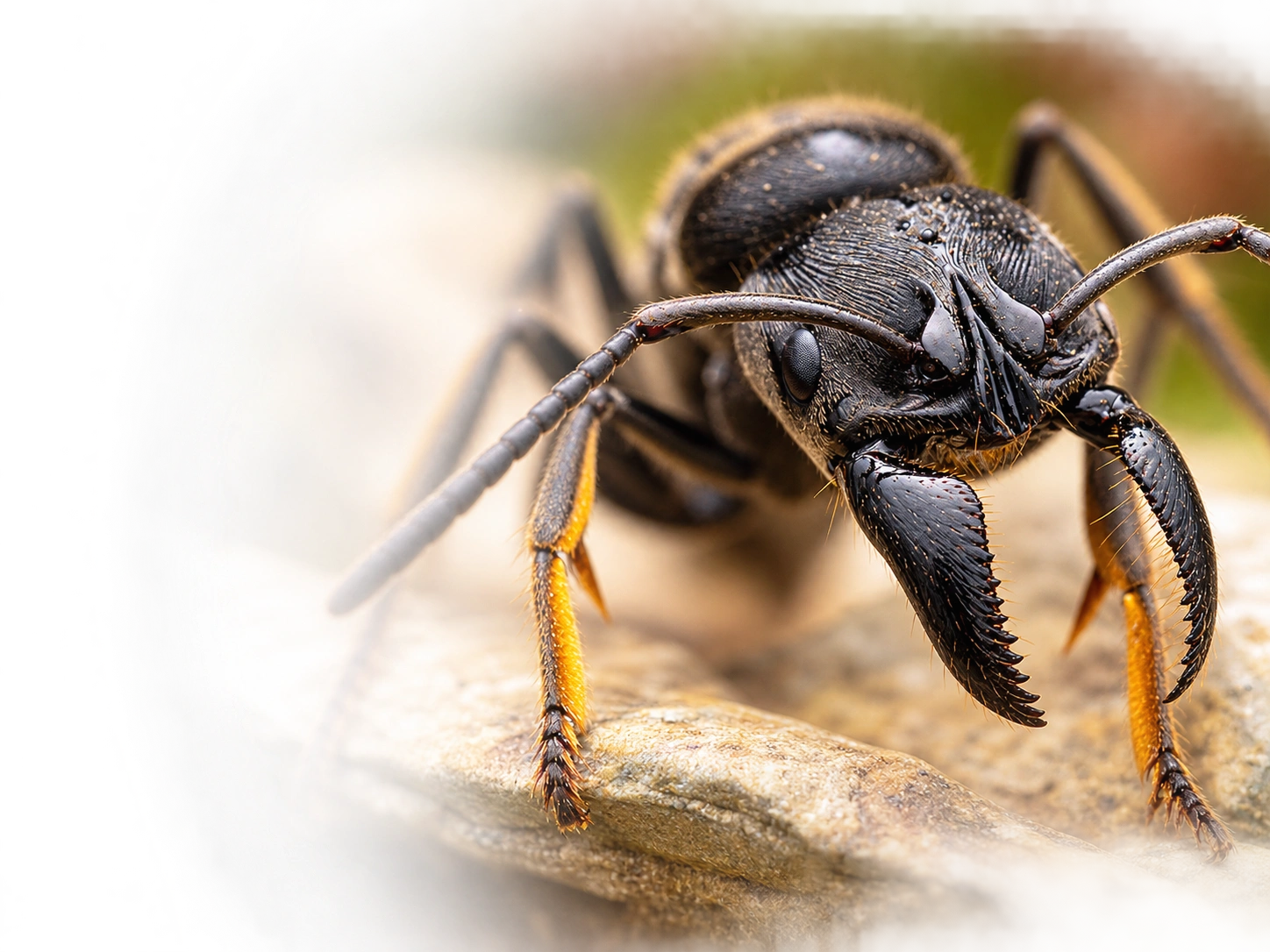
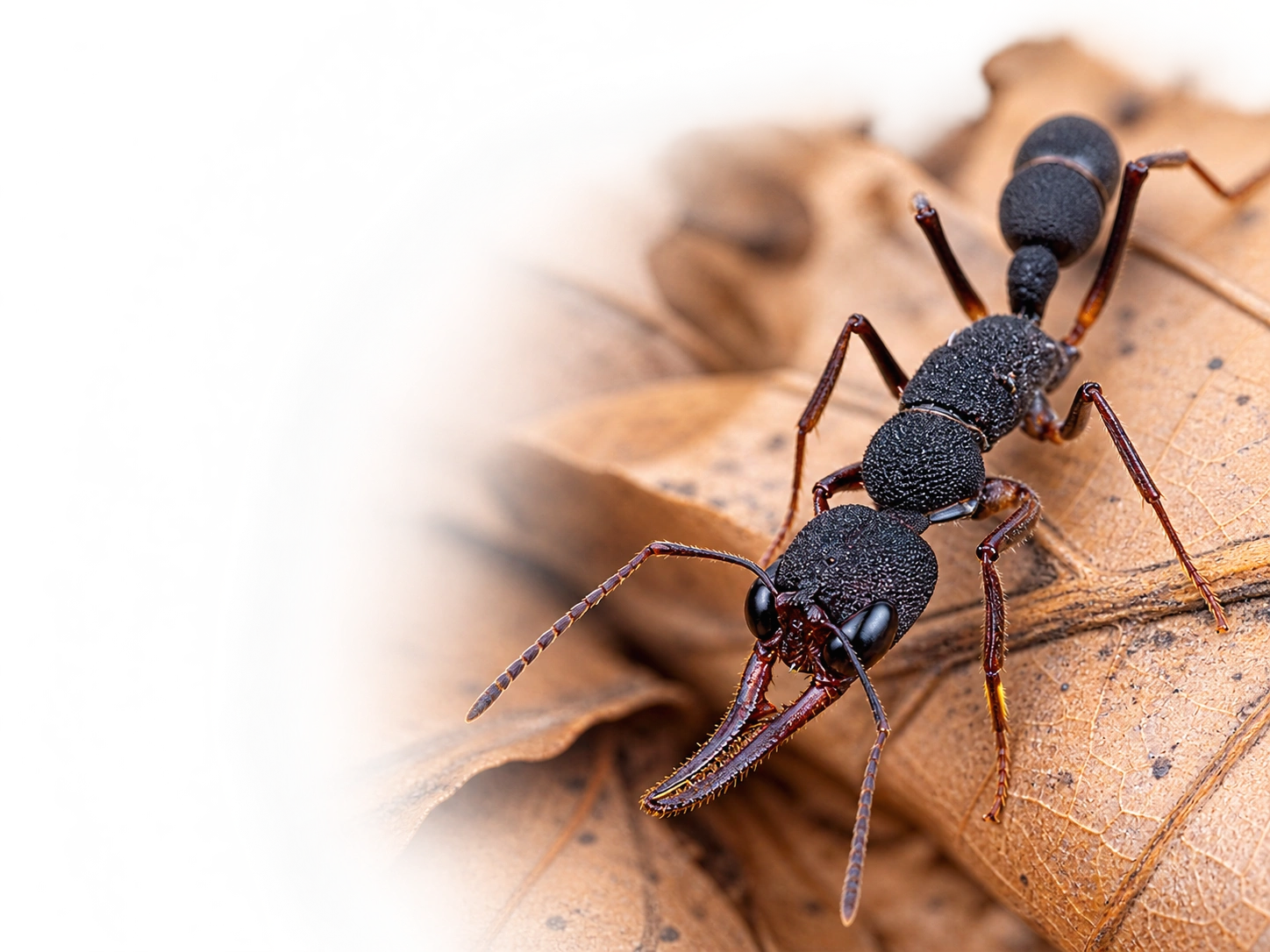
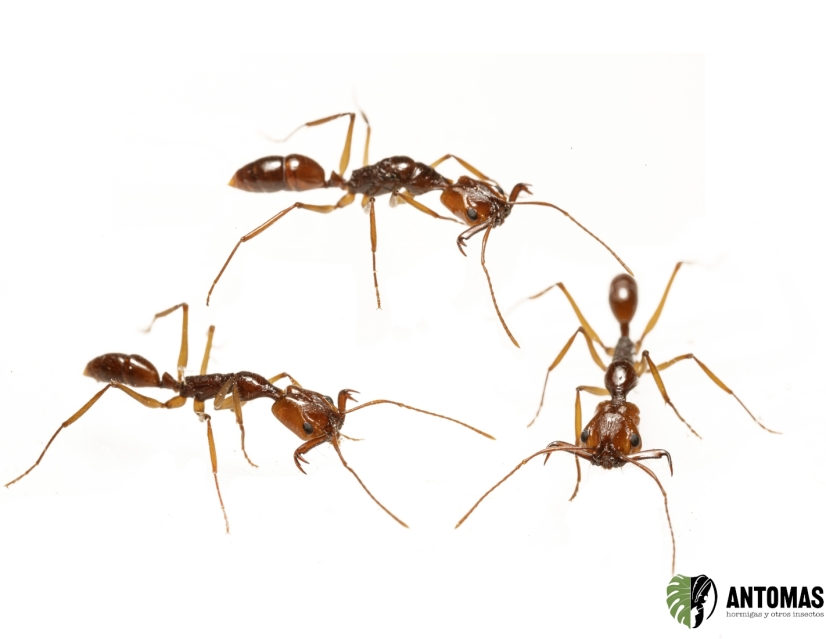
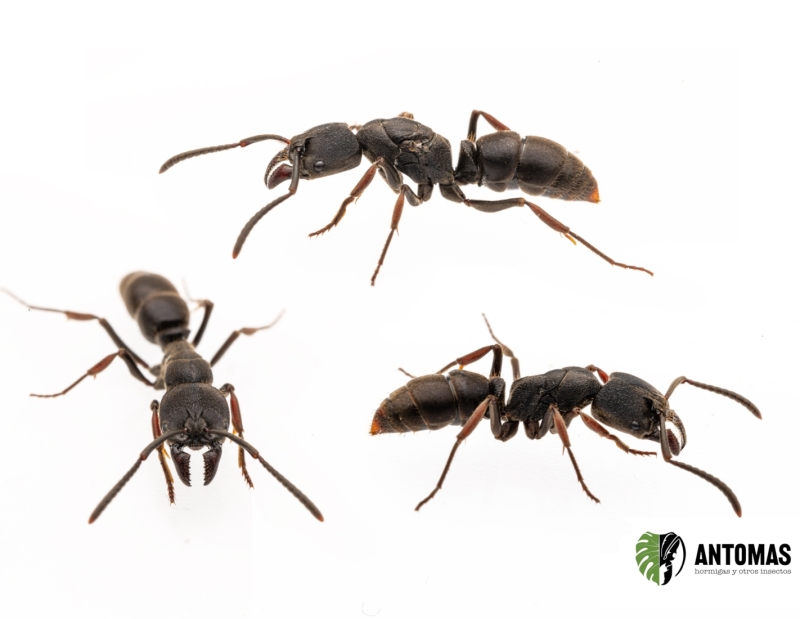
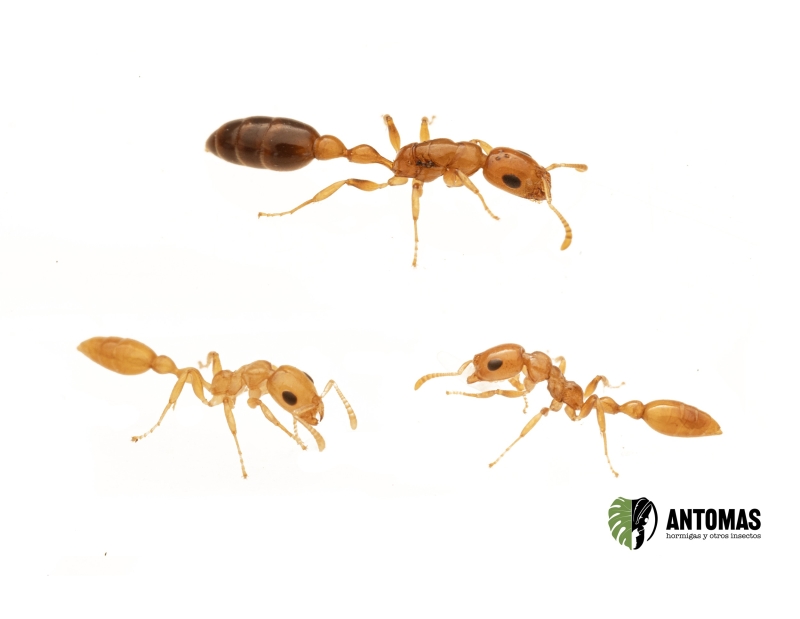
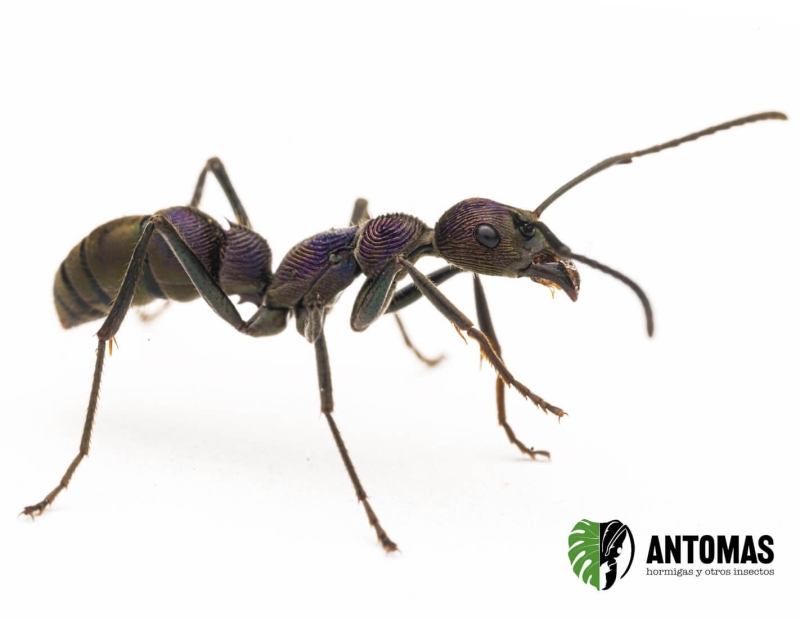
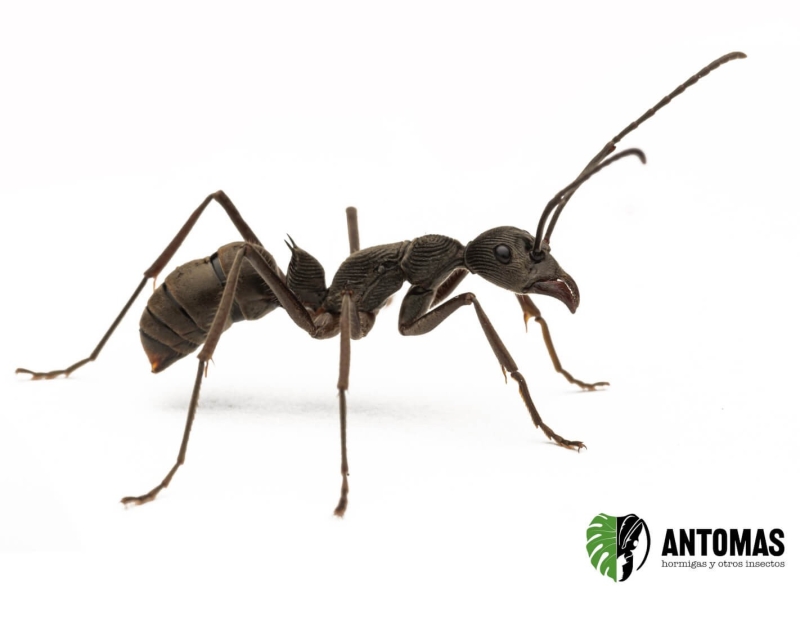
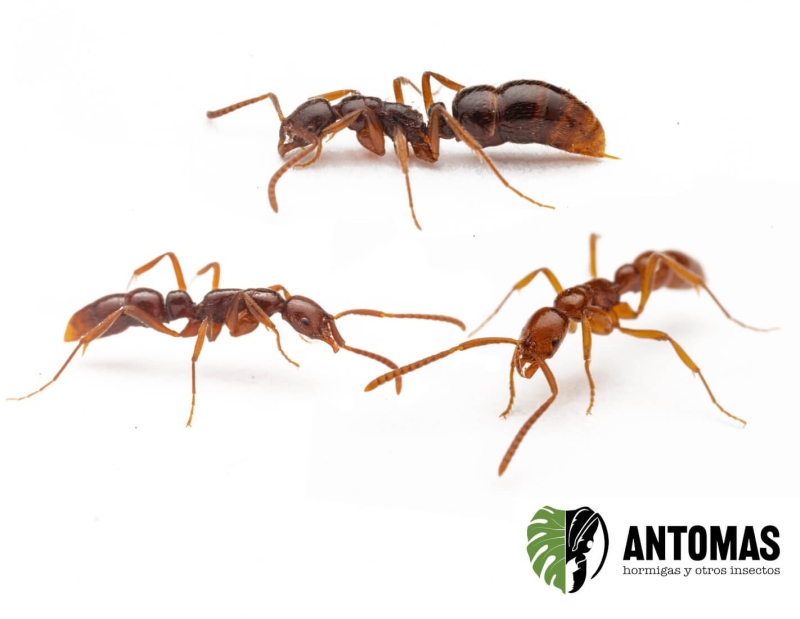
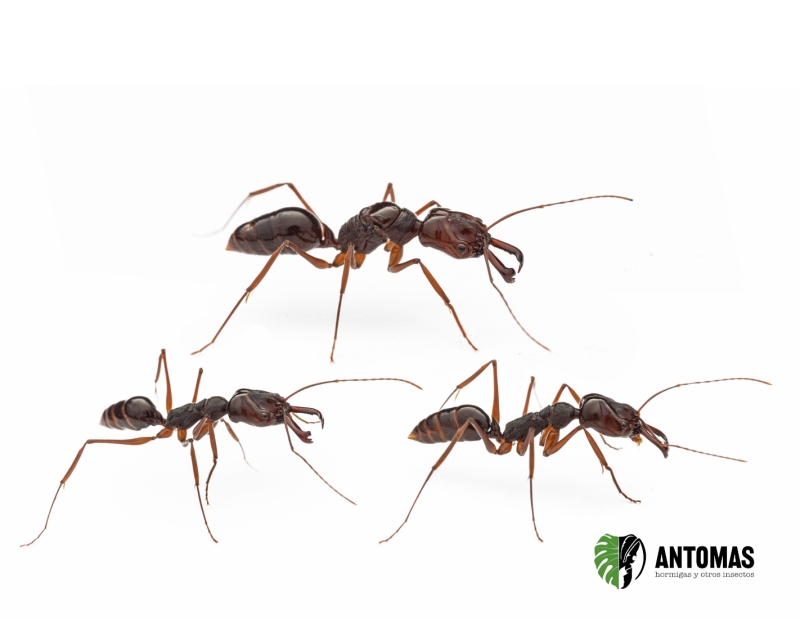
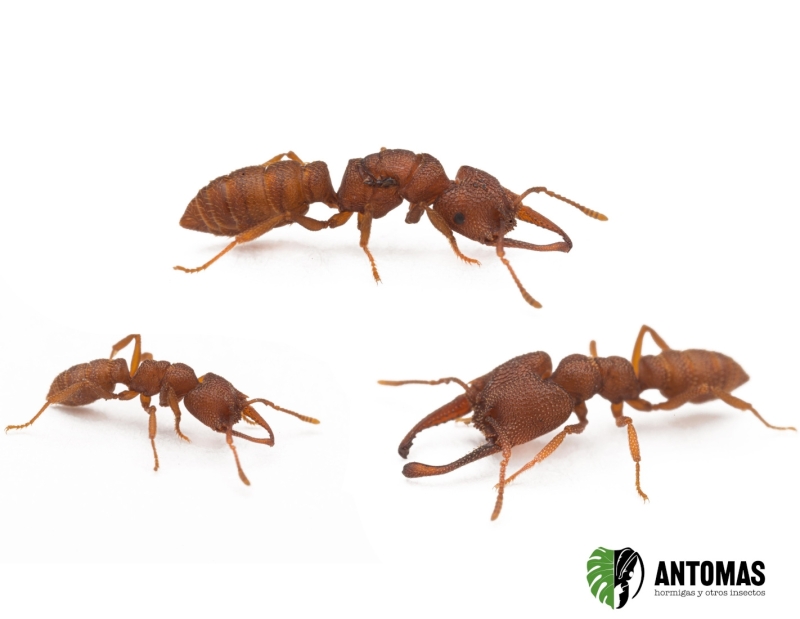
It is one of the large Anochetus, with workers over 8 mm long, and above all one of the most elegant: a slender, caramel-orange body, a long waist and long, straight mandibles that look like a gin trap when open. At Antomas we describe them like this: “quite large and, above all, very, very slender and beautiful”. Its name suits it well: in Latin, princeps means “the first” or “the prince”. And, like many ants from South-East Asia, it hides a small taxonomic mystery. That is where we begin.
Biology
A prince from Java that may be hiding another species
The Italian Carlo Emery described the species in 1884, within an identification key, from a single worker from Java; years later he specified the locality: Tjibodas. Since then it has received four other names that are now synonyms: A. princeps var. laeta Forel, 1910, from Sumatra; A. jacobsoni Forel, 1911, and A. serratus Stitz, 1925, both from Java; and A. jacobsoni var. taipingensis Forel, 1913, from Taiping, in Peninsular Malaysia. The myrmecologist William L. Brown brought them all together under A. princeps in 1964.
It belongs to the A. rugosus species group, which Brown defined in 1978: medium-sized to large ants whose mandibles have a serially toothed inner margin. The group includes A. princeps, A. rugosus and A. muzziolii, and A. mixtus joined it in 2017.
That is why the name of our product carries the abbreviation “cf.”, from the Latin confer, “compare”. Taxonomists use it when a specimen matches a species but the identification cannot be considered closed. Here there are good reasons for caution. As early as 1964, Brown warned that some isolated populations of A. princeps might turn out to be separate species, and in 2012 the entomologist Herbert Zettel went further: part of the material from mainland South-East Asia may belong to an undescribed species, because it differs considerably in the sculpture of the pronotum and the shape of the head.
What is more, very similar species live in the region, such as A. mixtus Radchenko, 1993, from the same group, known from Indochina and southern China. Its workers measure 8.4–8.8 mm, almost the same as those of A. princeps, and it is the species it is most easily confused with. A clue to tell them apart: A. mixtus has a clearly striated frons, whereas A. princeps stands out for its smooth, shiny pronotum, slender mesosoma and long-stalked petiole. And the group keeps springing surprises: in 2019 A. medogensis, a new species “similar to A. princeps”, was described from Tibet.
So the ant you will have at home matches A. princeps, but it could be a population that science eventually separates as a species in its own right. In the rest of this care sheet we simply call it A. princeps or “our Anochetus”.
A trap with a latch, a spring and a trigger
Its mandibles are among the most sophisticated weapons in the insect world. They work like a catapult: the muscles store energy for seconds and release it in less than a thousandth of a second. The mechanism has three parts, like a mousetrap:
- The latch. When the mandibles open, a muscle moves the base of each one into a small notch in the joint, where it stays locked, even while the huge muscle that closes them contracts with all its strength.
- The spring. That contraction loads energy into a “spring”, probably highly hardened pieces of cuticle in the mandible and the head, although it has not yet been identified with certainty.
- The trigger. A tiny muscle, the trigger muscle, pulls the mandible out of the notch and releases it, and the mandibles snap shut. Comparing Anochetus and Odontomachus, Wulfila Gronenberg and Birgit Ehmer concluded in 1996 that this muscle derives from the closer muscle itself.
They are two opposite muscles: the one that loads the spring contracts slowly, and the trigger muscle contracts fast. One provides the force and the other the speed.
And who pulls the trigger? Special trigger hairs. When prey touches them, the signal travels along giant sensory and motor neurons, like those first discovered in Odontomachus, and the whole reflex takes about 5 thousandths of a second. Curiously, the hairs are not essential: workers touch their nestmates with them without firing, and they probably serve to measure the distance to the target.
There are two details specific to the genus. In Anochetus, the maximum gape of the mandibles usually exceeds 180°, and its muscles attach to the tendon by means of fibrils, whereas in Odontomachus they attach directly.
Faster than a blink, but the records belong to its cousin
How fast is the strike? In Anochetus, the first studies gave a duration of less than 2.5 thousandths of a second, but they were made with cameras of about 400 frames per second, which could only give minimum values. The first high-speed measurement in the genus came in 2018, with four species: two of them, A. targionii and A. paripungens, strike very much like Odontomachus, with a mean maximum rotational speed of about 37,000 radians per second, while the other two, A. horridus and A. emarginatus, are considerably slower, at about 13,000. The strike of A. princeps has not been measured.
The record figures that circulate belong to its cousin, Odontomachus, and it is worth saying so. In O. bauri, filmed at 50,000 frames per second, the complete strike lasts on average 0.13 thousandths of a second (the fastest, 0.06), and the tip of the mandible reaches an average speed of 38 m/s, with a maximum of 64.3 m/s, over 230 km/h. The force of the impact can exceed 300 times the ant’s body weight. It is one of the fastest animal movements ever measured. In eight species of Odontomachus, the mean maximum speed ranges from 36 to 49 m/s, and the large species strike more slowly but with more force.
This invention is not exclusive to its lineage: the trap jaw has evolved at least four times in ants, in three subfamilies: once in the ponerines (Anochetus and Odontomachus), once in the formicines (Myrmoteras) and twice or more in the myrmicines (the dacetines).
“Bread-knife” mandibles and a dancer’s body
If you look closely at a worker, you will see that its mandibles are not simple pincers. They are long and linear, and they arise very close together, near the midline of the head. In A. princeps, moreover, the shaft is shaped like a bread knife: a single sharp, toothed inner edge, like a saw. This is the feature by which Zettel’s 2012 key identifies it, separating it from all the other Anochetus of the Philippines: over 8 mm and a mandible “bread-knife-shaped, with a single sharp, dentate medial edge”. At the tip, each mandible ends in a dorsal apical tooth, a ventral one and, between the two, a well-developed intercalary tooth.
And then there is the body. Science confirms what we see at home: the pronotal disc is smooth and shiny, the mesosoma (the “thorax”) is relatively slender and the petiole, the waist that joins the thorax to the abdomen, has a fairly long anterior peduncle. A slender mesosoma is common in the genus, but in a species of this size it really stands out. To get an idea of scale: the genus includes species of barely 4.35 mm, such as A. graeffei, and giants of 9.4 mm, such as A. werneri; ours, at over 8 mm, is among the large ones.
Flung backwards by a jaw strike
Such a powerful strike has a curious side effect: if the mandible hits something larger than the ant itself, or the ground, the recoil sends it flying. The myrmecologist William M. Wheeler described this backward leap in the early 20th century and called it “retrosaliency”, and it was later documented in other trap-jaw lineages, including Anochetus. In the genus it has been described that they can “bounce” away from danger with their mandibles.
Accident or strategy? It used to be thought that it was mainly an accidental effect, but in Odontomachus two kinds of jump are distinguished: a horizontal one, when striking an intruder, and a vertical escape jump, when striking the ground, which seems intentional and defensive. And it works: when faced with antlion larvae, O. brunneus escaped by jumping with its mandibles in 15 % of encounters, and with its mandibles immobilised it escaped less often.
In Anochetus, nobody has measured these jumps yet. What we can tell you is our own experience: our workers jump with their mandibles when something startles them, and they are flung backwards. It is spectacular, and worth bearing in mind when you open the foraging area (see “Escapes and barriers”).
Better to play dead than to fight
With a weapon like that, you might expect an aggressive ant. Not at all. Back in 1978, Brown observed that Anochetus often play dead when disturbed, unlike Odontomachus, which tend to attack and sting intruders. This is what biologists call thanatosis: the ant stays motionless, as if lifeless, until the danger has passed.
Its defensive repertoire is remarkably varied: keeping still, leaping backwards with a jaw strike and, if there is no other option, stinging. On the other hand, the “bouncer” workers of some Odontomachus, which wait at the nest entrance with the trap cocked to drive intruders away with blows, have not been documented in Anochetus.
A practical tip that follows from this: if, while cleaning or moving the colony, you see a motionless worker, do not assume it is dead straight away. Wait a few minutes: most likely it is only pretending.
A solitary hunter with its trap cocked
Trap-jaw ants hunt alone: apart from Daceton, they do not recruit their nestmates. The workers roam the forest floor, the leaf litter and the rotting wood with their mandibles open and the trigger ready. When they detect prey with their antennae, they bring it within reach of the trigger hairs and strike, often several times; if the prey resists, they sting it, and then carry it to the nest. In general, they wait for the prey to touch the trigger hairs, in a mixture of searching and ambush, and the use of the sting depends on size: the smaller the worker relative to its prey, the more it stings.
Why so much speed? It might seem to be for catching elusive prey, but a study of the hunting of O. bauri in Panama pointed to something else: in the more specialised Odontomachus and Anochetus, the speed of closure serves more to generate power than to catch fleeing prey. It is less a lasso than a hammer blow.
Very little is known about what they eat in the wild. Some species have specialised, such as A. traegordhi, which hunts termites in the same rotting logs where it nests, but in the laboratory the genus accepts many different arthropods: termites, fruit flies and springtails.
In Antomas’s experience, A. princeps is a truly good hunter, and not a specialist at all: it catches flies and blowflies, Drosophila, Thermobia (silverfish), mini crickets and small cockroaches. Watching it approach a blowfly with its trap open and catch it in a single strike is one of the great moments of keeping this species.
Its venom, on the other hand, is almost a mystery: it has barely been studied in the genus. In an American species, A. emarginatus, a venom peptide with a “unique” structure was isolated in 2016.
Cousin, not mother, of Odontomachus
Anochetus and Odontomachus are the two trap-jaw ants among the ponerines, and they have always been studied together. There are about 110 living species of Anochetus and 69 of Odontomachus, and nine fossil Anochetus are known, most of them in Dominican amber. Odontomachus are larger on average, and Anochetus smaller and more discreet, although ours is one of the large ones.
For decades it was thought that Odontomachus had arisen from within Anochetus. Brown proposed this in 1978, based on the male genitalia and the shape of the petiole, and the chromosomes and musculature seemed to prove him right. Molecular phylogenies have changed everything:
- 2016. A DNA study found strong support for each genus being a natural group, separate from the other, and for the trap jaw having evolved from a short-jawed ancestor. The group arose about 52.5 million years ago, in the early Eocene, in South America or South-East Asia.
- 2021. A global analysis, with 44 species of Anochetus and 38 of Odontomachus, confirmed it: the two genera split in the Eocene.
So Anochetus is not the “mother” of Odontomachus but its sister genus: two branches that have been evolving separately for tens of millions of years. Even so, Anochetus retains some older traits, such as its small size and mandible muscles attached by fibrils.
Rotting wood and clay banks, up to 1,500 m
In 1978 Brown described it as a species widespread in the forested parts of South-East Asia and the Greater Sunda Islands. Today it is recorded from the Andaman Islands, Myanmar and Indochina, through the Malay Peninsula, to Sumatra, Java, Borneo, the Philippines and Sulawesi.
It is an ant of humid forest. In Luzon it was collected between 150 and 500 m above sea level, but Brown cites a collection in Borneo at about 1,500 m, one of the highest in the genus. Its nests have been found in rotting wood on the forest floor, in a rotting log and in a clay bank. In Sulawesi it turned up less than 100 m from nests of another species of the genus, A. gladiator, also in rotting wood.
This fits what is known about the genus: small nests in the soil, in rotting wood and, in rainforest, very often under a fallen log, with galleries running into the wood. Everything suggests that A. princeps is a cryptic ant of leaf litter and rotting wood, living in a humid, dark world with a stable temperature. It is an inference, but it explains very well what it needs at home.
The climate of its home: heat outside, coolness in the soil
In the tropical forests of South-East Asia, the climate depends above all on altitude:
- Lowlands. Hot all year round, with monthly means of about 27–29.5 °C and maximums of 32–35 °C, a drier season and a season of monsoon rains, with air humidity of 80–85 % in the rainy months.
- Mountains. At around 1,500 m, where the species has also been found, the climate is mild and very stable, with means of about 16–19.5 °C, less than 4 °C difference between the coldest and the warmest month, and humidity of around 90 % in the rainy season.
- Day length. It changes little through the year: between about 11 and 13 hours.
But a colony of A. princeps does not live in the open air: it lives on the forest floor, under the leaf litter and inside rotting wood, and there the climate is different. A large 2024 study showed that, near the ground, the tropical understorey is on average 1.6 °C cooler than in the open, with a smaller daily range. In Borneo, where our species also lives, the daily mean in the understorey is 23.9 °C (25.3 °C by day and 22.9 °C at night), and South-East Asia is the most stable tropical region through the year. And in the Panamanian rainforest, next to the nests of another trap-jaw ponerine, O. bauri, the soil was at 24.2–27.5 °C while the air ranged between 24 and 30 °C, with humidity of 78–97 %.
The conclusion for keeping is clear. The 32–35 °C of lowland afternoons does not reach the nest, and a good part of its range, in Java, Sumatra and Borneo, lies close to the equator, where there is no winter. Nothing suggests that Anochetus needs a diapause, and keepers agree that it does not have one. What almost all the places where it lives have in common is stability. That is why at Antomas we keep it at a constant 24–27 °C all year round, with no winter drop, and never above 28 °C.
Small colonies, a single queen
Like many ponerines, Anochetus retains ancient ant traits, such as small colonies and solitary hunting. Their colonies usually have fewer than 100 workers, compared with several hundred in Odontomachus; the known exception is the African A. faurei, with about 400.
Queens in the genus are varied: in some species they are ergatoid, wingless and worker-like; in others they are winged, and some have both types. In the A. rugosus group, to which our species belongs, dealate queens have been found, which had wings and shed them after mating: in Borneo, Brown found a nest of A. rugosus under the bark of a rotting stump, with a dealate queen, 5–6 workers and very little brood. Shops describe Asian Anochetus as monogynous, with a single queen per colony.
Nothing has been published on the queen or the colonies of A. princeps. In Antomas’s experience, the queen is winged, like those of its group, and sheds her wings after the nuptial flight. The colonies grow at a moderate pace, and at home a colony of 200–300 workers is already a good size, above the average for the genus. How it founds colonies has not been studied. In many ponerines, colony foundation is semi-claustral: the queen goes out hunting to feed her first larvae, as Caryl Haskins documented in 1941 in Bothroponera soror. In Anochetus, keepers’ sources disagree. At Antomas we sell colonies with queen, already up and running, so you skip that delicate stage.
Larvae that need soil to spin their cocoons
Like almost all ponerines, A. princeps pupates inside a silk cocoon. As early as 1915, Wheeler pointed out that the cocoon is present in all known ponerines, with a single exception, a small African ant. And in the same work he recorded an observation that is key for any keeper: ant larvae are unable to spin their cocoons unless they are temporarily enveloped in particles to which they can attach the thread from their silk glands. That is why workers bury mature larvae or cover them with soil or debris.
In many ponerines, moreover, the larvae feed directly on the prey brought to them by the workers or the queen. Odontomachus keepers know that larvae which fail to spin die or end up eaten by the colony, and they blame a lack of substrate, smooth surfaces (tubes, acrylic, 3D printing) and a lack of humidity. At Antomas we add the most treacherous factor in our homes: heat (see “The key: above 28 °C, the larvae struggle to spin”).
Size and morphology
A large ponerine for its genus, slender, with long, linear mandibles and a long-stalked waist.
- Colouring. There is no published scientific description of the worker’s colour. In Antomas’s experience, the workers are rather orange, with a caramel tone: hence the name “copper-coloured” under which we sell it.
- Mandibles. Long and linear, “bread-knife” shaped, with three teeth at the tip and the trigger hairs of the trap (see “‘Bread-knife’ mandibles”).
- Mesosoma and petiole. Smooth, shiny pronotum, slender mesosoma with a raised anterior rim on the mesonotum, and a long-stalked petiole with a blunt or narrowly rounded apex, with no spines described.
- Sting. Functional: they use it to finish off prey that resists.
- Compared with its relatives. A. mixtus has a clearly striated frons, and A. rugosus a largely striated head.
- Queen. There are no published data on the queen of A. princeps. In Antomas’s experience, she is winged and sheds her wings after the nuptial flight, like the dealate queens known in her species group. We do not have a reliable measurement.
- Male. Winged and smaller, with large ocelli, strongly bulging eyes and tiny mandibles, each with a whitish basin that may serve to release pheromones. It is a warm tan colour, with the top of the head and thorax somewhat darker, and the legs and mouthparts pale yellow.
- Development. They pupate inside a cocoon, for which they need substrate. There are no published data on the development time of this species.
Approximate sizes
- Workers: over 8 mm
- Queen: no published measurements
- Male: about 5.6 mm, with a forewing of 4.8 mm
The worker measurement comes from Zettel’s key (2012); the male’s, from Brown (1978), based on a specimen from Borneo. For reference, A. mixtus, from the same group, measures 8.4–8.8 mm. There is no modern morphometry of the species.
Care in captivity
Difficulty: 4/5 – Advanced
It is not a difficult species on a whim, but because its margin is narrow. Its needs come down to three: a stable temperature that never goes above 28 °C, a very humid nest with coconut-fibre substrate and plentiful, varied prey. The challenge lies in the first: in many homes in southern Europe, summer keeps rooms above 28 °C for weeks, and, in Antomas’s experience, at those temperatures the larvae struggle to spin their cocoons. Add to that the fact that there is hardly any published keeping information on the species and that they jump with their mandibles, and you have an ant for keepers with some experience. Shops usually place other, smaller Asian Anochetus at an intermediate level; at Antomas we rate ours as advanced.
And it is well worth it. Few ants offer so much spectacle in so little space: large, slender workers that patrol with their mandibles open beyond 180°, catch blowflies in a single strike, are flung away by a jaw strike and, if you disturb them, play dead. It is a very rare species in the trade and almost undocumented in the hobby. And, in Antomas’s experience, with a very humid nest and never above 28 °C, they do very well in captivity.
Recommended parameters
- Temperature: 24–27 °C, constant all year round. Never above 28 °C. This is the range of the forest soil where these ponerines live (see “The climate of its home”). Shops do not go above 28 °C with other Asian Anochetus either.
- Nest humidity: very high, stable and without waterlogging: as a guide, 70–90 %. In the wild, next to the nests of rainforest ponerines, it is 78–97 %.
- Substrate: coconut fibre inside the nest, always moist (see “Recommended formicaria”).
- Foraging area: clean and drier than the nest, with the lid closed, an oil barrier and water always available in a test tube with cotton wool.
- Light: it is enough to leave them their dark area in the nest and a lit foraging area, with a normal day–night cycle; in their native range, the day lasts about 11–13 hours all year round.
- Diapause: none (see “Diapause”).
This is a high-humidity species, and letting the nest dry out is a serious mistake. Keepers of other Anochetus warn that a dry nest stresses the colony and slows brood development, and, without moisture, the coconut fibre is no use for spinning. High humidity does not mean waterlogging: standing water and still air bring mould. Gentle ventilation and removing leftovers are the best prevention.
The key: above 28 °C, the larvae struggle to spin
This is the most important point in this care sheet. In Antomas’s experience, as in many hypogaeic species and ponerines, above 28 °C the larvae of A. princeps struggle to spin their cocoons. It is an observation of ours and of other keepers, not a laboratory finding: we know of no study that has measured it in ponerines.
It does fit, however, with the microclimate of its home: the forest soil next to the nests of a rainforest ponerine was at 24.2–27.5 °C, and the understorey in Borneo stays at around 23.9 °C on average. Moreover, a study of 17 ant species found that species whose workers tolerate more heat also need more heat to raise their brood, and vice versa. An ant of the forest floor, little exposed to heat, would fit into the second group (this last point is our own inference).
How to spot it: larvae that are already large but never manage to wrap themselves in a cocoon and end up dying or being eaten by the colony. If you see this, check the temperature first, and then the humidity and the substrate.
How to prevent it:
- Choose the spot carefully: the coolest room in the house, away from windows, direct sunlight and radiators.
- Put a thermometer next to the nest and check it, above all on summer afternoons.
- In summer, no artificial heat. If your home stays above 28 °C for weeks, you will need an air-conditioned room.
- In winter, gentle heat. If the house drops below 24 °C, use a gentle heat source with a thermostat on one side of the nest, so the colony can choose; never under the whole nest.
- Humidity and coconut fibre, always. Heat is the most treacherous factor, but not the only one (see “Larvae that need soil to spin their cocoons”).
Recommended formicaria
At Antomas we recommend the Qbik Wild range by Anthouse, made of plaster, in its hybrid version, the one that best keeps a nest very humid and stable: beneath the galleries it has an evaporation reservoir, separate from them, which passes humidity through a mesh with activated carbon so the water does not stagnate, and it is completed by a side drinking tube. The right format for our colonies is the Qbik Wild Duo P 2C Hybrid.
Inside the nest there is one essential ingredient: coconut fibre. Put a thin layer in the chambers and keep it moist. It does two jobs:
- For spinning. The larvae need particles to which they can attach the cocoon thread, and the workers cover them with these. Odontomachus keepers agree that moist coconut fibre works very well, and dry fibre does not.
- For humidity. It holds water and spreads it through the chamber, like the forest soil.
Make sure there is still fibre in the brood chambers: workers sometimes carry it out of the nest, and the larvae are left without material. If this happens, add a little more. Use coconut fibre without fertilisers or additives.
Complete the set-up with these details:
- A closed lid on the foraging area and an oil barrier on the rim (see “Escapes and barriers”).
- A clean foraging area, drier than the nest, with no leftovers that grow mould or act as a bridge over the barrier.
- Water always available: for long-jawed species like this one, at Antomas we recommend a test tube with water and cotton wool in the foraging area; they drink from the cotton without any problem.
- A feeder for the occasional sugar; never cotton wool (see “Feeding”).
Arrival and moving
At Antomas we sell colonies with queen, workers and brood. When yours arrives, let it rest in a quiet place at 24–27 °C and check that it has water. To move it into its formicarium, we do it by tipping: we open the tube inside the foraging area, next to the nest entrance, and tip the colony out (workers, queen and brood) with a few gentle taps, helping the stragglers with a brush. Three tips for this species:
- Keep the lid at hand: a worker may be flung out by a jaw strike.
- Patience with the “dead”: if one stays motionless, it is probably pretending.
- Have the coconut fibre ready: the nest should already have its moist substrate when they arrive.
Do it calmly and without fear: within a few hours they will have taken over the nest. And be patient: they grow at a moderate pace, and a colony of 200–300 workers is already a good size. Their charm lies in quality, not quantity.
Feeding
A. princeps is first and foremost a hunter, and its diet is protein. At Antomas we feed it flies, blowflies, Drosophila, Thermobia (silverfish), mini crickets and small cockroaches, live if possible: that way you see the trap in action, which is the great appeal of the species. Shops add that they also take freshly killed prey.
- Prey size. Something they can overpower: for a small colony, small prey (Drosophila, mini crickets, Thermobia); as it grows, blowflies and small cockroaches.
- Close to the brood. The larvae feed directly on the prey the workers bring into the nest. If a large prey item is left in the foraging area, offer it in small pieces.
- Change the type of insect from one week to the next, so they do not always eat the same thing.
- Trusted insects. Buy them from a reliable supplier: insects treated with insecticides or acaricides can kill the colony.
The more they eat, the better and faster they grow. This is the Antomas philosophy: if you carry out daily maintenance and remove leftovers, it is better to overfeed, because the colony understands that it has more resources and grows faster and in greater numbers. If you will not be able to clean often, it is better not to overfeed: food that is left over rots and brings mould and mites. Remove leftovers within 24 hours. And do not leave them several days without protein: a keeper of another Anochetus lost almost all the brood after a few days without being able to feed them.
Sugar, only as an occasional supplement. It is not the basis of their diet and must never replace protein. From time to time you can offer them a drop of a nectar such as Anthouse’s Blue Sugar nectar, always in a feeder and never on cotton wool, because cotton goes mouldy and spoils the liquid very quickly. Use a traditional or home-made feeder, where the drop stays “spread out” and accessible.
Water: always, in the test tube with cotton wool. It is the one thing they must never be without.
Diapause
No diapause: in a good part of its range there is no winter, and on the forest floor temperature changes arrive heavily buffered (see “The climate of its home”). Keepers agree that it does not need one, and one shop warns that cooling it on purpose can harm it. At Antomas we keep it active all year round, at a constant 24–27 °C, with no winter drop. Avoid sudden changes, though.
Behaviour in captivity
Patient hunters. You will see the workers patrol the foraging area with their mandibles open, explore with their antennae and then, suddenly, the strike: every feed is a small hunt.
Discreet. A keeper of another Anochetus reported that his workers tended to hide. If you disturb them, they usually play dead or are flung away by a jaw strike rather than attack.
Watch without fear. At Antomas we believe ants are there to be enjoyed, observed and learned from, not kept hidden away. It is enough to leave them their dark area in the nest and a lit foraging area, and to watch them gently, intervening and stressing them as little as possible. They get used to your presence.
Warning signs:
- Large larvae that do not spin their cocoons: check the temperature (never above 28 °C), the humidity and the coconut fibre.
- Brood disappearing: food is almost always short.
- Mould in the nest: forgotten food leftovers or standing water.
- Workers crowding around the water, or the queen out of the nest: check the nest humidity.
Escapes and barriers
In Antomas’s experience, they jump with their mandibles but are only average climbers. That makes things easier: an oil barrier on the rim of the foraging area works well with them. Complete it with a closed lid and a clean foraging area, with no leftovers or decoration touching the barrier and acting as a bridge.
Jumping is their best way to escape: a startled worker can be flung backwards by a jaw strike and, with the lid open, end up outside. When you open the lid to feed or clean, do it calmly and close it when you have finished. Also check stoppers, joints and connections.
Handling and safety
They have a functional sting and can sting. In the genus, the sting is described as mildly painful (as one shop puts it for A. graeffei, adding that they are not aggressive towards people). They can also give you a jaw strike, the same blow they hunt with. At Antomas we recommend always handling them with entomological tools (a soft brush or soft forceps), never with your hands, and taking care if you are allergic to hymenopteran stings. Work slowly so as not to lose or harm the queen. This is an exotic species: it must never be released.
What not to do
- Let the temperature go above 28 °C: the larvae struggle to spin their cocoons.
- Let the nest dry out: it needs high humidity at all times.
- Forget the coconut fibre, or let the workers empty the brood chambers of substrate.
- Waterlog the nest or leave the air stagnant: it brings mould.
- Skimp on protein, always give them the same insect or leave leftovers for more than 24 hours.
- Replace protein with sugar, or put it on cotton wool: only occasionally and in a feeder.
- Give them a diapause or lower their temperature in winter.
- Leave the lid open or the foraging area dirty: jumping and leftovers are their escape routes.
- Assume a motionless worker is dead without waiting a few minutes.
- Handle them with your hands.
- Keep them hidden away: they are there to be watched and enjoyed; do it gently, intervening as little as possible.
Scientific sources
This care sheet is based on the scientific literature on Anochetus princeps and trap-jaw ants, on climate data from its native range and on the experience of Antomas and other keepers. Main references:
- Zettel, H. (2012). New trap-jaw ant species of Anochetus Mayr, 1861 (Hymenoptera: Formicidae) from the Philippine Islands, a key and notes on other species. Myrmecological News 16: 157–167. Full text in Myrmecological News (open access)
- Chen, Z., Yang, Z. & Zhou, S. (2019). Review of the ant genus Anochetus Mayr, 1861 (Hymenoptera, Formicidae) from China, with revival of the valid status of Anochetus gracilis. Journal of Hymenoptera Research 68: 49–74. doi:10.3897/jhr.68.30784
- Larabee, F. J. & Suarez, A. V. (2014). The evolution and functional morphology of trap-jaw ants (Hymenoptera: Formicidae). Myrmecological News 20: 25–36. Full text in Myrmecological News (open access)
- Gronenberg, W., Tautz, J. & Hölldobler, B. (1993). Fast trap jaws and giant neurons in the ant Odontomachus. Science 262: 561–563. doi:10.1126/science.262.5133.561
- Patek, S. N., Baio, J. E., Fisher, B. L. & Suarez, A. V. (2006). Multifunctionality and mechanical origins: ballistic jaw propulsion in trap-jaw ants. PNAS 103: 12787–12792. doi:10.1073/pnas.0604290103
- Spagna, J. C. et al. (2008). Phylogeny, scaling, and the generation of extreme forces in trap-jaw ants. Journal of Experimental Biology 211: 2358–2368. doi:10.1242/jeb.015263
- Gibson, J. C., Larabee, F. J., Touchard, A., Orivel, J. & Suarez, A. V. (2018). Mandible strike kinematics of the trap-jaw ant genus Anochetus Mayr (Hymenoptera: Formicidae). Journal of Zoology 306: 119–128. doi:10.1111/jzo.12580
- Larabee, F. J. & Suarez, A. V. (2015). Mandible-powered escape jumps in trap-jaw ants increase survival rates during predator-prey encounters. PLOS ONE 10: e0124871. doi:10.1371/journal.pone.0124871
- Larabee, F. J. et al. (2016). Molecular phylogenetics and diversification of trap-jaw ants in the genera Anochetus and Odontomachus (Hymenoptera: Formicidae). Molecular Phylogenetics and Evolution 103: 143–154. doi:10.1016/j.ympev.2016.07.024
- Fernandes, I. O., Larabee, F. J., Oliveira, M. L., Delabie, J. H. C. & Schultz, T. R. (2021). A global phylogenetic analysis of trap-jaw ants, Anochetus Mayr and Odontomachus Latreille (Hymenoptera: Formicidae: Ponerinae). Systematic Entomology 46: 685–703. doi:10.1111/syen.12483
- Wheeler, W. M. (1915). On the presence and absence of cocoons among ants, the nest-spinning habits of the larvae and the significance of the black cocoons among certain Australian species. Annals of the Entomological Society of America 8: 323–342. doi:10.1093/aesa/8.4.323
- Ehmer, B. & Hölldobler, B. (1995). Foraging behavior of Odontomachus bauri on Barro Colorado Island, Panama. Psyche 102: 215–224. doi:10.1155/1995/27197
- Penick, C. A., Diamond, S. E., Sanders, N. J. & Dunn, R. R. (2017). Beyond thermal limits: comprehensive metrics of performance identify key axes of thermal adaptation in ants. Functional Ecology 31: 1091–1100. doi:10.1111/1365-2435.12818
- Ismaeel, A. et al. (2024). Patterns of tropical forest understory temperatures. Nature Communications 15: 549. doi:10.1038/s41467-024-44734-0