Difficulty: 2/5 – Beginner
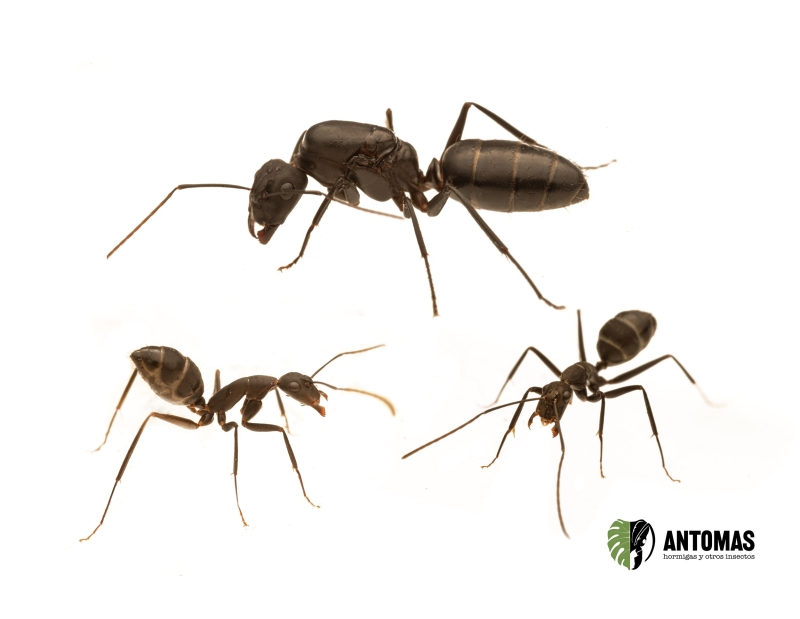
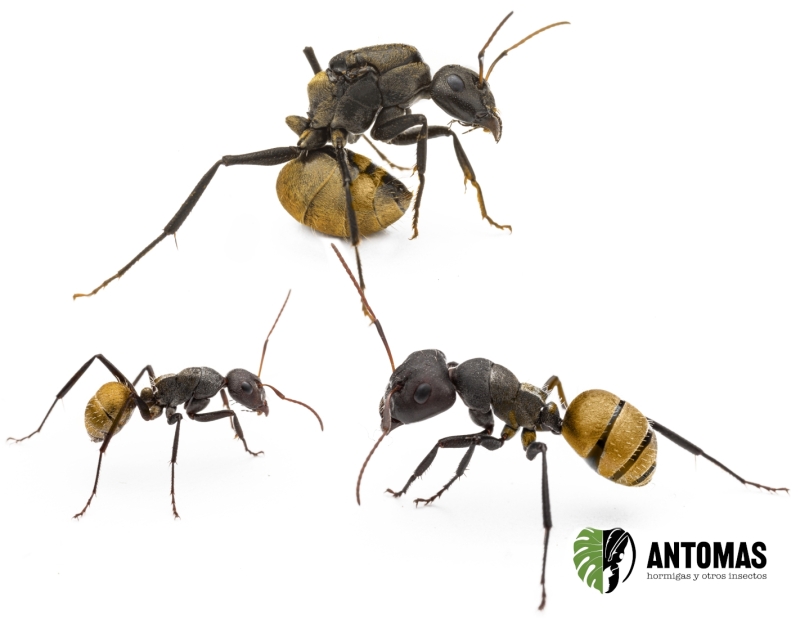
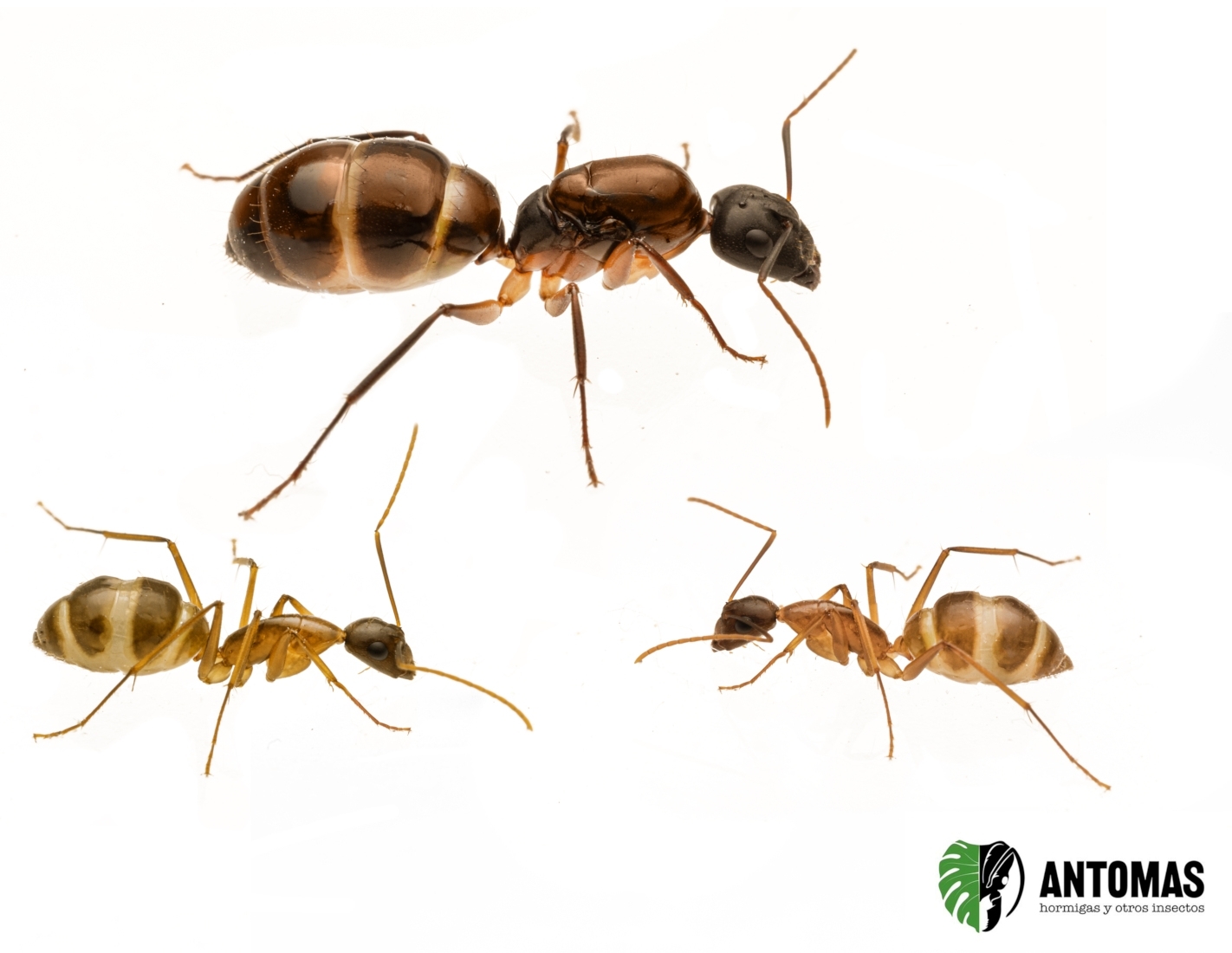
An African Camponotus from the C. maculatus group, smaller than our C. maculatus: slender, long-legged workers with a pale gaster marked with dark spots. “Mini-Maculatus” is a trade name, not the name of a described species. Sold as a queen and 4/7 workers with brood. Qbik Wild One P 1C to start with and the Qbik Alpha range afterwards; moisture in the tubes and modules while the colony is small, and a dry nest once it grows; 24–28 °C, sugar always available and plenty of protein. No diapause. It climbs acrylic: use a paraffin oil barrier.
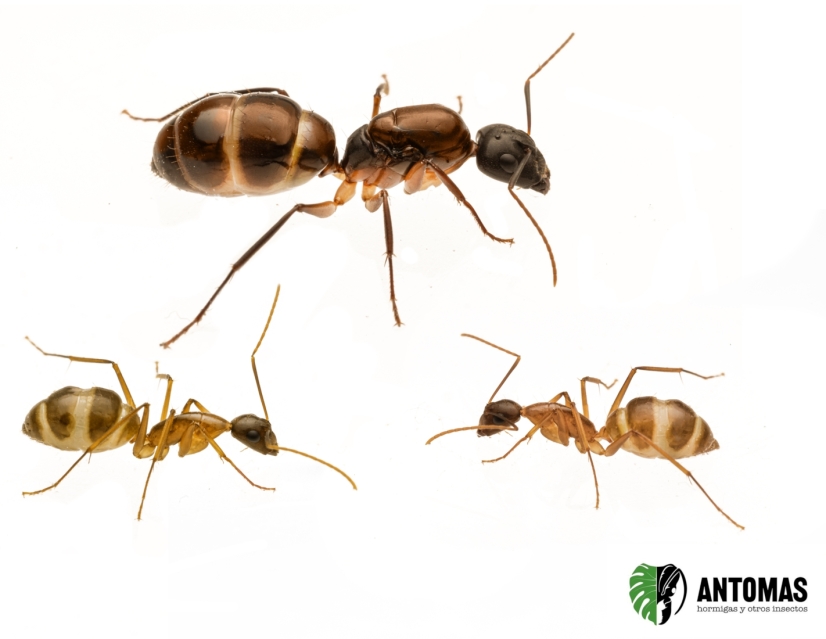
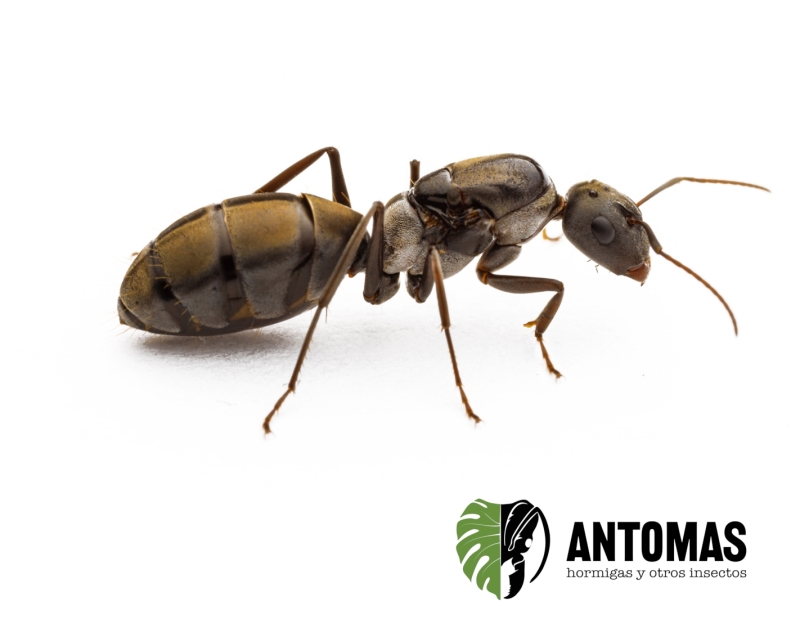
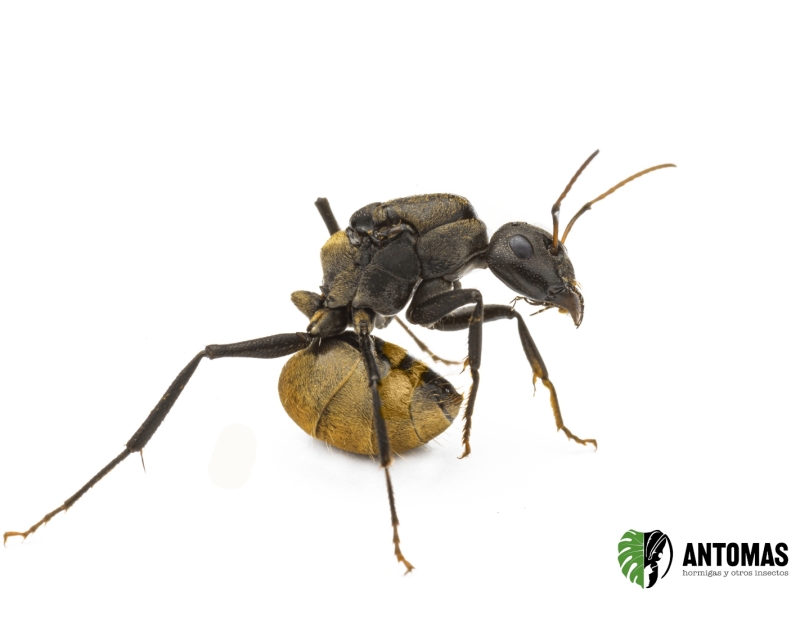
Camponotus sp. “Mini-Maculatus” is an African carpenter ant that, at first glance, looks like a miniature version of Camponotus maculatus: the same savannah Camponotus build, the same long legs, the same dark head and, above all, the same pale gaster with brown spots that gave its famous relative its name. But it is smaller and lighter, and that is why keepers know it by this nickname.
Let us be clear from the outset: “Mini-Maculatus” is not a scientific name. No species has ever been described under that name, either in the ant catalogues or in the scientific literature. It is a keeper’s label for an African Camponotus from the C. maculatus group that still has no reliable identification at species level. That is why it appears as Camponotus sp.: “sp.” simply means “a species of the genus, undetermined”.
Is that a problem for keeping it? Not at all. In this care sheet we separate what is documented for the maculatus group and for Camponotus in general from what we have learnt by keeping it at Antomas. If you are looking for an eye-catching, easy African Camponotus that will not take over half a room as it grows, this is an excellent candidate.
Biology
A keeper’s name, not a species name
In the hobby, when an ant arrives that cannot be identified with certainty, it is given a nickname in quotation marks. “Mini-Maculatus” says two things: that it resembles C. maculatus and that it is smaller.
What the name does not say is that it is a subspecies, a dwarf variety or a “small C. maculatus”. Assigning it to a species would require comparing it with the type specimens held in museums and, ideally, with genetic data, something particularly difficult in this group, as we shall see. At Antomas we prefer an honest name in quotation marks to an invented scientific name. If it is ever identified with certainty, we will update this care sheet.
What is certain is its genus. Camponotus, the carpenter ants, comprises more than a thousand described species worldwide, within the subfamily Formicinae. Genomic studies in 2015 and 2016 reorganised this subfamily and split genera such as Colobopsis and Dinomyrmex off from Camponotus, but the members of the maculatus group remain Camponotus in their own right.
The maculatus group maze
To understand why it has no species name, we need to take a look at the group it belongs to. The Camponotus of the C. maculatus group, usually placed in the subgenus Tanaemyrmex, are medium-sized to large ants with long legs, slender minor workers and broad-headed major workers, and often a pale, spotted gaster. In Africa they are legion: the myrmecologist Brian Taylor, author of the reference work The Ants of Africa, counts 52 described forms of the group in tropical Africa alone.
Many of these forms were described more than a century ago, from few specimens and with brief descriptions; in 1972 dozens of African names were merged with C. maculatus, and since then others have been split off again. A morphological and genetic study from 2006 added two facts:
- The African maculatus group is not a natural group: the species in it do not all descend from a single exclusive common ancestor, but resemble one another through convergence or through ancestral traits.
- The minor worker of C. maculatus in the strict sense has never been formally described. And the minor worker is precisely the caste we see most of in a young colony.
Without a modern revision of the group in Africa, many of the forms in circulation cannot be named with confidence. “Mini-Maculatus” is one of them.
Species hiding in plain sight
Two ants looking the same does not mean they are the same species. Ants recognise one another by smell, through a film of hydrocarbons that coats their cuticle and works like a chemical identity card. A German team analysed that film in colonies of “C. maculatus” founded by queens collected in the same savannah in West Africa and found two completely different chemical profiles, which they called chemotypes.
In a second paper, published in 2026, the same group pitted workers from different colonies against each other. Workers of the same chemotype tolerated each other even when they came from different nests, but attacked those of the other chemotype. And DNA barcoding also separated the two groups. The authors’ interpretation is that these are cryptic species: distinct species that the human eye cannot tell apart, but the ants themselves can.
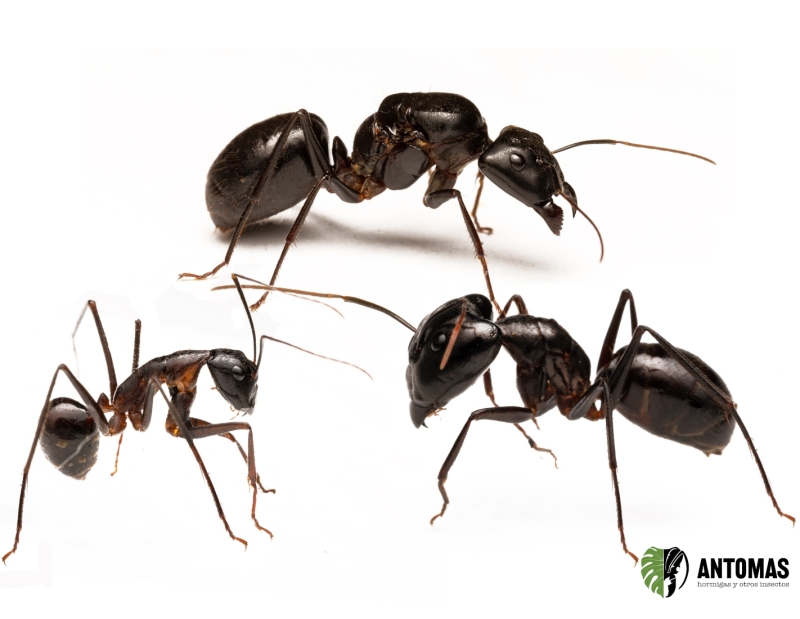
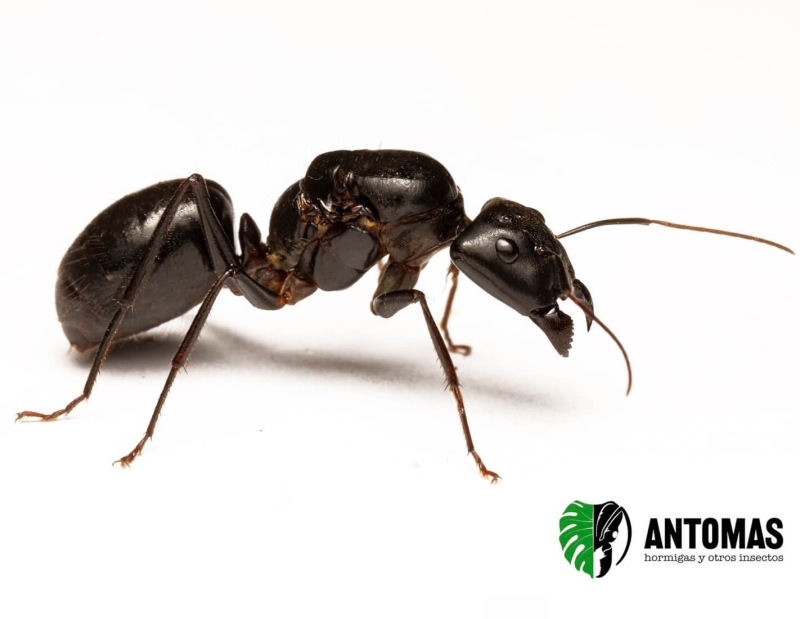
If what is called C. maculatus in a single savannah is probably two species, it is no surprise that there are similar forms, of a different size, that are not C. maculatus even though they look like it. The practical consequence: never mix colonies of this form with C. maculatus or with each other.
A child of the African savannah
As we do not know its exact species, we cannot give its precise distribution. What we do know is where the Camponotus of its group live: in sub-Saharan Africa, in savannahs, grasslands with scattered trees, open woodland and gallery forests along rivers. They are ground-dwelling ants that nest under stones, at the base of trees or in compact soil, with inconspicuous entrances. Many are crepuscular or nocturnal and come out to forage when the heat eases.
The climate is tropical: warm all year round and, instead of a cold winter, a dry season with somewhat cooler nights and less food, followed by the rains. That is why it does not need diapause.
Savannah Camponotus share out food resources with great finesse. In a West African savannah, Jean Lévieux found that C. maculatus obtained honeydew from root-feeding scale insects, underground, while its neighbour C. acvapimensis collected it from whiteflies on the grasses: two different “herds”. Honeydew is the energy base of these ants, which is why at home they need sugar every day.
One stomach for the whole colony
If you watch your “Mini-Maculatus” for a while, you will see two workers face to face, mouth to mouth, passing a drop of liquid between them. This is trophallaxis, the exchange of liquid food that holds the colony together. Foraging workers fill their crop, a pouch in the digestive tract that works as a “social stomach”, and share its contents with their nestmates, the larvae and the queen.
That drop is not just food. A 2016 study on Camponotus floridanus found proteins, small RNA molecules, recognition hydrocarbons and juvenile hormone, which regulates insect development. With juvenile hormone added to the food, more larvae completed metamorphosis and larger workers emerged: what they pass mouth to mouth also influences how their younger sisters grow.
Nurses, cleaners and foragers
Who does what inside the nest? In 2013 a Swiss team glued a tiny barcode onto the thorax of every worker in several colonies of Camponotus fellah and followed them with cameras for weeks, recording their positions and every encounter between them. They found that the workers are organised into three large social groups: nurses, which tend the brood alongside the queen; cleaners, which move around the rest of the nest; and foragers, which go outside. Each group occupies its own zone and tends to interact mainly with itself, and workers move from one group to another as they age: they start as nurses and end up as foragers.
In a formicarium you can see this without any cameras: the workers that spend the day on the brood hardly ever go out foraging, and the ones searching for food tend to be the same ones every time.
An amino acid factory in the gut
Camponotus live largely on sugars, which are poor in nitrogen, and they make up for it with the bacterium Blochmannia, which lives in special cells of the midgut and in the ovaries of the queen, who passes it on through her eggs.
The bacterium supplies essential amino acids, the ones the ant cannot make on its own, and helps to recycle nitrogen from waste. A 2007 experiment on C. floridanus proved it: colonies treated with antibiotics and fed a diet lacking those amino acids raised far less brood than colonies with their bacteria. And in 2020 it was shown just how intimate the relationship is: the ant embryo sets aside a space for the bacterium very early on and incorporates it into its own development, as if it were just another organ.
That does not mean they can live on sugar alone: the larvae need animal protein to grow (see “Feeding”).
Formic acid, disinfectant and surgery
Like all formicines, “Mini-Maculatus” has no sting. Its chemical defence is formic acid, which it expels through the acidopore, the small nozzle ringed with tiny hairs at the tip of the gaster. Workers that feel threatened bend the gaster forwards and spray; if you are very close, you may notice the sharp smell of the acid.
Furthermore, in 2020 it was shown that formicines swallow their acid to acidify the crop and keep in check the microbes that come in with food. And its relative C. maculatus has been famous since 2025 because its workers amputate the injured leg of a nestmate before the infection spreads, as we explain in the care sheet for Camponotus maculatus. Nobody has studied this in “Mini-Maculatus”, so we do not claim it; but if you see a five-legged worker going about its work as normal, you have a clue.
Queens that can live for many years
Camponotus queens are among the longest-lived insects known. The most often cited case is that of an Australian queen from the C. nigriceps group that the entomologists Caryl and Edna Haskins kept in their laboratory for 23.2 years, during which time she raised thousands of workers. There are no longevity data for the maculatus group, but in the genus a well-kept queen normally lives for many years. A “Mini-Maculatus” colony is not a one-summer project.
Size and morphology
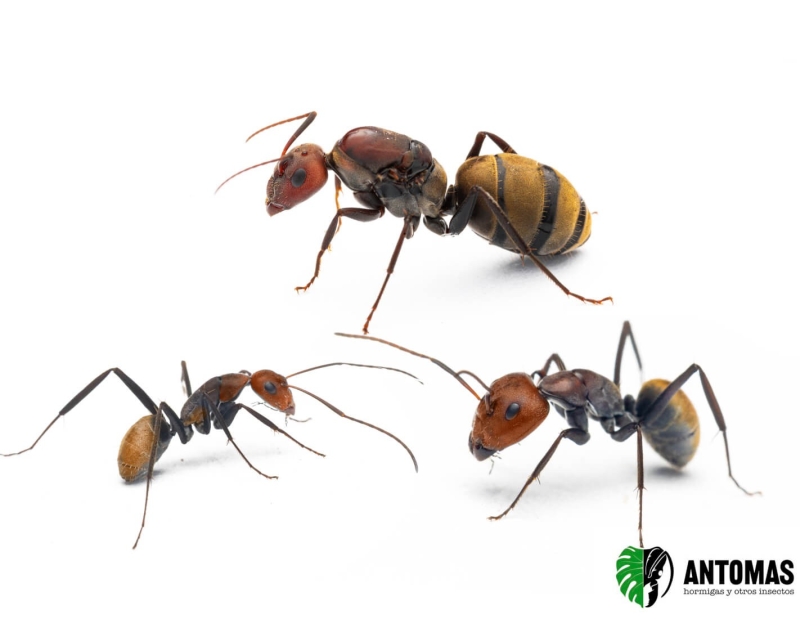
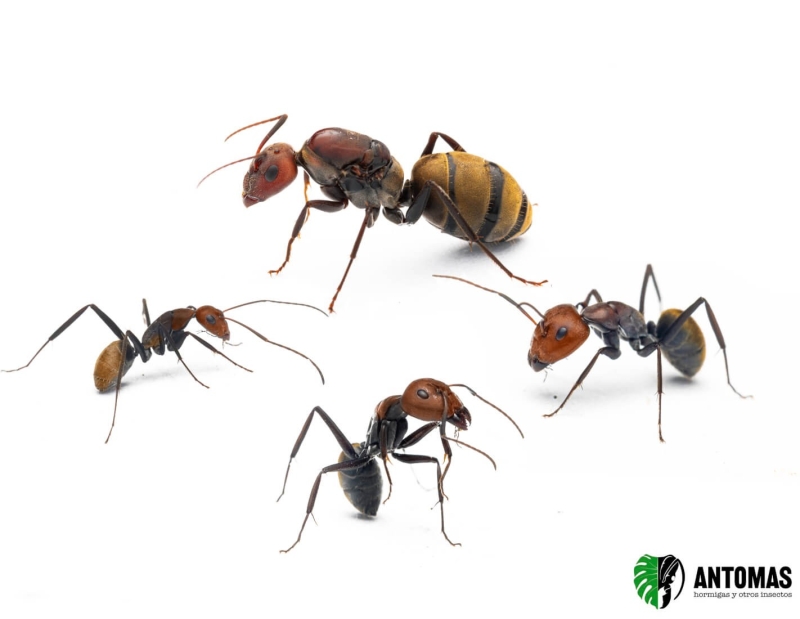
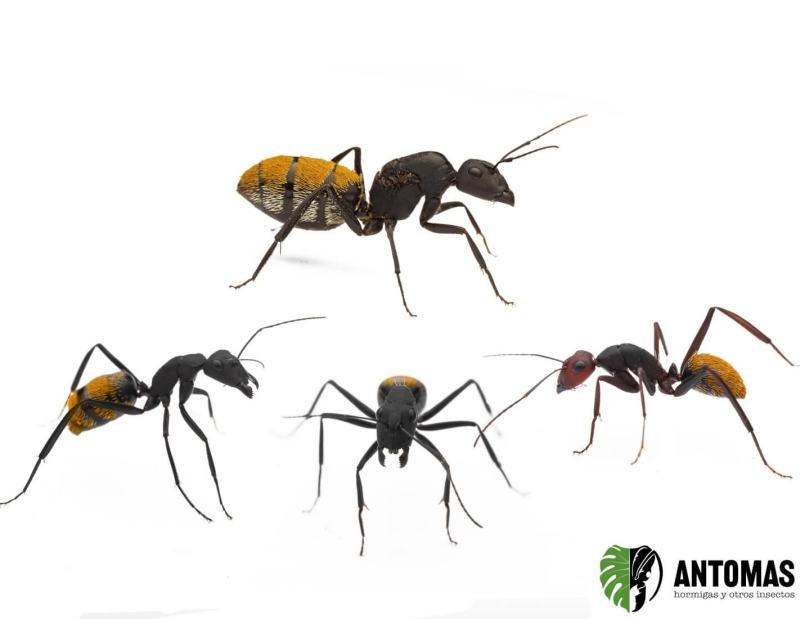
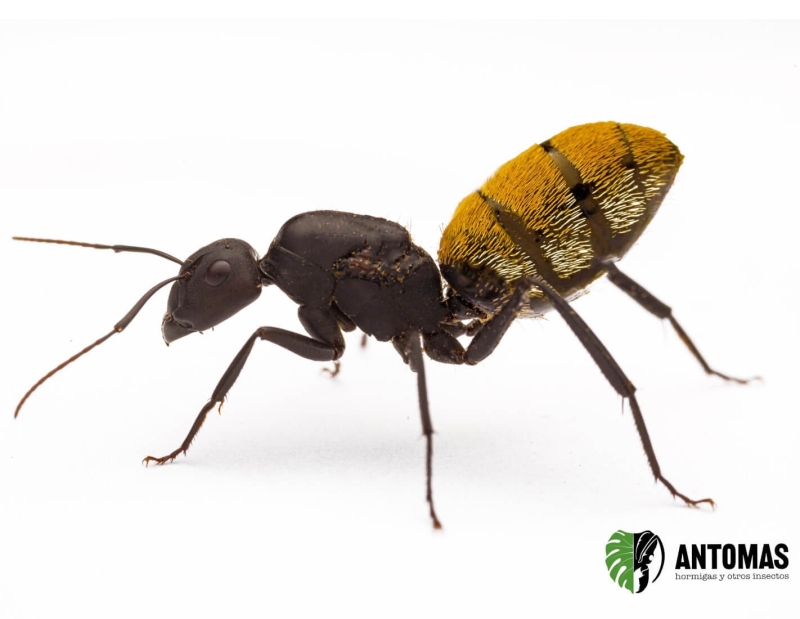
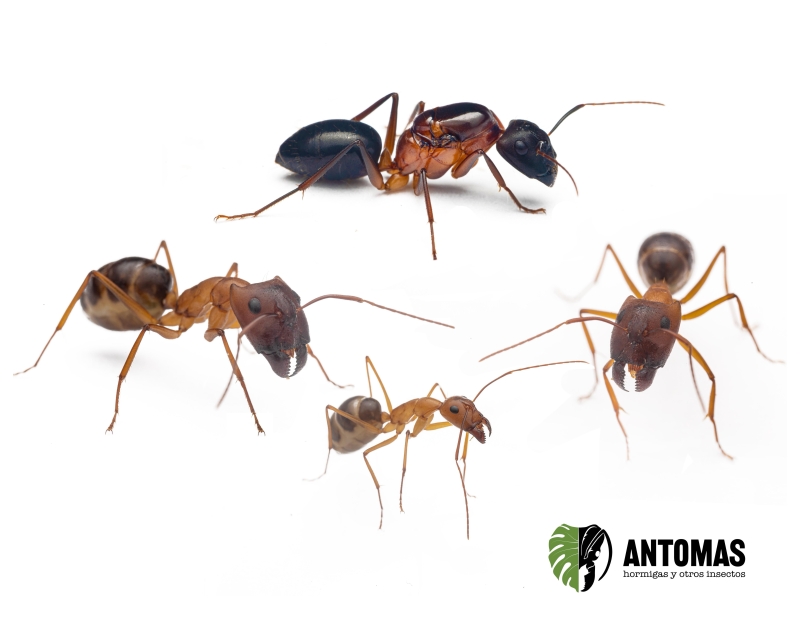
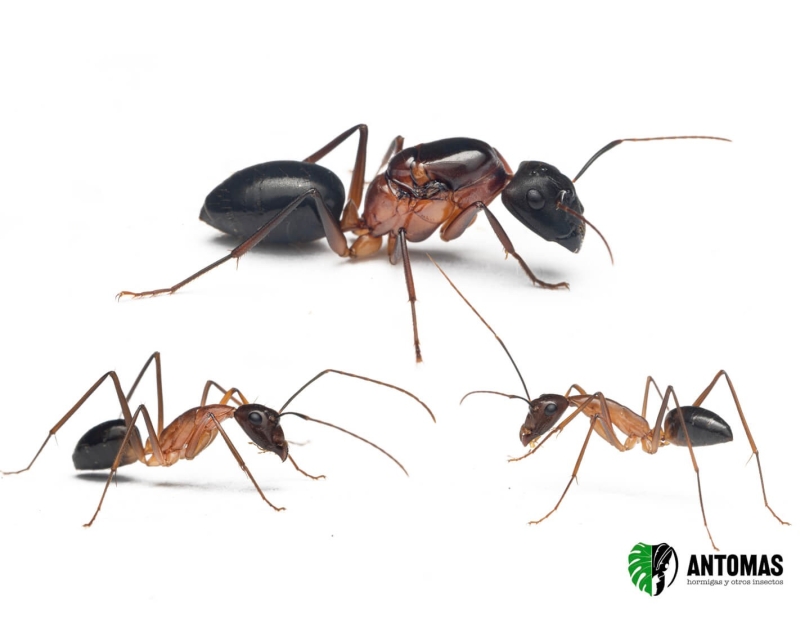
It is a medium-sized Camponotus, clearly smaller than our C. maculatus, slender-bodied, with long legs and antennae, and no sting. There are no published measurements, because there is no identified species to attribute them to, and we do not want to give unsupported shop figures either: we would rather describe what you can see.
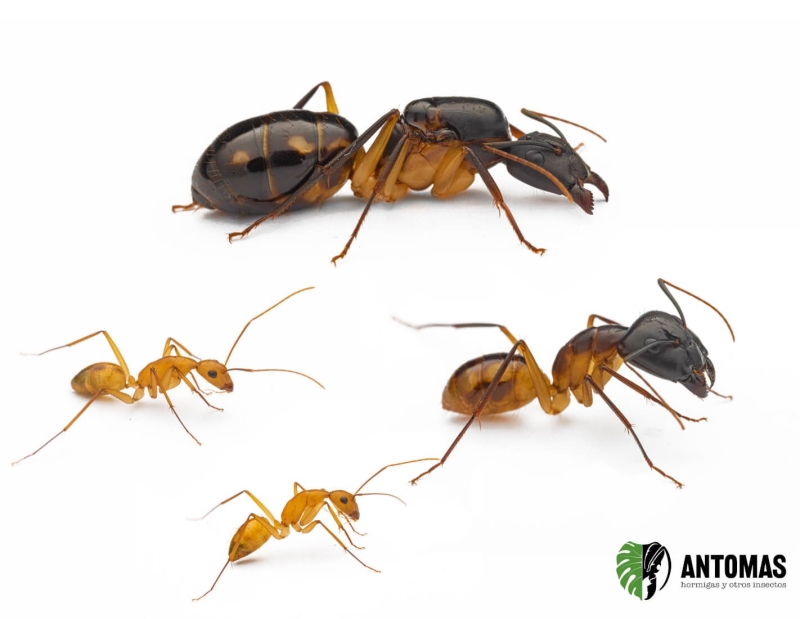
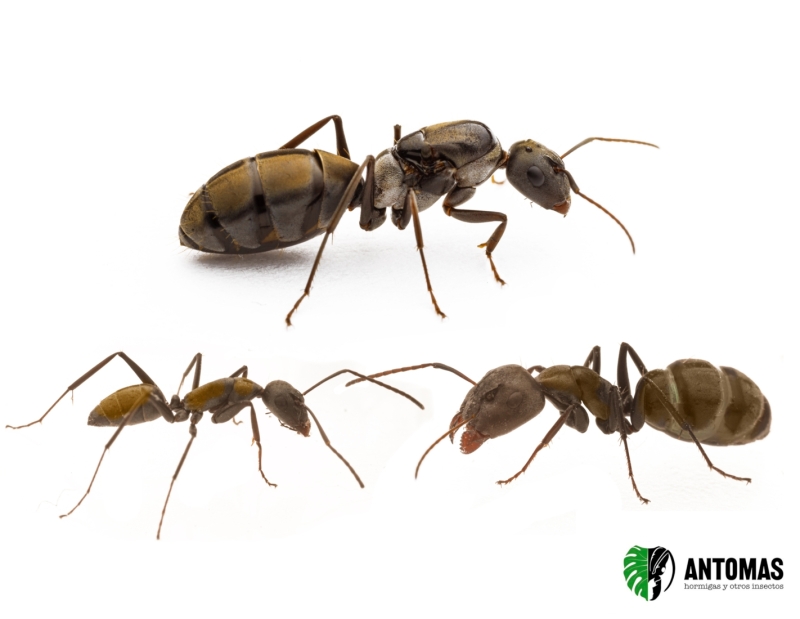
- Queen. Much sturdier than the workers, with the broad thorax typical of females that once had wings. In our colonies she has a black head, a dark reddish-brown, shiny mesosoma (the thorax), brown legs that are paler at the base and a brown gaster, with broad dark bands on each segment separated by pale stripes.
- Workers. Slender and agile, with long legs. The head is dark brown and contrasts with the mesosoma and legs, which are amber or straw-coloured. The gaster is pale, yellowish, with brown spots or bands on the segments: this is the “maculate” pattern (from the Latin macula, “spot”) that links it at a glance to its group and explains its nickname.
- Head and antennae. Twelve-segmented antennae inserted well behind the edge of the front plate of the head, the clypeus: this is one of the features that distinguish Camponotus from other formicines. Well-developed eyes.
- Waist. A single segment between the thorax and the gaster, the petiole, shaped like a scale or node.
- Gaster. It ends in the acidopore, through which it expels formic acid; it has no sting.
- Surface. In the workers, fairly shiny and with few erect hairs, which gives them a clean, satiny look.
Minors first, majors later
Camponotus of the maculatus group are polymorphic: the colony produces workers of different sizes, from slender minors to broad-headed majors. This polymorphism is not due to different types of egg, but to how the larvae grow. Edward O. Wilson explained it in a classic 1953 paper: in polymorphic ants, the different parts of the body do not grow at the same rate, and the head grows proportionally faster than the rest. So a larva that receives more food does not just become a larger worker, but a worker with a different shape, with a disproportionate head and powerful mandibles.
For a keeper, polymorphism grows with the colony. The first workers, the nanitics, are the smallest, because the queen raises them on her reserves; with each generation and more protein, larger workers appear. With a colony of 4–7 workers, you will see minors at first: be patient.
Approximate measurements
- Queen: no published measurements; clearly larger and sturdier than the workers.
- Workers: smaller than those of our C. maculatus; no published measurements.
- Major workers: appear once the colony has grown; no published measurements.
- Males: no published measurements.
Without an identified species there is no scientific description to compare it with, and within the maculatus group size varies greatly from one form to another; that is why we do not give figures.
Care in captivity
Difficulty: 2/5 – Beginner
At Antomas we consider it a very good Camponotus to start with: it eats everything, accepts a simple nest, needs no diapause and takes up less space than a giant Camponotus. Why 2/5 and not 1/5, like C. maculatus?
- It is smaller. Its workers squeeze through gaps that a C. maculatus could not get through, so connections and stoppers need to be checked carefully (see “Escapes and barriers”).
- It arrives as a young colony. With 4–7 workers, the first months are still delicate: the colony depends on the tube or nest staying moist and on never running short of food.
- There is less published information. Without an identified species, you have to go by the genus, its group and experience.
Why it is worth it. It is elegant, beautifully coloured, with lively foraging that is a pleasure to watch, and it has the charm of the uncommon: a form of the maculatus group that hardly anyone keeps.
Recommended parameters
- Nest temperature: 24–28 °C all year round.
- Warm spot: if needed, gentle thermostat-controlled heat on one side of the nest or at one end of the outworld, so that the colony can choose where to settle. Never strong heat inside the nest.
- Humidity: tubes and humidity systems well filled while the colony is small; a dry nest once it is populous (see “Humidity: from more to less”). The outworld, dry.
- Water: always available, in a test tube with water and cotton wool in the outworld.
- Light: a dark area in the nest and a lit outworld, with a normal day–night cycle.
- Diapause: not needed (see “No diapause: an ant from the tropics”).
Avoid direct sunlight, radiators and cold draughts. More than an exact figure, what they appreciate is a warm, stable nest.
Humidity: from more to less
At first it needs moisture: a colony of few workers loses water easily and the brood dries out. While it is small, keep the water reservoir of the tube or the humidity systems of the modules well filled.
As the colony grows, you can gradually keep the nest drier: a populous colony regulates its own humidity with the water in the outworld and the sugary liquids, and moves the brood to the chambers that suit it. As a reference, with our C. maculatus we make the switch at around 50–100 workers. Dry does not mean without water: the tube in the outworld must never be missing. What you must avoid is a nest that is wet throughout, which leads to condensation, mould and mites.
Recommended formicaria
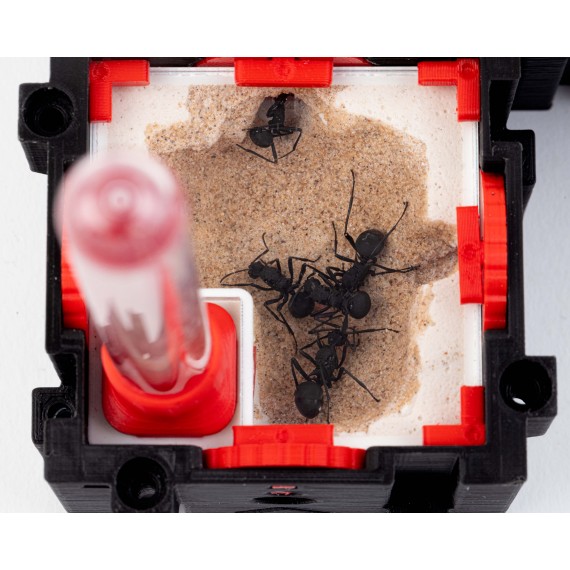
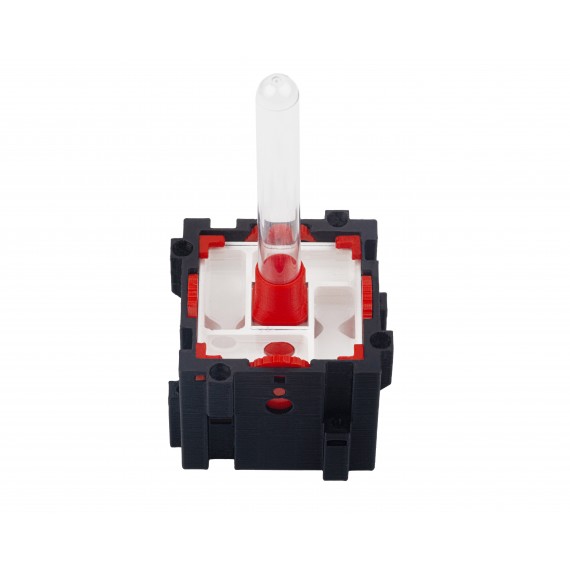
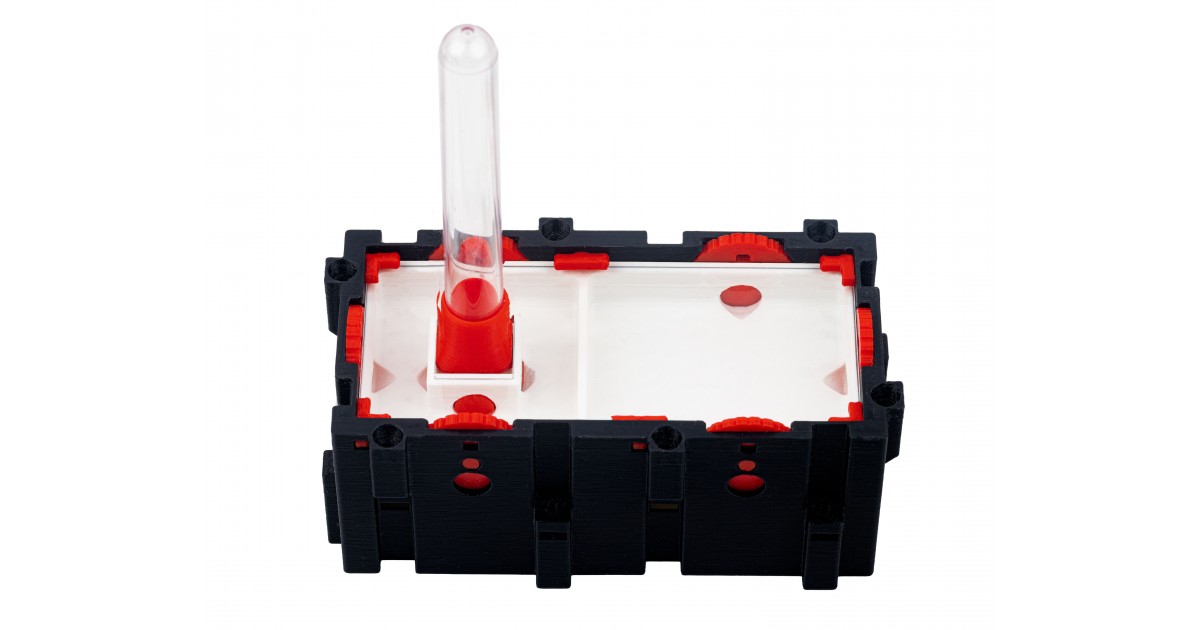
At Antomas we recommend Anthouse formicaria. For a colony that arrives with 4–7 workers, the best start is the smallest in the Qbik Wild range, made of plaster, which retains the moisture a young colony needs very well:
When the colony grows and needs less moisture, move on to the Qbik Alpha range: modular formicaria, on the dry and light side, which combine with the Wild nests without any problem. For a Camponotus of this size, a QBIK ONE with medium galleries:
And to keep expanding, the QBIK DUO, also with medium galleries, and then the larger formats in the same range:
Expand when you see lots of workers sitting idle in the corners of the outworld, with no room inside, but not before: in a nest that is too large, the spare chambers end up as rubbish dumps. Complete the set-up with:
- Escape barrier: a strip of paraffin oil along the top of the outworld walls and a well-fitting lid (see “Escapes and barriers”).
- A dry outworld, with a little sand, a flat stone or two and a twig or piece of bark to climb on, with nothing that could act as a bridge to the barrier.
- Water always available, in a test tube with water and cotton wool.
- A feeder for the sugary liquids, never on cotton wool (see “Feeding”).
- Gentle heat, only if needed, on one side of the nest and away from the feeder, with a thermostat.
A newly founded colony: what you receive and what to do
At Antomas we sell this form as a queen and 4/7 workers with brood: a colony that has already come through its riskiest phase. The queen founded it alone, claustrally, as is usual in Camponotus: after the nuptial flight she shed her wings, sealed herself in a chamber and raised her first workers without going out to feed, using her fat reserves and her wing muscles. These nanitics come with her, together with eggs, larvae or pupae.
Now the workers go out in search of food and feed the brood; your job is to give them a safe place, water and plenty of food:
- On arrival, rest. Leave the tube in a quiet, dark place at 24–26 °C, and check that the cotton wool is moist and that there is still water in the reservoir. Do not change the tube or move them into the formicarium straight away: a few days of calm after the journey will do them good.
- First meal. The next day, offer a tiny drop of sugary liquid on a small piece of aluminium foil or plastic, inside the tube or at its exit, and a small piece of a small insect. Never on the cotton wool: it goes mouldy and spoils the reservoir. Remove any leftovers the following day.
- Tube with an outworld. While they are still in the tube, it is best to connect it to a small outworld, or place it inside one, so that the workers can go out for food and water.
- Brief checks. You can and should look at them: that way you will know whether they are eating, whether there is brood and whether the water is holding out. Do it gently, without knocks or shaking.
When should you move them into the formicarium? There is no need to wait long. With 5–10 workers they can already be moved into a small nest, such as the Qbik Wild One P 1C, and sooner if the tube gets dirty, runs out of water or becomes too small for them. What matters is that the nest matches the size of the colony.
Moving by tipping out
At Antomas we move colonies by tipping them out, without waiting for the colony to decide to move on its own: we open the tube inside the outworld, next to the entrance of the new nest, and gently tip out the queen, the workers and the brood. Stragglers can be helped along with a soft brush, and if any resist, they are carefully taken out by force. Three tips:
- Prepare everything beforehand: the formicarium set up, with the escape barrier in place, the nest in darkness and the water tube connected.
- Work over a pale tray, so that you immediately spot any worker climbing up the tube or the tools. They are small and fast.
- Let them gather up: after tipping out, the workers carry the brood into the nest within a few minutes or hours. With the nest dark and the outworld lit, they move in straight away.
For future moves, the method is the same.
Feeding
A varied diet, always. In the wild, savannah Camponotus combine honeydew and nectar with insects they hunt or find dead. At home you need to give them both.
Sugary liquids, always available. Vary the sugars: at Antomas we recommend Blue Sugar nectar by Anthouse 4–5 times a week and another sugary liquid or nectar 1–2 times a week. You can also add a little protein to the nectar. Always offer them in a feeder, never on cotton wool: cotton wool goes mouldy and the liquid spoils very quickly. Use a traditional or home-made feeder, where the drop stays spread out and accessible, and replace it before it ferments.
Protein: the more, the better. It is what makes the colony grow. If you do daily maintenance and remove leftovers, it is better to overfeed: the colony understands that it has resources to spare and raises more brood, and faster. If you cannot clean often, it is better not to overdo it, because leftover food rots and brings mould and mites. Change the type of insect from one week to the next, so that they do not always eat the same thing:
- For the young colony, small, soft prey: the firebrat, Thermobia domestica, perfect for colonies that are just starting out, and Drosophila.
- As it grows, pieces of cricket, red runner roach or mealworm, as well as flies.
- For a small colony, preferably cut up or freshly killed, with the body opened so that they can reach the soft parts; for a large one, small live prey too.
Buy insects from a trusted supplier (insects treated with insecticides kill colonies), put them in late in the afternoon and remove the leftovers in the morning.
Water: always, in the test tube with cotton wool in the outworld. Check the water and the feeder every 2–3 days: in a small colony, running out of water is one of the few mistakes it does not forgive.
No diapause: an ant from the tropics
In the tropical savannahs and forests of Africa where its group lives, there is no cold winter: the season that marks the year is the dry season. That is why it does not need diapause, and certainly not a cold diapause like that of European ants. What we recommend at Antomas is to keep it at 24–28 °C all year round, with water, sugar and protein as for the rest of the year. In winter, if the room drops below about 20 °C, provide gentle thermostat-controlled heat on one side of the nest.
If at some point in the year the queen lays less or the colony eats less for a few weeks, that is normal: keep offering food and keep it warm. Do not cool it down to “trigger” a rest; below about 15 °C you only expose it to risks.
Growth: patience at first, momentum later
As in almost all Camponotus, development from egg to worker is slow, taking several weeks, and depends heavily on temperature: the closer to 26–28 °C, the faster. That is why the first months seem quiet. Later, once there are enough workers to forage and tend the brood at the same time, growth speeds up, provided protein is plentiful.
How large can it get? There are no data for this form. As a reference for the group, laboratory colonies of C. maculatus exceeded 2,000 workers, and researchers chose it as a test ant because it grows quickly and does not need diapause. The typical mistake is to get impatient and change the nest or the routine every few weeks: if the queen is laying and the brood is developing, all is well.
Behaviour in captivity
Active as evening falls. Like many savannah Camponotus, it livens up above all at dusk and at night, although in a warm formicarium you will also see workers during the day. If you want to see it in full swing, watch it at nightfall, when the outworld fills with scouts.
Fast, but not aggressive. It does not go looking for a fight; if the nest is disturbed, it comes out to defend it and may spray formic acid.
Watch without fear. At Antomas we believe ants are there to be enjoyed, watched and learnt from, not kept hidden away. All you need is a dark area in the nest and a lit outworld, and to watch them gently, intervening as little as possible. Look out for trophallaxis between workers, the division of labour and, in time, the first larger workers.
Warning signs:
- Brood that stalls or disappears: almost always a lack of protein or a lack of warmth.
- Workers huddled by the water tube or shrivelled brood: not enough moisture in a colony that is still small.
- Condensation on the walls or mould: too much moisture or forgotten leftovers.
- Lots of workers sitting idle in the outworld, with no room inside: time to expand.
Escapes and barriers
“Mini-Maculatus” climbs glass and acrylic, like almost all Camponotus, and it is also small and fast. Take these precautions from day one:
- A strip of paraffin oil along the top of the outworld walls, thin and continuous. Renew it when it collects dust or debris.
- A well-fitting lid, as a second line of defence.
- No gaps: check connections, stoppers and tubes. Where a C. maculatus could not get through, this one may well squeeze through.
- Nothing that can act as a bridge: no branches or stones leaning near the barrier.
- Take care when opening: have the food and tweezers ready beforehand, open only as much as necessary and close up when you have finished.
Handling and safety
It does not sting and is harmless to people; at most it bites, and its acid stings a little. Handle it with a soft brush or soft tweezers, never with your hands, and calmly so as not to harm the queen. Do not combine queens or different colonies, or keep it with other species. It is an exotic species: it must never be released into the wild.
What not to do
- Let the young colony run out of water or let the tube dry out.
- Keep the whole nest wet once the colony is populous: from then on, a dry nest and water in the outworld.
- Put it into diapause or cool it down in winter: it is tropical; never below about 15 °C.
- Move a colony of few workers into a nest that is too large.
- Leave gaps, loose connections or ill-fitting lids, or fail to renew the barrier: it is small and it climbs.
- Put the sugary liquids on cotton wool or let them run out.
- Always give it the same insect, skimp on protein or leave leftovers uncleared.
- Put it together with colonies of C. maculatus or of other similar forms.
- Handle it with your hands.
Scientific sources
“Mini-Maculatus” is a trade name and there are no studies of this form itself. This care sheet is based on the scientific literature on the Camponotus maculatus group and the genus Camponotus, on B. Taylor’s The Ants of Africa and on Antomas’s experience. Main references:
- Buellesbach, J., Rinke, J., Reuter, L., Thomas, J. M., Hartmann, V., Pohl, M., Gadau, J. & Ernst, U. R. (2023). Conserved worker policing in African carpenter ants with drastically different egg chemotypes. Evolutionary Ecology 37: 815–834. doi:10.1007/s10682-023-10245-5
- Pohl, M., Laukamp, T., Caspers, M., Paczkowski, S. & Buellesbach, J. (2026). Sharply contrasting chemotypes coincide with aggression and divergence in cryptic African carpenter ant populations. Journal of Chemical Ecology 52: 56. doi:10.1007/s10886-026-01732-4
- McArthur, A. J. & Leys, R. (2006). A morphological and molecular study of some species in the Camponotus maculatus group (Hymenoptera: Formicidae) in Australia and Africa, with a description of a new Australian species. Myrmecologische Nachrichten 8: 99–110. Full text (PDF)
- Lévieux, J. (1977). La nutrition des fourmis tropicales: V. Éléments de synthèse. Les modes d'exploitation de la biocoenose. Insectes Sociaux 24: 235–260. doi:10.1007/BF02232743
- Pohl, M., Otto, M., Hommen, U., Eilebrecht, S., Schäfers, C., Ringbeck, B., Göckener, B. & Gadau, J. (2025). A staged approach using ants as test organism in ecotoxicology. Science of the Total Environment 983: 179669. doi:10.1016/j.scitotenv.2025.179669
- Fujimoto, S. et al. (2025). Better safe than sorry: leg amputations as a prophylactic wound care behaviour in carpenter ants. Proceedings of the Royal Society B 292: 20251688. doi:10.1098/rspb.2025.1688
- Wilson, E. O. (1953). The origin and evolution of polymorphism in ants. The Quarterly Review of Biology 28: 136–156. doi:10.1086/399512
- LeBoeuf, A. C. et al. (2016). Oral transfer of chemical cues, growth proteins and hormones in social insects. eLife 5: e20375. doi:10.7554/eLife.20375
- Mersch, D. P., Crespi, A. & Keller, L. (2013). Tracking individuals shows spatial fidelity is a key regulator of ant social organization. Science 340: 1090–1093. doi:10.1126/science.1234316
- Feldhaar, H. et al. (2007). Nutritional upgrading for omnivorous carpenter ants by the endosymbiont Blochmannia. BMC Biology 5: 48. doi:10.1186/1741-7007-5-48
- Rafiqi, A. M., Rajakumar, A. & Abouheif, E. (2020). Origin and elaboration of a major evolutionary transition in individuality. Nature 585: 239–244. doi:10.1038/s41586-020-2653-6
- Tragust, S. et al. (2020). Formicine ants swallow their highly acidic poison for gut microbial selection and control. eLife 9: e60287. doi:10.7554/eLife.60287
- Blaimer, B. B. et al. (2015). Phylogenomic methods outperform traditional multi-locus approaches in resolving deep evolutionary history: a case study of formicine ants. BMC Evolutionary Biology 15: 271. doi:10.1186/s12862-015-0552-5
- Ward, P. S., Blaimer, B. B. & Fisher, B. L. (2016). A revised phylogenetic classification of the ant subfamily Formicinae (Hymenoptera: Formicidae), with resurrection of the genera Colobopsis and Dinomyrmex. Zootaxa 4072: 343–357. doi:10.11646/zootaxa.4072.3.4
- Haskins, C. P. & Haskins, E. F. (1992). Note on extraordinary longevity in a queen of the formicine ant genus Camponotus. Psyche 99: 31–33. doi:10.1155/1992/53614