This website uses its own and third-party cookies to improve our services and show you advertising related to your preferences by analyzing your browsing habits. To give your consent to its use, press the Accept button.
Functional cookies are strictly necessary to provide the services of the shop, as well as for its proper functioning, so it is not possible to refuse their use. They allow the user to browse through our website and use the different options or services that exist on it.
Cookie
Provider
Purpose
Expiry
PHP_SESSID
antomas.es
The PHPSESSID cookie is native to PHP and allows websites to store serialised status data. On the website it is used to establish a user session and to pass state data through a temporary cookie, which is commonly known as a session cookie. These Cookies will only remain on your computer until you close your browser.
Session
PrestaShop-#
antomas.es
This is a cookie used by Prestashop to store information and keep the user's session open. It stores information such as currency, language, customer ID, among other data necessary for the proper functioning of the shop.
These are cookies that collect information about the advertisements shown to users of the website. They can be anonymous, if they only collect information about the advertising spaces shown without identifying the user, or personalised, if they collect personal information about the user of the shop by a third party, for the personalisation of these advertising spaces.
Collect information about the user's browsing experience in the shop, usually anonymously, although sometimes they also allow the user to be uniquely and unequivocally identified in order to obtain reports on the user's interests in the products or services offered by the shop.
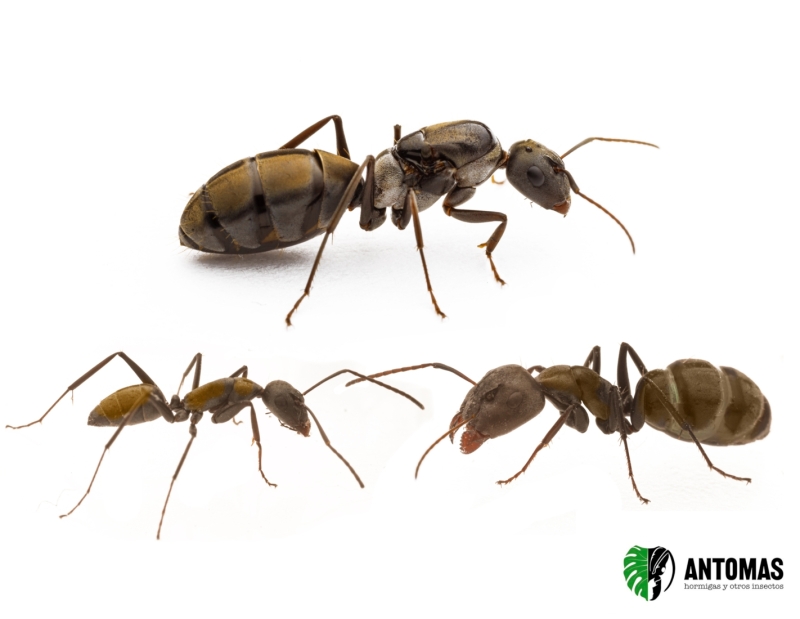
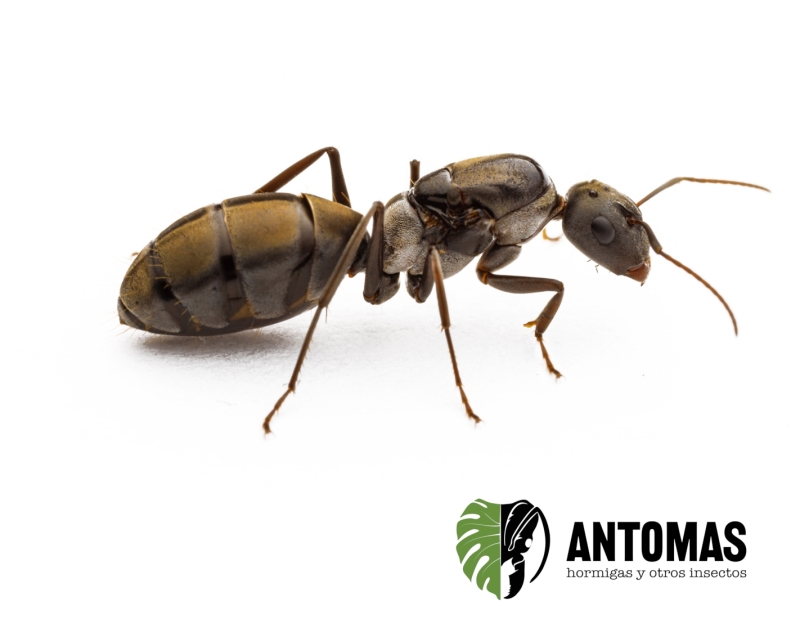
Clad in silver and forged in the dunes of the Sahara. The Saharan Silver Ant goes out hunting at the deadliest hour of the day, with the sand above 60 °C, protected by hairs that work like tiny mirrors. It is the fastest ant ever measured: more than 100 times its own body length per second, with strides in which it flies over the sand. Over the years, its colonies raise soldiers with sabre-shaped mandibles, a caste almost unique in the ant world. A jewel from Merzouga for experienced keepers. Colonies with queen. Shipping across Europe, live arrival guaranteed.
The fastest ant in the world, with silver hairs that reflect the Saharan sun and sabre-jawed soldiers in mature colonies. Merzouga line (Morocco): dry, heated foraging area, a slightly humid nest, substrate inside and outside the nest, and a long diapause.
Cataglyphis bombycina (Roger, 1859) has turned the hottest desert on the planet into its hunting ground. It lives in the dunes of the Sahara, goes out in search of food just when the sand is scorching at over 60 °C, and does so protected by an armour of silver hairs that reflect light like tiny mirrors. It is also the fastest ant ever measured, and its mature colonies hide a caste of soldiers with sabre-shaped mandibles that hardly exists anywhere else in the ant world.
The Antomas line comes from Morocco, from the Merzouga desert (Erg Chebbi), one of the places where the species has been studied most thoroughly: much of the scientific data in this care sheet comes from this area and its surroundings.
Biology
Dressed in silk: a name from 1859
The German entomologist Julius Roger described it in 1859 as Formica bombycina, from specimens from "Tripoli, Egypt, Nubia and the Red Sea". The epithet comes from the Latin bombycinus, "silken", a name that suits its sheen perfectly. In 1916, Auguste Forel created the subgenus Machaeromyrma for it, from the Greek machaira, "sabre", and myrmex, "ant", a name that fits it like a glove, as we will see with its soldiers; it is no longer used today.
Since Cataglyphis is a feminine name, it is now spelt bombycina, although the German trade still lists it as "Cataglyphis bombycinus". Its sister species is C. sabulosa, from Israel and the northern Sinai, which has no soldiers, and two subspecies are recognised: C. b. bruneipes, from Tunisia, and C. b. sinaitica, from the Sinai, whose status is disputed.
Queen of the dunes: distribution and habitat
It lives in the deserts of the Sahara, the Sinai and the Arabian Peninsula. Scientific papers have studied it mainly in Morocco (Merzouga and its surroundings, Amerzgane and Zagora) and in Tunisia (Douz), and catalogues also record it in Algeria, Libya, Egypt, Israel, Mali and Saudi Arabia.
It is the dominant ant of the North African dunes, but it does not live only in sand: in Merzouga it occupies extremely dry dunes, with huge colonies that reach several metres deep, while in Amerzgane, at the foot of the Atlas and with more rain, it lives in an old wadi, with much smaller colonies.
The climate of its home: a desert with a winter
We tend to imagine the desert as a permanent oven, but Merzouga has a real winter. The dunes have no official weather station, so their climate is estimated from the nearest one, Errachidia (WMO normals 1991–2020), corrected for the difference in altitude. Season by season:
Summer (June–August): averages of 31–35 °C, highs of 37–42 °C and nights of 22–28 °C. At midday the surface sand reaches 60–70 °C, although 4 mm above the ground, the height at which an ant moves, the air is 6–7 °C cooler.
Autumn (September–November): the average drops quickly, from about 28 to 16 °C.
Winter (December–February): averages of 11–13 °C, highs of about 18–20 °C and nights of 2–5 °C, with occasional frosts.
Spring (March–May): the average rises from about 18 to 26 °C.
Rain and light: about 53 mm of rain a year, and days of about 10 hours in winter and 14 in summer.
The key lies beneath the sand, which buffers the extremes. In Béni Ounif, in the Algerian Sahara, the soil at a depth of 75 cm ranges over the year between about 14 °C in winter and 32 °C in summer, and from about 20 cm down the difference between day and night almost disappears. Frosts and nights of 0–5 °C only affect the surface and the first few centimetres. Délye, who studied the ants of this part of the Sahara, already described C. bombycina as a highly heat-loving species, with its nests almost always sheltered by shrubs and an activity that the "great cold" of winter interrupts. This is the natural explanation for the diapause you will see at home.
Living mirrors: prism-shaped hairs
The silver sheen that gives it its name is not a pigment. The top and sides of the body are covered by a dense layer of hairs 200–300 µm long with a triangular cross-section: two corrugated upper faces and a flat base, barely 3.5 µm wide.
In 2016, Willot and his colleagues showed that the sheen is due to total internal reflection, the same phenomenon that makes optical fibre work: light enters the hair, hits the flat base and, if it arrives at a steep enough angle, cannot escape and is reflected entirely. Above an angle of incidence of about 35°, the hairs reflect more than 90 % of the light. At 50°, an ant with its hairs reflected 61 % of the light and a shaved one 7 %: about ten times less.
These mirrors stop it from cooking. Shi and his team, together with Rüdiger Wehner, the great expert on Cataglyphis, showed in Science that the hairs reflect the visible and near-infrared light of the sun and, at the same time, emit heat very efficiently in the mid-infrared, so the ant loses heat by radiation even in full sun. In Willot's experiment, an ant with its hairs warmed up almost 2 °C less after a minute and a half than a shaved one; Columbia University's press release on Shi's study speaks of a body temperature 5–10 °C lower. The idea that the hairless underside helps to reflect the heat of the sand comes from a popular-science summary and we have not been able to confirm it in the original paper.
The trick has made its way into engineering: there are flexible sheets and biodegradable films for passive radiative cooling, designed to imitate these hairs, that cool without using any energy.
The fastest ant in the world
In 2019, Sarah Pfeffer and her team filmed workers from Douz (Tunisia) with high-speed cameras and measured 855 mm/s, about 3.1 km/h: the speed record known for ants. For its size, this equals more than 100 body lengths per second. A calculation just for fun: a 1.80 m person running at 100 body lengths per second would travel at about 650 km/h. Among animals of its scale, in body lengths per second it is only beaten by a mite, Paratarsotomus macropalpis, and an Australian tiger beetle.
The surprising thing is that it does not achieve this with extraordinary legs. Its legs are 18–19 % shorter than those of its relative C. fortis, the salt-pan ant, and its thorax is 12 % shorter. Its secret lies in the stride frequency: up to 47 steps per second, compared with 36 in C. fortis.
Running on air: all six legs off the ground
Ants walk on a tripod: three legs on the ground (the front and hind legs on one side and the middle leg on the other) while the other three move forward. C. bombycina takes this pattern to the limit: each leg touches the ground for just 7 milliseconds, the leg swinging forward moves at up to 1,400 mm/s, and the stride ranges from 4.7 to 20.8 mm depending on speed.
From about 150 mm/s, aerial phases appear, moments when all six legs are in the air; at top speed, the ant spends around 30 % of each cycle without touching the ground. C. fortis only "flies" from about 350 mm/s. According to the authors, this highly synchronised coordination would help it to run on soft sand, which gives way under its legs.
Ten minutes between the lizard and heatstroke
In 1992, Rüdiger Wehner and his colleagues published a paper in Nature with a perfect title: "Desert ants on a thermal tightrope". They discovered that C. bombycina concentrates its activity into a burst of a few minutes at midday, in the hottest hours. Why take the risk precisely then? Because of a lizard. Acanthodactylus dumerili, a lacertid of the dunes, hunts silver ants, but tolerates heat worse than they do: when the sand is scorching, it retreats into its burrow. The ants come out in that gap: below them, the lizard; above them, their own thermal limit.
That limit is very close. Its critical thermal maximum is 53.6 °C, and the foraging window, of about 48–51 °C according to the measurements cited by Willot and colleagues, leaves a margin of just a few degrees. Each worker spends about 3–4 minutes outside, and the colony's entire foraging force is active for less than 20 minutes a day. As it runs, it uses any small stone or blade of grass to climb up and cool down away from the burning sand, and only the oldest workers go out. It has been written that a few scouts go out first to check whether the lizards have retreated, but we have not been able to verify this in the original sources.
Vaccinated against the heat before going out
Almost all living things produce heat-shock proteins when they warm up: they are "chaperones" that protect other proteins from becoming deformed. C. bombycina makes them in advance. Gehring and Wehner showed in 1995 that Cataglyphis accumulate these proteins before being exposed to heat and keep synthesising proteins up to 45 °C, whereas in the fruit fly or in Formica synthesis stops at 39 °C. In C. bombycina and C. bicolor they are already produced at 25 °C.
Serge Aron's team at the Free University of Brussels has gone further: C. bombycina constantly maintains more chaperones than other Cataglyphis and its proteins are more stable; it protects the mitochondria of its muscles with chaperones of its own, never described before in ants; and in response to heat it changes the expression of only 0.6 % of its transcripts, compared with 8–12.7 % in ants from temperate climates. It does not need to react to the heat: it lives ready for it.
Midday scavenger
What is it looking for in those few minutes? Above all, corpses: insects and other arthropods that have died from the heat. It is an unpredictable resource, which is why workers travel a long way: they have been seen collecting corpses up to about 100 m from the nest. Like the rest of the genus, it forages alone and without pheromone trails: each worker searches on its own and heads straight back to the nest as soon as it finds something. In the laboratory, researchers feed them pieces of mealworm and sugar water.
Soldiers with sabres: a third caste
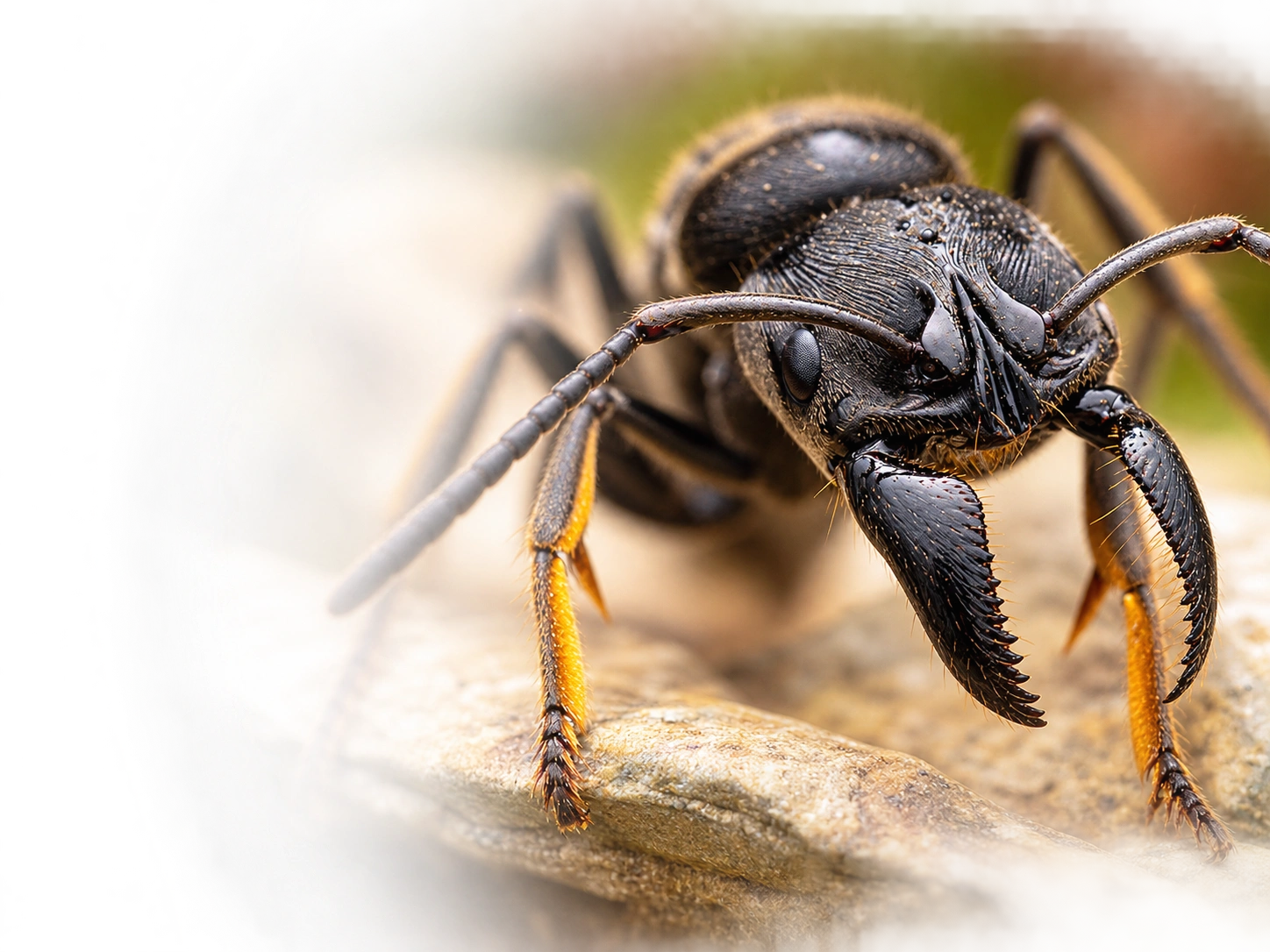
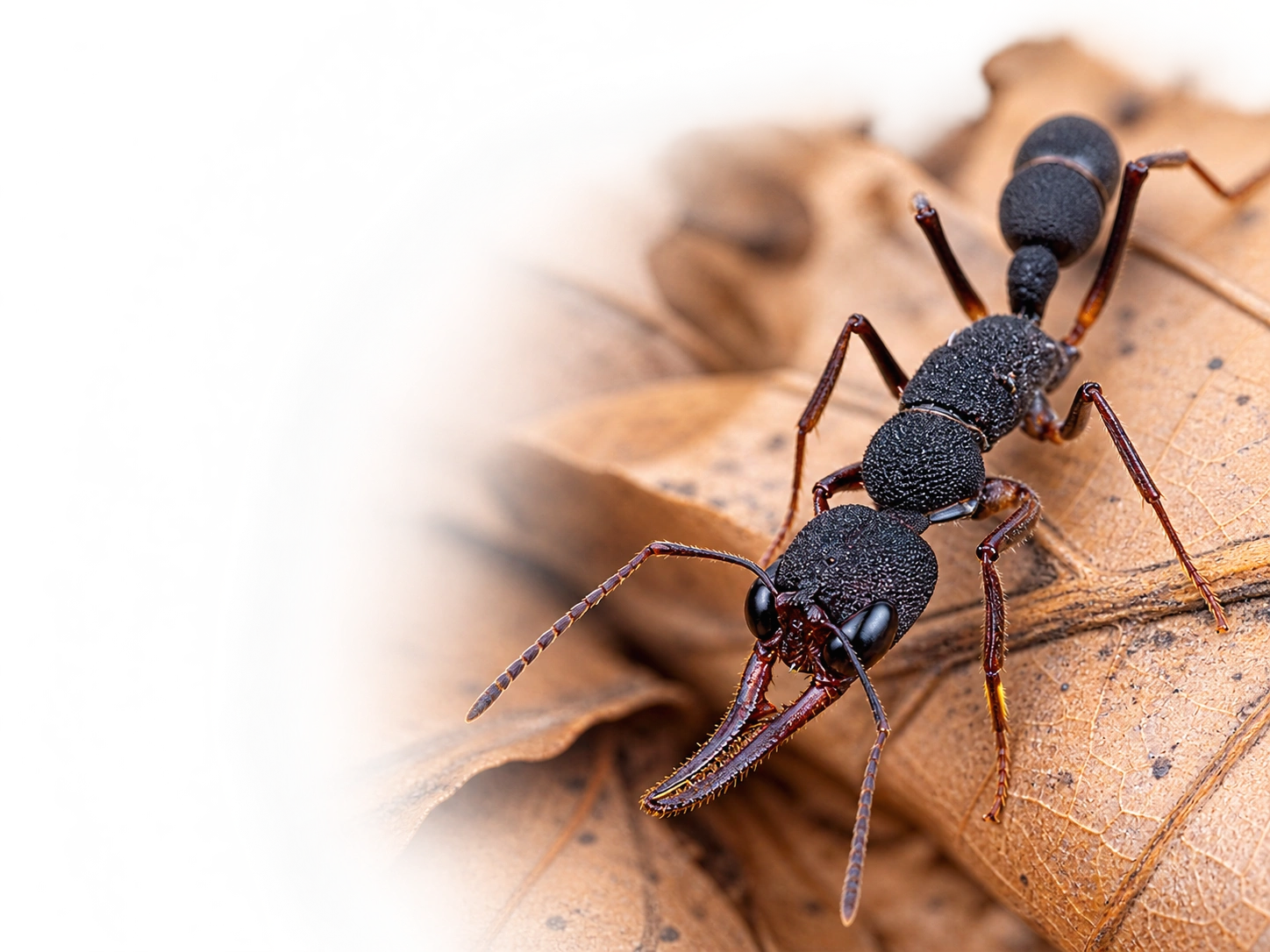
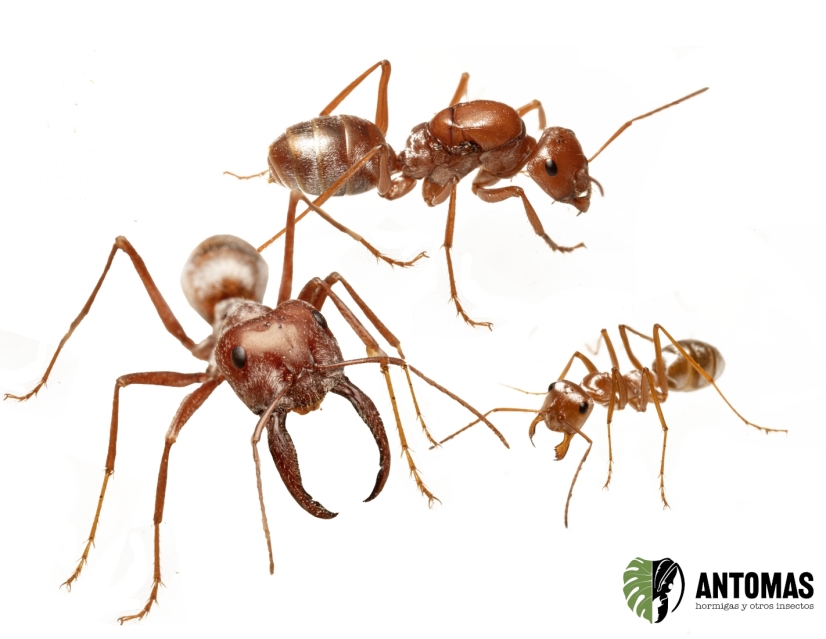
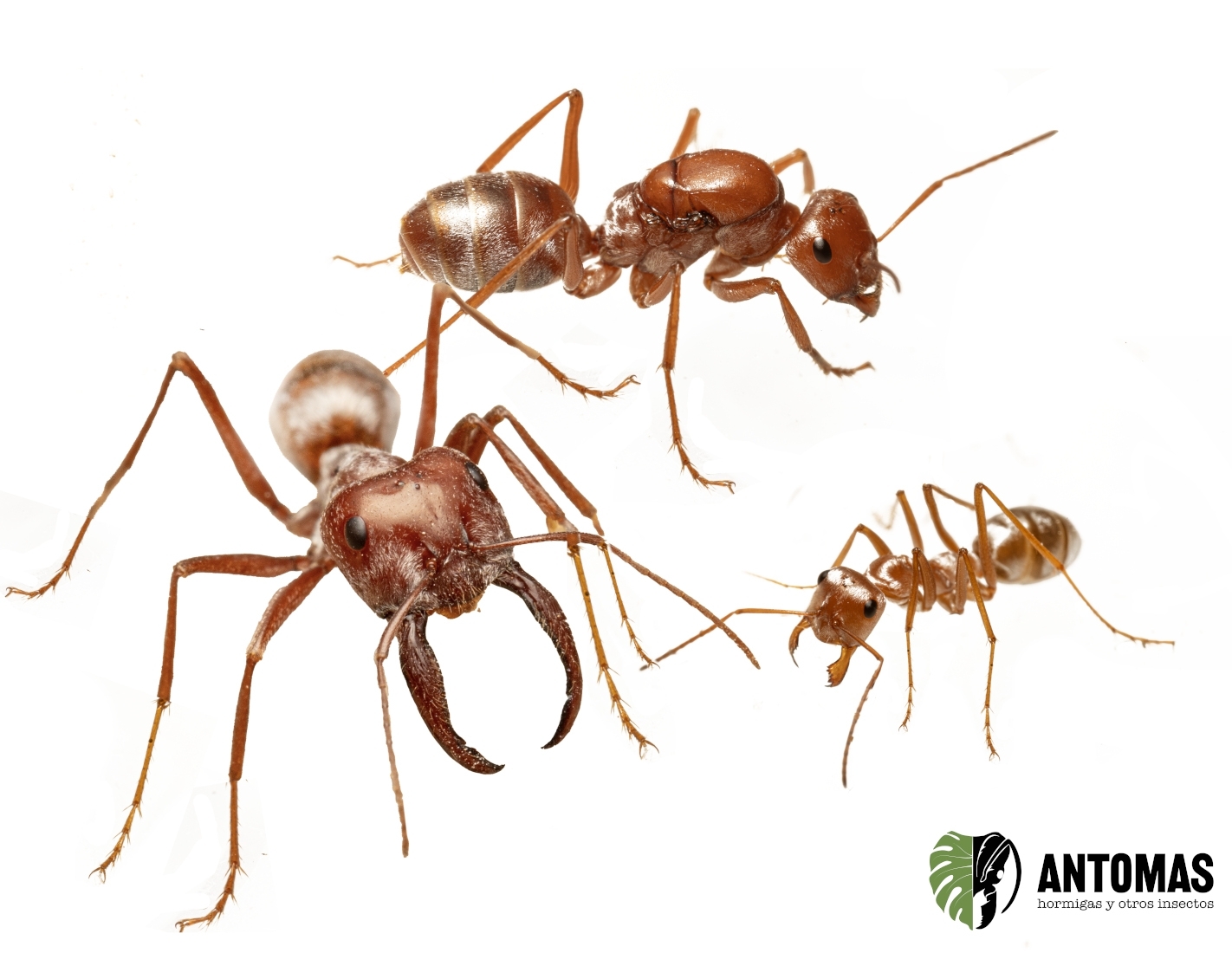
This is its most mysterious feature. Besides queens and workers, mature colonies have soldiers: large individuals with broad, muscular heads and sabre-shaped mandibles, long and with few teeth. Their mandibles are 3.2 times longer than those of the workers and 2.4 times longer than those of the large queens, and their head is, on average, 200 % larger than that of the workers.
In 2014, Molet, Maicher and Peeters showed that they are not simply large workers but a new caste: they combine a simple, worker-like thorax with a head, mandibles, palps and a gaster of their own. This type of soldier is only known in C. bombycina and C. kurdistanicus.
What are they for? They do not go out foraging: they live in the deep chambers, close to the brood, and if the nest is disturbed they rush out with their mandibles open and bite. There are three hypotheses, which are not mutually exclusive: defence against lizards that dig in search of larvae; a living larder, because their swollen gaster full of fat tissue could store food; and help in carrying out larger balls of sand when digging.
They are few: 1–2 % of the population in mature colonies, and 1 to 4 per colony in Amerzgane. Whether a larva becomes a soldier depends mainly on the environment, with a moderate genetic influence. And, above all, they only appear in large, old colonies.
A Saharan Silver Ant soldier: a large head and sabre-shaped mandibles (Anthouse).
Living lighthouses at the nest entrance
Finding the entrance to a tiny nest in a sea of sand is quite a challenge. Cataglyphis are the great navigators of the ant world: they work out their position with a sun and polarised-light compass, count their steps like a pedometer and memorise visual landmarks. C. bombycina searches for its nest as accurately as C. fortis, but more widely: after a 10 m return trip, its search spreads about 2.8 times further.
And it has extra help. Pfeffer and her colleagues observed that several motionless nestmates, typically soldiers, spread out around the entrance over a few square metres and mark the nest with their antennae: true living lighthouses for the foragers returning with their loads.
One queen and up to 14 males
Colonies are monogynous: they have a single queen. She lives in the deepest part of the nest and has never been found in excavations; researchers have reconstructed her genotype from her daughters' DNA, and it is always consistent with a single mother. What is extraordinary is how many males she mates with: in Amerzgane, an average of 5.7 (from 3 to 8), and in Merzouga, where our line comes from, an average of 11 and up to 14 males. With so many fathers, the workers in a colony are only distantly related to each other (r = 0.31), and the analyses show no inbreeding.
Queens also come in two sizes, macrogynes and microgynes, whose function is unknown. No parthenogenesis has been detected in queens, unlike in other Cataglyphis such as C. cursor.
Cities beneath the dunes
The Merzouga nests are huge and deep: they go down several metres, with an extensive network of galleries, and have several entrances several metres apart. No one has ever counted a whole colony: in one excavation, about 1,000 adults came out of the chambers less than 1 m deep alone before the dry sand collapsed. Leniaud and colleagues describe them as exceptionally populous for the genus; the queen, the soldiers and the brood occupy the deepest parts.
Nuptial flights and the rhythm of the year
Nuptial flights have been observed in April (winged queens in Amerzgane, in April 2011), and keepers place them between April and early June. How does a queen found a colony? Nobody knows: the literature has not documented colony founding in this species. In captivity, keepers have observed a pause in autumn and winter, the diapause we explain in the care section, and perhaps also breaks in brood rearing in high summer, in the most extreme heat.
Size and morphology
It is a slender formicine with thin legs, covered by the dense silver pubescence that characterises it. Main features:
Workers. Highly polymorphic (head width varies by around 194 % between the smallest and the largest) and slim, with a metallic silver sheen over a yellowish-brown to light-brown base colour and a brown gaster. They have a psammophore, a "basket" of long hairs for carrying sand, formed partly by the hairs of the maxillary palps; mandibles with more than 5 teeth and a scale-shaped petiole.
Soldiers. Large head, sickle-shaped mandibles with few teeth and a notch behind the apical tooth, and a simple thorax, like that of a worker.
Queen. Winged until the nuptial flight and found in two sizes. There is no scientific description of her colour, but in the Antomas line the queen is silver, like the workers.
No sting. Like all formicines, it has no functional sting.
Cocoon. The larvae spin a cocoon to pupate. In Antomas's experience they need substrate to do this properly (we explain this under "Set-up").
Approximate measurements
Small workers: 5.5–8 mm, according to the taxonomic website Ants of Africa; large workers are clearly bigger, with a mesosoma of more than 5 mm.
Foraging workers (Douz, Tunisia): mesosoma of 2.5 mm on average; front, middle and hind legs of 4.3, 5.2 and 6.8 mm.
Soldiers: about 15 mm.
Queen: no scientific measurements have been published; as a guide, about 11–12 mm according to a European shop.
Male: no scientific measurements published.
Molet and colleagues only published the measurements of queens and soldiers as ratios, not in millimetres.
Care in captivity
Difficulty: 4/5 – Advanced
This is not a beginner's ant. It needs a set-up that recreates its desert: a dry, heated foraging area, a nest with a little humidity but no condensation, and substrate inside and outside the nest. Poorly managed humidity and mould were the main cause of losses in the few published keeping diaries; it goes through a long diapause that puzzles anyone who is not expecting it; and it has been kept so rarely in Europe that there is hardly any shared experience. The good news: in Antomas's experience it adapts well to a Mediterranean climate and, with heat in the foraging area, it is a rewarding species to keep.
And it is worth it like few others. It is probably the most spectacular ant to watch in motion: silver workers that shine in the light and cross the foraging area at a speed the eye can barely follow. Behind it lies one of the best-studied biologies in the ant world, and a species that is very rare in European collections.
Recommended parameters
Nest temperature (active season): mild to warm; as a guide, 28–32 °C, without overdoing it. This is what the soil of its homeland has under the sand in summer (about 32 °C at 75 cm); in the laboratory they have been kept at 25–28 °C. In Antomas's experience it adapts well to a Mediterranean climate, with extra heat in the foraging area.
Hot spot in the foraging area: about 35 °C, in just one part of the foraging area, with any heat source. Keepers who have kept it used 30–40 °C. Always leave a cooler zone.
Nest humidity: a little humidity, in one part of the nest; never wet or with condensation.
Foraging area humidity: it can be completely dry.
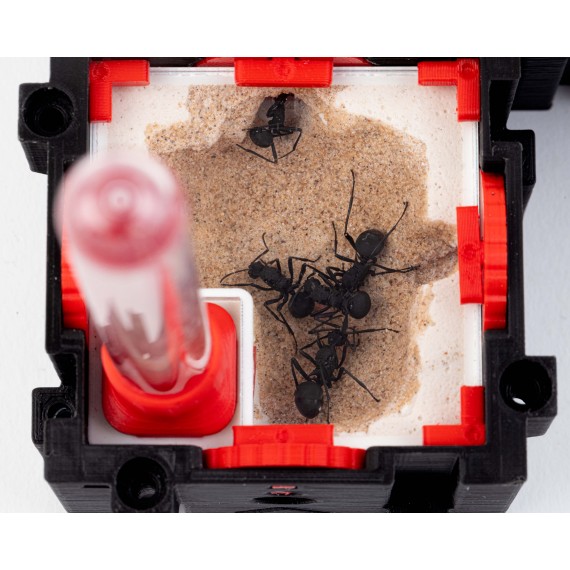
Nest type: plaster (Anthouse Qbik Wild, standard version), with substrate inside.
Substrate: fine sand, inside the nest and in the foraging area.
Diapause: yes, and a long one: about 5–6 months of rest and semi-rest, like Iberian species, with a core of about 3 months (December–February) at 14–18 °C. In the first year it can be avoided by keeping the colony above 30 °C with a long photoperiod (we explain this below).
Light: nest dark or covered; foraging area with daylight. It is a diurnal ant that becomes active with heat and light.
Ventilation: good, so that no condensation forms.
Think of the set-up as a piece of desert: the foraging area dry and hot; the nest milder, with just the right humidity in one part, so that the colony can choose where to place the brood. Without heat the colony fades; with too much humidity come mould and losses.
Set-up: recommended formicaria
At Antomas we recommend a plaster nest from the Anthouse Qbik Wild range, in its standard version, the one moistened by a refillable water tube: it is the one we recommend for this species, with gentle humidity in the nest and a dry foraging area. To start with our mini-colonies, choose the Qbik Wild One P 1C or the Qbik Wild Duo P 2C:
Substrate inside and outside the nest. It is essential: in Antomas's experience, without substrate the larvae do not spin their cocoons properly. Put a thin layer of fine sand in the nest chambers and in the foraging area; the workers will move it around as they please. It is also a born digger.
Heat in the foraging area. Any heat source will do: heating cable or mat, a lamp… Place it over one part of the foraging area, never over the whole set-up or on top of the nest, and control it with a thermostat so that the hot spot stays at about 35 °C. This creates a gradient: a hot spot where the workers become active and a milder nest. A few small stones or twigs in the foraging area serve as lookouts, just as in the wild.
Space. It is a fast forager that covers long distances in the wild: the larger the foraging area, the better.
Arrival of the colony and founding
The colonies we sell at Antomas are mini-colonies, with their queen and their workers. It is a monogynous species, with a single queen per colony. Founding by a lone queen has not been documented in the literature, and the few keepers who have tried agree that she founds poorly; that is why it is better to start with a colony that already has workers. Do not attempt adoptions or reinforce the colony with workers from another one either: in this species they almost never work, and in one documented attempt a worker bit the queen.
When it arrives, settle it in its nest, with its dark area, and leave it in peace for a few days to settle in. The journey is stressful (in one documented case, the queen ate an egg and a worker died during shipping): it is normal for them to be nervous for the first few days.
To move it to a new formicarium, at Antomas we do it by tipping it in: we tip the colony out into the new formicarium. Moves are a delicate moment for this species (in one keeping diary they coincided with significant losses), so only do them when necessary and with the new nest already prepared, with its substrate and its humidity.
There is only one published figure on growth, from a French keeper: from a queen with 2 workers in May to about 30 workers in early October. There are no scientific data on development time.
Feeding
In the wild it is a scavenger: it collects arthropods killed by the heat. At home, the basis is a varied diet of protein and sugars.
Protein. In Antomas's experience, they eat mainly small dead insects, although they also hunt small arthropods well. At first, as with all ants, offer small, dead prey: flies, Drosophila, small crickets or pieces of mealworm or cockroach. As the colony grows, you can gradually increase the size of the prey and change its state: half-dead, dead or fully alive and healthy. Watching them hunt at full speed is quite a show.
Change the type of insect from one week to the next so that they do not always eat the same thing. Keepers who have kept it used flies, small crickets, cockroaches, caterpillars and mealworms, and their favourite prey turned out to be wax moth larvae. Remove leftovers the next day: this species tends to store rubbish inside the nest and bury it in the sand, and that is where mould appears.
How much protein? At Antomas we give them insects 4–5 times a week, or even more: the more they eat, the better and faster they will grow. Our philosophy is simple: if you do daily maintenance and remove leftovers, it is better to overfeed, because the ants understand that they have more resources and do their best to grow faster and in greater numbers. If you cannot clean often, it is better not to overfeed: food that is left over ends up as mould.
Sugars.Yes, they take sugar: at Antomas we keep them with sugar feeders ad libitum, always available. Vary the sugar: use Anthouse Blue Sugar Nectar as the base, 4–5 times a week, and another nectar or sugary liquid 1–2 times a week. Protein can also be added to the nectar.
Offer sugary liquids in traditional or home-made feeders: containers in which the drop stays "spread out" and within reach so that they can drink freely. Never on cotton wool: the cotton goes mouldy and the liquid spoils far too quickly.
Water. A test tube with water and a cotton plug in the foraging area is a good source of water, always available, and keeps the rest of the foraging area dry. Also keep the nest's water tube filled, as it provides the nest's humidity. No standing water and no spraying of the foraging area. Part of their water also comes from their prey.
Diapause: a long pause, just like Iberian species
Yes, it has a diapause, and a long one. Many shops say it does not, but that is not what we see. In the wild, Cataglyphis reduce their activity in winter to a single foraging peak a day, or none: there is winter in the desert too. In Antomas's experience, C. bombycina tolerates more cold than is usually claimed and easily spends about 5–6 months in diapause, like Iberian species.
The signs that it is starting. The two European keepers who have published their experience describe them very well: in autumn, the colony eats its remaining brood, stops accepting insects (although it still takes sugar) and the large workers appear with swollen gasters full of reserves. It is not a disease: it is the colony getting ready for winter. They gave much shorter rest periods, of about 4 weeks at 15–18 °C; in our experience, the species' natural diapause lasts considerably longer.
At Antomas we recommend this schedule, based on our experience and on the climate of its homeland (we explain it under "The climate of its home"):
Autumn (October–November): when you see these signs, gradually lower the temperature, from the 28–30 °C of the active season to 14–18 °C, and shorten the hours of light.
Core of the diapause (about 3 months, December–February): 14–18 °C. Between 10 and 20 °C also works, but 14–18 °C is the safest option.
Spring (March–April): gradually raise the temperature back up to 28–30 °C and lengthen the hours of light.
In total: about 5–6 months of rest and semi-rest, like an Iberian species.
During diapause: switch off the heat in the foraging area and the artificial light, and do not offer insects. You can leave them sugar water, as the keepers who have kept it also did. Keep the nest humidity as usual, without flooding it.
At the end: switch the heat in the foraging area back on and resume insects when they start accepting them again.
There is no need to keep them very cold: in the wild, only the surface of the sand drops to 0–5 °C, and only at night. Beneath the sand, where the nest is, the cold is much milder: at a depth of 75 cm, the soil does not drop below about 14 °C.
Skipping diapause in the first year. In Antomas's experience, diapause can be avoided in the first year without any problem. This is achieved by keeping the colony above 30 °C with a fairly long photoperiod, mainly using artificial light. It is useful if the colony arrives in autumn and you want it to keep growing. From then on, we recommend respecting its diapause.
Behaviour in captivity
It is a very active ant in heat and light. With a warm foraging area you will see workers leaving one by one, criss-crossing the sand in fast runs with abrupt stops to get their bearings, and heading straight back to the nest with their prey. There are no columns or trails: each worker hunts on its own. At low temperatures, on the other hand, it shelters in the nest.
Keep an eye on three things: rubbish, which they tend to keep inside the nest and bury, with a risk of mould and mites; the autumn pause, which is the start of its diapause; and possible breaks in brood rearing in high summer, which one keeper observed at the end of a very hot summer. It is aggressive towards other ants: do not keep it in mixed set-ups or next to other colonies.
How to watch them without disturbing them. At Antomas we believe that ants are there to be enjoyed, watched and learnt from, not to be kept hidden away. All they need is their dark area in the nest and a lit foraging area. Like any good Cataglyphis, it navigates by sight and soon gets used to the light and to our presence. Watch them gently, without knocks or sudden movements, and intervene as little as possible: the less you stress them, the more natural what you see will be.
Escapes and barriers
Good news: it does not climb smooth surfaces well. In Antomas's experience, if the foraging area is clean and the acrylic walls are clean, no escape barrier is needed. Keep the walls free of food residue, dried sugar and dust, which could give them a grip, and check lids and connections. Some guides say it climbs glass well; in our experience, it does not.
What does require care is opening the formicarium: it is the fastest ant in the world and, in the heat, a worker can get out before you even see it. Always open it calmly and, if you need to handle anything, switch off the heat for a few minutes beforehand so that they slow down.
Handling and safety
It is harmless to people: like all formicines, it has no functional sting, and its workers are small. In large colonies, the soldiers bite whatever disturbs the nest. Handle it with soft tweezers or a brush, never with your hands, and calmly: if it escapes, it is very hard to recapture. Use a thermostat with the heat source and make sure the nest never overheats. It is an exotic species: it must never be released into the wild.
What not to do
Keep the nest wet or with condensation: mould is the main cause of losses.
Wet or spray the foraging area, or leave standing water.
Put sugary liquids on cotton wool: it goes mouldy and the liquid spoils straight away.
Set it up without substrate: without sand, the larvae do not spin their cocoons properly.
Go without heat in the foraging area or, conversely, heat the whole set-up without leaving a cooler zone.
Give large, live prey to a newly arrived mini-colony.
Always feed it the same insect or the same sugar.
Leave food leftovers: they end up buried in the nest.
Panic at the autumn pause: it is the start of its diapause.
Cut the diapause down to a few weeks: in our experience, it lasts about 5–6 months.
Keep it very cold during diapause: not even in its desert is it that cold beneath the sand.
Attempt adoptions, reinforce it with workers from another colony or keep it with other species.
Let the walls get dirty: cleanliness is its escape barrier.
Open the formicarium in a hurry with the heat switched on.
Scientific sources
This care sheet is based on the scientific literature on the species and the genus Cataglyphis, the few published keeping diaries and the experience of Antomas. Main references:
Shi, N.N., Tsai, C.-C., Camino, F., Bernard, G.D., Yu, N. & Wehner, R. (2015). Keeping cool: Enhanced optical reflection and radiative heat dissipation in Saharan silver ants. Science 349: 298–301. doi:10.1126/science.aab3564
Willot, Q., Simonis, P., Vigneron, J.-P. & Aron, S. (2016). Total internal reflection accounts for the bright color of the Saharan silver ant. PLoS ONE 11: e0152325. doi:10.1371/journal.pone.0152325
Pfeffer, S.E., Wahl, V.L., Wittlinger, M. & Wolf, H. (2019). High-speed locomotion in the Saharan silver ant, Cataglyphis bombycina. Journal of Experimental Biology 222: jeb198705. doi:10.1242/jeb.198705
Pfeffer, S.E., Wahl, V.L. & Wolf, H. (2020). Accuracy and spread of nest search behaviour in the Saharan silver ant, Cataglyphis bombycina, and in the salt pan species, Cataglyphis fortis. Animal Cognition 23: 1107–1117. doi:10.1007/s10071-020-01371-6
Wehner, R., Marsh, A.C. & Wehner, S. (1992). Desert ants on a thermal tightrope. Nature 357: 586–587. doi:10.1038/357586a0
Gehring, W.J. & Wehner, R. (1995). Heat shock protein synthesis and thermotolerance in Cataglyphis, an ant from the Sahara desert. PNAS 92: 2994–2998. doi:10.1073/pnas.92.7.2994
Willot, Q., Gueydan, C. & Aron, S. (2017). Proteome stability, heat hardening and heat-shock protein expression profiles in Cataglyphis desert ants. Journal of Experimental Biology 220: 1721–1728. doi:10.1242/jeb.154161
Willot, Q., Mardulyn, P., Defrance, M., Gueydan, C. & Aron, S. (2018). Molecular chaperoning helps safeguarding mitochondrial integrity and motor functions in the Sahara silver ant Cataglyphis bombycina. Scientific Reports 8: 9220. doi:10.1038/s41598-018-27628-2
Araujo, N. de S., Perez, R., Willot, Q., Defrance, M. & Aron, S. (2023). Facing lethal temperatures: heat-shock response in desert and temperate ants. Ecology and Evolution 13: e10438. doi:10.1002/ece3.10438
Molet, M., Maicher, V. & Peeters, C. (2014). Bigger helpers in the ant Cataglyphis bombycina: increased worker polymorphism or novel soldier caste? PLoS ONE 9: e84929. doi:10.1371/journal.pone.0084929
Leniaud, L., Pearcy, M. & Aron, S. (2013). Sociogenetic organisation of two desert ants. Insectes Sociaux 60: 337–344. doi:10.1007/s00040-013-0298-2
Leniaud, L., Pearcy, M., Taheri, A. & Aron, S. (2015). Testing the genetic determination of the soldier caste in the silver ant. Insectes Sociaux 62: 517–524. doi:10.1007/s00040-015-0431-5
Boulay, R., Aron, S., Cerdá, X., Doums, C., Graham, P., Hefetz, A. & Monnin, T. (2017). Social life in arid environments: the case study of Cataglyphis ants. Annual Review of Entomology 62: 305–321. doi:10.1146/annurev-ento-031616-034941