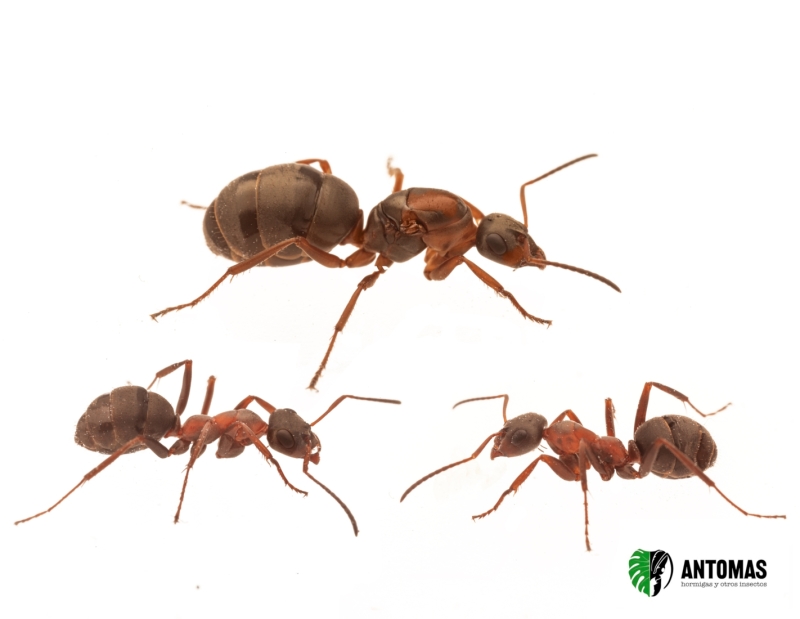
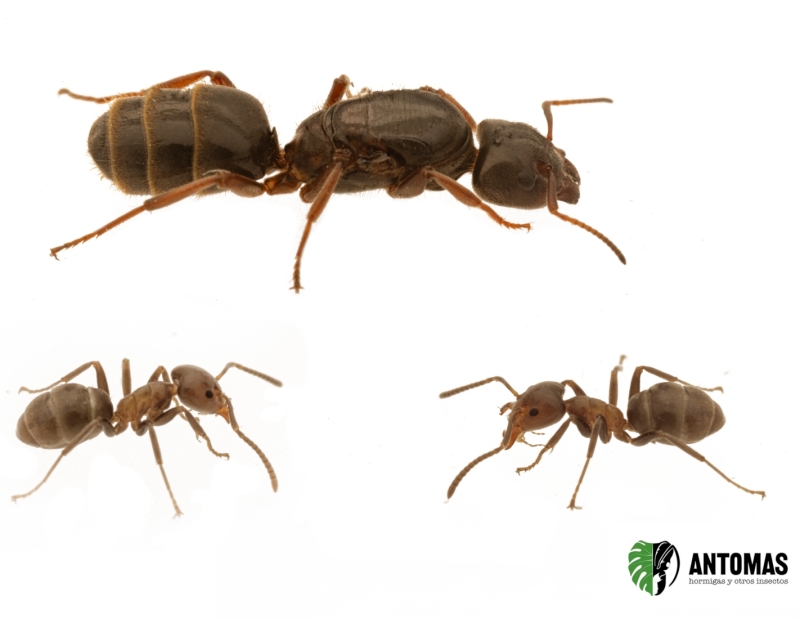
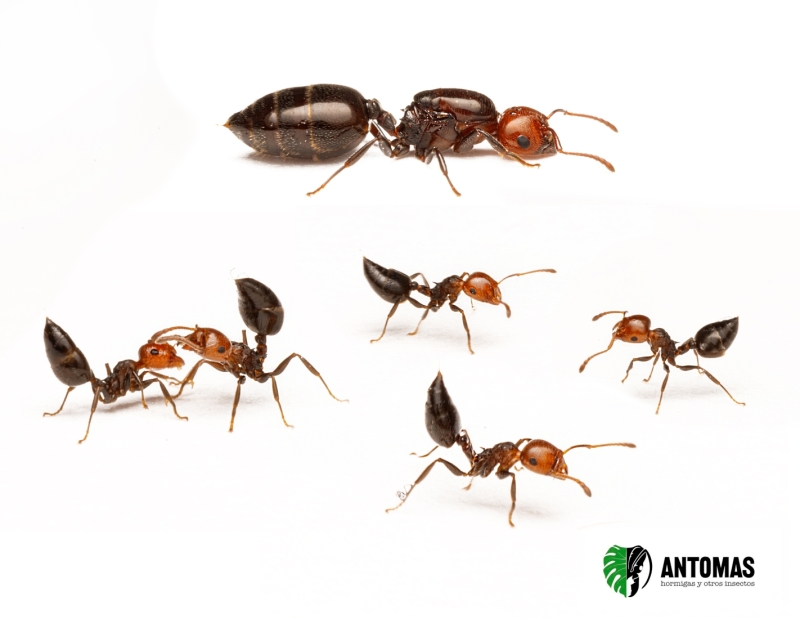
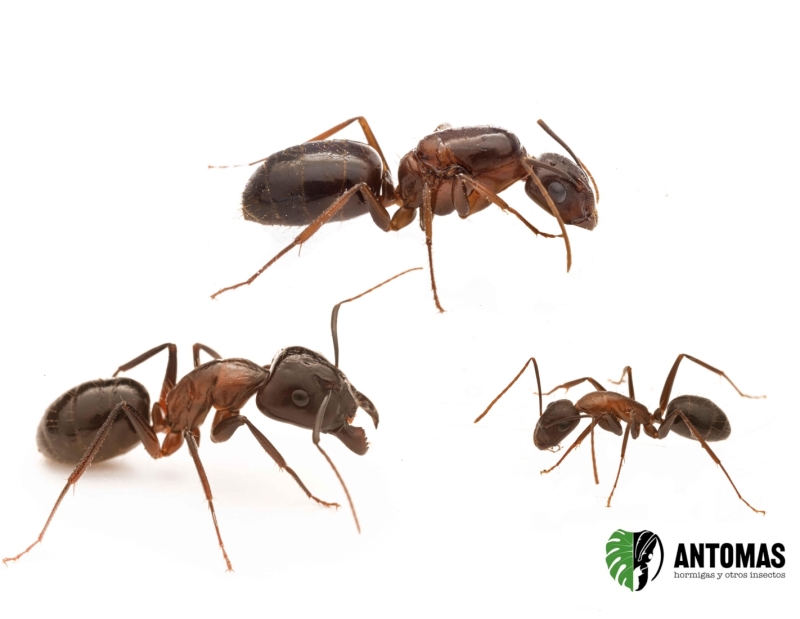
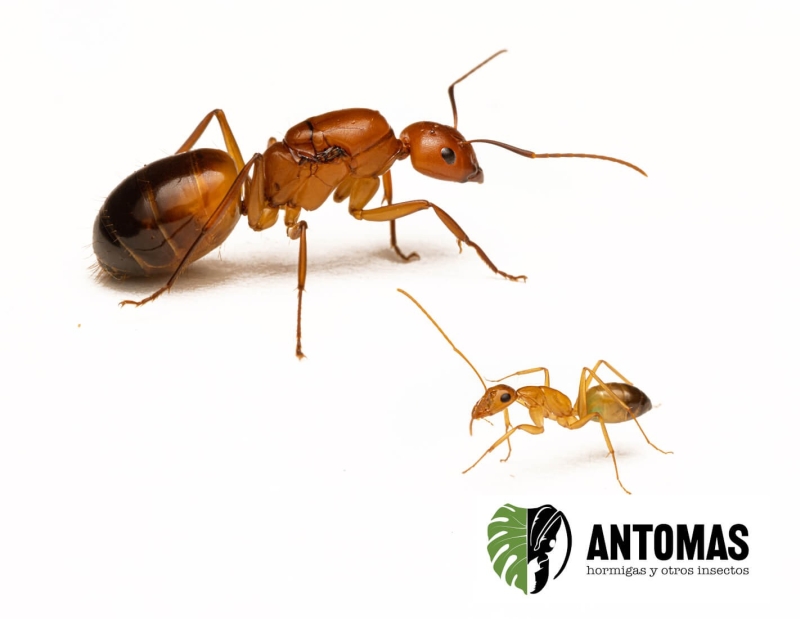
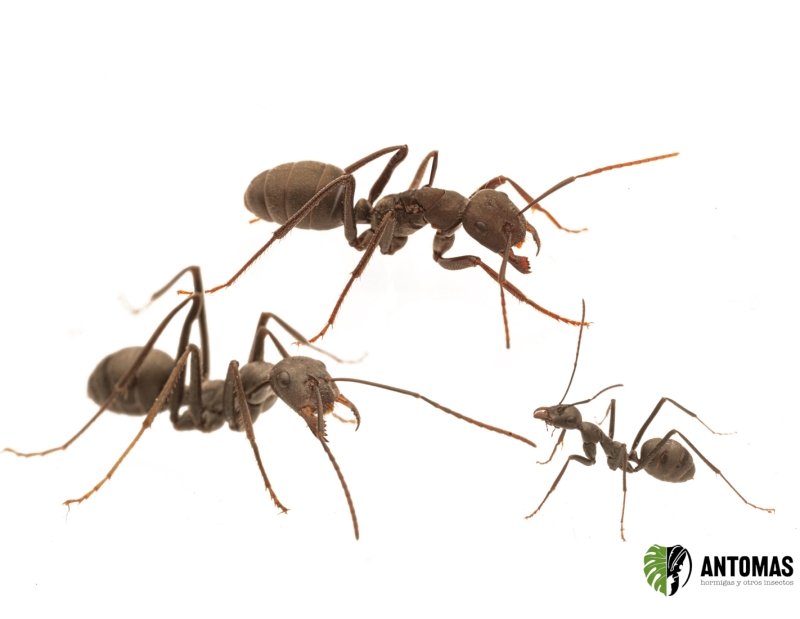
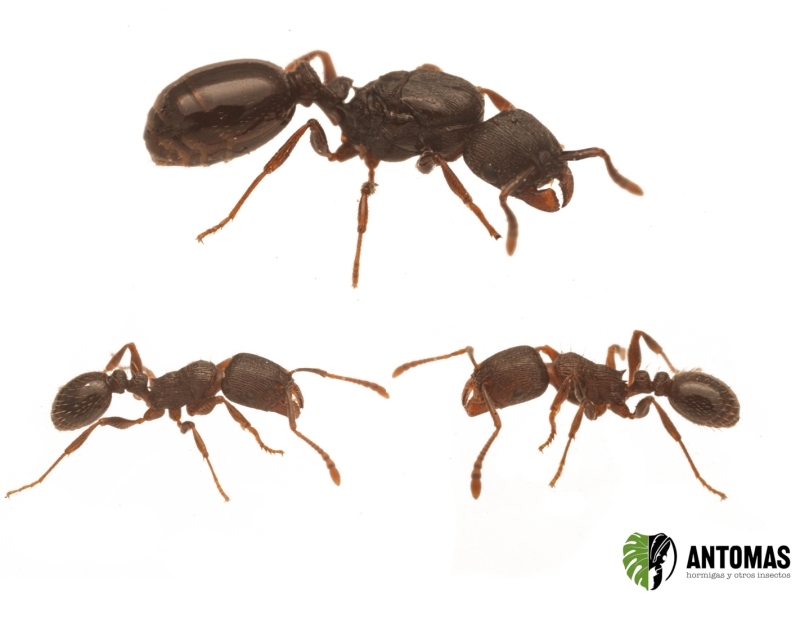
Difficulty: 1/5 – Beginner
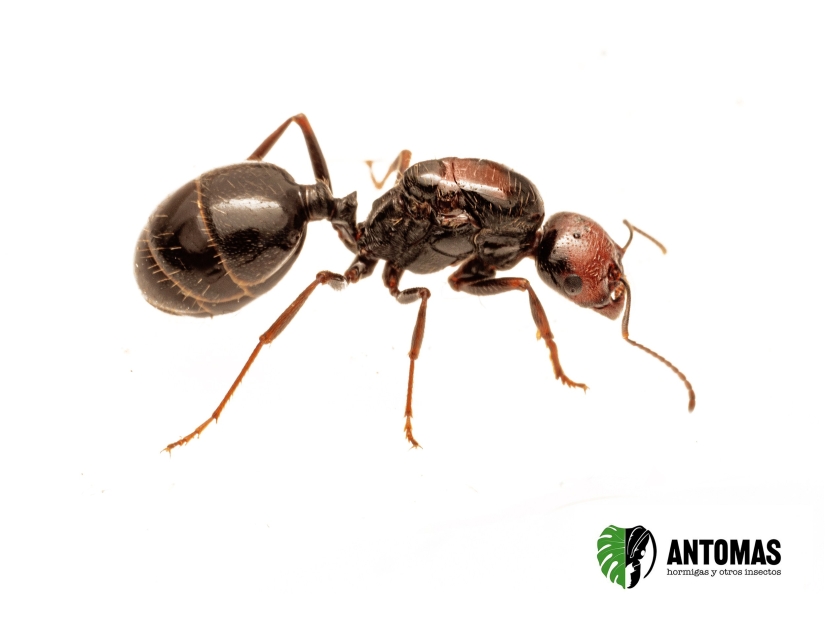
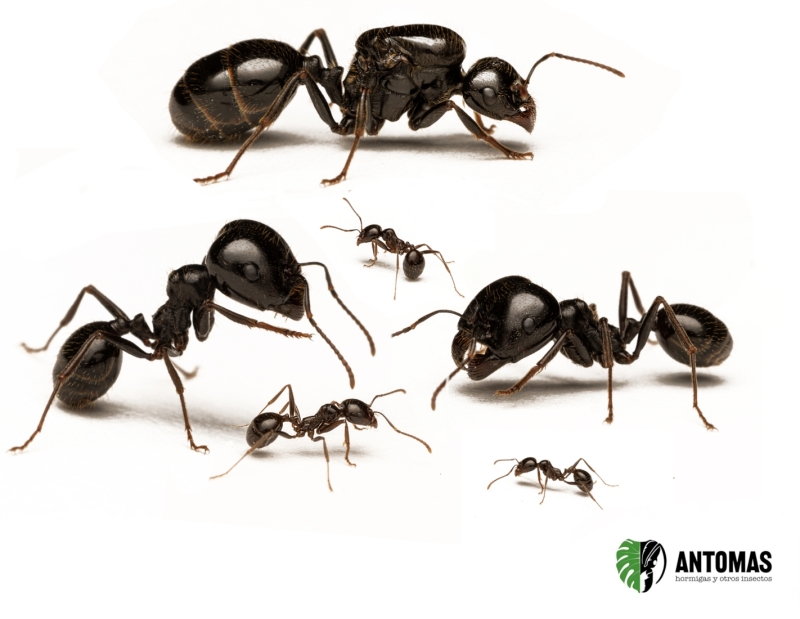
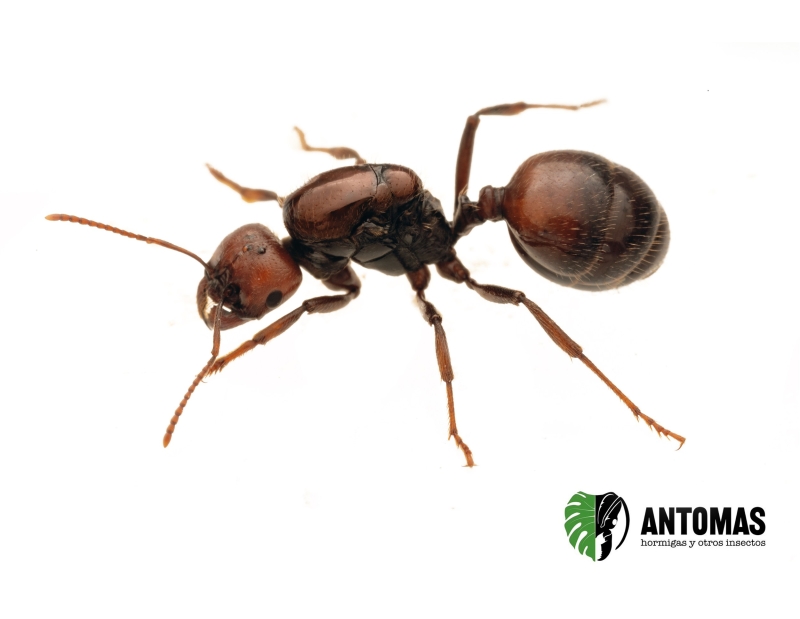
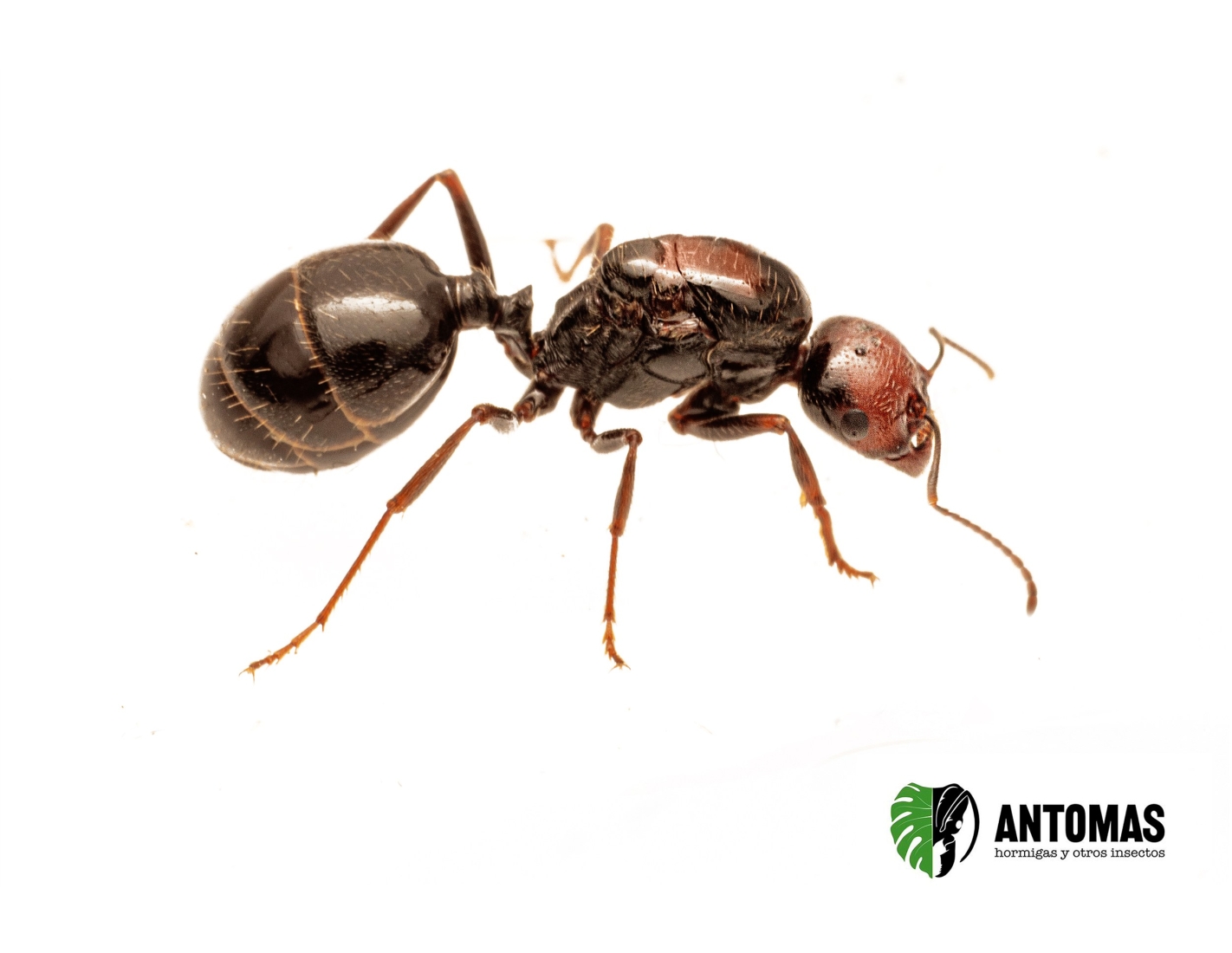
The Messor of the Canary Islands: the westernmost form of a western Mediterranean harvester ant, black with reddish highlights, with workers of many sizes and seed granaries. It arrives as a founding queen with her first brood. A Qbik nest from the Alpha range with medium galleries, a humid area for the brood and a dry granary, 22–28 °C, varied seeds and plenty of protein. Mild diapause: about 5 months, from November to March, below about 20 °C, with no need for cold. It is not an escape artist: a barrier of mineral oil or PTFE is enough.
Messor minor hesperius Santschi, 1927 is a seed-harvesting ant described from specimens collected at El Médano, on the south coast of Tenerife. It belongs to Messor minor (André, 1883), a western Mediterranean species that lives in Corsica, Italy and North Africa, and it is its Canary Island population: the westernmost form of the species, separated from the rest by hundreds of kilometres of ocean. It has never been recorded on the Iberian Peninsula: there the common Messor are other species, such as M. barbarus or M. capitatus.
It is an ant of dry, sunny land with mild winters, which lives on the seeds it gathers and keeps in its granaries. For beginners it is an excellent choice: hardy, not at all fussy and with a diapause that does not require cold. As its biology has barely been studied, in each section we state whether a piece of information comes from the scientific literature, from general knowledge of the genus Messor, from other keepers or from Antomas’s own experience.

Inside a great Messor empire: brood, granaries and wars, in a video by Anthouse (in Spanish).
Biology
“The lesser” and “the western”: a name in two stages
The story of its name begins in 1883, when the French entomologist Ernest André described a variety minor of what was then called Aphaenogaster barbara, from ants from Italy and Corsica. Minor means “lesser” in Latin. Over the years, that variety went through several combinations, including that of a variety of M. capitatus, until it ended up as a species in its own right within the genus Messor: M. minor.
The second part came in 1927. The Swiss myrmecologist Félix Santschi, the same man who demonstrated the sun compass of ants with M. barbarus, revised the Messor of the instabilis group and described the variety hesperius from workers, queens and a male collected at El Médano (Tenerife) by the naturalist J. M. Mas de Xaxars. The type specimens are kept in the Natural History Museum of Basel. Hesperius is the Latin adjective for “western”, “from the side of the sunset”. We do not know whether Santschi explained his choice, but it could not have been more fitting: it is the westernmost population of the whole species.
Species or subspecies? Almost a century of back and forth
Its rank has changed several times. Menozzi (1929), Báez and Ortega (1978) and Bolton (1995) treated it as a subspecies of M. minor; later, Cagniant and Espadaler, and Borowiec’s European catalogue (2014), raised it to a species in its own right, Messor hesperius. In 2020, the revision of the Messor of the Maghreb by Barech, Khaldi, Espadaler and Cagniant demoted it again: new material, above all from Corsica and Tunisia, showed that the shape of the petiole, the ant’s “waist”, on which the separation was based, varies from one population to another. As M. minor occupies a wide range that includes Algeria and the Canary Islands, the authors preferred to regard the Canarian form as a geographically circumscribed population of the species, that is, a subspecies.
That is how it stands today in the world ant catalogue: Messor minor hesperius, a valid subspecies. The Canary Islands Biodiversity Databank also lists as a synonym the name M. minor maurus Santschi, 1923, which appears in some old records from the islands. It shows how difficult Messor taxonomy is: to identify a species properly you need workers of all sizes, and even then the specialists disagree.
A Messor in the middle of the Atlantic
M. minor is a species of the western Mediterranean: on the international biodiversity portal GBIF, most of its records are from Italy and Corsica, with records also from Tunisia, Algeria and Morocco. Its presence in Sicily is debated, because André gave no specific locality and some old records from the island seem to belong to another species, M. bouvieri. In Spain, on the other hand, all its records are from the Canary Islands: not a single one from the mainland or the Balearic Islands.
The subspecies hesperius is, therefore, Canarian. It has been known on Tenerife since the late 19th century, and the citizen science records collected in GBIF, mostly iNaturalist photographs, place it on Tenerife, Gran Canaria, Fuerteventura and Lanzarote: from the arid south of Tenerife (Arona, Abades, Guía de Isora) to the coasts of Yaiza and Haría, on Lanzarote. These are identifications from photos, not checked by specialists, so the exact island-by-island map is still to be confirmed.
The Canary Islands are volcanic islands that were never joined to the mainland. How and when this ant reached them has not been studied: we have not found any work that sheds light on it.
A climate of eternal spring
Its climate explains almost everything it needs at home. At Tenerife South airport, a few kilometres from El Médano, the AEMET climate normals (1981–2010) give an annual mean of 21.4 °C: from 18.4 °C in January to 24.7 °C in August, with mean maximums of only 28.4 °C in the hottest month and minimums of about 15 °C in winter. Lanzarote is very similar: a mean of 17.4 °C in January and 25.2 °C in August. Rainfall is very low, 111–132 mm a year, and almost all of it falls between November and February.
In other words: warm summers without extremes and very mild winters, with means of 17–20 °C from December to March. No frost and none of the 40 °C of inland Spain. That is why we recommend a temperate nest for it, without an excessive hot spot, and a diapause that does not need cold (see “Diapause”).
Sand, stones and dry scrub
There are no studies of its habitat on the islands. Care sheets place it in sandy, steppe-like areas, with nests dug in the ground, often under stones or at the foot of shrubs, and the type locality itself, El Médano, is a sandy, arid coast. Like other Messor, it digs deep nests in the soil, with chambers for the brood and granaries for the seeds.
You will see it at home: it is a great digger. German keepers recommend that, if substrate is used, it should be dry and not need frequent watering, because it moves the soil around non-stop.
Seed reapers: granaries and “ant bread”
Like all Messor, whose name means “reaper” in Latin, it is granivorous: it lives mainly on seeds. No one has studied which seeds it collects in the Canary Islands, but the behaviour of the genus is well known, and the review by Plowes, Johnson and Hölldobler (2013) sums it up:
- They harvest and store. The workers collect seeds on the surface and carry them to granaries, dry chambers in the nest where they keep for months. It is their larder for times without food, which in an arid climate like that of the Canary Islands can be long.
- They control germination. In M. barbarus it was already described in the 19th century how the workers cut the root off seeds that start to sprout and carry out the ones that get wet to dry. At home you will see the same: they remove seeds that germinate.
- They grind the grain. The large workers crack the seeds and chew them into a paste with which they feed the larvae, the so-called “ant bread”. German keepers also describe it in this subspecies: they prepare it for winter or dry periods, which is why they insist that the granary must always be dry, or the seeds go mouldy or germinate.
- They throw out the husks. The husks they do not eat end up in a little pile outside the nest, the midden, very typical of any Messor colony.
They are not strict vegetarians: in the wild, Messor also collect dead insects, and animal protein is key for the colony to grow (see “Feeding”).
Workers of all sizes
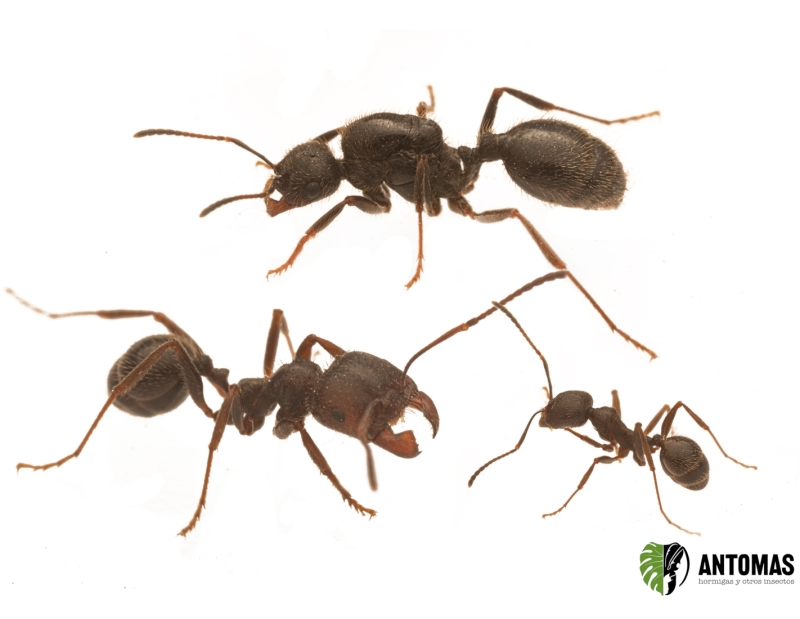
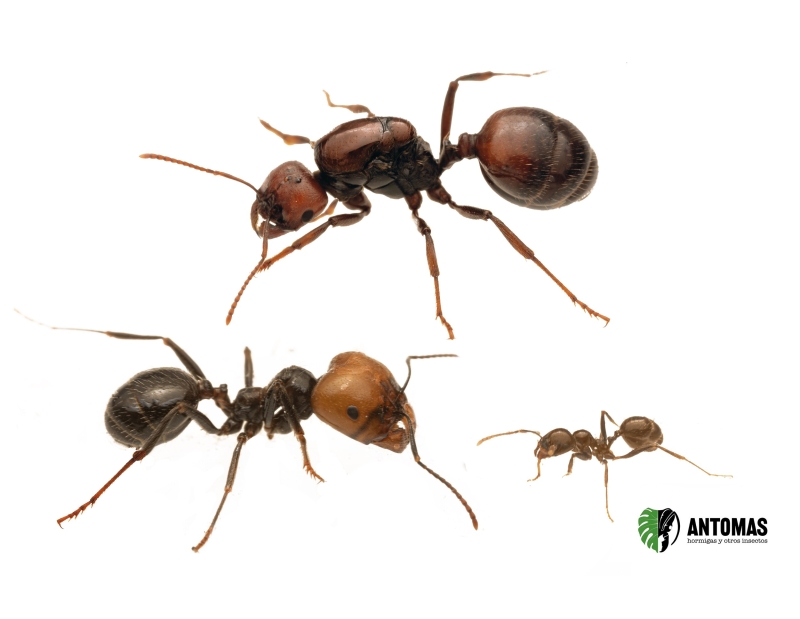
A mature colony looks like a size sampler. Keepers describe it as having strongly polymorphic workers: from small minors to big-headed majors, with all the intermediate sizes. There are no separate castes, but a continuous gradation. In its best-studied cousin, M. barbarus, it has been shown that each size tends to specialise: the small ones handle the small seeds, the medium ones mark the trails with pheromones and the large ones carry the large seeds (Heredia and Detrain, 2000). This has not been studied in M. minor, but at home you will soon see that the majors, with their heads full of muscle, are the ones that crack the hard seeds.
That is why, in a young colony, the appearance of the first majors is quite an event: from then on the colony can handle almost any seed, and its growth speeds up (see “Growth”).
Bolder than its cousins
Keepers who keep it agree on one trait: it is more aggressive and less shy than M. barbarus, and it goes out foraging with determination. At the same time, it gets agitated when light suddenly enters the nest chambers. Both things fit with what we see in many Messor: a strong temperament outside, dark chambers inside.
This character has a practical consequence, common to the whole genus: they are territorial. In the wild, neighbouring Messor colonies divide up the ground and defend their borders, and a mature colony will attack an insect invading its territory as a group. That is why you should not merge colonies or connect two formicaria to each other.
One queen and several thousand workers
According to keepers, colonies are monogynous: a single queen per nest. And they can become large: care sheets speak of several thousand individuals, a figure no one has measured in the wild, but one that matches that of other Mediterranean Messor. At home, with space, seeds and protein, a Messor colony becomes a true empire in a few years.
In some Messor, such as M. barbarus or M. structor, an unusual genetic system has been discovered, social hybridogenesis: the workers are born from crosses between two lineages and the queens from crosses within the same lineage (Norman and colleagues, 2016; Romiguier and colleagues, 2017). We do not know whether it occurs in M. minor: we have not found any study.
Nuptial flights: a calendar still to be worked out
There is no study of the flights of M. minor hesperius. The only data we have found come from hobbyists: in the collaborative AntFlights database, someone recorded a flight in the Canary Islands on 14 November 2024, in mid-morning, with sunshine, no wind and about 26 °C. For the species in Corsica, October is mentioned. Everything points to autumn flights, as in other Mediterranean Messor, but more observations are needed. If you live in the Canary Islands and see a flight of winged Messor queens, note down the date, the time and the weather: it is a piece of information that is still missing.
A founding without leaving home
After the flight, the queen sheds her wings, buries herself and founds her colony alone. Founding is claustral: she raises her first workers without going out to look for food, using the reserves in her body, the fat and the flight muscles she no longer needs. Keller and Passera (1989) showed that queens with claustral founding weigh more and store more fat than those that depend on feeding outside. And, as in other autumn Messor, the queen is usually in no hurry: she spends the winter at a slow pace and gets going properly in spring.
A companion for many years
Ant queens are among the longest-lived insects known. The review by Keller and Genoud (1997) includes queens that lived for decades, and the documented record, a Lasius niger queen, reached almost 29 years. No one has measured the queen’s lifespan in M. minor, but at Antomas we keep an 11-year-old Messor colony that is still active. A well-cared-for queen can keep you company for a very long time: bear that in mind when choosing her.
Size and morphology
A robust ant of the subfamily Myrmicinae, with workers of very different sizes. We have not been able to consult Santschi’s original description, so here we bring together what the reviews of the genus and the care sheets say, stating where each piece of information comes from.
- Colour. According to keepers, queen and workers are a shiny reddish black; the males, black.
- Castes. Highly polymorphic workers, from minors to majors with all the intermediate sizes. The majors have a proportionally much larger head, with broad mandibles for cracking seeds.
- Petiole. This is the character that was used to separate the Canarian form, and the one that, according to Barech and colleagues (2020), varies between populations of the species.
- Queen. Large and robust, with the bulky thorax of one that has flown and the scars of her wings.
- Development. As in other myrmicines, the larvae pupate without a cocoon: the pupae are naked.
How to recognise it
- By location. It is the form of Messor described from the Canary Islands, and the one that appears in the records from the islands. It does not live on the mainland: there the most common Messor is M. barbarus, with majors whose heads are often red.
- Compared with M. capitatus. M. capitatus is of the same lineage, to the point that minor was once one of its varieties, but it is a larger, entirely black species, from the Iberian Peninsula and the rest of the Mediterranean.
- Compared with M. ibericus. M. ibericus belongs to another group, that of M. structor, with smaller, less polymorphic workers.
- Under a lens. As in the whole genus, a reliable identification requires workers of all sizes, especially majors, and comparing fine characters such as the petiole or the sculpture of the head.
Measurements
We have not found accessible scientific measurements of the castes of M. minor hesperius. The figures circulating in shops and care sheets have no scientific source behind them, so we prefer not to reproduce them. What you will see at home: the queen’s first workers, the “nanitics”, are small, and each new batch brings somewhat larger workers, until the first majors appear.
Care in captivity
Difficulty: 1/5 – Beginner
It is one of the best ants to start with. Keepers agree that it is easy as long as temperature and humidity are stable, and at Antomas we see it the same way:
- It is hardy and adapts very well to life in a formicarium.
- It eats seeds that you can always keep at home, and it stores them itself for the days when you forget.
- Its diapause is simple: it comes from winters of 17–20 °C, so a cool corner of the house is enough, with no cold and no fridge.
- It is not an escape artist and, in practice, it does not sting.
What it asks for comes down to four things: a nest with a humid area and a dry granary, water always available, plenty of food with leftovers cleared away, and its winter rest. In return, you will watch the workers lay out their routes, fill the granary, crack seeds with the majors and carry the husks out to the midden.
Temperature, humidity and light
- Temperature (spring to autumn): 22–28 °C in the nest. This is the range of Canarian summers, with means of 22–25 °C from June to September and mean maximums of 28–29 °C. Keepers recommend 21–26 °C in the nest and a little more, up to 30 °C, in the foraging area. It does not need an excessive hot spot: if you use a heat source, keep it gentle, at one end and with a thermostat, and never let the nest go above 30 °C.
- Humidity: two zones. A humid part of the nest, without waterlogging, for the brood (keepers insist that the larvae develop well if their chambers are slightly humid), and a dry granary for the seeds. The foraging area, dry.
- Water: always available, also during diapause: a test tube with water and cotton wool in the foraging area. Like other Messor, it drowns in open water.
- Light: simply leave them their dark area in the nest and the foraging area in the light, with a normal day–night cycle. Avoid direct sunlight on the formicarium.
- Diapause: about 5 months, from November to March, below about 20 °C (see “Diapause”).
Recommended formicaria
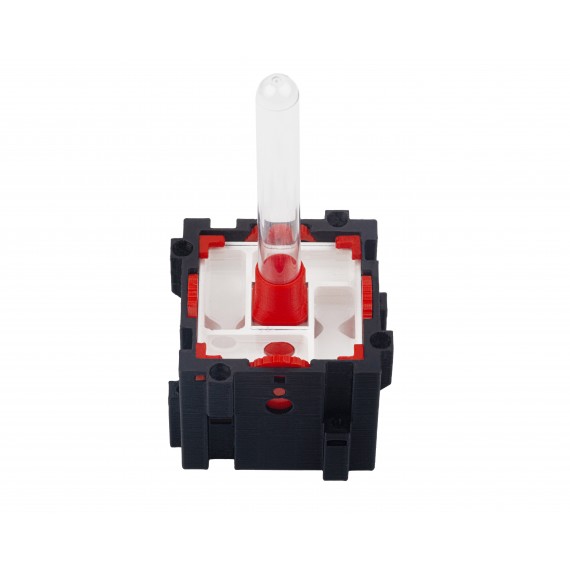
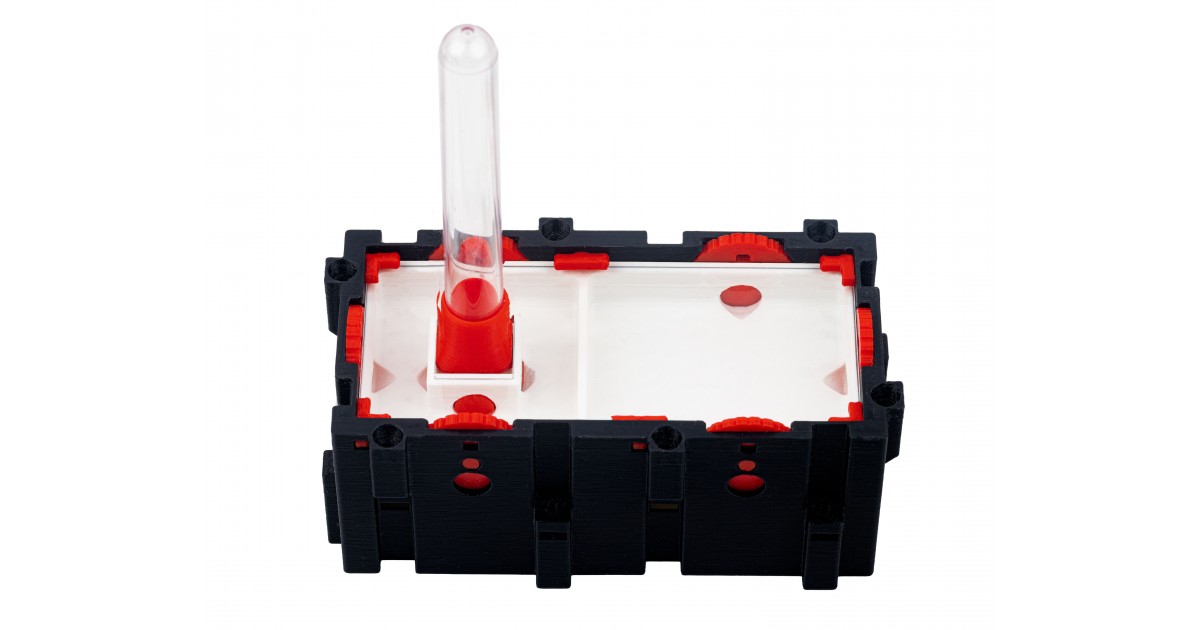
At Antomas we recommend the Qbik range by Anthouse, the standard Qbiks of the Alpha range: modular formicaria that grow with the colony. To start with, a QBIK ONE with medium galleries, which makes it easy to keep an eye on the brood and the granary in a small colony.
As the colony grows, it is expanded with the QBIK DUO, always with galleries sized for its majors:
Expand when the nest becomes too small for them, never in advance: a clear sign is seeing lots of workers standing still in the corners of the foraging area, with no room inside. A nest that is too big for a small colony ends up with corners used as a midden, mould and mites.
No plaster or Ytong nests. Messor gnaw: at Antomas we have seen it time and again, the majors wreck plaster and Ytong nests. Some shops recommend them for this species; we do not. Always choose professional nests made of materials they cannot gnaw.
Complete the set-up with these details:
- Humid area and dry granary. Moisten only the brood area and leave another part dry, where they will store the seeds.
- Water in a test tube, with its cotton wool plug, in the foraging area. In summer, add a second tube.
- A feeder for sugary liquids, never cotton wool, which goes mouldy and spoils the liquid.
- A large, dry foraging area, with a little sand so they can lay out their routes and set up their midden, as on the sandy coasts of the islands.
The first weeks with your queen
We send you a founding queen with her first brood: already mated and with eggs, larvae or pupae, in a tube with its water reservoir behind the cotton wool. As founding is claustral, she does not need to go out for food to raise her first daughters. Your role is simple:
- A quiet, dark place, at room temperature. Leave the tube as it arrives.
- Touch little, look as much as you like. This is the only stage at which it is best to intervene as little as possible: a stressed queen may eat some of her eggs. Look at her as much as you want, gently, but do not keep moving the tube or open it unnecessarily.
- Young queens, in diapause. Autumn Messor queens usually spend the winter at a slow pace and get going in spring. At Antomas we recommend respecting this and letting them go through diapause: the tube in a cool place, below about 20 °C, until March. Do not warm her up to bring egg-laying forward.
- The first seeds. When there are workers, offer a few small, soft seeds, such as chia, sesame, poppy or grass seed, on the dry side of the tube, away from the cotton wool: if they touch the damp cotton wool they germinate, and their roots drink the water.
- Water reservoir. If it runs out or the tube is very dirty, tip the colony into a clean one.
How long until the first worker? It depends on the temperature: in Messor, according to keepers, development from egg to worker takes 6 to 12 weeks. In winter the brood may stay on hold until spring: this is normal. The first workers, the “nanitics”, are small and short-lived: it is not a bad sign if some die.
Moving by tipping
At Antomas we move the colony into the formicarium when it has a few dozen workers and the tube is becoming too small, and we do it by tipping: we do not wait for them to decide to move on their own.
- Have the formicarium ready: barrier applied, water tube in place, humid area moistened and chambers in semi-darkness.
- Do it over a tray: if a worker escapes along the tube or the tools, it will not get far.
- Unplug the tube inside the foraging area, next to the nest entrance, and with a few gentle taps tip out all its contents: queen, workers, brood and seeds.
- The stragglers: help them out with a soft brush.
- Close up and watch: within a few hours they will have carried the brood into the nest and started to organise the granary.
When the colony grows and you add the QBIK DUO, the method is repeated.
Feeding
Varied seeds, the staple. In the wild it collects mainly seeds of grasses and wild plants, according to keepers. At home, in Antomas’s experience with Messor, they like practically everything: canary seed, millet, oats, bird seed mixes, grass seed, chia, quinoa, linseed, sesame or poppy seed. Use seeds for human consumption or for birds, untreated, unsalted and unroasted, and vary the mix. One rule depending on the age of the colony: until the first majors are born, the workers cannot crack hard seeds, so in a young colony it is best to give small or soft seeds. With majors, they can handle anything.
How to prevent mould and germination:
- Leave the seeds in the foraging area, so they carry them to the dry granary themselves; never in the humid area or in contact with the cotton wool.
- Remove seeds that germinate or go mouldy, and the husks from the midden.
- For a small colony, give a small amount and often; for a large one you can give more, because they store it.
Protein, in abundance. For the colony to grow fast, it is essential to give it plenty of protein: the queen needs it to lay, and the larvae to grow. For Messor, dead or cooked insects are best, in small pieces suited to the size of the colony, changing the type of insect every week:
The more they eat, the better and faster they grow. This is Antomas’s philosophy: if you clear away leftovers every day, it is better to feed generously, because the colony senses that it has resources and raises more brood. If you will not be able to clean often, adjust the portions.
Sugar, only now and then. It is a granivore, and sugars are not its staple. As an occasional supplement you can offer it Anthouse’s Blue Sugar nectar, always in a feeder and never on cotton wool: at Antomas, once or twice a month. Avoid thick honey: they get stuck in it.
Water: always, in the test tube with cotton wool. It is the one thing they must never be without.
Growth
There are no published data on its growth rate. As in other Messor, the first year is usually slow: few workers, small ones, and a queen who is gradually picking up the pace. With the arrival of the first majors, the colony can handle all seeds and speeds up; some shops that breed it say that, in good conditions, it grows fast. In Antomas’s experience with Messor, the key lies in three things: plenty of protein, stable warmth during the active season and a good diapause. Expand when you see lots of workers standing still in the foraging area because there is no longer room inside.
Diapause
Even though it comes from islands with a mild climate, it is best to give it a winter rest, the diapause. In its range, from December to March, the mean air temperature drops to 17–20 °C (AEMET, Tenerife South and Lanzarote), with minimums of about 14–15 °C, and this is the rainy season. German keepers and some shops recommend a rest from November to February, at 12–15 °C or at about 15 °C; some keep it warm all year round, but the keepers themselves warn that this is debatable.
At Antomas we recommend a diapause of about 5 months, from November to March, below about 20 °C. Cold is not needed: the closest thing to its winter is a cool, unheated room in the house, at about 15–20 °C. If it drops a little lower, like the 12–15 °C used by keepers, it tolerates that too; what makes no sense is putting it in the fridge.
- No artificial heat throughout the winter.
- Water always available, in its tube. They will eat little, mostly from the seeds they have stored.
- Little protein: if they barely touch it, do not insist.
- Gradual changes: November and March are transition months, in which the temperature falls and rises little by little.
You will know the colony has entered diapause because it eats less, moves less and no longer has pupae. In spring, as the temperature rises, the queen starts laying again and the colony takes off. Founding queens and small colonies also go through diapause.
Behaviour and observation
A tidy home. Within a few days you will see the colony organise its nest: the brood in the humid area, the granary in the dry one and the midden outside, with husks, food leftovers and dead workers. Clear it from time to time and keep it dry.
Things worth watching. The columns of workers between the nest and the seeds, the majors cracking grains, the “ant bread” they give the larvae and the group reaction when an insect enters their territory.
Watch without fear. At Antomas we believe ants are there to be enjoyed, watched and learnt from, not kept hidden away. Simply leave them their dark area in the nest and the foraging area in the light: check the brood, the queen and the food often. Keepers report that it gets agitated if light suddenly enters the chambers, so if you lift a lid, do it gently; they quickly get used to your presence.
Warning signs:
- The queen comes out into the foraging area: check the water.
- Mould in the granary: there is moisture where there should not be.
- Many workers die in a short time: check the water, the temperature and food leftovers.
- The brood is not progressing in the middle of the active season: almost always, protein or warmth is lacking.
Keeping them in
In Antomas’s experience, Messor are not escape artists: they only try to escape when they are short of food, water or space. A barrier of mineral oil or PTFE in the foraging area works very well with them. What they do is gnaw: check plugs, joints and soft parts. The best prevention is a professional formicarium, plenty of food and water, and expanding in good time.
Handling and safety
It is a very safe species. In practice it does not sting and, like all myrmicines, it has no formic acid. Majors can bite, but their bite is a pinch: you notice it, but it does not hurt. Even so, handle them with a soft brush or soft forceps, not with your hands, especially when tipping or cleaning, so as not to harm the queen. Do not merge colonies or connect two Messor formicaria. And never release colonies or queens into the wild: outside the Canary Islands it would be an introduced ant, and on the islands it could mix with the wild populations.
What not to do
- Housing them in plaster or Ytong nests, or nests of soft materials: they gnaw through them.
- Putting seeds in the humid area or in contact with the cotton wool: they germinate or go mouldy.
- Giving them a nest that is too big for the colony.
- Leaving protein for more than 24–48 hours, mouldy seeds or a damp midden.
- Skimping on protein or always giving the same insect.
- Overdoing sugars: in this species, once or twice a month.
- Putting sugary liquids on cotton wool, leaving open water or giving thick honey.
- Leaving them without water, also during diapause.
- Warming up a young queen to bring egg-laying forward, skipping diapause or putting it in the fridge.
- Using an excessive hot spot or leaving the formicarium in direct sunlight.
- Putting queens or colonies together.
- Keeping them hidden away: they are there to be watched and enjoyed.
Scientific sources
This care sheet is based on the scientific literature on Messor minor and the genus Messor, on distribution records (GBIF, Canary Islands Biodiversity Databank), on the AEMET climate normals (1981–2010, Tenerife South and Lanzarote) and on the experience of Antomas and other keepers. For the taxonomy we have also relied on Santschi’s original description (1927, Boletín de la Real Sociedad Española de Historia Natural 27) and on Borowiec’s catalogue (2014, Genus 25), cited via AntCat. Main references:
- Cagniant, H. & Espadaler, X. (1997). Le genre Messor au Maroc (Hymenoptera: Formicidae). Annales de la Société entomologique de France (N.S.) 33: 419–434. doi:10.1080/21686351.1997.12279186
- Barech, G., Khaldi, M., Espadaler, X. & Cagniant, H. (2020). Révision taxonomique du genre Messor (Hymenoptera, Formicidae) au Maghreb et description de Messor hodnii sp. n., une nouvelle espèce de fourmi trouvée en Algérie. Revue suisse de Zoologie 127: 9–19. doi:10.35929/RSZ.0002
- Plowes, N. J. R., Johnson, R. A. & Hölldobler, B. (2013). Foraging behavior in the ant genus Messor (Hymenoptera: Formicidae: Myrmicinae). Myrmecological News 18: 33–49. Full text in Myrmecological News
- Heredia, A. & Detrain, C. (2000). Worker size polymorphism and ethological role of sting associated glands in the harvester ant Messor barbarus. Insectes Sociaux 47: 383–389. doi:10.1007/PL00001735
- Keller, L. & Passera, L. (1989). Size and fat content of gynes in relation to the mode of colony founding in ants (Hymenoptera; Formicidae). Oecologia 80: 236–240. doi:10.1007/BF00380157
- Keller, L. & Genoud, M. (1997). Extraordinary lifespans in ants: a test of evolutionary theories of ageing. Nature 389: 958–960. doi:10.1038/40130
- Norman, V., Darras, H., Tranter, C., Aron, S. & Hughes, W. O. H. (2016). Cryptic lineages hybridize for worker production in the harvester ant Messor barbarus. Biology Letters 12: 20160542. doi:10.1098/rsbl.2016.0542
- Romiguier, J., Fournier, A., Yek, S. H. & Keller, L. (2017). Convergent evolution of social hybridogenesis in Messor harvester ants. Molecular Ecology 26: 1108–1117. doi:10.1111/mec.13899