Difficulty: 2/5 – Beginner
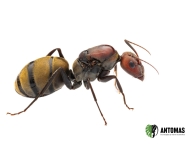
An African Camponotus of the subgenus Myrmosericus, whose name means “silk ant”: a gaster covered in golden pubescence that shifts with the light, a reddish head and workers of several sizes. Founding queens with brood and colonies with 5–10 workers, with claustral founding. QBIK ONE with large galleries or Qbik Wild, nest at 24–28 °C with a warm spot of 28–30 °C, moderate humidity with a gradient, sugar always available and plenty of protein. No diapause needed. Very fast workers and good climbers: escape barrier and lid from day one.
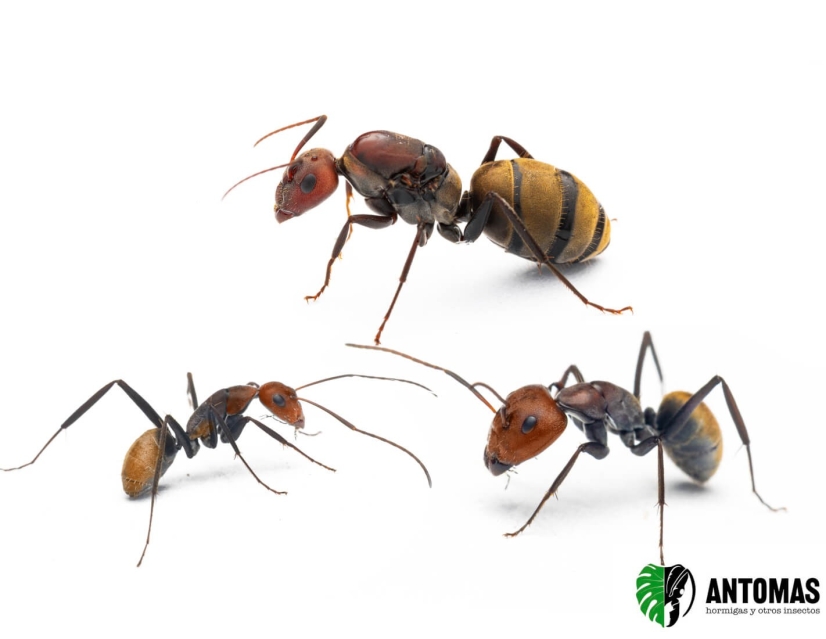
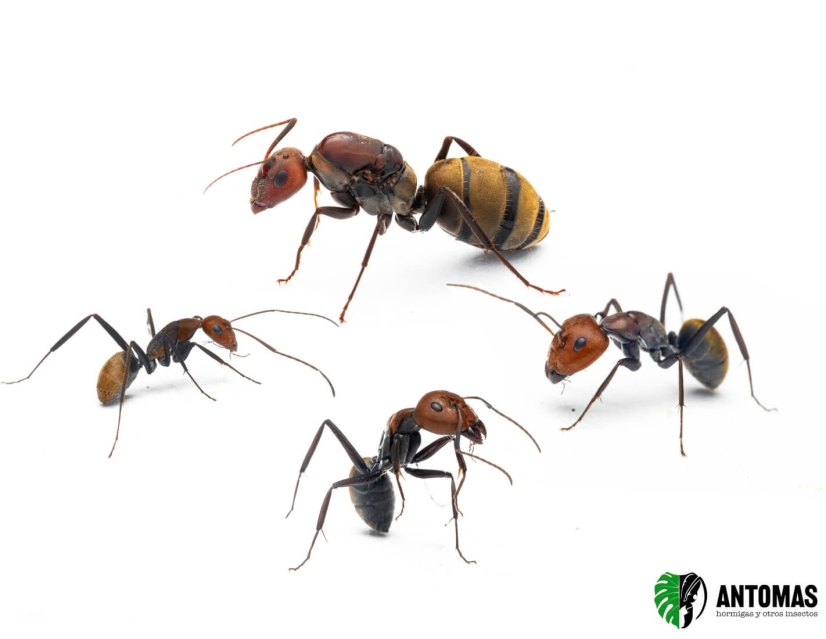
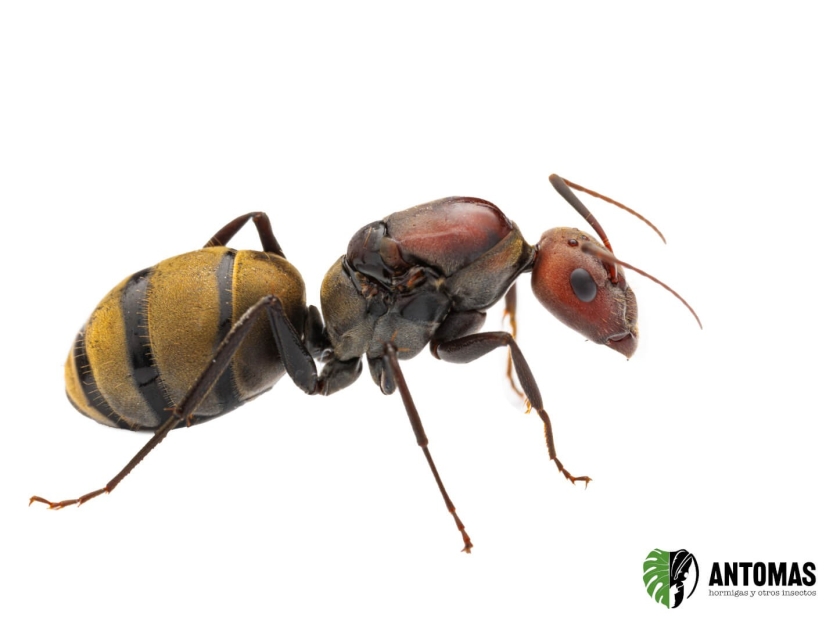
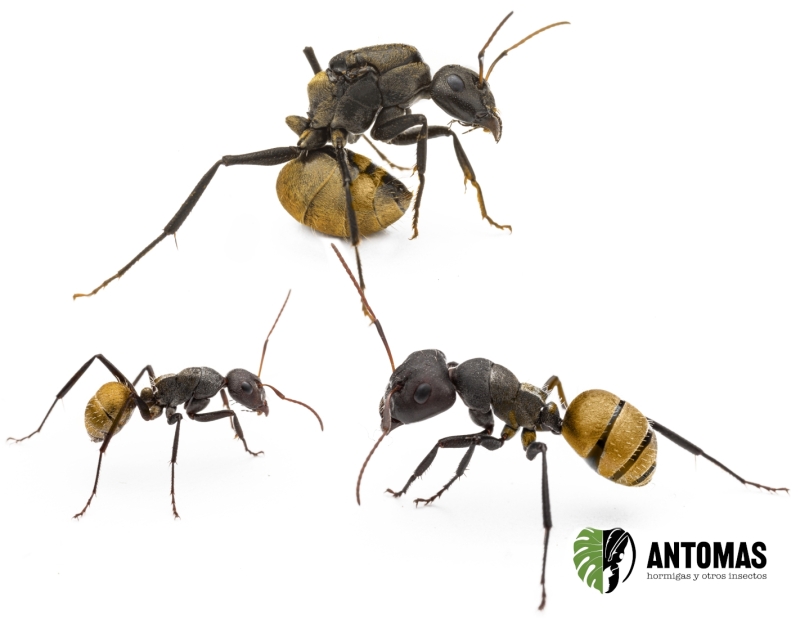
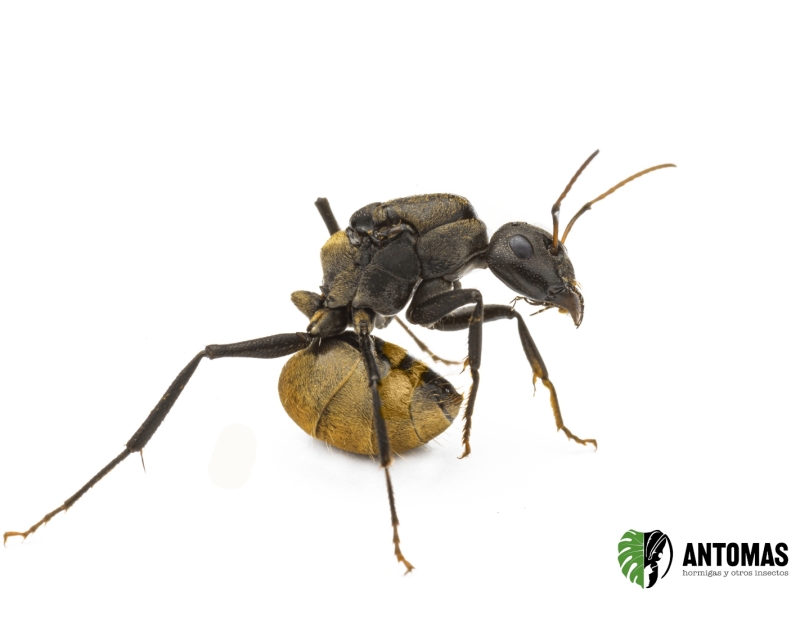
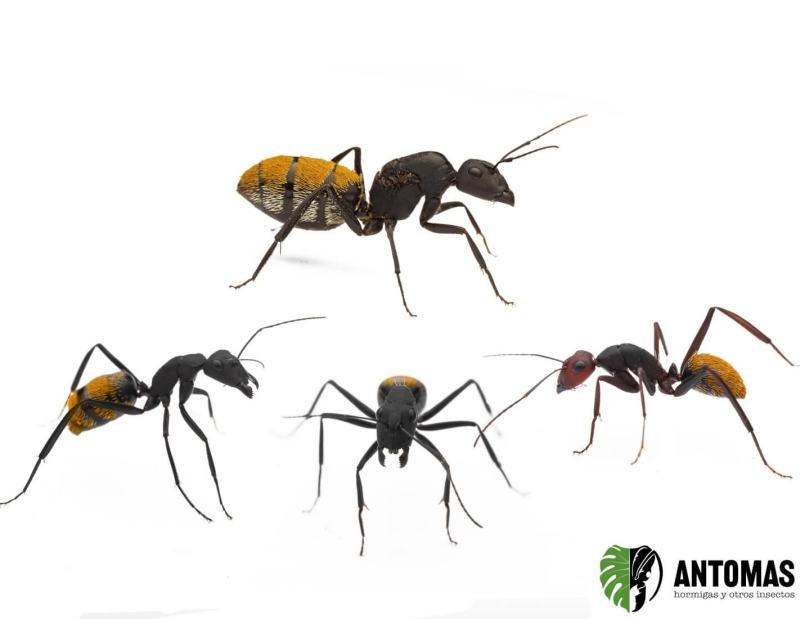
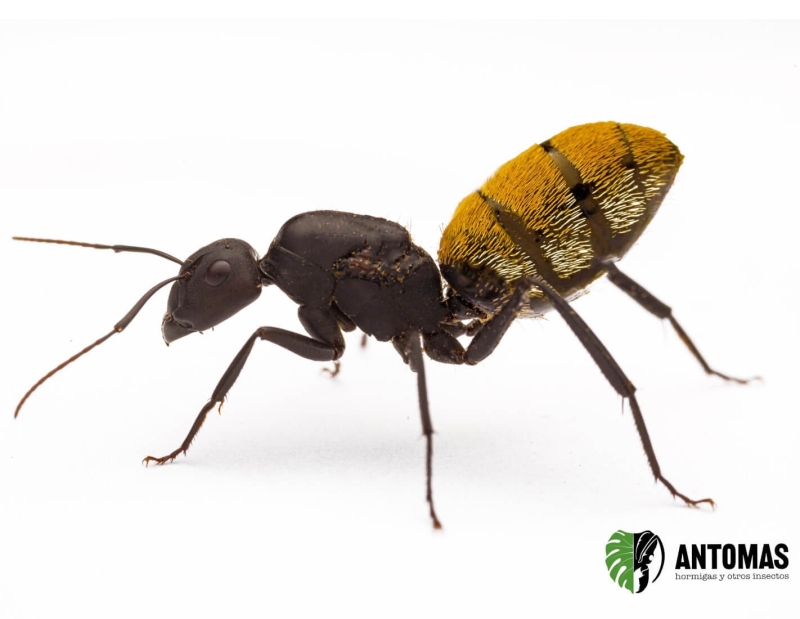
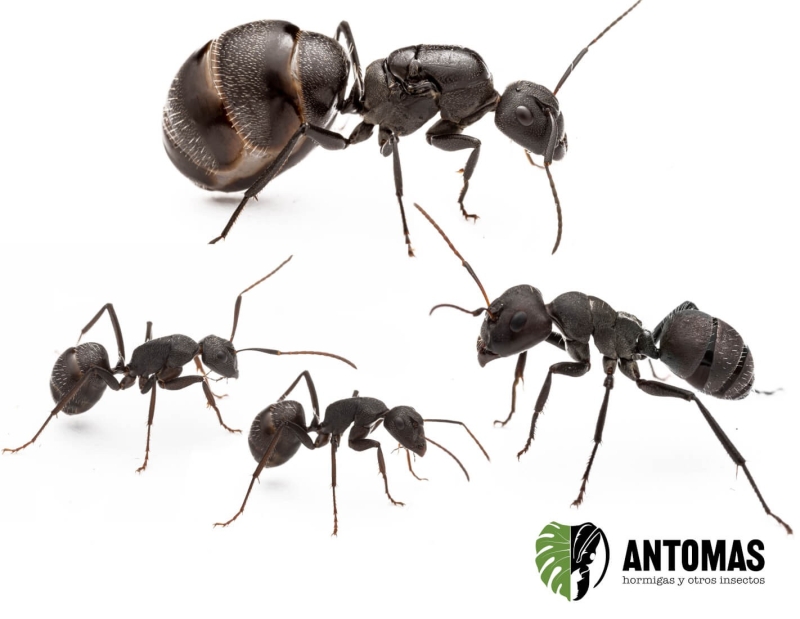
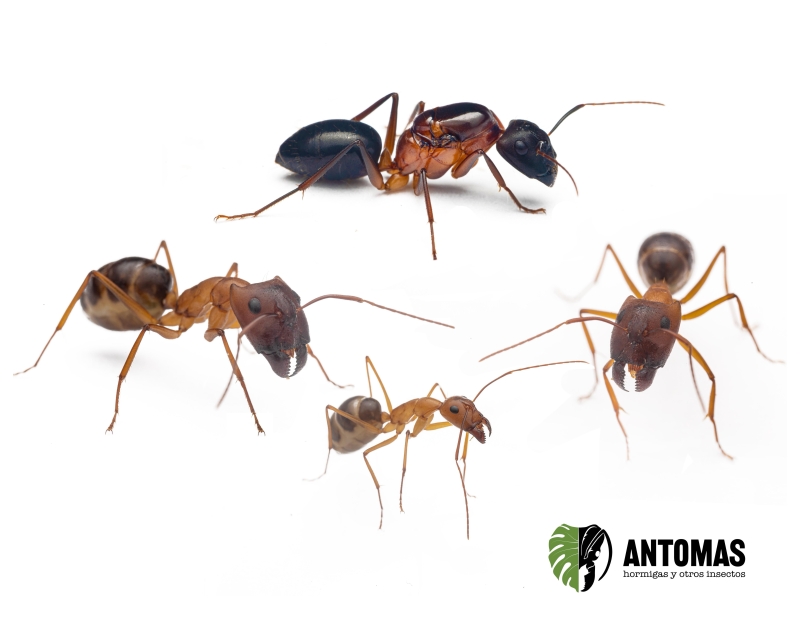
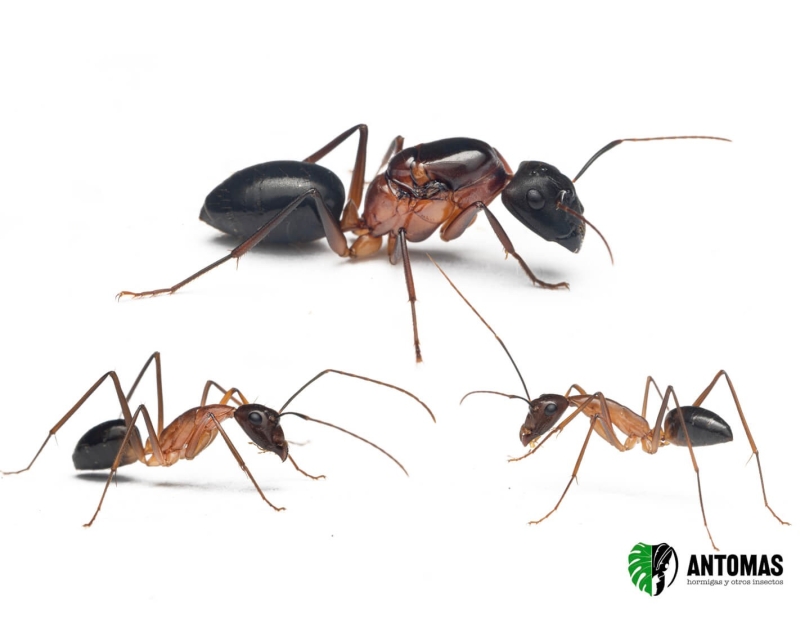
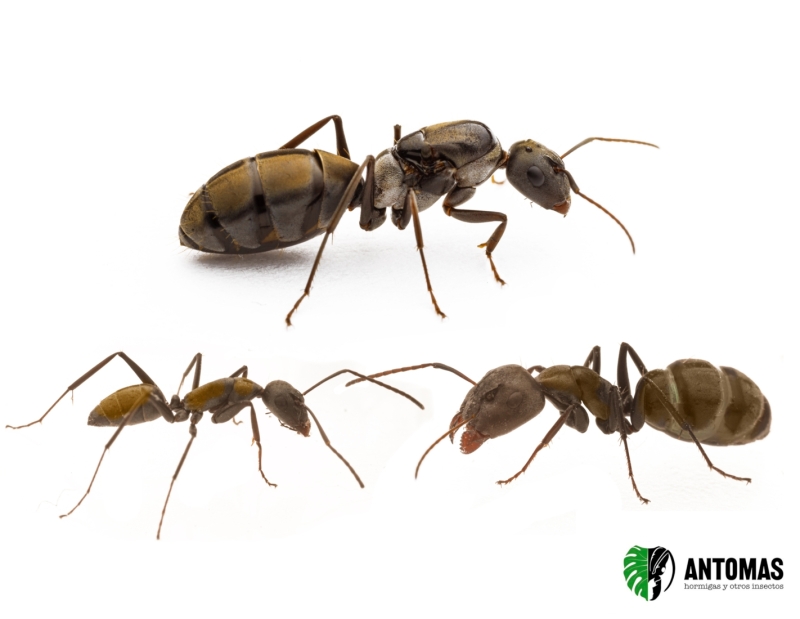
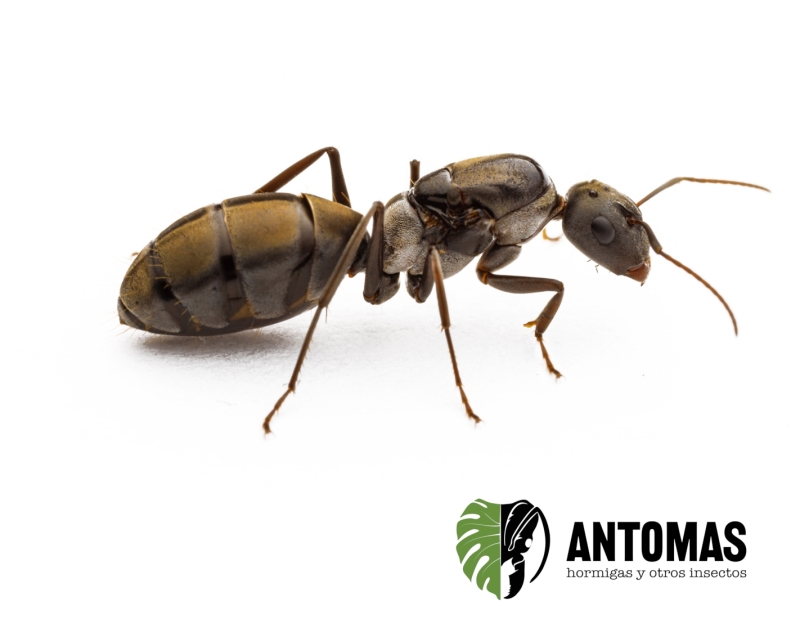
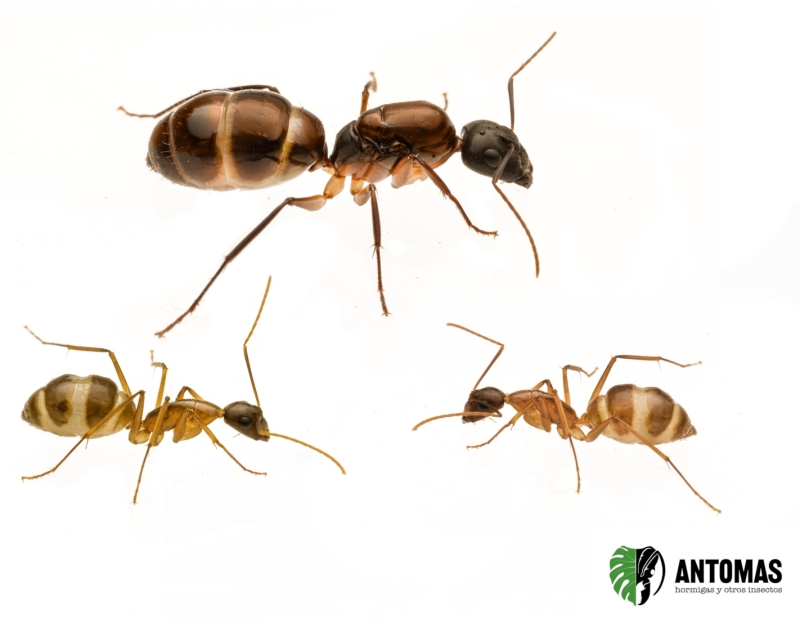
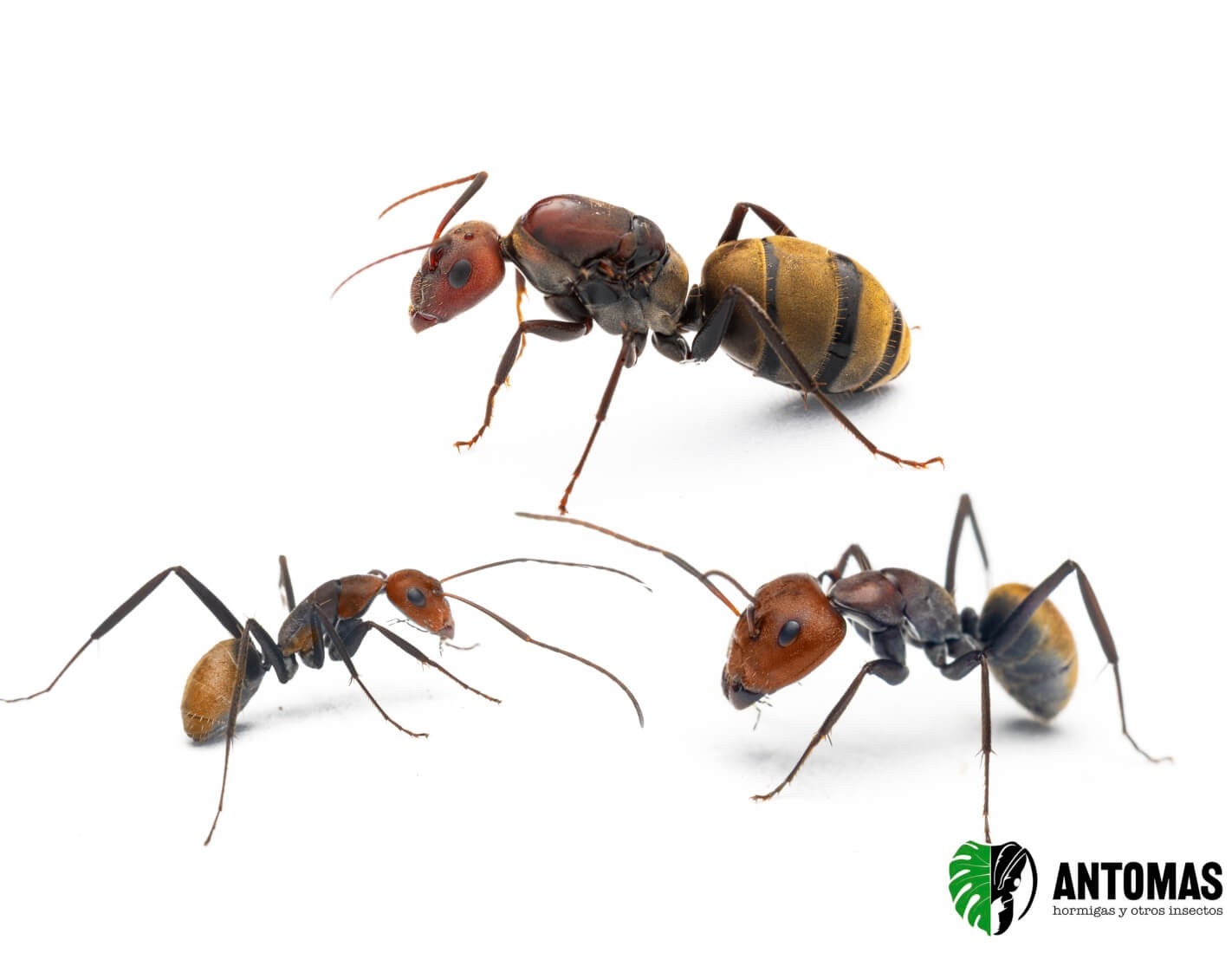
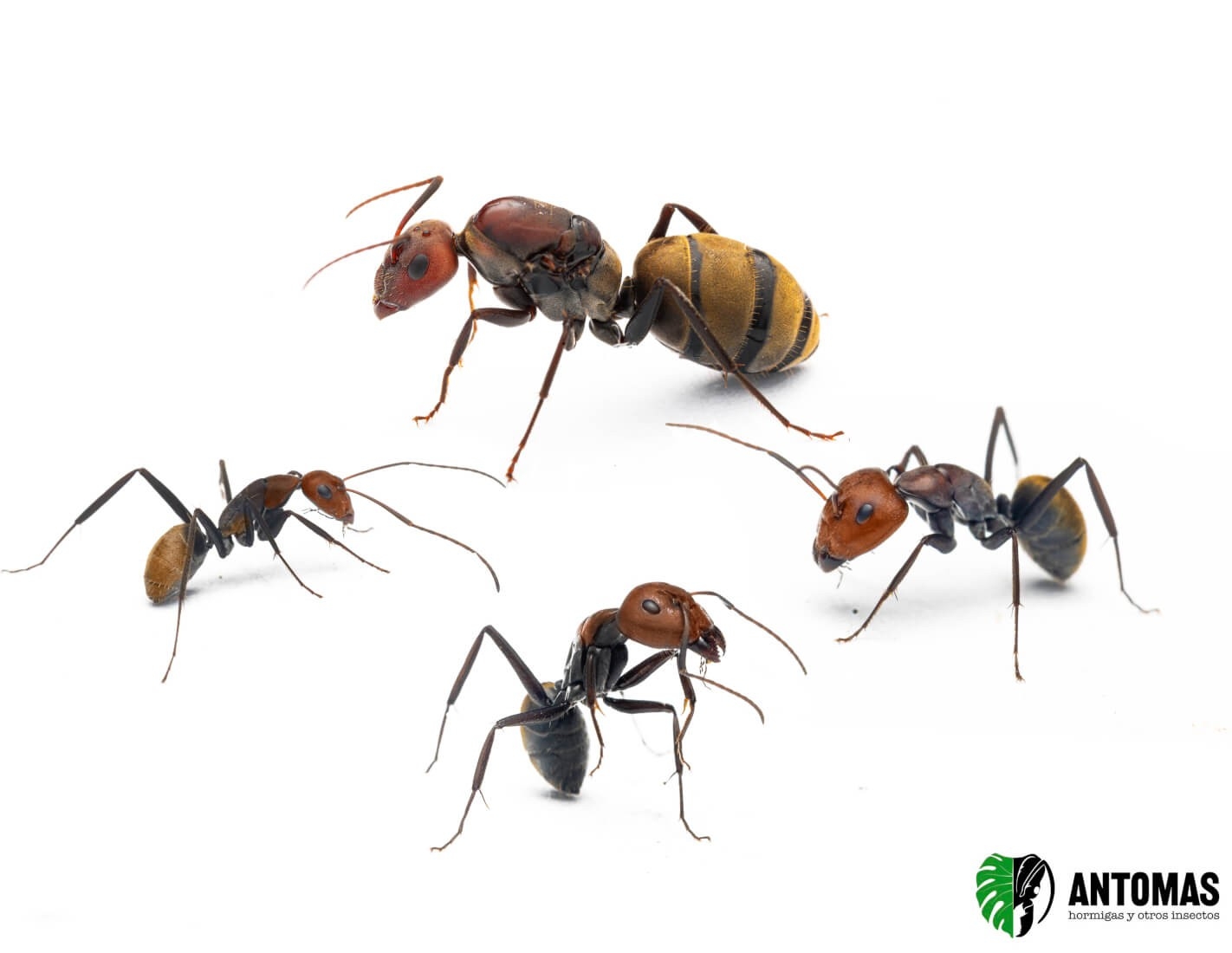
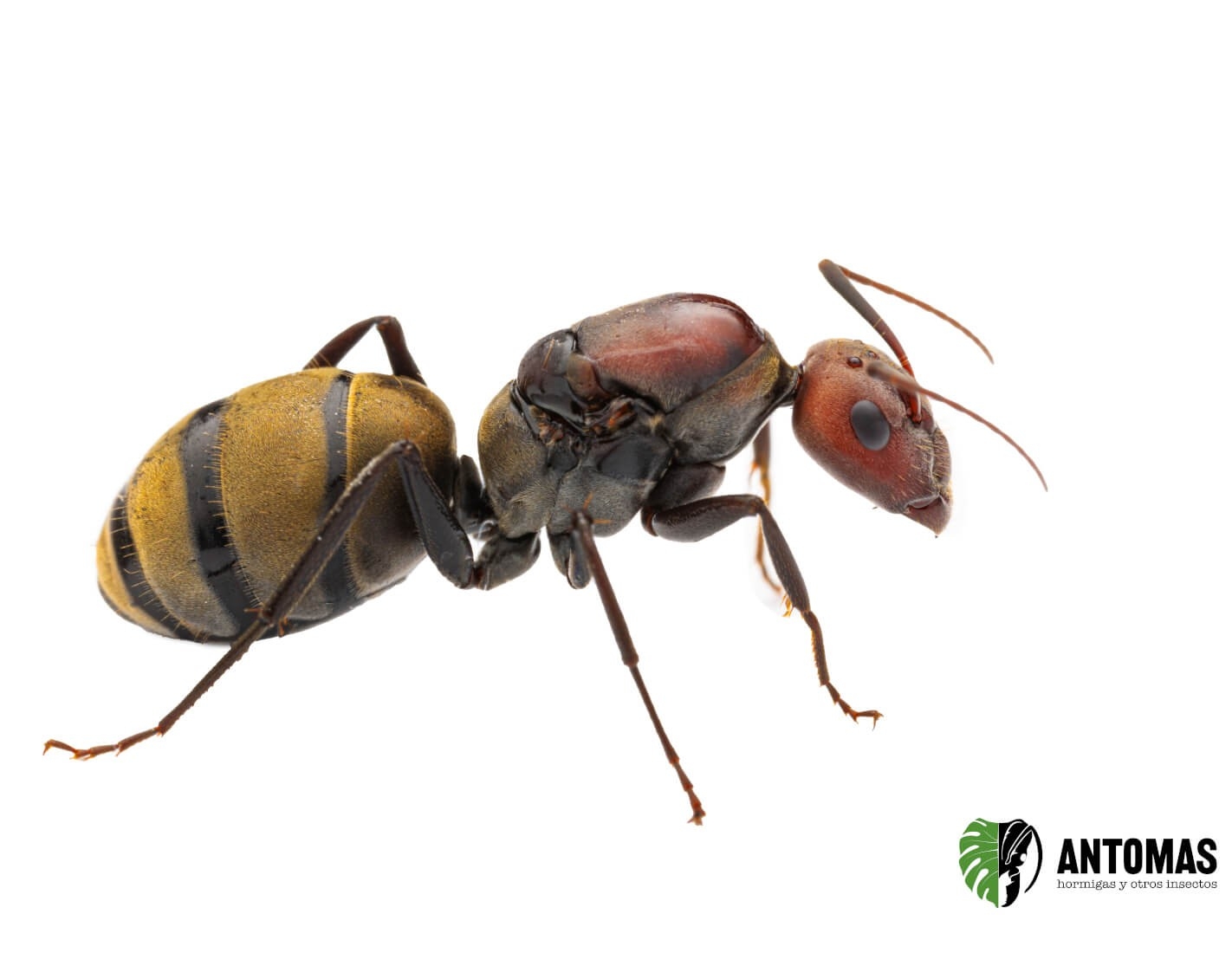
Camponotus vestitus (Smith, 1858) is an African carpenter ant in full evening dress. Its gaster is covered in golden pubescence so dense and silky that the colour of the cuticle all but disappears beneath it, and which shifts from pale gold to bronze depending on how the light catches it. It belongs to the subgenus Myrmosericus, whose name means “silk ant”, and is one of the most widespread Camponotus in Africa: it has been found from the shrublands of the Cape to the savannas of the Sahel.
Behind all that elegance lies a tangled story: a name that may not belong to it, a handful of unrevised subspecies and very few studies of its life in the wild. That is why, throughout this profile, we keep three voices apart: that of the studies, that of other keepers and our own, as its keepers at Antomas. And our conclusion fits in a single line: it is a hardy, rewarding Camponotus with just one demand: its speed.
Biology
Dressed in silk: a tailor’s name
Vestitus is Latin for “clothed” or “covered”, and it is hard to think of a better word. When he described it in 1858, the British entomologist Frederick Smith was struck by the fine, silky, pale golden down that covers its head, thorax and abdomen, and whose sheen changes with the light. The subgenus follows the same line: Myrmosericus, erected by the Swiss myrmecologist Auguste Forel in 1912, combines the Greek myrmex, “ant”, and the Latin sericus, “silken”. According to the Italian entomologist Carlo Emery (1925), what defines its species is an elongated body, a long head in the minor workers and a matt cuticle covered in dense, silky pubescence, especially on the gaster. That said, the internal classification of the genus is still a work in progress: in 2016, the last major reclassification of the formicines kept the subgenera of Camponotus only provisionally and warned that many of them are artificial groupings (Ward et al., 2016). Even the name of the genus describes its silhouette: Camponotus comes from the Greek kampé, “bend”, and nōtos, “back”, after the arched profile of the thorax.
The tailoring vocabulary continues in its subspecies, described between 1909 and 1930, almost all of them by the Swiss entomologist Felix Santschi. Pectitus means “combed”; perpectitus, “thoroughly combed”; comptus, “groomed”; bombycinus, “silken”, from the same root as the name of the Saharan silver ant; and strophiatus comes from strophium, the band that Roman women wore tied around the chest. It seems that myrmecologists could find no other way to describe it than by talking about clothes.
An ant with a borrowed name
The story of its name has a final twist. Smith described Formica vestita from a single queen, collected on the coast of south-eastern Africa and kept in the British Museum. In 1863, the German entomologist Julius Roger moved it to the genus Camponotus, with a question mark, and in the 1890s Emery linked it to the workers of a golden Camponotus, with no record that he ever saw that queen. It spent three decades as a subspecies of C. rufoglaucus, later regained species rank and has remained so in the catalogues ever since.
In 2014, the myrmecologist Brian Taylor, author of the great online work on the ants of sub-Saharan Africa, re-examined the type queen following a tip-off from C. Ludwig, and reached a surprising conclusion: that queen does not look like a Camponotus but like an Anoplolepis, another genus of formicines, and is almost identical to the queen of A. custodiens. Smith had described the latter in the same work, with material from the same place, so the specimens were most probably mixed up. If this is confirmed, the name vestitus would strictly belong to that other ant, and our Camponotus would need a new name.
But the proposal has only been published on Taylor’s website, not in a scientific journal, and the replacement name he suggested has not been settled either. That is why AntCat, the reference catalogue of the world’s ants, still regards Camponotus vestitus as valid, and that is what we call it. If it ever changes its name, the ant will still be the same.
Not one, but many
The name is the least of it compared with what it hides. Besides the typical form, eight subspecies have been described, almost all of them from specimens from Angola, the Congo, West Africa or the Cape, and nobody has revised the group with modern methods. Taylor, bringing together all the museum material, distinguishes at least four types:
- a red, matt form, from southern Africa, Namibia, West Africa and Uganda;
- several dark forms, with reddish-brown to black heads, mainly from Angola;
- bombycinus, which is probably not related to the others;
- and a form from the dry savannas of the Sahel, which he considers clearly distinct.
In his view, the colour of the head could be the key to telling them apart. A real case shows how hard that is: some workers from the Gambia went through two different names before, once compared with museum specimens, they were assigned to the subspecies intuens. For keepers, the consequence is a practical one: colonies that may differ in colour, size and temperament are sold under the name C. vestitus, which is why shops’ care sheets so often contradict each other. In this profile, whenever we are talking about our own colonies, we say so.
African cousin of two Iberian ants
Myrmosericus is not only African. Its type species, C. rufoglaucus, was described from India, and the subgenus reaches as far as Mauritius, the Canary Islands and southern Europe. Two species live in the Iberian Peninsula: the large Camponotus cruentatus, with a red base to its gaster, and Camponotus micans, “the one that sparkles”, whose gaster is banded with silvery or golden hairs. If you know them, you will spot the family resemblance straight away: the same matt cuticle, the long legs and that velvety gaster that changes with the light. C. vestitus is their cousin from the African savannas.
From the Cape fynbos to the Sahel
Few African Camponotus cover such a vast range. Material identified as C. vestitus has been collected from the southern tip of the continent, in the Cape region, to the dry savannas of the Sahel, in Sudan, Mali and Senegal, by way of Namibia, Botswana, Zimbabwe, Mozambique, Tanzania, Angola, the Congo, Uganda, Nigeria, Ghana and Côte d’Ivoire, among other countries. On GBIF, the great global biodiversity database, it has some 600 records, most of them from southern Africa, although this is partly because far more sampling and photography has been done there.
What is surprising is the variety of landscapes. Museum labels place it in fynbos and renosterveld, the Mediterranean-type shrublands of the Cape; in the semi-desert of the Karoo; in moist montane grasslands; in bushveld, open woodland and miombo; in acacia scrub and in the savannas of West Africa. It has even been photographed in gardens and on the walls of houses. And it holds a record: on the Brandberg massif, Namibia’s highest mountain, workers were caught at 2,470 m above sea level, on the saddle below its summit.
An ant able to live in such different climates is, almost by definition, adaptable, and that is one of the reasons why it is so easy to keep.
Crater nests in the sand
C. vestitus nests in the ground, often in sandy soils. The entomologist George Arnold, who studied the ants of southern Africa in the early 20th century, described how, in the form pectitus, the nest entrance is surrounded by a tall, sharp-rimmed circular crater, so characteristic that he regarded it as a distinguishing feature of this ant (Arnold, 1924). In the savannas of the Gambia, small tower-shaped nests have been described, with steep sand craters of up to about 2.5 cm.
That is not its only way of nesting. Nests have been recorded under rocks, large underground nests with a single round entrance, shallow nests in open woodland and, in the Okavango Delta, a colony under a fallen log. It digs in soft soil and makes use of any sheltered cavity. At home, this translates into an ant that adapts to almost any formicarium, as long as it has roomy chambers and an area with some moisture.
A golden coat in full sun
One of the few field studies to have paid any attention to it was carried out in the coastal savannas of Ghana. There, Ofei (1978) found that C. vestitus nested in almost bare, unshaded soil: in the dry season, every nest found was in full sun, whereas the commonest Camponotus in those savannas, C. acvapimensis, preferred the shade of bushes. A few centimetres below ground, the soil of an open savanna can exceed 30 °C in the hot season, while the surface bakes at midday.
So what is that golden coat for? Nobody has studied it in Camponotus. In another desert ant, the Saharan silver ant, Cataglyphis bombycina, it has been shown that its silvery hairs reflect sunlight and help to dissipate heat, keeping it a few degrees cooler (Shi et al., 2015; Willot et al., 2016). It is tempting to think that the golden velvet of an ant that nests in full sun serves a similar purpose but, for now, that is only a hypothesis. What is certain is the lesson for keeping it: it does well with warmth, a warm spot to which the colony can carry the brood and a dry, well-ventilated foraging area (see “Recommended parameters”).
Discreet on the savanna, swift in the formicarium
In those Ghanaian savannas, C. vestitus was not a dominant species: it foraged with few workers, was not aggressive and competed with its neighbour C. acvapimensis for neither space nor food (Ofei, 1978). It is an ant that does not go looking for a fight. Museum labels and naturalists’ photos show it mainly by day, foraging in mid-morning or roaming over gardens and walls, although some shops describe their colonies as more active at dusk.
And what about speed, its most striking trait in captivity? We have not found a single published observation on how fast C. vestitus is in the field. There is one for the type species of its subgenus, C. rufoglaucus: in the early 20th century, the naturalist Joseph Bequaert noted in the Congo that its workers “run very fast” (Wheeler, 1922). What we can tell you about is our own experience: the workers in our colonies are extraordinarily fast. They switch from walking to running in an instant, react as soon as the foraging area is opened and, faced with food or a disturbance, move more like a Formica than like the heavy, unhurried Camponotus many people have in mind. Other shops describe calmer forms of C. vestitus; with such a variable complex, that does not surprise us (see “Not one, but many”).
Scavenger, hunter… and a snack for toads
It combines sugars and animal protein, and little is known about its diet in the wild, but there are some curious details. In the Caprivi Strip, in Namibia, a trap baited with a dead millipede drew 2 majors and 13 minors at once: it does not turn its nose up at carrion. And its relative C. cinctellus, from the same subgenus, has been seen tending aphids on young orange trees to collect their honeydew, the sugary liquid they excrete (Wheeler, 1922), and has also been recorded on fruit and on nectar-bearing flowers.
It has its predators, too, and one historical fact says it all. On the American Museum of Natural History’s great expedition to the Congo, in the early 20th century, every single specimen of C. vestitus collected came out of the stomachs of toads (Wheeler, 1922). On that expedition, the toads served as ant collectors without knowing it.
Acid in the crop and a bacterium inside
Two traits shared by its whole group deserve a mention. Formicines have no sting: they defend themselves with formic acid, which they expel through the acidopore, a small nozzle at the tip of the gaster. And they swallow it too: while grooming, they pick up a few drops of their own venom with their mouths to keep their crop, the “social stomach” in which they store the food they share, highly acidic, and in this way they filter out the microbes that arrive with their food (Tragust et al., 2020). Inside their cells, all the Camponotus studied also carry a bacterium, Blochmannia, which passes from the queen to her daughters through the eggs and makes essential amino acids for them (Feldhaar et al., 2007). Neither study was carried out on C. vestitus, and the bacterium is no substitute for insects: the larvae need them to grow (see “Feeding”).
Size and morphology
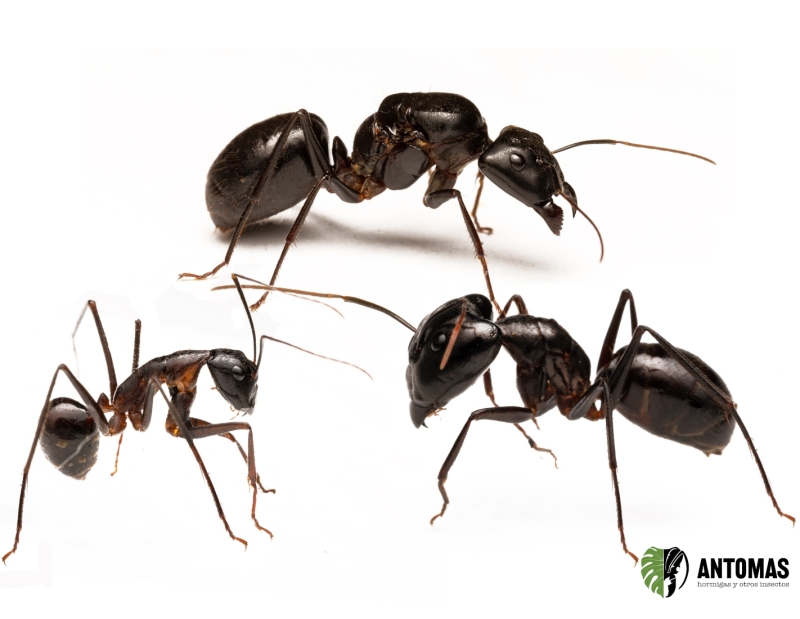
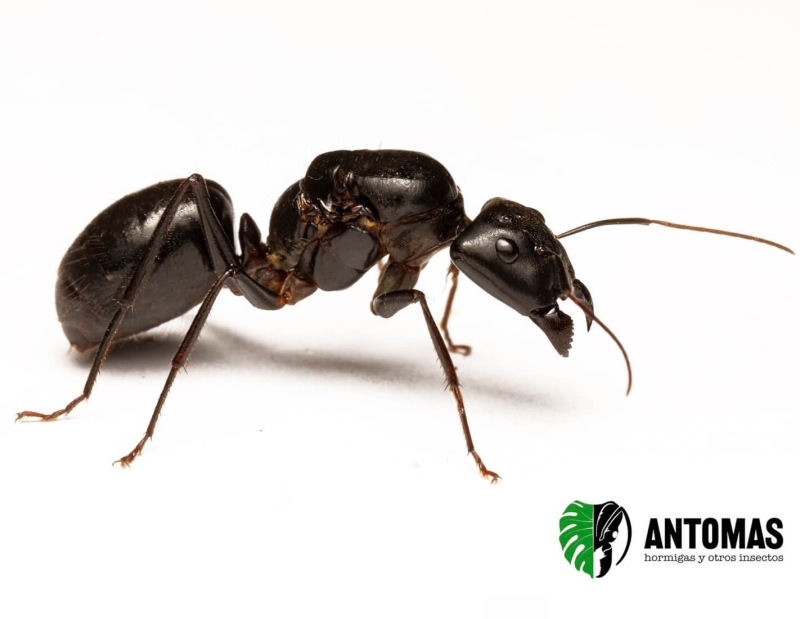
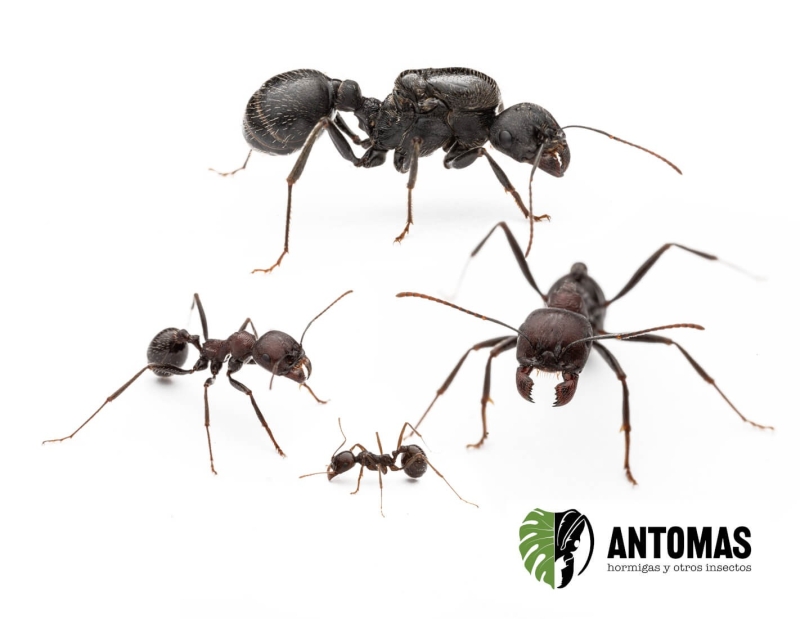
It is a medium-sized Camponotus, slender and long-legged, with workers of several sizes, from minors to majors, and no sting. The classic description of the typical form is Arnold’s (1924), and our colonies have a few nuances of their own:
- Colour in the typical form. Head, thorax, legs, antennae and mandibles brick red, from yellowish to dark. The gaster is dark brown, but can barely be seen: it is hidden by pale greyish-golden pubescence.
- A combed gaster. That pubescence does not all lie in the same direction. On each half of the gaster the hairs are combed differently, and the result, according to Arnold, is six longitudinal bands alternating light and dark. Because the gold comes from the hairs and not from the cuticle, it changes a great deal with the light: from pale gold to bronze or almost black, depending on the angle.
- Dark forms. In pectitus, intuens and their relatives, the head ranges from dark reddish brown to black and the body is blackish.
- Our colonies. A reddish head, from terracotta to dark chestnut, with very conspicuous black eyes; a thorax ranging from reddish chestnut to almost black, often with reddish patches on the pronotum; long, dark legs; and a gaster covered in very dense golden pubescence, with dark stripes along the edges of the segments. The queen, with her broad, bulky gaster, shows off that contrast between the red head and the golden abdomen even more.
- Head. In minor workers it is oval and considerably longer than broad; in majors, almost square and much more robust (Arnold, 1924).
- Pilosity. Few erect hairs, and short ones, over dense pubescence that gives it a velvety, matt appearance.
- Gaster. It ends in the acidopore, through which it expels formic acid. There is no sting.
vestitus, cinctellus or rufoglaucus?
Several golden African Camponotus from the same subgenus are circulating in the hobby, and it is not always easy to tell which is which. The classic keys focus on details that can be seen with a good hand lens:
- C. vestitus: slender body; the pubescence on the second and third segments of the gaster spreads out towards the sides from a lateral line; the propodeum, the rear part of the thorax, is slightly concave at its base, and there are few erect hairs. The head of the majors is almost square.
- C. cinctellus: almost black, with the front of the head and the appendages dark red; the propodeum forms an obtuse angle, there are more and longer erect hairs, and the head of the majors is more triangular (Arnold, 1924).
- C. rufoglaucus and C. flavomarginatus: all the pubescence on those segments converges towards the centre of the gaster. C. rufoglaucus also has strongly compressed tibiae, and C. flavomarginatus is almost entirely black.
In such a little-revised group no trait is infallible, but the direction of the hairs on the gaster is the best starting point.
Approximate sizes
- Minor workers: about 7 mm in the typical form and 6.5 mm in the form pectitus (Arnold, 1924); 4.3–6 mm in the form intuens (Forel, 1909)
- Major workers: 7.7–10 mm in the typical form and 8.5–9.5 mm in pectitus (Arnold, 1924)
- Queen: 12 mm in the typical form and 10–11 mm in pectitus (Arnold, 1924); about 11–12 mm in our colonies
- Male: no published measurements
These are total lengths from the classic descriptions, taken with the methods of their day, and they vary considerably from one form to another: there are no modern measurements of the species. The figure for the queen in our colonies is our own. As in all Camponotus, the first workers of a young colony are the smallest, and the average size increases with each generation.
Care in captivity
Difficulty: 2/5 – Beginner
At Antomas we consider it a very rewarding African Camponotus to start with. It eats everything, takes well to different formicaria, does not need diapause and, given warmth and protein, grows at a good pace. It is hardy and forgives the small mistakes beginners make.
So why a 2 and not a 1? For one reason only, and it is worth being clear about it from day one: its speed. C. vestitus workers switch from walking to running in a second, climb almost any surface and react instantly when the foraging area is opened. It is not a difficult ant, but it does require you to have the barrier, the food and your tools ready before opening the enclosure (see “Escapes and barriers”).
Some shops rate it as intermediate, and it is easy to see why: anyone who has not been warned may get a fright the first time they open the formicarium. If you are looking for an even calmer African Camponotus to start with, Camponotus maculatus is our 1/5.
And it is well worth it: a velvety golden gaster, a reddish head, ever more robust majors and lively, fast foraging. Few ants look so good in a display formicarium.
Recommended parameters
- Nest temperature: 24–28 °C all year round. This matches the annual average of the tropical savannas where it lives and the recommendations of other keepers, who give 21–28 °C.
- Warm spot: 28–30 °C at one end of the nest or the foraging area, so that the colony can choose where to put the brood. In our experience, it grows especially fast when it has 27–29 °C.
- Humidity: moderate, around 50–70 %, and with a gradient: never the whole nest wet (see “Humidity: one moist area and the rest dry”).
- Foraging area: dry or only slightly moist, and well ventilated.
- Water: always available, in a test tube with water and cotton wool in the foraging area.
- Light: a dark area in the nest and a lit foraging area, with a normal day–night cycle.
- Diapause: not needed (see “Diapause: not needed”).
For heat, a heating cable or mat on one side, with a thermostat, is better than a source that warms the whole formicarium evenly. Avoid direct sunlight, radiators and cold draughts.
Humidity: one moist area and the rest dry
C. vestitus does not need tropical humidity: remember that it nests in sandy, sunny soils. What works best is a gradient: moisten only one part of the nest and leave the rest dry. That way the colony can arrange the brood as it sees fit: eggs and larvae in the moistest area, pupae in the driest. At first, while the colony is small, the moisture comes mainly from the tubes: the founding tube and, once they move into the formicarium, a connected water tube or the module’s humidity system, kept well filled. The shops that sell it agree: a single moist area and a drier foraging area.
- In the Qbik Wild, made of plaster, which holds moisture, add water sparingly and only on one side.
- In the Qbik Alpha, which are rather dry, the moisture comes from the tubes and the modules’ reservoirs.
- If there is too much moisture: condensation on the walls, mould or mites. At the high temperatures this species likes, a soaked nest soon goes bad.
- If there is too little: brood piled up next to the water.
Recommended formicaria
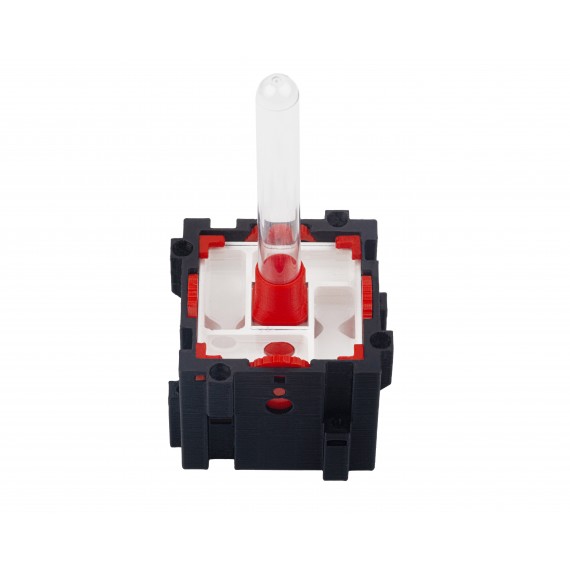
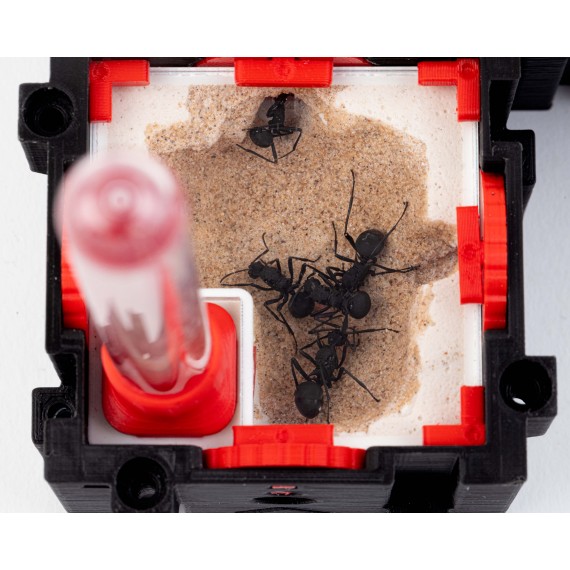
At Antomas we recommend Anthouse formicaria, and with this species both the Qbik Wild and the Qbik Alpha ranges work well. For a colony that is just starting out, the most convenient option is a QBIK ONE with large galleries: it houses the queen and the first majors without giving them too much space, and lets you check the brood and the humidity at a glance:
If you prefer a natural-looking set-up, the Qbik Wild range, made of plaster, suits it very well: these formicaria hold moisture and recreate a cavity between soil and wood, like the ones it chooses in the wild. For example, a Qbik Wild One P 1C:
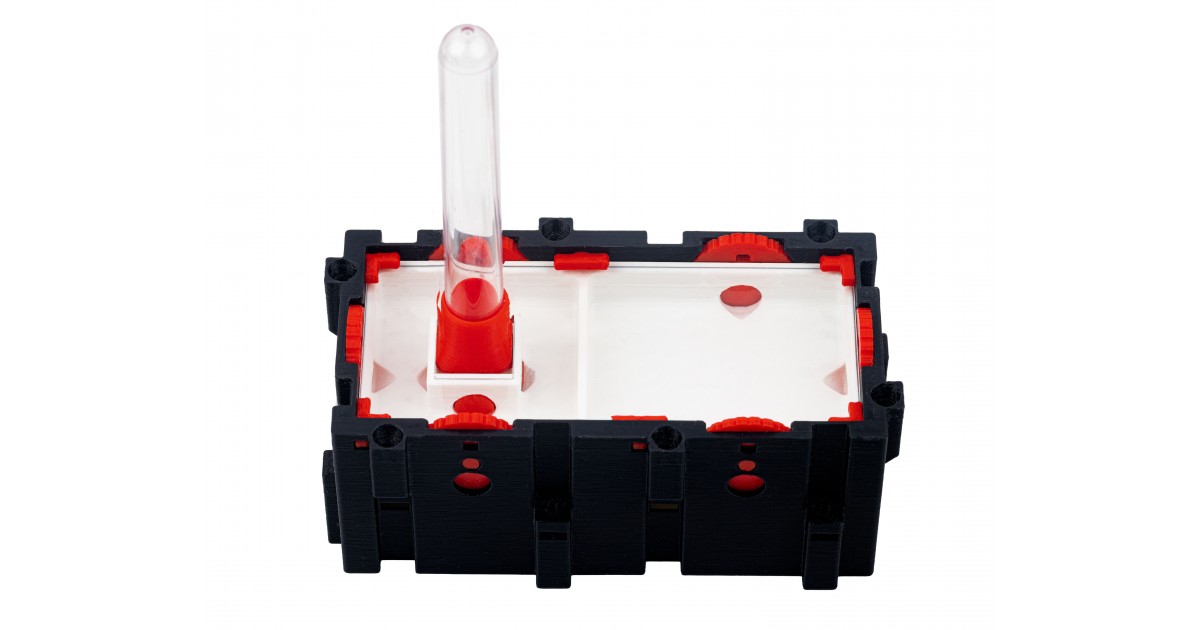
As the colony grows, expand with a QBIK DUO with large galleries and, later on, with Alpha modules with large galleries or larger Wild modules:
The easiest approach is to expand gradually, once the brood already fills every chamber: a huge formicarium does not make a young colony grow any faster, it just leaves empty chambers that end up as rubbish dumps. Complete the set-up like this:
- Escape barrier and lid from day one (see “Escapes and barriers”).
- A large foraging area, dry and well ventilated, with some sand, flat stones and a piece of bark or two, kept away from the edges so that nothing can act as a bridge.
- A water tube with cotton wool, always full.
- A feeder for sugary liquids, never cotton wool (see “Feeding”).
- Heat on one side with a thermostat, if your home does not reach 24 °C.
Founding: from a lone queen to the first workers
At Antomas we sell C. vestitus in two versions: queen with brood, that is, a founding queen that has already started her colony in a test tube, with eggs, larvae or pupae, and queen with 5–10 workers and brood, a colony that is already up and running. The species’ founding is claustral: the queen raises her first workers shut away, without going out to feed, thanks to the reserves in her body.
- Darkness and calm. Do not touch the tube: leave it in a dark place, free of vibrations, at a stable 25–28 °C, covered with a cloth or a piece of card. The water at the bottom, behind the cotton wool, is her reserve.
- Water. It is the only thing the queen really needs at this stage: check from time to time that the cotton wool is still moist and that there is water left behind it. If the water runs out or the tube gets very dirty, move her to another tube, again by tipping.
- A look once a week. No more is needed. Opening and moving the tube often stresses the queen, and a stressed queen may eat her eggs.
- Food. She does not need to eat before her first workers emerge, but at Antomas we recommend offering her a small snack from time to time, especially after the journey: a tiny drop of sugary liquid on a small piece of aluminium foil, never on the cotton wool, which goes mouldy. Remove it the next day if any is left over. As soon as there are workers, add a small piece of insect once or twice a week.
- Patience. According to other keepers, it takes about 5–7 weeks from egg to first worker, depending on the temperature. The first workers, known as nanitics, are small.
When should she be moved to the formicarium? At Antomas we do it when the colony has 5–10 workers, or sooner if the tube becomes too small or starts to dry out. If you have chosen the version with workers, you can move it as soon as it has recovered from the journey, always into a nest suited to its size.
Arrival and moving
When you receive your colony, let it rest for a couple of days in a dark, mild place, without opening the tube. To move it into the formicarium, at Antomas we do it by tipping: with the tube open inside the foraging area and its mouth pointing towards the nest entrance, all its contents are gently tipped out, and any stragglers are nudged along with a brush. With such a fast species, these details make all the difference:
- Everything ready before opening: the formicarium assembled, the barrier in place and checked, the water tube connected and the lid to hand.
- Over a tray, large and with high sides, in case a worker shoots out of the tube or up the brush.
- The nest in darkness and the foraging area lit: within a few minutes, the workers will have carried the brood inside.
- If they resist, tip them out again: at Antomas, if necessary, we move them by force.
Any later move, to a larger or different formicarium, is done the same way.
Feeding
Sugar for the workers, protein for the larvae. The adults live mainly on sugary liquids, and such an active colony gets through a lot of them: never let them run out. Vary the sugars: at Antomas we recommend Anthouse’s Blue Sugar nectar 4–5 times a week and another sugary liquid 1–2 times a week, such as honey water or sugar water, or the odd small piece of ripe fruit. You can also add a little protein to the nectar. Offer them in a feeder, never on cotton wool: cotton wool goes mouldy and spoils the liquid in no time. Any feeder will do, traditional or home-made, as long as the drop stays “spread out” and within the workers’ reach.
Protein: the more, the better. It is what turns a small colony into a large one, and at Antomas we are clear about it: with daily maintenance and the leftovers removed, it pays to give them more than they eat, because a colony that senses abundance raises more brood, and faster. If you cannot clean often, adjust the amount, because leftovers rot and attract mould and mites. The larvae are your guide: with plenty of brood, insects several times a week. And change the insect every week, so that they do not always eat the same thing:
- For founding and small colonies, the firebrat, Thermobia domestica, a small, soft prey, and Drosophila.
- For medium and large colonies, crickets, dubia roaches, red runner roaches, cut-up mealworms, flies or moths.
- For young colonies, cut-up or freshly killed insects. For large ones, small live prey too: they react to movement straight away and chase it down with an efficiency that is a joy to watch.
Buy insects from a trusted supplier: any that have been in contact with insecticides can wipe out the colony.
Diapause: not needed
Over most of its range there is no winter as we know it. In the tropical savannas, the coolest month averages 20–26 °C and it never freezes; what shapes the year is the dry season, five to eight months with almost no rain, less food and slightly cooler nights. Only in the south of the continent is there a short winter, from June to August, with averages of 14–16 °C and mild days, and there the records of the species are concentrated between September and May. What is more, ten or twenty centimetres below ground, where the nest is, the cold arrives greatly softened.
The line of C. vestitus we keep at Antomas does not need diapause or cold. It stays active all year round at 23–28 °C, with a warm spot during the periods of greatest growth. In winter you can let the room cool slightly, to around 21–24 °C: the colony slows its activity and growth somewhat, but a complete stop is not necessary, and as soon as the warmth returns it picks up the pace again.
- If you lower the temperature, do it gradually, never all at once.
- Always keep water and sugar available; protein according to the brood you see.
- Do not let it drop below about 20 °C: it does not need it, and in an unheated home, at 15–18 °C, it would be colder than in any tropical savanna in its range.
- Do not put it into a cold diapause like that of European ants: it does not need one and gains nothing from it.
Even when kept warm, the colony may slow its egg-laying for a few weeks at some point in the year. This is normal: many Camponotus have their own internal rhythm. Just keep offering food and wait.
Growth: from test tube to display colony
As in all Camponotus, the start is the slowest part: the queen raises a first batch of small workers on her own and, during the first few months, the colony barely changes. Some shops speak of a modest first year, with a few dozen workers. In our experience, as soon as the colony has enough workers to bring in food, the pace changes: at 27–29 °C and with frequent protein it keeps several batches of brood going at once, each generation brings slightly larger workers and the first robust-headed majors appear. From then on it grows considerably faster than most European Camponotus, and the foraging area soon fills with workers.
The keys: stable warmth, plenty of protein with daily cleaning, sugar always available and no tinkering with what works. What holds a young colony back most is unnecessary moves, sudden changes in temperature and nests that are too large.
Behaviour in captivity
A Camponotus in a hurry. Small colonies are calm, but once they are past the first generations the foraging area fills with workers that patrol non-stop and react instantly to food, to vibrations and to any opening.
Teamwork. When a scout finds a prey item or a drop of nectar, more workers arrive straight away. The minors do almost all the foraging; the majors show themselves mainly when there is a large prey item to cut up or something to defend.
Watch without fear. At Antomas we believe that ants are there to be enjoyed, observed and learnt from, not kept hidden away. With a dark area in the nest and a lit foraging area, the colony gets used to your presence; observe it gently and intervene only as much as necessary. Its speed, its contrasting colours and its ever larger majors make it a superb display colony.
Warning signs:
- Larvae that stall or disappear: almost always a lack of protein.
- Condensation, mould or mites: too much moisture or forgotten leftovers.
- Brood piled up next to the water: the nest is drying out.
- Many workers sitting idle in the foraging area: the nest has become too small.
Escapes and barriers
This is the species’ only tricky point. In our experience, the workers climb plastic, glass, wood and silicone, and their speed means that a worker reaching the edge of the enclosure can be out before you have time to react. With a good barrier and a well-prepared routine, they cause no problems at all:
- An escape barrier always in good condition: at Antomas we use a thin, continuous band of mineral oil on the upper part of the foraging area walls. Renew it as soon as it collects dust or debris.
- A tight-fitting lid, as a second line of defence.
- Prepare everything before opening: the food, the tweezers and the brush, all to hand. Open only as much as necessary and close up as soon as you have finished.
- Nothing that could act as a bridge: no bark or stones leaning near the barrier.
- No gaps: check connections, stoppers and tubes, especially as the colony grows.
Handling and safety
They have no sting, so they cannot sting you. If they are trapped or feel threatened, the majors may bite and the workers may spray formic acid, which smarts a little on sensitive skin. No special precautions are needed, but do not handle them with your hands: use a soft brush or soft tweezers, work slowly and take care not to harm any worker, let alone the queen. We recommend a single queen per colony: do not combine queens from different foundings or different colonies, or keep them with other species. It is an exotic species: it must never, under any circumstances, be released.
What not to do
- Opening the foraging area without the food, tweezers and lid ready.
- Neglecting the escape barrier or doing without the lid.
- Soaking the whole nest: moisture in one area only.
- Moving a young colony into a formicarium that is too large.
- Giving it a cold diapause: it does not need one.
- Letting the sugar or water run out, or putting sugary liquids on cotton wool.
- Always feeding the same insect or leaving leftovers uncleaned.
- Combining queens from different foundings or different colonies.
- Handling the workers with your hands.
Scientific sources
This profile is based on the classic descriptions of the species, on museum and distribution records, on climate data for its range, on the literature on its genus and on the experience of Antomas and other keepers. Main references:
- Smith, F. (1858). Catalogue of hymenopterous insects in the collection of the British Museum. Part VI. Formicidae. London: British Museum. Original description of Formica vestita, p. 32. Full text
- Arnold, G. (1924). A monograph of the Formicidae of South Africa. Part VI. Camponotinae. Annals of the South African Museum 14: 675–766. Full text
- Wheeler, W. M. (1922). Ants of the American Museum Congo Expedition. A contribution to the myrmecology of Africa. Bulletin of the American Museum of Natural History 45: 1–1139. Full text
- Ofei, K. O. (1978). The distribution, nesting habits and activity pattern of Camponotus acvapimensis Mayr (Hymenoptera: Formicidae) in savanna areas of southern Ghana. MSc thesis, University of Ghana. Full text
- Taylor, B. (2007–2018). Camponotus (Myrmosericus) vestitus (Smith) and Anoplolepis vestita (Smith). The Ants of (Sub-Saharan) Africa. antsofafrica.org
- Ward, P. S., Blaimer, B. B. & Fisher, B. L. (2016). A revised phylogenetic classification of the ant subfamily Formicinae (Hymenoptera: Formicidae), with resurrection of the genera Colobopsis and Dinomyrmex. Zootaxa 4072: 343–357. doi:10.11646/zootaxa.4072.3.4
- Jimoh, B. et al. (2024). A checklist of Nigerian ants (Hymenoptera, Formicidae): a review, new records and exotic species. Biodiversity Data Journal 12: e99555. doi:10.3897/BDJ.12.e99555
- Tragust, S. et al. (2020). Formicine ants swallow their highly acidic poison for gut microbial selection and control. eLife 9: e60287. doi:10.7554/eLife.60287
- Feldhaar, H. et al. (2007). Nutritional upgrading for omnivorous carpenter ants by the endosymbiont Blochmannia. BMC Biology 5: 48. doi:10.1186/1741-7007-5-48
- Shi, N. N., Tsai, C.-C., Camino, F., Bernard, G. D., Yu, N. & Wehner, R. (2015). Keeping cool: Enhanced optical reflection and radiative heat dissipation in Saharan silver ants. Science 349: 298–301. doi:10.1126/science.aab3564
- Willot, Q., Simonis, P., Vigneron, J.-P. & Aron, S. (2016). Total internal reflection accounts for the bright color of the Saharan silver ant. PLoS ONE 11: e0152325. doi:10.1371/journal.pone.0152325