This website uses its own and third-party cookies to improve our services and show you advertising related to your preferences by analyzing your browsing habits. To give your consent to its use, press the Accept button.
Functional cookies are strictly necessary to provide the services of the shop, as well as for its proper functioning, so it is not possible to refuse their use. They allow the user to browse through our website and use the different options or services that exist on it.
Cookie
Provider
Purpose
Expiry
PHP_SESSID
antomas.es
The PHPSESSID cookie is native to PHP and allows websites to store serialised status data. On the website it is used to establish a user session and to pass state data through a temporary cookie, which is commonly known as a session cookie. These Cookies will only remain on your computer until you close your browser.
Session
PrestaShop-#
antomas.es
This is a cookie used by Prestashop to store information and keep the user's session open. It stores information such as currency, language, customer ID, among other data necessary for the proper functioning of the shop.
These are cookies that collect information about the advertisements shown to users of the website. They can be anonymous, if they only collect information about the advertising spaces shown without identifying the user, or personalised, if they collect personal information about the user of the shop by a third party, for the personalisation of these advertising spaces.
Collect information about the user's browsing experience in the shop, usually anonymously, although sometimes they also allow the user to be uniquely and unequivocally identified in order to obtain reports on the user's interests in the products or services offered by the shop.
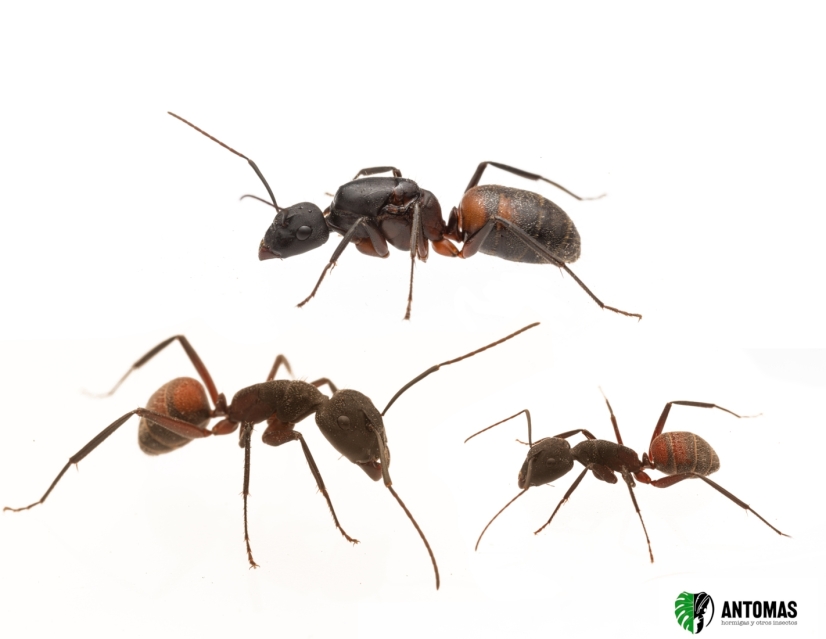
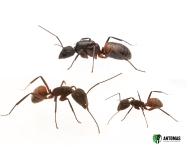
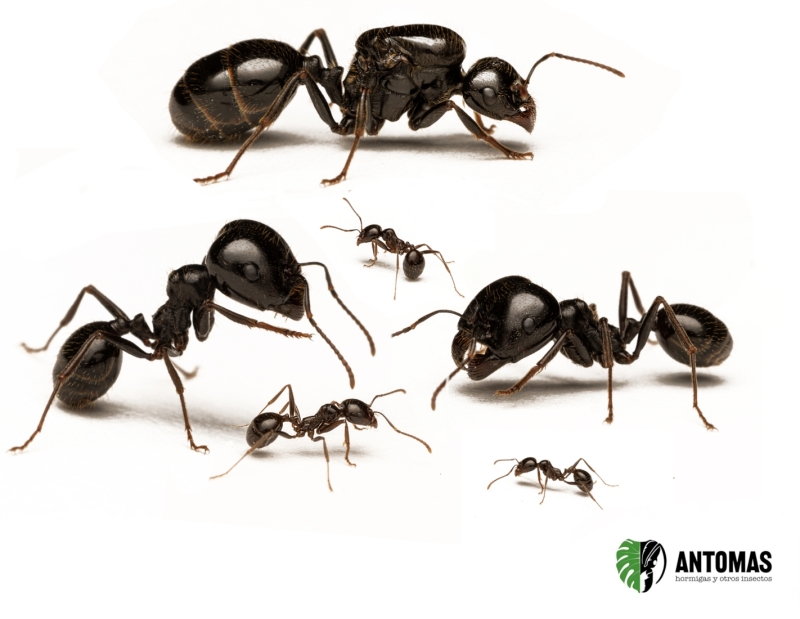
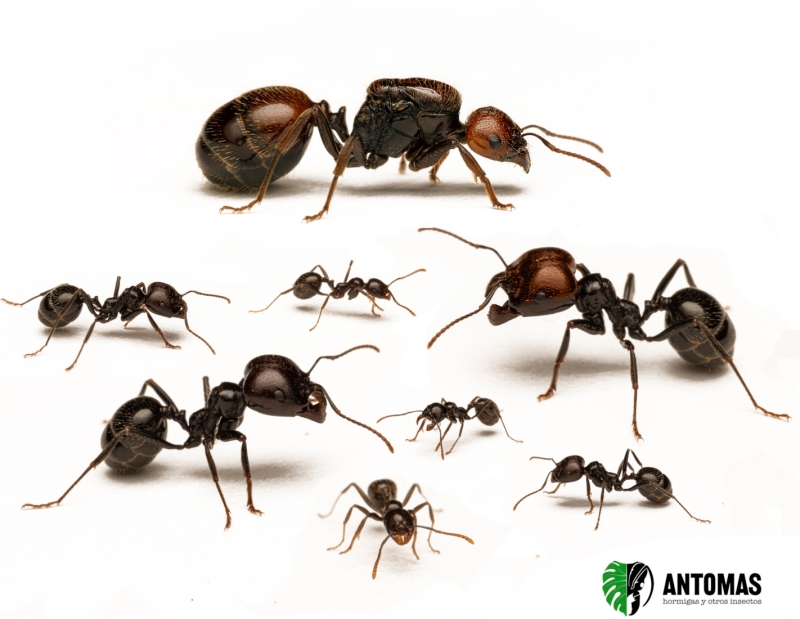
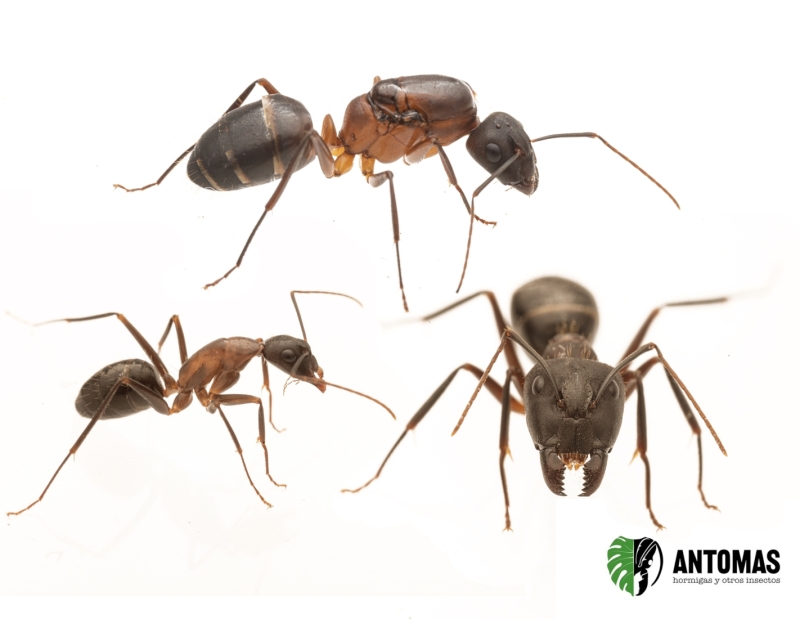
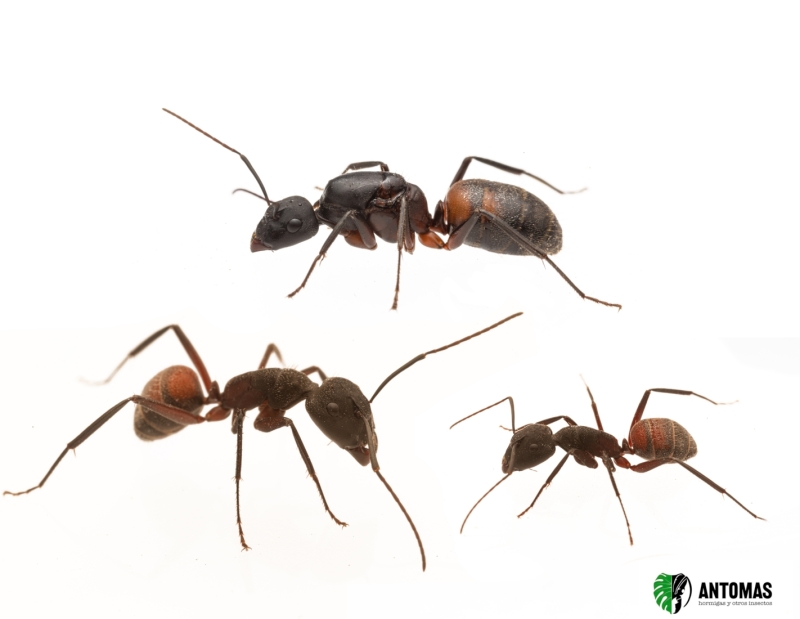
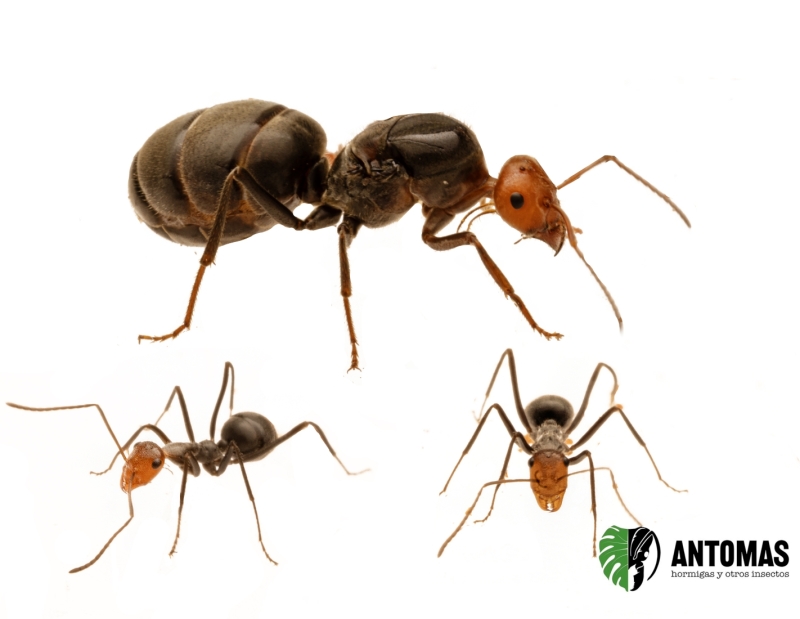
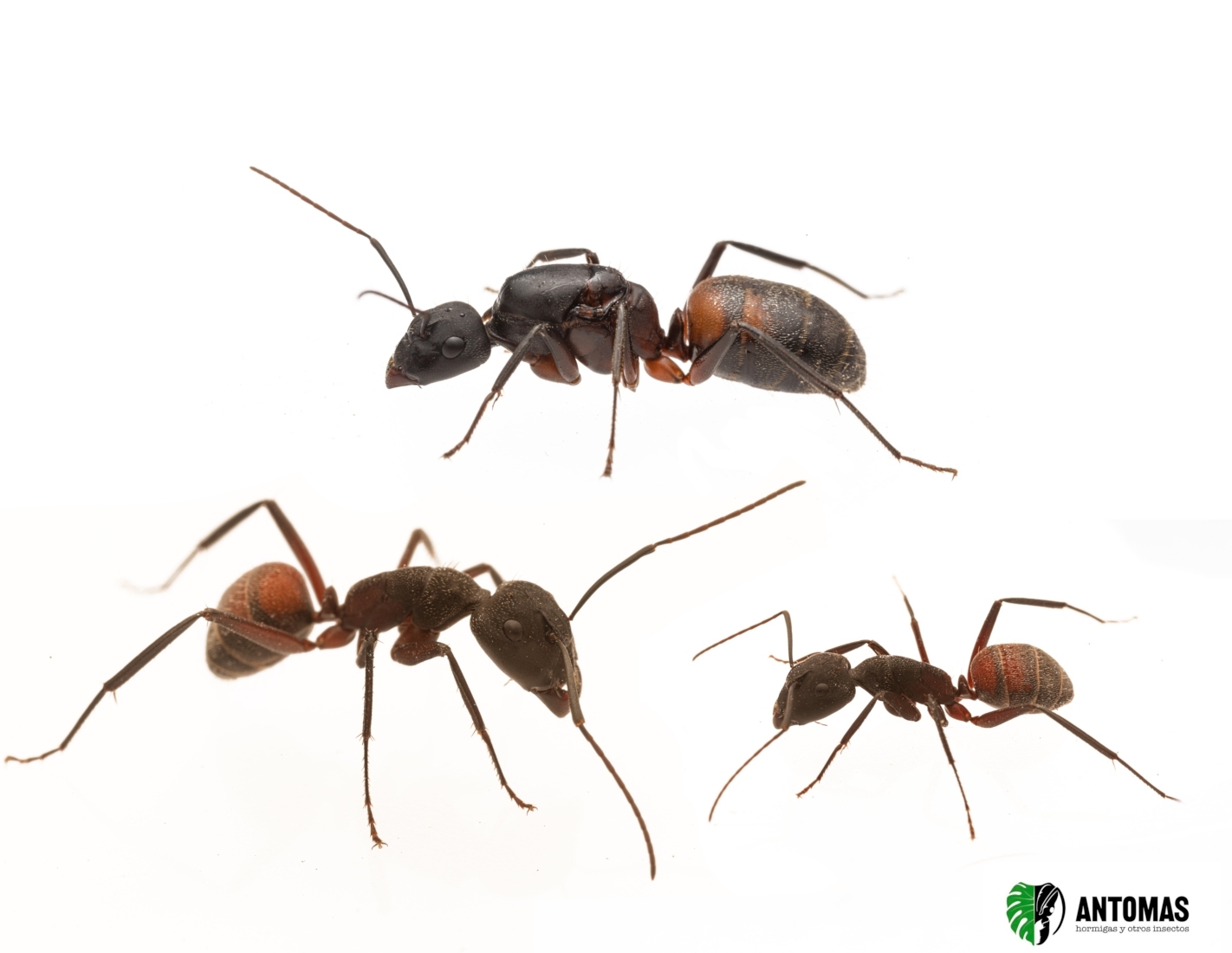
Dressed in black velvet and marked with a bloodstain: this is Camponotus cruentatus, one of the largest ants of the Iberian Peninsula, with workers up to 14 mm long. In high summer it never rests: it patrols its territory around the clock, milks aphids high up in the pines and defends its honeydew with its jaws against any rival. It sows hellebores, escorts butterfly caterpillars and, unlike many of its relatives, works in broad daylight, right before your eyes. Hardy, voracious and full of character, with broad-headed majors. Colonies with a queen. Shipping across Europe, live arrival guaranteed.
One of the largest ants of the Iberian Peninsula: black, matt and velvety, with the base of the gaster an orange red that gives the species its name. Diurnal and, in high summer, active day and night. Colonies with a queen: queen with 4–7 or with 20–40 workers and brood, monogynous and with claustral founding. Qbik Wild for founding and the Alpha range for growing, nest at 24–28 °C, sugar always available in a feeder and plenty of protein. Diapause of 10–15 weeks at 12–15 °C. It climbs: mineral oil or talc barrier. No danger at all to people.
Camponotus cruentatus (Latreille, 1802) is a carpenter ant of the western Mediterranean and one of the giants of the Iberian fauna: its largest workers exceed a centimetre and, seen up close, they look as if they were upholstered in black velvet with a brushstroke of red on the abdomen. It has no established common name in English, so at Antomas we simply call it by its scientific name.
It is also one of the few European Camponotus you can watch at work in broad daylight. Its ecology was studied in depth in a Mediterranean grassland in the 1980s, and that work is the source of the most curious stories in this care sheet: a war over a pine tree and a diet nobody would expect. As always, we keep apart what science says, what other keepers report and what we have learnt at Antomas.
Biology
“Cruentatus”: the blood-stained ant
It was described by the French naturalist Pierre André Latreille in 1802, in his Histoire naturelle des Fourmis, under the name Formica cruentata. The epithet comes from the Latin cruentare, “to stain with blood”, derived from cruor, spilt blood. We do not know exactly what Latreille had in mind, but it takes little imagination: on an almost black body, the front of the gaster bears an orange-red patch, as if the ant had just come out of a fight.
That patch is also the best clue for recognising it in the field. The Iberian keys describe the propodeum, the rear part of the thorax, and the front half of the gaster as yellowish orange. In our colonies, the head and mesosoma look black and the base of the gaster orange red. The shade varies between workers and between populations, but the contrast between the matt black and the red “stain” is unforgettable.
A giant dressed in velvet
With C. cruentatus you do not need a magnifying glass. The 1988 field study we cite throughout this care sheet measured workers of 6 to 14 mm, and a recent review of the Iberian Camponotus presents it as a species “of large size (up to 13 mm) and matt appearance”. It is therefore among the largest ants of the Iberian Peninsula and of western Europe, although nobody has published a ranking that gives it an exact place.
What stands out most, however, is the texture. The cuticle has a reticulate microsculpture and dense punctation that take away all its shine, and the gaster is covered in fine pubescence that makes it look like velvet. This is the hallmark of its subgenus, Myrmosericus, a name that joins myrmex, “ant”, and sericus, “silky”. A silken ant with a bloodstain: few European species dress so elegantly.
A cousin of C. micans, not of C. barbaricus
In shops and forums it is often lumped together with other large, two-coloured Camponotus of the Iberian Peninsula, such as C. barbaricus. On the outside they look alike: large, polymorphic, black and red, and they fly on the same summer nights. But the family ties run another way.
Taxonomists divide the more than a thousand species of the genus Camponotus into subgenera. C. cruentatus belongs to Myrmosericus Forel, 1912, which has only two species in the Iberian Peninsula: this one and C. micans, the black southern ant with silvery hairs. Both share mandibles with 7–8 teeth, a clypeal margin extended into a rectangular lobe and a matt, pubescent body. C. barbaricus, by contrast, is a Tanaemyrmex, from the subgenus of C. sylvaticus: shiny, with an almost hairless gaster.
The quick rule for telling them apart: if the gaster is matt, velvety and has a reddish patch, it is C. cruentatus; if it is black and shiny and the thorax is red, it is a Tanaemyrmex.
Open 24 hours in high summer
In the Mediterranean grassland where it was studied, several ants kept the same timetable all season: Cataglyphis cursor was strictly diurnal and C. sylvaticus crepuscular and nocturnal. C. cruentatus, on the other hand, changes shift with the seasons.
Spring: daytime only, with a fairly steady rhythm from morning to afternoon.
June, July and August: activity gradually spreads into the night until it covers all 24 hours, something no other ant in the area did.
Autumn: it becomes diurnal again and its activity slowly declines.
November: the workers only come out to remove soil, preparing the nest for winter. After that, outside activity stops completely.
Why does it work at night in summer? The authors link it to its larder: the pine aphid it was milking produces honeydew non-stop, day and night. The species also tolerates a very wide range of conditions, and only the extremes stop it. Below about 15 °C, the workers move very slowly and stop coming out. At the top end, activity ceased when the ground in the shade went above 33–34 °C, some 53–55 °C in the sun. One July day the colony stayed inside at midday and, as soon as it cooled down, up to 58 workers rushed out in ten minutes. The species was also part of a later study on the thermal limits of Mediterranean ants, in which its activity was followed hour by hour throughout the season.
An aphid farmer, jealous of its honeydew
Its diet is mainly liquid. In that study, 82 % of the workers returning to the nest without prey had their crop full of liquid, and only 5.9 % came back with something solid between their mandibles. That liquid was almost always honeydew, the sugary excrement of aphids, and the colony switched “farms” depending on the month:
Until mid-June it hardly used flowers or aphids, and only occasionally visited the flowers of Alyssum maritimum.
From June to late July, its workers milked Cinara maritimae aphids en masse on a nearby pine.
From August to November it moved on to fennel, where it collected nectar from the flowers and honeydew from another aphid, Aphis fabae. Its visits to the nectar were strictly diurnal, because fennel only produces it during the day.
That colony’s territory covered 230 m², with one pine and 14 fennel plants, and its workers defended it with real temper: the authors describe it as a very aggressive species that monopolises the food sources it occupies and defends them against any intruder. This is trophobiosis: ants protect aphids from their predators and parasitoids and are paid for the service in sugar, an alliance that has shaped the evolution of both groups.
War in the pine tree against C. sylvaticus
The harshest story in the study features a distant relative as the rival. Next to the C. cruentatus nest lived several colonies of C. sylvaticus, another very aggressive aphid farmer. For much of the year they hardly met, because C. sylvaticus comes out at night and starts its season later. But in July and August, when C. cruentatus also works at night, the two species ended up in the same pine.
Every encounter ended in a fight. The researchers found many mutilated C. cruentatus workers and others with C. sylvaticus heads still clamped to their legs and antennae: in these fights, the mandibles do not let go even when the rest of the body is gone. Little by little, C. sylvaticus activity in the tree increased and that of C. cruentatus fell, until by mid-August the pine belonged almost entirely to the rival. The two other nearby pines were held all year by two colonies of C. sylvaticus, and no other ant was ever seen there.
At Antomas we consider it the most powerful ant in Spain in one-to-one combat: highly dominant and aggressive wherever its empires rule. These short videos by Anthouse prove it, against a scorpion, against Aphaenogaster and against another colony of its own species in a territorial dispute:
“Escorpión vs hormigas gigantes”, by Anthouse (in Spanish): C. cruentatus facing a scorpion.
“Hormigas cazadoras vs hormigas gigantes”, part 2, by Anthouse (in Spanish): C. cruentatus against Aphaenogaster.
“Gigantes y crueles”, part 2, by Anthouse (in Spanish): cruentatus against cruentatus, pure territoriality.
An unexpected diet: droppings
Little solid food enters the nest, but what does is surprising. Of 116 loads analysed, 68 % were vertebrate droppings: from small mammals, birds and reptiles. The workers carried them whole, about 5 mm long, one at a time. Arthropods made up 27 %, and they were nearly always small, dried-up pieces, also about 5 mm, far below the size of the ant carrying them. No other ant in the grassland collected droppings.
What does it gain from this? Probably nitrogen. Such a sugary diet is short of it, and here a hidden partner comes in: all Camponotini carry a bacterium, Blochmannia, which lives in special gut cells, passes from mothers to daughters through the egg and helps the ant recycle nitrogen and make essential amino acids. As early as the 1980s it was suggested that these bacteria could explain why some Camponotus use droppings as a nitrogen source. It is a hypothesis, but it fits what was seen in the field like a glove. Even so, at home the brood needs real protein in the form of insects (see “Feeding”).
Hellebore gardener and butterfly nanny
Its services to the ecosystem do not end with aphids. Stinking hellebore (Helleborus foetidus), a plant of Iberian woods and scrubland, produces seeds with an elaiosome, a fleshy, fat-rich appendage that works as a “tip” for ants. The worker carries the seed to the nest, eats the elaiosome and leaves the seed intact, far from the mother plant and safe. A 2007 study of several Spanish populations named C. cruentatus as one of the hellebore’s two main dispersers in Andalusia, and in one southern population it was responsible for most of the seeds removed.
It also works as a nanny. It tends caterpillars of lycaenid butterflies, the family of small blue and copper butterflies, whose caterpillars secrete sugary droplets in exchange for an armed escort. Caterpillars of Glaucopsyche alexis and Lampides boeticus have been recorded with it.
From the Atlas to the Pyrenees
It is a species of the western Mediterranean: it lives in the Maghreb, in almost all of the Iberian Peninsula, in southern France and in north-western Italy. In the Iberian Peninsula it is widespread, from the coast to the interior and from Andalusia to the Pyrenees, and it becomes scarce in the north-west: in Galicia there are old records on the coast and recent ones inland, at 300–750 m, under stones in heathland and at pine-wood edges. It usually lives below 1,000 m. The most recent Iberian map has no records in the Balearic Islands, and it is absent from the Canary Islands.
Its typical habitat is pine and holm-oak woodland on sunny slopes, often on limestone soils, where it can become the dominant ant. In the coastal grassland of the 1988 study it was rather scarce, and the authors thought it was not in its optimal environment there. It nests in the ground, under stones in the sun, sometimes next to roots or dead wood, and leaves small heaps of soil at the entrance. One or two colonies per 100 m² have been counted.
In Morocco the story gets more complicated. The myrmecologist Henri Cagniant spoke of a C. cruentatus “superspecies”, a set of very closely related forms, and from them described a new species, C. obscuriventris. A new Camponotus related to it was even found in a relict holm-oak wood of 2–3 hectares, at more than 2,000 m altitude in the Anti-Atlas.
Formic acid: weapon and disinfectant
Like all formicines, C. cruentatus has no sting. Its chemical weapon is formic acid, which it produces in the venom gland and sprays through the acidopore, an opening at the tip of the gaster. It uses it in defence, but it has a second use that was demonstrated in 2020: formicine ants swallow their own acid. While grooming, the worker bends its gaster under its body, picks up a drop from the acidopore with its mouth and swallows it. This acidifies the crop, the “social stomach” where it stores the food it later shares, and gets rid of many of the microbes that arrive with it. It was studied in C. floridanus and not in our species, but it is a trait of the whole subfamily. For an ant that collects droppings, it seems a rather good idea.
Yet even this giant has its nemesis: parasitic flies, its great natural enemy. This short video by Anthouse shows it:
“Hormigas cazadoras vs hormigas gigantes”, final part, by Anthouse (in Spanish): parasitic flies, the nemesis of C. cruentatus.
Flights on June nights and a single queen
The sexuals, that is, the winged queens and males, leave the nest in early summer. Amateur records in Spain run from mid-June to early July, at dusk or at night, between seven in the evening and half past one in the morning, with clear skies and 22–28 °C. German care sheets mention May and June. After the flight, the mated queen tears off her wings, seals herself in a chamber and raises her first workers without going out to feed, using the reserves in her own body: this is claustral founding. A classic study showed that queens that found colonies this way are larger and carry more fat than those of species that go out to forage.
Its colonies are monogynous: a single queen per colony. We have found neither a study nor a keeper reporting several queens living together. Nor are there scientific data on the size they reach in the wild: the figures that circulate, from a few hundred to several tens of thousands of workers, have no solid source behind them. What we can tell you is that a well-kept colony becomes large and needs quite a lot of space.
Size and morphology
A large ant, with no sting and with continuous polymorphism: between the smallest and the largest worker there are all the intermediate sizes. Minors have a narrow, proportionally small head; in majors the head grows faster than the rest of the body and becomes broad and robust, an effect of allometry.
Colour. Head and mesosoma black or blackish, sometimes with a slightly reddish mesosoma, and the base of the gaster orange red. The rest of the gaster is black.
Surface. Matt, with reticulate microsculpture and dense punctation. No shine.
Pubescence. Dense, especially on the gaster, which looks velvety.
Head. Clypeus with a carina, a central keel, and the front margin extended into a rectangular lobe. Strong mandibles with 7–8 teeth.
Legs. With a longitudinal groove on the hind tibia, a detail that helps to identify it.
Gaster. It ends in the acidopore, through which the formic acid is released.
Queen and male. We have not found any accessible published descriptions.
Approximate measurements
Workers, from minor to major: 6–14 mm (Alsina et al., 1988); up to 13 mm according to García (2025)
Queen: no accessible published measurements
Male: no accessible published measurements
We only give scientific measurements. The sizes per caste that circulate in shops and forums vary a great deal from one source to another, and we do not use them. As in all Camponotus, the first workers of a young colony, the nanitics, are the smallest, and the average size increases with each generation until the majors appear.
Care in captivity
Difficulty: 2/5 – Beginner
It is a species for beginners, but we give it one point more than other Iberian Camponotus for four reasons:
Slow start. According to keepers, first-year colonies usually end the season with few workers. Patience is needed.
It likes warmth. Keepers count it among the most thermophilic European Camponotus, and in a cold nest the brood stops developing.
It needs a diapause every winter.
It grows a lot. Over the years, the colony needs space and large galleries for the majors.
In return, it is hardy, eats well and is diurnal: you will see it working while you are awake too. And it poses no danger at all to people (see “Handling and safety”).
Recommended parameters
Nest temperature: 24–28 °C during the active season, ideally with one side slightly warmer so that the colony can choose.
Foraging area: 21–28 °C, the normal temperature of a house in spring and summer.
Humidity: nest at 50–60 %, with a slightly damper corner for the brood; foraging area drier, at 30–50 %.
Water: always available, in a test tube with water and cotton wool in the foraging area.
Light: the nest area dark and the foraging area with the room’s normal light.
Diapause: 10–15 weeks at 12–15 °C, from November or December to February.
These are the values keepers use, and they match what is seen in the field: outside the nest it works happily over a very wide range, but below about 15 °C it becomes sluggish. If your home is cool, place a heat cable or heat mat with a thermostat on one side of the nest, never under the whole formicarium, and avoid direct sunlight: in the wild, activity stops as soon as the ground overheats.
Arrival and the first weeks
At Antomas we sell C. cruentatus in two sizes: queen with 4–7 workers and brood or queen with 20–40 workers and brood. Both have already come through claustral founding, the most delicate stage, and have workers that go out to look for food. They arrive in a test tube and, while the colony is small, it can stay there:
Rest on arrival: a couple of days in a quiet, dark place at 24–28 °C, checking that the tube still has water behind the cotton wool.
Food from the start: a drop of sugary liquid on a small piece of aluminium foil or in a mini feeder, never on the cotton wool of the tube, and a small piece of insect two or three times a week. Remove any leftovers.
No knocks or strong vibrations next to the tube: keepers say this is what most often makes a queen eat her eggs.
Into the nest when the tube becomes too small or there are about 10 workers. With the 20–40 worker version you can set it up almost from the start.
There are no published data on this species’ development time. From what is known of the genus, it may take some 6–10 weeks from egg to worker at 25–28 °C, and longer the cooler the nest.
Recommended formicaria
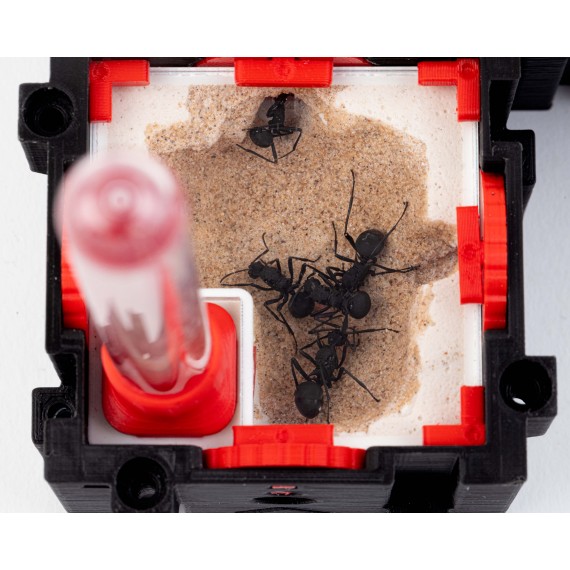
At Antomas we approach it in two stages. For founding, the plaster formicaria of the Qbik Wild range by Anthouse, which retain moisture and give the young colony a stable environment. The first, a Qbik Wild One P 1C with medium galleries:
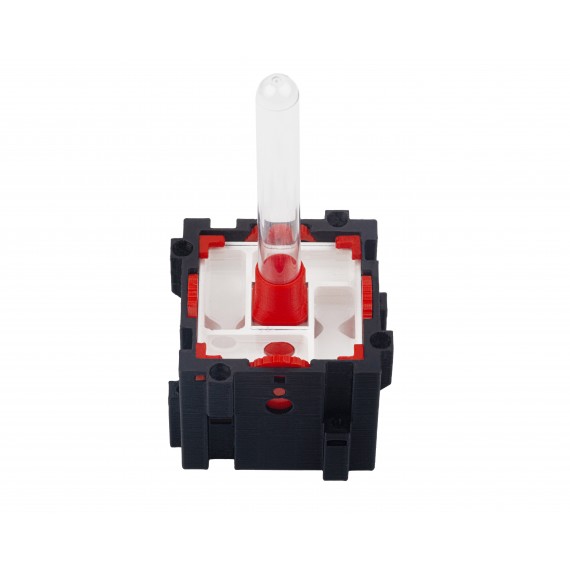
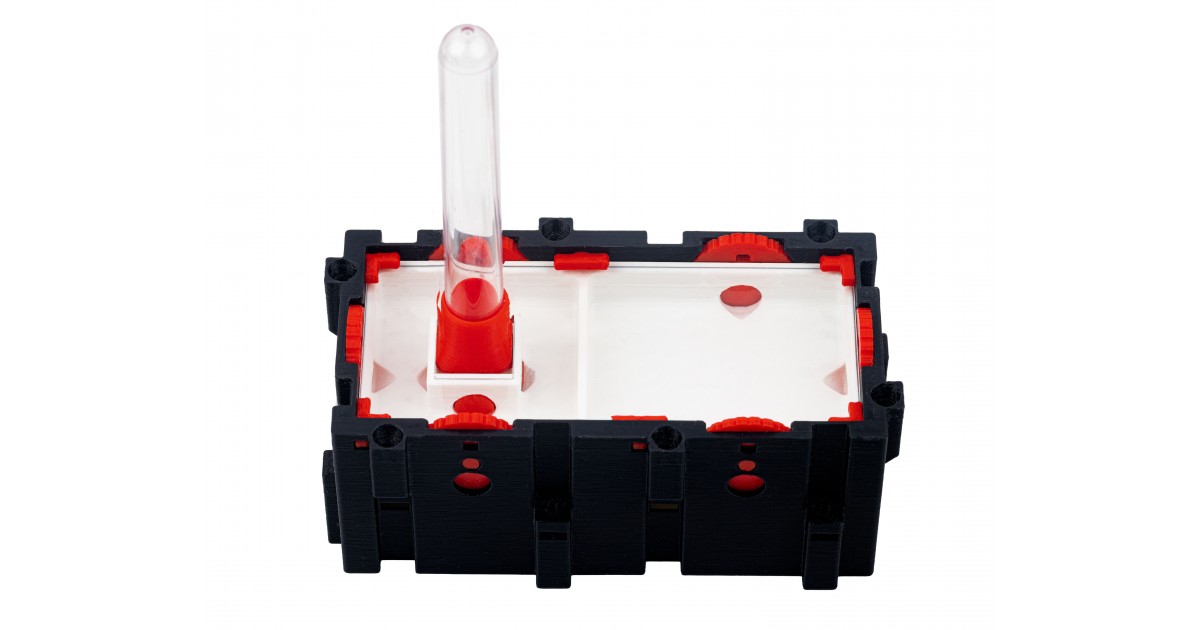
For growing, once the colony has a few dozen workers and starts asking for room, we move it to the Alpha range, with the modular QBIK ONE and QBIK DUO. They are drier, with the moisture supplied by the tubes, and they have two advantages: they are more economical and they weigh less, which is welcome because a well-kept C. cruentatus can grow quite large. When the majors appear, choose large galleries, through which they can pass easily with their broad heads.
Furnish the foraging area with sand or dry soil, a flat stone or two and a twig to climb on, always well away from the barrier. And expand when the nest becomes too small for them, not before: in an oversized nest the colony stays in one corner and uses the rest as a rubbish tip.
Moving by tipping
At Antomas we always move colonies by tipping them into the new home, both from the tube to the first formicarium and from the Qbik Wild to the Alpha range. This is how we do it:
Everything ready beforehand: the new formicarium set up, with the barrier in place and the water tube connected.
Over a tray, in case a worker climbs up your hands or your tools.
Tip: open the tube or the old nest in the foraging area, next to the entrance of the new one, and empty it with a few gentle taps. Help any stragglers with a brush.
Darkness in the new nest: cover it with something opaque and within a few minutes the workers will start carrying in the brood and the queen.
Feeding
Sugar, always. In the wild, C. cruentatus lives mainly on honeydew, so at home it must never run out of a sugary liquid. Offer it in a feeder, traditional or home-made, where the drop stays spread out and accessible, and never on cotton wool: it goes mouldy and the liquid soon spoils. Vary the sugars: at Antomas we recommend Anthouse’s Blue Sugar nectar 4–5 times a week and another nectar or sugary liquid 1–2 times a week. You can also enrich the nectar with a little protein.
Protein, as much as they can eat. It is the fuel for the queen and the larvae, and our rule is clear: if you do daily maintenance and remove leftovers, it is better to give too much than too little, because the colony senses that resources are plentiful and raises more brood, faster. If you will not be able to clean often, adjust the amount: forgotten food brings mould and mites.
Dead or opened up is best. In the wild it is not a great hunter: it gathers small pieces and remains left by others. A German care sheet notes that it tends to prefer dead insects to honey. For young colonies, give the prey chopped or opened up.
In the morning. It is diurnal: put the protein in early and remove the leftovers in the afternoon or the next day.
Insects you can trust, captive-bred and free of insecticides.
Water: besides the sugar, always a tube with water and cotton wool in the foraging area.
Growth and majors
The first year is slow: on a German keepers’ forum, first-year colonies reached winter with 1–5 workers. Do not be discouraged. After the first diapause the colony picks up pace, and each generation brings larger workers. There are no published data on when the first majors appear; from what is seen in the genus, they usually arrive when the colony has from a few dozen to a few hundred workers, normally in the second year. The 20–40 worker version saves you much of that wait. From then on, with warmth during the season, a good diapause and plenty of protein, the colony can grow quite large, and that is the moment to move it to the Alpha range and give it large galleries.
Diapause
In the wild, C. cruentatus stops completely in winter: in November the workers only come out to clean the nest, and then the colony stays inside until spring. It lives in a Mediterranean climate, with short, mild winters on the coast and colder ones inland, and under stones the soil buffers the frosts. Moreover, according to keepers, it has an internal rhythm that calls for this rest. At Antomas we recommend:
When: from November or December to February.
How long: about 10–15 weeks, around 3 months.
At what temperature: 12–15 °C. An unheated room is usually enough; check it with a thermometer. Do not go below about 10 °C: keepers advise against it and its climate does not call for it either.
Gradually: lower the temperature over 2–3 weeks and raise it the same way at the end.
During the rest: water always, a little sugar in the feeder and little or no protein. It is normal for them to spend the winter with larvae and almost no egg-laying.
On waking: according to keepers, it comes out of diapause very quickly. As soon as you see activity, go back to warmth and protein.
Behaviour in captivity
An ant to watch by day. Many Camponotus wait for nightfall; C. cruentatus forages in daylight and, in summer and with a warm nest, may be on the move at any hour.
Possessive about food. In the field it defends its aphids; in the formicarium it guards the feeder and the prey. You will see workers stationed by the sugar and quick recruitment as soon as something good turns up.
Each size, its trade. As usually happens in Camponotus with several worker sizes, the small and medium workers carry most of the foraging and brood care, and the majors, once they arrive, guard the entrances and cut up large prey.
Watch without fear. At Antomas we believe ants are there to be enjoyed, observed and learnt from. Leave the nest dark and the foraging area lit, watch them calmly and intervene only as much as needed: they soon get used to your presence.
Escapes and barriers
Camponotus climb glass and acrylic, even upside down, and C. cruentatus is no exception. To keep them in the foraging area:
A barrier of mineral oil or talc on the upper part of the walls, thin and continuous. Renew it when it gathers dust.
A well-fitting lid as a second line of defence.
Mesh over the ventilation holes: nanitics fit through grilles that look harmless.
No bridges: no twig or stone near the barrier.
Connections checked, especially when expanding or moving to the Alpha range.
Handling and safety
It poses no danger at all to people. It does not sting, because it has no sting. At most, a large worker that gets a good grip can give you a small cut on the finger with its mandibles. And if someone picked up a lot of them by hand, the formic acid could leave a small callus, although that would be exaggerating: it very rarely happens. The normal way is to handle them with a soft brush or soft tweezers, more for their sake than for yours, so as not to harm any worker or the queen. Do not put different colonies together, as they fight, or mix them with other species. And never release a colony raised at home.
What not to do
Put queens or colonies together: it is monogynous.
Put the sugar on cotton wool or let the feeder run dry.
Always give the same prey or leave leftovers in place.
Keep the nest cold during the season: below about 20 °C the brood barely develops.
Skip the diapause or make it too cold, below 10 °C.
Change the temperature suddenly when entering or leaving diapause.
Move a small colony into a huge nest.
Keep narrow galleries once there are majors.
Neglect the barrier, the lid or the grilles.
Scientific sources
This care sheet is based on field studies of Camponotus cruentatus, on the taxonomic literature on Iberian and North African Camponotus and on the experience of Antomas and other keepers. Main references:
Alsina, A., Cerdá, X., Retana, J. & Bosch, J. (1988). Foraging ecology of the aphid-tending ant Camponotus cruentatus (Hymenoptera, Formicidae) in a savanna-like grassland. Miscel·lània Zoològica 12: 195–204. Full text
Cerdá, X., Retana, J. & Cros, S. (1998). Critical thermal limits in Mediterranean ant species: trade-off between mortality risk and foraging performance. Functional Ecology 12: 45–55. doi:10.1046/j.1365-2435.1998.00160.x
Boulay, R., Coll-Toledano, J., Manzaneda, A. J. & Cerdá, X. (2007). Geographic variations in seed dispersal by ants: are plant and seed traits decisive? Naturwissenschaften 94: 242–246. doi:10.1007/s00114-006-0185-z
García, F. (2025). Novas citas para o xénero Camponotus Mayr, 1861 en Galicia (NO Iberia). Arquivos Entomolóxicos 32: 73–79. Full text (PDF)
Cagniant, H. (1996). Les Camponotus du Maroc (Hymenoptera: Formicidae): clé et catalogue des espèces. Annales de la Société entomologique de France (N.S.) 32: 87–100. doi:10.1080/21686351.1996.12278857
Ward, P. S. & Boudinot, B. E. (2021). Grappling with homoplasy: taxonomic refinements and reassignments in the ant genera Camponotus and Colobopsis (Hymenoptera: Formicidae). Arthropod Systematics & Phylogeny 79: 37–56. doi:10.3897/asp.79.e66978
Janicki, J., Narula, N., Ziegler, M., Guénard, B. & Economo, E. P. (2016). Visualizing and interacting with large-volume biodiversity data using client–server web-mapping applications: the design and implementation of antmaps.org. Ecological Informatics 32: 185–193. doi:10.1016/j.ecoinf.2016.02.006
Stadler, B. & Dixon, A. F. G. (2005). Ecology and evolution of aphid-ant interactions. Annual Review of Ecology, Evolution, and Systematics 36: 345–372. doi:10.1146/annurev.ecolsys.36.091704.175531
Keller, L. & Passera, L. (1989). Size and fat content of gynes in relation to the mode of colony founding in ants (Hymenoptera; Formicidae). Oecologia 80: 236–240. doi:10.1007/BF00380157
Sauer, C., Stackebrandt, E., Gadau, J., Hölldobler, B. & Gross, R. (2000). Systematic relationships and cospeciation of bacterial endosymbionts and their carpenter ant host species: proposal of the new taxon Candidatus Blochmannia gen. nov. International Journal of Systematic and Evolutionary Microbiology 50: 1877–1886. doi:10.1099/00207713-50-5-1877
Feldhaar, H., Straka, J., Krischke, M., Berthold, K., Stoll, S., Mueller, M. J. & Gross, R. (2007). Nutritional upgrading for omnivorous carpenter ants by the endosymbiont Blochmannia. BMC Biology 5: 48. doi:10.1186/1741-7007-5-48
Hefetz, A. & Blum, M. S. (1978). Biosynthesis of formic acid by the poison glands of formicine ants. Biochimica et Biophysica Acta 543: 484–496. doi:10.1016/0304-4165(78)90303-3
Tragust, S., Herrmann, C., Häfner, J., Braasch, R., Tilgen, C., Hoock, M., Milidakis, M. A., Gross, R. & Feldhaar, H. (2020). Formicine ants swallow their highly acidic poison for gut microbial selection and control. eLife 9: e60287. doi:10.7554/eLife.60287