This website uses its own and third-party cookies to improve our services and show you advertising related to your preferences by analyzing your browsing habits. To give your consent to its use, press the Accept button.
Functional cookies are strictly necessary to provide the services of the shop, as well as for its proper functioning, so it is not possible to refuse their use. They allow the user to browse through our website and use the different options or services that exist on it.
Cookie
Provider
Purpose
Expiry
PHP_SESSID
antomas.es
The PHPSESSID cookie is native to PHP and allows websites to store serialised status data. On the website it is used to establish a user session and to pass state data through a temporary cookie, which is commonly known as a session cookie. These Cookies will only remain on your computer until you close your browser.
Session
PrestaShop-#
antomas.es
This is a cookie used by Prestashop to store information and keep the user's session open. It stores information such as currency, language, customer ID, among other data necessary for the proper functioning of the shop.
These are cookies that collect information about the advertisements shown to users of the website. They can be anonymous, if they only collect information about the advertising spaces shown without identifying the user, or personalised, if they collect personal information about the user of the shop by a third party, for the personalisation of these advertising spaces.
Collect information about the user's browsing experience in the shop, usually anonymously, although sometimes they also allow the user to be uniquely and unequivocally identified in order to obtain reports on the user's interests in the products or services offered by the shop.
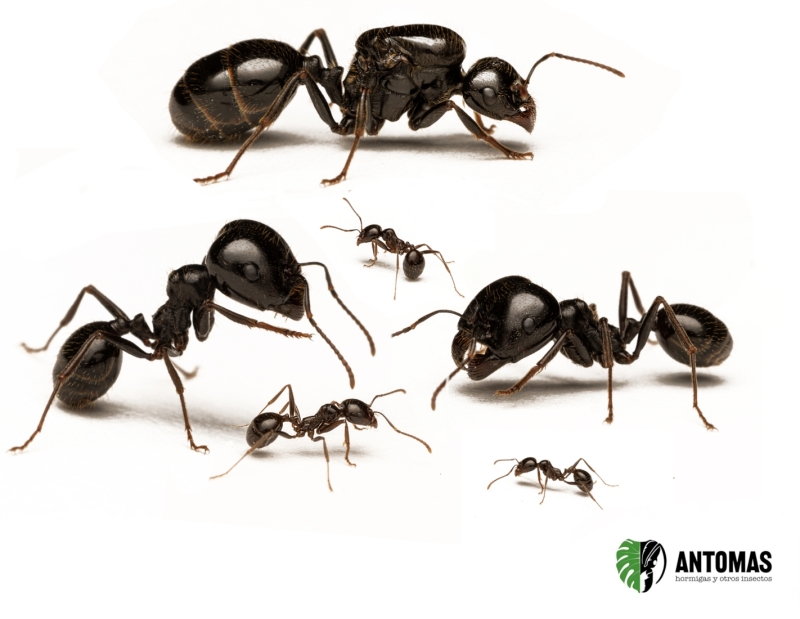
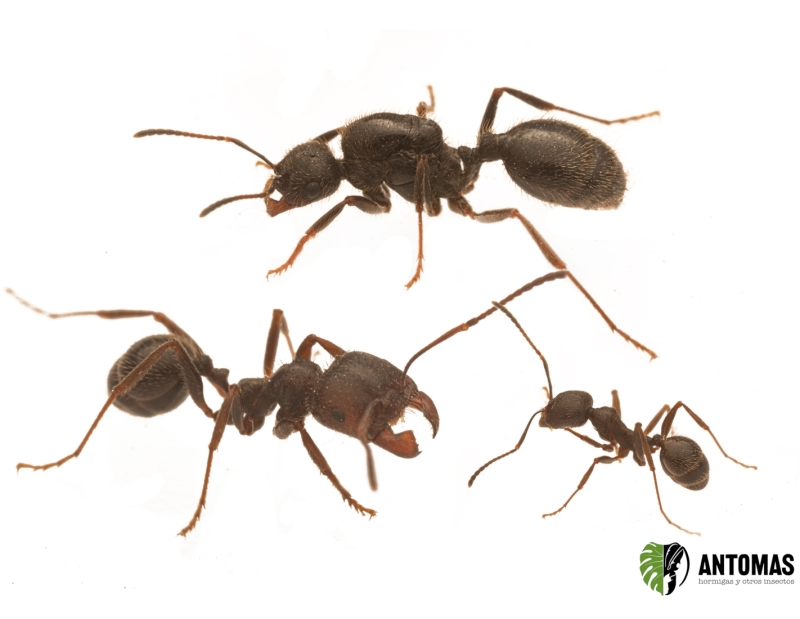
Farmers, engineers and warriors. The Harvester Ant builds empires of thousands of workers on top of underground granaries: it gathers seeds along trails up to 30 metres long, snips off their roots so they cannot sprout and carries them out to dry in the sun. Its red-headed majors crush grain with millstone jaws and, when an intruder sets foot on its territory, the whole colony charges into battle. Hybrid workers from two hidden lineages, pure-bred queens, and the ant that first proved the sun compass. The perfect species to start with, with a queen that can stay with you for decades. Colonies and queens, including Shiny Red, in an intense red. Shipping across Europe, live arrival guaranteed.
The harvester ant of the western Mediterranean: it stores seeds in granaries, raises red-headed majors and defends its territory fiercely. Colonies and single queens, including Shiny Red. A Qbik nest with medium galleries, a humid area and a dry granary, plenty of seeds and protein, and a diapause of about 5 months (November–March) below about 20 °C.
Messor barbarus (Linnaeus, 1767) is the harvester ant par excellence of the western Mediterranean: the one with the long black columns crossing dirt tracks loaded with seeds, the one with the little piles of husks around the nest entrance, the one with the red-headed soldiers. It lives on the Iberian Peninsula, in southern France and in North Africa, and the old records from the Balkans, Turkey or Iran are now considered mistaken or doubtful. It is an ant of open, dry ground: grasslands, wasteland, field margins, roadside verges, stony scrub and cereal fields, where it is the most common ant.
It is no ordinary ant within its genus. When the Swiss myrmecologist Auguste Forel described Messor in 1890, then as a subgenus, he based it on this species: in a way, it is the original Messor. In the 19th century it was known as Atta barbara, and under that name it was studied by the first naturalists who marvelled at its granaries. Today it is the most studied group-foraging species in the whole genus, and behind its look of an “ordinary” ant it hides extraordinary genetics, a sun compass with a history and a way of storing seeds that was already attracting attention in Antiquity.
Its name says it all: messor means “reaper” in Latin. It is granivorous: more than 90 % of what it harvests is seeds. But do not let its diet fool you: it is also a territorial, warlike ant that defends its ground with a ferocity that surprises anyone keeping it for the first time.
Inside a great Messor empire: brood, granaries and wars, in a video by Anthouse (in Spanish).
Biology
Hybrid workers, pure-bred queens: the strangest genetics in Iberia
In most ants, whether a female larva becomes a worker or a queen depends on how she is fed. In M. barbarus, it does not: it depends above all on who her father is. In 2016, a European team analysed the genetics of colonies from Andalusia, Castilla-La Mancha, Extremadura and the Algarve, and discovered that two cryptic genetic lineages of the species live side by side on the Iberian Peninsula, identical to the naked eye, which they named Mbar1 and Mbar2. They split between 1.4 and 2.5 million years ago and share territory in places such as Sorbas (Almería), Baúl (Granada) or Aljezur (Portugal).
The astonishing part is how the castes are divided: all workers are hybrids of the two lineages, whereas queens always come from crosses within a single lineage. This is what specialists call social hybridogenesis: the queen uses the sperm of males from her own lineage to raise princesses and that of males from the other lineage to raise workers. It fits with each queen mating with several males, about 2.4 on average. The system has been confirmed in other Messor, such as M. structor and M. ebeninus, though not in all of them.
It has a curious consequence: a queen that has only mated with males of her own lineage cannot produce workers. The authors estimate that, if mating were random, about 13 % of queens would not mate with both lineages. This is our own hypothesis, not proven, but it could explain why some newly caught queens, apparently healthy, never manage to raise a colony.
And there is something even stranger in the family. Its cousin M. ibericus, from the M. structor group, has taken the system to the extreme: its queens need the sperm of M. structor males, a different species, to produce workers, and so as not to depend on finding them they clone males of that other species, which split from their own more than 5 million years ago. The authors, who published it in Nature in 2025, called this mode of reproduction “xenoparity”.
The mirror ant: the first proof of the sun compass
Today we know that many ants navigate by the sun, but someone had to prove it for the first time. It was the Swiss physician and myrmecologist Félix Santschi, in 1911, and he did it with M. barbarus. His experiment is a classic: he shaded the sun from workers returning to the nest and, with a mirror, made them see its reflection on the opposite side of the sky. The ants turned round and walked in the opposite direction, as if the sun had moved. It was the first experiment on celestial orientation in ants, the starting point of more than a century of research on insect navigation.
A century later, in your formicarium, their descendants are still great navigators: in the foraging area they quickly lay out their routes and travel them in single file, back and forth, between the nest and the food.
Motorways up to 30 metres long, swept clean even in winter
The most striking feature of a M. barbarus colony in the wild is its trunk trails: permanent paths 1 to 30 m long and 10–20 cm wide, which leave the nest entrances and branch out towards the areas richest in seeds. The workers clear them of grass and obstacles and maintain them even in winter, when they are not in use: they are true infrastructure, and in a stubble field they can be seen with the naked eye as lines of bare earth.
The network is very well designed:
Several entrances, several trails. Each colony has several entrances, each with its own trail, and in one Spanish population a third of the colonies also had trails linking some entrances with others, to exchange information and food.
A network that adapts. The ends of the trails seek out the patches with most vegetation, and the colony alternates between two strategies, like an army: “guerrilla”, with long, little-branched advances to explore, and “phalanx”, with many short branches to exploit a rich area thoroughly. After a good year more branches and short links appear; after a bad one, fewer and longer branches.
Borders. The trails of neighbouring colonies do not cross: they divide the ground into territories and are defended against other colonies (see “Not hunters, but…”).
To recruit their nestmates they lay a chemical trail. The trail pheromone comes mainly from the Dufour’s gland, in the abdomen, while the venom gland is used for alarm and defence; and recruitment is reinforced by stridulation, a sound they produce by rubbing two body parts together. A relay transport has even been described on the trails: small workers pick up loads that are large for their size, start the journey and hand them over to larger workers, who cover the last stretch to the nest.
Farmers that switch off their seeds
A colony that lives on seeds has an obvious problem: if it stores them underground, in damp conditions, they germinate. M. barbarus solved this long ago, and the first person to describe it in detail was the English naturalist John Traherne Moggridge, in 1873, watching colonies in Menton and Cannes, on the French Riviera.
They cut the root. When a seed starts to sprout, the workers gnaw off the radicle, the tiny tip of the root.
They take them out to dry in the sun. After a downpour, Moggridge saw the ants carry the seeds out of the nest, spread them out in the air and sun, and store them again once dry.
It works. The stored seeds were damp, yet of thousands of seeds from 21 nests, only 27, from 7 nests, showed any sign of germination. And they were not dead: when sown, they grew vigorously.
The colony is essential. In his later experiments, Moggridge found that formic acid vapour had no effect: the key was the presence of the ants, which watch over the granary and eat first the seeds that begin to sprout.
It was not an entirely new discovery: Moggridge was confirming what Plutarch and other ancient authors had already reported, having seen ants “disable” grain before storing it. To date, no modern study has found a substance in Messor that inhibits germination: everything points to a job of surveillance and maintenance.
Moggridge also dug up their granaries: horizontal chambers about 4–15 cm deep, each “the size of a pocket watch”, and, in a deep nest, granaries more than half a metre down. And he saw something else: the stored seeds were “malted”, and the workers scraped the flour from a millet grain with their mandibles. Keepers describe how they chew the seeds into a paste, the so-called “ant bread”, which they feed to the brood; the details of its biochemistry have not been well studied.
A discerning palate: seeds of 4 to 50 mg
Harvesting seeds does not mean picking up just anything. In the wild, M. barbarus prefers seeds of 4 to 50 mg, regardless of their density; it almost never takes those under 0.4 mg, and it only uses some of the species available, which makes it a very selective predator. It also chooses by shape: it prefers elongated seeds, which are found sooner and are less likely to be buried. It is a strategy to save time rather than energy.
The further, the fussier. The longer the trail, the more selective they become, as if a long journey were only worth it for a good seed; seed density, on the other hand, does not change their selectivity.
Group preferences. They love grass caryopses (the “grains” of grasses), rush capsules and the achenes of some composites, and, among pieces of different sizes of the same food, they choose the small ones, which are easier to handle.
Almost anything. Moggridge found seeds from a great many plants in their granaries, from fumitory to amaranth, and wrote that they collected them “almost indiscriminately”.
In Antomas’s experience, at home they are far less fussy than in the wild: they like practically everything, from canary seed and millet to chia or oats (see “Feeding”).
Red-headed majors: the colony’s grinders
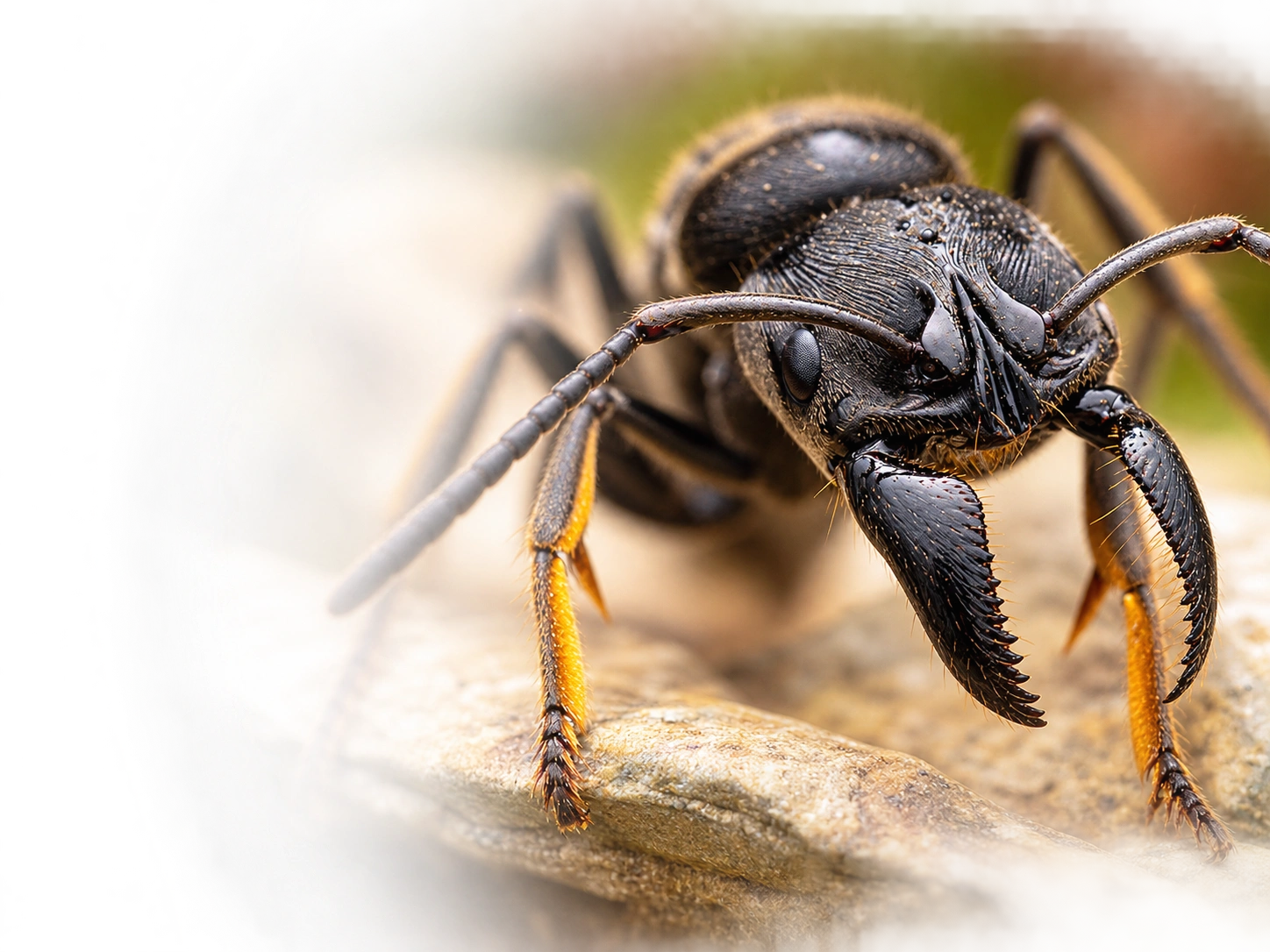
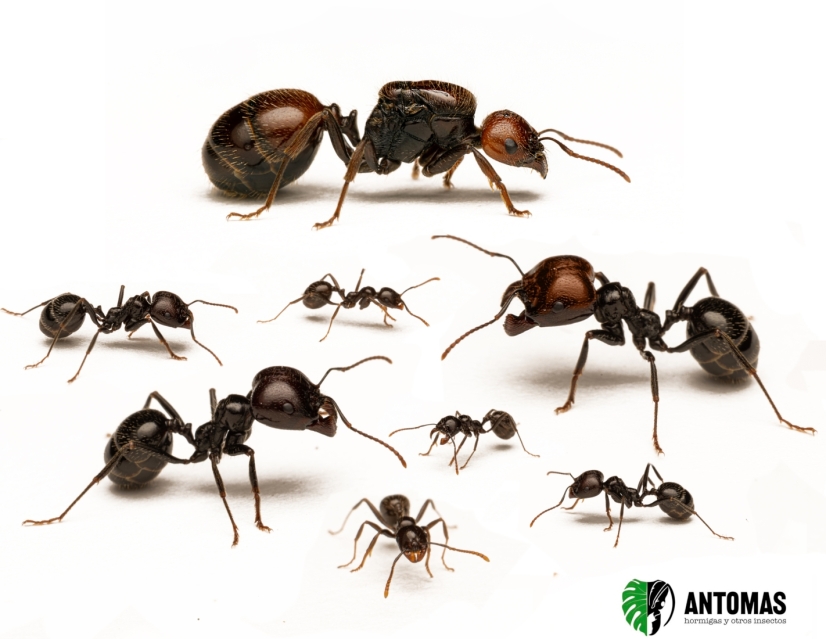
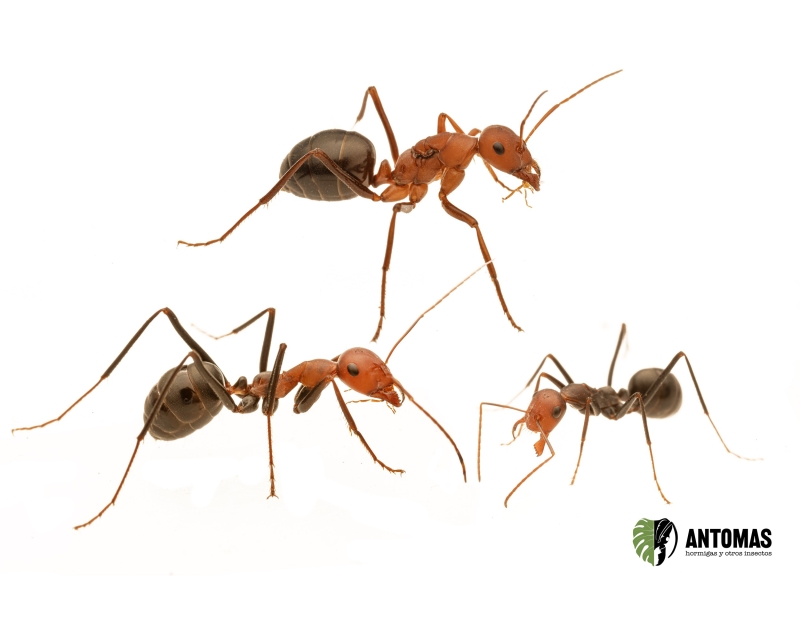
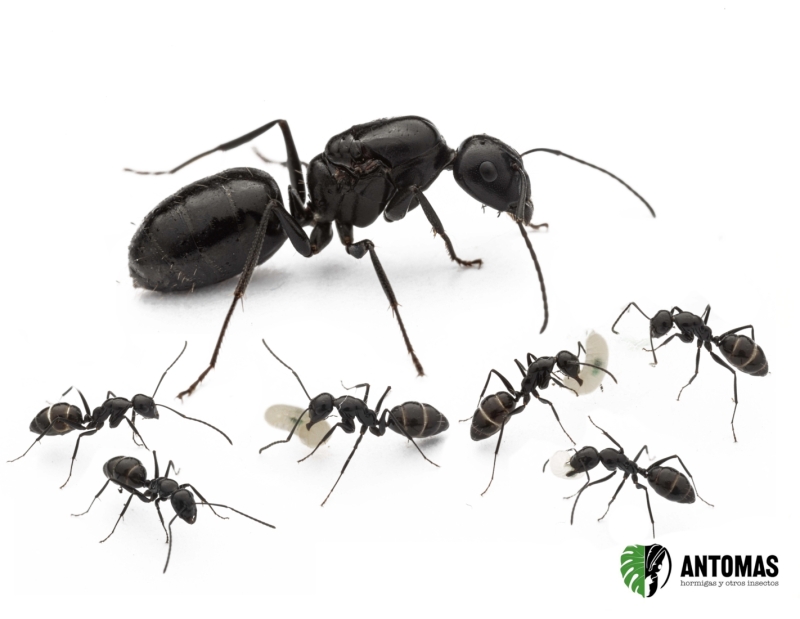
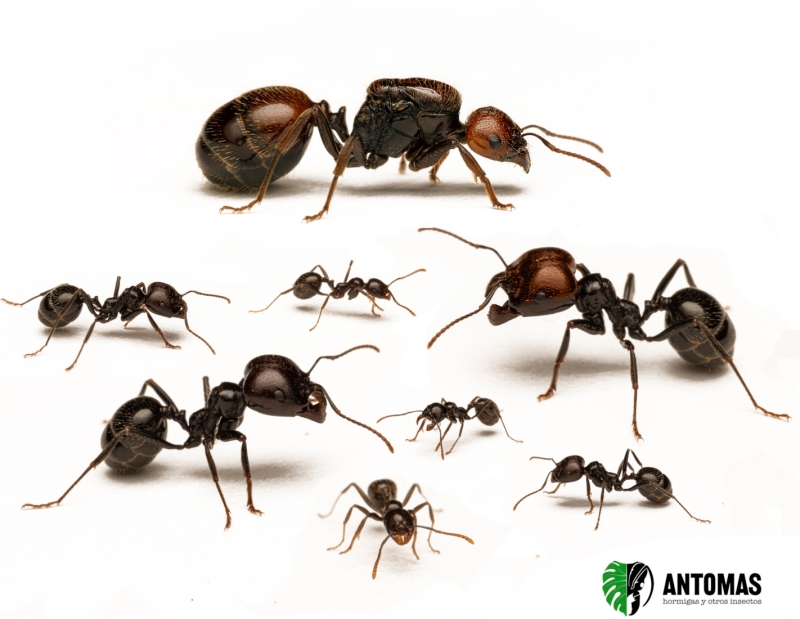
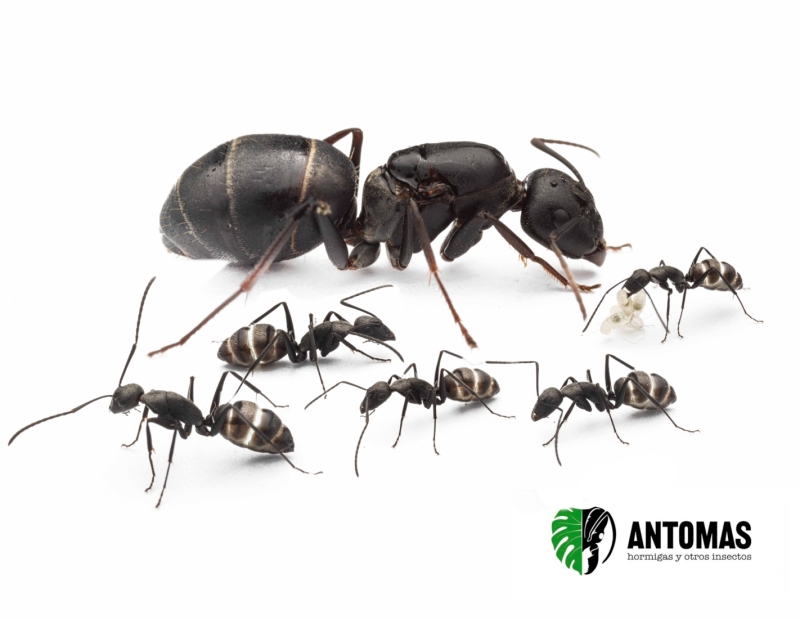
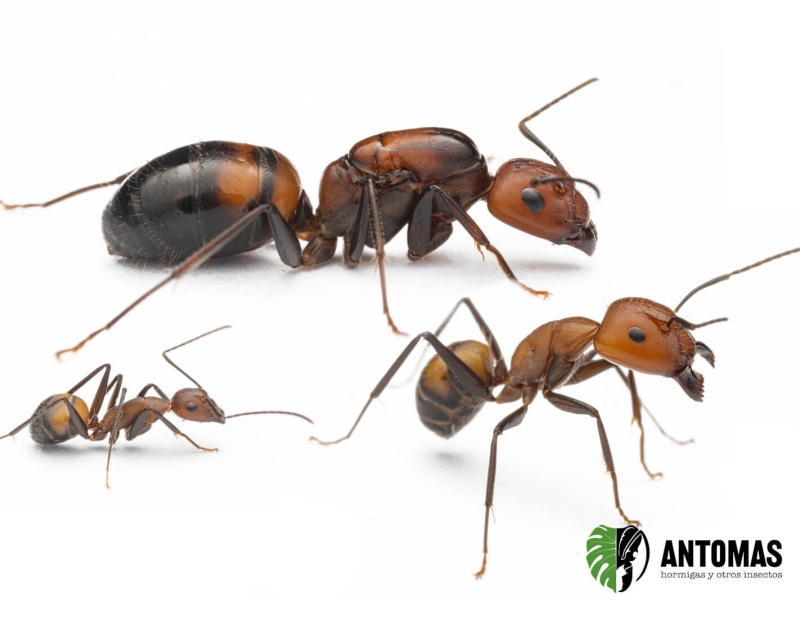
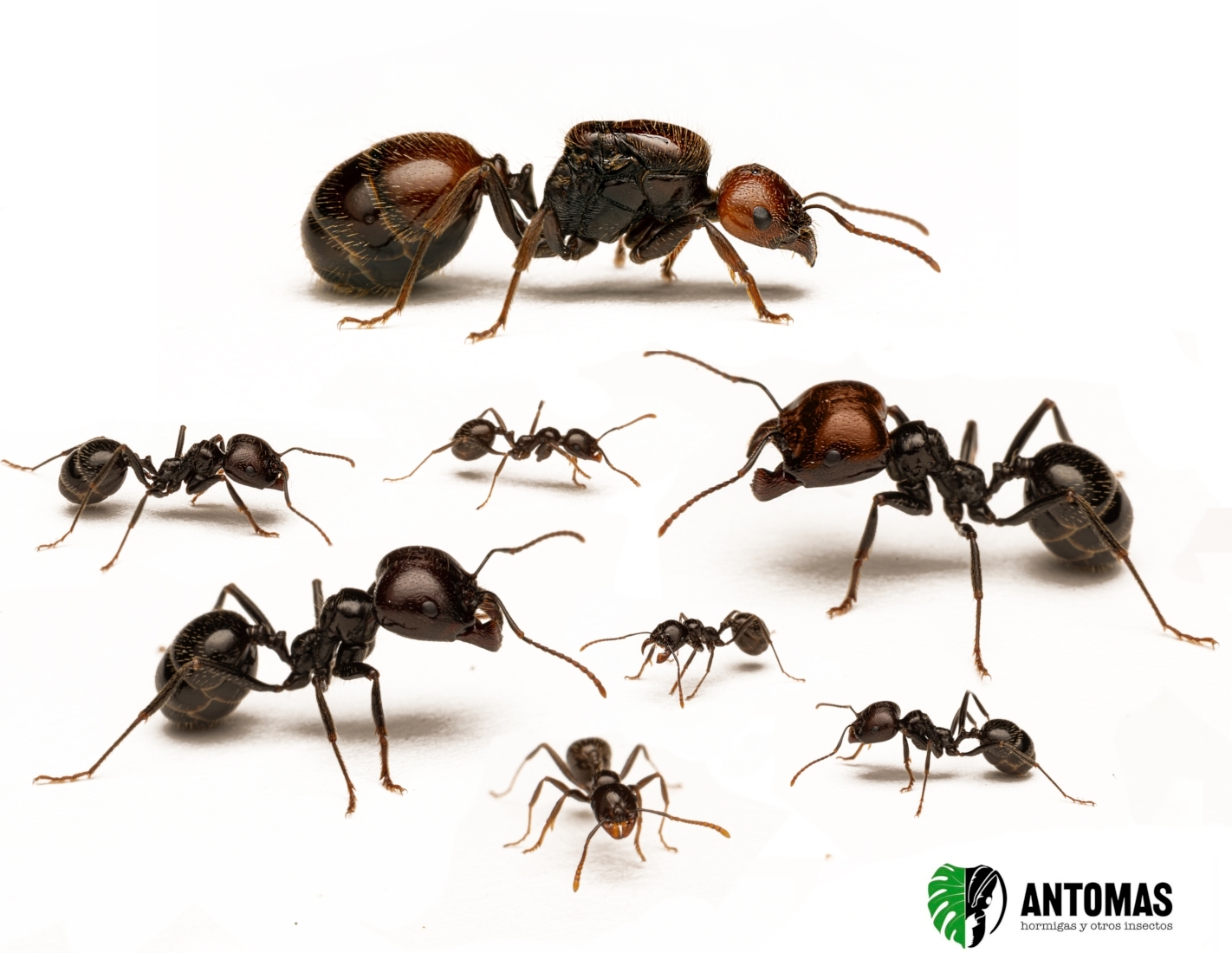
A mature M. barbarus colony looks like a catalogue of sizes: tiny workers of about 3 mm next to majors (the “soldiers”) more than a centimetre long, with an enormous and often red head. There are no separate castes, but a continuous gradation of minors, medias and majors, and each size tends to specialise:
The medias mainly mark the trails with pheromones.
The minors handle the small seeds.
The majors collect the large or preferred seeds.
Majors have a much larger head in proportion than small workers. A 2019 study of how they walk found that this head shifts their centre of gravity forward, even more so when they carry a seed: large ants are less stable and partly compensate by adjusting their gait; and, when loaded, all of them, large and small, grip the ground with their hind legs during part of each stride. That head is full of muscle, the engine of mandibles that work like a mill: in Antomas’s experience, the majors are the ones that crack the hard seeds the small workers cannot open, and the ones that turn grain into food for the brood. No studies have measured the strength of their bite.
That is why, in a young colony, the arrival of the first majors is quite an event: from then on, the colony can handle almost any seed, and its growth speeds up (see “Behaviour in captivity”).
Ecosystem engineers: fertile middens and farmers’ allies
The husks piling up next to the entrance are not just a rubbish tip. Moggridge already called them “kitchen middens”, and saw that a single one could fill a jug of more than a litre. More than a century later, a study in grasslands near Madrid found that the soil of these middens is siltier and richer in potassium and organic matter, with a higher pH, and holds a denser and more diverse seed bank; the changes also favour plants with heavy seeds. Each nest is, in practice, a patch of fertilised soil and a seed nursery.
They also move seeds from one place to another. On about 20 % of trails there are small seed caches that some workers drop and others pick up, although actual dispersal, through seeds lost along the way, is less than 1 %.
And farmers? In the dryland cereal fields of north-eastern Spain, M. barbarus is the most common ant, with densities of hundreds of nests per hectare: in plots with 468–900 nests per hectare they removed 99–100 % of the weed seeds offered within 24 hours. It acts as a biological weed control, and the crop losses it causes are low: 0.6 % on average, with a maximum of 9.2 % in the worst-affected fields. A far more useful neighbour than it seems.
A thermometer in their legs: when they go out to forage
A team from the Autonomous University of Madrid followed 44 colonies near Madrid for a year and a half, from March 1998 to September 1999. The colony starts to come out when soil temperature and humidity exceed certain minimum values and, once active, it is the surface temperature that regulates how many workers go out: activity peaks with the ground at 25–30 °C, and workers walk faster the warmer it is, except the largest ones. In general, they forage with the ground at about 15 to 35 °C.
In high summer they change tactics: in the morning, long columns towards known food sources, and, as the ground heats up, they shorten the columns and look for food closer to home. They are diurnal, but avoid the middle hours of the hottest days.
In winter, the cold keeps them indoors: depending on the area, the winter rest lasts roughly from November to March, with no brood, living on stored seeds. Climate normals explain it: from November to March, the mean temperature is 11.8–15.3 °C in Valencia and 6.3–11.2 °C in Madrid. These are the foundations of the diapause we recommend at home (see “Diapause”).
Not hunters, but…
M. barbarus is not a hunter: it lives on seeds, and in the wild it only picks up dead insects occasionally. But let no one mistake it for a peaceful ant. Its colonies defend their territory zealously: the trails of neighbouring colonies do not cross, and the workers defend them against other colonies, so that the ground is divided into territories. That is exactly what the venom gland is for: raising the alarm and defending themselves.
In Antomas’s experience, a mature colony brings down large insects, and plenty of them. It is not hunting in the strict sense: it is territorial defence. A cricket or a cockroach that wanders into its foraging area is a threat, and the whole colony throws itself at it: dozens of workers hold it by the legs and antennae, and the majors pin it down with their mandibles. Once the threat has been wiped out, it becomes what the colony needs to raise brood: protein. Watching a large Messor colony react like this is one of the most impressive sights a “seed” ant can give you.
A Messor colony pounces on an intruder, in a video by Anthouse.
One queen, several thousand workers… and several fathers
M. barbarus colonies are monogynous: they have a single queen and, in the wild, number several thousand workers. That queen, however, does not have just one partner: she mates with several males, about 2.4 on average, which fits her peculiar genetic system (see “Hybrid workers, pure-bred queens”). In the laboratory, researchers have also studied how colonies react when forced to accept several queens, and how they “close” themselves to foreign queens.
How many workers can a colony reach? The figures of tens of thousands that circulate in the hobby have not been measured: what science says is “several thousand”. At home, with space and food, a Messor colony becomes a true empire in just a few years.
Autumn flights and claustral founding
The nuptial flights of M. barbarus take place in autumn, usually after the first heavy rains following the summer. This fits the climate: in Valencia, September and October are the wettest months of the year, with 70 and 77 mm. The researchers who studied its genetics caught queens and males during flights in Granada and Albacete.
After the flight, the queen sheds her wings, buries herself and founds her colony alone. The founding is claustral: she raises her first workers without going out for food, using the reserves of her own body. And she is usually in no hurry: autumn queens normally spend the winter in diapause and start raising brood in spring.
What if several queens found a colony together? This is called pleometrosis. There are no scientific studies on it in M. barbarus, but keepers report that, when queens are put together, they usually tolerate each other at first and, when the workers emerge, only one ends up remaining. In its North American relative M. pergandei it is documented: in some populations, queens found together, dig the nest and raise the first brood as a team, and shortly after the workers emerge they fight to the death until only one is left. That is why, at Antomas, we recommend one queen per tube.
Combat queens: the princesses who stayed at home
Among Messor keepers there is a famous phenomenon that science has not yet studied in the genus: combat queens. This is what we call the young queens, the colony’s winged princesses, that have not been able to make their nuptial flight in season and stay in the nest doing workers’ jobs. It is fairly common in mature colonies in captivity: when autumn comes, the colony produces princesses, but there is no possible flight in a formicarium, and many end up shedding their wings and staying at home.
In the experience of Antomas and other keepers, they all share one trait: excessive aggressiveness. They can be seen going into battle alongside the workers when the colony defends its territory. But life in the colony is not easy for them: the workers themselves treat them quite badly and, if they serve no purpose in the colony, end up killing them. Do not expect one of them to replace the queen: a virgin princess cannot produce workers, and only males would hatch from her unfertilised eggs.
Is there any scientific basis? In Messor there are no studies and no scientific name for them, but the phenomenon is documented in another genus. In 2012, a team from the universities of Copenhagen and Freiburg studied the leaf-cutter ants Acromyrmex echinatior and A. octospinosus, and found that virgin queens that lose their wings without making the nuptial flight do not die: they stay in their mother’s colony, care for the brood and work in the nest like workers, and also defend it. Faced with the odour of foreign colonies, they reacted with far greater aggressiveness than the other females; the University of Freiburg’s press release even compared them to the legendary Amazons. Until then it had been assumed that these queens died, and some do indeed end up eaten by their sisters. They live on their own reserves, their wing muscles, and the authors suggest that, in ants that feed on a fungus, “recycling” surplus queens as protein does not pay off, so it is more worthwhile to give them another job.
The contrast with Messor is interesting: in leaf-cutters they are kept; in our harvesters, on the other hand, the workers end up getting rid of them if they are not useful. We keepers see it and we see it at Antomas, although no one has yet studied why. What is documented in the genus is that its queens can be very combative: in M. pergandei, in populations where founding queens fight to the death, queens have a wider head (and, with it, stronger mandibles) than in populations where they do not fight, while their workers do not differ: a true female “weapon” selected by combat.
Messor combat queens in the thick of battle, in a video by Anthouse.
How long does a Messor queen live? Decades
Ant queens are among the longest-lived insects known: they live far longer than their workers, than males and than the vast majority of solitary insects. The documented record belongs to a queen of Lasius niger, the black garden ant, which the German entomologist Hermann Appel caught in August 1931, after her nuptial flight, and which lived in his home until April 1960: almost 29 years (28 years and 9 months). According to his notes, in her last year of life she was still laying fertilised eggs.
In M. barbarus no study has measured the queen’s lifespan; the figures of 20 or 25 years found on some websites have no scientific backing. What we can tell you is our own experience: at Antomas we keep an 11-year-old colony that is still going strong. We are convinced they can live much longer. A well-cared-for Messor queen can keep you company for decades: bear that in mind when choosing her (and, if you like, when choosing her colour: see “Shiny Red queens”).
Size and morphology
A sturdy, shiny ant of the subfamily Myrmicinae, with workers of very different sizes, linked by a continuous gradation.
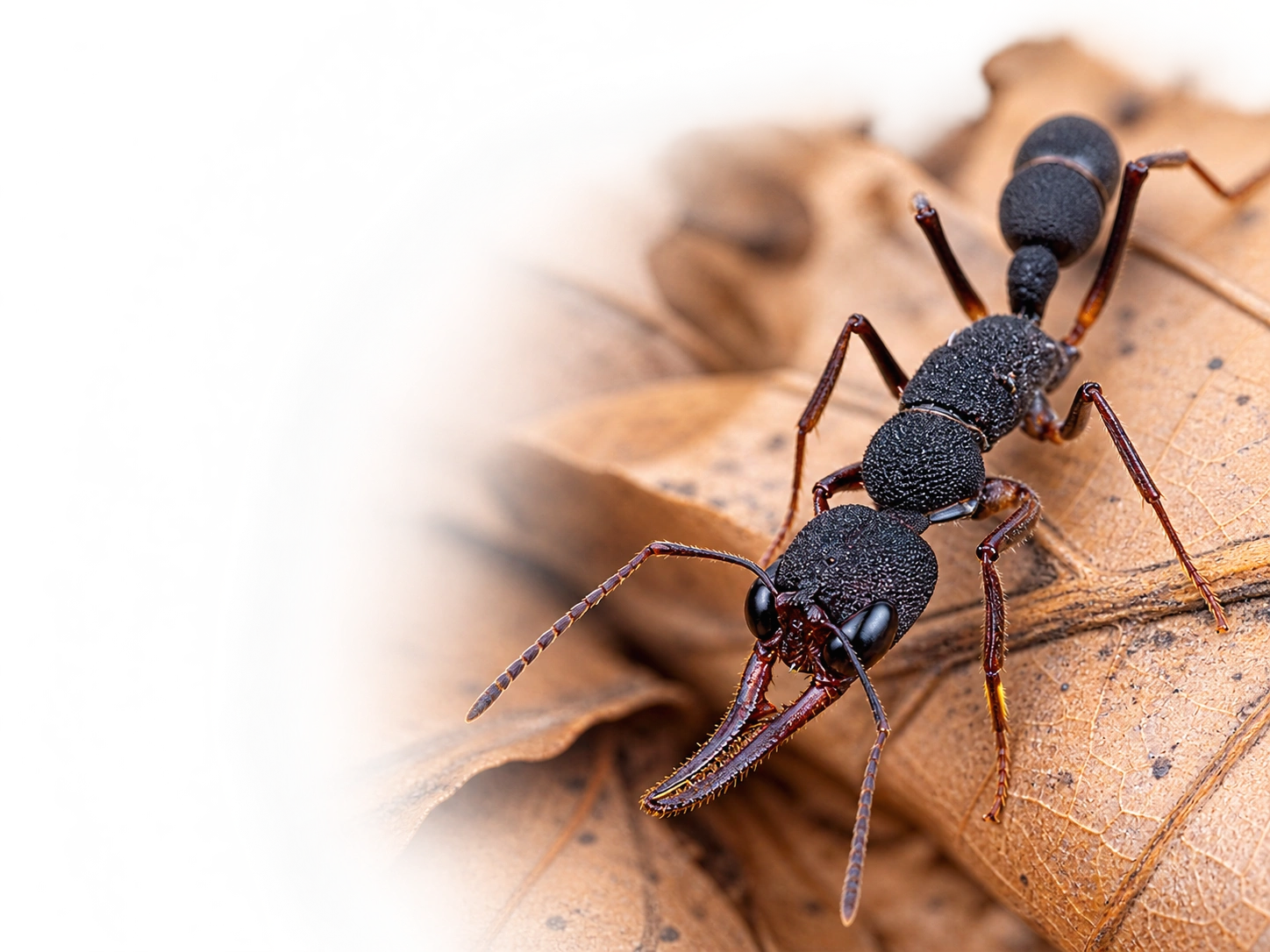
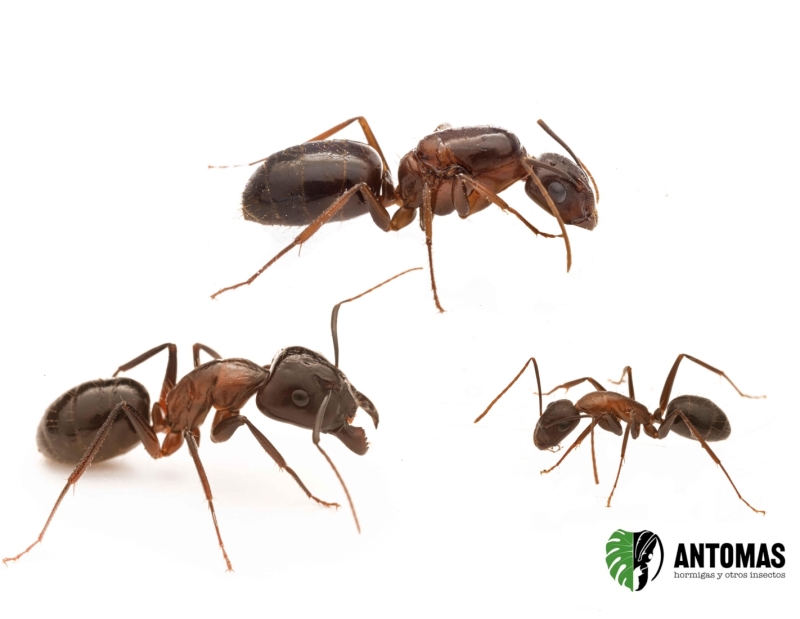
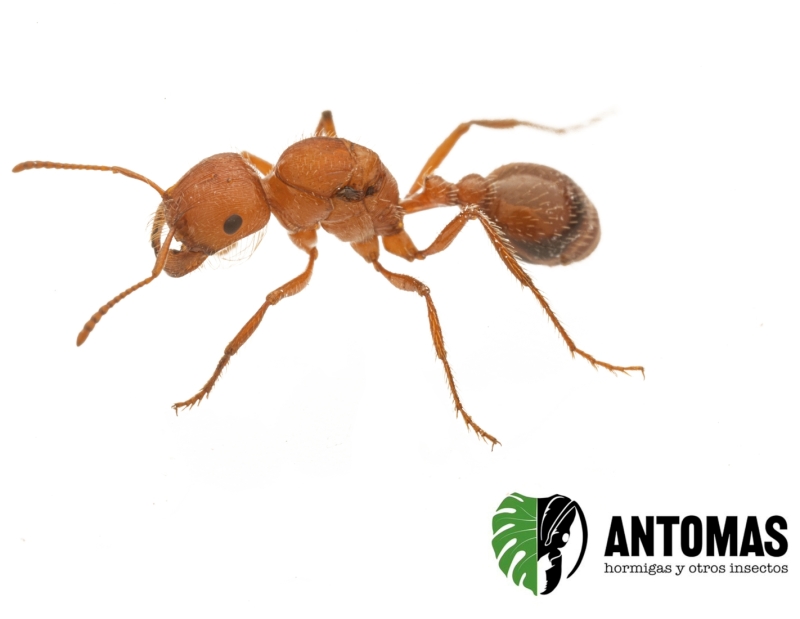
Worker colouring. Black and shiny. Minors are uniformly coloured; majors, especially the largest, are usually bicoloured, with a reddish head, and the intensity of that red varies greatly from one individual to another. In 1873 Moggridge already distinguished a “wholly black” form and a “red-headed” one.
Head and mandibles. In majors, the head is proportionally much larger than in small workers, with broad, powerful mandibles for cracking seeds.
No sand “basket”. Unlike other Messor, it has no psammophore, the row of long hairs under the head that other species use to carry sand.
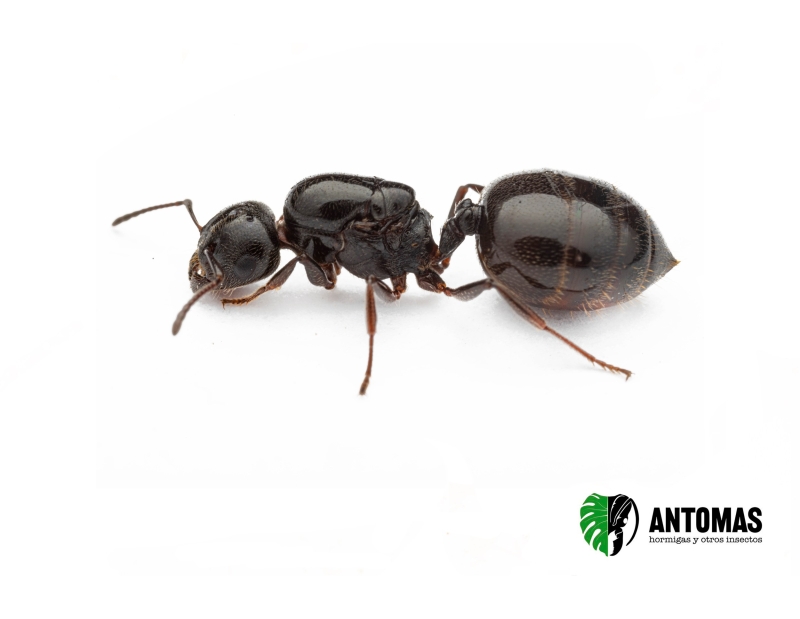
Queen. Large and sturdy, black and shiny, almost always with a red head and, rarely, a red gaster too. She can also be recognised by her bulky thorax, built for flight, and by her wing scars.
Male. Winged, smaller and slimmer than the queen; it flies in autumn, during the nuptial flights.
Compared with other Iberian Messor. The majors of M. capitatus have an angular propodeum (the rear part of the thorax) and lack the reddish head of M. barbarus; and M. ibericus, sometimes confused with it, belongs to another group, that of M. structor. To identify an Iberian Messor you need workers of all sizes, especially majors.
Development. As in all other myrmicines, the larvae pupate without a cocoon: the pupae are naked. According to keepers, it takes 6 to 12 weeks from egg to worker, depending on temperature.
Shiny Red queens: a touch of colour for a lifetime
As you have seen, the red of the head varies greatly in this species: there are almost black queens, red-headed ones and a few, rare ones with a reddish gaster too. Shiny Red queens are queens with redder colouring: the same species, with a more intense colour. If a Messor queen can keep you company for so many years, why not enjoy a little more colour throughout the whole experience?
And her daughters? There are no studies on how colour is inherited in M. barbarus, so the colour of the offspring cannot be guaranteed. In Antomas’s experience, however, some soldiers of queens of the redder morph tend to emerge with a more yellow or orange head, a lovely detail in a mature colony.
Approximate measurements
Workers: 3–13 mm, from minors to the largest majors
Queen: about 13–15 mm
Male: no reliable scientific measurements
The measurements come from Cagniant and Espadaler’s (1997) review of the Messor of Morocco; Iberian populations may differ somewhat. There is no modern morphometry of the species on the Iberian Peninsula.
Care in captivity
Difficulty: 1/5 – Beginner
It is, without exaggeration, one of the best species in the world to start with. It is hardy, adapts very well to life in a formicarium, eats seeds you can always keep at home and which it stores itself for the days when you forget, does not sting and is not an escape artist. Its needs come down to four: a nest with a humid area and a dry granary, water always available, plenty of food with leftovers cleared away, and a diapause in winter.
And it is well worth it. Easy does not mean boring: you will watch the workers lay out their routes, fill the granary, crack seeds with the majors, carry the husks out to the midden and, when an intruder slips into their territory, rush into battle. And all this with a queen that can keep you company for decades.
Recommended parameters
Temperature (spring to autumn): 22–28 °C. This is the range of the summers in its area, with means of 22–26 °C from June to August in Valencia and Madrid, and in the wild its activity peaks with the ground surface at 25–30 °C. Keepers agree on a similar range for the nest. It does not need an excessive hot spot: if you use a heat source, keep it gentle and at one end of the foraging area, and never let the nest go above 30 °C.
Humidity: two zones. A humid part of the nest, without waterlogging, for the brood, and a dry granary for the seeds. The foraging area, dry.
Water: always available, also during diapause: a test tube with water and cotton wool in the foraging area.
Light: simply leave them their dark area in the nest and the foraging area in the light, with a normal day–night cycle. Avoid direct sunlight on the formicarium.
Diapause: yes, of about 5 months, from November to March, below about 20 °C (see “Diapause”).
Recommended formicaria
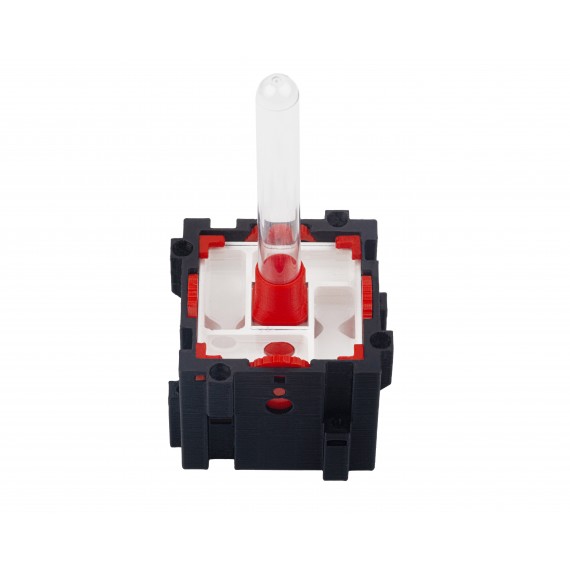
At Antomas we recommend the Qbik range by Anthouse, the standard Qbiks of the Alpha range: modular formicaria that grow with the colony. To start with, a QBIK ONE with medium galleries, which makes it easy to keep an eye on the brood and the granary in a small colony.
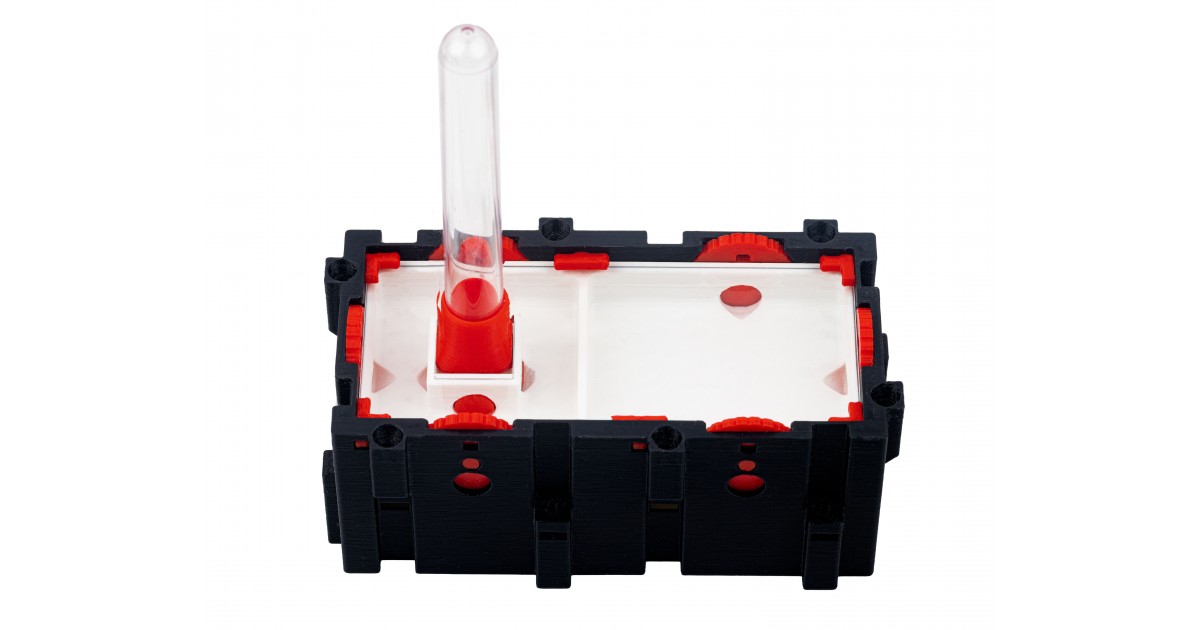
As the colony grows, it is expanded, always with larger galleries: the majors of a mature colony are big and need space. The next step is the QBIK DUO:
And, for great empires, the QuaDra, HeXa and NoNa formats of the same range. Expand when the nest becomes too small for them: a clear sign is seeing lots of workers standing still in the corners of the foraging area, with no room inside. Conversely, a nest that is too big for a small colony ends up with corners used as a midden, mould and mites.
No plaster or Ytong nests.M. barbarusgnaws through many materials: at Antomas we have seen it time and again, the majors wreck plaster and Ytong nests, and keepers report the same with plaster of Paris, sandstone, wood and soft plastics. Always choose professional nests that are well established on the market, made of materials they cannot gnaw.
Complete the set-up with these details:
Humid area and dry granary. Moisten only one part of the nest, the brood area, and leave another dry, where they will store the seeds. The ants quickly learn to separate the granary from the brood.
Water in a test tube. A tube with water and cotton wool in the foraging area is the best water source: always available and with no risk of drowning, because they drown in open water. In summer, add a second tube.
A feeder for sugary liquids. Never on cotton wool, which goes mouldy and spoils the liquid straight away: use a traditional or home-made feeder, where the drop stays “spread out” and accessible.
A large foraging area, kept dry, where they can lay out their routes and set up their midden. A little dry sand or soil lets them behave naturally.
Founding with a single queen
At Antomas we also sell single queens. Founding is claustral, so it is very simple: the queen does not need to eat, only peace and quiet, darkness and water.
In a test tube, with its water reservoir plugged with cotton wool, in a dark, quiet place.
Without disturbing her. A stressed queen may eat her eggs: look at her from time to time, gently and without moving her, but do not move her elsewhere or open the tube unnecessarily.
Autumn queens, in diapause. Queens that fly in autumn usually spend the winter in diapause, laying no eggs or very few, and start raising brood in spring. At Antomas we recommend respecting that rhythm and letting them go through diapause, as we do with the season’s queens we sell: the tube in a cool place (below about 20 °C) during the winter, and back to room temperature in March or April. Do not warm them up to bring egg-laying forward.
The first workers. When they emerge, offer a few small, soft seeds, such as chia, sesame or grass seed, on the dry side of the tube, away from the cotton wool: seeds that touch the damp cotton wool germinate, and their roots drink the water in the tube. The first workers, the “nanitics”, are small and short-lived: it is normal for some to die.
When to move her to the nest. When the colony has a few dozen workers and the tube becomes too small, by tipping (see “Arrival and moving”).
Several queens together. Pleometrosis exists, but usually only one queen remains when the workers emerge, and there may be fights to the death along the way (see “Autumn flights and claustral founding”). We do not recommend forcing it: one queen per tube.
If a queen does not produce workers. It is not always the keeper’s fault. Remember its genetics: a queen that has not mated with males of both lineages cannot produce workers. And, as in all ants, some queens simply do not make it.
Arrival and moving
When your colony arrives, let it rest in a quiet place at room temperature, and make sure it has water. To move it into its formicarium, at Antomas we do it by tipping: we open the tube and tip the colony (workers, queen, brood and seeds) into the new formicarium, with a few gentle taps. You can help the stragglers with a soft brush. Do it calmly and without fear: within a few hours they will have taken over the nest and started to organise the granary. When the colony grows and you expand it with larger galleries, the method is repeated.
Feeding
Seeds: they like practically everything. In Antomas’s experience, you can give them almost any seed: canary seed, millet, oats, bird seed mixes, grass seed, chia, quinoa, linseed, sesame, poppy seed… Keepers agree that they also love oily seeds. Use seeds for human consumption or for birds, untreated, unsalted and unroasted. Just one rule depending on the age of the colony: until the first majors are born, the workers cannot crack hard seeds, so in a young colony it is best to give small or soft seeds (chia, sesame, poppy, grass). With majors, they can handle anything.
How to prevent mould and germination. They know how to do it themselves, as they do in the wild (see “Farmers that switch off their seeds”), but give them a hand:
Leave the seeds in the foraging area, so they carry them to the dry granary; never in the humid area or in contact with the cotton wool.
Remove seeds that germinate or go mouldy, and the husks and leftovers from the midden.
For a small colony, give a small amount and top up often; for a large one, you can give more at a time, because they store it.
Cracked seeds do not germinate, but they go mouldy sooner if they get damp: only crack them if they are going into a dry granary.
Protein, in abundance. For the colony to grow fast, it is essential to give them plenty of protein, including animal protein: the queen needs it to lay, and the larvae to grow. At Antomas we give them insects (crickets, cockroaches, mealworms, flies), chicken, pinkies (frozen baby mice, the kind sold as reptile food) and tuna, in small pieces suited to the size of the colony. Meat and fish are always better cooked (chicken, tuna…); pinkies, as they come. Wild-caught insects are best frozen first, because of parasites. And an important rule: if they have not eaten the animal protein within 24–48 hours, remove it promptly. A mature colony will also throw itself at large live insects (see “Not hunters, but…”).
The more they eat, the better and faster they grow. This is Antomas’s philosophy: if you do daily maintenance and remove leftovers, it is better to overfeed, because the ants understand that they have more resources and grow faster and in greater numbers. If you are not going to be able to clean often, it is better not to overfeed: leftover protein rots and brings mould and mites.
A varied diet, always. In this species, variety comes from seeds and protein: change the type of insect from one week to the next, so they do not always eat the same thing. Sugars, on the other hand, are not really advisable for a granivore like this one. As a supplement, and only very occasionally, you can offer them a nectar such as Anthouse’s Blue Sugar nectar, always in a feeder and never on cotton wool: at Antomas we give it once or twice a month. Avoid thick, pure honey: they get stuck in it.
Water: always, in the test tube with cotton wool. It is the one thing they must never be without.
Diapause
M. barbarus needs a winter rest, the diapause: in the wild, from November to March, the colony stops raising brood and lives on stored seeds. At Antomas we recommend a diapause of about 5 months, from November to March, more or less depending on the temperature where you live.
Temperature: below about 20 °C, with a wide margin. Intense cold is not needed and the temperature can vary quite a lot: the cooler it is, the more marked the rest will be. As a reference, in its range, from November to March, the mean temperature is 11.8 to 15.3 °C in Valencia and 6.3 to 11.2 °C in Madrid. A cool room, a garage or an unheated storeroom usually works.
No artificial heat: remove heat sources throughout the winter.
Water always available: it is all they need. They will eat little or nothing, apart from the seeds they have stored.
Gradual changes: November and March are transition months, in which the temperature falls and rises little by little.
You will know the colony is entering diapause because it eats less, especially protein, moves less and no longer has pupae. In spring, as temperatures rise, the queen starts laying again and the colony takes off. Single queens and small colonies also go through diapause.
This is how an empire gets ready for winter: the last big meal before diapause, in a short video by Anthouse:
“El imperio debe descansar”, by Anthouse (in Spanish): the last supper of an M. barbarus colony before diapause.
Behaviour in captivity
Organised. Within a few days you will see the colony put its house in order: the brood in the humid area, the granary in the dry one and the midden outside, in the foraging area, with seed husks, food leftovers and dead workers. Clear the midden from time to time and keep it dry, so that it does not breed mould or mites.
Growth. In the first year they grow slowly and, with the arrival of the first majors, they speed up. A keeper who documented his colony on a forum saw the first major emerge when the colony had about 20 workers, and in just over a year it went from about 30 workers to several hundred. With plenty of protein and space, in a few years you will have an empire.
Wars. They are very territorial: do not merge colonies, not even of the same species, and do not connect two Messor formicaria to each other. In the wild, neighbouring colonies divide up the ground and defend their borders, and in a formicarium they have nowhere to retreat.
Combat queens. If your colony is mature, some autumn winged princesses may appear that, with no possible flight, stay in the nest. You do not need to do anything: the colony itself decides (see “Combat queens”).
Watch without fear. At Antomas we believe ants are there to be enjoyed, watched and learnt from, not kept hidden away. Simply leave them their dark area in the nest and the foraging area in the light, and watch them gently, intervening and stressing them as little as possible. They quickly get used to your presence.
Warning signs: if the queen comes out into the foraging area, check the water; if mould appears in the granary, there is moisture where there should not be; and if many workers die in a short time, check the water, the temperature and food leftovers.
Escapes and barriers
In Antomas’s experience, they are not escape artists: they only try to escape when they are short of food, water or space. Nor are they particularly agile at getting past escape barriers: a barrier of mineral oil or PTFE in the foraging area works very well with them.
What they do is gnaw: check plugs, joints and soft parts, and do not use materials they can get through. The best prevention is a professional formicarium, plenty of food and water, and expanding in good time.
Handling and safety
It is a very safe species. In practice they do not sting and, like all myrmicines, they have no formic acid. Majors can bite, but their bite is only a pinch: you notice it, but it does not hurt. Even so, handle them with entomological tools (a soft brush or soft forceps), not with your hands, especially when tipping or cleaning, so as not to harm the queen. And never release colonies or queens: although it is a native species in part of Europe, outside its range it would be an introduced species.
What not to do
Housing them in plaster or Ytong nests, or nests of soft materials: they gnaw through them and wreck them.
Putting seeds in the humid area or in contact with the cotton wool: they germinate or go mouldy.
Giving them a nest that is too big for the colony: they end up using the corners as a midden.
Leaving animal protein for more than 24–48 hours, mouldy seeds or a damp midden.
Skimping on protein: it is the key to their growth.
Overdoing sugars: in this species, only very occasionally.
Warming up an autumn queen to bring egg-laying forward: let her go through diapause.
Leaving open water or thick honey: they drown or get stuck.
Putting sugary liquids on cotton wool: use a feeder.
Leaving them without water, also during diapause.
Skipping diapause or changing the temperature suddenly.
Using an excessive hot spot or leaving the formicarium in direct sunlight.
Putting queens or colonies together.
Keeping them hidden away: they are there to be watched and enjoyed; do it gently, intervening as little as possible.
Scientific sources
This care sheet is based on the scientific literature on Messor barbarus and its genus, and on the experience of Antomas and other keepers. Main references:
Acosta, F. J., López, F. & Serrano, J. M. (1995). Dispersed versus central-place foraging: intra- and intercolonial competition in the strategy of trunk trail arrangement of a harvester ant. The American Naturalist 145: 389–411. doi:10.1086/285746
Keller, L. & Genoud, M. (1997). Extraordinary lifespans in ants: a test of evolutionary theories of ageing. Nature 389: 958–960. doi:10.1038/40130
Heredia, A. & Detrain, C. (2000). Worker size polymorphism and ethological role of sting associated glands in the harvester ant Messor barbarus. Insectes Sociaux 47: 383–389. doi:10.1007/PL00001735
Detrain, C., Tasse, O., Versaen, M. & Pasteels, J. M. (2000). A field assessment of optimal foraging in ants: trail patterns and seed retrieval by the European harvester ant Messor barbarus. Insectes Sociaux 47: 56–62. doi:10.1007/s000400050009
Azcárate, F. M., Arqueros, L., Sánchez, A. M. & Peco, B. (2005). Seed and fruit selection by harvester ants, Messor barbarus, in Mediterranean grassland and scrubland. Functional Ecology 19: 273–283. doi:10.1111/j.0269-8463.2005.00956.x
Azcárate, F. M., Kovacs, E. & Peco, B. (2007). Microclimatic conditions regulate surface activity in harvester ants Messor barbarus. Journal of Insect Behavior 20: 315–329. doi:10.1007/s10905-007-9074-3
Azcárate, F. M. & Peco, B. (2007). Harvester ants (Messor barbarus) as disturbance agents in Mediterranean grasslands. Journal of Vegetation Science 18: 103–110. doi:10.1658/1100-9233(2007)18[103:HAMBAD]2.0.CO;2
Doblas-Miranda, E. & Reyes-López, J. (2008). Foraging strategy quick response to temperature of Messor barbarus (Hymenoptera: Formicidae) in Mediterranean environments. Environmental Entomology 37: 857–861. doi:10.1603/0046-225X(2008)37[857:FSQRTT]2.0.CO;2
Baraibar, B., Ledesma, R., Royo-Esnal, A. & Westerman, P. R. (2011). Assessing yield losses caused by the harvester ant Messor barbarus (L.) in winter cereals. Crop Protection 30: 1144–1148. doi:10.1016/j.cropro.2011.05.010
Nehring, V., Boomsma, J. J. & d'Ettorre, P. (2012). Wingless virgin queens assume helper roles in Acromyrmex leaf-cutting ants. Current Biology 22: R671–R673. doi:10.1016/j.cub.2012.06.038
Plowes, N. J. R., Johnson, R. A. & Hölldobler, B. (2013). Foraging behavior in the ant genus Messor (Hymenoptera: Formicidae: Myrmicinae). Myrmecological News 18: 33–49. Full text in Myrmecological News
Bespalova, I. & Helms, K. R. (2014). Social selection and the evolution of a female weapon in queens of the ant Messor pergandei (Hymenoptera: Formicidae). Biological Journal of the Linnean Society 113: 1011–1020. doi:10.1111/bij.12376
Norman, V., Darras, H., Tranter, C., Aron, S. & Hughes, W. O. H. (2016). Cryptic lineages hybridize for worker production in the harvester ant Messor barbarus. Biology Letters 12: 20160542. doi:10.1098/rsbl.2016.0542
Romiguier, J., Fournier, A., Yek, S. H. & Keller, L. (2017). Convergent evolution of social hybridogenesis in Messor harvester ants. Molecular Ecology 26: 1108–1117. doi:10.1111/mec.13899