This website uses its own and third-party cookies to improve our services and show you advertising related to your preferences by analyzing your browsing habits. To give your consent to its use, press the Accept button.
Functional cookies are strictly necessary to provide the services of the shop, as well as for its proper functioning, so it is not possible to refuse their use. They allow the user to browse through our website and use the different options or services that exist on it.
Cookie
Provider
Purpose
Expiry
PHP_SESSID
antomas.es
The PHPSESSID cookie is native to PHP and allows websites to store serialised status data. On the website it is used to establish a user session and to pass state data through a temporary cookie, which is commonly known as a session cookie. These Cookies will only remain on your computer until you close your browser.
Session
PrestaShop-#
antomas.es
This is a cookie used by Prestashop to store information and keep the user's session open. It stores information such as currency, language, customer ID, among other data necessary for the proper functioning of the shop.
These are cookies that collect information about the advertisements shown to users of the website. They can be anonymous, if they only collect information about the advertising spaces shown without identifying the user, or personalised, if they collect personal information about the user of the shop by a third party, for the personalisation of these advertising spaces.
Collect information about the user's browsing experience in the shop, usually anonymously, although sometimes they also allow the user to be uniquely and unequivocally identified in order to obtain reports on the user's interests in the products or services offered by the shop.
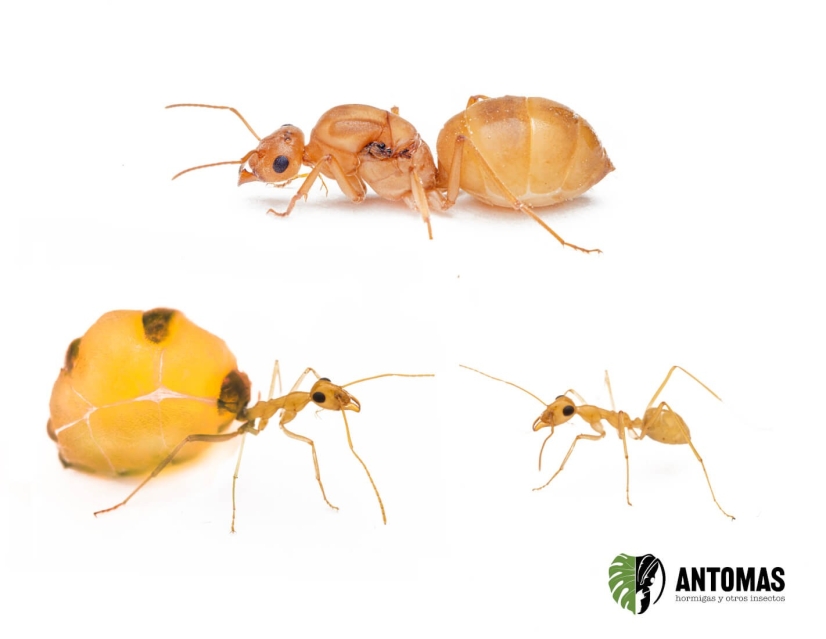
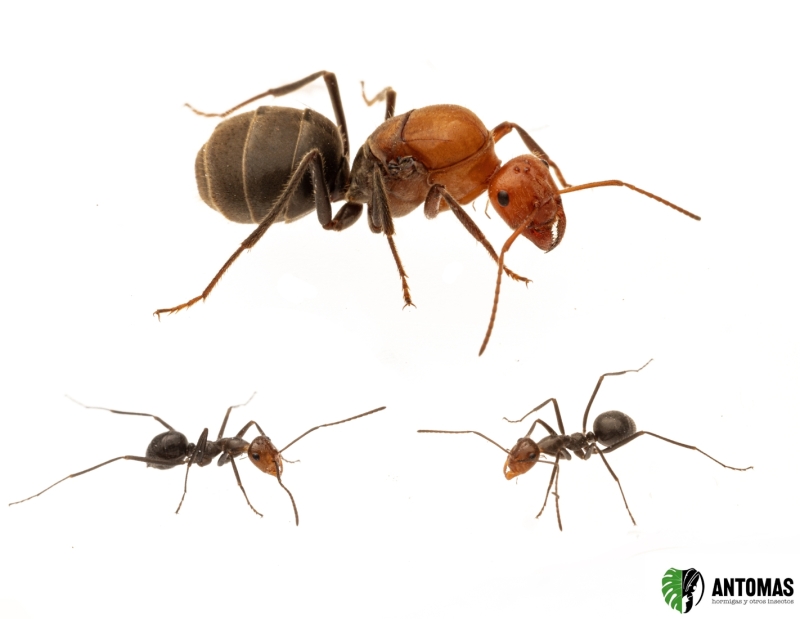
Almost a gram of reserves in a single ant. Myrmecocystus mexicanus is the original honeypot ant, the type species of its genus: a pale ant of the North American desert nights, whose workers go out to gather nectar at barely above freezing and store it in living repletes, amber, clear or milky, hanging from the ceilings of nests almost two metres deep. The Aztecs called them nequazcatl and dug for them like treasure. At home, you will watch the first replete appear and a colourful larder grow, night after night. For patient keepers: sugar by the drop at first and tiny prey. Founding queens with brood and colonies. Shipping across Europe, live arrival guaranteed.
The classic honeypot ant of North America: pale, nocturnal and with repletes of almost 1 g, living larders that hang from the ceiling of the nest. Queens with brood measuring 14–16 mm, with claustral founding and a single queen per colony. Sugar by the drop at first, so that the queen does not turn into a replete, and ad libitum as soon as the first repletes appear; tiny protein, daily if possible. Qbik Wild One P 1C to start with, hybrids to grow and NoNa Diáfano for large colonies. Normal household room temperature. Diapause of about 4 months, from November to February, at 8–14 °C. Mineral oil barrier.
Myrmecocystus mexicanus Wesmael, 1838 is the honeypot ant par excellence: the type species of the genus and one of the best-studied honeypot ants. It lives in the arid and semi-arid regions of the south-western United States and northern Mexico, and it goes out to work at night, when the ground cools down. Its great attraction is its repletes: workers that store so much nectar in their gaster that they turn into translucent spheres the size of a small grape and spend their lives hanging from the ceiling of the nest, like a living larder.
Why think of it as a giant? Not because of its workers, which are not the largest in the genus, but because of its repletes: the largest one ever weighed reached 0.98 g, almost a gram of reserves in a single ant, and a mature colony holds hundreds, even more than a thousand. In this care sheet we always separate what science has documented from the experience of other keepers and our own.
Biology
The type species: the first honeypot ant to be named
The genus was founded on this species. It was described by the Belgian entomologist Constant Wesmael in 1838, from Mexican specimens with no precise locality, and its name says almost everything: myrmex is Greek for “ant” and kystis for “bladder” or “bag”. As the original material was lost, Roy Snelling, author of the great revision of the genus, designated a new reference specimen in 1976, a neotype from Chihuahua.
In the United States it was given another name: in 1881, Henry McCook described M. hortusdeorum, the honeypot ant of the Garden of the Gods, the famous red rocks of Colorado Springs. Today it is a synonym, although it survives in the literature as “hortideorum”: that is the name used by John Conway, the researcher who excavated its nests in Colorado and whose data you will find throughout this care sheet. In the early twentieth century, Wheeler still treated as subspecies of mexicanus other pale honeypot ants that are now species in their own right, such as our M. navajo, the yellow honeypot ant, a “miniature mexicanus” in Snelling’s words.
Snelling placed it in the group of pale, large-eyed, nocturnal honeypot ants. Today those groups are regarded as historical: a molecular phylogeny published in 2021 showed that they do not match the genetic tree, that Myrmecocystus is the sister group of Lasius, the genus of our black garden ants, and that the genus diversified around 14 million years ago, while the deserts of the American South-West were taking shape.
From the Mexican highlands to the Garden of the Gods
According to Snelling, its range runs from central Mexico north to Colorado and Utah, and west to California and Baja California. Most records come from Arizona, Colorado, Utah, Nevada, New Mexico and California, with records from Texas and, in Mexico, from states such as Chihuahua, San Luis Potosí, Durango and Baja California. It lives from 69 m below sea level, by the Salton Sea in California, up to about 2,440 m in New Mexico. In Colorado, Conway found its colonies on ridges, mesas and bluffs at 1,700–2,200 m, in piñon–juniper woodland, sagebrush desert and saltbush scrub.
It prefers firm ground. There, the soil was full of stones and layers of caliche, a limestone crust as hard as cement, and a pickaxe was needed to dig out the nests. It is an ant of stable chambers that last for years without collapsing (see “A nest almost two metres deep”).
Almost a gram of reserves in one ant
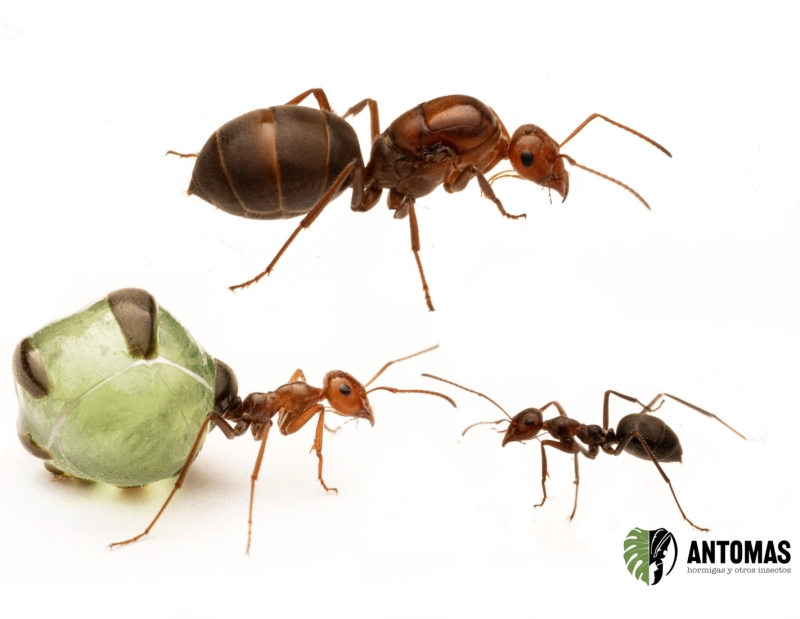
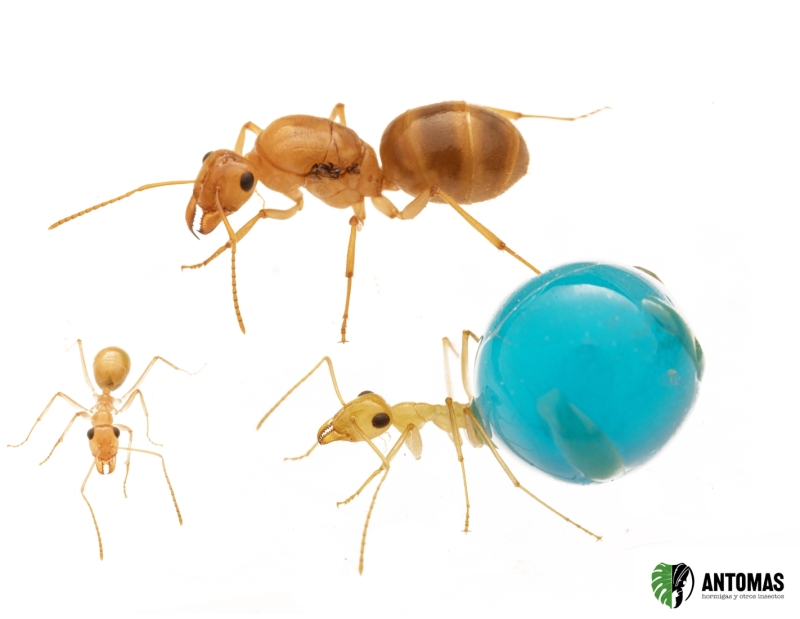
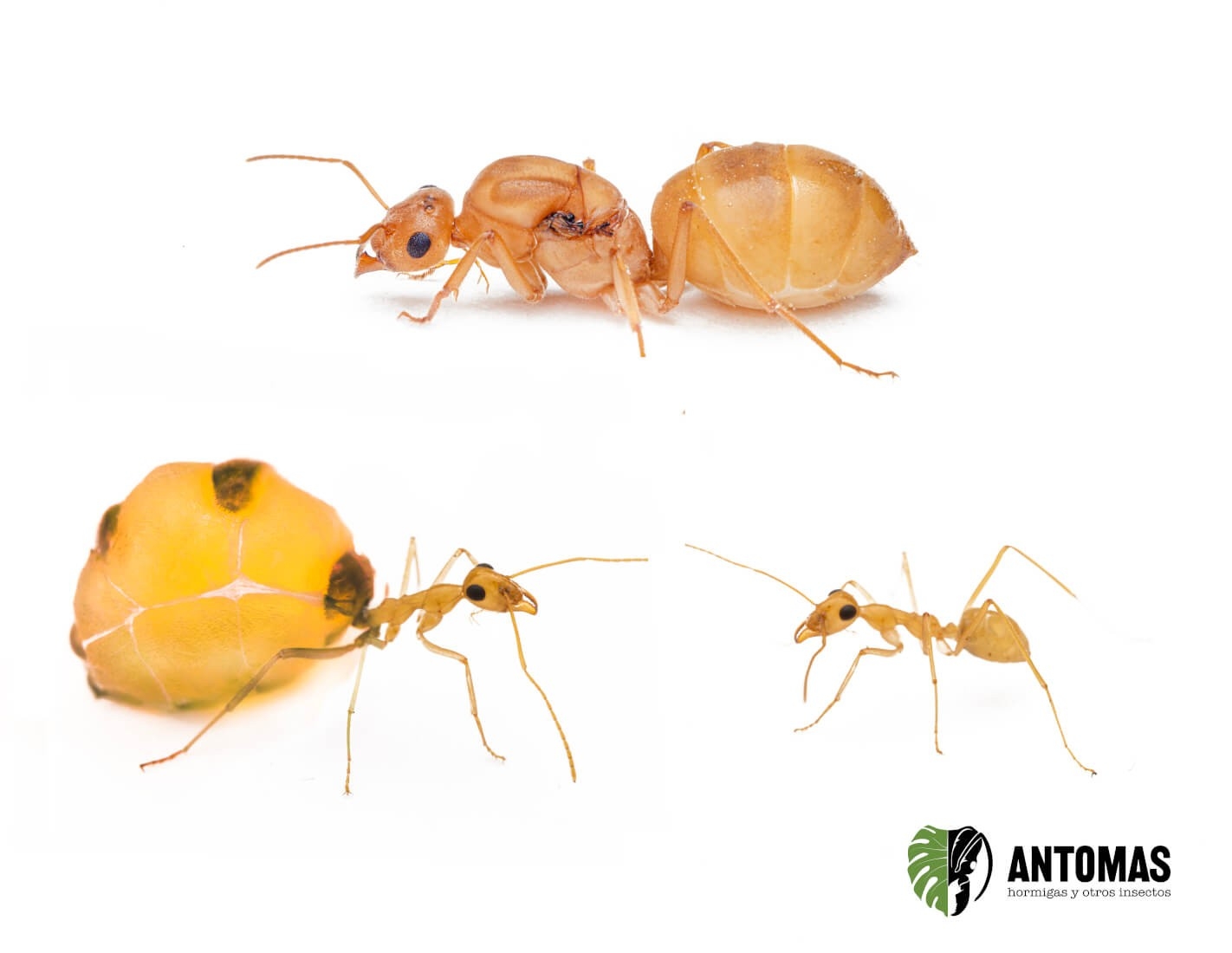
A replete is a worker whose social crop, the part of the digestive tract where ants keep the food they share, swells until it fills almost the entire gaster. The other organs are squashed, and the hard plates of the gaster, which normally overlap like roof tiles, end up separated like islands on a stretched, transparent membrane, thanks to resilin, a highly elastic protein.
In M. mexicanus the result is spectacular: the largest replete weighed by Conway reached 0.98 g, with a gaster of 12 mm. An ordinary worker weighs a few milligrams; we prefer the absolute figure to the “X times its own weight” claims that circulate online and do not appear in the primary sources. For comparison, the Australian honeypot ant Camponotus inflatus, from a lineage that invented repletes independently, reaches 1.4 g.
When nectar is plentiful, the foragers pass it to them mouth to mouth, by trophallaxis; when it is scarce, other workers stroke their antennae and the replete regurgitates a droplet. An emptied replete does not die: it becomes limp, a deplete, and can be filled again. This Anthouse video shows repletes of a diurnal cousin, M. mimicus; those of the giant are larger and more varied in colour.
Living larders: repletes of M. mimicus hanging from the ceiling of their nest, in a video by Anthouse.
Between 351 and 1,030 repletes per colony
Conway counted repletes by excavating entire nests in Colorado. In three colonies he found between 351 and 1,030 (729 on average), and in another series between 692 and 1,223, spread over 7–21 chambers per nest, with up to 348 repletes in a single chamber. Two of those colonies held about 5,000 ants, and 22–25 % of them showed some degree of distension: almost one ant in four was part of the larder.
Why so much storage? Because its food arrives in bursts. In Colorado it forages from March to November, but it gathers nectar mainly in June, July and August. What comes in during those three months has to last the rest of the year, including a whole winter with the entrance sealed. The repletes are the colony’s life insurance.
The largest, not the youngest
Repletes are not born different: they are ordinary workers that specialise. Steven Rissing showed this in 1984 with this very species: repletes are the largest workers and, if all of them are removed, the next largest quickly replace them. In this way the colony stores the greatest volume while taking the smallest number of ants away from other tasks.
They usually form within two weeks of emerging, hanging from the chamber ceilings while the foragers fill them up every night. But they need not be young: Rissing obtained repletes in colonies without any newly emerged workers. And there is a rule every keeper should know: the first generation, the nanitics the queen raises on her own, never becomes repletes. A full replete can barely walk and, if it loses its grip on the ceiling, a knock can rupture its membrane. In captivity, the most delicate thing about this species is its repletes (see “Handling and safety”).
Amber, clear and milky: the chemistry of the larder
A replete chamber of M. mexicanus is not all one colour: there are clear, yellow, amber, brown, almost black and milky repletes. Conway analysed them in 1977 and found that each colour holds something different:
Amber and dark amber. The vast majority: glucose and fructose, with an acidic taste and the smell and colour of cane molasses. In repletes from Arizona, 47–49 % fructose, 42–44 % glucose and 7–8 % maltose.
Clear. Between 0.2 and 4 %. They contain mainly sucrose, are very dilute and work as water tanks, an adaptation to the desert. Conway obtained a semi-replete full of water in a colony that he gave only water.
Milky. 12.4 % in one Arizona nest, rich in protein and fat: they probably store juices from prey.
Two-phase. About 5 %, according to Burgett and Young (1974), had their crop split into two layers, like water and oil: one of sugars and one of lipids.
The larder, then, is a store of sugar, water, fat and protein. A 2026 study, still a preprint, has also found lactic and acetic acid bacteria in the crop of its repletes that may help to preserve the contents. For keepers, the lesson is simple: water matters as much as sugar.
A nest almost two metres deep
From the outside, a M. mexicanus nest is unimpressive: a single entrance just over a centimetre wide in a gravel crater shaped like a miniature volcano, about 2 cm high, which the workers plug with fine soil in winter or during heavy rain. The astonishing part lies underneath, according to the excavations Conway published in 1983:
A shallow labyrinth of galleries and small chambers, down to about 20 cm, holding the brood, a few repletes and lodgers such as Cremastocheilus beetles.
A single vertical shaft leading down to the replete chambers.
The cellars: wide, low, vaulted chambers starting at a depth of about 20–40 cm, up to 33 cm long but only 3–5 cm high, with smoothed walls and a rough ceiling for the repletes to grip.
The depth:1 to 1.8 m, and nests up to 4 m deep have been reported in areas with long, dry summers.
Why so deep? Because down there temperature and humidity barely change, and the larder keeps for months. Snelling never found repletes above the level at which the soil stays moist all year round: their chambers are not dry, but stable. At home, what they need is not tall columns but wide, low chambers with a grippy ceiling (see “Recommended formicaria”).
Night foraging between 0.6 and 27 °C
M. mexicanus is an ant of the night: the workers pour out just after sunset. What is surprising is how much cold it tolerates. In Colorado, Conway saw it foraging from 17 March to 7 November at temperatures between 0.6 and 27 °C: desert ants working a few tenths of a degree above freezing. In New Mexico it does not come out below 2 °C or above 30 °C.
A 1978 study measured this in five honeypot ants: the diurnal, dark-coloured species became immobile at around 11–12 °C, while the nocturnal one kept walking at −0.4 °C. On the other hand, they all withstood heat in a similar way, up to 43–48 °C. In other words: it does not come out at night because it cannot stand the heat, but because it has taken the cold shift. In south-eastern Arizona it shares that shift with M. navajo, while M. mimicus and M. depilis divide the day between them.
It travels up to 20 m from the nest. Early in the summer it searches in a scattered way; once it knows which plants yield nectar, it follows fixed trails that it repeats night after night. And to live at night it has night eyes: a 2022 study showed that pale, nocturnal species have evolved larger eyes and larger facets than their dark, diurnal relatives. In M. mexicanus, each facet measures about 20.8 µm, compared with about 14.8 µm in the diurnal M. mendax, and small workers lack the anterior ocellus, one of the three simple eyes many ants carry on top of the head.
Yucca nectar, oak galls and dead harvester ants
Its diet is based on sugary liquids. In Colorado, Conway saw it collecting the nectar that oozes from the fruit capsules of Yucca glauca, the honeydew of the aphids living on them and the sweet droplets from the galls that the wasp Holcaspis perniciosus induces on Gambel oak (Quercus gambelii). Snelling adds floral and extrafloral nectar and the juice of prickly pear fruits.
It obtains protein mainly as a scavenger: it collects dead arthropods and only attacks small, soft-bodied insects, which it holds in its mandibles while it bends its gaster to spray formic acid into the wound. And it has a favourite neighbour: in Colorado, its nests are often found less than 3 m from colonies of the harvester ant Pogonomyrmex occidentalis and, according to the study that described this in 2001, its protein comes almost entirely from dead or dying workers of that harvester. The harvesters work by day; the honeypot ants pick up at night whatever is left on the path. For keepers, the message is clear: its natural protein comes in small, soft morsels.
Nequazcatl: the Aztec sweet
Repletes were a delicacy for the indigenous peoples of the south-western United States and Mexico. The Aztecs called them nequazcatl, a Nahuatl word that combines honey (necutli) and ant (azcatl). They dug them up, held the replete by the head and bit off its gaster. In Mexico they were also pressed so that their “honey” could be used in food, as a remedy and even fermented into an alcoholic drink.
A clarification, because it is often repeated: the nutritional analysis of the honeypot ants eaten in the Mezquital Valley (Hidalgo), with 9.45 % protein, refers to another species, M. melliger. And the same idea arose in Australia, where Aboriginal peoples dig up the nests of Camponotus inflatus: two lineages of ants that invented repletes separately, and two cultures that discovered the same treat.
Badgers, coyotes and an ant that throws stones
A colony with hundreds of bags of reserves has enemies that know it. The American badger digs up its nests more often than those of the diurnal honeypot ant M. depilis, according to a 1979 study, and Snelling also mentions coyotes. Inside the nest, Cremastocheilus beetles eat larvae. And the ant Dorymyrmex bicolor has a unique technique: when its nest is less than 1.5 m away, its workers drop small stones into the honeypot ant’s entrance, up to 200 stones in 5 minutes, cutting its foraging to one eighth. The honeypot ant responds with a deep nest, an entrance that can be sealed and a nocturnal schedule that spares it many of its competitors.
One queen, one flight and a colony for decades
In Colorado Springs, nuptial flights take place in late July or early August, after heavy rain, at dusk. More than a hundred males came out of a single nest, and 209 winged queens were dug out of another. Founding is claustral: the queen sheds her wings, digs and, about two days later, seals herself in and lives on her fat reserves and wing muscles, sometimes eating a few of her eggs. In Conway’s laboratory, the first workers emerged 53–87 days after the flight: 5 to 19 nanitics per queen, and none of them became a replete.
In the wild, the queen spends her first winter sealed in with that first brood. It is a fragile stage, and many queens do not survive it. But a colony that gets through its first years lasts a long time: in south-eastern Arizona, colonies lived 8.9 years on average, and the longest-lived one, 23. They have a single queen: unlike M. mendax, no M. mexicanus colonies with several queens are known.
Size and morphology
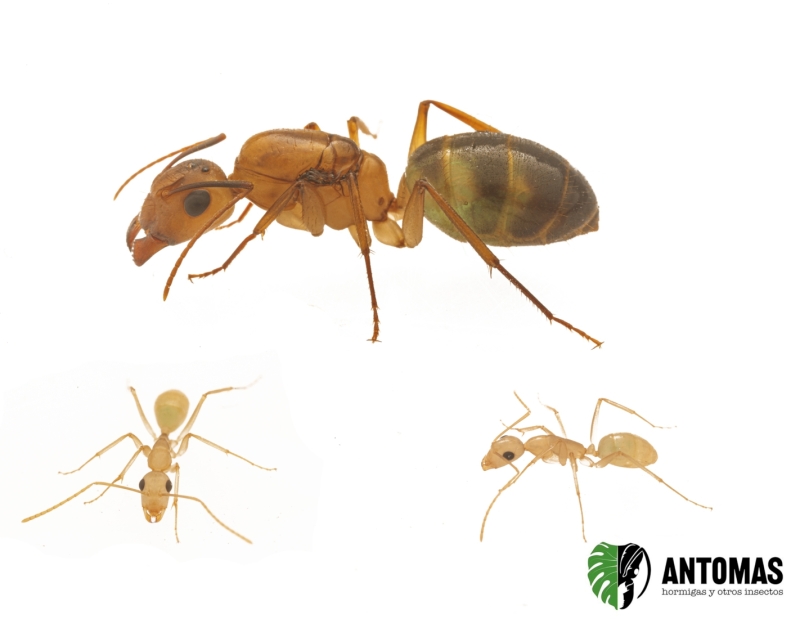
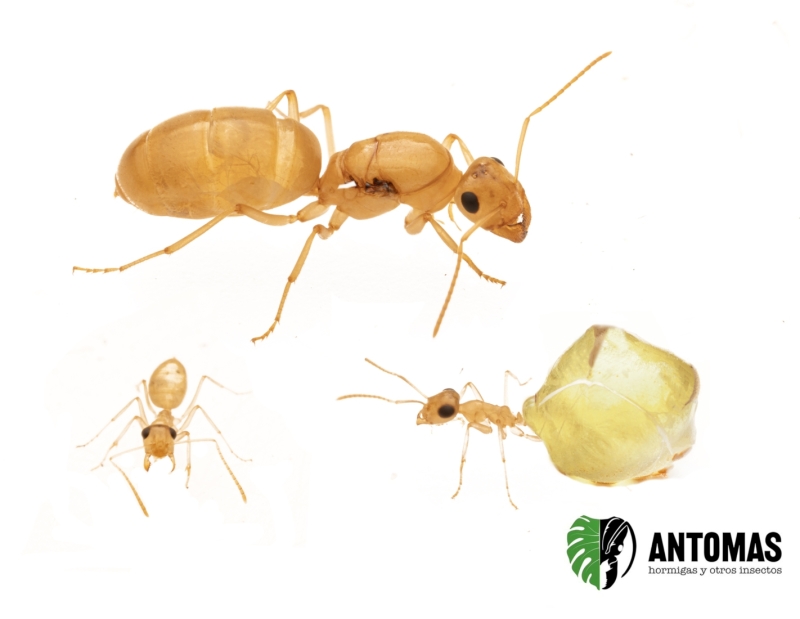
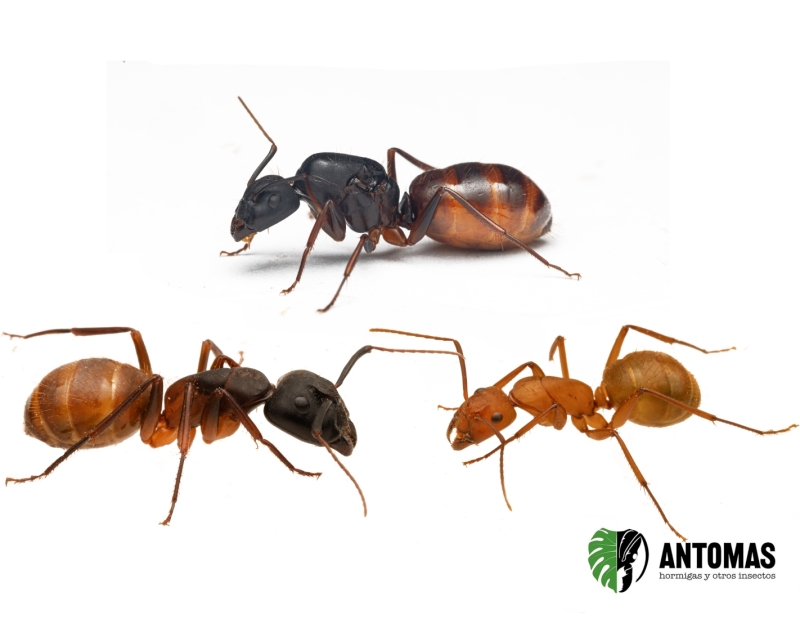
A slender, long-legged, pale ant, with workers of very different sizes but no soldier caste: size varies gradually, from the nanitics to the large workers that end up as repletes.
Colouration according to science. A pale species: light yellow workers, or yellow with a brownish tinge in the south of its range. According to Cole (1936), the thorax and legs are light cinnamon, the head somewhat darker and the mandibles black.
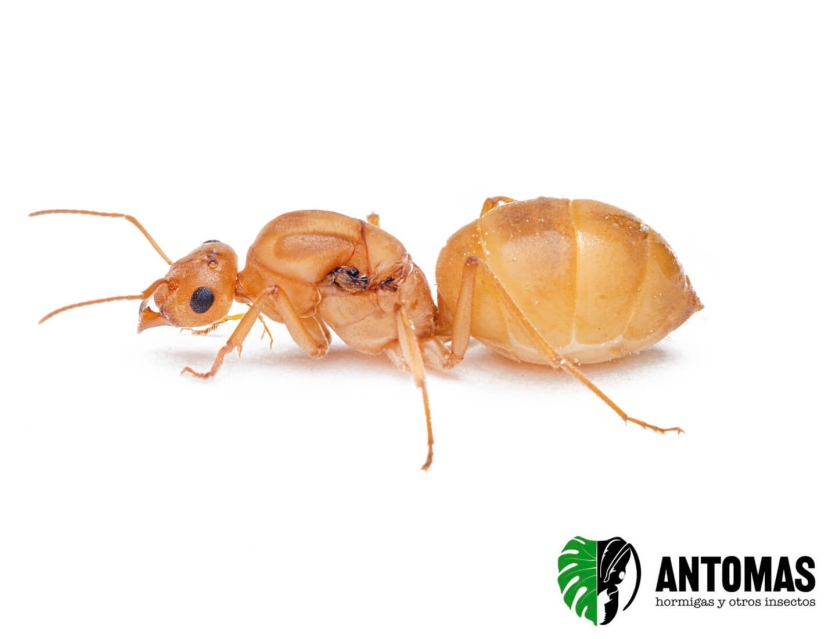
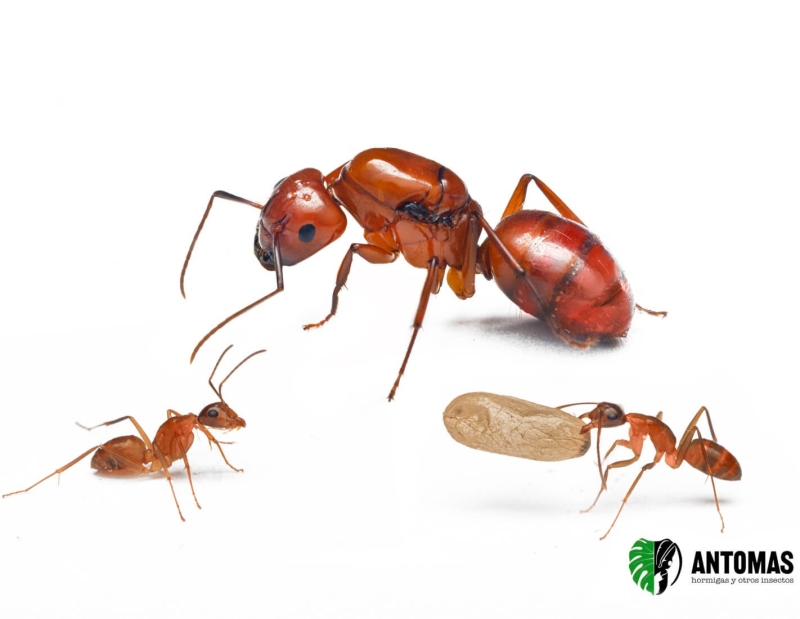
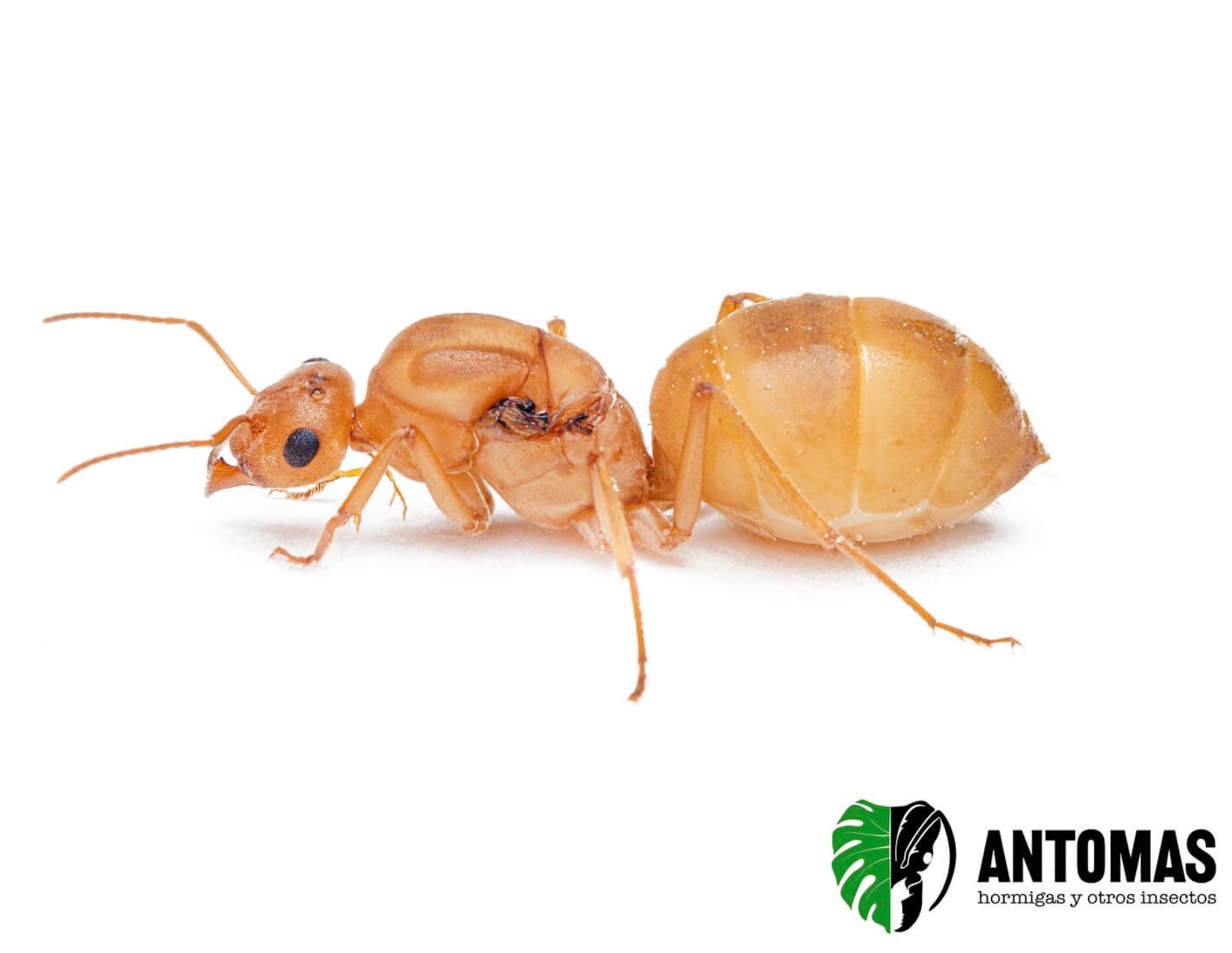
Colouration of our queens. The whole queen is orange amber or honey-coloured, with a lighter, yellowish gaster and black eyes.
Eyes. Large, with wide facets, typical of a nocturnal species; small workers lack the anterior ocellus.
Pilosity. Dense pubescence, made of short, flattened hairs, on the head, pronotum and gaster.
Queen. Antomas queens measure 14–16 mm. Bulkier mesosoma, with wing scars. In Antomas’s experience, if she receives too much sugar during founding, she can swell up like a replete (see “The sweet death: when the queen turns into a replete”).
Repletes. Head and thorax of a large worker and a gaster turned into a translucent sphere, from clear to dark amber.
Defence. Like all formicines, it has no sting: it bites and ejects formic acid through the acidopore, at the tip of the gaster.
Approximate measurements
Workers: 3–7 mm (Cole, 1936)
Queen: 14–16 mm (Antomas queens)
Male: about 6 mm (Cole, 1936)
Repletes: full gaster 6–12 mm; the largest measured, 12 mm and 0.98 g (Conway)
Worker eye facets: about 20.8 µm in mean diameter (Johnson and Rutowski, 2022)
The queen measurement is that of our own queens. Those of the workers and male come from Cole’s (1936) description, which we have only been able to consult through secondary sources; Snelling’s 1976 revision, the reference for the measurements of each species, was not accessible for this care sheet, so treat them as approximate. What has been measured precisely is the most striking feature of the species: its repletes.
Care in captivity
Difficulty: 4/5 – Advanced
At Antomas we class it as advanced, not because it is demanding about climate, but because you need to understand how a honeypot ant works:
Slow, fragile founding. The queen takes two or three months to produce a few nanitics, and keepers agree that some colonies are lost at that stage or shortly afterwards, with no clear cause. One of them sums it up: it is a numbers game.
Sugar must be rationed by the drop at first (see “The sweet death: when the queen turns into a replete”).
Patience: repletes do not appear until the second or third generation of workers.
Fragile repletes: a fall or a careless move can burst them.
Why not 5/5? Because, once you understand all this, it is rewarding: we keep it at more or less room temperature, it eats simple food, it is not an escape artist and it is calm. And it is well worth it: watching the first replete appear, hanging from the ceiling like an amber lantern, and seeing it grow night after night is one of the great moments of the hobby.
Recommended parameters
Temperature: at Antomas, practically normal household room temperature. For reference, keepers who succeed with the genus work at 24–31 °C, ideally around 29 °C, with one side of the nest slightly warmer. If your home is cool, a heating cable with a thermostat on one side helps, always away from the repletes, which tolerate heat poorly.
Humidity: a rather dry nest, with a moist spot near the brood and stable replete chambers (see “Humidity: stable, never soaked”).
Foraging area: dry and well ventilated.
Water: always, in a test tube with water and cotton wool in the foraging area.
Light: a dark area in the nest and the foraging area under normal room light.
Diapause: about 4 months, from November to February, at 8–14 °C (see “Diapause: four months in the cold”).
Humidity: stable, never soaked
Although it comes from arid areas, it should not be kept completely dry. Its repletes live in chambers of almost constant humidity: what they need is stability, not dryness. At home, that means a moist spot near the brood, so that eggs and larvae do not dry out, the rest of the nest drier, and replete chambers that are stable, ventilated and free of condensation, neither soaked nor parched. Never wet a chamber with repletes directly: droplets and slippery walls make them lose their grip and fall. And less is more: a keeper in Arizona, with 15 % ambient humidity, hydrated the nest once a week. Excess humidity brings mould and fungi.
Recommended formicaria
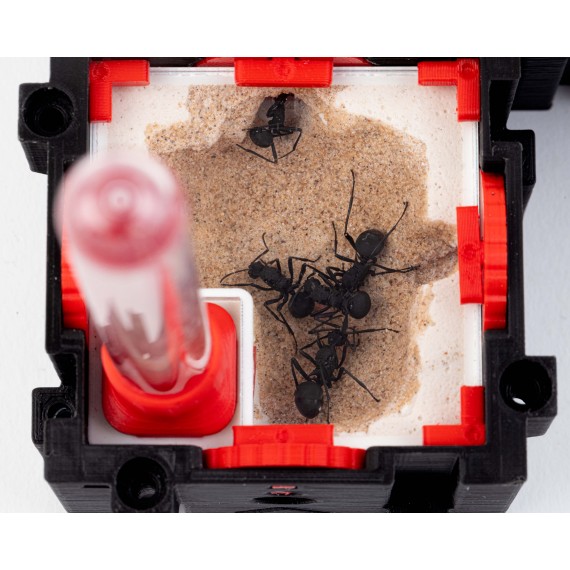
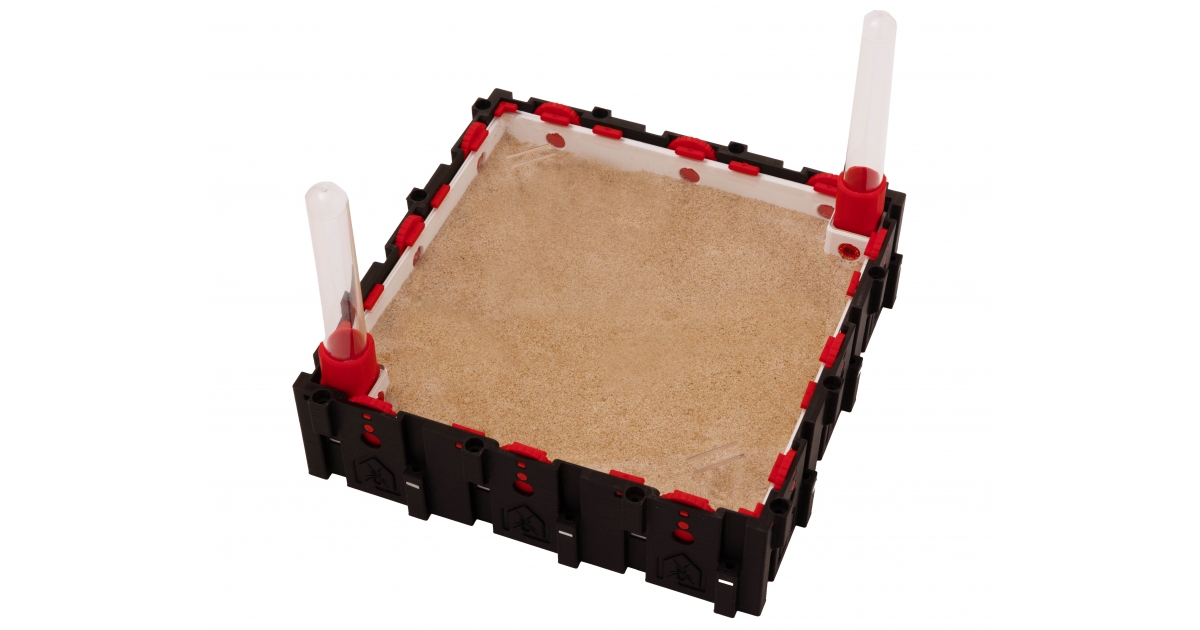
For founding queens and small colonies we do not recommend narrow vertical formicaria: they look ideal for viewing repletes, but they make it harder for the colony to organise itself at first and force the ants to move across surfaces that are too steep. To start with, at Antomas we recommend the Qbik Wild One P 1C by Anthouse, a small module designed for queens and small growing colonies:
Its chambers are tall enough for the first repletes to hang from the ceiling and walls, with a horizontal floor area in proportion to the queen, the brood and the workers.
We also recommend the hybrids. As the colony grows, the Qbik Wild Duo P 2C Híbrido is a good next step. “Hybrid” means that it combines two hydration systems: a lower reservoir, separate from the galleries, that moistens by evaporation, and a side tube where the ants drink. For a honeypot ant this is a great advantage: stable humidity without ever wetting the replete chambers.
As it has no interior chambers, it lets the colony organise and dig its own space: allowing for the difference in depth, it reproduces the logic of its natural nests, a large mass of substrate in which to open wide chambers with rough ceilings for the repletes to hang from. Use a compact, stable substrate, moisten it from specific points without saturating the block, and keep it for large colonies: in a small one it would make it harder to observe the ants, control the food and find the queen.
A laboratory trick: Bert Hölldobler raised honeypot ant colonies with hundreds of repletes for years in test tubes lying on their side, with small wooden sticks glued to the ceiling so the repletes could hang from them. The principle applies to any nest: a ceiling with grip and enough height. Complete the set-up with a dry foraging area, a water tube, a feeder and the mineral oil barrier.
Founding: a queen with brood and nectar by the drop
At Antomas we sell queens with brood: queens that have already started their colony in a test tube, with eggs, larvae or pupae; when available, also queens with 5 or 10 workers. Founding is claustral: the queen raises her first workers on her own reserves. What she needs is peace and quiet:
The tube as it arrives, with its water reservoir behind the cotton wool, in a dark, quiet, vibration-free place, at room temperature.
A quick look once a week to check that there is water left. If it runs out or the tube gets very dirty, move her to a new tube by tipping her in.
Nectar by the drop: now and then, a micro-drop of sugary liquid on a small piece of aluminium foil, never on the cotton wool, removing any leftovers the next day. The aim is to feed the queen and the larvae, not to fill anyone up.
Tiny protein from the first workers onwards, daily if possible (see “Feeding”).
Patience: in this species, the first workers take 53–87 days from the nuptial flight, and those nanitics will never become repletes.
Once the first workers are out, we move her by tipping into a Qbik Wild One P 1C, and we keep to the dropper while there are no repletes: micro-drops, waiting for them to finish before adding more. The first repletes usually arrive with the second or third generation, when the colony has a few dozen workers and large workers start to emerge.
The sweet death: when the queen turns into a replete
It is the most treacherous mistake with honeypot ants, and we know it from our own breeding experience, not from the literature. If a founding queen or a very small colony receives more sugar than it uses, that sugar has to go somewhere. Nanitics cannot become repletes, so the one that ends up acting as the larder is the queen herself: she fills up, her gaster swells like a replete’s and she lays fewer eggs or stops altogether. The colony stalls and, if this goes on, it can be lost. This Anthouse video shows queens that turned into repletes during founding:
Honeypot ant queens swollen with nectar during founding: the risk the dropper prevents (Anthouse).
If you see your queen with a very swollen gaster, give her no more nectar until it shrinks and she resumes laying; in the meantime, water and tiny protein. Once the first repletes are born, everything changes: the colony now has its own larder, and sugary liquids become available ad libitum.
Arrival and moving
When your queen arrives, let her rest in a quiet, dark place, check that the tube has water and do not change her tube or move her into the nest straight away. When it is time to move her, at Antomas we do it by tipping: we open the tube inside the foraging area, next to the nest entrance, and gently tip out the queen, workers and brood, helping any stragglers with a soft brush. Prepare the formicarium beforehand, with the barrier and water in place, work over a tray and keep the nest area dark so that they move in straight away.
Once there are repletes, it is best to avoid unnecessary moves, which is why it pays to choose the nest well from the start. If the colony has to be moved, do it by tipping as well, but move the repletes separately, one at a time, with a soft brush and without ever squeezing the gaster, to the entrance of the new nest.
Feeding
Sugar: by the drop at first and unlimited later. While there are no repletes, micro-drops. As soon as the first ones are born, sugary liquids become available ad libitum, and from then on they must never run out: with too little sugar, repletes do not form. Vary the sugars: at Antomas we recommend Anthouse’s Blue Sugar nectar 4–5 times a week and another sugary liquid 1–2 times a week, such as sugar water, very dilute honey or another nectar, plus a small piece of ripe fruit now and then. You can also add a little protein to the nectar. Always in a feeder, never on cotton wool, which goes mouldy and spoils the liquid very quickly: a traditional or home-made feeder, where the drop stays spread out and accessible, renewed before it ferments.
Protein: extremely small at first. It is a scavenger of soft morsels, and young colonies show it. At first, at Antomas we give them Drosophila, small firebrats (Thermobia), termites and micro-crickets, daily if possible, cut up or freshly killed. As the colony grows, it accepts larger prey, such as flies, crickets, small cockroaches or chopped mealworms, and you can give more, but less often, not every day. Change the type of insect from one week to the next and buy your insects from a reliable supplier: insects treated with insecticides can kill the colony.
Although nectar steals the show, without protein there are no new workers: a colony full of reserves but short of protein keeps its adults alive and barely grows. If you carry out daily maintenance and remove leftovers, overfeeding is better, because the colony understands that it has more resources and grows faster; if you cannot clean often, it is better not to, because leftovers ferment. This is how the larvae of a honeypot ant eat:
Honeypot ant larvae feeding: a colony of M. placodops at Antomas (Antomas channel).
Water, always and separately: nectar does not replace it, especially in a species that stores water in clear repletes. And a night-time tip: put the food in at dusk, when they start coming out, and remove leftovers in the morning.
Diapause: four months in the cold
In Colorado, M. mexicanus stops foraging in early November, seals its entrance and does not come out again until March: it spends the winter using up its repletes. At Antomas we give it a diapause slightly shorter than that of our native ants: about 4 months, from November to February.
At what temperature? We recommend 8–14 °C, and this is where its nocturnal nature shows. Pale, nocturnal species like this one keep moving close to 0 °C and tolerate a cooler diapause; dark, diurnal species such as M. mimicus or M. placodops become immobile at around 11–12 °C and need a milder rest. For a young colony without repletes, such as a queen with brood in her first winter, stay at the top of the range, 12–14 °C: it does not yet have a larder to fall back on.
Lower and raise the temperature gradually, over one or two weeks.
Water always; a little sugar only if you see active workers, without constantly topping up the repletes.
Little or no protein, as there are hardly any larvae; go back to it as soon as you see activity at the end.
Behaviour in captivity
Young colonies are discreet and keep few workers outside. Activity increases at dusk and when the room light dims, and when the workers find a stable food source, they mark regular routes to it, just like their trails in Colorado. The first replete changes the colony: first you will see a large worker with a slightly swollen gaster and, within a few weeks, it will hang from the ceiling like a drop of amber.
Observe without fear. At Antomas we believe ants are there to be enjoyed, observed and learned from, not kept hidden away. All they need is a dark area in the nest and a lit foraging area, and to be observed gently, with as little intervention as possible. They get used to your presence. Warning signs: a swollen queen that is not laying (too much sugar), stalled brood (not enough protein), fallen repletes (condensation or knocks) and mould (too much humidity or leftovers).
Escapes and barriers
It is not much of an escape artist: in our experience, mineral oil is enough. A thin, continuous band on the upper part of the foraging area walls, a well-fitting lid, connections without gaps and nothing that could act as a bridge to the barrier.
Handling and safety
It has no sting. It may bite and release formic acid if it feels trapped, but that is nothing to worry about. The real risk is the fragility of the repletes: plan every intervention and carry it out with tubes, containers and entomological tools, never with your hands. Do not combine different queens or colonies: among honeypot ants, strong colonies raid weak ones. It is an exotic species: it must never be released.
What not to do
Leave a full feeder with a founding queen or a colony without repletes.
Keep giving nectar to a queen with a swollen gaster.
Let sugar run out once there are repletes.
Offer large prey at first.
Put sugar on cotton wool or leave leftovers to ferment.
Wet the replete chambers or place direct heat next to them.
House a small colony in a narrow vertical nest or one that is too large.
Move a colony with repletes unnecessarily.
Combine different queens or colonies.
Scientific sources
This care sheet is based on the scientific literature on Myrmecocystus mexicanus and its genus, and on the experience of Antomas and other keepers. Main references:
Conway, J. R. (1977). Analysis of clear and dark amber repletes of the honey ant, Myrmecocystus mexicanus hortideorum. Annals of the Entomological Society of America 70: 367–369. doi:10.1093/aesa/70.3.367
Conway, J. R. (1983). Nest architecture and population of the honey ant, Myrmecocystus mexicanus Wesmael (Formicidae), in Colorado. The Southwestern Naturalist 28: 21–31. doi:10.2307/3670588
Conway, J. R. (1986). The biology of honey ants. The American Biology Teacher 48: 335–343. doi:10.2307/4448321
Conway, J. R. (1994). Honey ants. American Entomologist 40: 229–234. doi:10.1093/ae/40.4.229
Burgett, D. M. & Young, R. G. (1974). Lipid storage by honey ant repletes. Annals of the Entomological Society of America 67: 743–744. doi:10.1093/aesa/67.5.743
Cole, B. J., Haight, K. & Wiernasz, D. C. (2001). Distribution of Myrmecocystus mexicanus (Hymenoptera: Formicidae): association with Pogonomyrmex occidentalis (Hymenoptera: Formicidae). Annals of the Entomological Society of America 94: 59–63. doi:10.1603/0013-8746(2001)094[0059:DOMMHF]2.0.CO;2
Kay, C. A. R. & Whitford, W. G. (1978). Critical thermal limits of desert honey ants: possible ecological implications. Physiological Zoology 51: 206–213. doi:10.1086/physzool.51.2.30157867
Chew, R. M. (1979). Mammalian predation on honey ants, Myrmecocystus (Formicidae). The Southwestern Naturalist 24: 677–682. doi:10.2307/3670526
Möglich, M. H. J. & Alpert, G. D. (1979). Stone dropping by Conomyrma bicolor (Hymenoptera: Formicidae): a new technique of interference competition. Behavioral Ecology and Sociobiology 6: 105–113. doi:10.1007/BF00292556
Johnson, R. A. & Rutowski, R. L. (2022). Color, activity period, and eye structure in four lineages of ants: pale, nocturnal species have evolved larger eyes and larger facets than their dark, diurnal congeners. PLoS ONE 17: e0257779. doi:10.1371/journal.pone.0257779
van Elst, T., Eriksson, T. H., Gadau, J., Johnson, R. A., Rabeling, C., Taylor, J. E. & Borowiec, M. L. (2021). Comprehensive phylogeny of Myrmecocystus honey ants highlights cryptic diversity and infers evolution during aridification of the American Southwest. Molecular Phylogenetics and Evolution 155: 107036. doi:10.1016/j.ympev.2020.107036
Dificultad
Experienced
1 Reviews
Bardzo szybka wysylka, były u mnie w 24 godziny od zlozenia zamowienia. Za pierwszym razem krolowa przyjechala zywa, lecz po 3 dniach umarla. Sprzedawca od razu wyslal druga sztuke, i sam pokryl koszt wysylki, nie było zadnych trudnosci. Teraz mam juz dwie robotnice i ciagle się rozwijaja. bardzo polecam.