Difficulty: 2/5 – Beginner
The seed harvester of the eastern Mediterranean: described from Jerusalem, blackish brown and armed with reddish, toothed mandibles. Colonies with a queen. A QBIK ONE with medium galleries, a humid area and a dry granary, varied seeds, plenty of protein and a diapause from November to March or April below about 20 °C.
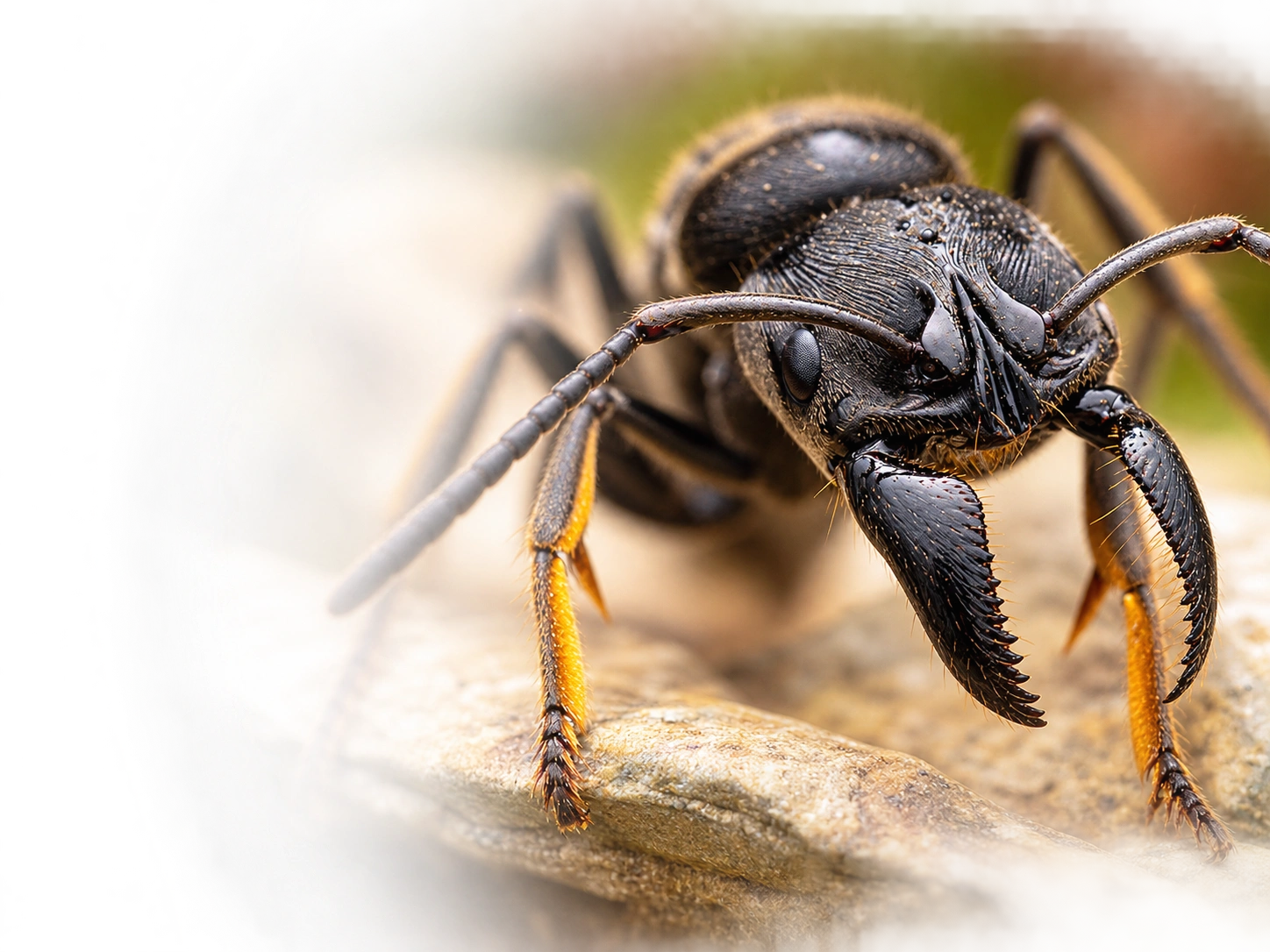
Messor dentatus Santschi, 1927 is a seed-harvesting ant from Anatolia and the Near East. Current literature records it from Turkey, Syria, Lebanon, Israel, Jordan and Iran: a belt of dry hills, steppes and rain-fed fields running from the Levantine coast to the Iranian plateaux. It was described from specimens collected in Jerusalem, and its name, “toothed”, suits it perfectly: look it in the face and you will see broad, reddish mandibles with a sharply marked row of teeth.
It is also one of the least studied Messor you can keep. There are no published measurements of its castes, no nest censuses and not a single study of its foraging: science knows it from a handful of museum specimens and from its place in the family tree of the genus. That is why this care sheet keeps apart what is known about the species, what is known about its group and the genus Messor, and what we have learnt at Antomas by keeping it.
At home, though, it behaves just like its western relatives: it fills its granary, raises big-headed majors and responds strongly to generous feeding. If you already know Messor barbarus, you will feel on familiar ground.
Biology
Born in Jerusalem: from humble variety to species
It all begins with some ants collected in Jerusalem by the naturalist E. Schmitz. Auguste Forel used the name in 1910, but at a rank below subspecies that zoological nomenclature does not recognise; it was made official in 1927 by the Swiss physician Félix Santschi, who described the worker, the queen and the male as Messor semirufus var. dentatus. This is the same Santschi who, years earlier and working from Tunisia, had discovered with M. barbarus that ants steer by the sun.
In 1974 the Italian Cesare Baroni Urbani demoted it to a synonym of M. semirufus; in 1981 G. and H. Tohmé restored it to species rank, and so it remains today. Curiously, the most recent revision no longer places it beside semirufus, but in a different species complex: that of M. wasmanni.
One of the big ones in the family: the wasmanni complex
The genus Messor contains 168 living species and subspecies. Santschi gathered many of the Mediterranean ones into the instabilis group, which has 19 species in the eastern Mediterranean alone, and in 2023 a Polish, Bulgarian and Greek team split those eastern species into two complexes:
- The semirufus complex: small to medium-sized species, with the head of the largest workers less than 2.7 mm wide, small eyes and a black or black-and-red body.
- The wasmanni complex: larger species, with the head of the largest workers more than 2.8 mm wide, nearly always bicoloured and with at least one of these traits: a more sculptured head, no psammophore (the “basket” of hairs under the head used for carrying sand), denticles on the propodeum or many erect hairs on the first segment of the gaster.
The complex of the big ones includes M. caducus, M. concolor, M. dentatus, M. hebraeus, M. mediosanguineus, M. meridionalis, M. sultanus and M. wasmanni, which gives the group its name and lives in the Balkans and western Turkey. The authors give these traits for the complex as a whole; no one has yet checked them one by one in M. dentatus, although the erect hairs and sculptured head of our ants fit them well.
The complex also holds a genetic surprise. In Italy, a European team found nests with workers of several Messor species and workers that looked intermediate, and showed with genetic markers and morphometrics that M. minor and an M. cf. wasmanni exchange genes in both directions. The hybrids seem to be fertile, which is unexpected in species that are not even sisters, and there are signs of crosses between hybrids, something very rare in ants. M. capitatus shared mixed colonies with them without interbreeding. And the two-lineage system of M. barbarus, with hybrid workers and non-hybrid queens, has arisen at least three separate times in the genus. The genetics of M. dentatus have not been studied: with relatives like these, it is an open question.
Why “toothed”? Teeth at the front and at the back
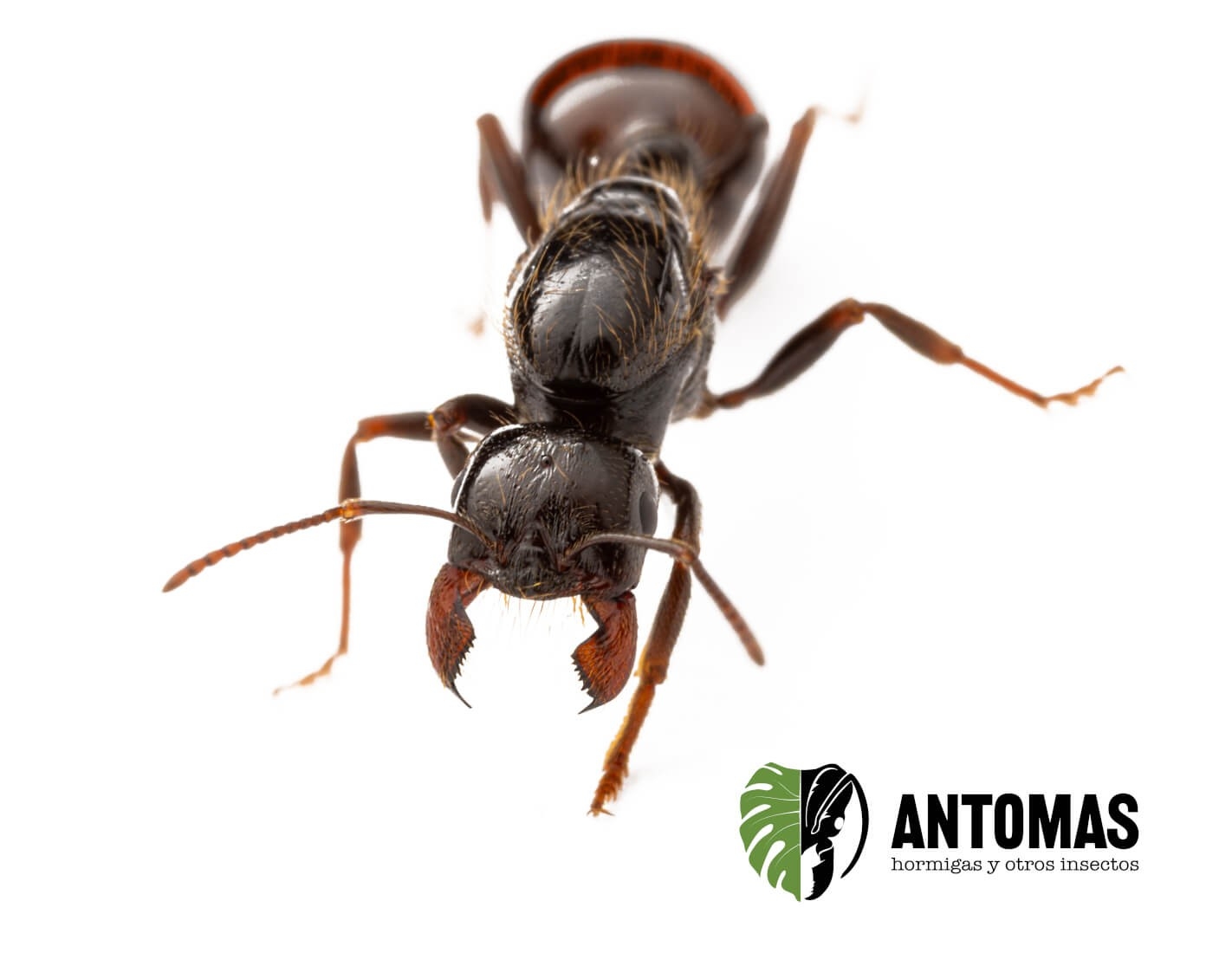
Dentatus means “toothed” in Latin. We have not been able to consult Santschi’s description, so two readings are possible. A taxonomist would think of the propodeal denticles, two small points at the rear of the thorax that are used to separate species in this group: in Jordan, for instance, some Messor resembling semirufus differed from it by having them clearly developed.
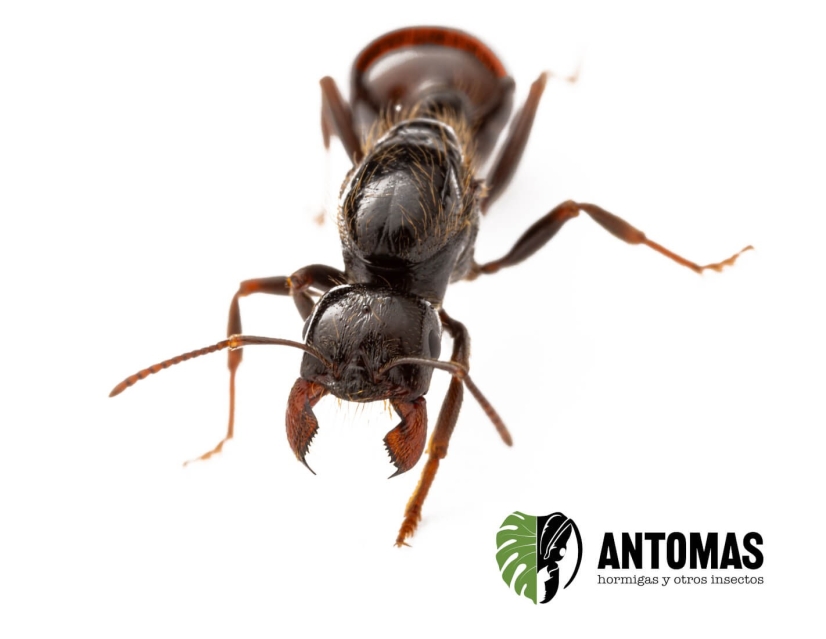
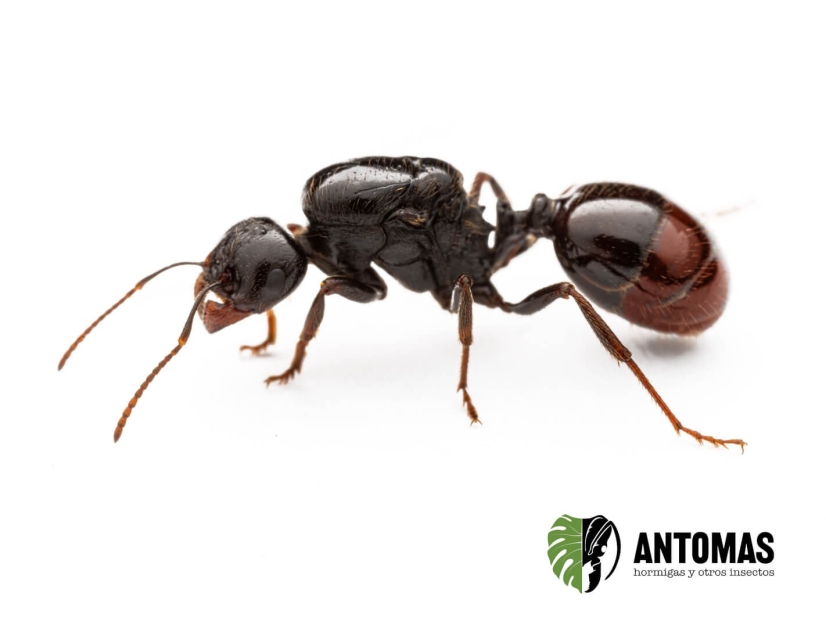
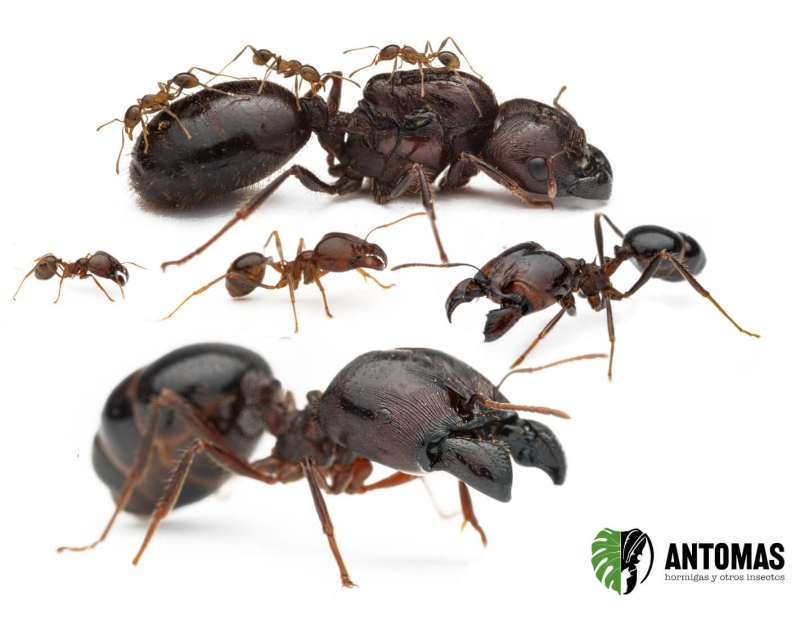
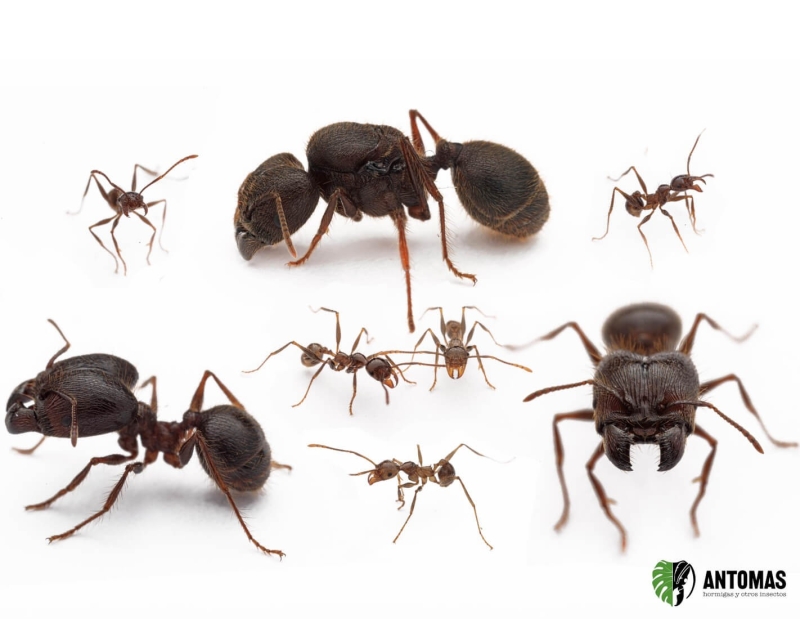
The other reading leaps out of the photo of our queen: the mandibles, large, reddish and with a sharply marked row of teeth, which earned it its name in our Spanish shop, Hormiga Recolectora Dentada. In every Messor they are a granivore’s tool: the toothed edge grips the seed, cracks the husk and peels the grain. In Antomas’ experience, once a colony has its first majors, their heads packed with muscle, hard seeds stop being a problem.
“Go to the ant, thou sluggard”: Solomon’s harvester
Few ants live in a land with so much written history about them. The Book of Proverbs holds the ant up as an example: “Go to the ant, thou sluggard; consider her ways, and be wise”, because, with no guide, overseer or ruler, she provides her food in summer and gathers it at harvest time (Proverbs 6:6–8).
Centuries later, the Mishnah, the great compilation of Jewish law completed around the year 200, laid down rules for the ant nests of cereal fields: if the nest is in the middle of standing grain, the grain belongs to the owner of the field; if it turns up behind the reapers, the grain at the top goes to the poor and the grain below to the owner. Rabbi Meir wanted all of it to go to the poor. That a law was needed says a great deal about how much grain those harvesters gathered.
In Europe, by contrast, Solomon was doubted for a long time: the ants of central and northern Europe do not store seeds, and several eminent entomologists thought the ancients had mistaken pupal cocoons for grain. Moggridge proved them wrong in 1873, as we tell in the M. barbarus care sheet. Which species inspired Proverbs? There is no way of knowing. Some Bible dictionaries point to M. semirufus, and M. dentatus, described from Jerusalem, began life precisely as a variety of it.
Harvesting in the cradle of wheat
The countries where M. dentatus lives cover much of the Fertile Crescent, the arc running from the Levant to south-eastern Anatolia and the Zagros Mountains in Iran: the land where farming was born, some 10,500 years ago. At a site in the Zagros foothills, inhabited for about 2,000 years, archaeologists have documented the shift from gathering to cultivating the wild ancestors of wheat, barley and pulses.
One detail links the two stories. The ears of wild cereals shatter on their own when ripe and drop their grain. Without meaning to, early farmers selected ears that do not break apart, but those domestic forms were slow to take over: they appear about 9,500 years ago, and 7,500 years ago shattering ears were still common in the fields. What the farmer lost, a harvester ant collects. No one has studied which seeds M. dentatus gathers, but grass seeds are among the favourites of the genus, and in Iran it has been found in the soil of rain-fed fields.
Seed harvesting is a trade ants have invented several times: in the Americas it is practised by Pogonomyrmex, such as P. badius; in the Old World, above all by Messor.
Better known in formicaria than in books
Jordan shows how little it has been studied. In 2020, a review of all the country’s ants, with 58 species and 26 forms without a definitive name, could cite only one specimen of M. dentatus: a worker collected in Amman in 1990 by the myrmecologist Donat Agosti and kept at the California Academy of Sciences. Its entire presence in the country rests on that single ant.
In Turkey it appears in the first annotated checklist of the country’s ants, from 2012, the same list that removed M. barbarus from the Turkish fauna; in the rest of its range, in regional catalogues. There is not a single published fact about its nests, colony size, flights or number of queens: what little is known of its daily life has been learnt by keepers.
Specialists speak of taxonomic chaos among the Messor of the Near East: in Jordan, several were left with a “cf.” before their name, and the 2023 revision considers Messor one of the hardest ant genera to classify. In 2018, M. structor turned out to be five species, one of which is M. ibericus, the one found in the Iberian Peninsula. That is why everything here comes with “according to current literature”.
A real winter: flights and diapause
On the Levantine coast winters are mild, but in the inland hills it sometimes snows, and on the Anatolian plateau and the Iranian highlands the climate is continental: hot, dry summers and winters with frost and snow, often colder than in inland Spain. Grasses set seed in spring, the dry summer leaves the land without new seeds and winter forces a stop: the granary is the colony’s insurance for the lean months.
There are no published data on its flights. In Antomas’ experience, M. dentatus flies in autumn, at the same time of year as M. barbarus and then enters diapause until March or April. In the genus, colony founding is usually claustral: the newly mated queen seals herself in and raises her first workers alone on her body reserves. The colonies we sell are already past that stage.
Size and morphology
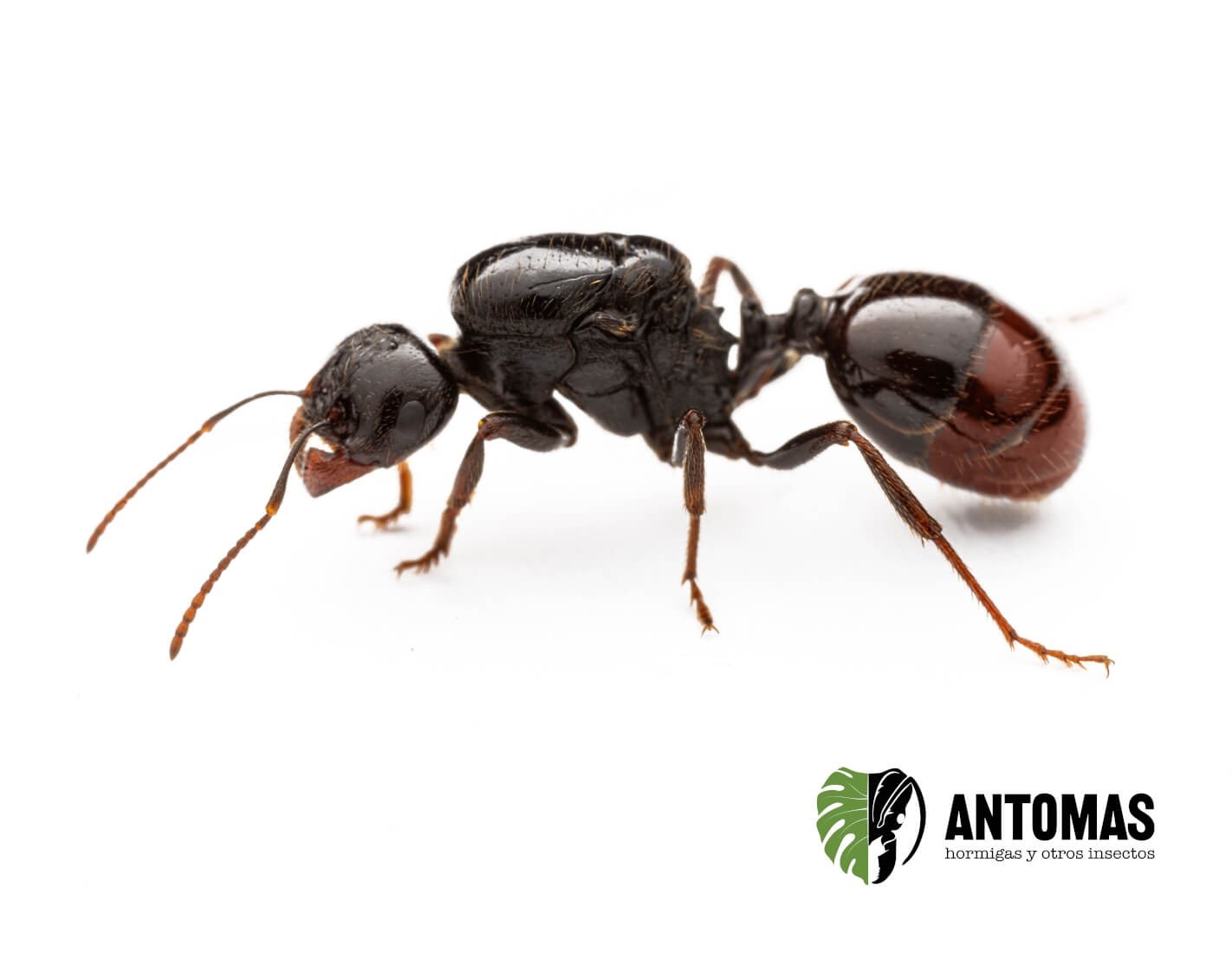
A large, sturdy myrmicine with a hairy look. As there are no modern descriptions of the species, what follows combines the traits of its complex with what we see in our colonies.
- Colour. Blackish brown and slightly glossy, with reddish legs, antennae and mandibles. The wasmanni complex is nearly always bicoloured; ours are among the dark ones, with the contrast in the face and legs.
- Mandibles. Large, broad and reddish, with an edge armed with well-marked teeth: its most striking feature.
- Head. Sculptured with fine striations, and wider the larger the worker.
- Hairs. Long, erect, golden hairs on the thorax and gaster, very visible in good light.
- Propodeum. It may bear denticles, a trait of the complex not yet confirmed in the species.
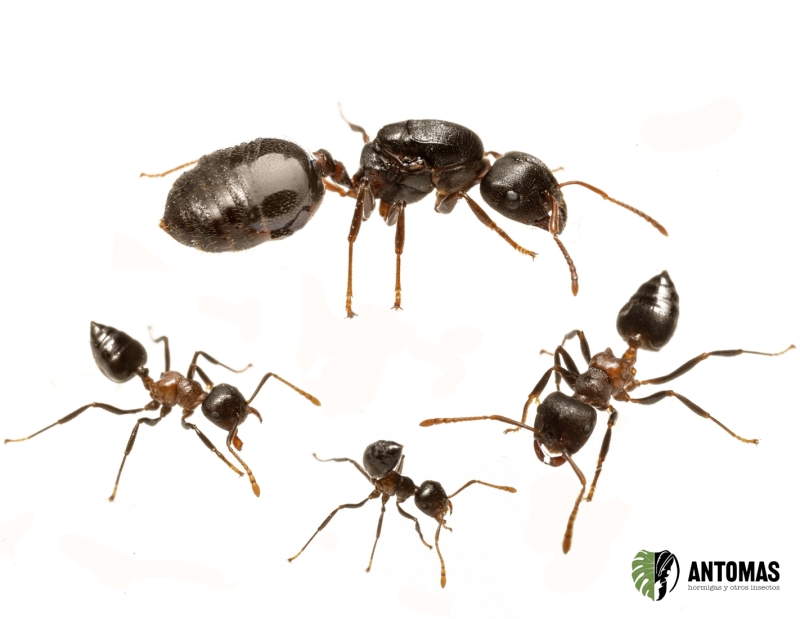
- Polymorphism. As in most Messor, workers range from small to large with no separate castes. The majors arrive as the colony grows.
- Queen. Larger, with the bulky thorax of females that have flown and the scars of the wings; in our colonies, the same blackish brown.
- Development. As in all myrmicines, the pupae spin no cocoon: you will see perfectly how the new workers take shape.
Approximate measurements
- Workers: no published measurements for the species
- Head width of the largest workers in the wasmanni complex: more than 2.8 mm
- Queen and male: no scientific measurements
This is the only applicable scientific figure, from the 2023 revision, and it gives an idea of how big the majors of a mature colony can get.
Care in captivity
Difficulty: 2/5 – Beginner
This is a beginner’s species: hardy, it eats easy-to-find seeds and stores them, does not sting and does not try to escape if it has what it needs. We rate it one point above M. barbarus because very little has been published about it, small colonies call for patience until the majors appear and its diapause lasts until March or April.
Why choose it? Because it has all the spectacle of the genus (granaries, middens, majors and foraging trails) with a face you will not forget. And because whatever you see in your formicarium is precious: if you note when the first majors hatch or when the colony wakes from diapause, you will be gathering data that nobody has published.
Recommended parameters
- Temperature (spring to autumn): 22–28 °C in the nest, the range we use for Messor and one that matches the summers of its range. If you use heating, keep it gentle and at one end of the foraging area; the nest should never go above 30 °C.
- Humidity: a humid area for the brood, never waterlogged, and a dry granary well apart from it. The foraging area should be dry as well.
- Water: all year round, in a test tube with water and cotton wool in the foraging area.
- Light: a dim nest and a lit foraging area, out of direct sunlight.
- Diapause: from November to March or April, below about 20 °C (see “Diapause”).
Recommended formicaria
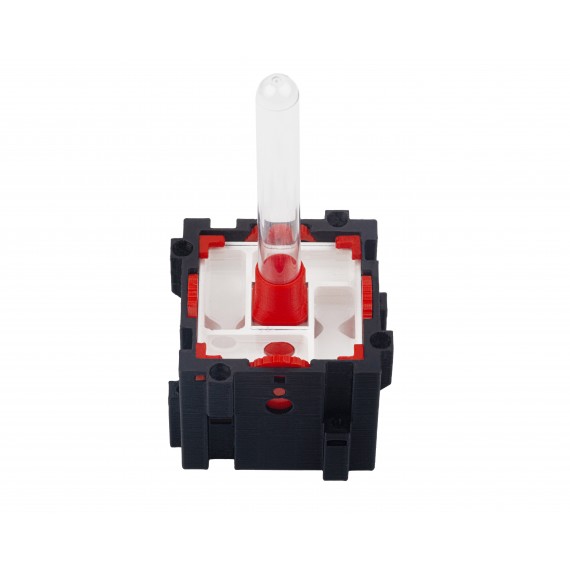
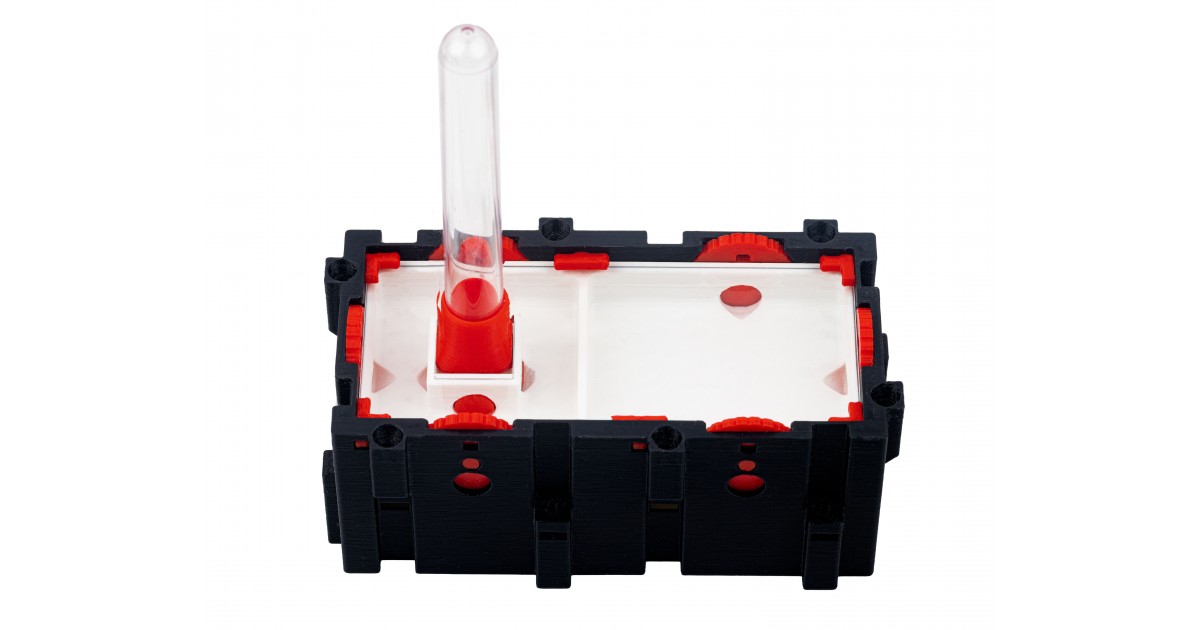
At Antomas we recommend the Qbik nests from Anthouse’s Alpha range, modular and designed to grow with the colony. To start with, a QBIK ONE with medium galleries, where the queen, the brood and the first granary stay in view:
When the majors start to appear, expand with the QBIK DUO, and always with larger galleries: workers with heads like that need passages to match.
No plaster, no ytong and no soft materials. Like M. barbarus, M. dentatus can gnaw them until they fall apart. Always choose professional formicaria made of materials they cannot chew through.
- Dry granary and humid area, kept apart. Moisten only the brood section; if the whole nest is damp, the seeds sprout and go mouldy.
- Water in a tube, sugar in a feeder. Sugary liquids never go on cotton wool, which turns mouldy at once, but in a feeder where the drop stays within reach.
- A large, dry foraging area, with a little sand, for their midden and their trails.
Arrival and moving
When it arrives, let the colony rest for a few hours somewhere quiet and check that it has water. At Antomas we move colonies by tipping them in: open the tube over the nest entrance or the foraging area and tip the whole colony out (queen, workers, brood and seeds) with gentle taps, helping the stragglers with a brush. Within a few hours they will have taken over the nest. Expansions are done the same way.
Feeding
Seeds: “they like practically everything”. Offer canary seed, millet, oats, wheat, barley, grass seed, chia, linseed, sesame or bird-seed mixes, untreated, unsalted and unroasted. For a small colony, small or soft seeds that the first workers can open; with majors on board, hard seeds as well. Wheat and barley for an ant from the land where they were domesticated? Few things make more sense.
- Leave the seeds in the foraging area, never in the humid area or next to the cotton wool, and let the ants carry them to the granary.
- Remove sprouted or mouldy seeds and clear out the midden from time to time.
Protein, and plenty of it. Seeds keep the colony going; protein makes it grow, because the queen needs it to lay and the larvae need it to develop. At Antomas we give insects as well as chicken or tuna, preferably cooked. For a small colony, Thermobia domestica is the perfect prey size; as it grows, alternate crickets, dubia roaches and red runner roaches, changing insect every week. If the animal protein has not been eaten within 24–48 hours, remove it.
Better too much than too little. The more they eat, the more and the faster they grow: if you check the formicarium daily and clear away leftovers, overfeeding is the best strategy, because the colony senses that resources are plentiful and raises more brood. If you cannot clean often, adjust the portions: forgotten protein brings mould and mites.
Sugar, only now and then. For a granivore it is a minor extra. You can offer Anthouse Blue Sugar Nectar in a feeder: at Antomas, once or twice a month. Never thick honey, as they get stuck in it.
Water: the tube with cotton wool, always full. It is the one thing they must never go without, not even for a day.
Founding and growth
Colonies are sold already founded, with their queen and first workers, so you skip the most delicate stage. The first months are a warm-up: small workers, slow growth, tiny seeds and protein in small pieces.
- A nest that fits. A huge nest for a small colony ends up with corners turned into middens, mould and mites.
- The majors’ leap. In Antomas’ experience, growth speeds up when the first majors hatch: the colony can now handle any seed and the granary fills quickly. That is the time to expand with larger galleries, especially if you see workers idling in the foraging area with no room inside.
- One colony per formicarium. Do not merge colonies or add queens: there is no evidence that the species accepts several, and the colonies we sell have just one.
Diapause
Diapause is part of its cycle: across much of its range, winter is genuinely cold. At Antomas we recommend a diapause from November to March or April, with the colony below about 20 °C. Messor keepers usually go down to 10–15 °C, a range that works very well, but an unheated room or a frost-free storeroom is enough.
- A gradual start and finish, in November and in March or April, with no sudden changes.
- No artificial heat all winter.
- Water at all times. They will eat very little, almost only from their granary, but the tube must always be there.
You will know the colony has entered diapause because it comes out less, loses interest in protein and the pupae disappear. With the warmth, the queen starts laying again and the colony begins the season in force. Do not cut it short to make them grow more: respecting it is the best way to keep a healthy colony for many years.
Behaviour in captivity
Everything in its place. Within a few days you will see the colony organise its nest: brood in the humid part, seeds in the dry granary and, outside, a midden of husks, leftovers and dead workers. Remove it from time to time and keep it dry.
Harvesters with attitude. Messor are not hunters, but they defend their ground: in Antomas’ experience, mature colonies pounce as a group on any insect that invades their foraging area. That is why you should never merge colonies or connect two Messor formicaria.
Combat queens. In mature Messor colonies kept at home, princesses sometimes appear that, with no chance of a flight, shed their wings and stay in the nest working as workers, with unusual aggressiveness; the workers themselves often end up killing them if they serve no purpose. It is a phenomenon keepers know well, with a scientific basis in leaf-cutting ants, and we explain it in depth in the M. barbarus care sheet. If they appear, let the colony decide.
Watch without fear. At Antomas we are clear about it: a colony is there to be watched, enjoyed and learnt from. With the nest dim and the foraging area lit, observe them gently and intervene as little as possible; they soon get used to your presence.
Warning signs: a queen wandering in the foraging area usually means a lack of water; mould in the granary, damp in the wrong place; and many deaths in a short time, a problem with water, temperature or food leftovers.
Escapes and handling
They are not escape artists. In Antomas’ experience, a Messor colony only looks for a way out when it is short of food, water or space. Nor are they good climbers: a barrier of mineral oil or PTFE along the edge of the foraging area works very well. Do check plugs, joints and soft parts, though: with mandibles like those, whatever they can bite, they end up chewing through.
Handling. In practice they do not sting, and a major’s bite can be felt but stays a pinch. To tip them in or clean, use a soft brush or soft tweezers, taking special care with the queen. And never release a colony: outside its natural range it would be an introduced species.
What not to do
- House them in plaster, ytong or any soft material: they gnaw it.
- Bring seeds and damp together: the granary always goes well away from the humid area and the cotton wool.
- Give them a nest far too big for the size of the colony.
- Skimp on protein or, the other way round, leave it in for more than 24–48 hours.
- Make sugar their daily food: a treat once or twice a month will do.
- Offer sugary liquids on cotton wool, open water or thick honey.
- Leave them without water, not even in winter.
- Skip diapause or end it suddenly and too early.
- Merge colonies or connect different Messor formicaria.
- Heat the nest above 30 °C or leave the formicarium in the sun.
- Hide them away: enjoy them, gently and without intervening more than necessary.
Scientific sources
This care sheet is based on the scientific literature on Messor dentatus, its species complex and the genus Messor, and on the experience of Antomas and other keepers. Main references:
- Tanno, K. & Willcox, G. (2006). How fast was wild wheat domesticated? Science 311: 1886. doi:10.1126/science.1124635
- Steiner, F. M., Seifert, B., Grasso, D. A., Le Moli, F., Arthofer, W., Stauffer, C., Crozier, R. H. & Schlick-Steiner, B. C. (2011). Mixed colonies and hybridisation of Messor harvester ant species (Hymenoptera: Formicidae). Organisms Diversity & Evolution 11: 107–134. doi:10.1007/s13127-011-0045-3
- Kiran, K. & Karaman, C. (2012). First annotated checklist of the ant fauna of Turkey (Hymenoptera: Formicidae). Zootaxa 3548: 1–38. doi:10.11646/zootaxa.3548.1.1
- Riehl, S., Zeidi, M. & Conard, N. J. (2013). Emergence of agriculture in the foothills of the Zagros Mountains of Iran. Science 341: 65–67. doi:10.1126/science.1236743
- Plowes, N. J. R., Johnson, R. A. & Hölldobler, B. (2013). Foraging behavior in the ant genus Messor (Hymenoptera: Formicidae: Myrmicinae). Myrmecological News 18: 33–49. Full text in Myrmecological News
- Romiguier, J., Fournier, A., Yek, S. H. & Keller, L. (2017). Convergent evolution of social hybridogenesis in Messor harvester ants. Molecular Ecology 26: 1108–1117. doi:10.1111/mec.13899
- Steiner, F. M., Csősz, S., Markó, B., Gamisch, A., Rinnhofer, L., Folterbauer, C., Hammerle, S., Stauffer, C., Arthofer, W. & Schlick-Steiner, B. C. (2018). Turning one into five: integrative taxonomy uncovers complex evolution of cryptic species in the harvester ant Messor “structor”. Molecular Phylogenetics and Evolution 127: 387–404. doi:10.1016/j.ympev.2018.04.005
- Borowiec, L. & Salata, S. (2020). Review of ants (Hymenoptera: Formicidae) from Jordan. Annals of the Upper Silesian Museum in Bytom, Entomology 29: 1–26. doi:10.5281/zenodo.3733156
- Salata, S., Lapeva-Gjonova, A., Georgiadis, C. & Borowiec, L. (2023). Review of the Messor semirufus complex (Hymenoptera, Formicidae) in Greece. ZooKeys 1185: 105–142. doi:10.3897/zookeys.1185.111484