Difficulty: 5/5 – Expert
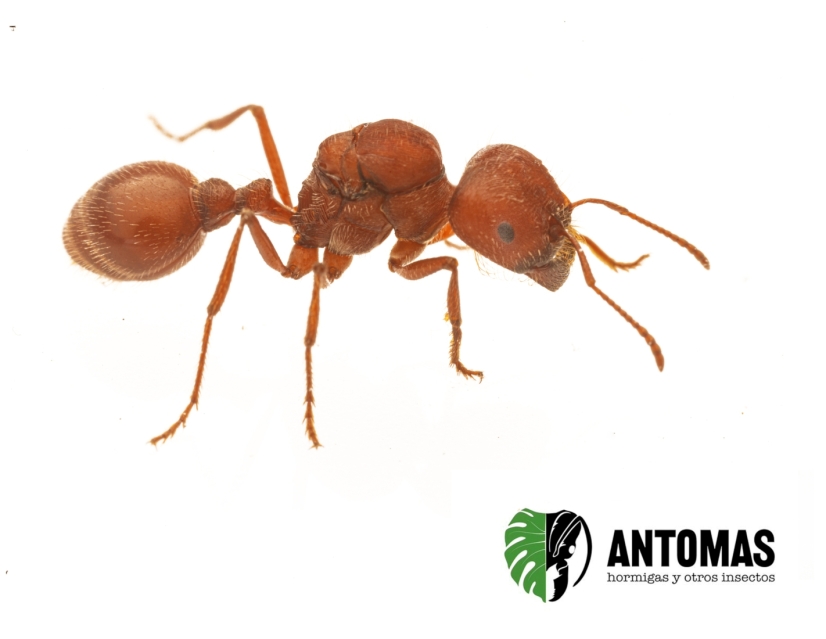
The only harvester ant of the eastern United States and the only Pogonomyrmex with big-headed major workers. In the wild it digs nests up to three metres deep, carpets the entrance with bits of charcoal and moves house almost every year. It is sold as a queen with brood: a colony in the middle of its founding stage, delicate and slow in its first year, which needs uninterrupted water, 25–30 °C with a thermostat, a QBIK ONE once it has its first workers (then a QBIK DUO), small dry seeds, frequent protein while there are larvae and a 3–4-month diapause at 10–15 °C. Its sting is very painful: always use tools, an oil barrier and a lid. This is not a species for homes with small children or pets, nor for anyone allergic to hymenopteran stings.
Pogonomyrmex badius (Latreille, 1802) is a reddish, seed-eating harvester ant that lives in the sandy lands of the coastal plain of the south-eastern United States. All its North American relatives live in the west; it is the only one that crossed, so to speak, to the other side of the Mississippi, into a warm, humid climate very different from that of its desert sisters.
It is also the harvester ant best known below the surface. For more than twenty years, the myrmecologist Walter R. Tschinkel, of Florida State University, and his colleagues have excavated its nests chamber by chamber and marked workers to follow them through the tunnels. At Antomas we consider it a species for experienced keepers: a collector's piece that rewards patience.
Biology
The only harvester ant of the east
The genus Pogonomyrmex brings together the great harvester ants of the Americas, and in North America almost all of them are western: P. barbatus, P. rugosus, P. maricopa and P. californicus live in arid lands from Texas to California. P. badius is the exception: it is the only species of the genus east of the Mississippi River.
Its range covers the Atlantic and Gulf of Mexico coastal plain, from south-eastern North Carolina, through South Carolina, Georgia and Florida, to Alabama, Mississippi and Louisiana. There it always looks for the same thing: loose, well-drained sand in open, sunny ground, such as dry sandhill scrub, open pine woods, grasslands and coastal dunes that still keep their vegetation. The climate is humid subtropical, with long, hot, rainy summers and mild winters with the occasional frost.
Three metres beneath the sand
In 2004, Tschinkel published the most detailed study ever made of a harvester ant's nests. To see them, he filled the tunnels with dental plaster and, in other cases, with molten zinc or aluminium from a small portable charcoal furnace; the result looks like a sculpture: a column of horizontal "plates" joined by spiralling shafts. These are its figures:
- Depth. Mature nests go down 2.5–3 m, and the deepest reached 3.06 m. Those of newly founded colonies stay at around 30–50 cm.
- Chambers. From 5 to 150 per nest. One of them had 135 chambers and 12 m of vertical shafts. Each chamber is about 1 cm high, whatever its floor area.
- A "top-heavy" nest. The upper chambers are large, with lobed outlines, and packed closely together, 2–4 cm apart; towards the bottom they become small and lie 20–30 cm apart. Half of the living space is in the top quarter of the nest.
- Floor by floor. Seeds are stored only in chambers between 40 and 100 cm deep; the brood and the newly emerged workers live in the bottom third.
Digging all of that is a colossal task: a colony of about 5,000 workers removes some 20 kg of sand in four or five days, and each worker moves between 300 and 400 times its own body weight per day.
A move a year, with the floor plan in mind
The most surprising thing is that, after so much effort, the colony often abandons its nest. In a two-year study published in 2014, Tschinkel found that colonies move on average about once a year, almost always between May and November, and that some do so up to four times in two seasons. These are the details of the move:
- A short distance. An average of 4.1 m, and rarely more than 8 m.
- Quick work. The whole move takes four to six days, and occasionally up to two weeks.
- What they take. Of everything they carry to the new home, 80% is seeds, 13% brood and 7% bits of charcoal.
- A random walk. Move after move, the colony wanders around its starting point: one that moved six times in two years travelled about 30 m in total and ended up a metre from where it began.
And the new nest is almost a copy of the old one, with the same shape and the same distribution of chambers by depth. Why they move remains a mystery: it is not for lack of space, because the new nest is no larger, and it costs them dearly, since colonies that relocate lose part of their size.
Underground relay chains
How does a seed get from the ground to a granary half a metre down? The forager does not carry it there. In 2015, Tschinkel, Rink and Kwapich had a colony dig into a "cake" of twelve layers of coloured sand and followed every grain. They discovered two conveyor belts running in opposite directions:
- Sand goes up by relay. It is dropped halfway and other workers pick it up and carry it a little higher: a single pellet brought to the surface could mix all twelve colours.
- Seeds go down in a wave. Foragers drop them in the highest chambers, less than 12 cm below the surface, and another group of workers moves them down in stages to the granaries, at 20–80 cm, within hours or a day.
Behind these chains lies an order based on age. In 2017, Tschinkel and Hanley marked workers from different groups and looked for them in every chamber: the foragers live almost always in the top 15–20 cm; the young workers, who tend the brood, at the bottom; and the transporters in between. Over time, each worker moves up through the nest as it ages, until it ends up working outside.
Majors: the big-heads that hardly ever go out
In almost all Pogonomyrmex, the workers come in a single size. P. badius is different: as Deborah Gordon pointed out in 1984, it is the only polymorphic species in the genus. Alongside the minor workers, which are the vast majority, it has major workers (majors) with disproportionately large heads and very powerful mandibles. This is what is known about them:
- They are few. In the colonies excavated by Tschinkel (1998), about 7% of the workers, a proportion that does not depend on colony size. They also keep their size, whereas the minors are somewhat larger in big colonies.
- They live indoors. Gordon saw that majors rarely leave the nest: the outside work is done by the minors.
- Millers? It has always been assumed that those heads are for cracking seeds. In 2016, Tschinkel and Kwapich found that colonies with majors open more small and medium seeds, but not larger ones: even with them, they cannot break thick seed coats. Their exact role remains open.
- It runs in the family. Rheindt, Strehl and Gadau (2005) found a genetic component in the production of majors: depending on its father, a larva is more or less likely to become one.
Watching them appear, once the colony has grown, is one of the great moments of keeping this species.
A carpet of charcoal at the door
The western harvester ants cover their mounds with small pebbles. P. badius does something similar with a material all its own: pieces of charcoal, mostly the burnt tips of pine needles, which it gathers in the woods and spreads around the entrance. Fires are frequent in the pine woods of the south-east, and charcoal is plentiful. Smith and Tschinkel (2007) reported that these deposits can add up to millions of pieces, a huge investment of labour in something that is not even eaten.
What is it for? The authors tested several ideas. The charcoal does not change soil moisture, and they found no evidence that it deters other ants, as had been suggested. The only effect they detected is that it slightly warms the uppermost part of the nest, which could help the colony get going earlier in the morning or in spring. Whatever its function, the ants value it: every time they move, they take the charcoal to the new home.
Granaries waiting to germinate
A mature nest can hold more than 300,000 seeds, over half a kilo. But, according to Tschinkel and Kwapich (2016), much of that treasure cannot be eaten as it is: the workers only open seeds of up to about a millimetre, and the large ones, which they also collect, build up in the granary until they make up 70% of its weight.
The solution is ingenious: waiting for them to germinate. When a seed germinates, it breaks its own coat and turns its starch into sugars. The ants promptly remove the seeds that begin to sprout from the granary, eat them and, above all, feed them to the larvae, as the authors showed by dyeing seeds: in laboratory colonies, almost half the larvae had received dyed seeds within two days. As each seed species germinates at a different time, the granary "ripens" over the course of the year.
Three-week foragers
A P. badius worker can live for about a year, but most of that life is spent underground. Outside, the risk is enormous: according to Tschinkel and Hanley, a forager lasts about three weeks in the field, with a mortality of around 4% a day, whereas in the laboratory it lives for many months.
The colony makes up for it with a very strict schedule. Kwapich and Tschinkel (2016) found that the age at which a worker starts foraging depends on when it was born: summer-born workers go outside at 43 days, while those born in autumn wait more than 200, until the following spring. And even when the researchers changed the number of foragers or larvae, the foragers did not go back to indoor tasks.
One queen, some twenty males
Smith and Tschinkel (2006) excavated colonies in a pine wood in northern Florida and described their yearly calendar:
- Spring: sexuals. Males and queens are reared only in spring, from April onwards and all at once.
- Early summer: the nuptial flight. The alates emerge after the first heavy rain of summer and gather in aggregations, often near the nests.
- Summer and autumn: workers. Then comes worker production, which continues into autumn.
- December to March: rest. In January they found no eggs, larvae or pupae.
A colony starts producing alates once it exceeds about 700 workers, and from then on it devotes to reproduction a share of itself proportional to its size. Typical colonies have around 4,000 workers, and few exceed 8,000. Queens weigh 3.6 times as much as males, and the record lies in mating: Rheindt and colleagues (2004) found one of the highest mating frequencies recorded in ants, with an average of 9–10 males per queen and up to 29. The same 2006 study documented for the first time in the genus that workers can also lay male eggs.
A record-breaking venom
Like all its relatives, this harvester ant has a functional sting and a very potent venom. In 1978, Justin O. Schmidt and Murray S. Blum analysed it in the journal Science and concluded that its toxicity to mammals was greater than that of any other insect venom known at the time. It is an enzyme-rich cocktail, including phospholipases, hyaluronidase and esterases, which breaks down red blood cells and produces symptoms unusual in mammals; the authors believe it evolved to deter the vertebrates that would like to raid its granary.
In his famous pain index, Schmidt gave harvester ants a 3 out of 4 and described the sting of this species as "bold and unrelenting". It is no passing nuisance: the pain is deep and lasts for hours. Fortunately, each worker injects very little venom, and with correct handling it very rarely gets the chance to sting.
Size and morphology
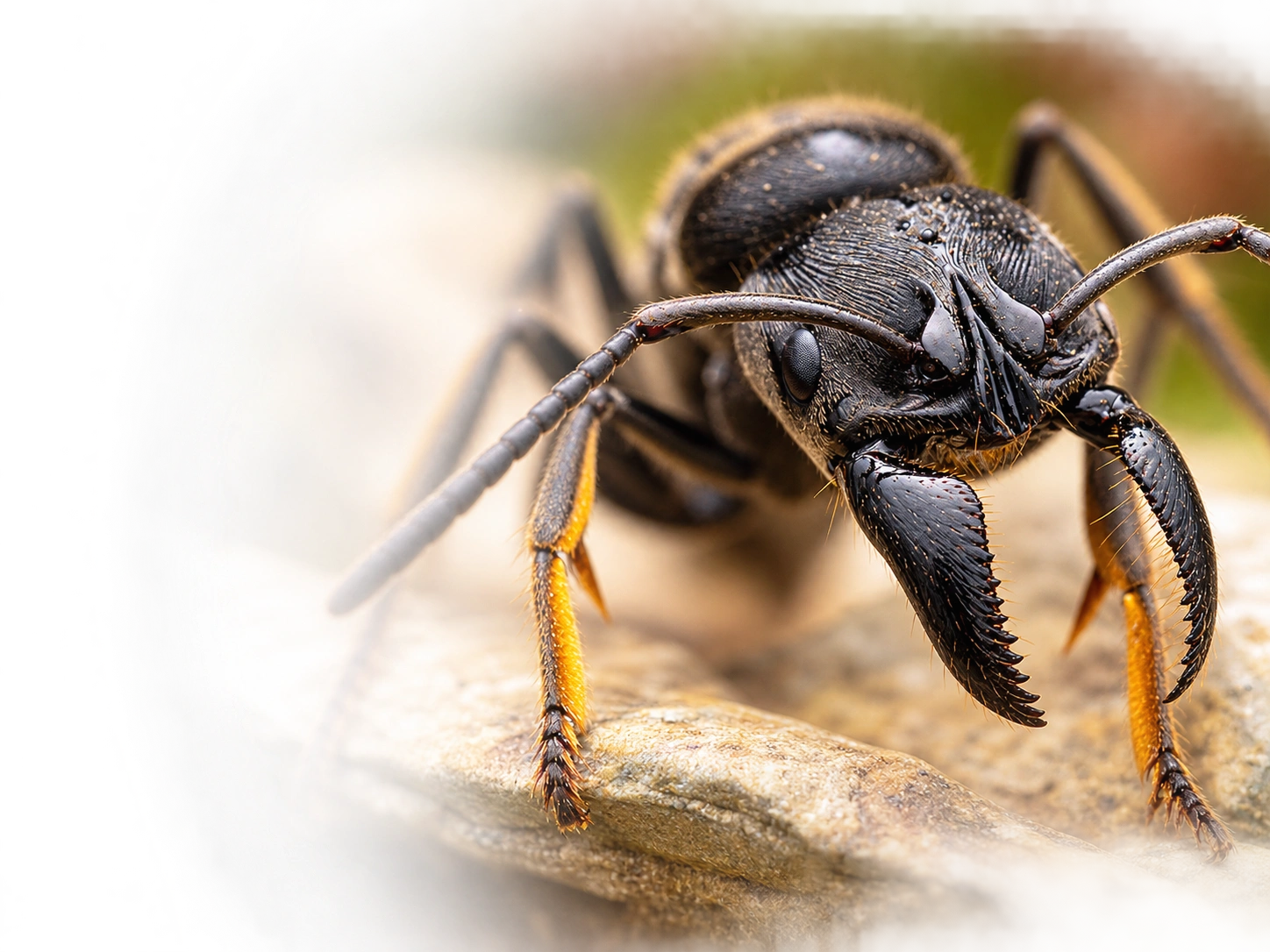
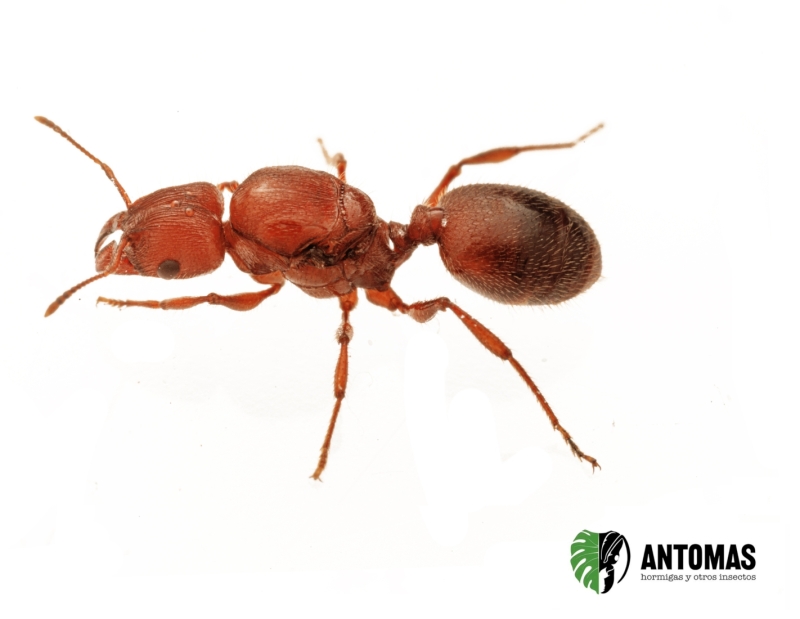
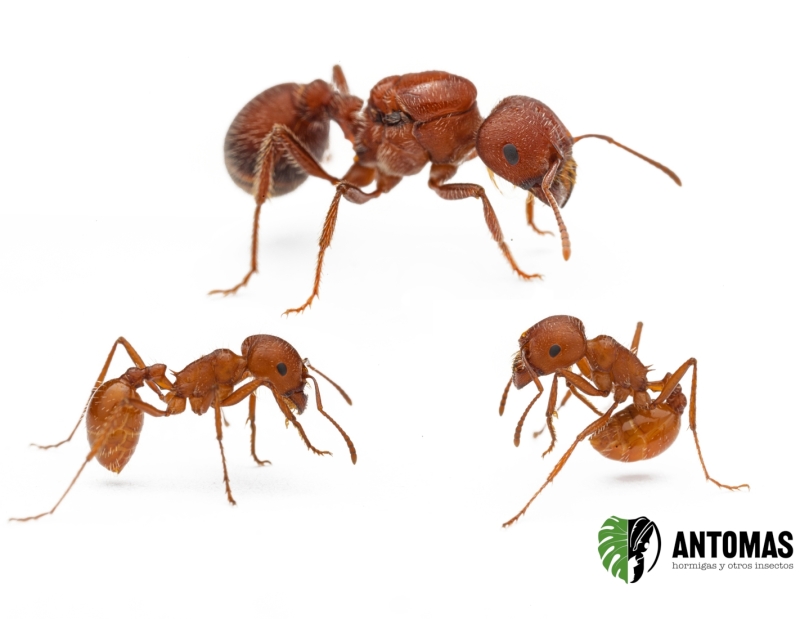
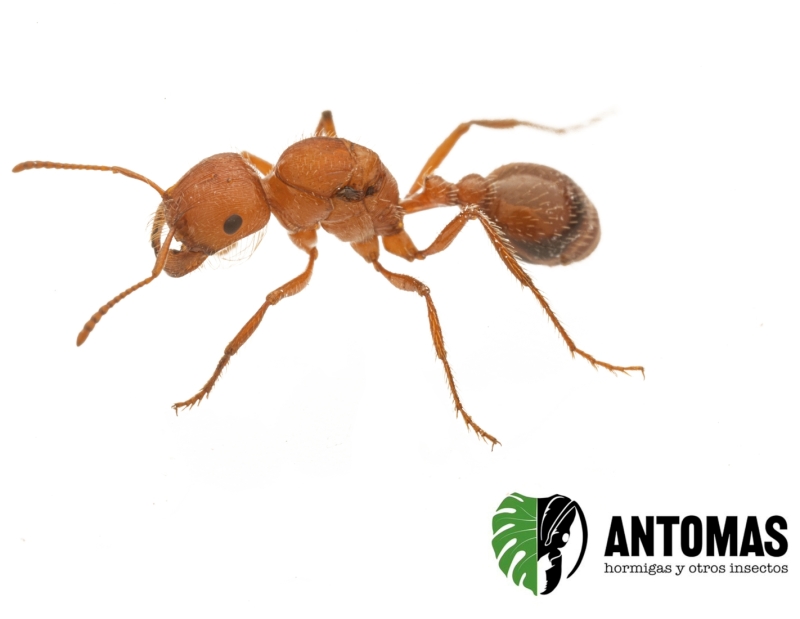
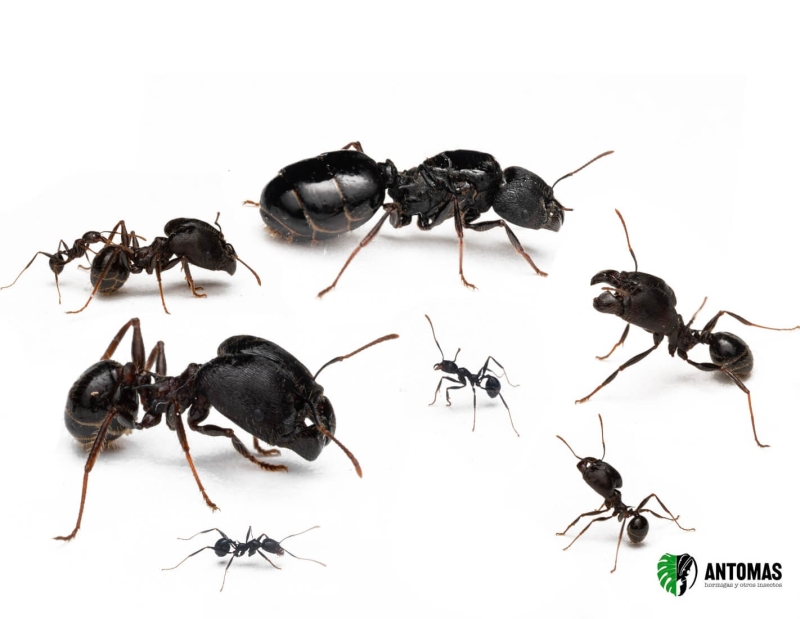
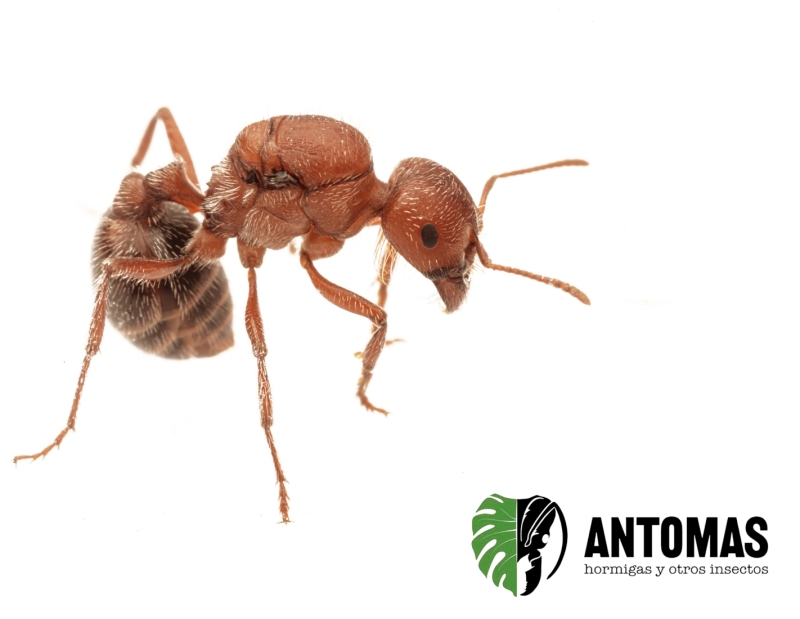
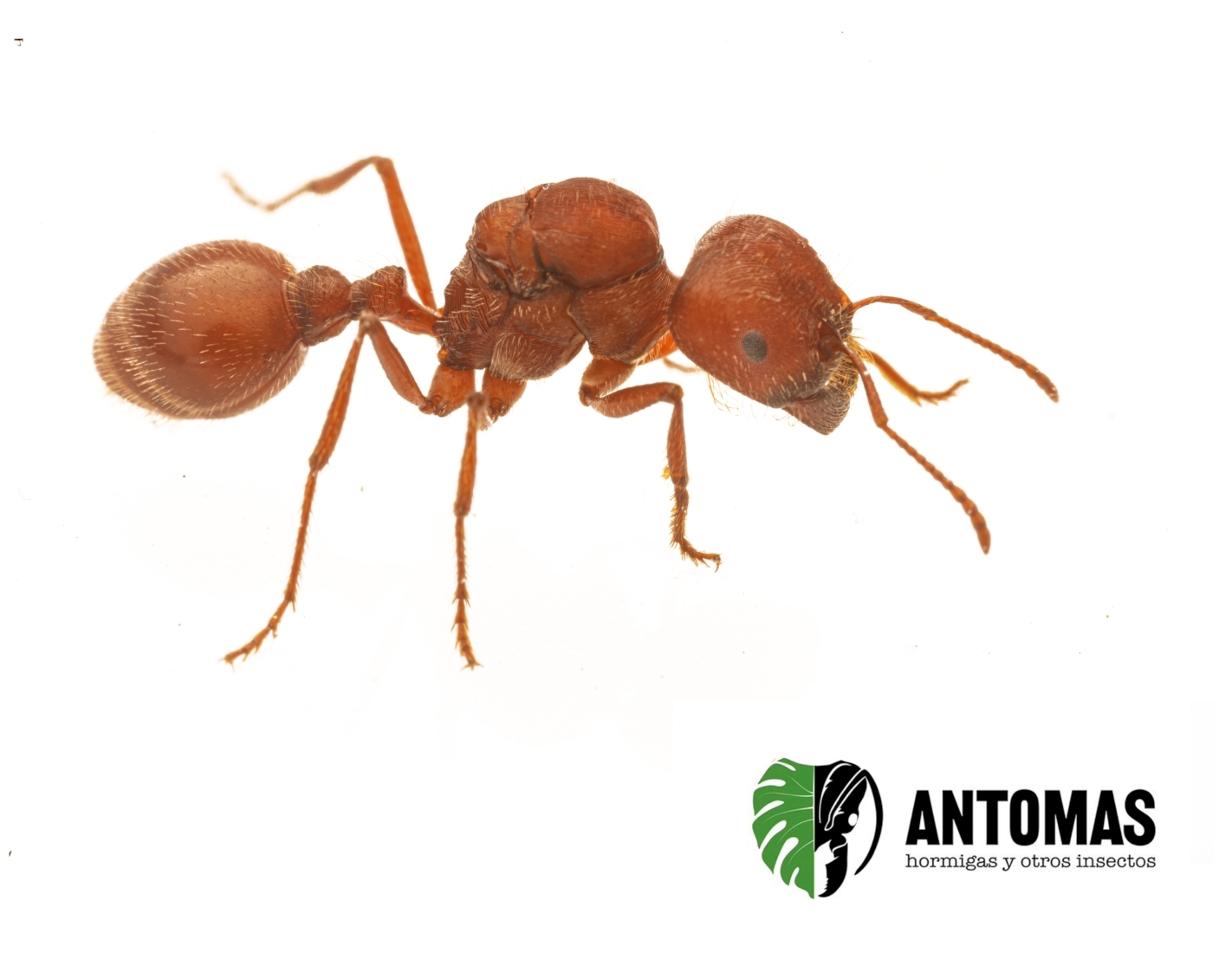
A robust myrmicine with a sting, a two-segmented waist and the typical "beard" of harvester ants. Its most striking feature is the one that sets it apart from its whole genus: two kinds of workers.
- Colour. Reddish brown to dark red; its name, badius, means precisely "bay", the reddish-brown colour of horses.
- Minor workers. They are the vast majority and do all the outside work. Their size varies considerably more than in other Pogonomyrmex.
- Major workers. A very broad head, out of proportion to the body, and broad, strong mandibles. They form a subcaste clearly distinct from the minors and work mainly inside the nest.
- Psammophore. A basket of long hairs under the head with which they carry sand and small seeds.
- Queen. Larger than the minor workers, with the bulky thorax of winged queens and the wing scars left after the flight. The largest majors come close to her in size.
- Development. As in all myrmicines, the pupae do not spin a cocoon.
Approximate measurements
We have not found a published, accessible scientific measurement of the body length of workers, majors or queens: the studies that measure them use head width and only give their figures in graphs. The lengths quoted in popular care sheets are rounded conversions from inches, not measurements, so we prefer not to give them.
Keeping in captivity
Difficulty: 5/5 – Expert
An adult colony of P. badius is no harder to keep than other harvester ants. What makes it a species for experts is how it is sold and how it starts: it arrives as a queen with brood, in the middle of its founding stage, and that first phase is the most fragile of its life. These are the reasons:
- A delicate founding stage. The queen has to raise her first workers on her own. A dry test tube, a heat spike or mould on the cotton wool can kill her, and without a queen there is no colony.
- A slow first year. The first workers are few and small, and the colony takes time to pick up pace.
- Compulsory diapause. Every winter it needs several months of cool rest, and doing this with a tiny colony takes care.
- Carefully judged humidity. It comes from sands that are dry at the surface within a humid climate: it needs a brood area with some moisture and a dry granary.
- A very painful sting and little published experience from other keepers in Europe, where it is rarely offered.
In return, you will have something very unusual: the only polymorphic harvester ant and one of the best-studied in the world. To get started with the genus, P. barbatus or P. rugosus are easier options.
Recommended parameters
- Temperature: 25–30 °C in the active season, with one side of the nest slightly warmer, always controlled with a thermostat. This way the colony chooses where to place the brood.
- Humidity: moderate in the brood area and dry in the granary and the foraging area (see the next section).
- Water: always available, in a test tube with water and cotton wool.
- Light: a dark nest and a lit foraging area, with a normal day–night cycle.
- Substrate: none inside the nest; in the foraging area, fine dry sand if you like.
- Diapause: 3–4 months, roughly from December to March, at 10–15 °C.
Dry sand above, moisture below
In the wild, the surface sand dries out quickly, but the brood lives in the deepest chambers, and the granaries sit in a middle band. The formicarium has to mimic that arrangement:
- A slightly moist brood area, close to the water reservoir. Damp to the touch, with no droplets or puddles.
- A dry granary, away from the water. A damp seed in a closed nest germinates, ferments or goes mouldy, and mould spreads fast.
- Neither all dry nor all wet. A parched nest slows the brood; a soaked one rots the food.
- Gentle ventilation so that water does not condense on the walls.
The ants themselves will tell you whether you have got it right: the brood will gather in the moist part and the seeds in the dry part.
Recommended formicarium
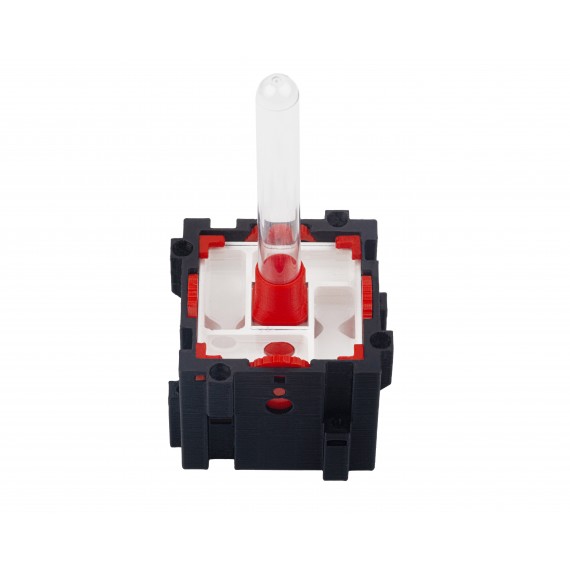
While the queen has only eggs, larvae or a few workers, leave her in her test tube: it is the ideal nest for a founding colony. Once she has her first batch of workers and the tube starts to feel cramped, at Antomas we recommend a QBIK ONE by Anthouse, from the Alpha range: it is modular and dry, and lets you clearly separate the brood chamber, close to the water, from the granary:
Always match the space to the colony: in a nest that is too big, the empty chambers become rubbish dumps, with mould and mites. When the workers crowd into the foraging area because there is no room inside, expand with a QBIK DUO. Complete the set-up like this:
- Horizontal, with a large foraging area where they can lay their trails and leave their midden.
- Fine, dry sand in the foraging area, so you can watch them carry it with their beards.
- A water tube with cotton wool and a feeder for sugar.
- An oil barrier and a tight-fitting lid from day one.
Founding: how to raise the queen and her brood
In the wild, the P. badius queen founds alone: after the nuptial flight she breaks off her wings, digs a short shaft with a small chamber, seals herself in and raises her first workers. The large harvester ants usually do this by drawing on their body reserves, the fat and the wing muscles they no longer need, but in this species there are no studies showing whether the queen ever goes out to forage during those weeks, and keepers do not agree. At Antomas we handle it as we do with the rest of the genus: with an assisted founding, offering her food from the start so that she does not exhaust her reserves and raises a larger first generation.
This is what we recommend while the colony is in the test tube:
- Uninterrupted water. This comes first. Keep an eye on the tube's reservoir and, when less than a third is left, get ready to change it. If the cotton wool gets dirty or mouldy, move the colony to a new tube by tipping it out.
- Steady warmth, at 25–28 °C, with the tube in a quiet, dimly lit place. Brood develops much more slowly below about 24 °C.
- Very small, soft seeds next to the mouth of the tube: dandelion, poppy, niger or grass seed, a few at a time. If she has not touched them after a couple of days, replace them with others.
- A tiny prey item when there are larvae, two or three times a week: half a fruit fly, a small piece of young Thermobia or of a freshly killed cricket. Whatever is left the next day, take it out.
- A drop of sugar now and then, on a scrap of aluminium foil or in a small feeder, never on the cotton wool, and removed the next day.
- A tiny foraging area, or the food right at the mouth of the tube.
- Calm, but not hidden away. You can look at her under soft light whenever you like; what harms her are knocks and sudden temperature changes.
The first workers will be few and all minors; with warmth, water and protein, each batch will be larger. If the colony is still living in the tube when autumn comes, it will spend its first diapause there, with the water carefully checked.
Arrival and moving by tipping out
When it arrives, leave the tube to rest for a day in a quiet, dimly lit place at a comfortable temperature, check that it has water and offer a few small seeds at the mouth. When it is time to move it into the formicarium, at Antomas we always do it by tipping it out:
- Prepare the nest first: the brood area moistened, the water tube in place, sand in the foraging area and the barrier already applied.
- Work over a large tray, with long tweezers and a soft brush to hand.
- Open the tube inside the foraging area, next to the nest entrance, and shake gently until the queen, workers, brood and seeds fall out. Help anything stuck to the cotton wool with the brush.
- Close the lid and keep the nest dark. Within a few hours they will have the brood inside.
Moving later into the QBIK DUO is done the same way. And do not be surprised if the colony moves its brood from chamber to chamber several times: in the wild it changes nest almost every year.
Seeds: small, varied and dry
Its workers readily open small seeds of about a millimetre, and hardly ever thick ones, as Tschinkel and Kwapich showed: not even the majors help them crack them. Do not expect the strength of a large Messor barbarus colony. The rule is simple:
- Small, varied seeds: dandelion, poppy, niger, millet, amaranth, chia, quinoa and grass seed. In the wild they collect many different species, so it is a good idea to keep rotating them.
- Large ones, cut into two or three pieces, without grinding them.
- Always dry in the granary.
- No bird seed mixes with hard, round grains, and no sowing seed treated with fungicides.
What about sprouted seeds? You have already seen that, in the wild, they use germinating seeds to feed their larvae. If you want to try it, now and then offer a few freshly sprouted small seeds in the foraging area, in small quantities, and remove the next day any they have not taken. This is an idea based on their biology, not a guideline tested by keepers.
Protein, sugar and water
Protein, generously when there are larvae. Seeds keep the workers going, but the queen and larvae need animal protein to grow. If you do daily maintenance and remove leftovers, at Antomas we recommend feeding them a lot: the colony senses abundance and grows faster and larger. If you cannot clean often, it is better not to overfeed. And vary the insect from one week to the next:
Always use captive-bred insects: wild-caught ones may carry insecticides.
Sugar, in moderation. Seeds already give them energy, but an occasional supply is welcome, especially in periods of high activity. Vary here too: Blue Sugar nectar by Anthouse as the base, for most feeds, and now and then another nectar or water with honey. Always in a feeder where the drop stays accessible, never on cotton wool, which goes mouldy and spoils the liquid within a few days. You can also add some protein to the nectar.
Water, without interruption, in the tube with cotton wool.
Diapause
In its native range, winter is mild but real: in northern Florida, Smith and Tschinkel saw that colonies stop from December to March and that by January there is no brood left. At Antomas we give it 3–4 months of diapause at 10–15 °C, roughly from December to February or March:
- A gradual cool-down. In November, remove the heat source and leave the colony for a few weeks at 18–20 °C before moving it to the cold.
- Where to do it. In a cellar, a garage or a wine cooler. Never below about 5 °C or with frost.
- During the rest: water always, a few dry seeds in the granary and hardly any protein.
- Small colonies, towards 15 °C. A queen with few workers overwinters better in the mild part of the range; a large colony copes well with 10–12 °C.
- A gradual return in March, raising the temperature in stages up to 25–30 °C.
Behaviour and observation
A colony organised by age. In the foraging area you will see the veterans; the young workers will stay inside, beside the brood, and you will be able to follow the journey of the seeds to the granary.
Offer it charcoal. An idea for enjoying one of its most curious behaviours: leave a few small pieces of natural lump charcoal, clean and additive-free (no briquettes or firelighters), in the foraging area. It is not essential, but if the colony starts collecting and placing them, you will be watching at home what Smith and Tschinkel described in the pine woods of Florida.
The first majors. As the colony grows, look out for the workers with huge heads: they hardly ever come out, so look for them in the chambers, among the brood and the seeds.
Observe without fear. Ants are there to be enjoyed and learned from: with the nest dark and the foraging area lit, look whenever you like, gently.
Warning signs: fuzzy or sprouted seeds in the granary (too much moisture), brood that does not develop in summer (not enough warmth or protein) and workers suddenly dying (lack of water, too much heat or rotting leftovers).
Escapes, barriers and safety
With a sting like this one, the barrier is not up for debate:
- Paraffin oil in a continuous band along the top of the foraging area walls, renewed when it gets dirty with sand or dust.
- A well-fitted lid and connections with no gaps.
- Nothing that can act as a bridge to the barrier: tall stones, tubes or forgotten tools.
- Never with your hands. For everything, use long tweezers, a brush and tubes.
- Away from small children and pets, and never in the home of someone allergic to bee, wasp or ant stings.
- If you get stung, wash with soap and water and apply something cold; if you notice any general symptoms, see a doctor.
This is an exotic species: it must never be released into the wild.
What not to do
- Let the queen's tube run out of water.
- Put different queens or colonies together.
- Put a queen with brood into a large formicarium.
- Moisten the granary or store seeds next to the water.
- Give bird seed mixes, treated seeds or whole thick grains.
- Serve sugar on cotton wool or leave food leftovers in place.
- Skimp on protein when there are larvae.
- Skip the diapause or go into and out of it abruptly.
- Handle it with your hands or open the formicarium without a barrier.
Scientific sources
This care sheet is based on the scientific literature on Pogonomyrmex badius, especially the studies by Walter R. Tschinkel and his group at Florida State University, together with Antomas's experience with the genus. Main references:
- Schmidt, J. O. & Blum, M. S. (1978). A harvester ant venom: chemistry and pharmacology. Science 200: 1064–1066. doi:10.1126/science.653354
- Gordon, D. M. (1984). The persistence of role in exterior workers of the harvester ant, Pogonomyrmex badius. Psyche 91: 251–265. doi:10.1155/1984/30980
- Tschinkel, W. R. (1998). Sociometry and sociogenesis of colonies of the harvester ant, Pogonomyrmex badius: worker characteristics in relation to colony size and season. Insectes Sociaux 45: 385–410. doi:10.1007/s000400050097
- Rheindt, F. E., Gadau, J., Strehl, C.-P. & Hölldobler, B. (2004). Extremely high mating frequency in the Florida harvester ant (Pogonomyrmex badius). Behavioral Ecology and Sociobiology 56: 472–481. doi:10.1007/s00265-004-0808-3
- Tschinkel, W. R. (2004). The nest architecture of the Florida harvester ant, Pogonomyrmex badius. Journal of Insect Science 4: 21. doi:10.1093/jis/4.1.21
- Rheindt, F. E., Strehl, C. P. & Gadau, J. (2005). A genetic component in the determination of worker polymorphism in the Florida harvester ant Pogonomyrmex badius. Insectes Sociaux 52: 163–168. doi:10.1007/s00040-004-0787-4
- Smith, C. R. & Tschinkel, W. R. (2006). The sociometry and sociogenesis of reproduction in the Florida harvester ant, Pogonomyrmex badius. Journal of Insect Science 6: 32. doi:10.1673/2006_06_32.1
- Smith, C. R. & Tschinkel, W. R. (2007). The adaptive nature of non-food collection for the Florida harvester ant, Pogonomyrmex badius. Ecological Entomology 32: 105–112. doi:10.1111/j.1365-2311.2006.00845.x
- Tschinkel, W. R. (2014). Nest relocation and excavation in the Florida harvester ant, Pogonomyrmex badius. PLoS ONE 9: e112981. doi:10.1371/journal.pone.0112981
- Tschinkel, W. R., Rink, W. J. & Kwapich, C. L. (2015). Sequential subterranean transport of excavated sand and foraged seeds in nests of the harvester ant, Pogonomyrmex badius. PLoS ONE 10: e0139922. doi:10.1371/journal.pone.0139922
- Kwapich, C. L. & Tschinkel, W. R. (2016). Limited flexibility and unusual longevity shape forager allocation in the Florida harvester ant (Pogonomyrmex badius). Behavioral Ecology and Sociobiology 70: 221–235. doi:10.1007/s00265-015-2039-1
- Tschinkel, W. R. & Kwapich, C. L. (2016). The Florida harvester ant, Pogonomyrmex badius, relies on germination to consume large seeds. PLoS ONE 11: e0166907. doi:10.1371/journal.pone.0166907
- Tschinkel, W. R. & Hanley, N. (2017). Vertical organization of the division of labor within nests of the Florida harvester ant, Pogonomyrmex badius. PLoS ONE 12: e0188630. doi:10.1371/journal.pone.0188630