Difficulty: 4/5 – Advanced
A hunting ponerine from tropical Asia and Australia: black, robust, with a heavily sculptured body and an orange gaster tip, a formidable termite hunter with a sting you will notice. Colonies with queen. 24–28 °C all year round, no diapause, high humidity (around 80 % in the brood area) and small prey, live or freshly killed, offered often. Key point: sandy substrate inside the nest so the larvae can spin their cocoons, and never above ~28 °C for long periods.
Ectomomyrmex astutus (Smith, 1858) is a ponerine ant of the warm, humid soils of tropical Asia and northern Australia: a hunter with large, black, armoured workers that roams the leaf litter and topsoil in search of small arthropods, with termites as its signature prey. It ranges from India and southern China, through South-East Asia, to New Guinea and northern Australia, and nests in the soil, at shallow depth, and under dead wood.
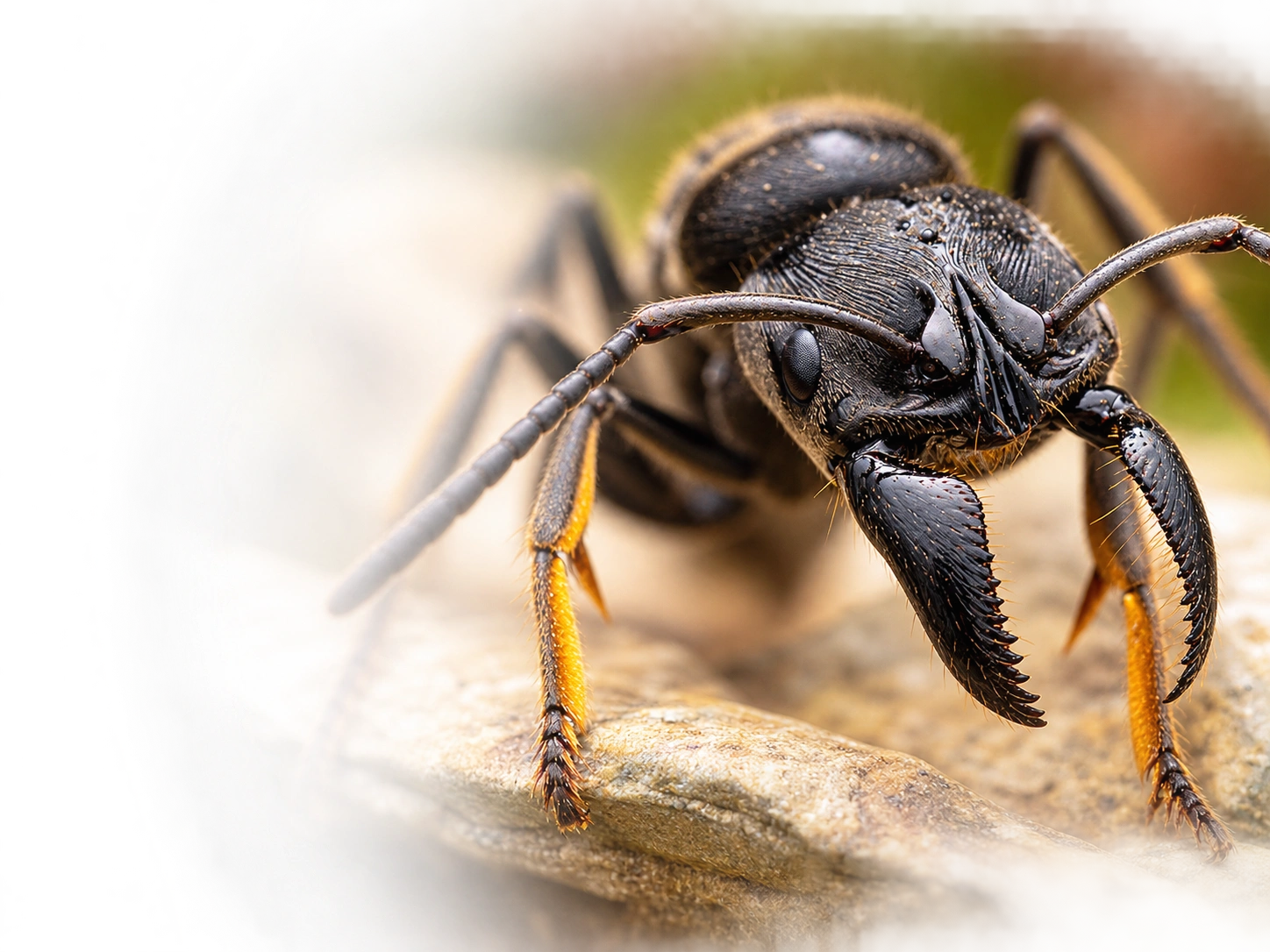
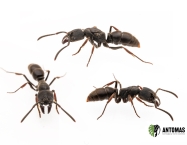
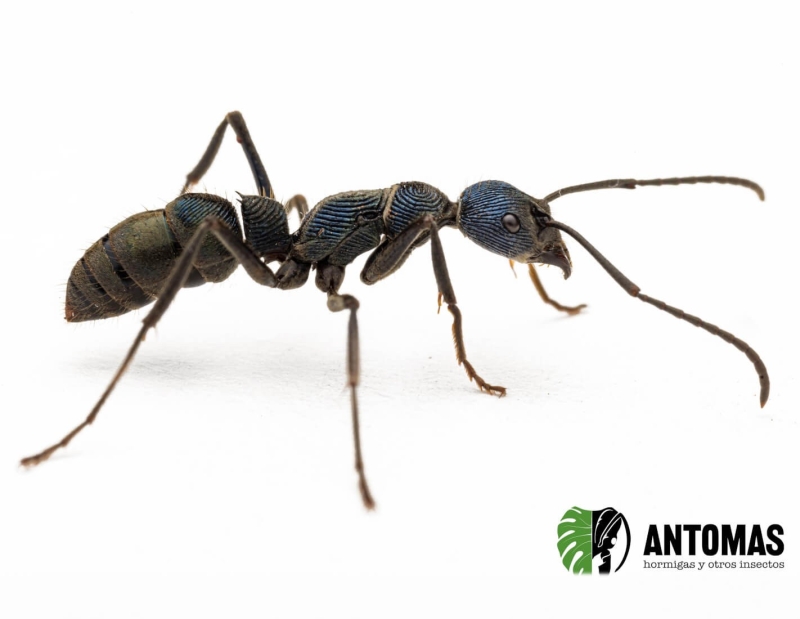
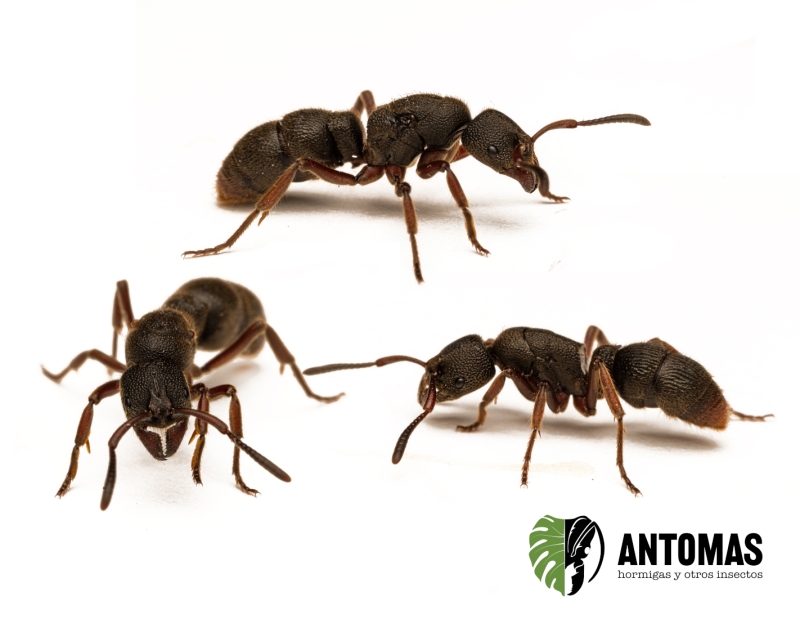
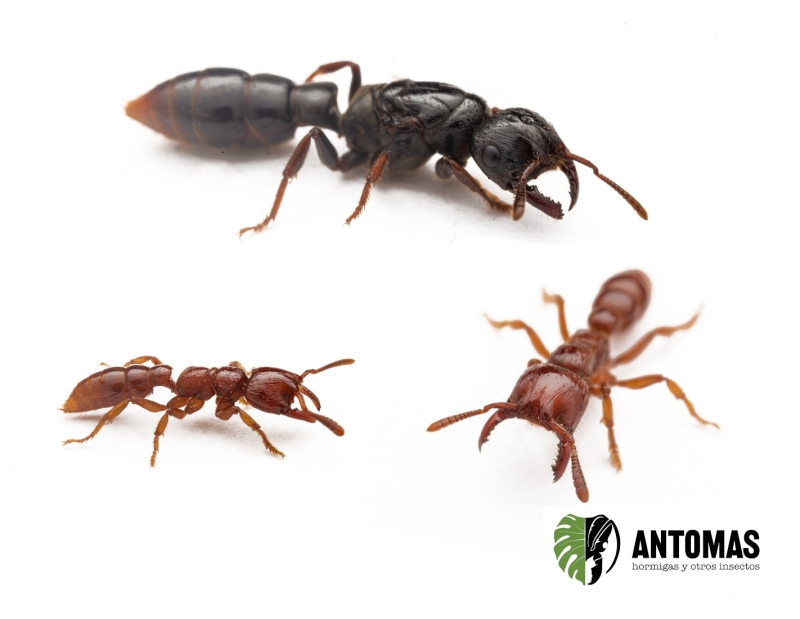
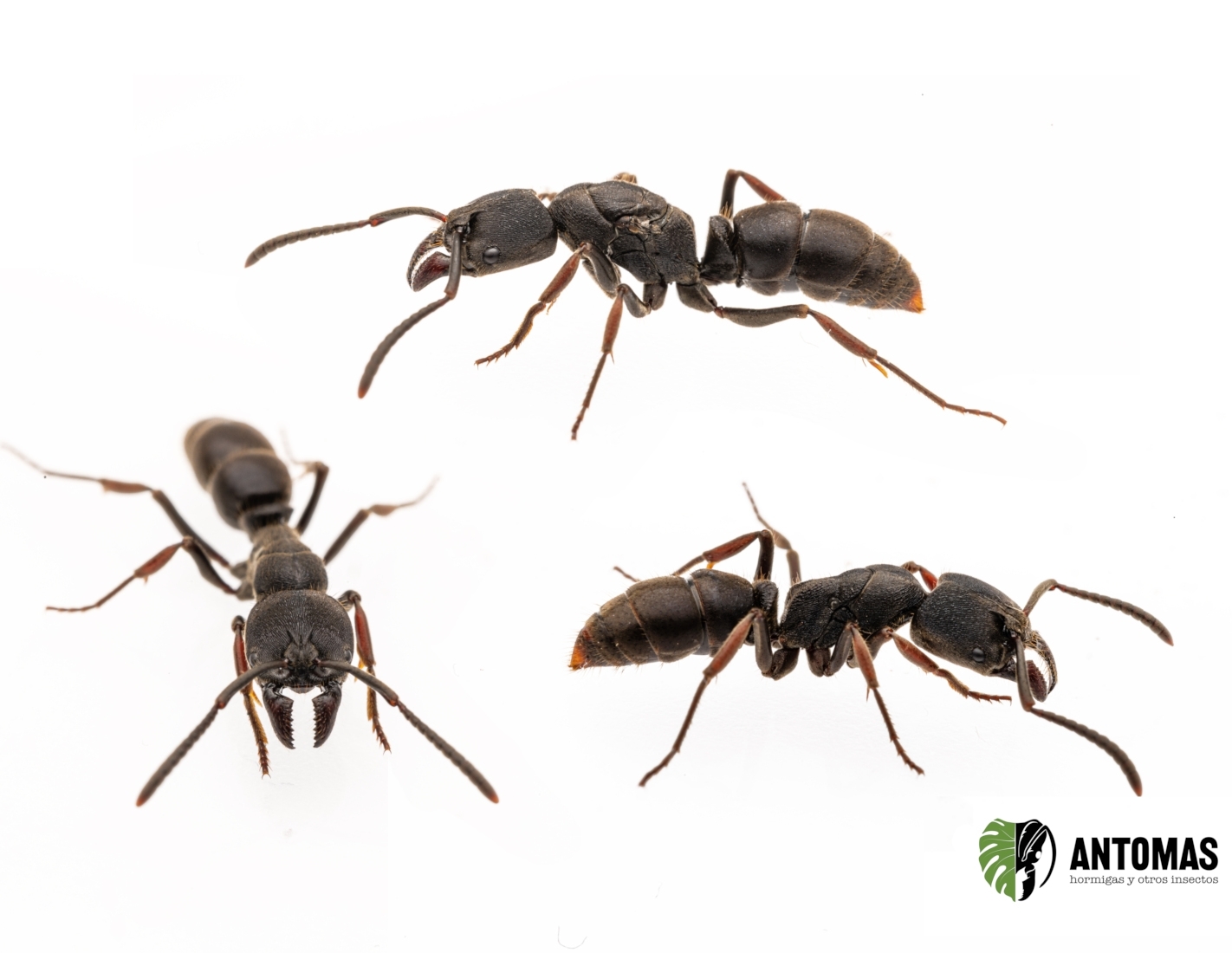
It hooks you as soon as you see it up close: a black, robust body covered in deep sculpture, reddish-brown legs and antennae and a gaster tip glowing orange. It also carries a taxonomic history of more than 160 years, with a name that many hobbyists have still not updated. That is where we begin.
Biology
Pachycondyla astuta? Not any more: the name that came back in 2014
The British entomologist Frederick Smith described it in 1858 as Pachycondyla astuta, from three workers still kept at the Natural History Museum in London. Its type locality is given as “New Holland”, the old name for Australia: curious for a species we now associate mainly with South-East Asia.
In 1903, Charles Bingham moved it to the genus Ectomomyrmex, created by Gustav Mayr in 1867. But for decades taxonomists kept lumping into Pachycondyla many groups of ponerines that looked alike from the outside, until it became a huge catch-all genus. Ectomomyrmex was absorbed, and our ant went back to being Pachycondyla astuta, the name many forums and shops still use for it.
The change came with DNA. In 2013, Chris Schmidt published the first large molecular phylogeny of the ponerines and showed that this Pachycondyla was not a natural group but a mixture of lineages. In 2014, Schmidt and Steven Shattuck published the new classification of the subfamily: they split the great Pachycondyla into several genera, revived Ectomomyrmex and gave our species back its 1903 name. Pachycondyla, in the strict sense, was kept for a group of American species.
In that review, Ectomomyrmex contained 27 described species, all from Asia and Australia. If you are looking for information, try both names: almost everything before 2014 appears as Pachycondyla astuta. By the way, astutus means “cunning” in Latin. Later on you will see it has earned the name.
From India to Australia, at ground level
Faunal lists record it in India, southern China and much of South-East Asia, from Thailand and Vietnam to the Malay Peninsula, Borneo, the Philippines and Indonesia, and to the east it reaches New Guinea and northern Australia, in the Northern Territory and Queensland. The genus reaches as far as Japan, but other species live there, not ours.
It lives in the soil of humid tropical and subtropical forests, and also in plantations. In a study published in 2013, Ke Yunling’s team dug up twenty nests of four ponerine species in southern China, E. astutus among them, in rubber plantations and lychee orchards. The nests were mostly underground and simple, with anything from a few to dozens of chambers, and almost always less than 60 cm deep. The data were published for the four species together, but they paint a clear picture of its lifestyle: a soil ant that does not dig deep. For E. astutus, nests under dead wood are also reported.
Across most of its range it is warm all year, with a monsoon rainy season and a somewhat drier one. But the colony lives under the leaf litter and a few centimetres of soil, where the climate is milder: a large 2024 study showed that, near the ground, the tropical forest understorey is cooler than the open air and fluctuates much less, and that South-East Asia is the most stable tropical region through the year. That is the recipe for keeping it: moderate, constant warmth, high humidity and no diapause.
A “primitive” ponerine that hunts alone
Ponerines have a reputation as “primitive” ants, and the word needs a little explanation: they are no less evolved than other ants, but they retain many traits considered ancestral in the family. That is why they are so interesting for understanding how ant social life began. Like most ponerines, E. astutus has almost all of them:
- Small colonies, of tens or a few hundred workers.
- Queens very similar to the workers, only slightly larger.
- Solitary hunting: each worker finds its prey, overpowers it and carries it to the nest without recruiting nestmates.
- A functional sting, with venom to paralyse prey.
- Larvae that feed directly on the prey and pupae inside a silk cocoon.
Schmidt and Shattuck admit that there is hardly any information on the habits of Ectomomyrmex, but the observations available and the moderately sized eyes of the workers point to foraging halfway between the surface and the subsoil, in and under the leaf litter. They are generalist predators of arthropods. One keeper also noticed that they use the sting not only to kill, but also to hold the prey while they pick it up.
The terror of termites
If one prey defines E. astutus, it is the termite. In an experiment in an artificial arena, Ke’s team observed that its workers were particularly ferocious predators of termites, one of the few behavioural data on the genus collected in the 2014 review. And the field confirms it: in the 2013 study, inside or next to the nests of these ponerines there were, besides other Hymenoptera and small soil animals, termites.
The authors suggested that these ponerines could be natural enemies of forest termites. It makes sense: a soil ant with shallow nests and large, armed workers is exactly what a termite colony does not want nearby. At home you do not need to give them termites, although, if you can get them, they will be a feast (see “Feeding”).
Chiselled armour with a glowing tip
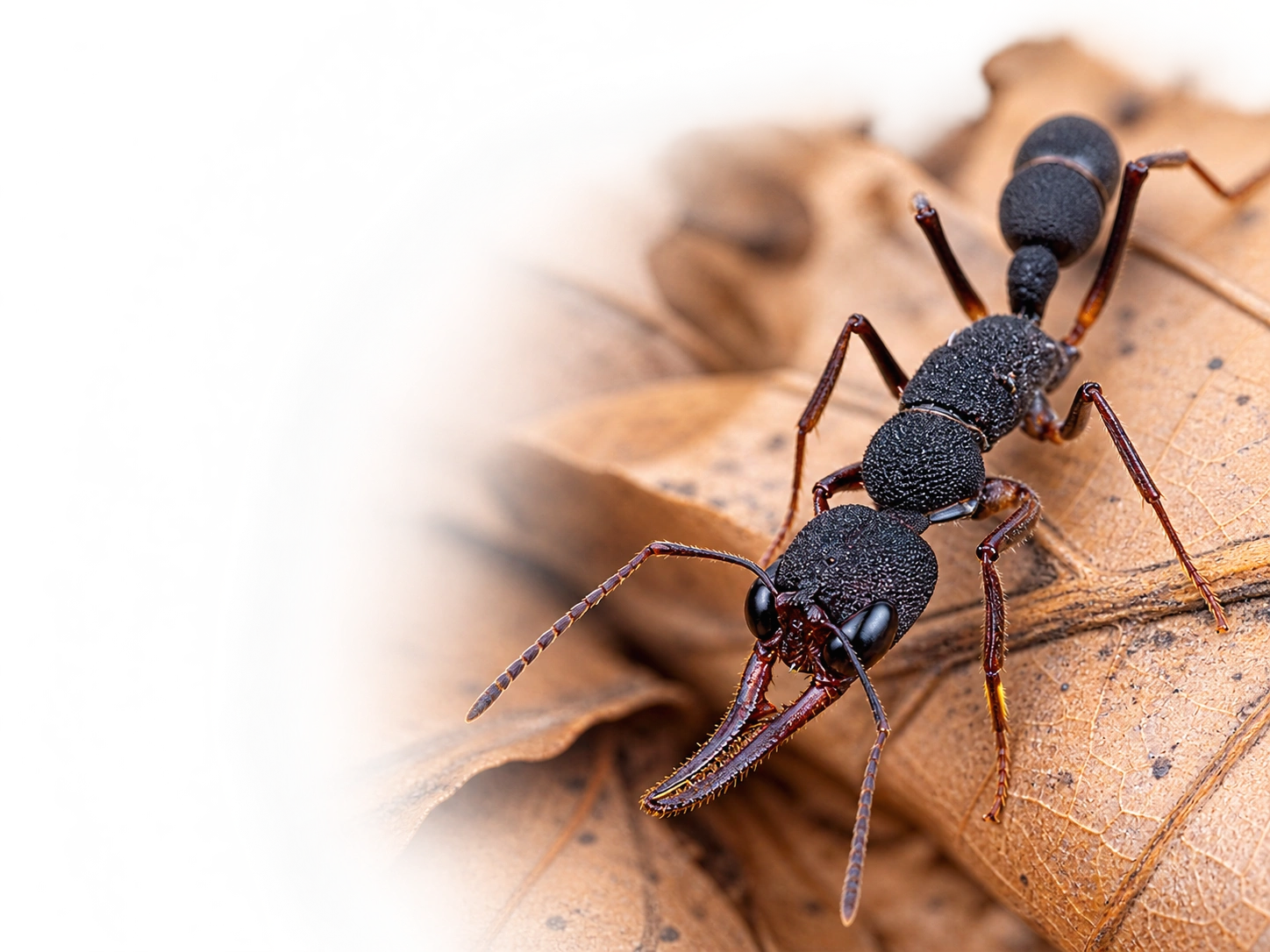
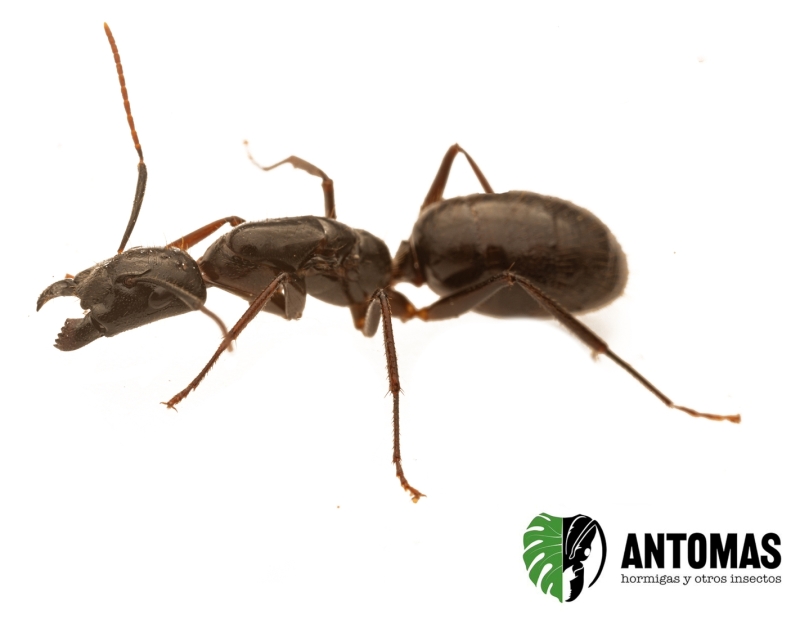
One look at a worker under a magnifying glass explains why this ant has so many admirers. The head and mesosoma (the “thorax”) are covered in deep sculpture, with grooves and ridges, like chiselled armour that changes with the light. It is a very typical trait of the genus: it is no coincidence that some of its species are called E. striatulus, “the finely striated one”, or E. aciculatus, “the one with needle-fine scratches”.
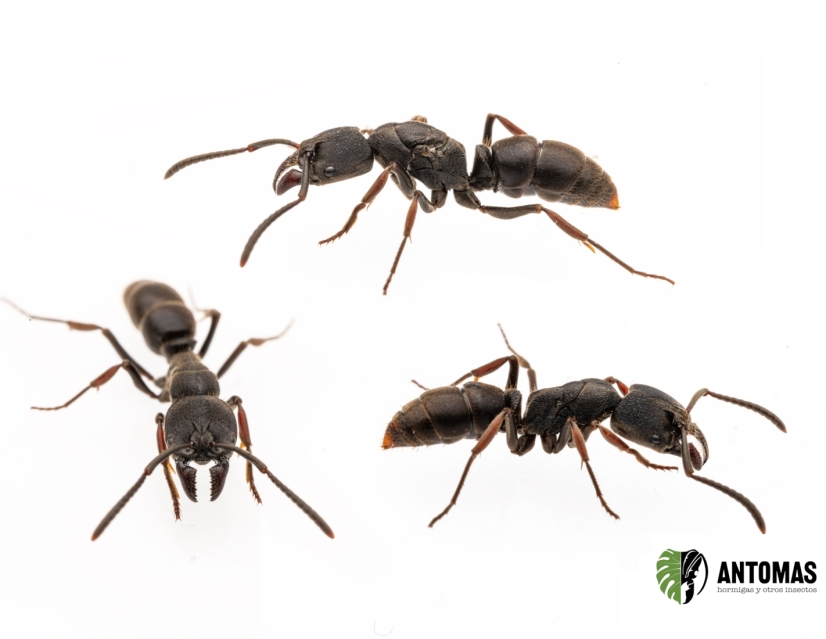
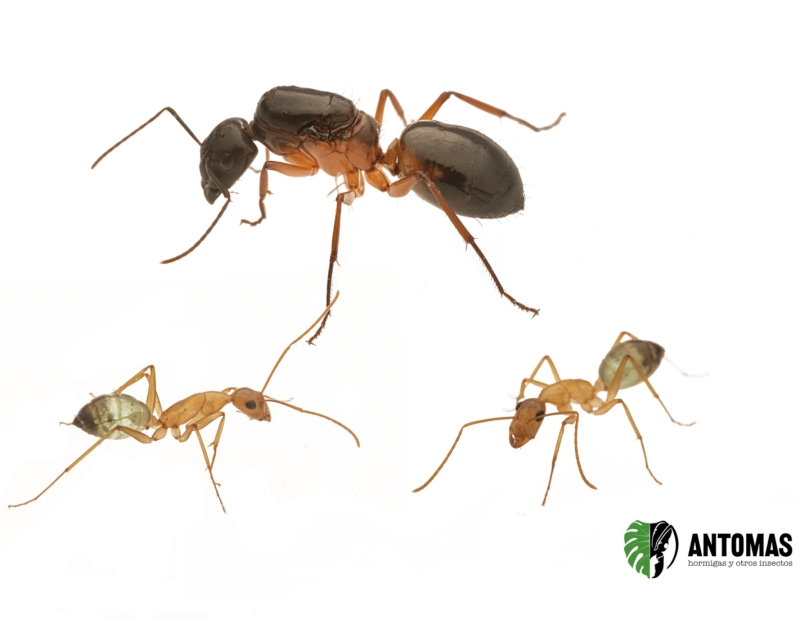
According to Bingham’s 1903 description, the worker is black, with the mandibles, tibiae and tarsi a dark chestnut red, short, erect, reddish-yellow hairs and a fine, appressed pubescence. In our colonies, the legs and antennae look reddish brown and the tip of the gaster is clearly orange, like a little navigation light. The old descriptions do not mention this detail, so we cannot tell you whether it is the same throughout its range.
Sting, vibrations and the trick of playing dead
Like all ponerines, E. astutus has a functional sting, and being stung hurts. There are no scientific measurements of its intensity, but keepers agree that you really feel it. Even so, it is not aggressive: according to one keeper, it only defends itself resolutely when something threatens the brood.
It has other defences. In the genus, Edward O. Wilson observed in the 1950s that workers play dead when disturbed, a behaviour called thanatosis. And keepers have noticed that they react more to vibrations than to light: a knock on the table alerts them long before a lamp does. In captivity, one keeper found them active mainly at night. The practical advice: work without knocks and, if you see a motionless worker, wait a few minutes before assuming it is dead.
A queen hiding among her workers
In Ectomomyrmex, the queen looks very much like a worker: she is somewhat larger, is born with wings and has ocelli, the three small simple eyes on the forehead. After the nuptial flight she sheds her wings and, from then on, she is hard to tell apart. According to keepers’ guides, in E. astutus the best clue is the thorax, bulkier because it keeps the muscles that once moved the wings. It is a good observation exercise: look for the one with the broadest “chest”.
Keepers and shops describe it as monogynous, with a single queen per colony, and with colonies of a few hundred workers. There are no scientific studies on either point; for reference, in E. striatulus Wilson counted colonies of fewer than 100 workers.
What is a gamergate? Workers that can become mothers
A gamergate is a mated worker that lays eggs and reproduces in place of a queen. She has no wings and no queen’s body: she is an ordinary worker that has mated with a male and activated her ovaries. The word was coined by Christian Peeters and Robin Crewe in 1984, from the Greek gamos, “marriage”, and ergátes, “worker”: literally, “married worker”. It is known mainly in ponerines, and in some of them, such as Diacamma, gamergates have completely replaced queens.
In Ectomomyrmex they have been documented: in E. leeuwenhoeki, when part of the colony is left without a queen, the dominant worker mates and starts laying eggs, and in E. horni the morphology of its gamergates has been studied. In E. astutus, however, no study has documented them: they may exist, as in its relatives, but it has not been shown. At Antomas we sell colonies with queen, so in yours the mother will be a true queen.
Larvae that need sand to spin their cocoons
Like almost all ponerines, E. astutus pupates inside a silk cocoon, and this is one of the most important details for keeping it. As early as 1915, the myrmecologist William M. Wheeler observed that ant larvae cannot spin a cocoon unless they are surrounded by particles to anchor the thread to; that is why workers bury them or cover them with soil and debris.
Keepers of E. astutus confirm it: without substrate inside the nest, the larvae do not spin their cocoons, and a sandy one works better than fine dust. What is more, their brood dries out easily: one keeper blamed low humidity for larvae dying while spinning their cocoons and for workers opening cocoons to eat the pupae. Sand and high humidity: those are the two keys (see “Recommended formicaria”).
Size and morphology
A robust, armoured ponerine with deep sculpture and a functional sting.
- Colour. Black, with dark chestnut-red mandibles, tibiae and tarsi, according to Bingham (1903). In our colonies, reddish-brown legs and antennae and an orange gaster tip.
- Sculpture. Head and mesosoma with very marked grooves and ridges.
- Queen. Similar to the worker, somewhat larger, winged and with ocelli; she sheds her wings after the nuptial flight.
- Male. We have not found any published description.
- Development. Pupates inside a cocoon, for which it needs sandy substrate.
Measurements
We will be honest: we have not found any accessible scientific measurements of the worker, queen or male. The descriptions by Smith (1858) and Bingham (1903) are old, and the species has not been revised with modern morphometrics. Figures circulate in shops and forums, but at Antomas we only give measurements published by science. From our colonies, we can tell you that it is a large, robust ponerine, bulkier than most European ants, and that the queen is only slightly larger than her workers. When we have a reliable measurement, we will add it.
Care in captivity
Difficulty: 4/5 – Advanced
It is not a beginner’s species, but it is not a nightmare either. It needs several things at once and does not forgive carelessness: high, stable humidity, sandy substrate inside the nest, a temperature that does not exceed ~28 °C for long periods and small prey very often. If one of them fails, the brood pays for it, right at the cocoon stage. Add the scarcity of published husbandry information, the fact that it stings and that it builds itself steps to climb, and you have an ant for experienced keepers. If you have already kept another Asian ponerine, such as our Anochetus cf. princeps, much of this will feel familiar.
And it is well worth it. Watching a black, sculptured worker patrol the foraging area, find a prey item and overpower it with its sting is pure natural history on your desk. It is a large, striking ponerine, uncommon in the hobby, with a biology full of unanswered questions.
Recommended parameters
- Temperature: 24–28 °C in the nest, stable all year. Never above ~28 °C for long periods. The foraging area can be slightly cooler.
- Humidity: high, around 80 % in the brood area, with a somewhat drier chamber so the colony can choose. High humidity does not mean waterlogging.
- Substrate: sandy, inside the nest, essential for the cocoons; it can be mixed with coconut fibre.
- Foraging area: spacious, with clean walls, a lid with fine mesh, a mineral oil barrier and water always available in a test tube with cotton wool.
- Light: a dark area in the nest and a lit foraging area, with a normal day-night cycle.
- Diapause: none.
The key: humidity, sand and never above 28 °C
Almost all the problems keepers report have to do with the brood, and almost all come down to one of these three causes:
- Heat. One keeper warns that, from around 28 °C, queens may eat the brood because of heat stress. In many homes in southern Europe, summer exceeds that figure for weeks: choose the coolest room, away from windows and radiators, and place a thermometer next to the nest. In winter, if the house drops below 24 °C, use a heating cable with a thermostat on one side of the nest, never under the whole of it.
- Dryness. Larvae and cocoons dehydrate easily. Letting the nest dry out is a serious mistake.
- Lack of substrate. Without sand in the brood chambers, the larvae have nothing to anchor their cocoon thread to.
The enemy on the other side is mould: high humidity plus forgotten leftovers is the perfect recipe. One keeper had to abandon a home-made clay nest overrun by mould from the cotton wool and food remains. The solution: gentle ventilation, no standing water and removing every day whatever they do not eat. A few springtails (Sinella curviseta) in the substrate help keep it clean, and some keepers recommend them against mites. Condensation on the glass is normal; if you cannot see anything, ventilate a little more or move the heat source away.
Recommended formicaria
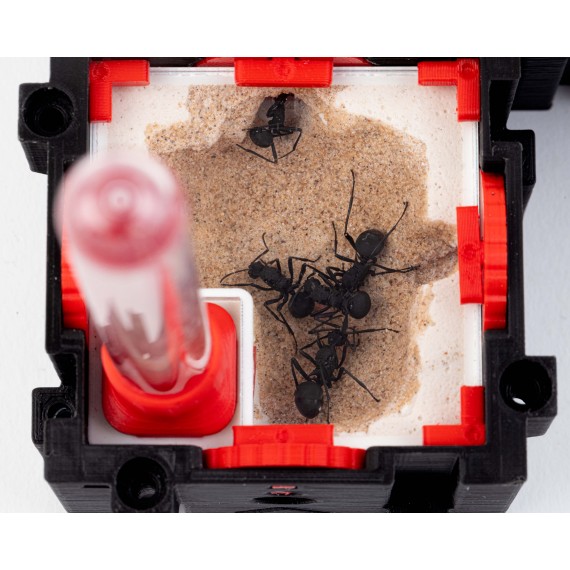
At Antomas we recommend the Qbik Wild range by Anthouse, made of plaster, which holds humidity very well. To start with, for a colony like ours, the Qbik Wild One P 1C is a compact format that is easy to manage:
When the colony grows, the natural next step is the Qbik Wild Duo P 2C Hybrid, the one that best keeps a nest humid and stable: beneath the galleries it has a separate water reservoir that passes humidity through a mesh with activated carbon without the water stagnating, and a side drinking tube.
Whichever model you choose, one ingredient is essential: sandy substrate inside the nest. Put a thin layer of clean sand in the chambers, on its own or mixed with fertiliser-free coconut fibre, and keep it moist: the larvae anchor their cocoon thread to the grains, and the fibre holds water. If the workers carry the substrate out of the brood chambers, add a little more. Complete the set-up with these details:
- A spacious foraging area: according to keepers, it covers more ground than other ants of its size, such as Camponotus.
- Clean walls, a lid with fine mesh and a mineral oil barrier (see “Escapes and barriers”).
- Water always available in a test tube with cotton wool, placed so that it cannot be buried: drinkers on the ground end up covered in substrate.
- A feeder for the occasional sugar; never cotton wool.
Arrival and moving in
At Antomas we sell colonies with queen, workers and brood. When yours arrives, let it rest in a quiet place at 24–28 °C and check that it has water. To move it into its formicarium, we do it by tipping: we open the tube inside the foraging area, next to the nest entrance, and tip the colony (workers, queen and brood) out with gentle taps. We help the stragglers with soft forceps. Before tipping, have the nest ready with its moist sand and the oil barrier in place, and if a worker stays motionless, give it time: it is probably pretending. Do it calmly and without fear: within a few hours they will have taken over the nest.
Feeding
E. astutus is a hunter: keepers estimate that protein makes up 80–90 % of what it eats. At Antomas we recommend prey of 1 cm or less, live or freshly killed, offered often:
Prey larger than 1 cm intimidates them and they often will not hunt it: if it is bigger, offer it in pieces. Their social stomach is small, so keepers give them small portions once or twice a day; if you cannot manage that, at least do not leave them several days without protein. Offer the prey in the foraging area, never inside the nest: one keeper who released live flies inside the nest several times ended up with the colony moving its brood. Change the type of insect from one week to the next, so they do not always eat the same thing, and buy from a reliable supplier: insects treated with insecticides can kill the colony.
The more they eat, the better and faster they grow. That is the Antomas philosophy: if you do daily maintenance and remove leftovers, it is better to overfeed, because the colony understands that it has plenty of resources and grows faster and in greater numbers. If you will not be able to clean often, do not overdo it: in such a humid nest, leftover food quickly brings mould and mites. Remove leftovers within 24 hours.
Sugar, only as a supplement. They take little of it, and often ignore it. Every now and then, offer them a drop of Anthouse’s Blue Sugar nectar and, for variety, another nectar, always in a feeder and never on cotton wool, which goes mouldy and spoils the liquid straight away. Water, on the other hand, must never be missing: always in the test tube with cotton wool.
Founding and growth
There are no scientific studies on how E. astutus founds its colonies. Keepers and shops describe it as semi-claustral: the queen goes out hunting to feed her first larvae, something common in ponerines. At Antomas we sell colonies with queen that are already established, so you skip that delicate phase. And it is a real advantage: one keeper observed that colonies with very few workers take poorer care of the larvae at the cocoon stage.
Growth is slow to moderate. The best record we know of is a keeper’s journal, with these approximate times at around 24–27 °C:
- Egg to larva: 1–2 weeks.
- Larva to cocoon: 1.5–2 weeks.
- Cocoon to worker: 4–5 weeks.
In that journal, a colony went from the queen and 3 workers in October to 11 workers in early December, 16 workers and 31 cocoons before Christmas and 24 workers in early January, with a queen that reached one egg a day. The workers remove the empty cocoons, so it is hard to catch the moment of emergence. With good food and a stable temperature, a colony can reach a few hundred workers: its charm lies in quality, not quantity.
Diapause
It has no diapause. It is a tropical species, active all year, and in the soil where it lives temperature changes are strongly buffered. Keepers and shops agree that it does not need one. At Antomas we keep it at 24–28 °C all year round, with no winter drop; do avoid sudden changes, though.
Behaviour in captivity
Solitary hunters. You will see the workers come out one by one, sweep the foraging area with their antennae and pounce on the prey. Watching them overpower a cricket with their sting and carry it to the brood is the best thing about this species.
Observe without fear. At Antomas we believe ants are there to be enjoyed, observed and learned from, not kept hidden away. Just leave them their dark area in the nest and a lit foraging area, and observe them gently, intervening and stressing them as little as possible. They get used to your presence; what they dislike is knocks.
Warning signs:
- Large larvae that never spin their cocoons: check the sand, the humidity and the temperature.
- Opened cocoons or disappearing brood: not enough humidity or not enough food.
- Mould in the nest: forgotten leftovers or standing water.
- Brood suddenly moved: something has stressed them, such as live prey in the nest, knocks or heat.
Escapes and barriers
Shops and keepers agree that E. astutus climbs smooth surfaces poorly, such as glass or acrylic. But do not rely on that alone: one keeper watched their workers stick grains of substrate and cocoon remains to the walls to build themselves steps, and climb up them. It is their own kind of cunning, and it does justice to the name. At Antomas we recommend:
- A mineral oil barrier along the upper edge of the foraging area, renewed when it loses effect.
- Clean walls: remove any substrate and debris stuck to the glass before it turns into a staircase.
- A lid with fine mesh, closed whenever you are not working, and nothing touching the barrier.
- Stoppers, joints and connections checked carefully.
Handling and safety
Its sting hurts: it is a ponerine with a real sting, and it uses it when it feels threatened, especially near the brood. That is why, at Antomas, we recommend always handling it with soft forceps, never with your hands, and working calmly and without knocks. We do not recommend it for people who are allergic to hymenopteran stings. It is an exotic species: it must never be released.
What not to do
- Setting up the nest without sandy substrate: the larvae cannot spin their cocoons.
- Letting the nest dry out: the brood dehydrates very quickly.
- Keeping it above ~28 °C for days: the queen may eat the brood.
- Waterlogging the nest or leaving food remains: it brings mould.
- Offering whole prey larger than 1 cm or releasing live prey inside the nest.
- Skimping on protein or always giving the same insect.
- Basing its diet on sugar or putting sugar on cotton wool.
- Giving it a diapause or lowering its temperature in winter.
- Relying only on smooth walls.
- Handling the ants with your hands.
- Keeping them hidden away: they are there to be watched and enjoyed, gently.
Scientific sources
This care sheet is based on the scientific literature on Ectomomyrmex astutus, its genus and ponerine ants, on climate data from its range and on the experience of Antomas and other keepers. Main references:
- Schmidt, C. A. & Shattuck, S. O. (2014). The higher classification of the ant subfamily Ponerinae (Hymenoptera: Formicidae), with a review of ponerine ecology and behavior. Zootaxa 3817: 1–242. doi:10.11646/zootaxa.3817.1.1
- Schmidt, C. (2013). Molecular phylogenetics of ponerine ants (Hymenoptera: Formicidae: Ponerinae). Zootaxa 3647: 201–250. doi:10.11646/zootaxa.3647.2.1
- Ke, Y., Tian, W., Zhuang, T., Wang, C. & Liang, M. (2013). Nest architecture of four ponerine ant species (Formicidae, Ponerinae) and organisms present in their nests. Journal of South China Agricultural University 34: 45–50. doi:10.7671/j.issn.1001-411X.2013.01.010
- Smith, F. (1858). Catalogue of hymenopterous insects in the collection of the British Museum. Part VI. Formicidae. London: British Museum. (Original description; no DOI)
- Bingham, C. T. (1903). The fauna of British India, including Ceylon and Burma. Hymenoptera, vol. II. Ants and cuckoo-wasps. London: Taylor and Francis. (No DOI)
- Peeters, C. & Crewe, R. (1984). Insemination controls the reproductive division of labour in a ponerine ant. Naturwissenschaften 71: 50–51. doi:10.1007/BF00365989
- Peeters, C. (1991). The occurrence of sexual reproduction among ant workers. Biological Journal of the Linnean Society 44: 141–152. doi:10.1111/j.1095-8312.1991.tb00612.x
- Wheeler, W. M. (1915). On the presence and absence of cocoons among ants, the nest-spinning habits of the larvae and the significance of the black cocoons among certain Australian species. Annals of the Entomological Society of America 8: 323–342. doi:10.1093/aesa/8.4.323
- Ismaeel, A. et al. (2024). Patterns of tropical forest understory temperatures. Nature Communications 15: 549. doi:10.1038/s41467-024-44734-0