Difficulty: 3/5 – Advanced
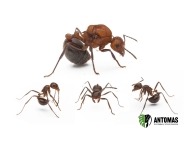
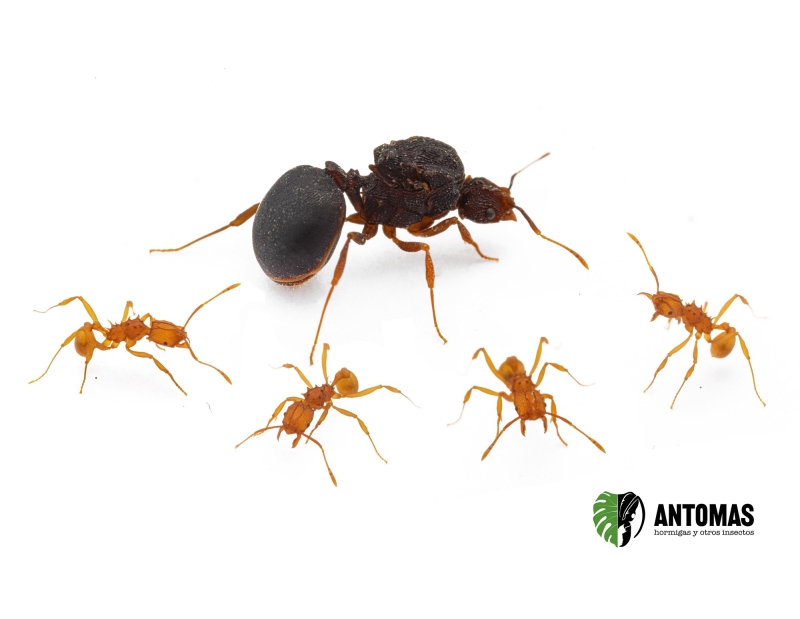
A soil ant from South and Southeast Asia and the species that gave its genus its name: antennae with only seven segments, a downward-curved gaster, a sting and colonies of thousands of workers that raise mounds of soil and hunt mainly at night. Queen with worker and brood, in full founding stage. Nest at 24–28 °C all year round, with moderate humidity and no diapause; Qbik Wild One to start with; nectar in a feeder and plenty of varied protein; moving by tipping. Escape barrier and lid from day one.
Myrmicaria brunnea Saunders, 1842 is one of those ants that dominate the ground wherever they live. From a single earth nest come thousands of workers that hunt, scavenge and tend sap-sucking insects across a territory that, in the rainforest of Borneo, has been measured in hundreds of square metres. It is the type species of Myrmicaria, a genus of more than 70 species in Africa and Asia, and it looks unmistakable: long legs, spines on the thorax and a gaster that hangs downwards.
It has been studied little for such a common ant, and almost never in captivity. That is why this care sheet separates what has been measured in this species, what is known about other Myrmicaria, what other keepers report and what we recommend at Antomas.
Biology
The ant with seven knuckles
The British entomologist William Wilson Saunders described it in 1842 from specimens from northern India, and he created the genus with it: brunnea means “brown”. Fifteen years later Frederick Smith, without yet connecting them, described similar forms under another very expressive name, Heptacondylus, from the Greek for “seven” and “knuckle”. He was referring to the strangest feature of these ants: the worker’s antenna has only seven segments, whereas most myrmicines have ten to twelve. Males, by contrast, have thirteen.
A genus spread across two continents
The genus has 71 species: 51 African and the rest Asian. It belongs to the tribe Solenopsidini, that of the fire ants, and it is old: a Myrmicaria has been found in Miocene amber from China (Wang and colleagues, 2021). In Africa it abounds in open habitats and its biology is somewhat better known: in M. eumenoides, Levieux (1983) described a mainly carnivorous diet of termites and other ants, topped up with honeydew. What we know of M. brunnea fits that pattern.
A subspecies collected by Wallace
One of the forms of M. brunnea has a special history. The specimens of M. brunnea subcarinata were collected in Sarawak, Borneo, by Alfred Russel Wallace, the naturalist who arrived at natural selection at the same time as Darwin, during his journey through the Malay Archipelago. Smith described them in 1857, and they are still in the Oxford University museum today.
Three forms are recognised today: the typical one, flava and subcarinata. According to Charles Bingham (1903), subcarinata is slimmer, paler and almost smooth. The genus has no modern revision, so the boundaries between these forms remain unclear.
A territory of 270 m²
The best portrait of its life in the wild comes from Wriedt and colleagues (2008), who followed a colony of M. b. subcarinata in a forest in Sarawak. Their figures are impressive for an 8 mm ant:
- A single nest with about 6,000–8,000 individuals.
- A territory of about 270 m², the size of a house with a garden.
- Underground motorways: many foraging trails ran underground, and the researchers traced about 44 m in total.
- Active around the clock, with foraging peaking at night.
- Dominant at food: it won nearly two-thirds of the encounters at baits. Its most effective rival was Pheidologeton affinis, now Carebara affinis, an ant with huge armies.
Hunter, scavenger and herder
In that study most of its food was of animal origin, with some sap and particles of herbaceous plants. To that it adds a very profitable business: trophobiosis, tending sap-sucking insects in exchange for their honeydew. In Sarawak it tended bugs and other hemipterans on the stems of the climbing bamboo Dinochloa trichogona, and in India it is known as a partner of the aphid Aphis gossypii (Siddiqui and colleagues, 2019). It also makes use of dead animals.
It communicates well, too. In India, Rastogi and colleagues (1997) saw that foragers finding food guided nearby nestmates, so that the group reached the bait sooner than if each had searched alone. The same did not happen with the Diacamma they compared it with.
The nightmare of the tasar silkworm
Its fame in India has an economic reason. Tasar silk comes from Antheraea mylitta, a large wild moth whose caterpillars are reared outdoors, on trees. According to Gathalkar and Barsagade (2018), M. brunnea is a serious predator of those caterpillars: the workers sting and bite them repeatedly until they destroy them, causing significant crop losses. These authors studied the sensory organs on its antennae and mouthparts to explain its effectiveness.
A venom that challenged the chemists
Myrmicaria have a well-developed sting and a unique chemistry. In the venom glands of African species, Schröder and colleagues (1996) found the myrmicarins, alkaloids with a carbon skeleton previously unknown, including a seven-ringed one, myrmicarin 430A. In the African M. eumenoides, that same gland is also involved in recruiting nestmates (Kaib and Dittebrand, 1990). The venom of M. brunnea has not been studied, although one shop says that when disturbed it gives off a strong smell that alerts the others.
Mound builder
It nests in the soil and often raises large mounds of soil particles. It lives in very different places: fruit gardens, open woodland, forest edges and well-preserved forests. That tolerance explains why it is found both in the rainforest and close to people.
In the genus, worker size seems to increase with colony age: older colonies produce larger and more varied workers. You will notice this at home: the first workers are small and each generation is a little larger.
From Pakistan to Borneo
The species, in the broad sense, lives in Pakistan, India, Sri Lanka, Bangladesh, Myanmar, Thailand and China, and the form subcarinata reaches Borneo, Java and other Indonesian islands. It is above all an ant of tropical and monsoon climates: a long, warm and rainy summer, with averages of 27–29 °C and air humidity of 75–85 %, and a drier season. Underground, the nest barely feels these fluctuations.
Size and morphology
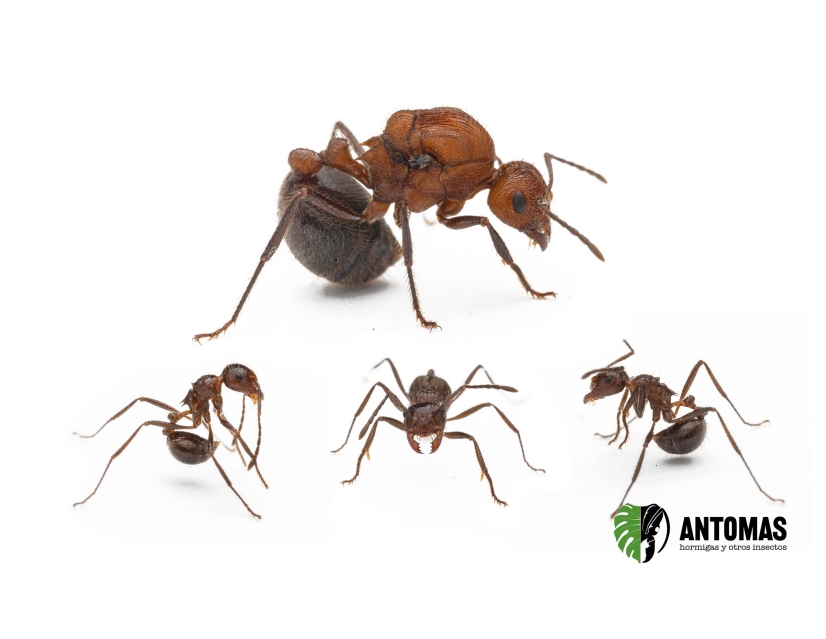
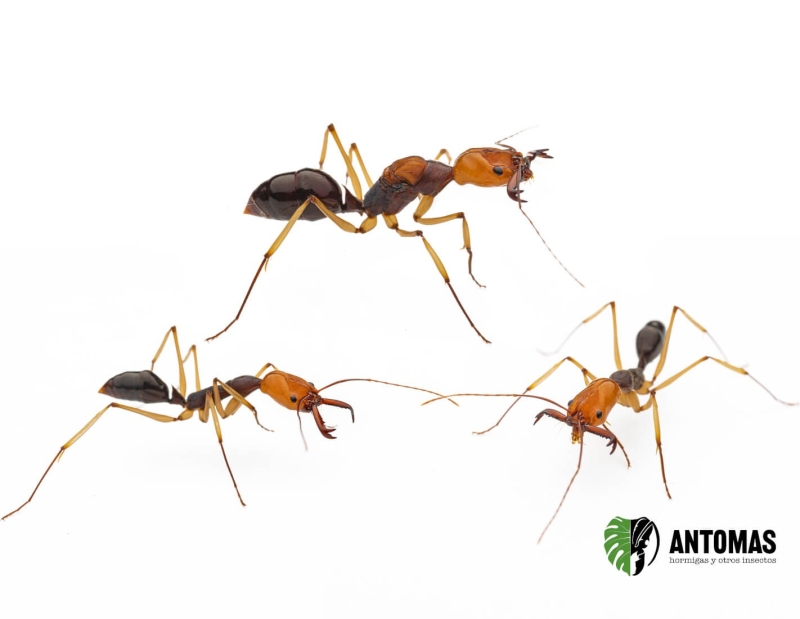
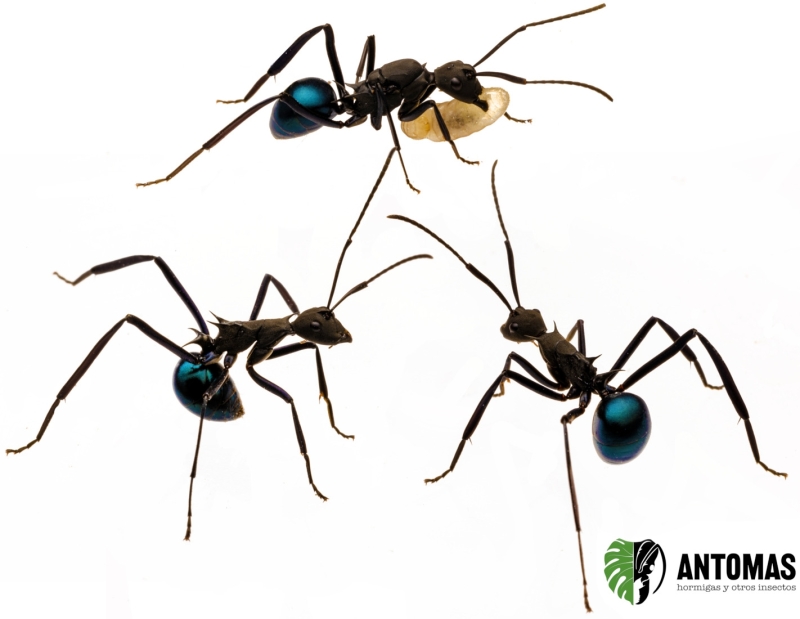
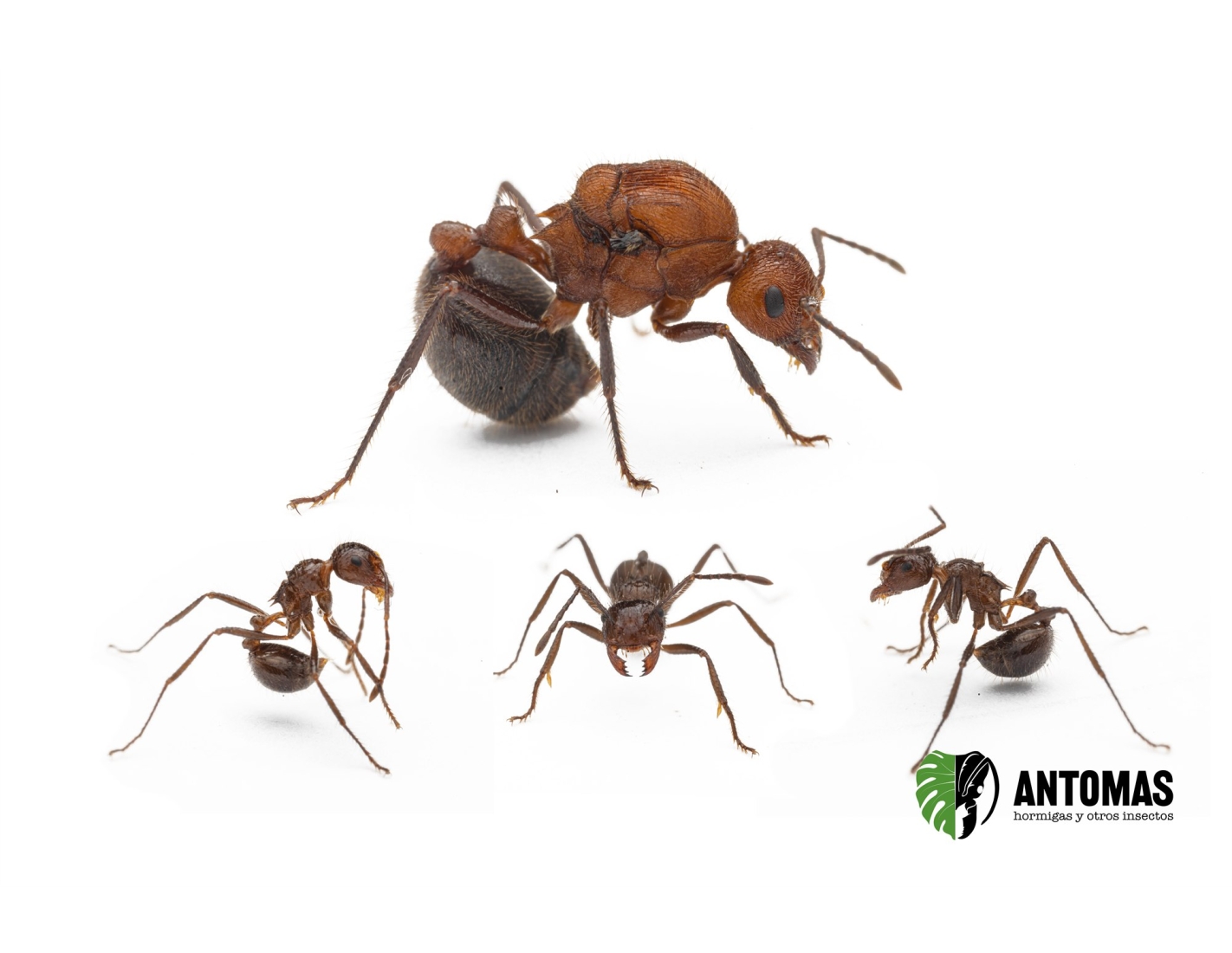
A medium-sized, slender myrmicine, very recognisable to the naked eye:
- Colour. Shiny chestnut, from light chestnut to yellowish in some workers, with the edge of the gaster segments darker.
- Sculpture. Head and thorax with longitudinal striations; gaster smooth and polished.
- Hairs. Long and abundant, reddish yellow.
- Thorax. With a pair of spines on the propodeum.
- Waist. Petiole with a long stalk and a well-marked node, and a long postpetiole as well.
- Gaster. The joint with the postpetiole is set low, which is why it seems to hang. It ends in a well-developed sting.
- Antennae. Seven-segmented in the worker.
- Queen. Much larger, with a striated pronotum and mesonotum and transparent wings with brown veins.
- Male. Yellowish chestnut, with the edge of the gaster segments dark.
Approximate measurements
- Worker: 5.5–8 mm (Bingham, 1903)
- Queen: 12–13 mm (Bingham, 1903)
- Male: 10–11 mm (Bingham, 1903)
Shops give similar figures, although one goes up to queens of 16 mm and workers of 9 mm. We have not found more modern published measurements.
Care in captivity
Difficulty: 3/5 – Advanced
An established colony is robust and eats everything. Even so, at Antomas we place it at the advanced level for four reasons:
- Founding. It is sold with very few workers: the first weeks are the most delicate.
- The strength of the colony. It grows large and is voracious: in time it needs space and plenty of food.
- The sting. It stings, and a large colony defends its nest en masse.
- Little published experience. Shops do not even agree on how many queens it has.
And it is worth it. Few ants offer such a show at night: columns of workers with hanging gasters, fast recruitment and prey cut up by the group.
Recommended parameters
- Nest temperature: 24–28 °C all year round. If heat is needed, at the side and always with a thermostat, so that the colony can choose.
- Foraging area: 22–28 °C.
- Nest humidity: 60–80 %, with one humid area and one drier area.
- Foraging area humidity: 50–60 %.
- Why these values: they are those of the warm months in its range, and shops give very similar ranges (nest at about 24–28 °C and between 60 and 90 % humidity).
- Light: dark nest and lit foraging area, with a normal day and night cycle.
- Diapause: not needed (see “No diapause”).
Recommended formicarium
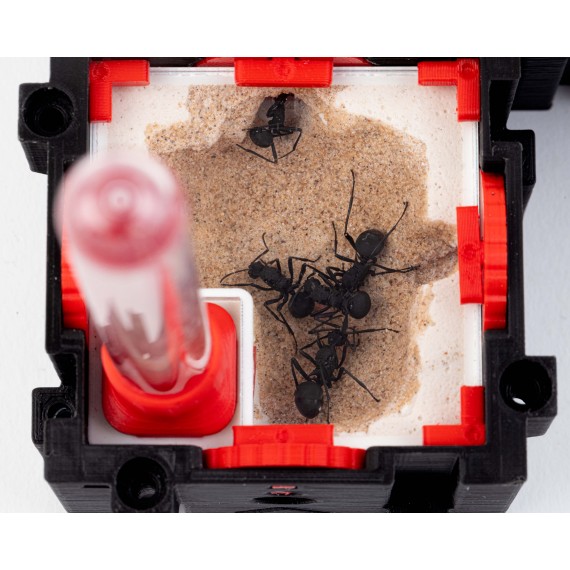
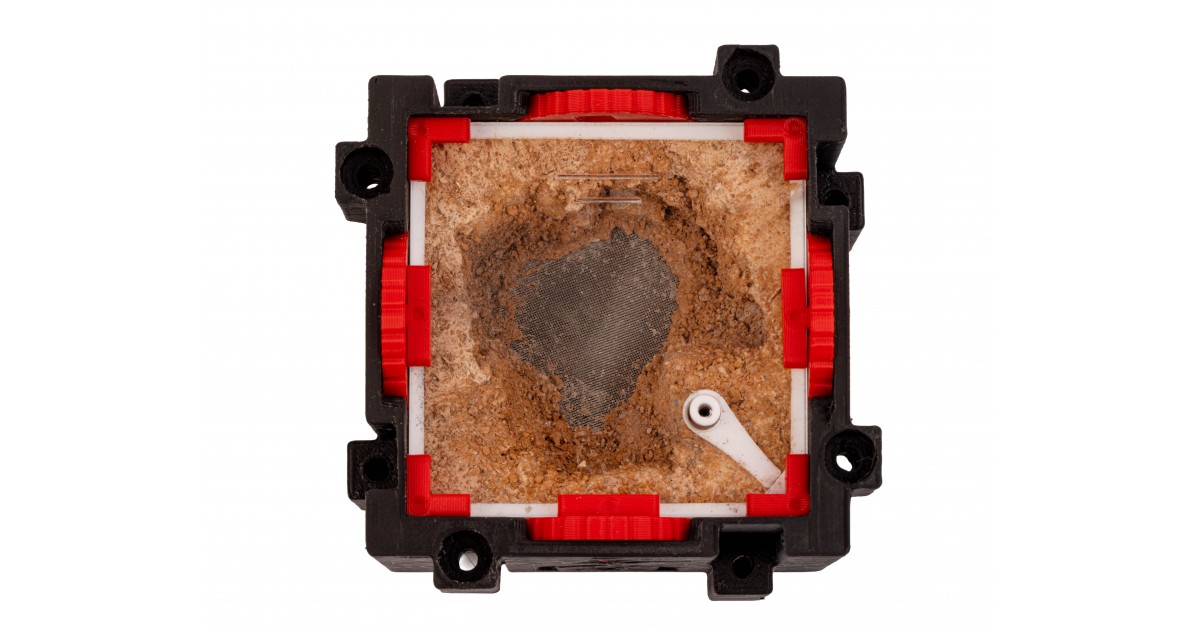
To start with, at Antomas we recommend the Anthouse Qbik Wild One, made of plaster, which holds humidity well, in either its standard or its evaporation version. The standard version has a refillable water tube. In the evaporation version, the water sits in a reservoir under the nest, separate from the galleries, and the humidity rises through a mesh, creating a gradient so that the colony can choose where to settle.
To expand, when the colony has a few dozen workers and chambers start to run short, at Antomas we recommend a hybrid, which provides more humidity: the Qbik Wild Duo P 2C Hybrid.
Complete the setup as follows:
- A foraging area with some substrate, in proportion to the colony.
- Water in a test tube with cotton wool and a feeder for the sugar.
- Escape barrier and a well-fitting lid (see “Escapes and barriers”).
How to prepare the Qbik Wild
The formicarium arrives dry, and the plaster takes about a week to take up moisture. Prepare it before the colony arrives, following Anthouse’s instructions:
- Standard version: fill the humidity tube and keep it upright. To speed things up, add 2.5–5 ml of water with a syringe through a side access.
- Evaporation version: fill the reservoir with a syringe. When the water runs out, empty it completely and refill it from scratch.
- Water only: nectar and other liquids ruin the humidity system.
- Heat always at the side: never directly on the modules.
Arrival and founding
We sell it in full founding stage: queen with worker and brood. This is the most delicate moment, so less is more:
- Peace and quiet. Leave it somewhere dark, quiet and free of vibrations at 24–26 °C and check that it has water. Do not inspect it every day.
- Minimal food. A drop of nectar and a tiny piece of small, soft prey, such as Thermobia or a fruit fly, once or twice a week. Remove what is left the next day.
- One queen per colony. Shops contradict each other: some say it is monogynous and others polygynous. At Antomas we do not combine queens.
- Pace. There are no scientific data. Shops speak of 7–9 weeks from egg to worker, and keepers of a few dozen workers in the first year.
Moving by tipping
At Antomas we move it into the formicarium by tipping, and with this species there is no need to wait until the colony is large. Do it carefully, as there are very few workers and the brood is delicate:
- Set up the formicarium beforehand, with the humid area ready, the water in place and the barrier on.
- Work over a tray with a soft brush, never with your hands.
- Open the container it arrived in inside the foraging area, next to the nest entrance, and gently tip out the queen, the workers and the brood, helping any stragglers with the brush.
- Close the lid and leave the nest dark. Within a few hours they will have carried the brood inside.
To move it to a larger module later, use the same method. Once the colony has grown, do it slowly: they sting.
Growth
One shop speaks of colonies of up to 20,000 workers and others of about 10,000. The only measured figure is that of Wriedt and colleagues: 6,000–8,000 individuals in one nest. There are no published data on growth in captivity, but with warmth, abundant food and a nest of the right size, expect a slow start and a colony that speeds up once it passes a few dozen workers.
Feeding
Sugar in a feeder, always available. At Antomas we recommend variety: Anthouse Blue Sugar Nectar 4–5 times a week and another nectar or sugary liquid 1–2 times a week. You can also add a little protein to the nectar. Always offer it in a feeder, where the drop stays spread out and within reach, and never on cotton wool, which goes mouldy and quickly spoils the liquid.
Protein: the more, the better. In the wild, most of what it eats is of animal origin, and in the experience of Antomas, the more protein a colony gets, the faster it grows. If you clean often and remove the leftovers, it is better to overdo it than to fall short; if you cannot clean, it is better not to overfeed. Change the type of insect from one week to the next:
At dusk. As it forages mainly at night, put the protein in as evening falls and remove the leftovers the next morning. With a large colony, also try small live prey: you will see how they recruit and hunt as a group.
Remove the leftovers within 24–48 h and buy the insects from a reliable supplier: insects treated with insecticides can kill the colony.
Water: always, in the test tube with cotton wool in the foraging area, separate from the sugar.
No diapause
It does not need diapause. Shops and keepers agree, and the climate over much of its range has no cold winter. At Antomas we recommend keeping it active all year round, at 24–28 °C.
- If your home stays at around 20–22 °C in winter, nothing happens: the colony grows more slowly and recovers with the warmth.
- To stop it slowing down, use heat at the side with a thermostat.
- Do not take it to a garage or a fridge, as you would a European species.
Behaviour and observation
A night ant. By day you will see few workers, and the foraging area fills up after dark. If you want to see it at work, watch it late in the evening.
Group recruitment. Once the colony has grown, as soon as one worker finds food, others arrive quickly. One shop describes it as very aggressive towards prey.
Watch without fear. At Antomas we believe ants are there to be enjoyed, watched and learnt from, not kept hidden away. All it takes is a dark nest, a lit foraging area and a gentle approach when you watch them.
Warning signs:
- The queen stops laying in the middle of the season: check the temperature and the protein.
- Larvae not growing: not enough protein.
- Mould or mites: too much water or forgotten leftovers.
- Many workers idle in the foraging area: time to expand.
Escapes and barriers
With a large colony, an escape will not go unnoticed. From the outset:
- Barrier: a thin, continuous strip of mineral oil at the top of the foraging area walls. Renew it when it gathers dust or debris.
- A well-fitting lid as a second line.
- No gaps in connections, plugs and tubes.
- Nothing that acts as a bridge to the barrier.
Handling and safety
It has a sting and it stings. No need for drama: it is much less painful than a bee or wasp sting, although a large colony defends its nest en masse. Work with tweezers and a soft brush over a tray, and open only as much as you need. We do not recommend it for people allergic to hymenopteran stings, and with small children or pets at home, keep the formicarium closed and out of their reach. This is an exotic species: it must never be released.
What not to do
- Inspect a queen with so few workers every day.
- Give it large or live prey while it has very few workers.
- Combine queens or colonies.
- Let the nest dry out, or soak all of it.
- Give it a cold diapause or keep it without any heat in winter.
- Put the sugar on cotton wool or always give the same insect.
- Leave leftovers for more than a day.
- Handle it with your hands or neglect the barrier.
Scientific sources
This care sheet is based on the scientific literature on Myrmicaria brunnea and its genus, on the AntCat and AntWiki catalogues, on climate data from its range and on the experience of Antomas and other keepers. Main references:
- Saunders, W. W. (1842). Descriptions of two hymenopterous insects from northern India. Transactions of the Entomological Society of London 3: 57–58.
- Smith, F. (1857). Catalogue of the hymenopterous insects collected at Sarawak, Borneo; Mount Ophir, Malacca; and at Singapore, by A. R. Wallace. Journal of the Proceedings of the Linnean Society of London, Zoology 2: 42–88.
- Bingham, C. T. (1903). The Fauna of British India, including Ceylon and Burma. Hymenoptera, Vol. II. Ants and Cuckoo-wasps. Taylor and Francis, Londres. Text on the Internet Archive (open access)
- Kaib, M. & Dittebrand, H. (1990). The poison gland of the ant Myrmicaria eumenoides and its role in recruitment communication. Chemoecology 1: 3–11. doi:10.1007/BF01240580
- Schröder, F., Sinnwell, V., Baumann, H. & Kaib, M. (1996). Myrmicarin 430A: a new heptacyclic alkaloid from Myrmicaria ants. Chemical Communications 1996: 2139–2140. doi:10.1039/CC9960002139
- Rastogi, N., Nair, P., Kolatkar, M. & Gadagkar, R. (1997). Foraging strategies in the ants Myrmicaria brunnea and Diacamma ceylonense: some preliminary observations. Entomon 22: 79–81.
- Wriedt, J., Mezger, D., Chong, L. & Pfeiffer, M. (2008). Observations on the foraging behaviour of Myrmicaria brunnea subcarinata (Smith) (Hymenoptera: Formicidae) in a tropical rainforest in Sarawak (Malaysia). Asian Myrmecology 2: 109–120.
- Gathalkar, G. B. & Barsagade, D. D. (2018). Cephalic microstructure and its role in predation biology of Myrmicaria brunnea on Antheraea mylitta. Journal of Applied Biology and Biotechnology 6: 1–6. doi:10.7324/jabb.2017.60101
- Siddiqui, J. A., Li, J., Zou, X., Bodlah, I. & Huang, X. (2019). Meta-analysis of the global diversity and spatial patterns of aphid-ant mutualistic relationships. Applied Ecology and Environmental Research 17: 5471–5524. doi:10.15666/aeer/1703_54715524
- Levieux, J. (1983). Mode d’exploitation des ressources alimentaires épigées de savanes africaines par la fourmi Myrmicaria eumenoides Gerstaecker. Insectes Sociaux 30: 165–176. doi:10.1007/BF02223866
- Wang, B., Shi, G., Xu, C., Spicer, R. A., Perrichot, V. et al. (2021). The mid-Miocene Zhangpu biota reveals an outstandingly rich rainforest biome in East Asia. Science Advances 7: eabg0625. doi:10.1126/sciadv.abg0625