Difficulty: 3/5 – Advanced
A small harvester ant from the Asian rainforest with one of the most extreme dimorphisms in the ant world: tiny minors and a handful of giant-headed majors which, according to the studies, grind seeds and guard the nest entrance. Small colonies, with queen, workers and brood. Plaster nest with one humid area and a drier one, 24–27 °C, small and varied prey, sugar in a feeder and small seeds such as fig seeds. No diapause. They grow slowly and squeeze through any gap: a small, well-sealed formicarium with a PTFE barrier.
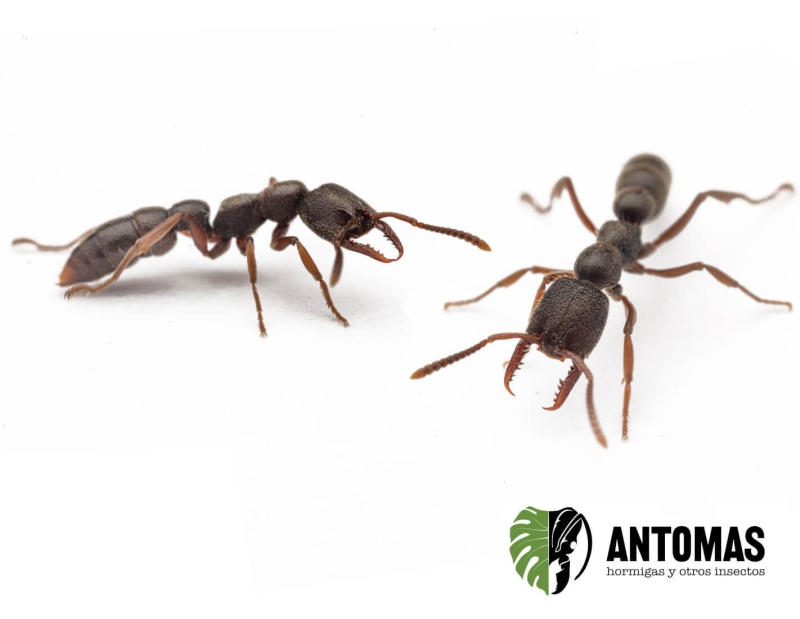
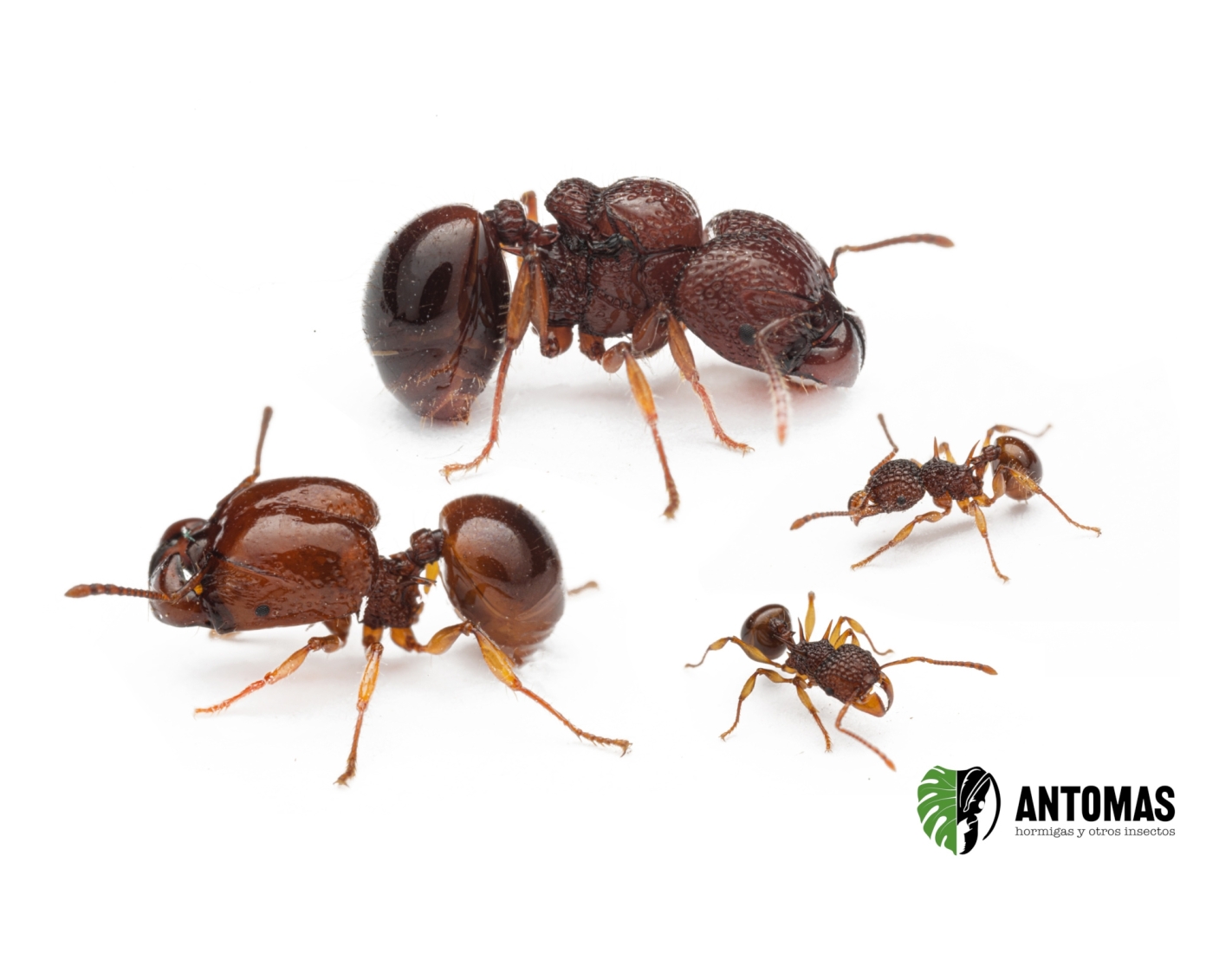
Acanthomyrmex Emery, 1893 is a small genus of myrmicine ants from tropical Asia, little known even among specialists and almost absent from the hobby. Its name comes from the Greek akantha, ‘thorn’, and myrmex, ‘ant’, after the spines on the workers’ thorax. But what catches the eye at first glance is not the spines, it is the head of the majors: so large that, seen from the side, the ant looks like a head on legs. In Spain we call it the ‘Hormiga Cabezona’, literally the ant with the big head, and rightly so.
We sell these colonies as Acanthomyrmex sp., that is, without a species name, and we do so on purpose. The genus has 17 described species, several of them very similar to one another, and identifications in the hobby are unreliable: on one keeping forum, for example, a colony sold under one name turned out, according to the seller himself, probably to be another species. Our colonies resemble A. glabfemoralis and its relatives, but without an identification made with the key in hand we prefer not to claim it. That is why, in this care sheet, we keep separate what science knows about the genus, what keepers report and what we have learnt at Antomas.
Biology
A genus of spines and heads
It was described by the Italian entomologist Carlo Emery in 1893, from a few workers from Sri Lanka. For almost a century hardly anything was known about it, until the myrmecologist Mark W. Moffett, of Harvard University, published the first observations of its behaviour in 1985 and, in 1986, the revision of the genus, with six new species split into two groups: the A. luciolae group and the A. notabilis group. More followed, among them A. glabfemoralis in 1997 and A. humilis in 2008, up to today’s 17. Molecular phylogenies place the genus in the tribe Crematogastrini, a huge group of mainly palaeotropical origin, the same as Crematogaster or Tetramorium. It has no common name in the scientific literature: ‘Hormiga Cabezona’ is the name we give it in our Spanish shop.
‘A walking head’
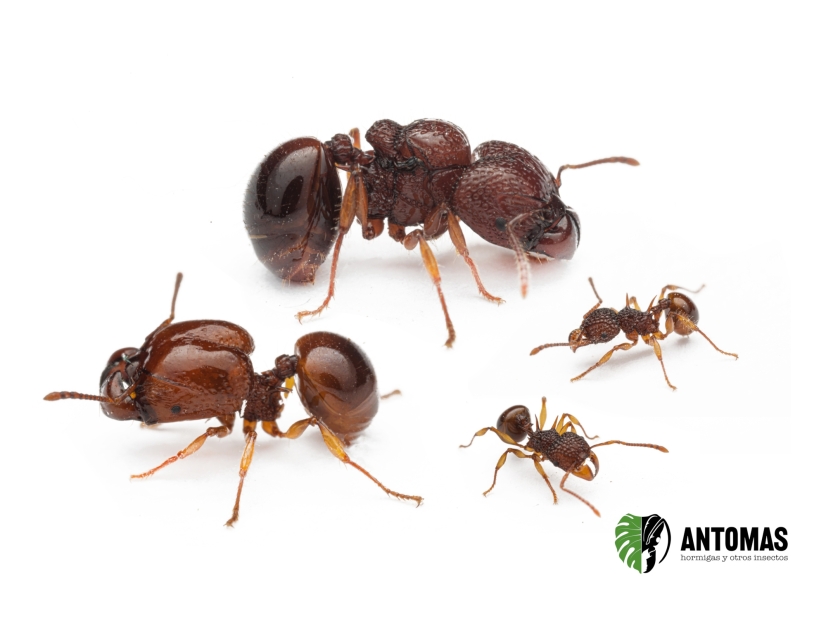
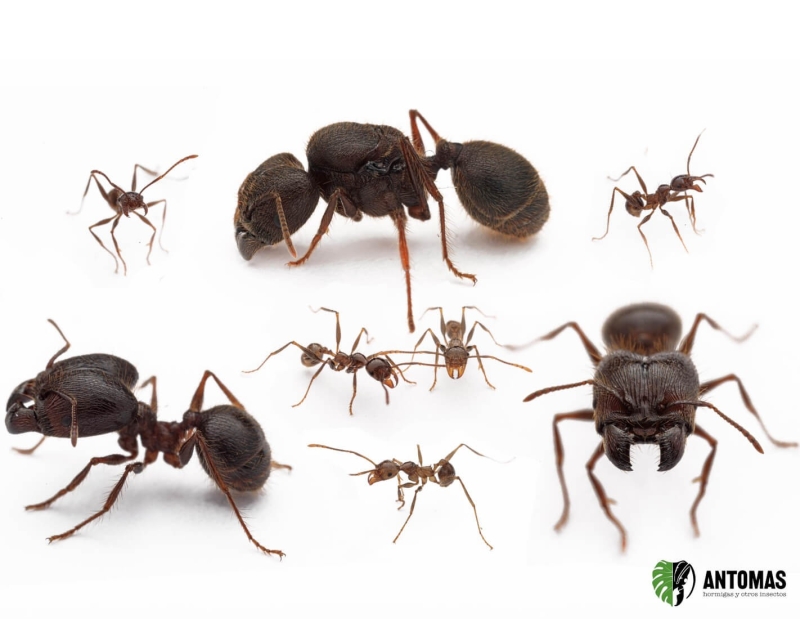
All Acanthomyrmex are dimorphic: their workers belong to two clearly separate castes, minors and majors, with no intermediate sizes. This is what is called complete dimorphism, and in ants it has arisen independently several times. For Moffett, Acanthomyrmex are perhaps the most spectacular examples of all, ‘the most striking’ cases of allometric growth known in ant workers.
The figures say it all. In a series of A. notabilis from Sulawesi, the head of a major was twice as long as that of a minor from the same nest and, given its shape, had about ten times its volume. And yet its antennae were only 5% longer and its trunk only 3% longer. In other words, the major is, to all intents and purposes, a minor with an enormous head.
In the major, the head seems to have more volume than the whole rest of the body and projects backwards over the trunk, which sits partly tucked into a cavity beneath it. With the gaster folded under the body, the trunk is barely visible from the side. Moffett summed it up in one sentence: the first impression of a live major of A. notabilis is that of ‘a walking head’.
Harvesters in the heart of the rainforest
When we think of harvester ants, we think of Messor or Pogonomyrmex, of dry fields and deserts. Harvesters are most abundant in arid environments. Acanthomyrmex break that pattern: they are leaf-litter ants of the tropical rainforest and, at least some of them, store seeds in the nest.
Moffett found the proof in northern Sulawesi. Inside a nest of A. notabilis there was a little pile of some 35 fig seeds, many with the outer coat gnawed. Other nearby colonies also stored fig seeds, in an area particularly rich in fig trees. In the field they carried sesame away from baits, and in captivity A. ferox moved the seeds together with the brood every time they relocated.
Moffett included at least A. notabilis among the ‘harvesting ants’. But they are not strict seed-eaters: they also eat fruit, tiny prey such as small centipedes, springtails or true bug nymphs, invertebrate carcasses and sugar. This fits the theory: seed specialists tend to have workers of a single size, whereas species with a broad diet tend to develop a highly specialised caste to grind them.
Millstone mandibles
What is such a big head for? The majors of every species have massive mandibles whose chewing edge is often heavily worn, typical features of the ‘milling’ castes of harvester ants, and in the A. notabilis nest they were badly worn down. A head like that is, above all, a box full of the muscle that drives those mandibles. Mind you, Moffett never actually saw a major grinding a seed: it is a very reasonable deduction, but a deduction all the same. In one keeping journal of Acanthomyrmex sp., the workers stored chia seeds, moistened them and ground them once they had softened, and the majors cut up locust legs for the brood.
Pocket-sized colonies
If you are looking for an ant for a large formicarium, this is not your species. Acanthomyrmex colonies are tiny:
- The A. notabilis colony that Moffett excavated had 3 majors, 37 minors and brood. Other colonies of the same species had around 40–50 workers, with 1–3 majors.
- The almost complete A. ferox colony had 47 minors, 2 majors, 7 males and a queen.
- In a study of 49 A. ferox colonies, the average was about 25 workers and 2–3 majors per colony.
Majors are always very few, less than 10% of the workers. According to Edward O. Wilson’s ergonomic theory of castes, the more specialised a caste is, the more efficient it is and the fewer individuals are needed. In captivity, keepers speak of colonies of a few dozen workers. For the hobby this is an advantage: a mature colony fits in a small formicarium for its whole life.
Eggs that are food
In many ants, the queen and sometimes the workers lay trophic eggs: eggs that do not develop and serve as food for the larvae, the queen or other workers. It is a way of sharing nutrients within the colony. Recent studies on the harvester ant Pogonomyrmex rugosus have shown that they even influence the fate of the larvae, whether they will become workers or queens.
In A. ferox, the researchers Bruno Gobin and Fuminori Ito found a surprising division of labour. The queen lays reproductive and trophic eggs, whereas majors and minors, with the queen present, lay only trophic eggs. And of all the trophic eggs in the colony, the queen lays 17%, the minors 41% and the majors 42%. This is striking on two counts: the queen was expected to devote herself solely to reproduction, and the majors, a defensive caste in many species, were expected to be sterile. In Acanthomyrmex, by contrast, those big heads are also the colony’s larder.
Sumo among big heads
There is more. In 2003, the same authors published a paper with an unforgettable title: ‘Sumo wrestling in ants’. A. ferox majors have as many ovarioles as the queen, three times as many as the minors, so they are very well equipped to lay eggs. Among themselves they settle a hierarchy through antennal ‘boxing’ and spectacular jerking fights, a form of contest never before described in ants. They fight only among majors, never with the minors, and the hierarchy is stable: there was not a single change of rank.
While there is a queen, fights are rare and the majors lay only trophic eggs. But if the queen disappears, aggression soars and all the majors start laying reproductive eggs, which give rise to males, although the higher they stand in the hierarchy, the more developed their ovaries. The dominant major, moreover, patrols the egg pile and eats the eggs laid by its subordinates. A genuine fight over the inheritance in a colony of a few dozen ants.
Dwarf queens and normal queens
In A. glabfemoralis, a 2008 study described for the first time, alongside the major, the normal queen and the male, a ‘dwarf queen’. Some colonies have a single normal queen, dealate after the nuptial flight, while others have one or several dwarf queens instead, and the structure varies from one locality to another. The authors believe the species may be in transition towards a system with wingless queens that are more worker-like. It is not an isolated case: in many ants there are intermediate or ‘mosaic’ castes, built by evolution from queen and worker parts.
Brood in their arms and a skittish queen
In captivity, Moffett saw that the workers spend a lot of time holding eggs, larvae and pupae in their mandibles, even when the colony is calm: a way of always being ready to flee with the brood, very useful in exposed leaf-litter nests. The majors also carried brood at times; Moffett recorded at least five different tasks in them, something unexpected in such an extreme caste. The A. ferox queen, on the other hand, was very timid: at the slightest problem she ran off, and the colony moved to wherever she was found. Keepers agree on their temperament: when disturbed, they freeze. One hobbyist called them ‘the calmest ants on the planet’.
Shy outside, steadfast at the door
Foraging minors retreat at the slightest disturbance, but they do defend the nest. When Moffett brought ants of other species close to an A. notabilis nest, the minors came out to bite them and the head of a major soon appeared in the entrance, blocking the way. It bit with such tenacity that Moffett was able to pull it out of the nest by tugging on a pair of forceps. Its technique: lower the head and present the intruder with its full face, broad as a shield, while bringing the gaster forward, with a much-reduced sting. Faced with ants with a powerful sting, such as Solenopsis or Monomorium, they prefer to flee with the brood.
Leaf litter, dead wood and monsoon
Acanthomyrmex live in the Oriental region: from Sri Lanka and mainland South-East Asia to southern China, Malaysia, Borneo, Sumatra, Sulawesi, the Moluccas and the Philippines. Curiously, they have not been found in India or New Guinea. Moffett found an A. notabilis colony in a log, in primary rainforest: the nest was a single natural passage 6 cm long and 4 mm wide. A. glabfemoralis, abundant in Vietnam and southern China, nests in cavities in twigs and rotten wood, in rock crevices and under stones on the forest floor.
The climate of its range is monsoonal, tropical in the south and subtropical in the north: warm and humid, with a marked rainy season. In the areas closest to the equator there are hardly any seasons; in the north of its range, summer is warm and rainy and winter cooler and drier, though mild. For keeping, the lesson is clear: stable warmth, humidity without waterlogging and no cold diapause.
Size and morphology
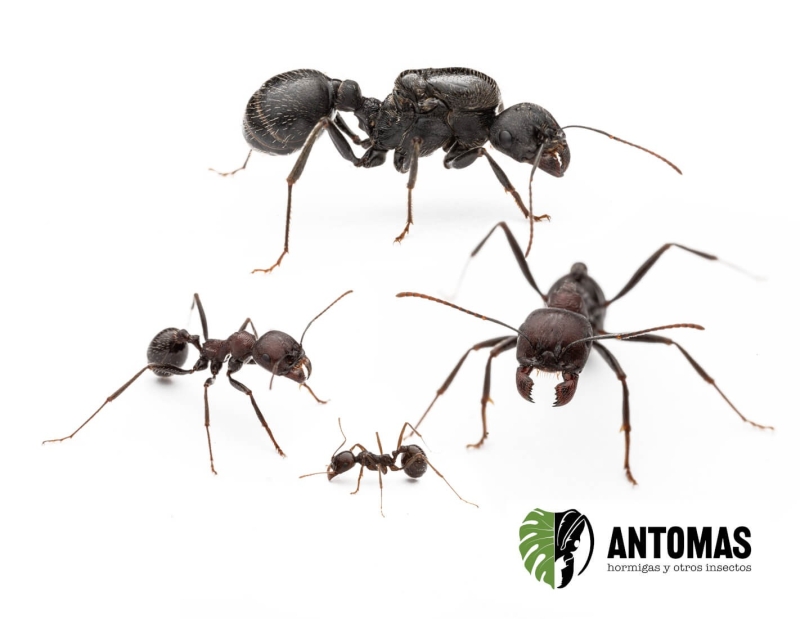
A small myrmicine with a compact, heavily sculptured body, spines on the thorax and two clearly separate worker castes. If you keep or have kept Pheidole pallidula, the idea will sound familiar: minors and big-headed majors. But in Acanthomyrmex the difference is far more exaggerated.
- Minors. Small, 2.7–5.0 mm in total length depending on the species, with little size variation within the same colony. Large head, about 50% wider than the trunk, its surface covered in small pits (foveae) from which long, erect hairs arise. Fairly large, strongly convex eyes. 12-segmented antennae with a three-segmented club. On the thorax, spines: usually one pair on the pronotum and another on the propodeum, the rear part.
- Majors. Enormous head, twice as long as the trunk or more, with massive mandibles and a large blunt, tooth-like process beneath their base. Antennae the same size as those of the minors, ridiculously small on such a head. Trunk without the pronotal spines.
- Queen. Head smaller than that of the majors and not projecting over the trunk, with ocelli; trunk very short and robust, almost as wide as it is long; short, thick spines on the propodeum. Mandibles with the same process as the majors.
- Male. Broad head with large eyes, 13-segmented antennae and long but much less massive mandibles.
- Gaster. Small, oval and tucked in, with a much-reduced sting. The majors do not become repletes although, as we have seen, they lay trophic eggs.
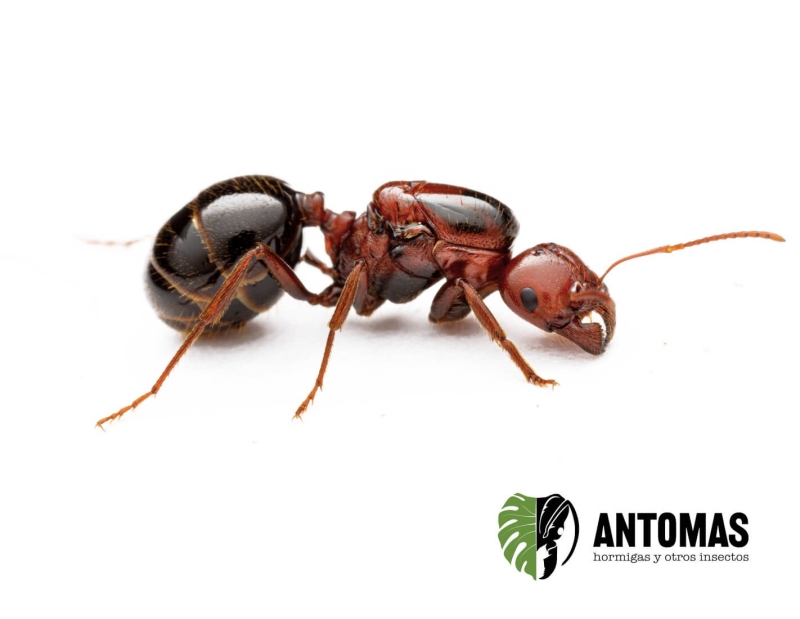
- Colouration. Variable depending on the species: from orange-yellow to reddish brown. Ours are mahogany or reddish brown, with lighter, amber legs and antennae. The photo on this page shows the difference in texture very clearly: the minors, with head and thorax covered in pits, and the major, with an enormous, smooth, shiny head.
To tell the species apart, specialists look at details such as the sculpture of the head, the shape and spines of the petiole and postpetiole or the hairiness of the legs: the very name A. glabfemoralis, for example, refers to its hairless femora. These are characters that require a magnifier and the key to the genus; that is why we prefer to sell it as Acanthomyrmex sp.
Approximate measurements
- Minors: total length 2.7–5.0 mm; head width 0.70–1.23 mm (genus)
- Majors: head width of about 1.6–2.6 mm in the measured specimens of several species; head twice as long as the trunk or more; total length not published
- Queen: head width 1.86–2.30 mm in A. ferox; total length not published
- Male: no published total-length measurements
The measurements come from Moffett’s revision of the genus (1986) and apply to the species as a whole, not just ours. Nobody has published the total length of a major or a queen: in life, the major carries its head bent over the trunk and the gaster tucked in.
Care in captivity
Difficulty: 3/5 – Advanced
It is not a delicate species: it is calm, eats everything, needs no diapause and lives in a small formicarium. So why is it not a 1/5? For three reasons:
- It grows slowly and stays small. A few dozen workers and plenty of males: this is a species for close-up observation, not for watching it grow big.
- Stable humidity and warmth. It needs a humid area in the nest, neither waterlogged nor drying out, and a constant temperature.
- They squeeze through any gap. The minors measure barely a few millimetres.
And it is well worth it: majors that look like cartoons, seeds stored in the heart of the rainforest and a social life with trophic eggs and sumo bouts. With a magnifier, every colony is a small laboratory.
Recommended parameters
- Nest temperature: 24–27 °C, stable all year round.
- Foraging area: can be a little warmer at one end, up to about 28–30 °C, so the colony can choose. Never strong heat inside the nest.
- Humidity: one humid area in the nest and a drier one, so they can settle where they prefer. Plaster moist, but never waterlogged or with droplets on the glass.
- Water: always available, in a test tube with water and cotton wool in the foraging area.
- Light: the dark area in the nest and the foraging area lit, with a normal day–night cycle.
- Diapause: not needed (see ‘No diapause: stable warmth all year round’).
Avoid direct sunlight, radiators and draughts. If you use a heat cable or heat mat, always with a thermostat and at one side, never under the whole nest.
Recommended formicarium
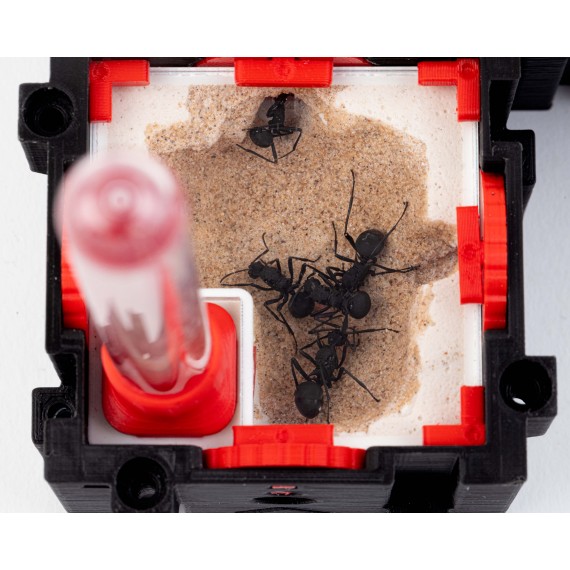
For a tropical leaf-litter ant that needs humidity, at Antomas we recommend the plaster formicaria of the Qbik Wild range by Anthouse, which hold humidity well and let you keep one area more humid and another drier. And, as the colonies are tiny, the smallest one: the single-chamber Qbik Wild One P 1C. For an Acanthomyrmex colony it is enough for a long time, and probably for life.
Only if the colony grows a lot and you see many workers with no room inside the nest, upgrade to the two-chamber Qbik Wild Duo P 2C:
Do not upgrade too early: in a nest that is too large, such a small colony scatters and the spare chambers end up as rubbish dumps. Moisten the plaster through its reservoir and leave the other end drier. In the small foraging area, a little soil, some dry leaf litter or bark and a flat stone are enough, plus the water tube, a small feeder and the barrier (see ‘Escapes and barriers’).
Arrival and moving in
Your colony arrives with its queen, its workers and brood. When you receive it, let it rest in a quiet place at 24–26 °C and check that it has water. The next day you can move it into the formicarium. At Antomas we do it by tipping: we open the container inside the foraging area, next to the nest entrance, and gently tip out the queen, the workers and the brood, helping the stragglers along with a very fine brush. Keepers who have moved them this way have had no problems. Three tips:
- Get everything ready beforehand: the formicarium set up, with the humidity ready, the barrier in place and the water tube.
- Work over a light-coloured tray: the minors are tiny and easily lost.
- Keep an eye on the queen. In some species of the genus the queen is very skittish and tends to break away from the group. Keep track of her at all times and, if she wanders off, guide her to the nest with the brush.
Keep the nest area dark so they occupy it straight away. If you ever need to move the colony to another formicarium, use the same method.
Feeding
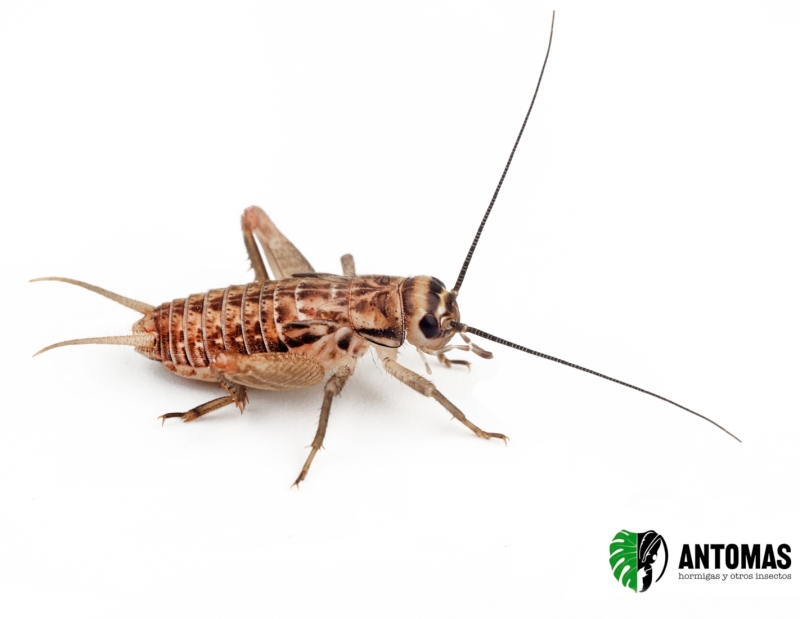
Protein: small, varied prey. The minors are tiny, so the food has to be on their scale. In the wild they hunt springtails, small centipedes and insect nymphs, and keepers report that they prefer small, soft-bodied prey. Very good options are the firebrat Thermobia domestica, a small prey item perfect for small colonies, Sinella curviseta springtails, which also help keep the formicarium clean, fruit flies and small pieces of freshly killed cricket or red runner roach, opened up so they can start eating. Change the type of insect from one week to the next, so they do not always eat the same thing.
The more protein, the better. This is the Antomas philosophy: if you do daily maintenance and remove leftovers, it is better to overfeed, because the colony understands that it has more resources and grows faster and larger. With a species whose colonies are so small, this means small but frequent portions, almost daily if you can, removing whatever is left over. If you will not be able to clean often, it is better not to overfeed: in a humid nest, leftover food rots quickly and brings mould and mites.
Sugary liquids. The minors readily drink sugar water and honey. Vary the sugars: at Antomas we recommend Blue Sugar nectar by Anthouse 4–5 times a week and another sugary liquid or nectar 1–2 times a week. You can also add a little protein to the nectar. Always offer them in a feeder and never on cotton wool, because cotton wool goes mouldy and spoils the liquid very quickly. Use a small feeder, traditional or home-made, where the drop stays ‘spread out’ and accessible, and replace it before it ferments.
Seeds: their harvester touch. Now and then, offer a few very small seeds: fig seeds, the ones found stored in their nests (they are easy to get out of a dried fig), and others such as chia or sesame; one keeper reports that chia is his colony’s favourite. Some colonies ignore them when they have plenty of sugar and protein: that is normal. In a humid nest they may sprout or go mouldy, so remove any that germinate. And remember that they are a supplement: the brood grows on insects.
Water: always, in the test tube with cotton wool in the foraging area. For a tropical leaf-litter ant, letting it dehydrate is a serious mistake.
A tip: some keepers have found their colony to be mainly nocturnal. If yours is too, put the food in late in the evening and remove the leftovers in the morning.
Growth and castes
Your colony arrives already up and running, with its queen, workers and brood, so you will not have to go through the founding stage. Very little is known about founding in the genus in the wild: shops describe it as semi-claustral, with a queen that goes out foraging while raising her first workers, but we have not found any study that confirms it.
What you do need to know is how an Acanthomyrmex colony grows:
- Slowly. In the wild they rarely exceed a few dozen workers; in captivity, with good food, they grow somewhat larger, but without hurry.
- Few majors. 1–3 majors is normal, less than 10% of the workers: it is not that your colony ‘is not producing soldiers’, it simply does not need more.
- Males. Keepers agree that they often produce males, even when small. This is normal; in time they die and the workers remove them.
- Eggs that are food. Some of the eggs you see are trophic eggs: if an egg pile does not develop, do not be alarmed.
- Look after the queen. Without her, the majors fight to lay eggs and the colony produces only males.
No diapause: stable warmth all year round
It is a tropical and subtropical ant from a monsoon climate, and it does not need diapause. At Antomas we recommend keeping it at 24–27 °C all year round. In winter, if your home gets cold, use a heat cable or heat mat with a thermostat, at one side of the nest.
In the species from the north of its range, with cooler winters, the colony may slow down a little during our winter: less egg-laying and less activity. It does no harm if the temperature drops slightly in those months, to about 21–23 °C, but do not cool it like a European ant. Keep up the water, sugar and some protein, and wait for it to liven up again in spring.
Behaviour in captivity
Calm. When disturbed, they freeze or form a ball around the brood and the queen, and you will often see workers holding brood in their mandibles. The majors hardly ever come out: they stay in the nest and appear at the entrance when faced with a threat or a prey item to cut up. The minors forage alone, without recruiting others.
Observe without fear. At Antomas we believe ants are there to be enjoyed, observed and learnt from, not kept hidden away. Just leave them their dark area in the nest and the foraging area lit, and observe them gently, intervening and stressing them as little as possible. With such a small species, a magnifier or a camera with a macro lens are your best allies: seen up close, the majors are quite a sight. One keeper reports that a red light let him watch them foraging at night without them fleeing.
Warning signs:
- Droplets or condensation on the glass, or mould: too much humidity, or forgotten leftovers or seeds.
- Workers crowded next to the water tube and dry plaster: not enough humidity.
- Brood that stalls or disappears: almost always a lack of protein or too cold.
- Workers outside the formicarium: there is a gap or the barrier is not working.
Escapes and barriers
They are not escape artists, but they are very small, and that is enough. The minors get through gaps you cannot even see, through loose connections and through ventilation meshes that are too coarse. At Antomas we recommend:
- A PTFE (Fluon) barrier on the upper part of the foraging area walls, thin and continuous. Paraffin oil also works, although it needs renewing more often.
- A tight-fitting lid, as a second line of defence.
- Very fine ventilation meshes. Check that a minor cannot fit through them.
- No gaps: check the connections, plugs and tubes, and make sure the cotton wool in the water tube is packed tightly.
- Nothing that can act as a bridge: no twigs, leaves or stones resting near the barrier.
Handling and safety
They are harmless to people: they have a much-reduced sting, and keepers report no stings at all. The majors can bite a pair of forceps hard, but they are not dangerous. As with any species, handle them with entomological tools, such as a very fine brush or soft forceps, and not with your hands: they are so small that they are easily injured. Do not merge different colonies or keep them with other species. This is an exotic species: it must never be released.
What not to do
- Let the nest dry out or, conversely, waterlog it: one humid area and a drier one.
- Use a large formicarium for a colony of a few dozen ants.
- Put it through a cold diapause, like European ants.
- Give them prey that is too big or whole and hard, or always the same insect.
- Leave food leftovers or germinated seeds in a humid nest.
- Put sugary liquids on cotton wool or let them run out of water.
- Leave gaps, loose connections or meshes that are too coarse.
- Lose sight of the queen during a move.
- Merge different colonies or handle them with your hands.
Scientific sources
This care sheet has been compiled from the scientific literature on the genus Acanthomyrmex and its relatives, and from the experience of Antomas and other keepers. Main references:
- Moffett, M. W. (1985). Behavioral notes on the Asiatic harvesting ants Acanthomyrmex notabilis and A. ferox. Psyche 92: 165–179. doi:10.1155/1985/53040
- Moffett, M. W. (1986). Revision of the myrmicine genus Acanthomyrmex (Hymenoptera: Formicidae). Bulletin of the Museum of Comparative Zoology 151: 55–89. doi:10.5281/zenodo.25806
- Gobin, B. & Ito, F. (2000). Queens and major workers of Acanthomyrmex ferox redistribute nutrients with trophic eggs. Naturwissenschaften 87: 323–326. doi:10.1007/s001140050731
- Gobin, B. & Ito, F. (2003). Sumo wrestling in ants: major workers fight over male production in Acanthomyrmex ferox. Naturwissenschaften 90: 318–321. doi:10.1007/s00114-003-0430-7
- Eguchi, K., Bui, T. V. & Yamane, S. (2008). Vietnamese species of the genus Acanthomyrmex (Hymenoptera: Formicidae: Myrmicinae). Myrmecological News 11: 231–241.
- Ward, P. S., Brady, S. G., Fisher, B. L. & Schultz, T. R. (2015). The evolution of myrmicine ants: phylogeny and biogeography of a hyperdiverse ant clade (Hymenoptera: Formicidae). Systematic Entomology 40: 61–81. doi:10.1111/syen.12090
- Blaimer, B. B., Ward, P. S., Schultz, T. R., Fisher, B. L. & Brady, S. G. (2018). Paleotropical diversification dominates the evolution of the hyperdiverse ant tribe Crematogastrini (Hymenoptera: Formicidae). Insect Systematics and Diversity 2(5): 3. doi:10.1093/isd/ixy013
- Wilson, E. O. (1968). The ergonomics of caste in the social insects. The American Naturalist 102: 41–66. doi:10.1086/282522
- Wilson, E. O. (1984). The relation between caste ratios and division of labor in the ant genus Pheidole (Hymenoptera: Formicidae). Behavioral Ecology and Sociobiology 16: 89–98. doi:10.1007/BF00293108
- Molet, M., Wheeler, D. E. & Peeters, C. (2012). Evolution of novel mosaic castes in ants: modularity, phenotypic plasticity, and colonial buffering. The American Naturalist 180: 328–341. doi:10.1086/667368
- Genzoni, E., Schwander, T. & Keller, L. (2023). Trophic eggs affect caste determination in the ant Pogonomyrmex rugosus. eLife 12: RP86899. doi:10.7554/eLife.86899