Difficulty: 3/5 – Advanced
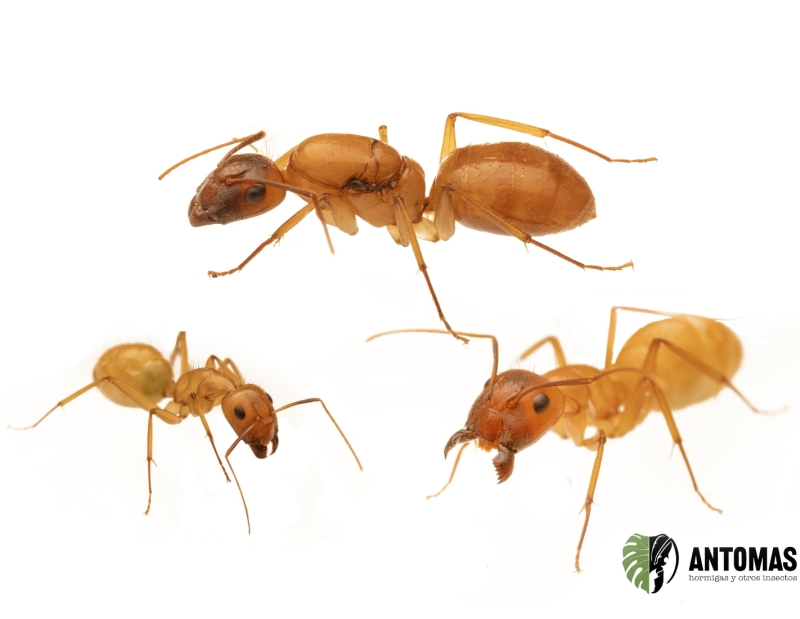
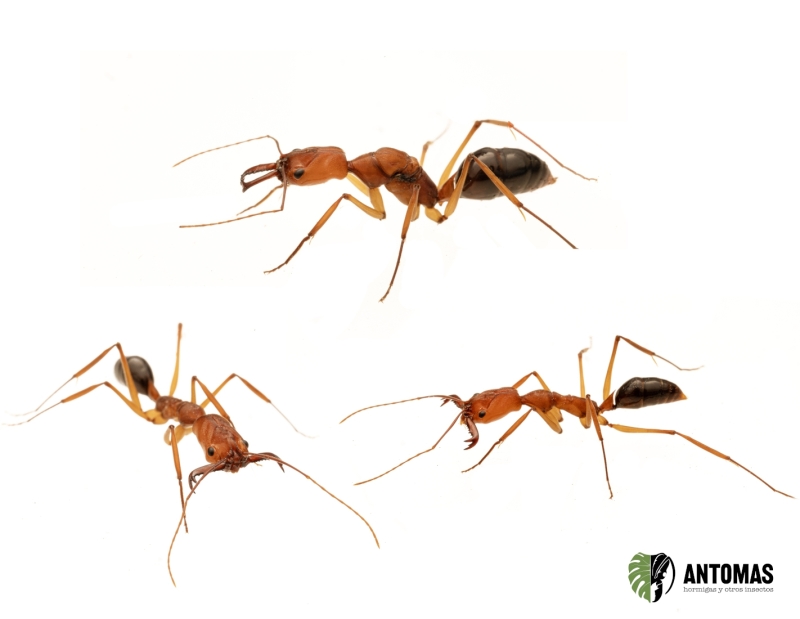
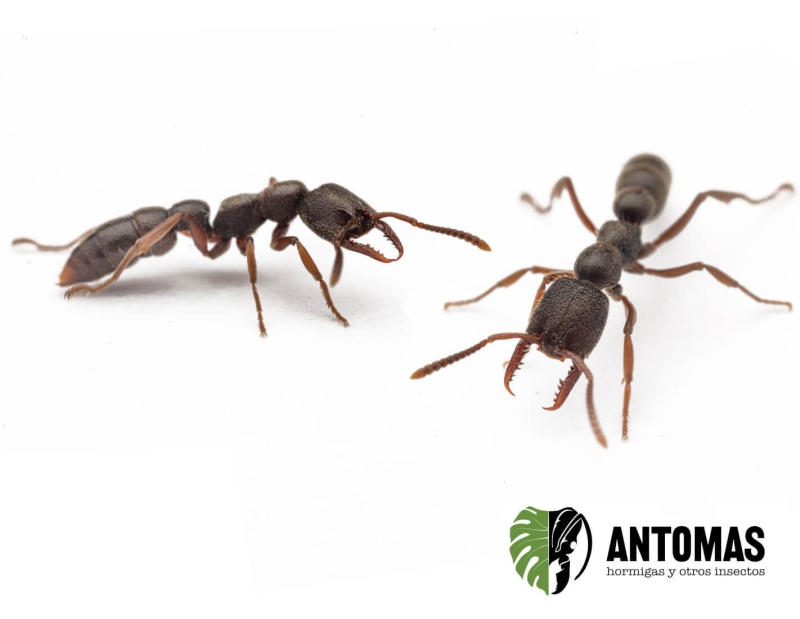
A trap-jaw ant in miniature: workers of around 4–5 mm, yellowish and hairy, that hunt with their mandibles wide open and play dead if disturbed. Colonies with a queen. 23–27 °C all year round, no diapause and never above 28 °C; a small, humid nest with a little coco fibre so the larvae can spin their cocoons, and tiny prey every day: Drosophila, springtails, Thermobia nymphs. Key: a small formicarium with no gaps, and food on their scale.
Anochetus graeffei Mayr, 1870 is proof that size isn’t everything. Its workers barely exceed 4 mm, yet they carry on their heads the same kind of weapon as the big trap-jaw ants: two long, straight mandibles that open like a gin trap, lock in place with a latch and snap shut in milliseconds when prey brushes against their trigger hairs. It is also one of the most widely travelled Anochetus in the world: it ranges from southern India, across South-East Asia and the Sunda Islands, to northern Australia and the Pacific islands, where Gustav Mayr first described it from workers collected in Samoa.
We like to think of it as a miniature trap-jaw ant, and the description suits it perfectly: it is a species of leaf litter, stones and rotting wood, discreet, hairy and honey-coloured, that hides under anything and, when it feels threatened, would rather freeze than fight. For anyone who wants a close look at how a trap jaw works without needing a large terrarium, it is one of the most fascinating species you can keep at home. In this care sheet we tell you what science says about it and its genus, and how we keep it at Antomas.
Biology
An ant from Samoa with half a dozen names
The Austrian Gustav Mayr described it in 1870 from workers collected on Upolu, one of the Samoan islands. The species name almost certainly honours the Swiss naturalist Eduard Graeffe, who at that time was collecting fauna in the Pacific islands for the Godeffroy Museum in Hamburg. More than a century later, in 1978, the myrmecologist William L. Brown re-examined the four original specimens, kept at the Natural History Museum in Vienna, and chose one of them, light brownish yellow in colour, as the lectotype: the reference specimen for the species.
What is curious is what happened in between. Because it lives across a huge area and varies quite a lot from place to place, entomologists described it several times under different names: A. rudis, from Mandalay (Myanmar); A. ruginotus, from Luzon (Philippines); A. minutus, from Johor (Malaysia); A. punctiventris oceanicus, from the Pacific; A. amati… Edward O. Wilson, in 1959, and Brown, in 1978, gradually brought them all together under a single name, A. graeffei. Wilson summed it up like this: using the characters then employed to separate them, he could not tell two species apart; there was, quite simply, “a single, relatively variable species”.
Steven Shattuck and Ewa Slipinska’s revision of the Australian Anochetus (2012) reached the same conclusion: a preliminary analysis found no clear subdivisions, and they continued to treat it as a single species. Brown did, however, provisionally keep apart a very close relative from Sri Lanka, A. yerburyi.
From southern India to the Pacific islands
Few Anochetus cover so much of the map. According to Shattuck and Slipinska, it is one of the most widely distributed species in the genus: it ranges from southern India, through South-East Asia, to Australia and the Cook Islands. The records compiled by Brown give an idea of its reach:
- Mainland Asia: India, including Sikkim, at around 1,220 m altitude, Myanmar, Indochina, the Malay Peninsula and the Chinese island of Hainan.
- Malay Archipelago: Java, Kalimantan, Sulawesi, Timor, Flores, Sumba and the southern Philippines.
- Australia: from the Kimberley and the Top End to the whole of eastern Queensland, as far as north-eastern New South Wales.
- Pacific: Melanesia and Polynesia, including Samoa, Tonga and the Cook Islands.
Brown described it as a highly successful coloniser throughout the Indo-Australian region. Did it reach the islands on its own, or was it carried there by humans? There is no consensus. In studies of Pacific ants it is classed as a widespread native species, as in James Wetterer’s Tonga inventory (2002); the Bishop Museum database in Hawaii, on the other hand, lists it as introduced, either recently or by the ancient Polynesian voyagers, and naturalised in the Cook Islands. What is clear is that a small ant that nests under any stone or in a piece of wood is a prime candidate for travelling between islands, with or without help.
Under stones, in termite mounds and in rotting wood
Although it lives mainly in tropical rainforest, it is not a delicate species: in Australia it also reaches dry sclerophyll forest, although it rarely turns up outside wooded areas. Its nests are remarkably varied. According to the Australian revision, they are almost always found under stones or other objects on the ground, but also directly in the soil with nothing on top, inside termite mounds and in rotting wood.
That flexibility partly explains its success: almost any damp, sheltered cavity on the forest floor will do. It also gives us clues for keeping it: this is an ant of the soil, of darkness and of stable humidity, which does not need a grand palace, just a few small chambers where it feels under cover.
A mousetrap on its head
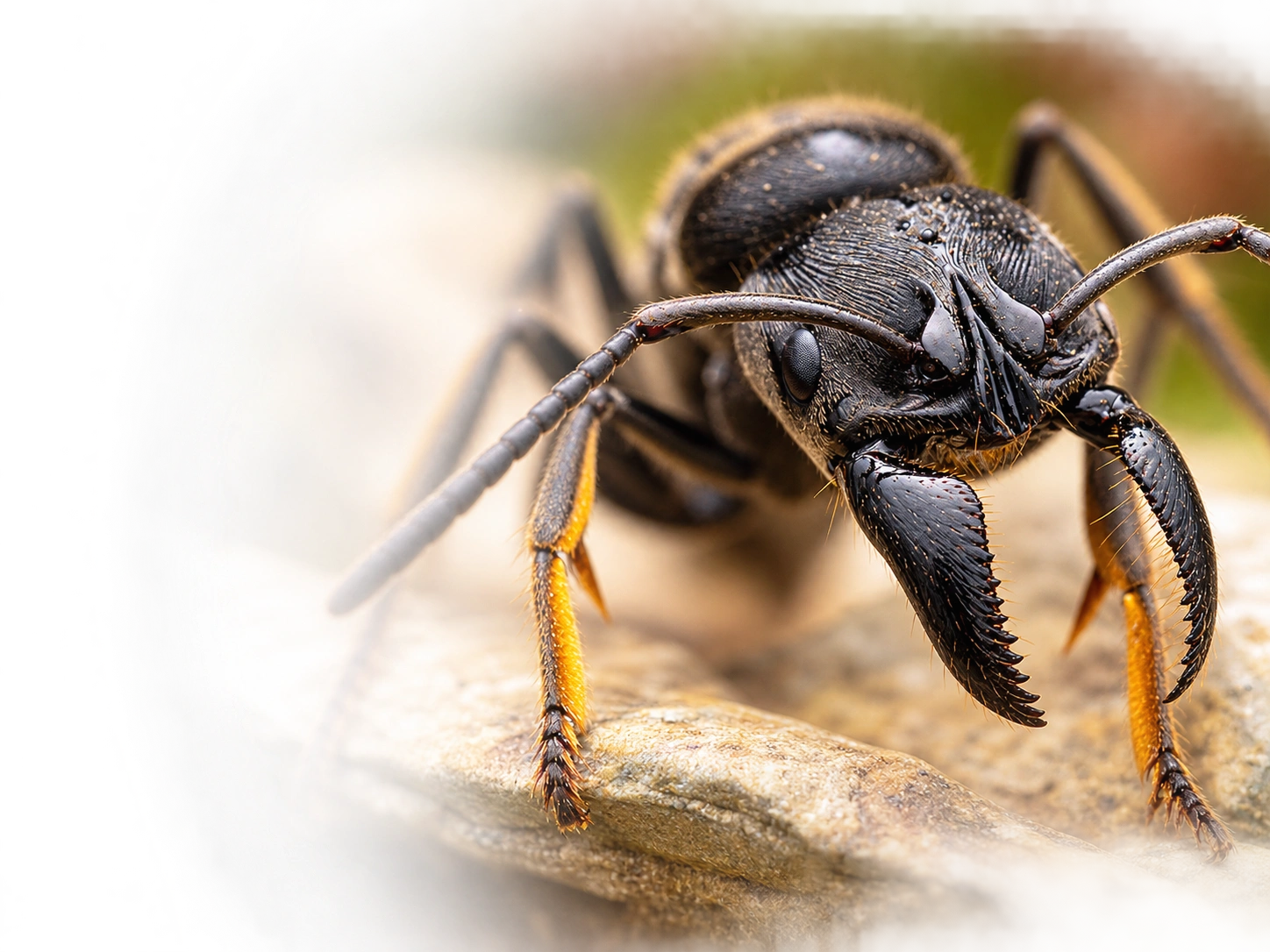
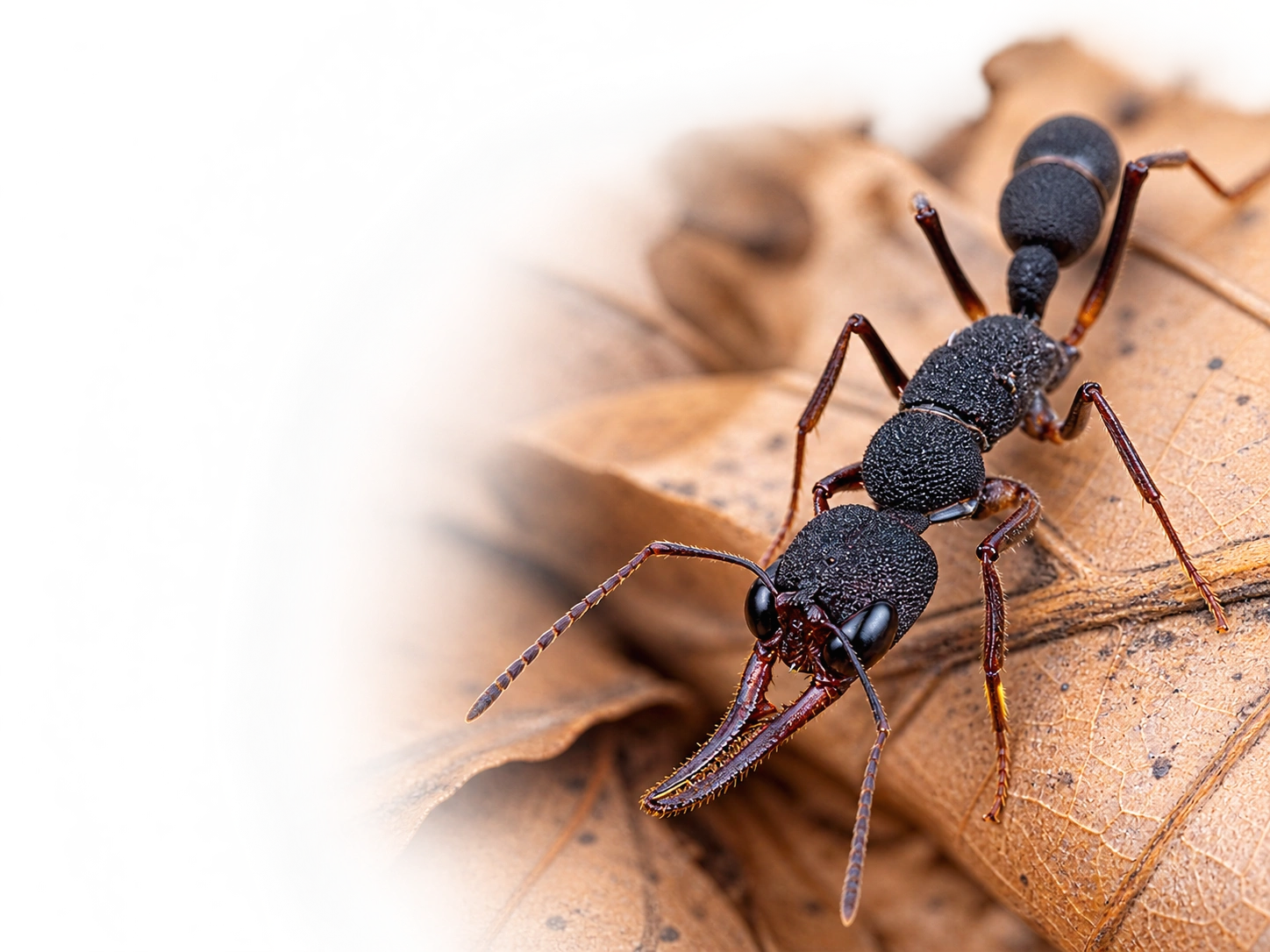
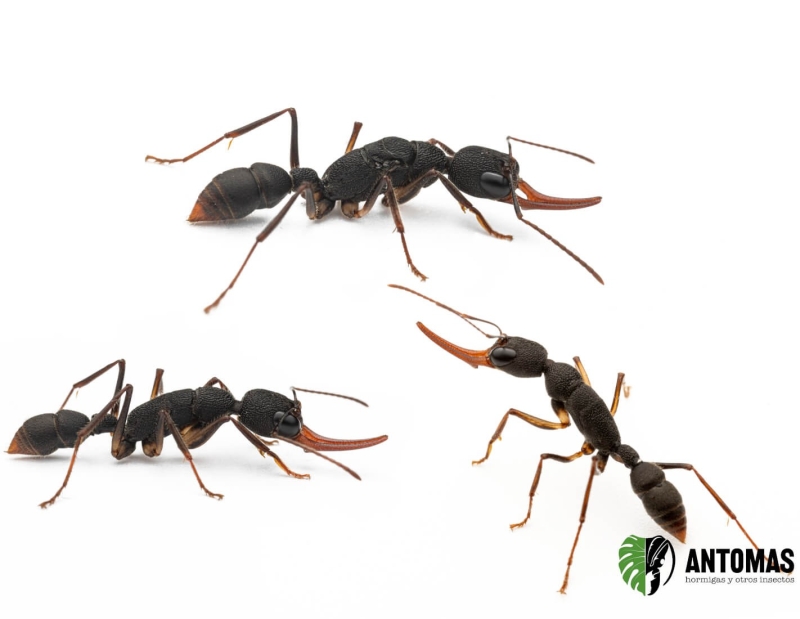
The trap jaw is one of the most refined weapons in the insect world, and it works the same way in small Anochetus as in large ones. The principle is that of a catapult: the muscles load energy over a relatively long time and then release it all at once.
- Open and lock. The ant opens its mandibles, often beyond 180° in this genus, and their base catches in a notch in the joint, which acts as a latch.
- Load. The large muscle that closes the mandibles contracts while the latch holds, and the energy is stored in very stiff pieces of cuticle that act as a spring.
- Fire. A tiny muscle, the trigger muscle, releases the mandible, and the spring snaps it shut.
The trigger is pulled by long sensory hairs on the inner face of the mandibles, connected to giant neurons that transmit the signal with almost no delay. In Anochetus, Gronenberg and Ehmer measured in 1996 a strike of less than 2.5 milliseconds and a complete reflex of about 5. A peculiarity of the genus: in it, the mandible muscles attach to their tendon via fine fibrils, whereas in its relative Odontomachus they attach directly.
Smaller, faster?
The record-breaking trap-jaw figures belong to Odontomachus: in O. bauri, the tip of the mandible reaches up to 64 m/s and the fastest strike lasts 0.06 milliseconds, with a force exceeding 300 times the ant’s body weight. Comparing species within that genus showed that acceleration decreases as size increases: large species strike harder, and small ones with greater acceleration.
In Anochetus, the first high-speed camera study, from 2018, measured four species and found two styles: some strike almost like Odontomachus, with a mean peak angular velocity of about 37,000 radians per second, and others considerably more slowly, at around 13,000. The strike of A. graeffei has not yet been measured. If it followed the Odontomachus rule, such a small trap jaw ought to accelerate enormously, but that is an inference, not a measurement. What you will see at home is that the strike is too fast for the eye: the prey is simply caught.
The best defence: playing dead
With a weapon like that you might expect an aggressive ant, but Anochetus are quite the opposite. Brown noted in 1978 that, when disturbed, they tend to play dead, whereas Odontomachus tend to attack and sting. This is thanatosis: the worker tucks in its legs, goes rigid and waits for the danger to pass. In a 4 mm ant, earth-coloured and covered in hairs, the trick works very well: motionless in the leaf litter, it is almost impossible to spot.
For the keeper this has a practical consequence: if you see motionless workers while cleaning or rehousing, don’t assume they are dead. Wait a few minutes and they will most likely get up and walk off as if nothing had happened.
A backward leap with one snap of the jaws
Such a fast strike has a side effect: if the mandible hits something hard or bigger than the ant, the recoil sends it flying. William M. Wheeler called this leap “retrosalience”, and it has been documented in several trap-jaw lineages, Anochetus among them. In Odontomachus it has been shown that the jump is used to escape: when faced with antlions, workers able to jump with their mandibles survived more often than those whose mandibles had been immobilised.
In such a small species the jump is nothing like that of the big Odontomachus, but it serves the same purpose: to vanish. A worker that “bounces” when you open the lid can end up where you least expect it, so it pays to work calmly (see “Escapes and handling”).
A cousin, not a daughter, of Odontomachus
For decades it was thought that Odontomachus had arisen from within Anochetus, an idea Brown defended in 1978. DNA-based phylogenies from 2016 and 2021 ruled it out: the two genera are sister groups, each with its own history going back tens of millions of years, and the trap jaws of both derive from a short-jawed common ancestor from the early Eocene. Anochetus comprises some 110 living species, nearly all smaller than Odontomachus, and A. graeffei is among the smallest of them all.
The trap jaw, incidentally, is not an invention exclusive to this lineage: it has evolved independently at least four times in ants, in three different subfamilies.
A hunter of the tiny
Like the rest of its genus, A. graeffei hunts alone. Workers roam the soil and leaf litter with their mandibles open; when they touch prey with their antennae, they position it in front of the trigger hairs and fire, often more than once, and if the prey struggles they finish it off with the sting. Then they carry it back to the nest. They do not recruit nestmates or form trails: each worker is a tiny trapper.
There are no studies of its diet in the wild. Very little is known for the genus as a whole: one species has specialised in termites, and in the laboratory Anochetus accept termites, fruit flies and springtails. The fact that A. graeffei sometimes nests inside termite mounds is a suggestive clue, but nobody has checked whether it hunts its hosts. What we do know is that its prey has to be on its scale: a 4 mm worker cannot tackle an adult cricket, but it can handle a fruit fly, a springtail or a newly hatched firebrat nymph.
Small colonies and a winged queen
Anochetus retain ancestral ant traits: small colonies, little difference between queen and workers, and solitary hunting. In the genus, colonies usually have fewer than 100 workers. There are no published counts for A. graeffei, and the figures given by shops do not agree with one another, so we won’t give you one. Its queen is of the winged type: Brown cited a dealate queen, that is, one that had already shed her wings after the nuptial flight, collected on Hainan together with her workers.
How a colony is founded has not been studied in this species. In many ponerines, founding is semi-claustral: the queen goes out hunting to feed her first larvae, and that is what most keepers of Asian Anochetus report. At Antomas we sell colonies with a queen that already have workers and brood, so that delicate stage is already behind them.
Cocoons that need soil
Like nearly all ponerines, A. graeffei pupates inside a silk cocoon. Wheeler explained in 1915 that ant larvae need to be surrounded by particles to anchor the thread in order to spin it, which is why workers bury mature larvae or cover them with soil. Keepers of trap-jaw ants confirm this: on a smooth, dry surface many larvae fail to spin and end up dying. That is why, in the set-up we suggest, a little damp substrate inside the nest is not decoration but a necessity.
The climate back home
Across such a vast range there are very different climates, but almost all of them share one thing: they are tropical and humid. In the lowlands of South-East Asia and the islands, monthly mean air temperatures hover around 26–29 °C all year round, with a monsoon rainy season and a somewhat drier one. At the edges of its range, such as the Himalayan foothills, Hainan or north-eastern New South Wales, there is a cool season, though without frost in the forest where it lives.
But an A. graeffei colony does not live in the open air; it lives under a stone, in the soil or inside a log. A large 2024 study of tropical forests showed that, near the ground, the understorey is on average 1.6 °C cooler than open sky and fluctuates less between day and night; in Borneo, the daily mean in the understorey is about 23.9 °C. That is its world: mild, stable and humid. This is where the parameters we recommend below come from: 23–27 °C, no diapause and never above 28 °C.
Size and morphology
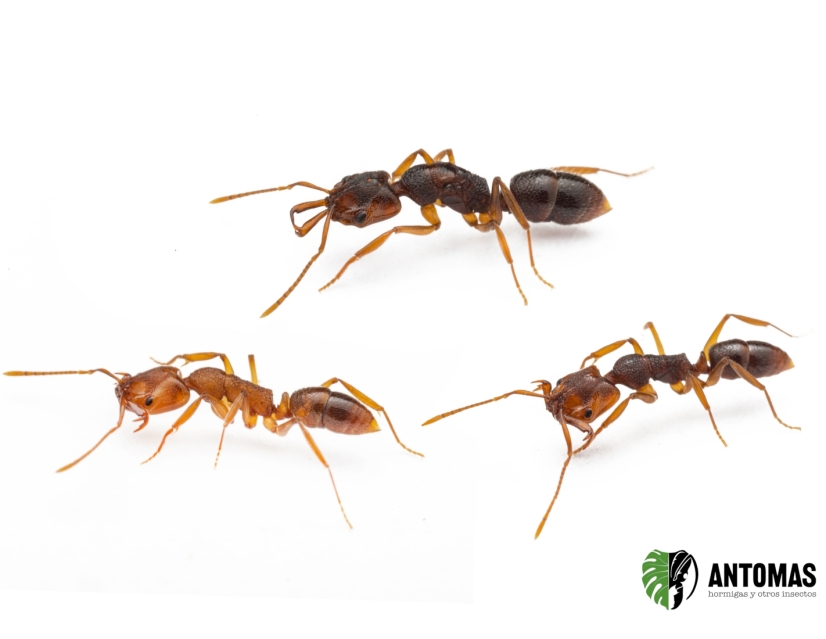
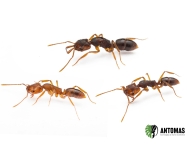
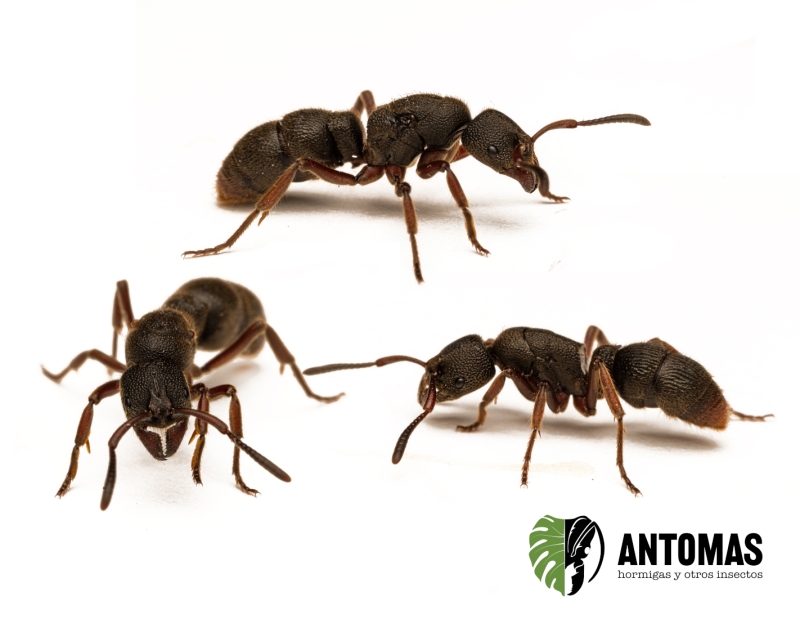
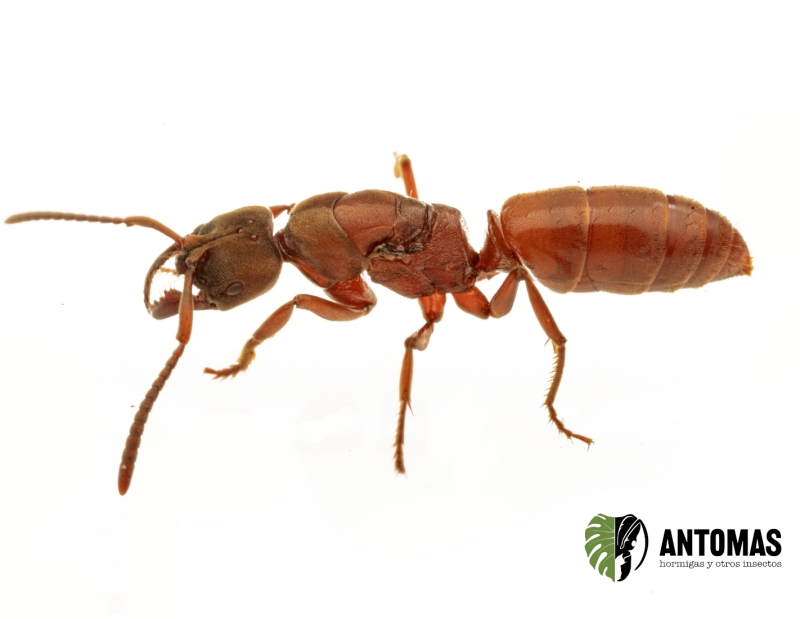
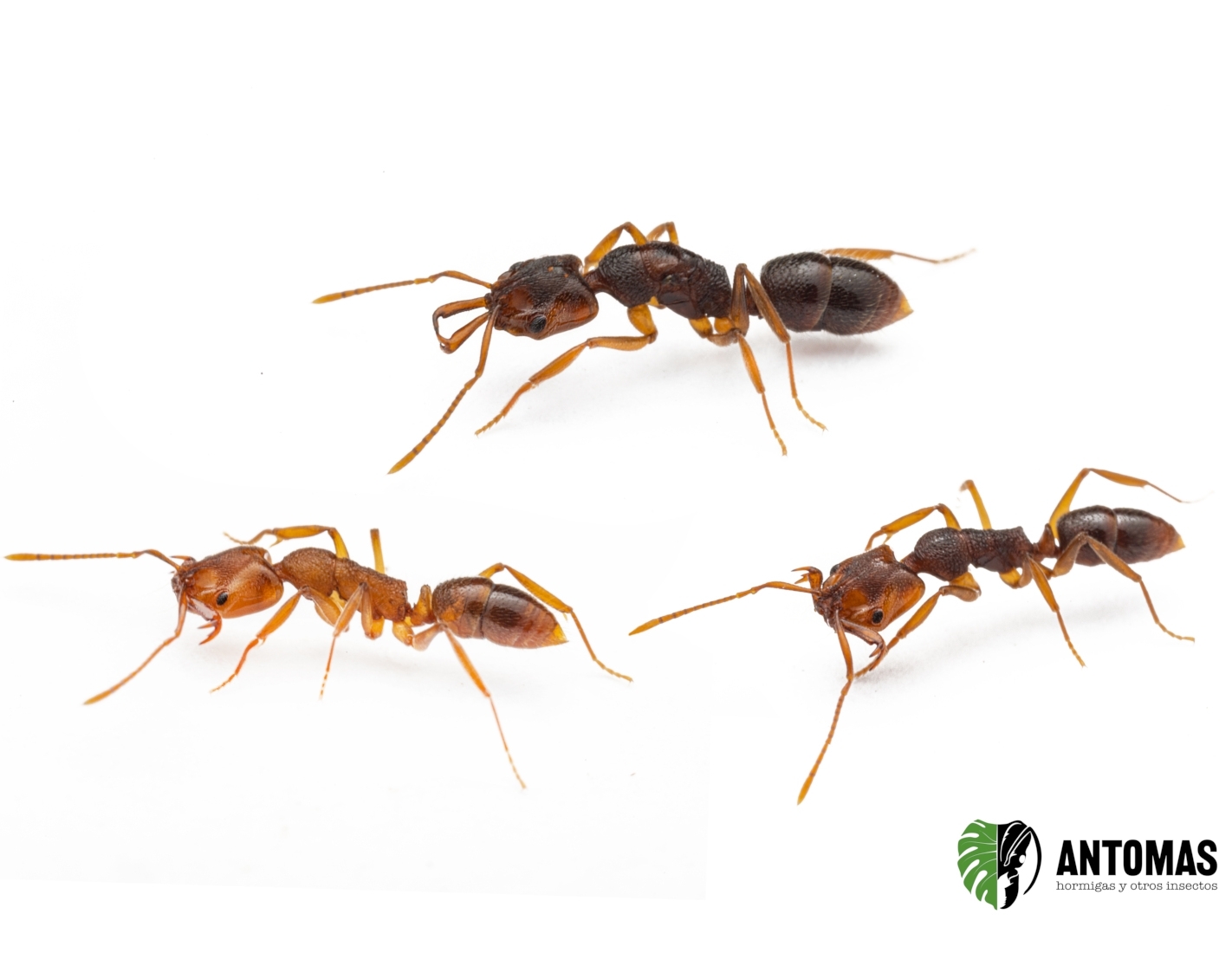
A tiny, sturdy ponerine with an elongated head, long, straight mandibles that arise close together in the middle of the face, and a body covered in hairs.
- Size. The lectotype from Samoa measures 4.35 mm in total length. To give you an idea, our Anochetus cf. princeps exceeds 8 mm: A. graeffei is almost half that.
- Colour. Yellowish brown to brown, with the head yellow to yellowish brown and the antennae, mandibles and legs yellow. It varies between populations: some workers are light honey-coloured and others darker.
- Hairs. It is a very hairy species, with abundant erect hairs all over the body, something you can appreciate very well with a magnifying glass.
- Eyes. Very small, as befits an ant of the leaf litter and soil that hunts more by touch than by sight.
- Sculpture. The frons is sculptured up to the posterior margin of the head, and the pronotum has a highly variable rugose or striate sculpture: in some Australian populations it is almost smooth and shiny.
- Petiole. A scale with a rounded apex that joins the thorax to the abdomen.
- Sting. Functional; they use it to finish off prey.
- Queen. Winged before the nuptial flight and dealate afterwards. Somewhat larger than the workers, although there are no published measurements.
- Development. Egg, larva, prepupa and pupa inside a silk cocoon, for which they need substrate.
Approximate measurements
- Worker, total length: about 4.35 mm (lectotype)
- Worker, head length: 0.95–1.13 mm in Australia and 1.15–1.32 mm in large workers from Java
- Worker, head width: 0.89–1.06 mm in Australia and 1.03–1.22 mm in Java
- Worker, mandible length: 0.52–0.69 mm, almost half the length of the head
- Worker, mesosoma length: 1.09–1.30 mm (Australia)
- Queen: no published measurements
The total length of the lectotype comes from Zettel (2012); the Java measurements from Brown (1978), and the Australian ones from Shattuck and Slipinska (2012). The differences between populations fit with how variable the species is.
Care in captivity
Difficulty: 3/5 – Advanced
A. graeffei is not a fussy species: in the wild it copes with everything from rainforest to dry forest and nests in almost any cavity. What makes it advanced is scale. Its workers are tiny, so everything has to be made to measure: a small nest, very small and frequent prey, substrate for spinning and a set-up with no gaps to slip through. On top of that, its colonies are small and discreet, and you have to learn to read what is going on inside without seeing everything at a glance.
It is well worth it. It is one of the few ways to keep a trap-jaw ant in a desktop formicarium. Watching them patrol with their mandibles open, catch a fruit fly in a single snap, play dead or bounce away is a spectacle that hardly any other ant of this size offers. And if you already have experience with small species, it is a perfect gateway into the world of ponerines.
Recommended parameters
- Temperature: 23–27 °C all year round, with a slight gradient so the colony can choose. Never above 28 °C: this is the same rule we apply to our Anochetus cf. princeps, because in soil-dwelling ponerines excessive heat causes the larvae problems when spinning their cocoons.
- Nest humidity: high and stable, roughly 60–80 % as a guide, with one wetter area and another slightly drier one. Never waterlogged.
- Substrate: a thin layer of damp coco fibre in the brood chambers.
- Foraging area: small, clean and drier than the nest, with a lid and water always available.
- Light: nest kept dark and foraging area under normal room light, with its day–night cycle.
- Diapause: none (see “Diapause”).
This is an ant of damp soil, and letting the nest dry out is a serious mistake: the brood is the first to suffer. High humidity does not mean standing water; mould is the other enemy, and you prevent it with gentle ventilation and by removing leftovers.
Recommended formicarium
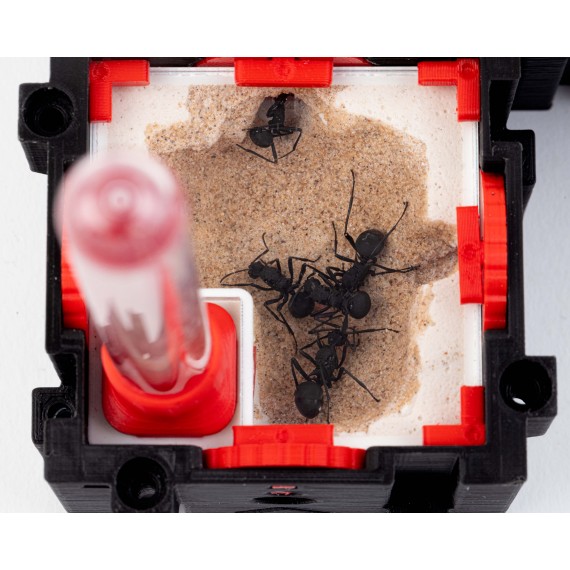
For such a small species, at Antomas we recommend the smallest formicarium in the Qbik Wild range by Anthouse, the Qbik Wild One P 1C. It is made of plaster, so it holds the humidity the species needs, and its small chambers make a colony of only a few workers feel under cover while letting you see the brood. With small colonies, a nest that is too large is counterproductive: the workers scatter, food gets lost and humidity is harder to control.
A few details to complete the set-up:
- Coco fibre in the chambers: a thin layer, always damp and free of fertiliser, so the workers can cover the mature larvae and these can spin. If they carry it out of the nest, top it up a little.
- Moisten regularly: the plaster must always be damp in part of the nest.
- Water always available: a small test tube with water and cotton wool in the foraging area; they drink from the cotton without any trouble.
- A small feeder for the nectar, never cotton wool soaked in sugar (see “Feeding”).
- No gaps: check joints, stoppers and lids. A 4 mm worker can squeeze through gaps you can’t even see.
Arrival and rehousing
When your colony arrives, leave it for a few hours in a quiet place at 23–27 °C and check that it has water. To move it into the formicarium, at Antomas we do it by tipping it in: we open the tube inside the foraging area, next to the nest entrance, and tip out workers, queen and brood with a few gentle taps, helping any stragglers along with a fine paintbrush. Three tips for this species:
- Work over a light-coloured tray: that way you will immediately spot any worker that escapes or bounces away.
- Don’t be alarmed by the “dead” ones: many will stay motionless; give them a few minutes.
- Brood first: if a larva or cocoon is left in the tube, move it close to the entrance; the workers will collect it.
Take your time and don’t worry. Within a few hours they will have moved into the nest, and within a few days you will see them hunting.
Feeding
A. graeffei is a hunter, and the basis of its diet is protein in the form of small prey. The golden rule is size: the prey should be smaller than the worker or, at most, the same size.
- Live prey on their scale: Drosophila (fruit flies, ideally wingless), springtails (Sinella curviseta) and newly hatched nymphs of Thermobia domestica (firebrat), a perfect prey for small colonies.
- Chopped prey: small pieces of cricket, red runner roach or other freshly killed insects, left near the nest entrance.
- Vary from week to week: change the type of insect so they don’t always eat the same thing.
- Springtails as a “larder”: a small springtail culture in the foraging area gives them continuous hunting and helps keep things clean too.
The more they eat, the better and faster they grow. If you do daily maintenance and remove leftovers, at Antomas we recommend feeding generously: the colony understands it has resources and raises more brood, more quickly. If you won’t be able to clean often, it is better not to overfeed, because leftover food rots and brings mould and mites. Remove leftovers within 24 hours and don’t leave them several days without protein: in small ponerines, the brood is the first thing to be lost.
Sugar, as a varied supplement. It is not the basis of their diet, but they accept nectar. Offer it in very small drops: at Antomas we use Blue Sugar nectar by Anthouse 4–5 times a week and another nectar 1–2 times, and a little protein can also be added to it. Always in a feeder and never on cotton wool, which goes mouldy and spoils the liquid very quickly: better a traditional or home-made feeder where the drop sits “spread out” and accessible and, in such a small species, where they cannot get stuck in it.
Water: always, in the tube with cotton wool. They must never run out.
Colony growth
Anochetus colonies are small by nature, and A. graeffei is no exception. Don’t expect an overflowing formicarium: its charm lies in seeing each worker up close, not in numbers. With a stable temperature, humidity and small prey every day, the colony adds workers steadily. A keeper of another small South-East Asian Anochetus reported around 24 days from egg to worker, an isolated figure but one that suggests that, when well fed, these small ponerines can raise brood quickly. When the colony fills the nest and you see heaps of brood, it is time to think about expanding or moving to a slightly larger nest, always rehousing by tipping them in.
Diapause
It does not undergo diapause. Most of its range is tropical, with no winter, and on the forest floor temperature changes are greatly buffered. At Antomas we keep it active all year round, at 23–27 °C. If your home gets a little cooler in winter, use a gentle heat source with a thermostat on one side of the nest, never under the whole of it, so the colony can choose. What you must avoid are sudden changes and, in summer, excessive heat.
Behaviour in captivity
Traps on patrol. You will see the workers slowly cover the foraging area, antennae first and mandibles open. Each prey item is a small hunt, and with a magnifying glass you can clearly see how they position it before firing.
Discreet. They spend a lot of time inside the nest or under any shelter. If disturbed, they usually freeze or bounce away rather than attack.
Watch without fear. At Antomas we believe ants are there to be enjoyed, watched and learned from. Leave them their dark area in the nest and a lit foraging area, and observe them gently, intervening as little as possible. A hand lens will open up a whole world: the hairs, the mandibles and the brood look wonderful.
Warning signs:
- Large larvae that don’t spin their cocoons: check the temperature, the humidity and the coco fibre.
- Brood disappearing: almost always a lack of food or prey that is too large.
- Workers clustered by the water: the nest is too dry.
- Mould: forgotten leftovers or standing water.
Escapes and handling
With such a small species, the main escape route is not climbing but squeezing through. Before introducing the colony, check that there are no gaps in lids, stoppers and connections. As a barrier, apply a thin layer of paraffin oil or PTFE (Fluon) to the rim of the foraging area, with the lid closed, and keep the foraging area clean, with no leftovers or decoration touching the barrier and acting as a bridge. When you open the lid to feed them, do it calmly: a startled worker can bounce out with one snap of its jaws.
They have a functional sting, although given their size the sting is very mild and they are not aggressive towards people. Even so, at Antomas we recommend always handling them with entomological tools, such as a fine paintbrush, never with your hands, especially if you are allergic to hymenopteran stings. This is an exotic species: it must never be released.
What not to do
- Let the temperature rise above 28 °C.
- Let the nest dry out, or waterlog it.
- Forget the coco fibre in the brood chambers.
- Use a nest that is too large for a small colony.
- Offer prey that is too large or leave leftovers for more than 24 hours.
- Always give them the same insect or skimp on protein.
- Put the nectar on cotton wool.
- Put them into diapause or let them get cold in winter.
- Leave gaps in the set-up or the lid open.
- Assume a motionless worker is dead without waiting a few minutes.
- Handle them with your hands.
- Keep them hidden away: they are there to be watched and enjoyed, gently.
Scientific sources
This care sheet has been compiled from the scientific literature on Anochetus graeffei and trap-jaw ants, from climate data for its range and from the experience of Antomas and other keepers. Main references:
- Brown, W. L. Jr. (1978). Contributions toward a reclassification of the Formicidae. Part VI. Ponerinae, tribe Ponerini, subtribe Odontomachiti. Section B. Genus Anochetus and bibliography. Studia Entomologica 20: 549–638. Treatment of A. graeffei: doi:10.5281/zenodo.6284114
- Shattuck, S. O. & Slipinska, E. (2012). Revision of the Australian species of the ant genus Anochetus (Hymenoptera: Formicidae). Zootaxa 3426: 1–28. doi:10.11646/zootaxa.3426.1.1
- Zettel, H. (2012). New trap-jaw ant species of Anochetus Mayr, 1861 (Hymenoptera: Formicidae) from the Philippine Islands, a key and notes on other species. Myrmecological News 16: 157–167. PDF at Myrmecological News (open access)
- Chen, Z., Yang, Z. & Zhou, S. (2019). Review of the ant genus Anochetus Mayr, 1861 (Hymenoptera, Formicidae) from China, with revival of the valid status of Anochetus gracilis. Journal of Hymenoptera Research 68: 49–74. doi:10.3897/jhr.68.30784
- Larabee, F. J. & Suarez, A. V. (2014). The evolution and functional morphology of trap-jaw ants (Hymenoptera: Formicidae). Myrmecological News 20: 25–36. PDF at Myrmecological News (open access)
- Gronenberg, W., Tautz, J. & Hölldobler, B. (1993). Fast trap jaws and giant neurons in the ant Odontomachus. Science 262: 561–563. doi:10.1126/science.262.5133.561
- Patek, S. N., Baio, J. E., Fisher, B. L. & Suarez, A. V. (2006). Multifunctionality and mechanical origins: ballistic jaw propulsion in trap-jaw ants. PNAS 103: 12787–12792. doi:10.1073/pnas.0604290103
- Spagna, J. C. et al. (2008). Phylogeny, scaling, and the generation of extreme forces in trap-jaw ants. Journal of Experimental Biology 211: 2358–2368. doi:10.1242/jeb.015263
- Gibson, J. C., Larabee, F. J., Touchard, A., Orivel, J. & Suarez, A. V. (2018). Mandible strike kinematics of the trap-jaw ant genus Anochetus Mayr (Hymenoptera: Formicidae). Journal of Zoology 306: 119–128. doi:10.1111/jzo.12580
- Larabee, F. J. & Suarez, A. V. (2015). Mandible-powered escape jumps in trap-jaw ants increase survival rates during predator-prey encounters. PLOS ONE 10: e0124871. doi:10.1371/journal.pone.0124871
- Larabee, F. J. et al. (2016). Molecular phylogenetics and diversification of trap-jaw ants in the genera Anochetus and Odontomachus (Hymenoptera: Formicidae). Molecular Phylogenetics and Evolution 103: 143–154. doi:10.1016/j.ympev.2016.07.024
- Fernandes, I. O., Larabee, F. J., Oliveira, M. L., Delabie, J. H. C. & Schultz, T. R. (2021). A global phylogenetic analysis of trap-jaw ants, Anochetus Mayr and Odontomachus Latreille (Hymenoptera: Formicidae: Ponerinae). Systematic Entomology 46: 685–703. doi:10.1111/syen.12483
- Wheeler, W. M. (1915). On the presence and absence of cocoons among ants, the nest-spinning habits of the larvae and the significance of the black cocoons among certain Australian species. Annals of the Entomological Society of America 8: 323–342. doi:10.1093/aesa/8.4.323
- Ismaeel, A. et al. (2024). Patterns of tropical forest understory temperatures. Nature Communications 15: 549. doi:10.1038/s41467-024-44734-0