Difficulty: 3/5 – Advanced
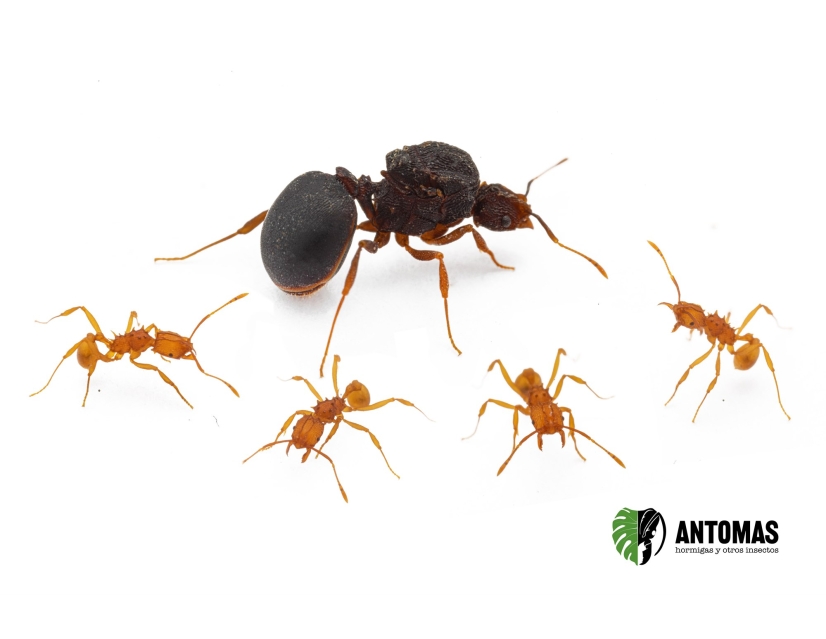
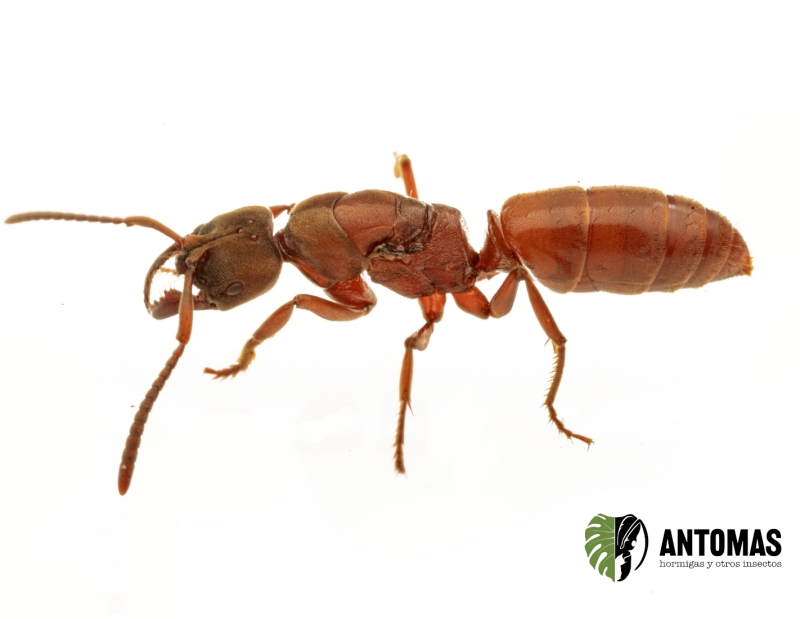
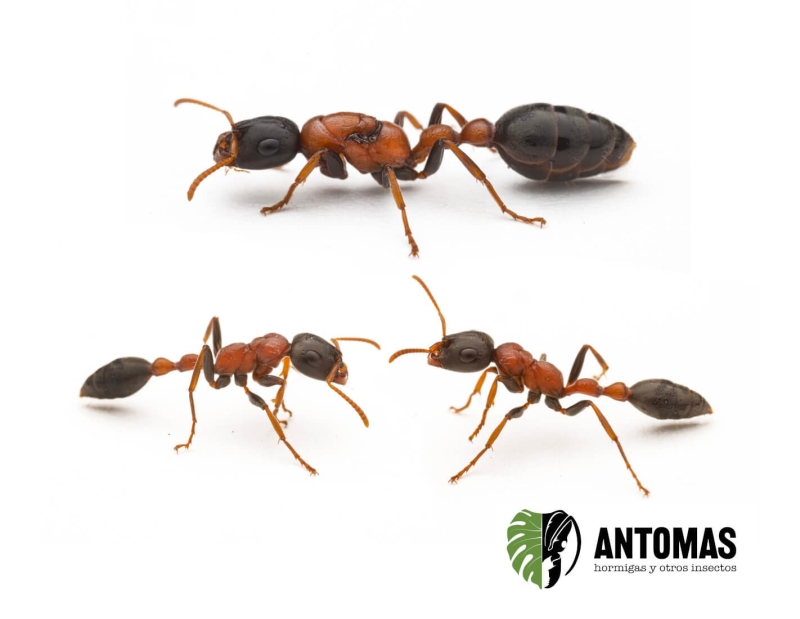
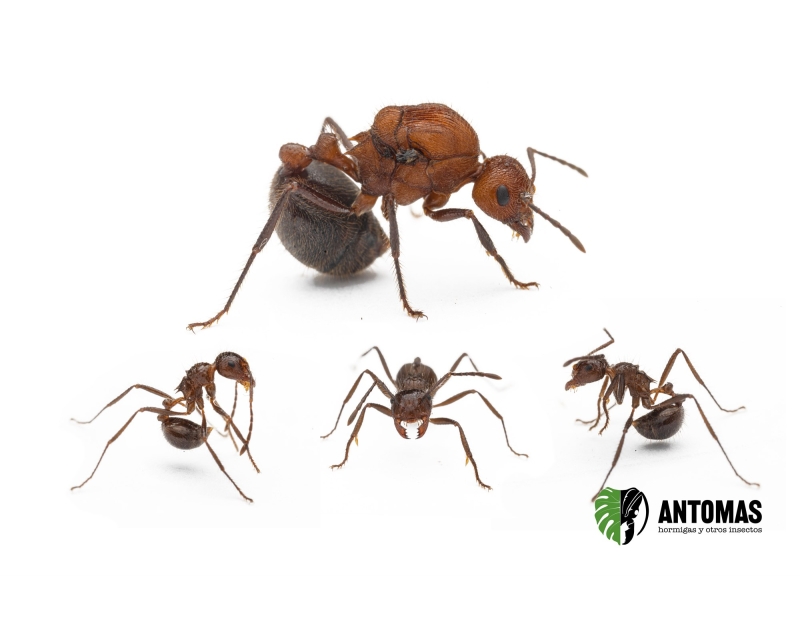
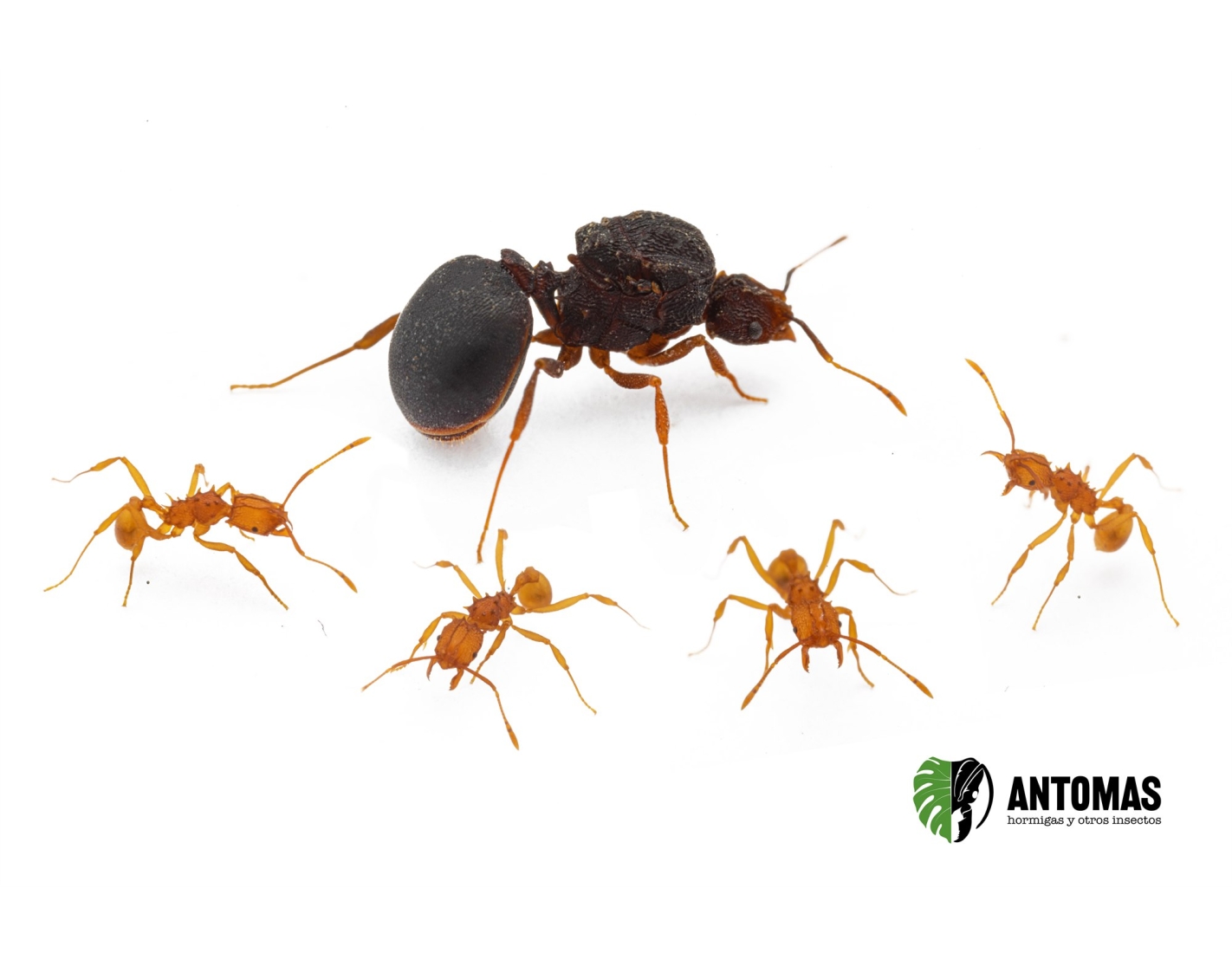
Tiny, about 2 mm long, spiny and coated in dirt, Proatta butteli looks like a miniature fungus farmer, but it is a hunter: several workers together pin down prey larger than themselves. Disturb it and it freezes, as if dead. Queen with workers and brood. Humid nest at 24–28 °C all year round, no diapause; Qbik Wild One to start with; nectar in a feeder and plenty of small prey; moving by tipping. Because of its size, escape barrier and lid from day one.
Proatta butteli Forel, 1912 is one of the most deceptive ants in Southeast Asia. It is the only species in its genus, and for decades it was taken for an Asian relative of the fungus-farming ants of the Americas, such as Atta mexicana. We now know that this resemblance is a false trail: it farms nothing. It is a hunter and scavenger of the forest floor, living in colonies with many queens and making up for its size with sheer numbers.
Almost everything known about its life in the wild comes from a single study, published by the myrmecologist Mark Moffett in 1986. That is why this care sheet separates what has been measured, what other keepers report and what we see at Antomas.
Biology
“Before Atta”: a name that misled everyone
The Swiss myrmecologist Auguste Forel described it in 1912 and named it Proatta, a name that already hints at its resemblance to Atta, the leafcutter ants. The epithet butteli honours the German zoologist Hugo von Buttel-Reepen, a student of bees, who collected ants in Sumatra for Forel.
The resemblance was no trifle. Its worker, small and with spines along the thorax, recalls the small American fungus farmers. Carlo Emery placed it among the Attini, and as late as 1986 Moffett was still presenting it as an “Old World relative” of that tribe: its queen shares with American genera such as Mycocepurus and Myrmicocrypta features such as blunt spines on the head and thorax, a finger-like extension of the clypeus and ridges on the petiole, and its wings resemble those of the fungus farmers.
Neal Weber, a great specialist in the fungus farmers, had already put that resemblance down to convergent evolution in 1958. Barry Bolton moved it out of the Attini in 2003, and today phylogenies place it in another tribe, Crematogastrini (Blaimer and colleagues, 2018). It is a textbook case: two distant lineages arriving separately at a similar appearance.
Not one fungus on the menu
Ant agriculture is an American story: according to Schultz and Brady (2008), it began in the Neotropics about 50 million years ago, and all the fungus farmers live in the Americas. Proatta, in Asia, does not feed on fungi (Moffett, 1986). Some may grow on the refuse heaps in its nests, but nobody tends them. Moffett also saw its workers crowding over piles of sesame seeds near the entrances without eating them.
A 2 mm hunter that works as a team
A 2 mm worker hardly seems a great threat, yet P. butteli catches prey larger than itself with a very simple method, which Moffett described as an incipient form of group predation:
- They go out alone. Foragers search for food individually and rarely stray more than 1 m from the nest entrance.
- But there are many of them. In that small area the density of workers is usually very high, and groups of up to 50 sometimes form.
- The first one holds on. The worker that finds a large prey tries to seize it. Others soon arrive, apparently by chance, and help to pin it down.
- Then comes recruitment. To exploit the food they use odour trails with a pheromone from their poison gland.
Its prey list includes woodlice, centipedes, assorted insects and other ants, as well as small dead arthropods.
It is a curious strategy. Beckers and colleagues (1989) compared dozens of species and found that small colonies tend to forage alone and large ones to recruit en masse. P. butteli mixes the two: it has large colonies, but its workers go out alone. Instead of searching far afield, it covers everything around it.
It plays dead
This is the curiosity that draws the most attention at home. Moffett had already noticed that when a nest is opened the workers freeze for a while, and that they are then very hard to see: they are small, matt, the colour of the soil and coated in dirt. The naturalist Quah, in his 2009 field notes on the ants of Malaysia, went further: when threatened, the queen curls up like a pupa and stays motionless, feigning death, and he believes that this protects her from visual hunters such as birds.
At Antomas we see it in our colonies too: if you disturb them they freeze, as if dead, and after a while they start moving again. This behaviour is called thanatosis and is a defence known in many animals (Humphreys and Ruxton, 2018). In ants it seems to be widespread, according to the review by Cardoso and colleagues, although nearly all of it has been seen in the laboratory, and a good share of the observations are, paradoxically, of fungus-farming ants. In the fire ant, workers a few days old play dead when attacked and survive about four times more often than older ones (Cassill and colleagues, 2008). In P. butteli nobody has measured it yet.
A practical tip: if you see motionless workers after tipping, do not assume they are dead or remove them. Give them a while.
Squatters in roots and termite mounds
For a soil ant, it digs very little. Moffett found its nests near the base of trees, in rotten roots, abandoned termite nests and shallow cavities, linked into a network of chambers and galleries. It lines the walls with debris: wood dust and bits of prey. Quah found them under fallen logs and branches, with a layer of wood chips, grass and leaves. The entrances do not stand out, and the main nest in the study had been occupied for at least 3 years.
Many queens and no fighting
P. butteli is polygynous: in the wild there is one queen for every 100–500 workers, and Moffett saw neither aggression between them nor favouritism from the workers. Nor did he see aggression between ants of the same species: they readily accepted workers brought from elsewhere. The colonies he studied reached about 10,000 workers, a figure at odds with the 500 given by one shop. Workers hardly vary in size, but the smallest are more plentiful near the brood.
Almost nothing is known about its flights: there is one record from April. One shop says it also reproduces inside the nest, which would fit a colony with many queens, but nobody has studied it.
Where it lives
It is an ant of Southeast Asia, known from the Malay Peninsula, Singapore, Borneo, Sumatra, Thailand and Laos. It lives in humid lowland forests, in a warm climate almost without seasons: averages of about 25–28 °C all year round and air humidity of around 75–85 %. Under the leaf litter and in the soil, the fluctuations are smaller still.
Size and morphology
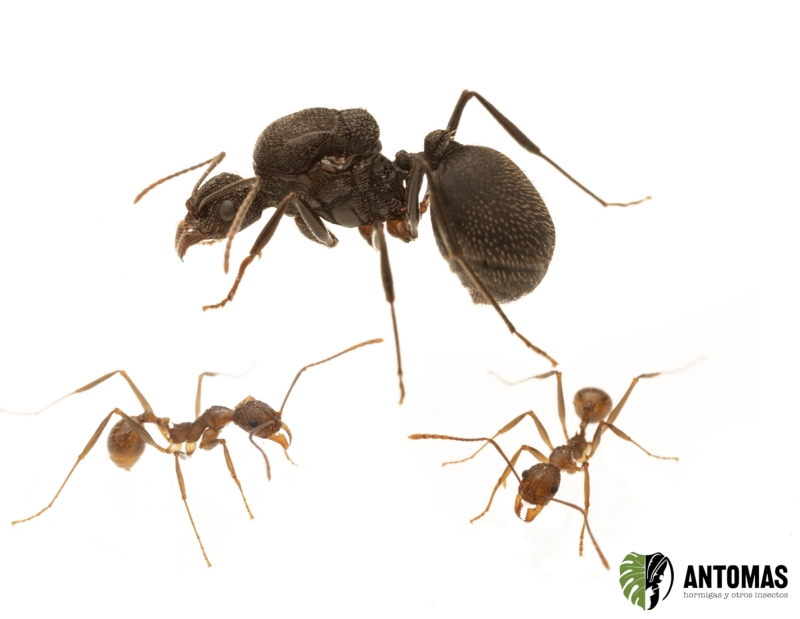
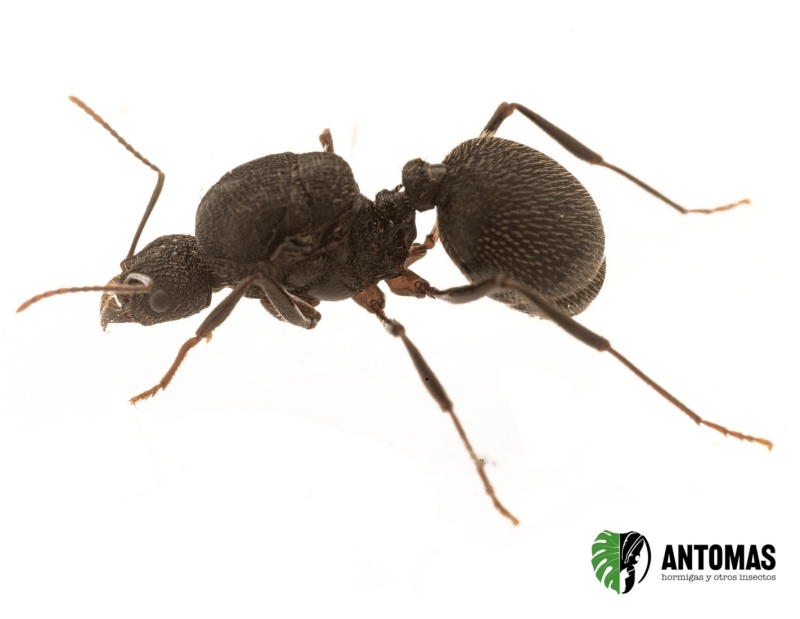
A tiny myrmicine with almost no size differences between workers:
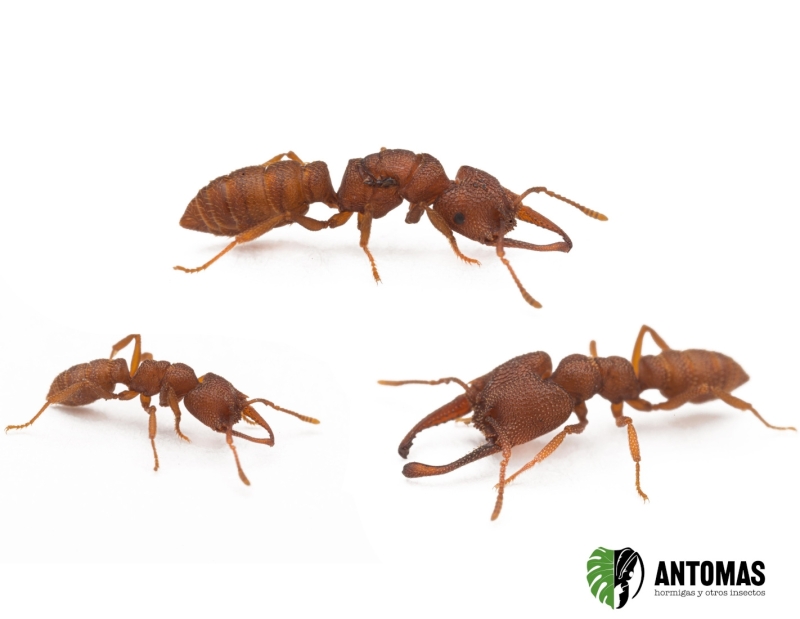
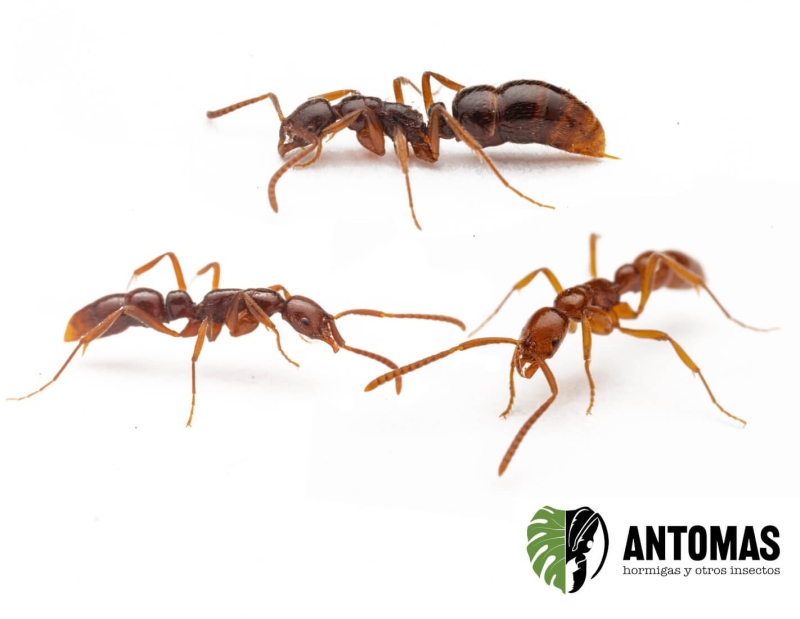
- Colour and appearance. Brick red, matt and usually coated in dirt, which makes it very inconspicuous on the soil.
- Thorax. With a series of spines along the upper edges.
- Head. With two very marked frontal carinae running from the antennal bases to the back of the head.
- Queen. Robust and much larger than the worker, with two pairs of spines on the pronotum. She was not described until 1986, in Moffett’s paper.
Approximate measurements
- Worker: about 2 mm; head 0.51–0.70 mm wide (Moffett, 1986)
- Queen: about 6 mm; head 1.05–1.06 mm wide and 1.08–1.10 mm long (Moffett, 1986)
- Male: about 2 mm on AntWiki and 5 mm according to shops
Shops give the queen about 4–5 mm, less than the published measurement.
Care in captivity
Difficulty: 3/5 – Advanced
It is not delicate by nature, but at Antomas we place it at the advanced level for four reasons:
- Its size. A 2 mm worker fits through almost any gap.
- Humidity. It is a rainforest ant: the nest must not dry out.
- Food. It needs small or cut-up prey, and you have to clean often.
- Little published experience. There is very little keeping data: you will have to observe and adjust.
And it is worth it. It is a rarity, with no relatives in its genus, that hunts in groups, plays dead and keeps a populous colony in very little space.
Recommended parameters
- Nest temperature: 24–28 °C all year round. If heat is needed, at the side and always with a thermostat.
- Foraging area: 22–28 °C. Do not keep it below about 20 °C for long.
- Nest humidity: 70–85 %, with one wetter area and one slightly drier, so that the colony can choose.
- Foraging area humidity: 60–70 %.
- Why these values: they match its climate, with no cold season, and agree with what the shops selling it say (nest at 24–28 °C and between 60 and 90 % humidity).
- Light: dark nest and lit foraging area, with a normal day and night cycle.
- Diapause: not needed (see “No diapause”).
Recommended formicarium
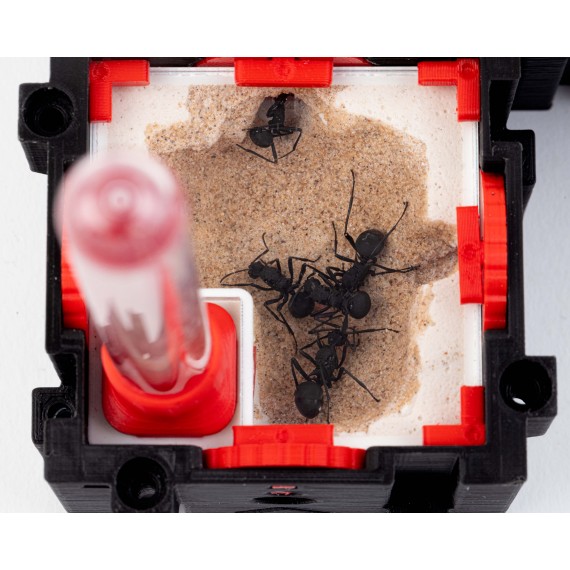
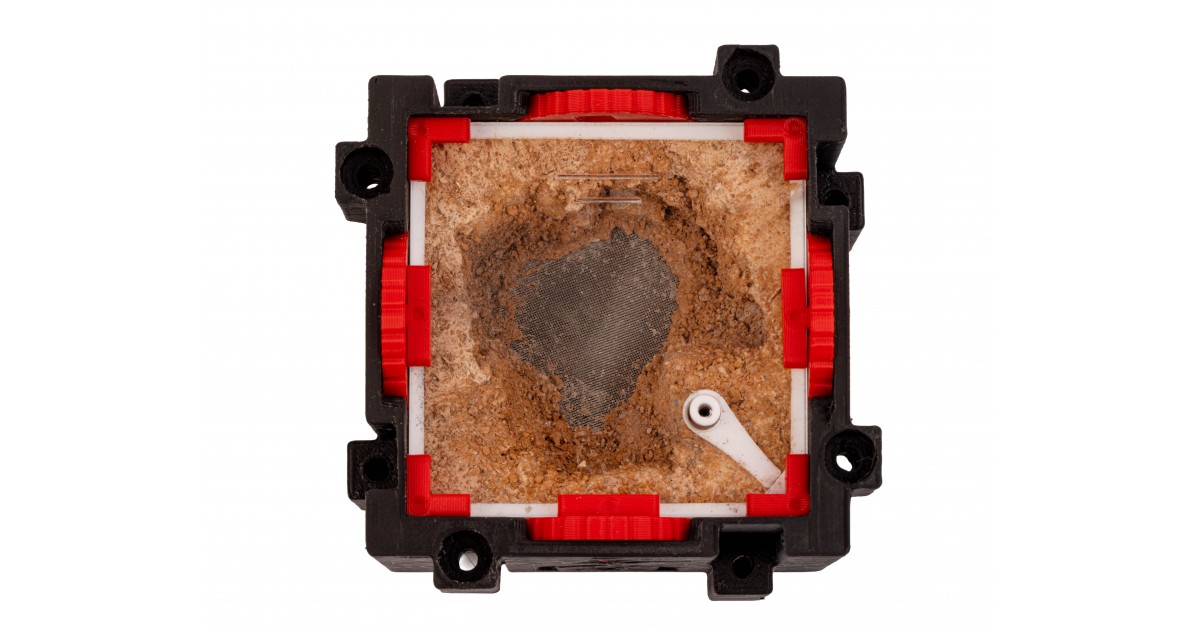
To start with, at Antomas we recommend the Anthouse Qbik Wild One, made of plaster, which holds humidity well, in either its standard or its evaporation version. The standard version has a refillable water tube. In the evaporation version, the water sits in a reservoir under the nest, separate from the galleries, and the humidity rises through a mesh, creating a gradient so that the colony can choose where to settle.
With this species, make sure the humid area never runs out of water. To expand, when you see many workers idle in the foraging area, at Antomas we recommend a hybrid, which provides more humidity: the Qbik Wild Duo P 2C Hybrid.
Complete the setup as follows:
- A small foraging area with some substrate, leaf litter and bits of cork: they look for shelter near the entrance and do not stray far.
- Water in a test tube with cotton wool and a feeder for the sugar.
- A corner as a rubbish tip: remove the debris often.
- Escape barrier and a well-fitting lid (see “Escapes and barriers”).
How to prepare the Qbik Wild
The formicarium arrives dry, and the plaster takes about a week to take up moisture. Prepare it before the colony arrives, following Anthouse’s instructions:
- Standard version: fill the humidity tube and keep it upright. To speed things up, add 2.5–5 ml of water with a syringe through a side access.
- Evaporation version: fill the reservoir with a syringe. When the water runs out, empty it completely and refill it from scratch.
- Water only: nectar and other liquids ruin the humidity system.
- Heat always at the side: never directly on the modules.
Arrival and moving by tipping
When it arrives, leave it for a day somewhere quiet and dark at 24–26 °C and check that it has water. To move it into the formicarium, at Antomas we do it by tipping:
- Set up the formicarium beforehand, with the humid area ready, the water in place and the barrier on.
- Work over a tray with a soft brush, never with your hands.
- Open the container it arrived in inside the foraging area, next to the nest entrance, and gently tip out the queen, the workers and the brood, helping any stragglers with the brush.
- Close the lid and leave the nest dark. Within a few hours they will have carried the brood inside.
During tipping, many will freeze as if dead: this is normal (see “It plays dead”). To move it to a larger module later, use the same method.
Growth
There are no published data on its growth rate or development times. We sell it as a queen with workers and brood, and although colonies in the wild have many queens, we advise against combining colonies, despite the lack of aggression that Moffett saw. With stable warmth, humidity and plenty of small food, the colony will gain workers; expand only when you see them short of space inside.
Feeding
Sugar in a feeder, always available. At Antomas we recommend variety: Anthouse Blue Sugar Nectar 4–5 times a week and another nectar or sugary liquid 1–2 times a week. You can also add a little protein to the nectar. Always offer it in a feeder, where the drop stays spread out and within reach, and never on cotton wool, which goes mouldy and quickly spoils the liquid.
Protein: small and plentiful. In the wild it hunts and scavenges constantly, and in the experience of Antomas, the more protein a colony gets, the faster it grows. If you clean often and remove the leftovers, it is better to overdo it than to fall short; if you cannot clean, it is better not to overfeed. Change the type of insect from one week to the next:
For a 2 mm ant, fruit flies and Thermobia prey are perfect. Cut up or open large prey: that way they make much better use of it. A soft live prey also works, as they know how to pin it down together. If you have woodlice or termites, offer them: they are part of what it eats in the wild, and one shop notes that it prefers other ants.
Remove the leftovers within 24–48 h and buy the insects from a reliable supplier: insects treated with insecticides can kill the colony.
Water: always, in the test tube with cotton wool in the foraging area, separate from the sugar.
No diapause
It does not need diapause. It lives in a climate with no winter, and the shops selling it agree that it is not necessary. At Antomas we recommend keeping it active all year round, at 24–28 °C and with the same humidity and feeding routine.
- If your home drops below 24 °C in winter, use heat at the side with a thermostat.
- If it stays at around 20–22 °C for a while, nothing happens: the colony slows down and picks up again with the warmth.
- Do not take it to a garage or a fridge, as you would a European species.
Behaviour and observation
Slow and discreet. Quah describes it as slow and not at all aggressive. Do not expect columns or big outings: you will see a trickle of workers near the entrance, which multiplies when there is food.
Watch them hunt. Put a small live prey in the foraging area and you will see what Moffett described: one worker holds it and others join in until it stops moving.
Watch without fear. At Antomas we believe ants are there to be enjoyed, watched and learnt from, not kept hidden away. All it takes is a dark nest, a lit foraging area and a gentle approach when you watch them.
Warning signs:
- Workers crowded in the humid area and the rest of the nest empty: it may be too dry.
- Mould or mites: too much water or forgotten leftovers.
- Brood not developing: check the temperature and the protein.
- Many workers idle in the foraging area: time to expand.
Escapes and barriers
It is slow, but very small. The shops selling it warn that it needs good escape prevention:
- Barrier: with an ant this small, at Antomas we prefer a thin, continuous band of talcum powder at the top of the foraging area walls. Mineral oil works too, but some workers can get stuck in it. Renew the talc when it cakes or gathers debris.
- A well-fitting lid and, if it has ventilation, a very fine mesh.
- No gaps: check connections, plugs and tubes. The Qbik comes with anti-escape parts: fit them all.
- Nothing that acts as a bridge to the barrier.
Handling and safety
It is not dangerous: it is so small that you will hardly notice it. Work with a soft brush over a tray, and look carefully before closing anything: a 2 mm ant is easily crushed. With small children or pets at home, keep the formicarium closed and out of their reach. This is an exotic species: it must never be released.
What not to do
- Let the nest dry out.
- Give it a cold diapause or keep it unheated in winter.
- Offer only large, whole prey to a small colony.
- Put the sugar on cotton wool or always give the same insect.
- Leave leftovers for more than 48 h in a humid nest.
- Set up the formicarium without a barrier or with gaps.
- Remove as dead any ants that are only motionless.
- Move a small colony into a huge formicarium.
Scientific sources
This care sheet is based on the scant scientific literature on Proatta butteli, on the AntCat and AntWiki catalogues, on climate data from its range and on the experience of Antomas and other keepers. Main references:
- Forel, A. (1912). Descriptions provisoires de genres, sous-genres, et espèces de Formicides des Indes orientales. Revue Suisse de Zoologie 20: 761–774.
- Emery, C. (1922). Hymenoptera. Fam. Formicidae. Subfam. Myrmicinae. Genera Insectorum 174B: 95–206.
- Weber, N. A. (1958). Nomenclatural notes on Proatta and Atta (Hym.: Formicidae). Entomological News 69: 7–13.
- Moffett, M. W. (1986). Behavior of the group-predatory ant Proatta butteli (Hymenoptera: Formicidae): an Old World relative of the attine ants. Insectes Sociaux 33: 444–457. doi:10.1007/BF02223950
- Beckers, R., Goss, S., Deneubourg, J. L. & Pasteels, J. M. (1989). Colony size, communication and ant foraging strategy. Psyche 96: 239–256. doi:10.1155/1989/94279
- Bolton, B. (2003). Synopsis and classification of Formicidae. Memoirs of the American Entomological Institute 71: 1–370.
- Schultz, T. R. & Brady, S. G. (2008). Major evolutionary transitions in ant agriculture. Proceedings of the National Academy of Sciences 105: 5435–5440. doi:10.1073/pnas.0711024105
- Blaimer, B. B., Ward, P. S., Schultz, T. R., Fisher, B. L. & Brady, S. G. (2018). Paleotropical diversification dominates the evolution of the hyperdiverse ant tribe Crematogastrini (Hymenoptera: Formicidae). Insect Systematics and Diversity 2(5). doi:10.1093/isd/ixy013
- Cassill, D. L., Vo, K. & Becker, B. (2008). Young fire ant workers feign death and survive aggressive neighbors. Naturwissenschaften 95: 617–624. doi:10.1007/s00114-008-0362-3
- Humphreys, R. K. & Ruxton, G. D. (2018). A review of thanatosis (death feigning) as an anti-predator behaviour. Behavioral Ecology and Sociobiology 72: 22. doi:10.1007/s00265-017-2436-8
- Cardoso, D. C., Alves, I. C. C., Cristiano, M. P. & Heinze, J. Death feigning in ants. Myrmecological News. Discussed on the journal’s blog (2024)
- Cardoso, D. C., Cristiano, M. P. & Heinze, J. (2026). Size, spines, and nests: what drives variation in death-feigning behavior in fungus-farming ants? Integrative Zoology. doi:10.1111/1749-4877.70169
- Quah (2009). Proatta butteli. Photos and Info on Ants and Termites of Malaysia. Online field notes