Difficulty: 4/5 – Advanced
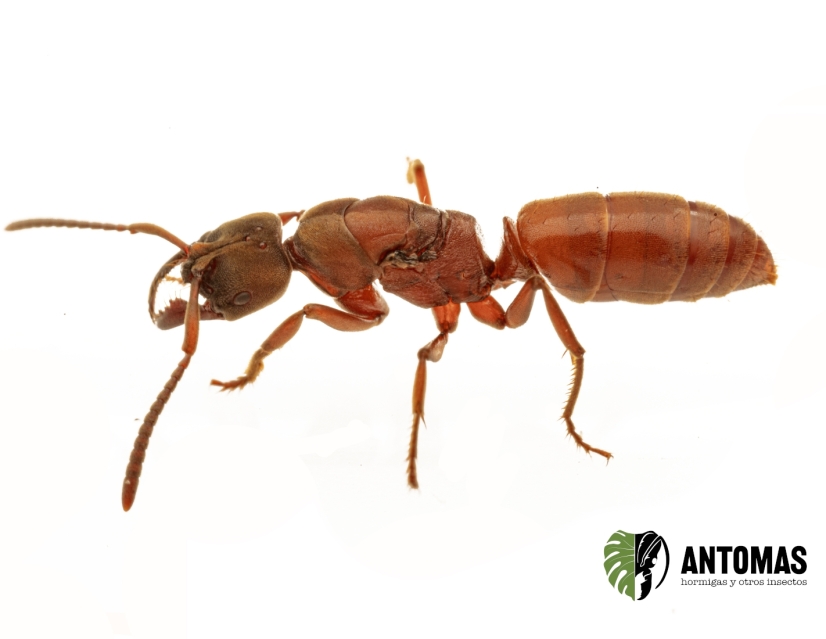
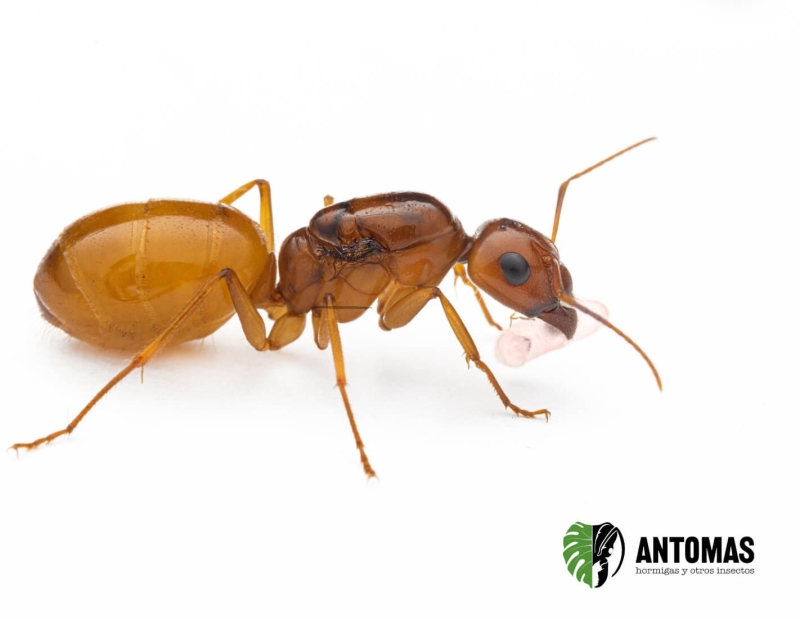
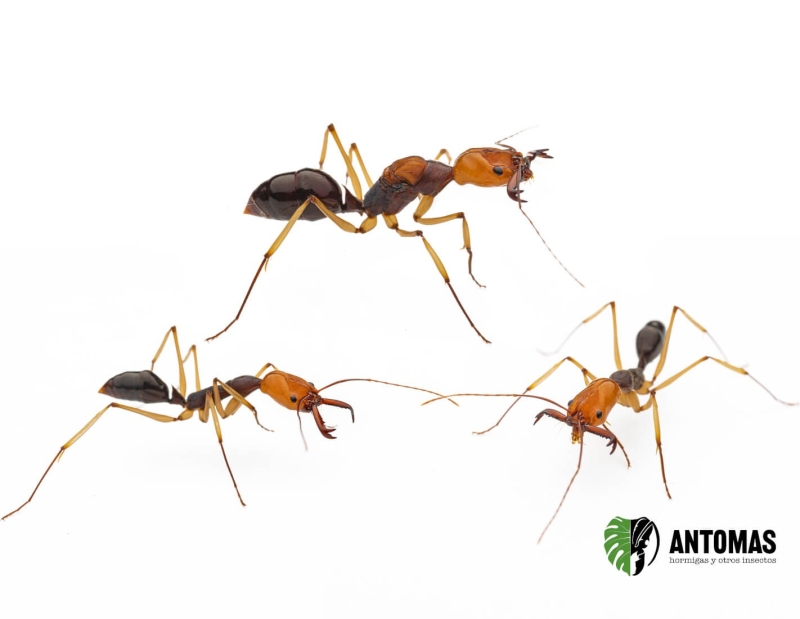
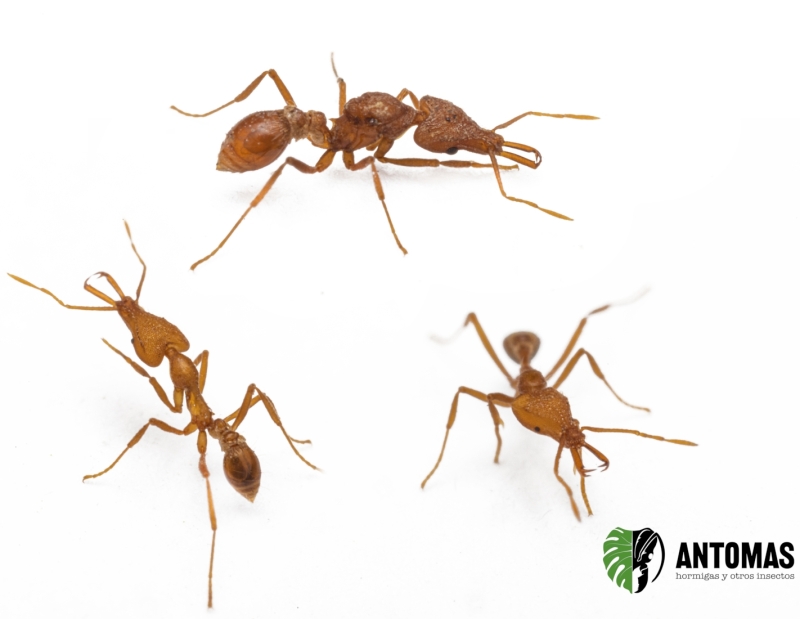
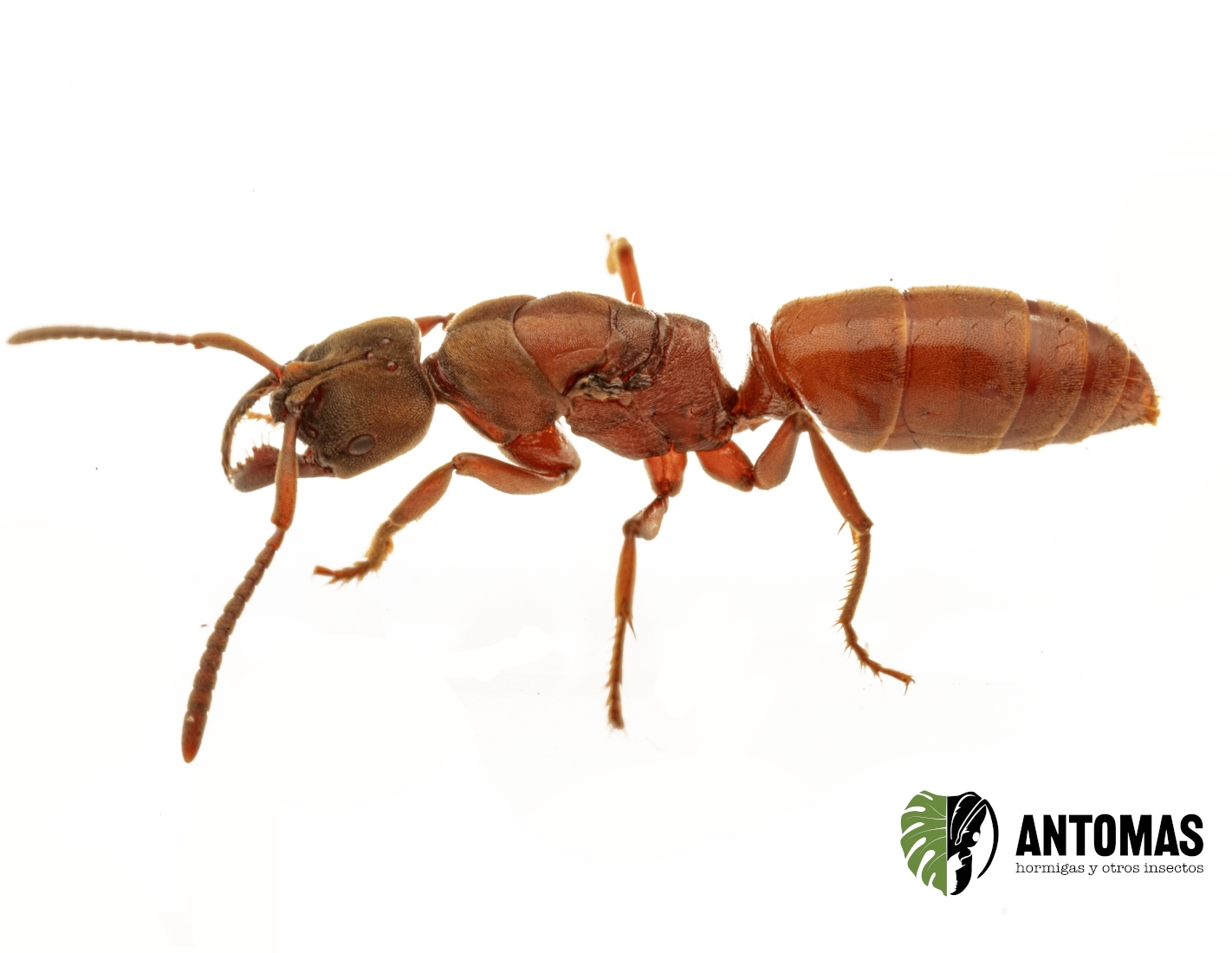
A subterranean ponerine from the tropical forests of South and South-East Asia: orange, almost blind (about four ommatidia per eye), with long, toothed mandibles and a sting. It is the only species in its genus and one of the least known ants that can be kept. The queen is sold on her own, and she founds semi-claustrally: she needs small prey from day one. Damp plaster nest (Qbik Wild), 24–28 °C, no diapause, plenty of varied protein as the staple and some nectar as a supplement. It has a sting: always handle it with tools.
Buniapone amblyops (Emery, 1887) is an ant that hardly anyone has seen alive. It lives beneath the floor of Asia’s tropical forests, from India to southern China and the southern islands of Indonesia, and myrmecologists nearly always find it the same way: by digging. Its workers are a deep orange, with long, narrow mandibles armed with seven teeth and eyes reduced to a handful of facets. It is the only species in its genus, and its name, taken from Malay folklore, already tells you what it is: a forest creature that does not let itself be seen.
It also has one of the most tangled taxonomic histories of any ponerine: it passed through seven different genera over more than a century before being given one of its own in 2014. And its closest relative does not live in Asia but in Africa: the large African “stink ant”, Paltothyreus tarsatus.
Science knows very little about its life: there are no studies of its colonies, its colony foundation or its prey. That is why, in this care sheet, we always keep three things apart: what is documented for B. amblyops; what is known about its sister genus and about ponerines in general, which we flag as such; and what we at Antomas recommend for keeping it. It is a species for experienced keepers who want something truly different: a queen that founds by hunting, a colony that lives in its galleries and the chance to observe behaviours that nobody has described yet.
Biology
Seven genera in a century: the ponerine nobody knew where to place
The Italian myrmecologist Carlo Emery described it in 1887 as Ponera amblyops, from a single worker. The species name comes from Greek and means “dim-sighted”, and that is no coincidence: the first thing you notice about its workers is their tiny eyes. What came next was, in the words of the authors of the modern revision of the ponerines, C. A. Schmidt and S. O. Shattuck, “probably the most convoluted taxonomic history of any ponerine”:
- 1887: Ponera.
- 1889: Trapeziopelta, a genus now considered part of Myopias.
- 1897: Belonopelta.
- 1900: Pachycondyla.
- 1901: Pseudoponera. Emery even designated it the type species of that genus, although a year earlier he had erected the genus with another species. The error was carried through the literature for a century until it was corrected in 2003.
- 1905: Euponera.
- 1995: back to Pachycondyla, the great “catch-all” genus of the ponerines, which is the name it still appears under in many lists: Pachycondyla amblyops.
- 2014: Buniapone, a new genus created just for it.
Why so much shuffling? Because its body combines features that do not occur together in other ponerines, and because life underground makes unrelated ants end up looking alike. It took DNA to settle the matter: the molecular phylogeny of the ponerines published by Schmidt in 2013 placed it with high confidence within the Odontomachus group, that of the trap-jaw ants and their relatives, as the sister of an African genus. On that basis, in 2014 Schmidt and Shattuck gave it its own genus, which remains monotypic: B. amblyops is its only species. A subspecies has also been described, B. amblyops oculatior, known only from a single queen from Java.
Named after the invisible spirits of the Malay forest
The genus name is one of the loveliest in myrmecology. According to its authors, Buniapone is dedicated to the Orang Bunian, a race of invisible beings that inhabit the forests in the traditional folklore of Malaysia, where the genus is common. It is a nod to its habits: a forest ant that lives hidden under the ground and that hardly anyone ever sees. The suffix -pone comes from Ponerinae, the subfamily it belongs to.
And the species name completes the picture: amblyops joins the Greek words for “dim” or “blunt” and “eye”. A dim-sighted forest spirit that lives underground. Few ants have a name that describes them so well.
Its closest relative is Africa’s “stink ant”
This is, according to its own authors, perhaps the most surprising result of the ponerine phylogeny: the closest relative of this small subterranean Asian ant is Paltothyreus, an exclusively African genus whose only species, P. tarsatus, is a large black ponerine that forages in the open on the floor of savannah and rainforest and is famous for the smell it gives off. The two share several unique anatomical features, and their split is recent enough that Schmidt and Shattuck acknowledged they could be merged into a single genus. They did not do so because their differences in form and way of life are enormous.
Most likely, according to the same authors, their common ancestor was a large ant that hunted on the surface, like most of the Odontomachus group, and the Asian lineage later adapted to life underground: it became smaller, lost almost all of its sight and gained tools for digging. B. amblyops is therefore the “underground version” of a lineage of surface hunters.
What is known about P. tarsatus helps us imagine how its Asian relative might live, although it should be read for what it is, data from another genus:
- Scavenger and termite hunter. In 1984 Bert Hölldobler showed that its workers mostly forage alone but, faced with a large prey item or a group of termites, recruit their nestmates with chemical trails produced in glands in the abdomen.
- Carries several prey items at once. A 1993 study observed that its workers can carry several termites at a time, search in restricted areas and adjust recruitment to the colony’s hunger.
- Tandem running. When the colony moves house or part of the nest collapses after rain, one worker leads another, which follows closely behind her, guided by a pheromone.
- Large colonies. In Ivory Coast its colonies averaged about 1,600 workers, and the largest exceeded 5,000 adults, with a single queen in some areas and several in the rainforest.
A hunter beneath the leaf litter
What is known about the life of B. amblyops in the wild fits in a few lines, and it is best to say so plainly. It is hypogaeic: it lives and forages below the soil surface. In Vietnam, its workers have always been collected by digging the soil in well-preserved forests. It is assumed to be a predator, like almost all ponerines, although nobody knows which prey it prefers.
There is a single field record of how it feeds, and it is very revealing. One of the authors of the genus, C. A. Schmidt, observed many workers gathered at a palm-oil bait buried in the soil. That suggests two things: that it is not strictly carnivorous but also makes use of fatty foods, and that it probably alerts its nestmates when it finds food, as its African relative does. For a keeper, it is a valuable clue: this is an ant that hunts but does not turn its nose up at a good food source when it finds one.
What does it hunt? Nobody has published it. Its size, its long toothed mandibles and its life underground fit with soft soil prey such as insect larvae, termites and other small arthropods, but that is an inference, not a fact. In captivity, the practical approach is to offer variety and watch what it accepts (see “Feeding”).
Almost blind: four facets per eye
The eyes of a B. amblyops worker have about four ommatidia, the facets that make up an insect’s compound eye. Ponerines that hunt on the surface, such as its relatives in the Odontomachus group, have eyes with many more facets. With four, B. amblyops can tell little more than light from dark.
This is not a defect but an adaptation. Underground, sight is of little use, and what counts is smell and touch, in other words the antennae. That is why this ant’s world is a chemical one: trails, the scent of prey and signals from its nestmates. For the keeper, this has a very pleasant practical consequence: light hardly bothers it during observation, although, like any good subterranean ant, it will always prefer a dark nest.
A body built for digging
Almost everything in its anatomy points to life in galleries. Its middle legs and the first tarsal segments bear stout traction setae, thick hairs that give it grip to push and move through the soil. The mesosoma is compact, without the groove that separates its parts in other ants. And the petiole, the “waist”, is a tall, thin scale.
That resemblance in shape to other soil ants, such as Centromyrmex, Promyopias or some American Cryptopone, is what confused taxonomists for so long. According to Schmidt and Shattuck, the resemblance is the result of convergence: unrelated lineages that end up with a similar form because they live in the same environment. Underground, the solutions repeat themselves: a compact body, small eyes, legs for digging.
Seven-toothed mandibles and a real sting
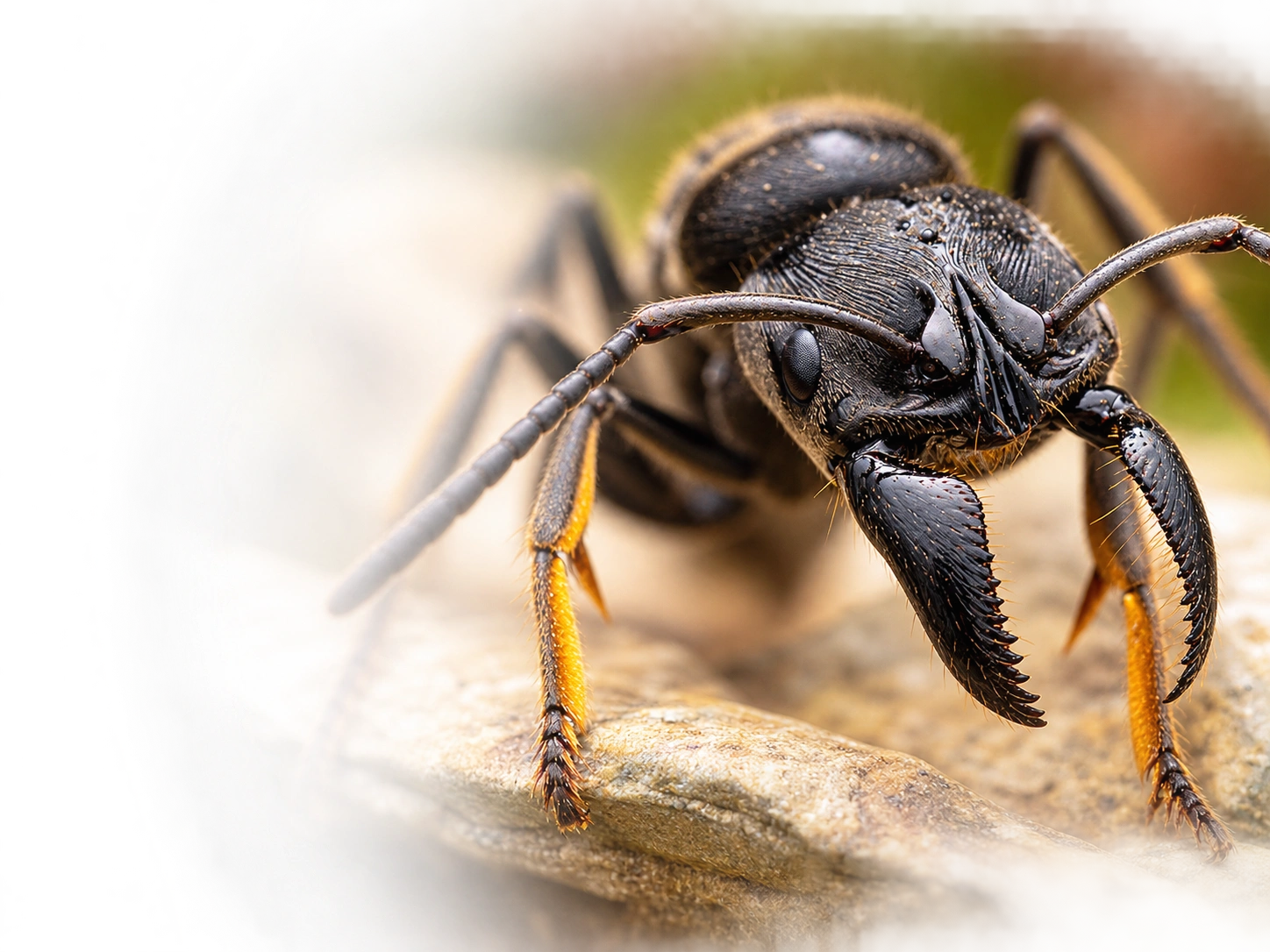
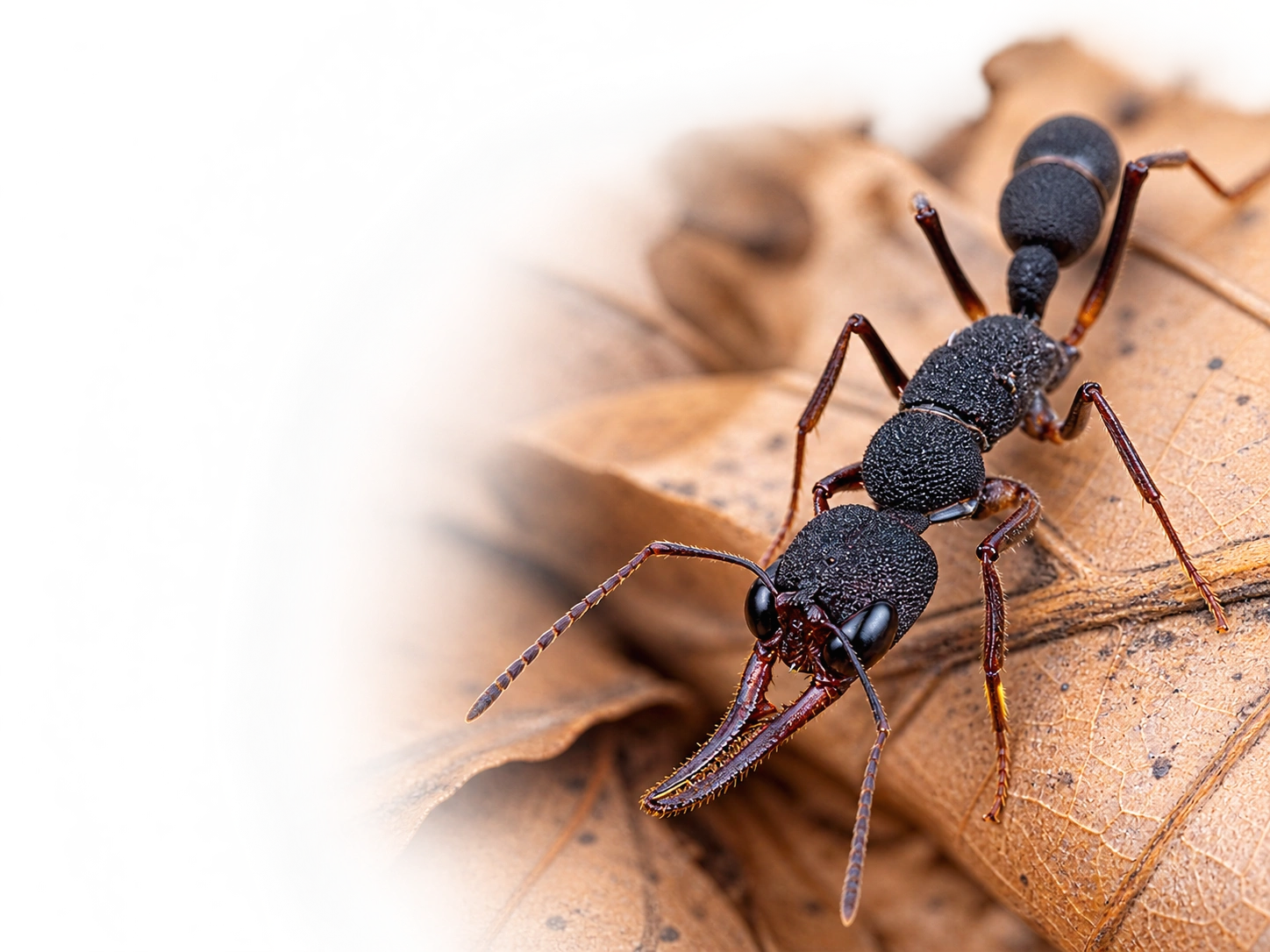
The mandibles of B. amblyops are long, narrow and elongate-triangular, with seven distinct teeth along the edge (six or seven depending on the specimens from Vietnam). In front of them, the clypeus forms a small blunt projection, another of its distinguishing features. They are not trap jaws like those of its relatives Odontomachus and Anochetus, but long pincers for holding prey.
And, like almost all ponerines, it has a well-developed sting. Ponerine venoms are rich in proteins and peptides, unlike the formic acid of the formicines, and serve both to paralyse prey and for defence. There are no studies on the venom of B. amblyops or on how painful its sting is, but it is worth bearing in mind: this is an ant that must always be handled with tools (see “Handling and safety”).
Its mitochondrial DNA, among the first of its lineage
That such a little-known species should have its complete mitochondrial genome published is a small surprise. In 2023, a team of Chinese researchers presented in the journal Life the first three complete mitogenomes of ants from the poneroid clade: those of Paraponera clavata, Harpegnathos venator and B. amblyops.
They found new rearrangements in gene order, and in H. venator they described, for the first time in an ant, a duplicated transfer RNA gene. For the hobbyist, the finding has a simple reading: B. amblyops is now a reference piece for understanding the evolution of the ponerines, even though hardly anyone has seen it in the field.
What nobody knows yet
We prefer to be clear: nothing has been published on how many workers a B. amblyops colony has, whether it has one queen or several, when it flies or how the queen founds in the wild. Its larva has not even been described. What has been described is the queen, which is like the worker but larger and winged, and the male, described by the entomologist Félix Santschi in 1928.
What we know about colony foundation comes from ponerines in general: in most of them, the queen does not shut herself away to live off her reserves but goes out to hunt while she raises her first workers. This is semi-claustral foundation, and it is the one we recommend managing at home (see “Founding with a lone queen, step by step”). Whoever keeps it is, quite literally, observing what science has not yet described. If you see anything curious, such as tandem running, recruitment or a favourite prey, let us know: in a species like this, every observation counts.
Size and morphology
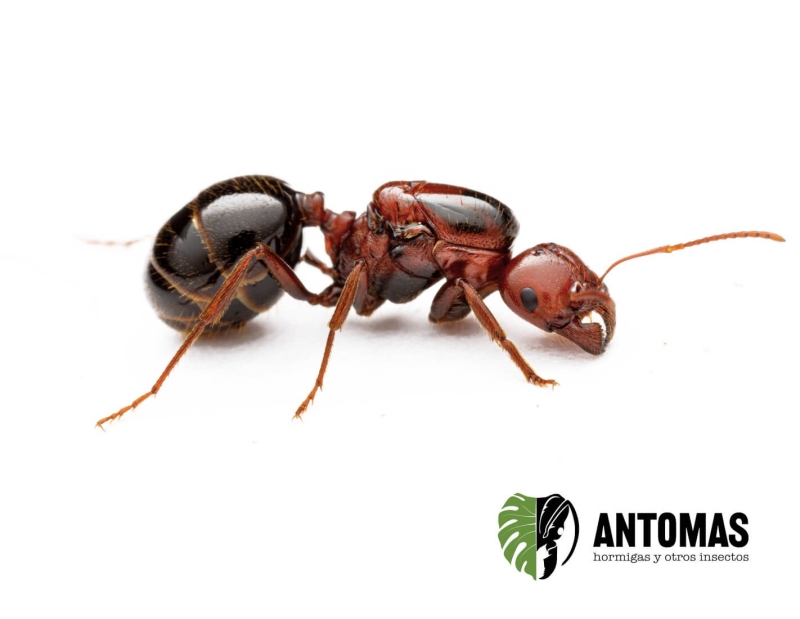
A medium-sized, robust and compact orange ponerine, with workers of a single size and a queen that is clearly larger and winged before the flight. These are its features, according to the descriptions by Emery, the revision by Schmidt and Shattuck and the synopsis of the ants of Vietnam by Eguchi and colleagues:
- Colour. Orange. Head, gaster and dorsum of the mesosoma punctate; the sides of the mesosoma longitudinally striate. Dense pubescence with scattered erect hairs. One keeper described his queen as having a “cherry-red” gaster with a slight golden sheen.
- Monomorphic workers. All the same size: there are no major workers or soldiers.
- Head. Subrectangular in full-face view, without scrobes to hold the antennae, with 12-segmented antennae that thicken gradually towards the tip.
- Clypeus. With a blunt, almost rectangular median projection above the mandibles.
- Mandibles. Long, narrow and elongate-triangular, with seven distinct teeth (six or seven in the specimens from Vietnam) and a basal groove.
- Eyes. Tiny, with about four ommatidia, located in the front half of the head.
- Mesosoma. Compact, without a metanotal groove; propodeum without spines, with oval spiracles.
- Legs. With stout traction setae on the middle tibiae and the first tarsal segments: tools for digging.
- Petiole. A tall, thin scale in profile, with a small triangular projection underneath.
- Gaster. With a slight constriction between its first two segments and a well-developed sting.
- Queen. Like the worker, but larger and with wings, which she sheds after the nuptial flight.
- Male. Described by Santschi in 1928.
- Larva. Not described.
How to tell it apart? For the hobbyist, the combination is unmistakable: an orange, compact ant with long, toothed mandibles, almost invisible eyes and a scale-shaped petiole. The ants that most resemble it are Centromyrmex, which has no eyes and lacks the clypeal projection, and Myopias, which has a thick petiole and a marked groove on the mesosoma.
Approximate measurements
- Queen: 9.25 mm total length (Emery, 1889)
- Workers: 5.5–6.5 mm total length (Emery, 1887)
- Worker eyes: about 4 ommatidia
- Mandibles: 7 teeth (6–7 in the specimens from Vietnam)
- Male: no measurements in the sources consulted
These are the only published measurements, and they come from the original descriptions. A keeper who kept several queens in 2021 estimated his at about 10 mm, a figure consistent with Emery’s. The size difference between queen and worker is moderate, as in many ponerines.
Keeping it in captivity
Difficulty: 4/5 – Advanced
This is not a species you can keep with your eyes closed, and we would rather explain why:
- There is almost no information. There are no studies of its biology and no care guides. What we propose is based on its habitat, on what is known about ponerines and on general experience with tropical ponerines. The keeper has to observe a great deal and adjust.
- The queen is sold on her own, and she founds by hunting. Semi-claustral foundation is more demanding than claustral foundation: you have to give her small prey regularly, remove leftovers so the tube does not go mouldy and keep the humidity up.
- Slow growth. The only keeper who has shared his experience on a forum described it as “one of the most beautiful and difficult species to keep” and very slow-growing. It is an isolated opinion, but it fits what you would expect from a subterranean ponerine.
- Humidity and life underground. It needs a damp, stable nest, and its young colonies are small and discreet.
- Sting. It must be handled with tools and with care.
Is it worth it? Very much so, if rare species appeal to you. It is the only member of its genus, an Asian relative of the African stink ant that looks like a small orange jewel, and almost everything you will see in your formicarium, from its favourite prey to how the colony organises itself, is still waiting to be described.
Recommended parameters
- Nest temperature: 24–28 °C, stable. It is a tropical forest-floor ant, where the soil buffers temperature changes; a stable range is better than heat peaks.
- Foraging area: at a mild room temperature, with one slightly warmer end if the room is cool. Never strong heat inside the nest.
- Humidity: high in the nest, with a gradient: one wetter part and another slightly drier, so the colony can choose where to keep the brood. Letting it dry out is a serious mistake.
- Water: always available, in a test tube with water and cotton wool in the foraging area.
- Light: dark nest and normal light in the foraging area. It can barely see, so observing under dim light hardly affects it.
- Diapause: none (see “No diapause”).
Recommended formicaria
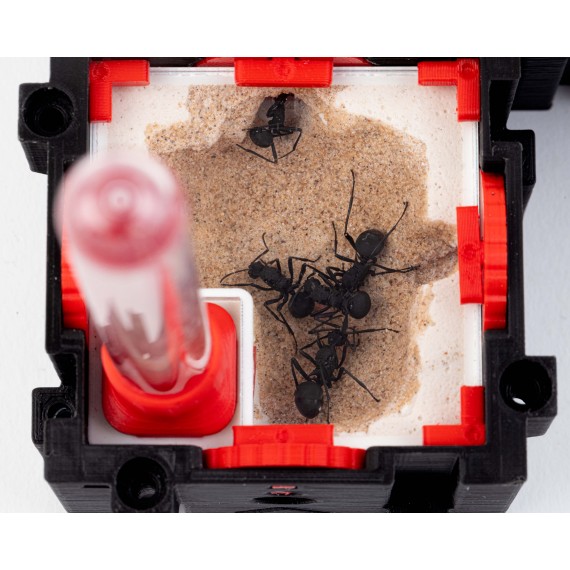
For a tropical ponerine that lives underground and needs humidity, at Antomas we recommend the plaster formicaria of the Qbik Wild range by Anthouse, which hold humidity well and offer dark galleries similar to those it digs in the soil. To start with, once the queen has her first workers, the Qbik Wild One P 1C, with a single chamber: a small colony needs a small nest.
When the colony grows, the Qbik Wild Duo P 2C, with two chambers, lets you keep one wetter and the other slightly drier:
Complete the set-up with these details:
- Humidity in the plaster: moisten the reservoir regularly, without flooding it. If you see heavy condensation or mould, reduce the water and ventilate a little.
- A small foraging area, with a thin layer of slightly damp soil or coconut fibre and a piece of bark or a flat stone: it is a soil ant and appreciates having somewhere to hide and dig.
- Water always available, in a test tube with water and cotton wool.
- A feeder for nectars, never soaked cotton wool (see “Feeding”).
- An escape barrier and a lid from day one (see “Escapes and barriers”).
- Gentle heat, only if needed, on one side of the nest, with a thermostat.
Founding with a lone queen, step by step
At Antomas we sell B. amblyops queens without workers. That means you are the one who accompanies the queen through the most delicate moment in a colony’s life: its foundation. And in this species, as in most ponerines, foundation is semi-claustral.
What is semi-claustral foundation? In many ants, such as Camponotus or Lasius, the queen seals herself in after the flight and raises her first workers without eating, using her body’s reserves: the wing muscles she no longer needs and her stored fat. That is claustral foundation. In most ponerines, by contrast, the queen has fewer reserves and, as Peeters and Ito explained in their review of colony dispersal, goes out to hunt during foundation to feed her larvae. A 2014 study on the thorax anatomy of ants links this to a trade-off between flying and moving on the ground: the queen’s body reflects whether she founds sealed in or by hunting. For the keeper, the consequence is clear: the queen needs prey from day one.
- The tube. Keep the queen in a test tube with water behind the cotton wool, at 25–27 °C and in the dark, for example covered with a piece of card. A good option is to leave the tube open inside a small foraging box with a barrier and lid, so the queen can go out to look for food, as she would in the wild.
- Small prey every 2–3 days. Offer soft prey of the right size, freshly killed or alive if small: Thermobia domestica nymphs, springtails, small pieces of cricket or cockroach. Leave them next to the tube entrance or in the box. Vary the prey from one feed to the next.
- Cleaning. Remove leftovers the following day. In a warm, damp tube, forgotten food goes mouldy very quickly, and mould is the great enemy of a semi-claustral foundation.
- Humidity. Check that the cotton wool is still damp and that there is water left in the reservoir. If the water runs out or the tube gets very dirty, move the queen to a new tube by tipping her out carefully.
- Check on her often. Have a look every day or every other day, under dim light and calmly: check whether she has eaten, whether there are eggs or larvae and whether there are leftovers to remove. She can barely see, so a brief look does not stress her; what you should avoid are knocks, vibrations and opening the tube unnecessarily.
- The larvae eat prey. In ponerines, the larvae are not fed only on regurgitated liquids: the queen and workers place small pieces of prey on them so they can eat directly. If you see the queen carrying food to the larvae, the foundation is on the right track.
- Patience. There are no published data on how long the first worker takes to emerge. The only keeper who has described a foundation counted a dozen eggs and no larvae after almost a month, and described it as a very slow-growing species. Allow several months until the first workers and do not be alarmed if you see no progress at first.
When to move her to the nest? Once she has her first workers, at Antomas we recommend moving her with 3–6 workers to a small nest, the Qbik Wild One P 1C, or sooner if the tube gets dirty, runs out of water or becomes too small. What matters is that the nest is not too big for the colony.
Arrival and moving
When you receive your queen, let her rest for a day in a dark, mild place, at 25–27 °C, and check that the tube has water. Offer the first small prey item the following day. When it is time to move the colony into the formicarium, at Antomas we do it by tipping: we open the tube inside the foraging area, next to the nest entrance, and gently tip out the queen, the workers and the brood, helping any stragglers with a soft brush. Three tips:
- Prepare everything beforehand: the nest moistened, the barrier in place and the water tube in position.
- Work over a tray and calmly, in case a worker gets out.
- Darkness in the nest: keep the nest area dark; the workers will gather the brood and carry it inside straight away.
If you ever need to move the colony to another formicarium, use the same method.
Feeding
Protein: the basis of its diet, and the more the better. It is a predatory ponerine, and protein is the engine of the colony. It is also the Antomas philosophy: if you do daily maintenance and remove leftovers, it is better to overfeed, because the colony perceives that it has more resources and grows faster and in greater numbers. If you will not be able to clean often, it is better not to overfeed: in a damp nest, leftover food rots and brings mould and mites. Change the type of insect from one week to the next, so they do not always eat the same thing:
- Thermobia domestica, a small, soft prey, perfect for foundation and small colonies.
- Springtails, Sinella curviseta, soil prey that fit its subterranean life and also help to clean up leftovers.
- Small pieces of cricket, Acheta domesticus, or runner cockroach, Shelfordella lateralis, freshly killed or cut up, and mealworm, Tenebrio molitor, cut up.
- If you can get hold of them, termites and soft insect larvae: soil prey like those it probably hunts in the wild.
Watch what it accepts and what it leaves: as there are no data on its prey in the wild, your colony will tell you. Buy insects from a reliable supplier, because insects treated with insecticides can kill the colony.
Nectars, as a supplement. The only field observation of how it feeds, that of many workers gathered at a palm-oil bait, indicates that it is not strictly carnivorous. That is why we also recommend offering sugary liquids, although it will probably take them much less than a formicine would. Vary the sugars: at Antomas we recommend Blue Sugar nectar by Anthouse 4–5 times a week and another sugary liquid or nectar 1–2 times a week. You can also add some protein to the nectar. Always offer them in a feeder, never on cotton wool, because cotton wool goes mouldy and spoils the liquid very quickly: a traditional or home-made feeder where the drop stays “spread out” and accessible, in small amounts and replaced before it ferments.
Water: always, in the test tube with cotton wool in the foraging area. It is a species from a humid environment, and letting it dry out is a serious mistake.
No diapause
It lives in the tropical forests of South and South-East Asia, which are warm all year round, and underground too, where the temperature changes even less than in the air. It does not need diapause: keep up the warmth and food all year round. In the northernmost part of its range, southern China, there is a cooler season, so a slight drop in temperature in winter, without going below about 22 °C, will do it no harm, but it is not necessary. What you must avoid is cold: a tropical ponerine below about 20 °C becomes sluggish and stops raising brood.
Behaviour in captivity
A gallery colony. It will spend most of its time inside the nest. The workers come out into the foraging area to look for food and tend to move close to the ground and under the soil or bark. It is normal to see little movement on the surface: the life of the colony is inside.
Observe without fear. At Antomas we believe ants are there to be enjoyed, observed and learned from, not kept hidden away. With this species it is even easier: it can barely see, so dim observation light hardly affects it. Leave them the dark area in the nest, light the foraging area normally and observe them often, gently: it is the best way to spot any problem in time.
What to look for. This is a species about which almost everything remains to be described. Watch how it hunts, whether a worker that finds a large prey item returns to the nest for help, as its African relative does, whether tandem running appears during house moves and which prey it prefers.
Warning signs:
- Larvae that do not grow or disappear: almost always a lack of protein.
- Mould in the tube or nest: forgotten leftovers or too much humidity without ventilation.
- Motionless, huddled workers or queen: check the temperature and humidity.
- Many workers in the foraging area that do not go in: the nest is too dry or has become too small.
Escapes and barriers
There are no data on its ability to climb smooth surfaces. To be on the safe side, with a ponerine that has a sting we recommend the most secure barrier:
- A strip of PTFE (Fluon) on the upper part of the foraging area walls, thin and continuous. Paraffin oil is an alternative if it is renewed often.
- A well-fitting lid, as a second line of defence.
- No gaps: check connections, stoppers and tubes. This is an ant that slips through cracks in the soil.
- Nothing that can act as a bridge to the barrier: no bark or stones leaning against the walls.
Handling and safety
It has a functional sting, like almost all ponerines. It is not an aggressive ant in the sense of coming out to attack, but if it feels trapped or is pressed, it can sting. There are no data on how painful its sting is, so it is best not to find out. Always handle it with entomological tools, such as a soft brush or soft forceps, never with your hands, and work slowly so as not to injure any worker, let alone the queen. People allergic to hymenopteran stings should take extra precautions. Do not combine queens or colonies, or keep it with other species. It is an exotic species: under no circumstances should it be released.
What not to do
- Treat the foundation as if it were claustral: the queen needs prey from day one.
- Leave food leftovers in the tube or nest: in a damp environment, mould arrives very quickly.
- Let the nest or the water tube dry out.
- Move it to a nest that is too big for its size.
- Put it through diapause or keep it below about 20 °C.
- Always give it the same insect, or only prey that is too large and hard.
- Put nectars on cotton wool.
- Go days without checking on it: you need to check on it often, under dim light.
- Handle it with your hands: it has a sting.
- Leave gaps or fail to renew the barrier.
Scientific sources
This care sheet has been prepared from the scientific literature on Buniapone amblyops, its sister genus Paltothyreus and ponerines in general, and from Antomas’s own keeping guidelines. Main references:
- Schmidt, C. A. & Shattuck, S. O. (2014). The higher classification of the ant subfamily Ponerinae (Hymenoptera: Formicidae), with a review of ponerine ecology and behavior. Zootaxa 3817: 1–242. doi:10.11646/zootaxa.3817.1.1
- Schmidt, C. A. (2013). Molecular phylogenetics of ponerine ants (Hymenoptera: Formicidae: Ponerinae). Zootaxa 3647: 201–250. doi:10.11646/zootaxa.3647.2.1
- Eguchi, K., Bui, T. V. & Yamane, S. (2014). Generic synopsis of the Formicidae of Vietnam (Insecta: Hymenoptera), Part II — Cerapachyinae, Aenictinae, Dorylinae, Leptanillinae, Amblyoponinae, Ponerinae, Ectatomminae and Proceratiinae. Zootaxa 3860: 1–46. doi:10.11646/zootaxa.3860.1.1
- Xiong, Z., He, D., Guang, X. & Li, Q. (2023). Novel tRNA gene rearrangements in the mitochondrial genomes of poneroid ants and phylogenetic implication of Paraponerinae (Hymenoptera: Formicidae). Life 13: 2068. doi:10.3390/life13102068
- Hölldobler, B. (1984). Communication during foraging and nest-relocation in the African stink ant, Paltothyreus tarsatus Fabr. (Hymenoptera, Formicidae, Ponerinae). Zeitschrift für Tierpsychologie 65: 40–52. doi:10.1111/j.1439-0310.1984.tb00371.x
- Déjean, A., Lachaud, J.-P. & Beugnon, G. (1993). Efficiency in the exploitation of patchy environments by the ponerine ant Paltothyreus tarsatus: an ecological consequence of the flexibility of prey capture behavior. Journal of Ethology 11: 43–53. doi:10.1007/BF02350005
- Peeters, C., Braun, U. & Hölldobler, B. (2013). Large colonies and striking sexual investment in the African stink ant, Paltothyreus tarsatus (subfamily Ponerinae). African Entomology 21: 9–14. doi:10.4001/003.021.0121
- Peeters, C. & Ito, F. (2001). Colony dispersal and the evolution of queen morphology in social Hymenoptera. Annual Review of Entomology 46: 601–630. doi:10.1146/annurev.ento.46.1.601
- Keller, R. A., Peeters, C. & Beldade, P. (2014). Evolution of thorax architecture in ant castes highlights trade-off between flight and ground behaviors. eLife 3: e01539. doi:10.7554/eLife.01539
- Touchard, A., Aili, S. R., Fox, E. G. P., Escoubas, P., Orivel, J., Nicholson, G. M. & Dejean, A. (2016). The biochemical toxin arsenal from ant venoms. Toxins 8: 30. doi:10.3390/toxins8010030