Difficulty: 4/5 – Advanced
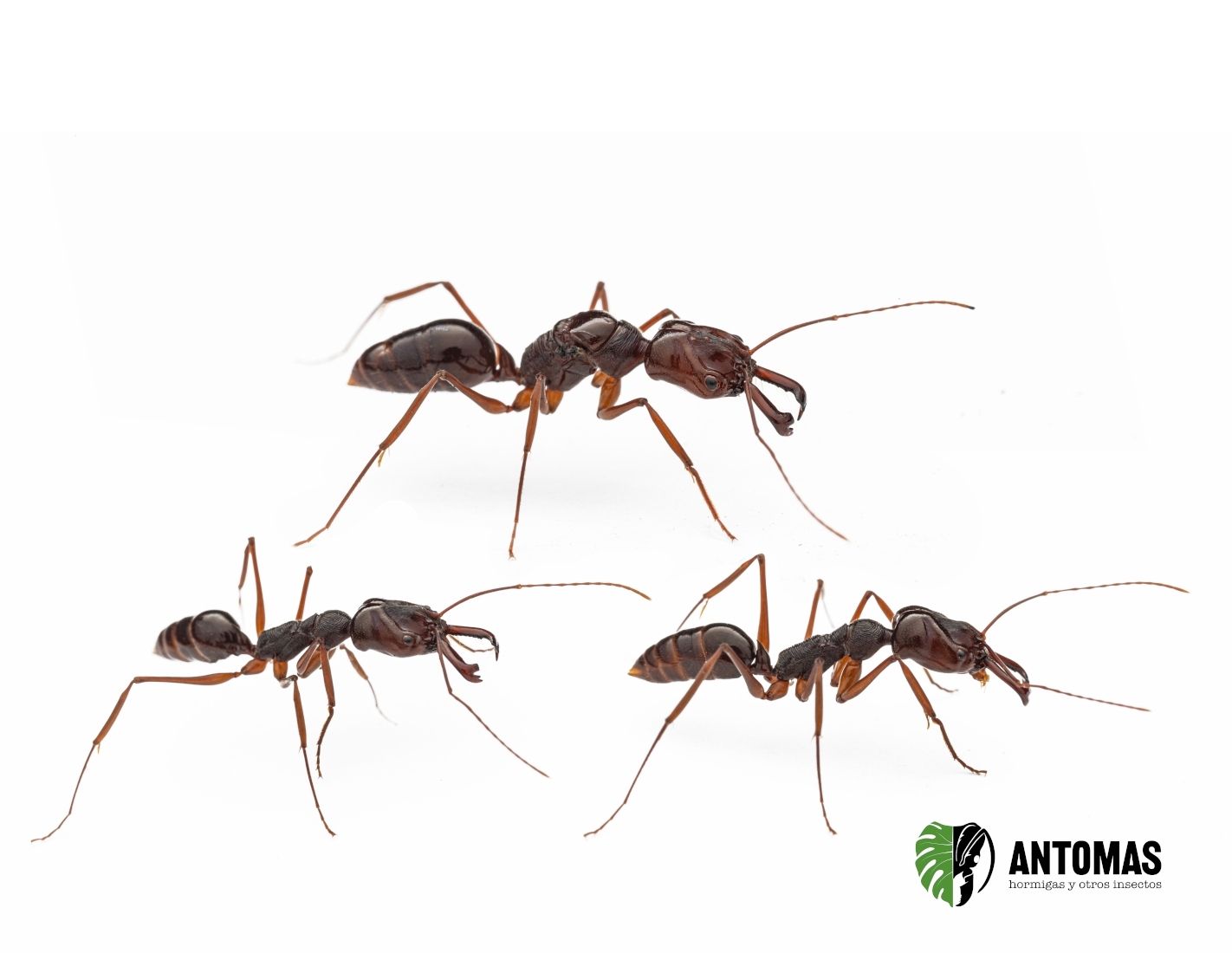
A Trap-Jaw Ant from Southeast Asia, still without a species name: workers of 12–15 mm, almost as large as the queen, with a mahogany head, a near-black thorax and amber legs. Colonies with queen, and the «Candy» line is polygynous: several queens live together in the same colony. A very moist plaster nest with coco fibre and a little fine sand, 24–26 °C inside the nest all year round, no diapause, plenty of varied protein and sugar as a free drop. Key: never let the nest dry out, use an oil barrier and keep the lid closed at all times, because they jump with their mandibles.
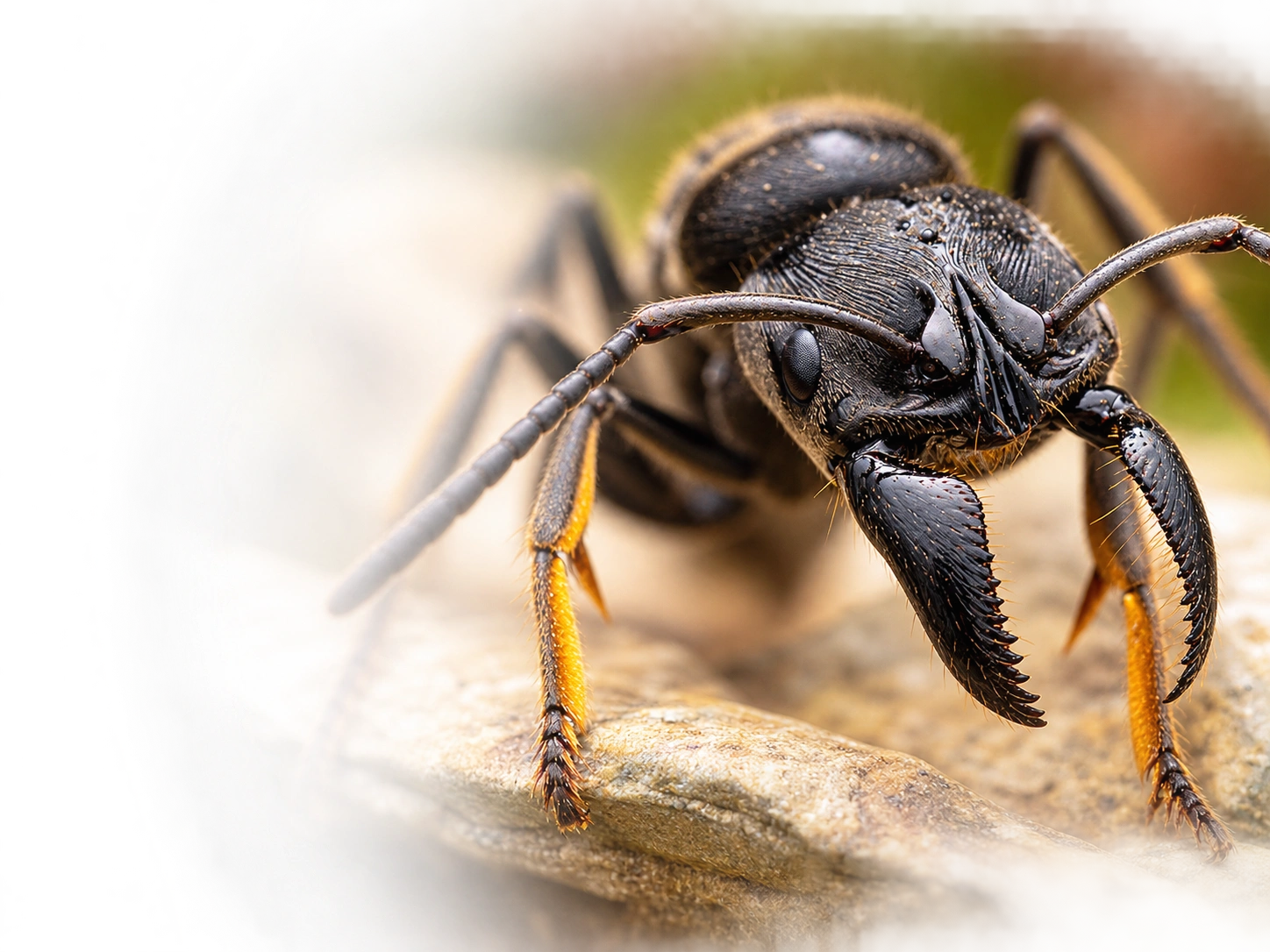
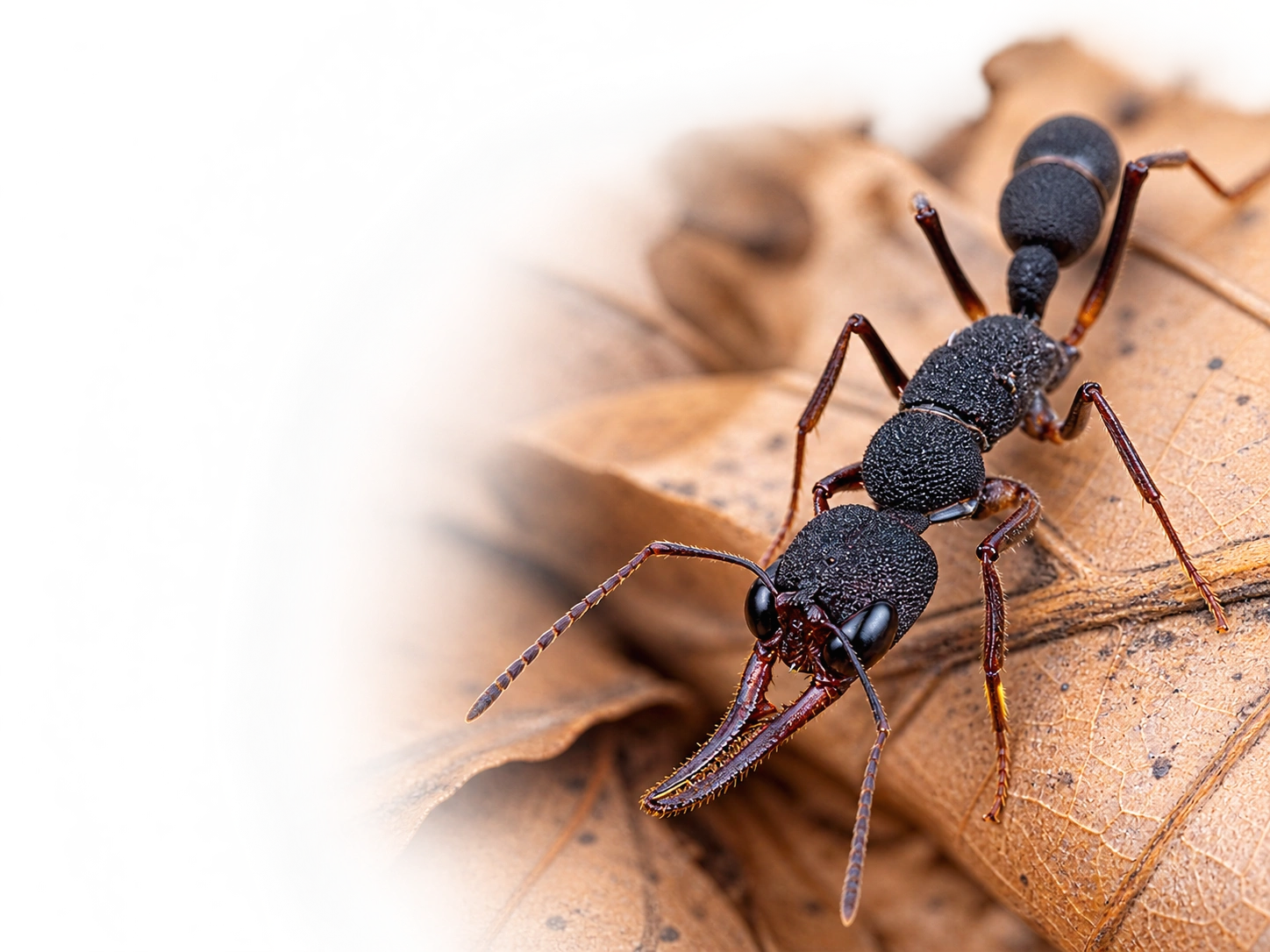
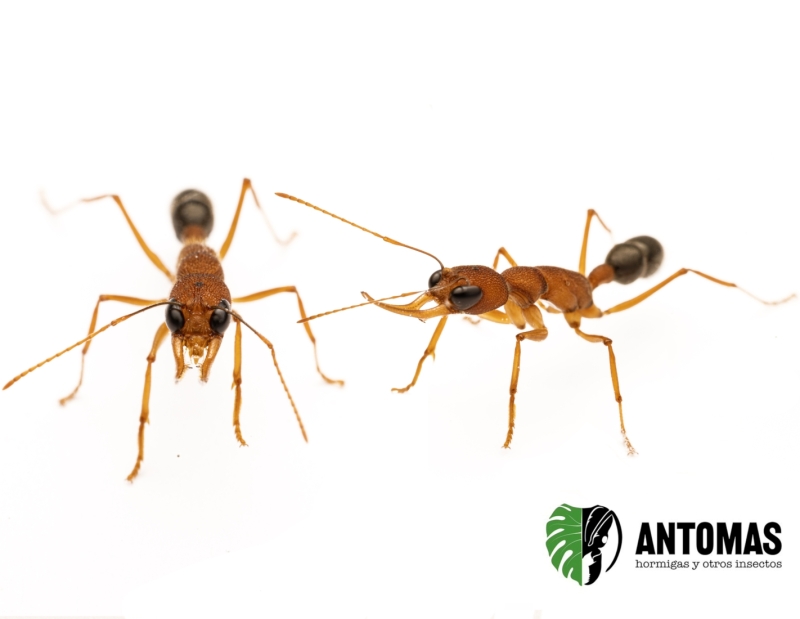
Odontomachus sp. «Candy» is a trap-jaw ant from Southeast Asia: a large, long-legged ponerine that patrols the ground with its mandibles held open in a straight line, like a loaded snare, and snaps them shut in a fraction of a millisecond when prey touches its sensory hairs. Its workers measure 12–15 mm, almost the same as the queen, and its colonies have a feature that is unusual in the hobby: several queens sharing one nest.
It does not yet have a species name. In this care sheet we explain what that means, what can be inferred from its appearance and, above all, what science knows about its genus, one of the most studied of all because of the speed of its mandibles. We always keep apart what is documented in Odontomachus (and in which species), what keepers report, and what we have learnt rearing this line at Antomas.
Biology
What does «sp.» mean? And why «Candy»?
«sp.» is the abbreviation of species, and it is written after the genus when the genus of an animal is known for certain but its species is not. Our ant is, without doubt, an Odontomachus: an elongated head, long straight mandibles inserted close together at the centre of the front of the head, and a petiole, the «waist», shaped like a tall scale ending in a point. Its size also sets it apart from Anochetus, the sister genus, whose ants are much smaller.
Giving it a surname is a job for a specialist: the teeth at the tip of the mandible, the pattern of striations on the thorax and the shape of the petiole have to be examined under magnification and compared with museum specimens. Until that is done, the honest thing is to call it Odontomachus sp. To tell this line apart from other unnamed Odontomachus, a trade name in quotation marks is used: «Candy». It has no scientific value: it is a label that indicates which population we are talking about. And it suits an ant in mahogany tones with caramel-coloured legs, even if there is little sweet about it.
Which group might it belong to? A cautious proposal
Taxonomists gather related Odontomachus into species groups. In the Oriental region, the classic classification by W. L. Brown (1976), still used by modern revisions, mainly distinguishes the O. haematodus group, with the Asian O. simillimus, and the O. rixosus group, which brings together the Oriental species with truncated subapical teeth on the mandible: O. latidens, O. monticola, O. rixosus and others described later, such as O. minangkabau from Sumatra, which its authors distinguish by its large size and dark colour. Separate from these is the O. infandus group, native to the Philippines, to which our O. banksi, O. infandus and O. schoedli belong.
Judging by the photos of our workers (a glossy dark brown body, a near-black and heavily sculptured thorax, orange legs and antennae, and large size), we think it reasonable to place it, with reservations, close to the O. rixosus group, and perhaps the O. monticola complex, which keepers describe as dark brown with orange legs. With reservations, because the defining character of the group, the subapical teeth, can only be seen under magnification; because colour varies within many species; and because the O. monticola complex is poorly resolved: the authors of the revision of the Odontomachus of Sumatra point out that it is highly variable and that some of its synonyms are probably valid species.
This fits what is known about the region: a 2018 phylogeny showed that Indo-Pacific Odontomachus form a mosaic of lineages that have dispersed again and again between the mainland and the islands. That is why everything we say here about biology has been measured in other species of the genus, and we tell you which.
0.13 milliseconds: the strike that made the genus famous
In 2006, Sheila Patek's team filmed workers of O. bauri, an American species, with a high-speed camera. The mandibles took an average of 0.13 milliseconds to close; the tip reached an average of about 38 m/s and a maximum of 64 m/s, more than 230 km/h, and each mandible struck with more than 300 times the ant's body weight. It was presented as the fastest predatory strike in the animal kingdom.
Three caveats. This is a figure for the genus: nobody has measured the strike of an Asian Odontomachus. In 2018, an even faster snap, of up to 90 m/s, was measured in the Dracula ant, Mystrium camillae, using a different mechanism: one mandible slides over the other, like snapping your fingers. And size matters: comparing four American species, Spagna and colleagues found that the large ones accelerate somewhat less but strike with much greater force. At 12–15 mm, «Candy» would predictably sit on the force side (this is an inference, not a measurement).
Latch, spring and trigger: how the trap works
No muscle contracts in 0.13 milliseconds. The trick is to load slowly and release all at once, like a crossbow:
- Cocking: as it opens, the base of each mandible is locked open at the joint.
- Loading: the large closer muscle, slow and powerful, contracts and stores energy in the cuticle itself, which acts as a spring.
- Firing: a small, fast muscle releases the latch and the energy is discharged instantly.
The trigger consists of long trigger hairs on the inner face of the mandibles. In 1993, Gronenberg, Tautz and Hölldobler discovered that each one is connected to a giant sensory neuron, with an exceptionally thick fibre, which carries the signal at top speed to the motor neurons: only a few milliseconds pass between the touch and the snap. This invention has appeared several times in the evolution of ants, and its closest trap-jawed relative is Anochetus, which you can see in our Anochetus cf. princeps and Anochetus graeffei.
Jumping with the head (and, sometimes, with the legs)
If the mandibles strike something hard, the recoil launches the ant into the air. In O. bauri, Patek described the escape jump, in which the worker fires against the ground and is propelled upwards, spinning as it goes, and the defensive bounce, in which it strikes an intruder and shoots backwards up to about 40 cm. In 2015, Larabee and Suarez pitted O. brunneus against antlion larvae: around 15% of the workers saved themselves with a mandible jump, and those whose mandibles had been immobilised fared considerably worse.
The twist concerns the group we compare «Candy» with. In 2015, D. Magdalena Sorger discovered in Borneo that O. rixosus also jumps with its legs, like Harpegnathos (including our Harpegnathos venator), and it is the only known ant that jumps in both ways. The leg jump helps it flee and, unlike the mandible jump, lets it choose where it lands. We do not know whether «Candy» does this: if you see it, let us know.
Leaf-litter hunters that carry the drop in their jaws
Odontomachus hunt arthropods, and many species mainly termites. In Panama, Ehmer and Hölldobler saw that O. bauri workers hunted alone beneath the leaf litter, by day and by night, and returned with prey on more than a quarter of their trips; almost all prey measured 3–4 mm, and large items were usually found already dead. They concluded that the speed of the snap serves above all to give the strike its impact.
With mandibles like these, how do they share nectar? Many ants swallow the liquid and regurgitate it to their nestmates; Odontomachus do not. In 1971, Evans and Leston described an African Odontomachus that collected honeydew in cocoa plantations and carried the drop held between its mandibles, like a bucket. That is why, at home, sugar must be offered as a free drop and never on cotton wool (see «Feeding»).
Several queens under one roof: polygyny in Odontomachus
The «Candy» line is polygynous: at Antomas we keep colonies in which several queens live together, which is why we also sell it with six. In the genus this is not the rule, but it is not a rarity either:
- O. rixosus, from Southeast Asia. In 1996, Ito and colleagues found colonies with several wingless queens, up to 82 in a single colony, and 92.4% of them were mated and laying eggs.
- O. chelifer, from South America. Several queens lay, but within a hierarchy: in 1992, Medeiros and colleagues described an escalation of antennal blows and mandible strikes that decides which queen dominates. High-ranking queens lay more, and the destruction of freshly laid eggs is part of that competition.
- O. hastatus, also American. In Brazil, about half of the colonies had more than one queen; in French Guiana, only one. You can get to know it in our care sheet for this species.
- O. bauri: only single-queen colonies have been found.
That «Candy» is polygynous is our own observation, not a published fact, but it fits O. rixosus, the best-studied Asian species in this respect. For the keeper it is an advantage: more queens, more eggs and a colony that does not depend on a single queen. That does not mean queens or colonies from elsewhere can be merged (see «Founding and growth»).
Does it have gamergates? What science says
Many people look up this word when they become interested in ponerines. A gamergate is a mated worker that lays eggs and acts as the queen, without wings or a queen's body; the name comes from Greek and means «married worker». This is what happens in Diacamma or in Harpegnathos. In Odontomachus, by contrast, we have not found a single documented case: they reproduce through queens, one or several. Some European shops suggest otherwise, but without published support. In «Candy», the egg-layers are queens.
A sting with laboratory-studied venom
As well as the trap, Odontomachus have a functional sting. The best-studied venom of an Asian species is precisely that of O. monticola: in 2017, a Japanese team found that 98.5% of its toxins were peptides similar to the pilosulins of the Australian jumper ants. The authors describe it as not very aggressive towards people, although its sting hurts and leaves an itch. We do not know whether «Candy» is O. monticola, so we do not attribute these data to it.
Cocoons that need soil
Like almost all ponerines, Odontomachus pupate inside a silk cocoon, and according to Brown's revision of the genus (1976) the larvae need sand or loose soil to complete it. Keepers confirm this: without substrate, large larvae often fail to pupate. For «Candy», substrate inside the nest is a necessity (see «Recommended formicarium»).
From the moist forest floor of Southeast Asia
Without a species there is no exact distribution. The line comes from Southeast Asia, and the Oriental Odontomachus we compare it with live in tropical and subtropical forests, from the lowlands to the mountains: O. monticola is recorded from north-east India to southern China, and the O. rixosus group is spread across Indochina, the Malay Peninsula and the large islands of Indonesia. In the genus, almost all species nest in the ground, under stones, in leaf litter or in rotting wood, in moist, shady places.
This is the climate of monsoon forests: heat for much of the year, abundant rainfall and very high air humidity, even more stable at ground level. In the north of the region there is a somewhat cooler, drier season, but beneath the leaf litter it never becomes a winter. For rearing: stable warmth and very high humidity all year round, without diapause.
Size and morphology
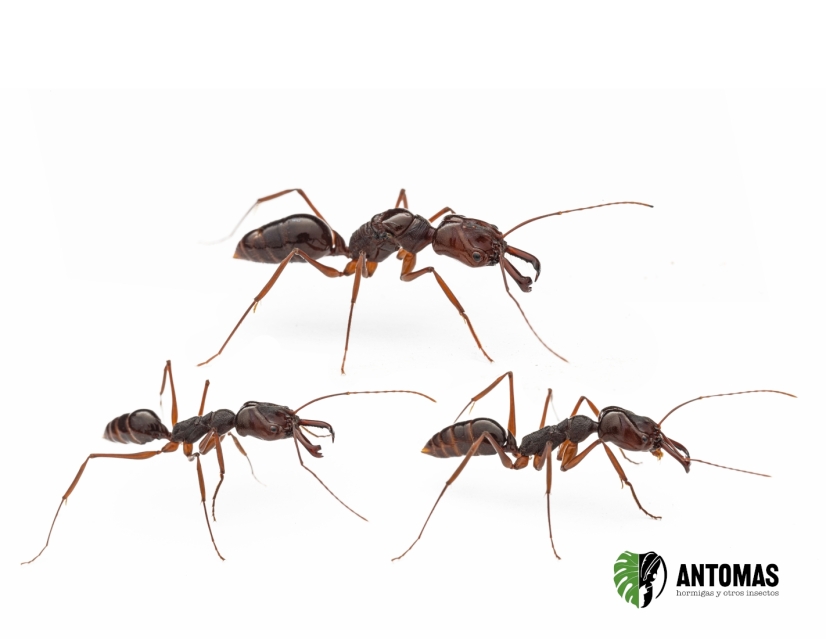
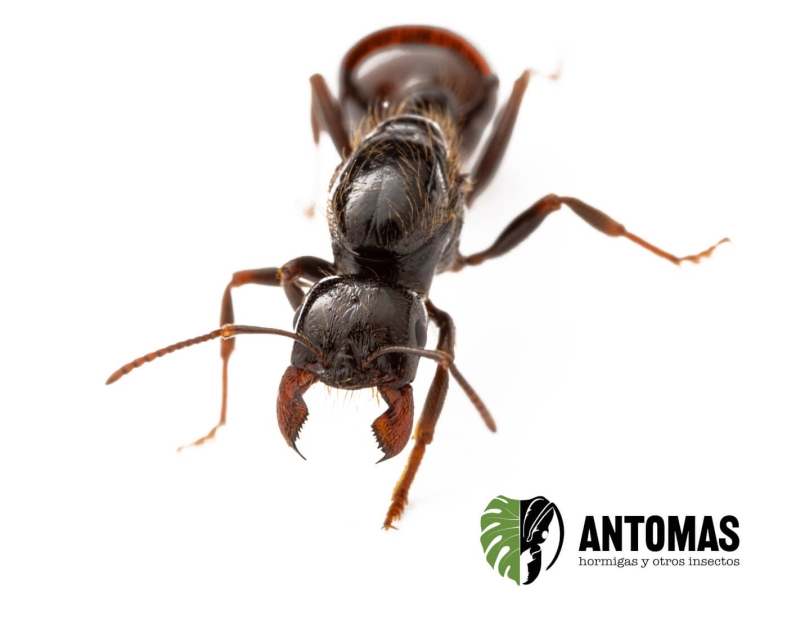
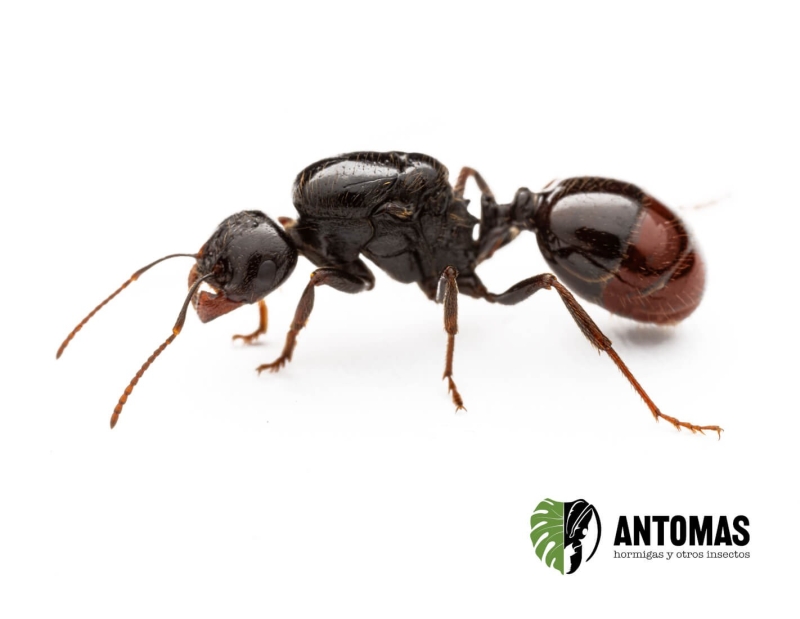
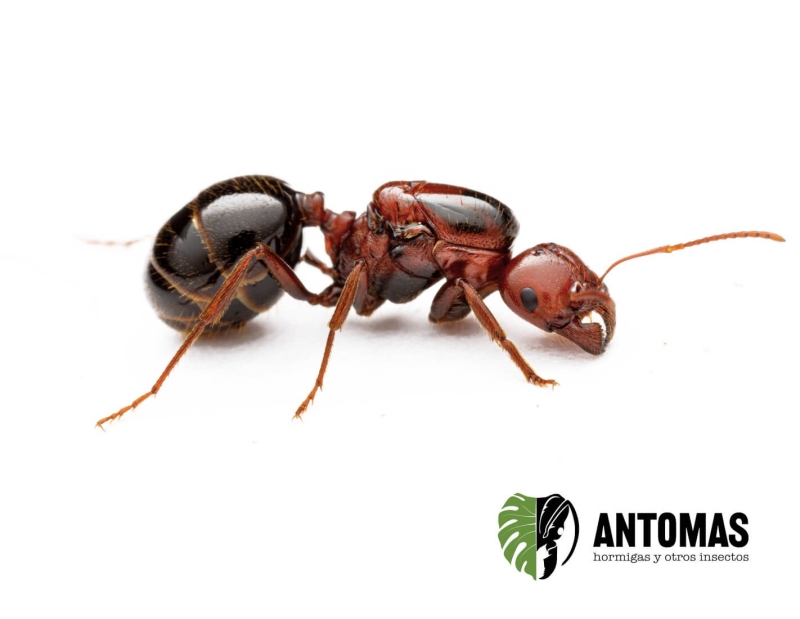
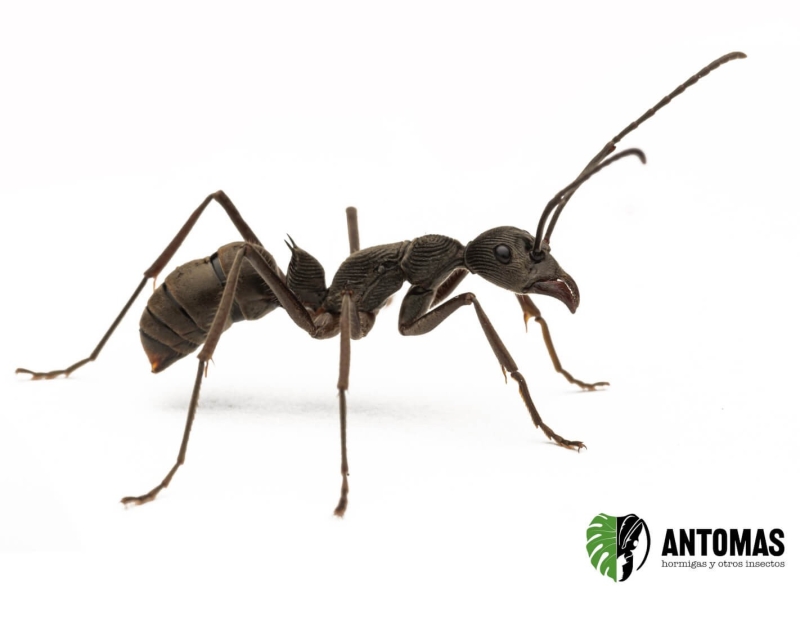
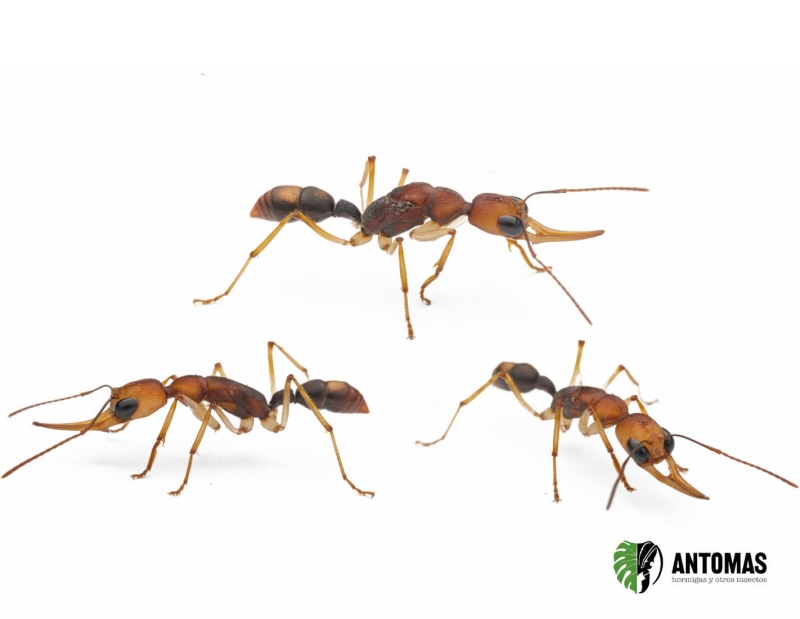
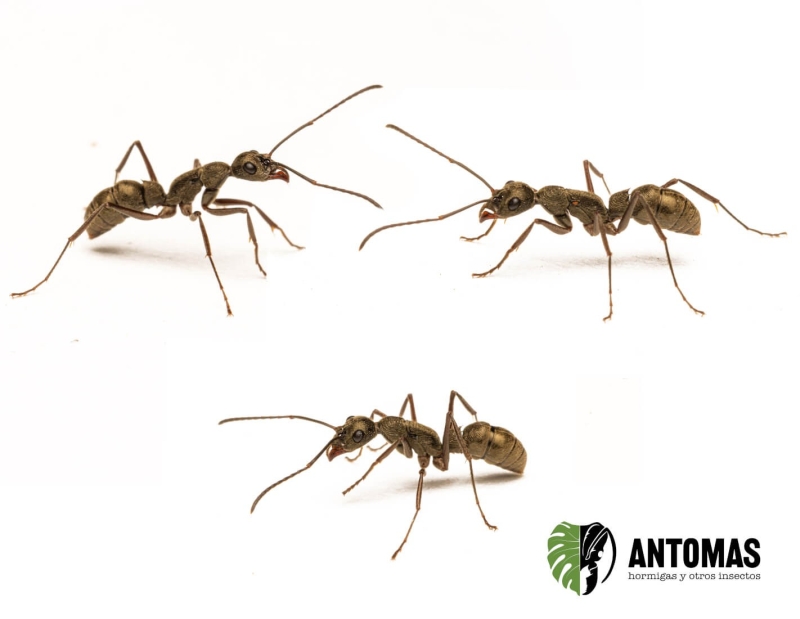
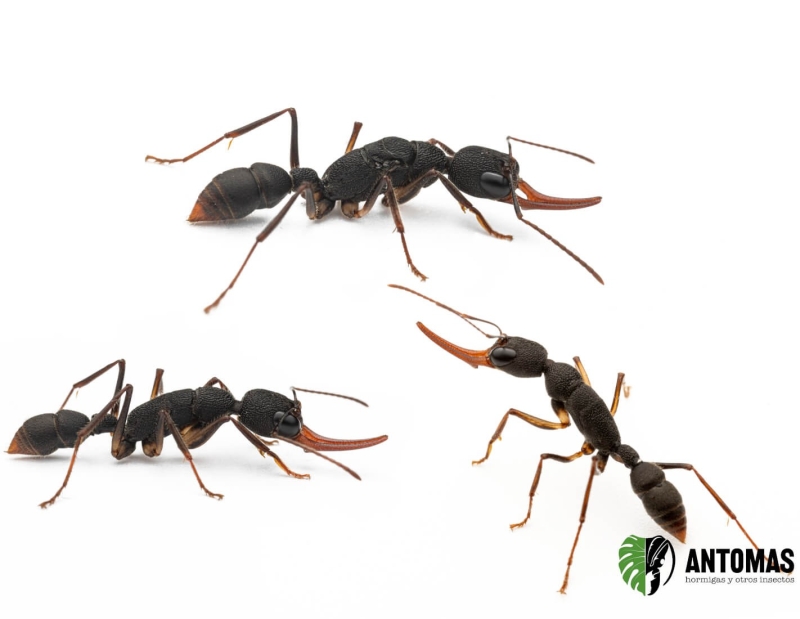
A large, slender ponerine with very long legs, an elongated, glossy head and long, straight mandibles. There is no scientific description of this line: what follows is what can be seen in our workers and in the photos on this page.
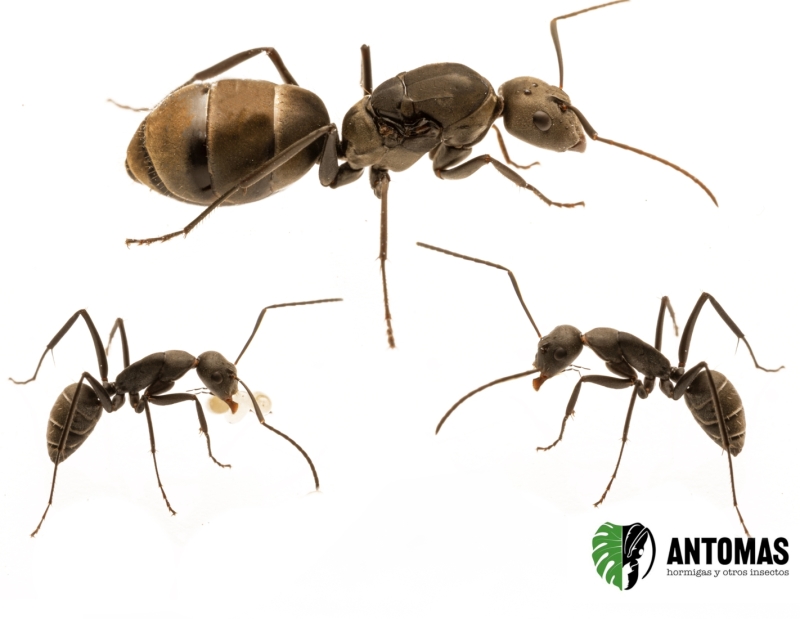
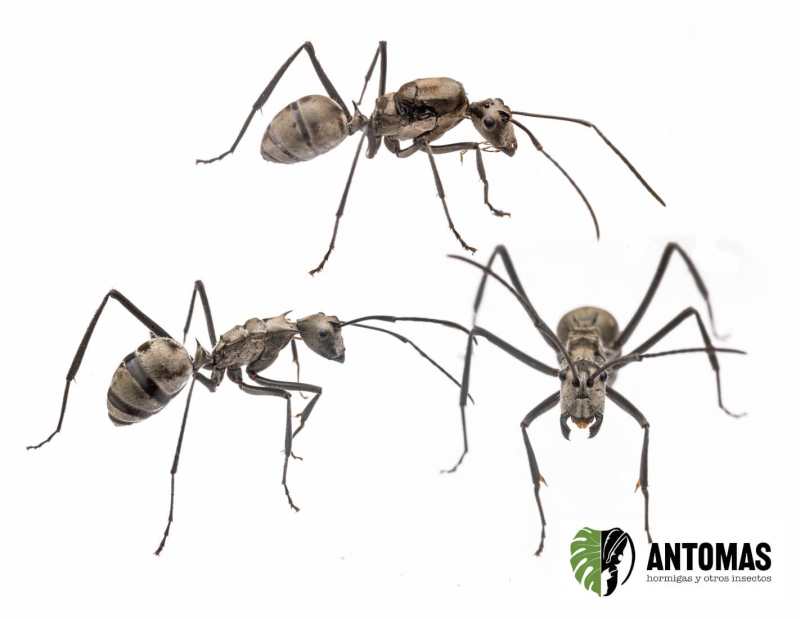
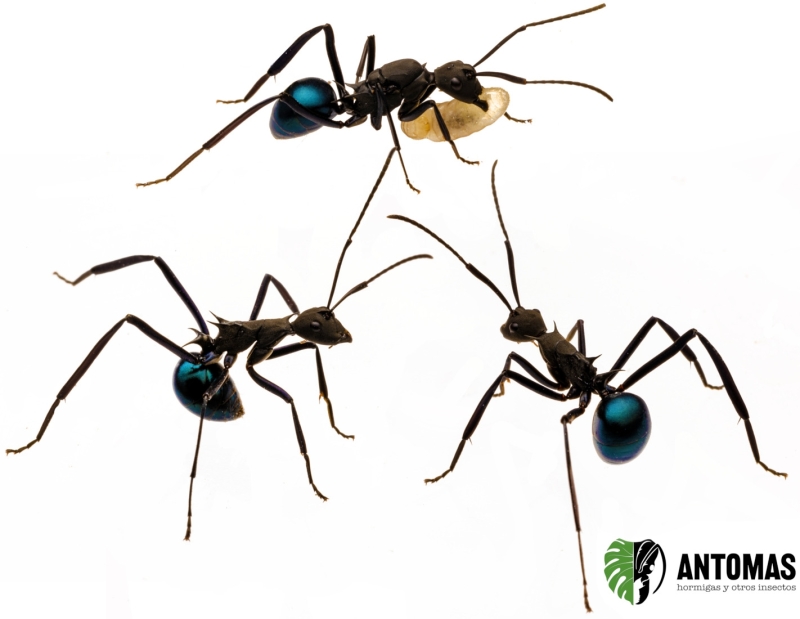
- Colouration. Head dark reddish brown, mahogany-coloured, smooth and very glossy over much of its surface; mesosoma (the «thorax») almost black; gaster dark reddish brown and glossy, with the edges of the segments slightly paler; legs and antennae amber or orange, and mandibles reddish brown.
- Head. Long, narrowing towards the back, with the eyes clearly visible at the sides and fine striations on the front part.
- Mandibles. Long and straight, inserted very close together, with teeth at the tip and the trigger hairs on the inner face.
- Mesosoma. Robust and matt, with marked striations and wrinkles, especially on the pronotum and the sides.
- Petiole. A tall scale ending in a point, typical of the genus.
- Sting. Functional.
- Queen. Very similar to the worker and only slightly larger, with the bulkier thorax of queens that have had wings.
To identify it, one would have to assess the shape of the teeth at the tip of the mandible, the denticles on the inner margin, the striations on the pronotum and sides, and the petiole: characters that cannot be judged from photos.
Approximate measurements
- Queen: 14–16 mm (Antomas queens)
- Workers: 12–15 mm (Antomas workers)
- Male: no data
As it has not been identified, there are no published measurements: the figures come from our colonies. For reference, the large Philippine species of the O. infandus group measure about 12–16 mm according to their 2011 revision, so «Candy» is among the large members of the genus. Workers and queen being almost the same size is normal in Odontomachus, which has no major or minor workers.
Care in captivity
Difficulty: 4/5 – Advanced
It is not difficult because of its climate, which is mild and stable, but because of four things together: very high humidity at all times, rule number one; plenty of protein, because they are hunters; security, because they jump, sting and can climb acrylic, albeit poorly; and little information, because almost everything comes from the genus and from our experience. In return, it is one of the most approachable Odontomachus for getting started with trap-jaw ants, and its polygyny helps colonies grow with ease.
Recommended parameters
- Nest temperature: 24–26 °C, stable all year round; avoid going above about 28 °C for long periods.
- Nest humidity: very high, with the substrate always moist and no standing water.
- Substrate: moist coco fibre with a little fine sand in the chambers.
- Foraging area: somewhat drier, with the lid always closed, an oil barrier, a water tube with cotton wool and a trap-jaw feeder.
- Light: a normal day–night cycle, with the nest kept in semi-darkness.
- Diapause: none.
If your home gets cold in winter, place a heating cable or mat with a thermostat on one side of the nest, never under the whole of it, so that the colony can choose. And a thermometer next to the nest.
Very high humidity: non-negotiable
If you remember only one thing, let it be this: letting the «Candy» nest dry out is a serious mistake. In a dry nest, the workers become stressed, the queens slow down their laying and the larvae fail to spin. Warning signs: pale, loose coco fibre, workers and brood crowded next to the reservoir, large larvae that do not spin, and queens at the entrance or outside the nest.
Refill the reservoir before it runs dry, moisten the fibre as soon as it starts to lighten, and check more often in winter, when central heating dries the air. But high humidity does not mean waterlogging: standing water brings mould and mites. Gentle ventilation, leftovers removed in good time and, if you like, some springtails as a clean-up crew.
Recommended formicarium
At Antomas we recommend Anthouse's Qbik Wild plaster nests in their hybrid version: an evaporation reservoir beneath the galleries moistens the nest continuously without water pooling in the chambers. Given the size of the workers and of our colonies, the right format is the Qbik Wild Duo P 2C Hybrid, the same one we use with our other Asian Odontomachus.
Inside, a thin layer of coco fibre with a little fine sand, always moist: it gives the larvae particles to spin with (see «Cocoons that need soil») and spreads the moisture as leaf litter does. Use fertiliser-free fibre and washed sand, and top up if the workers carry it out. When the nest becomes too small (workers camping with brood in the foraging area), connect another module; not before, because empty chambers end up as rubbish dumps.
Arrival and moving by tipping out
When the colony arrives, leave it undisturbed for a few hours at 24–26 °C and check that it has water. To move it into the formicarium, at Antomas we do it by tipping it out: we open the container in the foraging area, next to the nest entrance, and tip out queens, workers and brood with gentle taps, helping any stragglers along with a paintbrush.
- Everything ready beforehand: moist substrate, reservoir full, barrier in place and entrance in semi-darkness.
- Lid in hand and a tray underneath: a worker may be flung out by a mandible strike.
- Count the queens: make sure none is left in the container.
Founding and growth
At Antomas we sell established colonies with queen in two formats: one queen with ten workers, or six queens with five workers. You skip the founding stage, which in the genus is usually semi-claustral: the queen goes out to hunt while rearing her first workers, as has been observed in O. rixosus. The colony with more workers starts with a larger workforce; the six-queen colony with greater laying capacity, and when well fed it grows faster.
Protein sets the pace. There are no published data on the development of «Candy»; keepers of other Odontomachus speak of about two months from egg to worker with warmth and plentiful food, and considerably longer if protein is lacking. Do not expect thousands of workers: in the genus, hundreds are the norm, and in O. rixosus an average of about 140 has been counted.
Do not merge colonies or add queens from elsewhere. The fact that the queens of one colony tolerate each other does not mean they will accept strangers; in O. chelifer there are fights over rank even among nestmates.
Feeding
Protein, plentiful and varied. «Candy» is a hunter. Offer it live or freshly killed prey (live prey lets you see the trap in action) and switch insects from one week to the next, so that they do not always eat the same thing:
The more protein, the better and faster they grow. This is the Antomas philosophy: with daily maintenance and leftovers removed, it is better to overfeed, because the colony understands that it has resources to spare and grows faster and in greater numbers. If you will not be able to clean often, it is better not to overfeed: in such a moist nest, leftover food quickly brings mould and mites. With larvae present, feed daily or every other day and remove leftovers within 24 hours. Buy insects from a trusted supplier: insects treated with insecticides can wipe out the colony.
Sugar, as a free drop. There is no need to give them sugary liquids every day: at Antomas we offer them 2–3 times a week, mainly Blue Sugar nectar by Anthouse and, now and then, another nectar for variety, to which you can also add a little protein. If they pay it little attention at first, persevere: this is common in Odontomachus. As they carry the drop between their mandibles, they need a free, accessible liquid:
- use special trap-jaw feeders, or place the drop on a bottle cap, a shell or a small piece of aluminium foil;
- never on cotton wool: it goes mouldy, spoils the liquid and stops them picking up the drop;
- replace it as soon as it dries, thickens or ferments.
Water: always, in a test tube with water and cotton wool in the foraging area.
No diapause
«Candy» is tropical and does not undergo diapause. At Antomas we keep it active all year round at 24–26 °C inside the nest. If your home drops by one or two degrees at night in winter, that is not a problem, but do not cool it on purpose: it brings no benefit and slows down brood rearing. What you need to watch in winter is humidity, because central heating makes the nest dry out sooner.
Behaviour and observation
The trap in full view. The workers move slowly around the foraging area, mandibles open and antennae probing, until something brushes the trigger hairs and the strike comes. Watch, too, how they carry the drop of nectar between their mandibles. The genus includes species active by day and by night, so do not be surprised to see them at any hour. With several queens, it is normal to see them spread across the chambers, each with brood nearby.
Observe without fear. At Antomas we believe ants are there to be enjoyed, observed and learnt from, not kept hidden away. Simply leave them a dark area in the nest and a lit foraging area, and observe them gently, intervening and stressing them as little as possible.
Warning signs:
- Large larvae that do not spin: lack of humidity or substrate.
- Brood disappearing: almost always a lack of protein.
- Queens outside the nest or workers crowded next to the water: the nest is drying out.
- Mould, mites or workers rejecting food: forgotten leftovers or standing water.
Escapes and barriers
Many guides say that Odontomachus cannot climb smooth surfaces, but at Antomas we have seen other Asian Odontomachus climb acrylic, albeit poorly, and dust, condensation or stuck-on substrate give them grip. With «Candy», and with ants that jump, there is no point taking risks:
- Oil barrier: a thin, continuous strip of paraffin oil along the top of the foraging area walls, renewed when it gathers dust.
- Lid always closed, because of the mandible jumps; open it only to feed or clean.
- No bridges: no stones, twigs or substrate touching the barrier.
- Connections, tubes and stoppers all tightly fitted.
Handling and safety
They have a functional sting and their sting is usually painful, although with calm handling and the right tools it rarely comes to that; they can also deliver a mandible strike. Always handle them with entomological tools (a soft paintbrush or soft forceps), never with your hands, work slowly so as not to harm the queens, and take care if you are allergic to hymenopteran stings. Keep out of reach of small children and pets. This is an exotic species: it must never be released.
What not to do
- Let the nest dry out, even for a few days.
- Waterlog the nest or leave the air stagnant.
- Set them up without coco fibre or fine sand, or keep them in a test tube for months.
- Skimp on protein, always give them the same insect or leave leftovers for more than 24 hours.
- Put sugar on cotton wool or anywhere they cannot pick up the drop with their mandibles.
- Go above about 28 °C for long periods or heat the whole nest from below.
- Put them into diapause or cool them in winter.
- Trust that they cannot climb or leave the lid open.
- Merge colonies or add queens from another colony.
- Handle them with your hands.
Scientific sources
This care sheet has been compiled from the scientific literature on the genus Odontomachus and on trap-jaw ants, from the taxonomic revisions of the Oriental species, and from the experience of Antomas and other keepers. Main references:
- Satria, R., Kurushima, H., Herwina, H., Yamane, S. & Eguchi, K. (2015). The trap-jaw ant genus Odontomachus Latreille (Hymenoptera: Formicidae) from Sumatra, with a new species description. Zootaxa 4048: 1–36. doi:10.11646/zootaxa.4048.1.1
- Matos-Maraví, P. et al. (2018). Taxon cycle predictions supported by model-based inference in Indo-Pacific trap-jaw ants (Hymenoptera: Formicidae: Odontomachus). Molecular Ecology 27: 4090–4107. doi:10.1111/mec.14835
- Patek, S. N., Baio, J. E., Fisher, B. L. & Suarez, A. V. (2006). Multifunctionality and mechanical origins: ballistic jaw propulsion in trap-jaw ants. PNAS 103: 12787–12792. doi:10.1073/pnas.0604290103
- Gronenberg, W., Tautz, J. & Hölldobler, B. (1993). Fast trap jaws and giant neurons in the ant Odontomachus. Science 262: 561–563. doi:10.1126/science.262.5133.561
- Spagna, J. C. et al. (2008). Phylogeny, scaling, and the generation of extreme forces in trap-jaw ants. Journal of Experimental Biology 211: 2358–2368. doi:10.1242/jeb.015263
- Larabee, F. J. & Suarez, A. V. (2015). Mandible-powered escape jumps in trap-jaw ants increase survival rates during predator-prey encounters. PLOS ONE 10: e0124871. doi:10.1371/journal.pone.0124871
- Larabee, F. J., Smith, A. A. & Suarez, A. V. (2018). Snap-jaw morphology is specialized for high-speed power amplification in the Dracula ant, Mystrium camillae. Royal Society Open Science 5: 181447. doi:10.1098/rsos.181447
- Sorger, D. M. (2015). Snap! Trap-jaw ants in Borneo also jump using their legs. Frontiers in Ecology and the Environment 13: 574–575. doi:10.1890/1540-9295-13.10.574
- Ehmer, B. & Hölldobler, B. (1995). Foraging behavior of Odontomachus bauri on Barro Colorado Island, Panama. Psyche 102: 215–224. doi:10.1155/1995/27197
- Evans, H. C. & Leston, D. (1971). A ponerine ant (Hym., Formicidae) associated with Homoptera on cocoa in Ghana. Bulletin of Entomological Research 61: 357–362. doi:10.1017/S0007485300057898
- Ito, F., Yusoff, N. R. & Idris, A. H. (1996). Colony composition and queen behavior in polygynous colonies of the Oriental ponerine ant Odontomachus rixosus (Hymenoptera Formicidae). Insectes Sociaux 43: 77–86. doi:10.1007/BF01253958
- Medeiros, F. N. S., Lopes, L. E., Moutinho, P. R. S., Oliveira, P. S. & Hölldobler, B. (1992). Functional polygyny, agonistic interactions and reproductive dominance in the Neotropical ant Odontomachus chelifer (Hymenoptera, Formicidae, Ponerinae). Ethology 91: 134–146. doi:10.1111/j.1439-0310.1992.tb00857.x
- Oliveira, P. S., Camargo, R. X. & Fourcassié, V. (2011). Nesting patterns, ecological correlates of polygyny and social organization in the Neotropical arboreal ant Odontomachus hastatus (Formicidae, Ponerinae). Insectes Sociaux 58: 207–217. doi:10.1007/s00040-010-0138-6
- Kazuma, K., Masuko, K., Konno, K. & Inagaki, H. (2017). Combined venom gland transcriptomic and venom peptidomic analysis of the predatory ant Odontomachus monticola. Toxins 9: 323. doi:10.3390/toxins9100323