Difficulty: 2/5 – Beginner
Pet and large feeder. A wingless cockroach of 5–7.5 cm, long-lived (up to about 5 years) and calm in the hand. Temperature: 22–27 °C, a little warmer for breeding. Set-up: enclosure with a tight-fitting mesh lid (they climb glass), slightly moist substrate, bark to climb on and hide under, and water with no risk of drowning. Food: dry pellets plus fruit and vegetables in small pieces, removing leftovers. Breeding: easy; females give birth to live nymphs after about 60 days of gestation. For ants: nymphs or cut-up adults, for large colonies only.
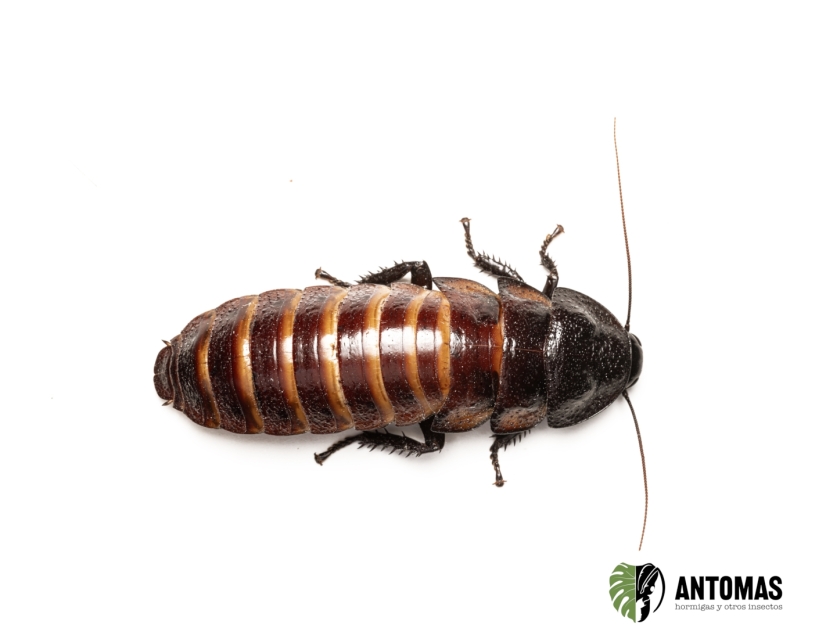
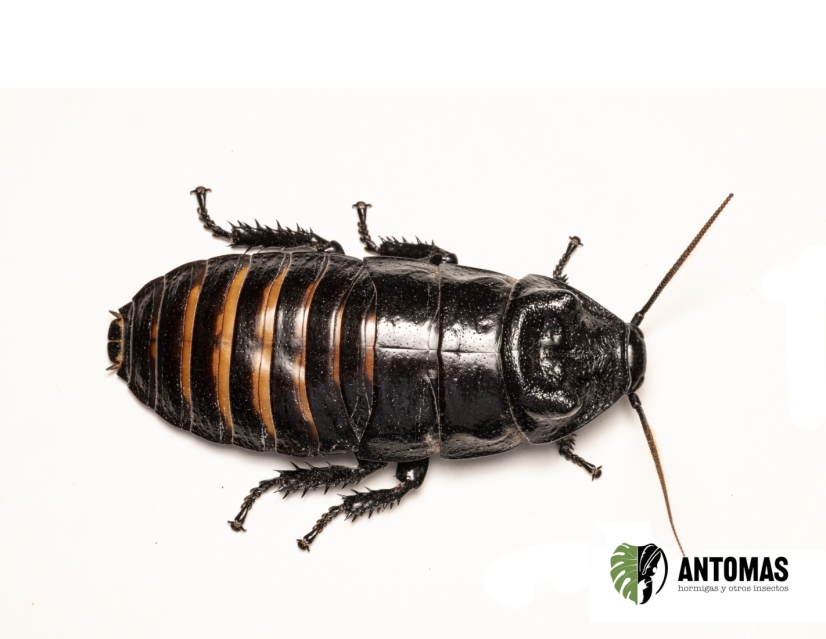
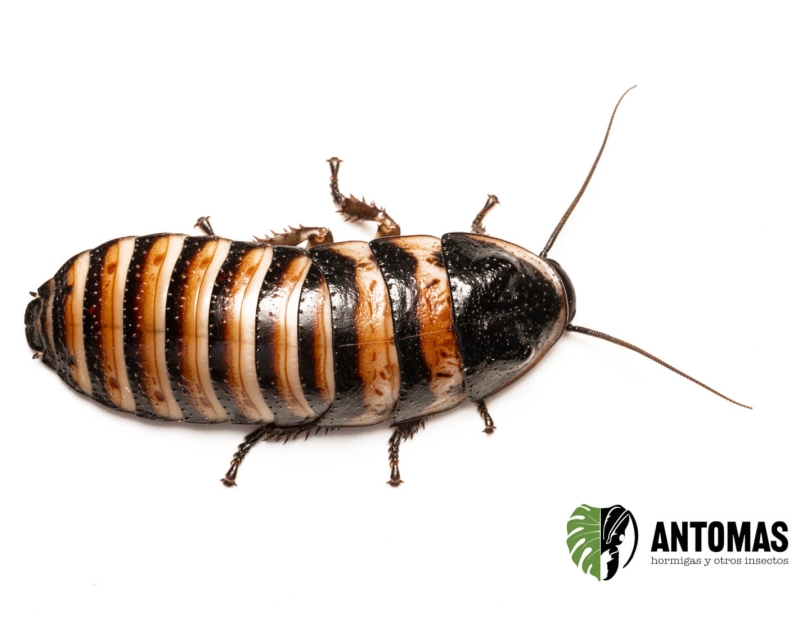
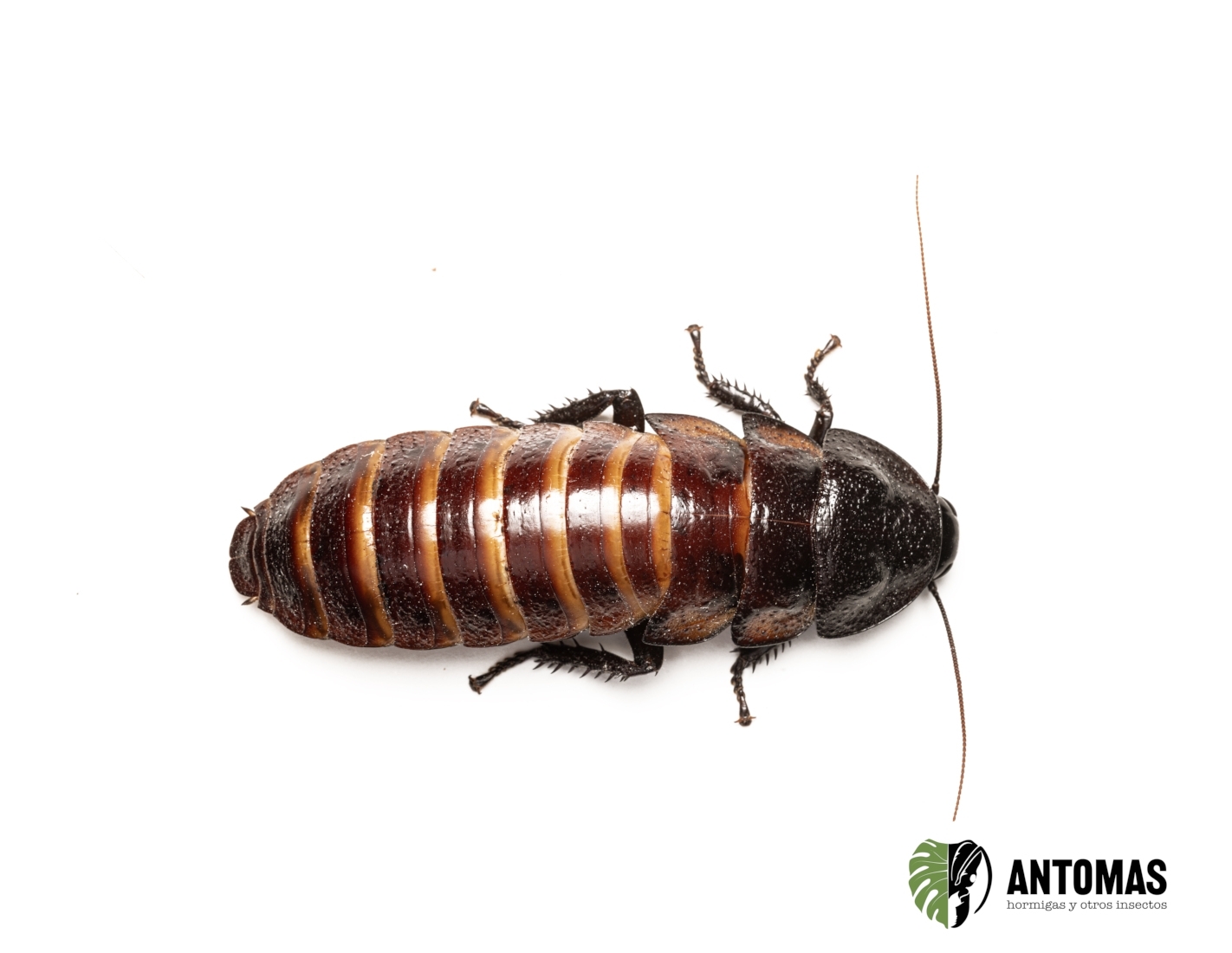
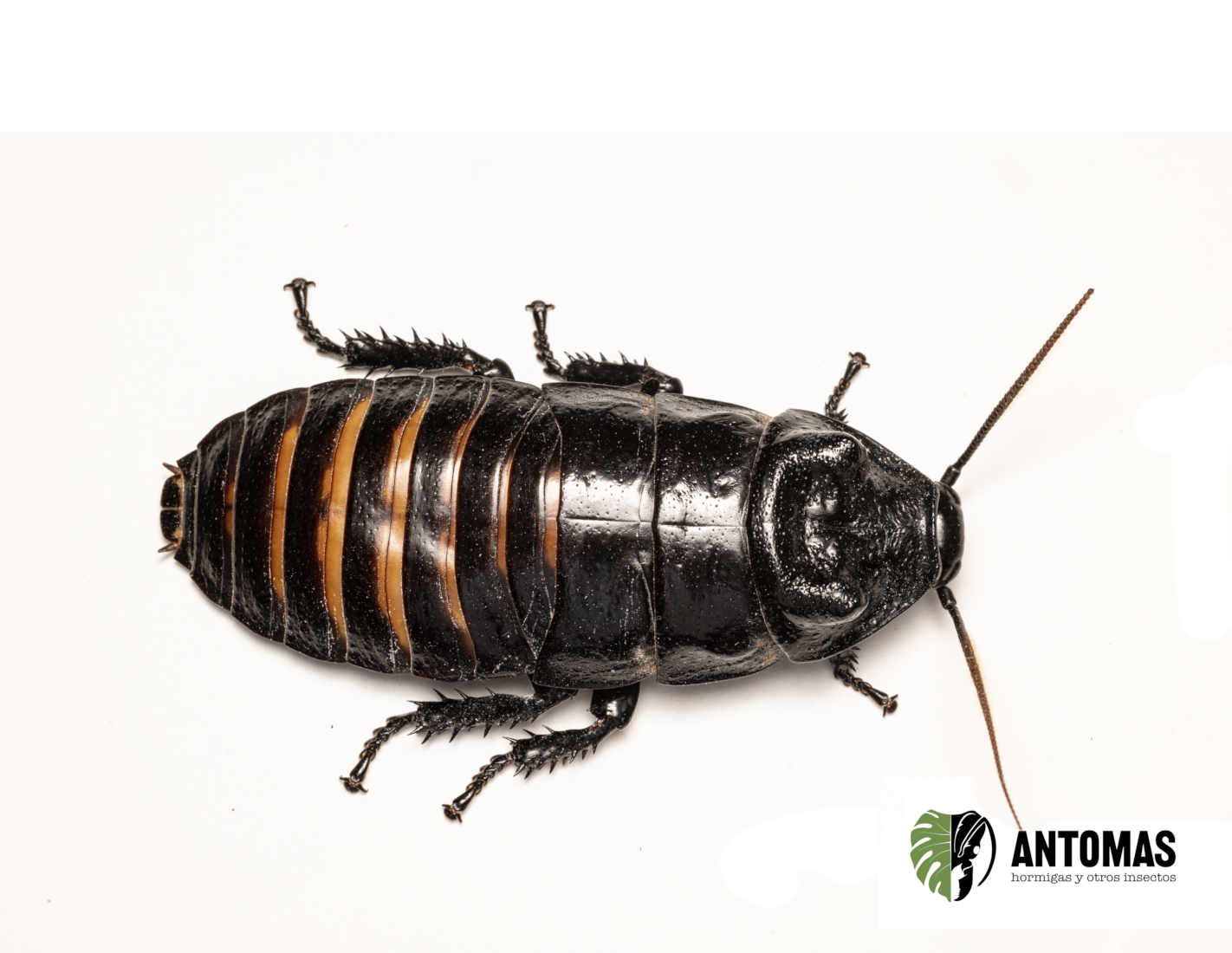
Gromphadorhina portentosa (Schaum, 1853) is the textbook Madagascar Hissing Cockroach: the reference species of its group, the one used in schools, museums and behaviour labs, and one of the largest cockroaches kept in culture. It has no wings, does not bite, lives for years and, if you disturb it, hisses by forcing air out through its spiracles. Males carry two large bumps on the pronotum, like horns, which they use to defend territories and shove each other in contests; these ritualised fights, almost always harmless, are among the best-studied insect behaviours.
At Antomas we sell it in groups of 5 and 10 specimens, as a pet and as a large feeder. If you are looking for a smaller, easier-to-handle hisser, mainly for feeding, have a look at our Elliptorhina javanica. This care sheet focuses on what makes G. portentosa unique: its behaviour and keeping and breeding it as a pet.
Why it makes a good pet
Large, slow in the hand and harmless
It is a sturdy, heavily sclerotised, wingless insect: it does not fly, jump or bite. It lets itself be picked up calmly and walks from one hand to the other. All it does when it feels disturbed is hiss and, if you squeeze it, dig the leg spines in slightly (Mulder and Shufran, Oklahoma State University). That is why it is one of the species most widely used in education.
Behaviour you can watch at home
Few terrarium invertebrates “do” so much in plain view: males pick a stone or a piece of bark and defend it, push each other with the pronotum, hiss in three different ways and court females. With a group of several males and females, you will see more ethology in one afternoon than in months with other species.
Long-lived and easy to breed
It can live up to about five years in captivity, and the Oklahoma State University colony has been kept going for more than sixteen years, over many generations, on dry dog food and water. Females give birth to live young, so there are no oothecae to look after: warmth, food and water are all you need.
And a large feeder too
Its nymphs and cut-up adults are a very complete protein source for large colonies of predatory ants and for other predators. We cover this further down, in “How to feed them to ants”.
Biology
Endemic to Madagascar
It occurs naturally only in Madagascar. It was described as Hormetica portentosa from specimens from the south-west of the island, and in 1865 Brunner von Wattenwyl erected the genus Gromphadorhina for it, of which it is the type species. It belongs to the family Blaberidae and to the tribe of hissing cockroaches, Gromphadorhinini, with some twenty species, all from Madagascar except one. It lives on the forest floor, among leaf litter and rotting logs, where it eats fallen fruit and plant matter and is prey for lemurs, birds and lizards.
A word of caution: in the trade, several large hissers are confused with one another, and G. portentosa is often mixed up with G. oblongonota and G. picea. Reliable identification of these species is a job for specialists.
How it hisses: pressurised air through the spiracles
Insects breathe through spiracles, small openings along the sides of the body. G. portentosa uses one pair of them, on the fourth abdominal segment, as a whistle: it closes them, compresses the abdomen and releases the air in a burst. Nelson (1979) showed that the trachea of that spiracle narrows at its origin and then opens into a long cone, and that it is driven by the same motor neurons as the respiratory spiracles, only with a different firing pattern. In other words, evolution turned a breathing organ into a communication organ without inventing new nerves. Unlike crickets and cicadas, it does not rub any body parts together: the sound is pure air.
Three hisses, three messages
- Disturbance hiss: produced by males, females and older nymphs when disturbed or caught. This is the one you will hear when you pick them up.
- Fighting hiss: adult males only, during contests.
- Courtship hiss: adult males only, in front of a female.
Nelson and Fraser (1980) showed that the hiss genuinely communicates: with silenced males, playing back the recorded courtship hiss made females accept mating again.
Males with “horns”: territories and fights
Adult males have two large bumps on the pronotum, which many people mistake for eyes: the head sits underneath, protected by that shield. In females they are lower and smoother. Males use them to push each other in fights.
In a colony, each male defends a stone or log for months, coming down only to eat and drink. He accepts females and nymphs in his territory, but not another male: if a neighbour comes in, he pushes him until he drives him off amid hissing. Females do not fight, and the loser is not hurt (Mulder and Shufran). Science has measured a great deal about these duels:
- Weight rules. Heavier males win more fights, and the hiss is an honest signal of their size: large males hiss longer and lower, a trait with a genetic basis (Clark and Moore, 1995).
- Dominant males hiss more. High-ranking males hiss more often in encounters, and hissing goes hand in hand with aggression (Clark and Moore, 1994 and 1995).
- They recognise each other. A male keeps his rank against familiar rivals, but may lose it against an unfamiliar one (Clark, Beshear and Moore, 1995).
- A female nearby changes everything. The resident male fights harder when there is a female in his territory (Guerra and Mason, 2005).
- No “winning streak”. A 2026 study of 158 adults found no evidence that winning one fight helps to win the next; the best predictors of victory are long jolts and antennal strikes, while uncontrolled charging, turning away or freezing signal defeat (Young and colleagues, 2026).
An unusual courtship for a cockroach
In most cockroaches, the female climbs onto the male’s back and licks glands on his back before mating. In G. portentosa, which has neither wings nor that ritual, Barth (1968) described an “anomalous” pattern: after courtship with hissing and antennae, the male turns round and backs up until he joins the female at the tip of the abdomen, and they end up facing in opposite directions, tail to tail.
They give birth to live young
It is ovoviviparous. The female forms an ootheca, but instead of dropping it, she draws it back into a brood sac inside the abdomen, where the embryos develop protected (Snart and colleagues, 1984). After about 60 days of gestation in the laboratory, she expels the already hatched nymphs. The nymphs go through six moults and take almost five months to reach adulthood (Mulder and Shufran).
Better in a group: together they save water
It is highly gregarious, and not just out of habit: Yoder and Grojean (1997) measured that grouped cockroaches lose less water than isolated ones. A single specimen in a dry enclosure fares worse than a group.
Their mites are not parasites
Many hissers carry tiny, pale mites that scurry over their bodies, especially near the legs. These are Androlaelaps schaeferi (formerly Gromphadorholaelaps schaeferi), and they live only on these cockroaches. For years they were thought to suck their haemolymph, but dye experiments showed that they eat the cockroach’s food and saliva (Yoder and Barcelona, 1995; Yoder, 1996). They also reduce moulds on the cockroach’s surface (Yoder and colleagues, 2009). They do not pass to people or other pets. If their numbers shoot up, it is usually a sign of food leftovers and dirt in the enclosure.
Size and morphology
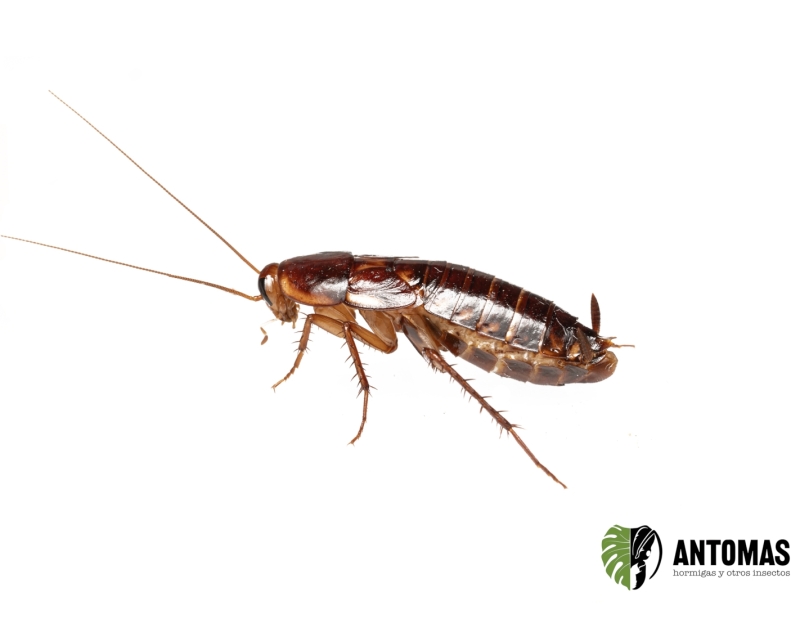
Broad, flattened body, dark brown to black, with the abdomen often showing lighter, orangey tones along the edges of the segments. Wingless at every stage. Large, shield-shaped pronotum covering the head. Long antennae and legs with spines, claws and adhesive pads that let them climb almost any surface, glass included. After each moult they emerge white and darken within a few hours as the cuticle hardens.
How to tell males from females
- Males: two tall, prominent bumps on the pronotum, and thicker, hairier antennae.
- Females: low, smooth, almost flat bumps, thinner antennae and a broader abdomen.
- Nymphs: harder to sex; the bumps become noticeable in the last instars.
Approximate measurements
- Adult: 5–7.5 cm long; up to about 10 cm according to Oklahoma State University
- Adult weight: about 7–25 g
- Gestation: about 60 days in the laboratory
- Development: 6 moults; almost 5 months to sexual maturity
- Lifespan: up to about 5 years in captivity
How to keep them as pets
These guidelines follow the Oklahoma State University guide and the usual practice of European breeders.
Enclosure and set-up
- Container: a terrarium or plastic box with a mesh lid that really seals. For a group of 5–10 adults, a container about 30–40 cm long is enough; if you want to see territories, give them more floor space.
- Substrate: coco fibre, peat or wood shavings, slightly moist, where they can burrow to escape the light. Never waterlogged.
- Structure: cork bark, branches, stones and upright pieces of cardboard. The more surfaces, the more usable space and the more territories for the males.
- Ventilation: good, but without draughts.
Temperature and humidity
- Temperature: 22–27 °C. Above about 27 °C they are more active and breed more; at 21 °C or lower they become sluggish, and they should never be kept below about 18 °C.
- Heat: if your home is cool, put a heat mat or heat cable at one end, with a thermostat, so there is a gradient and they can choose their zone.
- Humidity: slightly moist substrate and an occasional misting. It is easier to overdo it than to fall short: in a wet, poorly ventilated enclosure, mould and mites appear.
Water and food
- Dry staple: dry dog, cat or fish food, or an insect diet. The Oklahoma colony has lived for years on nothing but dog food and water.
- Fresh food: fruit and vegetables in small pieces, about 2–3 cm: orange, apple, banana, carrot, squash. They also provide water.
- Water: in a drinker with a cotton wick or in a dish with a sponge or stones, so the nymphs cannot drown. Water gel works too.
- Cleaning: remove fresh food after a few days, before it ferments or attracts flies.
How to pick them up
Let it climb onto your hand or nudge it gently towards it, or hold it delicately by the sides of the thorax. Never pull on it while it is holding on: its claws dig in and you could tear off a leg. Do not squeeze it, because the leg spines can scratch. And do not handle freshly moulted ones, which are white and soft.
How to breed them
- Starter group: several females per male. With 5 or 10 specimens you have a good start. If there are several males, give plenty of floor space and several stones or pieces of bark, so that each has its own territory.
- Breeding temperature: the top of the range, about 27–30 °C in the warm zone, with a cooler zone.
- Protein: the dry food already provides it; no meat is needed.
- Births: you will suddenly see a few dozen small, pale nymphs next to a female. There is no need to separate them: they grow up in the same group, with shelters and food for all.
- Nymphs: same care as the adults, with water they cannot drown in and chopped food. Almost five months to adulthood.
- Density: if the group grows a lot, move part of it to another enclosure or use it as food; with too many animals, dirt, mites and fights increase.
- Harvesting: for feeding, pick out nymphs of the size you need; always leave breeding adults.
How to feed them to ants
An adult G. portentosa is a huge prey item, with a hard armour that few ants can open. For feeding ants it works mainly as protein for large colonies, or cut into pieces:
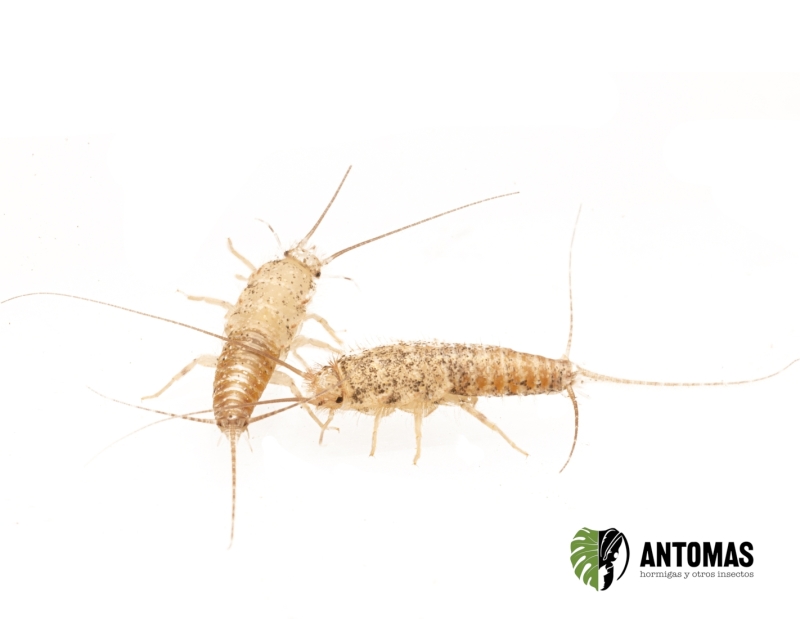
- Founding queens and small colonies: not the right prey. Better something soft and small, such as Thermobia domestica, or a small piece of a freshly moulted nymph.
- Medium colonies: small nymphs, freshly killed, or pieces of a large nymph. Open up the body or cut off the abdomen so the workers can reach the soft parts.
- Large colonies of hunters: whole medium nymphs, freshly killed, or an adult cut into pieces. Large ants with a strong sting, such as our Neoponera villosa or Myrmecia pyriformis, and those with populous colonies that dismember carrion, such as Iridomyrmex purpureus, make short work of them.
Live or dead. Alive, a large hisser defends itself by shoving, clings on and may climb out of the foraging area, so it is better to offer them freshly killed or frozen and thawed. At Antomas we recommend freezing them: it is the most convenient option, and it gives you a stock for weeks to take pieces from.
How many. Whatever the colony clears in one or two days. Remove the exoskeleton and leftovers so that mould and mites do not appear. With daily cleaning, overfeeding is better: the more protein, the better and faster the colony grows.
Gut loading. One or two days beforehand, give them varied fruit and vegetables: what they carry in their gut also feeds the ants.
Varied diet. No insect is complete on its own. Alternate from week to week with other live foods from the shop: Blaptica dubia, Shelfordella lateralis, Acheta domesticus or Tenebrio molitor.
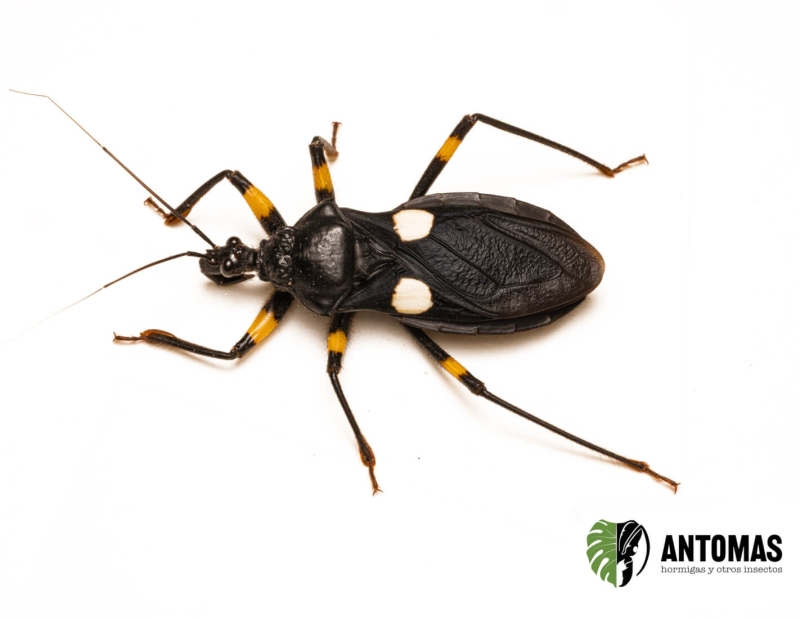
Other predators. The nymphs are also classic prey for reptiles, amphibians and large predatory invertebrates, such as the assassin bug Platymeris biguttatus.
Escapes, hygiene and safety
- Escapes: they climb glass and almost any wall. The lid must fit without gaps, and small nymphs squeeze through the tiniest openings. As extra security, a band of petroleum jelly or PTFE (Fluon) on the top 5 cm of the walls stops the nymphs, although it is no substitute for a good lid.
- An infestation at home? It is not a household cockroach: it needs constant warmth and humidity, and outside Madagascar it is only known from laboratories, schools and terrariums (Mulder and Shufran). Even so, never release them, and freeze leftovers or surplus animals before throwing them away.
- Mites: theirs are harmless and do not pass to people. If there are a lot of them, clean the enclosure, remove old food and dead animals, and brush the cockroaches with a soft paintbrush. The Oklahoma guide also suggests gently shaking them in a bag with a little flour and rinsing them with a water spray. Never use acaricides: they would kill the cockroaches too.
- Moulds and allergies: moulds grow on their droppings and moults, some of them allergenic (Yoder and colleagues, 2009), and, like any cockroach, they can cause allergies through contact or through dust from the enclosure. Wash your hands after handling them, clean the enclosure regularly and, if you have allergies or asthma, wear gloves.
- Smell: a clean enclosure that is dry on the surface hardly smells. Bad smells come from fermented food and excess moisture.
What not to do
- Do not use a lid that does not close properly, and do not assume they cannot climb glass: they can.
- Do not keep them below about 18 °C or over a heat source without a thermostat.
- Do not waterlog the substrate or leave it without ventilation: mould, mites and smell.
- Do not leave fruit or vegetables until they ferment, or dead cockroaches in the enclosure.
- Do not put water in a container where the nymphs could drown.
- Do not pull on a cockroach that is holding on, or handle freshly moulted ones.
- Do not put many males together in a small space without shelters: there will be more fights and stress.
- Do not use acaricides or insecticides near the enclosure.
- Do not give your ants a whole live adult if the colony is small: it will not be able to cope and will become stressed.
- Never release them into the wild.
Scientific sources
This care sheet is based on the scientific literature on Gromphadorhina portentosa and its mites, on the Oklahoma State University guide (Mulder, P. and Shufran, A., Madagascar Hissing Cockroaches: Information and Care, fact sheet L-278, extension.okstate.edu) and on the experience of Antomas and other breeders. Main references:
- Nelson, M. C. (1979). Sound production in the cockroach, Gromphadorhina portentosa: the sound-producing apparatus. Journal of Comparative Physiology A 132: 27–38. doi:10.1007/BF00617729
- Nelson, M. C. & Fraser, J. (1980). Sound production in the cockroach, Gromphadorhina portentosa: evidence for communication by hissing. Behavioral Ecology and Sociobiology 6: 305–314. doi:10.1007/BF00292773
- Clark, D. C. & Moore, A. J. (1994). Social interactions and aggression among male Madagascar hissing cockroaches (Gromphadorhina portentosa) in groups (Dictyoptera: Blaberidae). Journal of Insect Behavior 7: 199–215. doi:10.1007/BF01990081
- Clark, D. C. & Moore, A. J. (1995). Variation and repeatability of male agonistic hiss characteristics and their relationship to social rank in Gromphadorhina portentosa. Animal Behaviour 50: 719–729. doi:10.1016/0003-3472(95)80132-4
- Clark, D. C. & Moore, A. J. (1995). Genetic aspects of communication during male-male competition in the Madagascar hissing cockroach: honest signalling of size. Heredity 75: 198–205. doi:10.1038/hdy.1995.124
- Clark, D. C., Beshear, D. D. & Moore, A. J. (1995). Role of familiarity in structuring male–male social interactions in the cockroach Gromphadorhina portentosa (Dictyoptera: Blaberidae). Annals of the Entomological Society of America 88: 554–561. doi:10.1093/aesa/88.4.554
- Guerra, P. A. & Mason, A. C. (2005). Information on resource quality mediates aggression between male Madagascar hissing cockroaches, Gromphadorhina portentosa (Dictyoptera: Blaberidae). Ethology 111: 626–637. doi:10.1111/j.1439-0310.2005.01086.x
- Young, J. J., Craven, C. A., Koenig, J. A., Addemir, M., He, B. Z., Miakotina, O. L. & Eberl, D. F. (2026). Combat behaviors predictive of fight outcome in Gromphadorhina portentosa. microPublication Biology. doi:10.17912/micropub.biology.001927
- Barth, R. H. (1968). The mating behavior of Gromphadorhina portentosa (Schaum) (Blattaria, Blaberoidea, Blaberidae, Oxyhaloinae): an anomalous pattern for a cockroach. Psyche 75: 124–131. doi:10.1155/1968/96242
- Snart, J. O. H., Greenwood, M., Beck, R. & Highnam, K. C. (1984). The functional morphology of the brood sac in two species of ovoviviparous cockroaches, Byrsotria fumigata (Guerin) and Gromphadorhina portentosa (Schaum). 1. Scanning and light microscopy. International Journal of Invertebrate Reproduction and Development 7: 345–355. doi:10.1080/01688170.1984.10510112
- Yoder, J. A. & Grojean, N. C. (1997). Group influence on water conservation in the giant Madagascar hissing-cockroach, Gromphadorhina portentosa (Dictyoptera: Blaberidae). Physiological Entomology 22: 79–82. doi:10.1111/j.1365-3032.1997.tb01143.x
- Yoder, J. A. & Barcelona, J. C. (1995). Food and water resources used by the Madagascan hissing-cockroach mite, Gromphadorholaelaps schaeferi. Experimental and Applied Acarology 19: 259–273. doi:10.1007/BF00052618
- Yoder, J. A. (1996). The Madagascar hissing-cockroach mite (Gromphadorholaelaps schaeferi): first observation of its larva and ptyalophagy in Acari. International Journal of Acarology 22: 141–148. doi:10.1080/01647959608684088
- Yoder, J. A., Chambers, M. J., Condon, M. R., Benoit, J. B. & Zettler, L. W. (2009). Regulation of the external mycoflora of the giant Madagascar hissing-cockroach, Gromphadorhina portentosa, by its mite associate, Gromphadorholaelaps schaeferi, and its implications on human health. Symbiosis 47: 93–98. doi:10.1007/BF03182292