Difficulty: 2/5 – Beginner
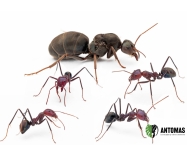
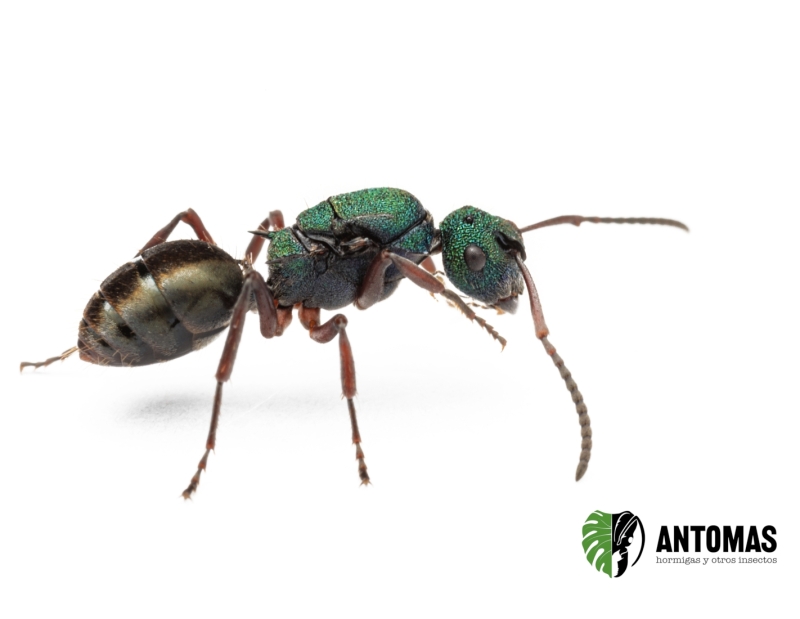
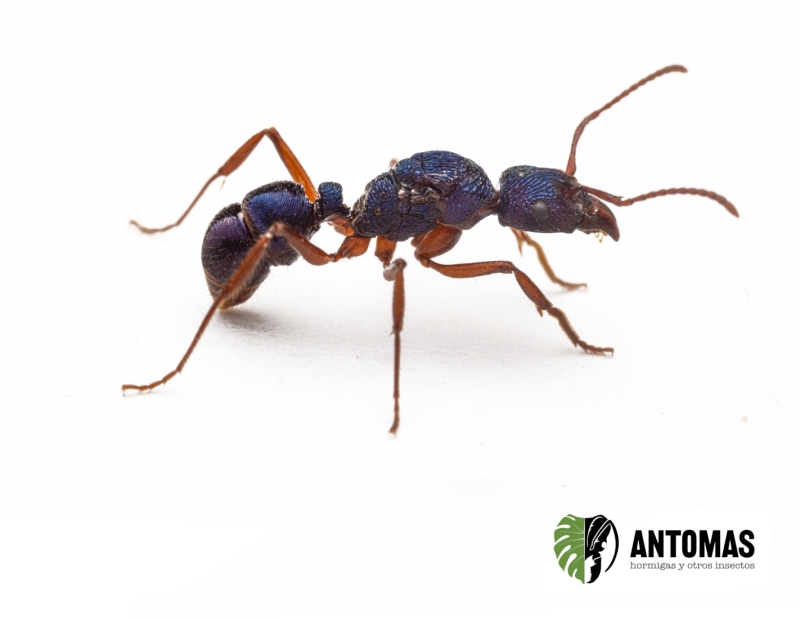
The Australian meat ant: a reddish head, purple and bluish highlights and tireless activity from dawn to dusk. Hardy, diurnal and voracious: it eats insects, meat and lots of sugar. It bites, but it does not sting: it has no functional sting. A single queen per colony. A QBIK ONE from the Alpha range, a rather dry nest with a slightly humid area, 24–28 °C with a spot at 28–30 °C, Blue Sugar nectar 4–5 times a week, plentiful and varied protein, and a mild diapause of about 3 months, from December to February, at 12–15 °C. Moving by tipping. It is an excellent climber: always use an escape barrier and a lid.
Iridomyrmex purpureus (F. Smith, 1858), the meat ant, is one of Australia’s best-known ants. In the south-east of that continent you only have to step out into the countryside to find its gravel mounds, cleared of grass and riddled with entrances, with thousands of reddish workers coming and going non-stop under the sun. Its name says it all: meat ants flock to any carcass and strip it to the bone, but they also hunt, gather nectar and tend small sap-sucking insects in the trees in exchange for their honeydew.
It is a dolichoderine, from the same subfamily as the Argentine ant, so it neither stings nor sprays formic acid: it bites and defends itself with a strong-smelling secretion. Behind its ordinary-ant appearance lies a surprising society: colonies spread across many nests, borders defended with ritualised “boxing” duels, queens that cannot stand one another and a chemistry that gave its name to a whole family of molecules. At home it is a very rewarding species for getting started with Australian ants: hardy, active by day and always in view.
Biology
Why “meat ant”?
In English it is known as the meat ant, and that is the name we use at Antomas. It has earned it. According to the Australian Museum, if a dead animal is left on one of its nests, within a few weeks it is reduced to bones, and Australian farmers have used these ants to get rid of carcasses on their land. The workers quickly find the carrion and dismember it among hundreds of nestmates.
But meat is only part of its menu. As early as 1971, the Australian ecologist Ettershank described foragers climbing trees to collect the honeydew of small sap-sucking insects, the sweet syrup they excrete, as well as nectar from flowers and from the nectaries that some plants bear outside their flowers, and dead or dying insects. It is, in fact, an opportunistic omnivore with a great appetite for sugar, something that matters when it comes to feeding it well at home (see “Feeding”).
It also goes by other English names: gravel ant, after its mounds, and southern meat ant, to tell it apart from its northern relatives.
Cities covered in gravel
Its nest is unmistakable: a low, cleared mound of bare ground, covered with small stones 2–4 mm across, bits of twig, eucalyptus fruits and dry stems. Ettershank (1971) observed that the workers pull up the seedlings that try to grow on top and remove the debris blown in by the wind. Some findings from his study:
- Many entrances. The openings follow a fairly regular pattern and each one leads into its own system of galleries. According to Greaves and Hughes (1974), the number of entrances is proportional to the nest’s population.
- Shallow galleries… and deep shafts. Almost all the galleries lie in the top 15–25 cm, but some shafts go down 2–3 m. In winter, most of the colony takes refuge below 25 cm.
- A stone radiator. The deep interior of the nest is warmer than the surrounding soil, the mound warms up earlier in the morning and its east-facing side allows activity to begin earlier in winter.
What is the gravel for? Ettershank proposed several functions, such as protecting the nest from rain erosion or collecting dew, although he himself warned that they had not been proven. What has been shown is that the mound buffers temperature: in a population at the cold edge of its range, Greenslade (1975) found that mounds damaged by people suffered more in winter, the season that most limited the species. And the scale is impressive: according to the Australian Museum, a single nest can house up to about 64,000 ants.
One colony, many nests
A meat ant colony hardly ever lives in a single mound. It is polydomous: it is spread over several nests linked by cleared trails, along which the workers come and go. On a 1 × 1 km plot near Hillston, in New South Wales, Ellen van Wilgenburg and her colleagues at the University of Melbourne counted more than 1,000 nests belonging to 140 colonies, with an average of about 7 nests per colony and cases of up to 16. The Australian Museum mentions networks of connected nests stretching for up to 650 m.
Why so many nests? In 2007, van Wilgenburg and Mark Elgar followed those 140 colonies for two years and found the answer in the trees:
- The nests follow the food. The distribution of each colony’s nests follows that of the trees with honeydew-producing insects.
- New nests, closer. Newly built nests are located closer to those trees than the existing ones.
- A two-stage delivery. Most of the food is taken to the nearest nest, and from there other workers redistribute it to the rest.
Polydomy, they conclude, is a way of foraging more efficiently: instead of carrying everything home from far away, the colony brings its home closer to the food.
Sisters, but from another nest
You might think that all the nests of a colony work like one big, close-knit family. That is not quite the case. In 2006, the same team set workers from different nests against one another and analysed their cuticular hydrocarbons, the “chemical signature” by which ants recognise each other:
- Workers almost never attack their own nestmates, but they often attack those from another nest of their own colony.
- Each colony, and within it each nest, has its own chemical profile: the colony odour is only partly shared between nests.
- Workers from colonies with many nests are less aggressive towards unfamiliar ants of their species than those from colonies with few nests, perhaps because they are used to a greater variety of odours.
Each nest has, so to speak, its own accent. And, according to that group’s genetic study, workers stay loyal to the nest where they were born.
Boxing at the border
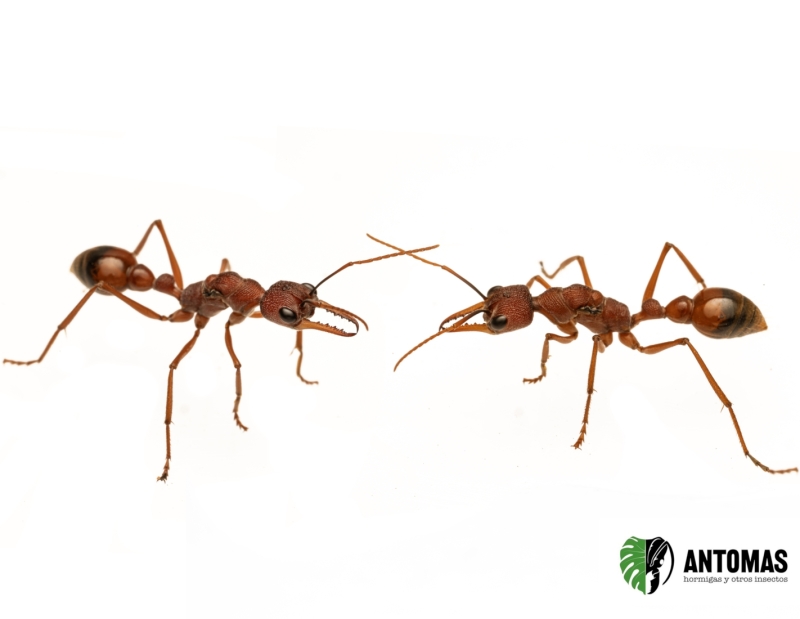
The most famous thing about the meat ant is the way it settles conflicts. Neighbouring colonies divide the land into exclusive territories (Greenslade 1975), and the borders are not marked by any physical obstacle but by the workers themselves. In 1982, G. and J. A. Ettershank described how they do it: with highly stereotyped ritualised fights, in which two workers face each other, feel each other out with their antennae, open their mandibles and strike each other with their forelegs in a kind of “boxing”, sometimes gripping each other by the mandibles. The most striking points:
- Almost no deaths. Injuries are rare and minor, and at any stage of the duel either of the two can withdraw and end the conflict.
- Wars of attrition. Clashes at the same point on the border can last for months and recur for years.
- Mostly theatre. In 2005, van Wilgenburg, van Lieshout and Elgar calculated that around 95% of interactions between colonies are ritualised. Fights to the death occur above all when a worker strays into foreign territory and the resident attacks her.
More recent studies by Elgar’s group indicate that these collective displays tell each colony how large its neighbour is relative to itself, although, as the title of one of them puts it, meat ants are “economical with the truth”: they do not always show everything they have. Another paper, from 2020, suggests that what they defend with them is above all resources, such as honeydew trees, rather than the land itself. In practice, the colony that shows the larger force gradually gains ground without the need for a massacre.
Several queens that cannot stand each other: oligogyny
How many queens does a colony have? The key work is that of Bert Hölldobler and Norman Carlin, of Harvard University, published in 1985. They studied nests near Canberra and described a curious organisation that they called oligogyny, “few queens”:
- In young colonies with several queens, the queens establish a hierarchy through ritualised duels fought with their antennae. The dominant queen inhibits egg-laying by the others, and physical fights are rare.
- The workers do not take sides. They treat all the queens equally and tolerate them even when the nest already has several thousand workers.
- As the colony grows, the queens become intolerant of one another and separate for good into different parts of the nest. Once separated, they lay roughly the same amount.
Is it common? It depends, above all, on the age of the colonies. Young colonies almost always have a single queen: in a population of colonies less than 14 years old near Hillston, the workers of each colony were descended from a single queen mated by a single male (van Wilgenburg, Mulder and Elgar 2006). By contrast, in older populations in South Australia and Victoria, genetic analyses suggest that some mature nests accumulate several queens, often unrelated to one another: adopted queens or colonies that have merged (Carew, Tay and Crozier 1997).
An important note for keepers: the published work describes queens that avoid each other, not queens that kill each other. What there is no data on at all is what happens when several queens have no room to separate, as in a tube or a small formicarium. That is why at Antomas we raise a single queen per colony (see “One queen per colony”).
Four ways to found a colony
Most ant species have a single way of getting started. The meat ant has four, according to Hölldobler and Carlin (1985):
- A queen on her own, who seals herself into her chamber and raises her first workers on her own reserves, without going out to eat: this is claustral founding, the most common.
- Several queens together, what is known as pleometrosis. In their excavations near Canberra, the vast majority of newly founded nests had one queen, and only a few had two or three.
- By budding: a group of workers from an established colony founds a satellite nest that eventually becomes independent.
- By adoption: newly mated queens dig their chamber next to a mature nest, probably their own, and end up integrated into it.
Greaves and Hughes, who studied a population near Canberra between 1949 and 1954, found that, where possible, growing by budding works better than founding with a single queen, and that the territories of colonies that die are taken over by their neighbours, their satellite nests or new colonies. Nuptial flights take place in the southern spring, above all in October and after rain: the males come out first, then the winged females.
Ruler of the rock
In Australia, Iridomyrmex are the most abundant and ecologically influential group of ants, and the ecologist Alan Andersen groups them under the name “dominant dolichoderines”: highly active, aggressive and typical of open, warm areas. The meat ant is the textbook example. In 2004, Heloise Gibb and Dieter Hochuli measured its dominance on sandstone outcrops near Sydney:
- Ever-present. It turned up in 95–100% of the surveys within 20 m of a nest, and accounted for up to 82% of the ants counted and 84% of the ant biomass on the rock.
- Unbeatable at the bait. It found all the honey baits in under 5 minutes, was never displaced from them and held on to 80% of those it discovered.
- But it does not control everything. When it was kept out with cages for a year, the other ants increased in spring and summer, but the make-up of the community did not change. Its effect, they concluded, is more limited than had been thought.
In the tropical north, with a relative from the same group, I. sanguineus, Andersen and Patel (1994) saw something more drastic: when this meat ant was fenced out, the number of ants and of species at the baits almost doubled.
Honeydew herders and a night shift
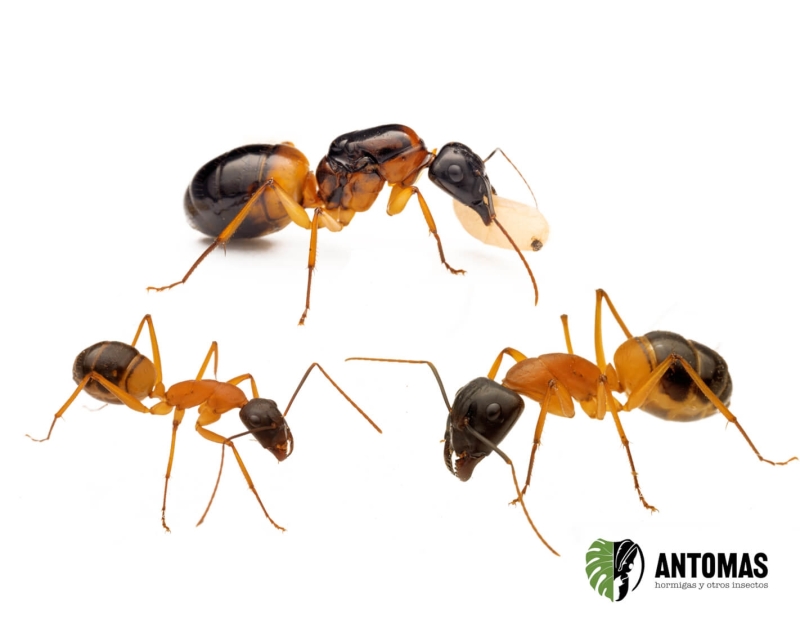
Much of a colony’s energy comes from the trees, where the workers tend small sap-sucking hemipterans and collect their honeydew. As we have seen, the colony even organises its nests around those trees. But it does not have them to itself: the banded sugar ant, Camponotus consobrinus, exploits the same resources at night, once the diurnal meat ant has retired. It is a genuine shift system.
Not that the shifts are free of dirty tricks: as Hölldobler and Wilson report, meat ants even plug the entrances of C. consobrinus nests with small stones and soil to delay their emergence. They also interact with lycaenid butterflies: according to the Australian Museum, they tend the caterpillars of Jalmenus ictinus, which give them sugary secretions, but prey on those of some Ogyris species.
The ant that gave its name to the iridoids
If you disturb a meat ant, you will know it by the smell. Like all dolichoderines, it has no formic acid, which is a formicine trait, but an anal gland that releases a volatile, strong-smelling secretion from the tip of the abdomen. In 1956, the Australian chemist George Cavill and his colleagues analysed these secretions in several Iridomyrmex, among them the meat ant, then called I. detectus, and found two main components:
- Methylheptenone (6-methyl-5-hepten-2-one), a volatile ketone with a pungent smell.
- Iridodial, a compound new to science.
According to Cavill (1970), in the meat ant they make up around 4% and 1% of body weight, respectively, and methylheptenone acts both as a defence and as an alarm pheromone. Iridodial, together with the iridomyrmecin of other dolichoderines, gave its name to a whole family of molecules: the iridoids, which are named after Iridomyrmex. That family includes, for example, the nepetalactone of catnip.
A spider that follows the alarm
Methylheptenone has one drawback: others can smell it too. In 1996, Allan, Elgar and Capon showed that the spider Habronestes bradleyi, a hunter that specialises in meat ants, locates its prey by following their alarm pheromone, which workers release when they are injured or alarmed. And where are alarmed ants most plentiful? At the borders between colonies, where they fight. The spider goes there and picks off the combatants. It was the first recorded case of a predator “eavesdropping” on an ant’s alarm signal.
It is not the meat ant’s only enemy: the literature mentions birds that dig up queens, the echidna, which attacks nests, and moth caterpillars that feed on its brood inside the nest itself. And the meat ant is also a hunter of unexpected prey: Clerke and Williamson (1992) documented it preying on young cane toads, an invasive, poisonous amphibian that is wreaking havoc on Australian wildlife.
Built for the heat
It is a sun-loving ant. It nests in open, sunny places, and shade from vegetation is, according to Greaves and Hughes (1974), one of the main causes of death among young colonies. In 2013, Nigel Andrew and his colleagues measured its resilience in Armidale, on the New South Wales tablelands:
- Critical thermal maximum: 46.1 °C, and a lethal temperature of 45.8 °C.
- Lightning raids: they forage for a few minutes on ground hotter than those limits. With surfaces at 18.6–57 °C, their body temperature ranged from 24.5 to 43.1 °C.
- Active all year round in that area, although they adjust part of their biology to the cold according to the season.
- A limit that does not shift: they cannot raise their heat tolerance by acclimation, something that worries the authors in the face of climate change.
In a sister species from the arid interior, I. viridiaeneus, Greenaway (1981) found that the workers forage only by day, with the air at between 14 and 43.5 °C: in midsummer they come out early in the morning and late in the afternoon, and in winter, around midday.
A fixture of south-eastern Australia
It lives across much of south-eastern Australia: New South Wales, the Australian Capital Territory, Victoria, south-eastern South Australia and eastern Queensland, with more scattered populations to the north and west; it is absent from Tasmania. It occupies open eucalypt forest, savanna woodland, heathland, roadside verges, parks and gardens, always on well-drained, sunny soils, often sandy or gravelly. It has not become established outside Australia, although in New Zealand specimens of the group have been intercepted in goods and luggage arriving from Australia.
Across much of its range the climate is temperate or semi-arid, with hot summers and cool winters in which frosts are frequent inland. That winter is the factor that most limits the species at the cold edge of its range (Greenslade 1975), and it is the basis for the diapause we recommend at home (see “Diapause”).
From Formica purpurea to the meat ant
The British entomologist Frederick Smith described it in 1858 as Formica purpurea, from a worker collected in Melbourne. In the same work he described, under the name Formica detecta, a queen from the Hunter River that turned out to belong to the same species. His description already explains the name: head, thorax and legs “bright red with a faint purple or blue tint” and an abdomen “bright violet, with sometimes a coppery tinge”. Purpureus means “purple” in Latin, and the genus Iridomyrmex, created by Gustav Mayr in 1862, combines the Greek iris, “rainbow”, and myrmex, “ant”, after those iridescent sheens.
For much of the 20th century it was called Iridomyrmex detectus, until taxonomists reinstated purpureus as the valid name. In 1993, Steve Shattuck revised the group and showed that “the meat ant” was in fact a set of similar species, with 11 species divided among four complexes, including I. viridiaeneus and I. sanguineus, which had previously been regarded as forms of purpureus. That is why older studies should be read with care: some were carried out on other species in the group. At Antomas we call it the meat ant.
Size and morphology
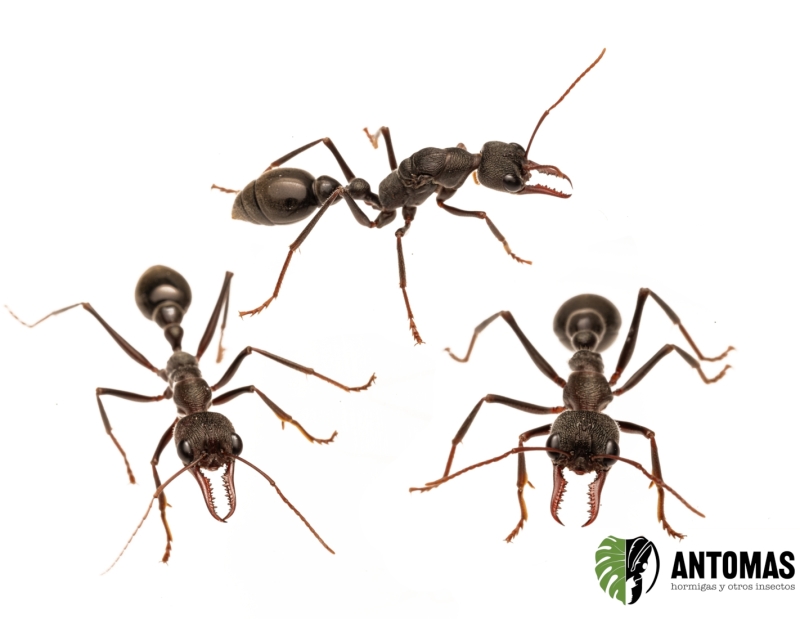
A medium-sized, robust ant with long legs and quick movements, and a single worker caste: it has no soldiers or clearly distinct major workers, although size varies quite a lot from one worker to another.
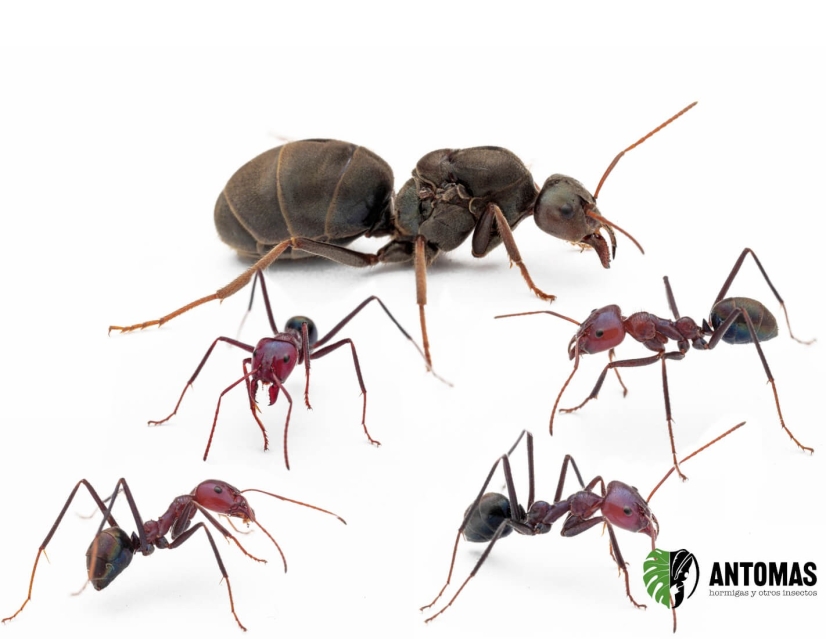
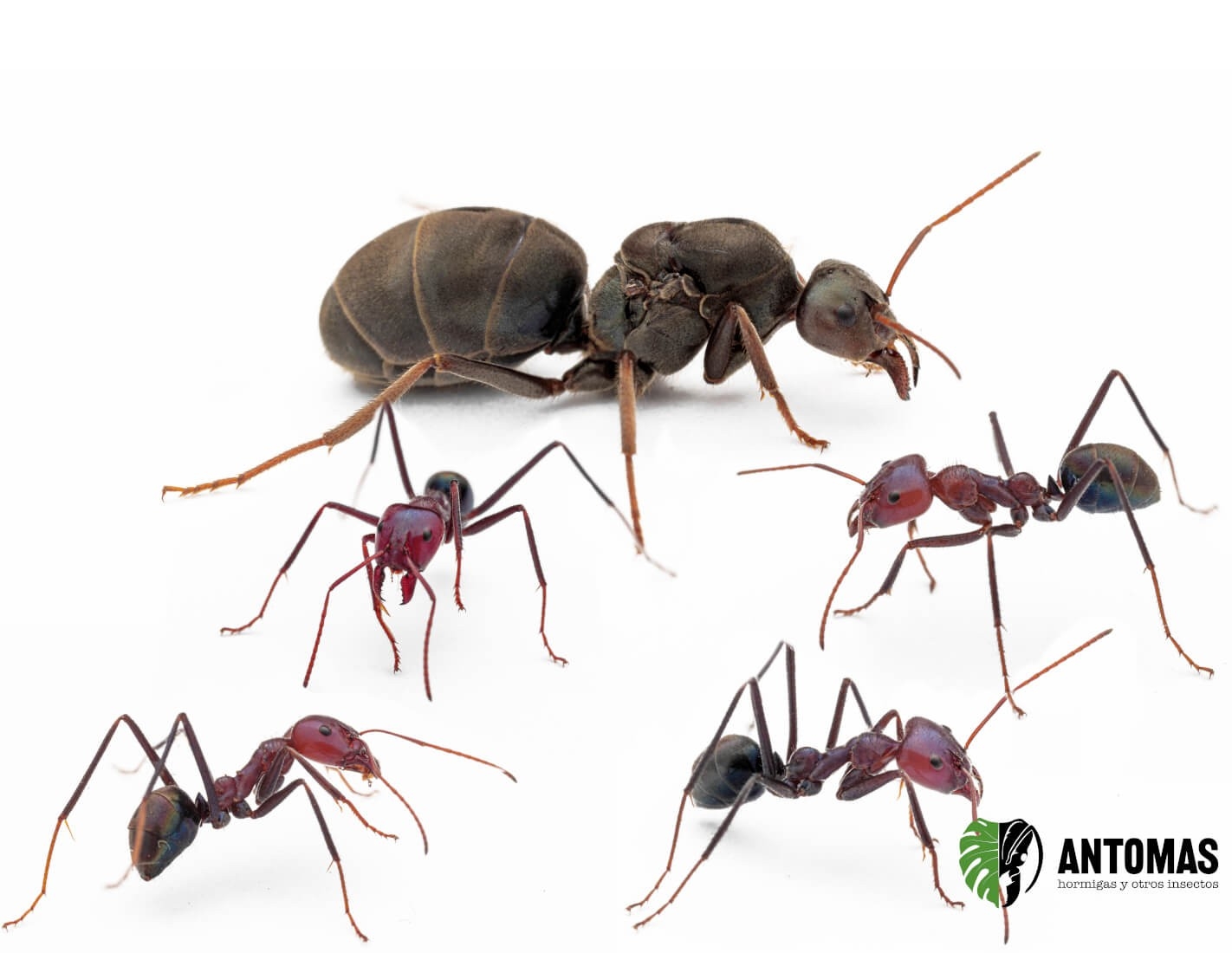
- Colour. According to Heterick and Shattuck’s revision of the genus (2011), the head, and often the front of the thorax, ranges from orange to brick red, and the gaster from brown to black. The front part of the body shows iridescent bluish, pinkish, yellowish-green or purple highlights, which change with the light and from one population to another.
- Variable size, no castes. In the 84 workers measured by Heterick and Shattuck, head width ranged from 1.51 to 2.29 mm. The variation is continuous, partly between populations, with no defined size classes.
- Head and eyes. Well-developed eyes, as befits an ant that forages by day, and no ocelli in the workers. The antennal scape extends beyond the rear margin of the head.
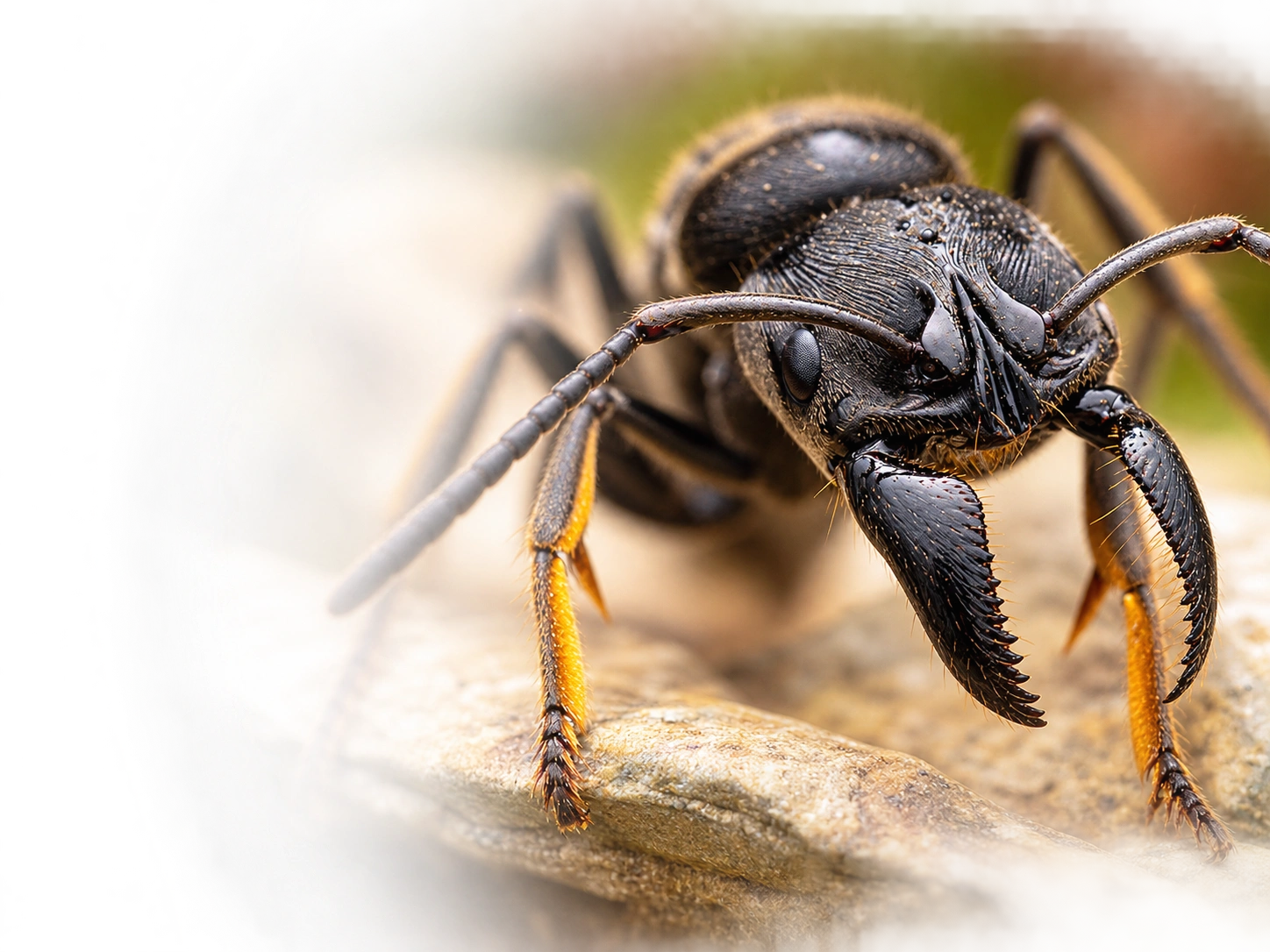
- Mandibles. Strong, and used to bite again and again when defending the nest (Australian Museum).
- Thorax and petiole. Thorax with short, stiff erect hairs and with the mesothoracic spiracles marked as small bumps. A single-segmented petiole, with a thin, upright scale.
- No functional sting. In dolichoderines the sting is vestigial or absent, and the tip of the gaster lacks the acidopore of the formicines. Its chemical defence comes from the anal gland (see “The ant that gave its name to the iridoids”).
- Queen. Winged before the nuptial flight and considerably larger than the worker. Smith described his type queen as blackish brown, with ferruginous antennae and legs and almost transparent wings, yellowish along the front edge.
- Development. As in all dolichoderines, the larvae do not spin a cocoon: the pupae are naked.
- Chromosomes. n = 9, according to studies by Crozier (1968) and by Imai and colleagues (1977).
Approximate measurements
- Workers: up to 1 cm long (Museums Victoria; Australian Museum)
- Type worker: about 8.5 mm (“4 lines”, an old English unit; Smith 1858)
- Workers: head 1.69–2.31 mm long and 1.51–2.29 mm wide; scape 1.57–2.05 mm (Heterick and Shattuck 2011, 84 workers)
- Queen: about 12.7 mm (“6 lines”, an old English unit; Smith 1858, a single specimen described as Formica detecta)
We have not found a modern measurement of the queen or the male. The figures of 6–8 mm for workers and up to 15 mm for the queen that circulate online do not come from published measurements, so we prefer not to give them.
Care in captivity
Difficulty: 2/5 – Beginner
It is one of the best gateways to Australian ants: hardy, undemanding about food, active by day and always in view. It eats practically anything, copes well with a dry nest and has no sting.
Why not a 1/5? Because of four details:
- It climbs and escapes. It is fast and curious and takes advantage of any crack: the barrier and the lid are not optional (see “Escapes and barriers”).
- A delicate start. Small colonies grow slowly at first, and it is best not to rush them into the formicarium (see “Founding and growth”).
- Heat and space. It is a sun-loving ant: it needs heat with a gradient and, once it takes off, the colony grows very quickly and demands room.
- Temperament. It is aggressive and it bites; nothing serious, but you should always work with tools (see “Handling and safety”).
And it is well worth it. Few ants offer so much activity: trails full of workers, food that disappears in minutes and a colony that organises itself before your eyes. At Antomas you will find Iridomyrmex purpureus for sale and, if Australian ants appeal to you, also the metallic pony ant, Rhytidoponera metallica, its relative R. chalybaea and C. consobrinus, the meat ant’s night-shift neighbour. And if you would like to start with a colony that is already large, we have the Meat Ant Empire, an established colony of this species.
Recommended parameters
- Nest temperature: 24–28 °C in the active season, with a slightly warmer spot of 28–30 °C on one side, always on a thermostat. The colony must be able to choose.
- Why these figures: in the warm months in its range, the soil where its chambers lie, at a depth of 20 to 50 cm, sits at around 22–28 °C according to our estimates based on climate data, and keepers agree on a nest at 22–28 °C with heat on one side.
- Foraging area: with light and some warmth. A warmer spot in one corner, at about 30–32 °C, lets them warm up as they do on the mound, but never heat the whole set-up.
- At night it can drop a few degrees, to about 20–22 °C, without any problem.
- Humidity: a rather dry nest, around 40–60%, with a slightly humid area for the brood and a dry foraging area (see “Dry on the outside, slightly humid on the inside”).
- Water: always available, in a test tube with water and cotton wool in the foraging area.
- Light: a dark nest and a lit foraging area, with a normal day–night cycle. It is diurnal: with light and warmth you will see it in full swing.
- Diapause: mild, about 3 months, from mid-December to late February, at 12–15 °C (see “Diapause”).
Dry on the outside, slightly humid on the inside
It is an ant of well-drained soils and dry climates, and it tolerates dryness much better than most tropical species. Keepers agree on the formula: a rather dry nest, with a single slightly humid corner or chamber, and a dry, well-ventilated foraging area. That way the colony chooses where to put the brood.
- Moisten only part of the nest, never all of it, and without waterlogging it.
- No drops on the walls: if you see condensation, stop moistening for a few days and ventilate.
- If they crowd into one corner, keepers take it as a sign that the rest of the nest is too dry or too cold.
- Leftovers out within 24 hours: with so much meat and sugar, forgotten food goes mouldy in no time.
Recommended formicaria
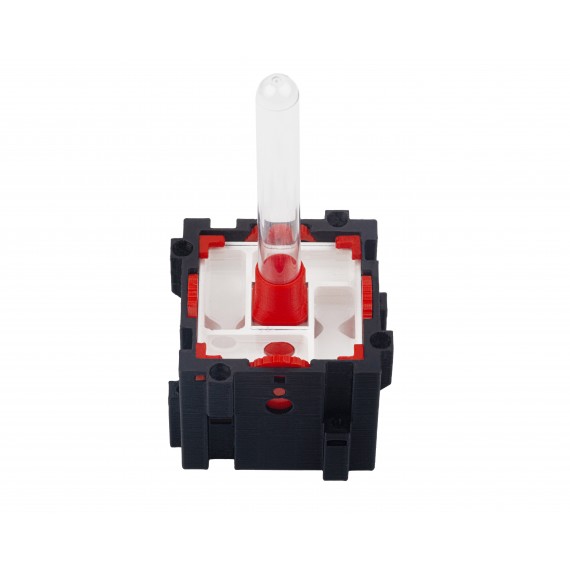
At Antomas we recommend the Anthouse Qbik Alpha range: modular, rather dry formicaria that suit a species that prefers a dry nest with a slightly humid area, and that let you add modules as the colony grows. To start with, a QBIK ONE:
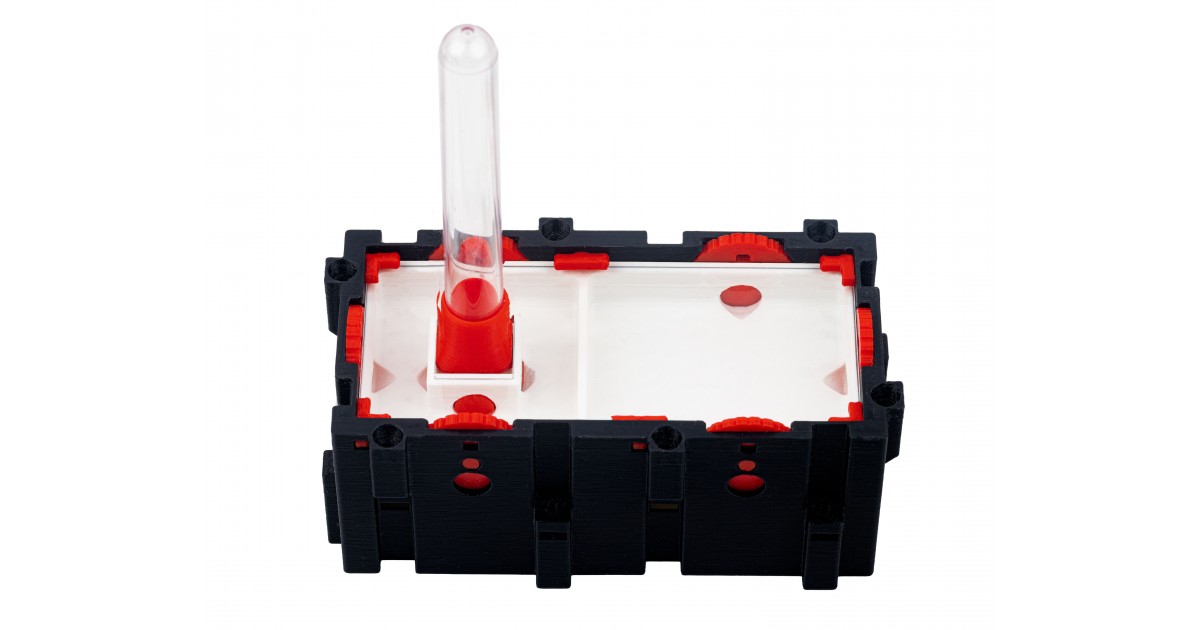
When the colony fills it, the next step is the QBIK DUO:
The module should always be in proportion to the colony: this is the mistake keepers of this species mention most often. In a formicarium that is too large, the empty chambers end up as rubbish dumps, with mould and mites, and the colony scatters and becomes stressed. Expand when you see workers sitting still in the foraging area with no room inside. As in the wild they spread the colony across several nests, with a large colony you can gradually connect further modules and foraging areas. Complete the set-up like this:
- A large foraging area. They are very active and cover a lot of ground; if you like, add a thin layer of sand with a little fine gravel, like that of their mounds.
- Heat on one side, on a thermostat, and a spot of light and heat in one corner of the foraging area, away from the feeder.
- Water in a test tube with cotton wool, and a feeder for the nectar, never cotton wool.
- An escape barrier around the whole perimeter of the foraging area and a well-fitting lid (see “Escapes and barriers”).
One queen per colony
Our colonies arrive with a single queen and her brood, and that is how we recommend keeping them.
- In the wild, young colonies almost always have a single queen. Some mature colonies end up with several, but they live apart in different parts of the nest and do not tolerate one another (see “Several queens that cannot stand each other: oligogyny”).
- In a formicarium they have nowhere to separate, and there is no published data or keeper experience showing that several queens live together well in captivity. That is why at Antomas we do not recommend combining queens.
- Nor should you combine colonies or mix workers from different formicaria: in the wild they attack workers from other colonies, and even those from another nest of their own colony.
Founding and growth
In the wild, the queen founds claustrally: she seals herself in and raises her first workers without going out to eat. Our colonies are already past that stage, but they are still small, and the first stretch calls for patience:
- From egg to worker takes about 6–9 weeks at 24–28 °C, as keepers agree; with less warmth, considerably longer.
- A shy start. Australian keepers report that the first workers spend periods hidden away and inactive. Do not worry: this is normal.
- An explosive take-off. Once past that stage, and with warmth and plenty of food, the brood grows at a surprising rate. One Australian keeper describes a colony that, in midsummer, went in a month from its first workers to about 16, with more than twenty eggs, as well as larvae and pupae.
- In a tube, at first. Keepers keep the colony in its tube until it has 15–30 workers, or move it sooner if the tube gets dirty or runs out of water. After that, into a QBIK ONE.
- Food from day one: a drop of nectar in the feeder and small prey, such as a Thermobia or a fruit fly. Remove any leftovers the next day.
Arrival and moving by tipping
When you receive the colony, let it rest in a quiet, dark place at 24–26 °C, check that it has water and offer it a drop of nectar and a small prey item. To move it into the formicarium, at Antomas we do it by tipping:
- Set up the formicarium beforehand, with the humid area ready, the water in place and, above all, the escape barrier already applied: they are very fast.
- Work over a tray, with long forceps and a soft brush, never with your hands.
- Open the tube in the foraging area, next to the nest entrance, and gently tip out the queen, the workers and the brood, helping the stragglers along with the brush.
- Close the lid and leave the nest dark. Before long they will have carried the brood inside.
To move them into a larger module later on, use the same method.
Feeding
Sugar, almost every day. In the wild much of its energy comes from honeydew and nectar, and at home it is much appreciated. At Antomas we recommend Anthouse’s Blue Sugar nectar 4–5 times a week and another nectar or sugary liquid, such as diluted honey, 1–2 times a week. You can also add a little protein to the nectar. Always offer it in a feeder, where the drop stays “spread out” and within reach, and never on cotton wool, which goes mouldy and spoils the liquid in no time. Some keepers report that their small colonies ignored honey but accepted other sugars, such as a small piece of grape: if they do not take it, try another form.
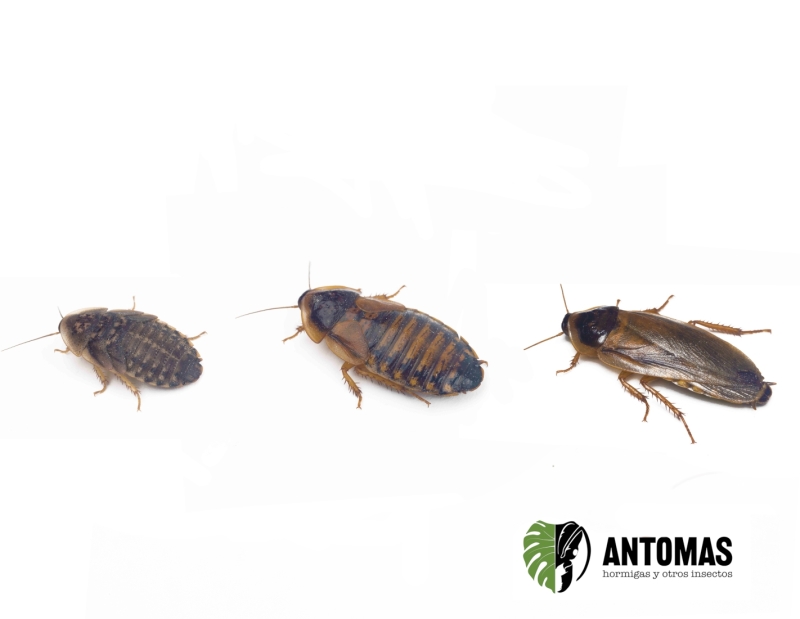
Protein: plentiful and varied. The queen needs it to lay and the larvae need it to grow, and this species has a voracious appetite. In Antomas’s experience, the more protein they receive, the faster colonies grow and the larger they become. If you carry out frequent maintenance and remove leftovers within 24 hours, it is better to give too much than too little; if you will not be able to clean up, it is better not to overfeed. Change the type of insect from one week to the next:
Buy your insects from a reliable supplier: insects treated with insecticides can kill the colony. There is no need to give it seeds.
Water: always, in the test tube with cotton wool, kept separate from the sugar.
Diapause
No study has shown that it needs an obligatory diapause, and in some parts of its range it can be seen active all year round (Andrew et al. 2013). But its winter is real:
- A cool winter. In the core of its range, the average air temperature from June to August is around 7–12 °C, with frequent frosts inland. We estimate that in the deep chambers, where the colony spends the winter, the temperature stays at about 8–13 °C.
- Less activity. In winter the colony retreats below 25 cm (Ettershank 1971) and, depending on the area, comes out only in the mildest hours or almost stops foraging. In a sister species, the workers do not come out when the air is below about 14 °C (Greenaway 1981).
- Cold as a limit. At the cold edge of its range, winter is the main factor limiting its populations (Greenslade 1975).
That is why at Antomas we recommend a mild diapause of about 3 months, from mid-December to late February, at 12–15 °C, which corresponds to the winter in its range:
- A gradual start in November. Remove the warm spot and lower the temperature little by little over 2–3 weeks, cutting back on protein.
- During diapause: water always available, a little nectar and almost no protein. Disturb the colony as little as possible. Do not go above 15 °C, because from there upwards they start foraging, or below about 10 °C.
- What you will see. In Antomas’s experience, at this time of year it is normal to see many larvae that do not grow and no eggs or pupae. When the warmth returns, brood development resumes.
- A gradual exit in March, until you are back at 24–28 °C with the warm spot, and protein as soon as you see brood.
- Small colonies: better a shorter, milder diapause, of 6–8 weeks at 15–18 °C.
- Where: an unheated room often does not get cold enough; a garage, a cellar or a wine cooler usually does the job.
Remember that in its range the seasons are the other way round from ours. If you receive the colony in autumn and it is still running on southern-hemisphere time, it has just come out of its winter: you can keep it active this first winter and give it the normal diapause from the following year onwards. If it slows down of its own accord, a short rest at 15–18 °C is enough.
On video: the meat ant empire
Two short videos by Anthouse featuring meat ant colonies in full swing:

The empire of the meat-eating ants: Iridomyrmex purpureus on the Anthouse channel.

The empire of blood wants meat: a colony in full swing, on the Anthouse channel.
Behaviour and observation
Active from dawn to dusk. With light and warmth, the workers patrol the foraging area tirelessly, form trails between the nest and the food and swarm over any prey together. It is one of those species that never seem to keep still.
Voracious. Keepers agree that “they never stop eating”. You will see prey disappear in no time, dismembered by many workers, and the feeder fill up with ants.
Defence. They are aggressive towards any intruder. If you knock the formicarium or open it abruptly, they will pour out in force to defend it with their mandibles open, and you will notice the smell of their alarm secretion.
Watch without fear. At Antomas we believe ants are there to be enjoyed, watched and learnt from, not kept hidden away. It is enough to leave them a dark nest and a lit foraging area, and to watch them gently, intervening as little as possible.
Warning signs:
- The colony does not grow in the height of the season: check the temperature and the protein.
- Workers crowded into one corner: the rest of the nest may be too dry or too cold.
- Mould or debris in the chambers: there is too much moisture or leftovers remain.
- Many workers sitting still in the foraging area, with no room inside: it is time to expand.
Escapes and barriers
This is where the most care is needed. Iridomyrmex climb smooth surfaces, even upside down, and keepers agree that the meat ant is fast, curious and able to exploit any gap. According to them, escapes happen above all at feeding time.
- An escape barrier on the upper part of the walls of the foraging area: mineral oil or PTFE (Fluon). Renew it as soon as it collects dust, sand or debris, which make it less effective.
- A well-fitting lid, with no gaps at the connections or plugs.
- Nothing that could act as a bridge to the barrier: no long twigs, forgotten forceps or tubes leaning against the walls.
- When feeding, open only as much as necessary and leave the food away from the walls.
Handling and safety
It does not sting: it bites. Like the other dolichoderines, it has no functional sting. It defends itself by biting, often several times in a row, and by releasing its strong-smelling secretion from the tip of the abdomen. The bite is unpleasant but not dangerous; that is why some people dare to put a hand into a bowl full of them. Even so, day to day it is best to work calmly and with tools: given their speed and numbers, a hand inside the foraging area is covered in workers within seconds.
- Always with tools: long forceps, a soft brush and, for transfers, tubes and adaptors.
- Open the formicarium only as much as necessary, work over a tray and close it when you have finished.
- With small children or pets at home, keep the formicarium closed at all times and out of their reach.
- If you are bitten, gently remove the ants and wash the area.
It is an exotic species: it must never be released.
What not to do
- Open the formicarium without a barrier or tools, or neglect the barrier.
- Combine queens or colonies, or mix workers from different formicaria.
- House a small colony in a huge formicarium.
- Wet the whole nest, or let condensation form on the walls.
- Keep it cold and in the shade in the height of the season: it needs heat with a gradient, and light.
- Put the nectar on cotton wool, or leave meat or prey remains for more than a day.
- Always give it the same insect, or skimp on protein when there are larvae.
- Give it a diapause that is too warm, above 15 °C, or change the temperature abruptly when going into or coming out of it.
Scientific sources
This care sheet is based on the scientific literature on Iridomyrmex purpureus and its species group, on climate data from its range and on the experience of Antomas and other keepers. Main references:
- Cavill, G. W. K., Ford, D. L. & Locksley, H. D. (1956). The chemistry of ants. I. Terpenoid constituents of some Australian Iridomyrmex species. Australian Journal of Chemistry 9: 288–293. doi:10.1071/CH9560288
- Greaves, T. & Hughes, R. D. (1974). The population biology of the meat ant. Journal of the Australian Entomological Society 13: 329–351. doi:10.1111/j.1440-6055.1974.tb02212.x
- Ettershank, G. & Ettershank, J. A. (1982). Ritualised fighting in the meat ant Iridomyrmex purpureus (Smith) (Hymenoptera: Formicidae). Journal of the Australian Entomological Society 21: 97–102. doi:10.1111/j.1440-6055.1982.tb01772.x
- Hölldobler, B. & Carlin, N. F. (1985). Colony founding, queen dominance and oligogyny in the Australian meat ant Iridomyrmex purpureus. Behavioral Ecology and Sociobiology 18: 45–58. doi:10.1007/BF00299237
- Shattuck, S. O. (1993). Revision of the Iridomyrmex purpureus species-group (Hymenoptera: Formicidae). Invertebrate Taxonomy 7: 113–149. doi:10.1071/IT9930113
- Allan, R. A., Elgar, M. A. & Capon, R. J. (1996). Exploitation of an ant chemical alarm signal by the zodariid spider Habronestes bradleyi Walckenaer. Proceedings of the Royal Society of London B 263: 69–73. doi:10.1098/rspb.1996.0012
- Carew, M. E., Tay, W. T. & Crozier, R. H. (1997). Polygyny via unrelated queens indicated by mitochondrial DNA variation in the Australian meat ant Iridomyrmex purpureus. Insectes Sociaux 44: 7–14. doi:10.1007/s000400050018
- Gibb, H. & Hochuli, D. F. (2004). Removal experiment reveals limited effects of a behaviorally dominant species on ant assemblages. Ecology 85: 648–657. doi:10.1890/03-0007
- van Wilgenburg, E., van Lieshout, E. & Elgar, M. A. (2005). Conflict resolution strategies in meat ants (Iridomyrmex purpureus): ritualised displays versus lethal fighting. Behaviour 142: 701–716. doi:10.1163/1568539054729150
- van Wilgenburg, E., Mulder, R. A. & Elgar, M. A. (2006). Intracolony relatedness and polydomy in the Australian meat ant, Iridomyrmex purpureus. Australian Journal of Zoology 54: 117–122. doi:10.1071/ZO05075
- van Wilgenburg, E., Ryan, D., Morrison, P., Marriott, P. J. & Elgar, M. A. (2006). Nest- and colony-mate recognition in polydomous colonies of meat ants (Iridomyrmex purpureus). Naturwissenschaften 93: 309–314. doi:10.1007/s00114-006-0109-y
- van Wilgenburg, E. & Elgar, M. A. (2007). Colony structure and spatial distribution of food resources in the polydomous meat ant Iridomyrmex purpureus. Insectes Sociaux 54: 5–10. doi:10.1007/s00040-007-0903-3
- Heterick, B. E. & Shattuck, S. (2011). Revision of the ant genus Iridomyrmex (Hymenoptera: Formicidae). Zootaxa 2845: 1–174. doi:10.11646/zootaxa.2845.1.1
- Andrew, N. R., Hart, R. A., Jung, M.-P., Hemmings, Z. & Terblanche, J. S. (2013). Can temperate insects take the heat? A case study of the physiological and behavioural responses in a common ant, Iridomyrmex purpureus (Formicidae), with potential climate change. Journal of Insect Physiology 59: 870–880. doi:10.1016/j.jinsphys.2013.06.003

Very good experience. Great and fast support. A healthy colony that is growing quickly, and fast shipping. I would definitely use them again. Greetings from Germany.