Difficulty: 2/5 – Beginner
The Australian metallic ant, with green, blue and violet highlights. In the wild, almost no colony has a queen: the eggs are laid by several mated workers, the gamergates. Antomas colonies are always sold with a queen. Hardy, diurnal and a hunter. A Qbik Wild with sand, a nest at 23–27 °C and never above about 27–28 °C, moderate humidity with a dry part and no condensation, nectar almost every day and varied protein; it does not eat seeds, only their elaiosome. A mild 12–16-week (3–4-month) diapause at 15–18 °C during our winter. Moving by tipping, a mineral-oil barrier and a lid. It stings: always use tools. This is not a species for people who are allergic to hymenopteran stings.
Rhytidoponera metallica (F. Smith, 1858), the metallic ant that Australians call the green-head ant, is one of the commonest ants on that continent. It lives in forests, scrubland, parks and gardens across much of the country, and its body, covered in wrinkles, shimmers green, blue and violet depending on how the light catches it. It is an ectatommine, one of the ants once grouped together as the “ponerines”: a primitive ant, with a sting, good eyesight and the habits of a solitary hunter.
What makes it unique, however, lies inside the nest. Most of its colonies have no queen: instead, dozens of mated workers, the gamergates, breed side by side in the same nest. Its workers call males with a perfume from the nest entrance, each of them carries a venom different from her sisters’, and the species sows the Australian bush by carrying off seeds that it then does not eat. At home it is a hardy ant, active by day and easy to watch, perfect for getting started with Australian ants.
Biology
What is a gamergate?
A gamergate is a worker that has mated and lays fertilised eggs: a worker playing the role of the queen. The word comes from the Greek gamos, “marriage”, and ergátēs, “worker”; a gamergate is, quite literally, a “married worker”. The term came into use in the 1980s and spread after a 1984 paper by Christian Peeters and Robin Crewe on another primitive ant.
The differences from a queen are clear:
- She has no wings and never has had. She emerges like any other worker and mates without flying, next to the nest.
- She has a worker’s body. To the naked eye she cannot be told apart from her sisters. In 1965, Haskins and Whelden showed that in this species worker-shaped females rear workers normally, and that there are no intermediate forms between queen and worker.
- Only some of the workers are gamergates. Whelden dissected 386 workers from colonies in Queensland and New South Wales, and 21 contained sperm: around 5%. Other studies give between 5 and 15% of mated females per colony.
- Those that do not mate can also lay, but their unfertilised eggs only produce males, as in all hymenopterans.
Other ants have gamergates too, such as Diacamma or Harpegnathos. The difference is one of scale: in Diacamma there is a single gamergate per colony, who prevents the others from reproducing; in R. metallica, as you will see in the next section, there can be dozens at once.
Dozens of mothers in the same nest
How many gamergates does a colony have? Michel Chapuisat and Ross Crozier studied the question in 2001 using genetic markers in 30 nests in a regional park in southern Victoria. They measured how genetically similar the workers of a single nest are, and the result was surprising: an average relatedness of only 0.082, when between full sisters it would be 0.75. It is the lowest value recorded in an insect society in which the breeders and the helpers look the same.
Such low relatedness can only be explained by many mothers. Their model gives a minimum of about 9 effective gamergates per nest, and the authors calculate that there could be up to 150. The colonies they excavated averaged about 464 adult females, ranging from 79 to 1,092: rather more than the “tens or a few hundred” you often read about. And another detail: neighbouring nests are no more alike genetically than distant ones, because the males fly and mix the genes of far-flung colonies.
A colony of R. metallica is therefore a society of half-sisters and distant cousins, with dozens of mothers working at the same time. It is an extreme case, much studied by those who research how cooperation is maintained when nestmates are barely related.
Workers that call males with a perfume
If gamergates do not fly, how do they find a mate? In 1977, Bert Hölldobler and Caryl Haskins published the answer in Science: the virgin workers of R. metallica call males with a pheromone released from a gland between the last segments of the abdomen, the pygidial gland. It was the first evidence of sexual chemical communication among the ponerines, the group in which the species was classified at the time.
The following year, Haskins described the scene in detail:
- The posture. The worker stands still next to the nest entrance, with her head and thorax pressed to the ground, her gaster raised and arched and her sting extruded.
- The duration. Each call lasts one or two minutes, and some more than twelve. Afterwards, the worker moves and calls again from another spot.
- The time of day and year. Above all in the early and mid-morning, and at almost any time of year: there are records from every month except February, August and December.
- The males. They fly low, almost at ground level, and enter other colonies’ nests.
In a laboratory colony, Haskins and Whelden even saw the matings: with the nest at about 22–24 °C, between ten to nine and ten to eleven in the morning, lasting 30 to 52 seconds each. It was no idyll: the foragers attacked the males and sometimes dragged them into the nest, and one worker even went back inside while still mating.
Real queens, but very rare
Does all this mean that R. metallica has no queens? Not exactly. Frederick Smith had already described a winged female in 1858, and in 1986 the myrmecologist Philip S. Ward showed that these queens are functional. But they are scarce: in five years of sampling across eastern Australia, Ward found only two. Then, in August and September 1983, many turned up in south-eastern Queensland: one colony under a log had 157 workers and 17 winged queens. Ward linked this, as a hypothesis, to the severe drought of 1982–83. Museum material shows that queens are produced throughout the species’ range.
Two of the three queens he collected while they were dispersing had mated, and he took them to the laboratory. Both tore off their wings, dug a cell and each founded her own colony without sealing herself in: they went out hunting to feed their larvae, a type of founding usually described as semi-claustral. The larvae used grains of sand to spin their cocoons. The colonies grew slowly: at one year old they had 41 and 27 workers, and one of them later reached about 120.
This is just what the queens of its relative Rhytidoponera chalybaea and of other species in the impressa group do; in those species, colonies with a queen and colonies with gamergates live side by side, though never in the same nest. In R. metallica, by contrast, no one has ever found a colony headed by a queen in the field: queens exist, but the species relies above all on its gamergates.
The queen who stops laying loses her throne
Ward followed his two laboratory colonies for years and saw something unsettling. Around week 56, the queen of one of them stopped laying; the workers began to attack her and she died around week 66. After that, the workers fought among themselves with blows of their antennae and spent six months performing the sexual call next to the nest. In the other colony, whose queen was still fertile, no worker called.
Ward concluded that what holds the workers back is not the mere presence of the queen, but her activity: while she lays, she rules; when she stops laying, the workers try to reproduce on their own account. It is an observation from a single colony, but it helps to explain why this species can do without queens.
Colonies born by budding
Without flying queens, colonies multiply by budding: a group of workers, with a gamergate or two, splits off from the mother nest and settles a short distance away. Chapuisat and Crozier consider this the normal way of founding new colonies in this species, with long-distance dispersal left to the males.
Haskins and Whelden put it to the test in 1965 with two groups of just seven workers taken from laboratory colonies. They grew quickly, and one of them reached at least 227 workers and 15 males. Another of their experiments shows the flip side: two fragments of a colony kept for ten years without any new genes ended up laying eggs that barely developed, which the authors put down to inbreeding.
Well looked after, these colonies can last a remarkably long time: a colony collected in 1963 was still alive and growing in the laboratory of Caryl and Edna Haskins twenty years later, and the authors wrote that they can be kept almost indefinitely.
The gardener of the Australian bush
You often read that this ant eats seeds. It does not, and the reality is more interesting. Many Australian plants have seeds with an elaiosome, a fleshy, fat-rich appendage that works as a gift for ants. R. metallica carries the seed to the nest, eats the elaiosome and throws the seed out intact. This is myrmecochory, the dispersal of seeds by ants, and the figures show how good it is at it:
- Near Sydney (Hughes and Westoby, 1992), R. metallica and Aphaenogaster longiceps usually left the seed whole on the surface of the nest, whereas a Pheidole ate them. Seeds that passed through R. metallica were more likely to survive.
- In South Australia (Beaumont and colleagues, 2013), it carried 43.6% of the seeds it was given back out of the nest, almost all still bearing traces of elaiosome, and dropped them on average about 60–80 cm from the entrance.
- On roadside verges in New South Wales (Palfi and colleagues, 2017), it accounted for 28% of dispersal events, with average distances of 1.4–1.6 m and a maximum of 14 m.
Researchers regard it as one of Australia’s great seed dispersers: an ant that, without meaning to, sows the bush. At home it does not need seeds, but if you ever offer it one with an elaiosome, you will be able to see this behaviour with your own eyes (see “Feeding”).
A solitary, opportunistic hunter
Outside the nest, R. metallica works alone. Each worker patrols on her own, by day, and returns to the nest if the sky clouds over. It hunts and gathers small insects and other arthropods, alive or dead. Thomas and Framenau (2005) observed that foragers take the first prey they find, whatever its size, and that those from large colonies travel further and spend more time outside.
It does not form columns: Haskins and Haskins (1983) found no evidence that it marks trails with pheromones, and suggest that what it marks, with tiny faecal droplets, is the nest site. Nor are there physical castes: all the workers look alike, and the division of labour depends on the size of the colony. In large colonies, of more than 450 workers, the young ones tend the brood and the veterans go out foraging; in small ones, of fewer than 80, there is no such division (Thomas and Elgar, 2003).
The myrmecologist Alan Andersen placed Rhytidoponera among the “opportunists” in his classification of Australian ant communities: unspecialised species, typical of disturbed sites. That explains why it thrives in gardens, lawns and roadside verges, and why it is so rewarding in captivity.
Neighbours tolerated, outsiders not
Do colonies fight one another? It depends on the distance. For years, Caryl and Edna Haskins set workers from different colonies against each other and found that tolerance decreases as the kilometres add up (1979):
- Up to about 5 km: colonies tolerate each other.
- At about 32 km: hostility is the rule.
- At about 900 km, between Queensland and New South Wales: total antagonism.
Two halves of the same colony, kept apart for four years or more, still accepted each other. And in 1983 they added a curious detail: workers introduced singly or in groups of ten were usually adopted by a foreign colony, but if a whole nest was introduced with its soil, the attack was immediate, violent and almost general. The authors put this down to a chemical mark of the nest site itself. At home, the lesson is simple: never combine colonies.
A different venom in every worker
In 2023, a team led by Samuel D. Robinson analysed the venom of R. metallica and found 123 components, most of them from a single family of peptides, the aculeatoxins. One of them, Rm4a, causes pain in mice; another, Rm1a, is insecticidal; and some have antibacterial and antifungal activity.
The surprise came when they compared workers: two workers from the same nest share on average only 62% of their venom. The reason lies, once again, with the gamergates: because there are many mothers, the workers inherit different variants of the toxin genes, and the colony as a whole brings together more than five times as many different toxins as other ant venoms studied. The authors suggest that this diversity helps to sustain social life in a colony of such distant relatives.
One of Australia’s commonest ants
The Australian Museum regards it as one of the most abundant and widespread insects in Australia. It lives in Victoria, New South Wales, the Australian Capital Territory, South Australia, much of Western Australia, the south of the Northern Territory and eastern Queensland, from sea level up to about 1,000 m. It occupies forests, savanna woodland, scrubland and heathland, and it is abundant in towns and cities: lawns, parks and gardens.
Its knack for living alongside people has made it a traveller. In New Zealand it was first found in Auckland in the late 1950s, apparently arriving with shipments of timber, and since 2001 it has been collected in Napier, where it is thought to be probably established. And a warning from taxonomists: its chromosome number varies greatly from one population to another, and what we now call R. metallica could be a complex of very similar sister species.
A stone of just the right size
In the wild it nests in the ground: under stones, logs and branches, among grass roots or at the foot of shrubs. Thomas (2002) studied its nests in a Victorian forest and found that it avoids stones smaller than 200 cm² and that the larger the colony, the larger the stone it occupies. In the laboratory, the workers recognised large stones by their dimensions. Under a stone, the nest is shielded from extremes of temperature and the brood receives extra warmth.
These are not nests for life: colonies move house often, especially in summer. This is one of the reasons why in captivity they readily accept a new formicarium.
From Ponera metallica to the green-head ant
It was described by the British entomologist Frederick Smith in 1858 as Ponera metallica, from specimens from Adelaide now held at the Natural History Museum in London. Since then it has passed through Ectatomma and Chalcoponera before settling in Rhytidoponera, the genus that Gustav Mayr created in 1862. The genus name seems to come from the Greek rhytís, “wrinkle”, joined to Ponera, after the wrinkled sculpture of its body; metallica means “metallic”.
During the 20th century it received several names that later turned out to belong to the same ant, such as purpurascens, varians, caeciliae or pulchra; William L. Brown merged them in 1958, when the species was still classified among the ponerines. Today it is placed in the subfamily Ectatomminae, within a genus of more than a hundred species spread across Australia and Melanesia, as far as New Caledonia.
It goes by several common names: green-head ant; greenhead ant, the form used in scientific papers; and metallic pony ant, the name recorded by the Atlas of Living Australia. Metallic pony ant is also the name we use at Antomas.
Size and morphology
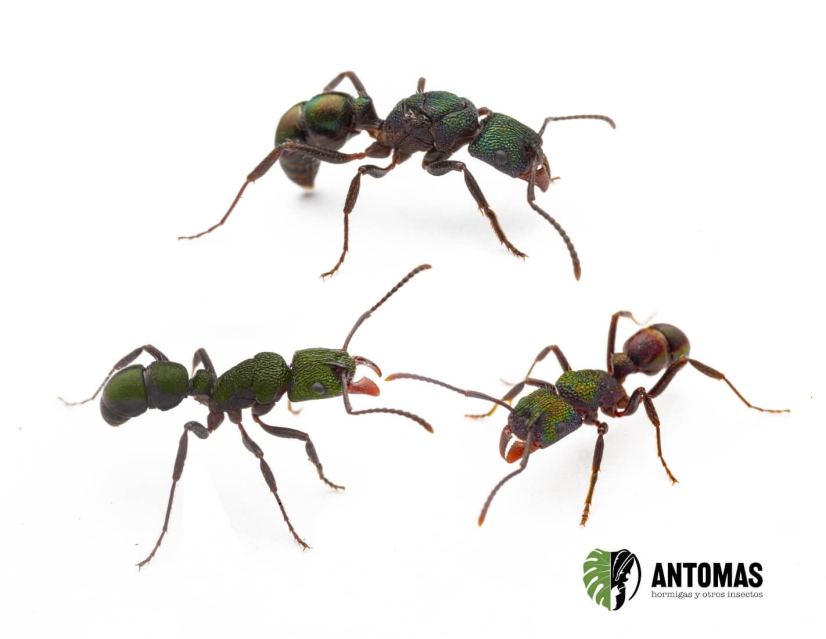
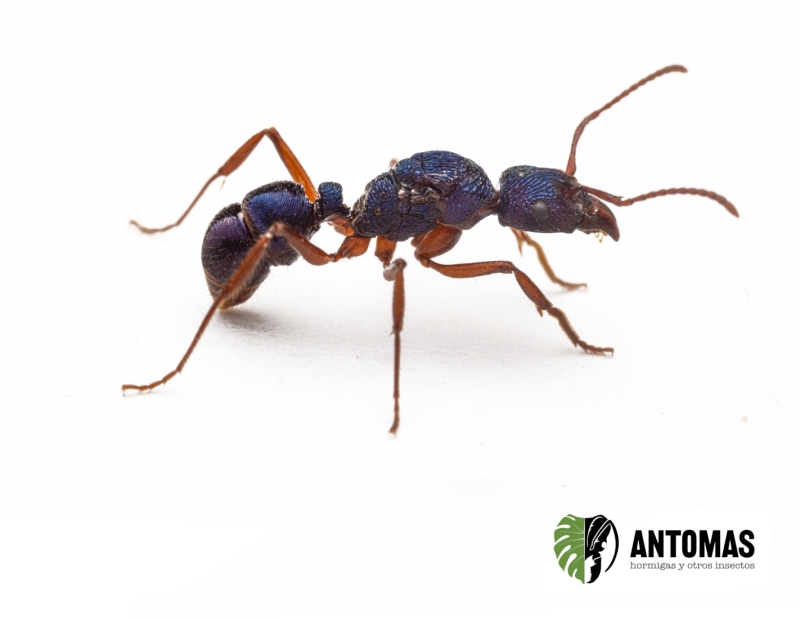
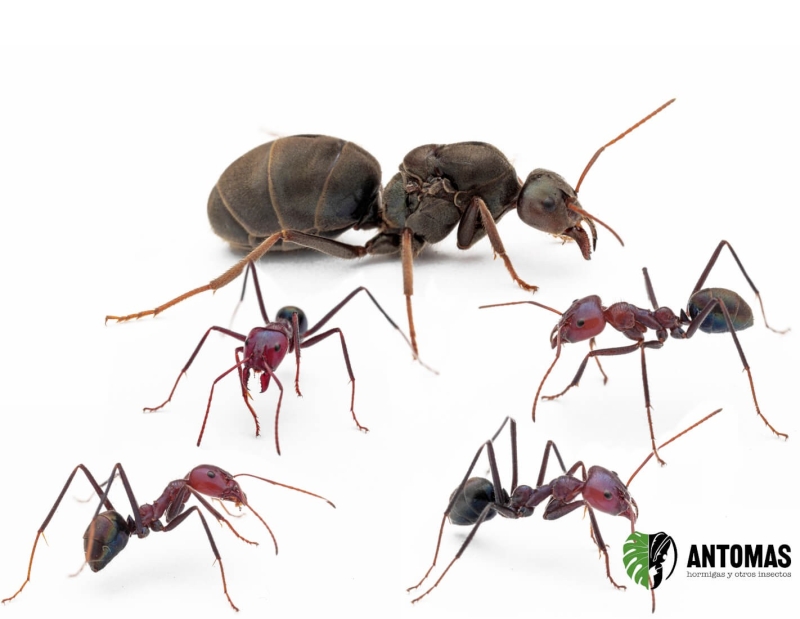
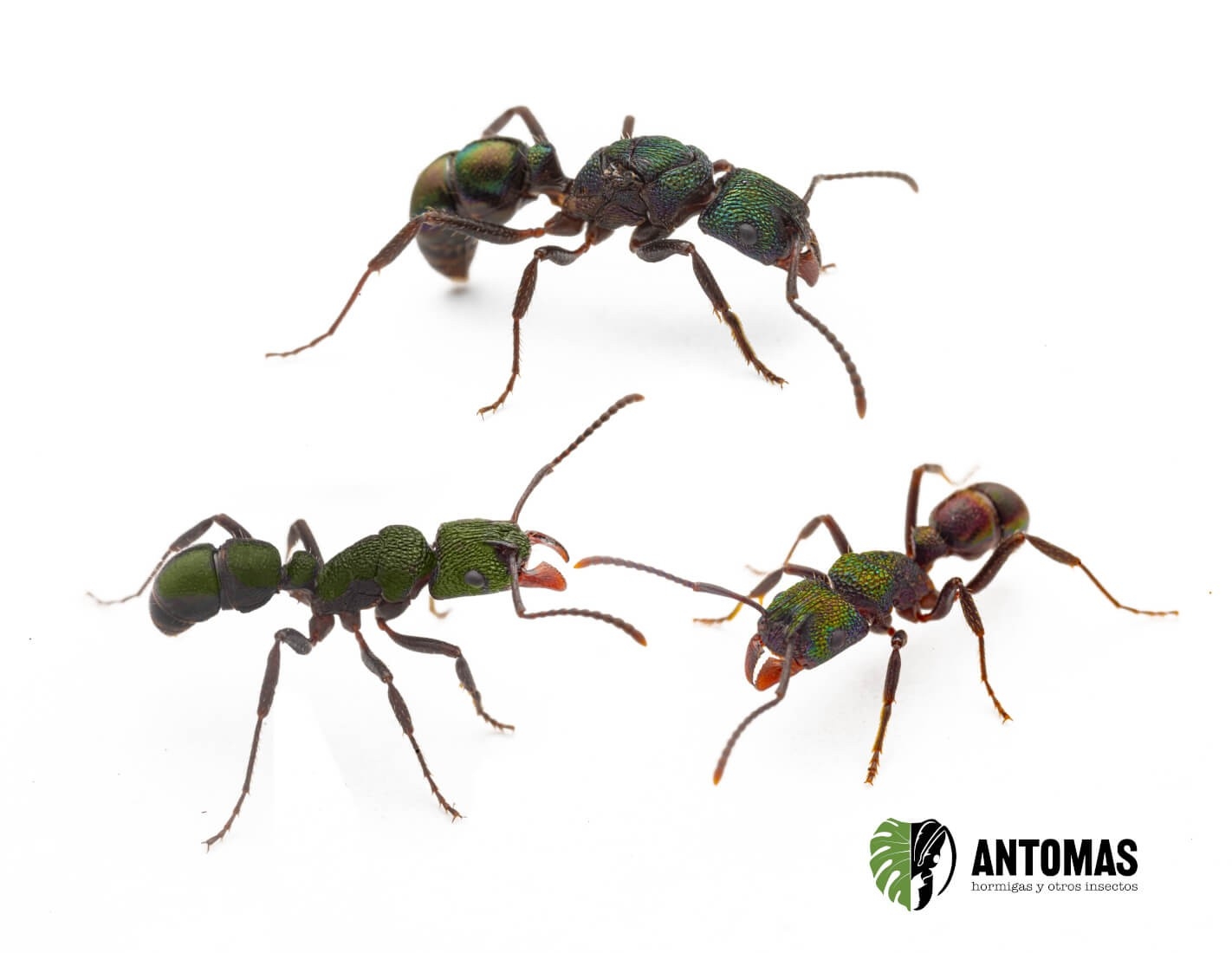
A medium-sized, robust and heavily sculptured ant, with a sting, well-developed eyes and a single worker caste, with no soldiers. Gamergates look just like the rest of the workers.
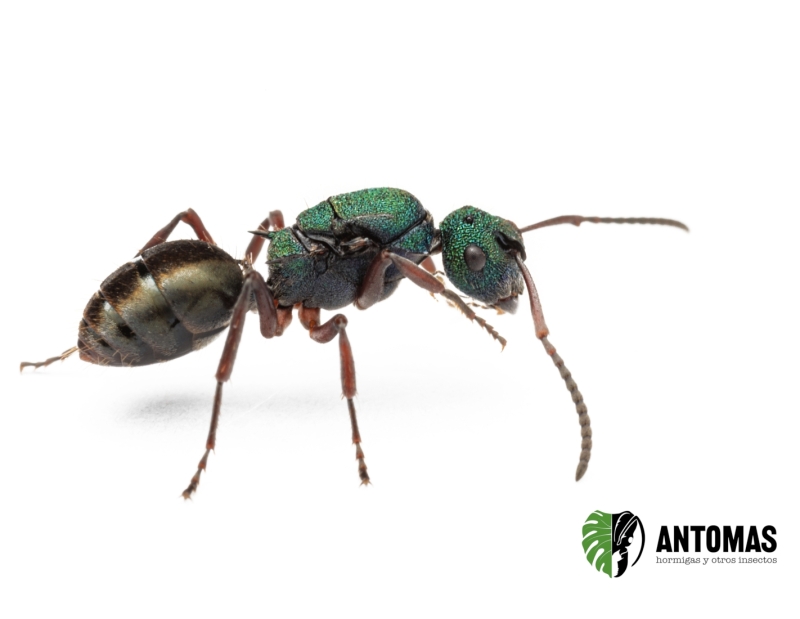
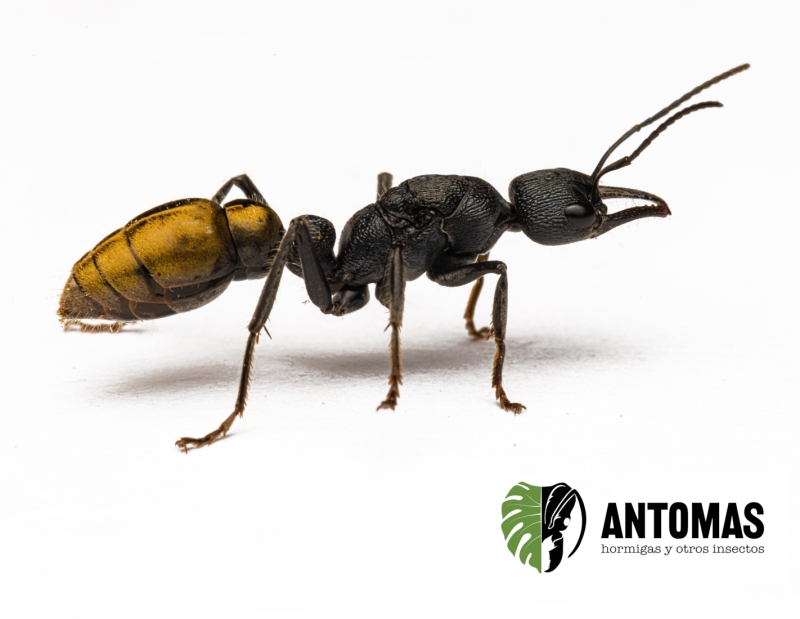
- Colour. Metallic green or bluish, with the mandibles, antennae, legs and tip of the gaster reddish (Emery 1912). Depending on how the light catches it, the sheen shifts from green to blue and violet, and its English name refers to the green head. It is an iridescent sheen, but no one has yet studied how it is produced. The workers in our colonies are an intense metallic green, as in the photos of this product.
- Sculpture. Head and thorax with a coarse, net-like rugosity and longitudinal striations on the frons; the first segment of the gaster with fine, curved striations (Smith 1858; Emery 1912).
- Petiole. A thick node, taller than it is wide, with a small spur underneath, the subpetiolar process (Heterick 2009).
- Eyes and legs. Well-developed eyes, as befits a hunter that finds its way by sight. In the genus, the tarsal claws bear a tooth in the middle (Brown 1958).
- Sting. Functional and well developed (see “Handling and safety”).
- Queen. Winged, somewhat larger than the worker and with a less compressed thorax (Smith 1858). After mating she tears off her wings. She is rare in the wild.
- Male. Winged, blackish brown or black, with a rugose body and slightly smoky wings (Mayr 1866).
- Development. The larvae spin a cocoon, and to do so they need particles: in the laboratory they used grains of sand (Ward 1986).
- Chromosomes. Highly variable: in southern Victoria, from n = 17 to n = 22 depending on the population (Crozier 1969).
Approximate measurements
- Workers: 6–6.5 mm (Emery 1912); about 6.5 mm in the New Zealand populations (Don & Harris 2005); 5–7 mm according to the Australian Museum. Gamergates are the same size.
- Winged queen: from about 7.4 mm (Smith 1858) to 8 mm (Emery 1912)
- Male: about 5.2–5.5 mm (Mayr 1866; Crawley 1925, as compiled on AntWiki)
Gamergates are the same size as any other worker: the figures of 7–8 mm that are sometimes attributed to them actually belong to the winged queen.
Care in captivity
Difficulty: 2/5 – Beginner
It is one of the best gateways to Australian ants and to primitive species: hardy, active by day, a good hunter and with no unusual temperature requirements. It eats almost anything it is offered, adapts well to formicaria and is happy to be watched.
Why not a 1/5? Because of three details:
- It stings. You must always work with tools, a barrier and a lid (see “Handling and safety”).
- An unusual biology. It is worth understanding the role of the queen and of the gamergates so as to avoid surprises (see “The queen at home”).
- Humidity without waterlogging. It likes a moderately humid nest, but condensation drowns newly emerged workers and brood.
And it is well worth it. Few ants shine like this in the light, and few reproduce in such a curious way as its gamergates do. If Australian ants appeal to you, at Antomas you will find Rhytidoponera metallica for sale alongside its relative R. chalybaea, with its blue highlights, and the meat ant, Iridomyrmex purpureus.
Recommended parameters
- Nest temperature: 23–27 °C in the active season, always on a thermostat. Do not go above about 27–28 °C: it does not need any warmer spot. At night it can drop a few degrees without any problem.
- Why these figures: across much of its range, the average air temperature in the warm months ranges from about 18 to 26 °C, with maximums of 25–34 °C, and that is when it breeds. Keepers agree on a nest at 24–28 °C.
- Humidity: moderate, around 50–70% in the humid part of the nest, with another, drier part and a dry foraging area (see “Humidity, but no condensation”).
- Water: always available, in a test tube with water and cotton wool in the foraging area.
- Sand: in the foraging area and, if the nest allows it, in the chambers. The larvae need it to spin their cocoons.
- Light: a dark nest and a lit foraging area, with a normal day–night cycle. It is diurnal: with light you will see it in full swing.
- Diapause: mild, 12–16 weeks (3–4 months) at 15–18 °C during our winter (see “Diapause”).
Humidity, but no condensation
This is the point that needs the most care. It does well in a nest with a moderately humid area for the brood and another, drier one, so that the ants themselves can choose where to put everything. But keepers agree on one warning: too much water is dangerous. There are cases of newly emerged workers drowning in drops of condensation, and in block nests colonies move to the driest areas.
- Moisten only part of the nest, never all of it.
- No drops on the walls: if you see condensation, stop moistening for a few days and ventilate.
- Slightly damp sand in the brood area, so that the larvae can spin their cocoons.
- Leftovers out within 24 hours: food buried in the sand goes mouldy.
Recommended formicaria
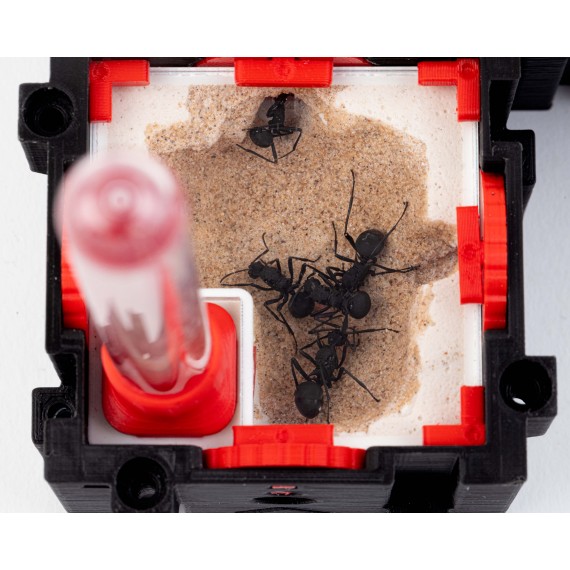
At Antomas we recommend the Anthouse Qbik Wild range: plaster formicaria that hold moisture and allow the gradient it needs, with a natural look that shows off its metallic highlights beautifully. For a young colony, the Qbik Wild One P 1C:
To expand, the Qbik Wild Duo P 2C Híbrido:
The module should always be in proportion to the colony: in a formicarium that is too large, the empty chambers end up as rubbish dumps, with mould and mites. Expand when you see workers sitting still in the foraging area with no room inside. Complete the set-up like this:
- Fine sand in the foraging area, so that they can grip, dig and have material for their cocoons.
- A flat stone or a piece of bark in the foraging area: it recalls their natural nests and gives them shelter.
- Water in a test tube with cotton wool, and a feeder for the nectar, never cotton wool.
- A mineral-oil barrier and a well-fitting lid (see “Escapes and barriers”).
- Gentle heat on one side, on a thermostat and away from the feeder.
The queen at home
Here two things need to be kept apart: how the species reproduces in the wild and how a colony works in a formicarium.
- Antomas colonies always have a queen. Gamergates are the rule in the wild, but what we sell are colonies with a mated queen that lays the eggs.
- In the wild, almost all colonies reproduce through dozens of gamergates and multiply by budding. Queens are rare, but functional.
- A colony with a queen depends on her: as long as she lays, the colony grows. In Ward’s laboratory, when a queen stopped laying, the workers attacked her and began calling males (see “The queen who stops laying loses her throne”).
- Unmated workers also lay, but their eggs only produce males. Seeing winged males from time to time is normal: colonies of this species produce them irregularly throughout the year.
- Long-lived queens. In our experience, the queens of this species live a long time. And if one were ever lost, a gamergate can take over: at Antomas we have kept colonies going with gamergates after the queen died. To become a gamergate, a worker has to mate with a male.
- Never combine colonies or add queens or workers from another colony (see “Neighbours tolerated, outsiders not”).
Founding and growth
If your colony is still small, remember what Ward saw: R. metallica queens do not seal themselves in and wait, but go out hunting to feed their larvae. That is why at Antomas we recommend treating it as a semi-claustral founding:
- A tube and peace and quiet. Keep the tube as it arrives, with its water reservoir, in a dark, quiet place free of vibrations, at 24–26 °C. Keepers report that at this stage they are sensitive to light and knocks: cover the tube with a cloth or a piece of cardboard.
- Food from the start. Small prey, often (in Ward’s laboratory they were given Drosophila every day), such as a fruit fly or a small Thermobia, and a tiny drop of nectar on a small piece of aluminium foil, never on the cotton wool. Remove any leftovers the next day.
- Sand for the cocoons. If you have to move it to a new tube, put a little fine sand in the new one so that the larvae can spin.
- Patience. From egg to worker takes about 2.5–3.5 months, according to keepers, which fits with what Ward observed. The first workers are few, and sometimes they struggle to get out of the cocoon. Ward’s colonies had 41 and 27 workers at one year old; a keeper in Sydney went from about 25 workers to more than 200 in about nine months.
When should you move it into the formicarium? When the tube becomes too small, gets dirty or runs out of water, always into a module in proportion to the colony and by tipping (see “Arrival and moving by tipping”).
Arrival and moving by tipping
When you receive the colony, let it rest in a quiet, dark place at 24–26 °C, check that it has water and offer it a small prey item and a drop of nectar. To move it into the formicarium, at Antomas we do it by tipping:
- Set up the formicarium beforehand, with the humid area ready and the sand, the oil barrier and the water in place.
- Work over a tray, with long forceps and a soft brush, never with your hands.
- Open the tube in the foraging area, next to the nest entrance, and gently tip out the queen, the workers and the brood, helping the stragglers along with the brush.
- Close the lid and leave the nest dark. They are quick: before long they will have carried the brood inside.
To move them into a larger module later on, use the same method. In the wild they move house often, so they take it well.
Feeding
Protein: the engine of growth. It is a hunter and a scavenger, and accepts almost any insect. The queen and the larvae need it for the colony to grow, and in Antomas’s experience, the more protein they receive, the faster colonies grow and the larger they become. If you carry out frequent maintenance and remove leftovers within 24 hours, it is better to give too much than too little; if you will not be able to clean up, it is better not to overfeed. Change the type of insect from one week to the next, so that they do not always eat the same thing:
As they take the first prey they find, offer small or chopped-up prey to a small colony. Buy your insects from a reliable supplier: insects treated with insecticides can kill the colony.
Nectar, almost every day. At Antomas we recommend Anthouse’s Blue Sugar nectar 4–5 times a week and another nectar or sugary liquid, such as diluted honey, 1–2 times a week. You can also add a little protein to the nectar. Always offer it in a feeder, where the drop stays “spread out” and within reach, and never on cotton wool, which goes mouldy and spoils the liquid in no time.
Seeds: not needed. It is not granivorous: all it takes from seeds is the elaiosome (see “The gardener of the Australian bush”), so do not give it seed mixes as food. If you want to see it at work as a gardener, now and then offer it a seed with an elaiosome, such as those of garden violets or greater celandine, and after a few days remove the ones it carries out of the nest.
Water: always, in the test tube with cotton wool.
Diapause
It does not need intense cold, but nor does it live the same way all year round. In south-eastern Australia, workers keep foraging in winter, although less, and Thomas (2003) found larvae and pupae only in the warm months. Its winter is mild: in the coldest months, the average air temperature is around 10–17 °C depending on the area, with minimums of about 5–12 °C. Haskins and Whelden kept their laboratory colonies at 15–17 °C in winter.
That is why at Antomas we recommend a mild 12–16-week (3–4-month) diapause, roughly from November to February or March, at 15–18 °C:
- A gradual start. In autumn, lower the temperature little by little over 2–3 weeks.
- During diapause: water always available, a little nectar and the occasional small prey item if you see it foraging. Disturb the colony as little as possible.
- Not too cold: do not go below about 12 °C. This is not a European ant’s diapause.
- A gradual exit when it ends, around February or March, until you are back at 23–27 °C, and protein as soon as you see brood.
- Where: a cool, unheated room is usually enough.
Remember that in its range the seasons are the other way round from ours. If you receive the colony in autumn, you can keep it active that first winter or give it a short, mild rest; from the following year onwards, the normal diapause during our winter.
On video: Australian blood
A short video by Anthouse featuring Rhytidoponera metallica:

Rhytidoponera metallica on the Anthouse channel (“Australian blood”, part two).
Behaviour and observation
Diurnal and very active. With light and warmth, the workers race around the foraging area, each on her own, and pounce on the first prey they find. It is one of those species that loves to be seen.
The workers’ call. If you see a worker standing still next to the entrance, with her head pressed to the ground, her gaster raised and her sting extruded, she is performing the sexual call. Workers of this species do it even when there are no males nearby, and in Ward’s laboratory it became very frequent when the queen stopped laying. It is one of the most unusual behaviours you can see in a formicarium.
Defence. They are bold with other insects, and if you knock the formicarium or open it abruptly, they will come out to defend it with their stings.
Watch without fear. At Antomas we believe ants are there to be enjoyed, watched and learnt from, not kept hidden away. It is enough to leave them a dark nest and a lit foraging area, and to watch them gently, intervening as little as possible.
Warning signs:
- The colony does not grow in the height of the season: check the temperature and the protein.
- Drops on the walls, mould or dead workers in wet areas: there is too much moisture or leftovers remain.
- Workers attacking the queen: she may have stopped laying.
- Many workers sitting still in the foraging area, with no room inside: it is time to expand.
Escapes and barriers
Keepers agree that the workers are poor climbers on glass and smooth plastic. But with an ant that stings it is not worth taking the risk: some keepers have had escapes, queens and alates climb better than workers, and dust, sand or condensation on the walls can give them a grip.
- A band of mineral oil on the upper part of the walls of the foraging area, renewed whenever it collects dust or debris.
- A well-fitting lid, with no gaps at the connections or plugs.
- Nothing that could act as a bridge to the barrier: no long twigs, forgotten forceps or tubes leaning against the walls.
Handling and safety
Its sting hurts, far more than its size would suggest: the myrmecologist William L. Brown described it as a dull, long-lasting pain. In the major Australian study on allergy to ant stings, published in 2011, it was also the only species apart from Myrmecia to appear as a cause of severe allergic reactions: 34 of 299 cases, mainly on the north coast of New South Wales and in south-eastern Queensland. With calm handling and the right tools, it will rarely sting you:
- Never with your hands. Always with tools: long forceps, a soft brush and, for transfers, tubes and adaptors.
- Open the formicarium only as much as necessary, work calmly over a tray and close it when you have finished.
- This is not a species for people who are allergic to bee, wasp or ant stings. With small children or pets at home, keep the formicarium closed at all times and out of their reach.
- If you are stung, wash the area and apply something cold.
It is an exotic species: it must never be released.
What not to do
- Handle it with your hands, or open the formicarium without a barrier or tools.
- Combine colonies or add queens or workers from another colony.
- Wet the whole nest, or let condensation form on the walls.
- Keep the nest above about 27–28 °C or give it a very warm spot.
- Set up a nest without sand: the larvae need it to spin their cocoons.
- Give it seed mixes as food: it is not granivorous.
- Put the nectar on cotton wool, or leave prey remains for more than a day.
- Always give it the same insect, or skimp on protein when there are larvae.
- Subject it to a cold, European-ant diapause, or change the temperature abruptly when going into or coming out of it.
- House a small colony in a huge formicarium.
Scientific sources
This care sheet is based on the scientific literature on Rhytidoponera metallica and its genus, on climate data from its range and on the experience of Antomas and other keepers. Main references:
- Haskins, C. P. & Whelden, R. M. (1965). «Queenlessness», worker sibship, and colony versus population structure in the formicid genus Rhytidoponera. Psyche 72: 87–112. doi:10.1155/1965/40465
- Hölldobler, B. & Haskins, C. P. (1977). Sexual calling behavior in primitive ants. Science 195: 793–794. doi:10.1126/science.836590
- Haskins, C. P. (1978). Sexual calling behavior in highly primitive ants. Psyche 85: 407–415. doi:10.1155/1978/82071
- Haskins, C. P. & Haskins, E. F. (1979). Worker compatibilities within and between populations of Rhytidoponera metallica. Psyche 86: 299–312. doi:10.1155/1979/12031
- Haskins, C. P. & Haskins, E. F. (1983). Situation and location-specific factors in the compatibility response in Rhytidoponera metallica. Psyche 90: 163–174. doi:10.1155/1983/67615
- Peeters, C. & Crewe, R. (1984). Insemination controls the reproductive division of labour in a ponerine ant. Naturwissenschaften 71: 50–51. doi:10.1007/BF00365989
- Ward, P. S. (1986). Functional queens in the Australian greenhead ant, Rhytidoponera metallica. Psyche 93: 1–12. doi:10.1155/1986/89482
- Hughes, L. & Westoby, M. (1992). Fate of seeds adapted for dispersal by ants in Australian sclerophyll vegetation. Ecology 73: 1285–1299. doi:10.2307/1940676
- Chapuisat, M. & Crozier, R. H. (2001). Low relatedness among cooperatively breeding workers of the greenhead ant Rhytidoponera metallica. Journal of Evolutionary Biology 14: 564–573. doi:10.1046/j.1420-9101.2001.00310.x
- Thomas, M. L. (2002). Nest site selection and longevity in the ponerine ant Rhytidoponera metallica. Insectes Sociaux 49: 147–152. doi:10.1007/s00040-002-8294-y
- Thomas, M. L. & Elgar, M. A. (2003). Colony size affects division of labour in the ponerine ant Rhytidoponera metallica. Naturwissenschaften 90: 88–92. doi:10.1007/s00114-002-0396-x
- Brown, S. G. A. et al. (2011). Causes of ant sting anaphylaxis in Australia: the Australian Ant Venom Allergy Study. Medical Journal of Australia 195: 69–73. doi:10.5694/j.1326-5377.2011.tb03209.x
- Beaumont, K. P., Mackay, D. A. & Whalen, M. A. (2013). Multiphase myrmecochory: the roles of different ant species and effects of fire. Oecologia 172: 791–803. doi:10.1007/s00442-012-2534-2
- Robinson, S. D. et al. (2023). Intra-colony venom diversity contributes to maintaining eusociality in a cooperatively breeding ant. BMC Biology 21: 5. doi:10.1186/s12915-022-01507-9





Very good experience. Great and fast support. Healthy colony and quick shipping. Would definitely use again. Greetings from Germany.