Difficulty: 5/5 – Expert
The species its describer called «the smallest species of the genus»: a bull ant of the urens group from the sandy scrublands and heaths of southern Australia, with workers of just 4–4.5 mm in the type species and almost unknown in the hobby. Our line is entirely black with orange mandibles, which is why we call it M. cf. exigua. Sold as a founding queen, with semi-claustral founding: total darkness, a small chamber with a mini-outworld that starts moist and is left to dry, cocoons kept dry and tiny, freshly killed prey. Nest at 22–26 °C, mature larvae never above about 28 °C, sugar every day and a diapause of about 3 months at 12–16 °C. Small does not mean easy: it has a sting and escapes through any gap.
Myrmecia exigua (Clark, 1943) is a bull ant in miniature. When the Australian entomologist John Clark described it, he presented it as the smallest species of the genus, with workers of 4–4.5 mm: a fraction of the size of a M. gulosa or a M. pyriformis. It belongs to the urens group, the group of small bull ants, and lives in scrubland and heath on sandy soils in southern Australia. And it keeps everything that earns a Myrmecia respect: large eyes, long toothed mandibles, solitary hunting and a sting that works.
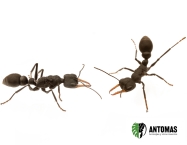
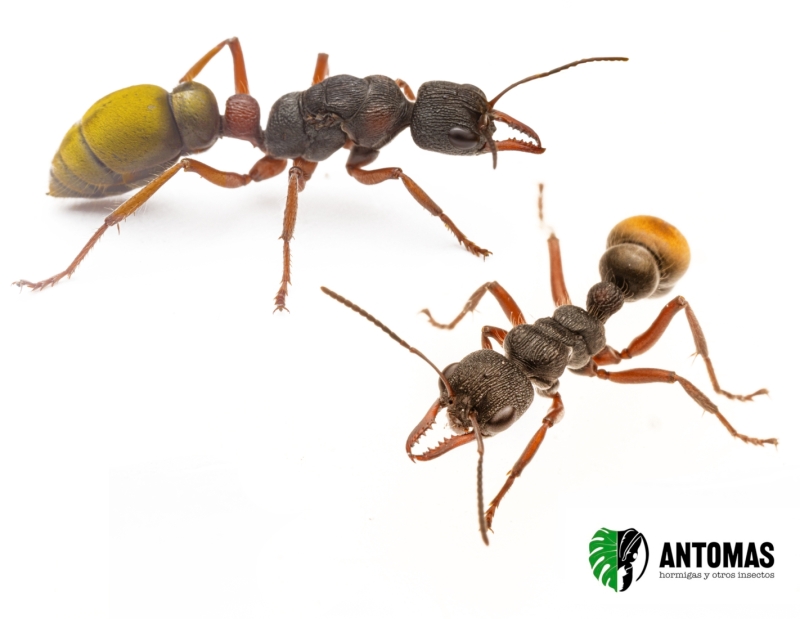
The line we keep at Antomas carries a «cf.» in its name, and in this care sheet we explain why: it is entirely black with orange mandibles, whereas the exigua described by Clark has a red propodeum and node. It is a small Myrmecia of the urens group, extremely rare in European formicaria and without a single publication on its care. That is why we separate what is documented for M. exigua, what is known about keeping other Myrmecia, which is very similar across the genus, and what we have learnt at Antomas. The conclusion, in advance, fits in one sentence: small does not mean easy.
Biology
The smallest bull ant of the genus
In his 1943 revision, Clark did not beat about the bush: of all the species he studied, exigua was the smallest. A worker measures 4–4.5 mm in length, so it would fit end to end on the nail of your little finger. The giants of the genus, by contrast, easily exceed two centimetres.
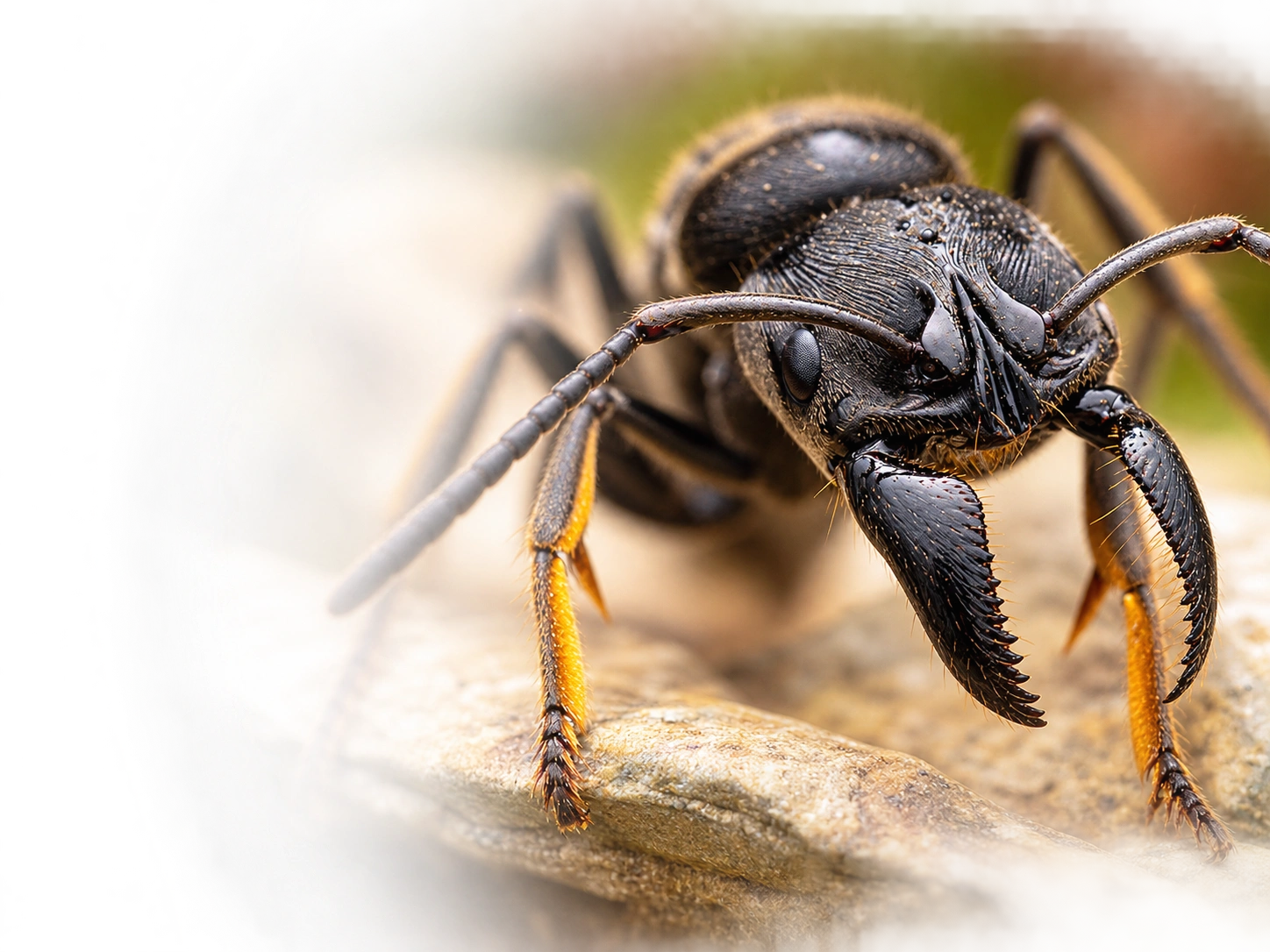
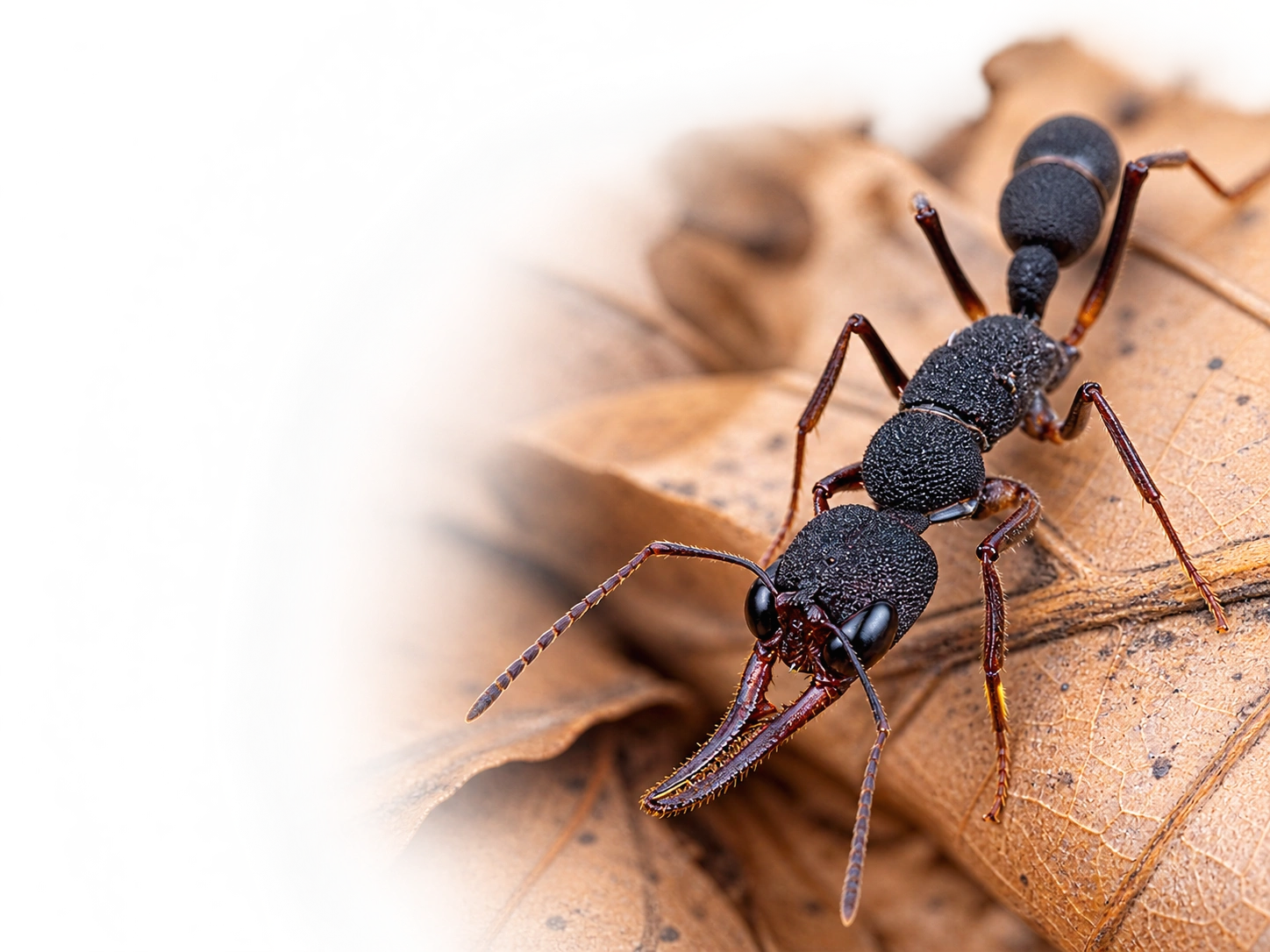
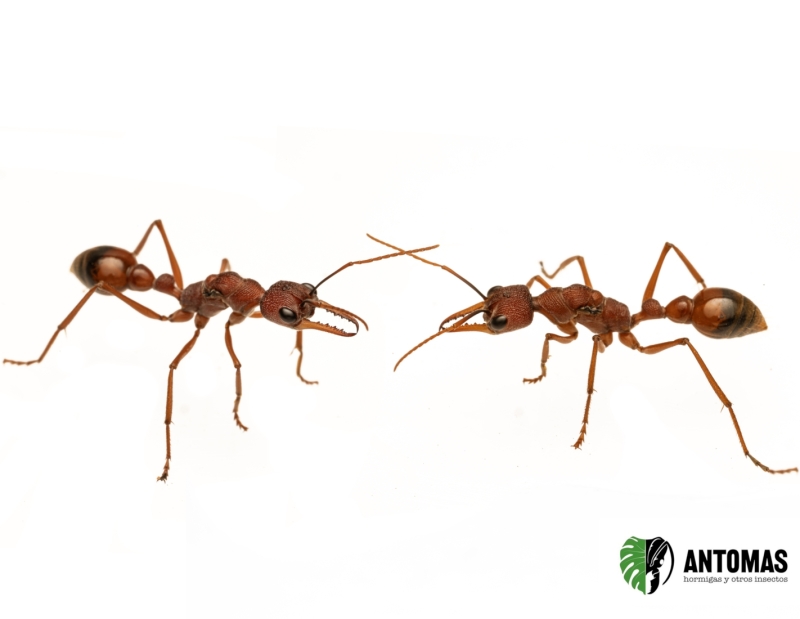
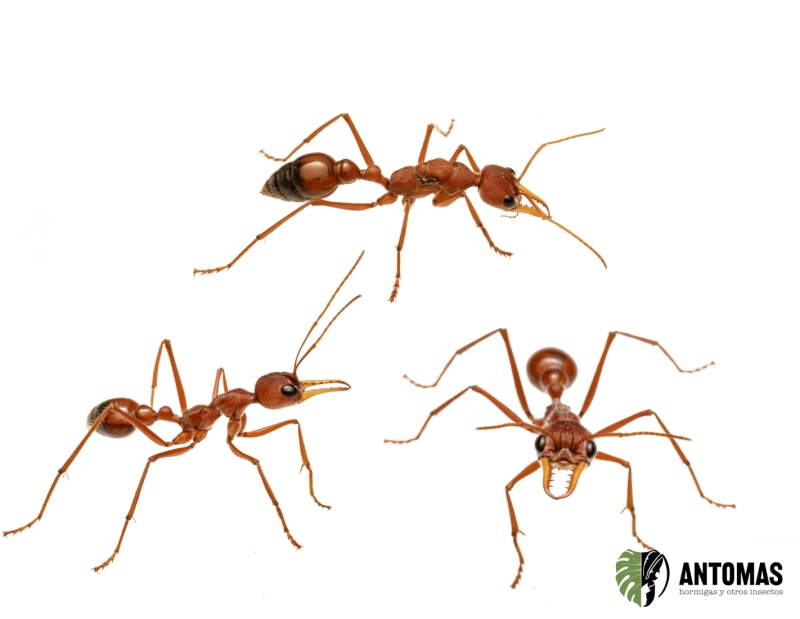
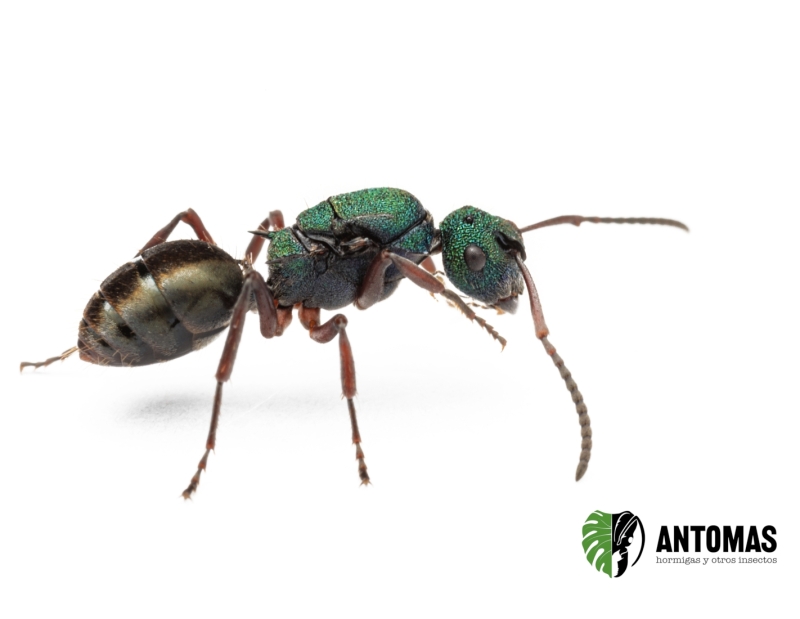
Yet M. exigua is no «half» bull ant. The original description details a head with very fine reticulate-rugose sculpture and mandibles as long as the head, armed with six large, sharp teeth; each of the first three is preceded by two denticles. The petiolar node is pear-shaped and almost as long as it is wide, and the whole body bears erect yellowish-white hairs over a very fine grey pubescence. It is a complete Myrmecia, just to scale.
A specimen from the south coast of Western Australia, collected in 1985 by the myrmecologist Philip S. Ward, provides another useful measurement: a head 1.47 mm wide, with a pale yellow, «relatively long» mandible. At the other end of our catalogue is M. nigriscapa, one of the large species of the gulosa group.
Described as Promyrmecia, beside a lake in the mallee
Clark did not describe it as a Myrmecia but as Promyrmecia exigua. In his day, many small and medium-sized bull ants were grouped in Promyrmecia, and his 1943 work was precisely a revision of that group. Today Promyrmecia is no longer recognised as a separate genus: all its species are included in Myrmecia, and the modern reference for identifying them is the review and key by Ogata and Taylor (1991).
The type material consists of workers collected by J. E. Dixon at Lake Hattah, a system of lakes surrounded by mallee in semi-arid north-western Victoria. The specimens are now shared between Museums Victoria, the Australian National Insect Collection (ANIC) and the Museum of Comparative Zoology at Harvard. And the name fits like a glove: exiguus, in Latin, means «small, scanty, meagre».
The description was based on workers only: in 1943, the queen and the male were unknown. For decades it was, for all practical purposes, «the bull ant of a single lake». Later public records can be counted on the fingers of one hand: the south-west coast of Victoria, the south coast of Western Australia and the odd photographic record in the south-west of that state. The latest synthesis of the ants of Western Australia, by Heterick (2022), extends it to much of the south-west of the state, so today it is considered far more widespread than its type locality suggested.
The urens group: pocket-sized bull ants
Myrmecia is a genus of just over ninety species, all Australian except one that lives in New Caledonia. Together with Nothomyrmecia macrops, they form the subfamily Myrmeciinae, an ancient lineage that retains many traits considered ancestral among ants (Ward and Brady 2003). To bring order to that diversity, taxonomists divide the species into groups (Ogata 1991), and M. exigua belongs to the urens group, which takes its name from M. urens and brings together some of the smallest bull ants on the continent.
They share an anatomical detail worth knowing: the occipital carina, a fine ridge running across the back of the head. It is a character of four groups in the genus (gulosa, nigrocincta, picta and urens) and is absent in five others, including the jack jumpers, the pilosula group (Hasegawa and Crozier 2006). That almost invisible ridge will be the key to a little detective story we tell you further down.
The urens group is also one of the most difficult in the genus. In his guide to the ants of south-western Australia, Heterick (2009) warns that most of its names cannot be assigned with confidence on morphology alone. And Clark himself had already noted that, in some species of the group, the colour of the thorax and node varies within a single nest, from almost all black to almost all red: a puzzle for any taxonomist.
Sandy scrubland and low vegetation
Its type locality lies in the heart of the mallee, the landscape of shrubby, multi-stemmed eucalypts that covers the sandy soils of semi-arid south-eastern Australia. It is a harsh climate: very hot summers, barely 270 mm of rain a year and cold winters, with frequent frosts and a daily mean of about 10 °C in July, the heart of the austral winter.
At the opposite end of the continent, Ward's specimen was collected in heath scrub with mallee eucalypts on the south coast of Western Australia, and its label adds a lovely detail: it was foraging on low vegetation. Heterick's synthesis paints the same kind of landscape for the south-western populations: coastal scrub and heath on sand, away from tall, closed forests, with workers collected among the leaf litter and twigs of sheoaks (Allocasuarina) on white sand. On that coastal strip the climate is Mediterranean and milder, with rainy winters and a daily mean of about 14–15 °C in July.
Everything points to an ant of loose soils, fine leaf litter and low plants, with warm, dry summers and cool winters. No description of its nest has been published, but the portrait is enough to guide its care: fine substrate, small chambers, some dry vegetation in the outworld and a real winter.
What does «cf.» mean? Why our line carries it
«cf.» is the abbreviation of the Latin confer, «compare with». In taxonomy it is written between the genus and the species when some specimens closely resemble a known species and are provisionally assigned to it, but something prevents the identification from being closed. It is not a second-rate label: it is the honest way of saying «we believe it is this one, and we cannot sign it off yet».
In our case, what prevents us from signing it off is the colour. This is how Clark described the worker of M. exigua:
- Head and gaster blackish brown.
- Mandibles yellow.
- Antennae, pronotum, mesonotum and legs brown or reddish brown, with the tarsi of the fore and middle legs reddish yellow.
- Propodeum and node red.
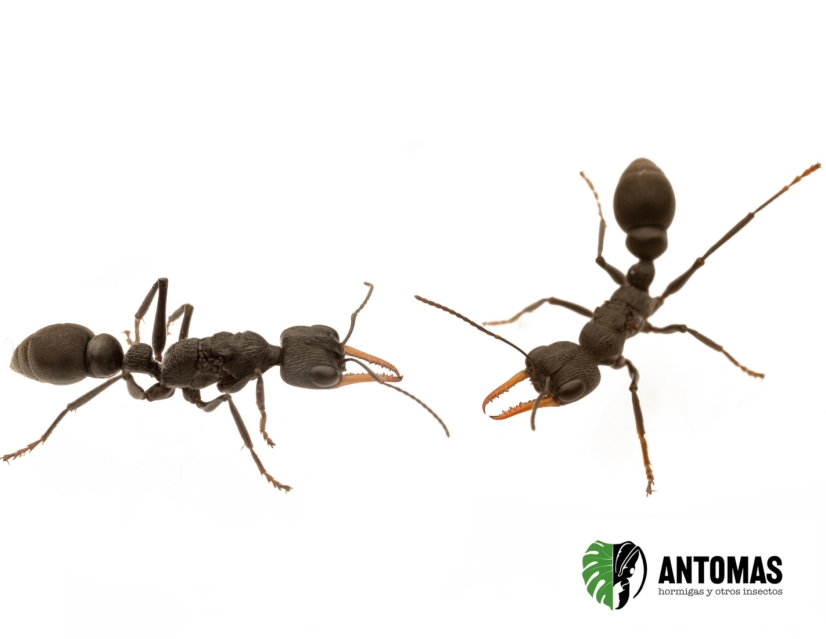
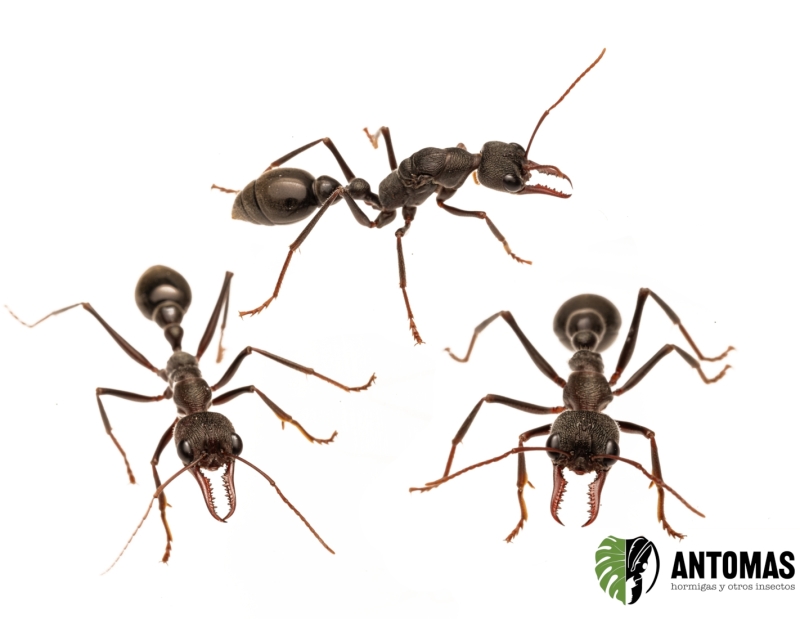
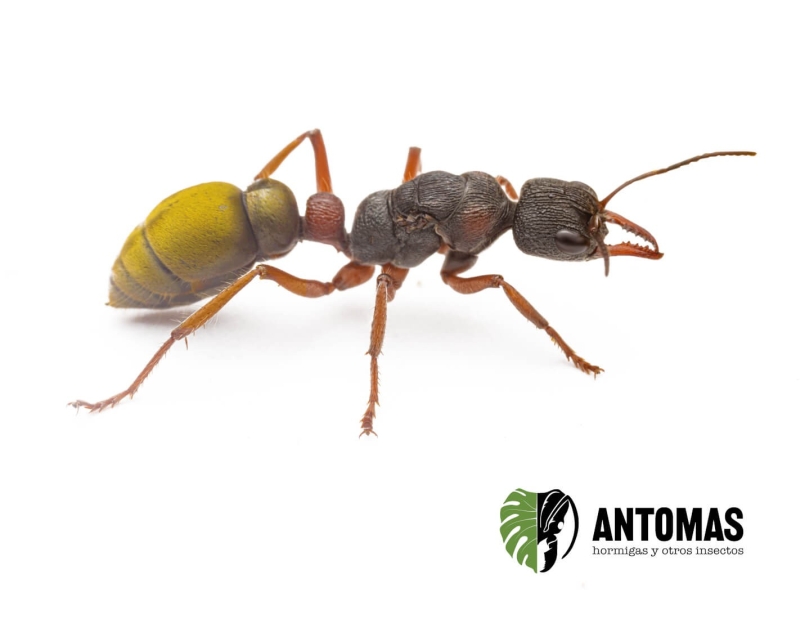
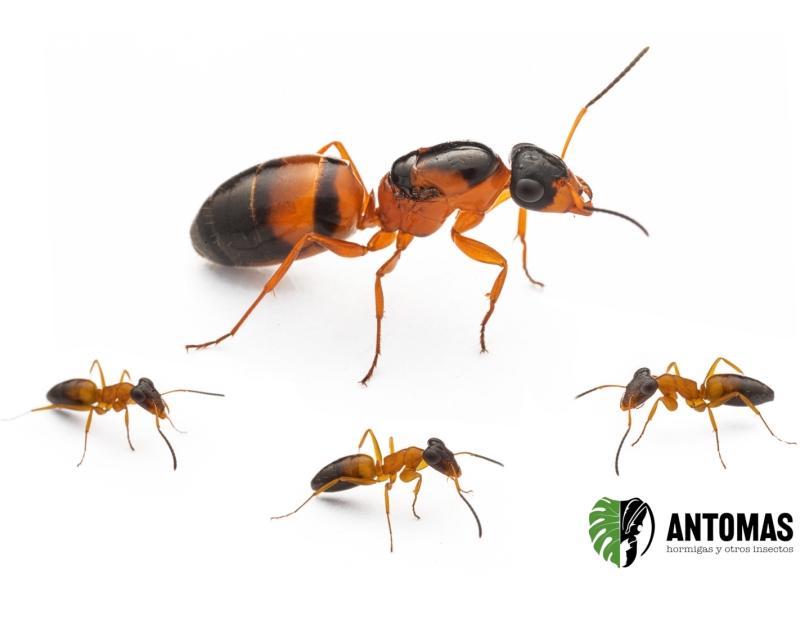
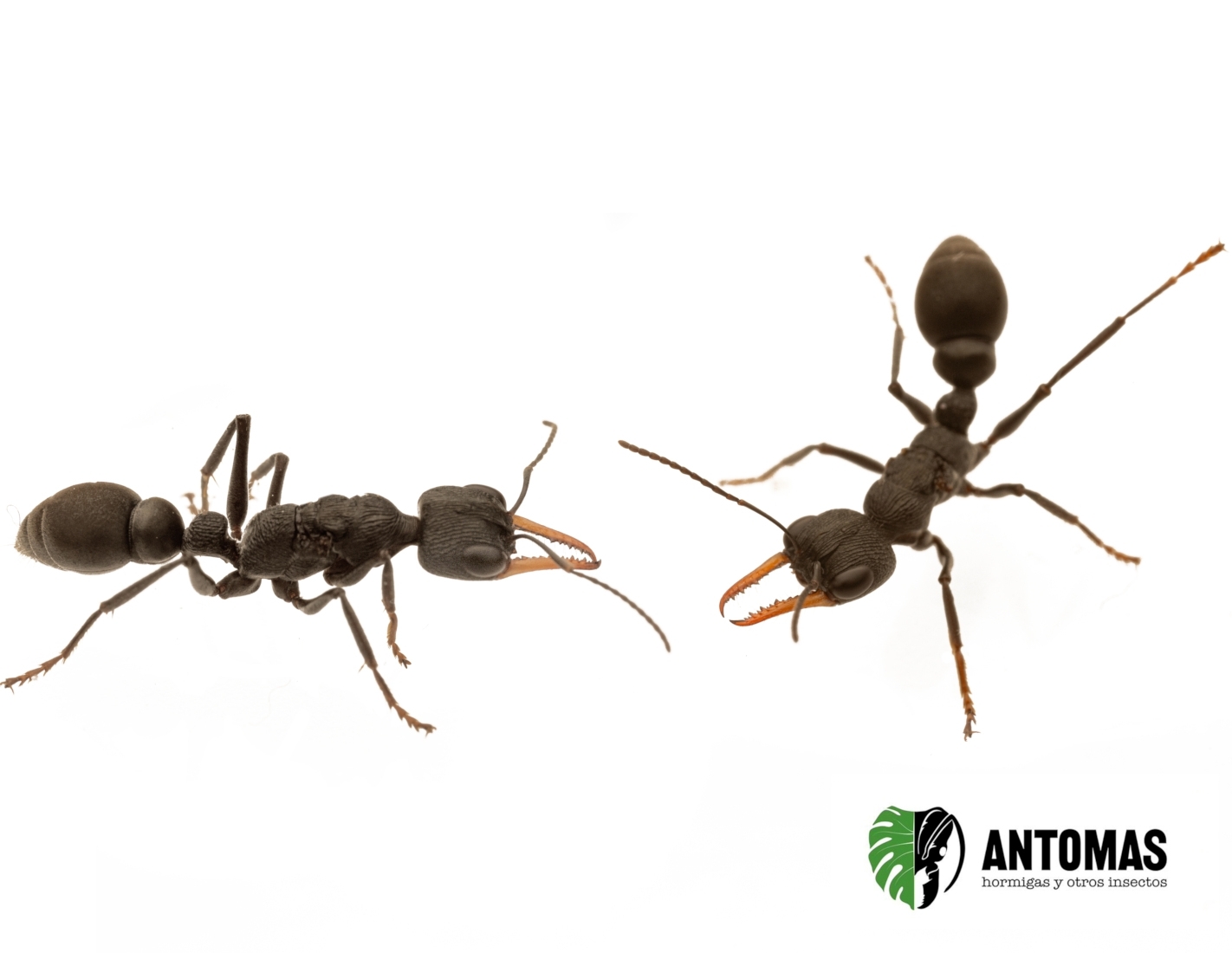
The Antomas line is entirely black, with orange mandibles and reddish tarsi. The pale mandibles and pale tarsi match, but the red propodeum and node are missing, and no black form of the species has been published. That is why, at Antomas, we keep the «cf.». Given what we already know about the group, colour alone is not enough either to rule it out or to confirm it.
What would it take to remove it? Measuring adult workers, checking the occipital carina and the mandibular dentition, examining the colour of the propodeum and node under a lens, and obtaining macro photos of a worker and of the queen, which in 1943 had not even been described. For the keeper, the «cf.» changes nothing that matters: it is a small Myrmecia of the urens group, with all the character of its genus, that hardly anyone has ever kept in a formicarium.
A DNA sequence that turned up where it should not
In 2023, an international team published the most complete phylogeny of bull ants to date: they sequenced a large number of genome regions (the so-called ultraconserved elements, or UCEs) from 66 of the 93 species in the genus. The result reshuffled the family tree and showed that five of the nine classic groups do not form natural branches (Mera-Rodríguez et al. 2023).
The only M. exigua specimen included was precisely Ward's. And it turned up where no one expected it: inside the pilosula complex, among the jack jumpers, a group with which it shares neither appearance nor anatomy. The AntWeb database notes it as probable contamination or bioinformatic error, and the reason is that ridge on the back of the head: the specimen has an occipital carina, and jack jumpers do not.
It is a good lesson in science: DNA is an extremely powerful tool, but a single sample can be wrong, and when it contradicts anatomy it has to be checked. Until more specimens are sequenced, the molecular position of M. exigua remains unresolved. Nor does it help that the urens group itself is an open case: with two nuclear genes, Hasegawa and Crozier (2006) could not confirm that it forms a natural group.
A visual hunter at ground level
Like all Myrmecia, it hunts alone: each worker locates, chases and overpowers its prey without recruiting nestmates. And it does so mainly by sight. Bull ant eyes are large for an ant, and their structure changes with each species' hunting schedule: the size of the eye and its facets is tuned to whether they forage by day, at dusk or at night (Greiner et al. 2007). Even within a single species, workers, winged queens and males have different eyes, adapted to their own schedules (Narendra et al. 2011).
There is no activity study of M. exigua, so we do not label it as diurnal or nocturnal. Nor is there a published list of its prey. What we do know is where it hunts: in the leaf litter and on low vegetation, the realm of arthropods a few millimetres long. A 4 mm hunter needs prey to match, and that shapes its diet in captivity.
At home, its eyesight shows straight away: a worker follows the movement of a pair of tweezers with its head even though it is half a centimetre long. That is why we recommend total darkness during founding and, once there is a colony, a dark area in the nest so that visual cues do not overwhelm them.
A sting to scale
Tiny, yes; unarmed, no. M. exigua keeps the functional sting of its genus. Bull ant venom is dual-purpose: in M. gulosa a large family of peptides, the aculeatoxins, has been described, with toxins that paralyse insects and others that activate the pain nerves of mammals (Robinson et al. 2018).
Myrmecia stings are rightly reputed to hurt considerably more than those of a bee or a wasp, and in Australia they are the leading cause of severe allergic reactions to ants: in a national study, 265 of the 299 anaphylaxis cases in which the ant was identified (89 %) were caused by species of this genus (Brown et al. 2011). There are no data on the sting of exigua, and such a small worker probably injects less venom, but it is not harmless: always handle it with tools, never by hand (see «Handling, moving and safety»).
Size and morphology
A tiny, slender Myrmecia with long mandibles, large eyes and a functional sting, with no soldier caste: all workers have the same shape and vary only a little in size.
- Colouring of M. exigua in the strict sense (Clark 1943). Head and gaster blackish brown; mandibles yellow; antennae, pronotum, mesonotum and legs brown or reddish brown; fore and middle tarsi reddish yellow; propodeum and node red.
- Colouring of our line. Entirely black, with orange mandibles and reddish tarsi. This is the reason for the «cf.» (see «What does «cf.» mean? Why our line carries it»).
- Head. With very fine reticulate-rugose sculpture and an occipital carina, the ridge on the back of the head typical of the urens group and of three other groups in the genus.
- Mandibles. As long as the head, with six large, sharp teeth; each of the first three preceded by two denticles.
- Petiole. Pear-shaped node, almost as long as it is wide.
- Pilosity. Erect yellowish-white hairs all over the body and a very fine grey pubescence.
- Gaster. Ends in a functional sting.
- Queen and male. Unknown when the species was described, and with no published descriptions that we have been able to verify.
- Larvae. As throughout the genus, they spin a silk cocoon before pupating: one of the critical moments of rearing (see «28 °C: the ceiling for spinning larvae»).
Approximate measurements
- Worker of M. exigua in the strict sense: 4–4.5 mm long (Clark 1943)
- Head width of a worker from Western Australia: 1.47 mm (Ward's specimen)
- Queen: no published measurements
- Male: no published measurements
These are measurements of the described species, not of our line: before publishing a figure, we prefer to measure our own workers and queens.
Care in captivity
Difficulty: 5/5 – Expert
It is tempting to think that a bull ant just a few millimetres long is easier than a giant. It is not. At Antomas we rate it 5/5 – Expert, like all the delicate Myrmecia, for several reasons:
- Semi-claustral founding. The queen has to go out to hunt and feed while she raises her first workers, and Myrmecia foundings are delicate: once the first workers arrive, everything runs much more smoothly.
- Demanding brood. Mature larvae need a moderate temperature, a substrate in which they can spin their cocoon and a humidity gradient that goes from moist to dry.
- Prey to scale. They need tiny insects, often, and well chosen.
- Eyesight and stress. They are highly visual and stress easily, especially during founding.
- Escapes through small gaps. A 4 mm worker slips through cracks that a large bull ant would not even attempt.
- No manual. There is not a single published record of its care: we work with what succeeds in the rest of the genus.
It is a species that forgives few mistakes, so it needs a daily check. If you are looking for a first bull ant, you would do better to start with a Myrmecia with more forgiving colonies, such as M. pavida or M. nigriceps, when we have them available. In return, M. cf. exigua takes up very little space and feeds on small prey, and it is a Myrmecia that hardly anyone has ever kept.
Recommended parameters
- Nest temperature: 22–26 °C in the active season, with a gradient so they can choose. It is not a tropical ant: never keep it constantly at 28–30 °C.
- Mature larvae: never above about 28 °C for sustained periods (see the next section).
- Humidity: in a gradient; eggs and small larvae in a moist zone, cocoons in a dry, ventilated zone.
- Water: it must never run out; the most practical option is a small test tube, filled and plugged with cotton wool, placed in the mini-outworld.
- Light: total darkness during founding; afterwards, a dark nest and an outworld with a normal day–night cycle.
- Diapause: about 3 months at 12–16 °C in our winter.
28 °C: the ceiling for spinning larvae
If there is one figure you should remember from this care sheet, it is this one. At Antomas, with all Myrmecia, we have found that mature larvae must not go above about 28 °C for sustained periods. Above that, spinning problems appear: larvae that fail to spin their cocoon, incomplete cocoons or pupae that form unprotected and end up dying. It is a practical observation from rearing, shared by other keepers of the genus, rather than a mechanism demonstrated in a laboratory.
The cocoon is the larva's last great work: it spins it from silk, using the particles around it as anchor points. If it fails, weeks of work are lost, and in a founding with half a dozen larvae every cocoon counts.
In practice:
- If you want to speed up development, work in the 24–26 °C range, no higher.
- If you use heat, keep it gentle, on one side only and with a thermostat, so the colony can move the brood away.
- Beware of summer. It is the season when we see the most problems. During heatwaves, find the coolest room in the house, away from sunny windows, and switch off any heat source.
- Remember that in a small set-up the temperature changes very quickly: a few minutes in the sun are enough to overheat a tiny chamber.
Humidity: from moist to dry, at the larvae's pace
Myrmecia need moisture at one end of their development and dryness at the other. Eggs and small larvae appreciate a moist environment. Cocoons need just the opposite: a wet cocoon suffocates, and the workers end up discarding it. At Antomas we solve this with a simple method:
- The queen starts in a fairly moist founding chamber or tube.
- As the larvae grow, it is left to dry out gradually, without adding more water.
- When the larvae are ready to spin, just the right amount of moisture remains, and the cocoons form in a dry environment.
You can also connect a drier chamber later on, but do not count on the queen moving the cocoons there herself: she does not always do so. And, with such a small species, be very careful when adding water: in a tiny chamber, a few drops too many quickly reach the brood and drown it.
Substrate inside the nest. A smooth, bare chamber is a bad idea for an ant that spins cocoons. Put a mixture of fine sand, a little mineral soil and very fine plant fibre, such as crumbled dry leaf litter, inside the nest so the workers can place it around the larvae when they start to spin. Match the grain to their size: what is fine sand for a giant is gravel for a 4 mm worker. There is no need to fill the chamber; a little that they can carry is enough.
Recommended formicarium
During founding, the queen lives in a tube or small chamber connected to a mini-outworld: a very small foraging area where you can leave food without opening her chamber. The smaller the whole set-up, the easier it is to control humidity, find leftovers and watch her without disturbing her.
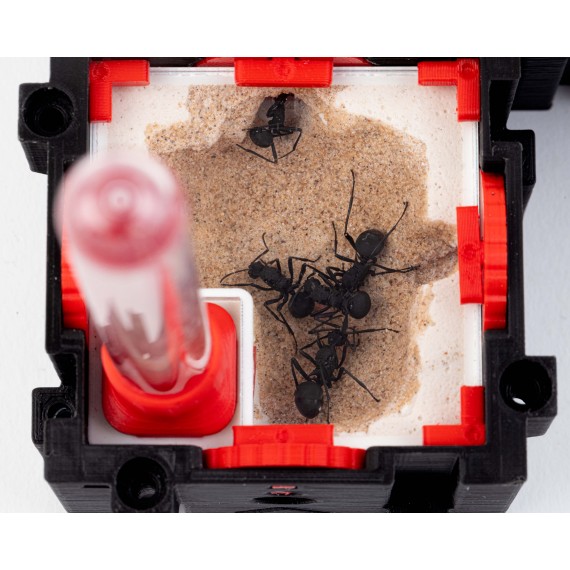
Once the first workers arrive, at Antomas we recommend the Qbik Wild One P 1C by Anthouse, with galleries suited to the species' size. It is made of plaster, holds humidity well and lets you create the moist-to-dry gradient its larvae need, as well as accepting substrate inside the chambers:
Do not move it into a large nest too early: in oversized chambers, a colony of a few workers cannot control the humidity, and empty corners fill up with waste. Complete the set-up as follows:
- A small outworld, with fine sand, a flat stone or two, a piece of bark and a few low twigs or dry plants: in the wild it forages on low vegetation and likes having something to climb.
- Stable landmarks. For such a visual ant, rearranging the décor every week achieves nothing.
- A small water tube with its cotton-wool plug, so they can drink whenever they like.
- A tiny feeder for sugary liquids, never on cotton wool (see «Feeding»).
- An escape barrier and tight seals: the first thing to check with a species of this size (see «Escapes: the danger of being tiny»).
Founding step by step
We sell this species as a founding queen. Its founding is semi-claustral, as throughout the genus: the queen leaves her chamber to drink, take sugar and hunt to feed her first larvae, something Caryl and Edna Haskins already described in their classic studies of bull ants (1950). These are the points that make the difference:
- Total darkness. Cover the chamber with card or aluminium foil and place the set-up somewhere quiet and free of vibrations. With her eyesight, any nearby movement stresses her, and this is the stage when it does the most harm.
- Decreasing humidity. A fairly moist chamber at first, left to dry as the larvae grow (see «Humidity: from moist to dry, at the larvae's pace»).
- Dead or freshly killed prey. Myrmecia queens are keen hunters: they detect vibrations and pounce on anything that moves. Precisely for that reason, at first we recommend giving them dead or freshly killed prey, so the queen does not get injured in the struggle. For such a small queen, tiny prey: Drosophila, newly hatched Thermobia nymphs or pinhead crickets.
- Watch the hatching. It is the most delicate moment. If the first larvae hatch and there is no food, the queen may eat them; a keeper of another Myrmecia lost a larva this way after only about 12 hours without prey. From the moment you see larvae, food every day.
- Daily check. Look every day from outside, with dim light and without moving the set-up: food, leftovers, humidity and the state of the brood. It is the way to catch in time the mistakes this species forgives so poorly.
Normal losses. In Myrmecia it is normal to lose the odd cocoon, roughly 1 or 2 in ten, and the queen is not a good nursemaid: her brood care is primitive, and she sometimes abandons or mistreats it. Do not be alarmed by an isolated loss; if many cocoons are lost, check humidity and temperature.
How long does it take? There are no data for M. exigua. In other Myrmecia, kept warm, keepers report 6 to 10 weeks from egg to worker, and small species tend to be among the fastest in the genus. But bull ant queens lay in batches and take long breaks: think in months, not weeks. With the first workers, who take over brood care and hunting, everything becomes easier.
Feeding
Sugars, every day and varied. At Antomas we recommend alternating Anthouse Blue Sugar Nectar with sugar water or honey water on most days, and offering a very small piece of ripe fruit now and then, such as banana, apple or grape. Remove the fruit before it ferments. Liquids go always in a feeder and never on cotton wool, which goes mouldy and spoils the liquid straight away: with a tiny colony, a single drop «spread» on a smooth surface, such as a small piece of aluminium foil or the lid of a small feeder, is enough.
Protein, according to the larvae. The amount of protein depends on the brood: when there are larvae they ask for plenty; when there are none, interest drops. And prey size grows with the larvae. For a Myrmecia of this size, these are the prey items that work best:
Change the insect from one week to the next, so they do not always eat the same thing. And, if you do daily maintenance and remove leftovers, it is better to overfeed: the colony understands that it has resources to spare and raises more brood, more quickly. If you cannot clean every day, do not overdo it: in such a small set-up, uneaten food quickly brings mould and mites. Once the colony is established, the occasional small live prey will let you enjoy its hunting.
Water: the small cotton-plugged tube in the mini-outworld, always with water to spare.
Diapause
It lives in climates with a real winter: at its type locality, the July daily mean is around 10 °C, with frosts, and on the south-west coast of Australia it is around 14–15 °C. Inside the nest, underground, the temperature is somewhat buffered. On that basis, at Antomas we recommend a diapause of about 3 months at 12–16 °C, during our winter:
- Lower the temperature gradually over one or two weeks, and raise it the same way at the end.
- Do not take it down to European diapause temperatures of 5–8 °C: it is a cool winter, not a freezing one.
- During diapause, water always available, a little sugary liquid and protein only if they accept it or if there are still larvae.
We do not know with which brood stage this species overwinters: in other Myrmecia, some do so with large larvae and others without brood. In several species of the genus, keepers report queens that stopped laying for months and started again after a cool rest: winter is not a whim but part of their cycle. When diapause ends, return to protein as soon as you see activity.
Escapes: the danger of being tiny
With a large bull ant, the lid is what worries you. With a 4 mm one, everything else does: ventilation grilles, joints between modules, tube stoppers, the gap left by loosely packed cotton wool or a slack connection. Before putting the queen in:
- Check every joint in the set-up. If the tip of a pin fits, a worker may fit.
- Fine mesh on all ventilation openings, with an aperture clearly smaller than the width of its head.
- A wide band of escape barrier at the top of the outworld walls: liquid PTFE or paraffin oil. PTFE loses effectiveness at high humidity, so check it often and renew it when it collects dust or debris.
- A well-fitting lid, as a second line of defence.
- Nothing that acts as a bridge: no twigs or leaves resting near the barrier.
The riskiest moment is right at feeding time: that is when the set-up is most open and the workers most active. Work over a light-coloured tray so you can spot any escapee at once, open only as much as necessary and close up when you finish. There is no record of this species jumping; even so, move slowly, because it is fast.
Behaviour in captivity
Observe without fear, once the colony is established. At Antomas we believe ants are there to be enjoyed, observed and learnt from, not kept hidden away. Total darkness is for founding; once there are workers, simply leave them their dark area in the nest and a lit outworld, and observe them gently, intervening and stressing them as little as possible. Over time they get used to your presence.
Warning signs:
- Larvae that disappear shortly after hatching: not enough food.
- Larvae that pupate without a cocoon: too much heat or no substrate in the chamber.
- Darkened or abandoned cocoons: too much moisture.
- Mould or mites in the mini-outworld: forgotten leftovers or excess humidity.
Handling, moving and safety
Moving by tipping. When it is time to move the colony into the Qbik Wild, at Antomas we do it by tipping: we open the founding tube or chamber inside the outworld of the new nest, next to the entrance, and gently tip out the queen, the workers and the brood, helping stragglers along with a very fine brush. Prepare the formicarium beforehand, with the barrier in place, the water tube connected and the nest area in darkness so they settle in quickly, and work over a tray.
Never by hand. It has a functional sting, and Myrmecia stings hurt considerably more than those of a bee or a wasp and can cause severe allergic reactions. Always use long, fine tweezers to remove leftovers, place food or move anything in the set-up. We do not recommend it for people allergic to hymenopteran stings, or in homes where small children or pets could reach the set-up.
Do not combine queens or different colonies, or keep them with other species. And, like any exotic species, it must never be released.
What not to do
- Assume that, because it is small, it is an easy Myrmecia.
- Let mature larvae go above about 28 °C for sustained periods, especially in summer.
- Keep the cocoons moist or keep adding water to a tiny chamber.
- House it in a smooth, bare chamber, without fine substrate for spinning.
- Give the founding queen a large live prey item.
- Leave her without food when the eggs hatch.
- Set up the founding in the light or in a busy area.
- Leave gaps, loose joints, grilles without fine mesh or the barrier unrenewed.
- Move it into a nest that is too big for its size.
- Put sugary liquids on cotton wool or leave food remains in the mini-outworld.
- Skip the diapause or make it cold, like that of a European ant.
- Handle it with your hands.
Scientific sources
Care sheet based on the original description of the species, the literature on the genus Myrmecia, museum records, the climate of its range and the experience of Antomas and other keepers. Main references:
- Clark, J. (1943). A revision of the genus Promyrmecia Emery (Formicidae). Memoirs of the National Museum of Victoria 13: 83–149. doi:10.24199/j.mmv.1943.13.05
- Ogata, K. & Taylor, R. W. (1991). Ants of the genus Myrmecia Fabricius: a preliminary review and key to the named species (Hymenoptera: Formicidae: Myrmeciinae). Journal of Natural History 25: 1623–1673. doi:10.1080/00222939100771021
- Ogata, K. (1991). Ants of the genus Myrmecia Fabricius: a review of the species groups and their phylogenetic relationships (Hymenoptera: Formicidae: Myrmeciinae). Systematic Entomology 16: 353–381. doi:10.1111/j.1365-3113.1991.tb00694.x
- Ward, P. S. & Brady, S. G. (2003). Phylogeny and biogeography of the ant subfamily Myrmeciinae (Hymenoptera: Formicidae). Invertebrate Systematics 17: 361–386. doi:10.1071/IS02046
- Hasegawa, E. & Crozier, R. H. (2006). Phylogenetic relationships among species groups of the ant genus Myrmecia. Molecular Phylogenetics and Evolution 38: 575–582. doi:10.1016/j.ympev.2005.09.021
- Mera-Rodríguez, D., Jourdan, H., Ward, P. S., Shattuck, S., Cover, S. P., Wilson, E. O. & Rabeling, C. (2023). Biogeography and evolution of social parasitism in Australian Myrmecia bulldog ants revealed by phylogenomics. Molecular Phylogenetics and Evolution 186: 107825. doi:10.1016/j.ympev.2023.107825
- Heterick, B. E. (2009). A guide to the ants of South-western Australia. Records of the Western Australian Museum, Supplement 76: 7–206. doi:10.18195/issn.0313-122x.76.2009.007-206
- Heterick, B. E. (2022). A guide to the ants of Western Australia. Part II: Distribution and biology. Records of the Western Australian Museum, Supplement 86: 247–510. doi:10.18195/issn.0313-122x.86.2022.247-510
- Haskins, C. P. & Haskins, E. F. (1950). Notes on the biology and social behavior of the archaic ponerine ants of the genera Myrmecia and Promyrmecia. Annals of the Entomological Society of America 43: 461–491. doi:10.1093/aesa/43.4.461
- Greiner, B., Narendra, A., Reid, S. F., Dacke, M., Ribi, W. A. & Zeil, J. (2007). Eye structure correlates with distinct foraging-bout timing in primitive ants. Current Biology 17: R879–R880. doi:10.1016/j.cub.2007.08.015
- Narendra, A., Reid, S. F., Greiner, B., Peters, R. A., Hemmi, J. M., Ribi, W. A. & Zeil, J. (2011). Caste-specific visual adaptations to distinct daily activity schedules in Australian Myrmecia ants. Proceedings of the Royal Society B 278: 1141–1149. doi:10.1098/rspb.2010.1378
- Robinson, S. D. et al. (2018). A comprehensive portrait of the venom of the giant red bull ant, Myrmecia gulosa, reveals a hyperdiverse hymenopteran toxin gene family. Science Advances 4: eaau4640. doi:10.1126/sciadv.aau4640
- Brown, S. G. A. et al. (2011). Causes of ant sting anaphylaxis in Australia: the Australian Ant Venom Allergy Study. Medical Journal of Australia 195: 69–73. doi:10.5694/j.1326-5377.2011.tb03209.x