Difficulty: 2/5 – Beginner
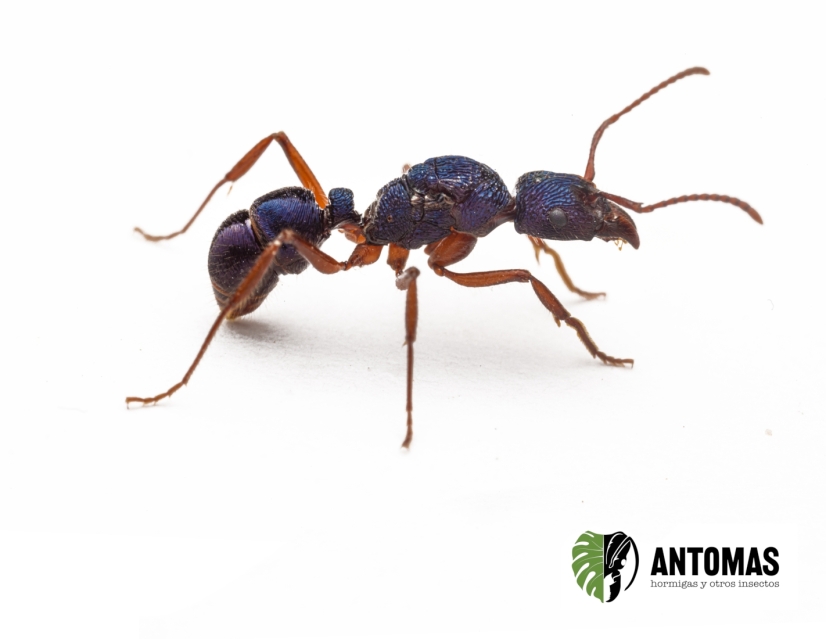
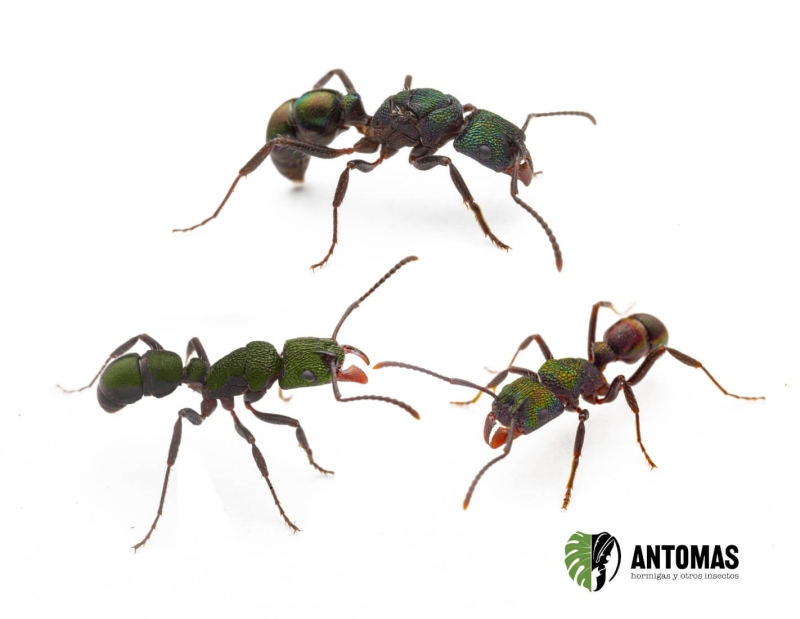
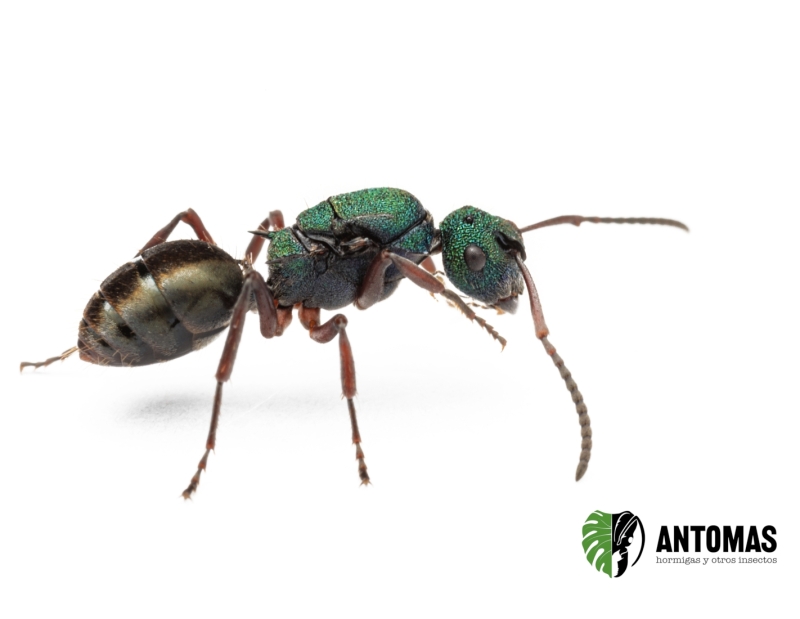
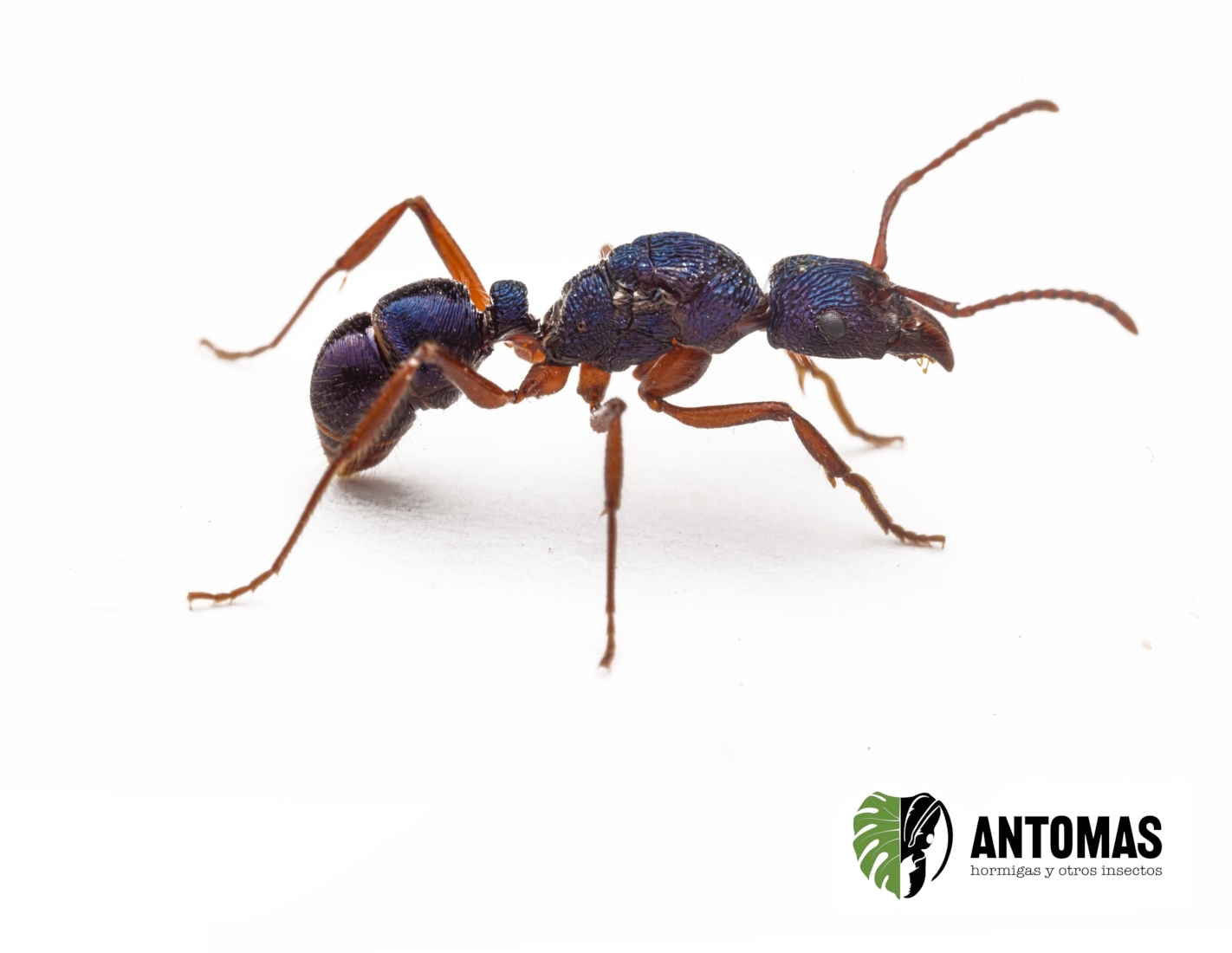
The Blue Metallic Ant of eastern Australia, with steel-blue highlights. Two systems coexist within this species: colonies with a winged queen and colonies in which the eggs are laid by mated workers, the gamergates (‘married’ workers, with no wings and no queen’s body). Antomas colonies are always sold with a queen: one queen with her brood. Semi-claustral founding and fast growth. A plaster Qbik Wild with sand, nest at 23–27 °C and never above about 27–28 °C, humidity a little higher than for R. metallica but without condensation, nectar almost daily and varied protein. A mild diapause of 12–16 weeks (3–4 months) at 15–18 °C during our winter. Moving by tipping out, a mineral oil barrier and a lid. It stings: always use tools.
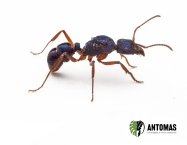
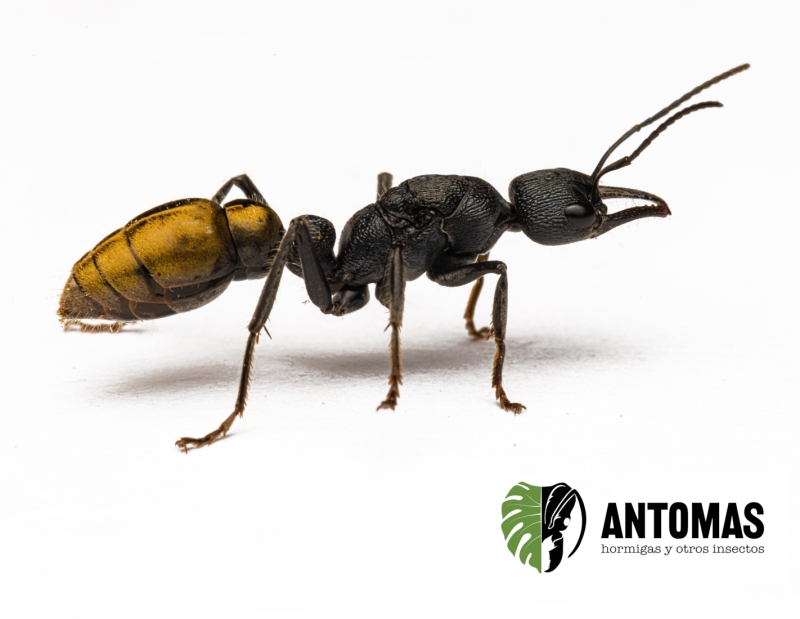
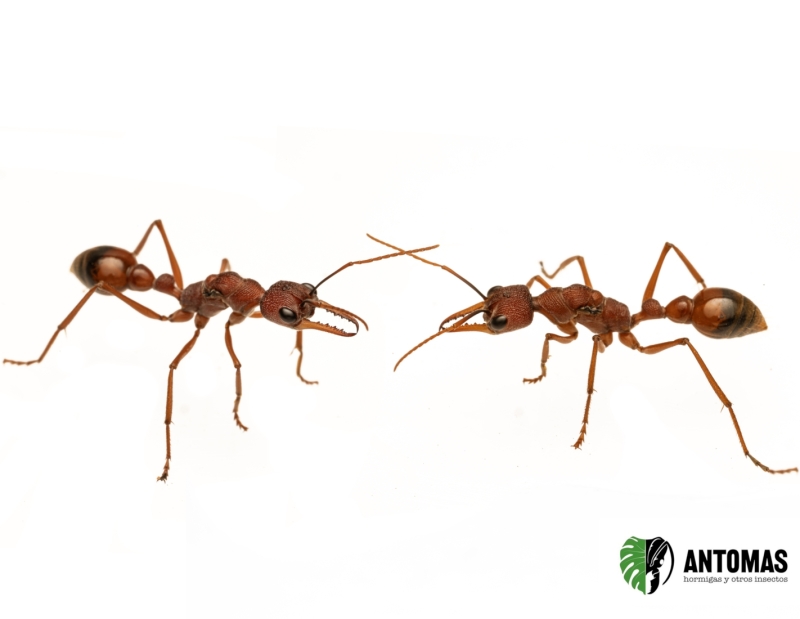
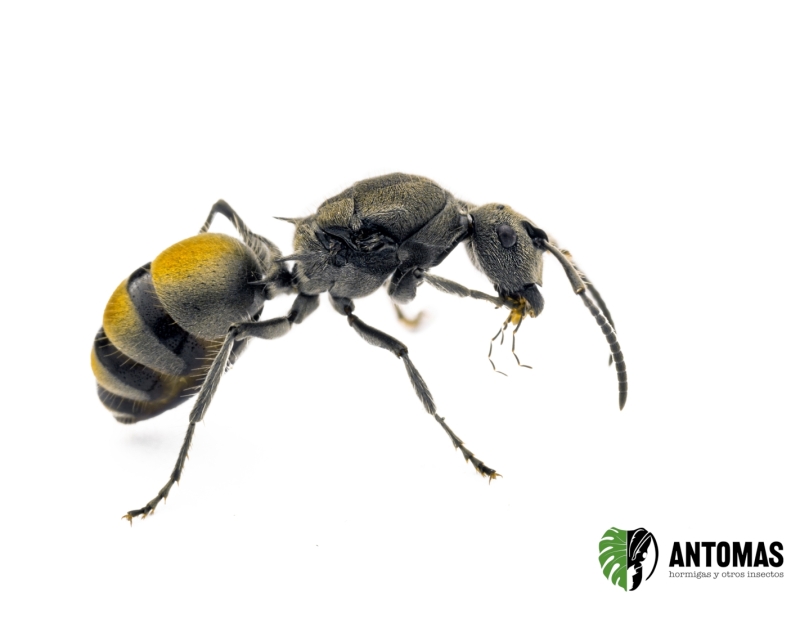
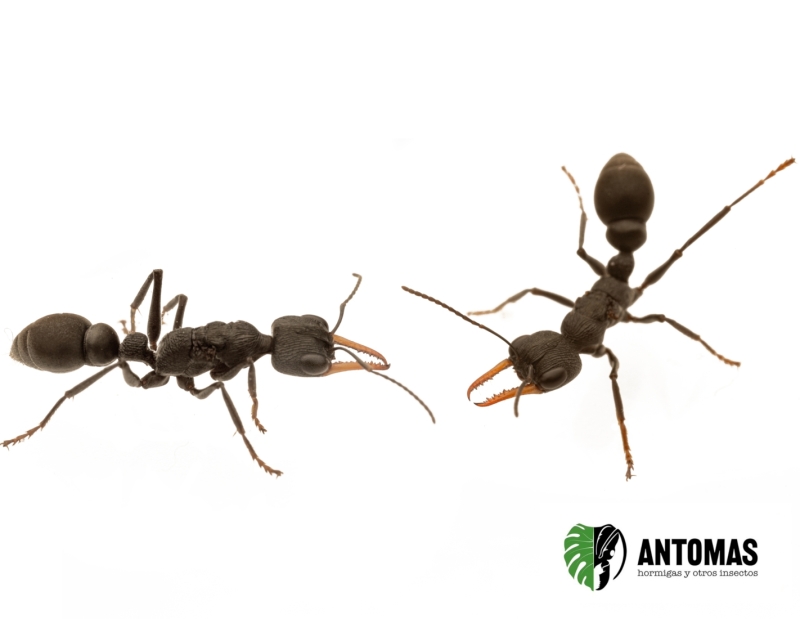
Rhytidoponera chalybaea Emery, 1901 is the Blue Metallic Ant of Australia’s east coast: a robust, heavily wrinkled ectatommine with a sting and a bluish steel sheen that shifts with the light. It lives in the subtropical rainforest and moist forests of New South Wales and southern Queensland, where it nests mainly inside rotting logs, and also in well-watered parks and gardens. It is a close relative of the green-headed R. metallica and, like it, belongs to a group of primitive ants that hunt alone, by day, guided by sight.
What makes it special lies inside the nest. Within a single population of R. chalybaea there are colonies ruled by a winged queen, as in most ants, and colonies in which there is no queen and the eggs are laid by several mated workers, the gamergates. The two systems live just a few metres apart, but never in the same nest. And, unlike its green relative, in this species queens are common and work beautifully: in the laboratory, a single queen reared more than 200 workers in her first year. That is why it is one of the best gateways to Australian ants.
Biology
What is a gamergate?
A gamergate is a worker that has mated and lays fertilised eggs: a worker playing the role of queen. The word comes from the Greek gamos, ‘marriage’, and ergátēs, ‘worker’; a gamergate is, quite literally, a ‘married worker’. The term spread after a 1984 paper by Christian Peeters and Robin Crewe on another primitive ant, in which they showed that what decides which worker reproduces is mating.
- It has no wings and never had any. It is born like any other worker and mates without flying, close to the nest.
- It has a worker’s body. To the naked eye it cannot be told apart from its sisters; only dissection reveals its full spermatheca.
- The other workers can lay too, but their unfertilised eggs only produce males, as in all Hymenoptera.
Gamergates occur in several primitive ants, such as Diacamma, Harpegnathos and Rhytidoponera. According to Peeters and Ito (2001), when colonies multiply on foot, by budding, a wingless reproductive that is cheap to produce can successfully replace a winged queen. R. chalybaea has given up neither.
Two ways of ruling a nest
The leading expert on this ant is the American myrmecologist Philip S. Ward, who in the 1970s excavated hundreds of colonies of the impressa group, to which R. chalybaea belongs, across eastern Australia. In 1981 he published an unexpected finding: the group has two types of reproductive female.
- The winged queen. Born with wings, she leaves the nest, mates, tears off her wings and founds a new colony.
- The gamergate. A worker that mates and lays, wingless and with her ordinary worker’s body. This was the first time they had been recorded in the impressa group.
The curious thing is how they are distributed. In R. chalybaea and its relatives R. confusa and R. impressa, Ward found queenright colonies and gamergate colonies in the same population, sometimes just a few metres from each other, but never both in the same nest: either a queen rules, or the mated workers do. And each system has its own style. Gamergate colonies produce alates while smaller and younger, and their alates are mostly males; queenright colonies grow larger before rearing sexuals.
This contrasts with its relative R. metallica, the green-headed species, which relies almost entirely on its gamergates, with dozens per nest according to the genetic analyses of Chapuisat and Crozier (2001), and in which nobody has found a colony running with a queen in the field. In R. chalybaea, by contrast, Ward stressed in 1986 that functional queens are common.
One queen, one male: what the allozymes revealed
Are those two types of colony two different species that look alike? Ward tested this in 1983 with allozymes, enzyme variants that work as genetic markers. He studied colonies of R. chalybaea and R. confusa and reached two conclusions:
- They are the same species. The frequencies of the genetic variants were virtually identical in the queenright colonies and the gamergate colonies living side by side. There is no reproductive barrier between them: they are two ways of life of one and the same ant.
- The queen mates only once. In queenright colonies, the markers showed that the queen had mated with a single male and was the mother of every inhabitant of the nest, males included. In other words, in those colonies the workers do not lay male eggs of their own.
In a queenright colony, all the workers are full sisters; in a gamergate colony, the daughters of several mothers live together, far less closely related. Ward suggested that this difference could influence cooperation within the nest.
The queen who goes hunting for her daughters
How is a new colony born? In the impressa group, Ward described two routes. The first is that of the winged queen: after the nuptial flight, the mated queen tears off her wings, looks for a spot under a stone or inside a rotting log, digs a small chamber and lays her first eggs. So far, just like any ant. The difference comes afterwards: she does not shut herself in and wait. She goes out hunting and feeds her larvae, at least in part, on the insects she catches.
This is what is called semi-claustral founding, typical of primitive ants, as opposed to the claustral founding of the ‘higher’ ants, in which the queen rears her first workers without eating, on her body reserves. In the field, the first workers take about 6 months to appear; in the laboratory, with warmth and food, 3–4 months. Of 43 newly founded colonies Ward found in the group, 41 had a single queen.
The second route is budding: a mated worker leaves the nest with a group of virgin nestmates and founds a daughter colony nearby. Ward found one of these groups of R. chalybaea in May 1977: nine workers with several larvae. Some shops say its founding is claustral, but science says otherwise: at Antomas we treat the queen as a hunter (see ‘Founding and growth’).
More than 200 workers in a year
One of the most useful facts for a keeper comes from a 1983 experiment by Ward. He collected mated queens of R. metallica and a dealate queen of R. chalybaea and reared them in exactly the same way, to compare them:
- Nest: a block of moist plaster with a glass-covered chamber and a small foraging area; once the colony passed about 50 workers, a larger nest.
- Food: small arthropods, mainly fruit flies (Drosophila), daily, and honey once a week, always in abundance.
- Sand so that the larvae could spin their cocoons.
By about the tenth week there was brood in all three colonies. But from then on, the R. chalybaea colony pulled away: it grew much faster, with regular brood cycles, and by its first birthday it had more than 200 workers. The two R. metallica colonies had 41 and 27, and their newly emerged workers had trouble getting out of their cocoons. It is only one colony, but it fits with everything else: in R. chalybaea the queen is a central piece. And look at the set-up: moist plaster, sand and daily food, almost point for point what we recommend at Antomas.
Twins that only chemistry can tell apart
In 1980, Ward revised the impressa group and recognised five species. Two of them, R. chalybaea and R. confusa, are so alike that in some localities he could only separate them by biochemical analysis, through their allozymes: under the magnifying glass they are practically twins. Not for nothing does the name confusa say it all.
What does separate them is where they live. Where they overlap, R. chalybaea occupies the drier microhabitats; and, although both climb higher in altitude the further north you go, R. chalybaea usually stays lower than R. confusa. They also choose different nests: R. confusa nests far more often under stones, and R. chalybaea almost always in rotting logs. Elsewhere in Australia, the impressa group is known as the blue pony ants.
An ant of rainforest and rotting wood
Ward recorded R. chalybaea at 34 populations between 21 and 34° south, from almost sea level up to about 1,000 m. It is common in the subtropical rainforest of northern New South Wales and southern Queensland. Further south, however, it only appears in low-lying areas disturbed by humans: in Sydney it lives in well-watered parks and gardens and moves into rainforest gullies invaded by introduced plants such as Lantana and privet.
And where does it nest? Ward measured it precisely: of 165 colonies, 87.9% were inside rotting logs, 11.5% under stones and one in a fallen epiphyte. He found curious nests under the sheath of a palm and, in the city, under rusty sheets of iron, concrete slabs and in the cracks of a stone wall. Nests in the group have several chambers, are shallow, no more than 15–20 cm into the soil, and have inconspicuous entrances, with no mound.
For keeping, the message is clear: this is an ant of damp wood and shade, moister than its green relative, which prefers soil under stones. In addition, colonies move house often: Ward several times saw R. chalybaea workers carrying brood, which is why they readily accept a new formicarium.
One year, one harvest
Ward followed almost 500 colonies of R. chalybaea and R. confusa throughout the year and drew up their calendar, which in the southern hemisphere runs the opposite way to ours:
- Two laying peaks: in September–October, at the start of the southern spring, and in February–April.
- Larvae all year round. Those that overwinter are small or medium-sized and barely grow until spring.
- Cocoons from October–November; those of the alates appear about two months after those of the workers.
- New workers from January to June and alates from February to April. From July to December no workers emerge and in winter there are no cocoons.
- Alates overwinter in the nest and fly out in spring.
A single ‘harvest’ of adults a year and a pause in brood rearing during the southern winter: the basis for the mild diapause we recommend (see ‘Diapause’).
Stowaway in timber: its life in New Zealand
R. chalybaea has travelled. According to the entomologists at Landcare Research, the New Zealand institute that catalogues the country’s ants, it is established in New Zealand, where it probably arrived in the 1950s with shipments of poles and sawn timber from Australia. Today it lives in Northland, in Auckland, where it is particularly numerous, and in the Bay of Plenty, and it nests in towns and cities: under pavements, under stones and in gardens. There it is described as a large ant by local standards, with a powerful sting.
‘Of steel’: the name
It was described by the Italian myrmecologist Carlo Emery in 1901, from a worker from New South Wales, as a variety of R. impressa. The name chalybaea comes from the Latin chalybeius, ‘of steel’, which in turn comes from the Chalybes, an ancient people famous for their smiths: a perfect name for its steel-blue sheen. In 1910, Auguste Forel described it again as cyrus, unaware that it was the same ant; William L. Brown and, later, Ward recognised it as a synonym. The genus name, Rhytidoponera, seems to come from the Greek rhytís, ‘wrinkle’, after the sculpture of its body. Today it is classified in the subfamily Ectatomminae, whose relationships were clarified in 2022 by a phylogenomic study by Camacho and colleagues, within a genus of more than a hundred species spread across Australia and Melanesia, as far as New Caledonia, where Ward himself revised its species in 1984.
Size and morphology
A medium-sized, robust and heavily sculptured ant, with a sting, well-developed eyes and a single worker caste, with no soldiers: they all look the same, gamergates included.
- Colour. Metallic, with a steel-blue sheen that gives it its name and that, depending on the angle of the light, can lean towards violet or bluish green. Nobody has yet studied how this sheen is produced in the genus.
- Sculpture. Head and thorax covered in coarse rugosity, the ‘wrinkle’ that gives the genus its name.
- Sting. Functional and well developed (see ‘Handling and safety’).
- Queen. Winged at birth; after mating she tears off her wings. Unlike in R. metallica, in this species she is common.
- Gamergates. Identical to the other workers; they can only be distinguished by their spermatheca, which contains sperm.
- Development. The larvae spin a cocoon and, to do so, need particles: in Ward’s laboratory they were given sand.
Approximate measurements
- Workers: no published measurements that we have been able to consult. Ward (1981) only states that its relative R. croesus is somewhat smaller than R. chalybaea, R. confusa and R. impressa. For reference, R. metallica workers measure 6–6.5 mm (Emery 1912).
- Queen and gamergates: no published measurements. Gamergates are the same size as any other worker.
- Male: no published measurements.
The millimetre figures circulating online do not cite any source, so we prefer not to give them.
Care in captivity
Difficulty: 2/5 – Beginner
Hardy, active by day, a good hunter, with no unusual temperature demands and a queen who, well fed, makes the colony grow quickly.
Why not a 1/5? Because of three details:
- It stings. Always work with tools, a barrier and a lid (see ‘Handling and safety’).
- A founding that eats. The queen is semi-claustral: she needs small prey from the very start; simply leaving her in her tube is not enough.
- Moisture without waterlogging. It likes a damp nest, somewhat damper than R. metallica, but condensation drowns newly emerged workers and brood.
And it is well worth it. Few ants shine like this, and few have such a fascinating social life. If you like it, at Antomas you can also find its green-sheened relative, Rhytidoponera metallica.
Recommended parameters
- Nest temperature: 23–27 °C during the active season, always with a thermostat. Do not go above about 27–28 °C: it does not need any hotter area. At night it can drop a few degrees without any problem.
- Why: its range has a humid subtropical climate, with warm, rainy summers and average highs of about 26–30 °C, and it lives in the shade of the rainforest and inside wood, where it is cooler than in the sun.
- Humidity: one part of the nest clearly moist for the brood and another drier one, and a dry foraging area (see ‘Moisture, but no condensation’).
- Water: always, in a test tube with water and cotton wool in the foraging area.
- Sand: in the foraging area and, if the nest allows it, in the chambers. The larvae need it to spin their cocoons.
- Light: nest kept dark and foraging area lit, with a normal day–night cycle.
- Diapause: mild, 12–16 weeks (3–4 months) at 15–18 °C during our winter (see ‘Diapause’).
Moisture, but no condensation
It lives in rotting logs in the subtropical rainforest, and Ward reared it successfully in moist plaster: this is an ant that appreciates humidity. But, as with the whole genus, excess water is dangerous: condensation droplets can drown newly emerged workers and damp food goes mouldy.
- Keep one part of the nest moist, the brood area, and leave another drier: the ants themselves will choose where to put everything.
- No droplets on the walls: if you see condensation, stop moistening for a few days and ventilate.
- Slightly damp sand in the brood area, so the larvae can spin their cocoons.
- Leftovers out within 24 hours.
Recommended formicaria
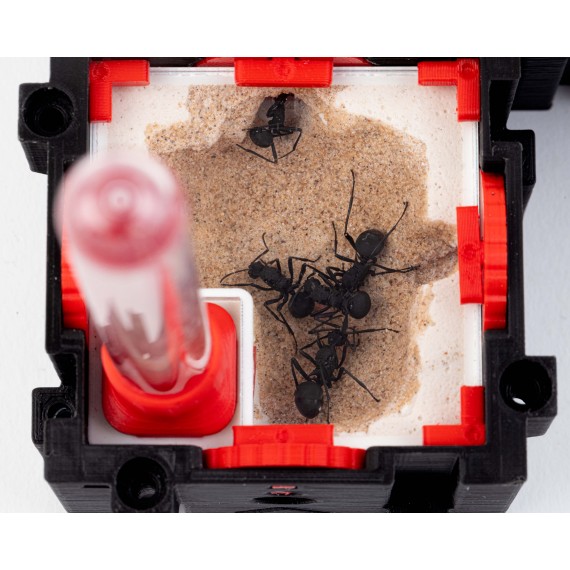
At Antomas we recommend the Qbik Wild range by Anthouse: plaster formicaria that hold moisture, like the nests Ward reared it in, and allow the gradient it needs. For the queen and her first workers, the Qbik Wild One P 1C:
To expand, the Qbik Wild Duo P 2C, made entirely of plaster, which holds the humidity it likes well:
The nest should always be in proportion to the colony: in one that is too large, the empty chambers end up as rubbish dumps. As it grows quickly, expand when you see workers standing idle in the foraging area, with no room inside. Complete the set-up like this:
- Fine sand in the foraging area, so they can grip, dig and have material for their cocoons.
- A piece of bark or wood in the foraging area: it recalls their natural nests and serves as a refuge.
- Water in a test tube with cotton wool, and a feeder for the nectar, never on cotton wool.
- A barrier of mineral oil and a tight-fitting lid (see ‘Escapes and barriers’).
- Gentle heat on one side, with a thermostat and away from the feeder.
The queen at home
- Antomas colonies always have a queen. We sell mated queens with their brood: the queen lays the eggs and the colony grows around her.
- One queen, many sisters. As the queen mates with a single male, all the workers in your colony will be full sisters.
- A queenright colony depends on her: as long as she lays, the colony grows. In Ward’s laboratory, in an R. metallica colony whose queen stopped laying, the workers attacked her and began calling in males.
- Males from time to time. Workers can lay unfertilised eggs, which produce males. Seeing the odd winged male in spring is normal.
- If the queen were ever lost, a worker can become a gamergate, but to do so she has to mate with a male; without males, the workers only rear males and the colony eventually dies out.
- Never merge colonies or add queens or workers from another colony.
Founding and growth
Your queen arrives with her brood, and what Ward observed is the key to caring for her: queens of this species do not shut themselves in and wait, but go out hunting to feed their larvae. That is why, at Antomas, we treat it as a semi-claustral founding:
- Tube and peace and quiet. Keep the tube as it arrives, with its water reservoir, in a dark, quiet place free of vibrations, at 24–26 °C. You can cover it with a cloth or a piece of cardboard.
- Food from the start. Small prey often, every day or every other day: in Ward’s laboratory they were given Drosophila daily. A fruit fly, a small piece of cricket or a small Thermobia domestica, and a tiny drop of nectar on a small piece of aluminium foil, never on the cotton wool. Remove whatever is left the next day.
- Sand for the cocoons. If you have to move her to a new tube, put a little fine sand in it so the larvae can spin.
- Patience, but not too much. In the laboratory, the first workers appear 3–4 months after laying, and Ward’s colony had brood at 10 weeks and more than 200 workers after a year. With warmth and plenty of protein, this is a species that takes off.
When should you move it into the formicarium? When it has a few workers and the tube becomes too small, gets dirty or runs out of water, always into a nest in proportion to the colony, such as the Qbik Wild One P 1C, and by tipping out (see ‘Arrival and moving by tipping out’).
Arrival and moving by tipping out
When you receive your queen, let her rest in a quiet, dark place at 24–26 °C, check that she has water and offer her a small prey item and a drop of nectar. To move her into the formicarium, at Antomas we do it by tipping out: with the formicarium already set up (moist area, sand, barrier and water), open the tube in the foraging area, next to the nest entrance, and gently tip out the queen, the workers and the brood, helping any stragglers along with a soft brush. Work over a tray and never with your hands. Close the lid and keep the nest dark: in the wild they move house often and will soon carry the brood inside. To move them later into a larger nest, use the same method.
Feeding
Protein: the engine of growth. It is a hunter and scavenger and accepts almost any insect. In Antomas’ experience, the more protein colonies receive, the faster and larger they grow, and Ward’s experiment, with daily, plentiful food, confirms it. If you carry out maintenance often and remove leftovers within 24 hours, it is better to overdo it than to fall short; if you will not be able to clean, it is better not to overfeed. Change the type of insect from one week to the next, so they do not always eat the same thing:
Buy insects from a reliable supplier: insects treated with insecticides can kill the colony.
Nectar, almost daily. At Antomas we recommend Blue Sugar nectar by Anthouse 4–5 times a week and another nectar or sugary liquid, such as diluted honey, 1–2 times a week. You can also add some protein to the nectar. Always offer it in a feeder, where the drop stays ‘spread out’ and accessible, and never on cotton wool, which goes mouldy and spoils the liquid very quickly.
Seeds: not needed. It is not a seed-eater. Rhytidoponera are major seed dispersers in Australia, but they only eat the elaiosome, a fleshy appendage on some seeds, and discard the seed intact, as shown by Hughes and Westoby (1992) with R. metallica and by Lubertazzi and colleagues (2010) with R. violacea. Water: always, in the test tube with cotton wool.
Diapause
It does not need intense cold, but nor does it live the same way all year round. In its range, the southern winter is mild, with highs of about 17–22 °C and lows of about 6–11 °C, and Ward found that brood rearing slows down during those months: the larvae barely grow, there are no cocoons and no workers emerge from July to December (see ‘One year, one harvest’).
That is why at Antomas we recommend a mild diapause of 12–16 weeks (3–4 months), roughly from November to February or March, at 15–18 °C, just as for its relative R. metallica:
- Gradual entry. In autumn, lower the temperature little by little over 2–3 weeks.
- During diapause: water at all times, a little nectar and the odd small prey item if you see them foraging. Keep the nest moist and disturb the colony as little as possible.
- Do not overdo the cold: do not go below about 12 °C. This is not a European ant’s diapause.
- Gradual exit at the end, around February or March, back up to 23–27 °C, and protein as soon as you see brood.
- Where: a cool, unheated room is usually enough.
Remember that in its range the seasons are the opposite of ours. If you receive the queen in autumn, you can keep her active that first winter or give her a short, mild rest; from the following year on, a normal diapause during our winter.
Behaviour and observation
Diurnal and very active. With light and warmth, the workers patrol the foraging area each on their own, without columns, and pounce on prey. It is one of those species that likes to be seen.
Frequent moves. It is normal to see workers carrying brood from one chamber to another depending on humidity or temperature.
Defence. They are bold with other insects, and if you knock the formicarium or open it abruptly, they will come out to defend it with their sting.
Watch without fear. At Antomas we believe ants are there to be enjoyed, observed and learnt from. Just keep the nest dark and the foraging area lit, and watch them gently: under a magnifying glass, their steel-blue sheen is a spectacle.
Warning signs:
- The colony is not growing in the middle of the season: check the temperature and the protein.
- Droplets on the walls, mould or dead workers in wet areas: there is too much moisture or leftovers remain.
- Workers attacking the queen: she may have stopped laying.
- Many workers standing idle in the foraging area, with no room inside: time to expand.
Escapes and barriers
Workers of the genus climb smooth glass poorly, but with an ant that stings it is not worth the risk: dust, sand or condensation can give them grip.
- A band of mineral oil along the top of the foraging area walls, renewed when it collects dust or debris.
- A tight-fitting lid, with no gaps at connections or stoppers.
- Nothing that can act as a bridge to the barrier: no long twigs, forgotten tweezers or tubes leaning against it.
Handling and safety
It has a sting and uses it. In New Zealand, where it has become established, entomologists describe it as an ant with a powerful sting, and its relative R. metallica was, in the major 2011 Australian study on ant sting allergy, the only species apart from Myrmecia to appear as a cause of severe allergic reactions, mainly on the north coast of New South Wales and in south-east Queensland, right in the range of R. chalybaea. With calm handling and tools, it rarely gets the chance to sting you:
- Never with your hands. Always with tools: long tweezers, a soft brush and, for transfers, tubes and adapters.
- Open the formicarium only as much as needed, work calmly over a tray and close it when you have finished.
- This is not a species for people who are allergic to bee, wasp or ant stings. With small children or pets at home, keep the formicarium closed at all times and out of their reach.
- If you are stung, wash the area and apply something cold.
It is an exotic species that has already shown it can travel and become established outside Australia: under no circumstances should it be released.
What not to do
- Handle it with your hands or open the formicarium without a barrier or tools.
- Treat the queen as if she were claustral and leave her without food: she needs small prey from the very start.
- Merge colonies or add queens or workers from another colony.
- Let the nest dry out completely or, conversely, soak it all until condensation forms.
- Keep the nest above about 27–28 °C or give it a very hot area.
- Set up a nest without sand for the cocoons.
- Put the nectar on cotton wool, leave leftovers for more than a day or always give the same insect.
- A cold, European-ant diapause, or sudden changes in temperature.
- House a small colony in a huge formicarium.
Scientific sources
This care sheet has been compiled from the scientific literature on Rhytidoponera chalybaea, its species group and its genus, from distribution data for Australia and New Zealand, from climate data for its range and from Antomas’ own experience. Main references:
- Ward, P. S. (1980). A systematic revision of the Rhytidoponera impressa group (Hymenoptera: Formicidae) in Australia and New Guinea. Australian Journal of Zoology 28: 475–498. doi:10.1071/ZO9800475
- Ward, P. S. (1981). Ecology and life history of the Rhytidoponera impressa group (Hymenoptera: Formicidae). I. Habitats, nest sites, and foraging behavior. Psyche 88: 89–108. doi:10.1155/1981/82408
- Ward, P. S. (1981). Ecology and life history of the Rhytidoponera impressa group (Hymenoptera: Formicidae). II. Colony origin, seasonal cycles, and reproduction. Psyche 88: 109–126. doi:10.1155/1981/39593
- Ward, P. S. (1983). Genetic relatedness and colony organization in a species complex of ponerine ants. I. Phenotypic and genotypic composition of colonies. Behavioral Ecology and Sociobiology 12: 285–299. doi:10.1007/BF00302896
- Ward, P. S. (1983). Genetic relatedness and colony organization in a species complex of ponerine ants. II. Patterns of sex ratio investment. Behavioral Ecology and Sociobiology 12: 301–307. doi:10.1007/BF00302897
- Ward, P. S. (1986). Functional queens in the Australian greenhead ant, Rhytidoponera metallica (Hymenoptera: Formicidae). Psyche 93: 1–12. doi:10.1155/1986/89482
- Ward, P. S. (1984). A revision of the ant genus Rhytidoponera (Hymenoptera: Formicidae) in New Caledonia. Australian Journal of Zoology 32: 131–175. doi:10.1071/ZO9840131
- Peeters, C. & Crewe, R. (1984). Insemination controls the reproductive division of labour in a ponerine ant. Naturwissenschaften 71: 50–51. doi:10.1007/BF00365989
- Peeters, C. & Ito, F. (2001). Colony dispersal and the evolution of queen morphology in social Hymenoptera. Annual Review of Entomology 46: 601–630. doi:10.1146/annurev.ento.46.1.601
- Chapuisat, M. & Crozier, R. H. (2001). Low relatedness among cooperatively breeding workers of the greenhead ant Rhytidoponera metallica. Journal of Evolutionary Biology 14: 564–573. doi:10.1046/j.1420-9101.2001.00310.x
- Camacho, G. P. et al. (2022). UCE phylogenomics resolves major relationships among ectaheteromorph ants (Hymenoptera: Formicidae: Ectatomminae, Heteroponerinae): a new classification for the subfamilies and the description of a new genus. Insect Systematics and Diversity 6. doi:10.1093/isd/ixab026
- Hughes, L. & Westoby, M. (1992). Fate of seeds adapted for dispersal by ants in Australian sclerophyll vegetation. Ecology 73: 1285–1299. doi:10.2307/1940676
- Lubertazzi, D. et al. (2010). The ecology of a keystone seed disperser, the ant Rhytidoponera violacea. Journal of Insect Science 10: 158. doi:10.1673/031.010.14118
- Brown, S. G. A. et al. (2011). Causes of ant sting anaphylaxis in Australia: the Australian Ant Venom Allergy Study. Medical Journal of Australia 195: 69–73. doi:10.5694/j.1326-5377.2011.tb03209.x