Difficulty: 2/5 – Beginner
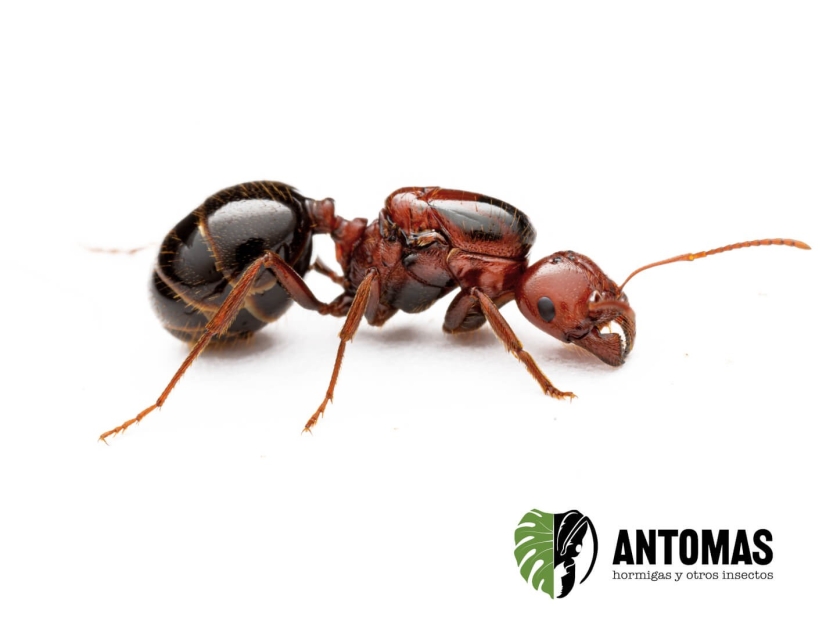
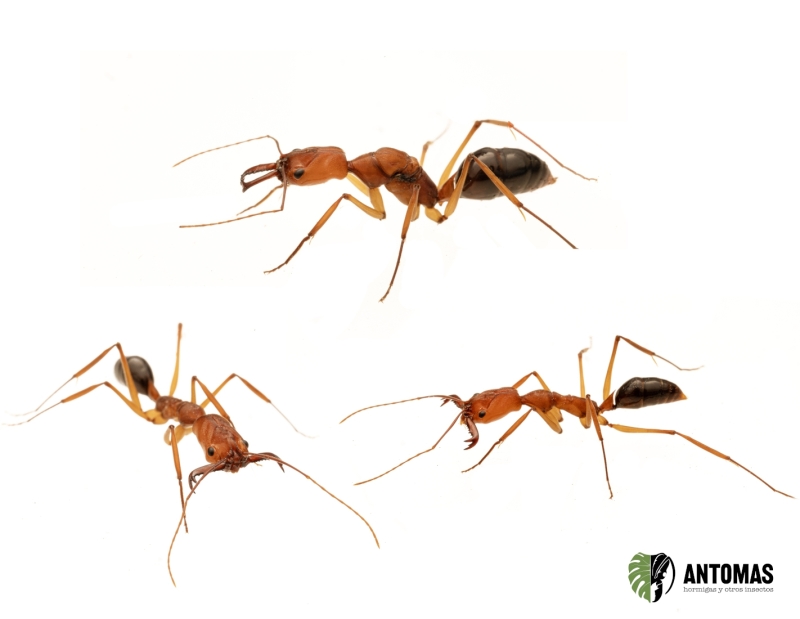
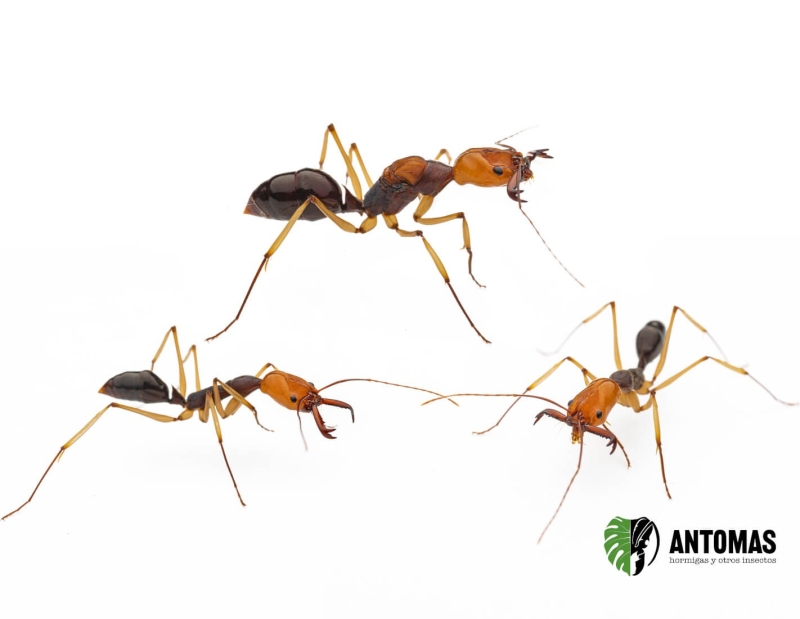
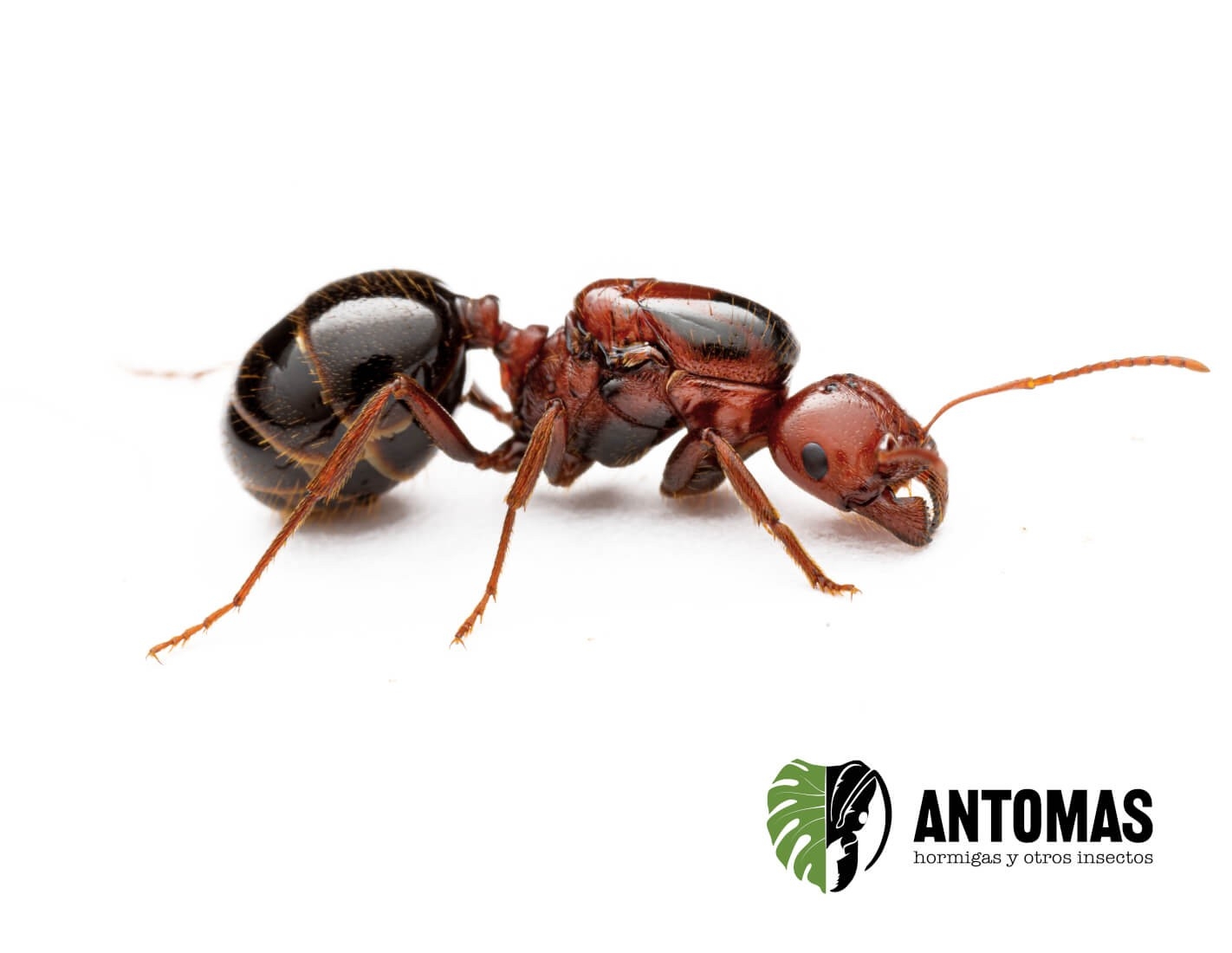
The bicoloured harvester of the Levant, described from Jerusalem in 1927: one of the large species of its genus, with a reddish head and thorax and a dark gaster. Sold as a queen with brood: a colony in the middle of claustral founding. A quiet test tube at 24–27 °C until the first workers, then a QBIK ONE with medium galleries, varied seeds, plenty of protein and a mild diapause of about 4 months at 10–15 °C.
Messor hebraeus Santschi, 1927 is a seed-harvesting ant of the eastern Mediterranean. It lives in Israel and Palestine, Lebanon and Syria, in the hills, fields and grasslands of that arc of land between the sea and the desert, where winter brings the rain and summer dries everything out. Its name ties it to that landscape: hebraeus is Latin for “Hebrew”, and its type locality is Jerusalem.
It is one of the large, bicoloured Messor and, like almost all the harvesters of the Near East, it has barely been studied: there are no published measurements, no nest censuses and no work on its foraging. Here we separate what is known about the species, its group, the Messor of Israel and the genus as a whole, and what we apply at Antomas with our own harvester ants.
We sell it as a queen with brood: a fertilised queen with her eggs, larvae or pupae, before her first workers emerge. It is the purest way to start a colony, because from day one you will watch a single female build an empire. That is why we devote a whole section to founding. If you have already kept Messor barbarus, the rest will feel familiar.
Biology
“The Hebrew”: two harvesters from Jerusalem in the same year
The species entered science in 1927 thanks to Félix Santschi, the Swiss physician based in Tunisia who devoted half his life to the ants of North Africa and the Near East. He described it from workers collected in Jerusalem as Messor semirufus var. hebraeus, that is, as a mere variety of another harvester that is very common in the region. The original specimens, the syntypes, are kept in the Natural History Museum of Basel.
That same year, and also from Jerusalem ants, Santschi named another variety of semirufus: Messor dentatus. The two followed parallel paths. They spent decades as minor forms of semirufus, until in 1981 the Lebanese zoologists G. and H. Tohmé raised them to species rank. Today neither is considered a close relative of semirufus: both belong to another species complex, that of M. wasmanni. Two ants described from the same city in the same year, confused with the same species and rescued together: few harvester ants have such an intertwined history.
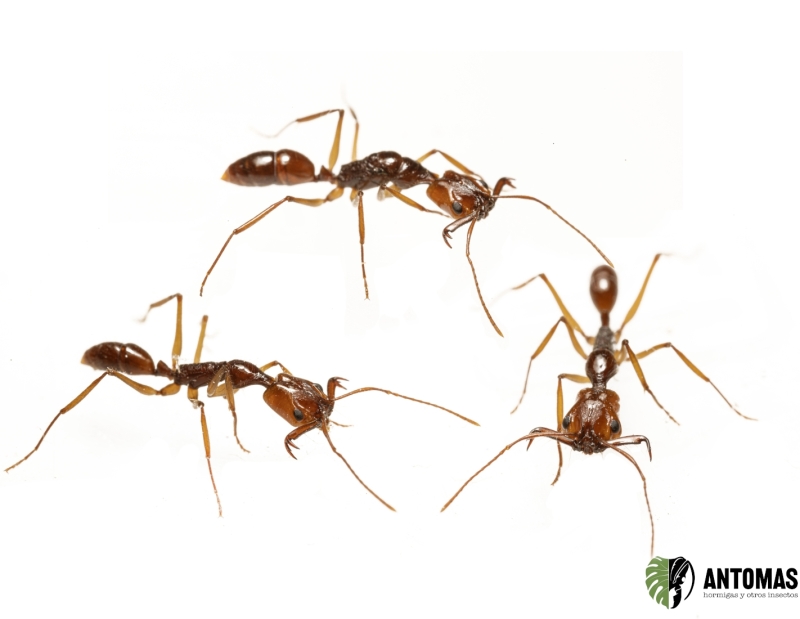
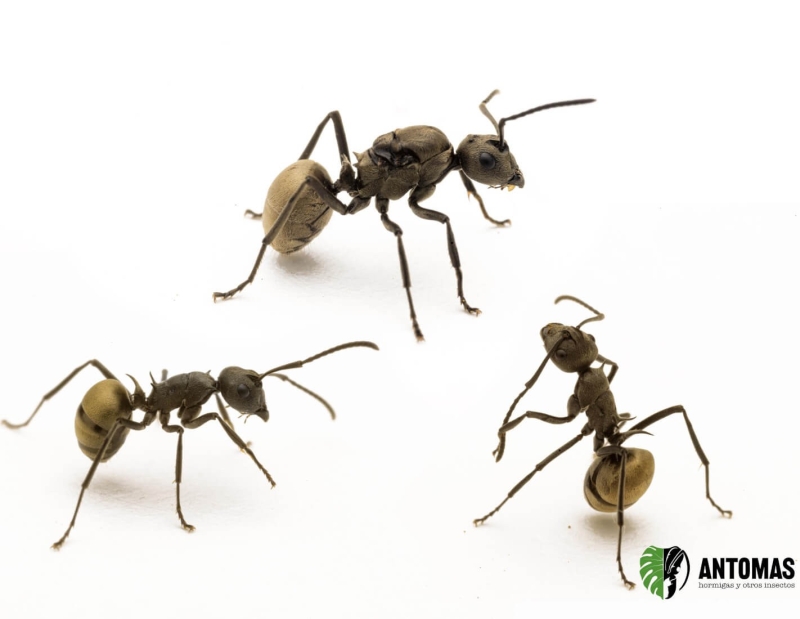
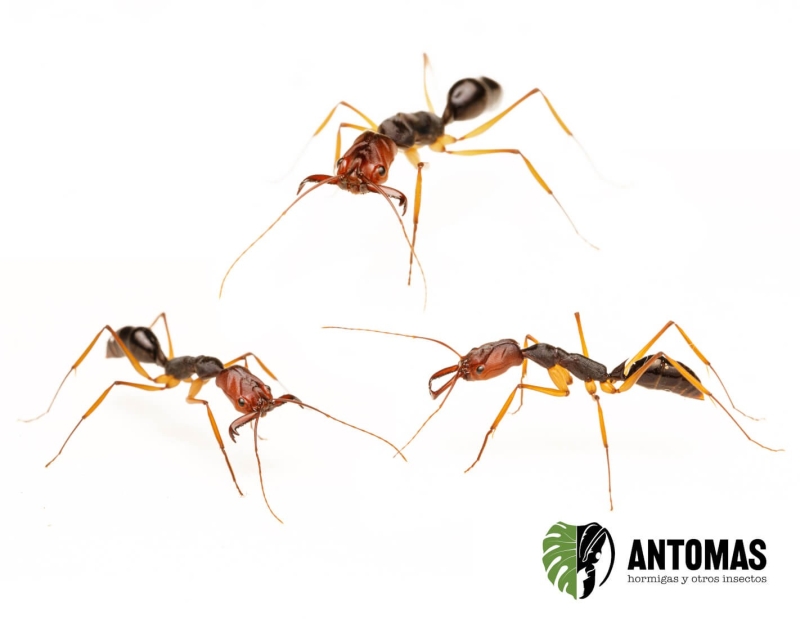
Put them side by side and it is obvious they are different ants: M. dentatus is one of the dark ones; M. hebraeus, one of the bicoloured ones.
Large and bicoloured: the wasmanni complex
The genus Messor is huge and, in the Near East, a real puzzle. In 2023 a team from Poland, Bulgaria and Greece reviewed the species of the instabilis group in the eastern Mediterranean and divided them into two complexes. In their list, M. hebraeus appears in the wasmanni complex, with its distribution: Israel and Palestine, Lebanon and Syria.
According to that review, what separates the species of the wasmanni complex from those of the semirufus complex is, above all, size: the largest workers have a head more than 2.8 mm wide, whereas in the semirufus complex they never exceed 2.7 mm and often stay below 2. In addition, the body is usually bicoloured and they show at least one of these traits:
- a more sculptured head, with striations that may cover the whole frons;
- no psammophore, the “basket” of long hairs under the head that other Messor use to carry sand when digging;
- small denticles on the propodeum, the rear part of the thorax, and many erect hairs on the first segment of the gaster.
These are traits of the complex, not a detailed description of the species, which has still not been published. But the colour of M. hebraeus fits perfectly: head and thorax in reddish or orange tones and a dark, shiny gaster. It is the first thing that catches your eye when you see a colony.
An ant of the Levant, between the sea and the desert
The range of M. hebraeus is small compared with that of many Messor: the Mediterranean Levant, from Israel and Palestine to Lebanon and Syria. Some catalogues also list it from Iran, where it was found in park soils in an area of moderate rainfall, but the 2023 review does not include that country, and in such a difficult genus distant records are best treated with caution.
The climate of its region is pure Mediterranean, with one peculiarity worth understanding if you want to keep it. It rains from autumn to spring, and the summer is long, dry and hot. Winters are mild on the coast and cool in the inland hills, with January averages of about 8–12 °C, rare frosts and the occasional snowfall at higher altitudes. For a harvester ant, this means that plants germinate with the rains, set seed in spring and the land has no new seeds throughout the summer. The colony’s year revolves around that spring harvest and a granary that sustains it for the rest of the time.
The flight of the first rains
There are no published data on the nuptial flights of M. hebraeus. What is known is when harvester ants fly in Israel: according to the Israeli entomologist Maya Saar, mainly in autumn and winter. The black Messor ebeninus, the most common in the country, usually flies on a sunny morning just after the first autumn rains, which in Hebrew have a name of their own: yoreh.
After months of drought the ground is as hard as concrete; the first rain softens it so that newly mated queens can dig their chamber, and such a clear signal allows every colony in the area to fly on the same day. M. hebraeus very probably follows a similar calendar but, like so much about this species, it has yet to be observed.
Claustral founding: a queen who lives off her wings
Like the great majority of Messor, M. hebraeus founds its colonies claustrally. After the flight, the queen tears off her wings, digs a small chamber, seals it from the inside and never comes out again. For weeks she raises her first generation alone without feeding outside: everything comes from her own body.
Her larder is her flight muscles, which she will no longer need and which her body gradually breaks down, and the fat reserves built up before leaving her mother nest. A classic study compared dozens of species and found that queens that found alone, like those of Messor, are heavier and carry considerably more fat than queens of species that found with the help of workers. With that reserve she feeds her first larvae with secretions and trophic eggs, and the first workers, the nanitics, are born small: the price of brood raised on a minimal budget.
Messor also have an advantage: a queen can make use of any grain within reach, and many keepers offer a few seeds to their founding queens. Once the first workers emerge, they go out to look for food and the queen does nothing but lay.
What its Negev neighbours teach us
There are no field studies of M. hebraeus, but there are of other Messor in Israel, and they show how a harvester ant works in this land:
- Seasonal specialists. In the Negev, Messor arenarius changes its diet with the season: right after the great spring pulse of seeds, its workers focus almost exclusively on a single annual grass, Stipa capensis, the most abundant at that moment. A granary is filled by exploiting abundance, not by picking at everything.
- Accidental gardeners. More vegetation grows around the nests of M. ebeninus, and in spring more seeds fall there than on the foraging trails or in areas the ants do not visit. At the same time, the workers preferentially remove certain species from the trails and reduce seed variety there: harvester ants shape both the seed bank and the composition of the plants that will sprout the following year.
- A scorpion lodger. In 2017 the first case of a scorpion living with ants was described in Israel: the tiny Birulatus israelensis, which is found only by the entrances of M. ebeninus nests and goes in and out of them without the workers attacking or hunting it. Remains of these scorpions were found in half of the twenty nests studied.
Mills on legs: how a Messor works
Each Messor looks for seeds in its own way. The major review of foraging in the genus describes everything from species that forage alone to others that lay down permanent trunk trails, true roads that branch out towards the harvesting areas. Which strategy M. hebraeus follows is unknown: in your formicarium you will see whether they march in columns or explore on their own.
Inside the nest the second part of the job begins. The large workers, their heads packed with muscle, crack and husk the grains; the small ones chew them into a mash that they feed to the larvae, and the husks end up on the refuse pile. The polymorphism of Messor, with workers of very different sizes in the same colony, is largely an adaptation to this milling work.
Cryptic species and hybrids: a complicated family
Messor are a headache for taxonomists. In 2018, M. structor turned out to be five species, one of them our M. ibericus. In Italy, M. minor and a Messor close to wasmanni, from the same complex as M. hebraeus, share nests and interbreed. And in several species, M. barbarus among them, the workers are hybrids of two lineages while the queens are not: social hybridogenesis, which has arisen at least three times in the genus. The genetics of M. hebraeus have yet to be studied.
Size and morphology
A robust myrmicine with a broad head, strong mandibles and a two-segmented petiole. In the absence of a modern description of the species, we combine the traits of its complex with what can be seen in captive specimens.
- Colour. Bicoloured: head and thorax in reddish or orange tones and a black, shiny gaster.
- Head. Broad and sculptured, with fine striations at the front, and proportionally larger the bigger the worker. In the wasmanni complex the psammophore, the beard of long hairs under the head, is often absent.
- Mandibles. Broad and with a toothed edge: the tool for holding, cracking and husking seeds.
- Thorax and gaster. The propodeum may bear two small denticles, and the first segment of the gaster clearly visible erect hairs: these are traits of the complex, not yet checked one by one in the species.
- Polymorphism. The workers form a continuous series, from small to very large, without separate castes. The largest, the majors, appear once the colony has reached a certain size.
- Queen. Considerably larger than the workers, with the bulky thorax of winged females and, after the flight, the wing scars. In the specimens seen in captivity, with the same colour pattern.
- Development. As in all myrmicines, the pupae are naked, without a cocoon: you will be able to watch each worker take shape and darken before emerging.
Approximate measurements
- Workers and queen: no published measurements for the species
- Head width of the largest workers in the wasmanni complex: more than 2.8 mm
This is the only applicable scientific figure, from the 2023 review. It is enough to place M. hebraeus among the large Messor: its majors have a wider head than any worker of the semirufus complex.
Care in captivity
Difficulty: 2/5 – Beginner
It is hardy, eats seeds that are easy to find, does not sting and is no escape artist if it has what it needs. We give it one point more than M. barbarus because you will have to see the founding through yourself and because very little has been published about it.
Why choose it? For its colours, which set it apart from almost every harvester ant in our shop; for the spectacle of a colony being born in front of you; and because every observation you note down (how long the first worker takes, when the first major appears, how it responds to diapause) is information nobody has published. And because it is a long-term investment: ant queens can live for decades, and at Antomas we have an eleven-year-old M. barbarus colony in top form.
Recommended parameters
- Temperature during founding: 24–27 °C for the queen’s test tube, stable and without sudden changes.
- Temperature with a colony: 22–28 °C in the nest, from spring to autumn, the range we use with Messor. If you use heating, keep it gentle and at one end; the nest should never go above 30 °C.
- Humidity: a moist area for the brood, never waterlogged, and a well-separated dry granary. The foraging area, dry.
- Water: all year round, in a test tube with water and cotton wool.
- Light: nest in semi-darkness and foraging area in the light, out of direct sunlight.
- Diapause: about 4 months, from November to February or early March, at 10–15 °C (see “Diapause”).
Founding: your queen with brood, step by step
The queen reaches you in her founding tube: a test tube with water at the bottom, a cotton-wool plug that holds it in and, on the other side, the queen with her brood (eggs, larvae or pupae, depending on the stage). She has no workers yet. It is the most delicate phase in a colony’s life, but also the simplest to manage, because almost everything comes down to not getting in the way.
- On arrival. Lay the tube horizontally in a quiet, warm place free of vibrations, away from radiators and sunlight. Cover it with a piece of card or a cloth so the queen stays in semi-darkness. Do not open it: the tube is already her founding chamber.
- Temperature. Between 24 and 27 °C the brood develops well. Below about 20 °C everything slows down, and that is fine: the workers will simply take longer to emerge.
- A few small seeds. Like any good Messor, the queen can eat seeds during founding. If the tube does not come with any, place a pinch of canary seed, millet or grass seed at the dry end, next to her. If any germinate or go mouldy, remove them.
- Keep an eye on the water and the cotton wool. If the water level drops a lot or the cotton wool gets dirty or mouldy, prepare an identical new tube and transfer her by tipping: open the old tube against the mouth of the new one, tilt it and let the queen and her brood pass across with the help of a soft brush. Do it calmly and only once.
- Watch without fear, but gently. You can look at her whenever you like, lifting the card for a moment without moving the tube. Queens get used to being looked at; what harms them are knocks, vibrations and temperature changes.
How long it takes. In keepers’ experience, Messor take about 6–8 weeks from egg to worker at 24–27 °C, and considerably longer in the cold. The first workers are small, the nanitics we mentioned: this is normal. If at some point you see the pile of eggs shrinking, don’t be alarmed either: during founding, queens recycle some eggs as food.
The workers arrive. With the first workers, the colony starts to need food from outside. Connect the tube to a small foraging area or open the cotton wool inside a foraging box with a barrier, and start offering varied seeds and the first protein, in very small pieces. When it has about 15–20 workers and the tube is getting too small, it is time for the formicarium.
If it arrives in autumn. If the queen reaches you close to diapause, let her spend the winter in her tube, in a cool place and without heating: that is how we do it at Antomas with young Messor queens. In spring, with the warmth, laying picks up again and the colony gets off to a strong start.
Recommended formicaria
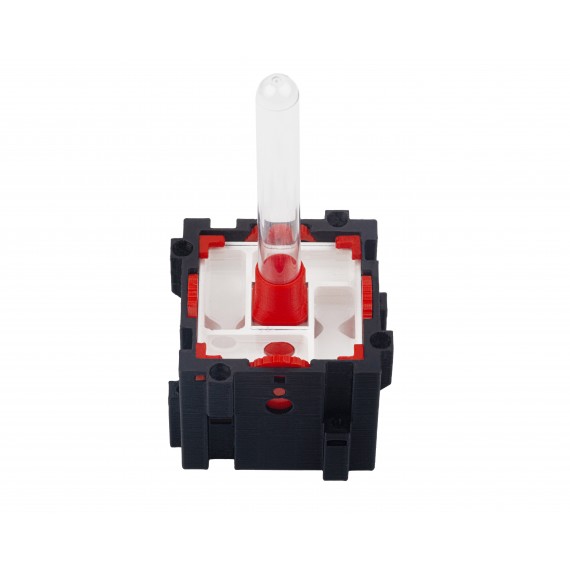
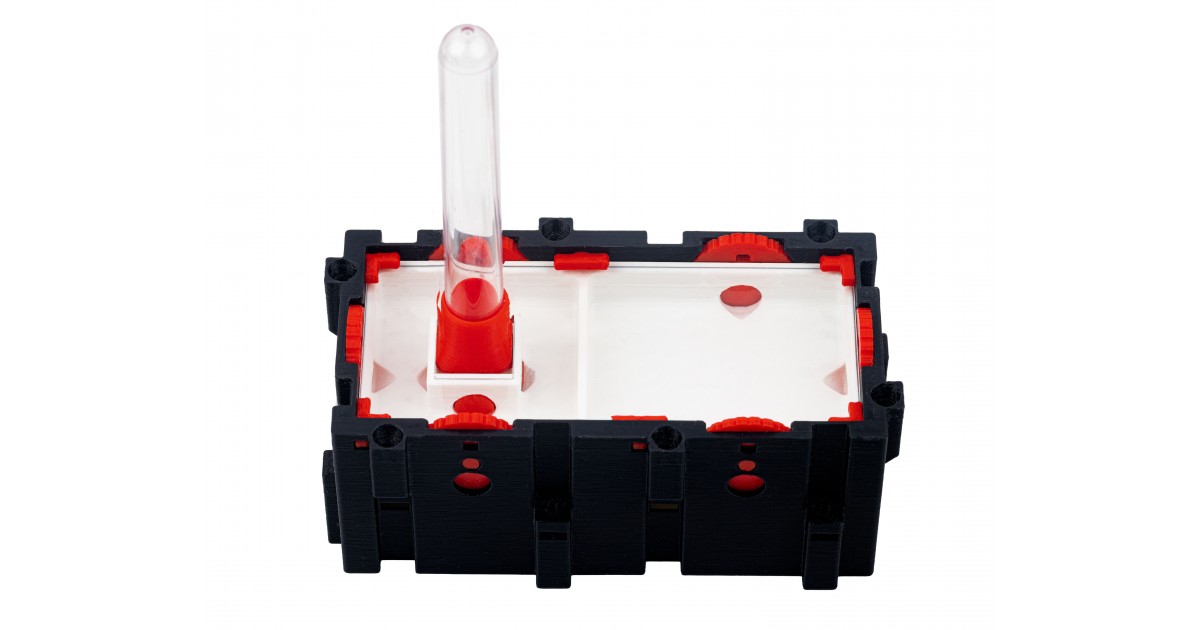
At Antomas we recommend the Qbiks of the Alpha range by Anthouse, modular and designed to grow with the colony. When the colony leaves the tube, a QBIK ONE with medium galleries is the perfect place: just the right size for the start and everything in view.
With the first majors, expand with the QBIK DUO, and always with larger galleries: the largest workers of a species from its complex need wide corridors.
No plaster, no Ytong. Messor gnaw soft materials until they destroy them, and a large colony will wreck any home-made plaster nest. Choose professional formicaria made of materials they cannot chew through.
- Granary and brood, each in its place. Moisten only the brood area. If the whole nest is damp, the seeds germinate or go mouldy.
- Water in a tube and sugar in a feeder. Sugary liquids never on cotton wool, which goes mouldy straight away; better in a feeder where the drop stays within reach.
- A large, dry foraging area, with some sand for the refuse pile and the trails.
Moving into the formicarium
At Antomas we move colonies by tipping. When the colony is ready, open the tube over the foraging area or over the entrance of the QBIK ONE and tip out the queen, the workers, the brood and the seeds with gentle taps, helping the stragglers with a brush. Keep the nest area in semi-darkness and the moist area ready: within a few hours they will have taken over their new home. Later expansions are done the same way.
Feeding
Seeds, of every kind. It is a harvester ant and seeds are its staple: canary seed, millet, oats, wheat, barley, grass seed, linseed, sesame or bird-seed mixes, always untreated, unsalted and unroasted. At first, small or soft seeds that tiny workers can open; once there are majors, hard ones too. Vary the mix from time to time: in the wild, its neighbours switch seeds with the season.
- Place the seeds in the foraging area, away from the cotton wool and the moist area, and let the ants store them in the granary themselves.
- Remove germinated or mouldy seeds and empty the refuse pile from time to time.
Protein, the more the better. Seeds keep the colony going, but what makes it grow is protein: the queen needs it to lay and the larvae to develop. For a newly founded colony, Thermobia domestica is the ideal prey, because of its size and because it is soft; as the colony grows, alternate crickets, Dubia roaches, red runner roaches and mealworms, switching insect from one week to the next so they don’t always eat the same thing. At Antomas we also give them animal protein such as chicken or tuna, preferably cooked. If they have not eaten it within 24–48 hours, remove it.
Feed generously. The more food they have, the more and the faster they grow: the colony senses that resources are available and raises more brood. If you check the formicarium daily and remove leftovers, overfeeding is the best strategy. If you will not be able to clean often, adjust the portions, because forgotten protein brings mould and mites.
Sugar, only as a supplement. For a granivore, sugar is an extra. You can offer the Blue Sugar nectar by Anthouse in a feeder, alternating it now and then with another nectar: at Antomas, with Messor, once or twice a month. Never thick honey, in which they get stuck.
Water: the tube with cotton wool, always full. It is the one thing that must never be missing.
Diapause
Diapause is part of its cycle, even though the Levantine winter is milder than that of inland Spain. That is why at Antomas we recommend a shorter, milder diapause than for M. barbarus: about 4 months, from November to February or early March, with the colony at 10–15 °C and always below about 18–20 °C. There is no need for intense cold or to go below about 8 °C, and it must never freeze.
- Gradual drops and rises, over a couple of weeks, without sudden changes.
- An unheated room, a covered terrace in mild areas or a cool storeroom is usually enough.
- Water at all times. They will eat very little, almost only from the granary, but the tube must never be missing.
- No protein. During diapause they do not take it and it only breeds mould.
You will know it has entered diapause because it comes out less, loses interest in protein and the pupae disappear. Do not shorten it to make the colony grow faster: respecting its rest is the best way to keep a healthy queen for many years.
Behaviour in captivity
A tidy home. Within a few days you will see the colony divide up the nest: the brood in the moist part, the seeds in the dry granary and, outside, a refuse pile of husks, leftovers and dead workers. It is one of the finest sights harvester ants offer.
Defenders of their territory. They are not hunters, but in Antomas’s experience a mature colony swarms in a group onto any insect that invades its foraging area, and the threat ends up as protein. So don’t merge colonies or connect two Messor formicaria to each other.
Fighting queens. In mature Messor colonies kept at home, princesses sometimes appear that, with no flight possible, shed their wings and stay in the nest working as workers, with unusual aggressiveness; the workers themselves often finish them off if they are of no use. In Messor we know this from keepers’ experience; in leaf-cutter ants it is documented that wingless virgin queens take on worker tasks and defend the nest more aggressively. We explain it in depth in the M. barbarus care sheet. If they appear, let the colony decide.
Made to be watched. A colony is there to be enjoyed, observed and learned from. With the nest in semi-darkness and the foraging area lit, watch them gently: they quickly get used to your presence, and with their colours they look like few others.
Warning signs: a queen wandering outside the nest usually points to a lack of water or an unsuitable nest; mould in the granary, moisture in the wrong place; and many deaths in a short time, a problem with water, temperature or food leftovers.
Escapes and handling
Hardly escape artists. In Antomas’s experience, Messor only look for a way out when they lack food, water or space. They are not good climbers, and a barrier of paraffin oil or PTFE on the rim of the foraging area works very well. Do check plugs, seals and any soft parts, though: whatever they can bite, they eventually chew through.
Handling. In practice they don’t sting, and a major’s bite is no more than a pinch. To tip them or to clean, use a soft brush or soft tweezers, taking special care with the queen. And never release a colony or a queen: outside the Levant, it would be an introduced species.
What not to do
- Open the founding tube unnecessarily, move it or leave it somewhere with vibrations.
- Move the colony into a large formicarium with only a few workers.
- House it in plaster, Ytong or any soft material: they gnaw it.
- Mix seeds and moisture: the granary, always away from the moist area.
- Skimp on protein or leave it for more than 24–48 hours.
- Make sugar their daily food.
- Put sugary liquids on cotton wool, open water or thick honey.
- Take away their water, not even during diapause.
- Skip diapause, let it freeze or end it abruptly.
- Merge colonies or connect different Messor formicaria.
- Heat the nest above 30 °C or leave the formicarium in the sun.
Scientific sources
This care sheet has been compiled from the scientific literature on Messor hebraeus, its species complex, the Messor of Israel and the genus Messor, and from the experience of Antomas and other keepers. Main references:
- Keller, L. & Passera, L. (1989). Size and fat content of gynes in relation to the mode of colony founding in ants (Hymenoptera; Formicidae). Oecologia 80: 236–240. doi:10.1007/BF00380157
- Keller, L. & Genoud, M. (1997). Extraordinary lifespans in ants: a test of evolutionary theories of ageing. Nature 389: 958–960. doi:10.1038/40130
- Wilby, A. & Shachak, M. (2000). Harvester ant response to spatial and temporal heterogeneity in seed availability: pattern in the process of granivory. Oecologia 125: 495–503. doi:10.1007/s004420000478
- Steiner, F. M., Seifert, B., Grasso, D. A., Le Moli, F., Arthofer, W., Stauffer, C., Crozier, R. H. & Schlick-Steiner, B. C. (2011). Mixed colonies and hybridisation of Messor harvester ant species (Hymenoptera: Formicidae). Organisms Diversity & Evolution 11: 107–134. doi:10.1007/s13127-011-0045-3
- Nicolai, N. & Boeken, B. R. (2012). Harvester ants modify seed rain using nest vegetation and granivory. Ecological Entomology 37: 24–32. doi:10.1111/j.1365-2311.2011.01331.x
- Nehring, V., Boomsma, J. J. & d'Ettorre, P. (2012). Wingless virgin queens assume helper roles in Acromyrmex leaf-cutting ants. Current Biology 22: R671–R673. doi:10.1016/j.cub.2012.06.038
- Plowes, N. J. R., Johnson, R. A. & Hölldobler, B. (2013). Foraging behavior in the ant genus Messor (Hymenoptera: Formicidae: Myrmicinae). Myrmecological News 18: 33–49. Full text (PDF)
- Romiguier, J., Fournier, A., Yek, S. H. & Keller, L. (2017). Convergent evolution of social hybridogenesis in Messor harvester ants. Molecular Ecology 26: 1108–1117. doi:10.1111/mec.13899
- Zvik, Y. (2017). First record of myrmecophily in the scorpion Birulatus israelensis (Scorpiones: Buthidae). Arachnologische Mitteilungen 54: 21–23. doi:10.5431/aramit5404
- Steiner, F. M., Csősz, S., Markó, B., Gamisch, A., Rinnhofer, L., Folterbauer, C., Hammerle, S., Stauffer, C., Arthofer, W. & Schlick-Steiner, B. C. (2018). Turning one into five: integrative taxonomy uncovers complex evolution of cryptic species in the harvester ant Messor «structor». Molecular Phylogenetics and Evolution 127: 387–404. doi:10.1016/j.ympev.2018.04.005
- Salata, S., Lapeva-Gjonova, A., Georgiadis, C. & Borowiec, L. (2023). Review of the Messor semirufus complex (Hymenoptera, Formicidae) in Greece. ZooKeys 1185: 105–142. doi:10.3897/zookeys.1185.111484