This website uses its own and third-party cookies to improve our services and show you advertising related to your preferences by analyzing your browsing habits. To give your consent to its use, press the Accept button.
Functional cookies are strictly necessary to provide the services of the shop, as well as for its proper functioning, so it is not possible to refuse their use. They allow the user to browse through our website and use the different options or services that exist on it.
Cookie
Provider
Purpose
Expiry
PHP_SESSID
antomas.es
The PHPSESSID cookie is native to PHP and allows websites to store serialised status data. On the website it is used to establish a user session and to pass state data through a temporary cookie, which is commonly known as a session cookie. These Cookies will only remain on your computer until you close your browser.
Session
PrestaShop-#
antomas.es
This is a cookie used by Prestashop to store information and keep the user's session open. It stores information such as currency, language, customer ID, among other data necessary for the proper functioning of the shop.
These are cookies that collect information about the advertisements shown to users of the website. They can be anonymous, if they only collect information about the advertising spaces shown without identifying the user, or personalised, if they collect personal information about the user of the shop by a third party, for the personalisation of these advertising spaces.
Collect information about the user's browsing experience in the shop, usually anonymously, although sometimes they also allow the user to be uniquely and unequivocally identified in order to obtain reports on the user's interests in the products or services offered by the shop.
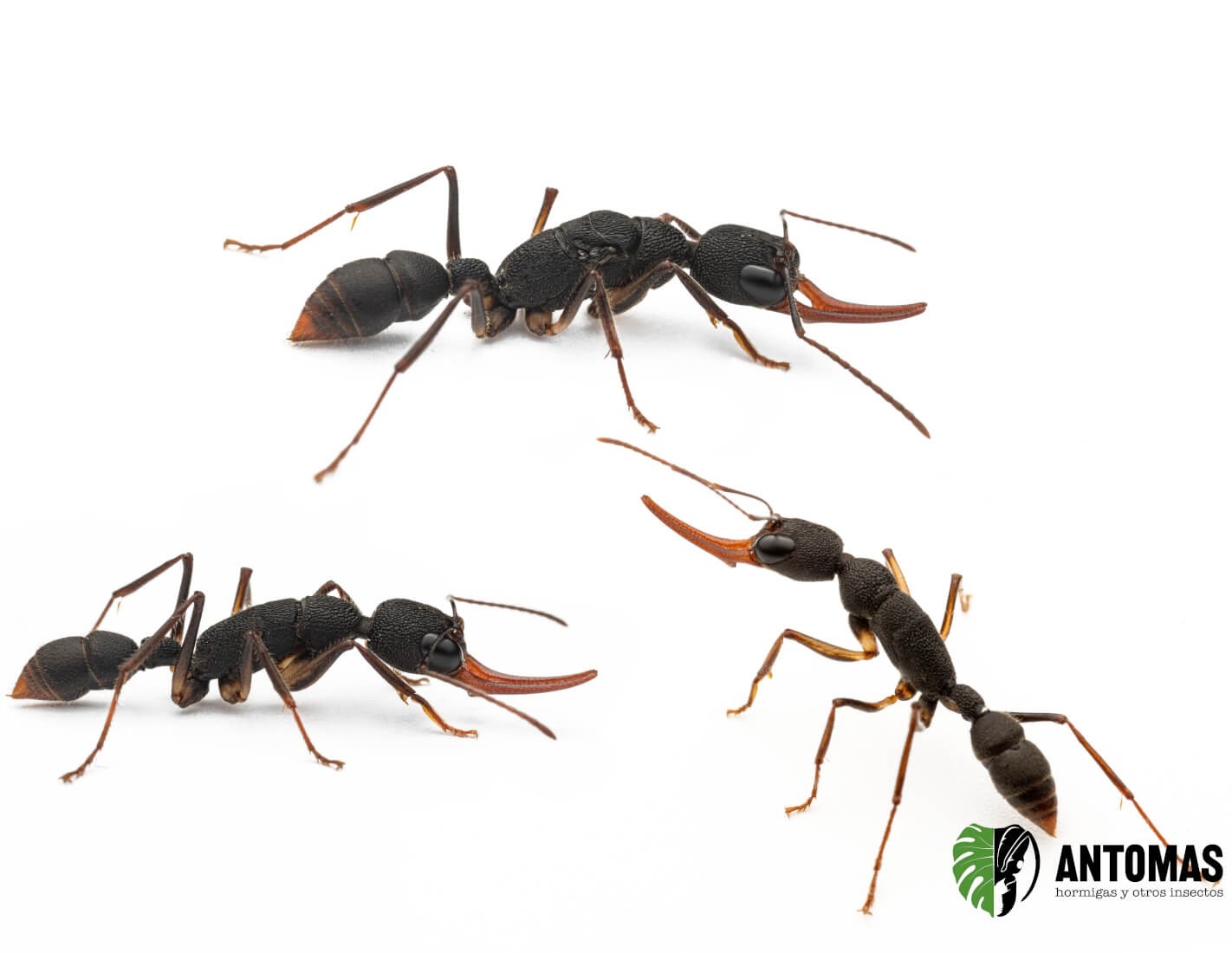
A sniper with sickle-shaped jaws. Harpegnathos venator waits motionless at the top of a branch, waggles its gaster as if adjusting its aim and pounces on its prey to paralyse it with a carefully dosed venom that does not kill. Its princesses never leave home: they mate inside the nest and reign together, several sister queens under the same roof, with mated workers, the gamergates, in reserve. It builds two-storey nests joined by a funnel and wallpapered with cocoons. A visual hunter from South and Southeast Asia, patient and fascinating, for keepers with some experience. Colonies with queen. Shipping across Europe, live arrival guaranteed.
A stalking hunter with sickle-shaped mandibles from South and Southeast Asia. Colonies with queens, often several: true winged queens; gamergates (mated, egg-laying workers) exist but are rare. 24–26 °C, 60–80 % humidity, live prey only and no diapause.
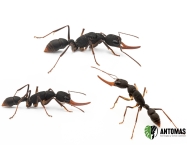
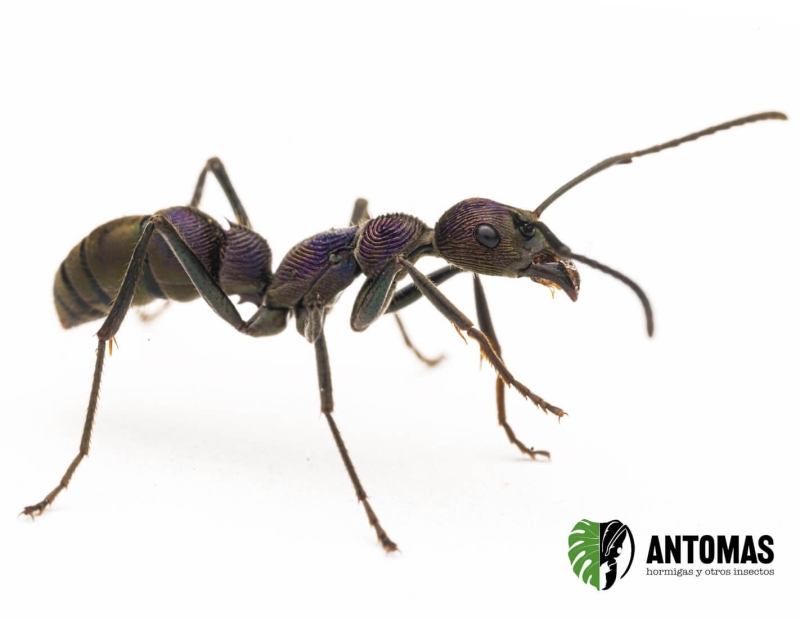
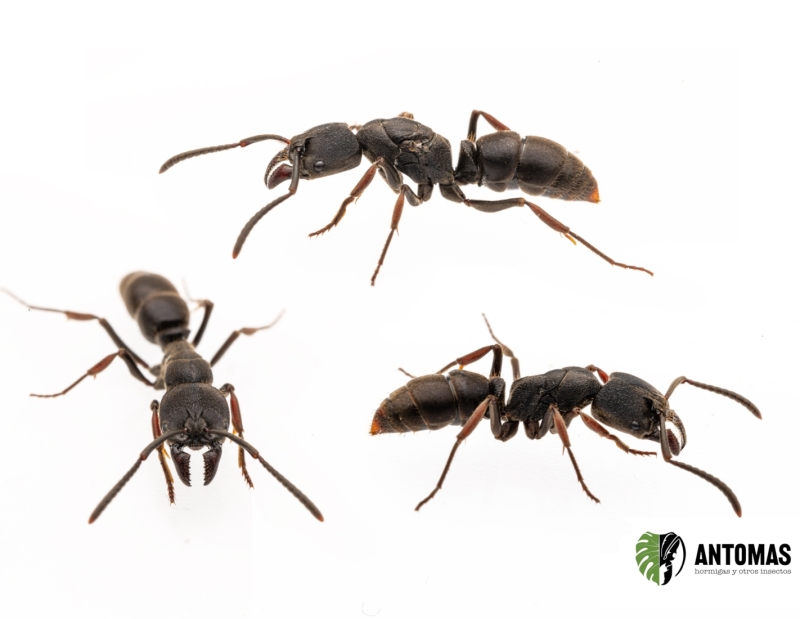
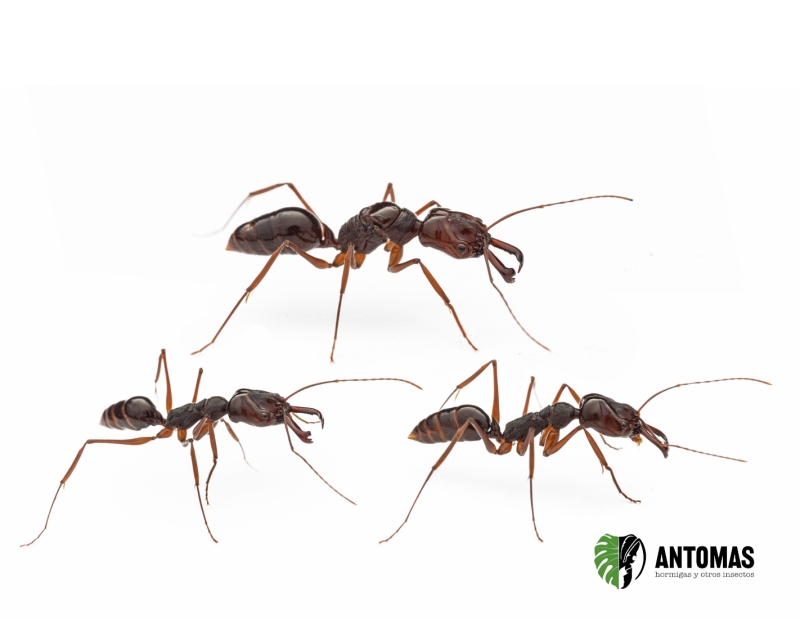
Harpegnathos venator (Smith, 1858) is a large, almost black ponerine ant from South and Southeast Asia, armed with long, curved, sickle-shaped mandibles: the genus name itself means “sickle jaw”. It is one of the most specialised solitary hunters in the ant world: it has exceptional eyesight for an ant, locates its prey by sight, stalks it motionless and pounces on it to paralyse it with a venom that does not kill. Its scientific name sums it up: venator is Latin for “hunter”.
It lives from northern India to southern China, in small colonies of a few dozen workers, and, after its Indian relative H. saltator, it is probably the best-studied Harpegnathos. Its social life is surprising: its colonies often have several queens, sisters that mate inside the nest and stay at home, and, now and then, a gamergate, a mated worker that lays eggs. Antomas colonies come from different parts of its range: Vietnam, Thailand and China.
As many people arrive at this page wondering who lays the eggs in a Harpegnathos colony, that is where we start.
Biology
Queens, gamergates or ergatoid queens?
It is the question we are asked most about this species, and all three answers circulate in the hobby. The short version: in H. venator, reproduction is mainly carried out by true winged queens, often several per colony; gamergates exist but are rare; and ergatoid queens, none at all. Let us take it step by step.
True queens. The H. venator queen is born with wings and with all the thoracic parts needed for flight. In Hong Kong, Crosland found newly emerged virgin queens in summer, all with fully developed wings and none with reduced ones, and concluded that they are queens, not ergatoid queens. After mating they shed their wings, and they then look very much like a worker (see “A queen almost identical to the worker”).
What is a gamergate? A gamergate is a mated worker that lays eggs and acts as the colony’s reproductive. She has no wings and never had any, she does not have a queen’s body and, from the outside, she is just another worker; the difference is inside: she has mated and her ovaries are active. The word comes from the Greek gámos, “marriage”, and ergátēs, “worker”: literally, “married worker”. It was proposed by the myrmecologist William L. Brown and first published by Peeters and Crewe in 1984; four years later, Peeters and Crozier defended it with an argument that says it all: not all mated, egg-laying females are “queens”.
Gamergates in H. venator: yes, but few. A field study in Thailand, published in 2022, found mated workers in many colonies that had a queen, but very few of them laid eggs. Only 14 % of colonies had no queen, and even in those only a small proportion of the mated workers laid: the species reproduces mainly through mated queens, and gamergates are the back-up system. And the same team’s study on trophic eggs explicitly lists them among the reproductive females.
The ergatoid queen is something else. She is a permanently wingless queen: a queen caste with its own larval development, often more ovarioles than the workers and an appearance halfway between worker and queen (“ergatoid” means “worker-like”), which in many species replaces winged queens. She should not be confused with a winged queen that has shed her wings, nor with an intercaste, an anomalous intermediate form that appears sporadically and hardly ever reproduces. No ergatoid queens are known in H. venator: its queens are born winged.
Three ants, three systems. In its Indian relative, H. saltator, colonies with a queen have only one, gamergates are common and, in southern India, around half of the colonies studied were running without a queen, on gamergates alone. In Diacamma, by contrast, there is no queen caste and only gamergates reproduce. H. venator sits at the other end: queens, very often several, and gamergates in reserve.
Why is it so often confused? Because at first sight a dealate queen, a gamergate and a worker of H. venator look very much alike: the queen weighs only 1.4 times as much as a worker. Because terminology has changed over the years, and in the hobby “gamergate” and “ergatoid queen” have been used almost as synonyms. And because it is easy to attribute the system of H. saltator, the most famous one, to the whole genus; in fact, some European shops make a point of saying that their colonies come with a “true queen, not a gamergate”. Antomas colonies come with a queen: one, two or four, depending on the option you choose.
Princesses who never leave home
In many ants, the princesses (young queens, still virgin) leave the nest on a nuptial flight, mate far from home and found their own colony. In H. venator, many do not leave. In Thailand, 85 % of colonies had mated dealate queens; more than half of them had several, and almost all of those were laying eggs. Many of these queens were clearly young, and many colonies also housed dealate queens that were still virgin. Everything points to daughters staying in their mother’s nest, what specialists call secondary polygyny, rather than queens founding together. In Hong Kong, 5 of the 26 colonies excavated by Crosland had two queens.
And who do they mate with? In the laboratory it has been observed that winged queens and workers mate inside the nest with brother males, and that the queens then shed their wings and stay. Another oddity observed in the laboratory: newly emerged queens are often attacked by the workers, but over time they shed their wings and end up hunting and caring for the brood as if they were workers.
Why stay? The researchers’ hypothesis is about space. H. venator nests in banks of bare soil, and in Thailand very few of the apparently suitable sites were occupied, as if good nesting sites were scarce. With few places to settle, inheriting the nest pays off. H. saltator, which lives on floodplains, an unstable habitat, would benefit more from dispersal by flight. That does not mean H. venator never flies: Crosland saw winged males and females, depending on the season. What nobody has studied is colony foundation by a single queen: shops talk about semi-claustral foundation, with the queen going out to hunt, but there are no scientific data, and foundation by several queens together has not been documented.
Trophic eggs: a menu reserved for royalty
Ants do not only lay eggs to raise brood: many species also lay trophic eggs, “food eggs” that never develop and are eaten. In H. venator, a 2022 study found that they are laid by the non-reproductive females: virgin workers, virgin queens and mated workers that do not lay fertile eggs. And it discovered something curious: all of them were eaten by mated queens or gamergates. A menu reserved for royalty.
It is no feast: each female lays, on average, one trophic egg every two days and five and a half hours (0.0187 eggs per individual per hour), and the reproductives feed on both prey and trophic eggs. Their value as food seems small, and it has been suggested that their real function is to keep the ovaries of the back-up layers primed (this is a hypothesis). It fits with what has been seen in the laboratory: when the queen is removed, the females that were laying trophic eggs quickly switch to laying reproductive eggs. A colony ready to cover any loss.
A queen almost identical to the worker
In many ants, the queen is much larger and heavier than her workers. Not in H. venator. Crosland weighed, dry, 10 queens and 100 workers from Hong Kong: the queen weighs 16.5 mg on average and the worker 11.5 mg; that is, only 1.4 times more. For Crosland, this minimal queen–worker dimorphism is a primitive trait.
What does set them apart is the thorax: the queen’s, built for flight, is about 2.25 mm wide and the worker’s about 1.67 mm, with no overlap between the ranges. Bingham described the queen in 1903 as very similar to the worker, with a sturdier thorax and gaster, the ocelli (the small simple eyes) in the middle of the forehead and a gaster with long, elongated punctures. So, in your colony, you will recognise the queen by her broader thorax and her wing scars rather than by her size.
A two-storey nest joined by a funnel
Crosland excavated 26 nests in Hong Kong in 1992 and 1993, and all of them followed the same design: two disc-shaped chambers, slightly domed in the centre, one above the other (only one colony, of 59 workers, had a third, irregular chamber). The only connection between them is a funnel about 2 cm across, with an opening of just 5–8 mm, which opens about 2 cm above the floor of the lower chamber, with its rim turned upwards. Workers and queens spend almost all their time in the upper chamber, gathered in small “alcoves”.
The entrance is just as unusual: a chimney about 3 cm across that sticks out 1–4 cm from the bank, with a narrow central opening that stays open all year round (the entrance that is closed at night is that of H. saltator). Why such a funnel? Crosland suggests that the upper chamber helps the ants escape predatory arthropods that get into the nest, and it has even been speculated that the ants reach the funnel opening by jumping, something nobody has checked.
In Thailand, the design is repeated: a chimney entrance with a funnel about 3 cm across, and two or three chambers, often one above the other. An architect’s blueprint that the species repeats in places thousands of kilometres apart.
Chambers wallpapered with cocoons and a rubbish dump in the basement
Inside, the Thai nests were even more carefully kept: chambers with flat, smooth floors, with floors and walls “wallpapered” with cocoon fragments, and, below, a smaller chamber with an irregular floor that served as a rubbish dump. It is the same trick known in H. saltator, which lines its walls with strips of empty cocoons and other debris, perhaps to keep the nest dry (this is a hypothesis), and which also takes its rubbish to a separate chamber.
At home there is no need to reproduce this architecture: in the laboratory they live perfectly well in plaster nests, although their larvae do need a little fine substrate for their cocoons (see “Recommended formicaria”). What is worth copying is their tidiness: rubbish away from the brood, and removed often.
A sniper that waggles its gaster
At Antomas we see it every day: in the moments before the attack, the worker makes an excited movement of the gaster, like a sniper adjusting the aim before taking the shot. Its stalking style is more reminiscent of a vertebrate predator than of an ordinary ant.
In 2021, a Chinese team described its hunting step by step, and that gesture is the first phase:
The worker stays still, waggling its gaster, facing the prey.
It jumps and seizes the prey with its mandibles.
It curls its body into a C and drives in its sting.
After about 10 s it stops stinging and carries the prey to the nest.
Sometimes it changes tactics: it waggles its gaster, touches the prey with its antennae and decides whether to attack or walk away. It hunts mostly alone, although some simple group hunting has been seen when prey is abundant. Exactly what the gaster movement is for remains unclear. Nor is it known at what time of day it hunts in the wild: the tests were done in the morning, and the “crepuscular” label found in some shops has no scientific basis.
Venom à la carte: they dose their sting
The venom of H. venatorparalyses without killing: the stung cockroaches were left completely motionless. But they do not always sting in the same way. Nie and colleagues found that they sting larger and more active prey for longer, and that, over a 48-hour follow-up, cockroaches stung for 13–20 s took longer to recover than those stung for 0–9 s.
Their interpretation: the workers dose their venom according to the prey, without wasting a single drop, and perhaps in this way they can store live prey, paralysed and “fresh”, for the colony (an inference by the authors). It fits with what we see at Antomas: the prey does not die, and the colony has fresh food for longer.
Dead prey? No, thank you
The same study offered the workers cockroaches killed with boiling water: they did not attack them. And cockroaches without legs, which could not move, received only very short stings. What triggers their hunting instinct is movement. That is why they preferred small or medium-sized, very active nymphs, of about 0.6 and 1.2 cm, over large adults of about 2 cm.
A detail we love: one of the prey species they had most contact with was Blatta lateralis, the red runner cockroach, which many keepers know as Shelfordella lateralis and which is our favourite for feeding them (see “Feeding”). The other was the rice grasshopper, Oxya chinensis; and the prey they carried back to the nest most often were cockroaches and crickets.
This is the scientific basis for what we have always said at Antomas: feeding only dead prey is usually ineffective and can even be harmful to the colony, because they often do not even recognise it as food.
Harpegnathos venator in a video by Anthouse.
Double-rowed mandibles that inspire robotic grippers
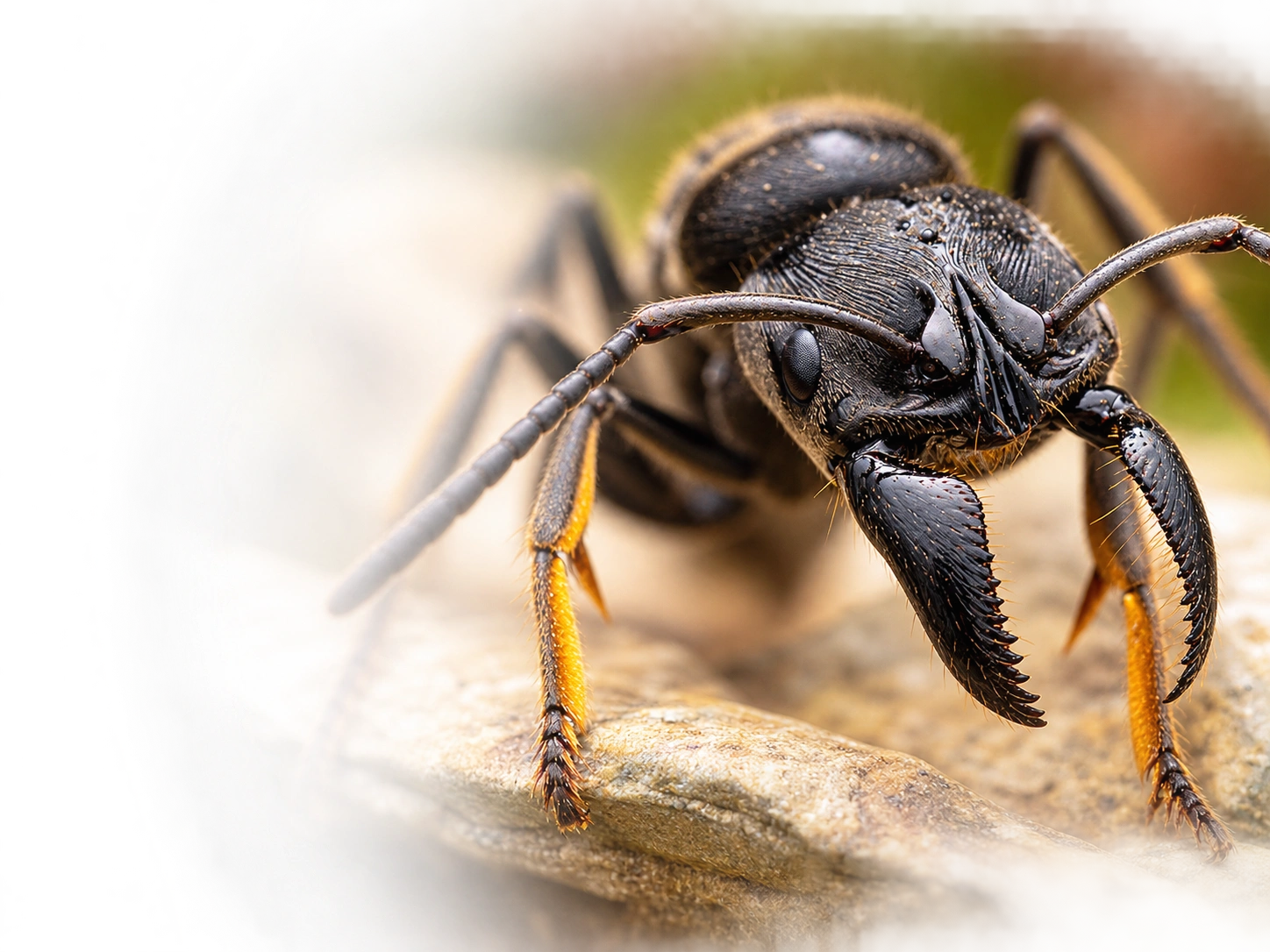
The mandibles of H. venator are long, curved like a sickle and, seen up close, a small feat of engineering. A team of Chinese engineers studied them in 2020 and 2021: they have a double row of teeth along the middle and the tip, which grips the prey firmly and steadily, and, at the base, a smooth concavity used to carry eggs without damaging them; they can also rotate around two perpendicular axes. The authors present them as a design specialisation and propose them as a model for building robotic grippers.
In Antomas’ experience, the same mandibles that hold a kicking cricket also allow precise handling of eggs and larvae inside the nest. And although they might seem to get in the way, they do not stop the ants from drinking: they drink from the damp cotton of a water tube without any problem.
Hong Kong’s “Jumping Ant”: shy and unhurried
In Hong Kong, a 1982 book on the region’s insects presented it as “The Jumping Ant”. And it does jump, but not as you might expect. Bingham wrote in 1903 that Harpegnathos make astonishing leaps when frightened, but do not usually jump to get around. In its relative H. saltator, jumps of about 2 cm high and 10 cm long have been measured, powered by the middle and hind legs at the same time; there are no studies of jumping in H. venator.
In Antomas’ experience, they find it hard to jump upwards: their strategy is to climb a wall or a branch and pounce on the prey from above, like a predator lying in ambush. That is why it is worth giving them branches or decoration in the foraging area: it is their favourite way of hunting and a wonderful sight.
And their temperament? Crosland described the workers as remarkably timid and slow-paced. Nothing like the image of a fierce predator: it is a patient hunter that watches a lot before acting.
A name with a history: from Drepanognathus to Harpegnathos
Frederick Smith described it in 1858 as Drepanognathus venator, from a worker in the British Museum labelled “Madras” (now Chennai) and donated by a certain “Mrs Capt. Hamilton”. Smith created the genus Drepanognathus because he believed the name Harpegnathos was already taken, which was not necessary. For half a century the species moved back and forth between the two genera: Roger and Emery moved it to Harpegnathos, Mayr and Dalla Torre returned it to Drepanognathus, and Bingham was still calling it that in 1903. That is why the author’s name goes in brackets: (Smith, 1858). And the type locality holds a small mystery: Bingham marked it with a question mark, because all his other records were from northern India and Burma.
Two subspecies have been described, neither revised with modern methods:
H. venator rugosus (Mayr, 1862), described from a queen from Hong Kong collected during the Austrian frigate Novara expedition.
H. venator chapmani Donisthorpe, 1937, from Mount Makiling (Luzon, Philippines): a “black variety” based on a specimen that Wheeler and Chapman had misidentified as rugosus in 1925, and whose holotype could not be located.
It is not known which subspecies the colonies in the trade belong to; they are all sold as H. venator (those from Hong Kong would, in principle, fall under rugosus).
And the names? Harpegnathos combines the Greek hárpē, “sickle”, and gnáthos, “jaw”: “sickle jaw”, after those long, curved mandibles. In Chinese it is called 猎镰猛蚁, roughly “sickle-jawed hunting ponerine”, and in Japanese the genus is クワガタハリアリ, the “stag beetle ponerine”, after mandibles that recall those of that beetle.
From India to southern China: an ant of earth banks
H. venator has a wide distribution: northern India (Dehradun, Sikkim, Assam), Nepal, Bangladesh, Myanmar, Thailand, Laos, Vietnam and southern China, from Yunnan to Hong Kong and Macao, via Guangxi, Guangdong, Fujian and Hainan. Records from Malaysia, Singapore or Borneo are doubtful (they may be other species of the genus), and in the Philippines only the subspecies chapmani has been recorded. Of the roughly 300 observations gathered in GBIF, more than half are from Hong Kong.
Its habitat is very specific: banks of bare soil. In Hong Kong, Crosland found its nests in steep clay banks along footpaths, in partial shade, in a mixed forest replanted since 1945, with some moss and ferns. In Thailand, in road-cut banks. In Vietnam, where it is considered rare, at forest edges and in open forest, with a nest next to a dirt track. And in Myanmar, Bingham recorded it at Maymyo, at about 900 m above sea level.
Its colonies are small: in Hong Kong, 8 to 72 workers, with an average of 35; the colonies from Guangxi studied in the laboratory had one queen, 15–30 workers and 4–8 larvae. The figures of “200–400 workers” given by some shops have no scientific backing. The genus includes nine species, from India to the Philippines and Java; at Antomas we also have its Indian relative, H. saltator, and the Philippine H. honestoi.
The climate of its home: monsoon in summer, winter depending on origin
Its range is wide, and so is its climate: it stretches from southern China and Hong Kong to northern and central Vietnam and northern Thailand. The official climate normals for Hong Kong, Guangzhou, Nanning, Qinzhou, Hanoi, Hue and Chiang Mai paint this picture:
Summer (May–September). Very similar across the whole range: averages of 27–29 °C and highs of 31–35 °C, with the monsoon bringing heavy rain and high humidity. Hong Kong receives about 2,430 mm a year, more than half of it between June and August, with relative humidity of 81–83 % at the height of summer.
Winter (December–February), depending on origin. In southern China, Hong Kong and Hanoi there are 3 to 5 months with averages below 20 °C, and Januaries averaging 13–16 °C, with nights of 10–15 °C. In Chiang Mai (northern Thailand) and Hue (central Vietnam), on the other hand, there is no real winter: the average does not fall below about 20–22 °C, and only the nights cool down, to 16–18 °C; in Chiang Mai, winter is also dry.
Spring and autumn. April and October, with averages of about 23–26 °C across almost the whole range, are the months closest to the 24–26 °C we recommend at home.
Day length changes little: about 11 hours in winter and about 13 hours in summer.
And its nest softens that climate even further. In Hong Kong, Crosland found its nests in clay banks in the partial shade of the forest, and in Thailand, in roadside banks; in that soil, which holds the monsoon moisture, summer heat and winter cool arrive dampened (this is an interpretation: the temperature inside their nests has not been measured). That is why a damp plaster nest and stable temperatures suit it so well at home.
Size and morphology
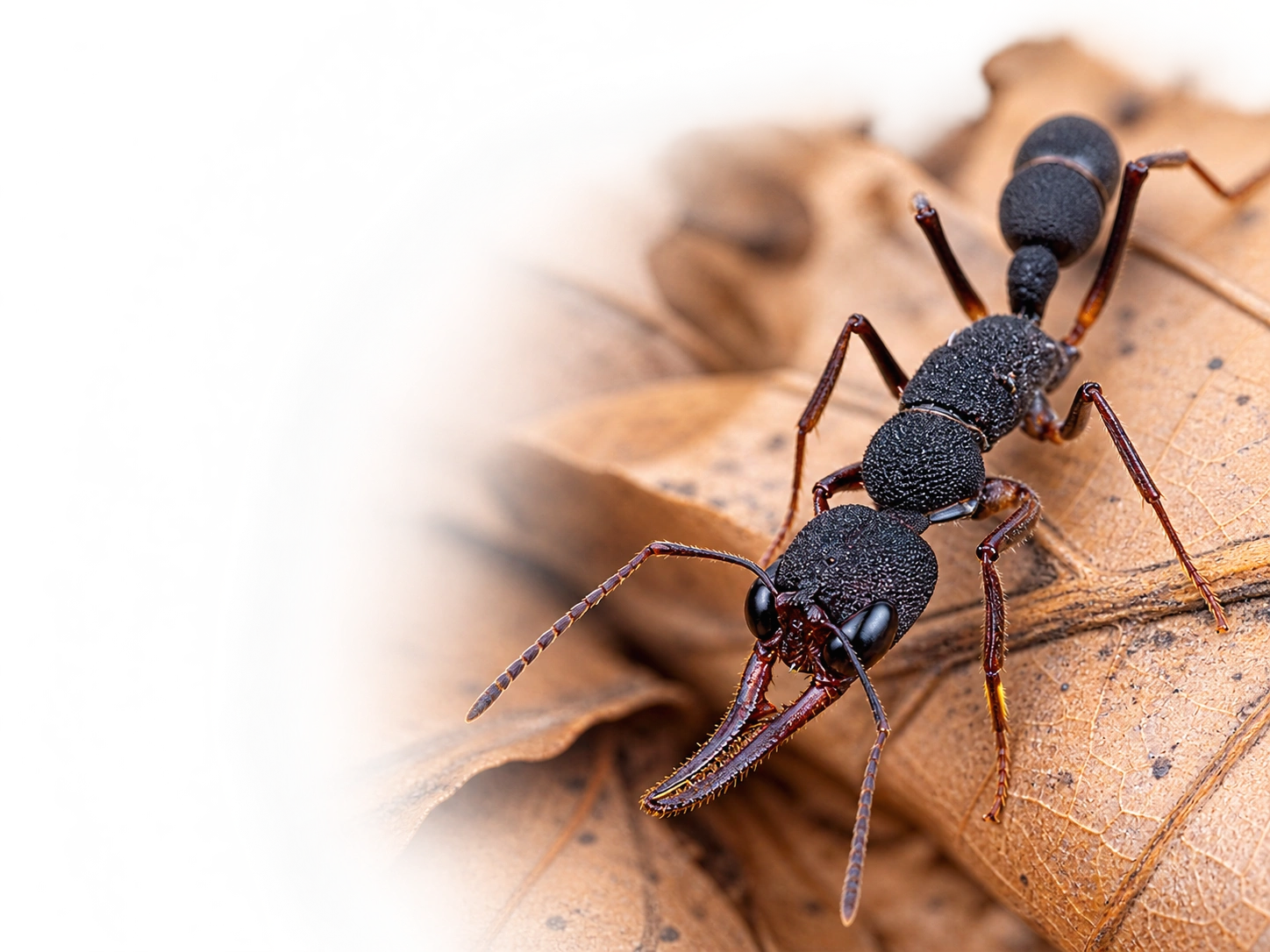
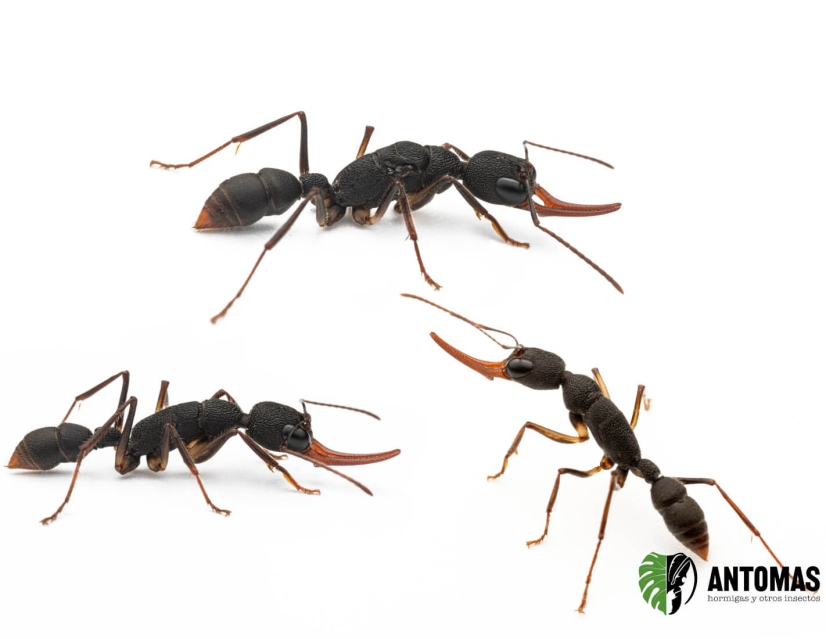
A large, slender ponerine, with long sickle-shaped mandibles, large eyes, an elongated thorax and long legs.
Colour. According to Bingham (1903), the worker is black, with the mandibles, clypeus, antennal carinae and legs brownish yellow, the antennae chestnut and the tip of the gaster reddish. In life, its long mandibles stand out with a rusty-brown tone against the black body.
Sculpture. Head and thorax coarsely and densely punctured, like a sieve; gaster finely reticulate-punctate and matt; pale, short, erect and sparse hairs.
Compared with its relatives.H. saltator has a reddish head, thorax and petiole and a black, smooth, shiny gaster; H. honestoi has an orange head and front of the thorax, and a striated head. H. venator is almost entirely black, with a punctured head and a matt gaster.
Mandibles. Long, curved and sickle-shaped, with a double row of teeth and a concavity at the base for carrying eggs (see “Double-rowed mandibles that inspire robotic grippers”).
Eyes. Large, at the front corners of the head: it is a hunter guided by sight, and its eyesight is exceptional for an ant.
Sting. Functional, with a venom that paralyses prey without killing it.
Queen. Born winged, with the full thorax of a flyer, she sheds her wings after mating. She is very similar to the worker, slightly larger, with a sturdier thorax and gaster and the ocelli in the middle of the forehead, and weighs only 1.4 times as much as a worker. She can be recognised by her broader thorax and her wing scars.
Gamergate. From the outside, a worker: she has no features that set her apart.
Male. Smaller, winged, with mandibles that are broad at the base and taper to the tip, not sickle-shaped; a rectangular head, broader than long (in H. saltator it is longer than broad); eyes smaller than the queen’s; thorax and petiole blackish brown, and head and gaster reddish yellow.
Development. As in many ponerines, the larvae feed directly on the prey and, before pupating, spin a cocoon, for which they need fine material; the workers help them by covering them with particles. According to keepers, it takes about 2.5–3.5 months from egg to worker.
Approximate sizes
Workers: 15–18 mm (Bingham gives 16–18 mm)
Gamergates: as workers
Queen: 18–20 mm
Male: about 10 mm
Thorax width: queen, 2.25 mm (2.20–2.35); worker, 1.67 mm (1.45–1.90)
The lengths are historical measurements (Bingham, 1903); the widths and weights are from Crosland (1995), based on 10 queens and 100 workers from Hong Kong. There is no modern morphometric study of the species.
Care in captivity
Difficulty: 3/5 – Intermediate
The parameters are simple: about 25 °C, kept stable, and a damp plaster nest, as in the laboratory that has studied it. The real difficulty lies in three things: high humidity at all times, stable and never waterlogged; a constant, plentiful supply of live prey, because it eats only protein; and patience, because it grows slowly and its colonies are small by nature. Shops usually rate it as “advanced”, and one even calls it one of the hardest ponerines to found; at Antomas we place it at an intermediate level: with an established colony and the guidelines in this care sheet, it is a very rewarding species.
And it is well worth it. Large black workers with sickle-shaped mandibles that follow you with their eyes, climb to the top of a branch, wait motionless, waggle their gaster and pounce on their prey. And, inside the nest, a remarkable society: several sister queens under the same roof, trophic eggs reserved for royalty and, who knows, perhaps a gamergate. A species small in numbers and huge in behaviour.
Recommended parameters
Temperature: 24–26 °C, stable. The laboratory that studied it kept it at 24 ± 2 °C, and keepers usually work between 24 and 28 °C. Across its range, summers average around 27–29 °C, and in part of it winter is cool (see “The climate of its home”); at Antomas we keep it at a constant temperature all year round, 24–26 °C.
Nest humidity: 60–80 %, high at all times and stable (in the laboratory, 70 %).
Foraging area: somewhat drier than the nest, with light and with water always available (a test tube with water and a cotton plug).
Nest type: made of natural materials that hold and spread humidity, ideally plaster. This is not a species for dry nests, nor for acrylic nests without a good hydration system.
Light: it is enough to give them their dark area in the nest and a lit foraging area; in the laboratory a cycle of 14 hours of light and 10 hours of darkness was used.
Diapause: none (see “Diapause”).
This species needs high humidity at all times, and stable humidity, because it is sensitive to sudden changes: letting it dehydrate is quite a serious mistake. A nest that dries out while the larvae are growing fast leads to failed moults and dead larvae; a waterlogged one soaks the cocoons, which then fail to open, and brings mould and mites. The rule of thumb from the laboratories that keep Harpegnathos: damp plaster, “not looking dusty to the touch”, but able to absorb all the water you add, watered with deionised water (at home, distilled water), because salts reduce how well the plaster absorbs water. Good ventilation helps to prevent mites.
Recommended formicaria
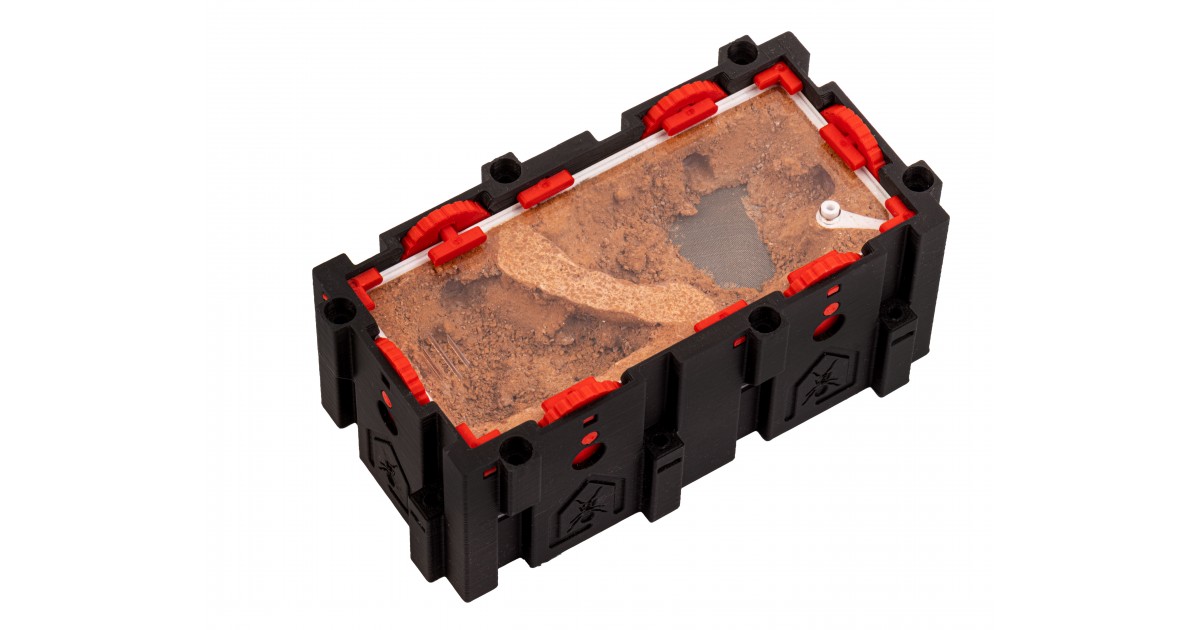
At Antomas we recommend the Qbik Wild range by Anthouse, made of plaster, and especially its hybrid version: a lower evaporation reservoir, separate from the galleries, passes humidity through a mesh (with activated carbon so the water does not stagnate), and it is completed by a side drinking tube. The right format is the Duo: the Qbik Wild Duo P 2C Hybrid, designed for large ants.
As alternatives, the same range with the evaporation system (the water never touches the chambers) or with the standard system (refillable water tube):
A large foraging area, ideally with a ventilated lid: with this species, a good hunting area matters more than the size of the nest. For reference, in the laboratory a box of 20 × 12 × 7 cm was enough for a colony of 15–30 workers.
Branches or decoration in the foraging area: they love climbing them, or the walls, to jump on their prey from above. It is their favourite way of hunting and a wonderful behaviour to watch.
Fine substrate in the foraging area and in the nest (coconut fibre, sawdust or fine soil, ideally sterilised for a few days in the freezer): the larvae need it to spin their cocoons, and the workers help them by covering them with particles.
Water always available: for long-jawed species like this one, at Antomas we recommend a test tube with water and a cotton plug in the foraging area; they drink from the cotton without any problem.
Roomy chambers, and never house them in test tubes: with their long mandibles, they find it hard to turn round in narrow spaces. In the wild they live in wide, disc-shaped chambers.
Colonies with one, two or four queens
At Antomas we sell H. venator colonies with one, two or four queens, depending on the option you choose. Having several queens is natural for this species: in Thailand, more than half of the colonies with a queen had several, almost all of them laying eggs. Colonies with several queens generally come already formed like that. That said, we cannot guarantee that every queen is fertile and laying, and that too is natural: in the wild, many colonies have, alongside their mated queens, a dealate queen that is still a virgin (see “Princesses who never leave home”), and not every mated queen is necessarily laying. What matters is that the colony has laying queens, and you will see that in the brood. And one rule with no exceptions: queens and colonies cannot be merged. Do not try it, not even with queens of the same species bought separately.
Do not be surprised to see a queen outside the chamber or even hunting: in the laboratory it has been observed that young queens, once they have shed their wings, sometimes work like workers. To recognise them, look at the thorax, which is broader, and at the wing scars.
Gamergates at home. They can appear, although less often than in H. saltator: in the wild there are mated workers in many colonies with queens, but they hardly ever lay while there are laying queens. If one does appear one day, you will be watching something considered rare in this species.
If the colony loses its queens, do not rush: wait and see whether a mated worker takes over, or whether males hatch and mate with a worker. In the laboratory, when the queen is removed, the females that were laying trophic eggs quickly switch to laying reproductive eggs. Only if there are no mated workers and no males hatch would the new layers produce nothing but males, because unfertilised eggs always produce males (this is a deduction). And if in doubt, ask us: we will be happy to help.
Arrival. Place the colony somewhere quiet and at a stable temperature, with its dark area in the nest, and offer water straight away: after the journey they often arrive thirsty. The first few days are the most delicate: they may be skittish and huddled together, but with their good eyesight they soon adapt. Remove any workers that died during the journey. To move the colony into its formicarium, at Antomas we do it by tipping it in: we tip the colony into the new formicarium.
Patience. It takes about 2.5–3.5 months from egg to worker, and in the wild its colonies average around 35 workers. With plenty of food they can grow larger, but do not expect a formicarium with hundreds of workers in a short time: their charm lies in quality, not quantity.
Feeding
This species eats only protein: no sugar or nectar. Most keepers agree that it does not accept sugar water or honey.
At Antomas we recommend feeding it at least 3–4 times a week, mainly with live prey: crickets, cockroaches and flies of a size they can overpower, ideally small or medium-sized, active nymphs of about 0.5–1.2 cm. Our favourite is the red runner cockroach (Shelfordella lateralis), which carries less risk of mites, to which this species is sensitive; it is also one of the prey the workers had most contact with in the study of their hunting. Keepers also use jumping spiders, winged termites, moths or fly larvae. Change the type of insect from one week to the next, so they do not always eat the same thing.
Why live? Its venom paralyses without killing, and the prey stays “fresh” for longer. Besides, dead prey barely arouses their interest: in the field, they did not even attack freshly killed cockroaches. Feeding only dead prey is usually ineffective and can even be harmful to the colony, and you would also miss the best part: the hunt.
They eat a lot. When hungry, the colony eats its own brood: this is one of the most common causes of failure. As a reference, in its relative H. saltator, one keeper reported that 40 workers ate more than 20 crickets a week, and that with less they did not raise brood. Adjust the amount to the brood: the more larvae, the more prey.
The more they eat, the better and faster they grow. This is the Antomas philosophy: if you do daily maintenance and remove leftovers, it is better to overfeed, because the ants understand that they have more resources and grow faster and in greater numbers. If you will not be able to clean often, it is better not to overfeed: leftover food rots and brings mould and mites.
Leave the prey within reach of the larvae. As in many ponerines, the workers do not feed the larvae mouth to mouth: the larvae feed directly on the prey, and they are so mobile that they tear it apart themselves. A well-fed larva is plump and a glossy greyish white; an undernourished one is small, wrinkled and yellowish.
Beware of treated crickets: insecticides or acaricides can kill the colony. Buy from a trusted supplier; a keeper’s tip: if there are live spiders in the cricket box, the crickets are probably untreated. Remove leftovers at every feed, before they grow mould and mites, and make sure they never run out of water in the cotton-plugged tube.
Diapause
It has no diapause. Keepers agree that it does not need one, and we know of no study suggesting otherwise. Its range is wide: in part of it winter is cool (in southern China, Hong Kong and northern Vietnam, January averages are around 13–16 °C), and in other parts, such as northern Thailand or central Vietnam, there is hardly any winter; summers, on the other hand, average around 27–29 °C throughout. At Antomas we keep it active and at a constant temperature all year round, 24–26 °C, without any winter drop. Do avoid sudden changes in temperature, though.
Behaviour in captivity
It is a very visual ant: one keeper reports that his workers followed him with their eyes around the room. And its way of hunting is a spectacle: in Antomas’ experience, they tend to climb the walls of the foraging area or a branch and jump on the prey from above, after standing still and waggling their gaster. They are very good climbers: that is why it is worth giving them branches or decoration in the foraging area.
Its temperament is calm: shy and slow-paced, as Crosland described it, somewhat skittish with the keeper at first and, in Antomas’ experience, with small colonies that have little hierarchy. Colonies with several queens live together normally: it is their natural way of life.
How to watch them without disturbing them. At Antomas we believe ants are there to be enjoyed, observed and learned from, not kept hidden away. With species that see this well it is even easier, because they get used to your presence. Simply leave them their dark area in the nest and a lit foraging area, and watch them gently, intervening and stressing them as little as possible.
Warning signs: if the brood disappears, food is almost always lacking; if the larvae look small, wrinkled and yellowish, the same applies; and if the colony huddles in a corner and stops raising brood, check the temperature and humidity.
Escapes and barriers
In Antomas’ experience, they are very good climbers, but not escape artists. They climb almost anything, glass included, but they do not look for ways out, and they find it hard to jump upwards.
That is why at Antomas we recommend a ventilated lid, if possible, and no other barrier is needed. Do check stoppers, joints and connections, though: any gap is a way out for such a good climber.
Handling and safety
It has a functional sting and can sting people. In practice, there is no need to worry: in Antomas’ experience, a Harpegnathos has never hurt us; in some people the sting has caused a little redness and swelling, and nothing more. Even so, at Antomas we recommend always handling it with entomological tools (soft forceps or a brush), never with your hands, and taking care if you are allergic to hymenopteran stings. Work slowly, especially when cleaning or tipping the colony into a new nest, so as not to lose or harm any queen. It is an exotic species: it must never be released into the wild.
What not to do
Offer it sugar, nectar or honey: it eats only protein.
Feed it only dead prey: it often does not even recognise it as food.
Skimp on food: hunger leads to brood cannibalism.
Always give it the same insect, or crickets that may have been treated with insecticides or acaricides.
Leave prey remains in the nest or in the foraging area.
Let it dehydrate: it needs high humidity at all times and water always available.
Waterlog the plaster or wet the cocoons, or change temperature or humidity abruptly.
Set it up without fine substrate: the larvae need it for their cocoons.
House it in test tubes: with its long mandibles, it finds it hard to turn round.
Leave the foraging area empty, with no branches or decoration from which to launch an attack.
Handle it with your hands.
Merge queens or colonies: it cannot be done.
Put it into diapause.
Keep it hidden away: it is there to be watched and enjoyed; do so gently, intervening as little as possible.
Scientific sources
This care sheet is based on the scientific literature on Harpegnathos venator and its genus, and on the experience of Antomas and other keepers. Main references:
Peeters, C. & Crewe, R. M. (1984). Insemination controls the reproductive division of labour in a ponerine ant. Naturwissenschaften 71: 50–51. doi:10.1007/BF00365989
Peeters, C. & Crozier, R. H. (1988). Caste and reproduction in ants: not all mated egg-layers are “queens”. Psyche 95: 283–288. doi:10.1155/1988/52368
Peeters, C. (1991). Ergatoid queens and intercastes in ants: two distinct adult forms which look morphologically intermediate between workers and winged queens. Insectes Sociaux 38: 1–15. doi:10.1007/BF01242708
Baroni Urbani, C. et al. (1994). A novel mechanism for jumping in the Indian ant Harpegnathos saltator (Jerdon) (Formicidae, Ponerinae). Experientia 50: 63–71. doi:10.1007/BF01992052
Peeters, C., Hölldobler, B., Moffett, M. & Musthak Ali, T. M. (1994). “Wall-papering” and elaborate nest architecture in the ponerine ant Harpegnathos saltator. Insectes Sociaux 41: 211–218. doi:10.1007/BF01240479
Crosland, M. W. J. (1995). Nest and colony structure in the primitive ant, Harpegnathos venator (Smith). The Pan-Pacific Entomologist 71: 18–23. Full text on archive.org
Peeters, C. & Hölldobler, B. (1995). Reproductive cooperation between queens and their mated workers: the complex life history of an ant with a valuable nest. PNAS 92: 10977–10979. doi:10.1073/pnas.92.24.10977
Schmidt, C. A. & Shattuck, S. O. (2014). The higher classification of the ant subfamily Ponerinae (Hymenoptera: Formicidae), with a review of ponerine ecology and behavior. Zootaxa 3817: 1–242. doi:10.11646/zootaxa.3817.1.1
Eguchi, K., Bui, T. V. & Yamane, S. (2014). Generic synopsis of the Formicidae of Vietnam (Insecta: Hymenoptera), Part II. Zootaxa 3860: 1–46. doi:10.11646/zootaxa.3860.1.1
General, D. E. M. (2016). A review of the ant genus Harpegnathos Jerdon, 1851 (Hymenoptera: Formicidae) in the Philippines, with the description of two new species. Halteres 7: 99–105. doi:10.5281/zenodo.54873
Zhang, W. et al. (2020). Multifunctional mandibles of ants: variation in gripping behavior facilitated by specific microstructures and kinematics. Journal of Insect Physiology 120: 103993. doi:10.1016/j.jinsphys.2019.103993
Zhang, W. et al. (2021). Double-rowed teeth: design specialization of the H. venator ants for enhanced tribological stability. Bioinspiration & Biomimetics 16: 055003. doi:10.1088/1748-3190/ac124a
Nie, L. et al. (2021). Prey status affects paralysis investment in the ponerine ant Harpegnathos venator. Insects 13: 26. doi:10.3390/insects13010026
Aupanun, S., Jaitrong, W., Suttiprapan, P., Peeters, C. & Ito, F. (2022). Nest architecture, worker reproduction, and polygyny in the ponerine ant Harpegnathos venator. Insectes Sociaux 69: 185–195. doi:10.1007/s00040-022-00857-5
Aupanun, S. et al. (2022). Trophic eggs in three ponerine ant species: Harpegnathos venator, Odontomachus simillimus and Odontoponera denticulata. Asian Myrmecology 15: e015001. doi:10.20362/am.015001
Dificultad
Intermediate
4 Reviews
Quería agradecer a Tomás por el trato. El paquete venía súper bien protegido y embalado. Se nota que es un profesional y lo hace con cuidado todo respecto a los envíos. La colonia ha llegado completamente sana y perfecta: la reina, las obreras y los huevos están genial. La comunicación con él ha sido excelente y me ha ayudado en todo lo necesario. Sin duda, si necesito comprar algo más, lo compraré aquí. ¡Un 10 de 10!
By Gonzalo
on 2026-10-14
Alles verliep heel erg goed. Duidelijke informatie en zelfs een filmpje van de beschikbare kolonies. En de verzending ook super alles kwam 100% goed aan. Zou hier zeker vaker wat gaan kopen. Dank je wel
By Danny
on 2026-09-28
Antomas is een erg betrouwbare mieren verkoper. Deze kolonie kwam goed aan! Erg blij met deze kolonie! Nergens anders (zover ik weet) zo goedkoop te krijgen! Super goed en makkelijk contact met Antomas. Snelle verzending. Al bij al erg goed geregeld allemaal.
Het enige minpuntje zijn de verzendkosten, die 25 euro zijn.. Maar zeker de moeite waard!
Heel erg bedankt! Ik ga ervan genieten:)
By Anoniem
on 2026-09-19
Quiero expresar mi más sincero agradecimiento a Tomás por su excelente servicio. Desde el primer momento, la comunicación fue fluida y constante, lo que me hizo sentir respaldado en todo el proceso. El embalaje de mi pedido fue impecable, asegurando que todo llegara en perfectas condiciones.
Además, me impresionó la rapidez con la que resolvió mis dudas y problemas. Su disposición para ayudar y su eficacia son realmente destacables. Sin duda, recomendaría sus servicios a cualquiera que busque una experiencia de compra sin igual.
Gracias, Tomás, por todo tu esfuerzo y dedicación. ¡Seguiré contando contigo en el futuro!